 A. Danehkar
- Eureka Scientific, Oakland, CA, United States
X-ray observations of active galactic nuclei (AGNs) reveal relativistic reflections from the innermost regions of accretion disks, which contain general-relativistic footprints caused by spinning supermassive black holes (SMBH). We anticipate the spin of a SMBH to be stable over the human timeframe, so brightness changes in the high-energy corona above the SMBH should slightly alter relativistic reflection. In this brief review, we discuss the latest developments in modeling relativistic reflection, as well as the rapid small variation in relativistic emission disclosed by the principal component analysis (PCA) of X-ray variability in AGN. PCA studies of X-ray spectra from AGNs have shown that relativistically blurred reflection has negligible fluctuations over the course of observations, which could originate from rapid (intrahour) intrinsic variations in near-horizon accretion flows and photon rings. The PCA technique is an effective way to disclose relativistic reflection from X-ray observations of AGNs, simplifying the complexity of largely variable X-ray data for automated spectral analysis with machine learning algorithms.
1 Introduction
The center of of the Milky Way is characterized by a supermassive black hole (SMBH), which is supported by indirect but compelling observational evidence such as stellar orbits in the vicinity of Sagittarius A* (Sgr A*; Ghez et al., 1998; Ghez et al., 2005) and the near-infrared luminosity of Sgr A* being consistent with the presence of an event horizon (Broderick and Narayan, 2006; Broderick et al., 2009). Similarly, we expect that active galactic nuclei (AGNs) in other galaxies host SMBHs at their centers (Kormendy, 1988; Kormendy and Richstone, 1992; Kormendy et al., 1997; Cretton and van den Bosch, 1999), which are essential to explaining the X-ray features of quasars and AGNs (see review by Mushotzky et al., 1993). Several techniques, such as the reverberation mapping (Blandford and McKee, 1982), spectral energy distribution (SED) fitting (Shields, 1978; Malkan, 1983), and broad-line region size–luminosity correlation (Vestergaard, 2002), have been developed to validate the presence of SMBHs and estimate their masses (e.g., Kormendy and Richstone, 1995; Miyoshi et al., 1995; Wandel et al., 1999; Peterson et al., 2004; Calderone et al., 2013; Capellupo et al., 2015; Bentz and Katz, 2015; Mejía-Restrepo et al., 2016). Our constraints on SMBH masses have allowed us to establish the connections between SMBHs and the evolution of their host galaxies (e.g., Magorrian et al., 1998; Ferrarese and Merritt, 2000; Häring and Rix, 2004; Heckman and Best, 2014).
Some solutions of standard general relativity simply characterize black holes using two parameters, mass and spin (Kerr, 1963), which can fully describe the properties of SMBHs. In this regard, spins of SMBHs, along with masses, could produce some of the fundamental mechanisms for powering relativistic jets (e.g., Garofalo et al., 2010; Tchekhovskoy and McKinney, 2012), as well as describing the discrepancy between radio-loud and radio-quiet AGNs (Wilson and Colbert, 1995; Moderski et al., 1998), galaxy evolution (Di Matteo et al., 2005; Volonteri et al., 2013; Sesana et al., 2014), and galaxy mergers (Hughes and Blandford, 2003; Volonteri et al., 2005; Berti and Volonteri, 2008). In particular, ultra-fast outflows (UFOs) have been detected in X-ray observations of several radio-quiet AGNs (e.g., Tombesi et al., 2010; 2011; 2012; Danehkar et al., 2018; Boissay-Malaquin et al., 2019), while extended relativistic jets have been seen in radio observations of radio-loud AGNs (see review by Blandford et al., 2019). The spins of SMBHs could have a potential role in the formation of UFOs and jets seen in AGNs and quasars (MacDonald et al., 1986; Thorne et al., 1986). These phenomena can be explained by spinning SMBHs according to the Blandford–Znajek (Blandford and Znajek, 1977) and Penrose mechanism (Penrose, 1969; 2002; Penrose and Floyd, 1971), as well as frame-dragging vortexes (e.g., Owen et al., 2011; Nichols et al., 2011; Danehkar, 2020). Alternatively, they could originate magnetically from the innermost accretion disk in the vicinity of a spinning SMBH according to the Blandford–Payne mechanism (Blandford and Payne, 1982).
In the Boyer–Lindquist coordinates, the Kerr metric (Kerr, 1963) of a spinning black hole is expressed using the set of oblate spheroidal coordinates (
where
where
This implies that the accretion disk has a limited extent at the marginal stability radius
In prograde rotation, the ISCO radius shrinks to nearly half of the Schwarzschild radius as it approaches a near-maximal spin
There are different methods available to measure the spin of a single SMBH (see review by Brenneman, 2013). All of them are based on general relativity solutions of the Kerr spacetime in the vicinity of the black hole. They use the aforementioned fact that the ISCO radius
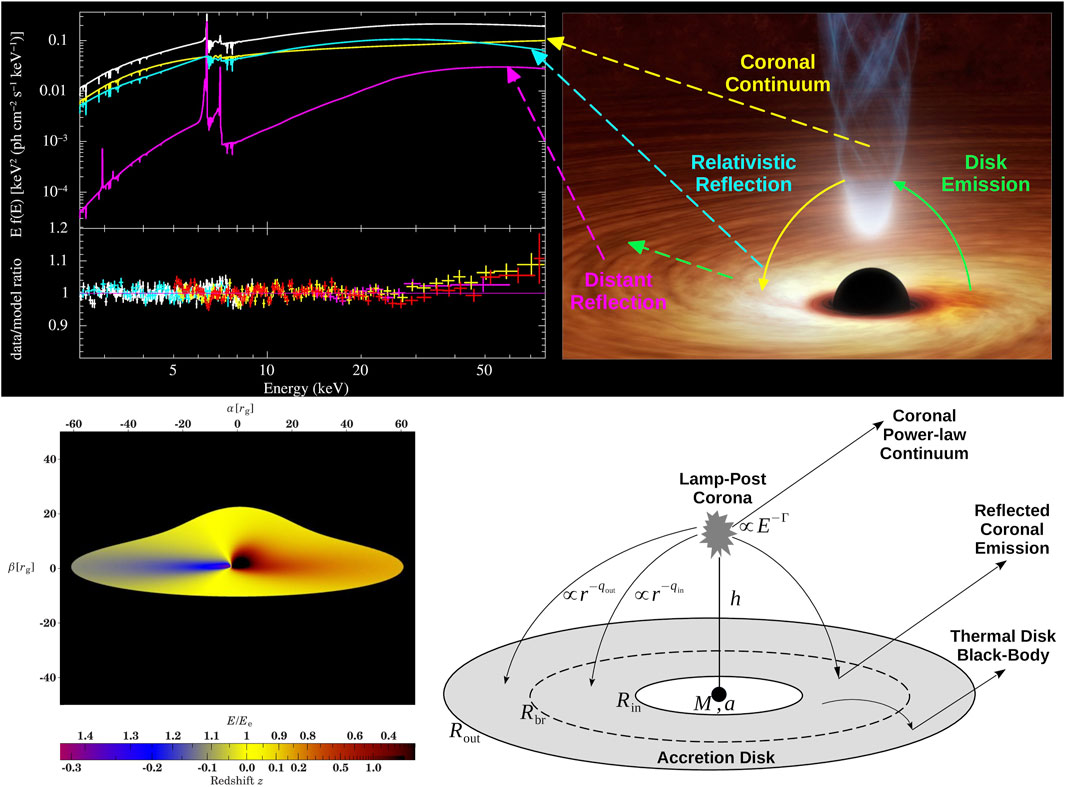
Figure 1. Top: A schematic view of X-ray relativistic reflection. Spectral model (left panel) of the Seyfert 1.5 galaxy NGC 4151, consisting of a coronal continuum (highecut
1.1 X-ray reflection spectroscopy
High-energy radiation from a corona or the base of a jet illuminates the accretion disk, reflecting scattered photons, which forms the basis of this method. Multiple Compton scatterings (Comptonization) of soft thermal photons lead to the cooling of the hot electrons in the corona (Haardt and Maraschi, 1991; 1993). A portion of the comptonized radiation undergoes scattering outside of the ionizing source, resulting in the formation of a power-law-shaped continuum that is typically observed in X-rays from AGN (Haardt and Maraschi, 1991). However, a fraction of the scattered photons will undergo reflection on the surface of the disk (Haardt and Maraschi, 1993), as seen in Figure 1 (top). If the disk is not fully ionized, the continuum includes the emission of various fluorescent emission lines at energies below 7 keV, in addition to the Compton hump with a peak at around 20–30 keV caused by downscattering, as seen in Figure 1 (top panel). The most notable line is Fe K
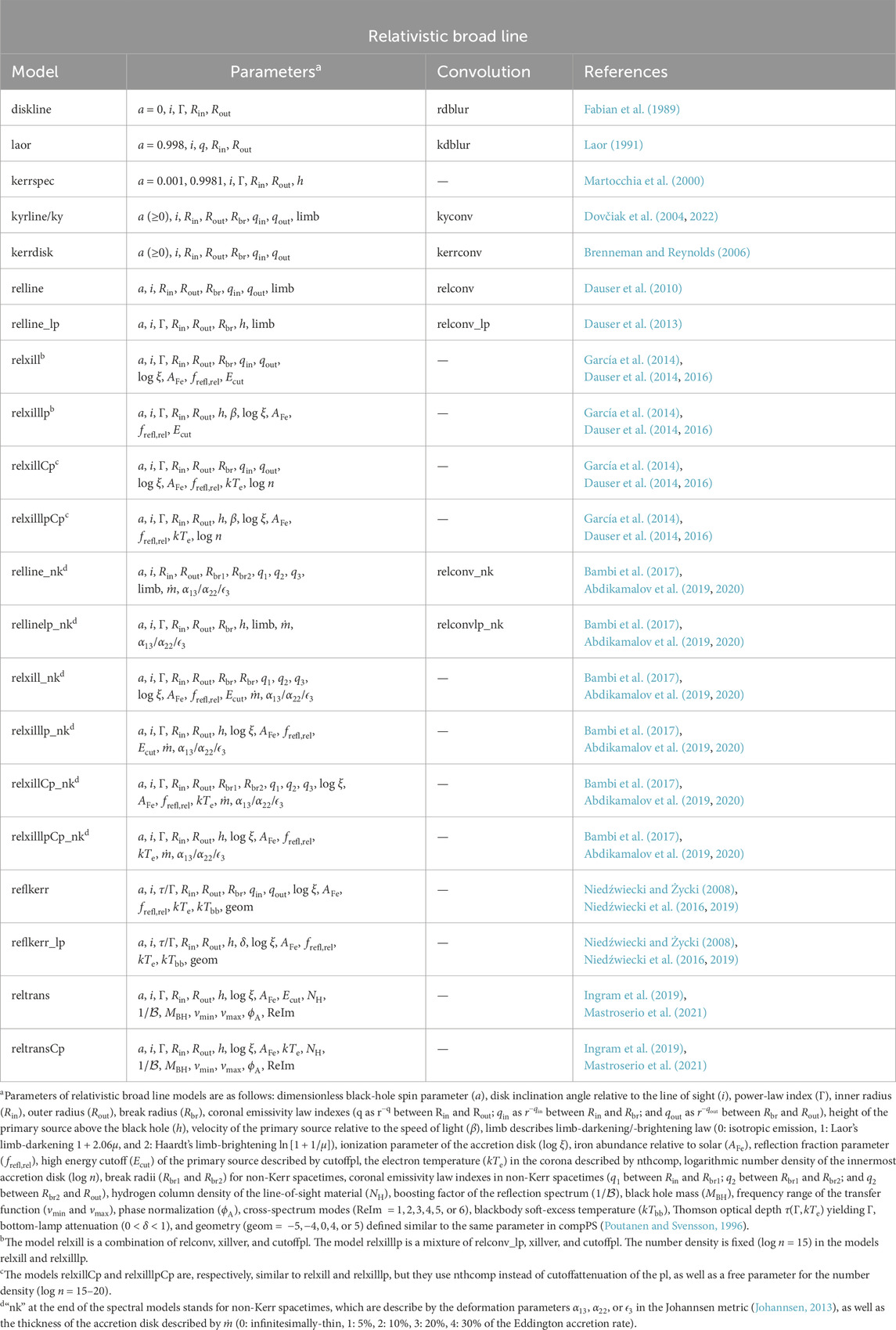
Table 1. A list of spectral models developed for relativistically broadened emission of the accretion disk.
1.2 Broad-band SED fitting
This method was initially began to be deployed for X-ray binaries by Zhang et al. (1997) and Gierliński et al. (2001). This approach depends on the distance, mass, and disk inclination angle of the accretion disk (see review by Remillard and McClintock, 2006), so it has mostly been used for the spin measurement of stellar-mass black holes (e.g., Shafee et al., 2006; McClintock et al., 2006). This method was first exploited by Done et al. (2013) to put constraints on the spins of SMBHs with the optxconv model (based on optxagnf; Done et al., 2012), which contains the SED spectrum made by a (color-temperature-corrected) blackbody, an optically thick warm Comptonisation (soft excess;
1.3 Radio event horizon imaging
This method employs sub-mm data collected by several very long baseline interferometry (VLBI) stations over different locations (e.g., JCMT, SMT, SPT, IRAM, APEX, and ALMA) to achieve micro-arcsecond spatial resolution images of an SMBH event horizon (Event Horizon Telescope Collaboration et al., 2019a; Event Horizon Telescope Collaboration et al., 2022a). This has enabled the first-ever images of the accretion flow in the vicinity of nearby SMBHs to be produced, namely M87 and Sgr A* (Event Horizon Telescope Collaboration et al., 2019b; Event Horizon Telescope Collaboration et al., 2022b). We can determine the SMBH spin by accurately modeling the appearance of accretion flows in VLBI images, accounting for general-relativistic light bending (see Figure 1 bottom-left) based on various characteristics such as the ISCO radius
2 Relativistic reflection modeling
Various spectral models have been constructed to reproduce the general-relativistic effects of the Kerr metric on the iron K
The early models, developed to analyze relativistic reflection, featured fiducial values for the spin parameter. Black hole spin measurement began with the diskline (Fabian et al., 1989) and laor (Laor, 1991) fixed-spin models, which were run with fiducial spin values of
The next-generation of relativistic reflection models has a free parameter for the positive spin rates, which allows for the determination of the black hole spin in prograde rotation
Since 2010, several spectral models have been developed for relativistic blurred emission (see Table 1) that incorporate both positive and negative spin values, enabling the measurement of the black hole’s spin in both the prograde and retrograde directions with respect to the accretion disk. To accommodate the full spin range
X-ray time-resolved observations of AGNs have shown variability in the relativistically blurred reflection (e.g., MCG–6-30-15; Fabian and Vaughan, 2003; Vaughan and Fabian, 2004; Larsson et al., 2007; Miller et al., 2008) that could be caused by general relativistic effects, particularly light bending near the black hole event horizon. Niedźwiecki and Życki (2008) and Niedźwiecki and Miyakawa (2010) investigated variability patterns of the red wing in X-ray reflection of the AGN in the Seyfert 1 galaxy MCG–6-30-15 using a detailed light-bending model (Miniutti and Fabian, 2004), which led to the development of the spectral model reflkerr and its corresponding lamp-post model reflkerr_lp (Niedźwiecki et al., 2016; Niedźwiecki et al., 2019).12 In particular, Niedźwiecki et al. (2016) identified some inconsistencies between reflkerr and relxilllp owing to the neglect of the general-relativistic redshift of the direct coronal radiation in relxilllp, though they found that the relxilllp model still produces acceptable results in weak-gravity in the energies below 80 keV. Moreover, the lamp-post model reflkerr_lp developed by Niedźwiecki et al. (2019) demonstrated a departure from relxilllp in the energies above 30 keV. Another model-family for spectral and timing variability in accreting black holes has been developed (Ingram et al., 2019; Mastroserio et al., 2021; 2022), named reltrans and reltransCp,13 which calculated the emergent reflection spectrum using xillver (or xillverCp in the case of reltransCp). The reltrans model considers all the general-relativistic effects to calculate the time delays and energy changes that occur when X-ray photons from the corona reflect from the accretion disk and scatter towards the observer. The calculations of reltrans incorporate both continuum lags and reverberation lags in a self-consistent manner to produce most of the practical X-ray variability time scales.
3 Variability in relativistic reflection from PCA
Principal component analysis (PCA; Hotelling, 1933),14 also referred to as the “Hotelling transform,” is a well-known method in multivariate statistics relying on eigenvalues and eigenvectors (see review by Jolliffe and Cadima, 2016) that has been extensively discussed in detail in the literature (e.g., Mardia et al., 1979; Jolliffe, 2002; Izenman, 2008; Rencher and Christensen, 2012). It bears a close relation to the “Kosambi–Karhunen–Loève transform” (Kosambi, 1943; Karhunen, 1947; Loève, 1948) in probability theory, and is among three classical techniques in multivariate analysis to determine the principal dimensions of large data, along with independent component analysis (ICA; Hérault and Ans, 1984; Hérault et al., 1985; Hérault and Jutten, 1986) and non-negative matrix factorization (NMF; Lee and Seung, 1999; Lee and Seung, 2000). PCA can be employed to separate various characteristics that are mostly responsible for complex variations in large data in astronomy (e.g., Wall and Jenkins, 2012; Ivezić et al., 2020) as well as to simplify complex data for machine learning approaches (e.g., Bishop, 2006; Müller and Guido, 2016; Witten et al., 2017; Géron, 2019). This is implemented by reducing the number of available data into a group of independent PCA components, which then provide information about the different levels of their contributions to the complexity of the entire data. Astronomers have extensively employed it as a practical multivariate method. The early application of this technique in astronomy (see review by Francis and Wills, 1999) can be traced back to some studies on spectral analyses of stars (Deeming, 1964; Whitney, 1983), galaxies (Faber, 1973; Bujarrabal et al., 1981; Efstathiou and Fall, 1984), and quasars (Mittaz et al., 1990; Francis et al., 1992; Boroson and Green, 1992). This approach was also employed for imaging analysis of the interstellar medium (Heyer and Schloerb, 1997; Brunt et al., 2009). It was later used for X-ray binaries (e.g., Malzac et al., 2006; Koljonen et al., 2013; Koljonen, 2015) and blazars (Gallant et al., 2018), and more recently for X-ray variability in symbiotic stars (Danehkar et al., 2024a) and starburst regions (Danehkar et al., 2024b). Especially, it has extensively been leveraged for X-ray data analysis of AGNs in Seyfert 1 galaxies (e.g., Vaughan and Fabian, 2004; Miller et al., 2008; Parker et al., 2014b; Gallo et al., 2015).
PCA can decompose time-resolved spectroscopic data into groups of PCA components and eigenvectors, yielding eigenvalues in the process. Normalized eigenvalues can yield the contribution of each eigenvector to the temporal evolution of the whole data over time. Each decomposed PCA component and eigenvector can be referred to as a principal spectrum with its corresponding light curve. The process of conducting PCA requires performing the decomposition of a matrix into its eigenvectors and eigenvalues. To analyze variability of a source in astronomy, this data matrix for PCA contains a set of spectroscopic data collected at
3.1 Singular value decomposition
The most common approach to obtaining the PCA components is the singular value decomposition (SVD; Beltrami, 1873; Jordan, 1874a; Jordan, 1874b; Sylvester, 1889a; Sylvester, 1889b; Sylvester, 1889c). The SVD of
where
3.2 Eigendecomposition
A classical way to determine the PCA components is through the eigenvalue decomposition (EVD; Cauchy, 1829a; Cauchy, 1829b)15 of the covariance matrix expressed as
which yields eigenvectors
Constructing the diagonal matrix
3.3 QR decomposition
Another faster method suitable for high-performance computing, which was proposed by Sharma et al. (2013) to conduct PCA, is performed using QR decomposition (Golub, 1965), also known as QR factorization (Golub and van Loan, 1996; Trefethen and Bau, 1997). In this approach,
Then, the SVD of
As demonstrated by Sharma et al. (2013), this leads to the same diagonal matrix and eigenvectors of Equation 3,
For a set of timing spectroscopic data stored in a data matrix, the PCA components
Vaughan and Fabian (2004) made initial attempts to conduct PCA on X-ray variability in AGN using low-spectral resolution data, suggesting that the X-ray variations in MCG–6-30-15 reported by Fabian and Vaughan (2003) are primarily due to a variable power-law component, with a small partial fraction likely originating from a reflection-dominated component. Later, Miller et al. (2007) employed SVD for PCA, resulting in the generation of exhaustive principal spectra of Mrk 766, which Turner et al. (2007) confirmed these spectral variations through time-resolved spectroscopy. Moreover, Miller et al. (2008) investigated the X-ray variability of MCG–6-30-15 using PCA, resulting in similar spectral components (absorbed, varying power-law) in MCG–6-30-15 and Mrk 766, with a less variable, heavily absorbed component characterizing the relativistically broadened red wing. PCA conducted by Parker et al. (2014a) and Parker et al. (2014b) demonstrated that SVD can successfully separate different spectral components responsible for the X-ray variability in AGNs by exploiting large archival data. In particular, Parker et al. (2014a) discovered that the X-ray variations in MCG–6-30-15 are mostly caused by only three spectral components (see Figure 2): the normalization factor of the power-law continuum (variability fraction of
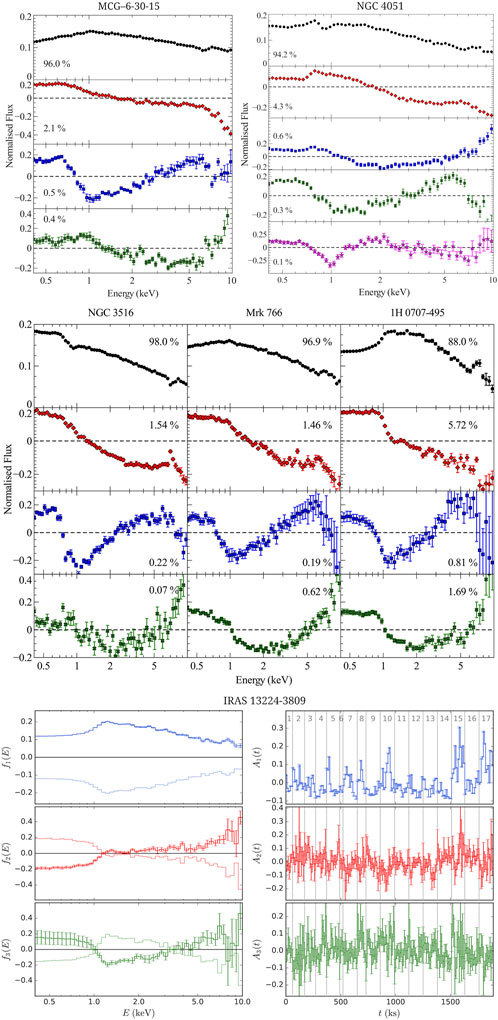
Figure 2. PCA spectra found in different AGNs hosted by nearby Seyfert 1 galaxies: MCG –6-30–15 (Parker et al., 2014a), NGC 4051, NGC 3516, Mrk 766, and 1H 0707-495 (Parker et al., 2015), with percentages of variability fractions, as well as PCA spectra
As seen in Figure 2, the third or/and fourth PCA components obtained by Parker et al. from X-ray observations of five AGNs (MCG –6-30–15, NGC 4051, NGC 3516, Mrk 766, and 1H 0707-495) resemble the relativistically broadened iron emission features shown in Figure 1 (top). Their normalized eigenvalues of
4 Future perspective: machine learning
SVD and PCA decomposition closely relate to the optimal solution for neural networks in auto-association mode (Bourlard and Kamp, 1988; Baldi and Hornik, 1989). As discussed by Hertz et al. (1991) in the context of unsupervised Hebbian learning, PCA can be used for dimensionality reduction of large data before proceeding with machine learning algorithms, such as artificial neural networks (ANNs). PCA can indeed alleviate the “curse of dimensionality” (coined by Bellman, 1957; Bellman, 1961), also known as the “Hughes phenomenon” (Hughes, 1968) or “peaking phenomenon” (Trunk, 1979), which often arises when searching for patterns in unknown large data. It has been extensively demonstrated in the literature that PCA can be utilized as a pre-processing step to simplify complex data prior to machine learning (e.g., Bishop, 2006), data mining (Witten et al., 2017), and deep learning (Goodfellow et al., 2017). Recently, Ivezić et al. (2020) also discussed in detail the applications of PCA, ICA, and NMF in dimensionality reduction for data mining and machine learning in astronomy.
Using PCA for the pre-processing of astronomical data enables a significant reduction in dimensionality and complexity of data, leading to an improvement in machine learning performance. The use of PCA to reduce the dimensionality of the data for training ANNs can be traced back to earlier efforts on the classification of galaxy spectra (Folkes et al., 1996; Lahav et al., 1996) and stellar spectra (Bailer-Jones et al., 1998; Singh et al., 1998). Later, Zhang and Zhao (2003) applied PCA to the multiwavelength data of AGNs, stars, and normal galaxies in order to reduce the dimensionality of the parameter space for support vector machines (SVM) and learning vector quantization (LVQ), two supervised classification algorithms in machine learning, resulting in the classification of stars, AGNs, and normal galaxies. PCA also reduced the complexity of image data for the morphological classification of galaxies with an ANN (de la Calleja and Fuentes, 2004). Moreover, Bu and Pan (2015) deployed PCA to pre-assemble stellar atmospheric parameters from spectra for Gaussian process regression (GPR) and then compared the results of GPR with those from ANNs, kernel regression (KR), and support-vector regression (SVR). Kuntzer et al. (2016) also conducted stellar classification from single-band images using pre-processed data from PCA to train ANNs to determine the spectral type. More recently, we see the application of PCA to construct input data for ANNs in stellar population synthesis modeling (Alsing et al., 2020), finding thermal components in X-ray spectra of the Perseus cluster (Rhea et al., 2020), and finally X-ray spectral analysis of AGN (Parker et al., 2022).
The avenue of automated spectral analysis with machine learning algorithms has not yet been fully explored for constraining the relativistically broadened iron emission in AGN, mostly because of the complicated variability seen in the X-rays over the course of observations. X-ray observations of AGNs have shown some X-ray changes in power-law continua, which were ascribed to so-called transient obscuration events caused by eclipsing material near the primary source, such as NGC 3783 (Mehdipour et al., 2017), NGC 3227 (Turner et al., 2018), and Mrk 335 (Longinotti et al., 2019; Parker et al., 2019), or flaring variations in the corona in the innermost central regions, e.g., PDS 456 (Matzeu et al., 2017; Reeves et al., 2021) and NGC 3516 (Mehdipour et al., 2022). This kind of change in X-rays over time, along with a relatively large number of parameters in relativistic reflection models (see Table 1), makes it much more complicated for machine learning algorithms to automatically determine the spins of SMBHs from the archival X-ray data. Nevertheless, as seen in Figure 2, the dimensionality reduction offered by PCA can avoid the curse of dimensionality in the X-ray data of AGNs. In the future, we will be able to use machine learning to automatically conduct the spin analysis of SMBHs in AGNs thanks to the principal spectra of relativistic reflection disentangled by PCA from X-ray observations.
Author contributions
AD: Writing–original draft, Writing–review and editing.
Funding
The author(s) declare that financial support was received for the research, authorship, and/or publication of this article. The author acknowledges financial support from the National Aeronautics and Space Administration (NASA) for an Astrophysics Data Analysis Program grant under no. 80NSSC22K0626.
Acknowledgments
The author would like to express his gratitude for the invitation to speak at the ‘Frontiers in Astronomy and Space Sciences: A Decade of Discovery and Advancement, 10th Anniversary Conference,’ as well as to the editor who requested a concise review of that presentation. The author thanks Michael Parker for permission to use figures from his publications and useful discussions; Javier García, Thomas Dauser, and Laura Brenneman for permission to use figures from their publications; and the reviewer for careful reading of the manuscript and constructive comments.
Conflict of interest
The author declares that the research was conducted in the absence of any commercial or financial relationships that could be construed as a potential conflict of interest.
Publisher’s note
All claims expressed in this article are solely those of the authors and do not necessarily represent those of their affiliated organizations, or those of the publisher, the editors and the reviewers. Any product that may be evaluated in this article, or claim that may be made by its manufacturer, is not guaranteed or endorsed by the publisher.
Supplementary material
The Supplementary Material for this article can be found online at: https://www.frontiersin.org/articles/10.3389/fspas.2024.1479301/full#supplementary-material
Footnotes
1https://heasarc.gsfc.nasa.gov/xanadu/xspec/
2https://space.mit.edu/cxc/isis/
3The Chandra X-Ray Center (CXC) is operated for NASA by the Smithsonian Astrophysical Observatory (SAO).
4https://cxc.cfa.harvard.edu/sherpa/
5Netherlands Institute for Space Research (Stichting Ruimteonderzoek Nederland; SRON) is a Dutch institute for astrophysical research.
6https://www.sron.nl/astrophysics-spex/
7https://pisrv1.am14.uni-tuebingen.de/∼speith/misc.html
8https://www.sternwarte.uni-erlangen.de/∼dauser/research/relxill/
9https://sites.srl.caltech.edu/∼javier/xillver/
10https://www.tat.physik.uni-tuebingen.de/∼nampalliwar/relxill_nk/
11https://github.com/ABHModels/relxill_nk, doi:10.5281/zenodo.13906295
12https://users.camk.edu.pl/mitsza/reflkerr/
13https://adingram.bitbucket.io/reltrans.html
14It was first innovated by Pearson (1901) in the context of principal axes of ellipsoids in geometry, but it was independently developed and called the method of principal components by Hotelling (1933) for statistical analysis.
15For a historical review, see Hawkins (1975).
16Based on the fast that
17https://www.michaelparker.space/pca-code
18https://github.com/xuquanfeng/qrpca
19https://github.com/RafaelSdeSouza/qrpca
References
Abdikamalov, A. B., Ayzenberg, D., Bambi, C., Dauser, T., García, J. A., and Nampalliwar, S. (2019). Public release of relxill_NK: a relativistic reflection model for testing einstein’s gravity. Astrophys. J. 878, 91. doi:10.3847/1538-4357/ab1f89
Abdikamalov, A. B., Ayzenberg, D., Bambi, C., Dauser, T., García, J. A., Nampalliwar, S., et al. (2020). Testing the Kerr black hole hypothesis using X-ray reflection spectroscopy and a thin disk model with finite thickness. Astrophys. J. 899, 80. doi:10.3847/1538-4357/aba625
Abdikamalov, A. B., Ayzenberg, D., Bambi, C., Liu, H., and Tripathi, A. (2021a). A reflection model with a radial disk density profile. Astrophys. J. 923, 175. doi:10.3847/1538-4357/ac3237
Abdikamalov, A. B., Ayzenberg, D., Bambi, C., Liu, H., and Zhang, Y. (2021b). Implementation of a radial disk ionization profile in the relxill_nk model. Phys. Rev. D. 103, 103023. doi:10.1103/PhysRevD.103.103023
Alsing, J., Peiris, H., Leja, J., Hahn, C., Tojeiro, R., Mortlock, D., et al. (2020). SPECULATOR: emulating stellar population synthesis for fast and accurate galaxy spectra and photometry. Astrophys. J. Suppl. 249, 5. doi:10.3847/1538-4365/ab917f
Arnaud, K., Dorman, B., and Gordon, C. (1999). XSPEC: an X-ray spectral fitting package. Astrophys. Source Code Libr. Rec. ascl:9910.005.
Arnaud, K. A. (1996). “XSPEC: the first ten years. In astronomical data analysis Software and systems V,”. ASP, vol. 101 of astronomical Society of the pacific conf. Ser. Editors G. H. Jacoby, and J. Barnes (San Francisco, CA), 17.
Bailer-Jones, C. A. L., Irwin, M., and von Hippel, T. (1998). Automated classification of stellar spectra - II. Two-dimensional classification with neural networks and principal components analysis. Mon. Not. R. Astron. Soc. 298, 361–377. doi:10.1046/j.1365-8711.1998.01596.x
Baldi, P., and Hornik, K. (1989). Neural networks and principal component analysis: learning from examples without local minima. Neural Netw. 2, 53–58. doi:10.1016/0893-6080(89)90014-2
Bambi, C. (2017). Testing black hole candidates with electromagnetic radiation. Rev. Mod. Phys. 89, 025001. doi:10.1103/RevModPhys.89.025001
Bambi, C., Brenneman, L. W., Dauser, T., García, J. A., Grinberg, V., Ingram, A., et al. (2021). Towards precision measurements of accreting black holes using X-ray reflection spectroscopy. Space Sci. Rev. 217, 65. doi:10.1007/s11214-021-00841-8
Bambi, C., Cárdenas-Avendaño, A., Dauser, T., García, J. A., and Nampalliwar, S. (2017). Testing the Kerr black hole hypothesis using X-ray reflection spectroscopy. Astrophys. J. 842, 76. doi:10.3847/1538-4357/aa74c0
Bardeen, J. M., Press, W. H., and Teukolsky, S. A. (1972). Rotating black holes: locally nonrotating frames, energy extraction, and scalar synchrotron radiation. Astrophys. J. 178, 347–370. doi:10.1086/151796
Bentz, M. C., and Katz, S. (2015). The AGN black hole mass database. Publ. Astron. Soc. Pac. 127, 67–73. doi:10.1086/679601
Berti, E., and Volonteri, M. (2008). Cosmological black hole spin evolution by mergers and accretion. Astrophys. J. 684, 822–828. doi:10.1086/590379
Blandford, R., Meier, D., and Readhead, A. (2019). Relativistic jets from active galactic nuclei. Ann. Rev. Astron. Astrophys. 57, 467–509. doi:10.1146/annurev-astro-081817-051948
Blandford, R. D., and McKee, C. F. (1982). Reverberation mapping of the emission line regions of Seyfert galaxies and quasars. Astrophys. J. 255, 419–439. doi:10.1086/159843
Blandford, R. D., and Payne, D. G. (1982). Hydromagnetic flows from accretion discs and the production of radio jets. Mon. Not. R. Astron. Soc. 199, 883–903. doi:10.1093/mnras/199.4.883
Blandford, R. D., and Znajek, R. L. (1977). Electromagnetic extraction of energy from Kerr black holes. Mon. Not. R. Astron. Soc. 179, 433–456. doi:10.1093/mnras/179.3.433
Boissay-Malaquin, R., Danehkar, A., Marshall, H. L., and Nowak, M. A. (2019). Relativistic components of the ultra-fast outflow in the quasar PDS 456 from Chandra/HETGS, NuSTAR, and XMM-Newton observations. Astrophys. J. 873, 29. doi:10.3847/1538-4357/ab0082
Boroson, T. A., and Green, R. F. (1992). The emission-line properties of low-redshift quasi-stellar objects. Astrophys. J. Suppl. 80, 109. doi:10.1086/191661
Bourlard, H., and Kamp, Y. (1988). Auto-association by multilayer perceptrons and singular value decomposition. Biol. Cybern. 59, 291–294. doi:10.1007/BF00332918
Bower, G. C., Broderick, A., Dexter, J., Doeleman, S., Falcke, H., Fish, V., et al. (2018). ALMA polarimetry of Sgr A*: probing the accretion flow from the event horizon to the bondi radius. Astrophys. J. 868, 101. doi:10.3847/1538-4357/aae983
Bower, G. C., Falcke, H., Sault, R. J., and Backer, D. C. (2002). The spectrum and variability of circular polarization in Sagittarius A* from 1.4 to 15 GHz. Astrophys. J. 571, 843–855. doi:10.1086/340064
Boyer, R. H., and Lindquist, R. W. (1967). Maximal analytic extension of the Kerr metric. J. Math. Phys. 8, 265–281. doi:10.1063/1.1705193
Brenneman, L. (2013). Measuring the angular momentum of supermassive black holes. New York: Springer. doi:10.1007/978-1-4614-7771-6
Brenneman, L. W. (2007). A spectral survey of black hole spin in active galactic nuclei. College Park: University of Maryland Ph.D. thesis.
Brenneman, L. W., and Reynolds, C. S. (2006). Constraining black hole spin via X-ray spectroscopy. Astrophys. J. 652, 1028–1043. doi:10.1086/508146
Broderick, A. E., Loeb, A., and Narayan, R. (2009). The event horizon of Sagittarius A. Astrophys. J. 701, 1357–1366. doi:10.1088/0004-637X/701/2/1357
Broderick, A. E., and Narayan, R. (2006). On the nature of the compact dark mass at the galactic center. Astrophys. J. Lett. 638, L21–L24. doi:10.1086/500930
Brunt, C. M., Heyer, M. H., and Mac Low, M. M. (2009). Turbulent driving scales in molecular clouds. Astron. Astrophys. 504, 883–890. doi:10.1051/0004-6361/200911797
Bu, Y., and Pan, J. (2015). Stellar atmospheric parameter estimation using Gaussian process regression. Mon. Not. R. Astron. Soc. 447, 256–265. doi:10.1093/mnras/stu2063
Bujarrabal, V., Guibert, J., and Balkowski, C. (1981). Multidimensional statistical analysis of normal galaxies. Astron. Astrophys. 104, 1–9.
Calderone, G., Ghisellini, G., Colpi, M., and Dotti, M. (2013). Black hole mass estimate for a sample of radio-loud narrow-line Seyfert 1 galaxies. Mon. Not. R. Astron. Soc. 431, 210–239. doi:10.1093/mnras/stt157
Campitiello, S., Ghisellini, G., Sbarrato, T., and Calderone, G. (2018). How to constrain mass and spin of supermassive black holes through their disk emission. Astron. Astrophys. 612, A59. doi:10.1051/0004-6361/201731897
Capellupo, D. M., Netzer, H., Lira, P., Trakhtenbrot, B., and Mejía-Restrepo, J. (2015). Active galactic nuclei at z 1.5 - I. Spectral energy distribution and accretion discs. Mon. Not. R. Astron. Soc. 446, 3427–3446. doi:10.1093/mnras/stu2266
Capellupo, D. M., Netzer, H., Lira, P., Trakhtenbrot, B., and Mejía-Restrepo, J. (2016). Active galactic nuclei at z 1.5 - III. Accretion discs and black hole spin. Mon. Not. R. Astron. Soc. 460, 212–226. doi:10.1093/mnras/stw937
Capellupo, D. M., Wafflard-Fernandez, G., and Haggard, D. (2017). A comparison of two methods for estimating black hole spin in active galactic nuclei. Astrophys. J. Lett. 836, L8. doi:10.3847/2041-8213/aa5cac
Cauchy, A.-L. (1829a). Sur l’équation à l’aide de laquelle on détermine les inégalités séculaires des mouvements des planètes. Exer. math. 4, 174–195.
Cauchy, A.-L. (1829b). Sur l’équation à l’aide de laquelle on détermine les inégalités séculaires des mouvements des planètes. Oeuvres Complètes (IIème Série) 9, 174–195. doi:10.1017/CBO9780511702686.009
Cretton, N., and van den Bosch, F. C. (1999). Evidence for a massive black hole in the S0 galaxy NGC 4342. Astrophys. J. 514, 704–724. doi:10.1086/306971
Cunningham, C. T. (1975). The effects of redshifts and focusing on the spectrum of an accretion disk around a Kerr black hole. Astrophys. J. 202, 788–802. doi:10.1086/154033
Danehkar, A. (2020). Gravitational fields of the magnetic-type. Int. J. Mod. Phys. D. 29, 2043001. doi:10.1142/S0218271820430014
Danehkar, A., Drake, J. J., and Luna, G. J. M. (2024a). X-ray variability in the symbiotic binary RT Cru: principal component analysis. Astrophys. J. 972, 109. doi:10.3847/1538-4357/ad5cf6
Danehkar, A., Nowak, M. A., Lee, J. C., Kriss, G. A., Young, A. J., Hardcastle, M. J., et al. (2018). The ultra-fast outflow of the quasar PG 1211+143 as viewed by time-averaged Chandra grating spectroscopy. Astrophys. J. 853, 165. doi:10.3847/1538-4357/aaa427
Danehkar, A., Silich, S., Herenz, E. C., and Östlin, G. (2024b). Disentangling the X-ray variability in the Lyman continuum emitter Haro 11. Astron. Astrophys. 689, A333. doi:10.1051/0004-6361/202449388
Dauser, T. (2010). Theoretical modeling of broad emission lines. Germany: Friedrich Alexander University of Erlangen-Nuremberg. Master’s thesis.
Dauser, T. (2014). Relativistic reflection around black holes: theory and observation. Germany: Friedrich Alexander University of Erlangen-Nuremberg. Ph.D. thesis.
Dauser, T., Garcia, J., Parker, M. L., Fabian, A. C., and Wilms, J. (2014). The role of the reflection fraction in constraining black hole spin. Mon. Not. R. Astron. Soc. 444, L100–L104. doi:10.1093/mnrasl/slu125
Dauser, T., García, J., Walton, D. J., Eikmann, W., Kallman, T., McClintock, J., et al. (2016). Normalizing a relativistic model of X-ray reflection. Definition of the reflection fraction and its implementation in relxill. Astron. Astrophys. 590, A76. doi:10.1051/0004-6361/201628135
Dauser, T., Garcia, J., Wilms, J., Böck, M., Brenneman, L. W., Falanga, M., et al. (2013). Irradiation of an accretion disc by a jet: general properties and implications for spin measurements of black holes. Mon. Not. R. Astron. Soc. 430, 1694–1708. doi:10.1093/mnras/sts710
Dauser, T., García, J. A., Joyce, A., Licklederer, S., Connors, R. M. T., Ingram, A., et al. (2022). The effect of returning radiation on relativistic reflection. Mon. Not. R. Astron. Soc. 514, 3965–3983. doi:10.1093/mnras/stac1593
Dauser, T., Wilms, J., Reynolds, C. S., and Brenneman, L. W. (2010). Broad emission lines for a negatively spinning black hole. Mon. Not. R. Astron. Soc. 409, 1534–1540. doi:10.1111/j.1365-2966.2010.17393.x
Deeming, T. J. (1964). Stellar spectral classification. I. Application of component analysis. Mon. Not. R. Astron. Soc. 127, 493–516. doi:10.1093/mnras/127.6.493
de la Calleja, J., and Fuentes, O. (2004). Machine learning and image analysis for morphological galaxy classification. Mon. Not. R. Astron. Soc. 349, 87–93. doi:10.1111/j.1365-2966.2004.07442.x
de La Calle Pérez, I., Longinotti, A. L., Guainazzi, M., Bianchi, S., Dovčiak, M., Cappi, M., et al. (2010). FERO: finding extreme relativistic objects: I. Statistics of relativistic Fe Kαlines in radio-quiet Type 1 AGN⋆. Astron. Astrophys. 524, A50. doi:10.1051/0004-6361/200913798
de Plaa, J., Kaastra, J. S., Gu, L., Mao, J., and Raassen, T. (2020). SPEX: high-resolution spectral modeling and fitting for X-ray astronomy. In astronomical data analysis software and systems XXIX, 527. Editors R. Pizzo, E. R. Deul, J. D. Mol, J. de Plaa, and H. Verkouter (San Francisco, CA: ASP), Astronomical Society of the Pacific Conf. Ser. 725. doi:10.48550/arXiv.1912.07897
de Souza, R. S., Quanfeng, X., Shen, S., Peng, C., and Mu, Z. (2022a). qrpca: a package for fast principal component analysis with GPU acceleration. Astron. Comput. 41, 100633. doi:10.1016/j.ascom.2022.100633
de Souza, R. S., Quanfeng, X., Shen, S., Peng, C., and Mu, Z.(2022b). qrpca: QR-based Principal Components Analysis. Astrophys. Source Code Libr. Rec. ascl:2208.002.
Di Matteo, T., Springel, V., and Hernquist, L. (2005). Energy input from quasars regulates the growth and activity of black holes and their host galaxies. Nature 433, 604–607. doi:10.1038/nature03335
Doe, S., Nguyen, D., Stawarz, C., Refsdal, B., Siemiginowska, A., Burke, D., et al. (2007). Developing Sherpa with Python. In astronomical data analysis software and systems XVI. Editors R. A. Shaw, F. Hill, and D. J. Bell (San Francisco, CA: ASP), 376. Astronomical Society of the Pacific Conf. Ser., 543.
Done, C., Davis, S. W., Jin, C., Blaes, O., and Ward, M. (2012). Intrinsic disc emission and the soft X-ray excess in active galactic nuclei. Mon. Not. R. Astron. Soc. 420, 1848–1860. doi:10.1111/j.1365-2966.2011.19779.x
Done, C., Jin, C., Middleton, M., and Ward, M. (2013). A new way to measure supermassive black hole spin in accretion disc-dominated active galaxies. Mon. Not. R. Astron. Soc. 434, 1955–1963. doi:10.1093/mnras/stt1138
Dovčiak, M. (2004). Radiation of accretion discs in strong gravity. Prague: Charles University. Ph.D. thesis.
Dovčiak, M., Karas, V., and Yaqoob, T. (2004). An extended scheme for fitting X-ray data with accretion disk spectra in the strong gravity regime. Astrophys. J. Suppl. 153, 205–221. doi:10.1086/421115
Dovčiak, M., Papadakis, I. E., Kammoun, E. S., and Zhang, W. (2022). Physical model for the broadband energy spectrum of X-ray illuminated accretion discs: fitting the spectral energy distribution of NGC 5548. Astron. Astrophys. 661, A135. doi:10.1051/0004-6361/202142358
Efstathiou, G., and Fall, S. M. (1984). Multivariate analysis of elliptical galaxies. Mon. Not. R. Astron. Soc. 206, 453–464. doi:10.1093/mnras/206.3.453
Event Horizon Telescope CollaborationAkiyama, K., Alberdi, A., Alef, W., Asada, K., Azulay, R., et al. (2019a). First M87 event horizon telescope results. I. The shadow of the supermassive black hole. Astrophys. J. Lett. 875, L1. doi:10.3847/2041-8213/ab0ec7
Event Horizon Telescope Collaboration Akiyama, K., Alberdi, A., Alef, W., Asada, K., Azulay, R., et al. (2019b). First M87 event horizon telescope results. IV. Imaging the central supermassive black hole. Astrophys. J. Lett. 875, L4. doi:10.3847/2041-8213/ab0e85
Event Horizon Telescope Collaboration Akiyama, K., Alberdi, A., Alef, W., Asada, K., Azulay, R., et al. (2019c). First M87 event horizon telescope results. V. Physical origin of the asymmetric ring. Astrophys. J. Lett. 875, L5. doi:10.3847/2041-8213/ab0f43
Event Horizon Telescope Collaboration Akiyama, K., Algaba, J. C., Alberdi, A., Alef, W., Anantua, R., et al. (2021a). First M87 event horizon telescope results. VII. Polarization of the ring. Astrophys. J. Lett. 910, L12. doi:10.3847/2041-8213/abe71d
Event Horizon Telescope Collaboration Akiyama, K., Algaba, J. C., Alberdi, A., Alef, W., Anantua, R., et al. (2021b). First M87 event horizon telescope results. VIII. Magnetic field structure near the event horizon. Astrophys. J. Lett. 910, L13. doi:10.3847/2041-8213/abe4de
Event Horizon Telescope Collaboration Akiyama, K., Alberdi, A., Alef, W., Algaba, J. C., Anantua, R., et al. (2022a). First Sagittarius A* event horizon telescope results. I. The shadow of the supermassive black hole in the center of the Milky way. Astrophys. J. Lett. 930, L12. doi:10.3847/2041-8213/ac6674
Event Horizon Telescope Collaboration Akiyama, K., Alberdi, A., Alef, W., Algaba, J. C., Anantua, R., et al. (2022b). First Sagittarius A* event horizon telescope results. III. Imaging of the galactic center supermassive black hole. Astrophys. J. Lett. 930, L14. doi:10.3847/2041-8213/ac6429
Event Horizon Telescope Collaboration Akiyama, K., Alberdi, A., Alef, W., Algaba, J. C., Anantua, R., et al. (2022c). First Sagittarius A* event horizon telescope results. V. Testing astrophysical models of the galactic center black hole. Astrophys. J. Lett. 930, L16. doi:10.3847/2041-8213/ac6672
Event Horizon Telescope Collaboration Akiyama, K., Alberdi, A., Alef, W., Algaba, J. C., Anantua, R., et al. (2022d). First Sagittarius A* event horizon telescope results. VI. Testing the black hole metric. Astrophys. J. Lett. 930, L17. doi:10.3847/2041-8213/ac6756
Event Horizon Telescope Collaboration Akiyama, K., Alberdi, A., Alef, W., Algaba, J. C., Anantua, R., et al. (2023). First M87 event horizon telescope results. IX. Detection of near-horizon circular polarization. Astrophys. J. Lett. 957, L20. doi:10.3847/2041-8213/acff70
Event Horizon Telescope Collaboration Akiyama, K., Alberdi, A., Alef, W., Algaba, J. C., Anantua, R., et al. (2024a). First Sagittarius A* event horizon telescope results. VII. Polarization of the ring. Astrophys. J. Lett. 964, L25. doi:10.3847/2041-8213/ad2df0
Event Horizon Telescope Collaboration Akiyama, K., Alberdi, A., Alef, W., Algaba, J. C., Anantua, R., et al. (2024b). First Sagittarius A* event horizon telescope results. VIII. Physical interpretation of the polarized ring. Astrophys. J. Lett. 964, L26. doi:10.3847/2041-8213/ad2df1
Faber, S. M. (1973). Variations in spectral-energy distributions and absorption-line strengths among elliptical galaxies. Astrophys. J. 179, 731–754. doi:10.1086/151912
Fabian, A. C., Rees, M. J., Stella, L., and White, N. E. (1989). X-ray fluorescence from the inner disc in Cygnus X-1. Mon. Not. R. Astron. Soc. 238, 729–736. doi:10.1093/mnras/238.3.729
Fabian, A. C., and Vaughan, S. (2003). The iron line in MCG-6-30-15 from XMM-Newton: evidence for gravitational light bending? Mon. Not. R. Astron. Soc. 340, L28–L32. doi:10.1046/j.1365-8711.2003.06465.x
Falbel, D., and Luraschi, J. (2022). Torch: tensors and neural networks with ’GPU’ acceleration. Available at: https://torch.mlverse.org/docshttps://github.com/mlverse/torch
Ferrarese, L., and Merritt, D. (2000). A fundamental relation between supermassive black holes and their host galaxies. Astrophys. J. Lett. 539, L9–L12. doi:10.1086/312838
Folkes, S. R., Lahav, O., and Maddox, S. J. (1996). An artificial neural network approach to the classification of galaxy spectra. Mon. Not. R. Astron. Soc. 283, 651–665. doi:10.1093/mnras/283.2.651
Francis, P. J., Hewett, P. C., Foltz, C. B., and Chaffee, F. H. (1992). An objective classification scheme for QSO spectra. Astrophys. J. 398, 476. doi:10.1086/171870
Francis, P. J., and Wills, B. J. (1999). “Introduction to principal components analysis,” in Quasars and cosmology. Editors G. Ferland, and J. Baldwin, 363. doi:10.48550/arXiv.astro-ph/9905079
Freeman, P., Doe, S., and Siemiginowska, A. (2001). “Sherpa: a mission-independent data analysis application,” in Astronomical Data Analysis (Bellingham: SPIE), 4477 proc. SPIE conf. Ser. Editors J.-L. Starck, and F. D. Murtagh, 76–87. doi:10.1117/12.447161
Fruscione, A., McDowell, J. C., Allen, G. E., Brickhouse, N. S., Burke, D. J., Davis, J. E., et al. (2006). . “CIAO: Chandra’s data analysis system,” in Observatory Operations: Strategies, Processes, and Systems, Editors D. R. Silva, and R. E. Doxsey (Bellingham: SPIE), vol. 6270 of Proc. SPIE Conf. Ser., 62701V. doi:10.1117/12.671760
Gallant, D., Gallo, L. C., and Parker, M. L. (2018). X-ray spectral variability of blazars using principal component analysis. Mon. Not. R. Astron. Soc. 480, 1999–2010. doi:10.1093/mnras/sty1987
Gallo, L. C., Wilkins, D. R., Bonson, K., Chiang, C. Y., Grupe, D., Parker, M. L., et al. (2015). Suzaku observations of Mrk 335: confronting partial covering and relativistic reflection. Mon. Not. R. Astron. Soc. 446, 633–650. doi:10.1093/mnras/stu2108
García, J., Dauser, T., Lohfink, A., Kallman, T. R., Steiner, J. F., McClintock, J. E., et al. (2014). Improved reflection models of black hole accretion disks: treating the angular distribution of X-rays. Astrophys. J. 782, 76. doi:10.1088/0004-637X/782/2/76
García, J., Dauser, T., Reynolds, C. S., Kallman, T. R., McClintock, J. E., Wilms, J., et al. (2013). X-ray reflected spectra from accretion disk models. III. A complete grid of ionized reflection calculations. Astrophys. J. 768, 146. doi:10.1088/0004-637X/768/2/146
García, J., and Kallman, T. R. (2010). X-Ray reflected spectra from accretion disk models. I. Constant density atmospheres. Astrophys. J. 718, 695–706. doi:10.1088/0004-637X/718/2/695
García, J., Kallman, T. R., and Mushotzky, R. F. (2011). X-Ray reflected spectra from accretion disk models. II. Diagnostic tools for X-ray observations. Astrophys. J. 731, 131. doi:10.1088/0004-637X/731/2/131
García, J. A. (2010). Modeling high-resolution spectra from x-ray illuminated accretion disks. Washington DC: Catholic University. Ph.D. thesis.
García, J. A., Dauser, T., Ludlam, R., Parker, M., Fabian, A., Harrison, F. A., et al. (2022). Relativistic X-ray reflection models for accreting neutron stars. Astrophys. J. 926, 13. doi:10.3847/1538-4357/ac3cb7
Garofalo, D., Evans, D. A., and Sambruna, R. M. (2010). The evolution of radio-loud active galactic nuclei as a function of black hole spin. Mon. Not. R. Astron. Soc. 406, 975–986. doi:10.1111/j.1365-2966.2010.16797.x
Géron, A. (2019). Hands-on machine learning with scikit-learn, keras, and TensorFlow: concepts, tools, and techniques to build intelligent systems. (Sebastopol, CA: O’Reilly).
Ghez, A. M., Klein, B. L., Morris, M., and Becklin, E. E. (1998). High proper-motion stars in the vicinity of Sagittarius A*: evidence for a supermassive black hole at the center of our galaxy. Astrophys. J. 509, 678–686. doi:10.1086/306528
Ghez, A. M., Salim, S., Hornstein, S. D., Tanner, A., Lu, J. R., Morris, M., et al. (2005). Stellar orbits around the galactic center black hole. Astrophys. J. 620, 744–757. doi:10.1086/427175
Gierliński, M., Maciołek-Niedźwiecki, A., and Ebisawa, K. (2001). Application of a relativistic accretion disc model to X-ray spectra of LMC X-1 and GRO J1655-40. Mon. Not. R. Astron. Soc. 325, 1253–1265. doi:10.1046/j.1365-8711.2001.04540.x
Golub, G. (1965). Numerical methods for solving linear least squares problems. Numer. Math. 7, 206–216. doi:10.1007/BF01436075
Golub, G. H., and van Loan, C. F. (1996). Matrix computations. 3rd edn. Baltimore: Johns Hopkins Univ. Press.
GRAVITY Collaboration Abuter, R., Amorim, A., Bauböck, M., Berger, J. P., Bonnet, H., et al. (2018). Detection of orbital motions near the last stable circular orbit of the massive black hole SgrA. Astron. Astrophys. 618, L10. doi:10.1051/0004-6361/201834294
GRAVITY Collaboration Jiménez-Rosales, A., Dexter, J., Widmann, F., Bauböck, M., Abuter, R., et al. (2020). Dynamically important magnetic fields near the event horizon of Sgr A. Astron. Astrophys. 643, A56. doi:10.1051/0004-6361/202038283
Guainazzi, M., Bianchi, S., and Dovčiak, M. (2006). Statistics of relativistically broadened Fe Kα lines in AGN. Astron. Nachr. 327, 1032–1038. doi:10.1002/asna.200610687
Haardt, F. (1993). Anisotropic comptonization in thermal plasmas: spectral distribution in plane-parallel geometry. Astrophys. J. 413, 680. doi:10.1086/173036
Haardt, F., and Maraschi, L. (1991). A two-phase model for the X-ray emission from Seyfert galaxies. Astrophys. J. Lett. 380, L51. doi:10.1086/186171
Haardt, F., and Maraschi, L. (1993). X-ray spectra from two-phase accretion disks. Astrophys. J. 413, 507. doi:10.1086/173020
Hagen, S., and Done, C. (2023). Estimating black hole spin from AGN SED fitting: the impact of general-relativistic ray tracing. Mon. Not. R. Astron. Soc. 525, 3455–3467. doi:10.1093/mnras/stad2499
Häring, N., and Rix, H.-W. (2004). On the black hole mass-bulge mass relation. Astrophys. J. Lett. 604, L89–L92. doi:10.1086/383567
Harris, C. R., Millman, K. J., van der Walt, S. J., Gommers, R., Virtanen, P., Cournapeau, D., et al. (2020). Array programming with NumPy. Nature 585, 357–362. doi:10.1038/s41586-020-2649-2
Harrison, F. A., Craig, W. W., Christensen, F. E., Hailey, C. J., Zhang, W. W., Boggs, S. E., et al. (2013). The nuclear spectroscopic telescope Array (NuSTAR) high-energy X-ray mission. Astrophys. J. 770, 103. doi:10.1088/0004-637X/770/2/103
Hawkins, T. (1975). Cauchy and the spectral theory of matrices. Hist. Math. 2, 1–29. doi:10.1016/0315-0860(75)90032-4
Heckman, T. M., and Best, P. N. (2014). The coevolution of galaxies and supermassive black holes: insights from surveys of the contemporary universe. Ann. Rev. Astron. Astrophys. 52, 589–660. doi:10.1146/annurev-astro-081913-035722
Hérault, J., and Ans, B. (1984). Neuronal network with modifiable synapses: decoding of composite sensory messages under unsupervised and permanent learning. C.R. Acad. Sci. Paris 299, 525–528.
Hérault, J., and Jutten, C. (1986). Space or time adaptive signal processing by neural network models. AIP Conf. Proc. 151, 206–211. doi:10.1063/1.36258
Hérault, J., Jutten, C., and Ans, B. (1985). Détection de grandeurs primitives dans un message composite par une architecture de calcul neuromimétique en apprentissage non supervisé. Actes Du. Xème Colloq. (Nice, France: GRETSI) 2, 1017–1020.
Hertz, J., Krogh, A., and Palmer, R. G. (1991). Introduction to the theory of neural computation. Redwood City, CA: Addison-Wesley.
Heyer, M. H., and Schloerb, F. P. (1997). Application of principal component analysis to large-scale spectral line imaging studies of the interstellar medium. Astrophys. J. 475, 173–187. doi:10.1086/303514
Hoormann, J. K., Beheshtipour, B., and Krawczynski, H. (2016). Testing general relativity’s no-hair theorem with x-ray observations of black holes. Phys. Rev. D. 93, 044020. doi:10.1103/PhysRevD.93.044020
Hotelling, H. (1933). Analysis of a complex of statistical variables into principal components. J. Educ. Psychol. 24, 417–441. doi:10.1037/h0071325
Houck, J. C., and Denicola, L. A. (2000). “ISIS: an interactive spectral interpretation System for high resolution X-ray spectroscopy,” In Astronomical Data Analysis Software and Systems IX (San Francisco, CA: ASP) vol. 216 of astronomical Society of the pacific conf. Ser. Editors N. Manset, C. Veillet, and D. Crabtree, 591.
Hughes, G. (1968). On the mean accuracy of statistical pattern recognizers. IEEE Trans. Inf. Theory 14, 55–63. doi:10.1109/TIT.1968.1054102
Hughes, S. A., and Blandford, R. D. (2003). Black hole mass and spin coevolution by mergers. Astrophys. J. Lett. 585, L101–L104. doi:10.1086/375495
Ingram, A., Mastroserio, G., Dauser, T., Hovenkamp, P., van der Klis, M., and García, J. A. (2019). A public relativistic transfer function model for X-ray reverberation mapping of accreting black holes. Mon. Not. R. Astron. Soc. 488, 324–347. doi:10.1093/mnras/stz1720
Ivezić, Ž., Connolly, A. J., VanderPlas, J. T., and Gray, A. (2020). Statistics, data mining, and machine learning in astronomy: a practical Python guide for the analysis of survey data. Princeton: Princeton Univ. Press. doi:10.1515/9780691197050
Izenman, A. J. (2008). Modern multivariate statistical techniques: regression, classification, and manifold learning. Berlin: Springer. doi:10.1007/978-0-387-78189-1
Johannsen, T. (2013). Regular black hole metric with three constants of motion. Phys. Rev. D. 88, 044002. doi:10.1103/PhysRevD.88.044002
Jolliffe, I. T., and Cadima, J. (2016). Principal component analysis: a review and recent developments. Philos. Trans. R. Soc. A 374, 20150202. doi:10.1098/rsta.2015.0202
Jordan, C. (1874a). Mémoire sur les formes bilinéaires (English: Memory on bilinear forms). J. Math. Pures Appl. Paris 19, 35–54.
Jordan, C. (1874b). Sur la réduction des formes bilinéaires (English: On the reduction of bilinear forms). C. R. Acad. Sci. Paris 78, 614–617.
Kaastra, J. S., Mewe, R., and Nieuwenhuijzen, H. (1996). “SPEX: a new code for spectral analysis of X and UV spectra,” in UV and X-ray spectroscopy of astrophysical and laboratory plasmas, 411–414.
Karhunen, K. (1947). “Über lineare methoden in der wahrscheinlich-keitsrechnung. Ann. Acad. Sci. Fennicea, Ser. A1 37. Trans. by I. Selin (1960)“ “On Linear Methods in Probability Theory” T-131. Santa Monica, CA: RAND Corp.
Keck, M. L., Brenneman, L. W., Ballantyne, D. R., Bauer, F., Boggs, S. E., Christensen, F. E., et al. (2015). NuSTAR and Suzaku X-ray spectroscopy of NGC 4151: evidence for reflection from the inner accretion disk. Astrophys. J. 806, 149. doi:10.1088/0004-637X/806/2/149
Kerr, R. P. (1963). Gravitational field of a spinning mass as an example of algebraically special metrics. Phys. Rev. Lett. 11, 237–238. doi:10.1103/PhysRevLett.11.237
Koljonen, K. I. I. (2015). Unsupervised spectral decomposition of X-ray binaries with application to GX 339-4. Mon. Not. R. Astron. Soc. 447, 2981–2991. doi:10.1093/mnras/stu2663
Koljonen, K. I. I., McCollough, M. L., Hannikainen, D. C., and Droulans, R. (2013). 2006 May-July major radio flare episodes in Cygnus X-3: spectrotiming analysis of the X-ray data. Mon. Not. R. Astron. Soc. 429, 1173–1188. doi:10.1093/mnras/sts404
Kormendy, J. (1988). Evidence for a supermassive black hole in the nucleus of M31. Astrophys. J. 325, 128–141. doi:10.1086/165988
Kormendy, J., Bender, R., Magorrian, J., Tremaine, S., Gebhardt, K., Richstone, D., et al. (1997). Spectroscopic evidence for a supermassive black hole in NGC 4486B. Astrophys. J. Lett. 482, L139–L142. doi:10.1086/310720
Kormendy, J., and Richstone, D. (1992). Evidence for a supermassive black hole in NGC 3115. Astrophys. J. 393, 559–578. doi:10.1086/171528
Kormendy, J., and Richstone, D. (1995). Inward bound—the search for supermassive black holes in galactic nuclei. Ann. Rev. Astron. Astrophys. 33, 581–624. doi:10.1146/annurev.aa.33.090195.003053
Kosambi, D. D. (1943). Statistics in function space. J. Indian Math. Soc. 7, 115–123. doi:10.1007/978-81-322-3676-4_15
Kubota, A., and Done, C. (2018). A physical model of the broad-band continuum of AGN and its implications for the UV/X relation and optical variability. Mon. Not. R. Astron. Soc. 480, 1247–1262. doi:10.1093/mnras/sty1890
Kubota, A., and Done, C. (2019). Modelling the spectral energy distribution of super-Eddington quasars. Mon. Not. R. Astron. Soc. 489, 524–533. doi:10.1093/mnras/stz2140
Kuntzer, T., Tewes, M., and Courbin, F. (2016). Stellar classification from single-band imaging using machine learning. Astron. Astrophys. 591, A54. doi:10.1051/0004-6361/201628660
Lahav, O., Naim, A., Sodré, J. L., and Storrie-Lombardi, M. C. (1996). Neural computation as a tool for galaxy classification: methods and examples. Mon. Not. R. Astron. Soc. 283, 207–221. doi:10.1093/mnras/283.1.207
Laor, A. (1991). Line profiles from a disk around a rotating black hole. Astrophys. J. 376, 90. doi:10.1086/170257
Larsson, J., Fabian, A. C., Miniutti, G., and Ross, R. R. (2007). Exploring the X-ray spectral variability of MCG-6-30-15 with XMM-Newton. Mon. Not. R. Astron. Soc. 376, 348–352. doi:10.1111/j.1365-2966.2007.11436.x
Lee, D. D., and Seung, H. S. (1999). Learning the parts of objects by non-negative matrix factorization. Nature 401, 788–791. doi:10.1038/44565
Lee, D. D., and Seung, H. S. (2000). “Algorithms for non-negative matrix factorization,”. Advances in neural information processing systems. Editors T. Leen, T. Dietterich, and V. Tresp (Cambridge, MA: MIT Press), 13, 556–562.
Li, L.-X., Zimmerman, E. R., Narayan, R., and McClintock, J. E. (2005). Multitemperature blackbody spectrum of a thin accretion disk around a Kerr black hole: model computations and comparison with observations. Astrophys. J. Suppl. 157, 335–370. doi:10.1086/428089
Loève, M. (1948). “Fonctions Aléatoires de second order,” in Processus Stochastiques et Movement Brownien. Editor P. Lévy (Paris, France: Gauthier-Villars).
Longinotti, A. L., Kriss, G., Krongold, Y., Arellano-Cordova, K. Z., Komossa, S., Gallo, L., et al. (2019). The XMM-Newton/HST view of the obscuring outflow in the Seyfert galaxy Mrk 335 observed at extremely low X-ray flux. Astrophys. J. 875, 150. doi:10.3847/1538-4357/ab125a
MacDonald, D. A., Thorne, K. S., Price, R. H., and Zhang, X. H. (1986). “Astrophysical applications of black-hole electrodynamics,” in Black holes: the membrane paradigm. Editors K. S. Thorne, R. H. Price, and D. A. MacDonald (New Haven, CT: Yale Univ. Press), 121–145.
Magorrian, J., Tremaine, S., Richstone, D., Bender, R., Bower, G., Dressler, A., et al. (1998). The demography of massive dark objects in galaxy centers. Astron. J. 115, 2285–2305. doi:10.1086/300353
Malkan, M. A. (1983). The ultraviolet excess of luminous quasars. II. Evidence for massive accretion disks. Astrophys. J. 268, 582–590. doi:10.1086/160981
Malzac, J., Petrucci, P. O., Jourdain, E., Cadolle Bel, M., Sizun, P., Pooley, G., et al. (2006). Bimodal spectral variability of Cygnus X-1 in an intermediate state. Astron. Astrophys. 448, 1125–1137. doi:10.1051/0004-6361:20053614
Marrone, D. P., Moran, J. M., Zhao, J.-H., and Rao, R. (2006). Interferometric measurements of variable 340 GHz linear polarization in Sagittarius A*. Astrophys. J. 640, 308–318. doi:10.1086/500106
Marrone, D. P., Moran, J. M., Zhao, J.-H., and Rao, R. (2007). An unambiguous detection of Faraday rotation in Sagittarius A*. Astrophys. J. Lett. 654, L57–L60. doi:10.1086/510850
Martocchia, A., Karas, V., and Matt, G. (2000). Effects of Kerr space-time on spectral features from X-ray illuminated accretion discs. Mon. Not. R. Astron. Soc. 312, 817–826. doi:10.1046/j.1365-8711.2000.03205.x
Martocchia, A., and Matt, G. (1996). Iron Kα line intensity from accretion discs around rotating black holes. Mon. Not. R. Astron. Soc. 282, L53–L57. doi:10.1093/mnras/282.4.L53
Martocchia, A., Matt, G., Karas, V., Belloni, T., and Feroci, M. (2002). Evidence for a relativistic iron line in GRS 1915+105. Astron. Astrophys. 387, 215–221. doi:10.1051/0004-6361:20020359
Mastroserio, G., Ingram, A., Wang, J., García, J. A., van der Klis, M., Cavecchi, Y., et al. (2021). Modelling correlated variability in accreting black holes: the effect of high density and variable ionization on reverberation lags. Mon. Not. R. Astron. Soc. 507, 55–73. doi:10.1093/mnras/stab2056
Mastroserio, G., Ingram, A., Wang, J., Lucchini, M., Nathan, E., and Garcia, J. (2022). RELTRANS: a public spectral-timing model to fit X-ray reverberation in accreting black holes. 44th COSPAR Sci. Assem. 44, 2345. Held 16-24 July.
Matzeu, G. A., Reeves, J. N., Nardini, E., Braito, V., Turner, T. J., and Costa, M. T. (2017). X-ray flaring in PDS 456 observed in a high-flux state. Mon. Not. R. Astron. Soc. 465, 2804–2819. doi:10.1093/mnras/stw2673
McClintock, J. E., Shafee, R., Narayan, R., Remillard, R. A., Davis, S. W., and Li, L.-X. (2006). The spin of the near-extreme Kerr black hole GRS 1915+105. Astrophys. J. 652, 518–539. doi:10.1086/508457
Mehdipour, M., Kaastra, J. S., Kriss, G. A., Arav, N., Behar, E., Bianchi, S., et al. (2017). Chasing obscuration in type-I AGN: discovery of an eclipsing clumpy wind at the outer broad-line region of NGC 3783. Astron. Astrophys. 607, A28. doi:10.1051/0004-6361/201731175
Mehdipour, M., Kriss, G. A., Brenneman, L. W., Costantini, E., Kaastra, J. S., Branduardi-Raymont, G., et al. (2022). Changing-look event in NGC 3516: continuum or obscuration variability? Astrophys. J. 925, 84. doi:10.3847/1538-4357/ac42ca
Mejía-Restrepo, J. E., Trakhtenbrot, B., Lira, P., Netzer, H., and Capellupo, D. M. (2016). Active galactic nuclei at z ∼ 1.5 - II. Black hole mass estimation by means of broad emission lines. Mon. Not. R. Astron. Soc. 460, 187–211. doi:10.1093/mnras/stw568
Miller, J. M. (2007). Relativistic X-ray lines from the inner accretion disks around black holes. Ann. Rev. Astron. Astrophys. 45, 441–479. doi:10.1146/annurev.astro.45.051806.110555
Miller, L., Turner, T. J., and Reeves, J. N. (2008). An absorption origin for the X-ray spectral variability of MCG-6-30-15. Astron. Astrophys. 483, 437–452. doi:10.1051/0004-6361:200809590
Miller, L., Turner, T. J., Reeves, J. N., George, I. M., Kraemer, S. B., and Wingert, B. (2007). The variable X-ray spectrum of Markarian 766. I. Principal components analysis. Astron. Astrophys. 463, 131–143. doi:10.1051/0004-6361:20066548
Miniutti, G., and Fabian, A. C. (2004). A light bending model for the X-ray temporal and spectral properties of accreting black holes. Mon. Not. R. Astron. Soc. 349, 1435–1448. doi:10.1111/j.1365-2966.2004.07611.x
Mittaz, J. P. D., Penston, M. V., and Snijders, M. A. J. (1990). Ultraviolet variability of NGC 4151: a study using principal component analysis. Mon. Not. R. Astron. Soc. 242, 370–378. doi:10.1093/mnras/242.3.370
Miyoshi, M., Moran, J., Herrnstein, J., Greenhill, L., Nakai, N., Diamond, P., et al. (1995). Evidence for a black hole from high rotation velocities in a sub-parsec region of NGC4258. Nature 373, 127–129. doi:10.1038/373127a0
Moderski, R., Sikora, M., and Lasota, J. P. (1998). On the spin paradigm and the radio dichotomy of quasars. Mon. Not. R. Astron. Soc. 301, 142–148. doi:10.1046/j.1365-8711.1998.02009.x
Müller, A. C., and Guido, S. (2016). Introduction to machine learning with Python (Sebastopol, CA: O’Reilly)
Mushotzky, R. F., Done, C., and Pounds, K. A. (1993). X-ray spectra and time variability of active galactic nuclei. Ann. Rev. Astron. Astrophys. 31, 717–761. doi:10.1146/annurev.aa.31.090193.003441
Nandra, K., O’Neill, P. M., George, I. M., and Reeves, J. N. (2007). An XMM-Newton survey of broad iron lines in Seyfert galaxies. Mon. Not. R. Astron. Soc. 382, 194–228. doi:10.1111/j.1365-2966.2007.12331.x
NASA HEASARC(2014). HEAsoft: unified release of FTOOLS and XANADU. Astrophys. Source Code Libr. Rec. ascl:1408.004.
Nichols, D. A., Owen, R., Zhang, F., Zimmerman, A., Brink, J., Chen, Y., et al. (2011). Visualizing spacetime curvature via frame-drag vortexes and tidal tendexes: general theory and weak-gravity applications. Phys. Rev. D. 84, 124014. doi:10.1103/PhysRevD.84.124014
Niedźwiecki, A., and Miyakawa, T. (2010). General relativistic models of the X-ray spectral variability of MCG-6-30-15. Astron. Astrophys. 509, A22. doi:10.1051/0004-6361/200911919
Niedźwiecki, A., Szanecki, M., and Zdziarski, A. A. (2019). Improved spectral models for relativistic reflection. Mon. Not. R. Astron. Soc. 485, 2942–2955. doi:10.1093/mnras/stz487
Niedźwiecki, A., Zdziarski, A. A., and Szanecki, M. (2016). On the lamppost model of accreting black holes. Astrophys. J. Lett. 821, L1. doi:10.3847/2041-8205/821/1/L1
Niedźwiecki, A., and Życki, P. T. (2008). On the variability and spectral distortion of fluorescent iron lines from black hole accretion discs. Mon. Not. R. Astron. Soc. 386, 759–780. doi:10.1111/j.1365-2966.2008.12735.x
Novikov, I. D., and Thorne, K. S. (1973). “Astrophysics of black holes,” in Black holes (les astres occlus). Editors C. Dewitt, and B. S. Dewitt (New York: Gordon & Breach), 343–450.
Owen, R., Brink, J., Chen, Y., Kaplan, J. D., Lovelace, G., Matthews, K. D., et al. (2011). Frame-dragging vortexes and tidal tendexes attached to colliding black holes: visualizing the curvature of spacetime. Phys. Rev. Lett. 106, 151101. doi:10.1103/PhysRevLett.106.151101
Parker, M. L., Alston, W. N., Buisson, D. J. K., Fabian, A. C., Jiang, J., Kara, E., et al. (2017a). Revealing the ultrafast outflow in IRAS 13224-3809 through spectral variability. Mon. Not. R. Astron. Soc. 469, 1553–1558. doi:10.1093/mnras/stx945
Parker, M. L., Fabian, A. C., Matt, G., Koljonen, K. I. I., Kara, E., Alston, W., et al. (2015). Revealing the X-ray variability of AGN with principal component analysis. Mon. Not. R. Astron. Soc. 447, 72–96. doi:10.1093/mnras/stu2424
Parker, M. L., Lieu, M., and Matzeu, G. A. (2022). AGN X-ray spectroscopy with neural networks. Mon. Not. R. Astron. Soc. 514, 4061–4068. doi:10.1093/mnras/stac1639
Parker, M. L., Longinotti, A. L., Schartel, N., Grupe, D., Komossa, S., Kriss, G., et al. (2019). The nuclear environment of the NLS1 Mrk 335: obscuration of the X-ray line emission by a variable outflow. Mon. Not. R. Astron. Soc. 490, 683–697. doi:10.1093/mnras/stz2566
Parker, M. L., Marinucci, A., Brenneman, L., Fabian, A. C., Kara, E., Matt, G., et al. (2014a). Principal component analysis of MCG-06-30-15 with XMM-Newton. Mon. Not. R. Astron. Soc. 437, 721–729. doi:10.1093/mnras/stt1925
Parker, M. L., Pinto, C., Fabian, A. C., Lohfink, A., Buisson, D. J. K., Alston, W. N., et al. (2017b). The response of relativistic outflowing gas to the inner accretion disk of a black hole. Nature 543, 83–86. doi:10.1038/nature21385
Parker, M. L., Walton, D. J., Fabian, A. C., and Risaliti, G. (2014b). PCA of PCA: principal component analysis of partial covering absorption in NGC 1365. Mon. Not. R. Astron. Soc. 441, 1817–1824. doi:10.1093/mnras/stu712
Parker, M. L., Wilkins, D. R., Fabian, A. C., Grupe, D., Dauser, T., Matt, G., et al. (2014c). The NuSTAR spectrum of Mrk 335: extreme relativistic effects within two gravitational radii of the event horizon? Mon. Not. R. Astron. Soc. 443, 1723–1732. doi:10.1093/mnras/stu1246
Paszke, A., Gross, S., Massa, F., Lerer, A., Bradbury, J., Chanan, G., et al. (2019). PyTorch: an imperative style, high-performance deep learning library. In Advances in neural information processing systems, Editors H. Wallach, H. Larochelle, A. Beygelzimer, F. d'Alché-Buc, E. Fox, and R. Garnett (Vancouver, Canada: Curran Associates, Inc.), vol. 32
Pearson, K. (1901). LIII. On lines and planes of closest fit to systems of points in space. Philos. Mag. 2, 559–572. doi:10.1080/14786440109462720
Pedregosa, F., Varoquaux, G., Gramfort, A., Michel, V., Thirion, B., Grisel, O., et al. (2011). Scikit-learn: machine learning in Python. J. Mach. Learn. Res. 12, 2825–2830. doi:10.48550/arXiv.1201.0490
Penrose, R. (1969). Gravitational collapse: the role of general relativity. Nuovo Cimento Riv. Ser. 1, 252.
Penrose, R. (2002). “Golden oldie”: gravitational collapse: the role of general relativity. Gen. Relativ. Gravit. 7, 1141–1165. doi:10.1023/A:1016578408204
Penrose, R., and Floyd, R. M. (1971). Extraction of rotational energy from a black hole. Nat. Phys. Sci. 229, 177–179. doi:10.1038/physci229177a0
Peterson, B. M., Ferrarese, L., Gilbert, K. M., Kaspi, S., Malkan, M. A., Maoz, D., et al. (2004). Central masses and broad-line region sizes of active galactic nuclei. II. A homogeneous analysis of a large reverberation-mapping database. Astrophys. J. 613, 682–699. doi:10.1086/423269
Petrucci, P. O., Ursini, F., De Rosa, A., Bianchi, S., Cappi, M., Matt, G., et al. (2018). Testing warm Comptonization models for the origin of the soft X-ray excess in AGNs. Astron. Astrophys. 611, A59. doi:10.1051/0004-6361/201731580
Porquet, D., Done, C., Reeves, J. N., Grosso, N., Marinucci, A., Matt, G., et al. (2019). A deep X-ray view of the bare AGN Ark 120. V. Spin determination from disc-Comptonisation efficiency method. Astron. Astrophys. 623, A11. doi:10.1051/0004-6361/201834448
Poutanen, J., and Svensson, R. (1996). The two-phase pair corona model for active galactic nuclei and X-ray binaries: how to obtain exact solutions. Astrophys. J. 470, 249. doi:10.1086/177865
Press, W. H., Teukolsky, S. A., Vetterling, W. T., and Flannery, B. P. (1997). Numerical recipes in fortran 77. The art of scientific computing vol. 1. 2nd Edn. Cambridge, UK: Cambridge University Press.
Reeves, J. N., Braito, V., Porquet, D., Lobban, A. P., Matzeu, G. A., and Nardini, E. (2021). The flaring X-ray corona in the quasar PDS 456. Mon. Not. R. Astron. Soc. 500, 1974–1991. doi:10.1093/mnras/staa3377
Remillard, R. A., and McClintock, J. E. (2006). X-ray properties of black-hole binaries. Ann. Rev. Astron. Astrophys. 44, 49–92. doi:10.1146/annurev.astro.44.051905.092532
Rencher, A. C., and Christensen, W. F. (2012). Methods of multivariate analysis. 3rd edn. Hoboken: Wiley. doi:10.1002/9781118391686
Reynolds, C. S. (2013). The spin of supermassive black holes. Class. Quantum Gravity 30, 244004. doi:10.1088/0264-9381/30/24/244004
Reynolds, C. S. (2014). Measuring black hole spin using X-ray reflection spectroscopy. Space Sci. Rev. 183, 277–294. doi:10.1007/s11214-013-0006-6
Reynolds, C. S. (2019). Observing black holes spin. Nat. Astron. 3, 41–47. doi:10.1038/s41550-018-0665-z
Reynolds, C. S., and Nowak, M. A. (2003). Fluorescent iron lines as a probe of astrophysical black hole systems. Phys. Rep. 377, 389–466. doi:10.1016/S0370-1573(02)00584-7
Rhea, C., Hlavacek-Larrondo, J., Perreault-Levasseur, L., Gendron-Marsolais, M.-L., and Kraft, R. (2020). A novel machine learning approach to disentangle multitemperature regions in galaxy clusters. Astron. J. 160, 202. doi:10.3847/1538-3881/abb468
Ross, R. R., and Fabian, A. C. (2005). A comprehensive range of X-ray ionized-reflection models. Mon. Not. R. Astron. Soc. 358, 211–216. doi:10.1111/j.1365-2966.2005.08797.x
Ross, R. R., and Fabian, A. C. (2007). X-ray reflection in accreting stellar-mass black hole systems. Mon. Not. R. Astron. Soc. 381, 1697–1701. doi:10.1111/j.1365-2966.2007.12339.x
Ross, R. R., Fabian, A. C., and Young, A. J. (1999). X-ray reflection spectra from ionized slabs. Mon. Not. R. Astron. Soc. 306, 461–466. doi:10.1046/j.1365-8711.1999.02528.x
Schnittman, J. D. (2019). Black hole accretion disk visualization. NASA scientific visualization studio. Goddard Space Flight Center. (Greenbelt, MD: NASA). Available at: https://svs.gsfc.nasa.gov/13326.
Schnittman, J. D., Krolik, J. H., and Hawley, J. F. (2006). Light curves from an MHD simulation of a black hole accretion disk. Astrophys. J. 651, 1031–1048. doi:10.1086/507421
Schnittman, J. D., Krolik, J. H., and Noble, S. C. (2013). X-ray spectra from magnetohydrodynamic simulations of accreting black holes. Astrophys. J. 769, 156. doi:10.1088/0004-637X/769/2/156
Schwarzschild, K. (1916). On the gravitational field of a mass point according to einstein’s theory. Sitzber. Dtsch. Akad. Wiss. Berl. Kl. Math. Phys., 189–196.
Sesana, A., Barausse, E., Dotti, M., and Rossi, E. M. (2014). Linking the spin evolution of massive black holes to galaxy kinematics. Astrophys. J. 794, 104. doi:10.1088/0004-637X/794/2/104
Shafee, R., McClintock, J. E., Narayan, R., Davis, S. W., Li, L.-X., and Remillard, R. A. (2006). Estimating the spin of stellar-mass black holes by spectral fitting of the X-ray continuum. Astrophys. J. Lett. 636, L113–L116. doi:10.1086/498938
Sharma, A., Paliwal, K. K., Imoto, S., and Miyano, S. (2013). Principal component analysis using QR decomposition. Int. J. Mach. Learn. and Cyber. 4, 679–683. doi:10.1007/s13042-012-0131-7
Shields, G. A. (1978). Thermal continuum from accretion disks in quasars. Nature 272, 706–708. doi:10.1038/272706a0
Shiokawa, H. (2017). Simulations of accretion disk. Event horizon telescope collaboration. Available at: https://eventhorizontelescope.org/simulations-gallery.
Shiokawa, H., Gammie, C. F., and Doeleman, S. S. (2017). Time domain filtering of resolved images of Sgr A∗. Astrophys. J. 846, 29. doi:10.3847/1538-4357/aa82b7
Singh, H. P., Gulati, R. K., and Gupta, R. (1998). Stellar spectral classification using principal component analysis and artificial neural networks. Mon. Not. R. Astron. Soc. 295, 312–318. doi:10.1046/j.1365-8711.1998.01255.x
Speith, R. (1993). Rotverschiebung längs Photonenbahnen in der Nähe Aktiver Galaktischer Kerne English: Redshift along Photon Trajectories near Active Galactic Nuclei. Germany: Eberhard Karls University of Tubingen. Master’s thesis.
Speith, R., Riffert, H., and Ruder, H. (1995). The photon transfer function for accretion disks around a Kerr black hole. Comput. Phys. Commun. 88, 109–120. doi:10.1016/0010-4655(95)00067-P
Sylvester, J. J. (1889a). A new proof that a general quadric may be reduced to its canonical form (that is, a linear function of squares) by means of a real orthogonal substitution. Messenger Math. 19, 1–5.
Sylvester, J. J. (1889b). On the reduction of a bilinear quantic of the nth order to the form of a sum of n products by a double orthogonal substitution. Messenger Math. 19, 42–46.
Sylvester, J. J. (1889c). Sur la réduction biorthogonale d’une forme linéo-linéaire à sa forme canonique. C. R. Acad. Sci. Paris 108, 651–653.
Tchekhovskoy, A., and McKinney, J. C. (2012). Prograde and retrograde black holes: whose jet is more powerful? Mon. Not. R. Astron. Soc. 423, L55–L59. doi:10.1111/j.1745-3933.2012.01256.x
Thorne, K. S., Price, R. H., and MacDonald, D. A. (1986). Black holes: the membrane paradigm. New Haven, CT: Yale Univ. Press.
Tombesi, F., Cappi, M., Reeves, J. N., and Braito, V. (2012). Evidence for ultrafast outflows in radio-quiet AGNs - III. Location and energetics. Mon. Not. R. Astron. Soc. 422, 1–5. doi:10.1111/j.1745-3933.2012.01221.x
Tombesi, F., Cappi, M., Reeves, J. N., Palumbo, G. G. C., Braito, V., and Dadina, M. (2011). Evidence for ultra-fast outflows in radio-quiet active galactic nuclei. II. Detailed photoionization modeling of Fe K-shell absorption lines. Astrophys. J. 742, 44. doi:10.1088/0004-637X/742/1/44
Tombesi, F., Cappi, M., Reeves, J. N., Palumbo, G. G. C., Yaqoob, T., Braito, V., et al. (2010). Evidence for ultra-fast outflows in radio-quiet AGNs: I. Detection and statistical incidence of Fe K-shell absorption lines. Astron. Astrophys. 521, A57. doi:10.1051/0004-6361/200913440
Trefethen, L. N., and Bau, D. I. (1997). Numerical linear algebra. Philadelphia, PA: Society for Industrial and Applied Mathematics.
Trunk, G. V. (1979). A problem of dimensionality: a simple example. IEEE Trans. Pattern Anal. Mach. Intell. PAMI-1, 306–307. doi:10.1109/TPAMI.1979.4766926
Turner, T. J., Miller, L., Reeves, J. N., and Kraemer, S. B. (2007). The variable X-ray spectrum of Markarian 766. II. Time-resolved spectroscopy. Astron. Astrophys. 475, 121–131. doi:10.1051/0004-6361:20077947
Turner, T. J., Reeves, J. N., Braito, V., Lobban, A., Kraemer, S., and Miller, L. (2018). A rapid occultation event in NGC 3227. Mon. Not. R. Astron. Soc. 481, 2470–2478. doi:10.1093/mnras/sty2447
Vaughan, S., and Fabian, A. C. (2004). A long hard look at MCG-6-30-15 with XMM-Newton- II. Detailed EPIC analysis and modelling. Mon. Not. R. Astron. Soc. 348, 1415–1438. doi:10.1111/j.1365-2966.2004.07456.x
Vestergaard, M. (2002). Determining central black hole masses in distant active galaxies. Astrophys. J. 571, 733–752. doi:10.1086/340045
Victoria-Ceballos, C. I., González-Martín, O., Masegosa, J., Longinotti, A. L., Esparza-Arredondo, D., and Osorio-Clavijo, N. (2023). Testing physical scenarios for the reflection features of type-1 AGNs using XMM-Newton and NuSTAR simultaneous observations. Astrophys. J. 954, 96. doi:10.3847/1538-4357/ace785
Volonteri, M., Madau, P., Quataert, E., and Rees, M. J. (2005). The distribution and cosmic evolution of massive black hole spins. Astrophys. J. 620, 69–77. doi:10.1086/426858
Volonteri, M., Sikora, M., Lasota, J.-P., and Merloni, A. (2013). The evolution of active galactic nuclei and their spins. Astrophys. J. 775, 94. doi:10.1088/0004-637X/775/2/94
Wall, J. V., and Jenkins, C. R. (2012). Practical statistics for astronomers. 2nd edn. Cambridge, UK: Cambridge Univ. Press.
Wandel, A., Peterson, B. M., and Malkan, M. A. (1999). Central masses and broad-line region sizes of active galactic nuclei. I. Comparing the photoionization and reverberation techniques. Astrophys. J. 526, 579–591. doi:10.1086/308017
Whitney, C. A. (1983). Principal components analysis of spectral data. I. Methodology for spectral classification. Astron. Astrophys. Suppl. Ser. 51, 443–461.
Wilson, A. S., and Colbert, E. J. M. (1995). The difference between radio-loud and radio-quiet active galaxies. Astrophys. J. 438, 62. doi:10.1086/175054
Witten, I. H., Frank, E., Hall, M. A., and Pal, C. J. (2017). Data mining: practical machine learning tools and techniques. Cambridge, MA: Elsevier. doi:10.1016/C2009-0-19715-5
Zdziarski, A. A., Johnson, W. N., and Magdziarz, P. (1996). Broad-band -ray and X-ray spectra of NGC 4151 and their implications for physical processes and geometry. Mon. Not. R. Astron. Soc. 283, 193–206. doi:10.1093/mnras/283.1.193
Zhang, S. N., Cui, W., and Chen, W. (1997). Black hole spin in X-ray binaries: observational consequences. Astrophys. J. Lett. 482, L155–L158. doi:10.1086/310705
Zhang, Y., and Zhao, Y. (2003). Classification in multidimensional parameter space: methods and examples. Publ. Astron. Soc. Pac. 115, 1006–1018. doi:10.1086/376847
Keywords: active galactic nuclei, relativistic disks, black hole spin, reflection, X-ray sources, principal component analysis
Citation: Danehkar A (2024) Relativistic reflection modeling in AGN and related variability from PCA: a brief review. Front. Astron. Space Sci. 11:1479301. doi: 10.3389/fspas.2024.1479301
Received: 12 August 2024; Accepted: 01 October 2024;
Published: 25 October 2024.
Edited by:
Paola Marziani, Osservatorio Astronomico di Padova (INAF), ItalyReviewed by:
Anna Lia Longinotti, Universidad Nacional Autonoma de Mexico, MexicoCopyright © 2024 Danehkar. This is an open-access article distributed under the terms of the Creative Commons Attribution License (CC BY). The use, distribution or reproduction in other forums is permitted, provided the original author(s) and the copyright owner(s) are credited and that the original publication in this journal is cited, in accordance with accepted academic practice. No use, distribution or reproduction is permitted which does not comply with these terms.
*Correspondence: A. Danehkar, ZGFuZWhrYXJAZXVyZWthc2NpLmNvbQ==