 G. F. Burgio
 H. C. Das
 I. Vidaña
- INFN Sezione di Catania, Department of Physics and Astronomy, Università di Catania, Catania, Italy
Introduction: We investigate possible correlations between the stiffness of the symmetry energy at saturation density, the so-called
Methods: We choose an ensemble of nucleonic equations of state (EoS) derived within microscopic (BHF, Variational, AFDMC) and phenomenological (Skyrme, RMF, DD-RMF) approaches. They are all compatible with the laboratory nuclear collisions data and with current observations of neutron stars (NS) mass and the tidal polarizability of a 1.4
Results: We find some degree of correlation between the
Conclusion: We confirm the results previously obtained with a different set of EoS models, and find a possible tension between the experimental data and the current understanding of the nuclear EoS.
1 Introduction
The nuclear symmetry energy plays a major role on the structure of neutron-rich finite nuclei as well as on the bulk properties of neutron stars (Li et al., 2014; Baldo and Burgio, 2016). In the past decades, several laboratory experiments (Russotto et al., 2023) have been performed in order to investigate the symmetry energy in finite nuclei, e.g., measurements of the nuclear masses (Möller et al., 2012), the nuclear dipole polarizability (Roca-Maza et al., 2015), the giant and pygmy dipole resonance energies (Klimkiewicz et al., 2007; Carbone et al., 2010), isobaric analog states (Danielewicz and Lee, 2014), and the neutron skin thickness (Adhikari et al., 2021; 2022). Several neutron stars (NS) properties are sensitive to the symmetry energy, e.g., its internal composition, the crust-core transition density and therefore the crust thickness, and the presence of fast direct URCA neutrino processes which regulate NS cooling (Yakovlev and Pethick, 2004; Burgio et al., 2021).
The symmetry energy is directly related to the more general and comprehensive task of the study of the equation of state (EoS), which plays a major role in nuclear structure studies, analysis of the heavy-ion collision dynamics, and the physics of compact objects (Oertel et al., 2017; Burgio and Fantina, 2018). The central density likely reached in NS interiors is about one order of magnitude larger than the nuclear saturation density, and this poses serious problems in theoretical astrophysics, because a correct theory of nuclear interactions for highly dense matter should be derived from the quantum chromodynamics (QCD). The well-known sign problem of lattice QCD still bars access to the high-density EoS, and therefore, models extracted from the nuclear many-body theory are required in order to build the EoS. Predictions have to be tested both in terrestrial laboratories, and in astrophysical observations. The most promising NS observables are the mass and radius; as far as the masses are regarding, the ones of several NSs are known with good precision (Lattimer, 2012; Demorest et al., 2010; Antoniadis et al., 2013; Fonseca et al., 2016; Cromartie et al., 2019; Romani et al., 2022), while the information on their radii (Özel and Freire, 2016; Guillot et al., 2013) has been improved thanks to the combined observations of NICER (Riley et al., 2019; Miller et al., 2019) and Advanced LIGO and Virgo collaborations, with the detection of gravitational waves emitted during the GW170817 NS merger event (Abbott et al., 2017; Abbott et al., 2018; Abbott et al., 2019). This event has provided us with important new information on the NS mass and radii by means of the measurement of the tidal deformability (Hartle, 1967; Flanagan and Hinderer, 2008), thus deducing upper and lower limits on it (Abbott et al., 2018; Radice et al., 2018). Further constraints on mass and radius have been recently reported by NICER for PSR J1231-1411, having mass
In this paper, we concentrate on the study of the neutron skin thickness
In our previous paper (Burgio and Vidaña, 2020), we studied those kind of correlations by choosing a set of EoS based on microscopic methods and phenomenological approaches, and discussing their behaviour with respect to the PREX-I experimental data, which were the available ones at that time. Now, we would like to elaborate more on that analysis, taking into account the recent PREX-II (Adhikari et al., 2021) and CREX data (Adhikari et al., 2022). Moreover, we now choose a set of equations of state EoS which are compatible with the NS data on the highest observed mass
The paper is organized as follows. In Section 2 we illustrate some basic properties of the EoS adopted in this work, along with the criteria selection for the choice of the optimal EoS. The laboratory and observational constraints on the nuclear EoS are presented in Section 3. The neutron skin thickness is discussed in Section 4, and conclusions are drawn in Section 5.
2 The nuclear equation of state
The composition of high density nuclear matter currently represents one of the most intriguing issues in theoretical physics, and several and diverse predictions have been proposed thus far (Burgio et al., 2021). The description of the extreme density conditions can include different scenarios, e.g., a purely nucleonic one characterized by a large neutron-proton asymmetry, or hyperonic matter or a hadron-quark phase transition. All those issues suffer of drawbacks that the current experimental data, either heavy-ion collisions in terrestrial laboratories or NS observations, cannot solve. In this work, we assume that nucleons are the most relevant degrees of freedom.
Theoretical approaches to determine the nuclear EoS are usually classified in microscopic and phenomenological ones. The interested reader is referred to recent reviews (Burgio and Fantina, 2018; Burgio et al., 2021); in this paper, we skip details and summarize the main features of the adopted methods. For the microscopic approaches, we adopt several EoS derived in the Brueckner–Hartree–Fock (BHF) theory (Baldo, 1999), which is based on the use of realistic two- and three-body forces (TBF), derived from meson-exchange theory (Machleidt et al., 1987; Nagels et al., 1978) and describe correctly the nucleonic phase shifts and the properties of the deuteron. For the TBF we use the phenomenological Urbana model (Pudliner et al., 1995; 1997; Baldo et al., 1997), and a microscopic TBF (Grangé et al., 1989; Baldo et al., 1997; Zuo et al., 2002; Li et al., 2008; Li and Schulze, 2008). We adopt as nucleon-nucleon potentials the Bonn B (Machleidt et al., 1987; Machleidt, 1989), the Nijmegen 93 (Nagels et al., 1978; Stoks et al., 1994), and the Argonne
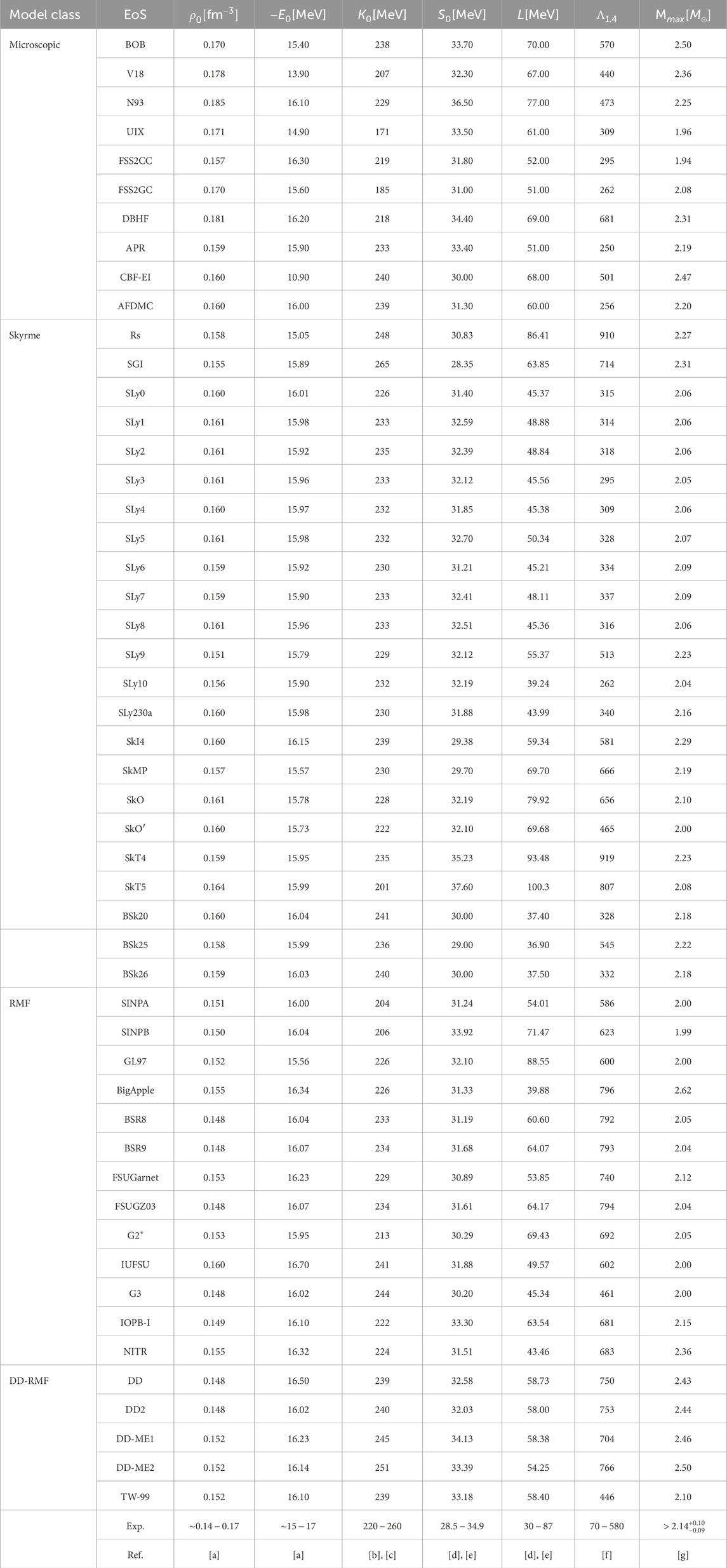
Table 1. Saturation properties predicted by the considered EoSs. Experimental nuclear parameters and observational data are listed for comparison. The references in the lower part of the table are labeled as [a] (Margueron et al., 2018); [b] (Shlomo et al., 2006); [c] (Piekarewicz, 2010); [d] (Burgio and Fantina, 2018); [e] (Burgio et al., 2021); [f] (Abbott et al., 2018); and [g] (Cromartie et al., 2019). See text for details.
The philosophy of the phenomenological approaches is quite different from the one characterizing microscopic methods. In fact, they are based on effective interactions that are built to describe finite nuclei in their ground state, and therefore, predictions at high isospin asymmetries and density have to be taken with care (Stone and Reinhard, 2007). Among the most used ones, we mention Skyrme interactions (Vautherin and Brink, 1972) and relativistic mean-field (RMF) models (Boguta and Bodmer, 1977). In this work, we use a set of modern Skyrme EoS, which are listed in Table 1; in particular we mention the SLy0-SLy10 (Chabanat, 1995) and SLy230a (Chabanat et al., 1997; 1998) of the Lyon group, and the BSk20, BSk25 and BSk26 of the Brussels group (Potekhin et al., 2013; Goriely et al., 2013), the latter ones being unified EoS constructed on the basis of the energy-density functional theory. A complementary approach is given by RMF models, which are based on effective Lagrangian densities. The interaction between baryons is described in terms of meson exchanges, which are regulated by coupling constants of nucleons with mesons, and are usually fixed by fitting the bulk properties of nuclear matter as well as masses and radii of finite nuclei. In this work, we consider two types of RMF models: models with density-dependent coupling constants labeled DD-RMF (Nikšić et al., 2002; Typel and Wolter, 1999; Xia et al., 2022) and RMF models with fixed coupling strength (Mondal et al., 2016; Fattoyev et al., 2020; Das et al., 2021; Dhiman et al., 2007; Chen and Piekarewicz, 2015; Kumar et al., 2006; Sulaksono and Mart, 2006; Fattoyev and Piekarewicz, 2010; Kumar et al., 2017; Kumar et al., 2018; Routaray et al., 2023).
The main properties of the chosen EoS at saturation density are listed in Table 1. We notice that, whereas the saturation properties of the phenomenological models are within the empirical range, some microscopic EoS are marginally compatible with it. The reason is that the parameters of the phenomenological models are fitted on the saturation properties, while they are a prediction in the case of microscopic calculations, and those depend both on the many-body approach and the choice of the employed forces. For instance, the V18 EoS predicts a slightly too low saturation energy
For completeness, we remind that the above mentioned methods are suited for describing the homogeneous component of the nuclear matter EoS, and that at densities
2.1 Criteria for the selection of the EoS
The most important criterium for selecting the EoS is to check its behaviour with respect to the saturation properties of nuclear matter. In fact, around saturation density
where
The density dependence of the symmetry energy around saturation is characterized by the parameters
In Table 1, we list the saturation properties of the various considered EoSs, and compare them with available experimental data. Measurements of nuclear masses (Audi et al., 2003) and density distributions (de Vries et al., 1987) yield the saturation point
Besides the laboratory data, we also exploit astrophysical observation of NS. A very important constraint to be fulfilled by the different EoS is the value of the maximum NS mass, which has to be compatible with the observational data (Demorest et al., 2010; Antoniadis et al., 2013; Fonseca et al., 2016), in particular, the recent lower limit
From Table 1, we notice that most of the adopted EoSs in this work are compatible with the nuclear empirical values, the NS maximum mass, and the tidal deformability of a 1.4
3 Constraints on the nuclear EoS
An important check for the EoS is the behaviour of the symmetry energy slope
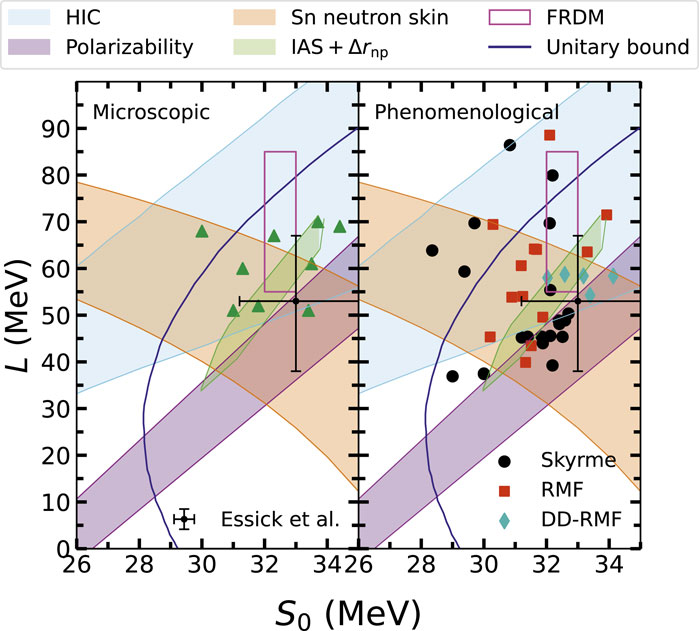
Figure 1. Symmetry energy slope
A further important check regards the high-density behaviour of the nuclear symmetry energy, as illustrated in Ref. (Russotto et al., 2023). In the last few years several heavy-ion collisions experiments at relativistic energies have been performed in order to constrain the high-density symmetry energy. Figure 2 displays the ASY-EOS data (Russotto et al., 2016) (blue band) and the FOPI-LAND ones (Russotto et al., 2011) (light green band) as a function of the density, HIC (Sn + Sn) diffuseness measurements (Tsang et al., 2009) (grey band), whereas the red dashed contour labeled by IAS shows the results of Ref. (Danielewicz and Lee, 2014). For completeness, we also display the results of a Bayesian analysis (Tsang et al., 2024) which determines the boundaries at 68% (dark pink) and 95% confidence intervals (light pink) of the posterior distributions using an initial sample size of 3M of EoS. The experimental data are plotted up to
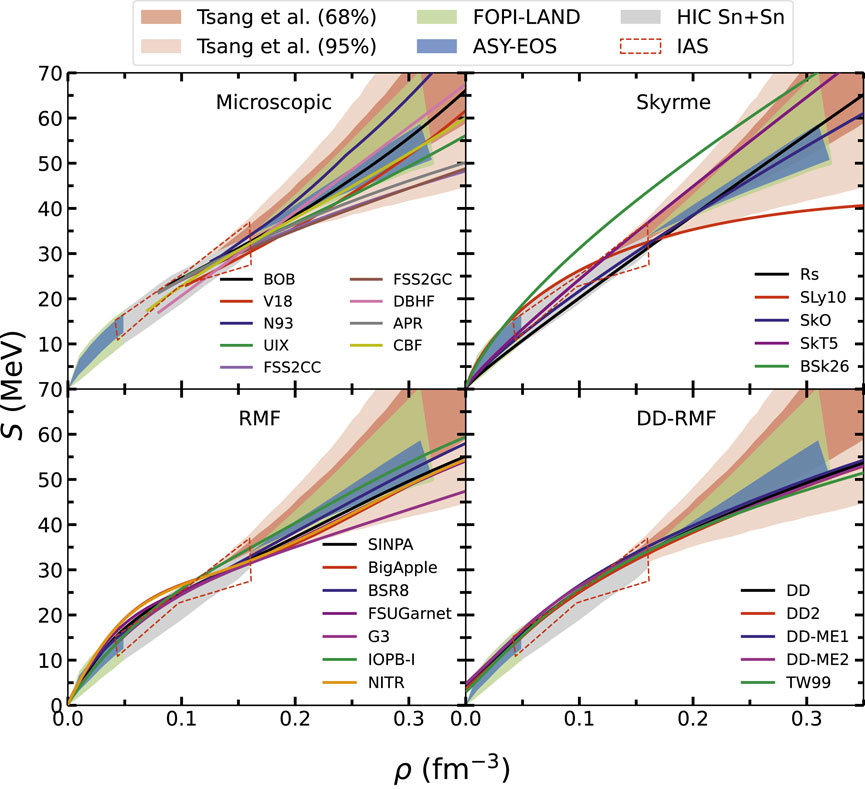
Figure 2. Symmetry energy vs. the nucleon density
4 The neutron skin thickness
The strong correlation between the neutron skin thickness and the slope parameter
The neutron skin thickness can be defined as the difference between the neutron
In that expression,
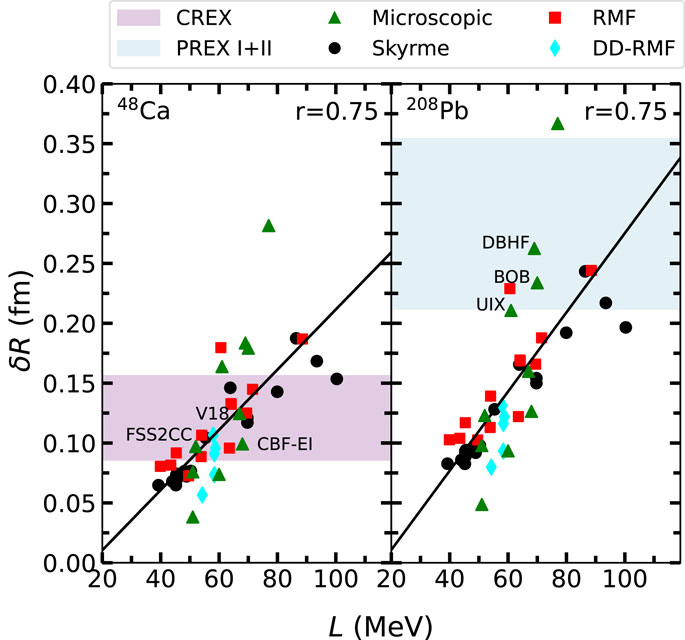
Figure 3. The neutron skin thickness for 48Ca (left panel) and 208Pb (right panel) is displayed as a function of
Finally, in Figure 4, we display a correlation matrix among the saturation properties shown in Table 1, with
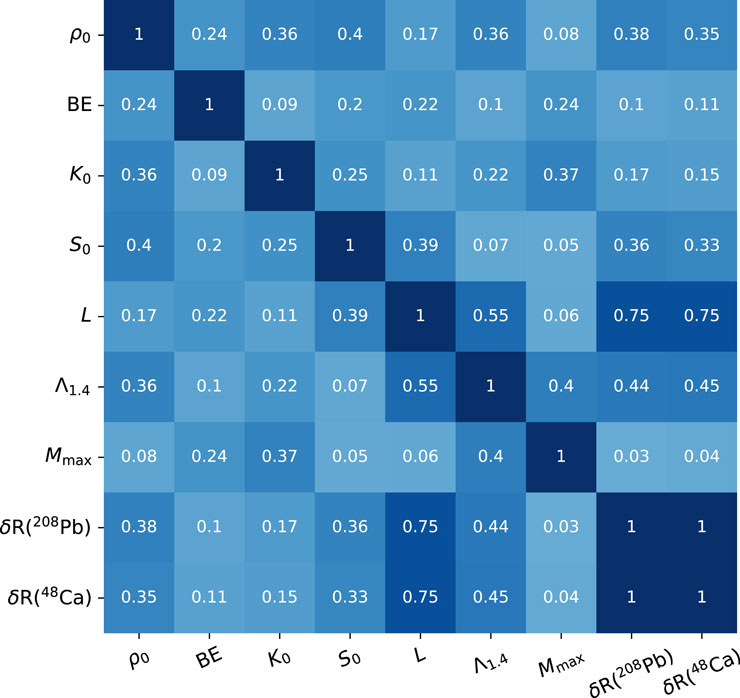
Figure 4. The correlation matrix between nuclear saturation properties and NS properties for the EoS ensemble shown in Table 1.
5 Conclusions
In this work, we have analyzed the predictions of microscopic and phenomenological EoS for the neutron skin thickness
We have found a linear correlation between the neutron skin thickness
The most important result of our analysis is that the same EoS cannot reproduce at the same time the CREX and PREX I + II experimental data. Therefore, those measurements do not allow us to select the most compatible EoS among the ones considered in this work. Future NS observations, along with planned experiments in existing facilities or in next-generation radioactive ion beam laboratories, are fundamental to provide more stringent constraints on the nuclear EoS, thus finally improving our knowledge of the extreme density matter conditions.
Data availability statement
The raw data supporting the conclusions of this article will be made available by the authors, without undue reservation.
Author contributions
GFB: Conceptualization, Methodology, Validation, Writing–original draft, Writing–review and editing. HCD: Software, Validation, Visualization, Writing–review and editing. IV: Conceptualization, Methodology, Software, Validation, Writing–review and editing.
Funding
The author(s) declare that no financial support was received for the research, authorship, and/or publication of this article.
Conflict of interest
The authors declare that the research was conducted in the absence of any commercial or financial relationships that could be construed as a potential conflict of interest.
The author(s) declared that they were an editorial board member of Frontiers, at the time of submission. This had no impact on the peer review process and the final decision.
Generative AI statement
The author(s) declare that no Generative AI was used in the creation of this manuscript.
Publisher’s note
All claims expressed in this article are solely those of the authors and do not necessarily represent those of their affiliated organizations, or those of the publisher, the editors and the reviewers. Any product that may be evaluated in this article, or claim that may be made by its manufacturer, is not guaranteed or endorsed by the publisher.
References
Abbott, B., Abbott, R., Abbott, T., Acernese, F., Ackley, K., Adams, C., et al. (2017). GW170817: observation of gravitational waves from a binary neutron star inspiral. Phys. Rev. Lett. 119, 161101. doi:10.1103/PhysRevLett.119.161101
Abbott, B. P., Abbott, R., Abbott, T., Acernese, F., Ackley, K., Adams, C., et al. (2018). GW170817: measurements of neutron star radii and equation of state. Phys. Rev. Lett. 121, 161101. doi:10.1103/PhysRevLett.121.161101
Abbott, B. P., Abbott, R., Abbott, T., Acernese, F., Ackley, K., Adams, C., et al. (2019). Properties of the binary neutron star merger GW170817. Phys. Rev. X 9, 011001. doi:10.1103/PhysRevX.9.011001
Adhikari, D., Albataineh, H., Androic, D., Aniol, K., Armstrong, D., Averett, T., et al. (2021). Accurate determination of the neutron skin thickness of 208Pb through parity-violation in electron scattering. Phys. Rev. Lett. 126, 172502. doi:10.1103/PhysRevLett.126.172502
Adhikari, D., Albataineh, H., Androic, D., Aniol, K., Armstrong, D., Averett, T., et al. (2022). Precision determination of the neutral weak form factor of 48Ca. Phys. Rev. Lett. 129, 042501. doi:10.1103/PhysRevLett.129.042501
Akmal, A., Pandharipande, V. R., and Ravenhall, D. G. (1998). Equation of state of nucleon matter and neutron star structure. Phys. Rev. C 58, 1804–1828. doi:10.1103/PhysRevC.58.1804
Antoniadis, J., Freire, P. C. C., Wex, N., Tauris, T. M., Lynch, R. S., van Kerkwijk, M. H., et al. (2013). A massive pulsar in a compact relativistic binary. Science 340, 6131. doi:10.1126/science.1233232
Audi, G., Wapstra, A. H., and Thibault, C. (2003). The Ame2003 atomic mass evaluation. Nucl. Phys. A 729, 337–676. doi:10.1016/j.nuclphysa.2003.11.003
Baldo, M. (1999) “Nuclear methods and the nuclear equation of state,” in International review of nuclear physics, 8. Singapore: World Scientific. doi:10.1142/2657
Baldo, M., Bombaci, I., and Burgio, G. F. (1997). Microscopic nuclear equation of state with three-body forces and neutron star structure. Astron. Astrophys. 328, 274–282. doi:10.48550/arXiv.astro-ph/9707277
Baldo, M., and Burgio, G. F. (2016). The nuclear symmetry energy. Prog. Part. Nucl. Phys. 91, 203–258. doi:10.1016/j.ppnp.2016.06.006
Baldo, M., and Fukukawa, K. (2014). Nuclear matter from effective quark-quark interaction. Phys. Rev. Lett. 113, 242501. doi:10.1103/PhysRevLett.113.242501
Baym, G., Pethick, C., and Sutherland, P. (1971). The Ground state of matter at high densities: equation of state and stellar models. Astrophys. J. 170, 299–317. doi:10.1086/151216
Benhar, O., and Lovato, A. (2017). Perturbation theory of nuclear matter with a microscopic effective interaction. Phys. Rev. C 96, 054301. doi:10.1103/PhysRevC.96.054301
Boguta, J., and Bodmer, A. R. (1977). Relativistic calculation of nuclear matter and the nuclear surface. Nucl. Phys. A 292, 413–428. doi:10.1016/0375-9474(77)90626-1
Brown, B. A. (2000). Neutron radii in nuclei and the neutron equation of state. Phys. Rev. Lett. 85, 5296–5299. doi:10.1103/PhysRevLett.85.5296
Burgio, G., Schulze, H.-J., Vidaña, I., and Wei, J.-B. (2021). Neutron stars and the nuclear equation of state. Prog. Part. Nucl. Phys. 120, 103879. doi:10.1016/j.ppnp.2021.103879
Burgio, G. F., and Fantina, A. F. (2018). Nuclear equation of state for compact stars and supernovae. Astrophys. Space Sci.Libr. 457, 255–335. doi:10.1007/978-3-319-97616-7_6
Burgio, G. F., and Vidaña, I. (2020). The equation of state of nuclear matter: from finite nuclei to neutron stars. Universe 6, 119. doi:10.3390/universe6080119
Carbone, A., Colò, G., Bracco, A., Cao, L.-G., Bortignon, P. F., Camera, F., et al. (2010). Constraints on the symmetry energy and neutron skins from pygmy resonances in 68Ni and 132Sn. Phys. Rev. C 81, 041301. doi:10.1103/PhysRevC.81.041301
Centelles, M., Roca-Maza, X., Viñas, X., and Warda, M. (2009). Nuclear symmetry energy probed by neutron skin thickness of nuclei. Phys. Rev. Lett. 102, 122502. doi:10.1103/PhysRevLett.102.122502
Chabanat, E., Bonche, P., Haensel, P., Meyer, J., and Schaeffer, R. (1997). A Skyrme parametrization from subnuclear to neutron star densities. Nucl. Phys. A 627, 710–746. doi:10.1016/S0375-9474(97)00596-4
Chabanat, E., Bonche, P., Haensel, P., Meyer, J., and Schaeffer, R. (1998). A Skyrme parametrization from subnuclear to neutron star densitiesPart II. Nuclei far from stabilities. Nucl. Phys. A 635, 231–256. doi:10.1016/S0375-9474(98)00180-8
Chen, L.-W., Ko, C. M., Li, B.-A., and Xu, J. (2010). Density slope of the nuclear symmetry energy from the neutron skin thickness of heavy nuclei. Phys. Rev. C 82, 024321. doi:10.1103/PhysRevC.82.024321
Chen, W.-C., and Piekarewicz, J. (2015). Searching for isovector signatures in the neutron-rich oxygen and calcium isotopes. Phys. Lett. B 748, 284–288. doi:10.1016/j.physletb.2015.07.020
Colò, G., van Giai, N., Meyer, J., Bennaceur, K., and Bonche, P. (2004). Microscopic determination of the nuclear incompressibility within the nonrelativistic framework. Phys. Rev. C 70, 024307. doi:10.1103/PhysRevC.70.024307
Cromartie, H. T., Fonseca, E., Ransom, S. M., Demorest, P. B., Arzoumanian, Z., Blumer, H., et al. (2019). Relativistic shapiro delay measurements of an extremely massive millisecond pulsar. Nat. Astron. 4, 72–76. doi:10.1038/s41550-019-0880-2
Danielewicz, P., and Lee, J. (2014). Symmetry energy II: isobaric analog states. Nucl. Phys. A 922, 1–70. doi:10.1016/j.nuclphysa.2013.11.005
Das, H. C., Kumar, A., Kumar, B., Biswal, S. K., and Patra, S. K. (2021). BigApple force and its implications to finite nuclei and astrophysical objects. Int. J. Mod. Phys. E 30, 2150088. doi:10.1142/S0218301321500889
Demorest, P. B., Pennucci, T., Ransom, S. M., Roberts, M. S., and Hessels, J. W. (2010). A two-solar-mass neutron star measured using shapiro delay. Nature 467, 1081–1083. doi:10.1038/nature09466
de Vries, H., de Jager, C. W., and de Vries, C. (1987). Nuclear charge-density-distribution parameters from elastic electron scattering. Atomic Data Nucl. Data Tables 36, 495–536. doi:10.1016/0092-640X(87)90013-1
Dhiman, S. K., Kumar, R., and Agrawal, B. K. (2007). Nonrotating and rotating neutron stars in the extended field theoretical model. Phys. Rev. C 76, 045801. doi:10.1103/PhysRevC.76.045801
Essick, R., Tews, I., Landry, P., and Schwenk, A. (2021). Astrophysical constraints on the symmetry energy and the neutron skin of 208Pb with minimal modeling assumptions. Phys. Rev. Lett. 127, 192701. doi:10.1103/PhysRevLett.127.192701
Fattoyev, F. J., Horowitz, C. J., Piekarewicz, J., and Reed, B. (2020). GW190814: impact of a 2.6 solar mass neutron star on the nucleonic equations of state. Phys. Rev. C 102, 065805. doi:10.1103/PhysRevC.102.065805
Fattoyev, F. J., and Piekarewicz, J. (2010). Relativistic models of the neutron-star matter equation of state. Phys. Rev. C 82, 025805. doi:10.1103/PhysRevC.82.025805
Feynman, R. P., Metropolis, N., and Teller, E. (1949). Equations of state of elements based on the generalized Fermi-Thomas theory. Phys. Rev. 75, 1561–1573. doi:10.1103/PhysRev.75.1561
Flanagan, E. E., and Hinderer, T. (2008). Constraining neutron star tidal Love numbers with gravitational wave detectors. Phys. Rev. D. 77, 021502. doi:10.1103/PhysRevD.77.021502
Fonseca, E., Pennucci, T. T., Ellis, J. A., Stairs, I. H., Nice, D. J., Ransom, S. M., et al. (2016). The NANOGrav nine-year data set: mass and geometric measurements of binary millisecond pulsars. Astrophys. J. 832, 167. doi:10.3847/0004-637X/832/2/167
Fuchs, C., Faessler, A., Zabrodin, E., and Zheng, Y.-M. (2001). Probing the nuclear equation of state by production in heavy-ion collisions. Phys. Rev. Lett. 86, 1974–1977. doi:10.1103/PhysRevLett.86.1974
Fukukawa, K., Baldo, M., Burgio, G. F., Lo Monaco, L., and Schulze, H.-J. (2015). Nuclear matter equation of state from a quark-model nucleon-nucleon interaction. Phys. Rev. C 92, 065802. doi:10.1103/PhysRevC.92.065802
Furnstahl, R. J. (2002). Neutron radii in mean-field models. Nucl. Phys. A 706, 85–110. doi:10.1016/S0375-9474(02)00867-9
Gandolfi, S., Illarionov, A. Y., Fantoni, S., Miller, J. C., Pederiva, F., and Schmidt, K. E. (2010). Microscopic calculation of the equation of state of nuclear matter and neutron star structure. Mon. Not. Roy. Astron. Soc. 404, L35–L39. doi:10.1111/j.1745-3933.2010.00829.x
Goriely, S., Chamel, N., and Pearson, J. M. (2013). Further explorations of skyrme-Hartree-Fock-bogoliubov mass formulas. xiii. the 2012 atomic mass evaluation and the symmetry coefficient. Phys. Rev. C 88, 024308. doi:10.1103/PhysRevC.88.024308
Grangé, P., Lejeune, A., Martzolff, M., and Mathiot, J.-F. (1989). Consistent three-nucleon forces in the nuclear many-body problem. Phys. Rev. C 40, 1040–1060. doi:10.1103/PhysRevC.40.1040
Gross-Boelting, T., Fuchs, C., and Faessler, A. (1999). Covariant representations of the relativistic Brueckner T-matrix and the nuclear matter problem. Nucl. Phys. A 648, 105–137. doi:10.1016/S0375-9474(99)00022-6
Guillot, S., Servillat, M., Webb, N. A., and Rutledge, R. E. (2013). Measurement of the radius of neutron stars with high signal-to-noise quiescent low-mass x-ray binaries in globular clusters. Astrophys. J. 772, 7. doi:10.1088/0004-637X/772/1/7
Hartle, J. B. (1967). Slowly rotating relativistic stars. I. Equations of structure. Astrophys. J. 150, 1005–1029. doi:10.1086/149400
Hinderer, T. (2008). Tidal Love numbers of neutron stars. Astrophys. J. 677, 1216–1220. doi:10.1086/533487
Hinderer, T. (2009). Erratum: “Tidal Love numbers of neutron stars” (2008, ApJ, 677, 1216). Astrophys. J. 697, 964. doi:10.1088/0004-637X/697/1/964
Hinderer, T., Lackey, B. D., Lang, R. N., and Read, J. S. (2010). Tidal deformability of neutron stars with realistic equations of state and their gravitational wave signatures in binary inspiral. Phys. Rev. D. 81, 123016. doi:10.1103/PhysRevD.81.123016
Horowitz, C. J., and Piekarewicz, J. (2001). Neutron star structure and the neutron radius of 208Pb. Phys. Rev. Lett. 86, 5647–5650. doi:10.1103/PhysRevLett.86.5647
Horowitz, C. J., Pollock, S. J., Souder, P. A., and Michaels, R. (2001). Parity violating measurements of neutron densities. Phys. Rev. C 63, 025501. doi:10.1103/PhysRevC.63.025501
Klimkiewicz, A., Paar, N., Adrich, P., Fallot, M., Boretzky, K., Aumann, T., et al. (2007). Nuclear symmetry energy and neutron skins derived from pygmy dipole resonances. Phys. Rev. C 76, 051603. doi:10.1103/PhysRevC.76.051603
Kumar, B., Patra, S. K., and Agrawal, B. K. (2018). New relativistic effective interaction for finite nuclei, infinite nuclear matter, and neutron stars. Phys. Rev. C 97, 045806. doi:10.1103/PhysRevC.97.045806
Kumar, B., Singh, S. K., Agrawal, B. K., and Patra, S. K. (2017). New parameterization of the effective field theory motivated relativistic mean field model. Nucl. Phys. A 966, 197–207. doi:10.1016/j.nuclphysa.2017.07.001
Kumar, R., Agrawal, B. K., and Dhiman, S. K. (2006). Effects of omega meson self-coupling on the properties of finite nuclei and neutron stars. Phys. Rev. C 74, 034323. doi:10.1103/PhysRevC.74.034323
Lattimer, J. M. (2012). The nuclear equation of state and neutron star masses. Ann. Rev. Nucl. Sci. 62, 485–515. doi:10.1146/annurev-nucl-102711-095018
Lattimer, J. M. (2023). Constraints on nuclear symmetry energy parameters. Particles 6, 30–56. doi:10.3390/particles6010003
Li, B.-An, Ramos, À., Verde, G., and Vidaña, I. (2014). Topical issue on nuclear symmetry energy. Eur. Phys. J. 50, 9. doi:10.1140/epja/i2014-14009-x
Li, Z. H., Lombardo, U., Schulze, H.-J., and Zuo, W. (2008). Consistent nucleon-nucleon potentials and three-body forces. Phys. Rev. C 77, 034316. doi:10.1103/PhysRevC.77.034316
Li, Z. H., and Schulze, H. J. (2008). Neutron star structure with modern nucleonic three-body forces. Phys. Rev. C 78, 028801. doi:10.1103/PhysRevC.78.028801
Machleidt, R. (1989). The Meson theory of nuclear forces and nuclear structure. Adv. Nucl. Phys. 19, 189–376. doi:10.1007/978-1-4613-9907-0
Machleidt, R., Holinde, K., and Elster, C. (1987). The Bonn meson exchange model for the nucleon nucleon interaction. Phys. Rep. 149, 1–89. doi:10.1016/S0370-1573(87)80002-9
Margueron, J., Hoffmann Casali, R., and Gulminelli, F. (2018). Equation of state for dense nucleonic matter from metamodeling. I. Foundational aspects. Phys. Rev. C 97, 025805. doi:10.1103/PhysRevC.97.025805
Miller, M. C., Lamb, F. K., Dittmann, A. J., Bogdanov, S., Arzoumanian, Z., Gendreau, K. C., et al. (2019). PSR J0030+0451 mass and radius from NICER data and implications for the properties of neutron star matter. Astrophys. J. Lett. 887, L24. doi:10.3847/2041-8213/ab50c5
Möller, P., Myers, W. D., Sagawa, H., and Yoshida, S. (2012). New finite-range droplet mass model and equation-of-state parameters. Phys. Rev. Lett. 108, 052501. doi:10.1103/PhysRevLett.108.052501
Mondal, C., Agrawal, B. K., De, J. N., and Samaddar, S. K. (2016). Sensitivity of elements of the symmetry energy of nuclear matter to the properties of neutron-rich systems. Phys. Rev. C 93, 044328. doi:10.1103/PhysRevC.93.044328
Nagels, M. M., Rijken, T. A., and de Swart, J. J. (1978). Low-energy nucleon-nucleon potential from Regge-pole theory. Phys. Rev. D. 17, 768–776. doi:10.1103/PhysRevD.17.768
Negele, J. W., and Vautherin, D. (1973). Neutron star matter at subnuclear densities. Nucl. Phys. A 207, 298–320. doi:10.1016/0375-9474(73)90349-7
Nikšić, T., Vretenar, D., Finelli, P., and Ring, P. (2002). Relativistic Hartree-Bogoliubov model with density-dependent meson-nucleon couplings. Phys. Rev. C 66, 024306. doi:10.1103/PhysRevC.66.024306
Oertel, M., Hempel, M., Klähn, T., and Typel, S. (2017). Equations of state for supernovae and compact stars. Rev. Mod. Phys. 89, 015007. doi:10.1103/RevModPhys.89.015007
Özel, F., and Freire, P. (2016). Masses, radii, and the equation of state of neutron stars. Ann. Rev. Astron. Astrophys. 54, 401–440. doi:10.1146/annurev-astro-081915-023322
Piekarewicz, J. (2004). Unmasking the nuclear matter equation of state. Phys. Rev. C 69, 041301. doi:10.1103/PhysRevC.69.041301
Piekarewicz, J. (2010). Do we understand the incompressibility of neutron-rich matter? J. Phys. G Nucl. Phys. 37, 064038. doi:10.1088/0954-3899/37/6/064038
Potekhin, A. Y., Fantina, A. F., Chamel, N., Pearson, J. M., and Goriely, S. (2013). Analytical representations of unified equations of state for neutron-star matter. Astronomy and Astrophysics 560, A48. doi:10.1051/0004-6361/201321697
Pudliner, B. S., Pandharipande, V. R., Carlson, J., Pieper, S. C., and Wiringa, R. B. (1997). Quantum Monte Carlo calculations of nuclei with A<∼7. Phys. Rev. C 56, 1720–1750. doi:10.1103/PhysRevC.56.1720
Pudliner, B. S., Pandharipande, V. R., Carlson, J., and Wiringa, R. B. (1995). Quantum Monte Carlo calculations of A<∼6 nuclei. Phys. Rev. Lett. 74, 4396–4399. doi:10.1103/PhysRevLett.74.4396
Radice, D., Perego, A., Zappa, F., and Bernuzzi, S. (2018). GW170817: joint constraint on the neutron star equation of state from multimessenger observations. Astrophys. J. 852, L29. doi:10.3847/2041-8213/aaa402
Reed, B. T., Fattoyev, F. J., Horowitz, C. J., Piekarewicz, J., Armstrong, D. S., Averett, T., et al. (2021). Accurate determination of the neutron skin thickness of 208Pb through parity-violation in electron scattering. Phys. Rev. Lett. 126, 172502. doi:10.1103/PhysRevLett.126.172502
Riley, T. E., Watts, A. L., Bogdanov, S., Ray, P. S., Ludlam, R. M., Guillot, S., et al. (2019). A NICER view of PSR J0030+0451: millisecond pulsar parameter estimation. Astrophys. J. Lett. 887, L21. doi:10.3847/2041-8213/ab481c
Roca-Maza, X., Viñas, X., Centelles, M., Agrawal, B. K., Colò, G., Paar, N., et al. (2015). Neutron skin thickness from the measured electric dipole polarizability in 68Ni120Sn and 208Pb. Phys. Rev. C 92, 064304. doi:10.1103/PhysRevC.92.064304
Romani, R. W., Kandel, D., Filippenko, A. V., Brink, T. G., and Zheng, W. (2022). PSR J0952-0607: the fastest and heaviest known galactic neutron star. Astrophys. J. Lett. 934, L17. doi:10.3847/2041-8213/ac8007
Routaray, P., Mohanty, S. R., Das, H. C., Ghosh, S., Kalita, P. J., Parmar, V., et al. (2023). Investigating dark matter-admixed neutron stars with NITR equation of state in light of PSR J0952-0607. J. Cosmol. Astropart. Phys. 2023, 073. doi:10.1088/1475-7516/2023/10/073
Russotto, P., Cozma, M. D., De Filippo, E., Le Fèvre, A., Leifels, Y., and Łukasik, J. (2023). Studies of the equation-of-state of nuclear matter by heavy-ion collisions at intermediate energy in the multi-messenger era: a review focused on GSI results. La Riv. del Nuovo Cimento 46, 1–70. doi:10.1007/s40766-023-00039-4
Russotto, P., Gannon, S., Kupny, S., Lasko, P., Acosta, L., Adamczyk, M., et al. (2016). Results of the ASY-EOS experiment at GSI: the symmetry energy at suprasaturation density. Phys. Rev. C 94, 034608. doi:10.1103/PhysRevC.94.034608
Russotto, P., Wu, P., Zoric, M., Chartier, M., Leifels, Y., Lemmon, R., et al. (2011). Symmetry energy from elliptic flow in 197Au + 197Au. Phys. Lett. B 697, 471–476. doi:10.1016/j.physletb.2011.02.033
Salmi, T., Julia, S., Deneva, S., Ray, P. S., Watts, A. L., and Choudhury, D. (2024). A NICER view of PSR j1231-1411: a complex case. arXiv:2409. doi:10.48550/arXiv.2409.14923
Shlomo, S., Kolomietz, V. M., and Colò, G. (2006). Deducing the nuclear-matter incompressibility coefficient from data on isoscalar compression modes. EPJA 30, 23–30. doi:10.1140/epja/i2006-10100-3
Steiner, A. W., Prakash, M., Lattimer, J. M., and Ellis, P. J. (2005). Isospin asymmetry in nuclei and neutron stars. Phys. Rep. 411, 325–375. doi:10.1016/j.physrep.2005.02.004
Stoks, V. G. J., Klomp, R. A. M., Terheggen, C. P. F., and de Swart, J. J. (1994). Construction of high quality N N potential models. Phys. Rev. C 49, 2950–2962. doi:10.1103/PhysRevC.49.2950
Stone, J. R., and Reinhard, P. G. (2007). The Skyrme interaction in finite nuclei and nuclear matter. Prog. Part. Nucl. Phys. 58, 587–657. doi:10.1016/j.ppnp.2006.07.001
Sulaksono, A., and Mart, T. (2006). Low density instability in relativistic mean field models. Phys. Rev. C 74, 045806. doi:10.1103/PhysRevC.74.045806
Tews, I., Lattimer, J. M., Ohnishi, A., and Kolomeitsev, E. E. (2017). Symmetry parameter constraints from a lower bound on neutron-matter energy. Astrophys. J. 848, 105. doi:10.3847/1538-4357/aa8db9
Tsang, C. Y., Tsang, M. B., Lynch, W. G., Kumar, R., and Horowitz, C. J. (2024). Determination of the equation of state from nuclear experiments and neutron star observations. Nat. Astron. 8, 328–336. doi:10.1038/s41550-023-02161-z
Tsang, M. B., Zhang, Y., Danielewicz, P., Famiano, M., Li, Z., Lynch, W. G., et al. (2009). Constraints on the density dependence of the symmetry energy. Phys. Rev. Lett. 102, 122701. doi:10.1103/PhysRevLett.102.122701
Typel, S., and Brown, B. A. (2001). Neutron radii and the neutron equation of state in relativistic models. Phys. Rev. C 64, 027302. doi:10.1103/PhysRevC.64.027302
Typel, S., and Wolter, H. H. (1999). Relativistic mean field calculations with density-dependent meson-nucleon coupling. Nucl. Phys. A 656, 331–364. doi:10.1016/S0375-9474(99)00310-3
Vautherin, D., and Brink, D. M. (1972). Hartree-Fock calculations with Skyrme’s interaction. I. Spherical nuclei. Phys. Rev. C 5, 626–647. doi:10.1103/PhysRevC.5.626
Vidaña, I., Providência, C., Polls, A., and Rios, A. (2009). Density dependence of the nuclear symmetry energy: a microscopic perspective. Phys. Rev. C 80, 045806. doi:10.1103/PhysRevC.80.045806
Wiringa, R. B., and Pieper, S. C. (2002). Evolution of nuclear spectra with nuclear forces. Phys. Rev. Lett. 89, 182501. doi:10.1103/PhysRevLett.89.182501
Wiringa, R. B., Stoks, V. G. J., and Schiavilla, R. (1995). Accurate nucleon-nucleon potential with charge-independence breaking. Phys. Rev. C 51, 38–51. doi:10.1103/PhysRevC.51.38
Xia, C.-J., Maruyama, T., Li, A., Yuan Sun, B., Long, W.-H., and Zhang, Y.-X. (2022). Unified neutron star EOSs and neutron star structures in RMF models. Commun. Theor. Phys. 74, 095303. doi:10.1088/1572-9494/ac71fd
Yakovlev, D., and Pethick, C. (2004). Neutron star cooling. Annu. Rev. Astronomy Astrophysics 42, 169–210. doi:10.1146/annurev.astro.42.053102.134013
Zhang, N.-B., Cai, B.-J., Li, B.-A., Newton, W. G., and Xu, J. (2017). How tightly is nuclear symmetry energy constrained by unitary Fermi gas? Nucl. Sci. Tech. 28, 181. doi:10.1007/s41365-017-0336-2
Keywords: neutron star, equation of state, many-body methods of nuclear matter, neutron skin thickness, CREX, PREX I + II
Citation: Burgio GF, Das HC and Vidaña I (2024) The nuclear symmetry energy and the neutron skin thickness in nuclei. Front. Astron. Space Sci. 11:1505560. doi: 10.3389/fspas.2024.1505560
Received: 03 October 2024; Accepted: 28 October 2024;
Published: 04 December 2024.
Edited by:
Armen Sedrakian, University of Wrocław, PolandReviewed by:
Praveen C. Srivastava, Indian Institute of Technology Roorkee, IndiaCharalampos Moustakidis, Aristotle University of Thessaloniki, Greece
Copyright © 2024 Burgio, Das and Vidaña. This is an open-access article distributed under the terms of the Creative Commons Attribution License (CC BY). The use, distribution or reproduction in other forums is permitted, provided the original author(s) and the copyright owner(s) are credited and that the original publication in this journal is cited, in accordance with accepted academic practice. No use, distribution or reproduction is permitted which does not comply with these terms.
*Correspondence: G. F. Burgio, ZmlvcmVsbGEuYnVyZ2lvQGN0LmluZm4uaXQ=