 Sibasish Laha1,2,3*
 Claudio Ricci4,5John C. Mather1Ehud Behar6Luigi Gallo7Frederic Marin8Rostom Mbarek1,9Amelia Hankla9
- 1Astrophysics Science Division, NASA Goddard Space Flight Center, Greenbelt, MD, United States
- 2Center for Space Science and Technology, University of Maryland Baltimore County, Baltimore, MD, United States
- 3Center for Research and Exploration in Space Science and Technology, NASA/GSFC, Greenbelt, MD, United States
- 4Instituto de Estudios Astrofísicos, Facultad de Ingeniería y Ciencias, Universidad Diego Portales, Santiago, Chile
- 5Kavli Institute for Astronomy and Astrophysics, Peking University, Beijing, China
- 6Department of Physics, Technion, Haifa, Israel
- 7Department of Astronomy and Physics, Saint Mary’s University, Halifax, NS, Canada
- 8Université de Strasbourg, CNRS, Observatoire Astronomique de Strasbourg, Strasbourg, France
- 9Department of Astronomy, University of Maryland, College Park, MD, United States
Active galactic nuclei (AGN) are powerful sources of panchromatic radiation. All AGN emit in X-rays, contributing around 5%–10% of the AGN bolometric luminosity. The X-ray emitting region, popularly known as the corona, is geometrically and radiatively compact with a size typically
1 Introduction
Some of the most energetic emission in an active galactic nucleus (AGN) hosting an accreting supermassive black hole (SMBH) is produced in the X-rays. The AGN corona which is responsible for most of the X-ray emission, is an extremely hot (
The central engine of AGN (see Figure 1 left panel) is thought to consist of an accretion disk surrounding the SMBH. The loss of gravitational energy of the accreting material is expected to be one of the main sources of the energy in AGN, part of which is manifested in the optical and UV bands (Shakura and Sunyaev, 1973). The rate at which the system is accreting is often parametrized as the Eddington ratio
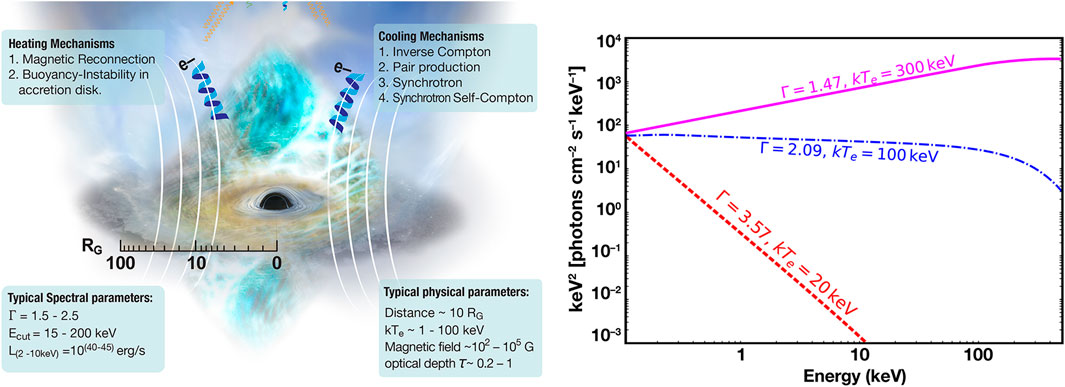
Figure 1. AGN coronal typical parameters and spectra. Left Panel: A cartoon of an AGN central engine with the SMBH (black), accretion disk (brown), the X-ray emitting corona (diffuse cyan), the larger scale outflows (blue) and typical electron orbits around the magnetic fields (helical strips).
In this review we will focus on the coronal X-ray emission from radio quiet AGN (RQ-AGN), which represent the largest population of accreting SMBHs. We do not discuss radio loud AGN (RL-AGN) in this review because the jets may contribute to the X-rays adding extra complexities and contaminate X-ray emission from the corona. We note that in a short review of a mature field such as AGN coronal emission, it is not possible to cover all topics related to the subject, and some subjectivity may unintentionally introduce bias.
This manuscript is arranged as follows: In Section 1.1 we discuss some of the most important physical processes in AGN coronae. In Section 2 we list the phenomenology of the coronal emission discussing the most relevant discoveries and the empirical relations between X-ray coronal emission and the other observable quantities. In Section 3 we briefly address some of the open questions in the field, and in Section 4 we discuss future perspectives.
1.1 The primary physical processes in AGN corona
The coronal X-ray emission can be simply characterized by a power law with a photon index
1.1.1 Inverse compton scattering
Inverse Compton (IC) scattering is thought to be the dominant process responsible for X-ray emission in AGN. When UV seed photons from the accretion disk, with energies
For a plasma of non-relativistic electrons in thermal equilibrium with energy
1.1.2 Synchrotron emission
The high densities of electrons around the magnetic field in AGN corona makes it a significant synchrotron emitter predominantly between
Direct measurement of magnetic fields in AGN corona has not yet been possible, but we can estimate a typical range from the analogy of RL-AGN. Large
1.1.3 Electron-positron pair production
Sources which are physically compact and highly luminous, like the AGN corona, are also radiatively compact. This means that the photons and the particles in the plasma are in constant interaction with each other. In such a plasma, photon–photon collisions can lead to
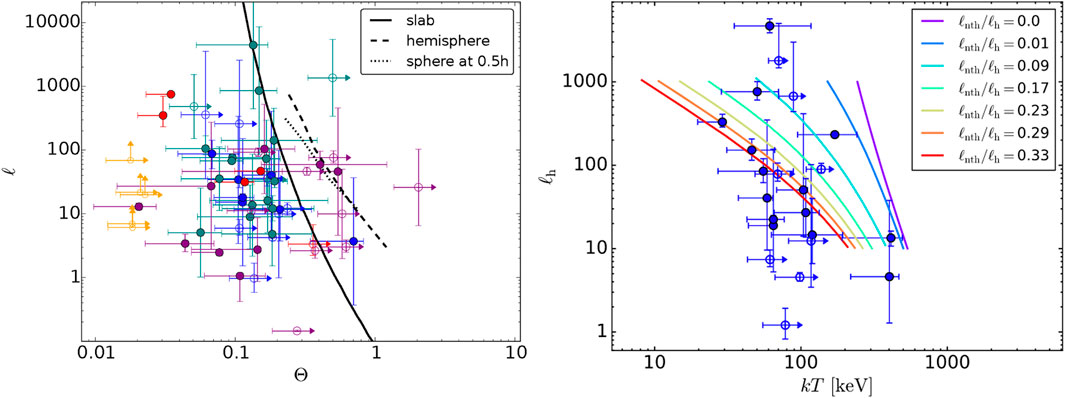
Figure 2. Pair production acting as a thermostat for coronal plasmas. Left: Compactness parameter
If magnetic reconnection is a dominant form of energy production mechanism in the X-ray corona (Di Matteo, 1998), then one would expect a fraction of non-thermal electrons (Done and Fabian, 1989). The existence of non-thermal particles in the corona would result in a distribution of photon energy that extends into the MeV band. This small number of high energy particles could be highly effective in seeding pair production. Moreover, the cooled non-thermal pairs could share the total available energy, thus reducing the mean energy per particle and therefore decreasing the temperature of the thermal population. Such hybrid coronal plasma, consisting of thermal and non-thermal electron populations, might have been found in a few nearby AGN (See Figure 2 right panel), in which the Comptonizing plasma is found well below the pair production line in the
2 Phenomenological properties of the corona
X-ray emission from AGN was detected and studied already by the early X-ray observatories such as Ariel-V (1974–1980, Smith and Courtier, 1976), HEAO-1 (1977–1983, Rothschild et al., 1979), HEAO-2 or Einstein (1978–1981, Giacconi et al., 1979), EXOSAT (1983–1986, Taylor et al., 1981), GINGA (1987–1991, Makino and ASTRO-C Team, 1987). In the later period ASCA (1993–2001, Tanaka et al., 1994) and RXTE (1995–2012, Swank, 1999) provided seminal insights into the X-ray properties of the AGN corona. For example, the ubiquity of X-ray emission from Seyfert-1 galaxies was established (Elvis et al., 1978) by the first catalog from the Ariel-V sky survey (Cooke et al., 1978). The first large spectral samples of AGN observed by HEAO-1 revealed that the observed range in photon spectral indices was tightly distributed around
These discoveries were followed by the era of the great X-ray observatories, which started with the launch of Chandra (1999-, Weisskopf et al., 1996) and XMM-Newton (1999-, Lumb et al., 2012), and later with the advent of hard X-ray
2.1 The coronal plasma spectral and physical properties
2.1.1 Coronal X-ray power law slope and optical depth
Figure 1 left panel highlights the primary spectral and physical characteristics of X-ray coronae and their typical range of values. The left panel of Figure 3 shows the photon index
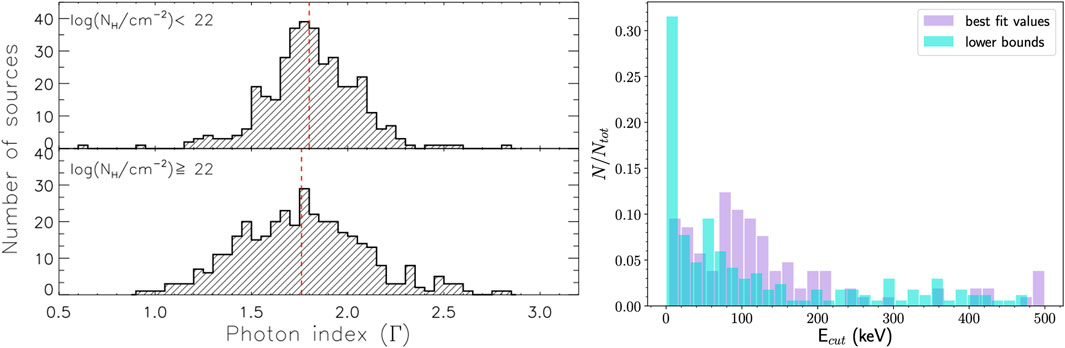
Figure 3. Distribution of the X-ray spectral parameters of AGN coronal emission: Left: The distribution of the photon-indices
The photon index is dependent on both the plasma temperature and the optical depth, and it can be estimated as
2.1.2 Coronal luminosity and bolometric correction
The typical coronal luminosity can span a large range
The contribution of the X-rays to the total AGN emission is usually parametrized with the X-ray bolometric correction
2.1.3 The high energy cut-off (EC) and the coronal temperature
The high energy cut-off of the power law component is related to the coronal temperature as
Analyzing a sample of
Sample studies of AGN in hard X-rays with NuSTAR detected an anti-correlation between
2.2 The coronal size, geometry and stability
Although corona is known to be compact (Ghisellini et al., 2004; Fabian et al., 2015), it can sometimes be patchy (e.g., Haardt and Maraschi, 1991; Stern et al., 1995; Petrucci et al., 2013; Wilkins and Gallo, 2015c). Four (simplified) coronal geometries that are commonly discussed in the literature: a point source, a cylindrical slab, a spheroid/ellipsoid, and a conical geometry (Gonzalez et al., 2017). Ray-tracing simulations suggest that some of these geometries could be distinguished through X-ray spectral modelling (e.g., Wilkins and Fabian, 2012; Dauser et al., 2013; Gonzalez et al., 2017) and polarization studies (e.g., Schnittman and Krolik, 2010; Zhang et al., 2019).
Although the geometry of the corona is extremely hard to determine, the size of the corona can be inferred from several indirect methods:
2.2.1 Spectral and spectral-timing techniques
2.2.1.1 Emissivity profile
The emissivity profile describes the amount of reprocessed radiation emitted from the disc as a function of distance from the illuminating source, and it is typically inferred from the properties of the relativistically broadened emission lines (e.g., Fe K
2.2.1.2 Reflection fraction
The detection of broad (and redshifted) FeK
2.2.1.3 X-ray variability
Coronal X-ray emission shows variability at different time scales
2.2.2 X-ray polarization
Compton scattering induces polarization of the X-ray photons, which is an important tool to study the geometry of the emitting plasma. The polarization of the X-ray photons measured both in degree and position angle, is energy- and geometry dependent. For example, a polarization degree of
Launched in December 2021, the Imaging X-ray Polarimetry Explorer (IXPE), is the first X-ray spectro-imaging polarimeter satellite sensitive in the 2–8 keV band (Weisskopf et al., 2022). IXPE successfully measured a polarized signature in NGC 4151 (Gianolli et al., 2023) with a polarization degree of 4.9%
Here we also mention an interesting result from an X-ray binary, Cygnus X-1, for which the polarization degree could be constrained exceptionally well, at (4.0
2.2.3 Microlensing studies
Gravitational microlensing of quasar light by a foreground mass (lens) can be used to probe the sizes related to the accretion disc and corona (e.g., Chartas et al., 2009; Morgan et al., 2008; Dai et al., 2010). Using such methods, the size of the X-ray emitting region (the corona) is estimated to be very compact, around
2.2.4 X-ray eclipses
Capturing the transit of the X-ray source by an obscuring cloud is fortuitous, but not rare (see for, e.g., Risaliti et al., 2007; Turner et al., 2018; Gallo et al., 2021; Ricci and Trakhtenbrot, 2022). Such events are important as they can be used to constrain the sizes of the X-ray region based on the duration of the eclipse. This method assumes that the cloud is gravitationally bound to the central SMBH in a Keplerian orbit and the eclipse occurs when the cloud moves across our line of sight to the central engine. In the objects for which eclipses could be used to measure the size of the corona (e.g., Risaliti et al., 2011; Gallo et al., 2021), the results have been consistent with those obtained using other methods.
2.3 Coronal X-ray variability and flares
AGN coronal X-ray emission is variable at different timescales and with different amplitudes (see for, e.g., McHardy and Czerny, 1987; Mushotzky et al., 1993; Papadakis, 2004; McHardy et al., 2004; 2006; Serafinelli et al., 2024, and references therein). Here we briefly discuss three types of AGN X-ray coronal variability commonly observed: (a) Stochastic variability, (b) quasi-periodic variability and (c) Flares, and we note that a detailed discussion of timing and spectral-timing studies of AGN corona is beyond the scope of this short review.
2.3.1 Stochastic variability
One of the most common coronal variability pattern is the chaotic total intensity variation, or stochastic variation. Early studies using observations from Ariel-V and EXOSAT show that
It is still unclear how the X-ray coronal variability at different-timescales is produced. Popular models predict that inward propagation of random accretion rate fluctuations in the accretion flow could create such stochastic variations in the coronal X-ray emission (Lyubarskii, 1997; Kotov et al., 2001; King et al., 2004; Kelly et al., 2011; Ingram and van der Klis, 2013; Cowperthwaite and Reynolds, 2014). The longer term variability may be produced by accretion rate changes (Mushotzky et al., 1993), but the origin of the short timescale variations (a few
An important measurement of the variability is the power density spectrum (van der Klis, 1989; Vaughan et al., 2003a; b), which describes the amount of power (the amplitude squared, i.e., the power of the signal) as a function of temporal frequency. When the X-ray light curve can be described as random displacements around a mean value, then the power density spectrum (PSD) shows a constant value, that is, all frequencies have equal power. This is known as a white noise spectrum. On the other hand, a red noise spectrum is created when the points in the light curve have a random displacement from its adjacent point rather than from the mean. In such a case the variations at lower frequencies have more power. Red noise is the characteristic of several astrophysical systems including the Sun (Lu and Hamilton, 1991) and black hole binaries (Belloni and Hasinger, 1990), and it is closely related to the stochastic nature of such non-linear systems. In AGNs, over the frequency range
2.3.2 Quasi-periodic-oscillation (QPO)
The origin of QPOs in AGN are highly debated, they are still very rare and they have mostly been discovered in the
2.3.3 X-ray flares
X-ray flares with different amplitude at different timescales are common in AGN. Typically, flares can exhibit flux increases of
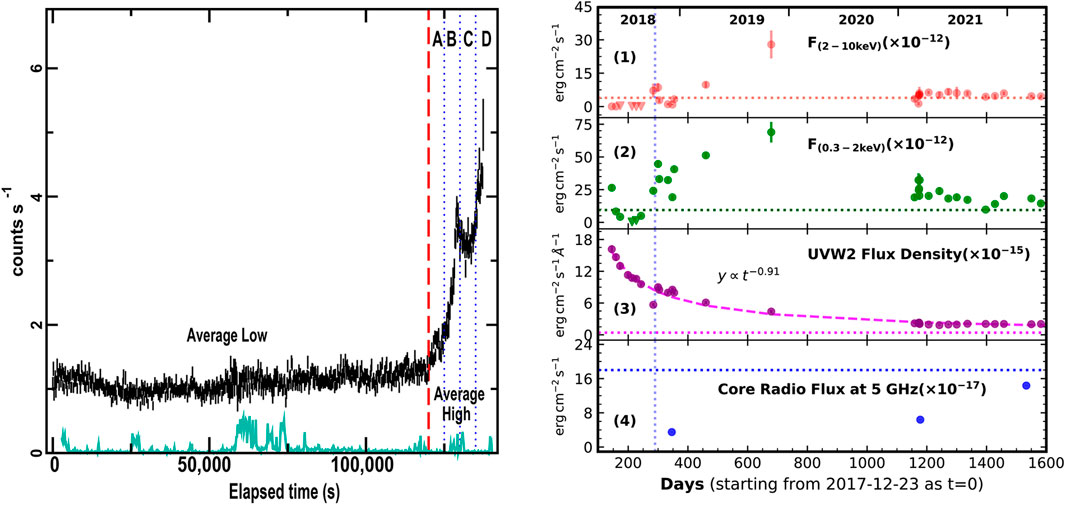
Figure 4. The short and long term X-ray flares in AGN corona. Left: The short term
X-ray flaring events in many astrophysical objects are generally associated with magnetic reconnection (e.g., Petropoulou et al., 2016; Mehlhaff et al., 2020), a fundamental plasma process where magnetic energy is converted into thermal and nonthermal particle energy (e.g., Lyubarsky, 2005; Takahashi et al., 2011). Magnetic reconnection has a short dissipation time, and short flares with durations that generally do not exceed a few times
2.4 The accretion disk - corona relation
The accretion disk and the corona are energetically and geometrically related (Haardt and Maraschi, 1993; Lusso et al., 2010; Lusso and Risaliti, 2016). A direct piece of evidence of the energy-coupling between the accretion disk and corona is the significant correlation between the quantity

Figure 5. Relationship between AGN corona and its surroundings Left: The
There is also a significant correlation between
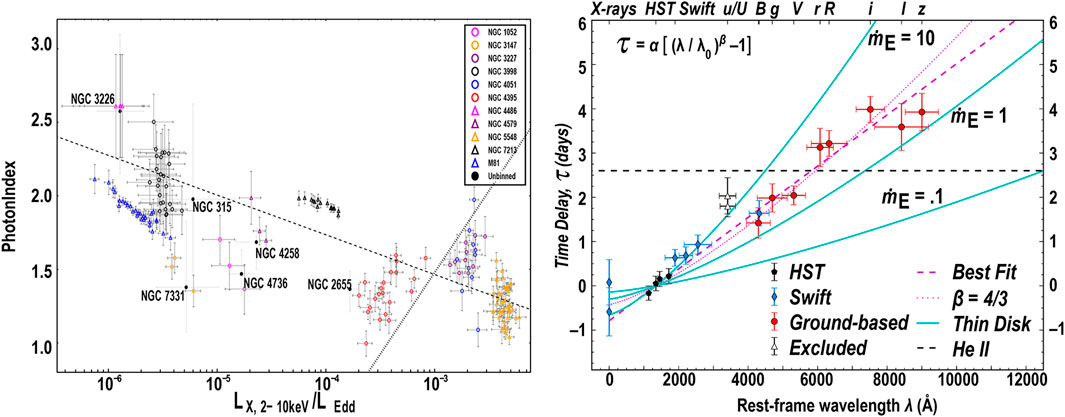
Figure 6. The relation between the coronal emission and AGN accretion: Left: The relation between the photon-indices
The reverberation mapping time lags between the optical/UV and the X-rays are an important indication of disk-corona coupling and serves as an important tool to understand the disk-corona geometry (see for, e.g., Peterson, 1993; Edelson et al., 2015; 2019; Cackett et al., 2021; 2023; Kara et al., 2023, and references therein). The corona is compact
Although the correlation between the UV and X-rays are pretty well constrained in most cases, there are AGN types which show additional complexities. The most interesting among them are changing look AGNs (CL-AGNs), which are sources that undergo a rapid change in flux and spectral state (in optical/X-rays) in a matter of months-years (see Ricci and Trakhtenbrot, 2023, for a review). Mrk 590 is a long term CL-AGN where the UV and X-rays are well correlated, but UV response to X-ray changes is lagged by
2.5 Coronae and high-energy neutrinos
Systematic searches for neutrino excess above atmospheric and cosmic backgrounds with the IceCube detector have detected
The highly magnetized black hole coronae (e.g., Beloborodov, 2017; Hooper and Plant, 2023; Grošelj et al., 2024; Nättilä, 2024; Mbarek et al., 2024) support two primary mechanisms for accelerating protons responsible for coronal neutrino production. First, magnetic reconnection in large current sheets near the black hole, with strong guide fields, can accelerate particles to extreme energies (Fiorillo et al., 2024). Second, magnetized turbulence allows particles to be initially energized by reconnection and subsequently re-accelerated within the turbulent corona (Mbarek et al., 2024). These high-energy protons interact with the corona’s dense photon fields, producing the observed neutrino signal. While purely leptonic models have also been suggested (Hooper and Plant, 2023), it remains unclear how electrons could achieve the TeV-scale energies required for such scenarios.
2.6 The empirical relations involving corona
Here we list the most important empirical relations involving emission from the X-ray corona and that produced by other AGN components (see Table 1 for a list).
(1) X-ray and UV: As noted earlier, the disk and the corona emission are very tightly related, showing a strong correlation between
(2)
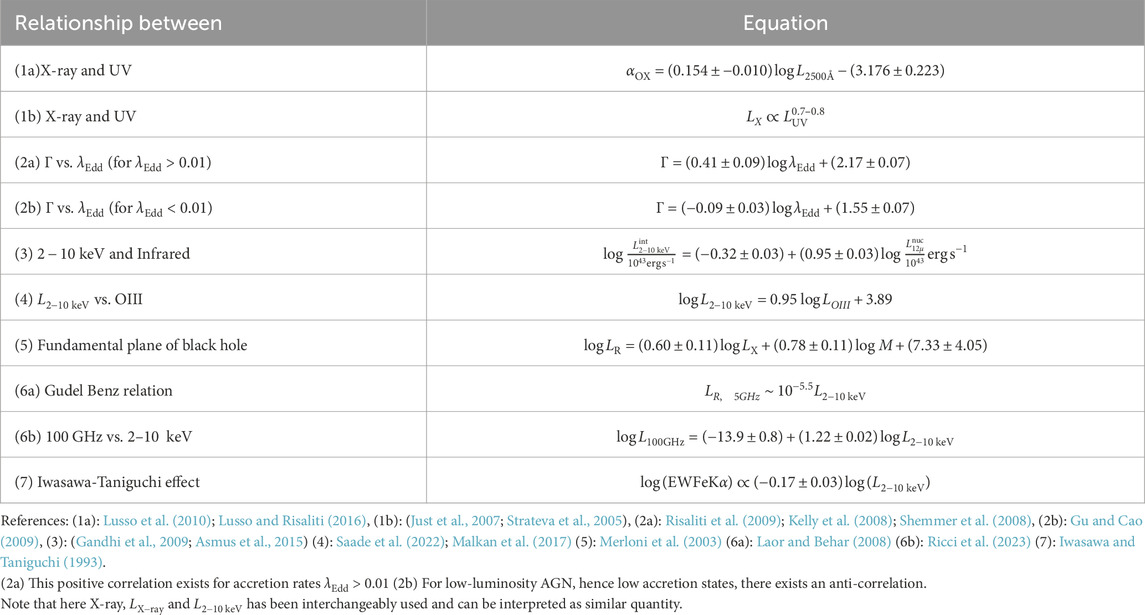
Table 1. The empirical relations involving AGN coronal emission.
A few studies involving high
(3)
(4)
(5) Fundamental plane of BH: The X-ray luminosity
(6) The mm and X-ray relation: As mentioned earlier, AGN show a strong correlation between their X-ray and radio luminosity at 5–200 GHz with
(7)
(8) The Iwasawa-Taniguchi effect: Also known as the X-ray Baldwin effect, is the anti-correlation between the equivalent width of the Fe K
3 List of open questions
Although we have discussed numerous observational discoveries regarding AGN coronal emission, several fundamental questions continue to elude us. We list some of the outstanding questions below, that, if answered, will improve our understanding of, not only the corona, but also how AGN operate.
• Since corona is found ubiquitously in AGN, is there something fundamental about the accretion process that produces it? The corona is a unique physical entity found in most accreting systems including black hole binaries (BHBs) and AGN. Studies have found similarities in coronal behavior of AGN and BHBs, lying at the two ends of black hole mass scales, suggesting that the AGN accretion-disk and corona are just a scaled-up version of those found in BHBs (McHardy et al., 2006), with the underlying physics being the same. Possibly the magnetic fields that thread the accretion disk creates and sustains the corona in these accreting systems, whose physics remains similar across a large range of black hole masses
• What is the geometry of the corona? The recent X-ray polarimetric results with IXPE point towards a more extended geometry of the corona, situated along the accretion disk plane. However, deeper polarimetric studies of larger samples of AGN in different flux states are required to understand how the geometry varies depending on accretion and X-ray luminosity states. This can only be done with the next-generation of X-ray polarimeters, as IXPE is sensitivity-limited. A systematic spectral and timing studies of the AGNs in rapidly changing X-ray flux states can also reveal the geometry.
• What are the main energy pumping and dissipation mechanisms in the corona? Is the corona in thermal and radiative equilibrium? Although random magnetic reconnection events can play an important role in pumping energy into the corona (Galeev et al., 1979; Di Matteo, 1998; Merloni and Fabian, 2001; Sironi and Beloborodov, 2020; Sridhar et al., 2021), we need a deeper understanding about heating and cooling processes in such a compact region, which shows constant stochastic fluctuations, and sometimes flares. Simulations coupled with observational inputs on simultaneous radiative and thermal equilibrium can shed light on this topic in the future.
• What determines the fraction of non-thermal electrons in the X-ray emitting plasma? As mentioned in the introduction, the existence of non-thermal particles in the corona would result in a distribution of photons that extends into the MeV band. This small number of high energy particles could be highly effective in seeding pair production and can share the total available energy, thus reducing the mean energy per particle and therefore decreasing the temperature of the thermal population. Thus the non-thermal fraction of particles in the corona plays an important role in balancing the temperature of the plasma. We do not understand the origin and the exact fraction of the non-thermal electrons in coronal plasma. Future simulations on magnetic reconnection events could help us understand this.
• What are coronal flares? It is not clear to us if there are particular flux/spectral states that favor the occurrence of coronal flares (rise in flux by a factor of
4 Future perspectives
4.1 Need for future missions
Future X-ray studies on AGN corona depends on how well we can extend our spectroscopic capabilities in the hard X-rays, preferably up to
To estimate the differences in the emissivity profiles (the illumination pattern of the accretion disk due to the reflection of X-rays from the corona, convolved with general relativistic effects), and hence the coronal shape and size, we need high quality X-ray observations, both in terms of collecting area and spectral resolution. For example, missions like Athena with its large collecting area (Nandra et al., 2013) and the recently launched XRISM with its high spectral resolution (Tashiro et al., 2020) will provide the ability to distinguish between the different coronal geometries.
The exciting field of X-ray polarimetry has just taken off with the launch of IXPE. However, a small effective-area mission such as this one needs much longer integration time to constrain the polarisation degree for even a very bright AGN (
High-energy neutrinos are also expected from AGN corona, and is currently opening up a huge multi-messenger avenue for AGN-coronal studies (Kheirandish et al., 2021). In the future, deeper and more sensitive studies by IceCube and other detectors will help us in understanding the relation between neutrino emission and the physical processes in an AGN corona.
4.2 Need for simulations
Coronal heating and cooling problems are among the most significant unresolved issues in astrophysics. ‘Fluid’ (MHD) models, by their very nature, are unable to explore the physics of non-thermal particle acceleration within the dissipation regions, where the energy from the magnetic field is transferred to particles. The corona is expected to have a good fraction (up to
On the other hand, particle-in-cell (PIC) simulations capture the microscopic dynamics of individual particles, rather than assuming a smooth distribution of particle energies, and thus capture accurately the non-thermal processes in dissipation regions, and the nonlinear interplay between charged particles and electromagnetic fields (e.g., Chernoglazov et al., 2023; Grošelj et al., 2024; Mbarek et al., 2024; Nättilä, 2024). Moreover, PIC simulations may include consistently evolving particles and their radiative cooling effects, in the presence of photons, pair creation and annihilation processes (Grošelj et al., 2024). These features make PIC an ideal tool to study the coronal heating problem. However, PIC simulations are usually employed to study local dissipation processes on microscopic scales—scaled down from actual astrophysical scales. Therefore, simulation setups might seem ideal and somewhat disconnected from the “global properties” of the corona. More work is still required to more robustly extrapolate the results of PIC simulations to large scales (underway efforts include, e.g., Zou et al., 2024; Sridhar et al., 2024).
Author contributions
SL: Conceptualization, Funding acquisition, Methodology, Project administration, Supervision, Validation, Writing–original draft, Writing–review and editing. CR: Validation, Writing–review and editing. JM: Conceptualization, Visualization, Writing–review and editing. EB: Conceptualization, Supervision, Validation, Writing–review and editing. LG: Supervision, Writing–review and editing. FM: Writing–review and editing. RM: Writing–review and editing. AH: Writing–review and editing.
Funding
The author(s) declare that financial support was received for the research, authorship, and/or publication of this article. We have a waiver. The material is based upon work supported by NASA under award number 80GSFC21M0002.
Acknowledgments
SL acknowledges insightful discussions with Christopher Reynolds, Mitchell Begelman, Navin Sridhar and Dev Sadaula. SL thanks NASA graphics designer Jay Friedlander for his help on the cartoon in Figure 1 and other figures. CR acknowledges support from Fondecyt Regular grant 1230345, ANID BASAL project FB210003 and the China-Chile joint research fund. EB acknowledges support by a Center of Excellence of the Israel Science Foundation (grant no. 2752/19). SL and EB acknowledge support from NSF-BSF grant numbers: NSF-2407801, BSF-2023752.
Conflict of interest
The authors declare that the research was conducted in the absence of any commercial or financial relationships that could be construed as a potential conflict of interest.
Generative AI statement
The author(s) declare that no Generative AI was used in the creation of this manuscript.
Publisher’s note
All claims expressed in this article are solely those of the authors and do not necessarily represent those of their affiliated organizations, or those of the publisher, the editors and the reviewers. Any product that may be evaluated in this article, or claim that may be made by its manufacturer, is not guaranteed or endorsed by the publisher.
Footnotes
1
2https://arxiv.org/abs/2501.01581
References
Aartsen, M. G., Ackermann, M., Adams, J., Aguilar, J. A., Ahlers, M., Ahrens, M., et al. (2020). Time-integrated neutrino source searches with 10 years of icecube data. Phys. Rev. Lett. 124, 051103. doi:10.1103/PhysRevLett.124.051103
Alston, W., Fabian, A., Markevičiutė, J., Parker, M., Middleton, M., and Kara, E. (2016). Quasi periodic oscilations in active galactic nuclei. Astron. Nachrichten 337, 417–422. doi:10.1002/asna.201612323
Alston, W. N., Markeviciute, J., Kara, E., Fabian, A. C., and Middleton, M. (2014). Detection of a QPO in five XMM–Newton observations of RE J1034+396. Detect. a QPO five Newt. observations RE J1034+396 445, L16–L20. doi:10.1093/mnrasl/slu127
Alston, W. N., Parker, M. L., Markevičiūtė, J., Fabian, A. C., Middleton, M., Lohfink, A., et al. (2015) Discovery of an 2-h high-frequency X-ray QPO and iron Kα reverberation in the active galaxy MS 2254, 449, 467–476. doi:10.1093/mnras/stv351
Arnaud, K. A. (1996). XSPEC: the first ten years. In astronomical data analysis Software and systems V. Editors G. H. Jacoby, and J. Barnes (Astronomical Society of the Pacific Conference Series), 101.
Asmus, D., Gandhi, P., Hönig, S. F., Smette, A., and Duschl, W. J. (2015). The subarcsecond mid-infrared view of local active galactic nuclei – II. The mid-infrared–X-ray correlation. mid-infrared-X-ray Correl. 454, 766–803. doi:10.1093/mnras/stv1950
Balbus, S. A., and Hawley, J. F. (1998). Instability, turbulence, and enhanced transport in accretion disks. Rev. Mod. Phys. 70, 1–53. doi:10.1103/RevModPhys.70.1
Baldi, R. D., Laor, A., Behar, E., Horesh, A., Panessa, F., McHardy, I., et al. (2022). The PG-RQS survey. Building the radio spectral distribution of radio-quiet quasars. I. The 45-GHz data. 45-GHz data 510, 1043–1058. doi:10.1093/mnras/stab3445
Baloković, M., Harrison, F. A., Madejski, G., Comastri, A., Ricci, C., Annuar, A., et al. (2020). NuSTAR survey of obscured swift/BAT-selected active galactic nuclei. II. Median high-energy cutoff in Seyfert II hard X-ray spectra. Median High-energy Cutoff Seyfert II Hard X-Ray Spectra 905, 41. doi:10.3847/1538-4357/abc342
Barthelmy, S. D., Barbier, L. M., Cummings, J. R., Fenimore, E. E., Gehrels, N., Hullinger, D., et al. (2005). The burst alert telescope (BAT) on the SWIFT midex mission. SSRv 120, 143–164. doi:10.1007/s11214-005-5096-3
Bassani, L., Dadina, M., Maiolino, R., Salvati, M., Risaliti, G., Della Ceca, R., et al. (1999). A three-dimensional diagnostic diagram for Seyfert 2 galaxies: probing X-ray absorption and Compton thickness. ApJS 121, 473–482. doi:10.1086/313202
Behar, E., Baldi, R. D., Laor, A., Horesh, A., Stevens, J., and Tzioumis, T. (2015). Discovery of millimetre-wave excess emission in radio-quiet active galactic nuclei. Mon. Not. R. Astron. Soc., Discov. millimetre-wave excess Emiss. radio-quiet Act. galactic Nucl. 451, 517–526. doi:10.1093/mnras/stv988
Behar, E., Vogel, S., Baldi, R. D., Smith, K. L., and Mushotzky, R. F. (2018). The mm-wave compact component of an AGN. Mon. Not. R. Astron. Soc., mm-wave compact Compon. AGN 478, 399–406. doi:10.1093/mnras/sty850
Beheshtipour, B., Krawczynski, H., and Malzac, J. (2017). The X-ray polarization of the accretion disk coronae of active galactic nuclei. Astrophys. J., X-Ray Polariz. Accretion Disk Coronae Act. Galactic Nucl. 850, 14. doi:10.3847/1538-4357/aa906a
Beloborodov, A. M. (2017). Radiative magnetic reconnection near accreting black holes. Astrophys. J. Radiat. Magn. Reconnect. Near Accreting Black Holes 850, 141. doi:10.3847/1538-4357/aa8f4f
Bisogni, S., Lusso, E., Civano, F., Nardini, E., Risaliti, G., Elvis, M., et al. (2021). The Chandra view of the relation between X-ray and UV emission in quasars. A& 655, A109. doi:10.1051/0004-6361/202140852
Brandt, W. N., Mathur, S., and Elvis, M. (1997). A comparison of the hard ASCA spectral slopes of broad- and narrow-line Seyfert 1 galaxies. Mon. Not. R. Astron. Soc., A Comp. hard ASCA Spectr. slopes broad- narrow-line Seyfert 1 galaxies 285, L25–L30. doi:10.1093/mnras/285.3.L25
Brenneman, L. W., Madejski, G., Fuerst, F., Matt, G., Elvis, M., Harrison, F. A., et al. (2014). Measuring the coronal properties of IC 4329A withNuSTAR. Astrophys. J., Meas. Coronal Prop. IC 4329A NuSTAR 781, 83. doi:10.1088/0004-637X/781/2/83
Brightman, M., Silverman, J. D., Mainieri, V., Ueda, Y., Schramm, M., Matsuoka, K., et al. (2013). A statistical relation between the X-ray spectral index and Eddington ratio of active galactic nuclei in deep surveys. Mon. Not. R. Astron. Soc., A Stat. Relat. between X-ray Spectr. index Eddingt. ratio Act. galactic Nucl. deep Surv. 433, 2485–2496. doi:10.1093/mnras/stt920
Buisson, D. J. K., Fabian, A. C., and Lohfink, A. M. (2018). Coronal temperatures of the AGN ESO 103−035 and IGR 2124.7+5058 from NuSTAR observations. 7+5058 NuSTAR observations 481, 4419–4426. doi:10.1093/mnras/sty2609
Cackett, E. M., Bentz, M. C., and Kara, E. (2021). Reverberation mapping of active galactic nuclei: from X-ray corona to dusty torus. iScience 24, 102557. doi:10.1016/j.isci.2021.102557
Cackett, E. M., Gelbord, J., Barth, A. J., De Rosa, G., Edelson, R., Goad, M. R., et al. (2023). AGN STORM 2. IV. Swift X-ray and ultraviolet/optical monitoring of Mrk 817. Astrophys. J., AGN STORM 2. IV. Swift X-Ray Ultraviolet/Optical Monit. Mrk 817 958, 195. doi:10.3847/1538-4357/acfdac
Cackett, E. M., Zoghbi, A., Reynolds, C., Fabian, A. C., Kara, E., Uttley, P., et al. (2014). Modelling the broad Fe Kα reverberation in the AGN NGC 4151. Mon. Not. R. Astron. Soc., Model. broad Fe Kα reverberation AGN NGC 4151 438, 2980–2994. doi:10.1093/mnras/stt2424
Cao, X. (2009). An accretion disc-corona model for X-ray spectra of active galactic nuclei. Mon. Not. R. Astron. Soc., An accretion disc-corona Model. X-ray spectra Act. galactic Nucl. 394, 207–213. doi:10.1111/j.1365-2966.2008.14347.x
Chartas, G., Kochanek, C. S., Dai, X., Poindexter, S., and Garmire, G. (2009). Astrophys. J., X-Ray Microlensing RXJ1131-1231 HE1104-1805 693, 174–185. doi:10.1088/0004-637X/693/1/174
Chernoglazov, A., Hakobyan, H., and Philippov, A. (2023). High-energy radiation and ion acceleration in three-dimensional relativistic magnetic reconnection with strong synchrotron cooling. Astrophys. J., High-energy Radiat. Ion Accel. Three-dimensional Relativistic Magnetic Reconnect. Strong Synchrotron Cool. 959, 122. doi:10.3847/1538-4357/acffc6
Christie, I. M., Petropoulou, M., Sironi, L., and Giannios, D. (2018). Radiative signatures of plasmoid-dominated reconnection in blazar jets. Mon. Notices R. Astronomical Soc. 482, 65–82. doi:10.1093/mnras/sty2636
Connolly, S. D., McHardy, I. M., Skipper, C. J., and Emmanoulopoulos, D. (2016). Long-term X-ray spectral variability in AGN from the Palomar sample observed by Swift. Mon. Not. R. Astron. Soc. 459, 3963–3985. doi:10.1093/mnras/stw878
Cooke, B. A., Ricketts, M. J., Maccacaro, T., Pye, J. P., Elvis, M., Watson, M. G., et al. (1978). The Ariel V (SSI) catalogue of high galactic latitude (b° > 10) X-ray sources. Mon. Not. R. Astron. Soc., Ariel V (SSI) catalogue high galactic latitude 182, 489–515. doi:10.1093/mnras/182.3.489
Cowperthwaite, P. S., and Reynolds, C. S. (2014). Astrophys. J., Nonlinear Dyn. Accretion Disks Stoch. Viscosity 791, 126. doi:10.1088/0004-637X/791/2/126
Dai, Y., Auchère, F., Vial, J. C., Tang, Y. H., and Zong, W. G. (2010). Astrophys. J., Large-scale Extreme-Ultraviolet Disturbances Assoc. a Limb Coronal Mass Ejection 708, 913–919. doi:10.1088/0004-637X/708/2/913
Dauser, T., García, J., Walton, D. J., Eikmann, W., Kallman, T., McClintock, J., et al. (2016). Normalizing a relativistic model of X-ray reflection. Definition of the reflection fraction and its implementation in relxill. A& 590, A76. doi:10.1051/0004-6361/201628135
Dauser, T., Garcia, J., Wilms, J., Böck, M., Brenneman, L. W., Falanga, M., et al. (2013). Irradiation of an accretion disc by a jet: general properties and implications for spin measurements of black holes. Mon. Not. R. Astron. Soc., Irradiat. accretion disc by a jet general Prop. Implic. spin Meas. black holes 430, 1694–1708. doi:10.1093/mnras/sts710
De Marco, B., Ponti, G., Cappi, M., Dadina, M., Uttley, P., Cackett, E. M., et al. (2013). Discovery of a relation between black hole mass and soft X-ray time lags in active galactic nuclei. Mon. Not. R. Astron. Soc., Discov. a Relat. between black hole mass soft X-ray time lags Act. galactic Nucl. 431, 2441–2452. doi:10.1093/mnras/stt339
Di Matteo, T. (1998). Magnetic reconnection: flares and coronal heating in active galactic nuclei. Mon. Not. R. Astron. Soc., Magnetic Reconnect. flares coronal Heat. Act. galactic Nucl. 299, L15–l20. doi:10.1046/j.1365-8711.1998.01950.x
Ding, Y., Li, R., Ho, L. C., and Ricci, C. (2022). Accretion disk outflow during the X-ray flare of the super-eddington active nucleus of I Zwicky 1. Astrophys. J., Accretion Disk Outflow Dur. X-Ray Flare Eddingt. Act. Nucl. I Zwicky 1 931, 77. doi:10.3847/1538-4357/ac6955
Done, C., and Fabian, A. C. (1989). The behaviour of compact non-thermal sources with pair production. Mon. Not. R. Astron. Soc., Behav. compact non-thermal sources pair Prod. 240, 81–102. doi:10.1093/mnras/240.1.81
Dong, R., Greene, J. E., and Ho, L. C. (2012). X-ray properties of intermediate-mass black holes in active galaxies. Astrophys. J. Spectr. Energy Distribution Possible Evid. Intrinsically X-Ray-weak Act. Galactic Nucl. 761, 73. doi:10.1088/0004-637X/761/1/73
Edelson, R., Gelbord, J., Cackett, E., Peterson, B. M., Horne, K., Barth, A. J., et al. (2019). The first Swift intensive AGN accretion disk reverberation mapping survey. Survey 870, 123. doi:10.3847/1538-4357/aaf3b4
Edelson, R., Gelbord, J. M., Horne, K., McHardy, I. M., Peterson, B. M., Arévalo, P., et al. (2015). Space telescope and optical reverberation mapping project. II. Swift HST Reverberation Mapp. Accretion Disk NGC 806, 129. doi:10.1088/0004-637X/806/1/129
Eichmann, B., Oikonomou, F., Salvatore, S., Dettmar, R.-J., and Tjus, J. B. (2022). Solving the multimessenger puzzle of the agn-starburst composite galaxy ngc 1068. Astrophysical J. 939, 43. doi:10.3847/1538-4357/ac9588
Elvis, M., Maccacaro, T., Wilson, A. S., Ward, M. J., Penston, M. V., Fosbury, R. A. E., et al. (1978). Seyfert galaxies as X-ray sources. Mon. Not. R. Astron. Soc. Seyfert galaxies as X-ray sources 183, 129–157. doi:10.1093/mnras/183.2.129
Elvis, M., Wilkes, B. J., McDowell, J. C., Green, R. F., Bechtold, J., Willner, S. P., et al. (1994). Atlas of quasar energy distributions. ApJS 95, 1. doi:10.1086/192093
Fabian, A. C., Lohfink, A., Belmont, R., Malzac, J., and Coppi, P. (2017). Properties of AGN coronae in the NuSTAR era – II. Hybrid plasma. Hybrid. plasma 467, 2566–2570. doi:10.1093/mnras/stx221
Fabian, A. C., Lohfink, A., Kara, E., Parker, M. L., Vasudevan, R., and Reynolds, C. S. (2015). Properties of AGN coronae in theNuSTARera. Mon. Not. R. Astron. Soc., Prop. AGN coronae NuSTAR era 451, 4375–4383. doi:10.1093/mnras/stv1218
Fabian, A. C., Zoghbi, A., Ross, R. R., Uttley, P., Gallo, L. C., Brandt, W. N., et al. (2009). Broad line emission from iron K- and L-shell transitions in the active galaxy 1H0707-495. Nat 459, 540–542. doi:10.1038/nature08007
Fang, K., Halzen, F., Heinz, S., and Gallagher, J. S. (2024). Astroparticles from X-ray binary coronae. ApJ 975, L35. doi:10.3847/2041-8213/ad887b
Fang, K., Lopez Rodriguez, E., Halzen, F., and Gallagher, J. S. (2023). High-energy neutrinos from the inner circumnuclear region of NGC 1068. Astrophys. J., High-energy Neutrinos Inn. Circumnuclear Region NGC 1068 956. doi:10.3847/1538-4357/acee70
Fausnaugh, M. M., Denney, K. D., Barth, A. J., Bentz, M. C., Bottorff, M. C., Carini, M. T., et al. (2016). Space telescope and optical reverberation mapping project. Opt. Continuum Emiss. Broadband Time Delays NGC 821, 56. doi:10.3847/0004-637X/821/1/56
Fiorillo, D. F. G., Petropoulou, M., Comisso, L., Peretti, E., and Sironi, L. (2024). TeV neutrinos and hard X-rays from relativistic reconnection in the corona of NGC 1068. ApJ 961, L14. doi:10.3847/2041-8213/ad192b
Fischer, T. C., Secrest, N. J., Johnson, M. C., Dorland, B. N., Cigan, P. J., Fernandez, L. C., et al. (2021). Fundamental reference AGN monitoring experiment (FRAMEx). I. Jumping out of the plane with the VLBA. I. Jump. Out Plane VLBA 906, 88. doi:10.3847/1538-4357/abca3c
Galeev, A. A., Rosner, R., and Vaiana, G. S. (1979). Structured coronae of accretion disks. Astrophys. J., Struct. coronae accretion disks 229, 318–326. doi:10.1086/156957
Gallo, L. (2018). “X-ray perspective of Narrow-line Seyfert 1 galaxies,” in Revisiting narrow-line Seyfert 1 galaxies and their place in the universe, 34, 034. doi:10.22323/1.328.0034
Gallo, L. C., Gonzalez, A. G., and Miller, J. M. (2021). Eclipsing the X-ray emitting region in the active galaxy NGC 6814. ApJ 908, L33. doi:10.3847/2041-8213/abdcb5
Gallo, L. C., Gonzalez, A. G., Waddell, S. G. H., Ehler, H. J. S., Wilkins, D. R., Longinotti, A. L., et al. (2019). Evidence for an emerging disc wind and collimated outflow during an X-ray flare in the narrow-line Seyfert 1 galaxy Mrk 335. Mon. Not. R. Astron. Soc., Evid. Emerg. disc wind collimated outflow Dur. X-ray flare narrow-line Seyfert 1 galaxy Mrk 335 484, 4287–4297. doi:10.1093/mnras/stz274
Gandhi, P., Horst, H., Smette, A., Hönig, S., Comastri, A., Gilli, R., et al. (2009). Resolving the mid-infrared cores of local Seyfort. A& 502, 457–472. doi:10.1051/0004-6361/200811368
Gaskell, C. M. (2004). Lognormal X-ray flux variations in an extreme narrow-line Seyfert 1 galaxy. ApJ 612, L21–L24. doi:10.1086/424565
Ghisellini, G., Haardt, F., and Matt, G. (2004). Aborted jets and the X-ray emission of radio-quiet AGNs. A& 413, 535–545. doi:10.1051/0004-6361:20031562
Ghosh, R., Laha, S., Meyer, E., Roychowdhury, A., Yang, X., Acosta-Pulido, J. A., et al. (2023). A reemerging bright soft X-ray state of the changing-look active galactic nucleus 1ES 1927+654: a multiwavelength view. A Multiwavelength View 955, 3. doi:10.3847/1538-4357/aced92
Giacconi, R., Branduardi, G., Briel, U., Epstein, A., Fabricant, D., Feigelson, E., et al. (1979). The Einstein/HEAO 2/X-ray observatory. Astrophys. J., Einstein (HEAO 2) X-ray Observatory 230, 540–550. doi:10.1086/157110
Gianolli, V. E., Kim, D. E., Bianchi, S., Agís-González, B., Madejski, G., Marin, F., et al. (2023). Uncovering the geometry of the hot X-ray corona in the Seyfert galaxy NGC 4151 with IXPE. Mon. Not. R. Astron. Soc., Uncovering geometry hot X-ray corona Seyfert galaxy NGC 4151 IXPE 523, 4468–4476. doi:10.1093/mnras/stad1697
Gierliński, M., Middleton, M., Ward, M., and Done, C. (2008). A periodicity of ˜1hour in X-ray emission from the active galaxy RE J1034+396. Nat 455, 369–371. doi:10.1038/nature07277
Gilli, R., Comastri, A., and Hasinger, G. (2007). The synthesis of the cosmic X-ray background in the Chandra and XMM-Newton era. A& 463, 79–96. doi:10.1051/0004-6361:20066334
Gleissner, T., Wilms, J., Pottschmidt, K., Uttley, P., Nowak, M. A., and Staubert, R. (2004). Long term variability of Cyg X-1. II. The rms-flux relation. A& 414, 1091–1104. doi:10.1051/0004-6361:20031684
Gonzalez, A. G., Wilkins, D. R., and Gallo, L. C. (2017). Probing the geometry and motion of AGN coronae through accretion disc emissivity profiles. Mon. Not. R. Astron. Soc., Probing geometry motion AGN coronae through accretion disc emissivity profiles 472, 1932–1945. doi:10.1093/mnras/stx2080
González-Martín, O., and Vaughan, S. (2012). X-ray variability of 104 active galactic nuclei: XMM-Newtonpower-spectrum density profiles⋆. A& 544, A80. doi:10.1051/0004-6361/201219008
Grandi, P., Tagliaferri, G., Giommi, P., Barr, P., and Palumbo, G. G. C. (1992). X-ray luminosity and spectral variability of hard X-ray–selected active galactic nuclei. ApJS 82, 93. doi:10.1086/191710
Grošelj, D., Hakobyan, H., Beloborodov, A. M., Sironi, L., and Philippov, A. (2024). Radiative particle-in-cell simulations of turbulent comptonization in magnetized black-hole coronae. Phys. Rev. Lett., Radiat. Particle-in-Cell Simulations Turbul. Compt. Magnetized Black-Hole Coronae 132, 085202. doi:10.1103/PhysRevLett.132.085202
Grupe, D., Komossa, S., Gallo, L. C., Longinotti, A. L., Fabian, A. C., Pradhan, A. K., et al. (2012). A remarkable long-term light curve and deep, low-state spectroscopy: Swift and XMM-Newton monitoring of the NLS1 galaxy mkn 335. ApJS 199. Astrophys. J. Suppl. Ser. 199, 28. doi:10.1088/0067-0049/199/2/28
Gu, M., and Cao, X. (2009). The anticorrelation between the hard X-ray photon index and the Eddington ratio in low-luminosity active galactic nuclei. Mon. Not. R. Astron. Soc., anticorrelation between hard X-ray Phot. index Eddingt. ratio low-luminosity Act. galactic Nucl. 399, 349–356. doi:10.1111/j.1365-2966.2009.15277.x
Guedel, M., and Benz, A. O. (1993). X-Ray/Microwave relation of different types of active stars. ApJ 405, L63. doi:10.1086/186766
Haardt, F., and Maraschi, L. (1991). A two-phase model for the X-ray emission from Seyfert galaxies. ApJ 380, L51. doi:10.1086/186171
Haardt, F., and Maraschi, L. (1993). X-ray spectra from two-phase accretion disks. Astrophys. J., X-Ray Spectra Two-Phase Accretion Disks 413, 507. doi:10.1086/173020
Harrison, F. A., Craig, W. W., Christensen, F. E., Hailey, C. J., Zhang, W. W., Boggs, S. E., et al. (2013). Thenuclear spectroscopic telescope array(NuSTAR) high-energy x-ray mission. Astrophys. J., Nucl. Spectrosc. Telesc. Array (NuSTAR) High-energy X-Ray Mission 770, 103. doi:10.1088/0004-637X/770/2/103
Heil, L. M., Vaughan, S., and Uttley, P. (2012). The ubiquity of the rms-flux relation in black hole X-ray binaries. Mon. Not. R. Astron. Soc. 422, 2620–2631. doi:10.1111/j.1365-2966.2012.20824.x
Hooper, D., and Plant, K. (2023). Leptonic model for neutrino emission from active galactic nuclei. Phys. Rev. Lett., Lept. Model. Neutrino Emiss. Act. Galactic Nucl. 131, 231001. doi:10.1103/PhysRevLett.131.231001
Huang, J., Luo, B., Du, P., Hu, C., Wang, J.-M., and Li, Y.-J. (2020). On the relation between the hard X-ray photon index and accretion rate for super-eddington accreting quasars. Astrophys. J., Relat. between Hard X-Ray Phot. Index Accretion Rate Eddingt. Accreting Quasars 895, 114. doi:10.3847/1538-4357/ab9019
IceCube Collaboration Abbasi, R., Ackermann, M., Adams, J., Aguilar, J. A., Ahlers, M., et al. (2022). Evidence for neutrino emission from the nearby active galaxy NGC 1068. Science 378, 538–543. doi:10.1126/science.abg3395
Ingram, A., Ewing, M., Marinucci, A., Tagliacozzo, D., Rosario, D. J., Veledina, A., et al. (2023). The X-ray polarization of the Seyfert 1 galaxy IC 4329A. Mon. Not. R. Astron. Soc., X-ray Polariz. Seyfert 1 galaxy IC 4329A 525, 5437–5449. doi:10.1093/mnras/stad2625
Ingram, A., and van der Klis, M. (2013). An exact analytic treatment of propagating mass accretion rate fluctuations in X-ray binaries. Mon. Not. R. Astron. Soc., An exact Anal. Treat. propagating mass accretion rate fluctuations X-ray Bin. 434, 1476–1485. doi:10.1093/mnras/stt1107
Inoue, Y., Khangulyan, D., and Doi, A. (2020). On the origin of high-energy neutrinos from NGC 1068: the role of nonthermal coronal activity. ApJ 891, L33. doi:10.3847/2041-8213/ab7661
Just, D. W., Brandt, W. N., Shemmer, O., Steffen, A. T., Schneider, D. P., Chartas, G., et al. (2007). The X-ray properties of the most luminous quasars from the sloan digital sky survey. Survey 665, 1004–1022. doi:10.1086/519990
Kamraj, N., Brightman, M., Harrison, F. A., Stern, D., García, J. A., Baloković, M., et al. (2022). X-ray coronal properties of swift/BAT-selected Seyfert 1 active galactic nuclei. Astrophys. J., X-Ray Coronal Prop. Swift/BAT-selected Seyfert 1 Act. Galactic Nucl. 927, 42. doi:10.3847/1538-4357/ac45f6
Kara, E., Alston, W. N., Fabian, A. C., Cackett, E. M., Uttley, P., Reynolds, C. S., et al. (2016). A global look at X-ray time lags in Seyfert galaxies. Mon. Not. R. Astron. Soc., A Glob. look A. T. X-ray time lags Seyfert galaxies 462, 511–531. doi:10.1093/mnras/stw1695
Kara, E., Barth, A. J., Cackett, E. M., Gelbord, J., Montano, J., Li, Y.-R., et al. (2023). UV–Optical disk reverberation lags despite a faint X-ray corona in the active galactic Nucleus Mrk 335. Astrophys. J., UV-Optical Disk Reverberation Lags despite a Faint X-Ray Corona Act. Galactic Nucl. Mrk 335 947, 62. doi:10.3847/1538-4357/acbcd3
Kara, E., Fabian, A. C., Cackett, E. M., Miniutti, G., and Uttley, P. (2013). Revealing the X-ray source in IRAS 13224−3809 through flux-dependent reverberation lags. Mon. Not. R. Astron. Soc., Reveal. X-ray source IRAS 13224-3809 through flux-dependent reverberation lags 430, 1408–1413. doi:10.1093/mnras/stt024
Kara, E., García, J. A., Lohfink, A., Fabian, A. C., Reynolds, C. S., Tombesi, F., et al. (2017). The high-Eddington NLS1 Ark 564 has the coolest corona. Mon. Not. R. Astron. Soc., Eddingt. NLS1 Ark 564 has Cool. corona 468, 3489–3498. doi:10.1093/mnras/stx792
Kawamuro, T., Ricci, C., Imanishi, M., Mushotzky, R. F., Izumi, T., Ricci, F., et al. (2022). BASS XXXII: studying the nuclear mm-wave continuum emission of AGNs with ALMA at scales 100-200 pc. arXiv e-prints , arXiv:2208, 03880. doi:10.3847/1538-4357/ac8794
Kelly, B. C., Bechtold, J., Trump, J. R., Vestergaard, M., and Siemiginowska, A. (2008). Observational constraints on the dependence of radio-quiet quasar X-ray emission on black hole mass and accretion rate. ApJS 176, 355–373. doi:10.1086/533440
Kelly, B. C., Sobolewska, M., and Siemiginowska, A. (2011). Astrophys. J., A Stoch. Model. Luminosity Fluctuations Accreting Black Holes 730, 52. doi:10.1088/0004-637X/730/1/52
Kheirandish, A., Murase, K., and Kimura, S. S. (2021). High-energy neutrinos from magnetized coronae of active galactic nuclei and prospects for identification of Seyfert galaxies and quasars in neutrino telescopes. Astrophys. J., High-energy Neutrinos Magnetized Coronae Act. Galactic Nucl. Prospects Identif. Seyfert Galaxies Quasars Neutrino Telesc. 922, 45. doi:10.3847/1538-4357/ac1c77
King, A. R., Pringle, J. E., West, R. G., and Livio, M. (2004). Variability in black hole accretion discs. Mon. Not. R. Astron. Soc., Var. black hole accretion discs 348, 111–122. doi:10.1111/j.1365-2966.2004.07322.x
Kotov, O., Churazov, E., and Gilfanov, M. (2001). On the X-ray time-lags in the black hole candidates. Mon. Not. R. Astron. Soc., X-ray time-lags black hole candidates 327, 799–807. doi:10.1046/j.1365-8711.2001.04769.x
Krawczynski, H., Muleri, F., Dovčiak, M., Veledina, A., Rodriguez Cavero, N., Svoboda, J., et al. (2022). Polarized x-rays constrain the disk-jet geometry in the black hole x-ray binary Cygnus X-1. Science 378, 650–654. doi:10.1126/science.add5399
Krolik, J. H., Horne, K., Kallman, T. R., Malkan, M. A., Edelson, R. A., and Kriss, G. A. (1991). Ultraviolet variability of NGC 5548 - dynamics of the continuum production region and geometry of the broad-line region. Astrophys. J., Ultrav. Var. NGC 5548 Dyn. Continuum Prod. Region Geometry Broad-Line Region 371, 541. doi:10.1086/169918
Laha, S., Meyer, E., Roychowdhury, A., Becerra Gonzalez, J., Acosta-Pulido, J. A., Thapa, A., et al. (2022). A radio, optical, UV, and X-ray view of the enigmatic changing-look active galactic nucleus 1ES 1927+654 from its pre-to postflare states. Astrophys. J., A Radio, Opt. UV, X-Ray View Enigmatic Changing-look Act. Galactic Nucl. 1ES 1927+654 Its Pre- Postflare States 931, 5. doi:10.3847/1538-4357/ac63aa
Laor, A., and Behar, E. (2008). On the origin of radio emission in radio-quiet quasars. Mon. Not. R. Astron. Soc., Orig. radio Emiss. radio-quiet quasars 390, 847–862. doi:10.1111/j.1365-2966.2008.13806.x
Laor, A., Fiore, F., Elvis, M., Wilkes, B. J., and McDowell, J. C. (1997). The soft X-ray properties of a complete sample of optically selected quasars. II. Final results. Final Results 477, 93–113. doi:10.1086/303696
Laurenti, M., Piconcelli, E., Zappacosta, L., Tombesi, F., Vignali, C., Bianchi, S., et al. (2022). X-ray spectroscopic survey of highly accreting AGN. A& 657, A57. doi:10.1051/0004-6361/202141829
Lawrence, A., Watson, M. G., Pounds, K. A., and Elvis, M. (1987). Low-frequency divergent X-ray variability in the Seyfert galaxy NGC4051. Nat 325, 694–696. doi:10.1038/325694a0
Lawther, D., Vestergaard, M., Raimundo, S., Koay, J. Y., Peterson, B. M., Fan, X., et al. (2023). Flares in the changing look AGN Mrk 590 - I. The UV response to X-ray outbursts suggests a more complex reprocessing geometry than a standard disc. Mon. Not. R. Astron. Soc. 519, 3903–3922. doi:10.1093/mnras/stac3515
Lin, D., Irwin, J. A., Godet, O., Webb, N. A., and Barret, D. (2013). A ˜3.8 hr periodicity from an ultrasoft active galactic nucleus candidate. ApJ 776, L10. doi:10.1088/2041-8205/776/1/L10
Liska, M., Tchekhovskoy, A., and Quataert, E. (2020). Large-scale poloidal magnetic field dynamo leads to powerful jets in GRMHD simulations of black hole accretion with toroidal field. Mon. Not. R. Astron. Soc., Large-scale poloidal magnetic field dynamo leads powerful jets GRMHD simulations black hole accretion toroidal field 494, 3656–3662. doi:10.1093/mnras/staa955
Liu, H., Luo, B., Brandt, W. N., Brotherton, M. S., Gallagher, S. C., Ni, Q., et al. (2021). On the observational difference between the accretion disk–corona connections among super- and sub-eddington accreting active galactic nuclei. Astrophys. J., Observational Differ. between Accretion Disk-Corona Connect. among Super- Eddingt. Accreting Act. Galactic Nucl. 910, 103. doi:10.3847/1538-4357/abe37f
Lu, E. T., and Hamilton, R. J. (1991). Avalanches and the distribution of solar flares. ApJ 380, L89. doi:10.1086/186180
Lumb, D. H., Schartel, N., and Jansen, F. A. (2012). X-Ray multi-mirror mission (XMM-Newton) observatory. Opt. Eng. 51, 011009–011011. doi:10.1117/1.OE.51.1.011009
Lusso, E., Comastri, A., Vignali, C., Zamorani, G., Brusa, M., Gilli, R., et al. (2010). The X-ray to optical-UV luminosity ratio of X-ray selected type 1 AGN in XMM-COSMOS. A& 512, A34. doi:10.1051/0004-6361/200913298
Lusso, E., and Risaliti, G. (2016). Astrophys. J., Tight Relat. between X-Ray Ultrav. Luminosity Quasars 819, 154. doi:10.3847/0004-637X/819/2/154
Lusso, E., and Risaliti, G. (2017). Quasars as standard candles. I. The physical relation between disc and coronal emission. A& 602, A79. doi:10.1051/0004-6361/201630079
Lyubarskii, Y. E. (1997). Flicker noise in accretion discs. Mon. Not. R. Astron. Soc., Flicker noise accretion discs 292, 679–685. doi:10.1093/mnras/292.3.679
Lyubarsky, Y. E. (2005). On the relativistic magnetic reconnection. Mon. Notices R. Astronomical Soc. 358, 113–119. doi:10.1111/j.1365-2966.2005.08767.x
Malkan, M. A., Jensen, L. D., Rodriguez, D. R., Spinoglio, L., and Rush, B. (2017). Emission line properties of Seyfert galaxies in the 12 μm sample. Astrophys. J., Emiss. Line Prop. Seyfert Galaxies 12 µm Sample 846, 102. doi:10.3847/1538-4357/aa8302
Marconi, A., Risaliti, G., Gilli, R., Hunt, L. K., Maiolino, R., and Salvati, M. (2004). Local supermassive black holes, relics of active galactic nuclei and the X-ray background. Mon. Not. R. Astron. Soc., Local supermassive black holes, relics Act. galactic Nucl. X-ray Backgr. 351, 169–185. doi:10.1111/j.1365-2966.2004.07765.x
Marinucci, A., Muleri, F., Dovciak, M., Bianchi, S., Marin, F., Matt, G., et al. (2022a). Polarization constraints on the X-ray corona in Seyfert galaxies: MCG-05-23-16. Galaxies MCG-05-23-16 516, 5907–5913. doi:10.1093/mnras/stac2634
Marinucci, A., Muleri, F., Dovčiak, M., Bianchi, S., Marin, F., Matt, G., et al. (2022b). Polarization constraints on the X-ray corona in Seyfert galaxies: MCG-05-23-16. arXiv e-prints.
Martí-Vidal, I., Muller, S., Vlemmings, W., Horellou, C., and Aalto, S. (2015). A strong magnetic field in the jet base of a supermassive black hole. Science 348, 311–314. doi:10.1126/science.aaa1784
Martocchia, S., Piconcelli, E., Zappacosta, L., Duras, F., Vietri, G., Vignali, C., et al. (2017). The WISSH quasars project. III. X-ray properties of hyper-luminous quasars. A& 608, A51. doi:10.1051/0004-6361/201731314
Masterson, M., Kara, E., Ricci, C., García, J. A., Fabian, A. C., Pinto, C., et al. (2022). Evolution of a relativistic outflow and X-ray corona in the extreme changing-look AGN 1ES 1927+654. Astrophys. J., Evol. a Relativistic Outflow X-Ray Corona Extreme Changing-look AGN 1ES 1927+654 934, 35. doi:10.3847/1538-4357/ac76c0
Matt, G., Baloković, M., Marinucci, A., Ballantyne, D. R., Boggs, S. E., Christensen, F. E., et al. (2015). The hard X-ray spectrum of NGC 5506 as seen by NuSTAR. Mon. Not. R. Astron. Soc., hard X-ray Spectr. NGC 5506 as seen by NuSTAR 447, 3029–3033. doi:10.1093/mnras/stu2653
Mbarek, R., Philippov, A., Chernoglazov, A., Levinson, A., and Mushotzky, R. (2024). Interplay between accelerated protons, x rays and neutrinos in the corona of NGC 1068: constraints from kinetic plasma simulations. Phys. Rev. D, Interplay between Accel. Prot. x rays neutrinos corona NGC 1068 Constraints Kinet. plasma simulations 109. doi:10.1103/PhysRevD.109.L101306
McHardy, I., and Czerny, B. (1987). Fractal X-ray time variability and spectral invariance of the Seyfert galaxy NGC5506. Nat 325, 696–698. doi:10.1038/325696a0
McHardy, I. M., Gunn, K. F., Uttley, P., and Goad, M. R. (2005). MCG-6-30-15: long time-scale X-ray variability, black hole mass and active galactic nuclei high states. Mon. Not. R. Astron. Soc. 359, 1469–1480. doi:10.1111/j.1365-2966.2005.08992.x
McHardy, I. M., Koerding, E., Knigge, C., Uttley, P., and Fender, R. P. (2006). Active galactic nuclei as scaled-up Galactic black holes. Nat 444, 730–732. doi:10.1038/nature05389
McHardy, I. M., Papadakis, I. E., and Uttley, P. (1999). Temporal and spectral variability of AGN with RXTE. Nucl. Phys. B Proc. Suppl. 69, 509–514. doi:10.1016/S0920-5632(98)00272-2
McHardy, I. M., Papadakis, I. E., Uttley, P., Page, M. J., and Mason, K. O. (2004). Combined long and short time-scale X-ray variability of NGC 4051 withRXTEandXMM-Newton. Mon. Not. R. Astron. Soc., Comb. long short time-scale X-ray Var. NGC 4051 RXTE Newt. 348, 783–801. doi:10.1111/j.1365-2966.2004.07376.x
Mehlhaff, J. M., Werner, G. R., Uzdensky, D. A., and Begelman, M. C. (2020). Kinetic beaming in radiative relativistic magnetic reconnection: a mechanism for rapid gamma-ray flares in jets. Mon. Not. R. Astron. Soc. 498, 799–820. doi:10.1093/mnras/staa2346
Merloni, A., and Fabian, A. C. (2001). Accretion disc coronae as magnetic reservoirs. Mon. Not. R. Astron. Soc. Accretion disc coronae as Magn. Reserv. 321, 549–552. doi:10.1046/j.1365-8711.2001.04060.x
Merloni, A., Heinz, S., and di Matteo, T. (2003). A Fundamental Plane of black hole activity. Mon. Not. R. Astron. Soc., A Fundam. Plane black hole activity 345, 1057–1076. doi:10.1046/j.1365-2966.2003.07017.x
Middei, R., Marinucci, A., Braito, V., Bianchi, S., De Marco, B., Luminari, A., et al. (2022). The lively accretion disc in NGC 2992 – II. The 2019/2021 X-ray monitoring campaigns. Mon. Not. R. Astron. Soc. 514, 2974–2993. doi:10.1093/mnras/stac1381
Miller, B. P., Brandt, W. N., Schneider, D. P., Gibson, R. R., Steffen, A. T., and Wu, J. (2011). Astrophys. J., X-ray Emiss. Opt. Sel. Radio-intermediate Radio-loud Quasars 726, 20. doi:10.1088/0004-637X/726/1/20
Miller, K. A., and Stone, J. M. (2000). The Formation and structure of a strongly magnetized corona above a weakly magnetized accretion disk. Astrophys. J., Form. Struct. a Strongly Magnetized Corona above a Weakly Magnetized Accretion Disk 534, 398–419. doi:10.1086/308736
Miniutti, G., and Fabian, A. C. (2004). A light bending model for the X-ray temporal and spectral properties of accreting black holes. Mon. Not. R. Astron. Soc., A light bending Model. X-ray temporal Spectr. Prop. accreting black holes 349, 1435–1448. doi:10.1111/j.1365-2966.2004.07611.x
Mitsuda, K., Bautz, M., Inoue, H., Kelley, R. L., Koyama, K., Kunieda, H., et al. (2007). The X-ray observatory Suzaku. PASJ 59, S1–S7. doi:10.1093/pasj/59.sp1.S1
Morgan, C. W., Kochanek, C. S., Dai, X., Morgan, N. D., and Falco, E. E. (2008). X-Ray and optical microlensing in the lensed quasar PG 1115+080. Astrophys. J., X-Ray Opt. Microlensing Lensed Quasar PG 1115+080 689, 755–761. doi:10.1086/592767
Murase, K., Karwin, C. M., Kimura, S. S., Ajello, M., and Buson, S. (2024). Sub-GeV gamma rays from nearby Seyfert galaxies and implications for coronal neutrino emission. ApJ 961, L34. doi:10.3847/2041-8213/ad19c5
Murase, K., Kimura, S. S., and Mészáros, P. (2020). Hidden cores of active galactic nuclei as the origin of medium-energy neutrinos: critical tests with the MeV gamma-ray connection. Phys. Rev. Lett., Hidden Cores Act. Galactic Nucl. as Orig. Medium-Energy Neutrinos Crit. Tests MeV Gamma-Ray Connect. 125. doi:10.1103/PhysRevLett.125.011101
Mushotzky, R. F. (1984). X-ray spectra and time variability of active galactic nuclei. Adv. Space Res. 3, 157–165. doi:10.1016/0273-1177(84)90081-4
Mushotzky, R. F., Done, C., and Pounds, K. A. (1993). X-ray spectra and time variability of active galactic nuclei. ARAA 31, 717–761. doi:10.1146/annurev.aa.31.090193.003441
Mushotzky, R. F., Marshall, F. E., Boldt, E. A., Holt, S. S., and Serlemitsos, P. J. (1980). HEAO 1 spectra of X-ray emitting Seyfert 1 galaxies. Astrophys. J., HEAO 1 spectra X-ray Emit. Seyfert 1 galaxies 235, 377–385. doi:10.1086/157641
Nandra, K., Barret, D., Barcons, X., Fabian, A., den Herder, J.-W., Piro, L., et al. (2013). The hot and energetic universe: a white paper presenting the science theme motivating the Athena+ mission.
Nättilä, J. (2024). Radiative plasma simulations of black hole accretion flow coronae in the hard and soft states. Nat. Commun. 15, 7026. doi:10.1038/s41467-024-51257-1
Neronov, A., Savchenko, D., and Semikoz, D. V. (2023). Neutrino signal from Seyfert galaxies. arXiv e-prints, 09018doi. arXiv:2306. doi:10.48550/arXiv.2306.09018
O’Sullivan, S. P., and Gabuzda, D. C. (2009). Magnetic field strength and spectral distribution of six parsec-scale active galactic nuclei jets. Mon. Not. R. Astron. Soc., Magnetic field strength Spectr. distribution six parsec-scale Act. galactic Nucl. jets 400, 26–42. doi:10.1111/j.1365-2966.2009.15428.x
Padovani, P., Resconi, E., Ajello, M., Bellenghi, C., Bianchi, S., Blasi, P., et al. (2024). Supermassive black holes and very high-energy neutrinos: the case of NGC 1068. arXiv e-prints. arXiv:2405.20146doi. doi:10.48550/arXiv.2405.20146
Page, K. L., O’Brien, P. T., Reeves, J. N., and Turner, M. J. L. (2004). An X-ray Baldwin effect for the narrow Fe Kα lines observed in active galactic nuclei. Mon. Not. R. Astron. Soc. 347, 316–322. doi:10.1111/j.1365-2966.2004.07203.x
Pan, H.-W., Yuan, W., Yao, S., Zhou, X.-L., Liu, B., Zhou, H., et al. (2016). Detection of a possible X-ray quasi-periodic oscillation in the active galactic nucleus 1H 0707-495. ApJ 819, L19. doi:10.3847/2041-8205/819/2/L19
Panessa, F., Baldi, R. D., Laor, A., Padovani, P., Behar, E., and McHardy, I. (2019). The origin of radio emission from radio-quiet active galactic nuclei. Nat. Astron. 3, 387–396. doi:10.1038/s41550-019-0765-4
Papadakis, I. E. (2004). The scaling of the X-ray variability with black hole mass in active galactic nuclei. Mon. Not. R. Astron. Soc. 348, 207–213. doi:10.1111/j.1365-2966.2004.07351.x
Parker, M. L., Wilkins, D. R., Fabian, A. C., Grupe, D., Dauser, T., Matt, G., et al. (2014). Mon. Not. R. Astron. Soc., NuSTAR Spectr. Mrk 335 extreme relativistic Eff. within two gravitational radii event horizon? 443, 1723–1732. doi:10.1093/mnras/stu1246
Peterson, B. M. (1993). Reverberation mapping of active galactic nuclei. Publ. Astron. Soc. Pac., Reverberation Mapp. Act. Galactic Nucl. 105, 247. doi:10.1086/133140
Petropoulou, M., Giannios, D., and Sironi, L. (2016). Blazar flares powered by plasmoids in relativistic reconnection. Mon. Not. R. Astron. Soc., Blazar flares powered by plasmoids relativistic Reconnect. 462, 3325–3343. doi:10.1093/mnras/stw1832
Petrucci, P. O., Haardt, F., Maraschi, L., Grandi, P., Malzac, J., Matt, G., et al. (2001). Testing comptonization models UsingBeppoSAXObservations of Seyfert 1 galaxies. Astrophys. J., Test. Compt. Models Using BeppoSAX Observations Seyfert 1 Galaxies 556, 716–726. doi:10.1086/321629
Petrucci, P. O., Haardt, F., Maraschi, L., Grandi, P., Matt, G., Nicastro, F., et al. (2000). Testing comptonizing coronae on a LongBEPPOSAXObservation of the Seyfert 1 galaxy NGC 5548. Astrophys. J., Test. Compt. Coronae a Long BeppoSAX Observation Seyfert 1 Galaxy NGC 5548 540, 131–142. doi:10.1086/309319
Petrucci, P. O., Paltani, S., Malzac, J., Kaastra, J. S., Cappi, M., Ponti, G., et al. (2013). Multiwavelength campaign on Mrk 509. XII. Broad band spectral analysis. A& 549, A73. doi:10.1051/0004-6361/201219956
Piconcelli, E., Jimenez-Bailón, E., Guainazzi, M., Schartel, N., Rodríguez-Pascual, P. M., and Santos-Lleó, M. (2005). The XMM-Newton view of PG quasars. I. X-ray continuum and absorption. A& 432, 15–30. doi:10.1051/0004-6361:20041621
Reeves, J. N., Braito, V., Porquet, D., Lobban, A. P., Matzeu, G. A., and Nardini, E. (2021). The flaring X-ray corona in the quasar PDS 456. Mon. Not. R. Astron. Soc., flaring X-ray corona quasar PDS 456 500, 1974–1991. doi:10.1093/mnras/staa3377
Ricci, C., Chang, C.-S., Kawamuro, T., Privon, G. C., Mushotzky, R., Trakhtenbrot, B., et al. (2023). A tight correlation between millimeter and X-ray emission in accreting massive black holes from <100 mas resolution ALMA observations. ApJ 952, L28. doi:10.3847/2041-8213/acda27
Ricci, C., Ho, L. C., Fabian, A. C., Trakhtenbrot, B., Koss, M. J., Ueda, Y., et al. (2018). BAT AGN Spectroscopic Survey – XII. The relation between coronal properties of active galactic nuclei and the Eddington ratio. Relat. between coronal Prop. Act. galactic Nucl. Eddingt. ratio 480, 1819–1830. doi:10.1093/mnras/sty1879
Ricci, C., Kara, E., Loewenstein, M., Trakhtenbrot, B., Arcavi, I., Remillard, R., et al. (2020). The destruction and recreation of the X-ray corona in a changing-look active galactic nucleus. ApJ 898, L1. doi:10.3847/2041-8213/ab91a1
Ricci, C., Loewenstein, M., Kara, E., Remillard, R., Trakhtenbrot, B., Arcavi, I., et al. (2021). The 450 Day X-ray monitoring of the changing-look AGN 1ES 1927+654. ApJS 255, 7. doi:10.3847/1538-4365/abe94b
Ricci, C., and Trakhtenbrot, B. (2022). Changing-look active galactic nuclei. doi:10.48550/arXiv.2211.05132
Ricci, C., and Trakhtenbrot, B. (2023). Changing-look active galactic nuclei. Nat. Astron. 7, 1282–1294. doi:10.1038/s41550-023-02108-4
Ricci, C., Trakhtenbrot, B., Koss, M. J., Ueda, Y., Del Vecchio, I., Treister, E., et al. (2017). BAT AGN spectroscopic survey. V. X-ray properties of the Swift/BAT 70-month AGN catalog. ApJS 233, 17. doi:10.3847/1538-4365/aa96ad
Ripperda, B., Liska, M., Chatterjee, K., Musoke, G., Philippov, A. A., Markoff, S. B., et al. (2022). Black hole flares: ejection of accreted magnetic flux through 3D plasmoid-mediated reconnection. ApJ 924, L32. doi:10.3847/2041-8213/ac46a1
Risaliti, G., Elvis, M., Fabbiano, G., Baldi, A., Zezas, A., and Salvati, M. (2007). Occultation measurement of the size of the X-ray-emitting region in the active galactic nucleus of NGC 1365. ApJ 659, L111–L114. doi:10.1086/517884
Risaliti, G., Nardini, E., Salvati, M., Elvis, M., Fabbiano, G., Maiolino, R., et al. (2011). X-ray absorption by broad-line region clouds in Mrk 766: X-ray absorption by BLR clouds in Mrk 766. Mon. Not. R. Astron. Soc., X-ray Absorpt. by broad-line region clouds Mrk 766 410, 1027–1035. doi:10.1111/j.1365-2966.2010.17503.x
Risaliti, G., Young, M., and Elvis, M. (2009). The sloan digital sky survey/XMM-Newton quasar survey: correlation between X-ray spectral slope and Eddington ratio. ApJ 700, L6–L10. doi:10.1088/0004-637X/700/1/L6
Rothschild, R., Boldt, E., Holt, S., Serlemitsos, P., Garmire, G., Agrawal, P., et al. (1979). The cosmic X-ray experiment aboard HEAO-1. Space Sci. Instrum. 4, 269–301.
Rothschild, R. E., Mushotzky, F. R., Baity, W. A., Gruber, D. E., Matteson, J. L., and Peterson, L. E. (1983). 2-165 keV observations of active galaxies and the diffuse background. Astrophys. J., 2-165 keV observations Act. galaxies diffuse Backgr. 269, 423–437. doi:10.1086/161053
Saade, M. L., Brightman, M., Stern, D., Malkan, M. A., and Garcia, J. A. (2022). NuSTAR observations of AGN with low observed X-ray to [OIII] luminosity ratios: heavily obscured AGN or turned-off AGN? arXiv e-prints. arXiv:2205.14216. doi:10.3847/1538-4357/ac88cf
Scepi, N., Begelman, M. C., and Dexter, J. (2021). Magnetic flux inversion in a peculiar changing look AGN. Magnetic flux inversion a peculiar changing look AGN 502, L50–L54. doi:10.1093/mnrasl/slab002
Schnittman, J. D., and Krolik, J. H. (2010). Astrophys. J., X-ray Polariz. Accreting Black Holes Coronal Emiss. 712, 908–924. doi:10.1088/0004-637X/712/2/908
Serafinelli, R., De Rosa, A., Tortosa, A., Stella, L., Vagnetti, F., Bianchi, S., et al. (2024). Investigating the interplay between the coronal properties and the hard X-ray variability of active galactic nuclei with NuSTAR. A& 690, A145. doi:10.1051/0004-6361/202450777
Shakura, N. I., and Sunyaev, R. A. (1973). Black holes in binary systems. Observational appearance. A&A 24, 337–355.
She, R., Ho, L. C., and Feng, H. (2017). Chandra survey of nearby galaxies: a significant population of candidate central black holes in late-type galaxies. Galaxies 842, 131. doi:10.3847/1538-4357/aa7634
Shemmer, O., Brandt, W. N., Netzer, H., Maiolino, R., and Kaspi, S. (2006). The hard X-ray spectral slope as an accretion rate indicator in radio-quiet active galactic nuclei. ApJ 646, L29–L32. doi:10.1086/506911
Shemmer, O., Brandt, W. N., Netzer, H., Maiolino, R., and Kaspi, S. (2008). The hard X-ray spectrum as a probe for black hole growth in radio-quiet active galactic nuclei. Astrophys. J., Hard X-Ray Spectr. as a Probe Black Hole Growth Radio-Quiet Act. Galactic Nucl. 682, 81–93. doi:10.1086/588776
Sironi, L., and Beloborodov, A. M. (2020). Kinetic simulations of radiative magnetic reconnection in the coronae of accreting black holes. Astrophys. J., Kinet. Simulations Radiat. Magnetic Reconnect. Coronae Accreting Black Holes 899, 52. doi:10.3847/1538-4357/aba622
Smith, J. F., and Courtier, G. M. (1976). The Ariel 5 programme. Proc. R. Soc. Lond. Ser. A 350, 421–439. doi:10.1098/rspa.1976.0115
Sobolewska, M. A., and Papadakis, I. E. (2009). The long-term X-ray spectral variability of AGN. Mon. Not. R. Astron. Soc. 399, 1597–1610. doi:10.1111/j.1365-2966.2009.15382.x
Sridhar, N., Ripperda, B., Sironi, L., Davelaar, J., and Beloborodov, A. M. (2024). Bulk motions in the black hole jet sheath as a candidate for the comptonizing corona. arXiv e-prints. arXiv:2411.10662doi. doi:10.48550/arXiv.2411.10662
Sridhar, N., Sironi, L., and Beloborodov, A. M. (2021). Comptonization by reconnection plasmoids in black hole coronae I: magnetically dominated pair plasma. Mon. Not. R. Astron. Soc. 507, 5625–5640. doi:10.1093/mnras/stab2534
Steffen, A. T., Strateva, I., Brandt, W. N., Alexander, D. M., Koekemoer, A. M., Lehmer, B. D., et al. (2006). The X-ray-to-optical properties of optically selected active galaxies over wide luminosity and redshift ranges. aj 131, 2826–2842. doi:10.1086/503627
Stern, B. E., Begelman, M. C., Sikora, M., and Svensson, R. (1995). A large-particle Monte Carlo code for simulating non-linear high-energy processes near compact objects. Mon. Not. R. Astron. Soc. 272, 291–307. doi:10.1093/mnras/272.2.291
Strateva, I. V., Brandt, W. N., Schneider, D. P., Vanden Berk, D. G., and Vignali, C. (2005). Soft X-ray and ultraviolet emission relations in optically selected AGN samples. aj 130, 387–405. doi:10.1086/431247
Swank, J. H. (1999). The rossi X-ray timing explorer. Nucl. Phys. B Proc. Suppl. 69, 12–19. doi:10.1016/S0920-5632(98)00175-3
Tagliacozzo, D., Marinucci, A., Ursini, F., Matt, G., Bianchi, S., Baldini, L., et al. (2023). The geometry of the hot corona in MCG-05-23-16 constrained by X-ray polarimetry. Mon. Not. R. Astron. Soc., geometry hot corona MCG-05-23-16 constrained by X-ray Polarim. 525, 4735–4743. doi:10.1093/mnras/stad2627
Takahashi, H. R., Kudoh, T., Masada, Y., and Matsumoto, J. (2011). Scaling law of relativistic sweet-parker-type magnetic reconnection. Astrophysical J. 739, L53. doi:10.1088/2041-8205/739/2/l53
Tanaka, Y., Inoue, H., and Holt, S. S. (1994). The X-ray astronomy satellite ASCA. PASJ 46, L37–L41.
Tananbaum, H., Wardle, J. F. C., Zamorani, G., and Avni, Y. (1983). X-ray studies of quasars with the Einstein Observatory. III the 3CR sample. III. 3CR sample 268, 60–67. doi:10.1086/160929
Tashiro, M., Maejima, H., Toda, K., Kelley, R., Reichenthal, L., Hartz, L., et al. (2020). “Status of x-ray imaging and spectroscopy mission (XRISM),”. Space telescopes and instrumentation 2020: ultraviolet to gamma ray. Editors J.-W. A. den Herder, S. Nikzad, and K. Nakazawa (Society of Photo-Optical Instrumentation Engineers (SPIE) Conference Series), 11444. doi:10.1117/12.2565812
Taylor, B. G., Andresen, R. D., Peacock, A., and Zobl, R. (1981). The EXOSAT mission. SSRv 30, 479–494. doi:10.1007/BF01246069
Tchekhovskoy, A., Narayan, R., and McKinney, J. C. (2011). Efficient generation of jets from magnetically arrested accretion on a rapidly spinning black hole. Effic. generation jets magnetically arrested accretion a rapidly Spinn. black hole 418, L79–L83. doi:10.1111/j.1745-3933.2011.01147.x
Tortosa, A., Bianchi, S., Marinucci, A., Matt, G., and Petrucci, P. O. (2018). A NuSTAR census of coronal parameters in Seyfert galaxies. A& 614, A37. doi:10.1051/0004-6361/201732382
Tortosa, A., Ricci, C., Tombesi, F., Ho, L. C., Du, P., Inayoshi, K., et al. (2022). The extreme properties of the nearby hyper-Eddington accreting active galactic nucleus in IRAS 04416+1215. Mon. Not. R. Astron. Soc., extreme Prop. nearby Eddingt. accreting Act. galactic Nucl. IRAS 04416+1215 509, 3599–3615. doi:10.1093/mnras/stab3152
Trakhtenbrot, B., Arcavi, I., MacLeod, C. L., Ricci, C., Kara, E., Graham, M. L., et al. (2019). 1ES 1927+654: an AGN caught changing look on a timescale of months. Astrophys. J., 1ES 1927+654 An AGN Caught Changing Look a Timescale Mon. 883, 94. doi:10.3847/1538-4357/ab39e4
Treister, E., Urry, C. M., and Virani, S. (2009). Astrophys. J., Space Density Compt. Act. Galactic Nucl. X-Ray Backgr. 696, 110–120. doi:10.1088/0004-637X/696/1/110
Turner, T. J., Reeves, J. N., Braito, V., Lobban, A., Kraemer, S., and Miller, L. (2018). A rapid occultation event in NGC 3227. Mon. Not. R. Astron. Soc., A rapid occultation event NGC 3227 481, 2470–2478. doi:10.1093/mnras/sty2447
Ueda, Y., Akiyama, M., Hasinger, G., Miyaji, T., and Watson, M. G. (2014). Astrophys. J., Toward Stand. Popul. Synthesis Model. X-Ray Backgr. Evol. X-Ray Luminosity Absorpt. Funct. Act. Galactic Nucl. Incl. Compt. Populations 786, 104. doi:10.1088/0004-637X/786/2/104
Ursini, F., Matt, G., Bianchi, S., Marinucci, A., Dovčiak, M., and Zhang, W. (2022a). Prospects for differentiating extended coronal geometries in AGNs with the IXPE mission. Mon. Not. R. Astron. Soc., Prospects Differ. Ext. coronal geometries AGNs IXPE mission 510, 3674–3687. doi:10.1093/mnras/stab3745
Ursini, F., Matt, G., Bianchi, S., Marinucci, A., Dovčiak, M., and Zhang, W. (2022b). Prospects for differentiating extended coronal geometries in AGNs with the IXPE mission. Mon. Not. R. Astron. Soc., Prospects Differ. Ext. coronal geometries AGNs IXPE mission 510, 3674–3687. doi:10.1093/mnras/stab3745
Uttley, P., Cackett, E. M., Fabian, A. C., Kara, E., and Wilkins, D. R. (2014). X-ray reverberation around accreting black holes. AAPR 22, 72. doi:10.1007/s00159-014-0072-0
Uttley, P., McHardy, I. M., and Vaughan, S. (2005a). Non-linear X-ray variability in X-ray binaries and active galaxies. Mon. Not. R. Astron. Soc., Non-linear X-ray Var. X-ray Bin. Act. galaxies 359, 345–362. doi:10.1111/j.1365-2966.2005.08886.x
Uttley, P., McHardy, I. M., and Vaughan, S. (2005b). Non-linear X-ray variability in X-ray binaries and active galaxies. Mon. Not. R. Astron. Soc., Non-linear X-ray Var. X-ray Bin. Act. galaxies 359, 345–362. doi:10.1111/j.1365-2966.2005.08886.x
Vaiana, G. S., and Rosner, R. (1978). Recent advances in coronal physics. ARAA 16, 393–428. doi:10.1146/annurev.aa.16.090178.002141
van der Klis, M. (1989). Quasi-periodic oscillations and noise in low-mass X-ray binaries. ARAA 27, 517–553. doi:10.1146/annurev.aa.27.090189.002505
Vasudevan, R. V., and Fabian, A. C. (2007). Piecing together the X-ray background: bolometric corrections for active galactic nuclei: bolometric corrections for AGN. Mon. Not. R. Astron. Soc., Piecing together X-ray Backgr. bolometric Correct. Act. galactic Nucl. 381, 1235–1251. doi:10.1111/j.1365-2966.2007.12328.x
Vaughan, S., Edelson, R., Warwick, R. S., and Uttley, P. (2003a). On characterizing the variability properties of X-ray light curves from active galaxies. Mon. Not. R. Astron. Soc., Charact. Var. Prop. X-ray light curves Act. galaxies 345, 1271–1284. doi:10.1046/j.1365-2966.2003.07042.x
Vaughan, S., Fabian, A. C., and Nandra, K. (2003b). X-ray continuum variability of MCG-6-30-15. Mon. Not. R. Astron. Soc., X-ray continuum Var. MCG-6-30-15 339, 1237–1255. doi:10.1046/j.1365-8711.2003.06285.x
Vaughan, S., Uttley, P., Pounds, K. A., Nandra, K., and Strohmayer, T. E. (2011). The rapid X-ray variability of NGC 4051: the rapid X-ray variability of NGC 4051. Mon. Not. R. Astron. Soc., rapid X-ray Var. NGC 4051 413, 2489–2499. doi:10.1111/j.1365-2966.2011.18319.x
Weisskopf, M. C., O’Dell, S. L., and van Speybroeck, L. P. (1996). “Advanced X-ray astrophysics facility (AXAF),” in Multilayer and grazing incidence X-ray/EUV optics III. 2805 of Society of photo-optical instrumentation engineers (SPIE) conference series. Editors R. B. Hoover, and A. B. Walker, 2–7. doi:10.1117/12.245079
Weisskopf, M. C., Soffitta, P., Baldini, L., Ramsey, B. D., O’Dell, S. L., Romani, R. W., et al. (2022). Imaging X-ray polarimetry explorer: prelaunch. J. Astronomical Telesc. Instrum. Syst. 8, 026002. doi:10.1117/1.JATIS.8.2.026002
Wilkins, D. R., and Fabian, A. C. (2011). Determination of the X-ray reflection emissivity profile of 1H 0707-495: the emissivity profile of 1H 0707-495. Mon. Not. R. Astron. Soc., Determ. X-ray Reflect. emissivity profile 1H 0707-495 414, 1269–1277. doi:10.1111/j.1365-2966.2011.18458.x
Wilkins, D. R., and Fabian, A. C. (2012). Understanding X-ray reflection emissivity profiles in AGN: locating the X-ray source: X-ray reflection emissivity profiles in AGN. Mon. Not. R. Astron. Soc., Underst. X-ray Reflect. emissivity profiles AGN locating X-ray source 424, 1284–1296. doi:10.1111/j.1365-2966.2012.21308.x
Wilkins, D. R., and Fabian, A. C. (2013). The origin of the lag spectra observed in AGN: reverberation and the propagation of X-ray source fluctuations. Mon. Not. R. Astron. Soc., Orig. lag spectra observed AGN Reverberation Propag. X-ray source fluctuations 430, 247–258. doi:10.1093/mnras/sts591
Wilkins, D. R., and Gallo, L. C. (2015a). Driving extreme variability: the evolving corona and evidence for jet launching in Markarian 335. Mon. Not. R. Astron. Soc. 449, 129–146. doi:10.1093/mnras/stv162
Wilkins, D. R., and Gallo, L. C. (2015b). Driving extreme variability: the evolving corona and evidence for jet launching in Markarian 335. Mon. Not. R. Astron. Soc. 449, 129–146. doi:10.1093/mnras/stv162
Wilkins, D. R., and Gallo, L. C. (2015c). The Comptonization of accretion disc X-ray emission: consequences for X-ray reflection and the geometry of AGN coronae. Mon. Not. R. Astron. Soc., Compt. accretion disc X-ray Emiss. consequences X-ray Reflect. geometry AGN coronae 448, 703–712. doi:10.1093/mnras/stu2524
Wilkins, D. R., Gallo, L. C., Costantini, E., Brandt, W. N., and Blandford, R. D. (2022). Acceleration and cooling of the corona during X-ray flares from the Seyfert galaxy I Zw 1. Mon. Not. R. Astron. Soc., Accel. Cool. corona Dur. X-ray flares Seyfert galaxy I Zw 1 512, 761–775. doi:10.1093/mnras/stac416
Wilkins, D. R., Kara, E., Fabian, A. C., and Gallo, L. C. (2014). Caught in the act: measuring the changes in the corona that cause the extreme variability of 1H 0707−495. Mon. Not. R. Astron. Soc., Caught act Meas. changes corona that cause extreme Var. 1H 0707-495 443, 2746–2756. doi:10.1093/mnras/stu1273
Winkler, C., Courvoisier, T. J. L., Di Cocco, G., Gehrels, N., Giménez, A., Grebenev, S., et al. (2003). The INTEGRAL mission. A& 411, L1–L6. doi:10.1051/0004-6361:20031288
Worrall, D. M., Giommi, P., Tananbaum, H., and Zamorani, G. (1987). X-ray studies of quasars with the Einstein Observatory. IV - X-ray dependence on radio emission. IV. X-Ray Dependence Radio Emiss. 313, 596. doi:10.1086/164999
Zhang, W., Dovčiak, M., and Bursa, M. (2019). Constraining the size of the corona with fully relativistic calculations of spectra of extended coronae. I. The Monte Carlo radiative transfer code. Monte Carlo Radiat. Transf. Code 875, 148. doi:10.3847/1538-4357/ab1261
Zhu, S. F., Brandt, W. N., Luo, B., Wu, J., Xue, Y. Q., and Yang, G. (2020). The LX-Luv-Lradio relation and corona-disc-jet connection in optically selected radio-loud quasars. 496, 245–268. doi:10.1093/mnras/staa1411
Zoghbi, A., Fabian, A. C., Reynolds, C. S., and Cackett, E. M. (2012). Relativistic iron K X-ray reverberation in NGC 4151: iron K reverberation in NGC 4151. Mon. Not. R. Astron. Soc., Relativistic iron K X-ray reverberation NGC 4151 422, 129–134. doi:10.1111/j.1365-2966.2012.20587.x
Zoghbi, A., Fabian, A. C., Uttley, P., Miniutti, G., Gallo, L. C., Reynolds, C. S., et al. (2010). Broad iron L line and X-ray reverberation in 1H0707-495. Mon. Not. R. Astron. Soc., Broad iron L line X-ray reverberation 1H0707-495 401, 2419–2432. doi:10.1111/j.1365-2966.2009.15816.x
Keywords: active - galaxies, black hole - X-rays, corona, supermassive black hole, galaxies - active
Citation: Laha S, Ricci C, Mather JC, Behar E, Gallo L, Marin F, Mbarek R and Hankla A (2025) X-ray properties of coronal emission in radio quiet active galactic nuclei. Front. Astron. Space Sci. 11:1530392. doi: 10.3389/fspas.2024.1530392
Received: 18 November 2024; Accepted: 23 December 2024;
Published: 05 March 2025.
Edited by:
Jirong Mao, Chinese Academy of Sciences (CAS), ChinaReviewed by:
Fabrizio Tavecchio, National Institute of Astrophysics (INAF), ItalyLiyi Gu, Netherlands Institute for Space Research (NWO), Netherlands
Copyright © 2025 Laha, Ricci, Mather, Behar, Gallo, Marin, Mbarek and Hankla. This is an open-access article distributed under the terms of the Creative Commons Attribution License (CC BY). The use, distribution or reproduction in other forums is permitted, provided the original author(s) and the copyright owner(s) are credited and that the original publication in this journal is cited, in accordance with accepted academic practice. No use, distribution or reproduction is permitted which does not comply with these terms.
*Correspondence: Sibasish Laha, c2liLmxhaGFAZ21haWwuY29t, c2liYXNpc2gubGFoYUBuYXNhLmdvdg==