 Rachid A. El-Aouar Filho1,2
 Aurélie Nicolas1
 Thiago L. De Paula Castro2
 Martine Deplanche1
 Vasco A. De Carvalho Azevedo2
 Pierre L. Goossens3
 Frédéric Taieb4
 Gerard Lina5,6,7
 Yves Le Loir1
 Nadia Berkova1*
- 1STLO, Agrocampus Ouest Rennes, Institut National de la Recherche Agronomique, Rennes, France
- 2Departamento de Biologia Geral, Laboratório de Genética Celular e Molecular, Instituto de Ciências Biológicas, Universidade Federal de Minas Gerais, Belo Horizonte, Brazil
- 3HistoPathologie et Modèles Animaux/Pathogénie des Toxi-Infections Bactériennes, Institut Pasteur, Paris, France
- 4CHU Purpan USC INRA 1360-CPTP, U1043 Institut National de la Santé et de la Recherche Médicale, Pathogénie Moléculaire et Cellulaire des Infections à Escherichia coli, Toulouse, France
- 5International Center for Infectiology Research, Lyon, France
- 6Centre National de la Recherche Scientifique, UMR5308, Institut National de la Santé et de la Recherche Médicale U1111, Ecole Normale Supérieure de Lyon, Université Lyon 1, Lyon, France
- 7Département de Biologie, Institut des Agents Infectieux, Hospices Civils de Lyon, Lyon, France
A corrigendum on
Heterogeneous Family of Cyclomodulins: Smart Weapons That Allow Bacteria to Hijack the Eukaryotic Cell Cycle and Promote Infections
by El-Aouar Filho, R. A., Nicolas, A., De Paula Castro, T. L., Deplanche, M., De Carvalho Azevedo, V. A., Goossens, P. L., et al. (2017). Front. Cell. Infect. Microbiol. 7:208. doi: 10.3389/fcimb.2017.00208
In the original article, there was a mistake in the legend for Figure 3 as published.
It was written: Adenylate cyclase toxin (ACT) binds to an unknown receptor at the cell surface through the pentameric subunit (purple), and the catalytic subunit (brown) is translocated to the cytosol.
The correct legend appears below.
ACT is translocated into the cell cytosol either via binding to the αmβ2 integrin as a cell receptor or by direct translocation to the eukaryotic cells cytosol.
Similarly, there were mistakes in Table 1 as published.
It was indicated

Enzymatic activity of CNF-1 was indicated as deaminase instead of deamidase.
The corrected Table 1 appears below.
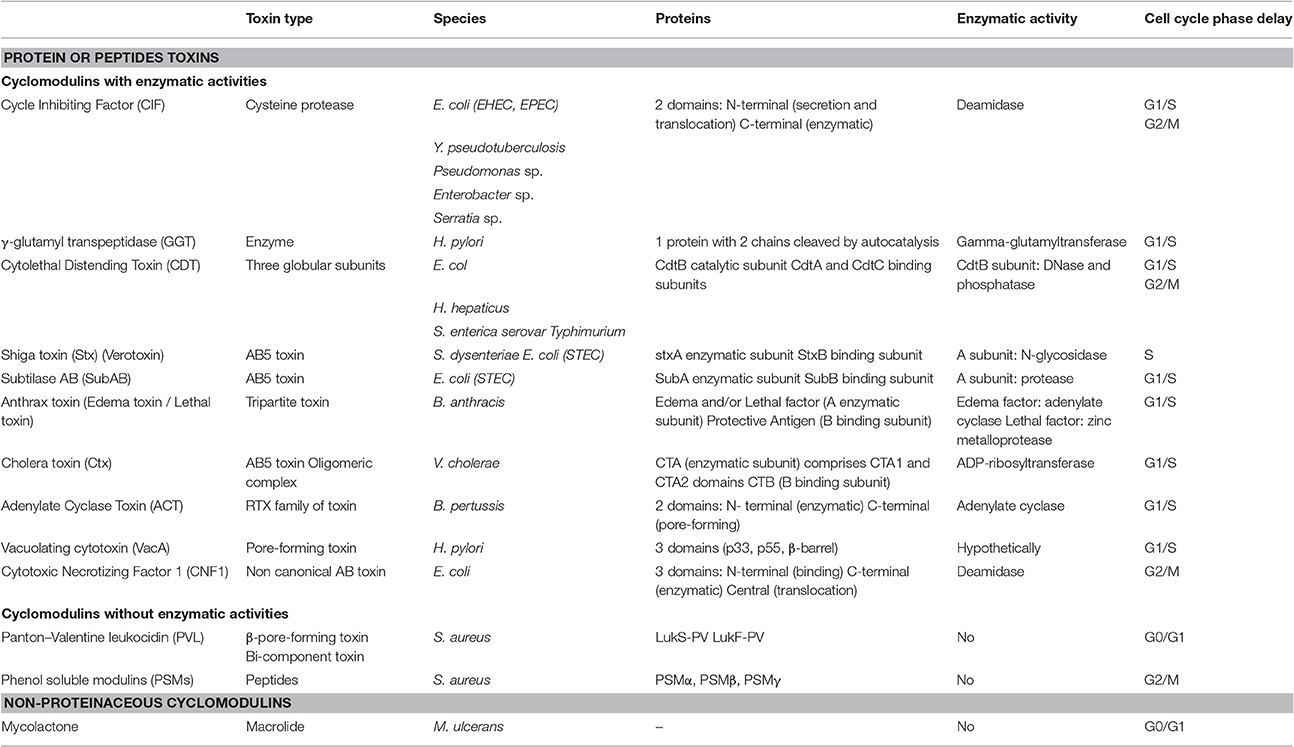
Table 1. Cyclomodulins and their key features.
Finally, it was written that “Similar to B. anthracis, B. pertussis produces an adenylate cyclase toxin (ACT), which belongs to the AB5 toxin family (Figure 3) (Melvin et al., 2014).”
A correction has been made to section Cyclomodulins: Protein Toxins or Peptide Toxins, subsection Cyclomodulins with Enzymatic Activities, sub-subsection Adenylate cyclase toxin, first paragraph. The corrected paragraph appears below:
Bordetella pertussis, a Gram-negative bacterial pathogen, is responsible for respiratory infections manifested by whooping cough, with possible lethal complications (Table 1).
Similar to B. anthracis, B. pertussis produces an adenylate cyclase toxin (ACT) (Figure 3) (Melvin et al., 2014). ACT of B. pertussis is a ~200 kDa protein consisting of two functional domains: an N- terminal adenylate cyclase enzyme domain (AC domain) and a pore-forming or hemolysin domain (Hly domain), which belongs to the RTX (Repeats in Toxin) family (Carbonetti, 2010). ACT displays the hemolytic/pore-forming activity along with the adenylate cyclase enzymatic activity (Basler et al., 2006). ACT is released by the Type I bacterial secretion system (Glaser et al., 1988). The Hly domain is required for the delivery of the AC domain into the cell cytosol either via binding to the αmβ2 integrin (CD11b/CD18) as a cell receptor or by direct translocation to the eukaryotic cells cytosol (Guermonprez et al., 2001; Eby et al., 2010).
The authors apologize for this error and state that this does not change the scientific conclusions of the article in any way.
Conflict of Interest Statement
The authors declare that the research was conducted in the absence of any commercial or financial relationships that could be construed as a potential conflict of interest.
References
Basler, M., Masin, J., Osicka, R., and Sebo, P. (2006). Pore-forming and enzymatic activities of Bordetella pertussis adenylate cyclase toxin synergize in promoting lysis of monocytes. Infect. Immun. 74, 2207–2214. doi: 10.1128/IAI.74.4.2207-2214.2006
Carbonetti, N. H. (2010). Pertussis toxin and adenylate cyclase toxin: key virulence factors of Bordetella pertussis and cell biology tools. Future Microbiol. 5, 455–469. doi: 10.2217/fmb.09.133
Eby, J. C., Ciesla, W. P., Hamman, W., Donato, G. M., Pickles, R. J., Hewlett, E. L., et al. (2010). Selective Translocation of the Bordetella pertussis adenylate cyclase toxin across the basolateral membranes of polarized epithelial cells. J. Biol. Chem. 285, 10662–10670. doi: 10.1074/jbc.M109.089219
Glaser, P., Sakamoto, H., Bellalou, J., Ullmann, A., and Danchin, A. (1988). Secretion of cyclolysin, the calmodulin-sensitive adenylate cyclase-haemolysin bifunctional protein of Bordetella pertussis. EMBO J. 7, 3997–4004.
Guermonprez, P., Khelef, N., Blouin, E., Rieu, P., Ricciardi-Castagnoli, P., Guiso, N., et al. (2001). The adenylate cyclase toxin of Bordetella pertussis binds to target cells via the αMβ2gf integrin (CD11b/CD18). J. Exp. Med. 193, 1035–1044. doi: 10.1084/jem.193.9.1035
Keywords: eukaryotic cell cycle alteration, bacterial toxins, cyclomodulins, colonization, invasion, infective efficiency, reduced host response
Citation: El-Aouar Filho RA, Nicolas A, De Paula Castro TL, Deplanche M, De Carvalho Azevedo VA, Goossens PL, Taieb F, Lina G, Le Loir Y and Berkova N (2017) Corrigendum: Heterogeneous Family of Cyclomodulins: Smart Weapons That Allow Bacteria to Hijack the Eukaryotic Cell Cycle and Promote Infections. Front. Cell. Infect. Microbiol. 7:364. doi: 10.3389/fcimb.2017.00364
Received: 20 July 2017; Accepted: 28 July 2017;
Published: 14 August 2017.
Edited and reviewed by: Georgios N. Belibasakis, Karolinska Institute (KI), Sweden
Copyright © 2017 El-Aouar Filho, Nicolas, De Paula Castro, Deplanche, De Carvalho Azevedo, Goossens, Taieb, Lina, Le Loir and Berkova. This is an open-access article distributed under the terms of the Creative Commons Attribution License (CC BY). The use, distribution or reproduction in other forums is permitted, provided the original author(s) or licensor are credited and that the original publication in this journal is cited, in accordance with accepted academic practice. No use, distribution or reproduction is permitted which does not comply with these terms.
*Correspondence: Nadia Berkova, bmFkZWpkYS5iZXJrb3ZhQGlucmEuZnI=