 Ella D. Rook
 Kevin J. Holmes
- Department of Psychology, Reed College, Portland, OR, United States
Being fat is often described as a “disease”—a form of linguistic framing that may exacerbate bias against fat people rather than reduce it as intended. Framing fatness as a matter of equal treatment and respect (“fat rights”) may be more effective for bias reduction. In a preregistered experiment (N = 401), we directly compared the effects of disease and fat-rights framing on attitudes toward fat people. Participants read a news article that affirmed or negated (a) the claim that fatness is a disease and (b) the unacceptability of weight discrimination, and then expressed their attitudes toward fat people. Disease-affirming articles yielded more negative attitudes than disease-negating articles, but only for participants who explicitly recognized that the article influenced their attitudes. For these participants, fat-rights framing also had a significant impact: those who read a disease-affirming article expressed less negative attitudes toward fat people when the article also affirmed rather than negated fat rights. These results show that language can shift public opinion about fatness when people are aware of its persuasive power. Our findings support a social-pragmatic account of linguistic framing and have implications for real-world anti-bias efforts.
1 Introduction
Obesity is a “disease,” declared the American Medical Association (AMA) in a controversial 2013 statement (American Medical Association, 2013). This message was intended to draw attention to the presumptive severity of the condition, spur research and education on its causes, and reduce stigma against fat people1 (Pollack, 2013). Critics feared, however, that the disease label would undermine anti-bias efforts: characterizing fat bodies as diseased, and fatness as “a major public health problem” (American Medical Association, 2013, p. 3), would only stigmatize fat people further (Campos et al., 2006; Garrey, 2013; Hansen, 2014).
The hopes and fears associated with framing fatness as a disease align with research on the subtle implications of linguistic messages and their consequences for thought and behavior (Lakoff and Johnson, 1980; Flusberg et al., 2022b, in revision; Holmes et al., 2022). According to cognitive theories of language comprehension, framing a concept like fatness in a particular way encourages the listener to construct a mental model of the concept that corresponds to the speaker's intended message (Zwaan and Radvansky, 1998; Bergen, 2012). Labeling fatness a disease communicates that it is grounded in genetic and physiological causes beyond one's control and that fat people therefore do not deserve blame (Crandall and Reser, 2005). A number of studies have demonstrated that this disease frame—whether instantiated in real news articles or researcher-constructed language—has a measurable impact on observers' attitudes and beliefs (e.g., Saguy et al., 2014; Thibodeau et al., 2015; Hoyt et al., 2017; Ata et al., 2018). For example, reading that fatness is caused by biogenetic factors can lead people to question whether weight is controllable (Ata et al., 2018) and reduce their support for weight-based health insurance fees (Thibodeau et al., 2015). Such findings seem to corroborate the AMA's assumption that framing fatness as a disease would mitigate anti-fat bias.
Other research suggests, however, that disease framing communicates a more complex message about the etiology of fatness. According to the stigma asymmetry model, labeling fatness a disease implies that it is a static, unchangeable characteristic, absolving fat people from responsibility but suggesting that they share a deep-seated negative essence (Hoyt et al., 2017). Disease framing therefore communicates that fat people, like diseases, are inherently undesirable and should be avoided (Haslam and Kvaale, 2015). Moreover, analyses of news media language indicate that disease framing does not fully eliminate blame: when medical “solutions” to fatness are unsuccessful, this is cast as a personal failing (Atanasova and Koteyko, 2017; Baker et al., 2020). Consistent with these analyses, several studies have shown that disease framing often exacerbates anti-fat bias (Saguy et al., 2014; Frederick et al., 2016a; Hoyt et al., 2017). Frederick et al. (2016a), for example, found that participants who read a news article that described fatness as a public health crisis expressed more negative attitudes toward fat people (e.g., judging them unattractive and lazy), compared to those who read an article about another health condition. Therefore, contra the AMA's endorsement, using disease framing to combat anti-fat bias can backfire (cf. Hoyt et al., 2017).
Two alternatives to disease framing, derived from grassroots social movements, have been proposed as more promising routes to bias reduction. The Health at Every Size (HAES) movement decouples fatness from health, citing evidence that health is influenced more by lifestyle factors such as nutrition and exercise than by body mass (Bacon, 2010). Compared to disease framing, this message has been found to elicit more favorable attitudes toward fat people (Saguy et al., 2014; Frederick et al., 2016a,b, 2020). Nevertheless, critics argue that HAES ultimately stigmatizes fatness by implying that “good fatties”—those who care about their appearance and prioritize their health—are more deserving of acceptance than other fat people (Gibson, 2021).
The fat-rights movement, by contrast, centers the goal of eliminating anti-fat bias. It rejects medicalizing terms like “obesity” and asserts that people of all sizes—like all genders and races—deserve equal treatment and respect, regardless of their ability or desire to engage in health-promoting behaviors (Saguy, 2013; Hansen, 2014; Gordon, 2020). Although fat-rights and HAES messages are often paired in framing studies as “fat-positive” frames (e.g., Frederick et al., 2016b, 2020), some evidence suggests that fat-rights messages are more effective for bias reduction. In the aforementioned study by Frederick et al. (2016a), a HAES-framed article and a fat-rights-framed article both reduced support for a punitive weight-based policy intervention, but only the fat-rights-framed article reduced anti-fat attitudes. By characterizing weight discrimination as a basic human-rights issue, fat-rights messages may be especially persuasive in combatting stigma.
Importantly, however, the effects of fat-rights framing have never been directly compared to those of disease framing, independent of other weight-related framing messages. Such a comparison is important for establishing fat-rights framing as an effective alternative that does not carry the stigmatizing implications of HAES. Moreover, research on disease and fat-rights framing has given little attention to the psychological mechanisms that underlie their effects. Recent work on framing in other domains highlights pragmatic inference—“reading between the lines” and interpreting language in context—as a key mechanism (e.g., Leong et al., 2017; Flusberg et al., 2022a,b; Holmes et al., 2022). As people process language, they draw inferences about the communicator's intentions, trusting that the language used to describe the topic at hand was chosen to be relevant and informative (Grice, 1975; Goodman and Frank, 2016; Christiansen and Chater, 2022). For example, readers might infer from an article that frames the alleged perpetrator of a crime as the “real” victim (i.e., of false allegations) that the writer chose the victim label to signal who deserved support. A recent study showed that this kind of pragmatic inference underlies the effects of so-called “victim framing”: applying the victim label to an alleged perpetrator of sexual assault increased support for him and decreased support for his accuser, but only for participants who explicitly cited the label as influencing their evaluations (Flusberg et al., 2022b). Disease and fat-rights framing may work in a similar way. Observers may infer that a given frame was chosen because it communicates relevant information about fatness, leading them to update their own attitudes toward fat people accordingly.
In the present study, we directly compared the effects of disease and fat-rights framing and explored pragmatic inference as a mechanism underlying them. Participants read a news article that affirmed or negated both (a) a disease-focused message and (b) a fat-rights message (i.e., that weight discrimination is unacceptable). This enabled us to assess the independent and joint effects of the two messages. After reading the article, participants expressed their attitudes toward fat people and indicated whether the article had influenced those attitudes—an index of pragmatic inference. We expected that the disease-affirming message and the fat-rights-negating message would yield more negative attitudes toward fat people than the disease-negating and fat-rights-affirming messages, respectively. Following other framing research (e.g., Flusberg et al., 2022b), we also expected that these framing effects would be driven by participants who inferred that the article was relevant to the topic at hand—that is, those who explicitly cited it as influencing the attitudes they had expressed.
2 Materials and methods
We preregistered our methods and analysis plan (https://aspredicted.org/FJ3_3G1), and all materials and data are available on the Open Science Framework (https://osf.io/cvfr8/).
2.1 Participants
In February 2022, we recruited 436 participants from Amazon Mechanical Turk via CloudResearch (Litman et al., 2017). All were U.S. residents and had ≥95% approval on ≥100 prior studies. Participants who failed an initial attention check (“… check the option ‘Other' below and enter the number 8 in the text box;” n = 15) were excluded, as were those who did not complete all measures (n = 20).
The final sample consisted of 401 participants, with roughly 100 per condition following other framing research (e.g., Flusberg et al., 2022b). The sample included 200 women, 191 men, and 10 participants of other genders, with a mean age of 43.0 (SD = 12.9). Most participants (75%) identified as white; 10% identified as Asian/Asian American/Indian, 10% as African American/Black, 4% as Hispanic/Latinx, 1% listed other races or ethnicities, and 2% did not specify their race/ethnicity (participants who selected multiple identities are included in each category above). The sample included 176 participants who identified as fat, obese, or overweight and 81 who indicated they had experienced weight discrimination. See the Supplementary material for additional demographics.
2.2 Design and materials
The study had a 2 (disease framing: affirming/negating) × 2 (fat-rights framing: affirming/negating) design. Four fictionalized news articles, purportedly from the New York Times, represented all combinations of the two types of framing (adapted from Frederick et al., 2020; see Table 1). Each article described findings from a scientific study on how weight affects people's health and social lives. The order of the disease and fat-rights segments within each article was counterbalanced across participants. The affirming and negating versions of each segment were written to be minimally different and to reflect contrasting ideas about fatness from real news media (Saguy, 2013; Frederick et al., 2020). These ideas mirror the mixed body of scientific evidence on weight and health: while fatness has been linked to increased risk of serious health conditions and mortality (Bray, 2004), the evidence falls short of establishing a causal influence and suggests that fatness can even be protective (Campos et al., 2006).
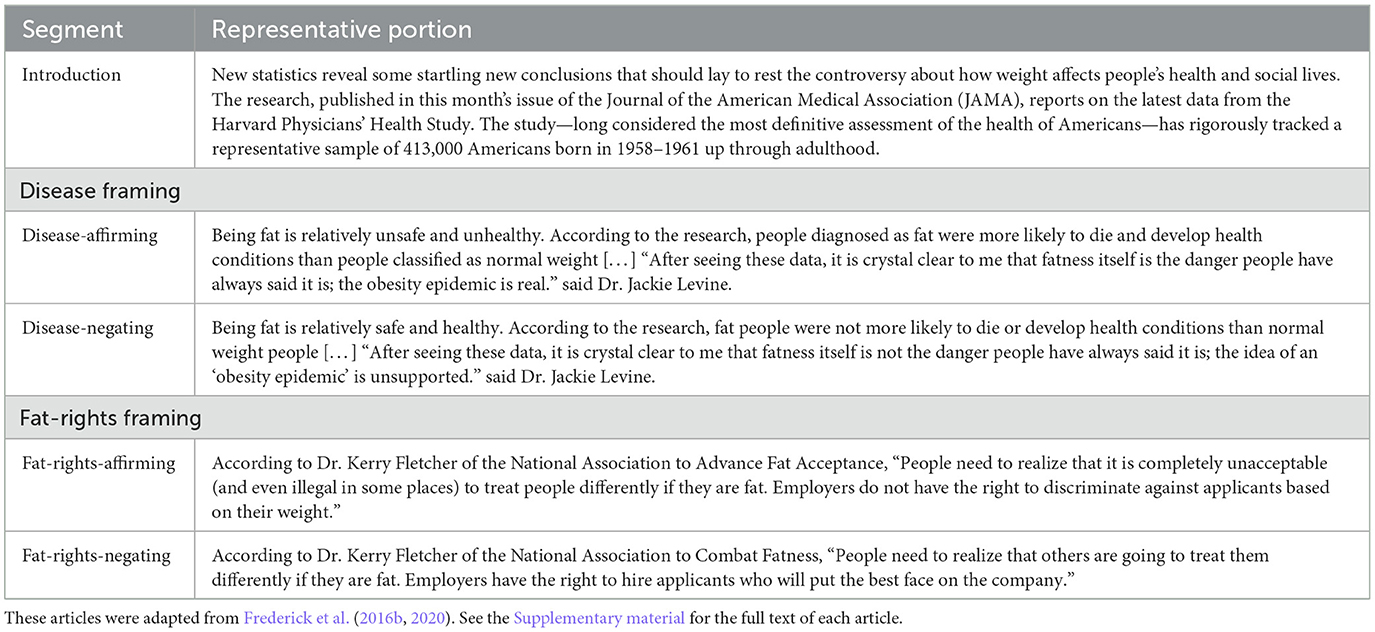
Table 1. Framing articles.
To verify the content of the articles, we presented them to a separate group of 101 participants. Each participant read one of the articles and rated the extent to which it communicated 24 fatness-related claims on a 7-point scale (1, not at all; 7, a great deal; α = 0.87; see Supplementary material). These statements were adapted from measures of anti-fat bias that include items equating fatness with a disease (e.g., “Being fat is very bad for your health;” Crandall, 1994; Saguy et al., 2014) and from a measure of attitudes toward transgender individuals that includes items endorsing fat-rights values (e.g., “Fat people should be treated with the same respect and dignity as any other person;” Kanamori et al., 2017). We included the latter set of items because their content is underrepresented in weight-related framing research.
An exploratory factor analysis indicated that the items clustered into three categories, which we labeled health concern (6 items, several disease-related; α = 0.93), devaluation (9 items, several fat-rights-related; α = 0.87), and negative emotion (8 items; α = 0.93). As expected, articles with disease-affirming language (M = 6.21, SD = 0.93) communicated greater health concern than articles with disease-negating language (M = 3.39, SD = 1.71), F(1, 97) = 115.06, p < 0.001, = 0.54, and articles with fat-rights-negating language (M = 4.27, SD = 1.59) communicated greater devaluation than articles with fat-rights-affirming language (M = 3.58, SD = 1.20), F(1, 97) = 7.49, p = 0.007, = 0.07. These results confirm that the content of the four articles differed along the relevant dimensions. See the Supplementary material for factor loadings and additional analyses of the content ratings.
The main study included an anti-fat bias measure with 24 items similar to those in the content-rating study but reworded to assess participants' own attitudes toward fat people (α = 0.87; see Table 2). We averaged agreement ratings across all items to create a composite anti-fat bias score for each participant.
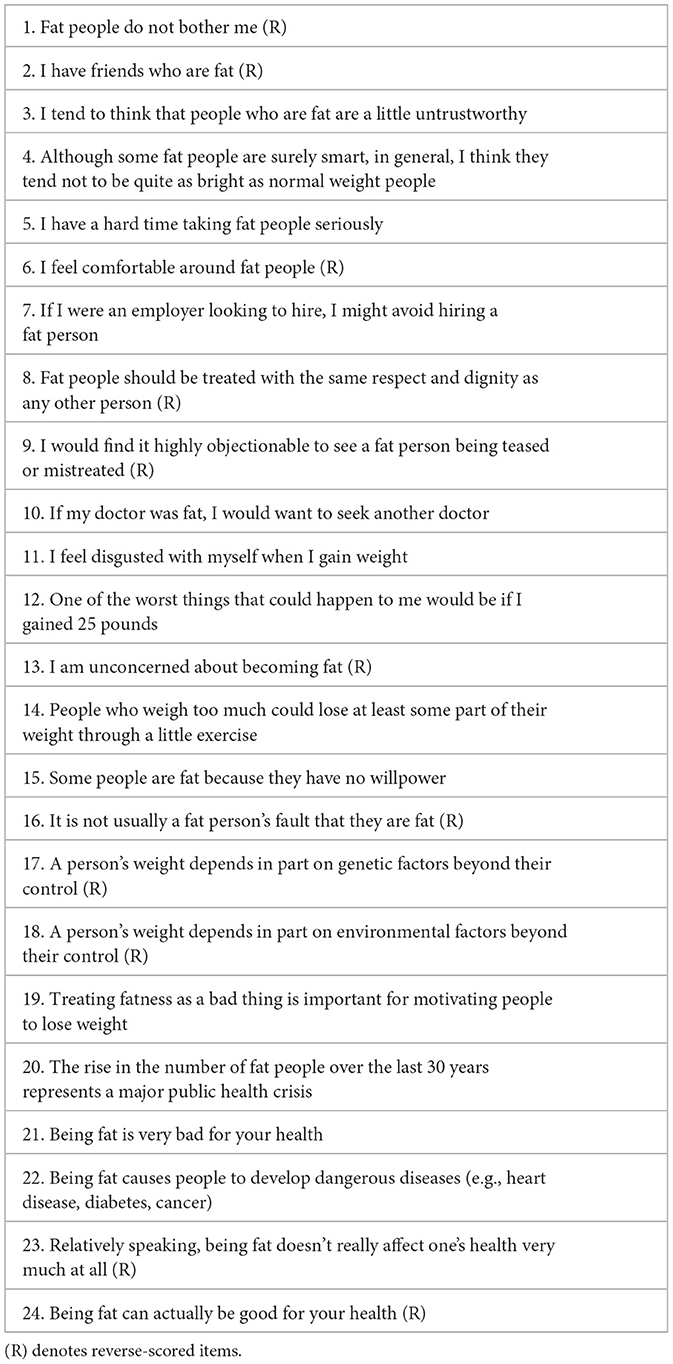
Table 2. Anti-fat bias measure.
2.3 Procedure
The study was presented online via Qualtrics. Following the attention check, participants were shown one of the articles. After 1 min, they were given the option to advance to the next screen. There they completed the anti-fat bias measure, rating their agreement with each statement on a 7-point scale (1, strongly disagree; 7, strongly agree). The instructions emphasized that participants should respond based on their personal beliefs. On the following screen, participants indicated whether they thought the article had influenced their responses, even slightly. If they indicated that it had, the article was shown again and participants were asked to copy and paste the part they found most influential into a text box. Finally, participants answered a series of demographic questions.
3 Results
3.1 Main analyses
To assess the effects of framing, we conducted a preregistered 2 (disease framing) × 2 (fat-rights framing) × 2 (order: disease/fat-rights segment first) ANOVA on composite anti-fat bias scores. As shown in Figure 1, there was a main effect of disease framing, F(1, 393) = 9.80, p = 0.002, = 0.02, with disease-affirming articles (M = 3.76, SD = 0.76) eliciting more negative attitudes toward fat people than disease-negating articles (M = 3.50, SD = 0.86). No other main effects or interactions were significant (ps > 0.09).

Figure 1. Anti-fat bias scores (1, strongly disagree; 7, strongly agree) for all combinations of disease framing and fat-rights framing. Error bars represent ± SEM. **p <0.01, main effect of disease framing; ns, nonsignificant.
To examine the role of pragmatic inference, we compared the anti-fat bias scores of participants who recognized that the article they had read influenced their responses (“recognizers;” n = 144) and those who indicated that it did not (“non-recognizers;” n = 257). A 2 (disease framing) × 2 (fat-rights framing) × 2 (recognizers/non-recognizers) ANOVA yielded a three-way interaction, F(1, 393) = 4.12, p = 0.04, = 0.01. To unpack this interaction, we conducted separate 2 (disease framing) × 2 (fat-rights framing) ANOVAs for recognizers and non-recognizers.
For recognizers, there was an interaction between the two types of framing, F(1, 140) = 9.06, p = 0.003, = 0.06. As shown in Figure 2, disease-affirming articles elicited less negative attitudes toward fat people when they affirmed fat rights (M = 3.66, SD = 0.56, n = 24) than when they negated fat rights (M = 4.06, SD = 0.67, n = 41), t(63) = −2.42, p = 0.02, d = −0.62. In contrast, there was no significant difference in anti-fat bias for disease-negating articles that affirmed fat rights (M = 3.42, SD = 0.67, n = 40) and those that negated fat rights (M = 3.09, SD = 0.85, n = 39), t(77) = 1.94, p = 0.056, d = 0.44. Additionally, disease framing exacerbated anti-fat bias for articles that negated fat rights, t(78) = 5.69, p < 0.001, d = 1.27, but had no significant impact for articles that affirmed fat rights, t(62) = 1.47, p = 0.15, d = 0.38. For non-recognizers, there were no significant framing effects (ps > 0.8).2

Figure 2. Anti-fat bias scores (1, strongly disagree; 7, strongly agree) for all combinations of disease framing and fat-rights framing, for participants who recognized the article as influential (n = 144) and those who did not (n = 257). Error bars represent ± SEM. *p < 0.05, effect of fat-rights framing for disease-affirming articles among recognizers; ns, nonsignificant.
3.2 Additional analyses
To explore background characteristics that might distinguish recognizers from non-recognizers, we entered the following demographic predictors into a logistic regression model (recognizers coded as 1, non-recognizers as 0): age, gender (male, 1; female, 2; other genders not included); race/ethnicity (white, 1; other races/ethnicities, 0), political conservatism (rated from extremely liberal,−50, to extremely conservative, 50), highest level of education completed (from some high school, 1, to doctorate/professional degree, 9), and annual household income (from <$25,000, 1, to >$200,000, 5), body weight self-identification (fat/obese/overweight, 1; none of these, 0), and whether participants had experienced weight discrimination (yes, 1; no, 0).
Three variables distinguished recognizers from non-recognizers: recognizers were relatively older, β = 0.24, p = 0.04, less likely to be white, β = −0.25, p = 0.03, and more likely to have experienced weight discrimination, β = 0.22, p = 0.05. The framing effects exhibited by recognizers, though strongest for participants with these characteristics, were also found for others (e.g., recognizers who had not experienced weight discrimination; see Supplementary material). None of the other demographic variables were significant predictors (ps > 0.3).
4 Discussion
In the wake of the AMA's recognition of obesity as a disease, the prevalence of disease-focused language about fatness in news media has increased (Baker et al., 2020; Saguy, 2020). Our results show that disease framing has a real impact on attitudes toward fat people. Using an experimental manipulation and researcher-constructed news articles that afforded tight control over extraneous factors, we found that articles affirming the claim that fatness is a disease elicited more negative attitudes than articles negating this claim. Notably, this framing effect was moderated by whether participants explicitly recognized the article as influencing their attitudes. Only recognizers (36% of participants) were affected by disease framing, and for them, this effect was further moderated by whether the article affirmed fat rights. For recognizers, disease-affirming articles that also affirmed fat rights yielded less negative attitudes than otherwise identical articles that negated fat rights. Additionally, for articles that affirmed fat rights, disease framing had no significant impact on recognizers' attitudes. This shows that fat-rights framing—the message that humans deserve equal treatment and respect regardless of their weight—can buffer against the bias-enhancing effect of disease framing, at least for people who recognize the persuasive power of the framing language.
The present study advances understanding of language's influence on anti-fat bias in two key ways. First, although our framing stimuli were closely adapted from previous work, our study is the first to directly compare the effects of disease and fat-rights framing. Disease framing may have been more influential overall for our U.S.-based participants because disease-focused messaging dominates American discourse about fatness. The disease-affirming articles likely reinforced participants' preexisting beliefs about fatness, while the disease-negating articles challenged them. In contrast, the fat-rights message may have seemed novel or radical for some participants (Frederick et al., 2016a), even those who endorsed equal rights for other characteristics like gender and race. Fat-rights framing might have a stronger impact in contexts less concerned with links between weight and health. Nevertheless, our results show that even when such links are salient, fat-rights framing has the potential to counteract the effects of disease framing among people who find the language influential.
Second, our findings dovetail with recent research implicating pragmatic inference as a mechanism underlying the effects of framing (e.g., Flusberg et al., 2022a,b; Holmes et al., 2022). Framing fatness as a disease or a matter of basic human rights communicates a host of implications—that fatness is an inherent negative attribute (Hoyt et al., 2017) or that eliminating weight discrimination is morally imperative (Gordon, 2020). That significant framing effects were observed only for recognizers suggests that these participants picked up on the implications of the frames. Specifically, they may have inferred that the article writer's chosen frame is a fitting characterization of fatness and then incorporated its content into their own attitudes. Non-recognizers—those who reported not finding the article influential—either failed to draw this pragmatic inference or were unmoved by it, and exhibited no framing effects as a result.
The contrast between recognizers and non-recognizers argues against a simple priming explanation for the results. On such an account, the article's content activated certain ideas captured by the anti-fat bias measure, leading participants to reflexively respond in a consistent manner rather than express their genuine attitudes toward fat people. This account does not explain why framing effects were only observed for participants who were explicitly aware of the article's impact (see Flusberg et al., 2022a,b). Moreover, framing affected aspects of anti-fat bias not specifically communicated by the articles. For example, as detailed in the Supplementary material, disease-affirming articles that also affirmed fat rights communicated similar levels of negative emotion toward fat people as those that negated fat rights, but participants who read such articles expressed significantly less negative emotion. This suggests that the articles affected participants' general attitudes toward fat people, not just attitudes specific to the articles' content.
Interestingly, in our exploratory analysis of participant background characteristics, we found that recognizers were older, less likely to be white, and more likely to have experienced weight discrimination. Although framing effects were not limited to participants with these characteristics, future research might explore why such participants were especially apt to find the framing article influential. Another approach would be to assess pragmatic inference more directly. For example, participants could be asked to explicitly identify the communicative intentions underlying a writer's choice to use disease or fat-rights framing. The ability to draw pragmatically appropriate inferences about the writer's intentions might predict the strength of the corresponding framing effects, as has been found in other studies (Leong et al., 2017; Wu et al., 2021; Holmes et al., under review).
More generally, future work should give careful consideration to the social-pragmatic context in which messages about fatness are communicated and received. Like our researcher-constructed stimuli, real news articles about fatness often include multiple frames (Baker et al., 2020), which may invite differing pragmatic inferences. Our findings suggest that fat-rights framing—relatively scarce but gaining traction in mainstream media (Atanasova and Koteyko, 2017)—may be effective when presented alongside disease framing in actual articles. That said, many articles also include images that depict fat people in dehumanizing ways (e.g., headless bodies; Heuer et al., 2011). How linguistic framing combines with framing in other modalities to shape anti-fat bias in real-world contexts is an important question for future research.
Our study had two other limitations that raise additional research questions. First, do the varieties of linguistic framing investigated in the present study affect implicit, not just explicit, anti-fat bias? This question is timely because implicit anti-fat bias has been on the rise in the U.S. From 2007 to 2016, there was a 15% increase in such bias, as assessed by implicit association tests, even as explicit anti-fat bias and implicit bias toward other marginalized groups (e.g., Black, gay, older, and disabled people) held steady or decreased over the same period (Charlesworth and Banaji, 2019). Some previous framing studies have used implicit measures of anti-fat bias that could be readily adapted to the present paradigm (e.g., Ata et al., 2018).
Second, how do the effects of disease and fat-rights framing compare not just to each other but also to language about fatness that avoids framing altogether? This question, while interesting, poses several methodological challenges. Some studies on disease and fat-rights framing have included control stimuli about unrelated health issues (e.g., alcohol use or cancer; O'Brien et al., 2010; Frederick et al., 2016a), but these stimuli may differ from their intended equivalents on a host of uncontrolled dimensions, including vividness, concreteness, and affective content (Thibodeau and Boroditsky, 2015). Moreover, even seemingly neutral language invites pragmatic inferences. For example, readers of an article about fatness with no common weight-related frames might attempt to infer the writer's motive for evading them (cf. Moty and Rhodes, 2021). Such an article is a different stimulus—not a truly neutral one—and may function as a frame in itself (Flusberg et al., in revision). These are important considerations in interpreting all linguistic framing effects, not just those pertaining to fatness.
In conclusion, contrary to the AMA's declaration, our findings show that framing fatness as a disease does not reduce anti-fat bias. Rather, this framing has the opposite effect, at least for people who recognize its persuasive power. Fat-rights framing, however, can serve to counteract this effect. Although reducing stigma was one of the AMA's stated goals in labeling obesity a disease, its ultimate objective was to lower the prevalence of the condition and encourage people to lose weight, on the assumption that fatness is “a major public health problem” (American Medical Association, 2013, p. 3). The message that fat people have a disease that should be treated and eliminated conveys sympathy or pity for them rather than dignity and respect. The fat-rights movement offers the alternative perspective that fatness is value-neutral or even desirable, and that weight discrimination is unacceptable. We suggest that this message should be taken seriously in research investigating how language is deployed to perpetuate—and resist—anti-fat bias.
Data availability statement
The datasets presented in this study can be found in online repositories. The names of the repository/repositories and accession number(s) can be found below: Open Science Framework; https://osf.io/cvfr8/.
Ethics statement
The studies involving humans were approved by Reed College Institutional Review Board. The studies were conducted in accordance with the local legislation and institutional requirements. The participants provided their written informed consent to participate in this study.
Author contributions
ER: Conceptualization, Formal analysis, Funding acquisition, Investigation, Methodology, Writing—original draft. KH: Conceptualization, Formal analysis, Supervision, Writing—review & editing.
Funding
The author(s) declare financial support was received for the research, authorship, and/or publication of this article. This work was supported by the Paul K. Richter and Evalyn Elizabeth Cook Richter Memorial Fund, a John Leonard Adams Fellowship to ER, and a James McKeen Cattell Sabbatical Award to KH.
Acknowledgments
We thank Enriqueta Canseco-Gonzalez, Stephen Flusberg, and members of the Thought Lab at Reed College for helpful discussion. The study reported in this article was part of an undergraduate thesis by ER at Reed College. Acknowledging that our identities can shape our approach to science, we wish to inform readers that one author self-identifies as fat and the other author does not.
Conflict of interest
The authors declare that the research was conducted in the absence of any commercial or financial relationships that could be construed as a potential conflict of interest.
Publisher's note
All claims expressed in this article are solely those of the authors and do not necessarily represent those of their affiliated organizations, or those of the publisher, the editors and the reviewers. Any product that may be evaluated in this article, or claim that may be made by its manufacturer, is not guaranteed or endorsed by the publisher.
Supplementary material
The Supplementary Material for this article can be found online at: https://www.frontiersin.org/articles/10.3389/fcomm.2023.1284074/full#supplementary-material
Footnotes
1. ^Following fat-rights advocacy (Gordon, 2020), we use fat and fatness (not obese and obesity) as value-neutral descriptors of body size, analogous to tall and height, respectively. In using the term anti-fat bias or stigma, we adopt the standard definition from the literature: negative attitudes, beliefs, or behavior toward people perceived as fat (Daníelsdóttir et al., 2010).
2. ^As only 8 of 144 recognizers cited the fat-rights segment of the article as most influential (102 cited the disease segment and 34 cited other parts), we were unable to conduct preregistered analyses comparing participants who cited different segments. In the Supplementary material, we report other preregistered analyses assessing framing effects separately for the three content categories identified in the content-rating study. The results converge with the main analyses reported here.
References
American Medical Association (2013). Resolution 420 (A-13): Recognition of Obesity as a Disease. Available online at: https://media.npr.org/documents/2013/jun/ama-resolution-obesity.pdf
Ata, R. N., Thompson, J. K., Boepple, L., Marek, R. J., and Heinberg, L. J. (2018). Obesity as a disease: effects on weight-biased attitudes and beliefs. Stig. Health 3, 406–416. doi: 10.1037/sah0000087
Atanasova, D., and Koteyko, N. (2017). Obesity frames and counter-frames in British and German online newspapers. Health 21, 650–670. doi: 10.1177/1363459316649764
Bacon, L. (2010). Health at Every Size: The Surprising Truth about Your Weight. Dallas, TX: BenBella Books, Inc.
Baker, P., Brookes, G., Atanasova, D., and Flint, S. W. (2020). Changing frames of obesity in the UK press 2008–2017. Soc. Sci. Med. 264:113403. doi: 10.1016/j.socscimed.2020.113403
Bergen, B. K. (2012). Louder Than Words: The New Science of How the Mind Makes Meaning. New York, NY: Basic Books.
Bray, G. A. (2004). Medical consequences of obesity. J. Clin. Endocrinol. Metabol. 89, 2583–2589. doi: 10.1210/jc.2004-0535
Campos, P., Saguy, A. C., Ernsberger, P., Oliver, E., and Gaesser, G. (2006). The epidemiology of overweight and obesity: public health crisis or moral panic? Int. J. Epidemiol. 35, 55–60. doi: 10.1093/ije/dyi254
Charlesworth, T. E. S., and Banaji, M. R. (2019). Patterns of implicit and explicit attitudes: I. long-term change and stability from 2007 to 2016. Psychol. Sci. 30, 174–192. doi: 10.1177/0956797618813087
Christiansen, M. H., and Chater, N. (2022). The Language Game: How Improvisation Created Language and Changed the World. New York, NY: Basic Books.
Crandall, C. S. (1994). Prejudice against fat people: ideology and self-interest. J. Pers. Soc. Psychol. 66, 882–894. doi: 10.1037/0022-3514.66.5.882
Crandall, C. S., and Reser, A. H. (2005). “Attributions and anti-fat bias,” in Weight Bias: Nature, Consequences and Remedies, eds K. D. Brownell, R. M. Puhl, and M. B. Schwartz (New York, NY: Guilford), 83–96.
Daníelsdóttir, S., O'Brien, K. S., and Ciao, A. (2010). Anti-fat prejudice reduction: a review of published studies. Obes. Facts 3, 47–58. doi: 10.1159/000277067
Flusberg, S. J., Holmes, K. J., Thibodeau, P. H., Nabi, R. L., and Matlock, T. (in revision). The Psychology of Framing: How Everyday Language Shapes the Way We Think, Feel, Act.
Flusberg, S. J., Thibodeau, P. H., and Holmes, K. J. (2022a). Even simple framing effects are rational: commentary on Bermúdez. Behav. Brain Sci. 45, e228. doi: 10.1017/S0140525X22000942
Flusberg, S. J., van der Vord, J., Husney, S. Q., and Holmes, K. J. (2022b). Who's the “real” victim? how victim framing shapes attitudes toward sexual assault. Psychol. Sci. 33, 524–537. doi: 10.1177/09567976211045935
Frederick, D. A., Saguy, A. C., and Gruys, K. (2016a). Culture, health, and bigotry: how exposure to cultural accounts of fatness shape attitudes about health risk, health policies, and weight-based prejudice. Soc. Sci. Med. 165, 271–279. doi: 10.1016/j.socscimed.2015.12.031
Frederick, D. A., Saguy, A. C., Sandhu, G., and Mann, T. (2016b). Effects of competing news media frames of weight on antifat stigma, beliefs about weight, and support for obesity-related public policies. Int. J. Obes. 40, 543–549. doi: 10.1038/ijo.2015.195
Frederick, D. A., Tomiyama, A. J., Bold, J. G., and Saguy, A. C. (2020). Can she be healthy at her weight? effects of news media frames on antifat attitudes, dieting intentions, and perceived health risks of obesity. Stig. Health 5, 247–257. doi: 10.1037/sah0000195
Garrey, S. (2013). Calling Obesity a Disease: Fat Acceptance Advocates Predict More Stigma. WBUR. Available online at: https://www.wbur.org/news/2013/06/21/obesity-ama-fat-acceptance (accessed August 20, 2023).
Gibson, G. (2021). Health(ism) at every size: the duties of the “good fatty.” Fat Stud. 11, 22–35. doi: 10.1080/21604851.2021.1906526
Goodman, N. D., and Frank, M. C. (2016). Pragmatic language interpretation as probabilistic inference. Trends Cogn. Sci. 20, 818–829. doi: 10.1016/j.tics.2016.08.005
Grice, H. P. (1975). “Logic and conversation,” in Speech Acts, eds P. Cole and J. L. Morgan (New York, NY: Academic Press), 41–58. doi: 10.1163/9789004368811_003
Hansen, J. (2014). Explode and die! a fat woman's perspective on prenatal care and the fat panic epidemic. Narrat. Inq. Bioeth. 4, 99–101. doi: 10.1353/nib.2014.0050
Haslam, N., and Kvaale, E. P. (2015). Biogenetic explanations of mental disorder: the mixed-blessings model. Curr. Dir. Psychol. Sci. 24, 399–404. doi: 10.1177/0963721415588082
Heuer, C. A., McClure, K. J., and Puhl, R. M. (2011). Obesity stigma in online news: a visual content analysis. J. Health Commun. 16, 976–987. doi: 10.1080/10810730.2011.561915
Holmes, K. J., Doherty, E. M., and Flusberg, S. J. (2022). How and when does syntax perpetuate stereotypes? probing the framing effects of subject-complement statements of equality. Think. Reason. 28, 226–260. doi: 10.1080/13546783.2021.1963841
Holmes, K. J., Wu, S. H., Elpers, N., Doherty, E. M., and Flusberg, S. J. (under review). How Syntax Promotes Stereotypes: Assessing the Role of Pragmatic Inference.
Hoyt, C. L., Burnette, J. L., Auster-Gussman, L., Blodorn, A., and Major, B. (2017). The obesity stigma asymmetry model: the indirect and divergent effects of blame and changeability beliefs on antifat prejudice. Stig. Health 2, 53–65. doi: 10.1037/sah0000026
Kanamori, Y., Cornelius-White, J. H. D., Pegors, T. K., Daniel, T., and Hulgus, J. (2017). Development and validation of the transgender attitudes and beliefs scale. Arch. Sex. Behav. 46, 1503–1515. doi: 10.1007/s10508-016-0840-1
Leong, L. M., McKenzie, C. R., Sher, S., and Müller-Trede, J. (2017). The role of inference in attribute framing effects. J. Beh. Decis. Mak. 30, 1147–1156. doi: 10.1002/bdm.2030
Litman, L., Robinson, J., and Abberbock, T. (2017). TurkPrime.com: a versatile crowdsourcing data acquisition platform for the behavioral sciences. Beh. Res. Methods 49, 433–442. doi: 10.3758/s13428-016-0727-z
Moty, K., and Rhodes, M. (2021). The unintended consequences of the things we say: what generic statements communicate to children about unmentioned categories. Psychol. Sci. 32, 189–203. doi: 10.1177/0956797620953132
O'Brien, K. S., Puhl, R. M., Latner, J. D., Mir, A. S., and Hunter, J. A. (2010). Reducing anti-fat prejudice in preservice health students: a randomized trial. Obes. 18, 2138–2144. doi: 10.1038/oby.2010.79
Pollack, A. (2013). A.M.A. recognizes obesity as a disease. The New York Times. Available online at: https://www.nytimes.com/2013/06/19/business/ama-recognizes-obesity-as-a-disease.html?_r=0 (accessed August 20, 2023).
Saguy, A. C. (2013). What's Wrong with Fat? New York, NY: Oxford University Press. doi: 10.1093/acprof:oso/9780199857081.001.0001
Saguy, A. C. (2020). “Representations of fatness by experts and the media and how this shapes attitudes,” in The Oxford Handbook of the Sociology of Body and Embodiment, eds N. Boero and K. Mason (New York, NY: Oxford University Press), 105–119. doi: 10.1093/oxfordhb/9780190842475.013.7
Saguy, A. C., Frederick, D., and Gruys, K. (2014). Reporting risk, producing prejudice: how news reporting on obesity shapes attitudes about health risk, policy, and prejudice. Soc. Sci. Med. 111, 125–133. doi: 10.1016/j.socscimed.2014.03.026
Thibodeau, P. H., and Boroditsky, L. (2015). Measuring effects of metaphor in a dynamic opinion landscape. PLoS ONE 10, e0133939. doi: 10.1371/journal.pone.0133939
Thibodeau, P. H., Perko, V. L., and Flusberg, S. J. (2015). The relationship between narrative classification of obesity and support for public policy interventions. Soc. Sci. Med. 141, 27–35. doi: 10.1016/j.socscimed.2015.07.023
Wu, S. H., Elpers, N., Doherty, E. M., Flusberg, S. J., and Holmes, K. J. (2021). Pragmatic reasoning ability predicts syntactic framing effects on social judgments. Proc. Ann. Conf. Cogn. Sci. Soc. 43, 3381.
Keywords: framing, language, anti-fat bias, pragmatic inference, fat rights, attitude change
Citation: Rook ED and Holmes KJ (2023) How language shapes anti-fat bias: comparing the effects of disease and fat-rights framing. Front. Commun. 8:1284074. doi: 10.3389/fcomm.2023.1284074
Received: 27 August 2023; Accepted: 27 November 2023;
Published: 18 December 2023.
Edited by:
Allison Kwesell, Embry–Riddle Aeronautical University, United StatesReviewed by:
Tara Coltman-Patel, Lancaster University, United KingdomEmma Putland, Lancaster University, United Kingdom
Copyright © 2023 Rook and Holmes. This is an open-access article distributed under the terms of the Creative Commons Attribution License (CC BY). The use, distribution or reproduction in other forums is permitted, provided the original author(s) and the copyright owner(s) are credited and that the original publication in this journal is cited, in accordance with accepted academic practice. No use, distribution or reproduction is permitted which does not comply with these terms.
*Correspondence: Kevin J. Holmes, a2pob2xtZXNAcmVlZC5lZHU=