 Melissa Santibañez
 Paul M. Boylan
 Frank P. Paloucek3†
 Joshua Caballero
- 1Department of Pharmacy Practice, Nova Southeastern University, Barry and Judy Silverman College of Pharmacy, Fort Lauderdale, FL, United States
- 2Department of Pharmacy; Clinical and Administrative Sciences, The University of Oklahoma Health Sciences Center, College of Pharmacy, Oklahoma City, OK, United States
- 3Department of Pharmacy Practice, University of Illinois at Chicago, College of Pharmacy, Chicago, IL, United States
- 4Department of Clinical and Administrative Pharmacy, University of Georgia, College of Pharmacy, Athens, GA, United States
Introduction
The Doctor of Pharmacy (Pharm.D.) degree provides the requisite training to prepare graduates to practice clinical pharmacy (American Association of Colleges of Pharmacy, 2024). However, Pharm.D. conferral alone is not a guarantee of successful pharmacist licensure, which is the minimum benchmark of competency to practice pharmacy in direct patient care roles in the United States (Dixon, 2023).
A current workforce crisis exists, with both new and established pharmacists working amidst often caustic occupational conditions which have encouraged many new graduates to reconsider direct patient care careers and instead pursue innovative, non-traditional pharmacist roles (Chappell, 2023). This pivot has led to more pharmacists not pursuing pharmacist licensure, often harnessing the power and accessibility of social media to promote themselves in these new roles while still often claiming to also have practice expertise. As a result, a rising tide of self-proclaimed “experts,” particularly in newer entrepreneurial roles, has increased across social media to capture followers; however, it is unclear exactly how peers, employers, and professional organizations are vetting such individuals as “experts” for opportunities like platform presentations when many of them lack pharmacist licensure, additional terminal degrees (e.g., Masters, Doctor of Philosophy), certifications, or other discernible real-world practice experience to justify their stated expertise in pharmacy practice. Meanwhile, credentialed and licensed pharmacists often remain as untapped resources to effect practice change from the lens of actual practice experience. Despite the increasing influence of social media platforms which newer generations of pharmacists may be better positioned to capitalize, the argument can be made that promoting practice expertise on social media does not obviate the need for pharmacist licensure in order to maintain a current connection to practice-related healthcare issues. This commentary calls to action the urgent need for increased transparency in the recruitment and peer review processes of pharmacy experts and speakers across social media, also acknowledging the onus that our peers and institutions have for the current overabundance of such self-proclaimed experts and proposing strategies to effectively identify and elevate pharmacists with verified expertise.
Current educational landscape
In pharmacy education, the current landscape is tumultuous and has been described as “Darwinian,” with Pharm.D. program enrollment dropping more than 10% from 2021 to 2022, North American Pharmacist Licensure Examination (NAPLEX®) first-time pass rates steadily declining, and more graduates choosing non-traditional positions outside of direct patient care [Brown, 2020; American Association of Colleges of Pharmacy (AACP), 2023]. Among graduates sitting for the NAPLEX from 2021 through 2023, mean first-time pass rates dropped from 81.3% to 77.5%, with ~2,500 fewer individuals sitting for their first attempt in 2023 compared to 2021 [National Association of Boards of Pharmacy (NABP), 2024]. Similarly, among the 8,999 pharmacy graduates representing 138 schools who completed the 2023 American Association of Colleges of Pharmacy (AACP) Graduating Student Survey, ~21% indicated they would either be seeking employment in a non-direct patient care role or were not actively seeking employment in the upcoming year (Brown, 2020). Furthermore, 6% of respondents indicated feeling unprepared to practice pharmacy, and 18% indicated they would not choose the pharmacy profession if starting their career anew, an observation that has been steadily worsening annually since 2016 [American Association of Colleges of Pharmacy (AACP), 2023; Nau and Kier, 2022]. Taken in context with the Bureau of Labor Statistics' 5% predicted increase for pharmacist positions from 2023 to 2032, it is expected there will be enough employment for new pharmacist graduates, especially within direct patient care settings (e.g., hospitals, clinics) (US Bureau of Labor Statistics, 2024). However, a recent systematic review of self-reported pharmacist burnout in direct patient care revealed a stunning 51% burnout prevalence, associated with longer work hours, unrealistic performance metrics, poor work-life balance, and the coronavirus disease-2019 (COVID-19) pandemic (Dee et al., 2022). This confluence of factors has created unappealing working conditions in many traditional pharmacy roles for new graduates, promoting a pivot in career trajectories (Maine, 2019; Mohammad et al., 2022; McQuade et al., 2022).
The impact of social media
Freshly-minted Pharm.D. graduates are gravitating away from traditional clinical practice and toward innovative non-traditional roles (e.g., medical communications, medical science liaison, consulting, pharmacy marketing), using social media platforms like LinkedIn© to highlight such new positions. The social media landscape is fertile ground and a healthy medium for innovation, particularly for Generation Z pharmacy graduates (O'Hara et al., 2013). Social media is a powerful tool that enables interpersonal connections and elevates profession-wide issues to the forefront; however, social media may also sensationalize the gullible and contribute to misinformation (O'Hara et al., 2013). Peer recognition on social media is drastically different from the critical appraisal that occurs when submitting a research manuscript for publication, applying for a position with patient care responsibilities, or seeking promotion. Social media generally rewards the opposite qualities: immediacy, brevity, and flashiness (O'Hara et al., 2013). This is not at all to discredit the opportunities and exposure available from using social media but rather meant to discourage automatic acceptance of self-reported expertise without thorough vetting. Followers on social media can serve to justify expertise by supporting claims made by pharmacists related to practice advancement opportunities. The impact on healthcare is that the average patient is not aware of these subtleties of self-proclaimed vs. established practice expertise.
Strategies to establish practice expertise
“Expertise” is defined as an individual's skill in a specific field (expertise, 2023). As with all skills, the prerequisite for expertise is dedicated, deliberate, and sustained experience (Guest et al., 2001). Although pharmacy graduates are expected to possess the minimum necessary competence and skills to enter clinical practice, they lack the years of formative experiences necessary to classify themselves as experts, especially so soon into the start of their careers. For added perspective, physician groups previously advocated that they should be recognized as experts only after achieving sustained experiences within their fields, and not solely or immediately due to their degrees, and it took over two decades for this to become the standard for medical expertise (Norman, 2002). It is imperative and necessary that the pharmacy profession urgently adopt a similar position to medicine, discouraging new graduates from referring to themselves as practice experts. By no means do we discourage these individuals from their pursuits of innovative or transformative practices, as this enables the profession to keep evolving; we merely petition our peers to more completely and objectively vet new graduates' qualifications, and we encourage new graduates to amend their titles to something more pertinent to their quest to become experts.
This concern has similarly been expressed by professional pharmacy organizations. The Practice Advancement Initiative (PAI) 2030 report outlines expectations for the pharmacist's role in education and training, namely that “pharmacists practicing in specialty areas should be board certified through the Board of Pharmacy Specialties or other appropriate body” and that “pharmacists should participate in organization-based credentialing and privileging processes to ensure competency within their scope of practice” [American Society of Health-Systems Pharmacists (ASHP) Practice Advancement Initiative (PAI) 2030, 2020]. This is, of course, not an immediately achievable feat across the profession. However, education, training, practice, and experience have been posited as four domains by which definitive expertise should be vetted among peers (Nichols, 2017). One potential avenue to recommend is for institutions to financially support their pharmacists taking board certification exams or obtaining additional practice-related certifications. Since these credentials often have a continuing education requirement, pharmacists are thus required to keep abreast of relevant practice advancements and changes to continue certifying their expertise over time.
Pharmacy faculty and preceptors bear partial responsibility for the recent increase in self-proclaimed experts because in trying to provide new graduates with exposure and unique opportunities for professional development (e.g., platform presentations, guest lectures), this may instill the misconception in trainees that they are now qualified experts on these topics. However, faculty themselves may not always be full content experts on particular topics they teach, given that it is common for faculty in one area to cover content in a different area for many reasons (e.g., faculty turnover, workload reassignments), perpetuating the false expert phenomenon.
As a profession, there is a lack of transparency on criteria for nominating, ranking, and selecting practice experts. Pharmacy organizations have already incorporated strong recommendations to prioritize nominating more early-career pharmacists with practice experience as speakers to promote diversity. One possible solution is to promote development of speaker's bureaus with established rules whereby individuals are able to self-nominate and provide objective measures of their credibility. We must also avoid the temptation to fall into the vicious cycle of self-reviewing one another's papers and instead recruit qualified professionals from outside of our immediate circles, and provide unbiased feedback to each other. For this aim, it may be necessary to implement an element within the educational/programming committees of professional organizations to ensure that standards of equitable representation are being upheld (Nichols, 2017). Similarly, health and pharmacy media content creators have a responsibility to minimize the extent of medical misinformation disseminated on pharmacists' stated practice expertise through their platforms (Sheng et al., 2021; Johnson et al., 2024). We suggest opportunities, stakeholders, and strategies in Table 1 as means to address these concerns.
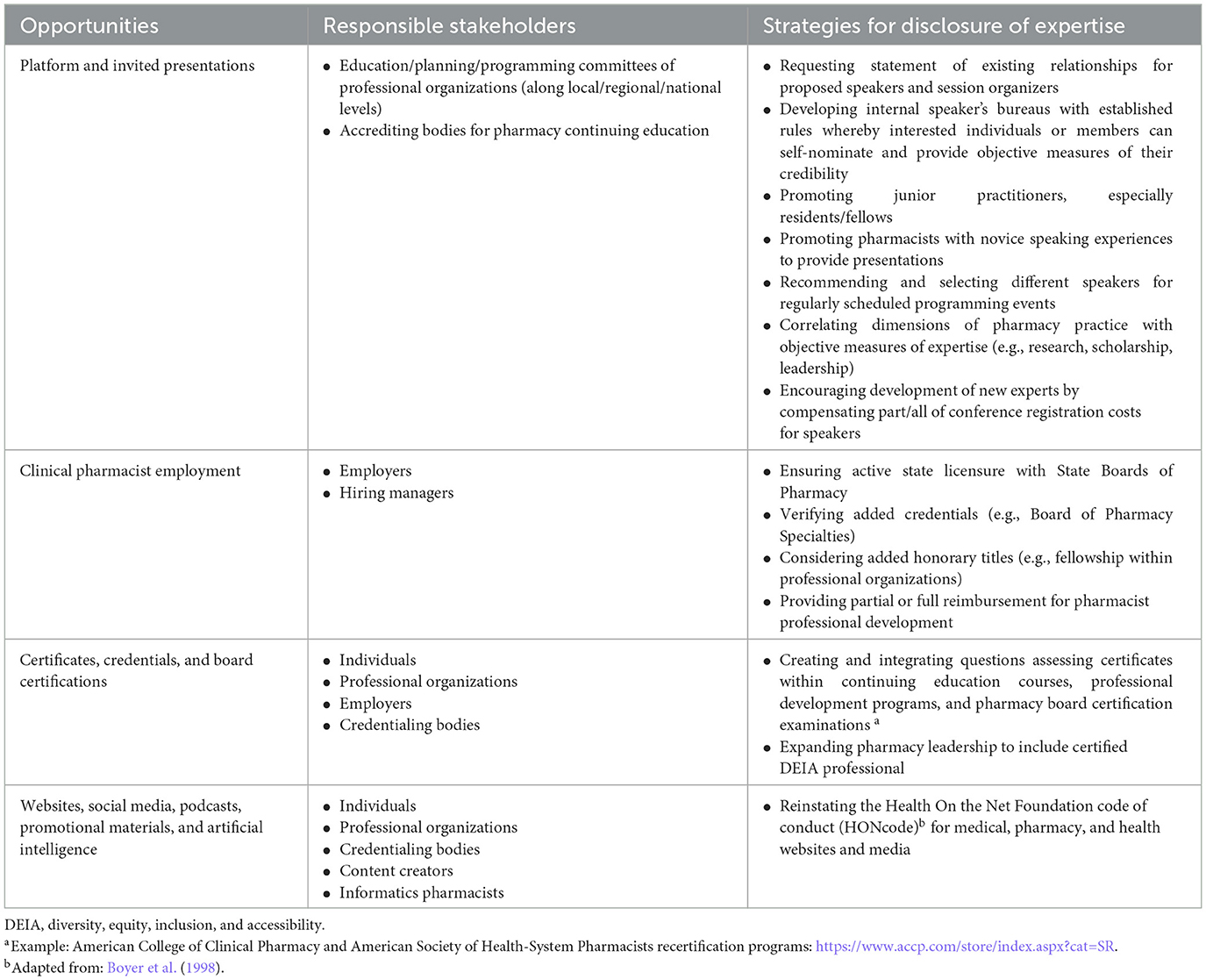
Table 1. Strategies and recommendations for disclosure of pharmacy practice expertise.
Conclusion
Expertise is difficult to measure, and in reality, skills and knowledge are never truly complete, especially in professions rooted in continuing education like medicine and pharmacy. Everyone is a life-long learner and has the capacity to learn and improve their craft. However, for persons proclaiming expertise, it is necessary to distinguish between novices with superficial understanding or interest in a subject vs. established professionals with definitive knowledge and skills. Measures of expertise, such as peer review, board certification, honorary fellowship, and professional associations ensure that the quality of clinical pharmacy knowledge disseminated by experts remains valid. Social media is an effective tool for change and practice advancement, but as professions we need to be more mindful that social media posts alone about an individual's experiences do not automatically translate into subject matter expertise.
Author contributions
MS: Conceptualization, Investigation, Methodology, Project administration, Supervision, Writing – original draft, Writing – review & editing. PB: Conceptualization, Investigation, Methodology, Writing – original draft, Writing – review & editing. FP: Conceptualization, Methodology, Writing – original draft, Writing – review & editing. JC: Conceptualization, Methodology, Writing – original draft, Writing – review & editing.
Funding
The author(s) declare that no financial support was received for the research, authorship, and/or publication of this article.
Acknowledgments
The authors would like to acknowledge The University of Oklahoma Health Sciences Center's publishing support.
Conflict of interest
The authors declare that the research was conducted in the absence of any commercial or financial relationships that could be construed as a potential conflict of interest.
Publisher's note
All claims expressed in this article are solely those of the authors and do not necessarily represent those of their affiliated organizations, or those of the publisher, the editors and the reviewers. Any product that may be evaluated in this article, or claim that may be made by its manufacturer, is not guaranteed or endorsed by the publisher.
References
“expertise, n.”. (2023). OED Online. Oxford University Press. Available at: https://www.oed.com/view/Entry/66556?rskey=NcxdfLandresult=1andisAdvanced=false (accessed July 6, 2023).
American Association of Colleges of Pharmacy (2024). Who We Are. Available at: https://www.aacp.org/article/who-we-are (accessed October 27, 2023).
American Association of Colleges of Pharmacy (AACP) (2023). Graduating Student Survey 2023 National Summary Report. Available at: https://www.aacp.org/sites/default/files/2023-08/2023-gss-national-summary-report.pdf (accessed September 6, 2023).
American Society of Health-Systems Pharmacists (ASHP) Practice Advancement Initiative (PAI) 2030 (2020). Available at: https://www.ashp.org/pharmacy-practice/pai?loginreturnUrl=SSOCheckOnly (accessed September 12, 2023).
Boyer, C., Selby, M., Scherrer, R., and Appel, R. D. (1998). The health on the net code of conduct for medical and health websites. Comput Biol Med. 28, 603–610.
Brown, D. L. (2020). Years of rampant expansion have imposed Darwinian survival-of-the-fittest conditions on the Academy. Am. J. Pharm. Educ. 87:8136. doi: 10.5688/ajpe8136
Chappell, B. (2023). Have a complaint about CVS? So do pharmacists: many just walked out. CVS 204 pharmacist walkout in Kansas City area reflects problems across US. National Public Radio. Available at: https://www.npr.org/2023/09/29/1202365487/cvs-206pharmacists-walkout-protest (accessed October 27, 2023).
Dee, J., Dhuhaibawi, N., and Hayden, J. C. A. (2022). A systematic review and pooled prevalence of burnout in 194 pharmacists. Int. J. Clin. Pharm. 45, 1–10. doi: 10.1007/s11096-022-01520-6
Dixon, D. L. (2023). Is the “clinical pharmacist” designation still relevant? J. Am. Coll. Clin. Pharm. 6, 672–674. doi: 10.1002/jac5.1835
Guest, C. B., Regehr, G., and Tiberius, R. G. (2001). The life long challenge of expertise. Med. Educ. 35, 78–81. doi: 10.1111/j.1365-2923.2001.00831.x
Johnson, S. T., Goldwire, M. A., Abdalla, M., Advani, A., Alhammad, A., Anderson, K., et al. (2024). Teaching learners to identify and reduce the spread of medical misinformation. J. Am. Coll. Clin. Pharm. 1–5. doi: 10.1002/jac5.2014
Maine, L. L. (2019). It really isn't that simple. Am. J. Pharm. Educ. 83:7593. doi: 10.5688/ajpe7593
McQuade, B. M., Keller, E., Elmes, A., DiDomenico, R. J., and Jarrett, J. B. (2022). Stratification of burnout in health-system pharmacists during the COVID-19 pandemic: a focus on the ambulatory care pharmacist. J. Am. Coll. Clin. Pharm. 5, 942–949. doi: 10.1002/jac5.1672
Mohammad, R. A., Jones, A. M., and Clark, J. S. (2022). Changing patterns of the prevalence of burnout and secondary traumatic stress in health-system pharmacists throughout the COVID-19 pandemic. J. Am. Coll. Clin. Pharm. 5, 674–681. doi: 10.1002/jac5.1632
National Association of Boards of Pharmacy (NABP) (2024). North American Pharmacist Licensure Examination Passing Rates for 2021-2023 Graduates. Available at: https://nabp.pharmacy/wp-content/uploads/NAPLEX-Pass-Rates-2023.pdf (accessed March 23, 2024).
Nau, D. P., and Kier, K. L. (2022). The decline in graduating student pharmacist positivity for the profession of pharmacy. J. Am. Pharm. Assoc. 62, 537–540. doi: 10.1016/j.japh.2021.10.013
Nichols, T. (2017). The Death of Expertise: The Campaign Against Established Knowledge and Why It Matters, 1st Edn. New York, NY: Oxford University Press. ISBN 978-0190469412.
Norman, G. (2002). Medical expertise and mashed potatoes. Med. Educ. 36, 1167–1168. doi: 10.1046/j.1365-2923.2002.01373.x
O'Hara, B., Fox, B. I., and Donahue, B. (2013). Social media in pharmacy: heeding its call, leveraging its power. J. Am. Pharm. Assoc. 53:565. doi: 10.1331/JAPhA.2013.13536
Sheng, A. Y., Gottlieb, M., and Welsh, L. (2021). Leveraging learner-centered educational frameworks to combat health mis/disinformation. AEM Educ. Train. 5:e10711. doi: 10.1002/aet2.10711
US Bureau of Labor Statistics (2024). Occupational Outlook Handbook: Pharmacists. Available at: https://www.bls.gov/ooh/healthcare/pharmacists.htm (accessed August 30, 2024).
Keywords: professional competence, disclosure, best practices, professional development, pharmacy licensure
Citation: Santibañez M, Boylan PM, Paloucek FP and Caballero J (2024) The social media “expert” phenomenon: need for increased pharmacy practice transparency. Front. Commun. 9:1467468. doi: 10.3389/fcomm.2024.1467468
Received: 19 July 2024; Accepted: 28 August 2024;
Published: 11 September 2024.
Edited by:
Ashok Kumbamu, Mayo Clinic, United StatesReviewed by:
Venugopal Rao Miyyapuram, Thermo Fisher Scientific, United StatesCopyright © 2024 Santibañez, Boylan, Paloucek and Caballero. This is an open-access article distributed under the terms of the Creative Commons Attribution License (CC BY). The use, distribution or reproduction in other forums is permitted, provided the original author(s) and the copyright owner(s) are credited and that the original publication in this journal is cited, in accordance with accepted academic practice. No use, distribution or reproduction is permitted which does not comply with these terms.
*Correspondence: Paul M. Boylan, cGF1bC1ib3lsYW5Ab3Voc2MuZWR1
†ORCID: Melissa Santibañez orcid.org/0000-0003-3514-1279
Paul M. Boylan orcid.org/0000-0002-0719-8238
Frank P. Paloucek orcid.org/0000-0003-2527-3307
Joshua Caballero orcid.org/0000-0003-4406-2425