 Irina Dallo
 Caroline Orchiston
 Laure Fallou
- 1Swiss Seismological Service at ETH Zurich, Zurich, Switzerland
- 2Centre for Sustainability, University of Otago, Dunedin, New Zealand
- 3Euro-Mediterranean Seismological Centre, Paris, France
Editorial on the Research Topic
Dynamic earthquake hazard and risk communication
Over the last few decades, communication about seismic hazard and risk has drastically changed and improved, thanks in part to technological innovations and scientific advances. These have made it possible not only to improve our knowledge of earthquakes and calculate the probability of these events, which cannot be predicted with any accuracy, but also to make this information available to a large number of people through communication technologies. To this end, various communication products have been developed that together contribute to a dynamic communication framework providing relevant, available information throughout the disaster management cycle. Such products include, among others, long-term forecasts, short-term forecasts, earthquake early warning, rapid earthquake information, and rapid impact assessments. In addition to assessing the products' technical value, it is important to involve societal stakeholders in their design to ensure a successful translation from science to practice and to develop effective communication products (Dallo et al., 2024).
The four papers of the Research Topic Dynamic earthquake hazard and risk communication collectively stress the importance of innovative educational approaches, multidisciplinary research, and the application of scientific knowledge to improve societies' resilience toward earthquakes.
The societal impact of earthquake early warning systems
Earthquake early warning (EEW) systems represent a significant advancement in disaster preparedness, offering the potential to save lives and reduce injuries by providing crucial seconds to take protective actions before seismic waves arrive. However, the effectiveness of these systems extends beyond the technology itself; it is deeply intertwined with the societal response to the alerts (McBride et al., 2022). The true value of an EEW system is realized only when the public understands the warnings and acts swiftly and appropriately. Public education, trust in the system, and clear communication strategies are essential components that determine whether these warnings translate into effective action. Thus, addressing the human and social factors associated with EEW is as critical as the technical development of the systems, ensuring that they fulfill their life-saving potential in real-world scenarios; see Study I in Table 1.
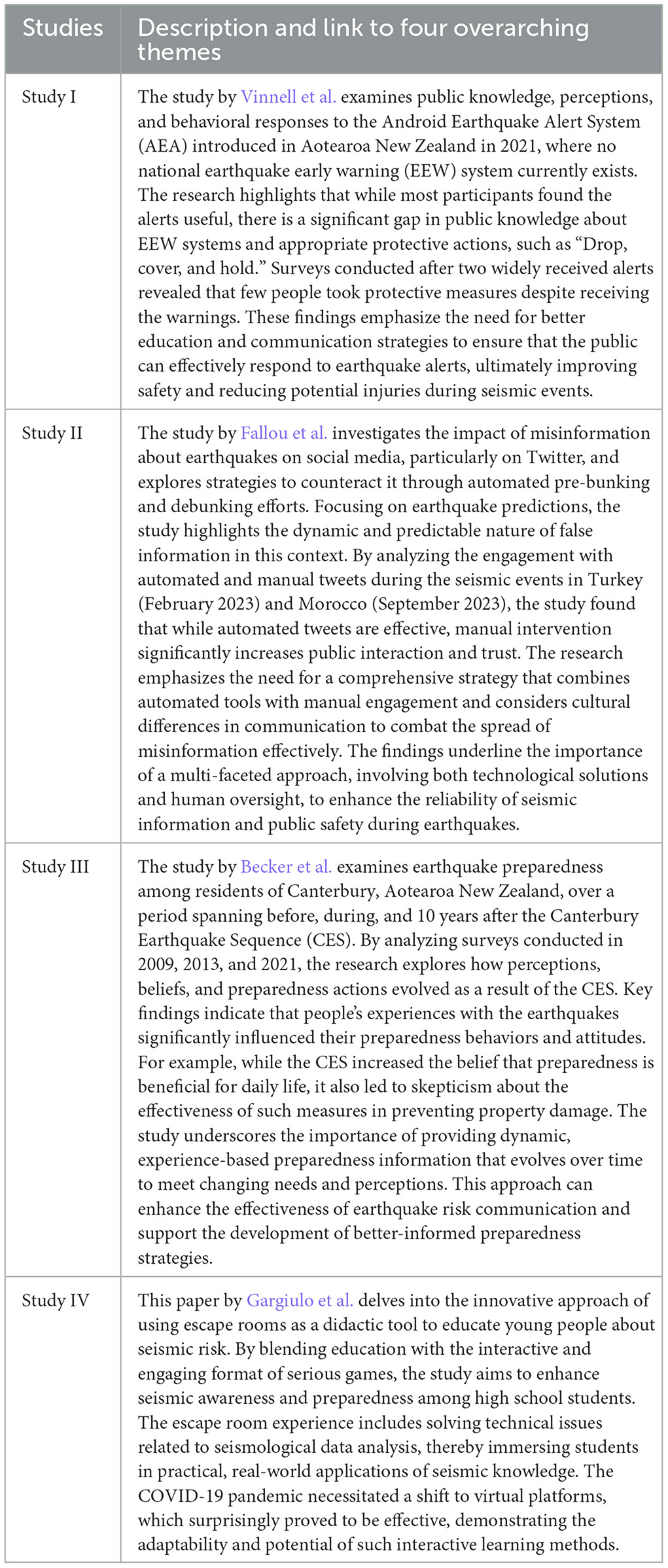
Table 1. Short description of the four studies and their link to the four overarching themes.
Combating earthquake misinformation on social media
In the age of instant communication, social media platforms have become critical channels for disseminating information during emergencies, including earthquakes. However, the rapid spread of misinformation on these platforms can undermine public safety, leading to confusion, panic, and inappropriate responses, and can counter or contradict official advice from trusted sources. Earthquake misinformation, such as false predictions or exaggerated reports, can exacerbate the challenges faced by emergency managers and communities during seismic events. Therefore, it is crucial to actively combat the spread of false information on social media by leveraging both technological tools and human intervention (Fallou et al., 2022). Ensuring the accuracy and reliability of information shared online is vital for maintaining public trust and enhancing the effectiveness of earthquake preparedness and response efforts; see Study II in Table 1.
Understanding perceptions and beliefs in earthquake preparedness
Effective earthquake preparedness is not only a matter of having the right tools and information but also deeply influenced by people's perceptions and beliefs (Bray et al., 2023). How individuals perceive the risks associated with earthquakes and their beliefs about the effectiveness of preparedness measures can significantly shape their actions before, during, and after a seismic event. Understanding these psychological and social factors is crucial for developing strategies that encourage proactive preparedness and appropriate responses during an earthquake. By addressing the underlying perceptions and beliefs that drive behavior, emergency management efforts can be better tailored to meet the needs of communities, ultimately reducing the impact of earthquakes and enhancing public safety; see Study III in Table 1.
Educational innovation and risk communication
The use of escape rooms as an educational tool represents a novel approach to improving risk communication and disaster preparedness. By engaging younger generations through interactive and immersive experiences, such approaches can significantly enhance public awareness and readiness for natural disasters. This is particularly crucial in regions prone to seismic activity, where educating the population, especially the youth, can lead to a more resilient society (Sumy et al., 2022); see Study IV in Table 1.
Conclusion
All in all, while seismic communication products have evolved considerably in recent years, this Research Topic demonstrates once again the importance of social science research in supporting advances in seismology. Understanding how this information is received, in terms of beliefs, cultural habits and perceptions of risk, is essential for effective risk reduction. There remain many gaps in knowledge and areas requiring future research investment, particularly in understanding the value of participatory co-design of risk communication initiatives, and evaluating the effectiveness of emerging tools and approaches, in order to learn lessons to reduce future earthquake risk.
Author contributions
ID: Writing – original draft, Writing – review & editing. CO: Writing – original draft, Writing – review & editing. LF: Writing – original draft, Writing – review & editing.
Funding
The author(s) declare that no financial support was received for the research, authorship, and/or publication of this article.
Conflict of interest
The authors declare that the research was conducted in the absence of any commercial or financial relationships that could be construed as a potential conflict of interest.
Publisher's note
All claims expressed in this article are solely those of the authors and do not necessarily represent those of their affiliated organizations, or those of the publisher, the editors and the reviewers. Any product that may be evaluated in this article, or claim that may be made by its manufacturer, is not guaranteed or endorsed by the publisher.
References
Bray, A., Orchiston, C. H., and Shrestha, S. R. (2023). Using photovoice for disaster and hazard preparedness: a methodological review. Int. J. Disaster Risk Reduct. 93:103742. doi: 10.1016/j.ijdrr.2023.103742
Dallo, I., Schnegg, L. N., Marti, M., Fulda, D., Papadopoulos, A. N., Roth, P., et al. (2024). Designing understandable, action-oriented, and well-perceived earthquake risk maps the Swiss case study. Front. Commun. 8:1306104. doi: 10.3389/fcomm.2023.1306104
Fallou, L., Marti, M., Dallo, I., and Corradini, M. (2022). How to fight earthquake misinformation: a communication guide. Seismol. Res. Lett. 93, 2418–2422. doi: 10.1785/0220220086
McBride, S. K., Smith, H., Morgoch, M., Sumy, D., Jenkins, M., Peek, L., et al. (2022). Evidence-based guidelines for protective actions and earthquake early warning systems. Geophysics 87, WA77–WA102. doi: 10.1190/geo2021-0222.1
Keywords: earthquake early warning (EEW), misinformation, earthquake preparedness behavior, risk communication, educational innovation
Citation: Dallo I, Orchiston C and Fallou L (2024) Editorial: Dynamic earthquake hazard and risk communication. Front. Commun. 9:1496432. doi: 10.3389/fcomm.2024.1496432
Received: 14 September 2024; Accepted: 17 September 2024;
Published: 26 September 2024.
Edited and reviewed by: J. Brian Houston, University of Missouri, United States
Copyright © 2024 Dallo, Orchiston and Fallou. This is an open-access article distributed under the terms of the Creative Commons Attribution License (CC BY). The use, distribution or reproduction in other forums is permitted, provided the original author(s) and the copyright owner(s) are credited and that the original publication in this journal is cited, in accordance with accepted academic practice. No use, distribution or reproduction is permitted which does not comply with these terms.
*Correspondence: Irina Dallo, aXJpbmEuZGFsbG9AYmx1ZXdpbi5jaA==