 Hong Liu
 Eric P. Burkhart3,4†‡
 Vivian Yi Ju Chen
- 1Department of Earth and Environment, Institute of Environment, Florida International University, Miami, FL, United States
- 2Fairchild Tropical Botanic Garden, Miami, FL, United States
- 3Shaver’s Creek Environmental Center, Petersburg, PA, United States
- 4Department of Ecosystem Science and Management, Pennsylvania State University, University Park, PA, United States
- 5Department of Marketing and Logistics, Florida International University, Miami, FL, United States
- 6Department of Geography, Centre for Geo-computation Studies, Hong Kong Baptist University, Kowloon Tong, Hong Kong
The cultivation of wild-harvested plant species is one strategy to achieve species conservation while meeting continued demand. A limitation to this approach for species used in Traditional Chinese Medicine, however, is that products produced under ex situ artificial agricultural conditions are often not a perfect replacement for their wild-collected counterparts, so demand for wild-harvested materials persists. This situation applies to American ginseng, an internationally protected species by the Convention on International Trade of Endangered Species of Wild Fauna and Flora (CITES) since 1975. In this paper, we trace the trade the history and conservation need for American ginseng in North America, including a summary of the development and evolution of in and ex situ cultivation methods. We report results from a preliminary survey of product labeling of American ginseng sold online in China and adjacent regions and provide recommendations for promoting forest farmed ginseng to consumers as a sustainable use strategy. We suggest that the use of CITES’s new “human assisted” production category amongst trade partners, coupled with “green” product certification and e-commerce platforms, provides a new opportunity to encourage consumption of wild-cultivated rather than wild ginseng in east Asia, and the continued development of ginseng forest farming and supply transparency mechanisms in the eastern United States.
Introduction
Over-exploitation is among the greatest threats to species’ survival (Maxwell et al., 2016). The cultivation of wild over-harvested species is a common strategy to meet continued demand and achieve species conservation at the same time (Abensperg-Traun, 2009; Anderies, 2015; Challender et al., 2015). It is often assumed that cultivation alone can alleviate wild harvesting pressure and help conserve species. However, a recent review found that there is limited evidence to validate this assumption with commercial cultivation only generating a conservation benefit for a handful of the 193 threatened species studied (Liu et al., 2019). This review found that cultivation operations may be motivated by market forces, but may be promoted by various NGOs, or government agencies if species conservation and social equalities are among the purposes of the cultivation operations. Cultivation operations structured to meet market demand only are not likely to generate conservation benefits, regardless of how large the operations are and how long a species has been under cultivation. One reason is that for many species, such as traditional medicinal plants, products cultivated under completely artificial conditions are not a perfect replacement for wild collected counterparts; therefore, demand for wild-harvested products persists despite the existence of mature artificial cultivation.
Nevertheless, there are cases in which cultivation has generated or is likely to generate conservation benefits, including the implementation of semi-wild cultivation approaches, in which populations planted in native wooded areas can be harvested (Burkhart, 2011; Liu et al., 2019). These cultivation operations can be seen as a hybrid between commercial cultivation and population restoration because farmers can adopt harvesting regimes that enable the population to persist and reproduce, as reported for selected medicinal (Ashton et al., 2014; Liu et al., 2014) and ornamental plants (Vovides et al., 2010; Menchaca Garcia et al., 2012; Ticktin et al., 2020). While these semi-wild cultivation operations hold promise for sustainable use, they should be considered experimental at this stage. However, it is nevertheless important to recognize these potential pathways exist and that they hold the promise to realize the dual goals of conserving plant resources while concurrently supporting local livelihood and social equity.
In this paper, we examine the opportunities and challenges associated with promoting in situ forest-based semi-wild cultivation as a mechanism to achieve sustainable use of American ginseng (Panax quinquefolius L., hereafter ginseng). We place our study within the context of evolving and emerging opportunities for product promotion in Asia where greater than 95% of wild ginseng is consumed. We first offer background on the trade and conservation needs surrounding ginseng in the United States of America (USA, hereafter US), followed by a discussion of the opportunities and challenges associated with ginseng forest farming in the eastern United States. We then examine ginseng product labeling in Mainland China and adjacent regions (e.g., Hong Kong China), the role of Convention on International Trade of Endangered Species of Wild Fauna and Flora (CITES) in ginseng conservation and trade, and conclude by offering recommendations intended to encourage consumption of forest farmed rather than wild ginseng as a conservation and sustainable use strategy. In offering this suggestion, we are not implying that continued trade monitoring and regulation are unnecessary; rather, we recognize that ginseng forest farming, and the consumption of wild-cultivated ginseng products, may offer sustainable use benefits not realized by a CITES-driven regulatory approach alone.
Background
Trade History and Wild Exploitation
Collection of wild ginseng in North America for Asian consumer markets began during the early 1700s following an exchange by Jesuit missionaries (Carlson, 1986; Wang, 2007). In 1716, the Jesuit priest Joseph Francois Lafitau, with help from the Iroquois tribes, recognized ginseng in the vicinity of Montreal, Canada from botanical descriptions of the Chinese relative Asian ginseng (Panax ginseng C.A. Mey.) provided by Jartoux in 1714. Commercial exports from Canada to China commenced the following year and by mid-century populations were already declining or extirpated from over-collection near Montreal where the species was first “discovered” (Benson, 1987).
Export and harvest records indicate nearly continuous commercial exploitation of wild ginseng in eastern North America during the past 300 years (Carlson, 1986; United States Fish and Wildlife Service (USFWS), 2020). Export statistics reveal that over 13.7 million kg of ginseng root was exported from the United States during 182–1899 (Figure 1), for example. This would have been comprised entirely of wild root since there are no reports of commercial cultivation before the late 1800s (as discussed in section “Cultivation as a Sustainable Use Solution”). During the twentieth century, about half the volume of the previous century (roughly 7 million kg) was exported, and in the first two decades of the 21st century only 500,000 kg was reported to United States Fish and Wildlife Service (United States Fish and Wildlife Service (USFWS), 2020). Harvest amounts of wild ginseng have not exceeded 250,000 kg/decade after the year 2000, which is less than 1/10 of the historic peak in the late 1800s. All these statistics do not account for the quantity marketed and utilized domestically which would not have been recorded in export or, more recently, harvest records.
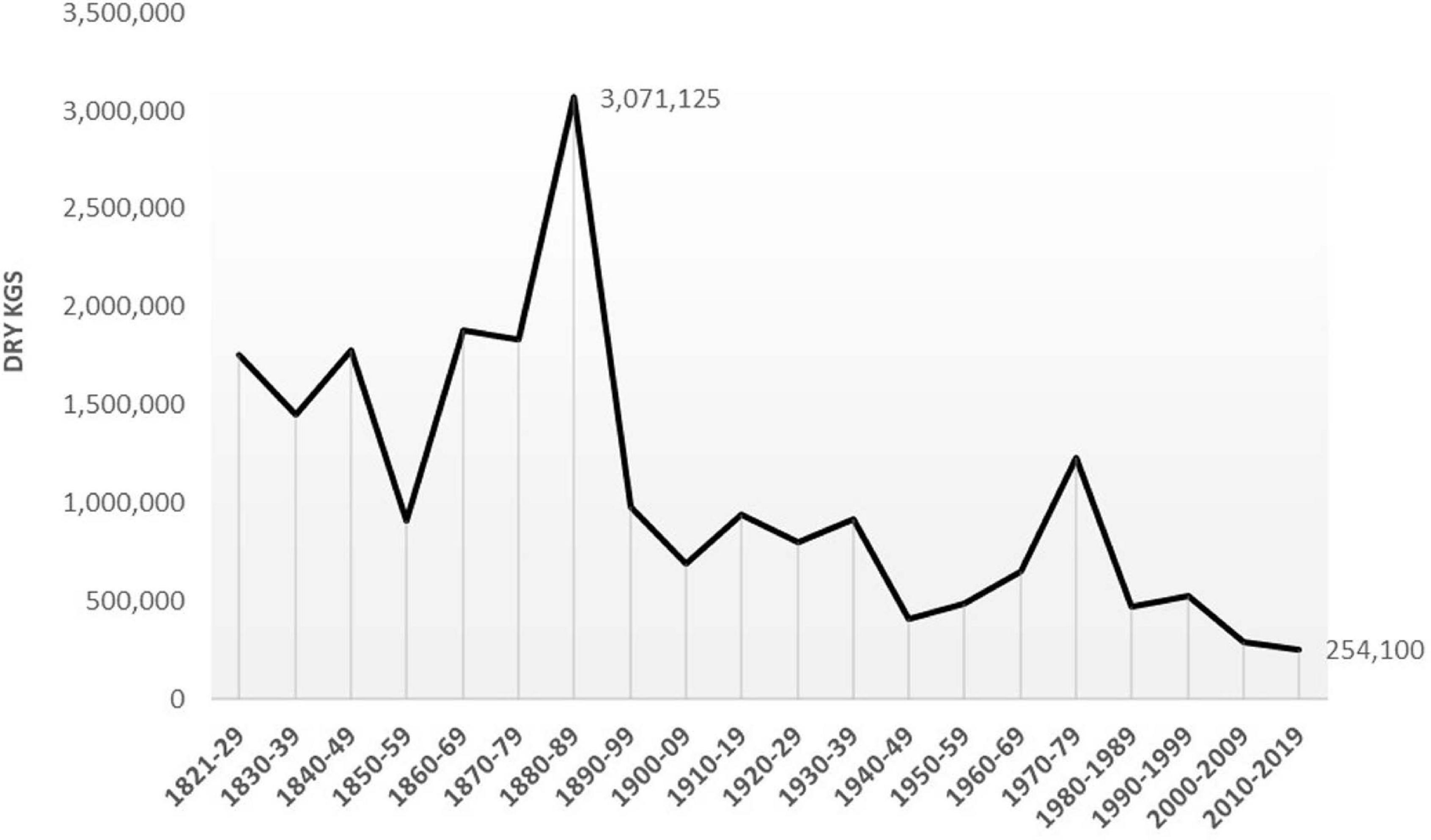
Figure 1. Reported harvest amounts (dry kgs) of wild American ginseng originating from the United States 1821-2019. Data sources: Carlson, 1986; United States Fish and Wildlife Service (USFWS), 2020.
The long trade history associated with ginseng suggests that the exploitation of wild ginseng throughout eastern North America during the past three centuries has resulted in significant impacts to the species in the wild. United States vary widely in export quantities (Figure 2) and while year-to-year export volume can reflect socio-economic conditions rather than availability (Schmidt et al., 2019), the gradual and significant declines in export volumes are likely indicative of declining wild populations —especially when coupled with contemporary botanical field observations (McGraw et al., 2013; NatureServe, 2021). Ginseng is presently listed as “vulnerable” in the United States and out of 33 states where ginseng occurs as an indigenous forest species, seven consider the species to be “critically imperiled” (S1); four “imperiled” (S2); fourteen “vulnerable” (S3); and eight “apparently secure” (S4) (NatureServe, 2021). The species has been listed as “endangered” in Canada since 1999, with exports of wild ginseng prohibited altogether (Ontario Ministry of Agriculture and Food (OMAFRA), 2005; NatureServe, 2021).
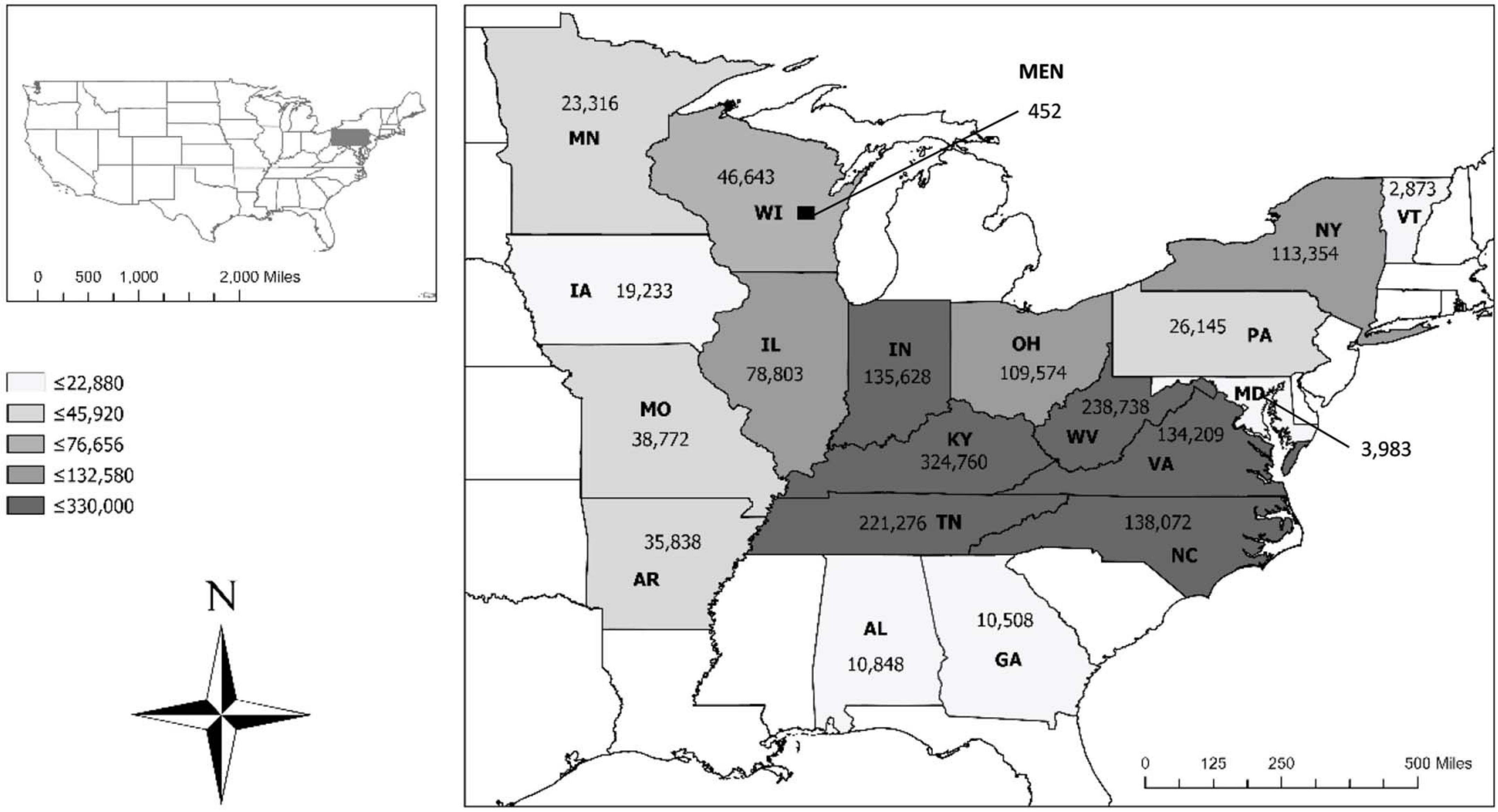
Figure 2. Geographic origins of wild American ginseng harvest exports from the U.S.A. 1978–2019. Shading and labels indicate states with legal export programs. Darker shading indicates greater exports. The year in parenthesis below notes the first year of reported data if different than 1978. Data source: USFWS 2020. State abbreviations: AL = Alabama (1988), AR = Arkansas (1979), GA = Georgia, IL = Illinois, IN = Indiana, IA = Iowa, KY = Kentucky, MD = Maryland, MN = Minnesota, MO = Missouri, NY = New York, NC = North Carolina, OH = Ohio (1980), PA = Pennsylvania (1989), TN = Tennessee, VT = Vermont (1984), VA = Virginia (1980), WV = West Virginia, WI = Wisconsin (1981), MEN = Menominee Nation (2012).
Species Biology and Vulnerability
Destructive root harvests exert the most negative impacts on population dynamics among the various types of plant parts harvested (Ticktin, 2004). With wild ginseng collection, the entire root and attached short rhizome (known as the “neck”) are generally taken, resulting in plant mortality. Collector attention to population structure (i.e., growth stages present) and harvest restraint are therefore necessary for continuous, sustained harvests (Van der Voort and McGraw, 2006; McGraw et al., 2013). Even given proper attention, recovery rates can be slow, and years of “rest” between harvests may be required (ibid). On average, about 90 roots, and therefore plants, are required to yield one kg of dry product (Burkhart and Jacobson, 2009; Unpublished data provided by Pennsylvania Department of Conservation and Natural Resources).
Ginseng is a slow-growing perennial herb, requiring at least three growing seasons before reaching reproductive or harvestable stages under cultivation (Ontario Ministry of Agriculture and Food (OMAFRA), 2005) and five or more years in forested habitats (Charron and Gagnon, 1991; McGraw et al., 2013; Davis and Persons, 2014; McGraw, 2020). Regeneration and recruitment occur primarily through seed production and therefore fecundity and seedling survival are important, and often constraining, life history traits. Reproduction is often delayed by years and fecundity is lower in wild plants, in comparison with cultivated plants, which means that wild plants must persist longer in forested habitats to contribute to recruitment (ibid). Moreover, all United States export states have regulations restricting harvest to mature stages, which effectively then inadvertently encourages wild collectors to remove reproductive plants from populations once mature stages are attained, thereby lowering recruitment potential over time (Van der Voort and McGraw, 2006).
In addition to collection for commercial markets, immediate threats to wild ginseng in the United States include loss/degradation of supportive forest habitat types, over-browsing by white-tail deer (Odocoileus virginianus Zimmerman), and poaching/theft (McGraw et al., 2013; McGraw, 2020). The last of these, ginseng poaching, is fueled by widespread stakeholder recognition that laws around theft are difficult to enforce and/or successfully prosecute, especially on privately owned lands where jurisdictional boundaries can limit enforcement activities (Pokladnik, 2008; Burkhart et al., 2012). During the past decade, this situation has only gotten worse as United States “reality” television shows (e.g., Appalachian Outlaws, Smoky Mountain Gold) have helped to “normalize” ginseng poaching by unfortunately portraying ginseng diggers, competitive digging, and theft from others as part of a cultural and industry “outlaw” identity (West Virginia Public Broadcasting, 2014).
CITES as a Conservation Mechanism
In the United States, ginseng trade is monitored by both state and federal governments following its 1975 listing in Appendix II of the Convention on International Trade in Endangered Species of Wild Fauna and Flora (CITES). CITES is an international agreement between governments with the shared goal to ensure that international trade in specimens of wild animals and plants does not threaten their survival (Convention on International Trade in Endangered Species of Wild Fauna and Flora (CITES), 2021). Appendix II status is reserved for “species not necessarily threatened with extinction, but in which trade must be controlled in order to avoid utilization incompatible with their survival” (ibid).
The United States Fish and Wildlife Service (USFWS), which is part of the Department of the Interior, is responsible for CITES implementation in the United States (Burkhart et al., 2012; Convention on International Trade in Endangered Species of Wild Fauna and Flora (CITES), 2021). The USFWS has the Division of Management Authority to address policy and permitting issues, and the Division of Scientific Authority (DSA) to deal with scientific issues relating to CITES implementation. Under CITES, ginseng exports must be legal and not detrimental to the survival of the species in the wild. The USFWS has approved export of wild ginseng from the United States on a state-by-state basis since 1978. The DSA relies on individual states’ data and determination in making its “non-detriment” determination, as a compliance measure to CITES when approving export of “wild” American ginseng (ibid).
The nineteen approved United States for wild ginseng export (Figure 2) have all experienced declines in reported harvest amounts since the species was first listed in CITES in 1975 (United States Fish and Wildlife Service (USFWS), 2019). Accordingly, the question of how effectively CITES is working as a conservation mechanism remains unclear, as is any influence of CITES listing on black market smuggling. At a minimum, a CITES listing elevates the conservation visibility around the species and helps to provide a mechanism for tracking and regulating trade. However, there is disagreement amongst stakeholders as to whether CITES regulations are helping ginseng conservation efforts (Burkhart, 2011; Burkhart et al., 2012; Beyfuss, 2019).
In a case study of CITES implementation in the United States of Pennsylvania, the impact of a CITES-driven “top-down” regulatory approach to wild ginseng conservation was found to be limited (Burkhart et al., 2012). While there was general support amongst stakeholders (e.g., diggers, growers, traders) for conservation efforts, study participants widely shared the belief that many harvest restrictions are not easily enforced—a reality that was externally validated by the fact that law enforcement is often constrained by complex jurisdictional boundaries. Moreover, Burkhart et al. (ibid) found that a lack of public confidence in ginseng conservation efforts stemmed in large part from a perceived failure of natural resource agencies to recognize and stop ginseng habitat loss, serving as justification to adopt critical attitudes toward any government involvement in the trade. Importantly, and relevant to this current paper, is the finding that the most widespread support uncovered for government driven ginseng efforts was involvement of stakeholders as “partners” for in situ planting, farming, and restoration.
Cultivation as a Sustainable Use Solution
Demand for Wild Persists Despite Cultivation
The first attempts to cultivate ginseng in North America began in the late 1800s, following more than a century of wild harvest and trade, in the Appalachian and Mid-Atlantic regions of the United States. One prominent figure during this early period was George Stanton, who started experimental forest beds at his home in Apulia Station, New York around 1885 (Stanton, 1892; Davis and Persons, 2014). Known in later years as the “Father” of American ginseng cultivation, he investigated both forest- and artificial shade-based horticulture. Stanton’s introduction of artificial shading around 1890 was intended to speed up plant development following the observation that ginseng grew very slowly in forest beds. The cultural system he employed featured wooden panels perched upon posts 6-7 feet above raised garden beds to facilitate 70% shade since ginseng is a shade-obligate species. In his pursuit of successful husbandry, Stanton used wild ginseng ecology as his model and attempted to duplicate natural conditions in every respect.
However, it was in Marathon County, Wisconsin that the Fromm brothers perfected the commercial methods still largely used today in artificially shaded field production of ginseng (Polczinski, 1982). Like Stanton, the Fromm brothers developed practices that essentially mimicked the natural requirements for optimum growth and reproduction by carefully observing the occurrence of plants in the wild. The practices they and others adopted included the use of raised beds to provide soil moisture drainage; the application of winter mulches; proper seed stratification to ensure germination; and the construction of lathing to create favorable shade conditions (Van Fleet, 1913; Hardacre, 1974).
Presently, the majority of ginseng is cultivated using these methods in two regions of North America: the upper Midwest United States (Wisconsin) and ON, Canada (Ontario Ministry of Agriculture and Food (OMAFRA), 2005; Ginseng Board of Wisconsin, 2021; Ontario Ginseng Growers Association (OGGA), 2021). Although there are no accurate statistics on production by country, four countries—South Korea, China, Canada, and the United States—are the biggest cultivated producers with a total ginseng root production (fresh weight) of approximately 79,769 tons, which is more than 99 percent of the estimated total world production of 80,080 tons (Baeg and So, 2013). These estimates include all ginseng species known to be cultivated (P. quinquefolius, P. ginseng, P. notoginseng Burk, P. japonicus C.A. Meyer), however. Artificial shade cultivation (also known as “field cultivation”) of ginseng in the North America has supplied export markets and thereby helped conserve wild ginseng by providing an affordable and accelerated alternative to wild. Ginseng cultivation under artificial shade is the primary horticultural arrangement for large-scale production in Ontario, Canada and Wisconsin, United States which are estimated to produce 6,486 and 1,504 tons of ginseng annually, respectively (Baeg and So, 2013). Ginseng farmers utilize artificial shade cropping to mechanize their production and better manage diseases, which in turn shortens the number of years to maturity, increases yields, and reduces labor needs (Ontario Ministry of Agriculture and Food (OMAFRA), 2005; Ontario Ministry of Agriculture, Food and Rural Affairs (OMAFRA), 2021).
However, the cultural predilections of some Asian consumers, especially within TCM, continue to drive a niche demand for wild ginseng since they are attracted to “wild” labeling and accompanying product characteristics. Ginseng grown in situ in forests are likely to possess “wild” traits that are traditionally favored by Asian consumers including taste, shape, color, and texture (Hu, 1976; Guo et al., 1995; Roy et al., 2003). Desirable characteristics include old age, which is demonstrated by a long “neck” (rhizome) with many “neck scars:” transverse “stress rings” on the main body of the root; and variable rhizome branching, with one or more variously shaped tubers attached (Hu, 1976; Upton, 2012; Figure 3). By contrast, cultivated ginseng roots tend to be larger, more uniform, younger, and lack many of the subtle characters such as “stress rings.”
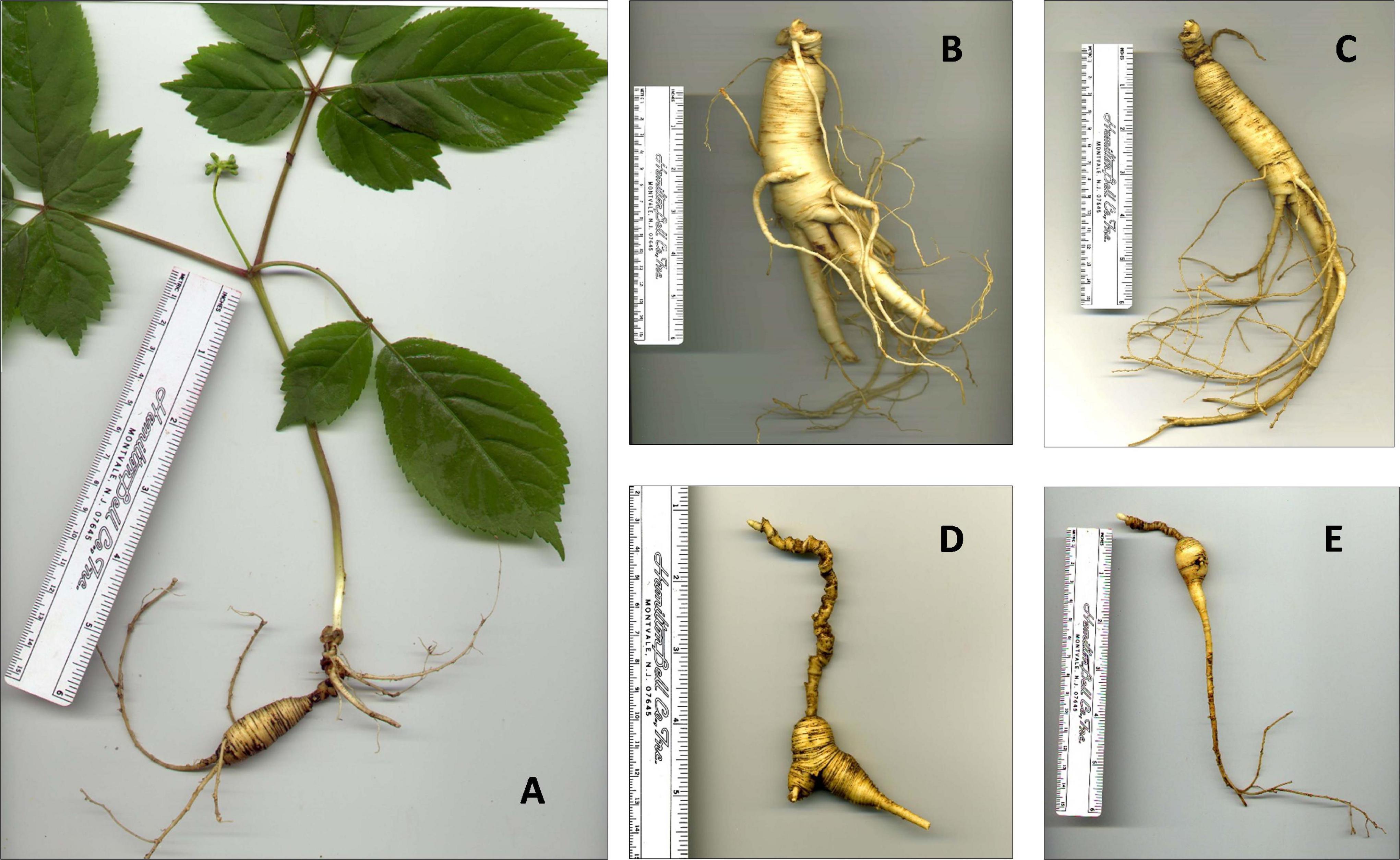
Figure 3. Comparative appearances of different types of American ginseng resulting from different production practices. (A) an in situ wild-cultivated ginseng plant with top attached is provided for overall scale. Root and attached rhizomes examples include (B) cultivated under artificial-shade; (C) cultivated under a forest canopy; (D) wild; and (E) wild-simulated.
The market price for wild-appearing ginseng roots is as much as 100 times greater than for artificially shaded field cultivated roots (Figure 4; Burkhart and Jacobson, 2009). Such high price premium of ginseng with “wild” traits over products cultivated in artificial shade field have driven continued wild harvests as well as the interest in forest farming in the United States (Davis and Persons, 2014).
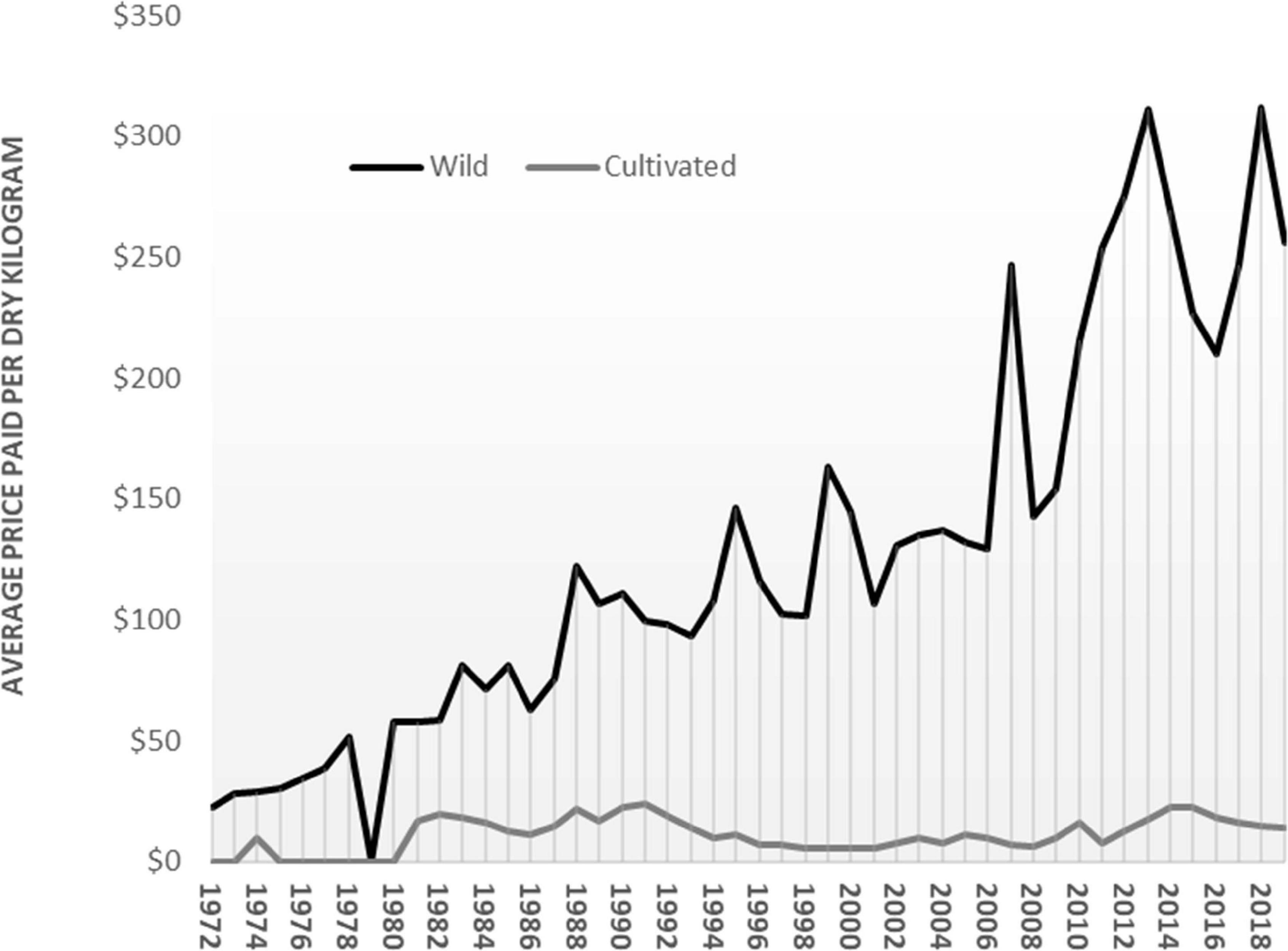
Figure 4. Comparison of the average prices paid for wild versus cultivated American ginseng for the years 1972-2019. (Prices have been sourced from ginseng buyers, producers, publications, and industry experts by EPB).
Forest Farming and “Wild Cultivation” in the Eastern United States
In the eastern United States, in situ forest-based ginseng cultivation was first adopted beginning in the late 1800s (Butz, 1897; Harding, 1912; Hardacre, 1974). The cultivation of crops in an existing forestland understory is referred to, and in recent decades promoted as, “forest farming” in the United States (Gold et al., 2000; Mudge and Gabriel, 2014). Forest farming has been defined as “the integration and management or intentional cultivation of high-value non-wood/timber forest crops such as medicinal and edible plants under the canopy of well-managed forest” (ibid). It is one of five agroforestry practices recognized and promoted by the United States Department of Agriculture National Agroforestry Center (NAC) nationwide (National Agroforestry Center (NAC), 2021). The specific husbandry practices associated with forest farming of ginseng form a husbandry continuum from management in situ, using enrichment plantings (“wild-simulated”), to intensive cultivation in situ using beds and/or tillage (“woods-cultivated”) (Hill and Buck, 2000; Pritts, 2010; Davis and Persons, 2014; National Agroforestry Center (NAC), 2021). Regardless of the approach, ginseng forest farming has the potential to be highly profitable, even at a small scale (Burkhart and Jacobson, 2009; Davis and Persons, 2014). Outside of the United States, ginseng forest farming methods are also being developed and encouraged in rural, mountainous regions within China and South Korea, where it is referred to as “wild-cultivated,” “mountain ginseng,” “forest-cultivated,” or simply “wild” ginseng production (International Federation of Organic Agriculture Movements (IFOAM), 2011).
Because ginseng forest farming has only recently been recognized in the United States, and because of the complexity associated with identifying growers (as discussed under section “Regarding Research”), there have been few efforts to date attempting to track adoption and production. An effort to estimate forest farmer numbers in 1994 estimated the total number of producers in 20 United States at 814 woods-cultivated and 3,334 wild-simulated growers farming 566 total hectares of forestlands (Persons, 1995). In 2000, estimates were again made with a resulting 750 and 3,416 forest farmers suggested, for a total of 818 hectares of woods-cultivated and wild-simulated producers, respectively (Persons, 2000). These estimates are incomplete, and perhaps even under-representative, as they were compiled by simply querying contacts in each state rather than by examining any type of official industry data (ibid).
Immediate advantages of forest farming are realized by producers through production cost savings. Since ginseng is shade obligate, significant investments in artificial shade structure are necessary when plants are grown in open field settings, with materials and associated labor costs averaging $75,000 (US$) per hectare (Ontario Ministry of Agriculture and Food (OMAFRA), 2005; Ontario Ministry of Agriculture, Food and Rural Affairs (OMAFRA), 2021). Moreover, ginseng is commonly plagued by fungal diseases under field cultivation which requires frequent and costly use of fungicides (Ontario Ministry of Agriculture and Food (OMAFRA), 2005). Depending on production methods, forest farmed ginseng may not be impacted as much or at all by fungal diseases, by contrast (Davis and Persons, 2014). The cultivation of forest plants in situ may therefore eliminate or reduce disease problems and, in turn, the need for pesticide use, thereby facilitating access to “organic” and other niche markets.
Disadvantages associated with forest farming include a slower growth rate, requiring 10 or more years to reach harvestable size, and generally lower yields when compared with field production (Ontario Ministry of Agriculture and Food (OMAFRA), 2005; Burkhart and Jacobson, 2009; Davis and Persons, 2014). In ON, Canada, field production under artificial shade can result in root yields as high as 2,950 kg per hectare (Ontario Ministry of Agriculture and Food (OMAFRA), 2005; Ontario Ginseng Growers Association (OGGA), 2021). By comparison, top yields of 670 kg per hectare are obtained under forest farming production (Burkhart and Jacobson, 2009; Davis and Persons, 2014). Thus, forest farming may be 1/10 as productive as field cultivation when yields alone are considered. These lower yields result from a combination of reduced ginseng biomass production and the heterogenous nature of forest cropping environment which creates both micro-site variation as well as physical barriers (e.g., rocks and boulders, basal tree stems) to cropping. Additionally, forest farmers typically rely heavily on labor for forest-based husbandry activities to minimize site disturbance, which prevents any efficiencies that might be gained through mechanization. In situ ginseng farming is also subject to many of the same threats facing wild ginseng populations including targeted theft, wildlife predation, and farming habitat changes resulting from invasive species and/or climate change (Pokladnik, 2008; Davis and Persons, 2014; McGraw, 2020).
Despite these diverse challenges, in situ forest farming of ginseng as a conservation strategy can generate direct benefits to ginseng and associated forestland habitats. In particular, the practice of in situ enrichment plantings can preserve understory forest biodiversity, and function in wild population restoration or augmentation (Burkhart, 2013; International Union for Conservation of Nature (IUCN), 2013; Chittum et al., 2019). Forest farming offers multiple economic and ecological benefits while also being attractive to forest landowners since the practice has the potential to increase income while maintaining forest integrity (Hill and Buck, 2000). Income derived from forest cultivation is received at shorter intervals than timber, giving private forest landowners more revenue options, enabling them to pay annual taxes and other carrying costs. Facilitating private landowner adoption of forest farming can therefore drive interest in forest stewardship, raise awareness about indigenous forest plants, and positively influence silvicultural decisions (Burkhart and Jacobson, 2009).
Promoting Forest Farmed Ginseng as a Sustainable Use Strategy
Challenges
Planting Stock Origins and Conservation of Wild Genotypes
The scaling-up of ginseng forest farming as a conservation strategy faces the fundamental challenge of securing adequate planting stock supplies while concomitantly utilizing and protecting wild ginseng genetic resources. Currently, most forest farmers in the United States obtain stock sourced from artificial shade ginseng farms in Wisconsin, which produce seed as a by-product of root production (Ontario Ministry of Agriculture and Food (OMAFRA), 2005; Davis and Persons, 2014; Burkhart et al., 2021). A persistent concern surrounding the planting of this “commercial” stock in forested environments is therefore how this stock might impact remaining local wild genotypes (e.g., United States Fish and Wildlife Service (USFWS), 2019). The introduction of non-local seed may, for example, result in “genetic swamping,” or the rapid increase in number of the introduced ecotypes or alleles in a population (Kramer and Havens, 2009). If these introduced ecotypes or alleles have a fitness advantage over the local ecotype, replacement of the local ecotype may occur (Hufford and Mazer, 2003). Concerns about genetic preservation and maintenance in wild plant populations has led to many in the conservation community to recommend using only local seed sources for restoration purposes to preserve local gene pools and to prevent outbreeding depression (Vallee et al., 2004; McKay et al., 2005). However, there is a lack of consensus, and considerable complexity, around this topic, and each species needs to be considered on a case-by-case basis (McKay et al., 2005). For species that have experienced dramatic population declines and fragmentation, inbreeding depression is common across many populations (Angeloni et al., 2011) and mixing local and non-local populations as planting source materials is sometimes recommended to overcome inbreeding depression in restoration (Frankham et al., 2011). This approach may be increasingly attractive as assisted population migration (Handler et al., 2021) may be required for applied plant conservation and restoration efforts under future climate change and extreme climate events (Maschinski and Haskins, 2012; Maschinski et al., 2013). It is presently unclear whether wild ginseng is more at risk of inbreeding or outbreeding depression (Schlag and McIntosh, 2012).
Additionally, for more than a century in the eastern United States, the distribution and genetic composition of wild ginseng have been greatly impacted by human husbandry through harvesting, planting, and “stocking” practices (Burkhart, 2011; Young et al., 2012; Davis and Persons, 2014; Burkhart et al., 2021). The use of non-local stock therefore needs to be considered through the unique and long-term cultural significance of this species, especially on privately owned lands, in which husbandry has resulted in a “middle ground” where plants may no longer be simply wild or cultivated and populations may be comprised of germplasm resulting from decades, lifetimes, or generations of planting activities (Hardacre, 1974; Burkhart, 2011; Burkhart et al., 2021). Research has shown that some forest farmers in the eastern United States may generate and maintain their own genotypes and chemotypes (Schlag and McIntosh, 2013) and such examples could be used to stimulate interest and collaboration by the broader public in conserving and sharing germplasm, as is currently done with other “heirloom” horticultural specialty crops (e.g., Seed Savers Exchange Mission, 2021). Forest farmers should be encouraged to establish any introduced “commercial” stock away from existing wild populations and use existing local, regional, or diverse purchased stock sources wherever possible. Some states (e.g., West Virginia Ginseng Program, 2021) with wild ginseng programs require that state-recognized forest farms be inspected and demonstrated to be free of existing wild ginseng before planting approval is given.
In coming decades, a reliance on non-local genetic stock which is undergoing unconscious selection (Zohary, 2004) through artificial shade culture may prove to be an increasingly important, and limiting, factor impacting ginseng forest farming success. There is an urgent need for the coordinated development of a United States ginseng germplasm conservation, propagation, and restoration/farming network pursuing an in situ “ecosystem domestication” approach (Michon and de Foresta, 1996) in which breeding, lineage selection, and maintenance is conducted in situ as an alternative to current ex situ stock sourcing approaches. By encouraging an “genetic awareness” amongst forest farmers and forest landowners, it may be possible to engage the United States public in longer-term collaborative efforts intended to actively protect and conserve remaining wild germplasm resources, and utilize this stock in future initiatives to scale-up forest farming using local or regionally sourced materials. Indeed, many current ginseng forest farmers in the eastern United States have found that the production of planting stock (e.g., seed, transplants) for sale to other landowners can be more profitable than production for root markets (Davis and Persons, 2014).
A CITES-Driven Lexicon
An immediate challenge confronting ginseng forest farmers is the “cultivated” vs. “wild” binary labeling derived from CITES. The present ginseng trade lexicon under CITES (Convention on International Trade in Endangered Species of Wild Fauna and Flora (CITES), 2021) is used by many United States on trade paperwork. It identifies “cultivated” plants as “artificially propagated” and in Resolution Conf. 11.11 (Rev. CoP14) defines these as follows:
Plants grown under controlled conditions from seeds, cuttings or divisions of cultivated parental stock. A controlled condition is defined as a non-natural environment that is intensively manipulated by human intervention. General characteristics of controlled conditions may include but are not limited to tillage, fertilization, weed control, irrigation, or nursery operations. The cultivated parental stock used must have been established in accordance with national and State laws, determined not to be detrimental to the survival of the species in the wild, and managed in such a way as to guarantee long-term maintenance of the cultivated stock.
Any ginseng that does not meet these criteria is “wild” under CITES and at present, de facto, by USFWS and State export programs. Burkhart et al. (2021) suggest that this dichotomous lexicon is far too simplistic to account for the breadth of forest farming practices that are being employed to produce roots ultimately sold as “wild.” When forced into this dichotomy, forest farmers often choose to report their product as wild, fearing pricing disparities (discussed below), theft, taxation, and disagreement over what constitutes “wild” (ibid).
However, while self-declaring forest farmed ginseng as “wild” can bring higher profit for farmers, it also increases exportation barriers due to CITES restrictions. The complexities and costs associated with applying for export permits also prevents forest farmers from legally selling their products directly to customers in China and east Asia via e-commerce platforms. Additionally, forest farmers often do not have the knowledge or financial resources to apply for CITES permits to sell small amounts of wild-cultivated ginseng internationally (Burkhart, pers. comm. with producers). The burden of applying for CITES export/import permits may be one of the reasons that very few or no vendors sell wild and wild-cultivated ginseng on e-commerce platforms in Hong Kong, China, Singapore, and Taiwan (Arik et al., 2020).
In the online retail market survey mentioned in section “Cultivation as a Sustainable Use Solution,” each of the named countries or regions, e.g., Mainland China, Hong Kong China, is an independent CITES entity, with its own national or equivalent domestic laws and authorities to carry out CITES regulations. Even though Hong Kong is part of the China, it has its own CITES related domestic laws, scientific and management authorities (Agriculture, Fisheries, and Conservation Department of Hong Kong, 2020). In addition, while Taiwan is not a CITES signatory authority because it is not a member of the United Nations, it participates in CITES and abides by the rules of this international convention voluntarily (Forestry Bureau of Republic of Taiwan, 2016). Import of ginseng into these countries and regions requires a CITES export permit issued by the authority of the exporting country and a license to import from the import country’s managing authority.
Another significant challenge to the forest farming in the eastern United States is that it remains a largely secretive and poorly documented. In eight years of annual surveying of Pennsylvania sellers, Burkhart et al. (2021) found that “wild” exports consisted of a mix of collected, planted (along with various husbandry practices), and forest farmed product. A complex suite of husbandry practices was found to be involved in modern wild ginseng occurrence and these practices obscure and complicate distinctions between “wild” and “cultivated.”
Importantly, Burkhart et al. (ibid) also found that attempts by United States to clarify the origins of “wild” ginseng through forest farming terminology in point-of-sale paperwork are often resisted or falsified because sellers harbor concerns regarding buyer-trader pricing and crop taxation. Regarding the former, it is recognized that many buyers pay less for wild-cultivated product even when it is indistinguishable from wild so that they can re-sell for a higher profit margin. Rumors of unfair pricing have resulted in low rates of seller compliance when asked to report forest farming activities in some United States that have worked to implement measures for differentiating wild-cultivated from wild ginseng (ibid).
Forest Farmed Product in Chinese E-commerce
More than 95% of American wild ginseng exports is sold to consumers in Mainland China and adjacent regions where TCM cultural practices are popular (Baeg and So, 2013; United States Fish and Wildlife Service (USFWS), 2013; Arik et al., 2020). To understand the current retail venues in the above regions, as well as in the United States where wild and forest farmed ginseng is produced, we carried out searches on popular e-commerce platforms using the key words “wild American ginseng” and “semi-wild American ginseng” (Table 1). To search vendors in Mainland China, we used the most popular e-commerce platform “Taobao.com” and the related Chinese key words “ ,” “
,” “ ,” “
,” “ ,” or “
 ” (meaning “wild or semi-wild American ginseng”). To search vendors in Hong Kong and Singapore, we used google.com using the same Chinese keywords. To search vendors in Taiwan, we use the popular internet platforms shopee.tw, momohope.com.tw, and Pchome.com.tw. And finally, in the United States, we used Amazon.com and Google.com for our searches. These searches were not exhaustive but rather exploratory and aimed to identify major e-commerce retailers, and examine any terminology used to describe the product being sold, especially whether there is a presence of any conservation appeals to consumers.
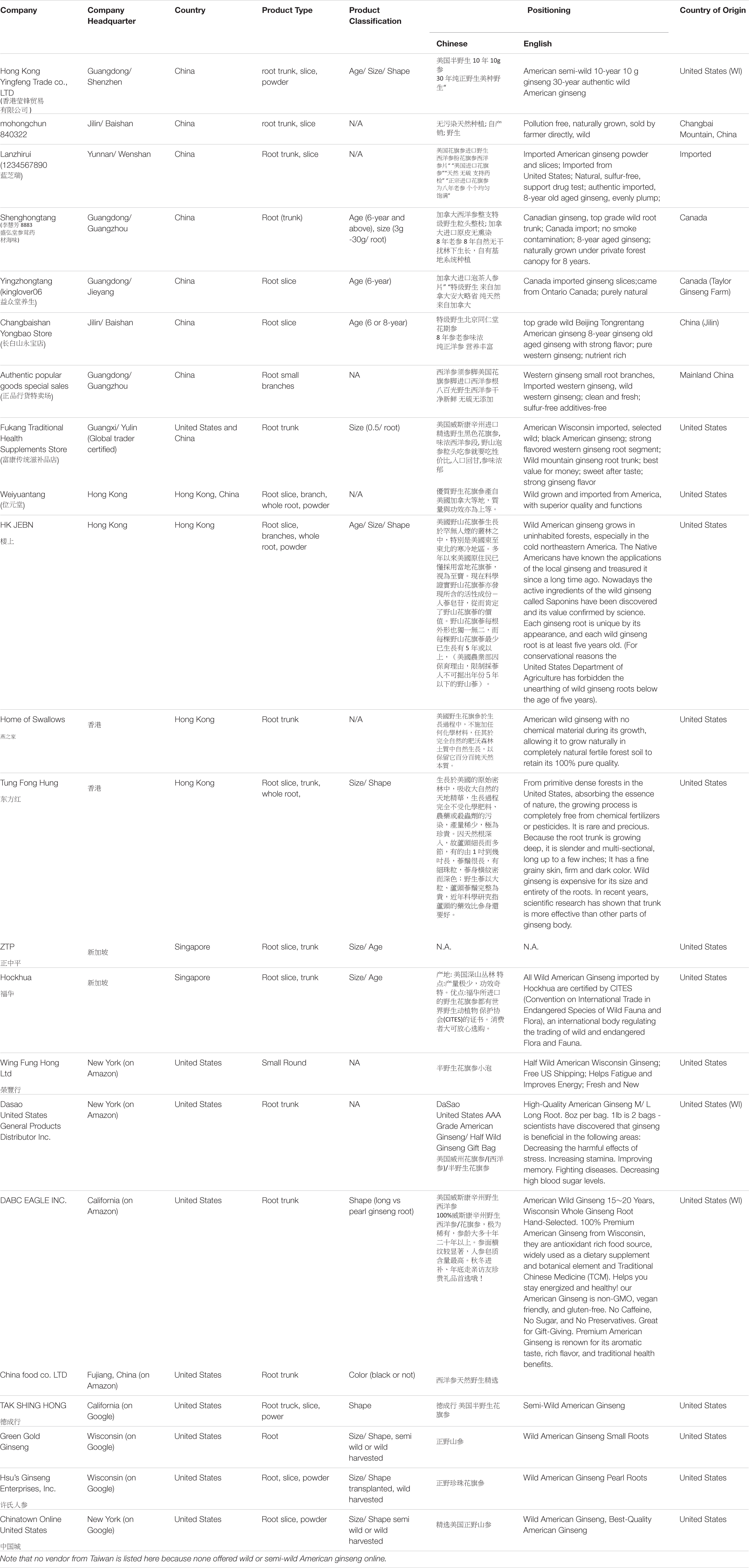
Table 1. Major wild and semi-wild American ginseng retail online companies in Mainland China, Hong Kong, Singapore, Taiwan, and the United States.
Among the countries and regions studied, the United States had the largest number of vendors (9) selling wild ginseng, mostly distributed in California and New York. All but one had a physical store. Vendors in Mainland China (8), Hong Kong China (4), and Singapore (2) also sold wild or wild-cultivated ginseng. Online vendors in Taiwan sold cultivated ginseng products only and were not included in our analysis. Many well-known traditional vendors of ginseng such as Tongrentang ( ), a famous TCM company, sold cultivated ginseng but surprisingly did not offer wild or wild-cultivated ginseng via e-commerce, even though the company is known to import both types of ginseng (Arik et al., 2020).
The most frequent terms used in e-commerce to promote ginseng in Mainland China and adjacent regions were the following: “Wisconsin,” “American imported,” “wild forest grown,” “authentic from North America,” “pollution-free,” and “old age.” Significantly, messages on sustainability and conservation were mostly absent in accompanying promotional language suggesting that while the socio-economic and environmental benefits associated forest farming of ginseng are understood in the United States, these are not being communicated to the ginseng consumers in Asia who constitute the overwhelming majority of whole-root consumers worldwide.
Hong Kong has been the most significant ginseng trading for decades and is the largest consumer of ginseng in the world (Robbins, 1998; Arik et al., 2020). A significant portion of the wild or wild-cultivated ginseng roots are imported from the United States through local-registered trading companies, priced in Hong Kong, and redistributed to China and adjacent regions. However, given the rapid economic development and maturation of e-commerce platforms in Mainland China in the past 10 years, the importance of Hong Kong for Mainland China as a hub for international goods has been declining as more goods are being traded directly between China and other countries. This is likely to be the case for ginseng, as American based vendors have begun to set up shops on Chinese e-commerce platforms. This change in trading venues and hubs presents new opportunities to create innovative value chains and new ways to promote forest farmed ginseng (Arik et al., 2020).
Opportunities
CITES and Recognition “Human Assisted” Production
Increased transparency is key to the continued expansion of ginseng forest farming and consumer awareness. A clear lexicon around ginseng planting, husbandry, and forest farming would help facilitate a more realistic and dynamic understanding of wild ginseng status and improve conservation and enforcement efforts (Burkhart et al., 2021). USFWS has continued to urge United States to implement measures for differentiating “wild simulated” ginseng from “wild” (United States Fish and Wildlife Service (USFWS), 2019).
A new production category has recently been accepted by CITES signatories referred to as “human assisted” (Convention on International Trade in Endangered Species of Wild Fauna and Flora (CITES), 2019). This production category is intended to better acknowledge the status surrounding many wild plant species which do not fall “within the definition of ‘artificially propagated’ and are considered not to be ‘wild’ because they are propagated or planted in an environment with some level of human intervention for the purpose of plant production” (p. 9, Convention on International Trade in Endangered Species of Wild Fauna and Flora (CITES), 2019). This new production category creates a pathway for forest farmed ginseng to be recognized as being distinct from both the conventional “cultivated” and the “wild” in commerce.
E-commerce and the Emergence of “Green Products” in China
Despite a relatively late start, e-commerce has been steadily increasing in China along with internet user numbers (Marinova, 2017; The China Internet Network Information Center (CNNIC), 2020). Among the 940 million internet users documented in China as of June 2020, 749 million or nearly 80% of internet users have participated in online shopping (The China Internet Network Information Center (CNNIC), 2020). E-commerce options include species of conservation concern (SOSC) (International Fund for Animal Welfare (IFAW), 2014; Yu and Jia, 2015; Wong and Liu, 2019); in a survey of wildlife trade which included both physical and online trading platforms, for example, more than half of the approximately 33,000 items of wild plant and animal SOSC in trade were offered on Chinese websites (International Fund for Animal Welfare (IFAW), 2014).
The emergence and growth of e-commerce platforms provides expanding opportunities for United States-based forest farmers to connect directly with consumers in China and neighboring regions, thereby reducing the number of intermediaries involved in supply chains. An ability to connect directly with Asian consumers is an important next step in the development of the United States ginseng forest farming industry, as it will help provide opportunities to maintain or increase profitability while differentiating and branding semi-wild products (Arik et al., 2020). In our survey, we did find United States-based companies offering forest farmed ginseng using e-commerce platforms, but these were very limited (Table 1).
From a producer perspective, this lack of market penetration is primarily due to the complexity and costs associated with application for CITES export permits from the United States, along with language and communication barriers (Burkhart, pers. comm. with forest farmers; Robbins, 2003; Burkhart, 2011). However, it must also be noted that there are challenges on the importation side including tariffs, which can lead to smuggling (Hsu, 2000), and a reluctance to be transparent. For United States forest farmers to take advantage of e-commerce platforms, there needs to be non-intimidating mechanisms or pathways within the CITES export/import process to permit small quantities of semi-wild ginseng to be sold directly to consumers, perhaps as part of implementation of the new CITES “human assisted” production category. This is especially important since most United States forest farming operations are mostly small-scale, often producing on less than one hectare of forestlands (Persons, 1995, 2000; Davis and Persons, 2014; Burkhart et al., 2021).
While we found little content featuring sustainability and conservation messaging on ginseng vendor e-commerce platforms in our survey, research suggests that there is an emerging consumer awareness of these concepts in China (Jin and Zhao, 2008). Agricultural products which feature such messaging are often referred to as “green food” —a concept that was first proposed in 1989. In 1992, the country established a green food management agency (i.e., China Green Food Development Center) and announced the development of a green food industry (China Green Food Development Center (CGFDC), 1992). Some environmentally friendly packaging and labeling systems have also been used for promoting wild-cultivated plants in TCM (TRAFFIC, 2013). In 2020, livestreamed online trading has become a trend among young consumers who, perhaps surprisingly, also consume TCM products including ginseng (Liu, pers. observation). Younger Chinese consumers possess increasing awareness around sustainability, which may exert a significant influence on attitudes and consumer behavior (Huang et al., 2017; Sustainable Lifestyle Lab, 2019). Green marketing and certification could play a crucial role in making forest farmed ginseng appealing to consumers, especially as there is also widespread distrust of production and environmental claims (Wang et al., 2018). Authentication provided through certification could provide confidence and quality assurances to consumers seeking and willing to pay for forest farmed ginseng products. Similar branding (e.g., Wisconsin ginseng “seal”) and messaging are already used within China for artificial shade produced ginseng originating from Wisconsin with good success (Ginseng Board of Wisconsin, 2021).
The convenience of e-commerce, however, also brings enforcement challenges as it will undoubtedly add difficulties in CITES enforcement when dealing with actual wild product (Bennett, 2011; Shirey et al., 2013; International Fund for Animal Welfare (IFAW), 2014; Yu and Jia, 2015; Hinsley, 2018; Wong and Liu, 2019). In our survey, we noted that e-commerce vendors located in Hong Kong China and Singapore displayed their CITES permits while those in Mainland China did not, demonstrating that enforcement of CITES on e-commerce should be monitored closely. To this end, Alibaba, Tencent, JD.com, and several other big e-commerce platforms in China joined in a “Wildlife Free E-commerce” campaign targeting online illegal sales of wild products in 2019. Unfortunately, illegal smuggling and ginseng trade continue (Ting, 2020) and the Covid-19 pandemic may have exacerbated the situation by restricting travel (Master and Nickel, 2020). Under the Covid-19 pandemic, new channels have developed in China for on-line trading of wild products such as the short video and live streaming APP Douyin (the Chinese version of TikTok). On these live streaming sales platforms, wild product advertisements sometimes include no key words or text, which makes monitoring and law enforcement even more challenging than traditional social media and the E-commerce platforms (Ebersole, 2020). Funding for research, collaboration, and monitoring of e-commerce trade will be needed to ensure proper enforcement of CITES regulations if forest farming is successful as a sustainable use strategy.
Product Certification
Forest farming of many indigenous eastern North American forest understory medicinal plants with significant commercial demand is increasingly acknowledged as a desirable future supply chain condition that could improve sustainability, quality, and livelihoods (Elevitch et al., 2018; Chittum et al., 2019). Increasingly, there is interest in exploring certification mechanisms for forest farmed non-timber forest products (NTFPs) in the eastern United States (Appalachian Beginning Forest Farmers Coalition, 2020), as an opportunity in such efforts. The idea of a ginseng certification program was proposed nearly two decades ago by Robbins (2003) but nothing emerged among international stakeholders. In 2014, a “Forest Grown Verification” (FGV) program was launched by Pennsylvania Certified Organic to provide a potential pathway for forest farmers to document ginseng and other forest “crops” in the eastern United States and provide consumer assurances regarding sustainability and source (Rubinkam, 2015; Leopold and Ormsby, 2016; Elevitch et al., 2018). The program is now administered by United Plant Savers (an NGO based in OH, United States) with forest farmer members enrolled throughout the eastern United States To date, however, forest farmers in this certification program have been selling primarily to United States consumers (United Plant Savers, 2020; Mountain Rose Herbs, 2019), because no direct export markets or sales to Chinese consumers have been possible as a result of CITES restrictions and lack of semi-wild product labeling opportunities within China and nearby regions.
Additional certification options for ginseng exist beyond the United States-based FGV program (Elevitch et al., 2018), perhaps most notably FairWild (2021), which could be used to in conjunction with FGV or as an alternative in international ginseng trade. FairWild is a “verification system that has specifically been designed to offer a meaningful and comprehensive guidance framework and certification option for all sustainably collected wild plant, fungi and lichen species worldwide (ibid).” However, broad enrollment in these programs will undoubtedly require further fine-tuning of standards and logistics using stakeholder input, in order to make certification accessible to the many low-income and poorly educated forest farmers in rural areas of the eastern United States Additionally there need to be incentives for forest farmers to want to join these programs as many are already profitable and see no need to complicate their farming businesses and divulge the wild-cultivated origins of their products, as discussed in Section “Regarding Research” (Burkhart, pers. comm. with forest farmers; Robbins, 2003).
Conclusion and Recommendations
Our e-commerce survey results indicate that many Chinese medicine stores with a long tradition of selling ginseng within China do not offer wild or wild-cultivated ginseng, at least in visible e-commerce storefronts. Moreover, those that do sell wild or wild-cultivated ginseng lack any messages regarding any environmental benefits and sustainability associated with the in situ forest farmed ginseng. This status quo does not capture the increasing availability of forest farmed ginseng available from the United States, nor does it capture the emerging awareness of sustainability and demand for “green” products among Asian consumers. We suggest that wild-cultivated ginseng resulting from in situ -forest farming be prioritized and promoted as a sustainable use strategy within Asian countries, since it appeals to traditional TCM niche demand by consumers interested in wild traits and origins, and can also meet growing consumer desire for sustainable and green products.
Recent developments within the CITES regulatory trade framework to recognize wild-cultivated products through labeling as “human-assisted” could facilitate improved transparency during the process of importation and in retail shops and e-commerce markets. This pathway should also be explored to permit sales of small quantities of wild-cultivated ginseng from United States forest farmers directly to consumers, thereby incentivizing small-scale producers to be transparent. Currently, small forest farmers find it easier to simply sell their product as wild. In efforts to promote forest farmed ginseng to consumers, the use and promotion of TCM quality assessment alongside emerging “green” product messaging will be key to encouraging Chinese consumers to choose forest farmed over wild ginseng.
However, it is likely that even with the new “human assisted” label in place, traders and consumers will continue to show a willingness to pay more for what is believed to be truly wild ginseng over human assisted products. In fact, “semi-wild” is an existing ginseng product category in online retail stores in the United States and Asia, with prices set somewhere between “wild” and “cultivated.” There is a concern that this may lead to continued impetus to deceive within supply chains and reluctance for any significant cultural shift toward transparency. However, the possibility of alternative supply chains in which growers may relate to the end markets directly or with reduced steps has the potential to increase profitability along the product value chains and allow for new opportunities for fair pricing (Arik et al., 2020). The expansion of e-commerce platforms into China and neighboring regions can facilitate the creation of such alternative supply chains. Widespread implementation of environmental product labeling and certification can increase transparency regarding origins and documentation of in situ planting activities, particularly in the indigenous range of the species. Environmental product certifications issued in the United States will also likely help to address the widespread lack of trust in product origin, cultivation mode, and sustainability claims among Chinese consumers (Wang et al., 2018). While potential new sales venues and packaging trends in China and neighboring countries offers new opportunities, these also present new challenges in achieving CITES compliance while conserving remaining wild populations that will need to be concurrently considered.
We therefore offer the following recommendations for future research and collaboration intended to encourage broader recognition and demand for wild-cultivated ginseng, and help drive more transparent and rapid adoption of forest farming as a conservation strategy:
Regarding Research
1. Map entire product value chains to increase transparency. This should include a feasibility analysis and extent of alternative value chains to increase forest farmer profits.
2. Conduct consumer preference and conjoin analysis studies. These should examine awareness around ginseng conservation needs and surveys around sustainability concepts and willingness to pay for forest farmed products. This includes emerging value-added products such as extracts, teas, and processed supplements as these would encourage United States forest farmers to certify before exporting and generate new market penetration opportunities.
3. Develop mechanism to conserve remaining wild ginseng stocks in the United States while providing germplasm and planting materials to forest farmers. This should include efforts to select, retain, and breed for desired traits such as phytochemistry, disease resistance, and/or to maintain regionally adapted planting stock under forest conditions. Forest farmers should be encouraged and taught how to preserve “heirloom” stock and United States should encourage or partner in the development of ginseng nurseries to produce acceptable planting stock.
Regarding collaboration:
1. Implement CITES “assisted production” category in international trade between treaty members, especially in United States exports to China, Hong Kong and Taiwan, and work to establish transparent pathways for sale of semi-wild ginseng.
2. Work with stakeholders (e.g., producers, sellers, buyers, traders, government agencies) to find acceptable pathways, including certification mechanisms, to document forest farmed ginseng in domestic supply chains and to reduce the complexity and costs associated with CITES permitting so that smaller quantities of ginseng may be legally and transparently sold by forest farmers who participate in these pathways.
3. Promote regular dialogues and collaboration among all stake holders, including forest farmers in the United States, CITES authorities of major ginseng export and import countries, and emerging e-commerce platforms.
4. Work to develop and/or recognize effective and non-costly “green” certification mechanisms.
5. Promote forest farmed ginseng as a green alternative to wild. A concerted effort should be made to educate Asian consumers about the plight of wild ginseng in the United States and the availability of wild-cultivated as an equal, and perhaps even superior (due to quality and phytochemistry assurances) substitution.
Author Contributions
HL and EPB conceived and designed of the study. HL, EPB, and VC revised the manuscript. All authors compiled the data, drafted the manuscript, secured funding of the study including publication fees, gave final approval for publication and agreed to be held accountable for the work performed therein.
Funding
This research was partially funded by a grant from the FIU Tropics to HL, and grants by the Pennsylvania Department of Conservation Natural Resources research grants 12456, 14512, and 16558 to EPB.
Conflict of Interest
The authors declare that the research was conducted in the absence of any commercial or financial relationships that could be construed as a potential conflict of interest.
References
Abensperg-Traun, M. (2009). CITES, sustainable use of wild species and incentive-driven conservation in developing countries, with an emphasis on southern Africa. Biol. Conserv. 142, 948–963. doi: 10.1016/j.biocon.2008.12.034
Agriculture, Fisheries, and Conservation Department of Hong Kong (2020). Endangered Species Protection. https://www.afcd.gov.hk/english/index.html (accessed January 03, 2021).
Anderies, J. M. (2015). Understanding the dynamic of sustainable socioecological systems: human behavior, institutions, and regulatory feedback networks. Bull. Math. Biol. 77, 259–280. doi: 10.1007/s11538-014-0030-z
Angeloni, F., Ouborg, N. J., and Leimu, R. (2011). Meta-analysis on the association of population size and life history with inbreeding depression in plants. Biol. Conserv. 144, 35–43. doi: 10.1016/j.biocon.2010.08.016
Appalachian Beginning Forest Farmers Coalition (2020). Available online at: https://www.appalachianforestfarmers.org/ (accessed January 05, 2021).
Arik, M., Gao, Y., and Graves, B. (2020). Implications of changing supply chain dynamics of global ginseng trade: a pilot study. J. Strateg. Innov. Sustain. 15, 73–92. doi: 10.33423/jsis.v15i1.2729
Ashton, M. S., Gunatilleke, I. A. U. N., Gunatilleke, C. V. S., Tennakoon, K. U., and Ashton, P. S. (2014). Use and cultivation of plants that yield products other than timber from South Asian tropical forests, and their potential in forest restoration. Forest Ecol. Manag. 329, 360–374. doi: 10.1016/j.foreco.2014.02.030
Baeg, I.-H., and So, S.-H. (2013). The world ginseng market and the ginseng (Korea). J. Ginseng Res. 37, 1–7. doi: 10.5142/jgr.2013.37.1
Bennett, E. L. (2011). Another inconvenient truth: the failure of enforcement systems to save charismatic species. Oryx 45, 476–479. doi: 10.1017/S003060531000178X
Benson, A.B. (ed.) (1987). Peter Kalm’s Travels in North America: the English Version of 1770. Revised edition, Vol. 2. Dover, DE. re-print.
Beyfuss, R. L. (2019). “Preserving wild populations of American ginseng: an alternative approach,” in Proceedings of the Presentation given at the Fall Tennessee Ginseng Growers Meeting Held at Middle Tennessee State University, Murfreesboro, TN.
Burkhart, E. P. (2011). “Conservation Through Cultivation:” Economic, Socio-Political and Ecological Considerations Regarding the Adoption of Ginseng Forest Farming in Pennsylvania. Ph.D. dissertation, The Pennsylvania State University, University Park, PA.
Burkhart, E. P. (2013). American ginseng (Panax quinquefolius L.) floristic associations in Pennsylvania: guidance for identifying calcium-rich forest farming sites. Agroforest. Syst. 87, 1157–1172. doi: 10.1007/s10457-013-9627-8
Burkhart, E. P., and Jacobson, M. G. (2009). Transitioning from wild collection to forest cultivation of indigenous medicinal forest plants in eastern North America is constrained by lack of profitability. Agroforest. Syst. 76, 437–453. doi: 10.1007/s10457-008-9173-y
Burkhart, E. P., Jacobson, M. G., and Finley, J. (2012). Stakeholder perspective and experience with wild American ginseng (Panax quinquefolius L.) conservation efforts in Pennsylvania, U.S.A.: limitations to a CITES driven, top-down regulatory approach. Biodivers. Conserv. 21, 3657–3679. doi: 10.1007/s10531-012-0389-9
Burkhart, E. P., Nilson, S. E., Pugh, C. V., and Zuiderveen, G. H. (2021). Neither wild nor cultivated: American ginseng (Panax quinquefolius L.) seller surveys provide insights into in situ planting and trade. Economic Botany (in press).
Butz, G. C. (1897). The Cultivation of Ginseng in Pennsylvania. Harrisburg, PA: Commonwealth of Pennsylvania Department of Agriculture Bulletin.
Carlson, A. W. (1986). Ginseng: America’s botanical drug connection to the orient. Econ. Bot. 40, 233–249. doi: 10.1007/BF02859148
Challender, D., Harrop, S., and MacMillan, D. (2015). Towards informed and multi-faceted wildlife trade interventions. Glob. Ecol. Conserv. 3, 129–148. doi: 10.1016/j.gecco.2014.11.010
Charron, D., and Gagnon, D. (1991). The demography of northern populations of Panax quinquefolius (American ginseng). J. Ecol. 79, 431–445. doi: 10.2307/2260724
China Green Food Development Center (CGFDC) (1992). About the Green Food Development Center of China. Available online at: http://www.greenfood.agri.cn/ywlssp/aboutcgfdc/ (accessed January 03, 2021).
Chittum, H. K., Burkhart, E. P., Munsell, J. F., and Kruger, S. D. (2019). Investing in forests and communities: a pathway to sustainable supply of forest farmed herbs. Herbalgram 124, 60–77.
Convention on International Trade in Endangered Species of Wild Fauna and Flora (CITES) (2019). “Source codes for plant specimens in trade,” in Proceedings of the 18th meeting of the Conference of the Parties Colombo (Sri Lanka), 23 May-3 June 2019. CoP18 Doc. 59.2, Colombo.
Convention on International Trade in Endangered Species of Wild Fauna and Flora (CITES) (2021). Available online at: http://www.cites.org/ (accessed January 05, 2021).
Davis, J. M., and Persons, W. S. (2014). Growing and Marketing Ginseng, Goldenseal and Other Woodland Medicinals (Revised and expanded). Gabriola Island, BC: New Society Publishers.
Ebersole, R. (2020). The Black-Market Trade in Wildlife has Moved Online, and the Deluge is ‘Dizzying’. National Geographic. Available online at: https://www.nationalgeographic.com/animals/2020/12/how-internet-fuels-illegal-wildlife-trade/ (accessed January 10, 2021).
Elevitch, C. R., Mazaroli, D. N., and Ragone, D. (2018). Agroforestry standards for regenerative agriculture. Sustainability 10:3337. doi: 10.3390/su10093337
FairWild (2021). Available online at: https://www.fairwild.org/ (accessed February 11, 2021).
Forestry Bureau of Republic of Taiwan (2016). International Participation. Available online at: https://conservation.forest.gov.tw/EN/0001638 (accessed January 03, 2021).
Frankham, R., Ballou, J. D., Eldridge, M. D. B., Lacy, R. C., Ralls, K., Dudash, M. R., et al. (2011). Predicting the probability of outbreeding depression. Conserv. Biol. 25, 465–475. doi: 10.1111/j.1523-1739.2011.01662.x
Ginseng Board of Wisconsin (2021). Available online at: https://www.ginsengboard.com/ (accessed February 11, 2021).
Gold, M. A., Rietveld, W. J., Garrett, H. E., and Fisher, R. F. (2000). “Agroforestry nomenclature, concepts, and practices for the U.S.A,” in North American Agroforestry: An Integrated Science and Practice, eds H. E. Garrett, W. J. Rietveld, and R. F. Fisher (Madison WI: American Society of Agronomy).
Guo, Y. P., Bailey, W. G., and van Dalfsen, K. B. (1995). “North American ginseng (Panax quinquefolium L.) root grading,” in Proceedings of the International Ginseng Conference – Vancouver 1994 “The Challenges of the 21st Century.”, eds W. G. Bailey, C. Whitehead, J. T. A. Proctor, and J. T. Kyle (Burnaby, BC: Simon Fraser University), 380–389.
Handler, S., Pike, C., St. Clair, B., Abbotts, H., and Janowiak, M. (2021). Assisted Migration. Climate Change Resource Center. Available online at: https://www.fs.usda.gov/ccrc/topics/assisted-migration (accessed February 11, 2021).
Hardacre, V. (1974). Woodland Nuggets of Gold: The Story of American Ginseng Cultivation (Revised and enlarged edition). Holland MI: Holland House.
Harding, A. R. (1912). Ginseng and Other Medicinal Plants, revised 1972 Edn. Columbus, OH: A.R. Harding.
Hill, D. B., and Buck, L. E. (2000). “Forest farming practices,” in North American Agroforestry: An Integrated Science and Practice, eds H. E. Garrett, W. J. Rietveld, and R. F. Fisher (Madison WI: American Society of Agronomy).
Hinsley, A. (2018). The Role of Online Platforms in the Illegal Orchid Trade from South East Asia. Geneva: The Global Initiative Against Transnational Organized Crime.
Hsu, P. (2000). “International marketing of American ginseng in the 21st century,” in Proceedings of the “American Ginseng Production in the 21st Century” conference, September 8-10, 2000, ed. R. L. Beyfuss (New York, NY: Cornell Cooperative Extension of Greene County), 195–198.
Hu, S. Y. (1976). The genus Panax (ginseng) in Chinese medicine. Econ. Bot. 30, 11–28. doi: 10.1007/BF02866780
Huang, Z. R., Dai, H. Y., Jin, H., and Wu, Y. P. (2017). Investigation and analysis of green product consuming behavior among college students. J. Hubei Univ. Econ. 14, 30–32. (In Chinese),Google Scholar
Hufford, K. M., and Mazer, S. J. (2003). Plant ecotypes: genetic differentiation in the age of ecological restoration. Trends Ecol. Evol. 18, 147–155. doi: 10.1016/S0169-5347(03)00002-8
International Federation of Organic Agriculture Movements (IFOAM) (2011). “Organic ginseng,” in Proceedings of the 17th Organic World Congress, Gyeonggi Paldang, Korea, September 26-27, 2011, Paldang.
International Fund for Animal Welfare (IFAW) (2014). Wanted – Dead or Alive: Exposing Online Wildlife Trade. Available online at: https://www.ifaw.org/resources/wanted-dead-or-alive-report (accessed January 10, 2021).
International Union for Conservation of Nature (IUCN) (2013). Guidelines for Reintroductions and Other Conservation Translocations. Version 1.0. Gland: IUCN.
Jin, M., and Zhao, C. (2008). Analysis of consumption intention and behavior of green agricultural products. Chin. Rural Econ. 5, 44–55. [In Chinese],Google Scholar
Kramer, A. T., and Havens, K. (2009). Plant conservation genetics in a changing world. Trends Plant Sci. 14, 599–607. doi: 10.1016/j.tplants.2009.08.005
Leopold, S., and Ormsby, A. (2016). Forest-grown ginseng verification programme addresses illegal trade. Traffic Bull. 28, 15–16.
Liu, H., Gale, S., Cheuk, M. L., and Fischer, G. A. (2019). Conservation impacts of commercial cultivation of endangered and overharvested plants. Conserv. Biol. 33, 288–299. doi: 10.1111/cobi.13216
Liu, H., Luo, Y. B., Heinen, J., Bhat, M., and Liu, Z. J. (2014). Eat your orchid and have it too: a potentially new conservation formula for Chinese epiphytic medicinal orchids. Biodivers. Conserv. 23, 1215–1228. doi: 10.1007/s10531-014-0661-2
Marinova, P. (2017). This is only the Beginning for China’s Explosive e-Commerce Growth. Available online at: http://fortune.com/2017/12/04/china-ecommerce-growth/ (accessed January 05, 2021).
Maschinski, J., and Haskins, K. E. (2012). Plant Reintroduction in a Changing Climate: Promises and Perils. Washington, DC: Island Press. doi: 10.5822/978-1-61091-183-2
Maschinski, J., Wright, S. J., Koptur, S., and Pinto-Torres, E. C. (2013). When is local the best paradigm? Breeding history influences conservation reintroduction survival and population trajectories in times of extreme climate events. Biol. Conserv. 159, 277–284. doi: 10.1016/j.biocon.2012.10.022
Master, F., and Nickel, R. (2020). Ginseng Exports Hampered by Pandemic Barriers. Available online at: https://farmtario.com/news/ginseng-exports-hampered-by-pandemic-barriers/ (accessed January 03, 2021).
Maxwell, S. L., Fuller, R. A., Brooks, T. M., and Watson, J. E. (2016). The ravages of guns, nets, and bulldozers. Nature 536, 143–145. doi: 10.1038/536143a
McGraw, J. B. (2020). Wild American Ginseng: Lessons for Conservation in the Age of Humans. Independently Published. Seattle, WA: Kindle Direct Publishing.
McGraw, J. B., Lubbers, A. E., Van der Voort, M., Mooney, E. H., Furedi, M. A., Souther, S., et al. (2013). Ecology and conservation of ginseng (Panax quinquefolius) in a changing world. Ann. N. Y. Acad. Sci. 1286, 62–91. doi: 10.1111/nyas.12032
McKay, J. K., Christian, C. E., Harrison, S., and Rice, K. J. (2005). “How local is local?” – a review of practical and conceptual issues in the genetics of restoration. Restor. Ecol. 13, 432–440. doi: 10.1111/j.1526-100X.2005.00058.x
Menchaca Garcia, R. A., Lozano Rodriguez, M. A., and Sanchez Morales, L. (2012). Strategies for the sustainable harvesting of Mexican orchids. Rev. Mex. Cien. Forestales 3, 9–16. doi: 10.29298/rmcf.v3i13.485
Michon, G., and de Foresta, H. (1996). “Agroforests as an alternative to pure plantations for the domestication and commercialization of NTFPs,” in Proceedings of the Domestication and Commercialization of Non-Timber Forest Products in Agroforestry Systems: International Conference Held in Nairobi, Kenya 19-23 February 1996, eds R. R. B. Leakey, A. B. Temu, M. Melnyk, and P. Vantomme (Rome: Food and Agriculture Organization of the United Nations), 160–175.
Mountain Rose Herbs (2019). A Forest Grown Future for Pennsylvania’s Precious Ginseng. Available online at: https://blog.mountainroseherbs.com/forest-grown-ginseng-in-pennsylvania (accessed February 11, 2021).
Mudge, K., and Gabriel, S. (2014). Farming the Woods: An Integrated Permaculture Approach to growing Food and Medicinals in Temperate Forests. White River Junction VT: Chelsea Green Publishing.
National Agroforestry Center (NAC) (2021). United States Department of Agriculture. Available online at: https://www.fs.usda.gov/nac/ (accessed January 05, 2021).
Ontario Ginseng Growers Association (OGGA) (2021). Available online at: https://ginsengontario.com/ (accessed February 11, 2021).
Ontario Ministry of Agriculture and Food (OMAFRA) (2005). Production Recommendations for Ginseng. Publication 610. Toronto, ON: Ministry of Agriculture and Food.
Ontario Ministry of Agriculture, Food and Rural Affairs (OMAFRA) (2021). Cost of Production of Ginseng in Ontario. Available online at: http://www.omafra.gov.on.ca/english/crops/facts/gincop.htm (accessed January 05, 2021).
Persons, W. S. (1995). “American ginseng farming in its native woodland habitat,” in Proceedings of the International Ginseng Conference – Vancouver 1994 “The Challenges of the 21st Century.”, eds W. G. Bailey, C. Whitehead, J. T. A. Proctor, and J. T. Kyle (Burnaby, BC: Simon Fraser University), 78–83.
Persons, W. S. (2000). “An overview of woodland ginseng production in the United States,” in Proceedings of the “American Ginseng Production in the 21st Century” Conference, September 8-10, 2000, ed. R. L. Beyfuss (New York, NL: Cornell Cooperative Extension of Greene County), 6–11.
Pokladnik, R. J. (2008). Roots and remedies of ginseng poaching in central Appalachia. Ph.D. dissertation, Antioch University, New England NH.
Polczinski, L. C. (1982). Ginseng (Panax quinquefolius L.) Culture in Marathon County, Wisconsin: Historical Growth, Distribution, and soils Inventory. Ph.D. thesis, University of Wisconsin, Stevens Point WI.
Pritts, K. D. (2010). Ginseng: How to Find, Grow, and Use North America’s Forest Gold, 2nd Edn. Mechanicsburg, PA: Stackpole Books.
Robbins, C. S. (1998). American Ginseng: the Root of North America’s Medicinal Herb Trade. Washington, DC: TRAFFIC North America.
Robbins, C. S. (2003). Eco-labeling as a conservation tool for American ginseng. Traffic Bull. 19, 153–156.
Roy, R. C., Grohs, R., and Reeleder, R. D. (2003). A method for classification by shape of dried roots of ginseng (Panax quinquefolius L.). Can. J. Plant Sci. 83, 955–958. doi: 10.4141/P03-029
Rubinkam, M. (2015). Saving ‘Sang’: New Label Aims to Conserve wild Ginseng, Spur More Domestic use of Pricy Plant. Available online at: https://www.usnews.com/news/business/articles/2015/10/19/saving-sang-new-label-aims-to-conserve-wild-ginseng (accessed January 05, 2021).
Schlag, E. M., and McIntosh, M. S. (2012). RAPD-based assessment of genetic relationships among and within American ginseng (Panax quinquefolius L.) populations and their implications for a future conservation strategy. Genet. Resour. Crop Evol. 59, 1553–1568. doi: 10.1007/s10722-011-9784-4
Schlag, E. M., and McIntosh, M. S. (2013). The relationship between genetic and chemotypic diversity in American ginseng (Panax quinquefolius L.). Phytochemistry 93, 96–104. doi: 10.1016/j.phytochem.2013.03.002
Schmidt, J. P., Cruse-Sanders, J., Chamberlain, J. L., Ferreira, S., and Young, J. A. (2019). Explaining harvests of wild-harvested herbaceous plants: American ginseng as a case study. Biol. Conserv. 231, 139–149. doi: 10.1016/j.biocon.2019.01.006
Seed Savers Exchange Mission (2021). Available online at: https://www.seedsavers.org/mission (accessed February 11, 2021).
Shirey, P. D., Kunycky, B. N., Chaloner, D. T., Brueseke, M. A., and Lamberti, G. A. (2013). Commercial trade of federally listed threatened and endangered plants in the United States. Conserv. Lett. 6, 300–316. doi: 10.1111/conl.12031
Sustainable Lifestyle Lab (2019). Whitepaper on Sustainable Living Trends of Chinese Young People. Available online at: https://www.bottledream.com/2019-CHINESE-YOUNG-PEOPLE-SUSTAINABLE-LIFESTYLE-TREND.PDF (accessed January 10, 2021).
The China Internet Network Information Center (CNNIC) (2020). Statistical Report on Internet Development in China. Available online at: https://cnnic.com.cn/IDR/ReportDownloads/202012/P020201201530023411644.pdf (accessed January 10, 2021).
Ticktin, T. (2004). The ecological implications of harvesting non-timber forest products. J. Appl. Ecol. 41, 11–21. doi: 10.1111/j.1365-2664.2004.00859.x
Ticktin, T., Mondragon, D., Lopez-Toledo, L., Dutru-Elliott, D., Aguirre-Leon, E., and Hernandez-Apolinar, M. (2020). Synthesis of wild orchid trade and demography provides new insight on conservation strategies. Conserv. Lett. 3:e12697. doi: 10.1111/conl.12697
Ting, V. (2020). Biggest Ginseng Seizure in Hong Kong History Nets HK$47 Million of Traditional Medicine from Seagoing Smugglers. South China Morning Post (May 9). Available online at: https://www.scmp.com/news/hong-kong/law-and-crime/article/3083655/biggest-ginseng-seizure-hong-kong-history-nets-hk47 (accessed January 03, 2021).
TRAFFIC (2013). Green growth for the TCM industry in China. Available online at: https://www.traffic.org/news/green-growth-for-the-tcm-industry-in-china/ (accessed January 10, 2021).
United Plant Savers (2020). Forest Grown Verification. Available online at: https://unitedplantsavers.org/fgv/ (accessed December 30, 2020).
United States Fish and Wildlife Service (USFWS) (2013). U.S. Exports of American Ginseng 1992-2012. Obtained from the Division of Management Authority by Request. Washington, DC: United States Fish and Wildlife Service.
United States Fish and Wildlife Service (USFWS) (2019). General Advice for the Export of Wild and Wild-Simulated American Ginseng (Panax quinquefolius) Roots Legally Harvested During the 2019 Harvest Season in the 19 States and Tribe with an Approved CITES Export Program for American ginseng. November 5. Washington, DC: Chief, Branch of Monitoring and Consultation, Division of Scientific Authority.
United States Fish and Wildlife Service (USFWS) (2020). American Ginseng Exports from the United States. Data Obtained from Division of Management Authority by Freedom of Information Act Requests. Washington, DC: United States Fish and Wildlife Service.
Upton, R. (ed.) (2012). American Ginseng Root Panax quinquefolius L.: Standards of Analysis, Quality Control, and Therapeutics. Scotts Valley, CA: American Herbal Pharmacopoeia and therapeutic compendium.
Vallee, L., Hogbin, T., Monks, L., Makinson, B., Matthes, M., and Rossetto, M. (2004). Guidelines for the Translocation of Threatened Plants in Australia. Canberra, NSW: Australian Network for Plant Conservation.
Van der Voort, M. E., and McGraw, J. B. (2006). Effects of harvester behavior on population growth rate affects sustainability of ginseng trade. Biol. Conserv. 130, 505–516. doi: 10.1016/j.biocon.2006.01.010
Van Fleet, W. (1913). The Cultivation of American Ginseng. Washington, DC: United States Department of Agriculture Farmers’ Bulletin.
Vovides, A. P., Perez-Farrera, M. A., and Iglesias, C. (2010). Cycad propagation by rural nurseries in Mexico as an alternative conservation strategy: 20 years on. Kew Bull. 65, 603–611. doi: 10.1007/s12225-010-9240-1
Wang, D. (2007). Ginseng: The Herb that Helped the United States to Enter International Commerce. Huaren E-Magazine. Available online at: http://www.huarenworldnet.org/members-contribution/ginseng–us-commerce (accessed January 05, 2021).
Wang, H. Y., Xing, H. W., and Tian, H. (2018). Position the “golden quadrant” of green consumption: a response surface analysis based on the stereotype content model. Nankai Bus. Rev. 21, 203–214. [In Chinese with English abstract],Google Scholar
West Virginia Ginseng Program (2021). Can I Grow Ginseng on My Own Property? Available online at: https://wvforestry.com/ginseng-program/ (accessed February 11, 2021).
West Virginia Public Broadcasting (2014). Ginseng Reality TV: Cultivating Conservation or Encouraging Extinction? Available online at: https://www.wvpublic.org/news/2014-10-09/ginseng-reality-tv-cultivating-conservation-or-encouraging-extinction (accessed January 05, 2021).
Wong, S., and Liu, H. (2019). Wild orchid trade in a Chinese e-commerce market. Econ. Bot. 73, 357–374. doi: 10.1007/s12231-019-09463-2
Young, J. A., Eackles, M. S., Springmann, M. J., and King, T. L. (2012). Development of tri- and tetra-nucleotide polysomic microsatellite markers for characterization of American ginseng (Panax quinquefolius L.) genetic diversity and population structuring. Conserv. Genet. Resour. 4, 833–836. doi: 10.1007/s12686-012-9653-2
Yu, X., and Jia, W. (2015). Moving Targets: Tracking Online Sales of Illegal Wildlife Products in China. Traffic Briefing (February). Available online at: http://static1.1.sqspcdn.com/static/f/157301/26245505/1432122394320/China-monitoring-report.pdf?token=sgKRW5O3xarD%2FYJqrWe59RAX%2FEI%3D (accessed January 05, 2021).
Keywords: agroforestry, CITES, green products, non-timber forest product certification, plant conservation, Traditional Chinese Medicine, semi-wild
Citation: Liu H, Burkhart EP, Chen VYJ and Wei X (2021) Promotion of in situ Forest Farmed American Ginseng (Panax quinquefolius L.) as a Sustainable Use Strategy: Opportunities and Challenges. Front. Ecol. Evol. 9:652103. doi: 10.3389/fevo.2021.652103
Received: 11 January 2021; Accepted: 22 February 2021;
Published: 17 March 2021.
Edited by:
Yan Zeng, Institute of Zoology, Chinese Academy of Sciences (CAS), ChinaReviewed by:
James McGraw, West Virginia University, United StatesJennifer Chandler, West Chester University, United States
Copyright © 2021 Liu, Burkhart, Chen and Wei. This is an open-access article distributed under the terms of the Creative Commons Attribution License (CC BY). The use, distribution or reproduction in other forums is permitted, provided the original author(s) and the copyright owner(s) are credited and that the original publication in this journal is cited, in accordance with accepted academic practice. No use, distribution or reproduction is permitted which does not comply with these terms.
*Correspondence: Hong Liu, aGxpdUBmaXUuZWR1
†These authors have contributed equally to this work and share first authorship
‡ORCID: Hong Liu, orcid.org/0000-0002-7814-5512; Eric P. Burkhart, orcid.org/0000-0002-8870-1340