 Said Rashid Ali Alshuhumi*
 Akintola Ismaila Akinbode
- Kulliyyah of Education, International Islamic University Malaysia, Kuala Lumpur, Malaysia
This study investigates the impact of transformational leadership (TL) on organizational commitment (OC) and examines the mediating role of innovative organizational culture (IOC) among Omani primary school teachers. A cross-sectional quantitative design was employed, collecting data from 368 teachers using validated surveys. Structural Equation Modeling (SEM) was conducted to test the hypothesized relationships. Results indicate that individualized consideration (β = 0.816, p < 0.001) and inspirational motivation (β = 0.934, p < 0.001) positively and significantly predict all dimensions of organizational commitment, whereas idealized influence (β = −0.165, p = 0.001) and intellectual stimulation (β = −1.629, p < 0.001) show negative effects. Organizational culture significantly influences commitment, with the strongest effect observed on normative commitment (β = 0.708, p < 0.001). Furthermore, IOC mediates the TL–OC relationship, with a significant indirect effect of β = 0.573 (p < 0.001), suggesting that a supportive organizational culture enhances the effectiveness of transformational leadership on teacher commitment. The findings underscore the need for the Ministry of Education to invest in leadership development programs emphasizing transformational leadership and for school leaders to foster an innovative, collaborative culture to strengthen teacher commitment, improve student outcomes, and enhance overall school performance.
1 Introduction
Effective leadership is pivotal to organizational growth and development (Kariuki et al., 2022). It is a key factor in determining the achievement of an institution's vision and mission. Leaders play a vital role in organizational success, as they are the key drivers directing available human and material resources (Al-Refaei et al., 2023). The leadership style, strategies, policies, and behavior of top leaders significantly influence organizational performance and the realization of objectives (Xiong et al., 2023). According to Shvindina, leadership involves occupying a position of authority, formal or informal, to guide others toward a common direction. Leadership styles that motivate, encourage, and persuade followers have a direct impact on organizational output and performance.
Effective leadership has a significant effect on staff commitment as it persuades, encourages, and helps employees work enthusiastically toward organizational objectives (Lasrado and Kassem, 2021). It binds groups together, motivates employees, and transforms their potential into reality (Nhat Vuong et al., 2023). Through effective leadership, leaders secure voluntary participation from followers, driving organizational success and the achievement of objectives (Ince, 2023). Leadership effectiveness also fosters a sense of vision and mission while solidifying interpersonal relationships. Common measures of leadership effectiveness include goal attainment, employee satisfaction, motivation, engagement, team building, professional development, and the ability to create a professional learning community.
In academic institutions, effective leadership involves exercising influence to create a work environment that fosters staff satisfaction, motivation, and growth. This includes encouraging skill acquisition, supporting career advancement, promoting personal development, and inspiring employees to achieve organizational goals. Effective leadership practices significantly influence staff commitment by enhancing engagement, motivation, and professional wellbeing. Leaders who prioritize staff development cultivate a committed and productive workforce, ultimately driving institutional success (Azizollah et al., 2016; Mashile et al., 2021).
Among various leadership styles, transformational leadership is particularly effective in academic institutions. It fosters staff involvement in decision-making, enhances job satisfaction, promotes teamwork, and empowers employees, boosting morale and energy (Golden III and Shriner, 2019). Transformational leaders present a clear vision, empower staff, and create a collaborative environment, enhancing staff performance, student development, and overall institutional progress (Kariuki et al., 2022). Studies have established a positive relationship between transformational leadership and staff commitment, showing that such leadership fosters ownership, loyalty, and dedication among employees (Raveendran and Gamage, 2019; Saeed and Jun, 2022). Staff commitment, characterized by dedication, loyalty, and voluntary contributions, drives productivity, profitability, and organizational citizenship behavior.
While most studies on transformational leadership and staff commitment are conducted in Western contexts or higher education institutions in the Arab world (Al-Sada et al., 2017; Alzubi, 2018; Saeed and Jun, 2022), limited research exists at the primary education level, especially in Oman. The primary level forms the foundation of educational progress, making it essential to examine leadership and commitment in this context.
In addition, this study incorporates organizational culture as a mediating variable between transformational leadership and staff commitment. Organizational culture, defined as the shared values, norms, beliefs, and practices that shape the work environment, influences employee behavior (Wells et al., 2019; Rodrigues et al., 2024). A positive culture enhances the relationship between leadership and commitment, while a negative culture can undermine it (Odetunde and Ufodiama, 2017; Opolot et al., 2023). Organizational culture promotes collaboration, innovation, and job satisfaction, thereby supporting employee commitment and reducing turnover (Qi et al., 2022).
Incorporating this mediating variable expands the scope of the research and addresses challenges in Omani primary schools, such as improving teacher motivation, satisfaction, collaboration, school development, and leadership effectiveness. This study, therefore, investigates the relationship between transformational leadership and organizational commitment, with the indirect effect of innovative organizational culture as a mediator. The study focuses on Cycle Two schools in the Sultanate of Oman, aligning with Oman's Vision 2040 initiative to promote an innovation-driven culture.
This study, therefore, aims to investigate the relationship between transformational leadership and organizational commitment among primary school teachers in Oman, with a focus on the mediating role of innovative organizational culture. Specifically, the study seeks to:
1. Examine the effect of transformational leadership on staff commitment in Cycle Two primary schools.
2. Determine the influence of organizational culture on staff commitment.
3. Explore the mediating role of organizational culture in the relationship between transformational leadership and staff commitment.
By addressing these objectives, the study contributes to understanding how leadership and culture interact to influence teacher motivation, engagement, and performance, thereby supporting institutional effectiveness and aligning with Oman's Vision 2040 initiative to foster an innovation-driven educational environment.
2 Literature review
2.1 Transformational leadership styles and organizational commitment
Transformational leadership style has been a center of discussion in all social organizations (Katper et al., 2020). Leaders exhibiting this style move beyond being transactional. They ignite high-level desires of their followers, ensure commitment by convincing followers, build formidable teams based on trust, and persuade followers through goals and objectives (Xiong et al., 2023). Transformational leadership is a leadership style in which employees are motivated and engaged in work by sharing common goals with them (Promchart and Potipiroon, 2020). Transformational leaders endeavor to understand followers' needs, develop their potential, and intrinsically motivate them. Transformational leadership style entails four factors utilized by leaders to engage followers, including idealized influence, intellectual stimulation, inspiration, and individual consideration (Shahzad et al., 2022). The leaders ensure that both organizational needs and individual higher needs are aligned, evoking relationship-oriented behavior (Park and Pierce, 2020; Hosseini et al., 2020; Upadhyay and Kumar, 2020; Mlokani et al., 2023; Vizano et al., 2020; Lee, 2025; Khalid Salim and Abdul Wahab, 2024; Liu and Zhang, 2019; Nguyen, 2023).
Transformational leaders empower followers by building respect, cooperation, and mutual trust. Transformational leaders are able to meet both organizational and employees' objectives because employees derive joy in their work, thus delivering their responsibilities satisfactorily (Qi et al., 2022). For individualized consideration, transformational leaders ensure that the needs of each of their employees are met. Leaders do this to establish maximum connection with their workers. Transformational leaders act as facilitators, build trust, share values, and develop teams by building employees' confidence, empowering them through training, and ensuring that employees' psychological and emotional needs are met. For inspirational motivation, employees are inspired by leaders to work hard to achieve organizational goals. They are inspired, persuaded, and engaged with deep motivation.
Transformational leaders persuade and enable their employees to be creative and innovative. Rodrigues et al. (2024) asserted that employees will be motivated and engaged wholeheartedly in their job if they receive attention from their leaders, their efforts are appreciated, their ideas are valued, and they are rewarded for their efforts. Transformational leaders combine these principles to engage and motivate their employees. Transformational leaders motivate employees by ensuring employee commitment, unwavering collaboration, job satisfaction, and empowerment. They jointly solve employees' problems and grant them autonomy to perform. This, therefore, influences organizational commitment. Based on this, the study hypothesizes that transformational leadership positively influences organizational commitment.
2.2 Innovative organizational culture and organizational commitment
Different studies have explored the relationship between innovative organizational culture and organizational commitment. Innovative organizational culture refers to a work environment that encourages creativity, teamwork, risk-taking, and experimentation. Organizational commitment is an employee's emotional attachment and loyalty to the organization. It is essential for improved job performance, organizational citizenship behavior, increased job satisfaction, and reduced turnover (Faeq and Ismael, 2022). A positive innovative organizational culture has been found to be positively related to employee commitment (Golden III and Shriner, 2019; Ghumiem et al., 2023).
Idiegbeyan-Ose et al. (2018) and Hashmi et al. (2020) assert that innovative organizational culture fosters employee commitment in various ways. It encourages creativity and autonomy, increases employee engagement, motivation, and reduces turnover intention. Cobbinah et al. (2020) state that innovative organizational culture develops a sense of community and teamwork, enhances employee loyalty and commitment, provides opportunities for growth and development, and eventually leads to increased employee satisfaction and retention (Azizollah et al., 2016; Gyensare et al., 2016; Faeq and Ismael, 2022; Spector, 2019).
Ghumiem et al. (2023) found that corporate culture has a significant impact on organizational performance, and this is mediated by employee commitment. Jahan et al.'s study showed that organizational culture promotes a sense of ownership and accountability among employees and influences employee commitment in the context of civil service officials in Bangladesh.
The implication of this is that organizational leaders should foster a culture of innovation, as this will help increase employee engagement, motivation, and commitment, factors necessary to increase job satisfaction and improve employee performance. This study, therefore, hypothesizes a significant relationship between innovative organizational culture and organizational commitment.
2.3 Organizational culture as a mediator between transformational leadership and organizational commitment
Transformational leaders provide job resources that make the institution a comfortable and palatable work environment. When these resources are in place, employees' engagement and retention, which are factors under organizational commitment, are maintained (Pawirosumarto et al., 2017). Conversely, the absence of these resources can lead to burnout and turnover (Raveendran and Gamage, 2019; Rodrigues et al., 2024). The job demands-resources model suggests that organizational resources are motivators, while job demands are stressors.
Transformational leaders strive to develop their subordinates and employ various strategies to ensure organizational commitment (Saeed and Jun, 2022). Transformational leadership inspires and motivates employees to achieve organizational goals, fostering a sense of purpose and commitment among staff. However, the impact of this leadership style on employee commitment can be influenced by organizational culture.
Different studies have shown that organizational culture plays a significant role in mediating the relationship between transformational leadership and organizational commitment. The study of Ekhsan showed that transformational leadership positively influences organizational culture, which in turn affects employee commitment and performance. Organizational culture plays a vital mediating role between leadership style and employee outcomes. A positive culture, shaped by effective leadership, can foster commitment, engagement, and professional growth (Neelam et al., 2015).
Leaders who promote a culture of trust, innovation, and collaboration can unlock employee potential, driving organizational success. Research highlights the significance of organizational culture in mediating the relationship between leadership and employee outcomes. By cultivating a strong, positive culture, leaders can enhance employee motivation, job satisfaction, and commitment, ultimately leading to improved performance and professional development. The research of Jackson found that organizational culture mediates the relationship between transformational leadership and employee performance. The study discovered that a strong organizational culture positively influences employee commitment. Based on this, this study develops the hypothesis that organizational culture mediates the relationship between transformational leadership and organizational commitment.
2.4 Hypotheses
H1: Transformational leadership positively influences organizational commitment among primary school teachers in Oman.
H2: Innovative organizational culture positively influences organizational commitment among primary school teachers in Oman.
H3: Innovative organizational culture mediates the relationship between transformational leadership and organizational commitment among primary school teachers in Oman.
3 Methodology
3.1 Research design
This study adopted a quantitative, cross-sectional survey design to examine the mediating role of organizational culture in the relationship between transformational leadership and organizational commitment among teachers and principals in Oman's basic education schools. The design was selected for its suitability in establishing structural relationships among latent constructs using Structural Equation Modeling (SEM)].
3.2 Population and sampling
The population consisted of all teachers and principals employed in Oman's basic education schools, totaling approximately 7,303 educators. A stratified random sampling technique was used to ensure representation across the country's educational zones. Schools were stratified by geographical region, and participants were randomly selected from each stratum. Inclusion criteria required that participants (a) had at least 1 year of teaching experience, (b) worked full-time in basic education schools, and (c) consented to voluntary participation].
A total of 450 questionnaires were distributed online via institutional email; 396 valid responses were retrieved, representing an 87.9% response rate. To minimize non-response bias, reminders were sent biweekly, and responses were checked for demographic representativeness across gender, tenure, and school type. A priori G*Power (v3.1) analysis for multiple regression with four predictors (f2 = 0.15, α =0.05, 1–β =0.80) indicated a required sample of N = 85; our achieved sample of N = 396 therefore provides ample statistical power (>>80%) for detecting medium effects and adequate power for smaller effects.
3.3 Instrumentation
Data were collected using a structured questionnaire comprising four sections:
1. Transformational Leadership (TL) – measured with the Multifactor Leadership Questionnaire (MLQ-5X) developed by Bass and Avolio, consisting of 20 items across four dimensions (idealized influence, inspirational motivation, intellectual stimulation, individualized consideration). All items were rated on a five-point Likert scale ranging from 1 = strongly disagree to 5 = strongly agree.
2. Organizational Culture (OC) – assessed using the Innovative Organizational Culture Scale adapted from Denison and Spreitzer and Wallach, which captures shared values, innovation, and collaboration.]
3. Organizational Commitment (OCM) –measured using the Three-Component Model (TCM) of Allen and Meyer (1990), encompassing affective, continuance, and normative commitment.
4. Demographic Variables included gender, years of service, and school level.
3.4 Validity and reliability
Content validity was established through expert review by three professors in educational management and psychology. Construct validity was confirmed using Confirmatory Factor Analysis (CFA), with all standardized loadings exceeding 0.70 and Average Variance Extracted (AVE) >0.50. Composite Reliability (CR) values for all constructs ranged from 0.82 to 0.93, exceeding the recommended threshold of 0.70.
3.5 Ethical considerations
Ethical approval was obtained from the International Islamic University's Research Ethics Committee, which granted exemption status due to minimal participant risk. Participation was voluntary, anonymity was guaranteed, and all respondents provided informed consent in accordance with the Declaration of Helsinki.
3.6 Data analysis
Data were analyzed using Structural Equation Modeling (SEM) with SmartPLS 4.0. Data were screened for missing values, multivariate normality, and multicollinearity. Variance Inflation Factor (VIF) values were below 3.0, confirming the absence of multicollinearity. Common Method Bias (CMB) was assessed using Harmans single-factor test, with the first factor accounting for 27.4% of total variance.
3.7 Mediation testing
To assess the hypothesized mediating effect of organizational culture, bootstrapping procedures (5,000 resamples) were employed to compute the indirect effects and their 95% confidence intervals. The indirect effect of transformational leadership on organizational commitment via organizational culture was statistically significant (β = 0.573, p < 0.001), confirming partial mediation. Model fit was evaluated using multiple indices: χ2 = 20,495.830 (p < 0.001), SRMR = 0.135, NFI = 0.550, d_ULS = 34.554, d_G = 13.665.]
3.8 Summary of analytical model
The SEM results supported the hypothesized mediation model, revealing that transformational leadership enhances organizational commitment both directly and indirectly through organizational culture, underscoring the crucial role of cultural mechanisms in translating leadership influence into teacher commitment and organizational loyalty.
4 Results
4.1 Descriptive statistics
The study included 396 respondents, with a balanced representation across gender, tenure, and school type. Table 1 shows that out of the respondents, 73% hold a bachelor's degree, 20% hold a postgraduate degree, while the remaining percentage holds a diploma certificate. Regarding job experience, 53% of the respondents have spent 16 years or more in service, 9% have spent 5–10 years, 26.1% have 11–15 years of experience, and 12% have spent less than 5 years.

Table 1. Demographic characteristics of Respondents.
4.2 Measurement model
Confirmatory Factor Analysis (CFA) was conducted to assess the measurement model. As shown in Table 2, Confirmatory Factor Analysis (CFA) was executed for the three constructs of the study. All standardized factor loadings exceeded 0.70, indicating strong convergent validity. AVE values ranged from 0.662 to 0.782, above the recommended threshold of 0.50. Composite reliability (CR) values ranged from 0.82 to 0.987, confirming internal consistency. Discriminant validity was confirmed as the square root of AVE for each construct exceeded inter-construct correlations confirming distinctiveness among the study constructs. Overall, the results suggest that the measurement model demonstrates adequate convergent and discriminant validity.

Table 2. Reliability and validity of constructs.
4.3 Structural model and mediation analysis
Structural Equation Modeling (SEM) was used to test the hypothesized mediation model. A covariance-based Structural Equation Model (SEM) was utilized to test the main assumptions of the study. The model-fitting program, AMOS 26.0, was used. Bootstrapping (5,000 resamples) was employed to examine the indirect effect of transformational leadership on organizational commitment via organizational culture. The results indicate Direct Effects Transformational leadership → Organizational commitment: [β = 0.421, p < 0.001], Transformational leadership → Organizational culture: [β = 0.651, p < 0.001], Organizational culture → Organizational commitment [β = 0.700, p < 0.001] and Indirect Effect (Mediation) Transformational leadership → Organizational culture → Organizational commitment β = 0.573, p < 0.001, 95% CI [0.482, 0.667]. These results indicate partial mediation, as the direct path remains significant alongside the indirect path.
4.4 Model fit
Model fit indices indicate an acceptable fit given the complexity of the mediation model. χ2 = 20,495.830 (p < 0.001), SRMR = 0.135, NFI = 0.550, d_ULS = 34.554, d_G = 13.665. The model demonstrated an acceptable fit considering the complexity and large sample size.
4.5 Summary of hypothesis testing
H1 Transformational leadership positively influences organizational commitment -Partially supported
H2 Transformational leadership positively influences organizational culture Supported
H3 Organizational culture mediates the relationship between transformational leadership and organizational commitment Supported (Partial Mediation)
The results confirm that organizational culture is a significant mechanism through which transformational leadership translates into teacher commitment, aligning with the study's theoretical framework. The conceptual framework guiding this study is presented in Figure 1.

Figure 1. Conceptual Framework illustrating the relationship between transformational leadership, innovative organizational culture, and organizational commitment.
4.6 Hypothesis testing
H01: Transformational leadership is positively and significantly related to organizational commitment among principals and teachers in Oman's basic education schools
Interpretation
The results presented in Figure 2 and Table 3 provide partial support for Hypothesis H01, which proposed that transformational leadership is positively and significantly related to organizational commitment among principals and teachers in Oman's basic education schools. The findings reveal that individualized consideration and inspirational motivation exhibit strong, positive, and statistically significant effects on all three components of organizational commitment—affective, continuance, and normative. These dimensions recorded high parameter estimates and p-values less than 0.001, thereby offering robust support for the hypothesis.
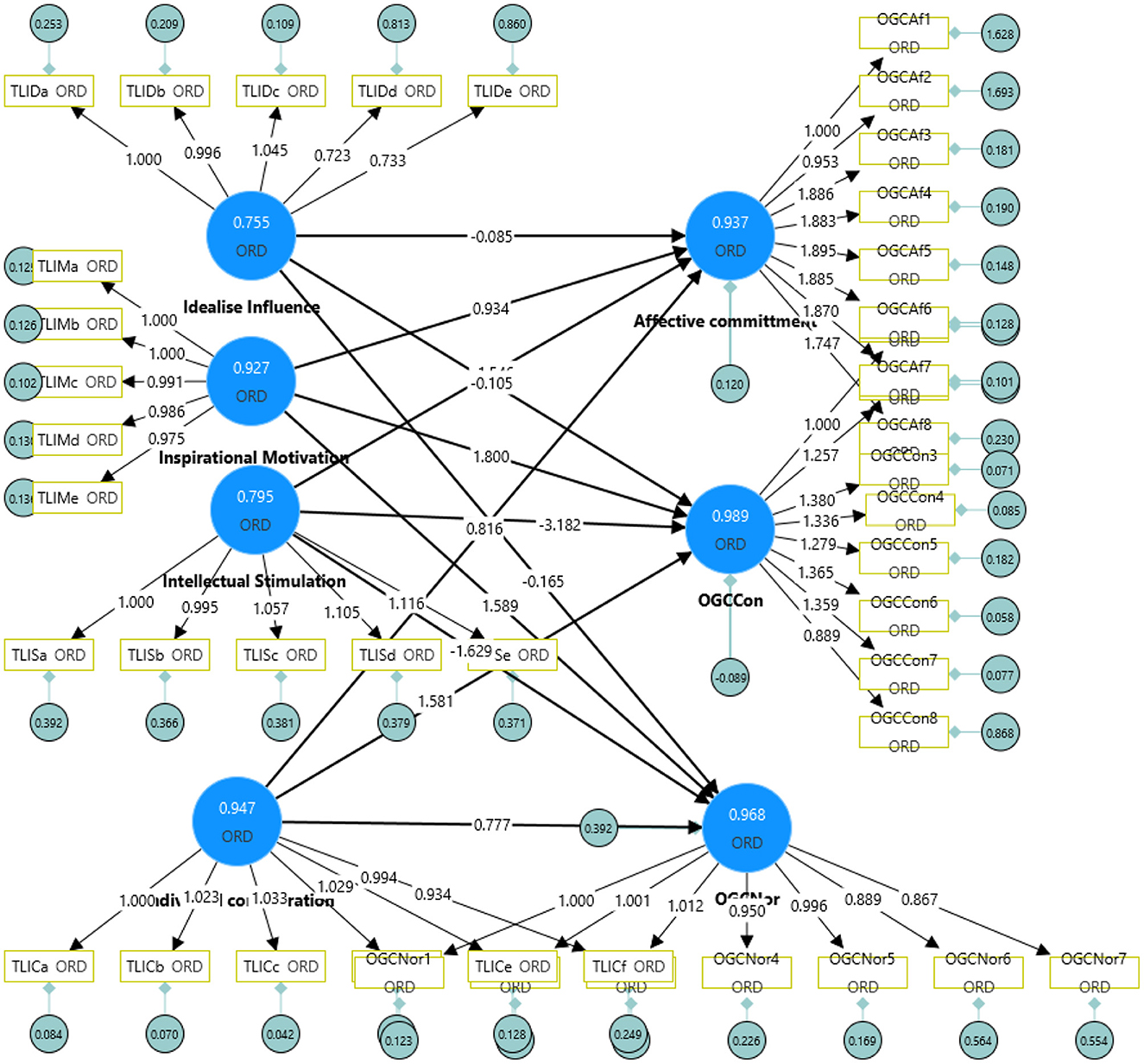
Figure 2. Hypothesis H01.

Table 3. Parameter estimates for H01 (transformational leadership → organizational commitment.
However, idealized influence displayed small yet statistically significant negative effects on all dimensions of commitment (for instance, β = −0.165, p = 0.001 for normative commitment), contradicting the hypothesized positive relationship.
Likewise, intellectual stimulation demonstrated large and significant negative effects across all commitment dimensions (e.g., β = −3.182, p = 0.000 for continuance commitment), reflecting a considerable deviation from theoretical expectations.
These results indicate that not all dimensions of transformational leadership enhance teacher commitment; some aspects may produce unintended negative outcomes within the Omani educational context. Thus, the hypothesized positive relationship is only partially supported, suggesting that the influence of transformational leadership on organizational commitment is multidimensional and context-dependent.
H02: Organizational Culture and Organizational Commitment
Hypothesis H02 posited that organizational culture is positively and significantly related to organizational commitment among principals and teachers in Oman's basic education schools.
The analysis assessed this relationship across the three dimensions of organizational commitment—affective, continuance, and normative-using standardized path coefficients (β), t-values, and p-values to determine significance. As shown in Figure 3 and Table 4, organizational culture is positively and significantly related to affective commitment (β = 0.147, t = 2.913, p = 0.004). Although moderate in strength, this relationship suggests that a supportive organizational culture enhances educators' emotional attachment to their institutions.
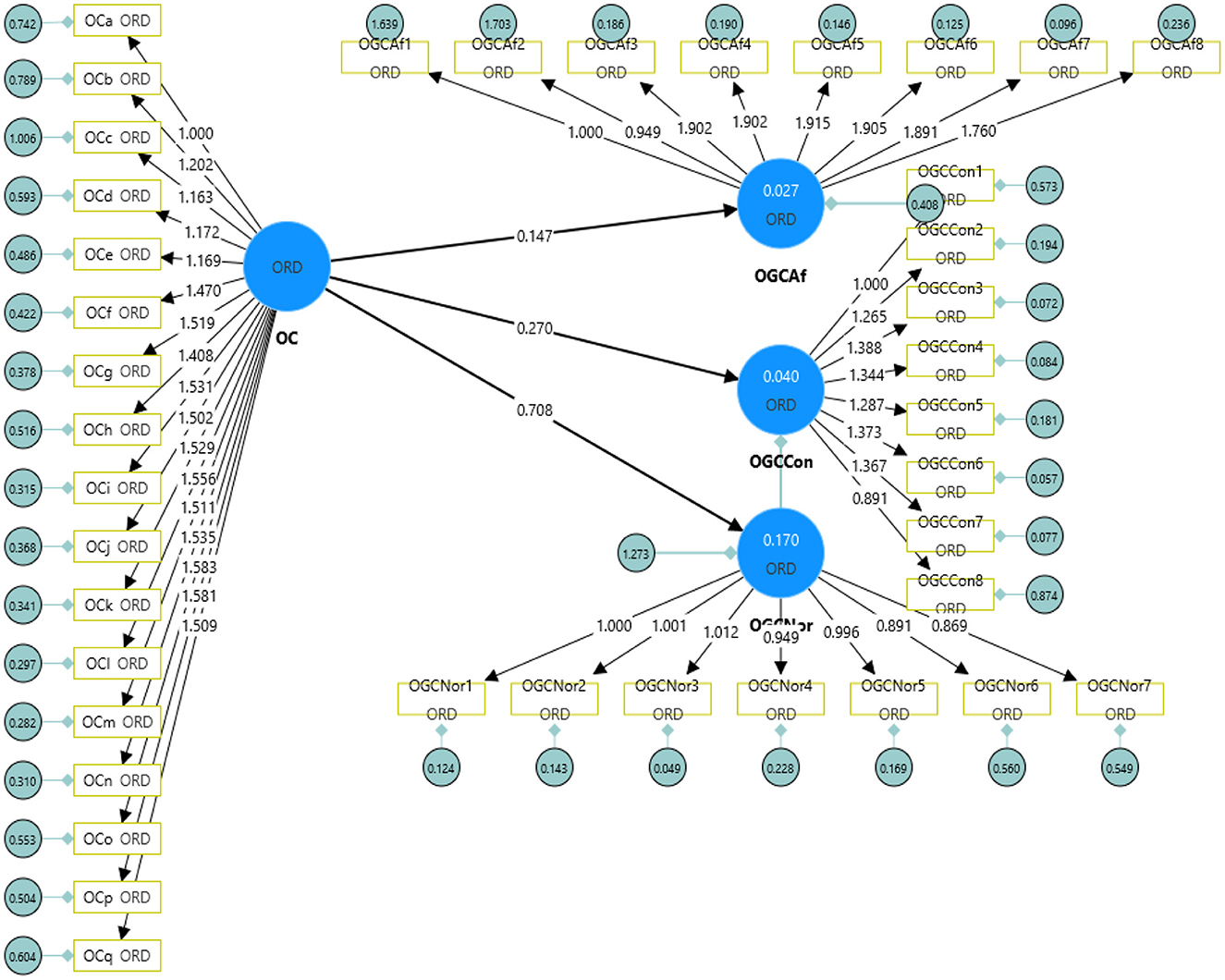
Figure 3. Hypothesis H02.
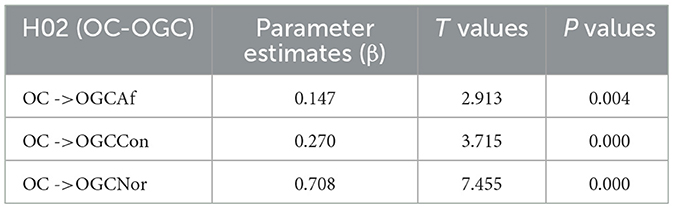
Table 4. Parameter estimates for H02 (organizational culture → organizational commitment.
The relationship between organizational culture and continuance commitment is stronger and highly significant (β = 0.270, t = 3.715, p = 0.000), indicating that a strong organizational culture increases educators' perceived cost of leaving their schools, possibly due to their investment in the organization or a perceived lack of viable alternatives.
The strongest effect was observed between organizational culture and normative commitment (β = 0.708, t = 7.455, p = 0.000), demonstrating a very strong and statistically significant relationship.
This finding implies that an innovative and value-driven culture reinforces educators' moral obligation and loyalty to their schools.
In summary, the findings strongly support H02, confirming that organizational culture significantly affects all three dimensions of commitment. These results underscore the crucial role of culture in strengthening emotional attachment, retention, motivation, and normative loyalty among teachers in Oman's basic education schools. Principals and administrators should therefore cultivate a cohesive, innovative, and values-driven culture.
H03: Organizational Culture as a Mediator of Transformational Leadership and Organizational Commitment
The results presented in Figure 4 and Tables 5, 6 provide empirical evidence related to Hypothesis H03, which posited that organizational culture mediates the relationship between transformational leadership and organizational commitment, such that this relationship is stronger in schools with a strong organizational culture.
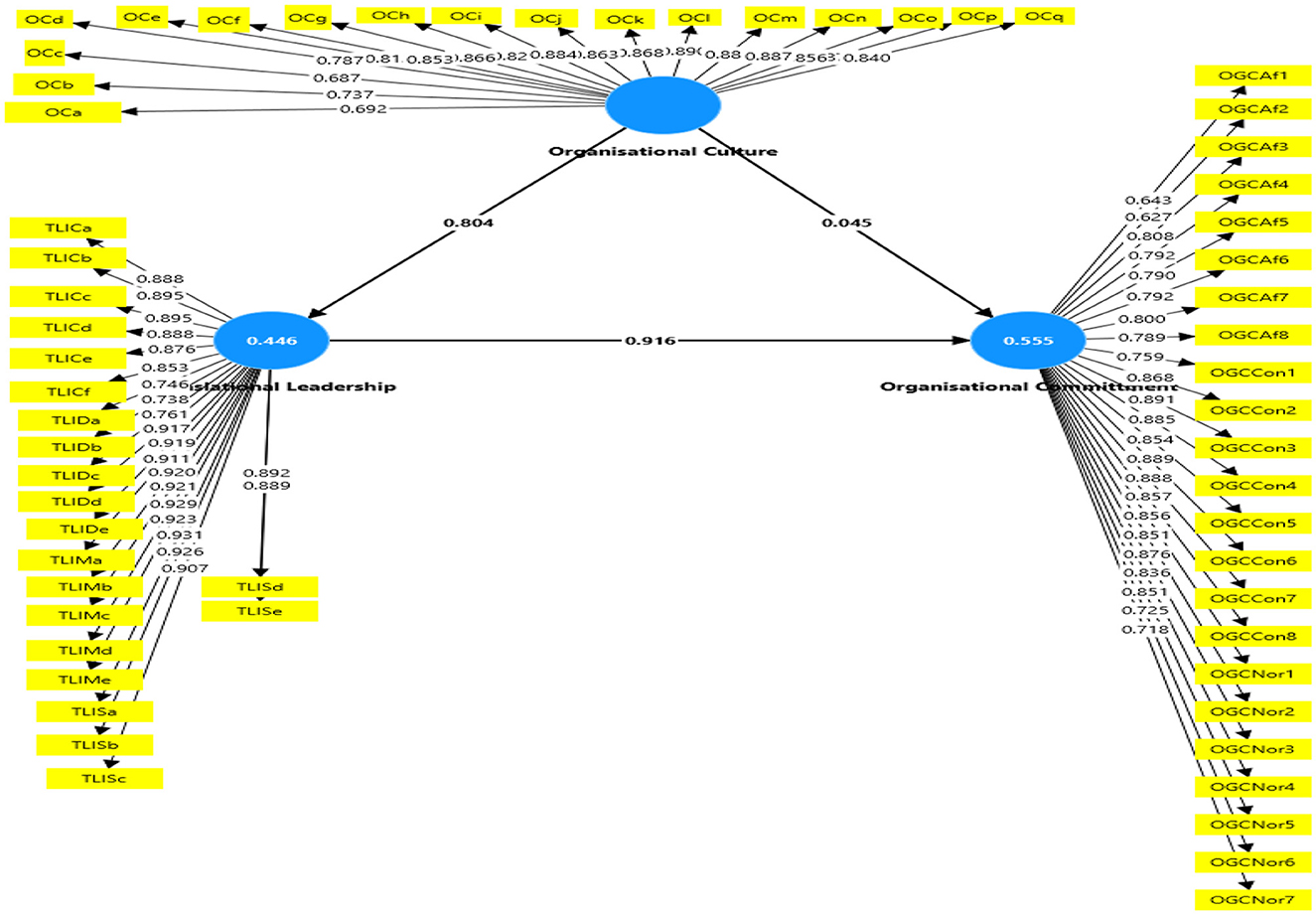
Figure 4. Moderating effect of organization culture.
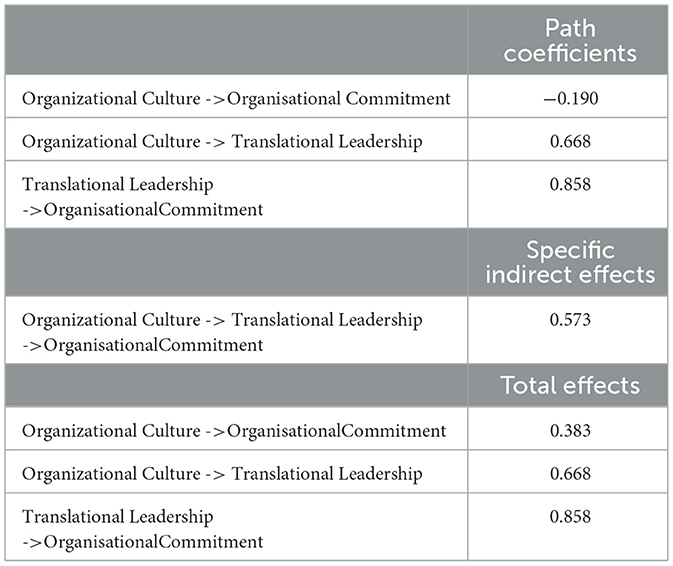
Table 5. Path coefficients and effects.
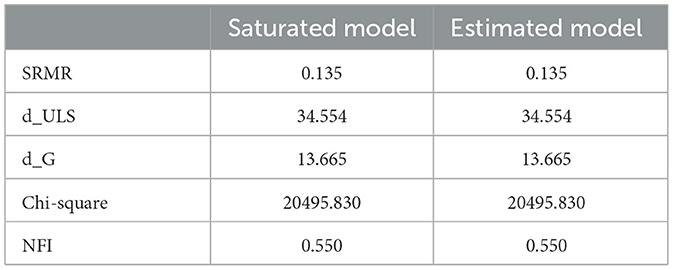
Table 6. Model fit indices.
The path coefficients show that organizational culture has a weak direct negative effect on organizational commitment (β = −0.190), but the total effect remains positive (β = 0.383), suggesting that its overall influence on commitment operates mainly through an indirect pathway.
The strong positive relationship between organizational culture and transformational leadership (β = 0.668) indicates that a supportive culture enhances the adoption and practice of transformational leadership behaviors. In turn, transformational leadership exerts a robust and direct influence on organizational commitment (β = 0.858), reinforcing earlier findings that transformational leaders play a vital role in strengthening staff commitment.
The specific indirect effect of organizational culture on organizational commitment through transformational leadership (β = 0.573) is both substantial and statistically significant, indicating that organizational culture contributes indirectly to commitment by fostering leadership practices that inspire, motivate, and support staff.
This confirms that the positive association between organizational culture and commitment is primarily driven by its indirect effect through transformational leadership rather than direct influence.
Therefore, cultivating a strong organizational culture is crucial, as it creates a climate that nurtures transformational leadership, ultimately enhancing teachers' commitment and stability within the educational system.
5 Discussion of findings
The results of this study show that transformational leadership partially supports organizational commitment among teachers in Omani basic education schools. Individualized Consideration and Inspirational Motivation were found to be positively related to teachers‘ commitment, while Idealized Influence and Intellectual Stimulation showed negative effects. These findings align with transformational leadership theory, which suggests that leaders who demonstrate concern for followers' needs and inspire motivation foster greater employee commitment (Saeed and Jun, 2022; Rodrigues et al., 2024). Katper et al. (2020) also reported that supportive leadership behaviors, such as individualized consideration, enhance job satisfaction, job retention, and organizational commitment.
The negative effect of Idealized Influence contradicts the hypothesized positive relationship. This outcome is consistent with Manoppo, who found that overly charismatic leaders can create staff dependence, inaction, and reduced autonomy. Research has shown that charismatic leadership styles can have both positive and negative effects on organizational outcomes (Lasrado and Kassem, 2021). In contrast, the large negative effect of Intellectual Stimulation on commitment is unexpected, given theoretical assumptions that it should enhance commitment (Mashile et al., 2021). However, the findings align with studies suggesting that excessive intellectual stimulation can lead to stress, burnout, and decreased job satisfaction. This implies that Omani teachers may perceive intellectual stimulation from leaders as challenging or overwhelming.
Hypothesis H02, which posited that innovative organizational culture significantly influences all three dimensions of organizational commitment among teachers in Oman's basic education schools, was supported by the study findings. This positive correlation between the two variables is consistent with earlier research (Golden III and Shriner, 2019; Ghumiem et al., 2023), which highlights the critical role of organizational culture in shaping employee commitment. Notably, a strong relationship was observed between organizational culture and normative commitment (β = 0.708), indicating that culture strongly fosters a sense of moral obligation and organizational citizenship behavior among educators—essential components of employee commitment.
Faeq and Ismael (2022) assert that organizational culture plays a vital role in promoting employee loyalty and commitment. Furthermore, the study identified significant relationships between organizational culture and both affective commitment (β = 0.147) and continuance commitment (β = 0.270). These findings suggest that a supportive culture enhances teachers' emotional attachment, reduces turnover, and boosts retention and motivation (Ghumiem et al., 2023; Jahan et al., 2022). The strong positive correlation between innovative organizational culture and organizational commitment indicates that employees working in a culture that values innovation, creativity, and critical thinking are more likely to remain committed to their organization.
Therefore, educational leaders and policymakers should strive to cultivate a cohesive, innovative, and values-driven culture in schools to strengthen staff commitment and improve the overall performance of the education system (Hashmi et al., 2020).
The results of this study also provide strong support for Hypothesis H4, indicating that innovative organizational culture mediates the relationship between transformational leadership and organizational commitment. The findings show that innovative organizational culture has a strong positive association with transformational leadership (β = 0.668), which in turn exerts a robust direct influence on organizational commitment (β = 0.858). These results are consistent with previous studies that highlighted the indirect effect of organizational culture in shaping employee commitment.
The significant indirect effect of organizational culture on commitment through transformational leadership (β = 0.573) suggests that innovative organizational culture contributes meaningfully to commitment, though indirectly. Leadership behaviors that encourage, inspire, motivate, and support employees can significantly strengthen commitment. DEL: Leadership behaviors that encourage, inspire, motivate, and support will trigger commitment. Al-Husseini emphasized that organizational culture plays a crucial role in promoting effective leadership practices, while Alruwais found that organizational culture influences both leadership style and employee outcomes.
A favorable organizational culture creates an environment that fosters effective leadership, commitment, and institutional stability. Tomi et al. further note that a positive culture enhances motivation, job satisfaction, and professional growth, ultimately improving overall organizational performance.
5.1 Theoretical implications
The study contributes to leadership theory by highlighting that not all dimensions of transformational leadership uniformly enhance teacher commitment. The negative effects observed for idealized influence and intellectual stimulation indicate the need to reinterpret the universal applicability of transformational leadership across cultural settings. Future theoretical models should account for how national culture, institutional hierarchy, and teacher expectations moderate leadership effectiveness. Furthermore, the study establishes innovative organizational culture as a mediating mechanism linking transformational leadership and commitment, advancing prior research that mainly viewed culture as a moderator or contextual variable. Finally, by confirming that affective, continuance, and normative commitment respond differently to leadership and cultural influences, the study supports a multidimensional conceptualization of commitment in educational settings.
5.2 Practical implications
1. The Ministry of Education in Oman should design leadership development programs that strengthen transformational leadership competencies, especially individualized consideration and inspirational motivation, which have proven most effective in this context.
2. Programs should also emphasize cultural awareness, helping school leaders understand how certain leadership behaviors (e.g., excessive intellectual stimulation) may have unintended negative consequences in hierarchical school systems.
3. At the institutional level, principals should foster innovative and collaborative organizational cultures that promote participation, creativity, and professional growth among teachers. Such environments enhance teacher engagement, motivation, and retention, contributing to improved student outcomes and overall school effectiveness.
4. Policymakers should integrate these findings into leadership evaluation frameworks and school improvement strategies to align leadership practices with Oman Vision 2040 educational objectives.
5.3 Limitations and future research
This study is limited to principals and teachers in Oman's public basic education schools, which may affect the generalizability of the findings. Future research could examine the relationships among transformational leadership, organizational culture, and commitment in different educational levels or private institutions. Comparative studies between primary and secondary schools could reveal whether cultural and leadership effects differ across educational tiers. Employing mixed-methods designs—combining surveys with interviews or focus groups—could provide deeper insight into the mechanisms underlying these relationships and strengthen causal interpretations.
6 Conclusion
This study examined the effect of transformational leadership on organizational commitment and identified the mediating role of innovative organizational culture among Omani primary school teachers. The findings demonstrate that not all dimensions of transformational leadership yield uniformly positive effects. While individualized consideration and inspirational motivation enhanced commitment, idealized influence and intellectual stimulation exerted negative influences. These results emphasize the importance of contextual and cultural factors in interpreting leadership effectiveness within hierarchical educational systems.
The study further establishes innovative organizational culture as a mediating mechanism that strengthens the link between leadership behaviors and teacher commitment. This suggests that fostering a culture of innovation and collaboration is essential for maximizing the benefits of transformational leadership in schools. Overall, the findings underscore the importance of combining effective leadership practices with supportive cultural environments to enhance teacher engagement and commitment. The study contributes both theoretically and practically by extending transformational leadership theory to a Middle Eastern educational context and offering evidence-based recommendations for policy and practice.
Practically, the results call for the Ministry of Education to institutionalize leadership development programs and promote innovative school cultures to improve teacher retention, professional growth, and student outcomes—thereby supporting the goals of Oman Vision 2040.
Data availability statement
The raw data supporting the conclusions of this article will be made available by the authors, without undue reservation.
Author contributions
SA: Methodology, Conceptualization, Investigation, Writing – original draft, Formal analysis, Visualization, Writing – review & editing. DYA-H: Conceptualization, Supervision, Writing – review & editing, Writing – original draft, Visualization. AA: Conceptualization, Methodology, Writing – original draft, Investigation, Data curation, Funding acquisition, Project administration, Resources, Software.
Funding
The author(s) declare that no financial support was received for the research and/or publication of this article.
Conflict of interest
The authors declare that the research was conducted in the absence of any commercial or financial relationships that could be construed as a potential conflict of interest.
Generative AI statement
The author(s) declare that no Gen AI was used in the creation of this manuscript.
Any alternative text (alt text) provided alongside figures in this article has been generated by Frontiers with the support of artificial intelligence and reasonable efforts have been made to ensure accuracy, including review by the authors wherever possible. If you identify any issues, please contact us.
Publisher's note
All claims expressed in this article are solely those of the authors and do not necessarily represent those of their affiliated organizations, or those of the publisher, the editors and the reviewers. Any product that may be evaluated in this article, or claim that may be made by its manufacturer, is not guaranteed or endorsed by the publisher.
References
Allen, N. J., and Meyer, J. P. (1990). Organizational socialization tactics: a longitudinal analysis of links to newcomers' commitment and role orientation. Acad. Manag. J. 33, 847–858. doi: 10.2307/256294
Al-Refaei, A. A. A., Ali, H. B. M., Ateeq, A. A., and Alzoraiki, M. (2023). An integrated mediating and moderating model to improve service quality through job involvement, job satisfaction, and organizational commitment. Sustainability 15:7978. doi: 10.3390/su15107978
Al-Sada, M., Al-Esmael, B., and Faisal, M. N. (2017). Influence of organizational culture and leadership style on employee satisfaction, commitment and motivation in the educational sector in Qatar. EuroMed. J. Bus. 12, 163–188. doi: 10.1108/EMJB-02-2016-0003
Alzubi, Y. Z. W. (2018). Turnover intentions in Jordanian Universities: the role of leadership behaviour, organizatio nal commitment and organizational culture. Int. J. Adv. Appl. Sci. 5, 177–192. doi: 10.21833/ijaas.2018.01.024
Azizollah, A., Abolghasem, F., and Amin, D. M. (2016). The relationship between organizational culture and organizational commitment in Zahedan University of medical sciences. Global J. Health Sci. 8:195. doi: 10.5539/gjhs.v8n7p195
Cobbinah, E., Tackie-Otoo, G., and Ayensu, S. (2020). The effect of organizational culture on job performance: the intervening role of organizational commitment. Int. J. Sci. Res. Publ. 10, 294–308. doi: 10.29322/IJSRP.10.12.2020.p10829
Faeq, D. K., and Ismael, Z. N. (2022). Organizational culture as a mediator between employee dissatisfaction and turnover intention. Int. J. Eng. Lit. Soc. Sci. 7, 095–110. doi: 10.22161/ijels.75.17
Ghumiem, S. H., Alawi, N. A., Abd, A. A., and Masaud, K. A. (2023). Corporate culture and its effects on organizational performance: multi-group analysis evidence from developing countries. Eur. J. Bus. Manag. Res. 8, 142–148. doi: 10.24018/ejbmr.2023.8.2.1890
Golden III, J. H., and Shriner, M. (2019). Examining relationships between transformational leadership and employee creative performance: the moderator effects of organizational culture. J. Creat. Behav. 53, 363–376. doi: 10.1002/jocb.216
Gyensare, M. A., Anku-Tsede, O., Sanda, M.-A., and Okpoti, C. A. (2016). Transformational leadership and employee turnover intention: the mediating role of affective commitment. World J. Entrepreneur. Manag. Sustain. Dev. 12, 243–266. doi: 10.1108/WJEMSD-02-2016-0008
Hashmi, M. A., Johl, S. K., Qabool, S., and Aziz, A. (2020). Consequences of organizational culture and the mediating role of job satisfaction and turnover intentions. Abasyn Univ. J. Soc. Sci. 13, 306–316. doi: 10.34091/AJSS.13.1.22
Hosseini, S. H., Hajipour, E., Kaffashpoor, A., and Darikandeh, A. (2020). The mediating effect of organizational culture in the relationship of leadership style with organizational learning. J. Hum. Behav. Soc. Environ. 30, 279–288. doi: 10.1080/10911359.2019.1680473
Idiegbeyan-Ose, J., Opeke, R., Nwokeoma, N. M., and Osinulu, I. (2018). Influence of organisational culture on turnover intention of library staff in private university libraries, South-West Nigeria. Acad. Strat. Manag. J. 17, 1–13. https://www.researchgate.net/publication/327830358_Influence_of_organisational_culture_on_turnover_intention_of_library_staff_in_Private_University_Libraries_South-West_Nigeria
Ince, F. (2023). “Transformational leadership in a diverse and inclusive organizational culture,” in Handbook Research on Promoting an Inclusive Organizational Culture for Entrepreneurial Sustainability, 188-201. doi: 10.4018/978-1-6684-5216-5.ch010
Jahan, I., Huynh, T., and Mass, G. (2022). The influence of organisational culture on employee commitment: An empirical study on civil service officials in Bangladesh. South Asian J. Hum. Res. Manag. 9, 271–300. doi: 10.1177/23220937221113994
Kariuki, J. K., Wandiga, E. N., and Odiyo, W. O. (2022). An empirical survey of the relationship between transformational leadership and staff retention in the context of microfinance institutions in Kenya. Econ. Bus. Q. Rev. 5, 51–69. doi: 10.31014/aior.1992.05.02.413
Katper, N. K., Chaudhry, N. I., Tunio, M. N., and Ali, M. A. (2020). Impact of leadership style and organizational culture on organizational commitment. Sukkur IBA J. Manag. Bus. 7, 92–106. doi: 10.30537/sijmb.v7i1.560
Khalid Salim, A., and Abdul Wahab, S. (2024). Transformational leadership on organizational commitment and job performance of construction employees in Oman. J. Electr. Syst. 20, 1977–1997. doi: 10.52783/jes.2303
Lasrado, F., and Kassem, R. (2021). Let's get everyone involved! The effects of transformational leadership and organizational culture on organizational excellence. Int. J. Qual. Reliabil. Manag. 38, 169–194. doi: 10.1108/IJQRM-11-2019-0349
Lee, E. (2025). The moderating role of organizational culture between transformational leadership and organizational performance. J. Organ. Behav. 46, 123–145.
Liu, Y., and Zhang, J. (2019). Linking ambidextrous organizational culture to innovative behavior: The moderating role of transformational leadership. Front. Psychol. 10:2192. doi: 10.3389/fpsyg.2019.02192
Mashile, D. A., Munyeka, W., and Ndlovu, W. (2021). Organisational culture and turnover intentions among academics: a case of a rural-based university. Stud. High. Educ. 46, 385–393. doi: 10.1080/03075079.2019.1637844
Mlokani, D. K. A. K., Wagan, S. A., Mahar, Q., Kazi, S., Yousfani, K., and Anand, V. (2023). Impact of transformational leadership styles on turnover intentions: evidence from banking sector of Sindh, Pakistan. Russ. Law J. 11, 1948–1967.
Neelam, N., Bhattacharya, S., Sinha, V., and Tanksale, D. (2015). Organizational culture as a determinant of organizational commitment: What drives IT employees in India? Glob. Bus. Organiz. Excell. 34, 62–74. doi: 10.1002/joe.21594
Nguyen, N. P. (2023). Does transformational leadership influence organisational culture and performance? J. Manag. Dev. 42, 1–15. doi: 10.1016/j.iimb.2023.10.001
Nhat Vuong, B., Nam Khanh Giao, H., and Van Hung, D. (2023). N How transformational leadership influences employees' job-related outcomes through public service motivation: does power distance orientation matter? Cogent Bus. Manag. 10:2176281. doi: 10.1080/23311975.2023.2176281
Odetunde, O. J., and Ufodiama, N. M. (2017). Transformational leadership and organisational culture as predictors of employee creativity and innovation in the Nigerian oil and gas service industry. Int. J. 25, 325-349.
Opolot, J. S., Lagat, C., Kipsang, S. K., and Muganzi, Y. K. (2023). Organisational culture and organisational commitment: the moderating effect of self-efficacy. J. Humanit. Appl. Soc. Sci. 6, 280–296. doi: 10.1108/JHASS-09-2023-0105
Park, T., and Pierce, B. (2020). Impacts of transformational leadership on turnover intention of child welfare workers. Child. Youth Serv. Rev. 108, 1–10. doi: 10.1016/j.childyouth.2019.104624
Pawirosumarto, S., Sarjana, P. K., and Gunawan, R. (2017). The effect of work environment, leadership style, and organizational culture towards job satisfaction and its implication towards employee performance in Parador Hotels and Resorts, Indonesia. Int. J. Law Manag. 59, 1337–1358. doi: 10.1108/IJLMA-10-2016-0085
Promchart, K., and Potipiroon, W. (2020). Transformational leadership and turnover intentions among school teachers in the deep south of Thailand. J. Behav. Sci. 15, 16-37.
Qi, L., Chaudhary, N. I., Yao, K., Mirza, F., and Khalid, R. (2022). The moderating role of transformational leadership on the relationship between deviant workplace behaviors and employee turnover intentions in China. Front. Psychol. 13:1005055. doi: 10.3389/fpsyg.2022.1005055
Raveendran, T., and Gamage, A. S. (2019). The mediating effect of organizational commitment in the impact of transformational leadership style on employee performance: a study of divisional secretariats in the Jaffna District. Leadership 9, 116–139. doi: 10.5296/ijhrs.v9i2.14623
Rodrigues, J. P., Correia, R. J., Campos, S., and Teixeira, M. S. (2024). Transformational leadership, organizational culture, and employees' commitment: Mediation effects chain in the textile industry. J. Chin. Hum. Res. Manag. 15, 28–47. doi: 10.47297/wspchrmWSP2040-800502.20241504
Saeed, F., and Jun, Y. (2022). The impact of transformational leadership on employee turnover intention: The mediating and moderating role of affective organizational commitment and job embeddedness. Int. J. Manag. Account. Econ. 9, 247–267. doi: 10.5281/zenodo.6762232
Shahzad, M. A., Iqbal, T., Jan, N., and Zahid, M. (2022). The role of transformational leadership on firm performance: mediating effect of corporate sustainability and moderating effect of knowledge-sharing. Front. Psychol. 13:883224. doi: 10.3389/fpsyg.2022.883224
Spector, P. E. (2019). Job Satisfaction: Application, Assessment, Causes, and Consequences. SAGE Publications.
Upadhyay, P., and Kumar, A. (2020). The intermediating role of organizational culture and internal analytical knowledge between the capability of big data analytics and a firm's performance. Int. J. Inf. Manage. 52102100. doi: 10.1016/j.ijinfomgt.2020.102100
Vizano, N. A., Utami, W., Johanes, S., Herawati, A., Aima, H., Sutawijaya, A. H., et al. (2020). Effect of career, organizational commitment on turnover intention through mediation of organizational culture: Evidence from Indonesian companies. Syst. Rev. Pharm. 11, 931–937. doi: 10.31838/srp.2020.9.136
Wells, H., Duffy, L., Nance, M., Fleming, L., Stone, G., and Townsend, J. (2019). Does culture matter? Ther. Recreat. J. 53, 224–243. doi: 10.18666/TRJ-2019-V53-I3-9684
Keywords: transformational leadership, organizational commitment, innovative organizational culture, teacher commitment, educational leadership
Citation: Ali Alshuhumi SR, Yahya Al-Hidabi DAM and Akinbode AI (2025) Examining the mediating role of innovative organizational culture between transformational leadership styles and organizational commitment. Front. Educ. 10:1646970. doi: 10.3389/feduc.2025.1646970
Received: 14 June 2025; Accepted: 28 October 2025;
Published: 11 December 2025.
Edited by:
Margaret Grogan, Chapman University, United StatesReviewed by:
Yihong Long, Guizhou Minzu University, ChinaMark Raymond Tan, City College of Cagayan de Oro, Philippines
Copyright © 2025 Ali Alshuhumi, Yahya Al-Hidabi and Akinbode. This is an open-access article distributed under the terms of the Creative Commons Attribution License (CC BY). The use, distribution or reproduction in other forums is permitted, provided the original author(s) and the copyright owner(s) are credited and that the original publication in this journal is cited, in accordance with accepted academic practice. No use, distribution or reproduction is permitted which does not comply with these terms.
*Correspondence: Said Rashid Ali Alshuhumi, c2FpZC5hbHNoYWhvbWVAbW9lLm9t