 Jiaxin Wang1,2
 Teng Hu
- 1School of Automotive Intelligent Manufacturing, Hubei University of Automotive Technology, Shiyan, China
- 2Key Laboratory of Automotive Power Train and Electronics, Hubei University of Automotive Technology, Shiyan, China
This study develops a hybrid Project-Based Learning (PBL) model integrating online-offline instruction for Hydraulic and Pneumatic Transmission. Using an intelligent tractor leveling system case, we implemented the approach with 93 undergraduates (test group) versus 70 undergraduates (control group). Results showed the test group achieved significantly higher theoretical test average score (70.4 vs. 67.9, p < 0.05) and lower failure rates (2.15% vs. 8.57%). Questionnaire surveys revealed greater satisfaction with teaching methods (1.52 vs. 1.96) and outcomes (1.92 vs. 2.21), with over 80% reporting improved practical understanding. The study demonstrates how research projects can effectively enhance engineering education through structured PBL implementation.
1 Introduction
The rapid advancement of agricultural mechanization and intelligent equipment has placed higher demands on the practical and innovative abilities of engineering students, particularly in the field of hydraulic and pneumatic transmission (Peng et al., 2023; Olewnik et al., 2023; Carrick and Czekanski, 2017). However, traditional teaching methods in hydraulic courses often focus on theoretical knowledge and simple experimental verification, lacking integration with real-world engineering applications. This disconnection limits students’ ability to translate classroom learning into solving complex industrial problems (Chunyang and Zhong, 2025; Tekmen-Araci, 2024; Qian et al., 2023).
PBL is an innovative educational approach where students engage in hands-on, real-world projects to deepen their understanding of academic concepts and develop essential skills. Instead of passive memorization, learners actively explore complex questions, conduct research, and collaborate to create meaningful solutions or products, such as designing sustainable cities, launching awareness campaigns, or building functional prototypes (Van Helden et al., 2023). This student-centered method fosters critical thinking, creativity, and teamwork while bridging multiple disciplines like science, math, and social studies. Instructors act as facilitators, guiding learners through challenges rather than delivering rigid instructions. The principle of authenticity is a cornerstone of PBL, requiring students to engage in tasks that mirror real-world professional practice (Bessa et al., 2019). This focus is so central that a key challenge in PBL implementation is ensuring this authenticity is maintained, with research dedicated to developing support systems specifically for this purpose (David and Marshall, 2015). This emphasis on authentic contexts boosts motivation and relevance by bridging the gap between theory and application. By integrating theory with practice, PBL transforms classrooms into dynamic environments where learning is driven by curiosity, purpose, and real-world impact.
To establish a comprehensive theoretical framework, it is essential to clarify PBL’s core pedagogical principles. First proposed by Barrows and Tamblyn in medical education, PBL operates on constructivist learning theories where knowledge is actively built through problem-solving experiences rather than passively received. The approach is characterized by: (1) problem-centered learning initiation, (2) collaborative small-group processes, (3) facilitator-guided inquiry, and (4) self-directed knowledge acquisition (Van Barneveld and Strobel, 2023). In engineering education specifically, PBL implementation typically follows a structured workflow comprising problem analysis, self-directed learning, solution development, and reflection/evaluation phases. This methodological framework enables students to develop both technical competencies and professional skills simultaneously - particularly crucial in hydraulic and pneumatic transmission education where theoretical principles must be translated into practical system design and troubleshooting capabilities (Higuera-Martinez et al., 2023).
PBL has been widely recognized as an effective pedagogical approach to bridge this gap, as it engages students in authentic engineering tasks while fostering problem-solving and teamwork skills (Zin et al., 2017; Derikvand, 2025). Guerra et al. used Q-methodology to examine 24 engineering students’ perceptions of sustainability agency within Danish PBL, identifying three key perspectives: professional responsibility toward Sustainable Development Goals (SDGs), curriculum’s foundational role, and collaborative learning. Findings demonstrate PBL’s effectiveness across personal, actional, and contextual dimensions while recommending more structured sustainability activities with clear institutional strategies (Guerra et al., 2025). Hasan et al. (2024) employed phenomenography to analyze engineering students’ diverse conceptions of PBL, revealing five distinct pedagogical beliefs that influence their learning approaches. The findings highlight the need for clearer communication of PBL objectives and more tailored activity designs to enhance knowledge/skill acquisition in engineering education (Hasan et al., 2024). Acuña et al. (2025) demonstrates how a Project-Oriented Problem-Based Learning (PO-PBL) approach enhanced with Integrated Product and Process Design (DIPP), gamification, and Artificial Intelligence (AI) tools improves chemical engineering students’ technical and professional skills, effectively preparing them for industry demands. Zhang F. et al. (2024) proposes a probability exceedance method (PEM) to holistically assess engineering students’ sustainable decision-making in online PBL courses, overcoming limitations of traditional grading while ensuring reliable, flexible evaluation aligned with educational innovation needs. González-Cortés et al. (2025) demonstrates the successful 8-year implementation of PBL in bioprocess engineering education (441 students), combining industrial-scale process design, MATLAB modeling, and techno-economic analysis, yielding high academic performance and improved student collaboration, comprehension, and industry readiness. Li et al. (2025) demonstrates that PBL significantly improves medical students’ understanding of congenital malformations, enhances teamwork and innovative thinking, and increases learning interest, as evidenced by inter-group evaluations and post-class surveys. Lucena et al. (2025) highlights PBL’s effectiveness in Brazilian forest science education, with 32 students reporting enhanced field skills, technical knowledge, teamwork, and communication, addressing the need for dynamic professionals to tackle real-world challenges. Ravi (2025) combine digital simulation-based learning (DSBL) with Legitimation Code Theory (LCT) and PBL in chemical engineering education, enhancing students’ conceptual understanding, critical thinking, and confidence through semantic shifts between theory and simulation.
Hybrid online-offline instruction strategically integrates digital learning platforms with in-person classroom activities to create a flexible and complementary educational experience. Based on insights from Massive Open Online Courses (MOOCs) and Small Private Online Course (SPOCs), Lin et al. (2024) develops an online-offline blended course in process simulation that enhances learning outcomes through complementary instructional design and project-based activities. This study demonstrates that blended teaching significantly improves clinical skills acquisition in medical education, with OSCE results showing superior performance compared to traditional methods (p < 0.05) and particularly strong effectiveness in emergency medicine and surgical training (He et al., 2024). Based on a survey of 1,250 EFL students in higher vocational colleges, Jiang and Niu (2025) reveals that SPOC-based blended learning elicits positive emotional responses with high adaptability and identifies key demographic factors influencing learning emotions through a validated regression model. Zhang J. et al. (2024) demonstrates that a digital twin learning system significantly enhances project-based engineering education by improving students’ critical thinking, learning experience, and academic performance. Li (2022) develops a hybrid online-offline English speaking teaching platform that effectively addresses listening skill disparities and enhances overall language learning outcomes through contextualized practice.
In conclusion, although both PBL and online-offline hybrid teaching have been extensively studied, few attempts have been made to integrate these two approaches, particularly in the context of Hydraulic and Pneumatic Transmission courses. This study bridges this gap by implementing a novel pedagogical model that synergizes PBL with a hybrid instructional framework.
2 Methodology
2.1 Hydraulic and pneumatic transmission course and participants
Hydraulic and Pneumatic Transmission is a foundational course for engineering mechanics majors and serves as a key core theoretical course within the mechanical discipline. It plays a pivotal role in bridging the upper and lower components of the mechanical curriculum and occupies an important place in the talent development system of higher education in the mechanical field. The course is typically offered in the second semester of the third year. Two student cohorts, the 2021 and 2022 grades, are selected as experimental subjects and are divided into the test group and the control group. Both groups are taught by the same instructor but are instructed using different teaching approaches. The control group consists of 70 students from the 2021 grade and follows the traditional teaching method. The test group comprises 93 students from the 2022 grade and adopts an integrated approach combining PBL with the hybrid online-offline pedagogical model. There are no statistically significant differences between the two groups in terms of age, gender, or theoretical examination scores in other professional courses taken during the first semester of the third year (p > 0.05). To further ensure the baseline equivalence in knowledge specific to this course, a pre-test on fundamental hydraulic principles was administered to both groups before the teaching intervention. An independent samples t-test confirmed no significant difference in pre-test scores between the control group (M = 62.1, SD = 10.5) and the experimental group (M = 63.4, SD = 11.2). This confirms the groups’ comparability at the outset of the study.
2.2 Case implementation
Our team’s research project “Design of a Hydraulic Leveling System for Intelligent Tractors” focused on developing a hydraulic system to stabilize the tractor body in hilly and mountainous terrain. This project not only resulted in patent authorization but also generated substantial technical data and valuable engineering experience. However, these resources have not been fully integrated into teaching practices. Based on this, this study proposes the “Research to Classroom” (R2C) innovative framework, aiming to transform cutting-edge research findings into teaching cases to meet the needs of undergraduate education. The teaching flow chart is illustrated in Figure.1.
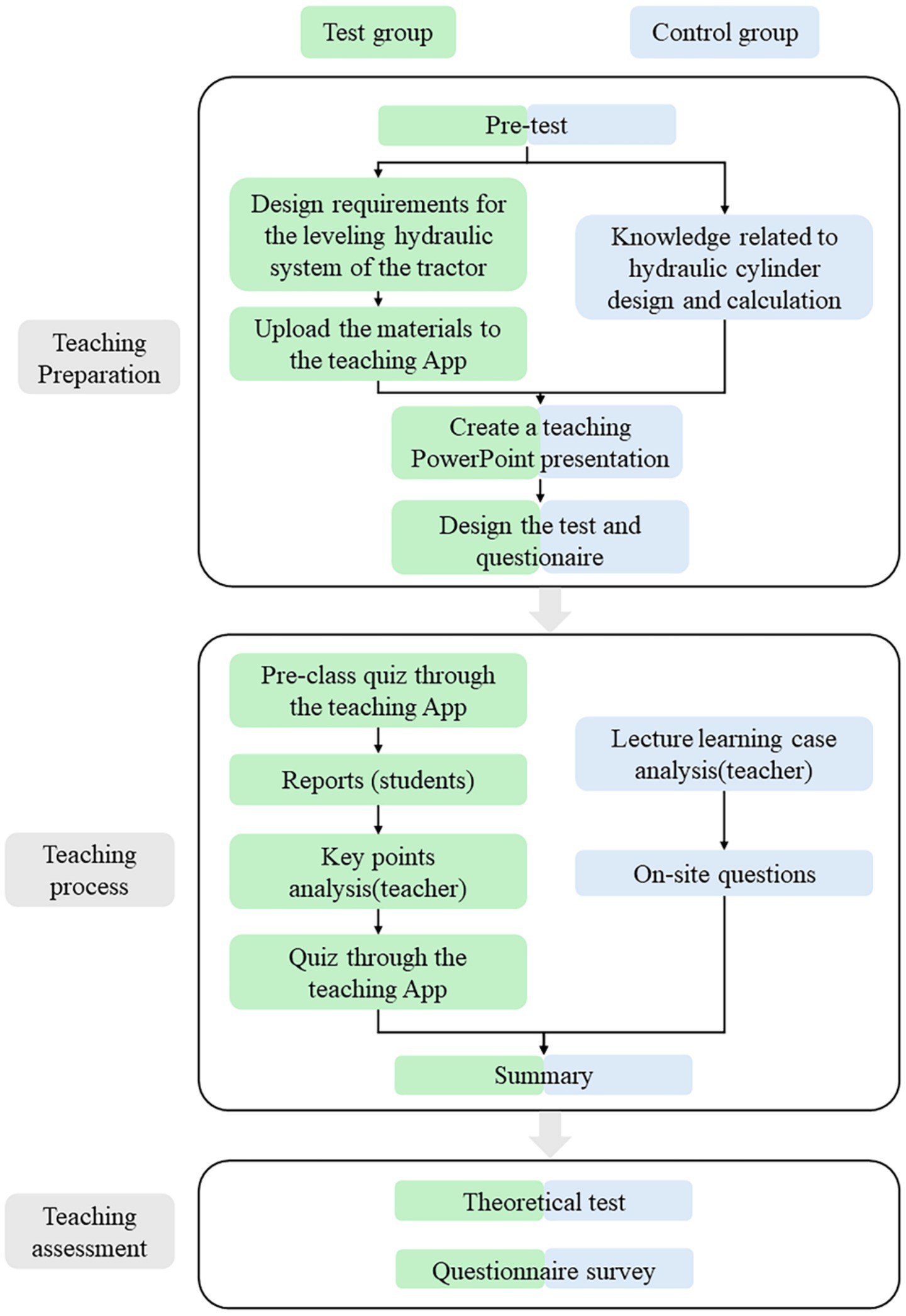
Figure 1. Teaching flow chart.
Following the pre-test, the hybrid online-offline methodology was implemented as follows, with a structured integration between the two modalities:
Two days prior to the in-person session, students were instructed to access the designated teaching App. The instructor uploaded curated digital materials, including: (1) video demonstrations of tractor operations on sloped terrain, (2) technical datasheets of the tractor and hydraulic components, and (3) key theoretical knowledge regarding hydraulic cylinder design. Subsequently, the instructor posed driving questions via the App (e.g., “Why is leveling necessary?,” “What factors influence cylinder design?”). Students were required to form groups online, select three questions for discussion, and initiate the collaborative design of the leveling system using shared documents. Instructor monitored group progress and online participation through the App’s backend analytics, which contributed to their continuous assessment.
The 45-min offline session was designed to deepen and apply the online pre-learning. It began with a 5-min quiz on the App to check understanding of the pre-class materials. This was followed by a 20-min structured group presentation session, where each group presented their initial design solutions and received immediate feedback from both peers and the instructor. The instructor then facilitated a 15-min interactive lecture, summarizing common design pitfalls, explaining the formal calculation process for hydraulic cylinders, and highlighting the connections between theoretical principles and the practical project. Finally, single-choice questions about the case were interspersed through the App to reinforce key points in real-time.
After the class, online discussion forums were opened for a week for students to submit refined design proposals, ask follow-up questions, and engage in cross-group discussions. The instructor provided final written feedback on the submitted designs within the platform.
Similarly, after completing the pre-test, the control group was instructed using the traditional lecture-based teaching approach. This method was primarily instructor-centered and textbook-driven. The specific implementation was as follows:
Two days prior to the class, students in the control group were assigned the task of previewing specific chapters (e.g., Chapter 3: Hydraulic Cylinders) from the designated textbook. They were asked to answer the same fundamental questions provided to the experimental group, but without any structured guidance or online resources provided by the instructor.
In-class Instruction: During the 45-min lesson, the instructor delivered a linear, slide-based lecture using PowerPoint. The content covered the classification of hydraulic cylinders, their structural components, and the step-by-step calculation method for cylinder design. The instructor explained these concepts using the standard example of a grinding machine’s slide table hydraulic system from the textbook. The session was predominantly a one-way knowledge transfer from instructor to students.
To encourage minimal student engagement, three multiple-choice questions (e.g., “What is the key factor in determining the piston rod diameter?”) of the same type were posed during the lecture. Students could answer either voluntarily upon the instructor’s general inquiry or when called upon individually. There were no group discussions or collaborative problem-solving activities.
Immediately after the class, students from both groups completed the same post-lesson assessment via a mobile application. The test consisted of two questions on hydraulic system design calculations (each worth 50 points, for a total of 100 points), requiring students to apply the knowledge they had acquired to achieve system functionality and design hydraulic cylinders that met specified requirements.
In addition, a questionnaire was distributed to the students via the App to investigate their feelings and opinions regarding the teaching content, teaching methods, and teaching outcomes. Each item was scored on a scale of five levels: strongly agree (1 point), agree (2 points), neutral (3 points), disagree (4 points), and strongly disagree (5 points). The lower the score, the higher the students’ acceptance of this learning method. The questionnaire was reviewed by a panel of three experts in engineering education and pedagogy. The experts evaluated the relevance, clarity, and comprehensiveness of each item. Their feedback was used to refine the wording and ensure the questionnaire accurately measured the intended constructs.
3 Results and discussion
3.1 Theoretical test
The comparative analysis of theoretical examination scores between the two groups is presented in the Table 1. The results indicate that the experimental group (n = 93), which employed the PBL approach combined with a hybrid online-offline instructional model, achieved a significantly higher mean score (70.4) than the control group (n = 70) using traditional teaching methods (67.9, p < 0.05, Cohen’s d = 0.42). In terms of academic pass rates, the experimental group had only 2 failing students (2.15%), a figure substantially lower than that of the control group (6 failures, 8.57%), with this difference being statistically significant (χ2 = 4.12, p = 0.042, φ = 0.16).

Table 1. Comparison of theoretical test scores between the two groups.
The enhanced teaching efficacy primarily derives from the multifaceted advantages of the blended PBL instructional approach. Firstly, the case-driven learning centered on the tractor hydraulic leveling system project stimulated students’ active knowledge construction, thereby deepening their comprehension of theoretical concepts. Secondly, the integrated online-offline teaching format established a virtuous cycle of “pre-class micro-lecture preparation, in-class project implementation, and post-class online discussion reinforcement.” Empirical data indicated an 89% completion rate for chapter assessments in the experimental group, significantly surpassing the control group’s 62% (p < 0.05). Thirdly, the online platform’s automated grading and error analysis functions provided timely formative feedback. Of particular note, the two underperforming students in the experimental group demonstrated platform engagement rates below 60%, revealing a statistically significant correlation between learning outcomes and participation levels (r = 0.51, p < 0.01). This finding underscores the necessity of implementing learning behavior monitoring mechanisms to ensure comprehensive student involvement across all PBL phases. These empirical results substantiate that the blended PBL model not only enhances academic achievement and reduces failure rates, but also optimizes learning effectiveness by fostering active learning, enabling multimodal reinforcement, and delivering personalized feedback.
3.2 Questionnaire survey
The survey results (Table 2) demonstrate that the experimental group (n = 87) showed higher overall acceptance of the blended PBL teaching model. Specifically, their satisfaction scores were 1.46 ± 0.52 for instructional content, 1.52 ± 0.61 for teaching methods, and 1.92 ± 0.73 for learning outcomes. In contrast, the control group (n = 66) rated traditional teaching methods as 1.38 ± 0.49, 1.96 ± 0.67, and 2.21 ± 0.82 for these respective dimensions. While no significant difference was observed in content satisfaction between groups (p > 0.05) indicating both groups equally recognized the course content’s strong practicality the experimental group showed significantly better ratings in both teaching methodology (t = 4.32, p < 0.01) and learning effectiveness (t = 2.87, p < 0.05).
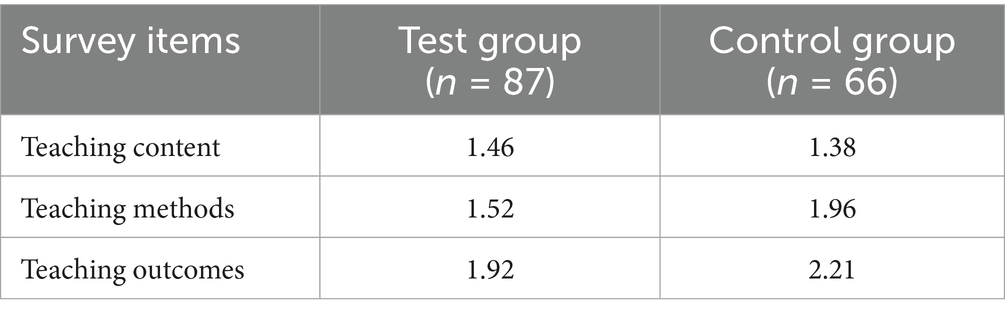
Table 2. Survey results.
Firstly, in terms of teaching methods, the experimental group achieved a score of 1.52 points, which can be attributed to the effective integration of the PBL (Project-Based Learning) approach with both online and offline educational resources. According to student feedback, 83.9% indicated that this instructional model enhanced their understanding of the practical application of theoretical knowledge, while 78.2% acknowledged its effectiveness in meeting individualized learning needs. Secondly, regarding teaching effectiveness, the experimental group scored 1.92 points, higher than the control group, nonetheless, there remains potential for further improvement. Specifically, 85.1% of students reported that this method improved their problem-solving abilities, and 76.3% believed it deepened their comprehension of theoretical concepts. However, 21.8% of students expressed concerns about the relatively heavy workload associated with the project tasks. In contrast, the control group, which followed the traditional teaching approach, showed moderate satisfaction with the instructional content design (1.38 points). Among them, 62.1% expressed a desire for more practical components, 67.4% found it challenging to connect theory with practice, and 53.2% reported a lack of learning achievement. Consequently, the scores for teaching methods (1.96 points) and teaching effectiveness (2.21 points) were comparatively lower. These findings clearly indicate that the PBL-based blended teaching model significantly enhances students’ learning experiences and outcomes through real-world engineering scenarios and flexible instructional strategies. Nevertheless, they also highlight the need to refine the design of project tasks to better balance academic rigor and workload. Furthermore, traditional teaching methods urgently require the incorporation of more practical elements to enhance overall instructional effectiveness.
4 Conclusion
This study developed an innovative “Research-to-Classroom” (R2C) framework by integrating PBL with a hybrid online-offline instructional approach, successfully transforming the intelligent tractor hydraulic leveling system research project into an undergraduate teaching module. The implementation provides significant insights for reforming hydraulic and pneumatic transmission education. The main research conclusions are as follows:
First, the PBL hybrid teaching model demonstrated substantial improvements in instructional effectiveness. The experimental group achieved an average theoretical examination score of 70.4 points, representing a 2.5-point increase over the control group. The failure rate was only 2.15%, significantly lower than the 8.5% observed in the control group. These outcomes can be attributed to the case-driven active learning mechanism and the multimodal reinforcement learning pathway incorporating “pre-class micro-lectures, in-class project practice, and online discussion consolidation.”
Second, students exhibited high acceptance of the PBL hybrid model. In terms of teaching methods and learning outcomes, the experimental group’s satisfaction scores (1.52 and 1.92 points, respectively) were significantly better than those of the traditional teaching group (1.96 and 2.21 points). Specifically, 83.9% of students acknowledged that this approach enhanced their understanding of theoretical knowledge applications, while 85.1% recognized its effectiveness in improving problem-solving capabilities.
Finally, the study identified several noteworthy issues: (1) A significant positive correlation (r = 0.51) between learning outcomes and participation levels, necessitating the establishment of learning behavior monitoring mechanisms; (2) 21.8% of students reported excessive workload in project tasks, suggesting the need for optimized task design. These findings provide clear directions for future instructional improvements.
This research confirms the advantages of the PBL hybrid teaching model in engineering education and establishes a replicable implementation pathway for transforming research achievements into teaching resources. Future studies should further explore the development of intelligent learning monitoring systems and the optimization of task difficulty gradients to better accommodate diverse student learning needs.
Data availability statement
The raw data supporting the conclusions of this article will be made available by the authors, without undue reservation.
Author contributions
JW: Conceptualization, Data curation, Funding acquisition, Investigation, Software, Writing – original draft, Writing – review & editing. JL: Project administration, Resources, Validation, Writing – original draft, Writing – review & editing. TH: Conceptualization, Data curation, Funding acquisition, Methodology, Supervision, Writing – original draft, Writing – review & editing.
Funding
The author(s) declare that financial support was received for the research and/or publication of this article. This work was supported by the Ministry of Education‘s Collaborative Education-Industry Partnership Program for Enhancing Learning Experience (Grant Nos. 2411272355, 2411281302); the PhD Research Startup Foundation of Hubei University of Automotive Technology (Grant Nos. BK202346, BK202332).
Conflict of interest
The authors declare that the research was conducted in the absence of any commercial or financial relationships that could be construed as a potential conflict of interest.
Generative AI statement
The authors declare that no Gen AI was used in the creation of this manuscript.
Any alternative text (alt text) provided alongside figures in this article has been generated by Frontiers with the support of artificial intelligence and reasonable efforts have been made to ensure accuracy, including review by the authors wherever possible. If you identify any issues, please contact us.
Publisher’s note
All claims expressed in this article are solely those of the authors and do not necessarily represent those of their affiliated organizations, or those of the publisher, the editors and the reviewers. Any product that may be evaluated in this article, or claim that may be made by its manufacturer, is not guaranteed or endorsed by the publisher.
References
Acuña, O. L., Santos Carvajal, D. M., Bolanos-Barbosa, A. D., Torres-Vanegas, J. D., Alvarez Solano, O. A., Cruz, J. C., et al. (2025). Fostering technical proficiency and professional skills: a multifaceted PO-PBL strategy for unit operations education. Educ. Chem. Eng. 51, 64–78. doi: 10.1016/j.ece.2025.01.001
Bessa, B. R., Santos, S., and Duarte, B. J. (2019). Toward effectiveness and authenticity in PBL: a proposal based on a virtual learning environment in computing education. Comput. Appl. Eng. Educ. 27, 452–471. doi: 10.1002/cae.22088
Carrick, R., and Czekanski, A. (2017). A review of outcome-based education and the use of engineering design competitions to improve underrepresented attributes. Int. J. Eng. Educ. 33, 1180–1188.
Chunyang, S., and Zhong, M. (2025). Using random forest on formative assessments to enhance the quality of teaching and learning in engineering education. Comput. Appl. Eng. Educ. 33:e70003. doi: 10.1002/cae.70003
David, B. G., and Marshall, J. A. (2015). Epistemological tension in project-based learning: fabricated and propagated knowledge through practical and formal lenses. Int. J. Eng. Educ. 31, 345–359.
Derikvand, M. (2025). Project-based learning in timber engineering education: a recent example. BioResources 20, 17–20. doi: 10.15376/biores.20.1.17-20
González-Cortés, J. J., Domingo Cantero,, and Martín Ramírez, (2025). Project-based learning in bioprocess engineering: MATLAB software as a tool for industrial-scale bioreactor design. Comput. Appl. Eng. Educ. 33:e22811. doi: 10.1002/cae.22811
Guerra, A., Jiang, D., Du, X., Abou-Hayt, I., and Valderrama Pineda, A. F. (2025). Examining engineering design students’ perceptions of agency for sustainability in a problem-and project-based learning (PBL) context—a Q methodology study. Int. J. Technol. Des. Educ. 35, 723–746. doi: 10.1007/s10798-024-09912-7
Hasan, M., Lodge, J. M., Karim, A., and Khan, M. S. H. (2024). Exploring students’ conceptions of project-based learning: implications for improving engineering pedagogy. IEEE Trans. Educ. 67, 234–244. doi: 10.1109/TE.2023.3348523
He, Z., Li, H., Lu, L., Wang, Q., and Wu, Q. (2024). The application of blended teaching in medical practical course of clinical skills training. BMC Med. Educ. 24:724. doi: 10.1186/s12909-024-05730-6
Higuera-Martinez, O. I., Fernandez-Samacá, L., and Alvarado-Fajardo, A. C. (2023). PBL intervention for fostering creativity in first-year engineering students. IEEE Trans. Educ. 66, 442–449. doi: 10.1109/TE.2023.3292997
Jiang, L., and Niu, X. (2025). A study on the learning emotions of EFL students in SPOC based blended learning in Chinese vocational colleges. Sci. Rep. 15:15126. doi: 10.1038/s41598-025-99350-9
Li, X. D. (2022). A hybrid online and offline approach to teaching spoken English based on modern educational technology. Math. Probl. Eng. 2022:3803436. doi: 10.3389/fmed.2025.1508415
Li, H., Cai, Z., Liu, Y., Chen, Y., Lin, Q., and Liu, H. (2025). The effect of PBL teaching method in the teaching of congenital malformation. Front. Med. 12:1508415. doi: 10.3389/fmed.2025.1508415
Lin, D. Q., Chen, Y. C., Chen, X. Y., and Yao, S.-J. (2024). Exploration and practice of online–offline blended teaching in process simulation courses. J. Chem. Educ. 101, 1966–1973. doi: 10.1021/acs.jchemed.4c00095
Lucena, L., Robeson, A., Falcão, C. J. L. M., Paulina, L., Santana, A. C., and Hakamada, R. (2025). Innovating forest science education through problem-based learning: insights from a public university in Brazil. Forest Policy Econ. 174:103476. doi: 10.1016/j.forpol.2025.103476
Olewnik, A., Horn, A., Schrewe, L., and Ferguson, S. (2023). A systematic review of PBL literature: in search of implementation guidelines for engineering situated problem design, facilitation, and assessment. Int. J. Eng. Educ. 39, 1450–1463.
Peng, H., Ma, W., Wang, Z., and Yuan, Z. (2023). Leveling control of hillside tractor body based on fuzzy sliding mode variable structure. Appl. Sci. 13:6066. doi: 10.3390/app13106066
Qian, Y., Vaddiraju, S., and Khan, F. (2023). Safety education 4.0–a critical review and a response to the process industry 4.0 need in chemical engineering curriculum. Saf. Sci. 161:106069. doi: 10.1016/j.ssci.2023.106069
Ravi, M. (2025). Digital simulation-based learning for reaction engineering: activity design and student metacognition. Comput. Appl. Eng. Educ. 33:e70038. doi: 10.1002/cae.70038
Tekmen-Araci, Y. (2024). Teaching creativity in engineering schools: a review of the literature. Int. J. Eng. Educ. 40, 126–143.
Van Barneveld, A., and Strobel, J. (2023). Faculty conceptions of tensions in PBL implementation in early undergraduate engineering education. Int. J. Eng. Educ. 39, 129–141.
Van Helden, G., Zandbergen, B. T. C., Specht, M. M., and Gill, E. K. A. (2023). Collaborative learning in engineering design education: a systematic literature review. IEEE Trans. Educ. 66, 509–521. doi: 10.1109/TE.2023.3283609
Zhang, F., Hongxia Yang,, and Shengbin Li, (2024). A multi-project evaluation of engineering students’ performance for online PBL: taking the sustainable decision analysis course as an example. Sustainability 16:1389. doi: 10.3390/su16041389
Zhang, J., Zhu, J., Tu, W., Wang, M., Yang, Y., Qian, F., et al. (2024). The effectiveness of a digital twin learning system in assisting engineering education courses: a case of landscape architecture. Appl. Sci. 14:6484. doi: 10.3390/app14156484
Keywords: PBL, blended learning, engineering education, hydraulic systems, online-offline hybrid teaching
Citation: Wang J, Li J and Hu T (2025) A hybrid online-offline project-based learning model with a tractor hydraulic leveling system case for hydraulic and pneumatic transmission education. Front. Educ. 10:1686502. doi: 10.3389/feduc.2025.1686502
Edited by:
Songxin Tan, South Dakota State University, United StatesReviewed by:
Anca Doloc-Mihu, Georgia Gwinnett College, United StatesCopyright © 2025 Wang, Li and Hu. This is an open-access article distributed under the terms of the Creative Commons Attribution License (CC BY). The use, distribution or reproduction in other forums is permitted, provided the original author(s) and the copyright owner(s) are credited and that the original publication in this journal is cited, in accordance with accepted academic practice. No use, distribution or reproduction is permitted which does not comply with these terms.
*Correspondence: Teng Hu, aHV0ZW5nQGh1YXQuZWR1LmNu