 Lei Chen
 Xin Bai
 Bi Chen
 Jingjing Wang
- Chongqingfuling Electric Power Industrial Co., Ltd., Chongqing, China
Encouraging enterprises to adopt green and low-carbon technological innovation is an important measure to cope with climate change and achieve low-carbon economic development. As the main stakeholders of green and low-carbon technological innovation of enterprises, what measures should the government and the public take to encourage green and low-carbon technological innovation of enterprises has become one of the focuses of research. This study constructs a tripartite evolutionary game model among the government, the public, and enterprises and then obtains the evolutionary stability strategy by analyzing the replication dynamic equation of each subject. Numerical simulation is made on the evolution path of the game under different enforcement intensities of environmental regulation means. The result shows that pollution tax, low-carbon technology innovation subsidy, and environmental protection publicity and guidance are three environmental regulation means to effectively stimulate enterprises’ green and low-carbon technology innovation. And moderate pollution tax, low-intensity publicity of public environmental protection, and high innovation incentive compensation have the highest incentive efficiency for enterprises’ green and low-carbon technological innovation. Targeted suggestions for promoting green and low-carbon technological innovation of enterprises are put forward in the end.
Introduction
The environmental impact caused by the excessive exploitation and utilization of energy, such as climate change, has posed a great challenge to the survival and development of human beings (Gaffney and Steffen, 2017; Tian et al., 2019). In the past 40 years, the frequency and intensity of extreme weather and natural disasters caused by global climate change have increased significantly, posing increasingly severe challenges to human survival and development. It has become a consensus of the international community to reduce emissions and develop a low-carbon economy to cope with global climate change. As the world’s largest emitter of carbon dioxide, China’s emissions status and its commitment to reducing emissions have attracted a lot of attention from the international community (Zhang et al., 2012; Cheng et al., 2021). At the General Debate of the 75th Session of the United Nations General Assembly, President Xi Jinping pledged that China will strive to reach the peak of CO2 emissions by 2030 and strive to be carbon neutral by 2060. Promoting green development through technological innovation is the inevitable choice to achieve the goal of carbon neutrality. To achieve the goal of energy conservation and emission reduction and promote the development of a low-carbon economy, vigorously developing energy technology and carrying out green and low-carbon technological innovation are the fundamental ways (Lutz et al., 2005; Wu et al., 2005; Smulders et al., 2014; Cheng and Yao, 2021). Green and low-carbon technological innovation is conducive to improving the overall utilization efficiency of resources and reducing resource consumption (Jia et al., 2018; Lin and Zhu, 2019). It is a key means to control climate problems, promote the construction of low-carbon cities, and realize low-carbon economy and sustainable development mode (Teixidó et al., 2019; Song et al., 2020a). It is also an effective way to promote China’s transformation from a high-carbon economy characterized by “high energy consumption, high emission, and high pollution” to a low-carbon economy which features “low energy consumption, low emission, and low pollution” (Zhang and Zhang, 2019; Du et al., 2021).
In the composition of China’s carbon emissions, corporate carbon emissions have been high and occupy a large proportion. Therefore, under the vision of “reaching carbon peak by 2030 and being carbon neutral by 2060,” enterprises will gradually become an increasingly important subject of action and responsibility in addressing climate change and achieving low-carbon development. As the main body of innovation, enterprises must be supported by green and low-carbon technology to achieve carbon reduction and pollution reduction and fulfill their social responsibilities. However, high initial investment costs and the dependence of the current technology path are seriously restricting the promotion of low-carbon technology innovation. Moreover, the public’s awareness of low-carbon products is relatively low, and the concept of low-carbon in society is not popular enough, which greatly slows down the process of low-carbon technological innovation of enterprises and reduces enterprises’ enthusiasm for low-carbon technological innovation. Therefore, green and low-carbon technological innovation is difficult to form spontaneously. The lack of enterprises’ motivation for low-carbon technological innovation requires external environmental regulation to provide punishment or incentive mechanisms (Song et al., 2020b). Therefore, reasonable environmental regulation policies can make up for the contrast between the cost and benefit of enterprises’ low-carbon technological innovation and promote the pace of enterprises’ implementation of low-carbon technological innovation (Song et al., 2021). In addition, public consumers are the main demanders in the low-carbon product market, whose preference for low-carbon products directly affects the production decisions of enterprises (Khan et al., 2021). The government’s publicity and guidance for low-carbon technological innovation can effectively stimulate the public’s demand for low-carbon products, thus encouraging enterprises to carry out green and low-carbon technological innovation. With the worsening of environmental pollution, the public’s requirements for enterprises’ green and low-carbon technological innovation have intensified, and the supervision has also been strengthened.
Thus, in the context of low-carbon economy and sustainable development, it is of great significance to explore how government incentives and punishment policies and the public’s consumer supervision behavior affect enterprises’ low-carbon technological innovation, forming a benign interaction between the government, the public, and enterprises to stimulate enterprises’ innovation behavior. However, there are few studies that unify the three in one system to study the common environmental responsibility, interest relationship, and mutual influence of the three parties. Based on this, this study aims to explore how to get rid of traditional non-environmental protection technologies and encourage enterprises to carry out green and low-carbon technological innovation under the participation of the public and the environmental regulation of the government. The marginal contribution of this study is as follows: 1) establish a game model with the government, the public (consumers), and enterprises as the three participants, and study the strategic choices of the three stakeholders; 2) find out the equilibrium point by solving the replicator dynamics equation and analyze its asymptotic stability; and 3) the evolutionary game model is simulated by a MATLAB numerical simulation analysis tool so as to find the path to encourage enterprises to choose the green and low-carbon innovation mode.
The remainder of this study is structured as follows: Literature Review section presents a review of the related literature, followed by the model hypothesis and construction in Model Hypothesis and Construction section. In Model Analysis section, we analyze the stability of the equilibrium point in the evolutionary game. Numerical Simulation Analysis section presents the numerical simulation results of the game model. Conclusions and policy implications are presented in Conclusion section.
Literature Review
With the challenge posed by environmental pollution and global warming, the development of green, low-carbon, and circular economy becomes matters of great concern for the academic community (Lai et al., 2016). The technological progress needed to develop a low-carbon economy is green and low-carbon technological innovation (Li et al., 2021). As an important carrier for the development of low-carbon economy, enterprises are not only the main body of carbon emissions but also the main undertaker of environmental protection and low-carbon emission reduction. Under the strict requirements of ecological environment, green and low-carbon technological innovation, as the strategic direction of enterprises, is the core of enterprise production and operation and is crucial to the improvement of their competitiveness, their ability of market survival, and sustainable development (Bi et al., 2016). Enterprises need to make trade-off between traditional technology and green low-carbon technology innovation. However, due to the large upfront investment cost of green and low-carbon technological innovation and the large uncertainty of the later income, enterprises are not strong in their willingness to take the initiative to conduct green and low-carbon technological innovation (Qu et al., 2019). Based on this, the government needs to take measures to motivate enterprises’ green and low-carbon technological innovation effectively.
At present, there are abundant research studies on government regulation, government intervention, and enterprise innovation. Bi et al. (2016) used DEA and Tobit two-stage method under the framework of the global value chain to analyze the main factors affecting manufacturing enterprises’ low-carbon technological innovation and found that government regulation was the main driving factor. Based on a quasi-natural experiment, Chakraborty and Chatterjee (2017) assessed the impact of environmental regulation policies on green innovation activities of Indian enterprises, finding that environmental regulation indirectly triggered green technology innovation of upstream firms. Using the BarabasiAlbert model, Zhang L. et al. (2019) respectively studied the impact of government environmental regulation measures such as carbon trading, environmental taxation, and innovation subsidies on green technology innovation and diffusion of Chinese manufacturing enterprises. Based on the data of environmental regulation (ER) and green technology innovation (GTI) of 30 provinces in China from 2007 to 2016, Guo et al. (2019) found that environmental regulation has a certain promotion effect on enterprises’ green technology innovation. Lyu et al. (2020) used the DID model to study the impact of carbon emission trading on low-carbon technological innovation of enterprises. Pan et al. (2021) found that the Two Control Zone (TCZ) environmental regulation policy in China had effectively promoted enterprises’ cleaner production technology innovation.
However, there is still no consensus on the direction of the impact of government environmental regulations on green and low-carbon technological innovation of enterprises. Many scholars believe that the adoption of environmental regulation means by the government can effectively encourage enterprises to conduct green and low-carbon technological innovation (Brunnermeier and Cohen, 2003; Lin and Yang, 2011; Dietrich and Chen, 2018; Liang et al., 2019). Some scholars, such as supporters of the Porter Hypothesis, believe that environmental regulation measures have to some extent inhibited enterprises’ green and low-carbon technological innovation behavior (Chintrakarn, 2008). Besides, there are also opinions that the direction of influence between the two is uncertain (Hu et al., 2008). In addition to the government’s environmental regulations, enterprises’ green and low-carbon technological innovation behavior will also be affected by many internal and external driving factors. External factors include the public opinion pressure (Hu et al., 2008), the demand of multinational corporations and consumers for low-carbon products (Kammerer, 2009; Fan and Dong, 2018), consumers’ environmental awareness (Wang and Zheng, 2019), stakeholder pressure (Olusegun et al., 2014; Jiang et al., 2018), and intra- and inter-industry competitive pressure (Cao et al., 2012). Internal factors include the enterprise’s innovation capabilities (Jiang et al., 2018) and the enterprise’s pursuit of economic interests (Klassen and McLaughlin, 1996; Xia et al., 2015).
Many scholars have applied the evolutionary game method to study the relationship between government environmental regulations and enterprises’ green and low-carbon behaviors. For example, with the construction of a mixed-strategy evolutionary game model between the government and enterprises, Wang et al. (2011) believe that the government can encourage enterprises to carry out low-carbon production by adopting the environmental regulation means of dynamic punishment. Wu et al. (2017) constructed an evolutionary game model between the government and enterprises in the context of low-carbon economy and studied the incentive effect of government’s environmental regulation policies on enterprises’ low-carbon production. Fan et al. (2017) constructed an evolutionary game model between the government and enterprises with supervision and without supervision, respectively, and studied the optimal regulatory strategy of the government for enterprises’ low-carbon subsidies as well as the regulatory efficiency and stability. Taking the objective functions of enterprises and governments in three different scenarios into consideration, Mahmoudi and Rasti-Barzoki (2018) established an evolutionary game model between the government and enterprises and analyzed the impact of government environmental regulation policies on enterprises’ low-carbon production, carbon emissions, and competitiveness, respectively.
In addition, the evolutionary game model is often used to study the incentive effect of government environmental regulations on enterprises’ green and low-carbon technological innovation. By establishing a game model between government regulators and enterprises, Krass et al. (2013) found that the two environmental regulation means, cost subsidy and tax punishment, could effectively mobilize enterprises to conduct green and low-carbon technological innovation and choose the low-carbon production mode. Huang et al. (2013) studied the influence of government subsidies and centralized control without subsidies on enterprises’ low-carbon technological innovation, respectively, in a duopoly setting and found that the incentive scheme with the centralized control with no subsidy is more effective in stimulating enterprises’ low-carbon technological innovation. By analyzing the equilibrium solution of the tripartite evolutionary game model of the government, enterprises, and consumers, Xu and Lv (2014) pointed out that the government’s environmental regulation measures effectively stimulated enterprises’ decision-making of green and low-carbon technological innovation. Liu et al. (2017) deduced the equilibrium strategy of the evolutionary game between the government and automobile manufacturers and found that the government’s dynamic tax and static subsidies are effective incentive means. Under the framework of the evolutionary game, Jiao et al. (2017) compared the incentive effects of carbon quota, carbon trading price, and government supervision cost on enterprises’ adoption of green and low-carbon technology innovation. Chen and Hu (2018) obtained the optimal carbon tax and subsidy mechanism by analyzing the stable strategy solution of the evolutionary game between the government and manufacturing enterprises under different conditions. Cheng et al. (2021) found that the government’s compensation method for enterprises’ innovation behaviors, such as transfer payment and tax credit, can effectively encourage enterprises to turn to green and low-carbon technology innovation.
With the application of different methods such as empirical analysis, theoretical research, and simulation model, the aforementioned research studies deeply explore the influence of government environmental regulation means and other factors on enterprises’ green and low-carbon technological innovation. However, most of the existing studies only focus on the mutual influence between the government or public consumers and enterprises, without unifying the three parties into a system to study the common environmental responsibility, interest relationship, and mutual influence of the three. As a public good, the environment connects the interests of the government, enterprises, and public consumers in complex social relations. Therefore, the profit loss of any party will affect the innovation behavior of enterprises’ low-carbon technology. Based on this, this study attempts to construct a tripartite evolutionary game model including the government, enterprises, and public consumers using the evolutionary game method of bounded rationality hypothesis. Through evolutionary game stability analysis and numerical simulation, this article discusses the incentive effect of different regulation means and enforcement intensity on enterprises’ low-carbon technological innovation and strives to provide a useful reference for enterprises’ low-carbon technological innovation decision-making and government’s environmental regulation policy formulation in the context of low carbon.
Model Hypothesis and Construction
Stakeholder Analysis
Under the common vision of “carbon neutrality,” whether an enterprise conducts green and low-carbon technological innovation is not only a strategic issue related to the gain and loss of its own interests but also a common proposition closely related to the interests of the country, the public, and every individual. Therefore, as the main body of green and low-carbon technology innovation, enterprises’ decisions and behaviors are not only driven by their own interests but also subject to the supervision and influence of the public and the government.
From the perspective of economics, the behavior of enterprises conducting the green and low-carbon technological innovation mode has strong positive externalities. Since most of the production and operation activities of enterprises are based on the profit maximization, the problems of “prisoner’s dilemma” and “tragedy of the commons” are common to arise. With the green and low-carbon technological innovation, the natural resources, including traditional fossil energy, consumed by enterprises due to production and operation activities will be greatly reduced, and thus, the environmental pollution caused by enterprise activities will be reduced. Such “energy conservation and environmental protection” results bring much more benefits to the society than enterprises’ own interests, while enterprises need to pay a high cost for their low-carbon innovation behavior. On the contrary, if the enterprise chooses to maintain the traditional technology, instead of conducting green and low-carbon technology innovation, the enterprise will save the corresponding innovation cost while the society will pay more cost for the environmental pollution caused by the production using traditional technology. This is a typical example where the private cost is far less than the social cost (Cheng et al., 2017; Miao et al., 2019).
As a national environmental manager and supervisor, the government’s environmental regulation means will indirectly affect enterprises’ low-carbon innovation behavior (Song et al., 2020a; Ouyang et al., 2020; Zhuge et al., 2020). On the one hand, the higher the consumers’ awareness of green and low-carbon, the greater is their preference for green and low-carbon products (Chen et al., 2018). The government’s vigorous publicity and popularization of green and low-carbon will improve the social view of environmental protection and green consumption and also improve the market acceptance and recognition of green and low-carbon products (Zhu et al., 2013; Jan et al., 2019). It will make the traditional high energy consumption, high pollution, non-environmental protection products gradually phased out by the market, thus forcing enterprises to turn to the green and low-carbon technology innovation mode. At the same time, by the means of propaganda and guidance, the government can encourage the public to actively supervise enterprises’ low-carbon technological innovation behavior (Chen et al., 2018; Fan et al., 2019). On the other hand, measures such as pollution tax or green subsidy adopted by the government will directly affect the final profit of enterprises, which internalizes the external benefits of enterprises’ low-carbon technological innovation and strengthens the motivation of enterprises to conduct green and low-carbon technological innovation (Brav et al., 2018; Song et al., 2020b).
From the perspective of the product market, as the last link of consumer behavior, green consumption can make green production activities make a real difference and achieve sustainable development (Zhang Y. et al., 2019). Public consumers’ satisfaction and acceptance of enterprise products will directly affect the production activities of enterprises. Enterprises are motivated to develop green products that adopt sustainable innovation or materials if environmental sustainability prevails among consumers (Chang and Zhang, 2019). Moreover, if the traditional non-environmental protection production activities of enterprises cause the environmental pollution, consumers, as the victims of pollution, will spontaneously supervise the production behavior of enterprises and adjust their consumption decisions accordingly, which will affect the profits of enterprises (Kammerer, 2009; Lin et al., 2013). Therefore, the public can “vote” for enterprises’ green and low-carbon technological innovation through their consumption behavior.
To sum up, enterprises’ decision on whether to conduct green and low-carbon technological innovation has a great influence on their own profit, production efficiency, energy efficiency, and their social image. And it will also have an impact on the natural environment and then affect the interests of the government and the public, thus causing the government’s regulation and social supervision. Moreover, when making the strategic choice of whether to adopt the green and low-carbon technology innovation mode, enterprises will not only take their needs of interest into account but also the consumption preference of the public, the social consciousness of environmental protection, the social acceptance of innovative products, and the requirements of government policies. Therefore, the interests of the enterprise, the government, and the public are mutually restricted and influenced. To be more intuitive, we use Figure 1 to simply represent the interest relationship between the three.

FIGURE 1. Relationship between the stakeholders.
Hypothesis
As an important economic analytical tool, the game theory has been widely applied in various fields to explain some social phenomena (Su et al., 2018a; Su et al., 2018b; Ma and Sun, 2018; Xie et al., 2018). The evolutionary game theory studies the changing trend and stability of the proportion of specific strategies adopted by game groups based on the learning ability and bounded rationality of game subjects (Smith, 1976; Friedman, 1998). Different from traditional games that emphasize static equilibrium, evolutionary games emphasize the dynamic process to reach system equilibrium as well as the overall evolution result and stability of the system. The selection process of the green and low-carbon technology innovation mode of enterprises is the result of enterprises’ continuous learning and adjustment of their own strategies in response to the different interest demands of the three parties in the system composed of the government, the public, and the enterprise itself, which is consistent with the evolutionary game theory. Therefore, in order to find the effective ways to encourage enterprises to conduct green and low-carbon technology innovation mode, this study constructs an evolutionary game model that includes the government, the public (consumers), and enterprises. We assume that the strategies of the government are {regulation, no regulation}. The strategies of the public consumers are {Supervision, No supervision}, while the strategies of enterprises are {conduct green and low-carbon technological innovation, adopt traditional techniques}. We first make the following assumptions:
Hypothesis 1: Participating subjects. In this model, the government, the public (consumers), and enterprises are considered a system without considering other constraints. All of them have bounded rationality and certain learning ability. They can form their own strategies and make decisions in response to the actual situation. And they can also adjust their strategies in the process of continuous learning and trial and error to reach an equilibrium state. In the model,
Hypothesis 2: Regulatory policies. Taxing on pollution, subsidizing and incentivizing green and low-carbon technological innovation (including innovative product price subsidy and innovative cost subsidy), and conducting social propaganda and guidance are the four means for the government to conduct environmental regulation on enterprises.
Hypothesis 3: The payoffs of each entity. The profit obtained by the enterprise using traditional technology for production is R. If an enterprise still uses traditional technology to carry out polluting production activities under the supervision of the public, it will lose
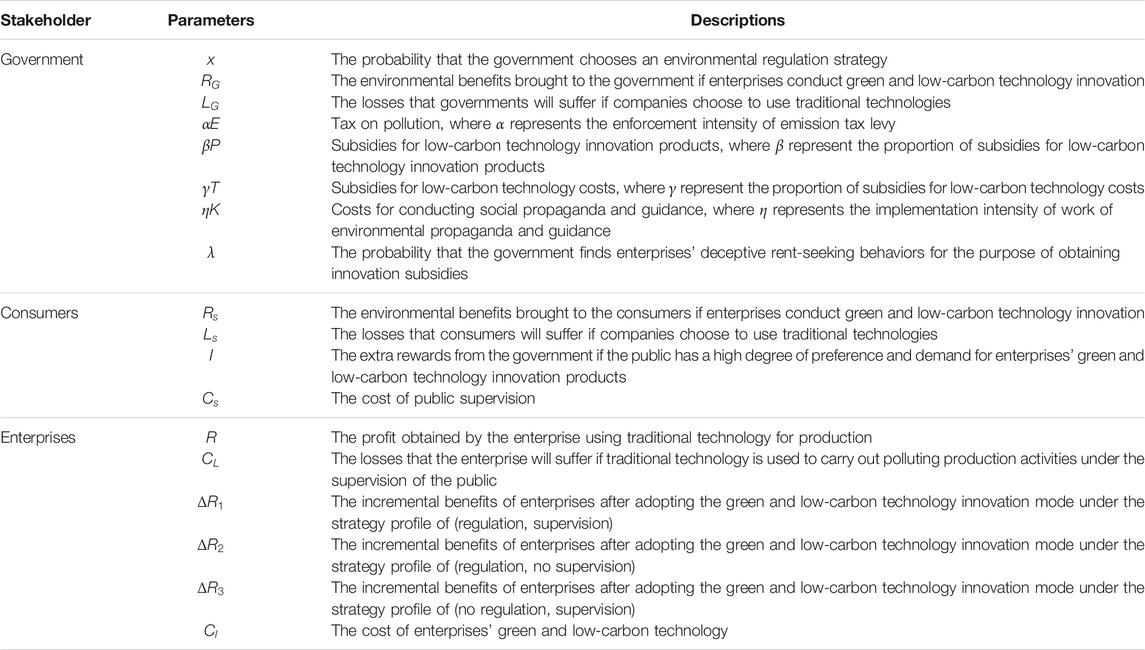
TABLE 1. Parameter descriptions.
Evolutionary Game Model Construction
Based on the aforementioned assumptions that the payoff of the participants is the difference between profit and cost (Hofbauer and Sandholm, 2007), this study constructs an evolutionary game model with the government, the public, and enterprises as the main participants. The payment matrix of the tripartite evolutionary game is given in Table 2.
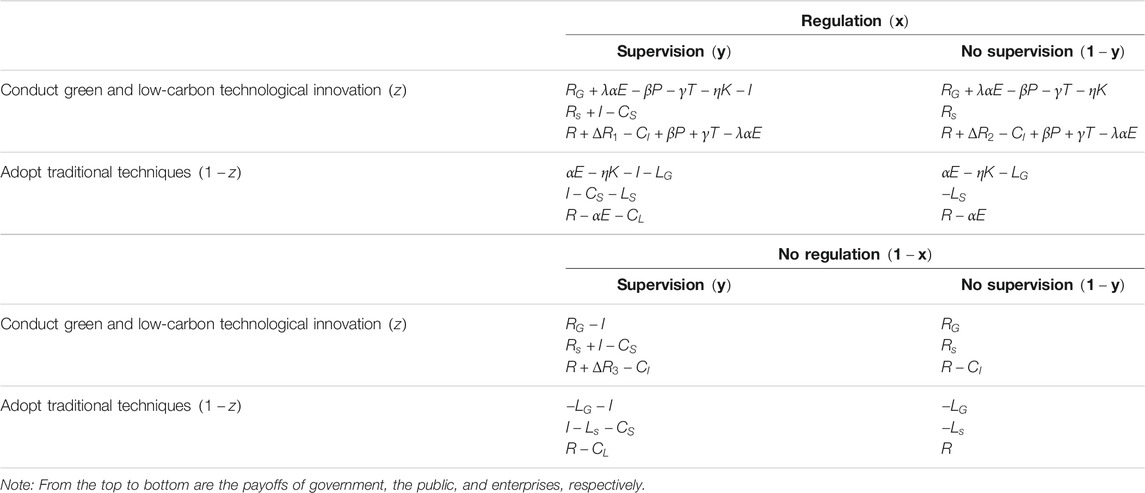
TABLE 2. Tripartite evolutionary game payment matrix.
Model Analysis
The Strategy Stability Analysis of Each Party
Due to the information asymmetry between the government, enterprises, and the public under environmental regulation, the three parties will judge the strategies of other players based on historical experience and adjust their own strategies in the process of continuous learning and trial and error. Therefore, in the process of dynamic adjustment of their own strategies, the government, enterprises, and the public show a dynamic replication process in the evolutionary game. Based on the payment matrix, we calculate the replication dynamic equation of the government, enterprises, and the public, respectively, and analyze the strategic stability of each entity.
Analysis on the Stability of Government’s Strategy
According to the payment matrix, the expected revenue
The replicator dynamic equation of environmental regulation by the government is shown in Eq. 2:
The first derivative of
According to the implicit theorem of differential equations,
Analysis on the Strategic Stability of the Public
The expected payoff
According to Eq. 5, the replicator dynamic equation of the supervision strategy adopted by the public and its first derivative can be, respectively, written as Eqs 6, 7:
According to the implicit theorem of differential equations, when
Analysis on the Stability of Enterprises’ Strategy
The expected return
Thus, the replicator dynamic equation of enterprises’ choice of green and low-carbon technology innovation strategy is obtained, as shown in Eq. 9:
Then, the first derivative of
When condition
Stability Analysis of Equilibrium Point of Tripartite Evolutionary Game System
In the tripartite game between the government, the public, and enterprises, the replicator dynamics in Eqs 2, 6, 9 describe the dynamic process in which the bounded rational parties learn and adopt regulation strategies, supervision strategies, and green and low-carbon technology innovation strategies, respectively. When all the three parties reach a stable state, it means that all the players have found effective and stable Nash equilibrium solutions through continuous trial and error. In order to seek the equilibrium point of enterprises under environmental regulation, Equation set (12) is established as follows:
All the strategic equilibrium solutions of the evolutionary game model are obtained by solving equation set 12):
According to the Lyapunov equilibrium stability theory, when all eigenvalues of the Jacobian matrix are less than 0, the equilibrium point is asymptotically stable. When all eigenvalues in the Jacobian matrix are greater than 0, the equilibrium point is unstable. When the eigenvalues of the Jacobian matrix are both positive and negative, the equilibrium point is an unstable point. The Lyapunov indirect method was used to analyze the stability of each pure strategy equilibrium point, and the results are given in Table 3.
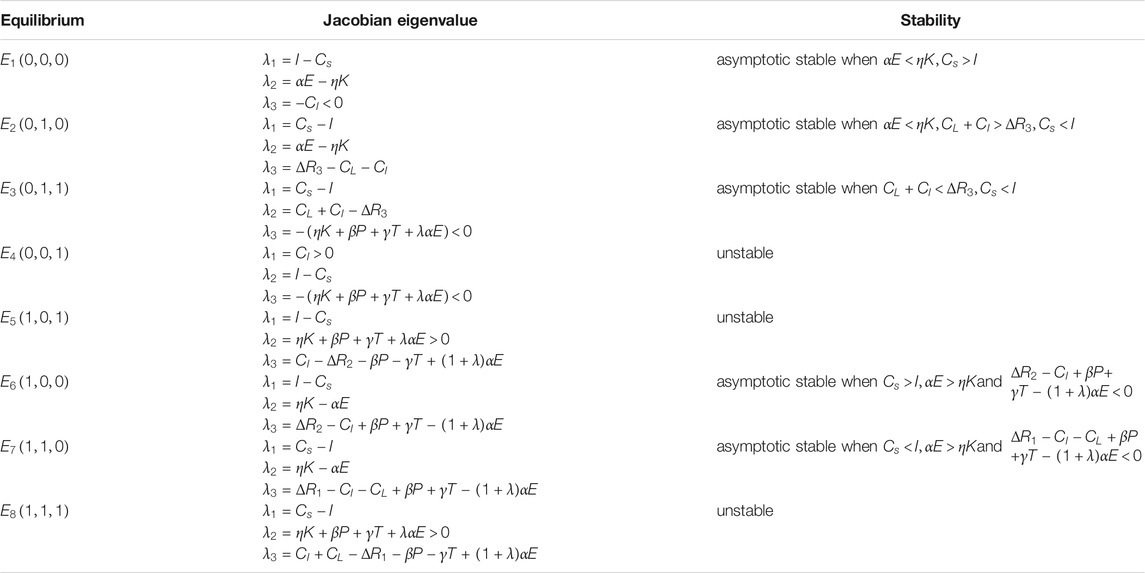
TABLE 3. Result of local Stability.
As can be seen from Table 3,
Numerical Simulation Analysis
The asymptotic stability analysis of the evolutionary game shows that the stability of strategies of the government, the public, and the enterprise are closely related to the benefits and costs of all parties. To visually depict the asymptotic stable operation track of enterprises’ green technology innovation under different executive strengths of pollution tax, subsidies, propaganda, and guidance, respectively, this study uses a MATLAB simulation tool to conduct numerical simulation analysis on the aforementioned evolutionary game model. The initial value of the parameter is set as follows:
The initial proportion of “regulation,” “supervision,” and “conduct green and low-carbon technology innovation” strategies chosen by the government, the public, and enterprises was set as
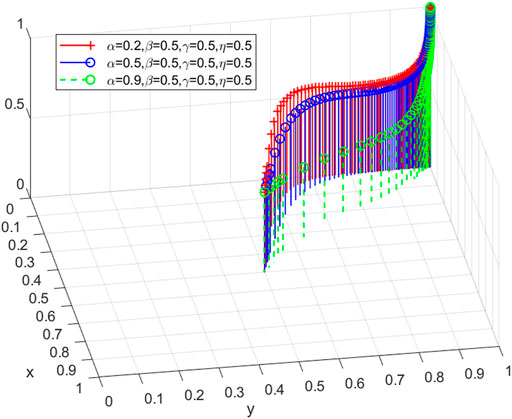
FIGURE 2. System evolution trajectory under different tax intensities
First, the levy intensity of the pollution tax
In order to explore the incentive effect of different intensities of innovation subsidies on enterprises’ green and low-carbon technology innovation, we assign 0.2, 0.5, and 0.9 to the implementation intensity
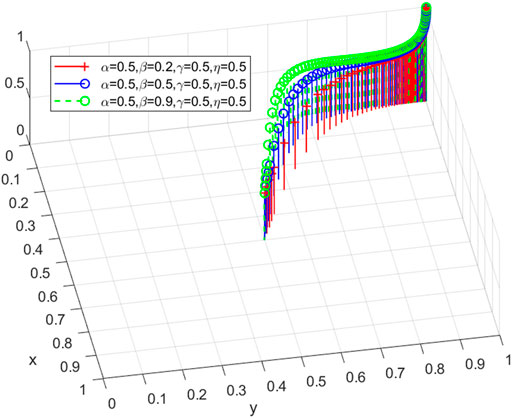
FIGURE 3. System evolution trajectory under different subsidy intensities
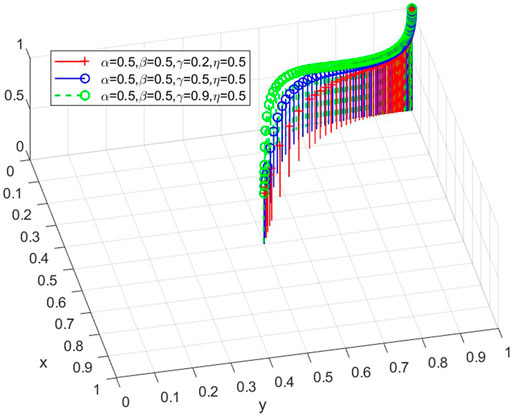
FIGURE 4. System evolution trajectory under different subsidy intensities
Numerical simulation analysis was carried out when the intensity of government’s environmental propaganda and guidance to the public is 0.2, 0.5, and 0.9, respectively. The evolution trajectory of the system is shown in Figure 5. With different intensities of environmental propaganda and guidance, the three parties, respectively, choose “no regulation,” “supervision,” “conduct green and low-carbon technology innovation” as the ultimate strategy, that is, because of the government’s environmental protection, propaganda work successfully improved the public environmental protection consciousness and effectively motivated the social public supervision behavior of low-carbon production activities of the enterprise. The government will gradually loosen environmental regulations and let the public’s supervision play a leading role. This is because the government’s efforts on environmental propaganda and guidance have successfully raised the public’s awareness of environmental protection and effectively encouraged the public to supervise enterprises’ low-carbon production activities. Therefore, the government will gradually relax environmental regulations, making the supervision of the public play a leading role. In addition, it can be seen from Figure 5 that low intensity of public propaganda and guidance has the strongest incentive effect on enterprises’ low-carbon technological innovation, that is, the proportion of enterprises choosing low-carbon technological innovation evolves to 1 at the fastest rate. However, the high-intensity public propaganda and guidance do not significantly accelerate enterprises’ choice of green and low-carbon technology innovation, and the speed of public supervision evolved to a stable state in the high-intensity case is also slow. The government’s environmental propaganda and guidance and the public’s supervision all take costs. Besides, when enterprises conduct green and low-carbon technological innovation and related production activities, the innovation cost will be partially transferred to consumers. Therefore, with the strengthening of government’s propaganda and guidance, the cost of the public and enterprises will be further increased, which will slow down the evolution speed of enterprises’ green and low-carbon technological innovation and the adoption of supervision behavior by the public. In addition, in the case of asymmetric information, excessive environmental publicity may also inhibit the public’s preference for low-carbon products to a certain extent, thus having a negative impact on the enthusiasm of enterprises for green and low-carbon technology innovation.
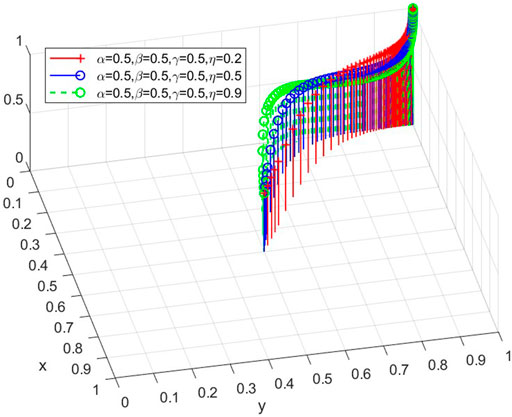
FIGURE 5. System evolution trajectory under different propaganda and guidance efforts
Conclusion
Green and low-carbon technology innovation is the fundamental way to implement energy conservation and environmental protection and achieve low-carbon economy. As an important carrier of economic development, enterprises should undertake the responsibility and mission of developing low-carbon economy and actively conduct green and low-carbon technology innovation. The government and the public, as the main stakeholders of green and low-carbon technological innovation, should create favorable conditions for the low-carbon development of enterprises and help enterprises overcome obstacles such as high cost and technical barriers, thus mobilizing enterprises to conduct green and low-carbon technological innovation. The synergy among the government, the public, and enterprises is the key to the development of low-carbon economy in China.
Therefore, it is of great significance to study how should the government make effective environmental regulation policies to fully mobilize the enthusiasm of the public and enterprises, thus directly or indirectly stimulating enterprises’ green and low-carbon technological innovation. Different from some existing studies, this work not only focuses on the interaction between two of the government, public consumers, and enterprises but also studies the three in a unified system. Specifically, under the assumption of information asymmetry and bounded rationality, this study applies the evolutionary game method to study the incentive mechanism of enterprises’ green and low-carbon technological innovation. Specifically, this study constructs an evolutionary game model that includes the government, the public, and enterprises and obtains the evolutionary stability strategy by analyzing the replication dynamic equations of each subject. And the evolutionary path of the game under different enforcement efforts of environmental regulation means is numerically simulated. The results show that 1) the regulation means of pollution tax, subsidies for low-carbon technology innovation products and innovation costs, and environmental propaganda and guidance are all effective incentives for enterprises’ green low-carbon technology innovation; 2) moderate pollution tax can effectively promote the green and low-carbon technology innovation of enterprises; 3) high innovation subsidies have a significant incentive effect on enterprises’ innovation behavior of low-carbon technology; and 4) the incentive effect of low-intensity environmental propaganda and guidance on enterprises’ green technology innovation is stronger than that of high intensity.
This study also has policy implications. Based on the aforementioned analysis, this study puts forward the following suggestions:
1) As the promoter of green and low-carbon technology innovation and the authority of social and environmental supervision, government’s management means and management intensity will have an impact on enterprises’ green technology innovation. Therefore, the government should reasonably choose the means and intensity of environmental regulation so as to prevent the implementation of excessive regulatory means from hindering the green and low-carbon technological innovation of enterprises, which poses a higher requirement for the government’s incentive mechanism design. First of all, the traditional view of all enterprises as the same type of hybrid mechanism no longer meets the practical requirements. For different types of enterprises, the government should treat them differently according to their actual situation. A relatively fair mechanism can be formed by giving matching incentive intensity according to the different levels of low-carbon technology of enterprises. In this way, the motivation of enterprises to conduct green low-carbon technology innovation can be improved. Second, the government should reasonably determine the subsidy level, evaluate the efficiency of subsidy implementation in time, and dynamically adjust the subsidy level according to the evaluation results. Third, the government should dynamically adjust the level of pollution tax and timely evaluate the efficiency of different tax implementation so as to find the optimal proportion of pollution tax. In addition, the environmental propaganda and guidance of the public should not be neglected. As the main body of the market economy, the consumer’s consumption preference is the production orientation of enterprises. The government can improve consumers’ awareness of green and low-carbon products through low-carbon public service advertisements and other publicity methods and provide appropriate incentives for their green and low-carbon consumption. Last but not least, green-credit policy should also be committed to provide support for enterprises’ green and low-carbon technological innovation. Moreover, the government should improve the certification standards of low-carbon product, establish market access systems, and improve the intellectual property protection laws for low-carbon technology so as to create a good institutional environment for the development of green and low-carbon industries.
2) As the main demand body in goods market, the consumption behavior of the public has a significant impact on the production decision-making of enterprises. Therefore, the public consumers should first improve their awareness of low-carbon environmental protection and then cultivate the concept of low-carbon consumption in their daily life by collecting information about green and low-carbon products and services spontaneously, thus gradually increasing the cognition and demand for low-carbon products and services. Second, the public should be aware of their responsibilities as environmental stakeholders and take the initiative to play the role of the market regulator. In efforts to supervise enterprises’ low-carbon production and operation activities and eliminate non-environmental protection products, the public can contribute a lot to the development of green and low-carbon technology innovation.
3) It has become a global consensus to develop low-carbon economy. And low-carbon technological innovation has also become a worldwide trend. Enterprises should seize the opportunity and take the initiative to implement the strategy of green and low-carbon technology innovation. To be specific, enterprise should first strengthen their awareness of social responsibility and green environmental protection and take the initiative to conduct green and low-carbon technological innovation. Besides, at the same time of increasing innovation investment, enterprises should also constantly improve the quality of their low-carbon products and strength to meet the production capacity and requirement of green and low-carbon technological innovation so as to occupy a favorable competitive position in the low-carbon product market. Second, enterprises should develop a long-term low-carbon innovation strategy and improve their own low-carbon management mechanism, which contributes to reducing the cost of low-carbon production. At the same time, enterprises should also make full use of various incentive policies of the government, with the guidance of the government policy mechanism, promoting the low-carbon technology innovation process with maximum efficiency and achieving great progress and sustainable development of enterprises. Last but not least, enterprises can strengthen the publicity of the performance and long-term environmental advantages of low-carbon products so as to enhance consumers’ cognition and trust on the performance of their products and thus attract more consumers with low-carbon preference.
Data Availability Statement
The original contributions presented in the study are included in the article; further inquiries can be directed to the corresponding author.
Author Contributions
LC and XB contributed to conceptualization, methodology, and writing—original draft; BC assisted with software, data curation, and writing—review and editing; JW helped with conceptualization, methodology, writing—review and editing, and supervision. All authors have read and agreed to the published version of the manuscript.
Conflict of Interest
The authors LC, XB, BC, and JW were employed by Chongqingfuling Electric Power Industrial Co., Ltd.
Publisher’s Note
All claims expressed in this article are solely those of the authors and do not necessarily represent those of their affiliated organizations, or those of the publisher, the editors, and the reviewers. Any product that may be evaluated in this article, or claim that may be made by its manufacturer, is not guaranteed or endorsed by the publisher.
References
Bi, K., Huang, P., and Wang, X. (2016). Innovation Performance and Influencing Factors of Low-Carbon Technological Innovation under the Global Value Chain: A Case of Chinese Manufacturing Industry. Technol. Forecast. Soc. Change 111, 275–284. doi:10.1016/j.techfore.2016.07.024
Brav, A., Jiang, W., Ma, S., and Tian, X. (2018). How Does Hedge Fund Activism Reshape Corporate Innovation? J. Financial Econ. 130, 237–264. doi:10.1016/j.jfineco.2018.06.012
Brunnermeier, S. B., and Cohen, M. A. (2003). Determinants of Environmental Innovation in US Manufacturing Industries. J. Environ. Econ. Manag. 45, 278–293. doi:10.1016/S0095-0696(02)00058-X
Cao, C., Wu, X. B., Zhou, G. G., and Hu, Q. (2012). Game Analysis on Innovation and Diffusion of green Product Among Manufacturers. J. Syst. Eng. 27, 617–625.
Chakraborty, P., and Chatterjee, C. (2017). Does Environmental Regulation Indirectly Induce Upstream Innovation? New Evidence from India. Res. Pol. 46, 939–955. doi:10.1016/j.respol.2017.03.004
Chang, Y., and Zhang, T. (2019). The Effects of Product Consistency and Consumer Resistance to Innovation on Green Product Diffusion in China. Sustainability 11 (9), 2702. doi:10.3390/su11092702
Chen, C.-C., Chen, C.-W., and Tung, Y.-C. (2018). Exploring the Consumer Behavior of Intention to purchase green Products in Belt and Road Countries: An Empirical Analysis. Sustainability 10, 854. doi:10.3390/su10030854
Chen, W., and Hu, Z.-H. (2018). Using Evolutionary Game Theory to Study Governments and Manufacturers' Behavioral Strategies under Various Carbon Taxes and Subsidies. J. Clean. Prod. 201, 123–141. doi:10.1016/j.jclepro.2018.08.007
Cheng, S., Chen, Y., Meng, F., Chen, J., Liu, G., and Song, M. (2021). Impacts of Local Public Expenditure on CO2 Emissions in Chinese Cities: A Spatial Cluster Decomposition Analysis. Resour. Conservation Recycling 164, 105217. doi:10.1016/j.resconrec.2020.105217
Cheng, Y., and Yao, X. (2021). Carbon Intensity Reduction Assessment of Renewable Energy Technology Innovation in China: A Panel Data Model with Cross-Section Dependence and Slope Heterogeneity. Renew. Sust. Energ. Rev. 135, 110157. doi:10.1016/j.rser.2020.110157
Cheng, Z., Li, L., and Liu, J. (2017). The Emissions Reduction Effect and Technical Progress Effect of Environmental Regulation Policy Tools. J. Clean. Prod. 149, 191–205. doi:10.1016/j.jclepro.2017.02.105
Chintrakarn, P. (2008). Environmental Regulation and U.S. States' Technical Inefficiency. Econ. Lett. 100, 363–365. doi:10.1016/j.econlet.2008.02.030
Dietrich, U., and Chen, H.-H. (2018). Towards Carbon Free Cities: Interplay between Urban Density and Energy Demand. Int. J. SDP 13, 967–974. doi:10.2495/SDP-V13-N7-967-974
Du, K., Cheng, Y., and Yao, X. (2021). Environmental Regulation, green Technology Innovation, and Industrial Structure Upgrading: The Road to the green Transformation of Chinese Cities. Energ. Econ. 98, 105247. doi:10.1016/j.eneco.2021.105247
Fan, R., and Dong, L. (2018). The Dynamic Analysis and Simulation of Government Subsidy Strategies in Low-Carbon Diffusion Considering the Behavior of Heterogeneous Agents. Energy Policy 117, 252–262. doi:10.1016/j.enpol.2017.12.003
Fan, R., Dong, L., Yang, W., and Sun, J. (2017). Study on the Optimal Supervision Strategy of Government Low-Carbon Subsidy and the Corresponding Efficiency and Stability in the Small-World Network Context. J. Clean. Prod. 168, 536–550. doi:10.1016/j.jclepro.2017.09.044
Fan, R., Lin, J., and Zhu, K. (2019). Study of Game Models and the Complex Dynamics of a Low-Carbon Supply Chain with an Altruistic Retailer under Consumers' Low-Carbon Preference. Physica A: Stat. Mech. its Appl. 528, 121460. doi:10.1016/j.physa.2019.121460
Friedman, D. (1998). On Economic Applications of Evolutionary Game Theory. J. Evol. Econ. 8, 15–43. doi:10.1007/s001910050054
Gaffney, O., and Steffen, W. (2017). The Anthropocene Equation. Anthropocene Rev. 4, 53–61. doi:10.1177/2053019616688022
Guo, Q., Zhou, M., Liu, N., and Wang, Y. (2019). Spatial Effects of Environmental Regulation and green Credits on green Technology Innovation under Low-Carbon Economy Background Conditions. Ijerph 16, 3027. doi:10.3390/ijerph16173027
Hofbauer, J., and Sandholm, W. H. (2007). Evolution in Games with Randomly Disturbed Payoffs. J. Econ. Theor. 132, 47–69. doi:10.1016/j.jet.2005.05.011
Hu, A. G., Zheng, J., Gao, Y., Zhang, N., and Xu, H. P. (2008). Provincial Technology Efficiency Ranking with Environment Factors (1999-2005). China Econ. Q. 7 (3), 933–960. (In Chinese).
Huang, J., Leng, M., Liang, L., and Liu, J. (2013). Promoting Electric Automobiles: Supply Chain Analysis under a Government's Subsidy Incentive Scheme. IIE Trans. 45, 826–844. doi:10.1080/0740817X.2012.763003
Jan, I. U., Ji, S., and Yeo, C. (2019). Values and Green Product Purchase Behavior: The Moderating Effects of the Role of Government and Media Exposure. Sustainability 11 (23), 6642. doi:10.3390/su11236642
Jia, P., Li, K., and Shao, S. (2018). Choice of Technological Change for China's Low-Carbon Development: Evidence from Three Urban Agglomerations. J. Environ. Manage. 206, 1308–1319. doi:10.1016/j.jenvman.2017.08.052
Jiang, X. L., Dai, W. W., and Luo, P. F. (2018). Research on Promotion Mechanism of Manufacturing Enterprises’ Ecological Innovation. Ecol. Econ. (Ecological Economy) 34 (8), 64–69.
Jiao, J., Chen, J., Li, L., and Li, F. (2017). A Study of Local Governments’ and Enterprises’ Actions in the Carbon Emission Mechanism of Subsidy or Punishment Based on the Evolutionary Game. Chin. J. Manag. Sci. 25, 140–150.
Kammerer, D. (2009). The Effects of Customer Benefit and Regulation on Environmental Product Innovation. Ecol. Econ. 68, 2285–2295. doi:10.1016/j.ecolecon.2009.02.016
Khan, S. A. R., Yu, Z., and Umar, M. (2021). How Environmental Awareness and Corporate Social Responsibility Practices Benefit the enterprise? an Empirical Study in the Context of Emerging Economy. Meq 32 (5), 863–885. doi:10.1108/MEQ-08-2020-0178
Klassen, R. D., and McLaughlin, C. P. (1996). The Impact of Environmental Management on Firm Performance. Manag. Sci. 42, 1199–1214. doi:10.1287/mnsc.42.8.1199
Krass, D., Nedorezov, T., and Ovchinnikov, A. (2013). Environmental Taxes and the Choice of green Technology. Prod. Oper. Manag. 22, a–n. doi:10.1111/poms.12023
Lai, X., Liu, J., and Georgiev, G. (2016). Low Carbon Technology Integration Innovation Assessment index Review Based on Rough Set Theory - an Evidence from Construction Industry in China. J. Clean. Prod. 126, 88–96. doi:10.1016/j.jclepro.2016.03.035
Li, F., Xu, X., Li, Z., Du, P., and Ye, J. (2021). Can Low-Carbon Technological Innovation Truly Improve enterprise Performance? the Case of Chinese Manufacturing Companies. J. Clean. Prod. 293, 125949. doi:10.1016/j.jclepro.2021.125949
Liang, Z., Hewitt, R. R., and Du, Y. (2019). Research on Design Method for the Blue-Green Ecological Network System to deal with Urban Flooding: A Case Study of Charleston peninsula. Int. J. DNE 14, 275–286. doi:10.2495/DNE-V14-N4-275-286
Lin, B., and Zhu, J. (2019). Determinants of Renewable Energy Technological Innovation in China under CO2 Emissions Constraint. J. Environ. Manage. 247, 662–671. doi:10.1016/j.jenvman.2019.06.121
Lin, R.-J., Tan, K.-H., and Geng, Y. (2013). Market Demand, green Product Innovation, and Firm Performance: Evidence from Vietnam Motorcycle Industry. J. Clean. Prod. 40, 101–107. doi:10.1016/j.jclepro.2012.01.001
Liu, C., Huang, W., and Yang, C. (2017). The Evolutionary Dynamics of China's Electric Vehicle Industry - Taxes vs. Subsidies. Comput. Ind. Eng. 113, 103–122. doi:10.1016/j.cie.2017.08.026
Lutz, C., Meyer, B., Nathani, C., and Schleich, J. (2005). Endogenous Technological Change and Emissions: The Case of the German Steel Industry. Energy Policy 33, 1143–1154. doi:10.1016/j.enpol.2003.11.012
Lyu, X., Shi, A., and Wang, X. (2020). Research on the Impact of Carbon Emission Trading System on Low-Carbon Technology Innovation. Carbon Manag. 11, 183–193. doi:10.1080/17583004.2020.1721977
Ma, J., and Sun, L. (2018). Complexity Analysis about Nonlinear Mixed Oligopolies Game Based on Production Cooperation. IEEE Trans. Contr. Syst. Technol. 26, 1532–1539. doi:10.1109/TCST.2017.2702120
Mahmoudi, R., and Rasti-Barzoki, M. (2018). Sustainable Supply Chains under Government Intervention with a Real-World Case Study: An Evolutionary Game Theoretic Approach. Comput. Ind. Eng. 116, 130–143. doi:10.1016/j.cie.2017.12.028
Miao, Z., Baležentis, T., Tian, Z., Shao, S., Geng, Y., and Wu, R. (2019). Environmental Performance and Regulation Effect of China's Atmospheric Pollutant Emissions: Evidence from "Three Regions and Ten Urban Agglomerations". Environ. Resource Econ. 74, 211–242. doi:10.1007/s10640-018-00315-6
Minghua, L., and Yongzhong, Y. (2011). Environmental Regulation and Technology Innovation: Evidence from China. Energ. Proced. 5, 572–576. doi:10.1016/j.egypro.2011.03.100
Olusegun, A. H., Hasbullah, A., and Nordin, N. (2014). Influence of Top Management Commitment, Stakeholder Pressure and Public Concern on Sustainable Environmental Manufacturing Practices in Malaysia: Data Screening and Preliminary Analysis. Int. J. Bus. Manag. 2, 189.
Ouyang, X., Li, Q., and Du, K. (2020). How Does Environmental Regulation Promote Technological Innovations in the Industrial Sector? Evidence from Chinese Provincial Panel Data. Energy Policy 139, 111310. doi:10.1016/j.enpol.2020.111310
Pan, X., Cao, Y., Pan, X., and Uddin, M. K. (2021). The Cleaner Production Technology Innovation Effect of Environmental Regulation Policy: Evidence from China. Meq 32 (4), 737–751. doi:10.1108/MEQ-10-2020-0227
Qu, X., Li, C., Dai, Y., and Li, C. (2019). Semiempirical Backscatter Models at Low Incidence Angles under Rain Conditions. J. Appl. Rem. Sens. 13, 1. doi:10.1117/1.jrs.13.048507
Smulders, S., Toman, M., and Withagen, C. (2014). Growth Theory and 'green Growth'. Oxford Rev. Econ. Pol. 30, 423–446. doi:10.1093/oxrep/gru027
Song, M., Wang, S., and Zhang, H. (2020a). Could Environmental Regulation and R&D Tax Incentives Affect green Product Innovation? J. Clean. Prod. 258, 120849. doi:10.1016/j.jclepro.2020.120849
Song, M., Xie, Q., and Shen, Z. (2021). Impact of green Credit on High-Efficiency Utilization of Energy in China Considering Environmental Constraints. Energy Policy 153, 112267. doi:10.1016/j.enpol.2021.112267
Song, M., Zhao, X., and Shang, Y. (2020b). The Impact of Low-Carbon City Construction on Ecological Efficiency: Empirical Evidence from Quasi-Natural Experiments. Resour. Conservation Recycling 157, 104777. doi:10.1016/j.resconrec.2020.104777
Su, X., Duan, S., Guo, S., and Liu, H. (2018a). Evolutionary Games in the Agricultural Product Quality and Safety Information System: A Multiagent Simulation Approach. Complexity 2018, 1–13. doi:10.1155/2018/7684185
Su, X., Liu, H., and Hou, S. (2018b). The Trilateral Evolutionary Game of Agri-Food Quality in Farmer-Supermarket Direct Purchase: A Simulation Approach. Complexity 2018, 1–11. doi:10.1155/2018/5185497
Teixidó, J., Verde, S. F., and Nicolli, F. (2019). The Impact of the EU Emissions Trading System on Low-Carbon Technological Change: The Empirical Evidence. Ecol. Econ. 164, 106347. doi:10.1016/j.ecolecon.2019.06.002
Tian, X., Bai, F., Jia, J., Liu, Y., and Shi, F. (2019). Realizing Low-Carbon Development in a Developing and Industrializing Region: Impacts of Industrial Structure Change on CO2 Emissions in Southwest China. J. Environ. Manage. 233, 728–738. doi:10.1016/j.jenvman.2018.11.078
Wang, H., Cai, L., and Zeng, W. (2011). Research on the Evolutionary Game of Environmental Pollution in System Dynamics Model. J. Exp. Theor. Artif. Intelligence 23, 39–50. doi:10.1080/0952813X.2010.506300
Wang, L., and Zheng, J. (2019). Research on Low-Carbon Diffusion Considering the Game Among Enterprises in the Complex Network Context. J. Clean. Prod. 210, 1–11. doi:10.1016/j.jclepro.2018.10.297
Wu, B., Liu, P., and Xu, X. (2017). An Evolutionary Analysis of Low-Carbon Strategies Based on the Government-enterprise Game in the Complex Network Context. J. Clean. Prod. 141, 168–179. doi:10.1016/j.jclepro.2016.09.053
Wu, L., Kaneko, S., and Matsuoka, S. (2005). Driving Forces behind the Stagnancy of China's Energy-Related CO2 Emissions from 1996 to 1999: the Relative Importance of Structural Change, Intensity Change and Scale Change. Energy Policy 33, 319–335. doi:10.1016/j.enpol.2003.08.003
Xia, D., Chen, B., and Zheng, Z. (2015). Relationships Among Circumstance Pressure, green Technology Selection and Firm Performance. J. Clean. Prod. 106, 487–496. doi:10.1016/j.jclepro.2014.11.081
Xie, L., Ma, J., and Han, H. (2018). Implications of Stochastic Demand and Manufacturers' Operational Mode on Retailer's Mixed Bundling Strategy and its Complexity Analysis. Appl. Math. Model. 55, 484–501. doi:10.1016/j.apm.2017.06.005
Xu, J., and Lv, X. (2014). Evolutionary Analysis between Governments, Manufacting Enterprises and Consumers on Low-Carbon Decision-Making Behavior under the Background of Low-Carbon Economy. Oper. Res. Manag. Sci. 23, 81–91.
Zhang, L., Xue, L., and Zhou, Y. (2019a). How Do Low-Carbon Policies Promote green Diffusion Among alliance-based Firms in China? an Evolutionary-Game Model of Complex Networks. J. Clean. Prod. 210, 518–529. doi:10.1016/j.jclepro.2018.11.028
Zhang, Q., He, K., and Huo, H. (2012). Cleaning China's Air. Nature 484, 161–162. doi:10.1038/484161a
Zhang, Y., Ao, J., and Deng, J. (2019b). The Influence of High-Low Power on Green Consumption: The Moderating Effect of Impression Management Motivation. Sustainability 11 (16), 4287. doi:10.3390/su11164287
Zhang, Y., and Zhang, J. (2019). Estimating the Impacts of Emissions Trading Scheme on Low-Carbon Development. J. Clean. Prod. 238, 117913. doi:10.1016/j.jclepro.2019.117913
Zhu, Q., Li, Y., Geng, Y., and Qi, Y. (2013). Green Food Consumption Intention, Behaviors and Influencing Factors Among Chinese Consumers. Food Qual. Preference 28, 279–286. doi:10.1016/j.foodqual.2012.10.005
Keywords: environmental regulation, green and low-carbon technological innovation, evolutionary game, numerical simulation, replicator dynamics equation
Citation: Chen L, Bai X, Chen B and Wang J (2022) Incentives for Green and Low-Carbon Technological Innovation of Enterprises Under Environmental Regulation: From the Perspective of Evolutionary Game. Front. Energy Res. 9:793667. doi: 10.3389/fenrg.2021.793667
Received: 12 October 2021; Accepted: 09 November 2021;
Published: 03 January 2022.
Edited by:
Xin Yao, Xiamen University, ChinaReviewed by:
Ailun Wang, Southwestern University of Finance and Economics, ChinaHouyin Long, Fuzhou University, China
Copyright © 2022 Chen, Bai, Chen and Wang. This is an open-access article distributed under the terms of the Creative Commons Attribution License (CC BY). The use, distribution or reproduction in other forums is permitted, provided the original author(s) and the copyright owner(s) are credited and that the original publication in this journal is cited, in accordance with accepted academic practice. No use, distribution or reproduction is permitted which does not comply with these terms.
*Correspondence: Jingjing Wang, amp3YW5nX3dvcmtAMTI2LmNvbQ==