 I. Rashid
 T. Zubair
 M. I. Asjad
 J. Awrejcewicz4
- 1Department of Engineering and Computer Science, National University of Modern Languages, Islamabad, Pakistan
- 2School of Mathematical Sciences, Peking University, Beijing, China
- 3Department of Mathematics, University of Management and Technology, Lahore, Pakistan
- 4Department of Automation, Bio-mechanics and Mechatronics, Lodz University of Technology, Łódź, Poland
The current study presents an entropy generation investigation of magnetohydrodynamic Ag- and Au-H2O nanofluid flows induced by an exponential stretchable sheet implanted in porous media accompanying suction/injection and heat radiation impact. Moreover, the stagnation point flow and silver and gold nanoparticles are considered. The consequences of ohmic heating and thermal radiation are also included as part of the heat transport examination. A physical process is transformed into a set of mathematical expressions using mathematical concepts, which can then be further simplified by using the necessary variables. Considering numerous physiological factors of interest, exact solutions for velocity and temperature profiles are calculated. Graphs and numerical tables are utilized to examine how different physical entities affect the distribution of velocity, temperature, and entropy. It is noted that enhancing the values of Ω reduces entropy inception. It is observed that the entropy inception field gains due to an increment in Ecrt.
1 Introduction
Entropy is defined as a gauge of disorder inside a system and its surroundings or a measure of progress toward thermodynamic equilibrium under the scope of thermodynamics. Working with a thermodynamics process, an entropy generation investigation is essential since entropy calculates the effectiveness of every engineered thermofluid mechanism. The second law of thermodynamics determines the randomnessof any system. According to current research, the second law of thermodynamics is a significant tool for calculating the entropy of any system. Entropy inception has considerable fascinating application in the engineering and chemical industry such as extrusion procedures, lubrication phenomena, and schemes of geothermal energy, thermal mechanisms, heat management, and power production (Abbasi et al., 2021). Bejan (1979) was the first to introduce the concept of entropy production inside the flowing fluid and heat exchange mechanism. Later on, many researchers discussed entropy generation inside fluid and heat transport frameworks. Abbasi et al. (2021) studied the significant entropy inception with ohmic heating and thermal radiation effects of a viscoelastic nanofluid on a lubricated disk. Entropy production inside the MHD flow between porous media was discussed by Rashidi and Freidoonimehr (2014). Hayat et al. (2021) described the entropy in Newtonian nanofluid flow provoked by a curved stretchable sheet. Entropy inception within a Casson nanoliquid by a stretched surface soaked in porous media considering many impacts was investigated by Mahato et al. (2022). Wang et al. (2022) studied the Darcy–Forchheimer nanofluid for irreversibility inception. The entropy production in the Darcy–Forchheimer fluid in the presence of ohmic heat was scrutinized by Khan et al. (2022). Tayebi et al. (2021) examined the entropy and thermo-economics inside a convective nanofluid with the MHD effect. Afridi et al. (2018) analyzed the consequences of frictional and ohmic heating to find the entropy inception inside the used problem. Sithole et al. (2018) investigated the irreversibility of MHD nanofluid flow provoked by a stretchable surface for viscous dissipation influence. The impact of entropy inception inside the nanofluid with several effects is addressed in Noghrehabadi et al. (2013); Bhatti et al. (2017); and Abd El-Aziz and Afify (2019).
Despite the fact that a variety of approaches are used to promote heat transport, low thermal quality is a significant barrier in development of energy-efficient heat transfer fluids, which are in high need for a variety of industrial applications. The thermal capabilities of energy-carrying liquids are accountable for boosting the exchange of heat in a system. As a result, insufficient thermal conductivity is a disadvantage of conventional fluids, such as glycol, oil, water, and ethylene, in promoting the properties and efficiency of various engineered electronic devices. Integrating a fraction of nanometal particles within ordinary fluids is a novel way to improve the thermal conductivity of traditional liquids, which are known as nanofluids. The first time a nanofluid was used by adding nano-sized metallic particles into a conventional fluid was in 1995 by Choi (1995). Such kinds of nanofluids significantly enhance heat transport properties. After that, many scientists investigated the heat exchange rate of a nanofluid with several impacts. Prasannakumara (2021) analyzed the MHD Maxwell nanofluid provoked by a stretched surface by applying a numerical method. The influence of thermal radiation on the Casson nanofluid by shrinking/stretching walls was observed by Mahabaleshwara et al. (2022). The consequence of dissipation and radiation entities on an MHD bioconvective nanoliquid due to a stretching sheet was discussed by Neethu et al. (2022). B Awati et al. (2021) used the Haar wavelet method to study nanofluid flow with a nonlinear stretchable surface along with mass and energy transport. The impact of nanofluid flow provoked by a stretching sheet along with hydromagnetics is scrutinized by Manzoor et al. (2022). The impact of emerging entities on a nanofluid is presented in Oztop and Abu-Nada (2008); Khan and Pop (2010); Hamad (2011); Yacob et al. (2011); Noghrehabadi et al. (2012); Rohni et al. (2012).
Motivated by the aforementioned studies and interesting applications, entropy inception is calculated inside the magnetohydrodynamic nanofluid flow by incorporating Ag and Au nanoparticles on an exponentially stretchable surface with stagnation point flow, porous wall, and ohmic heating. Furthermore, the Bejan number and energy transport investigation are carried out along with thermal heating. The closed form solutions are acquired by utilizing hypergeometric functions to visualize the impact of numerous emerging parameters on the velocity field, temperature field, local skin friction, Nusselt number, and the chaos due to different effects in the used problem. Additionally, numerical tables and graphs are displayed.
2 Problem statement
A two-dimensional, laminar, incompressible, steady flow of an Ag/Au-water MHD nanofluid provoked by an exponentially stretchable surface immersed in porous media with different body forces has been carried out. The impact of ohmic heating and thermal radiation is also considered part of the heat transfer study. The extending sheet is placed along the x-axis in the flow path, whereas the y-axis is assumed normal to the sheet. Figure 1 shows that the fluid is in the y ≥ 0 space. Considering a velocity of
in which B(x) = magnetic entity; u, v denote the velocity portions in the x and y directions, respectively, ρsf = density; μsf is the dynamic viscosity; the thermal diffusivity is expressed by αsf; the specific heat capacitance is
In Eq. 5, ksf=thermal conductivity; σsf =electrical conductivity;
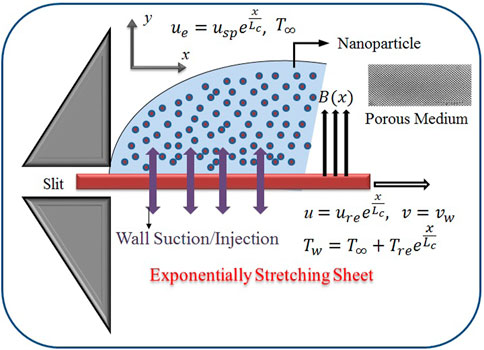
FIGURE 1. Pictorial view of the model.
The accompanying similarity variables have been established to non-dimensionalize the basic equations and boundary conditions (Bilal et al., 2017):
Expression Eq. 5 reduces Eq. 2 into a dimensionless form and is given as
and the boundary conditions are
where Kpr is the permeability parameter and Megn = the Hartmann number. The closed form solution of such a kind of equation was introduced by Chakrabarti and Gupta, (1979):
To obtain Ψ, λ1, and λ1, substitute Eq. 9 in Eq. 6:
where Ψ, λ1, and λ1 are constants with Ψ > 0. After substituting Eqs. 11–13 in Eq. 9, the solution of the velocity filed is found as
The skin friction at the sheet is calculated as follows:
Here, the Reynolds number is shown by
3 Heat transfer analysis
Heat transport analysis is carried out in this portion. Additionally, ohmic heating and thermal radiation are considered, which are presented by the following governing equation:
where
Here, σ∗ is the Stefan–Boltzmann constant, k∗ expresses the mass absorption coefficient, and the specific heat
The suitable boundary conditions are
where Tw is the temperature of the sheet, the characteristic length = Lc, Tre is the reference temperature, and T∞ is the free stream temperature. The temperature field similarity variable is specified as follows (Rashid et al., 2017):
The energy equation takes the following dimensionless form by utilizing Eqs. 5, 20:
where
Here, Pr is the Prandtl number, Ntr is the radiation parameter, and Ecrt is the Eckert number. The boundary conditions are
introduces the following new variable to convert Eq. 24 into Kummer’s ordinary differential equation:
Applying the new variable, Eq. 24 becomes as expressed below:
where Q = (1 − H), and
The boundary conditions are
The closed form solution of Eq. 26 in the form of Kummer’s function (Abramowitz and Stegun, 1972) is
where M is the confluent hypergeometric function (1st kind). The following is the solution to the energy equation:
where
As a result, the non-dimensional wall temperature was generated by the aforementioned equation. The local Nusselt number is as follows:
4 Second law analysis
The interchange of momentum, temperature, and magnetic effects inside the fluid and at the surfaces generates a continual entropy accumulation, resulting in a non-equilibrium condition. The following formula can be used to compute the volumetric entropy inception factor (SGen):
The impact of three independent mechanisms generating entropy production is reflected in Eq. 33. The first term of Eq. 33 shows the entropy inception provoked by heat transport along with a thermal impact, which is expressed by (EHT), the second term represents the entropy inception because of a magnetic impact (EMGN), and the entropy inception due to porous (EPM) is described by the third term. Entropy is a measure of disordered in a system and its surroundings. The amount of non-dimensional entropy production
where
where Ω is the ratio of free stream temperature to the change in temperature. Bejan (1979) proposed an additional parameter, the Bejan number (Be), to find out the irreversibility field. The Bejan number (Be) is the ratio of heat exchange irreversibility to the total amount of irreversibility inside the process, expressed as
5 Results and discussion
The influence of several emerging factors on the velocity, temperature, and entropy inception fields has been demonstrated in the current phase to examine the impact of these parameters. Furthermore, under the effect of suction/injection parameter (S), permeability parameter Kpr, and magnetic parameter Megn, Ecrt, ϕ, Brkmn, Ω, and Rey, local skin friction, stream line, local Nusselt number, and Bejan (Be) number are presented. In this scenario, Figures 2–18 are plotted and Tables 1, 2, 3 are shown. Figures 2, 3 show the trend of the velocity field as the magnitude of ϕ is varied. It is to be noted that the velocity field is accelerated due to an increment in the magnitude of the nanoparticle volume friction in the case of Ag − and Au − water with S > 0 depicted in Figure 2. Physically, inter-molecular forces are increased in the presence of nanoparticles, which leads to a reduction in the velocity distribution. In the case of both Ag − and Au − water nanofluids with S < 0, the velocity distribution decreases due to an increase in ϕ as shown in Figure 3. The variation of nanoparticle friction on the temperature field is shown in Figure 4. An increment is observed in temperature distribution while gaining the magnitude of ϕ. Physically, the friction factor is enhanced with the existence of nanoparticles due to friction, and the overall internal temperature is accelerated in both Ag − and Au − water.
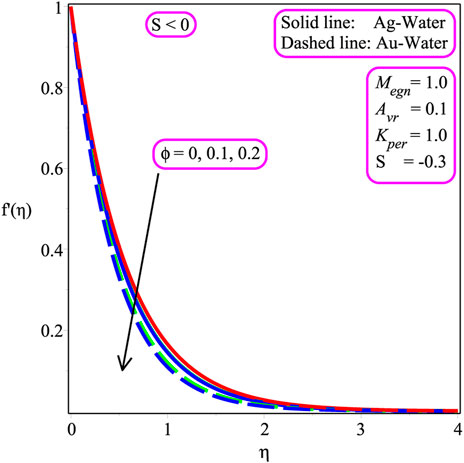
FIGURE 2. Outcome of ϕ (S < 0) on f′(η).
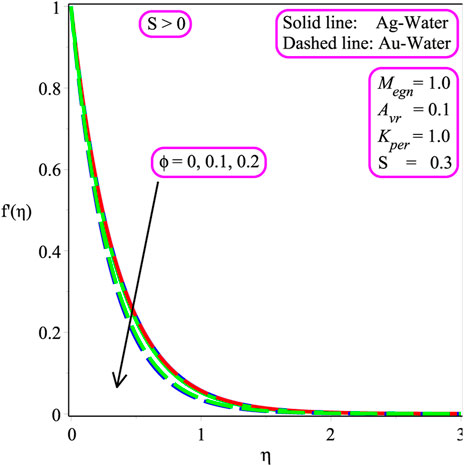
FIGURE 3. Outcome of ϕ (S < 0) on f′(η).
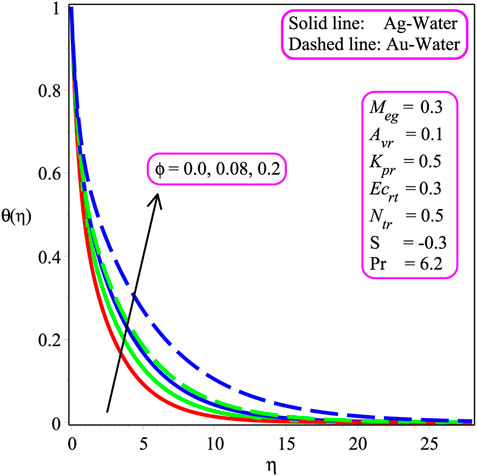
FIGURE 4. Outcome of ϕ on θ(η).
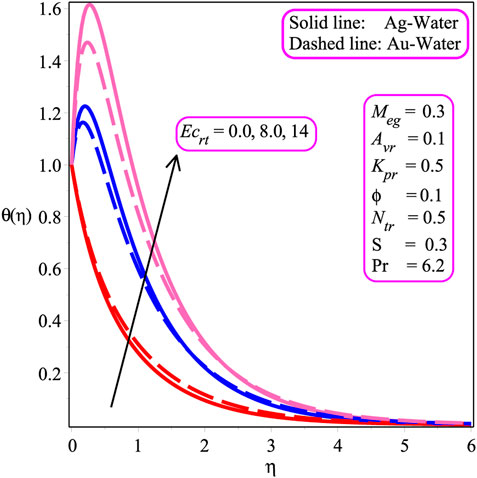
FIGURE 5. Outcome of Ecrt on θ(η).
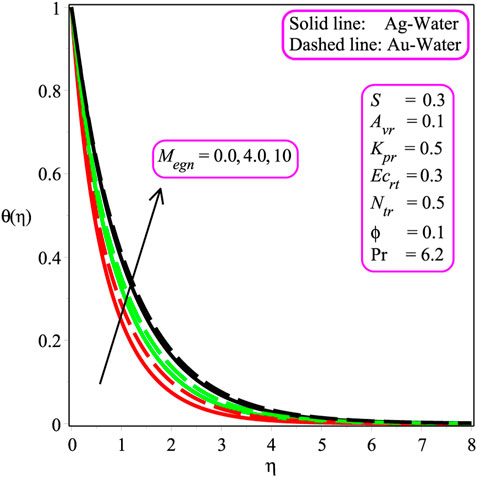
FIGURE 6. Outcome of Megn on θ(η).
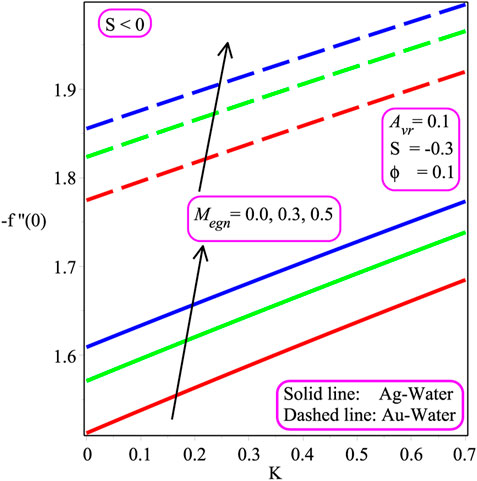
FIGURE 7. Outcome of Megn on − f′′(0).
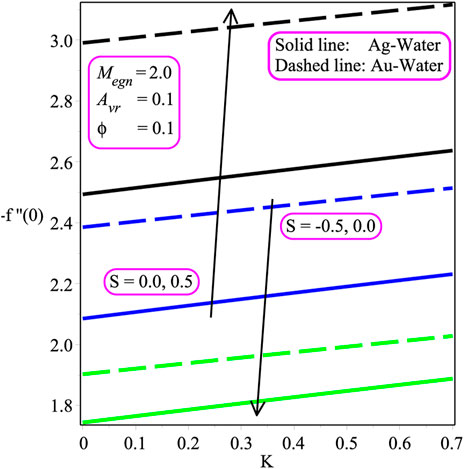
FIGURE 8. Outcome of suction/injection on − f′′(0).
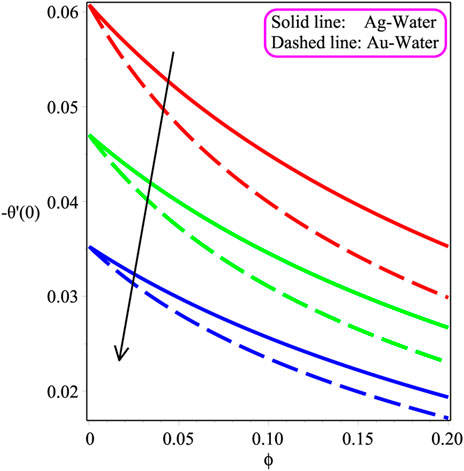
FIGURE 9. Outcome of Ecrt on − θ′(0).
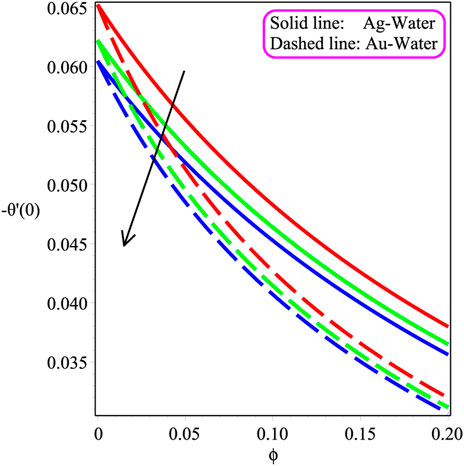
FIGURE 10. Outcome of Kpr on − θ′(0).

FIGURE 11. Outcome of Brkmn on EG.
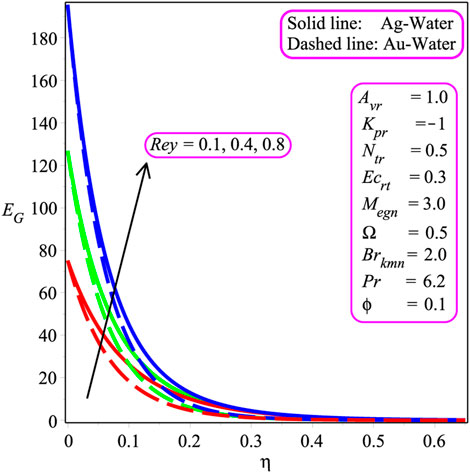
FIGURE 12. Outcome of Rey on EG.
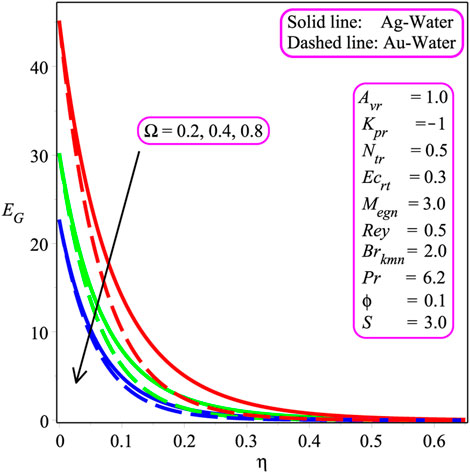
FIGURE 13. Outcome of Ω on EG.
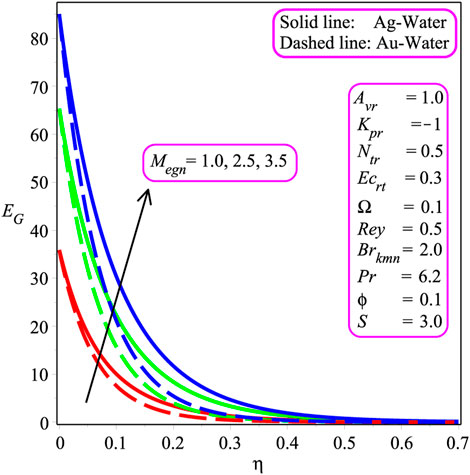
FIGURE 14. Outcome of Megn on EG.
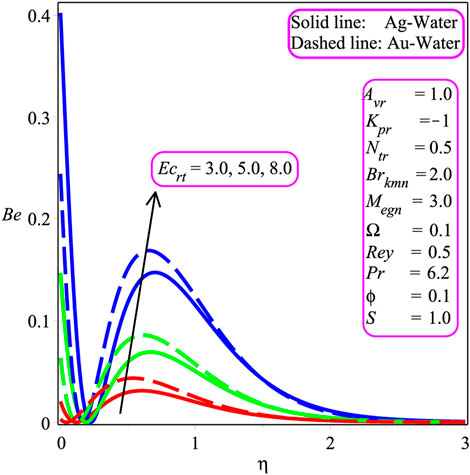
FIGURE 15. Outcome of Ecrt on Be.
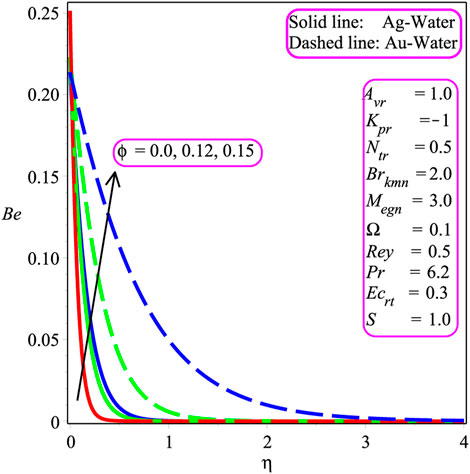
FIGURE 16. Outcome of ϕ on Be.

FIGURE 17. Outcome of Ω on Be.
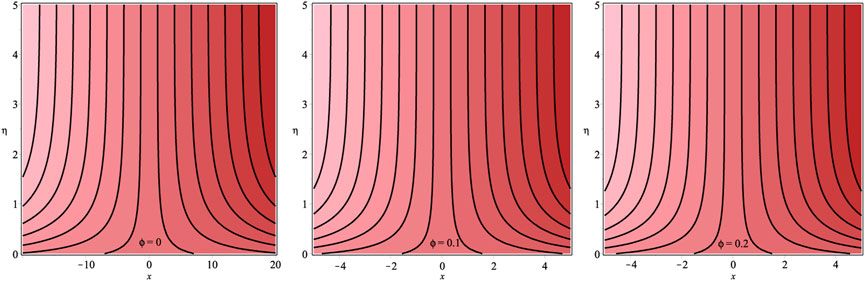
FIGURE 18. (A–C) Flow pattern of Ag − water for Kpr = 1, Megn = 1, Avr = 0.8, and S = 0.2.

TABLE 1. Thermophysical characteristics of water, Ag, and Au (Mahalakshmi and Vennila, 2020).
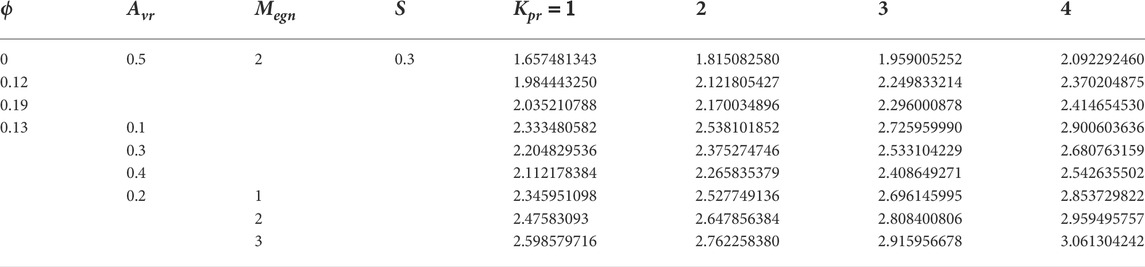
TABLE 2. Variation of ϕ, Avr, Megn, and Megn on − f′′(0).

TABLE 3. Numerical values of − θ′(0) for Ecrt = 1, Pr = 6.2, and Ntr = 1.5.
Figure 5 depicts the influence of Ecrt on the temperature profile. As heat energy is produced in Ag − and Au − water nanofluids caused by friction heat, the temperature field is being augmented with an increasing value of Ecrt. The impression of Megn on the temperature field is shown in Figure 6. It is pointed out that the temperature distribution increases with a gain in Megn. In fact, the Lorentz effect has a considerable influence on Megn. A greater Lorentz force is associated with elevated Megn, whereas a smaller Lorentz strength is linked with lower Megn. The larger Lorentz force creates more energy in both Ag − and Au − water, resulting in an increase in temperature change. The consequences of Megn on − f′′(0) are plotted in Figure 7. It is perceived that an augmentation in the magnetic entity escalates skin friction at the wall in both Ag − and Au − water. Moreover, Ag − water has a higher rate of skin friction than the Au − water nanofluid. Figure 8 shows the reaction of the wall mass transport entity on − f′′(0). The magnitude of − f′′(0) is stated to be reduced due to the decreasing amount of the wall mass transport entity (S) for both Ag − and Au − water. Additionally, Ag − water has a higher rate of skin friction than the Au − water nanofluid. The effects of Ecrt and Kpr are shown in Figures 9, 10. The heat transport rate is seen to decrease with the magnitude of Ecrt and Kpr for both Ag − and Au − water nanofluids. It is also noted that the heat exchange rate rapidly decreases in the occurrence of Au − water than in the Ag − water in Figures 9, 10. Physically, the magnitude of − θ′(0) decreases as the value of the permeability parameter decelerates. Physically, the existence of a porous structure restricts nanofluid flow, slowing fluid velocity and decreasing the heat transport rate at the wall.
Figures 11, 17 plot the influence of different parameters on the entropy inception EG and Bejan Be number to visualize the system’s chaos. Figure 11 portrays the result of the Brkmn number. It is expressed that entropy inception is decreased with an increase in Brkmn. Additionally, more chaos is reported in the case of silver–water in the system than the gold–water nanofluid. Similar trends are shown in Figures 12, 14 for Rey and Megn, respectively The opposite behavior is observed in Figure 13 for Ω. In Figures 15, 17, the variation of Ecrt, ϕ, and Ω is investigated. It is perceived that Be is increased while increasing the value of Ecrt, ϕ, and Ω. Physically, the Bejan Be number is, indeed, a non-dimensional quantity that shows the proportion of overall entropy creation that is generated by thermal dissipation. As a result, the Bejan number is a description of the entropy created by heat transmission and resistance to flow rather than a heat transport parameter.
Table 1 lists the thermophysical characteristics of H2O, Ag, and Au. Tables 2, 3 are constructed for numerical values of − f′′(0) and − θ′(0), respectively. Figures 18A–C, Figures 19A–C are plotted to provide insight into the flow pattern in the case of Ag − and Au − water (Figure 16).
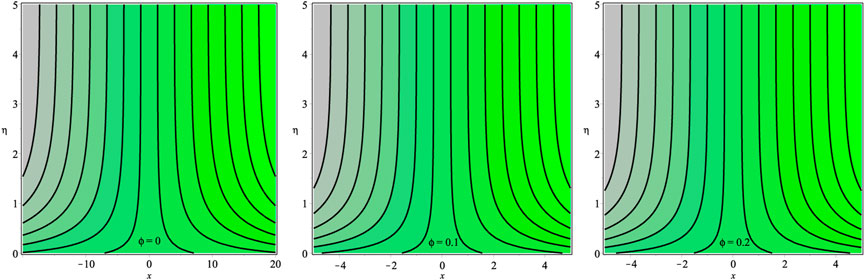
FIGURE 19. (A–C) Flow pattern of Au − water for Kpr = 1, Megn = 1, Avr = 0.8, and S = 0.2.
6 Conclusion
The study presents an entropy inception investigation of magnetohydrodynamic Ag– and Au–H2O nanofluid flows induced by an exponential stretching surface embedded in a porous medium with suction/injection and thermal conductivity. The investigation’s principal conclusions have been summarized as follows:
• In both Ag– and Au–H2O, the solid volume percentage has an accelerating effect on the velocity profile with suction/injection parameters.
• In both Ag– and Au–H2O, the Ecrt and Megn have an increasing impact on the temperature profile.
• It is perceived that an augmentation in the magnetic entity escalates skin friction at the wall in both Ag − and Au − water. Moreover, Ag − water has a higher rate of skin friction than the Au − water nanofluid.
• The heat transport rate is a decreasing function of Ecrt and Kpr for both Ag − and Au − water nanofluids.
• It is also noted that the heat exchange rate rapidly decreases in the occurrence of Au − water than in Ag − water.
• The entropy inception is an increasing function of Brkmn, Rey, and Megn in both Ag − and Au − water.
• More chaos is observed in the case of Ag − water in the system than in the Au − water nanofluid.
Data availability statement
The original contributions presented in the study are included in the article/Supplementary Material; further inquiries can be directed to the corresponding author.
Author contributions
IR initiated the fluid model and methodology. TZ, IR, and MA solved the model using software. JA completed the write-up and assisted in fluid model development.
Funding
The work in this study has been supported by the Polish National Science Centre under the grant OPUS 14 No. 2017/27/B/ST8/01330.
Conflict of interest
The authors declare that the research was conducted in the absence of any commercial or financial relationships that could be construed as a potential conflict of interest.
Publisher’s note
All claims expressed in this article are solely those of the authors and do not necessarily represent those of their affiliated organizations, or those of the publisher, the editors, and the reviewers. Any product that may be evaluated in this article, or claim that may be made by its manufacturer, is not guaranteed or endorsed by the publisher.
References
Abbasi, A., Farooq, W., Khan, M. I., Khan, S. U., Chu, Y. M., Hussain, Z., et al. (2021). Entropy generation applications in flow of viscoelastic nanofluid past a lubricated disk in presence of nonlinear thermal radiation and Joule heating. Commun. Theor. Phys. 73 (9), 095004.
Abd El-Aziz, M., and Afify, A. A. (2019). MHD Casson fluid flow over a stretching sheet with entropy generation analysis and Hall influence. Entropy 21 (6), 592. doi:10.3390/e21060592
Abramowitz, M., and Stegun, L. A. (1972). Handbook of Mathematical Functions 55. Washington, D. C.: National Bureau of Standards/Amer. Math. Sot. Providence.
Afridi, M., Qasim, M., Khan, I., and Tlili, I. (2018). Entropy generation in MHD mixed convection stagnation-point flow in the presence of Joule and frictional heating. Case Stud. Therm. Eng. 12, 292–300. doi:10.1016/j.csite.2018.04.002
B Awati, V., Kumar, M., and Wakif, A. (2021). Haar wavelet scrutinization of heat and mass transfer features during the convective boundary layer flow of a nanofluid moving over a nonlinearly stretching sheet. Partial Differ. Equations Appl. Math. 4, 100192. doi:10.1016/j.padiff.2021.100192
Bejan, A. (1979). Study of entropy generation in fundamental convective heat transfer. J. Heat. Transf. 101 (4), 718–725. doi:10.1115/1.3451063
Bhatti, M. M., Abbas, T., and Rashidi, M. M. (2017). Entropy generation as a practical tool of optimisation for non-Newtonian nanofluid flow through a permeable stretching surface using SLM. J. Comput. Des. Eng. 4 (11), 21–28. doi:10.1016/j.jcde.2016.08.004
Bilal, S., Malik, M. Y., Awais, M., Rehman, K., Hussain, A., and Khan, I. (2017). Numerical investigation on 2D viscoelastic fluid due to exponentially stretching surface with magnetic effects: An application of non-fourier flux theory. Neural Comput. Applic 30 (9), 2749–2758.
Chakrabarti, A., and Gupta, A. S. (1979). Hydromagnetic flow and heat transfer over a stretching sheet. Quart. Appl. Math. 37, 73–78. doi:10.1090/qam/99636
Choi, S. U. S. (1995). “Enhancing thermal conductivity of fluids with nanoparticles,” in International mechanical engineering congress and exposition (San Francisco, USA, 99–105. ASME, FED 231/MD, 66.
Hamad, M. (2011). Analytical solution of natural convection flow of a nanofluid over a linearly stretching sheet in the presence of magnetic field. Int. Commun. Heat Mass Transf. 38 (4), 487–492. doi:10.1016/j.icheatmasstransfer.2010.12.042
Hayat, T., Shinwari, W., Khan, S. A., and Alsaedi, A. (2021). Entropy optimized dissipative flow of Newtonian nanoliquid by a curved stretching surface. Case Stud. Therm. Eng. 27, 101263. doi:10.1016/j.csite.2021.101263
Khan, S. A., Khan, M. I., Alsallami, S. A., Alhazmi, S. E., Alharbi, F. M., and El-Zahar, E. R. (2022). Irreversibility analysis in hydromagnetic flow of Newtonian fluid with joule heating: Darcy-forchheimer model. J. Pet. Sci. Eng. 212, 110206. doi:10.1016/j.petrol.2022.110206
Khan, W., and Pop, I. (2010). Boundary-layer flow of a nanofluid past a stretching sheet. Int. J. Heat. Mass Transf. 53 (11-12), 2477–2483. doi:10.1016/j.ijheatmasstransfer.2010.01.032
Mahabaleshwara, U. S., Aly, H. E., and Anushaa, T. (2022). MHD slip flow of a Casson hybrid nanofluid over a stretching/shrinking sheet with thermal radiation. Chin. J. Phys. doi:10.1016/j.cjph.2022
Mahalakshmi, D., and Vennila, B. (2020). Boundary layer flow of sliver and gold nanofluids over a flat plate by adomain decomposition method. AIP Conf. Proc. 2277 (1), 170002. doi:10.1063/5.0025571
Mahato, R., Das, M., Sen, S. S. S., and Shaw, S. (2022). Entropy generation on unsteady stagnation-point Casson nanofluid flow past a stretching sheet in a porous medium under the influence of an inclined magnetic field with homogeneous and heterogeneous reactions. Heat. Trans. 51, 5723–5747. doi:10.1002/htj.22567
Manzoor, U., S Naqvi, S. M. R., Muhammad, T., Naeem, H., Waqas, H., and M Galal, A. (2022). Hydro-magnetic impact on the nanofluid flow over stretching/shrinking sheet using Keller-box method. Int. Commun. Heat Mass Transf. 135, 106114. doi:10.1016/j.icheatmasstransfer.2022.106114
Neethu, T. S., Sabu, A. S., Mathew, A., Wakif, A., and Areekara, S. (2022). Multiple linear regression on bioconvective MHD hybrid nanofluid flow past an exponential stretching sheet with radiation and dissipation effects. Int. Commun. Heat Mass Transf. 135, 106115. doi:10.1016/j.icheatmasstransfer.2022.106115
Noghrehabadi, A., Pourrajab, R., and Ghalambaz, M. (2012). Effect of partial slip boundary condition on the flow and heat transfer of nanofluids past stretching sheet prescribed constant wall temperature. Int. J. Therm. Sci. 54, 253–261. doi:10.1016/j.ijthermalsci.2011.11.017
Noghrehabadi, A., Saffarian, M. R., Pourrajab, R., and Ghalambaz, M. (2013). Entropy analysis for nanofluid flow over a stretching sheet in the presence of heat generation/absorption and partial slip. J. Mech. Sci. Technol. 27 (3), 927–937. doi:10.1007/s12206-013-0104-0
Oztop, H. F., and Abu-Nada, E. (2008). Numerical study of natural convection in partially heated rectangular enclosures filled with nanofluids. Int. J. Heat. Fluid Flow. 29 (5), 1326–1336. doi:10.1016/j.ijheatfluidflow.2008.04.009
Prasannakumara, B. C. (2021). Numerical simulation of heat transport in Maxwell nanofluid flow over a stretching sheet considering magnetic dipole effect. Partial Differ. Equations Appl. Math. 4, 100064. doi:10.1016/j.padiff.2021.100064
Rashid, I., Haq, R. U., Khan, Z. H., and Al-Mdallal, Q. M. (2017). Flow of water based alumina and copper nanoparticles along a moving surface with variable temperature. J. Mol. Liq. 246, 354–362. doi:10.1016/j.molliq.2017.09.089
Rashidi, M. M., and Freidoonimehr, N. (2014). Analysis of entropy generation in MHD stagnation-point flow in porous media with heat transfer. Int. J. Comput. Methods Eng. Sci. Mech. 15 (4), 345–355. doi:10.1080/15502287.2014.915248
Rohni, A. M., Ahmad, S., and Pop, I. (2012). Flow and heat transfer over an unsteady shrinking sheet with suction in nanofluids. Int. J. Heat. Mass Transf. 55 (7-8), 1888–1895. doi:10.1016/j.ijheatmasstransfer.2011.11.042
Sithole, H., Mondal, H., and Sibanda, P. (2018). Entropy generation in a second grade magnetohydrodynamic nanofluid flow over a convectively heated stretching sheet with nonlinear thermal radiation and viscous dissipation. Results Phys. 9, 1077–1085. doi:10.1016/j.rinp.2018.04.003
Tayebi, T., Dogonchi, A. S., Karimi, N., Ge-JiLe, H., Chamkha, A. J., and Elmasry, Y. (2021). Thermo-economic and entropy generation analyses of magnetic natural convective flow in a nanofluid-filled annular enclosure fitted with fins. Sustain. Energy Technol. Assessments 46, 101274. doi:10.1016/j.seta.2021.101274
Wang, F., Khan, S. A., Khan, M. I., El-Zahar, E. R., Yasir, M., Nofal, T. A., et al. (2022). Thermal conductivity performance in propylene glycol-based Darcy-Forchheimer nanofluid flow with entropy analysis. J. Pet. Sci. Eng. 215, 110612. doi:10.1016/j.petrol.2022.110612
Keywords: thermal radiation, entropy inception, ohmic heat, magnetic field, stagnation point flow
Citation: Rashid I, Zubair T, Asjad MI and Awrejcewicz J (2022) Entropy generation investigation of MHD Ag– and Au–H2O nanofluid above an exponential porous stretchable surface with thermal radiation and stagnation point flow. Front. Energy Res. 10:1009044. doi: 10.3389/fenrg.2022.1009044
Received: 01 August 2022; Accepted: 05 September 2022;
Published: 07 October 2022.
Edited by:
Umar Khan, Hazara University, PakistanReviewed by:
Homan Emadifar, Islamic Azad University, IranUmair Ali, Universiti Sains Malaysia (USM), Malaysia
Copyright © 2022 Rashid, Zubair, Asjad and Awrejcewicz. This is an open-access article distributed under the terms of the Creative Commons Attribution License (CC BY). The use, distribution or reproduction in other forums is permitted, provided the original author(s) and the copyright owner(s) are credited and that the original publication in this journal is cited, in accordance with accepted academic practice. No use, distribution or reproduction is permitted which does not comply with these terms.
*Correspondence: I. Rashid, bWVoYXIuaXJmYW4wMTRAZ21haWwuY29t