 Małgorzata Baran1†
 Richard Hazenberg2‡
 Katarzyna Iwińska3§
 Krzysztof Kasianiuk4*†
 Ioannis Perifanos5‡Joana Maria Ferreira Da Silva6§
 Clara Vasconcelos7‡
- 1Department of Management, Collegium Civitas, Warsaw, Poland
- 2Institute for Social Innovation and Impact, University of Northampton, Northampton, United Kingdom
- 3Edmund Wnuk-Lipiński Institute of Sociology, Collegium Civitas, Warsaw, Poland
- 4HIVE–Systems Collective Design Lab, Institute of Political Sciences and International Relations Department of Management, Collegium Civitas Warsaw, Poland
- 5Agricultural University of Athens, Athens, Greece
- 6Interdisciplinary Centre of Marine and Environmental Research (CIIMAR), Faculty of Sciences (FCUP), University of Porto, Porto, Portugal
- 7Interdisciplinary Centre of Marine and Environmental Research (CIIMAR), Science Teaching Unit (UEC) and Department of Geosciences, Environment and Spatial Planning (DGAOT), Faculty of Sciences (FCUP), University of Porto, Porto, Portugal
In this article, we explore individuals’ pro-environmental innovative behavior (PEIB) as one of the conditions for developing more sustainable cities. We assume that energy-efficient sustainable cities are those where people behave sustainably. Hence, studying the conditions of human behavior is essential for understanding the transformation of cities. We focused on individual antecedents of pro-environmental innovative behavior with a survey conducted in five European countries and a sample of 2502 participants. Descriptive and correlation statistical analyses confirm a moderate relationship between environmental awareness and environmental action. Based on this rudimentary analysis, we suggest further research on city energy transformation, including multiple aspects of individual behavior.
1 Introduction
The transformation of cities toward more energy-efficient sustainable systems requires a constant exchange of knowledge about the capacities and behaviors of all engaged actors. Apart from technological advancements, industries must adapt to environmental and societal changes. Hence, sustainable transformation needs to parallel the sustainable development of society, with the decisions and policies adopted needing to simultaneously consider the energy system’s industrial and societal implications.
Yet, understanding the conditions of social development might foster or undermine sustainable energy transformation of cities. Among societal challenges that enhance energy transition, we find new technologies, institutions cooperating with the innovative private sector, and public policies that merge these three elements to sustain the change (Henderson and Newell 2010). The UN Sustainable Development Goals Report 2022 focuses on other issues, including the necessity of reducing the number of slum dwellers, solid waste problems, and air pollution (UN 2022). At the same time, some studies show that sustainable cities seem to exist primarily in economically developed countries (Arcadis 2022).
We still lack sufficient knowledge on the driving forces of integration and the development of cities. Some researchers (Hoppe and De Vries 2019; Dall-Orsoletta et al., 2022) point out that social innovations are the purpose of development and contribute to low-carbon energy transitions, civic empowerment, and social goals that benefit a sustainable future. These shortages include the gaps in societies’ inclination toward innovativeness and the level of impact of behaviors of individuals and norms on social institutions.
From an individual’s point of view, it is essential to know what psychological traits can lead to environmental innovations and citizen behavior oriented towards sustainability. In this paper, we seek to identify the individual antecedents to Pro-environmental Innovative Behavior (PEIB) by showing the links between pro-innovative behavior, environmental awareness, and, ultimately, environmental actions. In developing the PEIB theoretical model, we aim to demonstrate the importance of psychosocial traits in predicting and shaping individuals’ attitudes to environmental awareness and pro-environmental behaviors, which academics, policymakers, and practitioners can use to drive sustainable behavior change in populations across Europe and beyond.
We approach the problem of sustainable transformation of energy systems through a lens centered on the behavior of individuals (Stephens 2019). We aim to contribute to the debate on conditions of sustainable transformation by showing evidence of how individual innovative behaviors impact pro-environmental actions. We explore this by correlating awareness, daily habits, and other antecedents of innovativeness within the field of environmental actions.
According to research psychological aspects are crucial for conceptualizing pro-environmental behaviors (Kurisu 2015), however the number of these factors have not been tested widely. Some studies seek to understand people’s perceptions of environmental actions and behaviors (such as recycling, energy, and pollution) (Morgil et al., 2004). Whilst only recently, the issue of everyday practices in terms of daily habits in energy consumption has been gaining increasing attention from scholars (Butler et al., 2016; Matsumoto 2019; Delina 2022).
In doing so, we developed a model of PEIB, tested with 2502 participants across Europe, including Greece, Poland, Portugal, Sweden, and the United Kingdom. As will be demonstrated later in the paper, this model can explain why people are more likely to engage in pro-environmental actions.
We focused our research on innovativeness and innovative behavior, which we defined as coming up with new ideas and working to implement them through individual actions in the private sphere (Seibart et al., 2012). Scholars across disciplines highlighted the same attitudes and cognitive abilities as key antecedents to innovative behavior. Indeed, a growing body of literature explores eco-innovation and environmental awareness linkages at the organizational and managerial levels. The research shows the importance of environmental awareness and leadership in actively shaping innovative '''green behaviors in organizations” (Su et al., 2020; Yang and Liu, 2021) and the role that risk and cost-benefit approaches play in shaping this (Peng and Liu, 2016). However, there remains a paucity of research centered on how this interplay occurs at the individual, psychosocial level.
Moreover, some researchers (i.e., Frese 2008) suggest that a more current view of individuals in the innovation process should be taken. Virkkunen (2006) proposes the concept of transformative agency with individuals as active agents who question the status quo and take the initiative to change it. Haapasaari et al. (2017) found that individual innovation efforts need a transformative agency to bring their ideas into successful innovations. Individual innovators are those who are willing (motivated to act) and capable of being (cognitive ability and personality characteristics) innovative (Anderson et al., 2004). Prior research has referred to individual innovative outcomes as the ability to develop new ideas and implement them, with personality factors such as attitudes and cognitive skills influencing behavior, including individual innovative behavior (Ahuja et al., 2008).
In relation to the antecedents of innovation, research has identified several individual key characteristics that can drive innovation across a variety of different sectors (not just eco-focused), including risk-taking propensity, external environment, and proactiveness (Zhang and Ma, 2019); and self-starting behavior, proactivity, and persistence (Frese et al., 1997).
In identifying the research gap, we posed the following research question: What are the main determinants of pro-innovative behavior in the context of environmental innovation? This paper focuses specifically on the role of individuals in relation to the creation and implementation of environmental innovations as social change. On this basis, it is explained how individuals can act as innovators and devise innovative techniques/solutions to environmental problems upon their social cognitive frame and their processing of external information/stimuli.
2 The PEIB model
For the study, we have used a model in which a composite of four antecedents of pro-innovative behavior was correlated with daily habits (Figure 1).
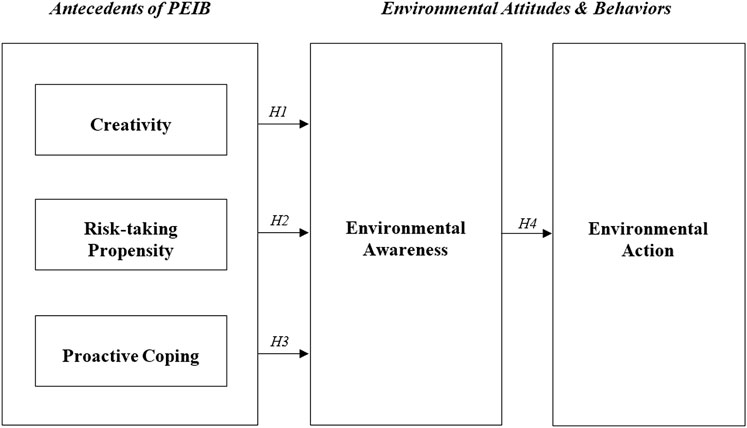
FIGURE 1. PEIB Hypotheses model
In understanding pro-innovative behaviors, risk-taking propensity, proactiveness, and self-starting behavior (termed here as creativity) have all been shown to be key antecedent characteristics (Frese et al., 1997; Zhang and Ma, 2019). Indeed, risk-taking propensity has been closely linked in prior research with innovation and innovative behaviors (Amabile, 1996; Cropley, 2002; Miron et al., 2004); whilst proactivity in individuals has also been shown to be linked to pro-innovative behaviors (Bateman and Crant, 1993; Frohman, 1997; Parker et al., 2006). Finally, creativity acts as a critical cornerstone for innovation and new behaviors amongst individuals, with research demonstrating transparent positive relationships between creativity and innovation, with the former acting as a precursor to the latter (Amabile, Fisher, 2000; Miron et al., 2004; Hammond et al., 2011).
However, as PEIB is concerned explicitly with such innovative behaviors in order to develop pro-environmental behaviors and actions, there is also a need to understand environmental innovation and awareness. In doing so, this paper therefore shows a link between pro-innovative behaviors and environmental awareness. We test it to identify causal links between these social cognitive traits and actual environmental actions on the ground.
We formulated and operationalized four hypotheses:
Hypotheses 1 = Creativity will be positively correlated to Environmental Awareness.H2 = Risk-taking Propensity will be positively correlated to Environmental Awareness.H3 = Proactive Coping will be positively correlated to Environmental Awareness.H4 = Environmental Awareness will be positively correlated to Environmental Action.Within this framework, we applied a survey to a random sample to answer the research question and test the hypotheses.
3 Materials and methods
We have used the survey data collected using Computer Assisted Website Interview (CAWI), an internet-based survey technique with regard to pro-innovative behavior to answer the following question: What are the main determinants of pro-environmental innovative behavior (PEIB) in the context of environmental innovations? The survey was implemented in July 2020 in five European countries–Greece, Poland, Portugal, Sweden, and the United Kingdom. The sample size was N = 2503 respondents (approximately N = 500 interviews per country) aged 18–45 years old. The survey sampling design was based on a random sample scheme stratified by gender, age, and size of place of residence. The choice of the five countries was deliberately made to show the geographical, cultural and national variations across Europe. After the data collection was completed, we used the SPSS (v.23) software for the analysis.
We performed a reliability analysis (Cronbach’s Alpha and Guttman’s Lambda) for each set of items referring to a latent construct. The preliminary statistical analysis involved frequency distributions and conditional frequency distributions by gender, age, and domicile.
To observe the potential relationship among the scales, a correlation analysis was performed for the five dimensions. The level of significance was set to 0,01.
3.1 Measurement scales
We used five scales n the study: Environmental Awareness, Creativity, Pro-active Coping, Risk-taking Propensity, and Daily Habits (as a proxy for Environmental Action):
Morgil et al.'s (2004) Environmental Awareness Scale, which explores 13 items of perceptions in relation to recycling, energy usage and pollution (Morgil et al., 2004). This is a set of 20 statements, where the participants chose between a 5-level Likert scale of agreement.
Kaufman Domains of Creativity Scale (K-DOCS), which uses a self-report, behavior-based scale that measures everyday creativity, using five factors: self/everyday, scholarly, performance, mechanical/scientific and artistic (Kaufman, 2012). The questionnaire utilized 11 statements with a 4-level Likert scale.
Schwarzer and Jerusalem (1995) General Self-efficacy scale. It is a group of 14 statements, where the participants chose between a 4-level Likert scale of agreement based on their beliefs.
the General Risk Propensity Scale (Zhang et al., 2018) which provides a short self-report measure of general risk propensity. The 8-statement measurement utilized 5-level Likert scale.
Defra’s attitudes and behaviors surveys (2008, 2009), for environmental action. The 16-item scale with a 5-level Likert scale, was categorized based on set of goals and behavioral areas, such as consumption, food and drink, household, and travel (Thornton 2009, Markle 2013).
3.2 Participants
The participants represented equally five countries: 500 Greece, Poland and the United Kingdom (N = 500 each), and Portugal and Sweden (N = 501 each). This collection of nations provides an idea of the European variety, ranging from Northern and richer countries to Central-Eastern and Southern ones with lower GDP, expressed in current international dollars converted by purchasing power parity (PPP) conversion factor (World Bank, 2022). The number of respondents enabled to gain a 4–5% error margin, which is acceptable for the study of this kind. Males and females were represented almost equally, with percentages of 50,4% and 49,6% respectively. The age of the participants ranged from 18 to 45 years old and the age band with the highest contribution was from 36 to 45 years, with 39,2%.
The sampling method for CAWI was based on the selection of individuals to mirror each country’s socio-demography in terms of gender, age (between 18–45), educational level (primary education, secondary education, technical/vocational, university degree, PhD or more) and place of residence (farm or home in the country, country village, town or small city, suburbs or outskirts of a big city, big city). These three demographic factors reflect the sociodemographics division in this age group, which was our focus in the project due to educational reasons. This age group is mostly represented by students at the universityThe survey research was carried out by the KANTAR international research agency. The total sample consisting of 2502 (100%) was included into the analysis. The generalization of the results focused on the population of people aged 18–45, so it takes into account the socio-economic categories of the participants, which were subordinated to the goals of the survey.
4 Results
4.1 Descriptive statistical analysis
4.1.1 Environmental Awareness
The highest mean scores are observed for the opinions supporting that humans are seriously abusing the environment (4,21), that energy-saving light bulbs should be used even though they are expensive (4,10). Also, the statement concerning chemical waste units in the research foundations (4,01), and the belief that small, individual actions make a difference in protecting the environment (4,01) had high values (meaning “strongly agree” answers).
4.1.2 Creativity
For almost all statements, the respondents claimed that they were “more creative” than an average person of approximately their age and life experience, as the mode of ten out of eleven variables is 4. The highest mean is observed for the creativity of the participants in choosing the best solution to a problem (3,65), helping other people cope with a difficult situation (3,60), and teaching someone how to do something (3,59).
4.1.3 Proactive coping
The sample seems to be positive for almost all statements as the mode is 3 (moderately true) for 13 items. The highest mean is observed for: the initiative to solve a problem when experiencing one (3,05), pointing out the need to succeed (3,04), and visualization of dreams in an attempt to achieve it.
4.1.4 Risk-taking propensity
Almost all statements referring to the level of agreement on risk-taking have a mode of 3, representing the neutral attitude of the participants in risk-taking. The exception is for the statement referring to the belief in taking chances, where the mode is 4, and the mean score is the highest (3,59).
4.1.5 Environment Actions (Daily habits)
There is a significant variance in the answers on daily habits. Participants primarily stated that in the month preceding, they had turned off the lights when no one was in the room (4,10), taken my shopping bag when shopping (4,05), turned off the tap while brushing their teeth (4,01), and separated most of my waste for recycling for environmental reasons (3,90). The lowest scores were observed for buying organic food (2,91) and choosing vegetarian products over meat products for environmental reasons (2,86).
4.2 Correlation analysis
Correlation analysis among the five scales was promoted in order to search for the potential interconnection and relationship among them.
Table 1 presents the internal consistency coefficients Cronbach’s alpha and Guttman’s Lambda for the variables of each scale. The scores of both Cronbach’s alpha and Guttman’s Lambda for all four scales are considered high, indicating very good internal consistency. Cronbach-a ranged between 0.805 and 0.916, and Guttman’s Lambda (G6) ranged between 0.820–0.910. These results allow the grouping of the variables of each scale into the relevant dimensions.

TABLE 1. Internal consistency of scales.
After the grouping, a correlation analysis was performed for the five dimensions to observe potential relationships among them. All correlation coefficients are positive and statistically significant at the level of 0,01. The strongest correlation is observed between the Creativity and Proactive Coping Dimensions (r = 0.487, p < 0,01) as well as between Environmental Awareness and Daily Habits (Environmental action) (r = 0.451, p < 0,01). Moreover, the weakest relationship is between Environmental Awareness Dimension and Risk-taking Dimension (r = 0.059, p < 0,01).
The other correlations obtained indicate the absence of influence among these dimensions. The Environmental Awareness Dimension is correlated positively with Creativity Dimension, and the correlation is moderate (r = 0.277, p < 0,01), the same as the correlation between Proactive Coping and Risk-taking (r = 0.350, p < 0,01). The correlation coefficients between Risk-taking and Creativity (r = 0.191, p < 0,01) and between Proactive Coping and Environmental Awareness (r = 0.211, p < 0,01) indicate a positive and relatively weak relationship.
4.3 Discussion of the results
The aim of this study has been to identify individual antecedents of pro-environmental innovative behavior (PEIB). The results presented in the study have shown the individual characteristics that can lead to environmental innovation and positive pro-environmental behavior. All four hypotheses have been confirmed.
Since our aim was to understand pro-environmental behaviors, it is important to note especially one of the results–the relationship with environmental awareness with other antecedents within the model. The results of the frequencies and mean scores of these two sets of variables are presented in Tables 2 and 3.
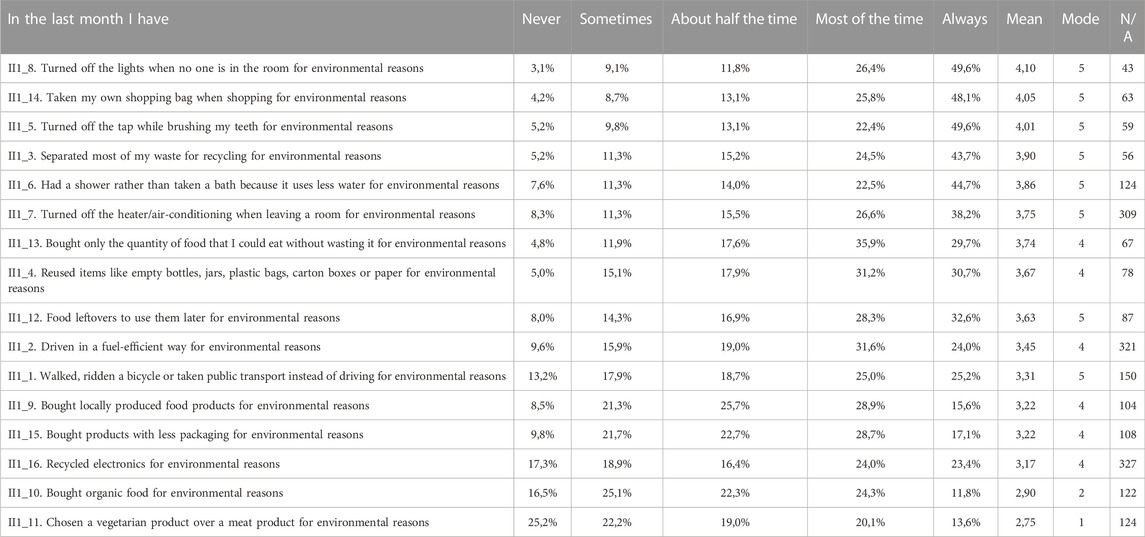
TABLE 2. Daily habits (Environmental action).
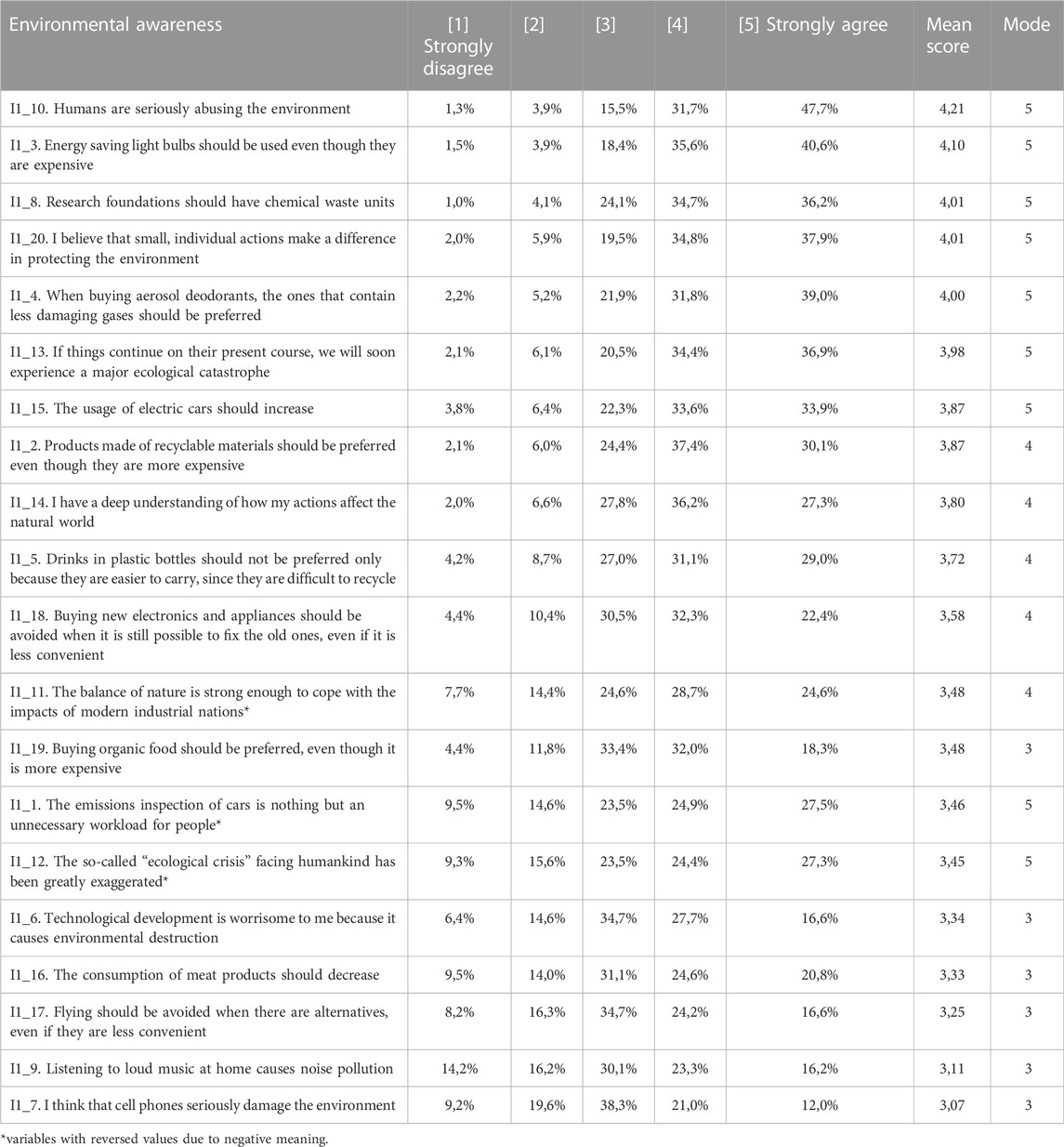
TABLE 3. Environmental awareness
In turn, an analysis of an individuals’ actions based upon environmental reasoning shows that people generally turned off the lights when no one was in the room, took their own shopping bag when shopping, turned off the tap while brushing their teeth, separated most of their waste for recycling, used less water for the environment, and turned off the heater or air conditioning when leaving a room, all for environmental reasons. This indicates that behaviors that serve as proxies for a transition to a more sustainable energy source are not the only significant elements that have the potential to impact PEIB. This finding echoes previous research on pro-environmental daily habits (Punzo et al., 2019; Ünal et al., 2018).
5 Conclusion
By creating a theoretical model of PEIB and testing it through empirical research in European countries, we have demonstrated the relevance of individuals’ attitudes towards environmental awareness, which influences environmental action. The verification of all four hypotheses provide support for a perspective in which socio-cognitive factors at individual level play important role in development of sustainable behavior. It seems that these factors create a vital context for development of energy-efficient sustainable cities, at least in five European countries, which have been the subject to the study.
In providing the PEIB model, we have shown the links between pro-innovative behavior, environmental awareness, and declaration of environmental action. In doing so, the findings support prior research identifying the of individual psychological factors in environmental behavior (Kurisu 2015). At the same time, our result offers a new theoretical model as to what these specific psychological factors may be. We focuse particularly on creativity and proactive coping. By aligning this to an individual’s environmental awareness and the specific environmental actions people undertake on a daily basis, the paper presents empirical evidence in support of this new theoretical approach that aligns psychological factors with the moral and cognitive functions inherent in environmental decision-making (De Groot and Steg 2008).
Due to the fact that this is a preliminary study, we highlight two points. First, the analysis was conducted at an aggregated level, and the analysis was based on descriptive statistics. Second, it did not focus on the country-level differences, which might have an impact on the overall results. That is why the analysis does not provide sufficient data for an in-depth explanation at the country level, however it provides the model of PEIB open for further investigation. The chosen survey method, which included only people actively using the Internet, is another limitation of our study. Among the other limitations is the sample we used: the age group (18–45) is not covering the total population but only the main group of people who study at the college or university level. These are areas for further research and analysis.
Our results show a moderate relationship between environmental awareness and environmental action. The literature supports our findings, whilst also drawing attention to important spheres of environmental awareness, namely information (state of knowledge about nature and ecological threats), evaluations (together with emotional involvement), and attitudes (determining motivations for action). Environmental awareness has been recognized as a motivating component in moral norms and a cognitive aspect of environmental decision-making (Hosta and Zabkar 2021). According to recent research, environmental awareness has a higher positive predictive value than other factors and can more effectively predict support for environmental protection (de Groot and Steg 2010; Pradhananga et al., 2017, Unal et al., 2018). Similarly to previous researchers (Steg et al., 2015), we state that only an integrated approach to the human aspects of a sustainable energy transition will help us understand the general factors influencing energy behaviors.
The study’s preliminary results might be used to fill the gap in future in-depth research on individual behaviors’ impact on energy transitions (Sovacool 2014). Researchers, policymakers and practitioners can use these findings to stimulate changes in pro-environmental behavior in populations across Europe and beyond, whilst at the same time having an impact on energy transformation of cities.
The desirability of using environmental policy instruments depends on the value of expected environmental behavior (Kemp and Pontoglio, 2011). To achieve the goals of environmental policy, it is necessary to bring about changes in the way people behave. The results presented here can serve as an important insight for development of environmental policy and stimulators of change.
Data availability statement
The raw data supporting the conclusions of this article will be made available by the authors, without undue reservation.
Ethics statement
Ethical review and approval was not required for the study on human participants in accordance with the local legislation and institutional requirements. Written informed consent from the [patients/ participants OR patients/participants legal guardian/next of kin] was not required to participate in this study in accordance with the national legislation and the institutional requirements.
Author contributions
MB and KK–equal contribution and First authorship. RH, IP, and CV – equal contribution and Senior authorship. KI and JF – equal contribution and last authorship.
Funding
This research has been conducted within the PASSION- Partnership for Sustainable development and Social Innovation project, funded by Polish National Agency for Academic Exchange (NAWA). Grant Number: PPI/APM/2019/1/00096/DEC/01.
Acknowledgments
Clara Vasconcelos is thankful to Fundação para a Ciência e Tecnologia (FCT) within the scope of UIDB/04423/2020 and UIDP/04423/2020.
Conflict of interest
The authors declare that the research was conducted in the absence of any commercial or financial relationships that could be construed as a potential conflict of interest.
Publisher’s note
All claims expressed in this article are solely those of the authors and do not necessarily represent those of their affiliated organizations, or those of the publisher, the editors and the reviewers. Any product that may be evaluated in this article, or claim that may be made by its manufacturer, is not guaranteed or endorsed by the publisher.
References
Ahuja, G., Lampert, C. M., and Tandon, V. (2008). Moving beyond schumpeter: Management research on the determinants of technological innovation. Acad. Manag. Ann. 2, 1–98. doi:10.5465/19416520802211446
Amabile, T. M. (1996). Creativity in context: Update to the social psychology of creativity. Westview Press. Boulder, CO, USA,
Amabile, T. M., and Fisher, C. M. (2000). Stimulate creativity by fueling passion. Handb. Princ. Organ. Behav., 341–331.
Anderson, N., de Dreu, C. K. W., and Nijstad, B. A. (2004). The routinization of innovation research: A constructively critical review of the state-of-the-science. J. Organ. Behav. 25, 147–173. doi:10.1002/job.236
Arcadis, . (2022). Prosperity beyond profit. The arcadis sustainable cities index 2022. https://connect.arcadis.com/Sustainable-Cities-Index?origin_source=NoData&origin_medium=NoData&origin_campaign=NoData&origin_content=NoData (accessed: 23.11.2022)
Bateman, T. S., and Crant, J. M. (1993). The proactive component of organizational behavior: A measure and correlates. J. Organ. Behav. 14, 103–118. doi:10.1002/job.4030140202
Butler, C., Parkhill, K. A., and Pidgeon, N. F. (2016). Energy consumption and everyday life: Choice, values and agency through a practice theoretical lens. J. Consumer Cult. 16 (3), 887–907. doi:10.1177/1469540514553691
Cropley, A. (2002). Creativity and innovation: Men's business or women's work? Baltic J. Psychol. 3, 77–88.
Dall-Orsoletta, A., Cunha, J., Araújo, M., and Ferreira, P. (2022). A systematic review of social innovation and community energy transitions. Energy Res. Soc. Sci., 88, 102625. doi:10.1016/j.erss.2022.102625
De Groot, J. I. M., and Steg, L. (2008). Value orientations to explain beliefs related to environmental significant behavior: How to measure egoistic, altruistic, and biospheric value orientations. Environ. Behav. 40, 330–354. doi:10.1177/0013916506297831
Delina, L. L. (2022). Co-Producing just energy transition in everyday practices: Sociotechnical innovation and sustainable development in the Thailand-Myanmar border. Local Environ. 27 (1), 16–31. doi:10.1080/13549839.2021.1997964
Frese, M., Fay, D., Hilburger, T., Leng, K., and Tag, A. (1997). The concept of personal initiative: Operationalization, reliability and validity in two German samples. J. Occup. Organ. Psychol. 70, 139–161. doi:10.1111/j.2044-8325.1997.tb00639.x
Frohman, A. L. (1997). Igniting organizational change from below: The power of personal initiative. Organ. Dyn. 25, 39–53. doi:10.1016/s0090-2616(97)90046-2
Haapasaari, A., Engeström, Y., and Kerosuo, H. (2017). From initiatives to employee-driven innovations. Eur. J. Innovation Manag. 21, 206–226. doi:10.1108/ejim-09-2016-0085
Hammond, M. M., Neff, N. L., Farr, J. L., Schwall, A. R., and Zhao, X. (2011). Predictors of individual-level innovation at work: A meta-analysis. Psychol. Aesthet. Creativity, Arts 5, 90–105. doi:10.1037/a0018556
Henderson, R., and Newell, R. G. (2010). Accelerating energy innovation: Insights from multiple sectors, harvard discussion paper 10-25. Available at: https://heep.hks.harvard.edu/files/heep/files/dp25_henderson-newell.pdf
Hoppe, T., and de Vries, G. (2018). Social innovation and the energy transition. Sustainability 11, 141. doi:10.3390/su11010141
Hosta, M., and Zabkar, V. (2021). Antecedents of environmentally and socially responsible sustainable consumer behavior. J. Bus. Ethics 171 (2), 273–293. doi:10.1007/s10551-019-04416-0
Kaufman, J. C. (2012). Counting the muses: Development of the kaufman domains of creativity scale (K-docs). Psychol. Aesthet. Creativity, Arts 6, 298–308. doi:10.1037/a0029751
Kemp, R., and Pontoglio, S. (2011). The innovation effects of environmental policy instruments. Ecol. Econ. 72, 28–36. doi:10.1016/j.ecolecon.2011.09.014
Matsumoto, S. (2019). Daily habits and energy consumption: Go to bed earlier for environmental protection. Eur. J. Sustain. Dev. 8, 54. doi:10.14207/ejsd.2019.v8n4p54
Miron, E., Erez, M., and Naveh, E. (2004). Do personal characteristics and cultural values that promote innovation, quality, and efficiency compete or complement each other? J. Organ. Behav. 25, 175–199. doi:10.1002/job.237
Morgil, İ., Seçil, A., Seçken, N., Yavuz, S., and Oskay, Ö. Ö. (2004). The influence of computer-assisted education on environmental knowledge and environmental awareness. Chem. Educ. Res. Pract. 5, 99–110. doi:10.1039/b3rp90032k
Parker, S. K., Williams, H. M., and Turner, N. (2006). Modeling the antecedents of proactive behavior at work. J. Appl. Psychol. 91, 636–652. doi:10.1037/0021-9010.91.3.636
Pradhananga, A. K., Davenport, M. A., Fulton, D. C., Maruyama, G. M., and Current, D. (2017). An integrated moral obligation model for landowner conservation norms. Soc. Nat. Resour. 30, 212–227. doi:10.1080/08941920.2016.1239289
Punzo, G., Panarello, D., Pagliuca, M. M., Castellano, R., and Aprile, M. C. (2019). Assessing the role of perceived values and felt responsibility on pro-environmental behaviours: A comparison across four eu countries. Environ. Sci. Policy, 101, 311–322. doi:10.1016/j.envsci.2019.09.006
Schwarzer, R., and Jerusalem, M. (1995). “Generalized self-efficacy scale,” in Measures in health psychology: A user's portfolio. Causal and control beliefs. Editors J. Weinman, S. Wright, and M. Johnston (Windsor:NFER-NELSON)), England, UK, 35.
Sovacool, B. K. (2014). What are we doing here? Analyzing fifteen years of energy scholarship and proposing a social science research agenda. Energy Res. Soc. Sci. 1, 1–29. doi:10.1016/j.erss.2014.02.003
Steg, L., Perlaviciute, G., and Van der Werff, E. (2015). Understanding the human dimensions of a sustainable energy transition. Front. Psychol. 6, 805. https://www.frontiersin.org/articles/10.3389/fpsyg.2015.00805. doi:10.3389/fpsyg.2015.00805
Stephens, J. C. (2019). Energy democracy: Redistributing power to the people through renewable transformation. Environ. Sci. Policy Sustain. Dev. 61 (2), 4–13. doi:10.1080/00139157.2019.1564212
Su, J., Zhang, S., and Ma, H. (2020). Entrepreneurial orientation, environmental characteristics, and business model innovation: A configurational approach. Innovation 22, 399–421. doi:10.1080/14479338.2019.1707088
Thornton, A. (2009). Public attitudes and behaviours towards the environment-tracker survey: A report to the department for environment, food and rural affairs. London, UK: TNS. Defra.
Ünal, A. B., Steg, L., and Gorsira, M. (2018). Values versus environmental knowledge as triggers of a process of activation of personal norms for eco-driving. Environ. Behav. 50, 1092–1118. doi:10.1177/0013916517728991
Virkkunen, J. (2006). Dilemmas in building shared transformative agency. Activités 3, 43–66. doi:10.4000/activites.1850
Yang, G., and Liu, B. (2021). Research on the impact of managers' green environmental awareness and strategic intelligence on corporate green product innovation strategic performance. Ann. Oper. Res., 1–21. doi:10.1007/s10479-021-04243-5
Keywords: sustainability, environmental action, innovative behavior, environmental awareness, energy
Citation: Baran M, Hazenberg R, Iwińska K, Kasianiuk K, Perifanos I, Ferreira Da Silva JM and Vasconcelos C (2023) Between innovative and habitual behavior. Evidence from a study on sustainability in Greece, Poland, Portugal, Sweden, and the United Kingdom. Front. Energy Res. 10:1030418. doi: 10.3389/fenrg.2022.1030418
Received: 28 August 2022; Accepted: 30 November 2022;
Published: 09 January 2023.
Edited by:
Alberto-Jesus Perea-Moreno, University of Cordoba, SpainReviewed by:
Gudina Terefe Tucho, Jimma University, EthiopiaAdriana Grigorescu, National School of Political Studies and Public Administration, Romania
Copyright © 2023 Baran, Hazenberg, Iwińska, Kasianiuk, Perifanos, Ferreira Da Silva and Vasconcelos. This is an open-access article distributed under the terms of the Creative Commons Attribution License (CC BY). The use, distribution or reproduction in other forums is permitted, provided the original author(s) and the copyright owner(s) are credited and that the original publication in this journal is cited, in accordance with accepted academic practice. No use, distribution or reproduction is permitted which does not comply with these terms.
*Correspondence: Krzysztof Kasianiuk, a3J6eXN6dG9mLmthc2lhbml1a0BjaXZpdGFzLmVkdS5wbA==
†These authors have contributed equally to this work and share first authorship
‡These authors have contributed equally to this work and share senior authorship
§These authors have contributed equally to this work and share last authorship