 Yuqing Huang
 Liangxiu Wang
- Shanghai Marine Equipment Research Institute, Shanghai, China
Owing to the severe fossil energy shortage and carbon pollution, the extensive electrification of maritime transportation, represented by all-electric ships (AESs), has become an appealing solution to increase the efficiency and environmental friendliness of the industry. To improve energy utilization, not only renewable energy but also thermal energy has been introduced is used in AESs. However, various uncertainties that are associated with renewable energy and ship motions significantly inhibit and complicate the operation and navigation of multi-energy shipboard microgrids. Accordingly, a new coordination of optimal energy management and voyage scheduling is important in reducing both the costs and emissions of AESs. This overview characterizes shipboard microgrids and several emerging technical challenges related to joint power and voyage scheduling, and elucidates prospects for further research, based on a comprehensive survey of the relevant literature.
1 Introduction
In the last decade, almost 90% of global overseas trading by value involved maritime transportation (Fiadomor, 2009). Due to the increasing global concern about the huge fuel consumption and GHG emissions of traditional ships, the IMO has proposed a series of regulations to limit the contamination footprint of shipping and its energy waste (IMO, 2008). The AES has been proposed as promising and exemplary technology for improving energy efficiency and reducing carbon emissions (Skjong et al., 2016).
Different from land-based microgrid, an all-electric ship microgrid consists of propulsion system and electric power system. The on-board generation supplies electric power for the ship’s propulsion system and load through the electric network, so as to realize the integration of the ship’s power generation, loads, and storage. AESs are equipped with a fully electrified propulsion system, making their navigation more flexible than that of conventional ships. To reduce the use of fossil fuels (Apsley et al., 2009; Nuchturee et al., 2020), renewable generation (Geertsma et al., 2017) and thermal energy have been applied in shipboard microgrids (Li F. et al., 2018; Yuan et al., 2018; Li et al., 2021). However, uncertainties that are caused by multiple energy sources pose a critical challenge in the interaction between the operation and the navigation of an AES. Therefore, energy storage systems have drawn attention for their use in on-board power balance and efficiency improvement. Coordinated optimal power management and voyage scheduling are necessary to improve the efficiency of operation of on-board sources, considering various uncertainties (Sulligoi et al., 2016; Yigit and Acarkan, 2018).
The main contributions of this paper are as follows: 1) The developments, benefits, drawbacks, and applications of multi-energy systems in AESs are summarized; 2) efficient energy management and voyage scheduling pathways for the shipping industry are pro-posed; 3) several emerging technical challenges are raised and a future research roadmap is outlined.
The rest of this paper is organized as follows. Section 2 introduces a background of AESs. Section 3 discusses the configuration of the multi-energy systems of an AES. Section 4 present a joint optimization scheme for optimal energy management and voyage scheduling, and surveys the literature on multi-energy coordination and its potential maritime applications. Section 5 proposes a optimization scheme roadmap. Section 6 draws conclusions.
2 Characteristics of All-Electric Ships
Due to the low efficiency of traditional ships, an electric propulsion system is integrated into the shipboard power system so that both service loads and propulsion loads are powered by electricity. Thus, total fuel consumption is reduced and flexible navigation is achieved. AESs have been successfully used for military and commercial purposes.
An integrated propulsion system provides tremendous benefits in terms of efficiency and ship design over conventional propulsion systems (Geertsma et al., 2017; Doerry et al., 2015; Man Diesel and Turbo, 2021).
1) Efficiency improvement of prime mover: ship service and propulsion loads are efficiently managed using a power distribution system. A higher fuel efficiency is achieved by operating the engine at the optimal operation point. The increase in efficiency reduces fuel consumption and greenhouse gas emissions.
2) Improvement of efficiency of propulsor: electric an propulsion system is equipped with variable-speed driven fixed pitch propellers, which replace conventional constant-speed driven controllable pitch propellers. Hydrodynamic efficiency is increased by operation of propeller design pitch, especially at a low rate of revolution.
3) Flexibility of arrangement of equipment: the arrangements of prime movers and auxiliary machinery have become more flexible owing to the development of electric mechanical shafts. The arrangement increases ship payload since the electric propulsion plant takes less space than the conventional propulsion plants, so smaller engine rooms can be designed.
4) Navigation flexibility: with the support of the electric propulsion system, the speed of an AES can be adjusted according to the navigation conditions, making sailing more flexible.
5) Reduction of noise and vibration: vibration noise is reduced by eliminated the need for a mechanical gearbox and mechanical transmission.
6) Enhancement of reliability and survivability: the centralized power concept contributes to a high redundancy of a multiple-engine installation. The robustness of the power distribution virtually prevents the failure of a generator engine from affecting the operation of generator.
7) Facilitation of alternative energy integration: energy storage systems and renewable energy sources are integrated to build a multi-energy shipboard system.
3 Configuration of Multi-Energy Systems in All-Electric Ships
Figure 1 shows a typical topology of an all-electric ship. The diesel generators and energy storage systems deliver power via the energy network to meet the power demand of service and propulsion loads. To enhance the interaction of energy systems, electric boilers and electric chillers convert power into heat/cooling. The ship service load is associated with various pieces of onboard equipment, such as the radar, air conditioners, the navigation system and lights. The propulsion load drives the AES.
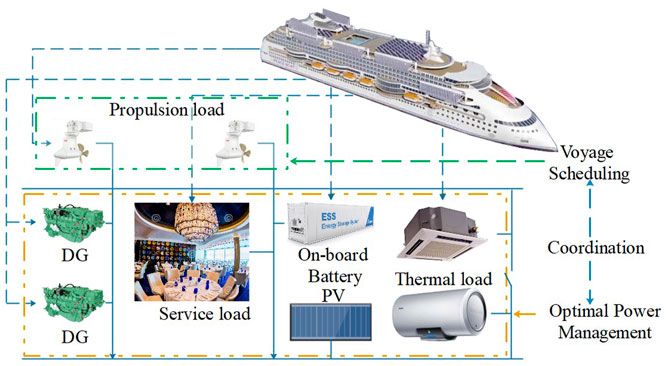
FIGURE 1. Configuration of an AES.
3.1 Power Generation
3.1.1 Diesel Generator
As the main power sources in a power system of AESs, diesel generators satisfy the load demand when the total power that is generated by both the renewable energy modules and the energy storage systems is insufficient. The fuel consumption of a diesel generator depends on the output power (Lin and Wang, 2019), as defined by Eq. 1.
Conventional reciprocating combustion engines, gas turbines, and boilers replace the traditional diesel generator. As either pure fuels or in fuel mixtures, LNG, biofuels, hydrogen, and ammonia have been widely piloted in commercial shipping as alternatives to conventional fuel oils.
3.1.2 Eco-Friendly Fuels
LNG was initially used as a fuel for steam engines, which are installed on large LNG carrier ships. Dual-fuel marine diesel generators use LNG as a secondary fuel (Tang et al., 2022). Alter-native fuels such as liquefied petroleum gas, methanol and ethanol have also been used as secondary fuels (Ali Shah et al., 2021). LNG emits around 12–20% less CO2 than traditional maritime fuel oils (Fernández et al., 2017; Balcombe et al., 2021; Jo et al., 2021). However, the required LNG storage infrastructure, operational risk and regulatory uncertainty have prevented the large-scale use of LNG-fueled ships (Qyyum et al., 2021). The commercial viability and market-acceptance significantly motivate the use of LNG-fueled ships due to their economic and environmental merits. LNG-fueled ships will play an essential role in a near-term transition toward zero-carbon shipping (Kumar et al., 2011; Thomson et al., 2015; IMO, 2016; Schinas and Butler, 2016; Xin et al., 2021).
A decarbonizing future will favor the use of other eco-friendly fueled ships, including methanol-fueled and biomass-fueled shipping (Imran et al., 2013; Balamurugan and Nalini, 2014; Ellis and Tanneberger, 2015; Svanberg et al., 2018). With the growth of the hydrogen economy on land, hydrogen-fueled shipping is expected to be important in the future (Gohary and Seddiek, 2013; Welaya et al., 2013; Pan et al., 2014).
3.1.3 New Energy Sources
Since fossil fuel reserves are limited and carbon emissions are becoming serious, the IMO and researchers are paying more attention to new energy applications, such as solar energy, wind energy, fuel cells, nuclear energy (Xu et al., 2020).
Solar energy is abundant, non-polluting and freely available. On a ship, sunlight is converted to electricity through the installed PV generation system. Limited by the energy density and relatively low energy conversion efficiency, PV generation systems in AESs have power levels from hundred Watts to several kilo Watts.
Solar power has a significant role in AES coordination because both navigation and power plans are influenced by the received solar irradiation. To estimate the magnitudes of these effects, a mathematical model for calculating the power output of an on-board PV generation system (Qiu et al., 2019) is presented, as follows.
Unlike a land-based PV system, an on-board PV generation system is influenced by both solar irradiance and the moving and rolling of the AES, increasing associated uncertainties. Therefore, solar energy is normally the main power source in small-scale ships, but an auxiliary power source in large-scale ships (Zapałowicz and Zeńczak, 2021). Table 1 presents relevant characteristics these two kinds of solar-powered ship.
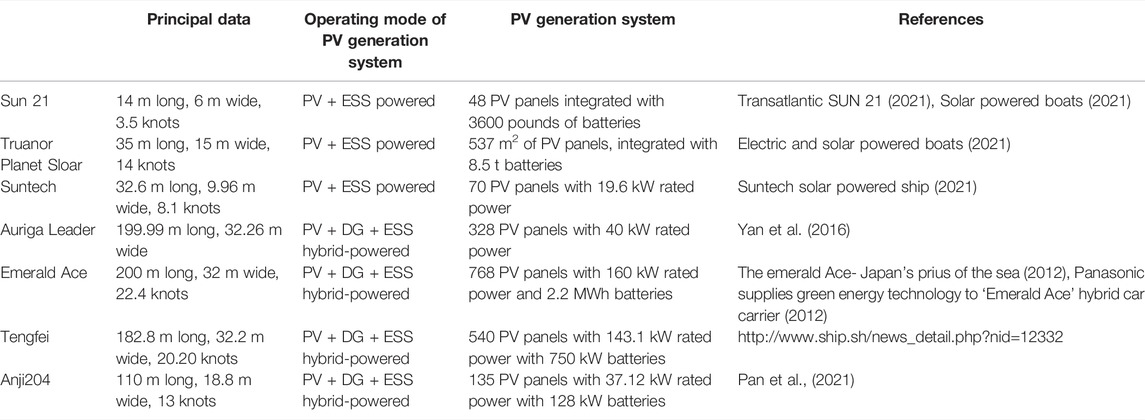
TABLE 1. Representative solar-powered ships.
The two main ways of using wind energy in today’s shipping industry are wind-assisted ship propulsion and wind power generation (Talluri et al., 2016). On-board wind power generation can produce electricity irrespective of the direction of the wind. A suitable wind turbine must be used in the ship’s power system. Even though horizontal-axis wind tur-bines can operate with higher efficiency and produce more power than vertical-axis wind turbines (Kramer and Steen, 2022), the latter are more suitable for use on AESs because of they are less complex, cheaper costs and more stable (Mphatso et al., 2021).
Wind-assisted ships are primarily powered by the main engine, assisted by sails that are controlled by computers on different principles on which regular sails are based. Numerical calculations and experiments have shown that 15–25% of the thrust force that is generated by a ship’s propeller can be replaced by wind-assisted ship propulsion, saving fuel and reducing emissions (Ballini et al., 2017; OECD and ITD, 2018; Tillig and Ringsberg, 2020; Nyanya et al., 2021).
Nuclear-powered marine propulsion has mainly been used for military vessels, such as submarines, aircraft carriers, and icebreakers (Khlopkin and Zotov, 1997). Only four nuclear-powered merchant ships have ever been built, but none of them has proved profitable owing to the large initial investment and operational costs (Freire and Andrade, 2015; Ortiz-Imedio et al., 2021). The advantages of nuclear-powered merchant ships include the lack of a need for frequent refuelling, their having more space for cargo than available in other merchant ships, their higher power and speed, and their lower air pollution and emission of GHG. However, safety is the biggest concern around the use of nuclear energy in AESs. Furthermore, the generation of radioactive nuclear waste and the need for refuelling are the main barriers their widespread use.
The fuel cell is another promising technology for use in AESs. The energy efficiency of fuel cell ships is typically between 40 and 60%; it can reach 85% if waste heat is captured in a cogeneration scheme (Tronstad et al., 2017).
3.2 Service Load
Unlike loads on land, the service loads of AESs vary with the navigation mode and exhibit clear seasonality. The service loads of AESs require less power than propulsion loads, and they are independent of frequency. Fluctuations of service loads are relatively slow, regardless of randomness and uncertainties.
The service loads in AESs always involve pump loads, deck machinery, auxiliary equipment, air conditioning and refrigerating equipment, fans, repair equipment, kitchen equipment, and lighting devices. Table 2 presents the typical service loads of an AES un-der sailing conditions (Fang et al., 2019a).

TABLE 2. Example service load in AES.
During ship sailing, the ship’s service load reaches its maximum peak at 12:00. At 23:00 the service load is the minimum. Within 24 h, due to the daily routine of personnel, the service load in the three periods of morning, noon, and evening is relatively high, and the service load in other periods is relatively low.
3.3 Propulsion Load
The sailing speed of an AES, as a mobile microgrid, can be changed by electric pro-pulsion motors. The relationship between propulsion load and ship speed is defined as follows (Kanellos, 2014).
According to Eq. 3, voyage optimization is critical to shipboard power management because the navigation of an AES can be optimized by adjusting the sailing speed, which corresponds to load demand.
3.4 Thermal Load
Unlike electric loads, onboard thermal loads support heating and cooling, with the conversion of power into heat.
The thermal system in an AES counteracts the exchange of heat with the outdoor ambient temperature to maintain a comfortable indoor temperature for passengers (Y. Chen et al., 2019). The temperature change that is associated with the heat variation is specified by Eq. 4.
Equation 4 represents the heat exchange of air and the hot water system, respectively. The left side of the function represents the energy required for temperature change per unit time, and the right side include three parts, the first part represents the power required by the heating component, and the second part represents the heat dissipation energy of the surrounding environment, the third part represents the water energy added by thermal boiler. From the equation, it can be seen that the energy demand of the thermal load varies with temperature. Through the coordination and cooperation between the thermal system and electric system, the comprehensive utilization of energy can also be improved.
An electric boiler is an on-board device that converts power into heat. Since various electric boilers operate similarly, an electric boiler can be modeled as a heat-generating device with a constant efficiency (Li and Xu, 2018), as presented in Eq. 5.
3.5 Energy Storage System
In order to maintain the power balance of multi-energy systems in AESs, ESSs are utilized to compensate for the power fluctuations that are caused by renewable sources and ship loads. ESSs provide operational benefits in terms of power quality and fuel cost (Posthumus et al., 1996; Monti et al., 2008). The charging/discharging behavior of on-board battery is given below (Wen et al., 2017; Lan et al., 2019).
As presented in Eq. 6, when the total power that is generated from DGs and the PV generation system exceeds the total load demand, the ESS is charged. Otherwise, the ESS discharges to provide needed power.
4 Key Technologies for Multi-Energy All-Electric Ships
The intermittent and uncertain nature of renewable energy generation raises crucial challenges in maintaining stable and sustainable operations. Irregular and stochastic waves make the outputs of a dynamic positioning system uncertain, increasing the difficulty and complexity of energy management in an AES over that in a terrestrial power system.
4.1 Optimal Energy Management
In the maritime industry, efficiency and emissions are becoming increasingly important issues (IMO-MEPC, 2009; MEPC-IMO, 2009; MEPC-IMO, 2011). Fuel consumption also becomes increasingly important as the penalization of emissions adds to ships’ operational costs. Accordingly, power management should be optimized in a manner that takes into account several factors, such as the operational restrictions that are imposed by each power source, operating and maintenance costs, safety constraints, and load demand (Li and Xu, 2018; Othman et al., 2018; Accetta and Pucci, 2019; Yin et al., 2019; Hasanvand et al., 2020; Hein et al., 2020; Yang et al., 2020; Rafiei et al., 2021; Yang et al., 2021).
Service loads mainly consist of power and thermal loads. Power loads come are associated with all of the appliances on-board and thermal loads are mainly associated with space heating in winter or cooling in summer (Li and Xu, 2018).
In this paper, the capacity of the electric propulsion system for the ship is 12 MW, and the capacity of the battery is 1 MW.
Case 1. A cost and emission study without any uncertain variables.
Case 2. A cost and emission study that considers only optimal power management.In Case 1, the operating conditions are constant in each hour and generation is scheduled without optimization. Consequently, the operating cost and air pollution of the AES microgrid are maximal, at $79,548 and 22,537 kg, respectively, which are unrealistic values in the real-world. Both fuel cost and emissions are lower in Case 2 than in Case 1. However, the total navigation time in the former case is 24 h and must be reduced. It can be proved by Figure 2.
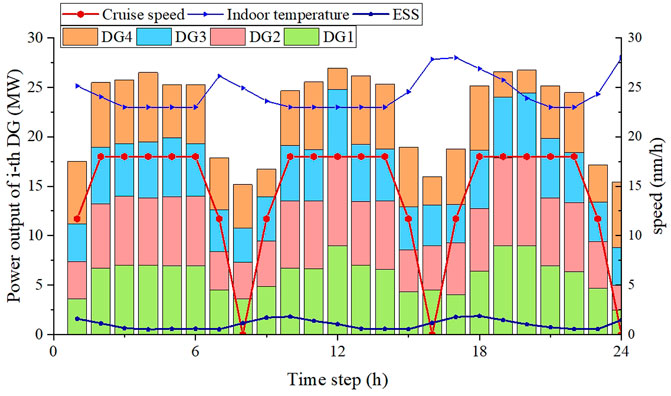
FIGURE 2. Optimal power management.
4.2 Voyage Scheduling
With respect to power consumption, the ship’s propulsion motors dominate the propulsion loads, which depend strongly on the ship’s speed (Kanellos et al., 2014; Sen and Padhy, 2015; Zaccone et al., 2018).
The main objective of voyage optimization is to reduce the total resistance of the ship, and thus to reduce operational cost during navigation (Fang et al., 2020). The basic variables are the ship’s specifications, sailing speed, and weather conditions. The main constraints are safety of handling, the time at ports and fuel consumption. The variables and constraints are all related to distance travelled, speed at time (Sen and Padhy, 2015; Fang et al., 2020; Wen et al., 2020).
Speed optimization refers to a specific route under the constraints of an uncertain service time and weather conditions (Li X. et al., 2018; Wang et al., 2018; Li X. et al., 2020). Ship routes and scheduling methods were initially used to shorten distances, optimize the time of navigation, improve safety, and reduce costs (Kontovas, 2014; Vettor and Soares, 2016).
A ship’s voyage consists of periods of cruising and berthing. During cruising periods, a ship operates at full speed. During berthing periods, a ship operates at zero speed (Kanellos et al., 2014; Kanellos et al., 2017). During other periods, the speed of the ship is between zero and full speed.
As shown in Figure 3, the speed of the ship is flexible but it must be kept between the upper and lower bounds for an efficient and safe voyage. The ship’s cruising distance is determined by the cruising speed for the corresponding duration. A punctual arrival requires that the ship reaches the vicinity of the relevant ports during the berthing periods (Fang et al., 2019b).
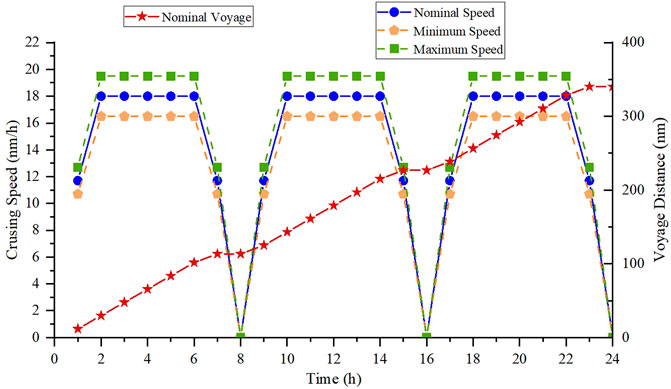
FIGURE 3. Ship voyage pattern.
Case 1.1. A cost and emission study without any uncertain variables.
Case 2.1. A cost and emission study that considers only voyage optimization.
Figure 4 reveals that the cruise ship can maximally exploit its electric propulsion motors by adjusting its sailing speed. In Case 2.1, the proposed method enables the AES to arrive at the final terminal 3 h earlier than that in Case 1.1 as a result of optimal voyage scheduling.
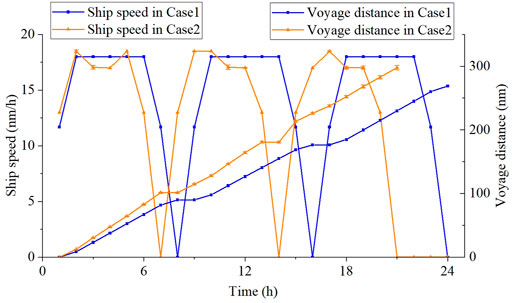
FIGURE 4. Voyage scheduling.
The ship speed after coordination optimization of power generation and voyage scheduling is the optimized speed during the all-electric ship navigation. The optimization research is conducted on the voyage of all-electric ships. By optimizing the voyage of all-electric ship during the voyage and indirectly adjusting the load demand of the electric propulsion system, the output power of the diesel engine power generation system can be indirectly optimized. Although the economic dispatch of all-electric ships is not considered in Case 2, the operating costs and pollution emissions of all-electric ships during sailing can still be reduced to a certain extent.
4.3 Coordination of Optimal Power Management and Voyage Scheduling
The cited works consider only optimal power management or voyage scheduling when the ship is cruising. However, a ship’s voyage can be scheduled simultaneously for an energy dispatch (Fang et al., 2019a). Under an obligation to arrive punctually, the cruising speed of a ship can be varied in a secure range. Since the ship speed is driven by the propulsion loads, the ship’s energy dispatch. A few investigations have addressed voyage scheduling (Kanellos, 2014; Kanellos et al., 2014; Shang et al., 2016a; Shang et al., 2016b; Kanellos et al., 2017; Bouaicha et al., 2018).
As proved by Figure 5, the potential of an electric propulsion system of an AES can be optimally realized by the coordination of optimal power management and voyage scheduling which minimize both the operational cost and emissions associated with the cruise.
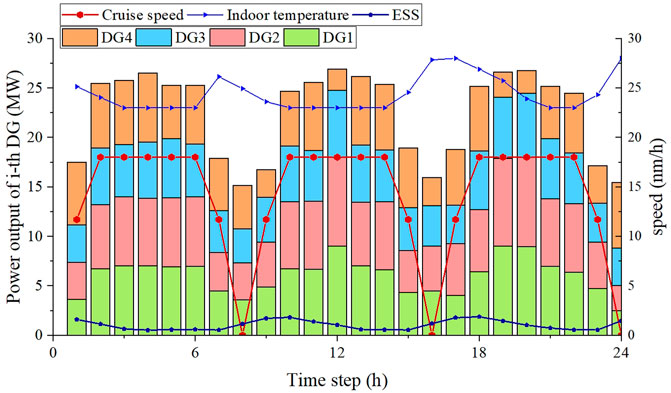
FIGURE 5. Hourly power output of coordinated optimal power management and voyage scheduling.
The ship with voyage scheduling can reach the final port in 1 h before it does so without voyage scheduling case, as displayed in Figure 6.

FIGURE 6. Hourly voyage outputs of coordination of optimal power management and voyage scheduling.
4.4 Multi-Energy All-Electric Ship Considering Uncertainty
In multi-energy AES energy systems, the solar irradiation that is received by an AES varies with the motion of the ship, resulting in dramatic power fluctuations. Furthermore, the stochastic nature of the wind increases the risk of unsafe sailing and late arrival. Not only does shipboard operating performance significantly affect the environment, but also the deployment of on-board solar energy raises a crucial challenge in the interaction be-tween the operation and the navigation of an AES. Therefore, coordinated optimal power management and voyage scheduling are necessary to improve the efficiency of operation of on-board sources, considering various uncertainties.
For the optimization of uncertainty, the three currently available methods are, interval optimization (Wen et al., 2016), robust optimization Li Z. et al., 2020) and probabilistic optimization (Huang et al., 2020).
Scenario 1: Multi-energy AES without any uncertain variables.
Scenario 2: Multi-energy AES considering uncertain irradiation.
Scenario 3: Multi-energy AES considering uncertain wind energy.
Scenario 4: Multi-energy AES considering uncertain ship rolling.
Scenario 5: Multi-energy AES considering combined uncertain factors.
Figure 7A-Hourly optimized outputs of DGs and on-board ESS under various uncertainties are proved by Figure 7. It can be observed from above that solar irradiance and ship rolling have a greater effect on the power outputs of DGs and the wind source has a greater effect on voyage optimization. Even though the uncertainties vary considerably among various time periods, the proposed method can ensure the stability of the operation of the AES, implying the robustness of the proposed algorithm. Among uncertain variables, ship rolling most strongly affects the power outputs since the motion of the ship has a deep influence on not only the on-board solar power but also the navigation of the ship.
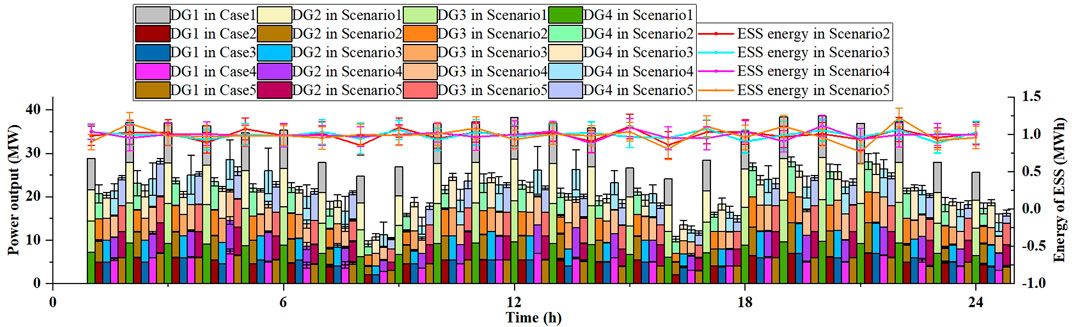
FIGURE 7. Hourly optimized outputs of DGs and on-board ESS under various uncertainties.
5 Prospects and Research Roadmap
5.1 Multi Microgrid Coordination Between Seaport and Ships
The seaport microgrid is a recently proposed concept in seaport management (Parise et al., 2014). Since the extensive electrification of maritime transportation, the logistics and electrical side of seaports and ships have been connected (Paul et al., 2014; Sciberras et al., 2015). A seaport and ships will jointly operate with respect to both logistics and electric in future maritime transportation management, exhibiting two operating patterns.
Berthed-in mode: AESs are berthed in the seaport and receive a cold-ironing power supply. In this mode, ships coordinate with the seaport. The seaport microgrid system has many sub-systems and each has a clear function; they include the renewable energy sub-system and the port crane sub-system (Kanellos et al., 2019), Research into distributed control frame-works should be carried out.
Berthed-out mode: AESs navigate on the sea, coordinating with the seaport under the punctuality requirement, given the selected navigation route. In this mode, more features of shipboard microgrids should be considered. Multi-functional and multi-timescale power management systems on shipboard microgrids power quality and power-sharing problems should be considered in the future.
Future seaport and shipboard energy management will need to consider more complicated variables or constraints than must be considered conventional land-based microgrids, to address the characteristics of maritime transportation, such as cruise speed constraints (Lindstad and Eskeland, 2015), voyage distance or arrival times of ships (Lanellos et al., 2014; Shang et al., 2016a), and berth position/time allocation by seaports (Imai et al., 2001; Bierwirth and Meisel, 2015; Lu, 2015).
5.2 Adaptive Energy Management Methods
In berthed-in mode, a seaport has two roles: it acts as the service provider for AESs, supplying power, loading and unloading. The seaport also acts as an interface between AESs and the main grid owing to the very high energy demand. To ensure economic and environmental operations, adaptive energy management methods are needed. Operation-al methods should consider various uncertainties and coordinate the operations of electrical and logistic sub-systems.
Seaport microgrids typically purchase electricity from the main grid. Both ships and seaports can change their schedules for economic benefit. For example, ships can choose an arrival time when the electricity price is low, and seaports can arrange berths to ships with larger cold-ironing power in the first place, potentially establishing a power market.
Numerous energy management methods for AESs in berthed-out mode are available (Goel et al., 2015; Lan et al., 2015; Wang et al., 2015; Lu et al., 2016; Wen et al., 2016; Yao et al., 2018; Wen et al., 2021). Adaptive energy management methods should consider cruising speed regulation, PV integration and other uncertainties. Two topics must also be considered with respect to AESs and seaports. First, the cruising vessels need to provide various services to tourists, so they have a higher service load than conventional ships. Managing service loads in berthed-in and berthed-out modes. Second, AESs, and seaports must exchange information, and exchanged information can directly influence subsequent actions.
The resilience and reconfiguration control of a shipboard microgrid is another important topic. Methods for predicting fault and take pre-fault actions become quite important. Advanced protection and fault recognition techniques should be considered in adaptive energy management methods of AESs and seaport microgrids.
Above all, Energy saving and emission reduction is the general trend of ship development, and the development of multi-energy microgrid in all-electric ships is a choice that conforms to the future development trend of ships. At present, the global research on multi-energy microgrid in all-electric ships is not perfect, and multi-energy ships have great development potential and development space.
The in depth planning of port ecologicalization is the basis for the development of green ecological ports. From planning, payout to construction, the concept of scientific development should be adhere to. In the process of ecological port construction, there is no reasonable planning for local natural and biological resources. Therefore, it is necessary to embody the concept of ecological environmental protection in the daily operation of the port and the construction of the ecological wharf. On the one hand, it can realize the mutual balance between the local ecosystem and the port resources, and on the other hand, it can achieve the standard of the port and ship polluting waste.
6 Conclusion
This paper presented an overview of multi-energy power systems in all-electric ships; it reviewed technological measures, operational measures, eco-friendly fuels, and alternative power sources. The potential of multi-energy systems in all electric ships, and the ad-vantages and challenges of various optimization methods were analyzed and some important conclusions are drawn.
1) Multi-energy systems in all-electric ships can effectively reduce their fuel consumption and emissions. Hybrid system modeling, parameter matching and energy management are essential.
2) Current renewable energy technologies can only meet part of the overall power demand of ships. Some applications show relatively high energy-saving potential under ideal conditions, but some technologies are very sensitive to various environmental factors, which generate uncertainties. Probabilistic optimization methods are used to optimize the operations of ships that are equipped with backup power systems such as renewable energy and energy storage systems.
3) A comprehensive literature revealed two main problems to be addressed by for future research, which are multi-microgrid coordination between seaport and ships, and adaptive energy management.
Data Availability Statement
The original contributions presented in the study are included in the article/Supplementary Material, further inquiries can be directed to the corresponding author.
Author Contributions
All authors contributed to this reviewing work. YQH performed the research and discussed the results. LXW proposed the mathematical model for ship loads. YWZ explored the optimization algorithm for energy management and voyage scheduling. LW and ZFZ suggested the research idea and contributed to the writing and revision of the paper. All authors approved the manuscript.
Conflict of Interest
The authors declare that the research was conducted in the absence of any commercial or financial relationships that could be construed as a potential conflict of interest.
Publisher’s Note
All claims expressed in this article are solely those of the authors and do not necessarily represent those of their affiliated organizations, or those of the publisher, the editors and the reviewers. Any product that may be evaluated in this article, or claim that may be made by its manufacturer, is not guaranteed or endorsed by the publisher.
References
Accetta, A., and Pucci, M. (2019). Energy Management System in DC Micro-grids of Smart Ships: Main Gen-Set Fuel Consumption Minimization and Fault Compensation. IEEE Trans. Ind. Applicat. 55, 3097–3113. doi:10.1109/TIA.2019.2896532
Ali Shah, S. F., Qyyum, M. A., Qadeer, K., and Lee, M. (2021). Sustainable Economic Growth and export Diversification Potential for Asian LNG-Exporting Countries: LNG-Petrochemical Nexus Development Using Product Space Model. Energy 236, 121334. doi:10.1016/j.energy.2021.121334
Apsley, J. M., Gonzalez-Villasenor, A., Barnes, M., Smith, A. C., Williamson, S., Schuddebeurs, J. D., et al. (2009). Propulsion Drive Models for Full Electric marine Propulsion Systems. IEEE Trans. Ind. Applicat. 45, 676–684. doi:10.1109/TIA.2009.2013569
Balamurugan, T., and Nalini, R. (2014). Experimental Investigation on Performance, Combustion and Emission Characteristics of Four Stroke Diesel Engine Using Diesel Blended with Alcohol as Fuel. Energy 78, 356–363. doi:10.1016/j.energy.2014.10.020
Balcombe, P., Staffell, I., Kerdan, I. G., Speirs, J. F., Brandon, N. P., and Hawkes, A. D. (2021). How Can LNG-Fuelled Ships Meet Decarbonisation Targets? an Environmental and Economic Analysis. Energy 227, 120462. doi:10.1016/j.energy.2021.120462
Ballini, F., Ölçer, A. I., Brandt, J., and Neumann, D. (2017). Health Costs and Economic Impact of Wind Assisted Ship Propulsion. Ocean Eng. 146, 477–485. doi:10.1016/j.oceaneng.2017.09.014
Bierwirth, C., and Meisel, F. (2015). A Follow-Up Survey of Berth Allocation and Quay crane Scheduling Problems in Container Terminals. Eur. J. Oper. Res. 244, 675–689. doi:10.1016/j.ejor.2014.12.030
Bouaicha, H., Nejim, S., and Dallagi, H. (2018). “Optimal Economic and Pollution-Constrained Management of a Hybrid DC Shipboard Power System,” in 2018 International Conference on Advanced Systems and Electric Technologies (IC_ASET), 435–440. doi:10.1109/ASET.2018.8379896
Chen, Y., Xu, Y., Li, Z., and Feng, X. (2019). Optimally Coordinated Dispatch of Combined‐heat‐and‐electrical Network with Demand Response. IET Generation, Transm. & Distribution 13, 2216–2225. doi:10.1049/iet-gtd.2018.6992
Man Diesel and Turbo (2021). Diesel Electric Propulsion Plants: a Brief Guideline How to Design a Diesel-Electric Propulsion Plant. Available online https:// marine. Mandieselturbo.com.
Doerry, N., Amy, J., and Krolick, C. (2015). History and the Status of Electric Ship Propulsion, Integrated Power Systems, and Future Trends in the U.S. Navy. Proc. IEEE 103, 2243–2251. doi:10.1109/JPROC.2015.2494159
Electric and solar powered boats (2021). Available: http://www.solarnavigator.net/solar_boats.htm (Accessed July 22, 2021).
Ellis, J., and Tanneberger, K. (2015). Study on the Use of Ethyl and Methyl Alcohol as Alternative Fuels in Shipping, Report Prepared for the European Maritime Safety Agency (EMSA).
Fang, S., Fang, Y., Wang, H., and Zhang, S. (2020). “Adaptive Voyage-Generation Scheduling in Shipboard Microgrid under Time-Varied Weather Conditions,” in 2020 IEEE/IAS 56th Industrial and Commercial Power Systems Technical Conference (I&CPS), 1–8. doi:10.1109/ICPS48389.2020.9176790
Fang, S., Xu, Y., and Li, Z. (2019b). “Joint Generation and Demand-Side Management for Shipboard Carbon Capture and Storage System,” in 2019 IEEE/IAS 55th Industrial and Commercial Power Systems Technical Conference (I&CPS), 1–8. doi:10.1109/ICPS.2019.8733353
Fang, S., Xu, Y., Li, Z., Zhao, T., and Wang, H. (2019a). Two-Step Multi-Objective Management of Hybrid Energy Storage System in All-Electric Ship Microgrids. IEEE Trans. Veh. Technol. 68, 3361–3373. doi:10.1109/TVT.2019.2898461
Fernández, I. A., Gómez, M. R., Gómez, J. R., and Insua, Á. B. (2017). Review of Propulsion Systems on LNG Carriers. Renew. Sust. Energ. Rev. 67, 1395–1411. doi:10.1016/j.rser.2016.09.095
Fiadomor, R. (2009). Assessment of Alternative Maritime Power (Cold-Ironing) and its Impact on Port Management and Operations. Ph.D. dissertation. Malmö, Sweden: Maritime Affairs Dept., World Maritime University.
Freire, L. O., and Andrade, D. A. d. (2015). Historic Survey on Nuclear Merchant Ships. Nucl. Eng. Des. 293, 176–186. doi:10.1016/j.nucengdes.2015.07.031
Geertsma, R. D., Negenborn, R. R., Visser, K., and Hopman, J. J. (2017). Design and Control of Hybrid Power and Propulsion Systems for Smart Ships: a Review of Developments. Appl. Energ. 194, 30–54. doi:10.1016/j.apenergy.2017.02.060
Goel, V., Slusky, M., van Hoeve, W.-J., Furman, K. C., and Shao, Y. (2015). Constraint Programming for LNG Ship Scheduling and Inventory Management. Eur. J. Oper. Res. 241, 662–673. doi:10.1016/j.ejor.2014.09.048
Gohary, M. M. E., and Seddiek, I. S. (2013). Utilization of Alternative marine Fuels for Gas Turbine Power Plant Onboard Ships. Int. J. Naval Architecture Ocean Eng. 5, 21–32. doi:10.2478/IJNAOE-2013-0115
Hasanvand, S., Rafiei, M., Gheisarnejad, M., and Khooban, M.-H. (2020). Reliable Power Scheduling of an Emission-free Ship: Multiobjective Deep Reinforcement Learning. IEEE Trans. Transp. Electrific. 6, 832–843. doi:10.1109/TTE.2020.2983247
Hein, K., Xu, Y., Wilson, G., and Gupta, A. K. (2020). "Condition-based Optimal Maintenance and Energy Management of All-Electric Ships," IECON 2020 The 46th Annual Conference of the IEEE Industrial Electronics Society, 3767–3772. doi:10.1109/IECON43393.2020.9254842
Huang, Y., Lan, H., Hong, Y.-Y., Wen, S., and Fang, S. (2020). Joint Voyage Scheduling and Economic Dispatch for All-Electric Ships with Virtual Energy Storage Systems. Energy 190, 116268. doi:10.1016/j.energy.2019.116268
Imai, A., Nishimura, E., and Papadimitriou, S. (2001). The Dynamic Berth Allocation Problem for a Container Port. Transportation Res. B: Methodological 35, 401–417. doi:10.1016/S0191-2615(99)00057-0
IMO (2016). Studies on the Feasibility and Use of LNG as a Fuel for Shipping. Technical report. London: International Maritime Organisa-tion.
IMO-MEPC (2009). Guidelines for Voluntary Use of the Ship Energy Efficiency Operational Indicator (EEOI). Tech. Rep. MEPC. 1, Circ.684.
Imran, A., Varman, M., Masjuki, H. H., and Kalam, M. A. (2013). Review on Alcohol Fumigation on Diesel Engine: a Viable Alternative Dual Fuel Technology for Satisfactory Engine Performance and Reduction of Environment Concerning Emission. Renew. Sust. Energ. Rev. 26, 739–751. doi:10.1016/j.rser.2013.05.070
Jo, Y., Shin, K., and Hwang, S. (2021). Development of Dynamic Simulation Model of LNG Tank and its Operational Strategy. Energy 223, 120060. doi:10.1016/j.energy.2021.120060
Kanellos, F. D., Anvari-Moghaddam, A., Guerrero, J. M., Chun-Lien, S., and Guerrero, J. M. (2017). A Cost-Effective and Emission-Aware Power Management System for Ships with Integrated Full Electric Propulsion. Electric Power Syst. Res. 150, 63–75. doi:10.1016/j.epsr.2017.05.003
Kanellos, F. D. (2014). Optimal Power Management with GHG Emissions Limitation in All-Electric Ship Power Systems Comprising Energy Storage Systems. IEEE Trans. Power Syst. 29, 330–339. doi:10.1109/TPWRS.2013.2280064
Kanellos, F. D., Volanis, E.-S. M., and Hatziargyriou, N. D. (2019). Power Management Method for Large Ports with Multi-Agent Systems. IEEE Trans. Smart Grid 10, 1259–1268. doi:10.1109/TSG.2017.2762001
Khlopkin, N. S., and Zotov, A. P. (1997). Merchant marine Nuclear-Powered Vessels. Nucl. Eng. Des. 173, 201–205. doi:10.1016/S0029-5493(97)00109-X
Kontovas, C. A. (2014). The green Ship Routing and Scheduling Problem (GSRSP): A Conceptual Approach. Transportation Res. D: Transport Environ. 31, 61–69. doi:10.1016/j.trd.2014.05.014
Kramer, J. V., and Steen, S. (2022). Simplified Test Program for Hydrodynamic CFD Simulations of Wind-Powered Cargo Ships. Ocean Eng. 244, 1–19. doi:10.1016/j.oceaneng.2021.110297
Kumar, S., Kwon, H.-T., Choi, K.-H., Lim, W., Cho, J. H., Tak, K., et al. (2011). LNG: An Eco-Friendly Cryogenic Fuel for Sustainable Development. Appl. Energ. 88, 4264–4273. doi:10.1016/j.apenergy.2011.06.035
Lan, H., Wen, S., Hong, Y.-Y., Yu, D. C., and Zhang, L. (2015). Optimal Sizing of Hybrid PV/diesel/battery in Ship Power System. Appl. Energ. 158, 26–34. doi:10.1016/j.apenergy.2015.08.031
Lan, H., Zhang, C., Hong, Y.-Y., He, Y., and Wen, S. (2019). Day-ahead Spatiotemporal Solar Irradiation Forecasting Using Frequency-Based Hybrid Principal Component Analysis and Neural Network. Appl. Energ. 247, 389–402. doi:10.1016/j.apenergy.2019.04.056
Li, F., Yuan, Y., Yan, X., Malekian, R., and Li, Z. (2018). A Study on a Numerical Simulation of the Leakage and Diffusion of Hydrogen in a Fuel Cell Ship. Renew. Sust. Energ. Rev. 97, 177–185. doi:10.1016/j.rser.2018.08.034
Li, X., Sun, B., Guo, C., Du, W., and Li, Y. (2020). Speed Optimization of a Container Ship on a Given Route Considering Voluntary Speed Loss and Emissions. Appl. Ocean Res. 94, 101995. doi:10.1016/j.apor.2019.101995
Li, X., Sun, B., Zhao, Q., Li, Y., Shen, Z., Du, W., et al. (2018). Model of Speed Optimization of Oil Tanker with Irregular Winds and Waves for Given Route. Ocean Eng. 164, 628–639. doi:10.1016/j.oceaneng.2018.07.009
Li, Z., Wu, L., and Xu, Y. (2021). Risk-Averse Coordinated Operation of a Multi-Energy Microgrid Considering Voltage/Var Control and Thermal Flow: An Adaptive Stochastic Approach. IEEE Trans. Smart Grid 12, 3914–3927. doi:10.1109/TSG.2021.3080312
Li, Z., Xu, Y., Fang, S., Zheng, X., and Feng, X. (2020). Robust Coordination of a Hybrid AC/DC Multi-Energy Ship Microgrid with Flexible Voyage and Thermal Loads. IEEE Trans. Smart Grid 11, 2782–2793. doi:10.1109/TSG.2020.2964831
Li, Z., and Xu, Y. (2018). Optimal Coordinated Energy Dispatch of a Multi-Energy Microgrid in Grid-Connected and Islanded Modes. Appl. Energ. 210, 974–986. doi:10.1016/j.apenergy.2017.08.197
Lin, J., and Wang, Z.-J. (2019). Multi-area Economic Dispatch Using an Improved Stochastic Fractal Search Algorithm. Energy 166, 47–58. doi:10.1016/j.energy.2018.10.065
Lindstad, H., and Eskeland, G. S. (2015). Low Carbon Maritime Transport: How Speed, Size and Slenderness Amounts to Substantial Capital Energy Substitution. Transportation Res. Part D: Transport Environ. 41, 244–256. doi:10.1016/j.trd.2015.10.006
MEPC-IMO (2009). Interim Guidelines on the Method of Calculation of the Energy Efficiency Design index for New Ships. Tech. Rep. MEPC. 1, Circ 681.
MEPC-IMO.(2011). Reduction of GHG Emissions from Ships- Marginal Abatement Costs and Cost-Effectiveness of Energy-Efficiency Measures. Tech. Rep. 61/inf. 18,
Monti, A., D'Arco, S., Gao, L., and Dougal, R. A. (2008). “Energy Storage Management as Key Issue in Control of Power Systems in Future All Electric Ships,” in 2008 International Symposium on Power Electronics, Electrical Drives, Automation and Motion, 580–585. doi:10.1109/speedham.2008.4581218
Nuchturee, C., Li, T., and Xia, H. (2020). Energy Efficiency of Integrated Electric Propulsion for Ships - A Review. Renew. Sust. Energ. Rev. 134, 1–25. doi:10.1016/j.rser.2020.110145
Nyanya, M. N., VuHu, H. B., Schönborn, A., and Ölçer, A. I. (2021). Wind and Solar Assisted Ship Propulsion Optimisation and its Application to a Bulk Carrier. Sustainable Energ. Tech. Assessments 47, 1–12. doi:10.1016/j.seta.2021.101397
OECD and ITD (2018), Decarbonising Maritime Transport: Pathways to Zero-Carbon Shipping by 2035. Case-specific Policy Analysis Reports by the International Transport Forum.
Ortiz-Imedio, R., Caglayan, D. G., Ortiz, A., Heinrichs, H., Robinius, M., Stolten, D., et al. (2021). Power-to-Ships: Future Electricity and Hydrogen Demands for Shipping on the Atlantic Coast of Europe in 2050. Energy 228, 120660. doi:10.1016/j.energy.2021.120660
Othman, M., Su, C.-L., Anvari-Moghaddam, A., Guerrero, J. M., Kifune, H., and Teng, J.-H. (2018). Scheduling of Power Generations for Energy Saving in Hybrid AC/DC Shipboard Microgrids. Proc. IEEE Ind. Appl. Soc. Annu. Meet. (Ias), 1–7. doi:10.1109/IAS.2018.8544723
Pan, H., Pournazeri, S., Princevac, M., Miller, J. W., Mahalingam, S., Khan, M. Y., et al. (2014). Effect of Hydrogen Addition on Criteria and Greenhouse Gas Emissions for a marine Diesel Engine. Int. J. Hydrogen Energ. 39, 11336–11345. doi:10.1016/j.ijhydene.2014.05.010
Pan, P. C., Sun, Y. W., Yuan, C. Q., Yan, X. P., and Tang, X. J. (2021). Research Progress on Ship Power Systems Integrated with New Energy Sources: A Review. Renew. Sust. Energ. Rev. 144, 111048. doi:10.1016/j.rser.2021.111048
Panasonic supplies green energy technology to ‘Emerald Ace’ hybrid car carrier (2012). Available: https://news.panasonic.com/global/topics/2012/9428.html.
Parise, G., Parise, L., Martirano, L., Chavdarian, P. B., Su, C.-L., and Ferrante, A. (2014). Wise Port & Business Energy Management: Portfacilities, Electrical Power Distribution. Proc. IEEE Ind. Appl. Soc. Annu. Meet., 1–6. doi:10.1109/IAS.2014.6978475
Paul, D., Peterson, K., and Chavdarian, P. R. (2014). Designing Cold Ironing Power Systems: Electrical Safety during Ship Berthing. IEEE Ind. Appl. Mag. 20, 24–32. doi:10.1109/MIAS.2013.2288393
Pope, K., Dincer, I., and Naterer, G. F. (2010). Energy and Exergy Efficiency Comparison of Horizontal and Vertical axis Wind Turbines. Renew. Energ. 35, 2102–2113. doi:10.1016/j.renene.2010.02.013
Posthumus, K. J. C. M., Schillemans, R. A. A., and Kluiters, E. C. (1996). Sodium-sulphur Batteries for Naval Applications. Proc. 11th Annu. Battery Conf. Appl. Adv., 301–306. doi:10.1109/BCAA.1996.485013
Qiu, Y., Yuan, C., Tang, J., and Tang, X. (2019). Techno-economic Analysis of PV Systems Integrated into Ship Power Grid: A Case Study. Energ. Convers. Manag. 198, 1–12. doi:10.1016/j.enconman.2019.111925
Qyyum, M. A., Ahmed, F., Nawaz, A., He, T., and Lee, M. (2021). Teaching-learning Self-Study Approach for Optimal Retrofitting of Dual Mixed Refrigerant LNG Process: Energy and Exergy Perspective. Appl. Energ. 298, 117187. doi:10.1016/j.apenergy.2021.117187
Rafiei, M., Boudjadar, J., and Khooban, M.-H. (2021). Energy Management of a Zero-Emission Ferry Boat with a Fuel-Cell-Based Hybrid Energy System: Feasibility Assessment. IEEE Trans. Ind. Electron. 68, 1739–1748. doi:10.1109/TIE.2020.2992005
Schinas, O., and Butler, M. (2016). Feasibility and Commercial Considerations of LNG-Fueled Ships. Ocean Eng. 122, 84–96. doi:10.1016/j.oceaneng.2016.04.031
Sciberras, E. A., Zahawi, B., and Atkinson, D. J. (2015). Electrical Characteristics of Cold Ironing Energy Supply for Berthed Ships. Transportation Res. Part D: Transport Environ. 39, 31–43. doi:10.1016/j.trd.2015.05.007
Sen, D., and Padhy, C. P. (2015). An Approach for Development of a Ship Routing Algorithm for Application in the North Indian Ocean Region. Appl. Ocean Res. 50, 173–191. doi:10.1016/j.apor.2015.01.019
Shang, C., Srinivasan, D., and Reindl, T. (2016a). Economic and Environmental Generation and Voyage Scheduling of All-Electric Ships. IEEE Trans. Power Syst. 31, 4087–4096. doi:10.1109/TPWRS.2015.2498972
Shang, C., Srinivasan, D., and Reindl, T. (2016b). “NSGA-II for Joint Generation and Voyage Scheduling of an All-Electric Ship,” in 2016 IEEE Congress on Evolutionary Computation (CEC), 5113–5119. doi:10.1109/CEC.2016.7748338
Skjong, E., Volden, R., Rodskar, E., Molinas, M., Johansen, T. A., and Cunningham, J. (2016). Past, Present, and Future Challenges of the Marine Vessel's Electrical Power System. IEEE Trans. Transp. Electrific. 2, 522–537. doi:10.1109/TTE.2016.2552720
Solar powered boats (2021). Available: http://www.daolar.com/ solar-energy/solar-powered-boats (Access July 22, 2021).
Sulligoi, G., Vicenzutti, A., and Menis, R. (2016). All-Electric Ship Design: From Electrical Propulsion to Integrated Electrical and Electronic Power Systems. IEEE Trans. Transp. Electrific. 2, 507–521. doi:10.1109/TTE.2016.2598078
Suntech solar powered ship (2021). Available: http://guangfu.bjx.com.cn/news/20130624/441632-6.shtml (Accessed July 22, 2021).
Svanberg, M., Ellis, J., Lundgren, J., and Landälv, I. (2018). Renewable Methanol as a Fuel for the Shipping Industry. Renew. Sust. Energ. Rev. 94, 1217–1228. doi:10.1016/j.rser.2018.06.058
Talluri, L., Nalianda, D. K., Kyprianidis, K. G., Nikolaidis, T., and Pilidis, P. (2016). Techno Economic and Environmental Assessment of Wind Assisted marine Propulsion Systems. Ocean Eng. 121, 301–311. doi:10.1016/j.oceaneng.2016.05.047
Tang, C., Hu, F., Zhou, X., and Li, Y. (2022). Optimization Methods for Flexibility and Stability Related to the Operation of LNG Receiving Terminals. Energy 250, 123620–123638. doi:10.1016/j.energy.2022.123620
The emerald Ace- Japan’s prius of the sea (2012). Available at: http://gizmodo.com/5921423/the-emerald-ace-japans-prius-of-the-sea
Thomson, H., Corbett, J. J., and Winebrake, J. J. (2015). Natural Gas as a marine Fuel. Energy Policy 87, 153–167. doi:10.1016/j.enpol.2015.08.027
Tillig, F., and Ringsberg, J. W. (2020). Design, Operation and Analysis of Wind-Assisted Cargo Ships. Ocean Eng. 211, 107603. doi:10.1016/j.oceaneng.2020.107603
Transatlantic SUN 21 (2021). Transatlantic Sun 21. Available: http://www.solarnavigator.net/transatlantic_21.htm/ (Access July 22, 2021).
Tronstad, T., Åstrand, H. H., Haugom, G. P., and Langfeldt, L. (2017). Study on the Use of Fuel Cells in Shipping. Report to European Mari-time Safety Agency by DNV GL.
Vettor, R., and Guedes Soares, C. (2016). Development of a Ship Weather Routing System. Ocean Eng. 123, 1–14. doi:10.1016/j.oceaneng.2016.06.035
Wang, K., Yan, X., Yuan, Y., Jiang, X., Lin, X., and Negenborn, R. R. (2018). Dynamic Optimization of Ship Energy Efficiency Considering Time-Varying Environmental Factors. Transportation Res. Part D: Transport Environ. 62, 685–698. doi:10.1016/j.trd.2018.04.005
Wang, S., Liu, Z., and Qu, X. (2015). Collaborative Mechanisms for Berth Allocation. Adv. Eng. Inform. 29, 332–338. doi:10.1016/j.aei.2014.12.003
Welaya, Y. M. A., Mosleh, M., and Ammar, N. R. (2013). Thermodynamic Analysis of a Combined Gas Turbine Power Plant with a Solid Oxide Fuel Cell for marine Applications. Int. J. Naval Architecture Ocean Eng. 5, 529–545. doi:10.2478/IJNAOE-2013-0151
Wen, S., Lan, H., Hong, Y.-Y., Yu, D. C., Zhang,, L., and Cheng, P. (2016). Allocation of ESS by Interval Optimization Method Considering Impact of Ship Swinging on Hybrid in PV/diesel Ship Power System. Appl. Energy 175, 158–167. doi:10.1016/j.apenergy.2016.05.003
Wen, S., Lan, H., Yu, D. C., Fu, Q., Hong, Y.-Y., Yu, L., et al. (2017). Optimal Sizing of Hybrid Energy Storage Sub-systems in PV/diesel Ship Power System Using Frequency Analysis. Energy 140, 198–208. doi:10.1016/j.energy.2017.08.065
Wen, S., Zhao, T., Tang, Y., Xu, Y., Fang, S., Zhu, M., et al. (2020). “Joint Energy Management and Voyage Scheduling for All-Electric Ships Using Dynamic Real-Time Electricity Price of Onshore Power,” in 2020 IEEE/IAS 56th Industrial and Commercial Power Systems Technical Conference (I&CPS), 1–8. doi:10.1109/ICPS48389.2020.9176793
Wen, S., Zhao, T., Tang, Y., Xu, Y., Zhu, M., Fang, S., et al. (2021). Coordinated Optimal Energy Management and Voyage Scheduling for All-Electric Ships Based on Predicted Shore-Side Electricity Price. IEEE Trans. Ind. Applicat. 57, 139–148. doi:10.1109/TIA.2020.3034290
Xin, Y., Zhang, Y., Xue, P., Wang, K., Adu, E., and Tontiwachwuthikul, P. (2021). The Optimization and Thermodynamic and Economic Estimation Analysis for CO2 Compression-Liquefaction Process of CCUS System Using LNG Cold Energy. Energy 236, 121376. doi:10.1016/j.energy.2021.121376
Xu, S., Gu, Z., Shen, W., Leiand, Q., and Tang, W. (2020). Experimental and Numerical Study on Ultimate Bearing Capacity of Pressure Cabin for Nuclear Power Ships. Ocean Eng. 218, 1–20. doi:10.1016/j.oceaneng.2020.108123
Yan, X. P., Sun, Y. W., and Yuan, C. Q. (2016). Review on the Application Progress of Solar Ship Technology. Ship Ocean Eng. 45, 50–54.
Yang, R., Jiang, L., Du, K., Zhang, Y., Wang, L., and Li, K. (2020). “Research and Experimentation on Energy Management System for Inland Diesel-Electric Hybrid Power Ships,” in 2020 IEEE 8th International Conference on Computer Science and Network Technology (ICCSNT), 102–106. doi:10.1109/ICCSNT50940.2020.9305003
Yang, R., Wei, H., and Wang, L. (2021). “Research on Energy Regulation and Optimal Operation Strategy of Multi-Energy Ship Power Station Based on Improved Particle Swarm Algorithm,” in IEEE 5th Advanced Information Technology, Electronic and Automation Control Conference (IAEAC), 294–298. doi:10.1109/IAEAC50856.2021.93906642021
Yao, C., Chen, M., and Hong, Y.-Y. (2018). Novel Adaptive Multi-Clustering Algorithm-Based Optimal ESS Sizing in Ship Power System Considering Uncertainty. IEEE Trans. Power Syst. 33, 307–316. doi:10.1109/TPWRS.2017.2695339
Yigit, K., and Acarkan, B. (2018). A New Electrical Energy Management Approach for Ships Using Mixed Energy Sources to Ensure Sustainable Port Cities. Sust. Cities Soc. 40, 126–135. doi:10.1016/j.scs.2018.04.004
Yin, Q., Li, M., Yuan, Y., Wu, P., Liu, G., and Bucknall, R. (2019). “The Design of Energy Efficiency Management System for an Electric Pro-pulsion Passenger Ship in Inland River,” in 2019 5th International Conference on Transportation Information and Safety (ICTIS), 1453–1462.
Yuan, Y., Wang, J., Yan, X., Li, Q., and Long, T. (2018). A Design and Experimental Investigation of a Large-Scale Solar Energy/diesel Generator Powered Hybrid Ship. Energy 165, 965–978. doi:10.1016/j.energy.2018.09.085
Zaccone, R., Ottaviani, E., Figari, M., and Altosole, M. (2018). Ship Voyage Optimization for Safe and Energy-Efficient Navigation: A Dynamic Programming Approach. Ocean Eng. 153, 215–224. doi:10.1016/j.oceaneng.2018.01.100
Zapałowicz, Z., and Zeńczak, W. (2021). The Possibilities to Improve Ship's Energy Efficiency through the Application of PV Installation Including Cooled Modules. Renew. Sust. Energ. Rev. 143, 1–16. doi:10.1016/j.rser.2021.110964
Zhen, L., Shen, T., Wang, S., and Yu, S. (2016). Models on Ship Scheduling in Transshipment Hubs with Considering bunker Cost. Int. J. Prod. Econ. 173, 111–121. doi:10.1016/j.ijpe.2015.12.008
Zhen, L. (2015). Tactical Berth Allocation under Uncertainty. Eur. J. Oper. Res. 247, 928–944. doi:10.1016/j.ejor.2015.05.079
Nomenclature
Acronyms
AES All Electric Ship;
DG Diesel Generator
EES Energy Storage System
GHG Greenhouse Gas Emission
LNG Liquefied Natural Gas
IMO International Maritime Organization
PV Photovoltaic
Indices
i Index of diesel generators.
t Index of voyage time periods.
Parameters
Sex External surface of the cruise
q Consumption flow of water
Variables
Ffuel Total fuel cost
Keywords: multi-energy all-electrics ships, seaport microgrid, green maritime transportation, optimal energy management, voyage scheduling
Citation: Huang Y, Wang L, Zhang Y, Wang L and Zhao Z (2022) An Overview of Multi-Energy Microgrid in All-Electric Ships. Front. Energy Res. 10:881548. doi: 10.3389/fenrg.2022.881548
Received: 22 February 2022; Accepted: 11 April 2022;
Published: 03 May 2022.
Edited by:
Tianyang Zhao, Jinan University, ChinaReviewed by:
Athanasios I. Papadopoulos, Centre for Research and Technology Hellas (CERTH), GreeceJinyu Wang, Xi’an Jiaotong University, China
Xiandong Xu, Tianjin University, China
Bin Gou, Southwest Jiaotong University, China
Copyright © 2022 Huang, Wang, Zhang, Wang and Zhao. This is an open-access article distributed under the terms of the Creative Commons Attribution License (CC BY). The use, distribution or reproduction in other forums is permitted, provided the original author(s) and the copyright owner(s) are credited and that the original publication in this journal is cited, in accordance with accepted academic practice. No use, distribution or reproduction is permitted which does not comply with these terms.
*Correspondence: Yuqing Huang, aHVhbmd5dXFpbmcyMDE3QDEyNi5jb20=