 Abdullah Al Mamun
 Naeem Hayat
 Muhammad Mohiuddin
 Anas A. Salameh
 Noor Raihani Zainol
- 1UKM-Graduate School of Business, Universiti Kebangsaan Malaysia, Bangi, Malaysia
- 2Global Entrepreneurship Research and Innovation Centre, Universiti Malaysia Kelantan, Kota Bharu, Malaysia
- 3Faculty of Business Administration, Laval University, Quebec, QC, Canada
- 4College of Business Administration, Prince Sattam Bin Abdulaziz University, Al-Kharj, Saudi Arabia
Energy conservation is a necessary form of green behaviour, as energy production and consumption gravely affect the climate. The current study aimed to explore energy conservation behaviour among Chinese households based on the value-belief-norm framework. This study used a cross-sectional design and collected quantitative data from 1671 respondents through an online survey. The hybrid analysis techniques of partial least squares structural equation modelling and artificial neural network analysis were used to analyse the data. Findings revealed that biospheric values have a positive and significant effect on pro-environmental beliefs, awareness of consequences, and ascription of responsibility, which ultimately explains 46.3% of the change in personal norms and 42.6% of the change in green trust. The results shed light on the significant positive impact of green trust and personal norms on the energy conservation intention. Green trust and personal norms can elucidate 27.3% of the change in energy conservation intention. The energy conservation intention (39.1%) explains the energy conservation behaviour. The results of ANN analysis revealed energy conservation intention, personal norms, green trust, and awareness of consequences as the four most significant contributors to the formation of energy conservation behaviour. The current study extended the VNB model with the green trust. It offered empirical evidence on the effects of pro-environmental belief, awareness of consequences, and ascription of responsibility concerning energy conservation intention. Energy policies should thus concentrate on addressing energy conservation behaviour, promoting energy-efficient household appliances, and rewarding energy conservation by lowering energy prices for low-energy users.
Introduction
The electricity consumption represents the country’s national development and prosperity. However, economic development has caused the most significant damage to the climate (Maichum, Parichantnon, & Peng, 2016). Elevated energy consumption also depicts the intensification of global climate issues and seriously causes environmental pollution through the production and distribution of electricity (Song, Bilsoborrow, Jagger, Zhang, Chen, & Huang, 2018). China is the world’s most populated nation, with about one-third of the population living in the urban area and enjoying civic utilities (Sheng, Cao, & Xue, 2018). A typical Chinese household’s annual energy consumption equals 1426 kg of coal-burning (China Electricity Council, 2021). The household per capita electricity consumption demand increased gradually from 115 kWh in 2000 to 722 kWh in 2018 (China Electricity Council, 2021). The energy consumption increased, and the household energy consumption’s carbon dioxide (CO2) emission amounted to 40% of the total CO2 emission in China (Mao, Qiu, Li, Tang, Deng, & Zheng, 2020). The energy consumption represents an improved lifestyle and higher dependence on the use of electronic utensils (Nie, Kemp, Xu, Vasseur, & Fan, 2018).
China’s electricity generation mainly relies on coal, forming 65% of the total energy supply, followed by a hydro-based power supply (China Electricity Council, 2021). The recent power outage in China impacted production and caused the shutdown of many production plants in the north-eastern provinces (Pak, 2021). Responsible energy consumption at the household and commercial levels is the key to addressing China’s rising demand (Ma, Wang & Li, 2020). Inclusive efforts are required to mitigate climate change and practice responsible citizenship behaviour (Liu, Zou, Wu, 2018). Responsible energy consumption is the need of the hour, and general households have to take charge and reduce their energy consumption practices. The growing population causes higher energy demand as households to use electricity to run equipment like television, refrigerator, air conditioning systems, and many more (Mao et al., 2020). United Nations (UN) developed sustainable development goals (SDGs) for 2030, which 189 UN member countries endorsed in 2016. As a responsible member of the UN and signatory of SDGs, China has taken proactive actions to mitigate climate issues and promoted energy conservation behaviour (Nie et al., 2018).
Energy conservation behaviour
Social and economic factors influence household energy consumption, and household composition plays a significant role in energy conservation behaviour (Nie et al., 2018). However, personal values and beliefs initiate the norms to mitigate climatic issues (Lopez-Mosquera & Sanchez, 2012). Energy conservation or reducing unnecessary energy usage prompts the personal belief system that protecting the environment is indispensable (Sheng et al., 2018).
The changing pattern of urbanization and lifestyle changes build households’ augmented need for electricity (Song et al., 2018). Energy consumption reflects the modern lifestyle and is associated with personal growth and affluence (Wolske, Stern, & Dietz, 2017). The affluent class has increased worldwide, and more people rely on electricity-based home devices (Nie et al., 2018). Household electricity demand rises as the middle- and upper-income groups prosper (Mao et al., 2020). The lavish lifestyle has instigated higher energy consumption, and personal norms and beliefs have become necessary to address the energy conservation behaviour issue.
Energy conservation is a personal decision rooted in personal ethics and beliefs, forming an individual’s behaviour (Yildirim & Semiz, 2019). Reducing energy consumption is a green behaviour, and educational, personal, and contextual factors contribute to the formation of pro-environmental behaviour (Kim & Seock, 2019). Individuals demonstrate varying green behaviours in public and private life (Hirstsuka, Perlaviciute, & Steg, 2018). In private life, individuals pay the cost of conservational behaviour (Li, Cheng, & Liu, 2019). However, in public, energy-conversion may not benefit those who exhibit conservational behaviour. The current study aimed to evaluate Chinese household energy conservation behaviour based on the value-belief-norm (VBN) model. The current study incorporated green trust as the novel influencing factor, persuading the intention to reduce electricity consumption and energy conservation behaviour. Responsible consumption of energy is a shared responsibility of the community. Personal inclinations toward the environment and trust in collective efforts for climate mitigating practices promote responsible energy consumption. Policymakers must exhibit that they are categorically inclined toward responsible energy use. Policymakers’ genuine efforts can harness responsible energy consumption and promote energy conservation.
Literature review
Theoretical foundation
Stren (2000) postulated that the VBN model builds on the norm activation model (NAM); the VBN model utilizes a variety of personal values that instigate environmentally friendly beliefs and behaviours. VBN causally elucidates personal environmental recognition grounded on personal values (Wensing, Carraresi, & Broring, 2019). Initiating personal and social norms allows the intention and actual green actions (Megeirhi, Woosnam, Riberio,Ramkissoon & Denley, 2020). Pro-environmental behaviours are the cogent activities that diminish the adverse effects of individual activities on the climate, minimize the use of resources, and decrease energy consumption wastage (Wondirad, 2019).
Values are domineering ideologies that lead one’s personal actions. Values promote diverse beliefs and act as a systematic controlling ground for one’s attitude and behaviour (Wensing et al., 2019). Biospheric values are the inner spirits that non-human organisms are necessary for the global climate (Yildirim & Semiz, 2019). The evolving climatic challenges are real and bring emergent climate shifts and harm living organisms, including humans, on Earth (Unal, Steg, & Garnskaya, 2019). Biospheric values instigate pro-environment beliefs, nurturing the realization that climate change requires changing individual behaviours towards climate and how humans should live (Zhang, Ruiz-Menjivar, Luo, Linag, & Swisher, 2020). Human actions affect the climate, and public awareness harnesses the belief to change the currently adopted practices to restore the climate (Lopez-Mosquera & Sanchez, 2012). The consciousness of consequences is the level of personal awareness of the cost of environmental threats (Riper & Kyle, 2014). A sense of responsibility emerges from the awareness to take necessary actions to mitigate the climate issues that help to achieve human wellbeing (Ramkissoon, 2020). Ascription of responsibility is one’s reaction to instigate climate action to protect the environment (Yidirim & Semiz, 2019).
Personal norms are linked to the essential sense of duty that nurtures the personal standards to change the currently adopted climate actions (Choi, Jang, & Kandampully, 2015). The interplay of cognitive, emotional, and social aspects instigates the commitment to behave more responsibly (Chen, Lin, & Weng, 2015). Prosocial emotions of guilt activate appropriate specific behaviours, causing harm to the climate in general public or private settings, and learning new prosocial behaviours to minimize the adverse impact on the environment (Dhir, Sadiq, Talwar, Sakashita, & Kuar, 2021).
Meanwhile, intention refers to the cognizance proposal to act within the individual settings, which significantly influences the actual behaviour to protect the climate or take corrective actions to reduce the environmental harm (Landon, Woosnam, & Boley, 2018). A green attitude instigates pro-climate behaviour, and individuals start engaging in such behaviour to reduce the climate impact (Sanchez, Lopez-Mosquera, & Lera-Lopez, 2015). The intention to conserve energy within one’s personal setting is an inherent impetus and activates one’s personal responsibility to conserve energy at a personal level (Gkargkavouzi, Halkos, & Matsiori, 2019).
Development of hypotheses
Development of pro-environmental belief
As previously discussed, biospheric values are part of one’s essential value system that directs personal importance and environmental actions (Gupta & Sharma, 2019). Biospheric values are built based on the notion that all other species on Earth are essential and vital parts of human life (Choi et al., 2015). Biospheric values foster a constructive view toward taking the necessary actions to protect the environment (Landon et al., 2018). López-Mosquera and Sánchez (2012) postulated that one’s biospheric values suggestively encourage pro-environmental belief. However, Liu et al. (2018) projected that biospheric values affect Chinese students’ pro-environmental belief in executing pro-environmental behaviour in public settings. The following hypothesis was proposed for testing:
H1: Biospheric values have a positive effect on pro-environmental belief.
Development of awareness of consequences
One’s actions always influence other individuals, cultures, humanity, and even the environment (Wensing et al., 2019; Ramkissoon, 2020). The underlying connection suggests that biospheric values affect the awareness of consequences—for instance, individual actions influence energy conservation practices (Liu et al., 2018). Individual biospheric values support the awareness of consequences instigated by individual actions (Kim & Seock, 2019). In one of the prior studies, which involved Japanese car consumers, biospheric values were found to influence awareness of consequences (Hiratsuka et al., 2018). In a more recent study, Yidirim and Semiz (2019) postulated that respondents’ biospheric values build awareness of the consequences of water conservation actions.
Individual eco-belief harnesses environmental-related beliefs (Wensing et al., 2019). pro-environmental belief instigates awareness of the consequences of the formation of green behaviour (Fornara et al., 2020). In a recent study, Gkargkavouzi et al. (2020) advocated the influence of pro-environmental beliefs on awareness of consequences among Europeans. Thus, the following hypothesis was proposed for testing:
H2: Biospheric values have a positive effect on awareness of consequences.
H3: Pro-environmental belief has a positive effect on awareness of consequences.
Development of ascription of responsibility
VBN model highlights the causal association between awareness of consequences and ascription of responsibility in the case of green behaviour (Lopez-Mosquera & Sanchez, 2012). Hiratsuka et al. (2018) examined and suggested the influence of biospheric values on the ascription of responsibility in using green cars among Japanese respondents. Focusing on visiting natural parks, Gkargkavouzi et al. (2019) suggested that Spanish respondents’ awareness of consequences affects the ascription of responsibility. In a recent study on environmental problems, Fornara et al. (2020) recognized the significant influence of awareness of consequences on the ascription of responsibility among European respondents. Therefore, the following hypothesis was suggested for testing:
H4: Biospheric values have a positive effect on the ascription of responsibility.
H5: Awareness of consequences positively affects the ascription of responsibility.
Development of personal norms
Personal beliefs are necessary to build personal norms (Liu et al., 2018). Beliefs are necessary antecedents for the emergence of personal norms, which are said to facilitate green attitudes and behaviour (Zhang et al., 2020). Gkargkavouzi et al. (2019) linked pro-environmental belief to personal norms of engaging in environmental problems. Zieske, Venhoeven, Steg, and van der Werff (2020) identified environmental values as an essential predictor of personal norms. Awareness of consequences acts as the belief of fear that necessary actions are required to address the issue and correct the currently adopted behaviour (Obeng & Aguliar, 2018). Gkargkavouzi et al. (2019) postulated that awareness of consequences harnesses personal norms to take care of the environment. Fornara et al. (2020) offered empirical evidence on the significant influence of awareness of consequences on personal norms. Kim and Seock (2019) postulated that the ascription of responsibility spurs personal norms among the residents in the United States.
Similarly, the VBN model projects that affect the ascription of responsibilities, advancing personal norms towards environmentally friendly behaviour (Landon et al., 2018). Furthermore, Zhang et al. (2020) report that the ascription of responsibility impacts the personal norms for assuming the environment mitigating farming practices among Chinese farmers. Therefore, we suggest the following:
H6: Pro-environmental belief has a positive effect on personal norms.
H7: Awareness of consequences has a positive effect on personal norms.
H8: Ascription of responsibility has a positive effect on personal norms.
Development of green trust
The number of consumers looking for eco-friendly products and services has recently increased (Ramkissoon, 2020). Consumers look for products and services that can minimize adverse impacts on the environment. Chen et al. (2015) posited that pro-environmental belief promotes green trust among Taiwanese consumers. Consumers build such belief that the use of specific products and services can reduce their impact on the climate (Yu-Shan, 2010). Pro-environmental belief nurtures people’s confidence that leads to green trust.
Awareness of the consequences of human actions on the climate comes from the knowledge and understanding that there is a need to correct human actions on the environment (Megeirhi et al., 2020). Environmental knowledge empowers consumers to understand the impact of human activities on the environment and build trust toward human actions and firms’ services (Yu-Shan, 2010; Ramkissoon, Smith and Weiler, 2013; Ramkissoon, Mavondo and Uysal, 2018; Elkhwesky, Salem, Varmus and Ramkissoon, 2022). Awareness and perception of duty are necessary conditions that instigate trust toward green practices (Chen et al., 2015). Alamsyah and Febriani (2020) predicted that green awareness harnesses GTT among organic vegetable consumers in Indonesia. In another recent study, Dhir et al. (2021) postulated that environmental knowledge influences green trust among green apparel consumers in Japan. With that, the following hypotheses were proposed for testing:
H9: Pro-environmental belief has a positive effect on green trust.
H10: Awareness of consequences has a positive effect on green trust.
H11: Ascription of responsibility has a positive effect on green trust.
Development of energy conservation intention (ECI)
With the development of the right personal norms, individuals would become more inclined towards green behaviour (Scanhez et al., 2015). Personal norms support the development of green behavioural intention (Choi et al., 2015). In one of the prior studies, Nordfaern and Zavareh (2017) posited personal norms’ significant and positive influence on behavioural intention. In a recent study, Zhang et al. (2020) described that Chinese agriculture professionals’ personal norms harness green agricultural practices. Meanwhile, Choi et al. (2015) provided evidence on how green trust suggestively predicts the intention to engage in eco-friendly hotel booking. The above-reported evidence prompted the testing of the following hypotheses in the current study:
H12: Personal norms have a positive effect on ECI.
H13: Green Trust has a positive effect on ECI.
Energy conservation behaviour
The intention is the antecedent of actual behaviour. According to Stren (2000), the intention to execute green behaviour positively triggers green behaviour. Gkargkavouzi et al. (2019) posited that behavioural intention significantly envisages voluntary actions to reduce the climatic impact among the Greek samples. Based on the notion that taking the responsibility of reducing unnecessary energy use at the household level instigates ECB at the household level, the current study proposed the following hypothesis:
H14: ECI has a positive effect on ECB.
All associations hypothesized in this study are presented in the Figure 1 below:
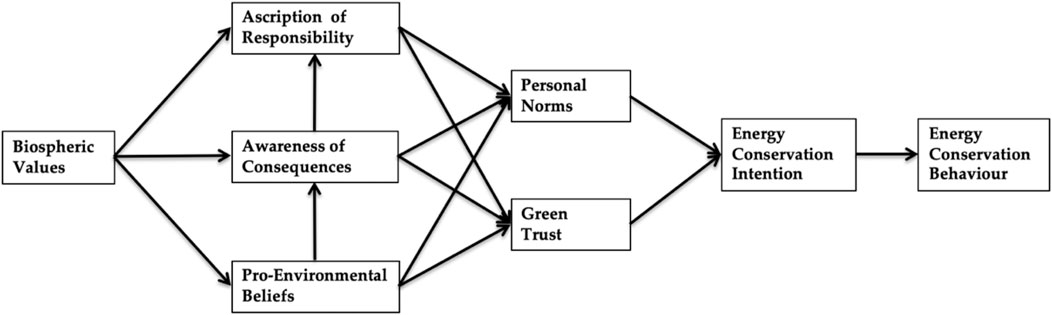
FIGURE 1. Research framework.
Methodology
The current study employed a quantitative-deductive design to assess the ECI and ECB among households in China based on the VBN theory (Hair, Risher, Sarstedt, & Ringle, 2019). This study focused on households in China as the target population. The required sample size for this study was evaluated using the G-Power 3.1, with a power of 0.95, an effect size of 0.15, and seven predictors. As a result, the minimum sample size required was 153 (Faul, Erdfelder, Lang, & Buchner, 2007). Meanwhile, it is suggested to achieve a sample size of 200 for PLS-SEM (Hair, Hult, Ringle, & Sarstedt, 2014). The study intended to employ the second-generation statistical analysis technique of partial least squares structural equation modelling and artificial neural network analysis, therefore collecting data from a total of 1671 respondents, which is much higher than the calculated and recommended sample size. The respondents were required to answer a few qualifying questions, including their consent to participate in the study. The online survey was performed by preparing a dual-language (Mandarin and English) questionnaire posted online (http://www.wjx.cn/) from March 2021 to April 2021.
Survey instrument
This study employed a structured questionnaire format. All measurement items were adopted from earlier studies, with minor modifications (Supplementary Appendix S1). In this study, a seven-point Likert scale was used to measure biospheric values, with the endpoints of “not important at all” 1) and “very important” (7), and another seven-point Likert scale was used to measure other constructs, with the endpoints of “strongly disagree” 1) and “strongly agree” (7).
Common method bias
The issue of common method bias (CMB) is associated with cross-sectional research. CMB can be calculated using multiple methodological and statistical tools (Podsakoff, Mackenzie, & Podsakoff, 2012). Harman’s one-factor test was employed as a diagnostic tool for this study to evaluate the effect of CMB. The single factor accounted for 40.69%, which is lower than the suggested limit of 50% for Harman’s one-factor test; thus, approving the insignificant effect of CMB on the current study’s constructs (Podsakoff et al., 2012). Another probing analysis suggested involves the evaluation of the latent factor correlation. Podsakoff et al. (2012) recommended that a latent factor correlation of less than 0.90 suggests no CMB issue in the model. For this study, the highest correlation between personal norms and ECB was recorded at 0.706, confirming that CMB is not a significant issue. Furthermore, referring to Kock’s (2015) recommendation, this study evaluated CMV to test the full collinearity of all constructs. All the constructs appeared to regress on the common variable. Referring to Table 1, the recorded variance inflation factor (VIF) values did not exceed 5, indicating the absence of bias from the single-source data.
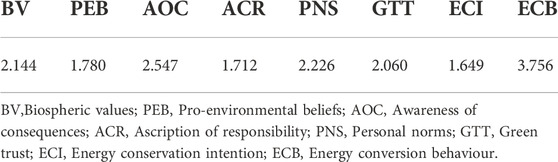
TABLE 1. Full collinearity test.
Multivariate normality
Hair et al. (2019) recommended evaluating the multivariate normality of the data prior to using the SmartPLS. The current study assessed multivariate normality using the WebPower online tool (Source: https://webpower.psychstat.org/wiki/tools/index). The calculated Mardia’s multivariate p-value indicated that the data had a non-normality issue, as the p-values were below 0.05 (Cain, Zhang, & Yuan, 2017).
Data analysis
Partial least squares structural equation modelling
Because of multivariate non-normality, this study employed the PLS-SEM as Hair et al. (2019) recommended. Smart-PLS 3.1 was employed to analyze the data. Accordingly, PLS-SEM is a multivariate exploratory method to analyze the path structure of integrated latent constructs (Hair et al., 2014). PLS-SEM is a casual-predictive statistical tool to accomplish complex models with composites and no specific assumption of goodness-of-fit static requirements (Hair et al., 2019). PLS-SEM in this study was performed in two stages. The first stage focused on the reliability and validity of the model’s constructs (Hair et al., 2014). In the second stage, the correlations and path model were evaluated (Henseler, Ringle, & Sarstedt, 2015). In particular, the values of r2, Q2, and f2 were obtained in this study to determine the change of endogenous construct due to the exogenous constructs (Hair et al., 2019). Meanwhile, multiple group analysis (MGA) confirms the existence of variances between the study sample based on the sample categorical variables (Hair et al., 2014). The differences in the groups’ path coefficients help estimate the differences between groups on the guidelines offered by Henseler, Ringle and Sinkovics (2009).
Artificial neural network analysis
Artificial neural network (ANN) analysis is a pseudo-diagnostic procedure or, in other words, a non-compensatory investigative technique based on the deep learning method with input, output, and hidden layers (Gbongali, Xu, & Amedjonekou, 2019). The input and output neurons are connected through the hidden layer. The hidden layer works the same way as the human brain’s block-box (Hayat, Al-Mamun, Nasir, Selvachandran, Nawi, & Gai, 2020). The causal layer attaches input neurons to the output neurons. The information is separated into three categories: training, testing, and hold out the sample. Accordingly, the predictive score is calculated by summing the training and testing data’s root mean square errors (RMSE) (Hayat et al., 2021). The more significant the difference in RSME scores between training and testing data, the higher the prediction accuracy (Gbongali et al., 2019).
The sum of square error (SSE) is estimated with the following formula.
The root means square error (RMSE) was estimated using the following formula as under:
Besides that, sensitivity analysis was performed for this study to evaluate the relative influence of each external factor. The influence of each exogenous variable on the endogenous structure is shown by the normalized relevance of each exogenous variable (Gbongali et al., 2019). Following that, average synaptic weights denote the contributions of input and hidden layers to the output layer (Hayat et al., 2020). Finally, this study applied the following equation to obtain the goodness-of-fit index:
Findings
Demographic details of the respondents are presented in Table 2 below:
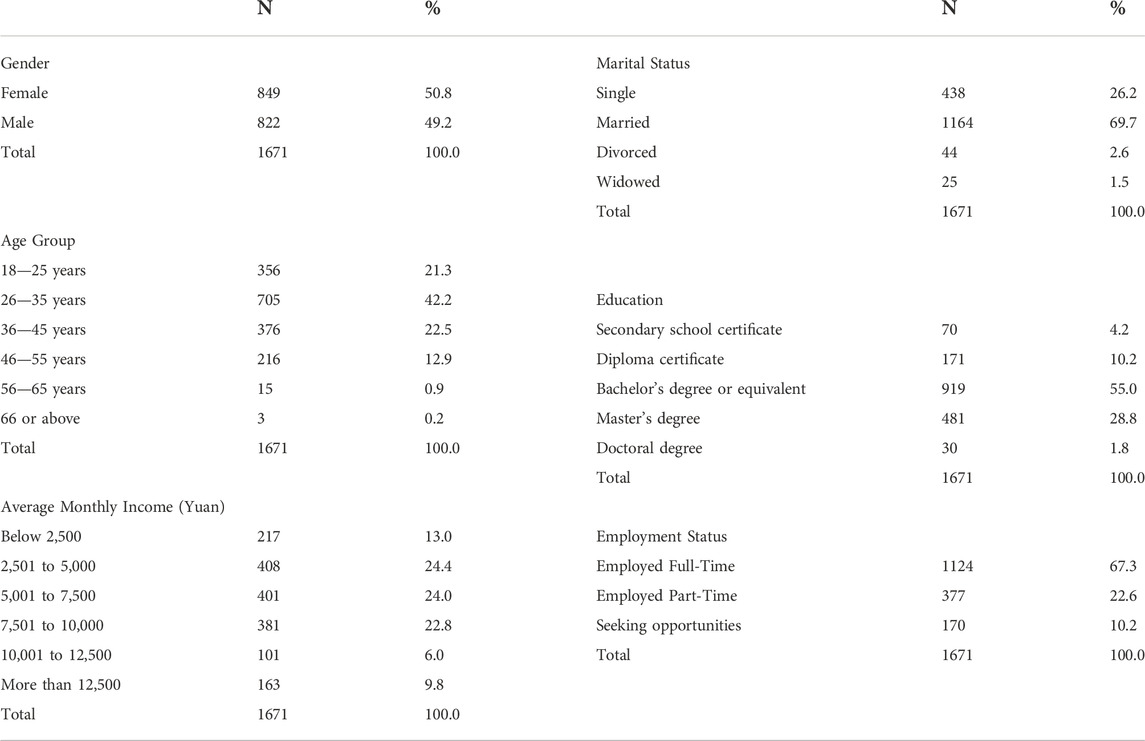
TABLE 2. Demographic characteristics.
Reliability and validity
Referring to the recommendations by Hair et al. (2019), the current study evaluated the reliability and validity of all constructs. The results in Table 3 revealed Cronbach’s alpha (CA) of more than a threshold value of 0.70 (Hair et al., 2014) for all constructs. The lowest value of Cronbach’s alpha was 0.878. Additionally, all values of Dijkstra-Hensele’s rho exceeded the threshold value of 0.70 (Hair et al., 2019) for all constructs. The lowest value of Dijkstra-Hensele’s rho was 0.880. Similarly, the recorded values of composite reliability (CR) were well beyond the threshold value of 0.70 (Hair et al., 2014), where the lowest CR value was 0.905. Based on the results of CA, Dijkstra-Hensele’s rho, and CR, the constructs were deemed reliable. Besides that, according to Hair et al. (2019), the average value extracted (AVE) for all items for each construct must exceed 0.50 to achieve the acceptable convergent validity for the uni-dimensionality notion for each construct. The obtained results in Table 3 demonstrated satisfactory convergent validity of these constructs. The value inflation factor (VIF) scores for all constructs did not exceed the benchmark value of 3.3 (Hair et al., 2014), revealing no multicollinearity issue.
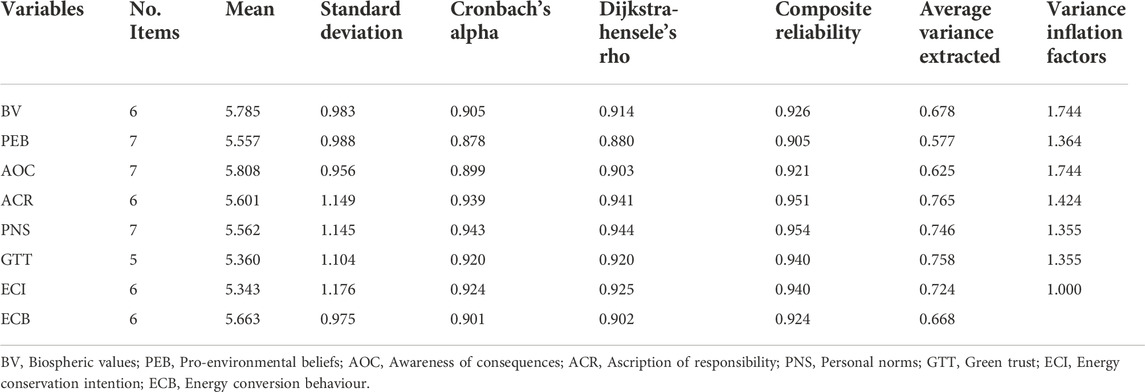
TABLE 3. Reliability and validity.
This study also reported item loadings (Table 4) and cross-loadings (provided in the Annexure) to confirm the discriminant validity of these constructs. Based on the results in Table 4, the study’s constructs demonstrated appropriate discriminant validity. Additionally, the Fornell-Larcker criterion (1981) was utilized in this study to evaluate the discriminant validity of each construct. Fornell-Larcker criterion estimated with the square root of a particular construct’s AVE. Referring to Hair et al. (2019), the square root of AVE for each construct exceeded the correlation of the constructs (Hair et al., 2019). The Heterotrait-Monotrait Ratio is below 0.9, confirming each construct’s discriminant validity (Hair et al., 2019).
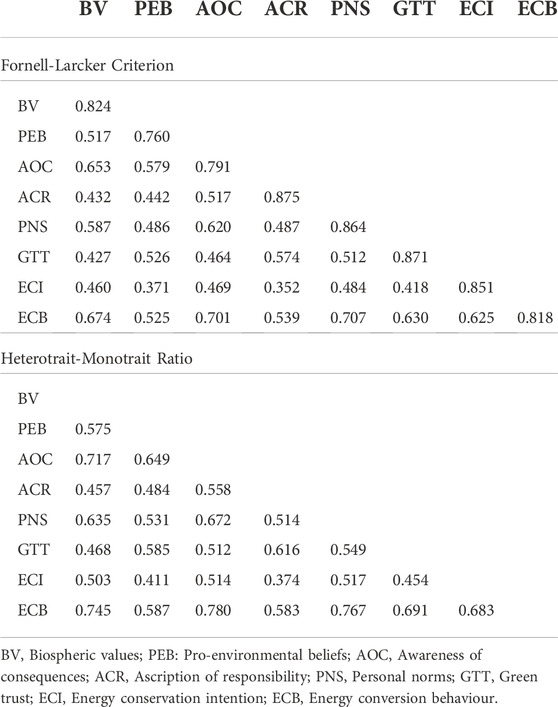
TABLE 4. Discriminant validity.
Path analysis
Based on the r2 value, biospheric values as an exogenous construct explained 26.7% of the change in the pro-environmental beliefs. The predictive relevance (Q2) value for this part of the model was 0.152, representing medium predictive relevance (Hair et al., 2014). Meanwhile, the r2 value for two exogenous constructs, namely biospheric values and pro-environmental beliefs, indicated that both constructs explained 50.6% of the change in awareness of consequences. The predictive relevance (Q2) value for this part of the model was 0.314, representing high predictive relevance (Hair et al., 2014). On the other hand, the r2 value for two exogenous constructs, namely biospheric values and awareness of consequences, revealed that both constructs explained 28.3% of the change in the ascription of responsibility. The predictive relevance (Q2) value for this part of the model was 0.212, indicating medium predictive relevance (Hair et al., 2014).
The r2 value for the three exogenous constructs, namely pro-environmental beliefs, awareness of consequences, and ascription of responsibility, indicated that these constructs explained 43.6% of the change in personal norms. The predictive relevance (Q2) value for this part of the model was 0.323, demonstrating high predictive relevance (Hair et al., 2014). The r2 value for three exogenous constructs, namely pro-environmental beliefs, awareness of consequences, and ascription of responsibility, revealed that these constructs explained 42.6% of the change in green trust. The predictive relevance (Q2) value for this part of the model was 0.321, signifying high predictive relevance (Hair et al., 2014). Meanwhile, the r2 value for two exogenous constructs, namely personal norms and green trust, implied that the constructs explained 27.3% of the change in ECI. The predictive relevance (Q2) value for this part of the model was 0.196, signifying medium predictive relevance (Hair et al., 2014). The r2 value for ECI as an exogenous construct ECB suggested that the construct accounted for 39.1% of the change in ECB. The predictive relevance (Q2) value for this part of the model was 0.259, representing medium predictive relevance (Hair et al., 2014).
Model standardized path values, t-values, and significance levels are presented in Table 5. Firstly, biospheric values were found to contribute positively and significantly affect pro-environmental beliefs, which provided adequate statistical support for H1. Secondly, biospheric values were also found to contribute a positive and significant effect on awareness of consequences, which provided adequate statistical support for H2. In addition, pro-environmental beliefs were found to positively and significantly affect awareness of consequences. With that, this study found adequate statistical evidence to accept H3. Besides that, the results also demonstrated the positive and significant effect of biospheric values on the ascription of responsibility. The obtained statistical evidence supported H4 in this study. Likewise, the results demonstrated the positive and significant effect of awareness of consequences on the ascription of responsibility R. In other words, H5 was supported.
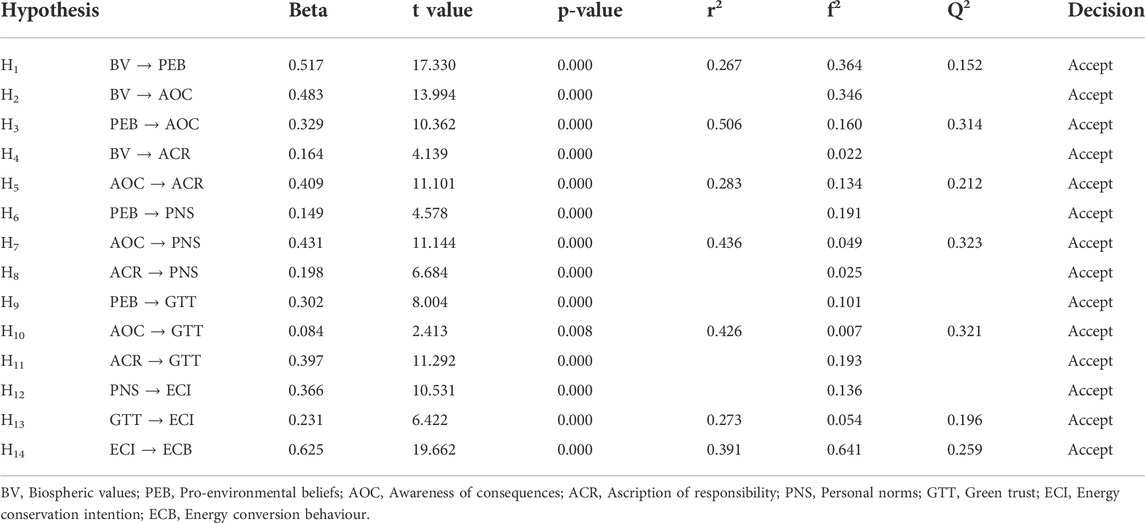
TABLE 5. Hypothesis testing.
The results also demonstrated the positive and significant effects of pro-environmental beliefs, awareness of consequences, and ascription of responsibility on personal norms. In other words, H6, H7, and H8 were supported. This study also proved the positive and significant effects of pro-environmental beliefs, awareness of consequences, and ascription of responsibility on green trust. Thus, H9, H10, and H11 were accepted. Besides that, the results revealed the positive and significant effects of personal norms and green trust on ECI. With that, H12 and H13 were supported. Last but not least, the results demonstrated the positive and significant effect of ECI on ECB (β = 0.625, t = 19.662, p = 0.000), which supported H14.
Multi-group analysis
The study assessed the measurement invariance using the measurement invariance of composite models (MICOM) procedure for two groups (Group 1. Bachelor’s degree or below, and Group 2. Master and Doctorate degree). The permutation p-values for all variables exceeded 0.05, which confirmed the partial measurement invariance. Therefore, the study was able to compare the path coefficients between two groups using PLS-MGA. The results (presented in Table 6) of two groups based on education revealed no significant differences in all associations hypothesized in this study.
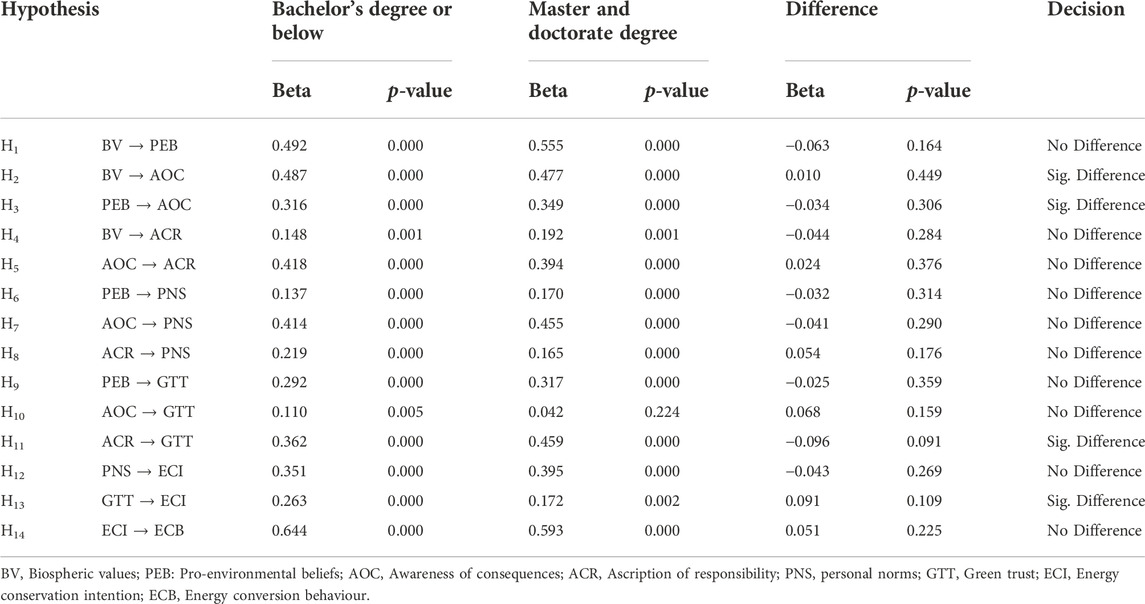
TABLE 6. Multi-group analysis—education.
Following that, this study assessed the measurement invariance between two groups using the MICOM procedure: 1) Group 1: 35 years and below; 2) Group 2: 36 years and above. The permutation p-values for all variables exceeded 0.05, which confirmed the partial measurement invariance. Therefore, the study was able to compare the path coefficients between two groups using PLS-MGA. The results (presented in Table 7) of the two groups based on age revealed no significant differences in all associations hypothesized in this study.
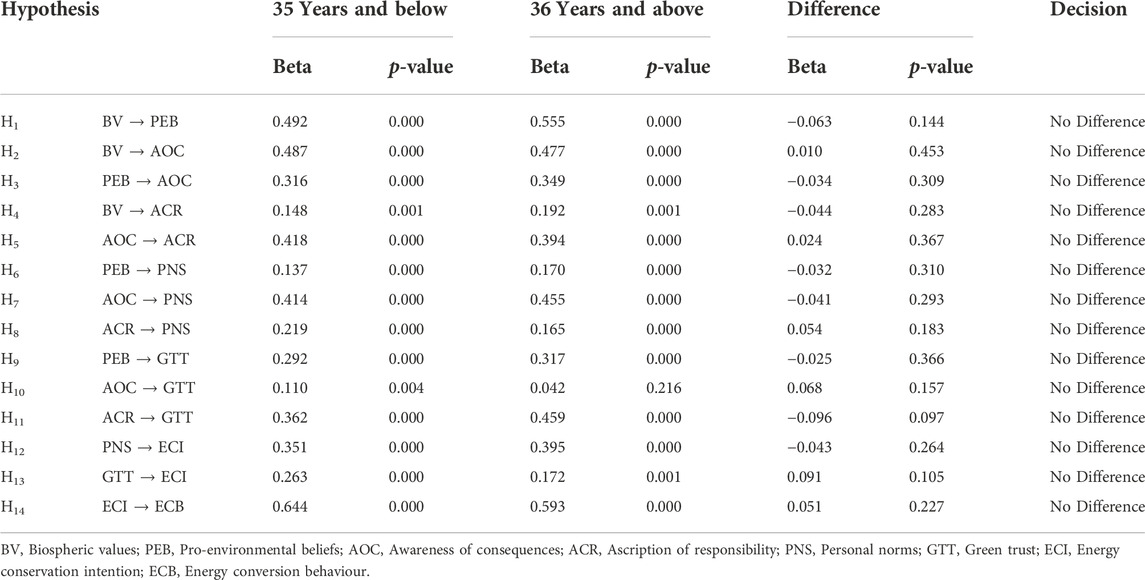
TABLE 7. Multi-group analysis—age.
Artificial neural network analysis
For the current study, multi-layer perception (MLP) ANN, consists of input, hidden, and output layers (Gbongali et al., 2019). The feed-forward-back propagation (FFBP) with MLP ANN was employed, and the ten-fold ANN model has opted for the SPSS neural network algorithm (Hayat et al., 2021). About 70% of the data served as training data, and 30% served as testing data. The model’s prediction accuracy was evaluated based on the obtained RMSE scores (Hayat et al., 2021). The results are presented in Table 8, which displayed high prediction accuracy, as the data’s RMSE scores for training and testing segments were close.
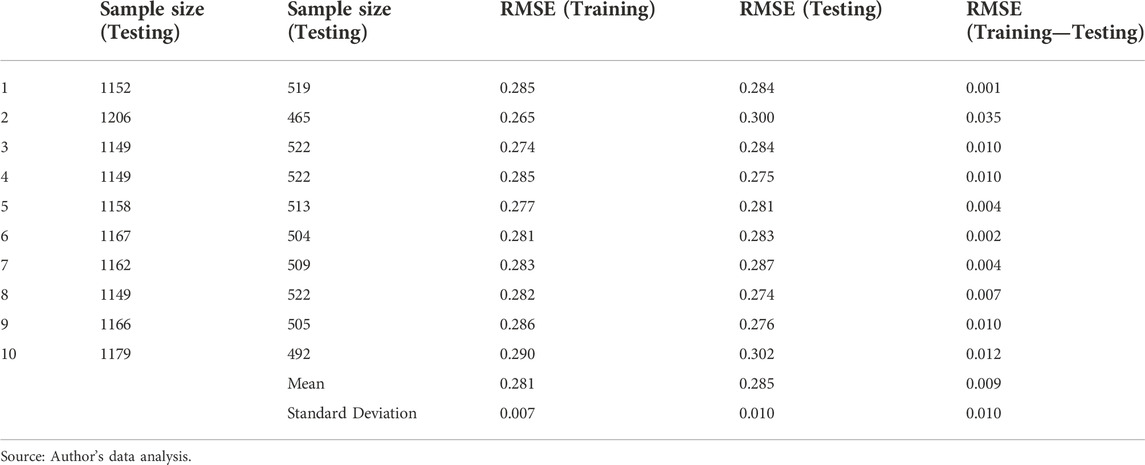
TABLE 8. RMSE values of Artificial Neural Networks (n = 1671).
The sensitivity analysis evaluated the effect of each input variable on ECB (Gbongali et al., 2019). Normalized importance scores for every input variable in this study were gauged with the percentage fraction of the relative importance of each input neuron divided by the highest relative importance (Hayat et al., 2021). The results in Table 9 showed energy conservation intention, personal norms, green trust, awareness of consequences, and biospheric values as the five most significant contributing factors to ECB.
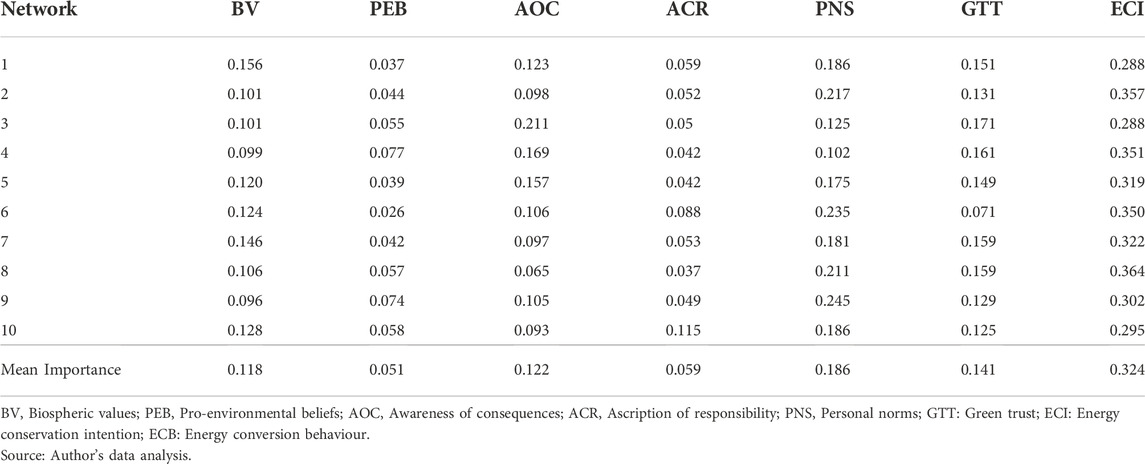
TABLE 9. Sensitivity analysis.
Discussion
The current study examined energy conservation behaviour among Chinese households based on the VBN model. The obtained results demonstrated the positive and significant effect of biospheric values on pro-environmental belief, which was in line with the findings reported by Liu et al. (2018) on how biospheric values build one’s realization of the importance of PEB and promote the necessary actions of protecting the environment and behaving pro-environmentally. Besides that, the obtained results suggested biospheric values’ positive and significant effect on awareness of consequences. Hiratsuka et al. (2018) described comparable findings on how Japanese consumers’ biospheric values instigate their awareness of the consequences of engaging in climate-friendly behaviour. The current study’s results also matched the conclusion shared by Wensing et al. (2018) on the influence of pro-environmental beliefs on awareness of consequences at the individual level. With respect to the VBN model, this study also demonstrated a positive and significant effect of awareness of consequences on the ascription of responsibility. Zhang et al. (2020) presented similar findings on how awareness of consequences harnesses energy conservation. Our study result coincides with the finding posted by Megeirhi et al. (2020) that the ascription of responsibility promotes individual sustainable behaviours.
Furthermore, the effects of pro-environmental belief, awareness of consequences, and ascription of responsibility on personal norms were hypothesized. The study found that the obtained results coincided with the findings reported by Gkargkavouzi et al. (2019) on the relationship between pro-environmental beliefs and personal norms. The current study also proved the positive and significant effect of awareness of consequences on personal norms, which supported the findings reported by Fornara et al. (2020) on how European consumers understand the cost of human activity on the climate. Additionally, these results showed the positive and significant effect of awareness of consequences on personal norms, which matched the findings reported by Zhang et al. (2020) that individuals exhibit green behaviour.
Moreover, the current study obtained empirical evidence of the positive and significant effect of pro-environmental belief on green trust for energy conservation. Chen et al. (2015) reported similar findings on how pro-environmental beliefs triggered green trust among Taiwanese samples. Next, the obtained results revealed that awareness of consequences significantly affected green trust among the respondents. This particular result appeared to be consistent with the findings reported by Dhir et al. (2021) that awareness of consequences instigates green trust to engage in green behaviour.
The study’s results confirmed the positive and significant effects of personal norms and green trust on energy conservation intention. These results coincided with the findings reported by Gkargkavouzi et al. (2019) on how personal norms facilitate the intention to engage in green behaviour and the findings reported by Choi et al. (2015) on the significance of green trust in forming the intention to engage in eco-friendly behaviour to book the green hotel.
Lastly, the energy conservation intention appeared to instigate energy conservation behaviour, as suggested by the current study’s results. The obtained results were found to be in line with the findings reported by Sanchez et al. (2015) on the influence of the intention to engage in pro-environmental behaviour on pro-conservational behaviour. The results of ANN analysis provided evidence on energy conservation intention, personal norms, and awareness of consequences as the three most significant factors contributing to energy conservation behaviour. These results were consistent with the results postulated by Zeiske et al. (2020) on environmental values and personal norms as significant predictors of energy conservation behaviour.
Conclusion
Overall, the current study empirically tested the extended VBN model in predicting energy conservation behaviour among Chinese households. The study’s findings suggested that biospheric values guide pro-environmental belief, awareness of consequences, and ascription of responsibility. Meanwhile, performing green behaviour requires collective action from all individuals to ensure the necessary care of minimizing adverse effects on the environment and mitigating climate challenges. Inclusive and collective actions can help reduce climate harm and restore the global climate to its pre-industry era.
Policy and managerial implications
This study contributed to the current literature on energy conservation in four ways. Firstly, most of the prior studies on energy conservation used the theory of planned behaviour (TPB) or the VBN model in its original form (Sanchez et al., 2015; Unal et al., 2019). The current study extended the VNB model by providing empirical evidence on the effects of pro-environmental belief, awareness of consequences, and ascription of responsibility in relation to the energy conservation intention. Green behaviour facilitated by personal norms and green trust can promote one’s personal inclination to mitigate climate challenges. Next, most of the prior studies debated the adoption of green behaviour in general, mainly within public settings. The current study explored energy conservation behaviour in private settings; an individual has to take full responsibility for the economic, social, and environmental costs of immoderate energy use (Han et al., 2016). From the stance of the VBN model, this study also significantly contributed to the current understanding of energy conservation behaviour within private settings.
Based on the current study’s findings, business managers need to learn that consumers are willing to engage in energy conservation behaviour. This study proved no significant differences in behaviour by age and gender. Equal efforts are required to instigate responsible energy consumption behaviour. Policymakers need to offer reduced pricing that nurtures responsible energy consumption. Furthermore, the government must promote energy conservation behaviour, including energy-efficient devices that use less energy.
Limitations
The current study encountered three significant limitations. Firstly, this study concentrated on energy conservation behaviour within personal settings, specifically among households in China. It is recommended for future research to incorporate a larger sample to explore energy conservation behaviour within personal and public settings. Furthermore, the samples must be taken from other geographic locations in order to compare the emergence of green behaviour in different geographic areas. Furthermore, the current study utilized the VBN model framework to explore energy conservation behaviour among households in China. The current study did not consider economic factors, such as the cost of electricity, the use of an eco-friendly electric instrument, and an eco-friendly attitude. It is recommended for future research to incorporate these aforementioned factors that nurture the intention and actual behaviour to reduce electricity consumption. Besides that, personality plays a vital role in resource conservation. Hence, it is recommended for future research to consider adopting personality traits to explore the effect of personality on energy conservation behaviour.
Data availability statement
The original contributions presented in the study are included in the article/Supplementary Material, further inquiries can be directed to the corresponding author.
Ethics statement
Ethical review and approval was not required for the study on human participants in accordance with the local legislation and institutional requirements. The patients/participants provided their written informed consent to participate in this study.
Author contributions
MM, NZ, and AS—Conceptualisation, Methodology, Data Collection, Writing—original Draft. AA and NH—Conceptualisation, Formal Analysis, Writing—Revision.
Conflict of interest
The authors declare that the research was conducted in the absence of any commercial or financial relationships that could be construed as a potential conflict of interest.
Publisher’s note
All claims expressed in this article are solely those of the authors and do not necessarily represent those of their affiliated organizations, or those of the publisher, the editors and the reviewers. Any product that may be evaluated in this article, or claim that may be made by its manufacturer, is not guaranteed or endorsed by the publisher.
Supplementary material
The Supplementary Material for this article can be found online at: https://www.frontiersin.org/articles/10.3389/fenrg.2022.954595/full#supplementary-material
References
Alamsyah, D., P., and Febrinai, R. (2020). Green customer behaviour: Impact of green brand awareness to green trust. J. Phys. Conf. Ser. 147, 072022. doi:10.1088/1742-6596-1477-7-072022
Cain, M. K., Zhang, Z., and Yuan, K.-H. (2017). Univariate and multivariate skewness and kurtosis for measuring non-normality: Prevalence, influence, and estimation. Behav. Res. Methods 49 (5), 1716–1735. doi:10.3758/s13428-016-0814-1
Chen, K., Lin, C-Y., and Weng, C-S. (2015). The influence of environmental friendliness on green trust: The mediation effects of green satisfaction and green perceived quality. Sustainability 7, 10135–10152. doi:10.3390/su70810135
China Electricity Council, (2021). China electricity Council. Available online: http://www.cec.org.cn/guihuayutongji/tongjxinxi/niandushuju/2020-01-21/197077.html. accessed on 21 August 2021.
Choi, H., Jang, J., and Kandampully, J. (2015). Application of the extended VBN theory to understand consumers' decisions about green hotels. Int. J. Hosp. Manag. 51, 87–95. doi:10.1016/j.ijhm.2015.08.004
Dhir, A., Sadiq, M., Talwar, S., Sakashita, M., and Kuar, P. (2021). Why do retail consumers buy green apparel? A knowledge-attitude-behaviour-context perspective. J. Retail. Consumer Serv. 59, 102398, 1–11. doi:10.1016/j.jretconser.2020.102398
Elkhwesky, Z., Salem, I., Varmus, M., and Ramkissoon, H. (2022). Sustainable practices in hospitality pre and amid COVID -19 pandemic: Looking back for moving forward post-COVID-19. Sustain. Dev. 30. doi:10.1002/sd.2304(Early View)
Faul, F., Erdfelder, E., Lang, A.-G., and Buchner, A. (2007). G*power 3: A flexible statistical power analysis program for the social, behavioral, and biomedical sciences. Behav. Res. Methods 39 (2), 175–191. doi:10.3758/bf03193146
Fornara, F., Molinario, E., Scopelliti, M., Bonnes, M., Bonaiuto, F., Cicero, L., et al. (2020). The extended value-belief-norm theory predicts committed action for nature and biodiversity in Europe. Environ. Impact Assess. Rev. 81, 106338. doi:10.1016/j.eiar.2019.106338
Fornell, C., and Larcker, D. F. (1981). Evaluating structural equation models with unobservable variables and measurement error. J. Mark. Res. 18 (1), 39–50. doi:10.2307/3151312
Gbongali, K., Xu, Y., and Amedjonekou, K., M. (2019). Extended technology acceptance model to predict mobile-based money acceptance and sustainability: A multi-analytical structural equation modeling and neural network approach. Sustainability 11, 3639. doi:10.3390/su11133639
Gkargkavouzi, A., Halkos, G., and Matsiori, S. (2019). Environmental behavior in a private-sphere context: Integrating theories of planned behavior and value belief norm, self-identity and habit. Resour. Conserv. Recycl. 148, 145–156. doi:10.1016/j.resconrec.2019.01.039
Gupta, A., and Sharma, R. (2019). Pro-environmental behaviour of adventure tourists: An application of value belief norm theory. Tourism 67 (3), 253–267.
Hair, J. F., Hult, G. T. M., Ringle, C. M., and Sarstedt, M. (2014). A primer on partial least squares structural equation modeling. Thousand Oaks, CA, USA: Sage.
Hair, J. F., Risher, J. J., Sarstedt, M., and Ringle, C. M. (2019). When to use and how to report the results of PLS-SEM. Eur. Bus. Rev. 31 (1), 2–24. doi:10.1108/ebr-11-2018-0203
Han, H., Hwang, J., and Lee, M. J. (2016). The value–belief–emotion–norm model: Investigating customers' eco-friendly behavior. J. Travel & Tour. Mark. 34 (5), 590–607. doi:10.1080/10548408.2016.1208790
Hayat, N., Al-Mamun, A., Nasir, N. A., Selvachandran, G., Nawi, N., and Gai, Q. S., (2020). Predicting sustainable farm performance-using hybrid structural equation modelling with an artificial neural network approach. Land 9, 289. doi:10.3390/land9090289
Hayat, N., Al-Mamun, A., Nasir, N., A., and Nawi, N., (2021). “Predicting accuracy comparison between structural equation modelling and neural network approach: A case of intention to adopt conservative agriculture,” in Importance of new technologies and entrepreneurship in the business context. (Berlin, Germany: Springer Nature International Publishing), 1958–1971. doi:10.1007/978-3-030-69221-6_141
Henseler, J., Ringle, C. M., and Sarstedt, M. (2015). A new criterion for assessing discriminant validity in variance-based structural equation modeling. J. Acad. Mark. Sci. 43 (1), 115–135. doi:10.1007/s11747-014-0403-8
Henseler, J., Ringle, C., Sinkovics, R., and Sinkovics, R. R. (2009). “The use of partial least squares path modelling in international marketing,”. 20, 277–320.Adv. Int. Mark.
Hirstsuka, J., Perlaviciute, G., and Steg, L. (2018). Testing VBN theory in Japan: Relationship between values, beliefs, norms and acceptability and expected effects of a car pricing policy. Transp. Res. Part F 53, 74–83.
Kim, S., H., and Seock, Y., K. (2019). The roles of values and social norm on personal norms and pro-environmentally friendly apparel product purchasing behavior: The mediating role of personal norms. J. Retail. Consumer Serv. 15, 83–90. doi:10.1016/j.jretconser.2019.05.023
Kock, N. (2015). Common method bias in PLS-SEM: A full collinearity assessment approach. Int. J. e-Collaboration 11, 1–10. doi:10.4018/ijec.2015100101
Landon, A., C., Woosnam, K., M., and Boley, B., (2018). Modeling the psychological antecedents to tourists’ pro-sustainable behaviors: An application of the value-belief-norm model. J. Sustain. Tour. 26 (6), 957–972. doi:10.1080/09669582.2017.1423320
Li, J., Chen, C., and Liu, H. (2019). Transition from non-commercial to commercial energy in rural China: Insights from the accessibility and affordability. Energy Policy 127, 392–403. doi:10.1016/j.enpol.2018.12.022
Liu, X., Zou, Y., and Wu, J. (2018). Factors influencing public-sphere pro-environmental behavior among Mongolian college students: A test of value-belief-norm theory. Sustainability 10, 1384. doi:10.3390/su10051384
López-Mosquera, N., and Sánchez, M. (2012). Theory of Planned Behavior and the Value-Belief-Norm Theory explaining willingness to pay for a suburban park. J. Environ. Manag. 113, 251–262. doi:10.1016/j.jenvman.2012.08.029
Ma, X., Wang, M., and Li, C. (2020). A summary on research of household energy consumption: A bibliometric analysis. Sustainability 12, 316. doi:10.3390/su12010316
Maichum, K., Parichatnon, S., and Peng, K. (2016). Application of the extended theory of planned behavior model to investigate purchase intention of green products among Thai consumers. Sustainability 8 (10), 1077. doi:10.3390/su8101077
Mao, S., Qiu, S., Li, T., Tang, M., Deng, H., and Zheng, H. (2020). Using characteristic energy to study rural ethnic minorities’ household energy consumption and its impact factors in chongqing, China. Sustainability 12, 6898. doi:10.3390/su12176898
Megeirhi, H., A., Woosnam, K., M., Riberio, M., A., Ramkissoon, H., and Denley, T., J. (2020). Employing a value-belief-norm framework to gauge Carthage residents' intentions to support sustainable cultural heritage tourism. J. Sustain. Tour. 28 (9), 1351–1370. doi:10.1080/09669582.2020.1738444
Nie, H., Kemp, R., Xu, J., Vasseur, V., and Fan, Y. (2018). Drivers of urban and rural residential energy consumption in China from the perspectives of climate and economic effects. J. Clean. Prod. 172, 2954–2963. doi:10.1016/j.jclepro.2017.11.117
Obeng, E. A., and Aguilar, F. X. (2018). Value orientation and payment for ecosystem services: Perceived detrimental consequences lead to willingness-to-pay for ecosystem services. J. Environ. Manag. 206, 458–471. doi:10.1016/j.jenvman.2017.10.059
Pak, J (2021). What-behind-chinas-power-cuts. https://www.marketplace.org/2021/10/05/whats-behind-chinas-power-cuts/. Received on 05 October 2021.
Podsakoff, P., M., Mackenzie, S., B., and Podsakoff, N., P. (2012). Sources of method bias in social science research and recommendations on how to control it. Annu. Rev. Psychol. 63 (1), 539–569. doi:10.1146/annurev-psych-120710-100452
Ramkissoon, H., Mavondo, F., and Uysal, M. (2018). Social involvement and park citizenship as moderators for quality-of-life in a national park. J. Sustain. Tour. 26 (3), 341–361. doi:10.1080/09669582.2017.1354866
Ramkissoon, H. (2020). COVID-19 place confinement, pro-social, pro-environmental behaviors, and residents' wellbeing: A new conceptual framework. Front. Psychol. 2248, 2248. doi:10.3389/fpsyg.2020.02248
Ramkissoon, H. (2020). Perceived social impacts of tourism and quality-of-life: A new conceptual model. J. Sustain. Tour., 1–17. doi:10.1080/09669582.2020.1858091
Ramkissoon, H., Smith, L. D. G., and Weiler, B. (2013). Testing the dimensionality of place attachment and its relationships with place satisfaction and pro-environmental behaviours: A structural equation modelling approach. Tour. Manag. 36, 552–566. doi:10.1016/j.tourman.2012.09.003
Riper, C., and Kyle, G. T. (2014). Understanding the internal processes of behavioral engagement in a national park: A latent variable path analysis of the value-belief-norm theory. J. Environ. Psychol. 38, 288–297. doi:10.1016/j.jenvp.2014.03.002
Sánchez, M., López-Mosquera, N., and Lera-López, F. (2015). Improving pro-environmental behaviors in Spain. The role of attitudes and socio-demographic and political factors. J. Environ. Policy & Plan. 18 (1), 47–66.
Sheng, C., Cao, Y., and Xue, B. (2018). Residential energy sustainability in China and Germany: The impact of national energy policy system. Sustainability 10, 4535. doi:10.3390/su10124535
Song, C., Bilsborrow, R., Jagger, P., Zhang, Q., Chen, X., and Huang, Q. (2018). Rural household energy use and its determinants in China: How important are influences of payment for ecosystem services vs. Other factors? Ecol. Econ. 145, 148–159. doi:10.1016/j.ecolecon.2017.08.028
Stern, P., C. (2000). New environmental theories: Toward a coherent theory of environmentally significant behavior. J. Soc. Issues 56, 407–424. doi:10.1111/0022-4537.00175
Ünal, A. B., Steg, L., and Granskaya, J. (2019). “To support or not to support, that is the question”. Testing the VBN theory in predicting support for car use reduction policies in Russia. Transp. Res. Part A Policy Pract. 119, 73–81. doi:10.1016/j.tra.2018.10.042
Wensing, J., Carraresi, L., and Broring, S. (2019). Do pro-environmental values, beliefs, and norms drive farmers' interest in novel practises fostering the bio-economy? J. Environ. Manage. 232, 858–867. doi:10.1016/j.jenvman.2018.11.114
Wolske, K., S., Stern, P., C., and Dietz, T. (2017). Explaining interest in adopting residential solar photovoltaic systems in the United States: Toward an integration of behavioral theories. Energy Res. Soc. Sci. 25, 134–151. doi:10.1016/j.erss.2016.12.023
Wondirad, A. (2019). Does ecotourism contribute to sustainable destination development, or is it just a marketing hoax? Analyzing twenty-five years contested journey of ecotourism through a meta-analysis of tourism journal publications. Asia Pac. J. Tour. Res. 24 (11), 1047–1065. doi:10.1080/10941665.2019.1665557
Yildirim, B., C., and Semiz, G., K. (2019). Future teachers' sustainable water consumption behavior: A test of the value-belief-norm theory. Sustainability 11, 1558. doi:10.3390/su11061558
Yu-Shan, C. (2010). The drivers of green brand equity: Green brand image, green satisfaction, and green trust. J. Bus. Ethics 93, 307–319. doi:10.1007/s10551-009-0223-9
Zeiske, N., Venhoeven, L., Steg, L., and van der Werff, E. (2020). The normative route to a sustainable future: Examining Children's environment values, identity and personal norms to conserve energy. Environ. Behav. 53, 1–22. doi:10.1177/0013916520950266
Zhang, L., Ruiz-Menjivar, J., Luo, B., Liang, Z., and Swisher, M., E. (2020). Predicting climate change mitigation and adaptation behaviors in agricultural production: A comparison of the theory of planned behavior and the value-belief-norm theory. J. Environ. Psychol. 68, 101408. doi:10.1016/j.jenvp.2020.101408
Keywords: energy conservation, value-belief-norm model, consumption behaviour, household energy consumption, China
Citation: Al Mamun A, Hayat N, Mohiuddin M, Salameh AA and Zainol NR (2022) Modelling the energy conservation behaviour among Chinese households under the premises of value-belief-norm theory. Front. Energy Res. 10:954595. doi: 10.3389/fenrg.2022.954595
Received: 27 May 2022; Accepted: 09 November 2022;
Published: 22 November 2022.
Edited by:
Siamak Hoseinzadeh, Sapienza University of Rome, ItalyReviewed by:
Haywantee Ramkissoon, University of Derby, United KingdomAbolfazl Ahmadi, Power & Water University Technology, Iran
Copyright © 2022 Al Mamun, Hayat, Mohiuddin, Salameh and Zainol. This is an open-access article distributed under the terms of the Creative Commons Attribution License (CC BY). The use, distribution or reproduction in other forums is permitted, provided the original author(s) and the copyright owner(s) are credited and that the original publication in this journal is cited, in accordance with accepted academic practice. No use, distribution or reproduction is permitted which does not comply with these terms.
*Correspondence: Abdullah Al Mamun, bWFtdW43NzkzQGdtYWlsLmNvbQ==, YWxtYW11bkB1a20uZWR1Lm15