 Xianfei Yang
 Xiang Yu1*
- 1School of Electronics and Information Engineering, Taizhou University, Taizhou, China
- 2School of Art and Design, Taizhou University, Taizhou, China
Power Internet of Things (PIoT) is the key technology to build a new power system based on new energy. Focusing on the problem that the large amount of data leads to the long computation delay of cloud computing in the operation control process of PIoT including renewable energy sources, this paper establishes a cloud-edge-end collaborative optimization calculation model for PIoT based on edge computation. Combined with data collected by a variety of smart terminal devices (STDs) arranged around the power generation equipment, the edge computation framework of PIoT is analyzed, and a computing task allocation model based on minimizing average system latency is established. The corresponding simulation model is built for simulation verification. Compared with other baseline schemes, it has been demonstrated that the average system latency of all tasks can be significantly decreased by using the proposed optimization scheme.
1 Introduction
In order to reach the goal of achieving carbon peak by 2030 and carbon neutrality by 2060, the construction of new power systems with new energy sources as the main body continues to advance in china (Xu et al., 2021). Due to the limited distribution of traditional fossil fuels in China, renewable energy sources such as wind power and photovoltaic power generation will gradually become the main form of energy in the future power system (Xu et al., 2022). By 2020, the installed capacity of wind power and photovoltaic power has exceeded 24.3% of the total installed capacity of power generation, and the installed capacity of grid-connected renewable energy power generation has maintained rapid growth in China. The high proportion of distributed renewable energy connected to grid significantly affects the operation mode of the power grid. Because the operation state of the distribution network is complex and changeable and the control objects are diverse, higher requirements are put forward for the measurement and control level of the power system.
A high proportion of renewable energy is a key feature of future energy systems (Xu, 2019). PIoT provides an effective solution for the efficient operation of distribution networks with renewable energy. PIoT fully applies advanced information and communication technologies such as artificial intelligence and 5G to realize real-time connection between devices in the power system, so that the system state of each link of power production, transmission, and consumption can be fully perceived and controlled. Specifically, affected by natural conditions, renewable energy generation has the characteristics of intermittence and volatility. With the continuous operation of renewable energy generation grids, the energy storage capacity of lithium-ion batteries will also continue to decrease. Using a large number of STDs arranged around the power generation equipment to collect data and calculate, the output power of renewable energy generation equipment in the future can be predicted and the health status of lithium-ion batteries can be estimated, which can control the efficient and stable operation of the power grid (Huang and Wei, 2020; Zhang et al., 2020; Qin et al., 2023). PIoT connects power grid enterprises, power generation enterprises, power users, suppliers, and their equipment to achieve data sharing and ensure the intelligent management of the power grid without increasing the complexity of the physical connection structure of the power grid.
With the continuous construction of PIoT, the number of STDs has exploded, resulting in a huge amount of STDs’ data that need to be stored, processed, and analyzed. The traditional data processing method is used to transmit the data to the remote cloud center server (RCCS) with strong computing power for calculation. However, due to the heterogeneous and large number of STDs in the PIoT environment, the unified upload of computing tasks to the RCCS will cause network congestion, and the RCCS is arranged at the remote end of STDs. The transmission delay generated by the STD uploading data will greatly increase the completion time of the overall task, thus affecting the real-time performance of the computing task. As an extension and supplement of cloud computing, edge computation solves this problem well. Edge computation technology enables many computing tasks to be completed by local devices without being handed over to the RCCS. The task processing is completed at the edge node close to STDs, and the edge server (ES) can respond to the STD’s requests and tasks in a shorter time. However, ESs typically offer fewer computing and storage resources than RCCS. If STDs have many computing tasks, they cannot execute all of them simultaneously. Therefore, the edge computation research has focused on computing task allocation (Bi et al., 2020; Pham et al., 2020; Song et al., 2020; Wei et al., 2020; Zhu and Zhou, 2021).
Generally, a computing task allocation scheme comprises of two parts: offloading decision and resource allocation decision (Chen et al., 2022a; Chen et al., 2022b; Deng et al., 2022; Fang et al., 2022; Wang et al., 2022; Yue et al., 2022; Zhou et al., 2022; Zhou and Zhang, 2022). The former serves to determine which tasks should be performed on ESs or RCCS. The latter specifies the amount of computing and storage resources allocated to each STD by ESs or RCCS. By caching applications and their associated databases on ESs, ESs can perform tasks that require these applications, which is called service cache (Xu et al., 2018). Nowadays, in most computation offloading schemes, all services required by STDs’ computing tasks have been cached by ESs. The RCCS can cache all types of services because of its massive storage capacity. However, due to its limited storage resources, there are only a few services that an ES can cache. Accordingly, a joint optimization scheme for service cache updating and computing task allocation (JOSSCUCTA) for PIoT including renewable energy sources was proposed. The contribution of this article mainly included the following three parts:
• JOSSCUCTA was proposed and established as a mathematical model of mixed-integer non-linear programming (MINLP).
• JOSSCUCTA was solved using the optimal method of outer approximation (OA).
• Comparing JOSSCUCTA with other schemes of computing task allocation, simulation results showed that it reduces average system latency of all STDs’ computing tasks.
The remainder of this paper is organized as follows: a review on related work on computing task allocation is provided in Section 2. A cloud-edge-end collaboration edge computation network framework is proposed and JOSSCUCTA is proposed and established as an MINLP problem in Section 3. Section 4 provides a solution to the MINLP problem using the OA method. In Section 5, simulation results are analyzed, and conclusion is reported in Section 6 .
2 Related work
Based on optimization objectives, computing task allocation schemes can be categorized into four types: schemes with minimum delay, with minimum consumption of energy, with minimum trade-off between delay and consumption of energy, and with optimization of other performance indicators. Liu et al. (2016) adopted the Markov decision process to establish the computing task allocation scheme optimization model with minimum delay under the power constraint of terminal equipment. Based on experimental results, the scheme greatly reduced computing delay compared to the local computing and cloud computation schemes. Similarly, to obtain a computing task allocation scheme with the shortest latency in an ultra-dense network under the power constraints of terminal equipment, Chen and Hao (2018) demonstrated the computing task allocation problem as an MINLP problem using software-defined networking. According to experimental results, the method can reduce delay by 20% compared with baseline schemes. Xing et al. (2018) introduced a time-division multiple-access communication protocol under the scenario that each STD has several computing tasks. These tasks can be offloaded simultaneously to many ESs and can be completed in parallel. The performance and energy consumption of local computing and computing on ESs were analyzed under the framework of the protocol to develop an optimization model with minimum delay. Zhang et al. (2017) proposed an intelligent vehicle computing task allocation scheme model that utilized a Stackelberg game theory method to determine the task offloading decision with minimum delay, thereby maximizing the efficiency of the vehicle and edge devices. Ning et al. (2018) proposed a partial allocation scheme for computation tasks that minimizes total amount of computing delay and transmission delay when computing tasks may be separated into numerous modules. Considering that STDs communicate with ESs via wireless access networks and communication resources are limited in the edge computation system, STDs’ energy consumption can be minimized by computing task allocation (Zhao et al., 2017). In order to determine the optimal c computing task allocation scheme, computer resource allocation and wireless network resource allocation were optimized simultaneously. The simulation results showed that this model had a better energy-saving effect. Because the data source is always far away from the remote cloud, computing tasks with delay constraints can only be offloaded to ESs for execution. Therefore, Guo and Liu (2018) investigated an edge computing network architecture based on a fiber–wireless network and proposed an ES and a remote cloud collaborative computing task allocation scheme with the minimum energy consumption of terminal equipment under delay constraints. STDs’ energy usage can be reduced by offloading computing tasks to idle wireless devices nearby. Therefore, Cao et al. (2018) proposed an edge computing network architecture composed of STDs, help devices, and an access point device. Lan et al. (2019) developed a computing task allocation scheme that provided the optimal allocation decision while optimizing bandwidth resources, CPU frequency of STDs, and transmission power, which was modeled as an MINLP problem. Meng et al. (2019) proposed an online scheduling algorithm that optimized the allocation decision of computation tasks, the allocation of network bandwidth, and computing resources so that most tasks can be completed before the deadline. Lin and Shen (2015) aimed at optimizing the quality of the users’ experience while playing interactive games. A cloud–fog system was designed to reduce delay and improve coverage using response time, network congestion, and service coverage as indicators of users’ experience.
3 Model of computing task allocation
3.1 System model
As shown in Figure 1, STDs can access the nearest wireless access point (such as a mobile network base station and gateway) equipped with an ES. By the core network, the ES can offload some computing tasks to the RCCS for execution if there are many computing tasks arriving simultaneously. Meanwhile, the ES can download required services from the RCCS to update the service cache of the ES. The key notations used in this paper are summarized in Table 1.
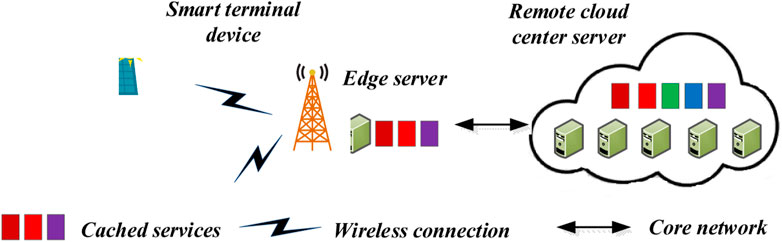
FIGURE 1. Edge computing network architecture for PIoT with renewable energy sources.
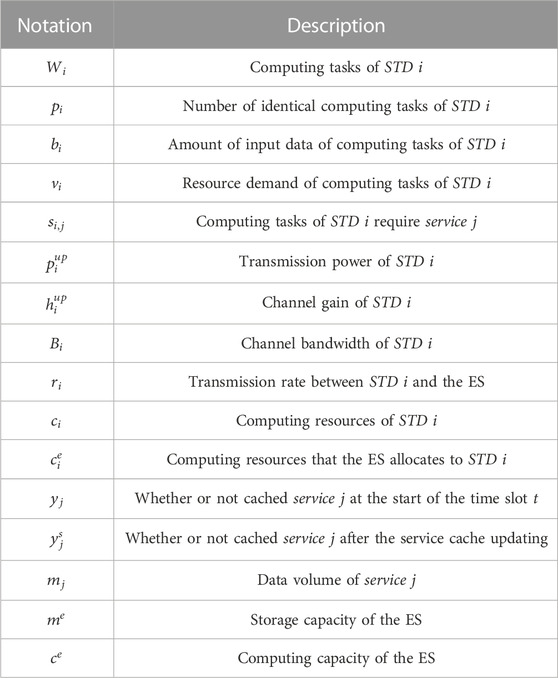
TABLE 1. Main notations.
3.2 Execution latency model of computational tasks performed by STDs locally
We consider an edge computation system for PIoT with n STDs and m services in the time slot t. Let STD i and server j represent ith STD and jth service, respectively, where
where
3.3 Execution latency of computational tasks performed by the ES
When the ES performs part of computing tasks of STD i, the execution latency includes the following three parts: task offloading latency from STD i to the ES, computing latency, and result feedback latency. Since the result feedback latency is relatively small, it is ignored in this article. Assuming the channel bandwidth allocated by the wireless network to STD i is
where
If the ES has cached the service required by STD i, the computing latency depends on the computing resource demand of tasks. Therefore, the computing latency is
where
3.4 Execution latency of computational tasks performed by the RCCS
If the RCCS performs part of computing tasks of STD i, execution latency includes the following two parts: the first part is the transmission latency of computing tasks, including latency from STD i to the ES and from the ES to the RCCS. The second part is computing latency on the RCCS. The calculation formulas of transmission latency and calculation latency are, respectively, given as
where
According to Eqs 1, 5, 8, without considering service cache updating, the formula for calculating the execution latency expectation of computing tasks of STD i is
3.5 Latency of service cache updating
If STDs offload computing tasks to the ES for execution and the ES has not cached services required by these computing tasks, service need to be downloaded from the RCCS to the ES. Let the binary variable
where
3.6 Mathematical description and optimization modeling of problems
Let
Every optimization variable has a value range restricted by constraints
4 Solution for the optimization mode
Taking Eqs 9, 10 into the objective function of
It can be proved that if the integer variables X and Y are relaxed to real variables, Eq. 12 is a convex function. Therefore, the optimization model
Let
The interior point method can be used to solve the optimization model
Add
By solving the optimization model
Algorithm 1.The JOSSCUCTA scheme based on the OA method.
input:
output:
Initialization:
While
End While
5 Performance evaluation
An evaluation of the efficiency of JOSSCUCTA is conducted in this section. The specific simulation environment is as follows: the simulation in this paper was conducted using MATLAB. The edge computation system includes one RCCS, one WiFi wireless access point, one ES, and multiple STDs. STDs are randomly distributed in a square area, and the center of the area is deployed with one wireless access point and one ES. Channel gain is
• All local: STDs perform all computing tasks locally.
• All offloading: The BS or the RCCS execute all computing tasks.
• STD–edge-cloud collaborative computing without service cache updating (SE3CSCU): Use the optimization scheme proposed in this article to allocate computing tasks to devices, but set the download times of services to infinity, making cached service updating impossible.
To verify whether JOSSCUCTA can reduce the average system latency of all STDs’ computing tasks when the ES has not cached services required by STDs, experiments 1 and 2 assume that services required by all STDs are not cached by the ES. The simulation scenario of experiment 1 is as follows: there are five STDs that require five servers, or that require two services. A comparison of the average system latency of different computing offloading schemes as the number of computing tasks of each STD increases is illustrated in Figure 2. As each computing task requires more and more computing resources, the average system latency of different task allocation schemes is compared, as shown in Figure 3.
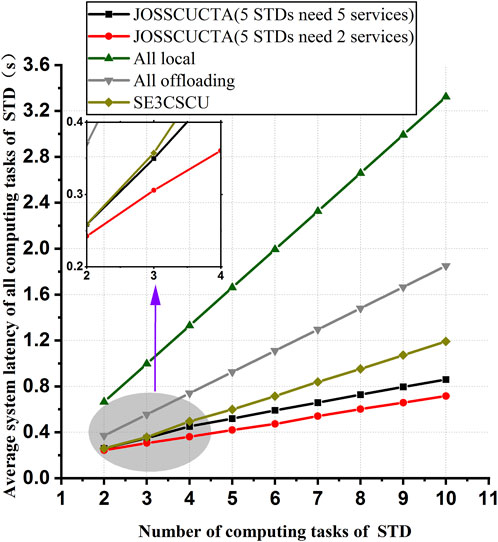
FIGURE 2. Efficiency comparison of all computing offloading schemes using different numbers of computing tasks of an STD.
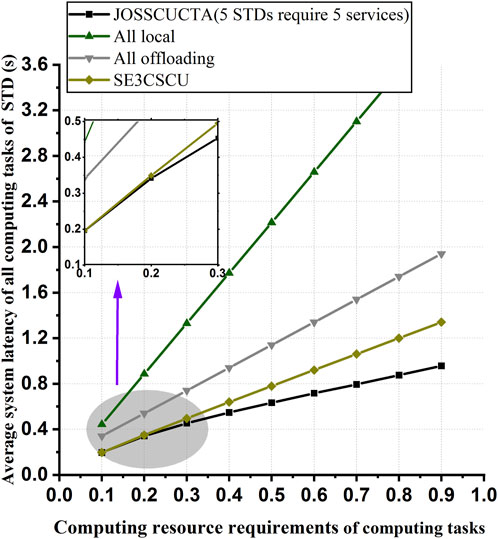
FIGURE 3. Efficiency comparison of all computing offloading schemes using different resource requirements of computing tasks.
Figures 2, 3 show that as the number of computing tasks on each STD increases or the computing resources required to perform each computing task increase, the average system latency of all computation offloading schemes increases. Because each STD’s total computing tasks require more computing resources and each STD or the ES has constant computing resources, each computing task is allocated fewer resources. As a result, the average system latency increases.
The average system latency of JOSSCUCTA increases as the number of servers required by STDs increases because the more STDs need the same service, the earlier the service is downloaded from the RCCS to the ES. The average system latency of all local is the highest among all computation offloading schemes, which indicates that computing intensive tasks are hardly to perform locally. SE3CSCU has higher average system latency than JOSSCUCTA because without service cache updating, computing tasks of STDs can only be offloaded to the RCCS.
The simulation scenario of experiment 2 is that the server required by each STD in the edge computation system is different. As shown in Figure 4, the average system latency of JOSSCUCTA gradually increases as the number of STDs increases when there are fewer STDs in the edge computation system. This is because the ES allocates fewer computing resources to each task when STDs offload more computing tasks to it. However, with an increasing number of STDs, more computing tasks are executed on the RCCS to obtain a smaller execution delay. Thus, average system latency does not continue to increase. Meanwhile, in computing task allocation schemes of all local and all offloading, the average execution latency does not increase or decrease consistently as it depends on computing resource requirements, computing resources supplied by all STDs, and transmission latency.
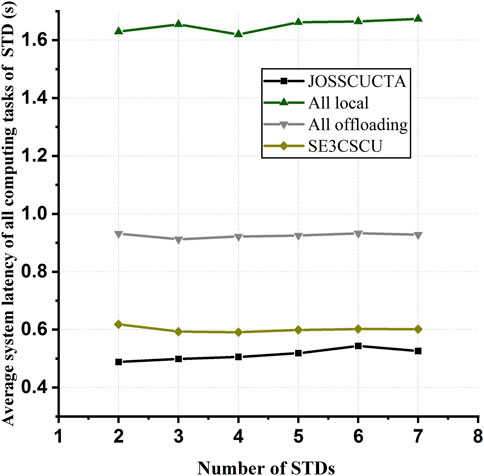
FIGURE 4. Efficiency comparison of all computing offloading schemes using different numbers of STDs.
To verify whether JOSSCUCTA can reduce the average system latency of all STDs’ computing tasks when the ES has not cached part of the services required by STDs, the simulation scenario of experiment 3 is that the edge computation system contains five STDs, and each of them requires different services. The ES has cached three services which are required by first to third STDs, and there is no enough storage capacity in the ES to cache more servers. Figure 5 illustrates the comparison of all computing offloading schemes when the number of computing tasks of the fourth and fifth STDs increases.
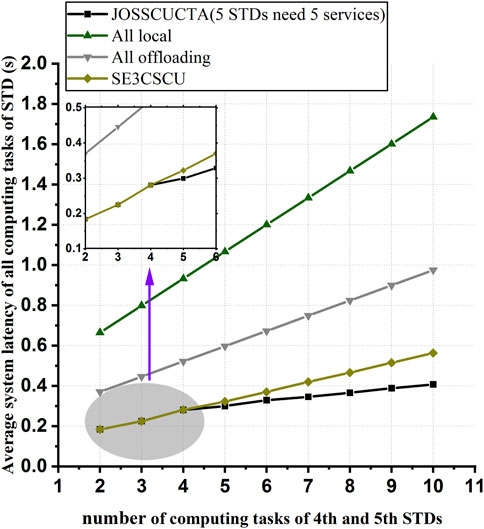
FIGURE 5. Efficiency comparison of all computing offloading schemes using different numbers of computing tasks of fourth and fifth STDs.
In Figure 5, we can see even if the services cached in the ES are all required by STDs and the ES has no more storage resources to cache other services, JOSSCUCTA can reduce the average system latency. Because an STD has many computing tasks, it will increase transmission latency to offload them to the RCCS. JOSSCUCTA can download the service required by the STD to the ES, reducing the transmission latency of these computing tasks. To cache the new service, the ES needs to delete services required by other STDs with a small number of computing tasks and perform their computing tasks on the RCCS. Even though the total execution latency of these STDs has increased, it remains that the pros outweigh the cons.
The simulation scenario of experiment 4 is that there are two categories of STDs in the edge computation system. The services required by one category of STDs have been cached on the ES, and there are no more storage resources to cache other services on the ES. The services required by another category of STDs are not cached by the ES, but they are the same services. Figure 6 shows the comparison of all computing offloading schemes as the number of the second category of STDs increases.
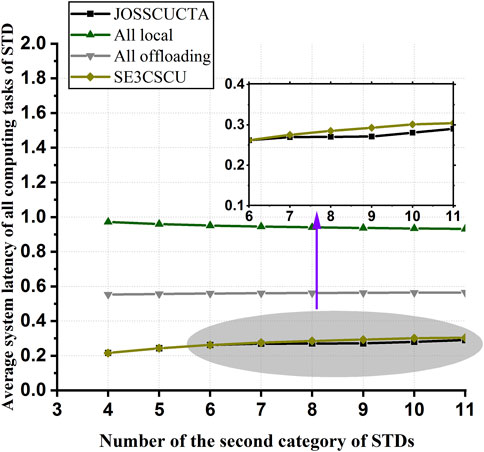
FIGURE 6. Efficiency comparison of all computing offloading schemes using different numbers of the second category of STDs.
We can see that when there are fewer STDs of the second category, the average system latency of JOSSCUCTA is the same as that of SE3CSCU, as shown in Figure 6 because server cache updating does not occur. However, as more and more STDs need the same service, JOSSCUCTA improves performance further. This is because the required service can be downloaded to the ES through service cache updating. Therefore, JOSSCUCTA can effectively adapt quickly to the changing service requirements of many STDs.
6 Conclusion
Massive heterogeneous data in PIoT with renewable energy need to be processed, and the demand for computing power and communication resources has increased dramatically. Edge computation can significantly improve the computational performance of the smart power grid. However, as the categories of computing tasks increase in PIoT and ESs are equipped with limited storage resources, ESs cannot cache all types of services required by STDs’ computing tasks. Therefore, this article proposed JOSSCUCTA for PIoT with renewable energy sources and established it as an MINLP problem. Simulation experiments showed that the JOSSCUCTA scheme can effectively reduce the average system latency of all STDs’ computing tasks when the ES has not cached or cached part of the services required by computing tasks.
Data availability statement
The original contributions presented in the study are included in the article/Supplementary material; further inquiries can be directed to the corresponding author.
Author contributions
XYa: Writing–review and editing. XYu: Writing–original draft, Writing–review and editing. XL: Writing–review and editing.
Funding
The author(s) declare financial support was received for the research, authorship, and/or publication of this article. The paper was funded by the Science and Technology Project of Taizhou (2003gy15 and 20ny13).
Acknowledgments
The authors gratefully acknowledge the support provided by the Science and Technology Project of Taizhou (2003gy15 and 20ny13).
Conflict of interest
The authors declare that the research was conducted in the absence of any commercial or financial relationships that could be construed as a potential conflict of interest.
Publisher’s note
All claims expressed in this article are solely those of the authors and do not necessarily represent those of their affiliated organizations, or those of the publisher, the editors, and the reviewers. Any product that may be evaluated in this article, or claim that may be made by its manufacturer, is not guaranteed or endorsed by the publisher.
References
Bi, R., Liu, Q., Ren, J., and Tan, G. J. T. S., (2020). Utility aware offloading for mobile-edge computing. Util. aware offloading mobile-edge Comput. 26 (2), 239–250. doi:10.26599/TST.2019.9010062
Cao, X., Wang, F., Xu, J., Zhang, R., and Cui, S. (2018). Joint computation and communication cooperation for energy-efficient mobile edge computing. IEEE Internet Things J. 6 (3), 4188–4200. doi:10.1109/JIOT.2018.2875246
Chen, M., and Hao, Y. (2018). Task offloading for mobile edge computing in software defined ultra-dense network. IEEE J. Sel. Areas Commun. 36 (3), 587–597. doi:10.1109/JSAC.2018.2815360
Chen, X., Zhang, J., Lin, B., Chen, Z., Wolter, K., and Min, G. (2022a). Energy-efficient offloading for DNN-based smart IoT systems in cloud-edge environments. Ieee Trans. Parallel Distributed Syst. 33 (3), 683–697. doi:10.1109/tpds.2021.3100298
Chen, Y., Zhang, S., Jin, Y., Qian, Z., Xiao, M., Ge, J., et al. (2022b). LOCUS: user-perceived delay-aware service placement and user allocation in MEC environment. Ieee Trans. Parallel Distributed Syst. 33 (7), 1581–1592. doi:10.1109/tpds.2021.3119948
Deng, X., Li, J., Guan, P., and Zhang, L. (2022). Energy-efficient UAV-aided target tracking systems based on edge computing. Ieee Internet Things J. 9 (3), 2207–2214. doi:10.1109/jiot.2021.3091216
Fang, T., Yuan, F., Ao, L., and Chen, J. (2022). Joint task offloading, D2D pairing, and resource allocation in device-enhanced mec: a potential game approach. Ieee Internet Things J. 9 (5), 3226–3237. doi:10.1109/jiot.2021.3097754
Guo, H., and Liu, J. (2018). Collaborative computation offloading for multiaccess edge computing over fiber–wireless networks. IEEE Trans. Veh. Technol. 67 (5), 4514–4526. doi:10.1109/TVT.2018.2790421
Huang, Q., and Wei, S. (2020). Improved quantile convolutional neural network with two-stage training for daily-ahead probabilistic forecasting of photovoltaic power. Energy Convers. Manag. 220, 113085. doi:10.1016/j.enconman.2020.113085
Lan, X., Cai, L., and Chen, Q. (2019). “Execution latency and energy consumption tradeoff in mobile-edge computing systems,” in 2019 IEEE/CIC International Conference on Communications in China: IEEE), Changchun, China, 11-13 August 2019, 123–128.
Lin, Y., and Shen, H. (2015). “Cloud fog: towards high quality of experience in cloud gaming,” in 2015 44th International Conference on Parallel Processing: IEEE, Beijing, China, September 1-4, 2015, 500–509.
Liu, J., Mao, Y., Zhang, J., and Letaief, K. B. (2016). Delay-optimal computation task scheduling for mobile-edge computing systems. IEEE. 1451-1455 %@ 1509018069 Available at: https://arxiv.org/abs/1604.07525.
Meng, J., Tan, H., Li, X.-Y., Han, Z., and Li, B. (2019). Online deadline-aware task dispatching and scheduling in edge computing. IEEE Trans. Parallel Distributed Syst. 31 (6), 1270–1286. doi:10.1109/TPDS.2019.2961905
Ning, Z., Dong, P., Kong, X., and Xia, F. (2018). A cooperative partial computation offloading scheme for mobile edge computing enabled Internet of Things. IEEE Internet Things J. 6 (3), 4804–4814. doi:10.1109/JIOT.2018.2868616
Pham, X.-Q., Nguyen, T.-D., Nguyen, V., and Huh, E.-N. J. I. C. L. (2020). Joint service caching and task offloading in multi-access edge computing: a qoe-based utility optimization approach. IEEE Commun. Lett. 25 (3), 965–969. doi:10.1109/LCOMM.2020.3034668
Qin, Y., Yuen, C., Yin, X., and Huang, B. (2023). A transferable multistage model with cycling discrepancy learning for lithium-ion battery state of health estimation. IEEE Trans. Industrial Inf. 19 (2), 1933–1946. doi:10.1109/TII.2022.3205942
Song, F., Xing, H., Luo, S., Zhan, D., Dai, P., and Qu, R. (2020). A multiobjective computation offloading algorithm for mobile-edge computing. IEEE Internet Things J. 7 (9), 8780–8799. doi:10.1109/JIOT.2020.2996762
Wang, X., Ning, Z., Guo, L., Guo, S., Gao, X., and Wang, G. (2022). Online learning for distributed computation offloading in wireless powered mobile edge computing networks. Ieee Trans. Parallel Distributed Syst. 33 (8), 1841–1855. doi:10.1109/tpds.2021.3129618
Wei, Z., Pan, J., Lyu, Z., Xu, J., Shi, L., and Xu, J. J. C. C. (2020). An offloading strategy with soft time windows in mobile edge computing. Comput. Commun. 164, 42–49. doi:10.1016/j.comcom.2020.09.011
Xing, H., Liu, L., Xu, J., and Nallanathan, A. (2018). “Joint task assignment and wireless resource allocation for cooperative mobile-edge computing,” in 2018 IEEE International Conference on Communications: IEEE), Kansas City, MO, USA, 20-24 May 2018.
Xu, J., Chen, L., and Zhou, P. (2018). “Joint service caching and task offloading for mobile edge computing in dense networks,” in IEEE INFOCOM 2018-IEEE Conference on Computer Communications: IEEE), Honolulu, Hawaii, USA, 16-19 April 2018, 207–215.
Xu, X., Lin, Z., Li, X., Shang, C., and Shen, Q. J. I. J. o.P. R. (2022). Multi-objective robust optimisation model for MDVRPLS in refined oil distribution. Int. J. Prod. Res. 60, 6772–6792. doi:10.1080/00207543.2021.1887534
Xu, X., Wang, C., and Zhou, P. (2021). GVRP considered oil-gas recovery in refined oil distribution: from an environmental perspective. Int. J. Prod. Econ. 235, 108078. doi:10.1016/j.ijpe.2021.108078
Xu, X. J. R. P., Wei, Z., Ji, Q., Wang, C., and Gao, G. (2019). Global renewable energy development: influencing factors, trend predictions and countermeasures. Resour. Policy 63, 101470. doi:10.1016/j.resourpol.2019.101470
Yue, S., Ren, J., Qiao, N., Zhang, Y., Jiang, H., Zhang, Y., et al. (2022). TODG: distributed task offloading with delay guarantees for edge computing. Ieee Trans. Parallel Distributed Syst. 33 (7), 1650–1665. doi:10.1109/tpds.2021.3123535
Zhang, K., Mao, Y., Leng, S., Maharjan, S., and Zhang, Y. (2017). “Optimal delay constrained offloading for vehicular edge computing networks,” in 2017 IEEE International Conference on Communications: IEEE), Paris, France, 21-25 May 2017.
Zhang, Y., Li, Y., and Zhang, G. (2020). Short-term wind power forecasting approach based on Seq2Seq model using NWP data. Energy 213, 118371. doi:10.1016/j.energy.2020.118371
Zhao, P., Tian, H., Qin, C., and Nie, G. (2017). Energy-saving offloading by jointly allocating radio and computational resources for mobile edge computing. IEEE Access 5, 11255–11268. doi:10.1109/ACCESS.2017.2710056
Zhou, H., Jiang, K., Liu, X., Li, X., and Leung, V. C. M. (2022). Deep reinforcement learning for energy-efficient computation offloading in mobile-edge computing. Ieee Internet Things J. 9 (2), 1517–1530. doi:10.1109/jiot.2021.3091142
Zhou, J., and Zhang, X. (2022). Fairness-Aware task offloading and resource allocation in cooperative mobile-edge computing. Ieee Internet Things J. 9 (5), 3812–3824. doi:10.1109/jiot.2021.3100253
Keywords: power Internet of Things, renewable energy, edge computation, computing task allocation, cloud edge end
Citation: Yang X, Yu X and Li X (2024) Computing task allocation for power Internet of Things including renewable energy sources. Front. Energy Res. 11:1269988. doi: 10.3389/fenrg.2023.1269988
Received: 31 July 2023; Accepted: 12 December 2023;
Published: 08 January 2024.
Edited by:
Jun Wu, Beijing University of Chemical Technology, ChinaReviewed by:
Zhang Xiaohong, Dalian University, ChinaGaoming Yang, Anhui University of Science and Technology, China
Copyright © 2024 Yang, Yu and Li. This is an open-access article distributed under the terms of the Creative Commons Attribution License (CC BY). The use, distribution or reproduction in other forums is permitted, provided the original author(s) and the copyright owner(s) are credited and that the original publication in this journal is cited, in accordance with accepted academic practice. No use, distribution or reproduction is permitted which does not comply with these terms.
*Correspondence: Xiang Yu, eXV4aWFuZ0B0emMuZWR1LmNu