 Boshen Shu
 Shufeng Zhang
 Jian Gao
- Department of Pediatric Surgery, Henan Provincial People’s Hospital, Zhengzhou, Henan, China
Introduction: Artificial intelligence has been extensively used in the personalized diagnosis and treatment of pediatric surgery. Numerous articles have been published related to this research recently. Consequently, we aimed to perform a bibliometric analysis of influential studies to reveal the digital transformation and future era within pediatric surgery.
Methods: We searched publications on artificial intelligence application in pediatric surgery until December 31, 2023, via Web of Science core collection database comprehensively. Of these, the 100 most cited articles were evaluated in detail. Diverse parameters including total citations, publication year, journal, impact factor, impact index, country, organization, keyword, study design and evidence level were analyzed. Bibliometrix package from Rstudio, VOSviewer and GraphPad Prism were used for data analysis and mapping.
Results: A total of 2,799 publications were searched and the 100 most cited articles were published from 1995 to 2023, with a total citation number of 2,770. The top country and organization contributing to this area were the USA and Stanford University, while the Journal of Pediatric Surgery dominated the number of studies from the top 100. Retrospective study and articles with evidence level III were the most common. For keyword co-occurrence analysis, it indicated necrotizing enterocolitis, congenital heart disease and radiomics dominated potential hotspots in the future.
Conclusions: The present study presents a detailed list of the impactful articles on artificial intelligence application in pediatric surgery. It provides insights into potential cooperation and prospects for future research, which plays a helpful reference for researchers studying on artificial intelligence application in pediatric surgery.
1 Introduction
Artificial intelligence (AI) mainly refers to the utilization of computers or machines to simulate human intelligent behavior, including learning, cognitive functions, problem-solving, perception and many other characteristics (1). Since McCarthy et al. mentioned the AI conception in the 1950s, it has progressively evolved to be a multidisciplinary subject (2). Incorporating various areas such as computing, mathematics, biology, mechanical engineering and several more sectors. Due to the powerful potential of its advanced algorithms and learning capabilities, AI has demonstrated significant application in different medical domains like cardiovascular disease and rheumatic disease (3, 4). It now shows considerable reliability in disease diagnosis, prognosis prediction, drug research, as well as other fields (5, 6).
Wide applications of AI hold substantial potential to transform child and adolescent health digitally. The special challenges related to children, containing distinctive developmental and physiological requirements, heterogeneous cognitive capabilities, and natural communication problems, emphasize the revolutionary potential of AI in this area (7). For pediatric surgery, precise diagnosis, timely predictions, patient's safety and therapy strategies can be remarkably reinforced by the combination with AI in patient care process (8). Notably, numerous articles were published related to AI application in pediatric surgery recently. Consequently, it is of crucial importance for scholars to grasp the latest studies for reviewing the substantial update. Bibliometric analysis is a type of statistical approach that takes citation counts as a main measure of research influence, serving as a useful tool to evaluate development tendencies of a certain research field (9). This method has been applied in many different medical research fields to depict the knowledge structure and development trends till today (10, 11). However, to the best of our knowledge, there is no research on bibliometric analysis for artificial intelligence application in pediatric surgery. Hence, we aimed to perform a bibliometric analysis to explore the current research topics and cooperative networks in the application of AI in pediatric surgery over recent years, for the purpose of providing a theoretical reference for scholars to better seize the research frontiers and future trends.
2 Materials and methods
2.1 Data collection and search strategy
In October 2024, we performed a literature search in Web of Science Core Collection (WoSCC). A comprehensive review of pertinent studies was taken to support the formulation for our search strategy. Besides, for obtaining only related search results, a “title” instead of “topic” searching strategy was used (12, 13). Concerning the application of AI in pediatric surgery, we conducted the following searching terms: (“artificial intelligence” OR “computational intelligence” OR “machine learning” OR “deep learning” OR “decision trees” OR “decision forest” OR “expert system” OR “fuzzy logic” OR “automatic programming” OR “autonomous robot” OR “intelligent agent” OR “neural net” OR “voice recognition” OR “text mining” OR “electronic health record” OR “AI” OR “ML” OR “SVM” OR “Random forest” OR “Logistic regression” OR “RNN” OR “LSTM”) (Title) AND (“neonate” OR “neonates” OR “neonatal” OR “infant” OR “infants” OR “infancy” OR “preterm” OR “preterms” OR “newborn” OR “newborns” OR “pediatric” OR “pediatrics” OR “children” OR “child” OR “boy” OR “girl” OR “boys” OR “girls” OR “adolescent” OR “congenital” OR “atresia” OR “tracheoesophageal fistula” OR “necrotizing enterocolitis” OR “Hirschsprung disease” OR “anorectal malformation” OR “neuroblastoma” OR “hepatoblastoma” OR “nephroblastoma” OR “wilms” OR “orchidopexy” OR “pyloromyotomy” OR “Kasai” OR “imperforate anus” OR “pediatric surgery”) (Title) AND LA = (English) AND Publication time span = (1 January 1945 to 31 December 2023).
2.2 Data extraction and including criteria
The included articles were restricted to those that (1) involved AI applications, (2) and were relevant to pediatric surgery field (3) were published as article or review. Two independent authors screened all the publications by reading abstracts or full text according to the criteria. Differences between these two authors were resolved through thorough discussion. The selected articles based on the unanimous decision from these two reviewers were ranked in a descending order and the first 100 came to be the final list.
The following factors of the 100 most cited manuscripts were recorded and analyzed: total citations, publication year, journal, impact factor (IF), impact index, country, organization, keyword, study design and evidence level. The impact index is calculated by dividing the duration time (unit: year) since publication by the number of cited times, multiplied by 100, with lower outcome demonstrating a more robust impact (14). The study designs included retrospective study, prospective study, review, case-control study, randomized controlled trial (RCT), meta-analysis and systematic review. The evidence levels were arranged in accordance with Cashin et al. from high to low: meta-analysis (Level I), RCT (Level I), systematic review (Level I), prospective study (Level II), retrospective study (Level III), review (Level IV) and case-control study (Level IV) (15). Level I and II were defined as high evidence levels.
2.3 Data analysis and visualization
Statistical analyses were conducted with GraphPad Prism v. 7.0 (GraphPad, La Jolla, CA, USA). All tests were two-sided. Spearman correlation coefficient was applied to examine correlations among selected continuous variables. Unpaired t tests were taken to make the comparison between two different groups for parametric data and the One-way ANOVA test was performed for non-parametric data. The P Value of <0.05 was considered statistically significant.
Visualized analysis for country and organization collaboration, as well as keyword co-occurrence network analysis were conducted by VOSviewer 1.6.20 (Leiden University, Leiden, The Netherlands). Here, the line thickness between the colored nodes represents the total link strength. While for bibliometrix package from Rstudio, the “Most Relevant Sources” function was applied to describe the rank of publications from different journals. The “Most Relevant Affiliations” function was used to identify the contribution from different organizations.
3 Results
3.1 Overview
A total of 2,799 manuscripts were identified by the initial search. The top 100 cited articles were published between 1995 and 2023 and they were presented accordingly in Table 1. The total number of citations was 2,773 (2,710 without self-citations; range from 11 to 162). The number of publications and citations each year generally increased from 1995 to 2023 and the year 2021 held the leading position in the number of publications (n = 35) (Figure 1A). The most cited article entitled “Prediction of progression of the curve in girls who have adolescent idiopathic scoliosis of moderate severity. Logistic regression analysis based on data from The Brace Study of the Scoliosis Research Society” was published in 1995 by Peterson et al. in Journal of Bone and Joint Surgery-American Volume (16). While the article with the lowest impact index entiteled “Real-time cardiovascular MR with spatio-temporal artifact suppression using deep learning-proof of concept in congenital heart disease” was published in 2019 by Hauptmann A et al. in the journal Magnetic Resonance in Medicine (17). There were 75 retrospective studies, 9 prospective studies, 9 reviews, 3 case-control studies, 2 RCTs, 1 meta-analysis and 1 systematic review papers on the top 100 list. Articles with evidence level III dominated the leading position (n = 75), followed by level IV (n = 12) and level II (n = 9) (Figure 1B). There was no significant difference between evidence level with either citation number per article (P = 0.057) (Figure 1C) or impact factor of the corresponding journal (P = 0.095) (Figure 1D). The number of cited times did not correlate with the IF (r = 0.161, P = 0.112) (Figure 2A) or II (r = −0.178, P = 0.077) (Figure 2B) per article significantly.

Table 1. The top 100 cited articles on AI application in pediatric surgery.
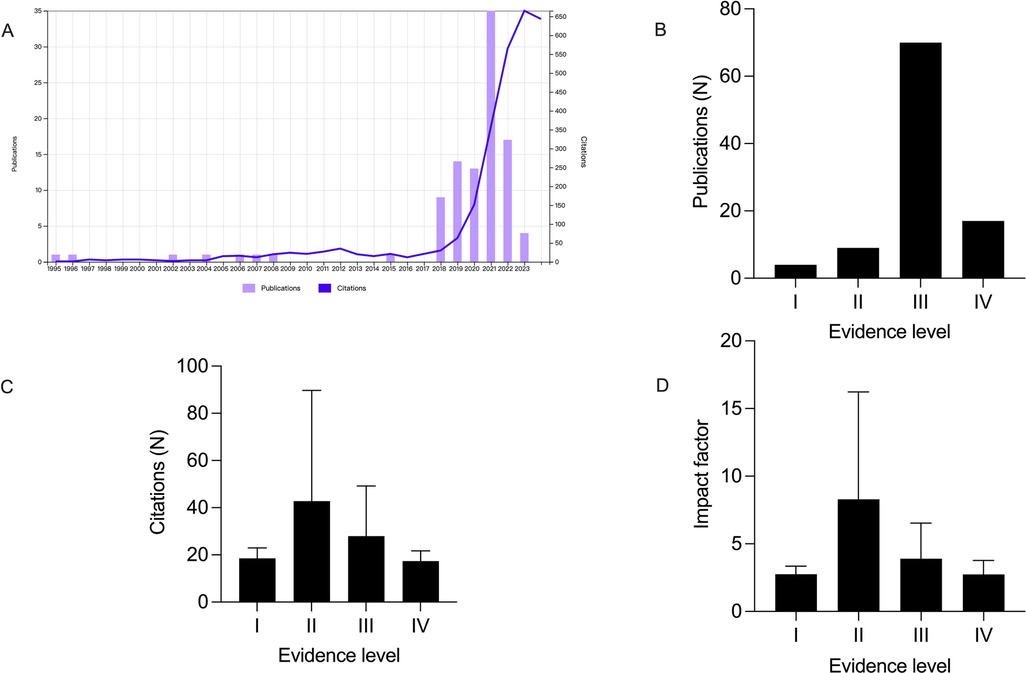
Figure 1. (A) Trends in the number of top 100 cited articles and their citations. (B) The evidence level distribution of top 100 cited publications. (C) Mean citation number per publication according to the evidence level. (D) Mean impact factor per corresponding journal according to the evidence level. No significant difference was found in citations per publication among different evidence levels (P = 0.057); no significant difference was found in impact factor per corresponding journal among different evidence levels (P = 0.095).
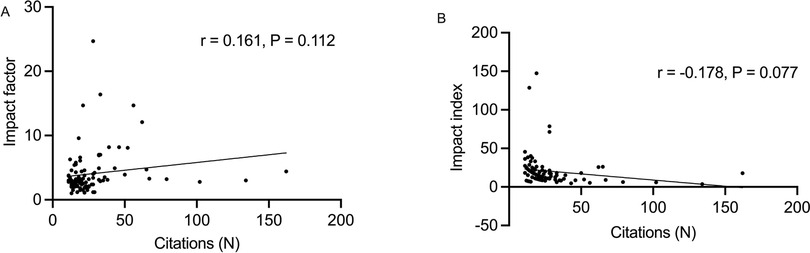
Figure 2. (A) The correlation between the number of citations and impact factor for the top 100 cited publications. (B) The correlation between the number of citations and impact index for the top 100 cited publications. There were no correlations between the number of citations and impact factor or impact index, respectively, for the top 100 cited articles.
3.2 Analysis of countries and organizations
For the comprehensive and detailed analysis of contributing countries and organizations to these top 100 cited publications, we took the “individual authorship strategy” for counting countries or organizations. Briefly, if two authors from one paper came from the same country or organization, we counted the number of contributions about this country or organization as two rather than one.
A total of 41 countries have contributed related articles in the list. Of these, the USA dominated the global publication pattern (n = 52) (Figure 3A) as well as the leading position in country-wise collaboration, with the most total link strength (n = 2,552) (Figure 3B). It is pivotal to emphasize the broad country-wise collaboration in scientific work. Notable partnerships involved close collaborations among the USA, China and Germany (Figure 3B). Notwithstanding these active cooperations, there was a noticeable imbalance in different countries regarding research collaboration.
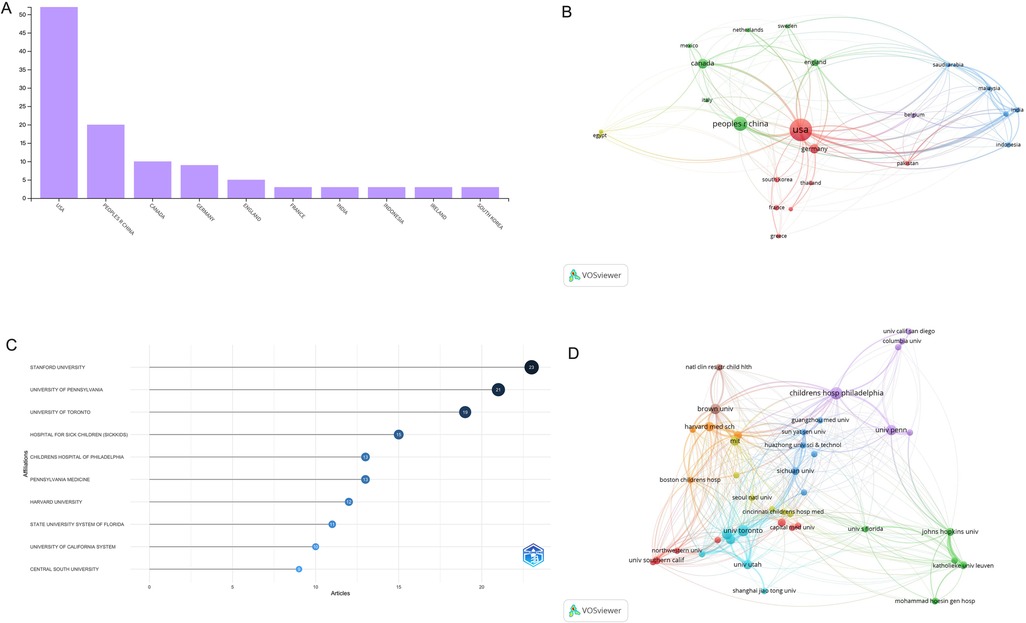
Figure 3. (A) Top 10 authorship countries by the number of publications. (B) Bibliographic coupling analysis of country-wise collaboration. (C) Top 10 authorship organizations by the number of publications. (D) Bibliographic coupling analysis of organization collaboration network.
There were 304 organizations contributing to the 100 most cited manuscripts. The Stanford University dominated the publication number position (n = 23) (Figure 3C). While for the organization level collaboration, Children's Hospital of Philadelphia had the highest total link strength (n = 567) (Figure 3D).
3.3 Analysis of authors and journals
Similar to the “individual authorship strategy” for counting countries or organizations we applied in the analysis of countries and organizations. Here, for example, if one author played as both first and corresponding author, we counted this author' authorship as two rather than one.
Bertsimas D. from Massachusetts Institute of Technology held the leading position for the number of publications (n = 3) in the top 100 cited list. While for the international collaboration network analysis for authors, Arafati A. from University of California owned the highest total link strength (n = 498) (Figure 4A). However, from the collaboration analysis, we can find collaborations from authors in different organizations and countries were still not enough and should be enhanced.
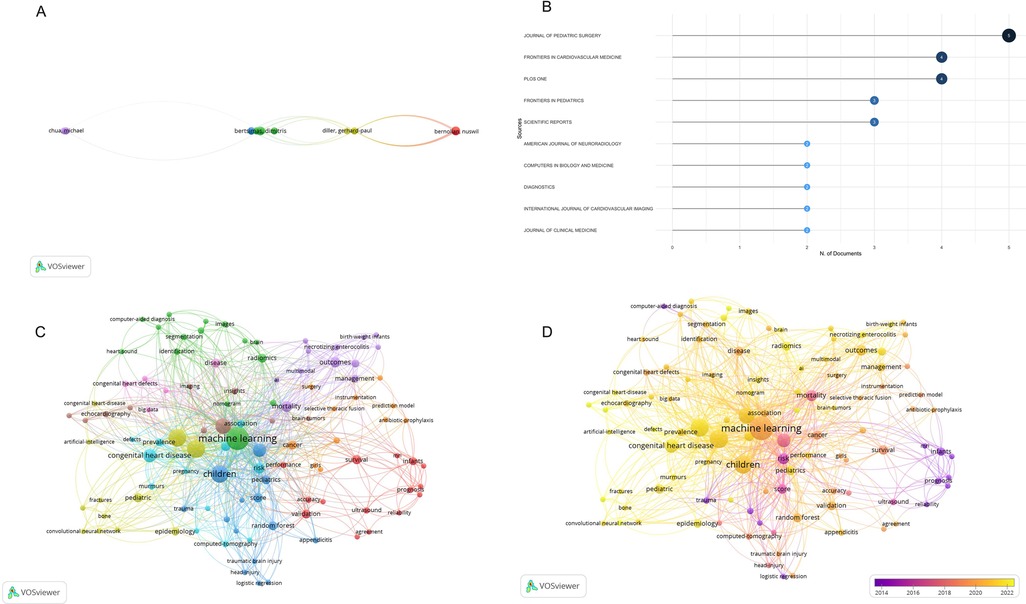
Figure 4. (A) Co-authorship collaboration network of authors. (B) Top 10 journals by the number of publications. (C) Mapping on co-occurrence of keywords for the top 100 cited articles. (D) Time visualization for the keywords. Keywords in yellow appeared later than that in purple.
There were 77 journals contributing to the top 100 cited papers. Of these, the Journal of Pediatric Surgery dominated the number of studies (n = 5; IF = 2.4), followed by the Frontiers in Cardiovascular Medicine (n = 4; IF = 2.8) and PLOS ONE (n = 4; IF = 2.9) (Figure 4B).
3.4 Keyword co-occurrence analysis
From keyword network visualization (Figure 4C) and overplay visualization (Figure 4D) based on VOSviewer, we might identify the current hotspots and future trends of artificial intelligence application in pediatric surgery, for a better understanding of the development of research key points. Our study contained a total of 560 all keywords, and there were 106 keywords with a frequency of more than or equal 2 times. The size of the colored nodes stands for the frequency of keyword occurrence, indicating the focus within the area. The linking lines between nodes represent the strength of connection, with thicker lines demonstrating more often co-appearance in one article. This network visualization promoted the recognition of eminent topics and associations in all keywords. Figure 4C depicted notable high-frequency keywords, including machine learning (ML), AI, DL, children, CHD and so on. When focusing on the emerging research cores in this field, we found necrotizing enterocolitis, CHD and radiomics may dominate potential hotspots in the future (Figure 4D).
4 Discussion
With the advent of digital time, it is crucial for scholars to entirely grasp the development in their research fields. Our study used a bibliometric method to investigate the present status and future trends of AI application in pediatric surgery. Unlike systematic review or meta-analysis, the bibliometric method applies visual software such as VOSviewer or bibliometrix package from Rstudio to analyze current publications in detail, in order to reveal research focus and predict trends.
For these 100 impactful publications in this field. The annual article production has presented a general rising trend from 1995 to 2023. Remarkably, the period between 2018 and 2021 witnessed a pivotal boost in AI technologies, including DL, ML and ChatGPT. This technological growth has provided extraordinary opportunities for the diagnosis, treatment and prediction of patients. These findings indicated the enhanced focus and interests from academia on AI application in pediatric surgery research, which was analogous to several other research fields (18, 19).
The USA stood out in the position for the number of articles, which was similar with other medical areas such as robotic arthroplasty and esophageal atresia (14, 20). This phenomenon is probably owning to the advanced technology and robust national support in the USA. In addition, previous literature has suggested that authors from the USA prefer to publish and cite native sources (21, 22). Remarkably, the government of USA issued an executive order titled “Maintaining American Leadership in Artificial Intelligence” mandating all federal government agencies to execute strategic goals for keeping the leading position in AI field on February 11, 2019 (18). Although China started later in AI field, it has become the second most productive country in the world, establishing close collaboration with the USA and Germany based on our country-wise collaboration map. Seven out of the top 10 publishing organizations were from the USA, two were from Canada and the other one was from China, which also indicated the dominant role of the USA in AI. Several findings can be drawn from the organization and country collaboration network in our study. The USA primarily collaborated with China and Germany, while other European countries tended to cooperate more with European Union countries. The USA and China owned both high scientific production and efficient collaboration, while other countries such as India, Indonesia and South Korea maintained considerable scientific outputs with relatively poor global cooperation. The challenges of global collaboration, such as time, cost, and integration, are likely responsible for this. Yet, there are mutual advantages to promote global collaborative efforts, including wider patient recruitment, better generalizability of results, scientific progress, and greater citation impact (23, 24). Collaboration at the global level should take place through international partnerships that lead and encourage action on health concerns by scheduling, support, and technical assistance (25). Due to the centrality of Bertsimas D. from Massachusetts Institute of Technology and Arafati A. from University of California, they were placed as the top authors in publication and worldwide collaboration field respectively. Studying their scientific outputs would be beneficial to understand of the knowledge structure in this area. The Journal of Pediatric Surgery dominated a higher publication count than other journals. Although the IF of the Journal of Pediatric Surgery is not the highest, due to it is one of the few journals which focus on pediatric surgery specifically, it contributed the highest number of publications. Researchers concentrating on AI application in pediatric surgery might pay more attention to this source.
Information analysis for the impactful articles is an advantageous index for bibliometric study, which is broadly utilized in various subjects (26, 27). The most cited article in the present analysis was published in 1995 by Peterson et al. in Journal of Bone and Joint Surgery-American Volume, predicting the progression of the curve in girls who had adolescent idiopathic scoliosis of moderate severity by using logistic regression analysis (16). The paper with the lowest impact index was released in 2019 by Hauptmann A et al. in the journal Magnetic Resonance in Medicine, investigating the potential of deep learning (DL) to reconstruct highly accelerated radial real-time data in patients with congenital heart disease (CHD) (17).
In the field of AI application in pediatric surgery, ML, AI, DL, children and CHD were identified highly frequent mentioned keywords according to the co-occurrence visualization analysis. ML and DL, as subsets of AI, they are especially effective for distinguishing subtle patterns among huge files that is probably imperceptible to humans using conventional statistical methods conducting manual investigations. They have been widely applied to analyze patient data for predicting outcomes and recovery times after surgery, the aim is to provide a better patient care as well as enhance the precision and efficacy of surgical procedures furtherly (28, 29). Notably, CHD was a hotspot in both current research and future trends, its prenatal diagnosis and postnatal management has progressed considerably with the AI assistance (30). Notwithstanding many advantages including precise prenatal screening, improved perioperative planning, acceptable individualized risk stratification and prognostication, a notable challenge for using AI in CHD has been the disconnect between clinical investigators and computer engineers (31). Therefore, computer engineers are necessary to be more familiar with clinical practice. In the meantime, clinicians lack of experience in AI filed shall get more information to better understand how AI works in medicine.
The level of evidence for a certain paper is probably an excellent index to evaluate its scientific quality (32). In the top 100 articles with the highest number of citations on AI application in pediatric surgery, publications with high evidence levels (level I and II), i.e., meta-analysis and prospective study, were underrepresented. For assessing the CHD diagnostic accuracy of ML models, one meta-analysis included 16 studies on 1,217 participants used ML algorithm to diagnose CHD, reporting ML models owned the potential to diagnose CHD correctly without the requirement for experienced personnel. However, the heterogeneity of the CHD diagnosis among these 16 studies was hard to ignore, which was a main limitation (33). One RCT used data from 964 pediatric patients with minor traumatic brain injury to compare the prediction function between ML and a nomogram, concluding that ML had the superior predictive performance which can assist clinicians with reducing the overuse of head CT scans and therapy costs of pediatric traumatic brain injury (34). The majority of the top 100 cited manuscripts were retrospective studies, which was vital in making research on manifestations and results for diverse cases. Nevertheless, their academic quality is limited: Several information might be lacking, selection and recall deviations can influence the outcomes, and reasons for differences in therapy procedure or inadequate follow-ups cannot be confirmed usually (35). Hence, to enhance the development of AI application in pediatric surgery, prospective studies and RCTs, as the superior standard of scientific work, are needed to a further step.
5 Limitations
Inevitably, there are still several limitations in the present study. Firstly, only the WoSCC database was applied to search for relevant studies, therefore, other sources such as Google Scholar or PubMed might have presented a different number of publication items or citations. To improve the comprehensiveness and representativeness of the analysis, we plan to include more data sources in future research. Secondly, only particular papers (English writing, article or review) were included, which may neglect several outstanding literatures published in different languages and cause biased outcomes. Thirdly, we aimed to obtain only related articles on AI application in pediatric surgery, thus the searching strategy of “title” instead of “topic” was utilized. This strategy could probably exclude few, but an insignificant number of pertinent literatures.
6 Conclusions
In conclusion, the present study performs the first comprehensive bibliometric analysis of impactful articles pertaining to AI application in pediatric surgery from 1995 to 2023. The USA and China lead the research frontiers, providing valuable opportunities for global cooperations. However, collaborations among developing countries need to be strengthen intensely. Necrotizing enterocolitis, CHD and radiomics might dominate potential hotspots in the future. This study may play a helpful role for researchers studying on AI application in pediatric surgery by providing insights into potential collaboration and prospects for future research.
Data availability statement
The original contributions presented in the study are included in the article/Supplementary Material, further inquiries can be directed to the corresponding author.
Author contributions
BS: Conceptualization, Data curation, Formal analysis, Investigation, Methodology, Writing – original draft. SZ: Methodology, Visualization, Writing – review & editing. JG: Methodology, Visualization, Writing – review & editing. LW: Methodology, Visualization, Writing – review & editing. XW: Methodology, Supervision, Visualization, Writing – review & editing.
Funding
The author(s) declare that financial support was received for the research and/or publication of this article. This study was supported by the Science and Technology Research Project of Henan province (222102310133), the Joint Project of Medical Science and Technology Research Program of Henan Province (Grant No.: LHGJ20200013), and the Natural Science Foundation of Henan Province (Grant No.: 252300421371).
Conflict of interest
The authors declare that the research was conducted in the absence of any commercial or financial relationships that could be construed as a potential conflict of interest.
Generative AI statement
The author(s) declare that no Generative AI was used in the creation of this manuscript.
Publisher's note
All claims expressed in this article are solely those of the authors and do not necessarily represent those of their affiliated organizations, or those of the publisher, the editors and the reviewers. Any product that may be evaluated in this article, or claim that may be made by its manufacturer, is not guaranteed or endorsed by the publisher.
Abbreviations
AI, artificial intelligence; CHD, congenital heart disease; DL, deep learning; IF, impact factor, ML, machine learning; RCT, randomized controlled trial; WoSCC, web of science core collection.
References
1. Manickam P, Mariappan SA, Murugesan SM, Hansda S, Kaushik A, Shinde R, et al. Artificial intelligence (AI) and internet of medical things (IoMT) assisted biomedical systems for intelligent healthcare. Biosensors (Basel). (2022) 12:562. doi: 10.3390/bios12080562
2. Sabanovic S, Milojevic S, Kaur J. John McCarthy [history]. IEEE Robot Autom Mag. (2012) 19:99–106. doi: 10.1109/MRA.2012.2221259
3. Siontis KC, Noseworthy PA, Attia ZI, Friedman PA. Artificial intelligence-enhanced electrocardiography in cardiovascular disease management. Nat Rev Cardiol. (2021) 18:465–78. doi: 10.1038/s41569-020-00503-2
4. Galozzi P, Basso D, Plebani M, Padoan A. Artificial intelligence and laboratory data in rheumatic diseases. Clin Chim Acta. (2023) 546:117388. doi: 10.1016/j.cca.2023.117388
5. Rajpurkar P, Chen E, Banerjee O, Topol EJ. AI in health and medicine. Nat Med. (2022) 28:31–8. doi: 10.1038/s41591-021-01614-0
6. Varghese C, Harrison EM, O’Grady G, Topol EJ. Artificial intelligence in surgery. Nat Med. (2024) 30:1257–68. doi: 10.1038/s41591-024-02970-3
7. Knake LA. Artificial intelligence in pediatrics: the future is now. Pediatr Res. (2023) 93:445–6. doi: 10.1038/s41390-022-01972-6
8. Sinha A, Bhatt S. Potential and promise: artificial intelligence in pediatric surgery. J Indian Assoc Pediatr Surg. (2024) 29:400–5. doi: 10.4103/jiaps.jiaps_88_24
9. Hicks D, Wouters P, Waltman L, de Rijcke S, Rafols I. Bibliometrics: the Leiden manifesto for research metrics. Nature. (2015) 520:429–31. doi: 10.1038/520429a
10. Kow RY, Razali K, Low CL, Siron KN, Zakaria Mohamad Z, Mohd Yusof M, et al. Bibliometric analysis of diagnostic yield of CT pulmonary angiogram (CTPA) in the diagnosis of pulmonary embolism (PE). Cureus. (2023) 15:e41979. doi: 10.7759/cureus.41979
11. Shu B, Feng X, Martynov I, Lacher M, Mayer S. Pediatric minimally invasive surgery—a bibliometric study on 30 years of research activity. Children. (2022) 9:1264. doi: 10.3390/children9081264
12. Friedmacher F, Pakarinen MP, Rintala RJ. Congenital diaphragmatic hernia: a scientometric analysis of the global research activity and collaborative networks. Pediatr Surg Int. (2018) 34:907–17. doi: 10.1007/s00383-018-4304-7
13. Shu B, Ou X, Hu L. Influential articles on shoulder arthroplasty: bibliometric analysis and visualized study. J Shoulder Elbow Surg. (2023) 32:677–84. doi: 10.1016/j.jse.2022.09.030
14. Feng X, Martynov I, Suttkus A, Lacher M, Mayer S. Publication trends and global collaborations on esophageal atresia research: a bibliometric study. Eur J Pediatr Surg. (2020) 31(2):164–71. doi: 10.1055/s-0040-1702223
15. Cashin MS, Kelley SP, Douziech JR, Varghese RA, Hamilton QP, Mulpuri K. The levels of evidence in pediatric orthopaedic journals: where are we now? J Pediatr Orthop. (2011) 31:721–5. doi: 10.1097/BPO.0b013e31822aa11a
16. Peterson LE, Nachemson AL. Prediction of progression of the curve in girls who have adolescent idiopathic scoliosis of moderate severity. Logistic regression analysis based on data from the brace study of the scoliosis research society. J Bone Joint Surg. (1995) 77:823–7. doi: 10.2106/00004623-199506000-00002
17. Hauptmann A, Arridge S, Lucka F, Muthurangu V, Steeden JA. Real-time cardiovascular MR with spatio-temporal artifact suppression using deep learning–proof of concept in congenital heart disease. Magn Reson Med. (2019) 81:1143–56. doi: 10.1002/mrm.27480
18. Zhao J, Li L, Li J, Zhang L. Application of artificial intelligence in rheumatic disease: a bibliometric analysis. Clin Exp Med. (2024) 24:196. doi: 10.1007/s10238-024-01453-6
19. Zhang J, Zhang J, Jin J, Jiang X, Yang L, Fan S, et al. Artificial intelligence applied in cardiovascular disease: a bibliometric and visual analysis. Front Cardiovasc Med. (2024) 11:1323918. doi: 10.3389/fcvm.2024.1323918
20. Shu B, Ou X, Shi S, Hu L. From past to digital time: bibliometric perspective of worldwide research productivity on robotic and computer-assisted arthroplasty. Digit Health. (2024) 10:20552076241288736. doi: 10.1177/20552076241288736
21. Campbell FM. National bias: a comparison of citation practices by health professionals. Bull Med Libr Assoc. (1990) 78:376–82. Available at: http://www.ncbi.nlm.nih.gov/pubmed/22243012224301
22. Link AM. US and non-US submissions: an analysis of reviewer bias. JAMA. (1998) 280:246–7. doi: 10.1001/jama.280.3.246
23. Miyata BL, Tafuto B, Jose N. Methods and perceptions of success for patient recruitment in decentralized clinical studies. J Clin Transl Sci. (2023) 7:e232. doi: 10.1017/cts.2023.643
24. Wang J, Frietsch R, Neuhäusler P, Hooi R. International collaboration leading to high citations: global impact or home country effect? J Informetr. (2024) 18:101565. doi: 10.1016/j.joi.2024.101565
25. Syed SB, Dadwal V, Rutter P, Storr J, Hightower JD, Gooden R, et al. Developed-developing country partnerships: benefits to developed countries? Global Health. (2012) 8:17. doi: 10.1186/1744-8603-8-17
26. He J, He L, Geng B, Xia Y. Bibliometric analysis of the top-cited articles on unicompartmental knee arthroplasty. J Arthroplasty. (2021) 36:1810–8.e3. doi: 10.1016/j.arth.2020.11.038
27. Huang Y, Chen P, Peng B, Liao R, Huang H, Huang M, et al. The top 100 most cited articles on triple-negative breast cancer: a bibliometric analysis. Clin Exp Med. (2022) 23(2):175–201. doi: 10.1007/s10238-022-00800-9
28. Tsai AY, Carter SR, Greene AC. Artificial intelligence in pediatric surgery. Semin Pediatr Surg. (2024) 33:151390. doi: 10.1016/j.sempedsurg.2024.151390
29. Morris MX, Rajesh A, Asaad M, Hassan A, Saadoun R, Butler CE. Deep learning applications in surgery: current uses and future directions. Am Surg. (2023) 89:36–42. doi: 10.1177/00031348221101490
30. Reddy CD, Van den Eynde J, Kutty S. Artificial intelligence in perinatal diagnosis and management of congenital heart disease. Semin Perinatol. (2022) 46:151588. doi: 10.1016/j.semperi.2022.151588
31. Jone P-N, Gearhart A, Lei H, Xing F, Nahar J, Lopez-Jimenez F, et al. Artificial intelligence in congenital heart disease. JACC Adv. (2022) 1:100153. doi: 10.1016/j.jacadv.2022.100153
32. Sargeant JM, Brennan ML, O’Connor AM. Levels of evidence, quality assessment, and risk of bias: evaluating the internal validity of primary research. Front Vet Sci. (2022) 9:960957. doi: 10.3389/fvets.2022.960957
33. Hoodbhoy Z, Jiwani U, Sattar S, Salam R, Hasan B, Das JK. Diagnostic accuracy of machine learning models to identify congenital heart disease: a meta-analysis. Front Artif Intell. (2021) 4:708365. doi: 10.3389/frai.2021.708365
34. Tunthanathip T, Duangsuwan J, Wattanakitrungroj N, Tongman S, Phuenpathom N. Comparison of intracranial injury predictability between machine learning algorithms and the nomogram in pediatric traumatic brain injury. Neurosurg Focus. (2021) 51:E7. doi: 10.3171/2021.8.FOCUS2155
Keywords: artificial intelligence, AI, pediatric surgery, bibliometrics, visualized study
Citation: Shu B, Zhang S, Gao J, Wang L and Wang X (2025) The digital transformation and future era: bibliometric view of artificial intelligence application in pediatric surgery. Front. Pediatr. 13:1528666. doi: 10.3389/fped.2025.1528666
Received: 15 November 2024; Accepted: 2 June 2025;
Published: 12 June 2025.
Edited by:
Antonino Morabito, University of Florence, ItalyReviewed by:
Mohsen Norouzinia, Shahid Beheshti University of Medical Sciences, IranSicheng Zhang, Anhui Provincial Children's Hospital, China
Copyright: © 2025 Shu, Zhang, Gao, Wang and Wang. This is an open-access article distributed under the terms of the Creative Commons Attribution License (CC BY). The use, distribution or reproduction in other forums is permitted, provided the original author(s) and the copyright owner(s) are credited and that the original publication in this journal is cited, in accordance with accepted academic practice. No use, distribution or reproduction is permitted which does not comply with these terms.
*Correspondence: Xiaohui Wang, NzY1NTEwMEBxcS5jb20=