 Mingming Fan1,2
 Huijuan Xiao2,3
 Dingyun Song2
 Lili Zhu2Jie Zhang1
 Xinran Zhang2,4
 Jing Wang5*
 Huaping Dai2*
 Chen Wang1,2,5*
- 1Department of Respiratory Medicine, The Second Hospital of Jilin University, Jilin, China
- 2National Center for Respiratory Medicine, National Clinical Research Center for Respiratory Diseases, Department of Pulmonary and Critical Care Medicine Center of Respiratory Medicine, Chinese Academy of Medical Sciences, Peking Union Medical College, China-Japan Friendship Hospital, Capital Medical University, Institute of Respiratory Medicine, Beijing, China
- 3Department of Pulmonary and Critical Care Medicine, China-Japan Friendship School of Clinical Medicine, Peking University, Beijing, China
- 4Institute of Clinical Medical Sciences, China-Japan Friendship Hospital, Beijing, China
- 5State Key Laboratory of Medical Molecular Biology, School of Basic Medicine Peking Union Medical College, Institute of Basic Medical Sciences Chinese Academy of Medical Sciences, Beijing, China
by Fan M, Xiao H, Song D, Zhu L, Zhang J, Zhang X, Wang J, Dai H and Wang C (2022). Front. Pharmacol. 13:848435. doi: 10.3389/fphar.2022.848435
Missing information
Add information about chemical formula, Table 2, polarization and antibody list.
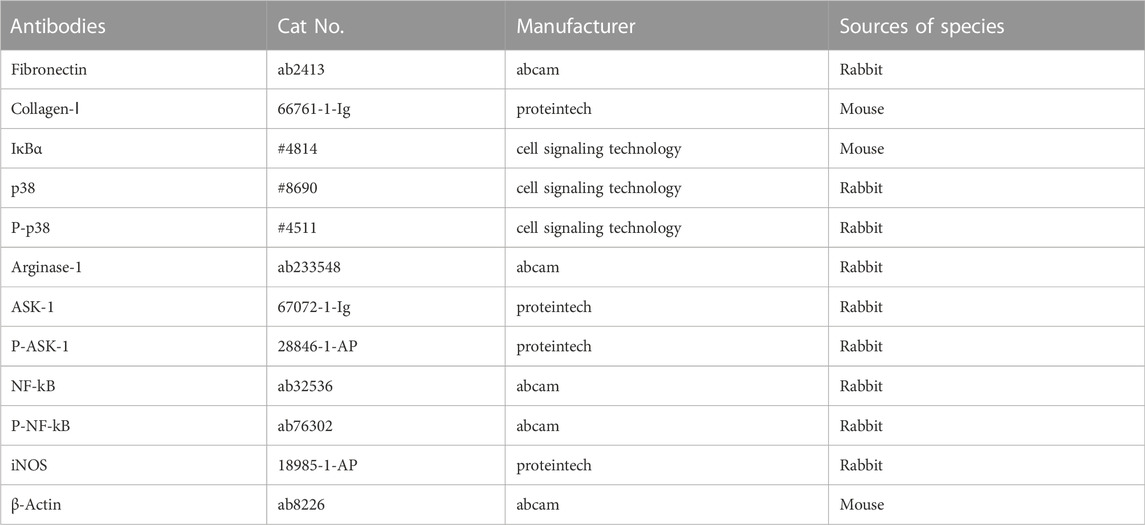
TABLE 2. (Antibody list) Primary antibodies for Western Blot.
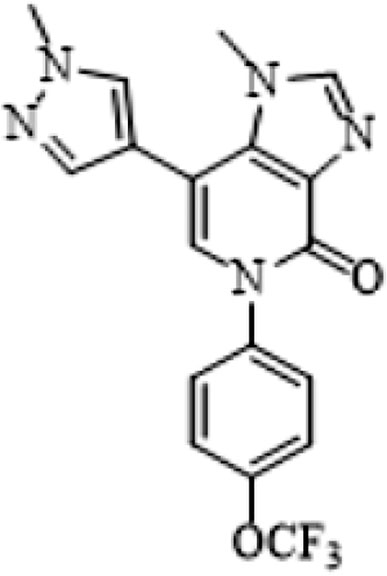
Chemical formula
Chemical structure of AKEX0011
Molecular formula C18H14N5O2F3, mass 389.3 g/mol, CAS:1590403-33-0.
Polarization
RAW 264.7 cells are a macrophage-like, Abelson leukemia virus-transformed cell line derived from BALB/c mice. This macrophage cell line is commonly used to study phagocytosis, apoptosis, inflammation, as well as M1/M2 polarization. Polarization of M1/M2 phenotype can be determined by the expression of specific M1 (CD80, CD86) and M2 (CD206, CD163) markers detected by flow cytometry. In the in vitro experiments of our study, we detected the expression of CD86 and CD163 in RAW264.7 cells of each group by flow cytometry to explore macrophage polarization. Our flow cytometry results confirmed that silica induced polarization of RAW264.7 from M0 macrophages toward certain M1 subtype (F4/80 + CD86+), but have no effect on the polarization towards M2 subtype (F4/80 + CD163+).
Publisher’s note
All claims expressed in this article are solely those of the authors and do not necessarily represent those of their affiliated organizations, or those of the publisher, the editors and the reviewers. Any product that may be evaluated in this article, or claim that may be made by its manufacturer, is not guaranteed or endorsed by the publisher.
Keywords: AKEX0011, macrophage polarization, pirfenidone, pulmonary fibrosis, silicosis
Citation: Fan M, Xiao H, Song D, Zhu L, Zhang J, Zhang X, Wang J, Dai H and Wang C (2023) Addendum: A novel N-Arylpyridone compound alleviates the inflammatory and fibrotic reaction of silicosis by inhibiting the ASK1-p38 pathway and regulating macrophage polarization. Front. Pharmacol. 13:1108989. doi: 10.3389/fphar.2022.1108989
Received: 27 November 2022; Accepted: 29 November 2022;
Published: 18 January 2023.
Edited and reviewed by:
Paola Patrignani, University of Studies G. d'Annunzio Chieti and Pescara, ItalyCopyright © 2023 Fan, Xiao, Song, Zhu, Zhang, Zhang, Wang, Dai and Wang. This is an open-access article distributed under the terms of the Creative Commons Attribution License (CC BY). The use, distribution or reproduction in other forums is permitted, provided the original author(s) and the copyright owner(s) are credited and that the original publication in this journal is cited, in accordance with accepted academic practice. No use, distribution or reproduction is permitted which does not comply with these terms.
*Correspondence: Jing Wang, d2FuZ2ppbmdAaWJtcy5wdW1jLmVkdS5jbg==; Huaping Dai, ZGFpaHVhcGluZ0BjY211LmVkdS5jbg==; Chen Wang, d2FuZ2NoZW5AcHVtYy5lZHUuY24=