 Yeli Zhao1,2†
 Shasha Ye1,2†Jingjing Lin2Fei Liang2
 Jun Chen2
 Jian Hu2Kun Chen2Yani Fang2Xiongjian Chen2
 Ye Xiong1*
 Li Lin1,2,3*Xianxi Tan1*
- 1The First Affiliated Hospital of Wenzhou Medical University, Wenzhou, China
- 2School of Pharmaceutical Sciences, Wenzhou Medical University, Wenzhou, China
- 3Research Units of Clinical Translation of Cell Growth Factors and Diseases Research, Chinese Academy of Medical Science, Wenzhou, China
by Zhao Y, Ye S, Lin J, Liang F, Chen J, Hu J, Chen K, Fang Y, Chen X, Xiong Y, Lin L and Tan X (2021). Front. Pharmacol. 12:680351. doi: 10.3389/fphar.2021.680351
In the published article, there was an error in Figure 4 and Figure 5 as published. The representative images and quantified data in Figures 4B, C and Figures 5G, H have been presented incorrectly. Two pictures were taken from the same cell culture well with HG treatment in Figure 4B and HG + OGD + nmFGF1+A-769662 treatment in Figure 5G, respectively. Therefore, we reassembled and quantified all pictures in Figures 4B, C and Figures 5G, H. The corrected Figure 4 and Figure 5 and its captions appear below.
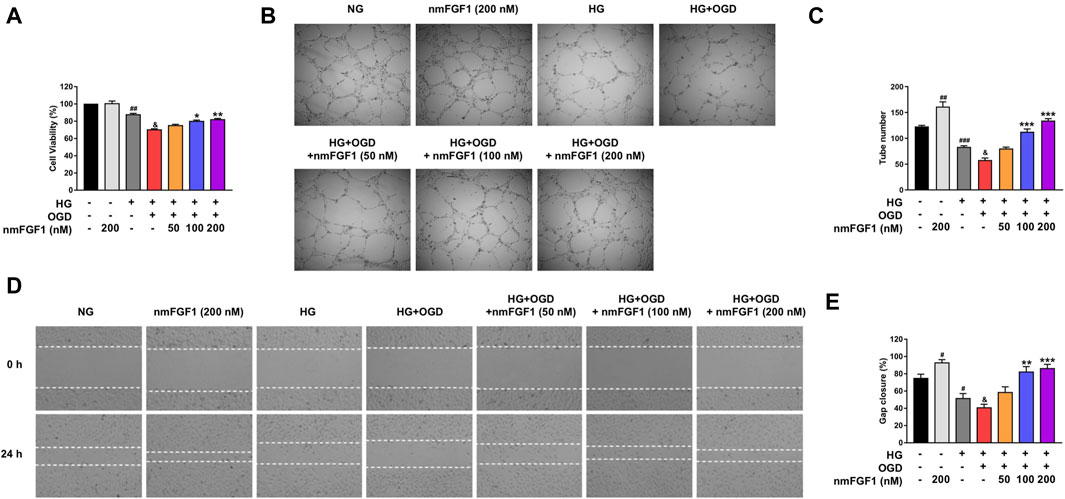
Figure 4. NmFGF1 reversed the reduction of tube formation and cell migration in HG + OGD-treated HBMEC cells. (A) The effect of nmFGF1 on the viability of HG + OGD-treated HBMEC cells. (B) The effects of nmFGF1 on tube formation, original magnification: ×40. (C) Quantitative analysis of the number of capillary-like tubes. (D) Wounding healing migration assay of HBMEC cells; images show wound areas as observed by phase-contrast microscopy, original magnification: ×40. (E) The migration ratio was calculated using Image Pro Plus software (n = 3). Date are presented as means ± SEM. #p < 0.05, ##p < 0.01, ###p < 0.001 vs. NG group; &p < 0.05 vs. HG group; *p < 0.05, **p < 0.01, ***p < 0.001 vs. HG + OGD group.
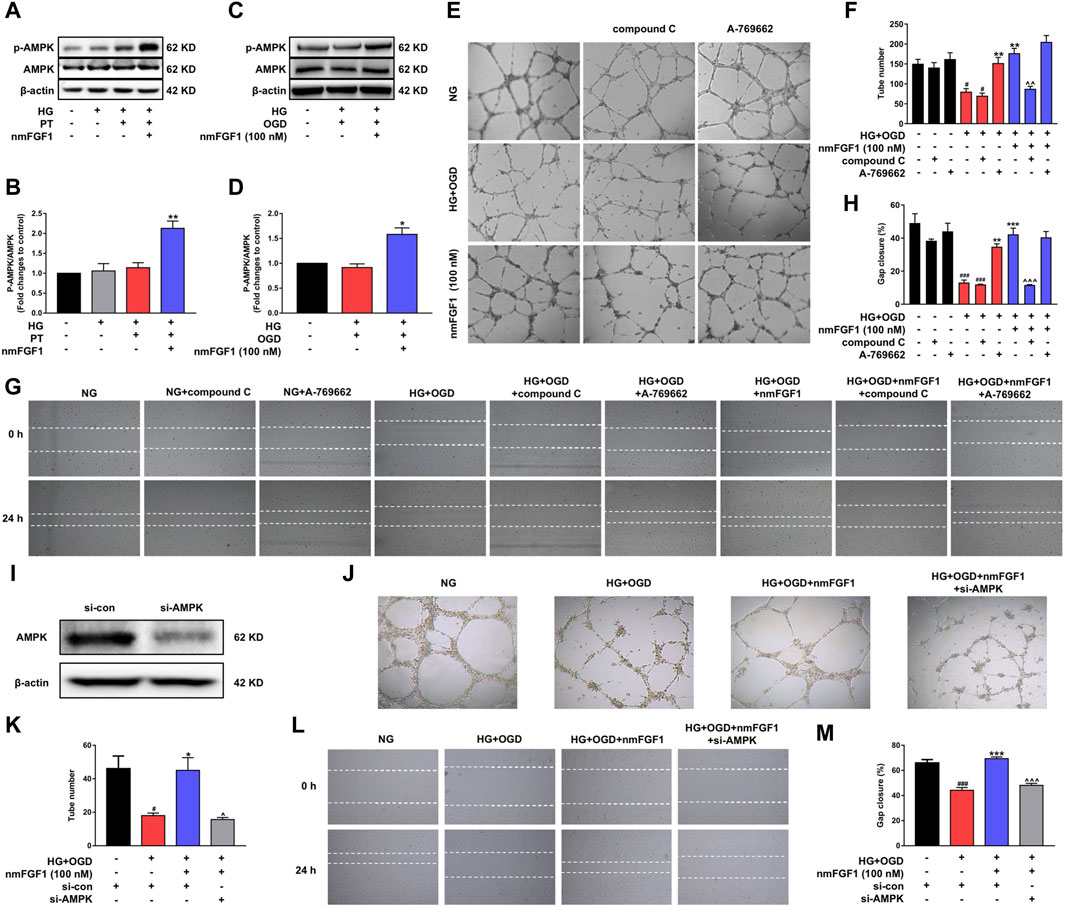
Figure 5. NmFGF1 promoted tube formation and migration of HBMEC in HG + OGD-treated HBMEC cells by activating the AMPK signaling pathway. (A) Western blotting analysis of p-AMPK and AMPK levels in a mouse model of diabetic stroke treated with or without nmFGF1. β-actin was used as a loading control. (B) The ratio of p-AMPK/AMPK. (C) The levels of p-AMPK and AMPK in HBMEC cells, as determined by western blotting. (D) The ratio of p-AMPK/AMPK in HBMECs, as quantified by image software. (E) Cells treated with AMPK agonist or inhibitor. AMPK agonist, A-769662, 10 nM; AMPK inhibitor, compound C, 5 μM. Tube formation was observed by phase contrast microscopy, original magnification: ×40. (F) The number of tubes formed in HBMECs treated with AMPK agonist or inhibitor. (G) The migration ability of HG + OGD-cultured HBMECs treated with an AMPK agonist or inhibitor. Images of the wound areas were observed by phase-contrast microscopy. A-769662, 10 nM, compound C, 5 μM; Original magnification: ×40. (H) The migration ratio was calculated using Image Pro Plus software. (I) AMPK expression was silenced by the transfection of siRNA. (J) The effect of AMPK silencing on tube formation. Original magnification: ×40. (K) Quantitative analysis of tube formation. (L) Wounding healing migration assay of cells in which AMPK had been silenced by siRNA. Original magnification: ×40. (M) Quantitative analysis of migration ratio (n = 3). Data are presented as means ± SEM. #p < 0.05, ##p < 0.01, ###p < 0.001 vs NG group; *p < 0.05, **p < 0.01, ***p < 0.001 vs HG + OGD or HG + PT group; ^p < 0.05, ^^p < 0.01, ^^^p < 0.001 vs HG + OGD + nmFGF1 group.
The authors apologize for this error and state that this does not change the scientific conclusions of the article in any way. The original article has been updated.
Publisher’s note
All claims expressed in this article are solely those of the authors and do not necessarily represent those of their affiliated organizations, or those of the publisher, the editors and the reviewers. Any product that may be evaluated in this article, or claim that may be made by its manufacturer, is not guaranteed or endorsed by the publisher.
Keywords: ischemic stroke, diabetes, nmFGF1, angiogenesis, AMPK
Citation: Zhao Y, Ye S, Lin J, Liang F, Chen J, Hu J, Chen K, Fang Y, Chen X, Xiong Y, Lin L and Tan X (2024) Corrigendum: NmFGF1-regulated glucolipid metabolism and angiogenesis improves functional recovery in a mouse model of diabetic stroke and acts via the AMPK signaling pathway. Front. Pharmacol. 15:1392148. doi: 10.3389/fphar.2024.1392148
Received: 14 March 2024; Accepted: 03 May 2024;
Published: 17 May 2024.
Edited and reviewed by:
Yidong Wang, Xi’an Jiaotong University, ChinaCopyright © 2024 Zhao, Ye, Lin, Liang, Chen, Hu, Chen, Fang, Chen, Xiong, Lin and Tan. This is an open-access article distributed under the terms of the Creative Commons Attribution License (CC BY). The use, distribution or reproduction in other forums is permitted, provided the original author(s) and the copyright owner(s) are credited and that the original publication in this journal is cited, in accordance with accepted academic practice. No use, distribution or reproduction is permitted which does not comply with these terms.
*Correspondence: Xianxi Tan, ZHJ0eHh3ekAxNjMuY29t; Li Lin, bGlubGl3ekAxNjMuY29t; Ye Xiong, eGlvbmd5ZTIzMTBAMTYzLmNvbQ==
†These authors have contributed equally to this work and share first authorship