There was a mistake in Figure 2 as published. The image for the DFO group in Figure 2C was mistakenly replaced with the control group’s image, resulting in partial overlap between Figure 1C and Figure 2C. Additionally, to prevent misinterpretation of the ALI (25 μM) groups in Figures 1C and Figure 2C, we have used new images for the ALI group in Figure 2C. Finally, the housekeeping protein β-actin in Figure 2E was inadvertently duplicated from Figure 5C, and we have corrected this error. The corrected Figure 2 appears below.
FIGURE 2
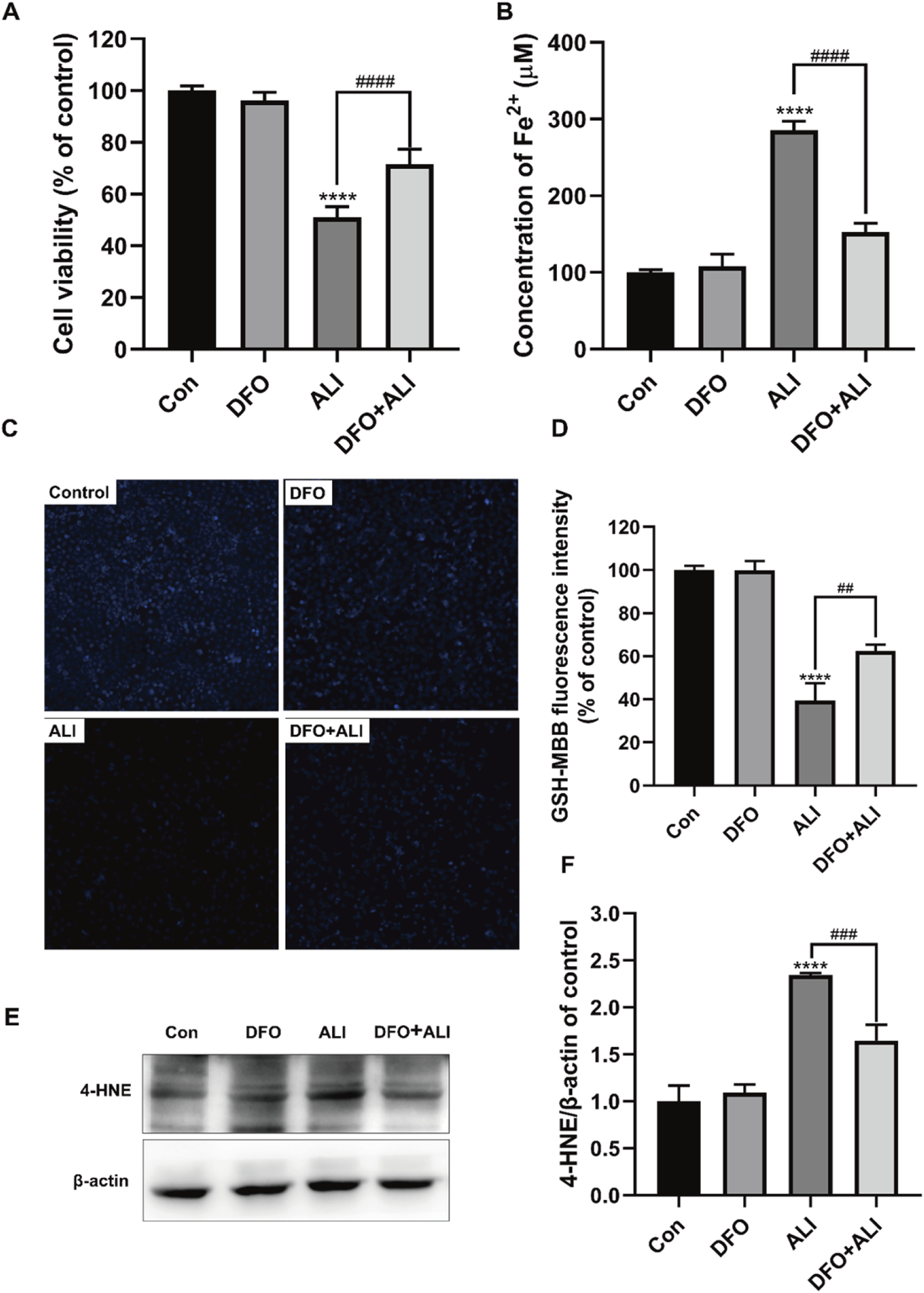
ALI-induced cytotoxicity could be alleviated by iron chelator DFO. (A) Cell viability of HK-2 cells was detected using CCK-8 assay. (B) Intracellular Fe2+ levels in HK-2 cells treated by ALI and DFO. (C,D) Intracellular GSH content in HK-2 (X200). (E,F) The protein levels of 4-HNE were measured by Western blot. *p < 0.05, **p < 0.01, ***p < 0.001, ****p < 0.0001 vs. the control group; #p < 0.05, ##p < 0.01, ###p < 0.001, ####p < 0.0001 vs. the ALI group.
The original article has been updated.
Statements
Publisher’s note
All claims expressed in this article are solely those of the authors and do not necessarily represent those of their affiliated organizations, or those of the publisher, the editors and the reviewers. Any product that may be evaluated in this article, or claim that may be made by its manufacturer, is not guaranteed or endorsed by the publisher.
Summary
Keywords
aristolactam I, nephrotoxicity, ferroptosis, mitochondrial iron overload, Nrf2-HO-1/GPX4
Citation
Deng H-F, Yue L-X, Wang N-N, Zhou Y-Q, Zhou W, Liu X, Ni Y-H, Huang C-S, Qiu L-Z, Liu H, Tan H-L, Tang X-L, Wang Y-G, Ma Z-C and Gao Y (2025) Correction: Mitochondrial iron overload-mediated inhibition of Nrf2-HO-1/GPX4 assisted ALI-induced nephrotoxicity. Front. Pharmacol. 16:1734058. doi: 10.3389/fphar.2025.1734058
Received
28 October 2025
Accepted
28 November 2025
Published
15 December 2025
Volume
16 - 2025
Edited and reviewed by
Ying-Yong Zhao, Northwest University, China
Updates
Copyright
© 2025 Deng, Yue, Wang, Zhou, Zhou, Liu, Ni, Huang, Qiu, Liu, Tan, Tang, Wang, Ma and Gao.
This is an open-access article distributed under the terms of the Creative Commons Attribution License (CC BY). The use, distribution or reproduction in other forums is permitted, provided the original author(s) and the copyright owner(s) are credited and that the original publication in this journal is cited, in accordance with accepted academic practice. No use, distribution or reproduction is permitted which does not comply with these terms.
*Correspondence: Yue Gao, gaoyue@bmi.ac.cn
†These authors have contributed equally to this work
Disclaimer
All claims expressed in this article are solely those of the authors and do not necessarily represent those of their affiliated organizations, or those of the publisher, the editors and the reviewers. Any product that may be evaluated in this article or claim that may be made by its manufacturer is not guaranteed or endorsed by the publisher.