 Laura Migliorini
 Martina Olcese
 Paola Cardinali
 Davide Prestia
- 1Department of Educational Science, University of Genoa, Genoa, Italy
- 2Department of Economics, Mercatorum University, Rome, Italy
- 3IRCCS Ospedale Policlinico San Martino, Genoa, Italy
Introduction
The Russian-Ukrainian conflict, which began in February 2022, has triggered a catastrophic and rapidly growing humanitarian emergency and displacement, threatening the stability of geopolitical relations. At the time of writing, the number of border crossings from Ukraine recorded since the beginning of the war stands at 19,729,989 and the number of Ukrainian refugees registered in Europe stands at 8,157,230, most of whom are women and children because men have been drafted into the armed forces since the conflict began (1, 2). Regarding the experience of forced migration, the literature highlights several traumatic factors that can compromise the mental health of these people (3, 4). Traumatic factors can be classified in relation to the period of forced migration. Before migration, people may experience violence, loss of family or community members, and disruption of family and community life; difficult and strenuous conditions may occur during the journey to move and, finally, reached host countries people can experience social isolation, joblessness and unemployment, language difficulties, different forms of persecution and acculturative stress (5, 6). These experiences are associated with psychological distress and an increased risk of psychiatric disorders; women are also more likely to develop internalizing symptoms (7). In addition, these people are at high risk of developing anxiety and depressive disorders, post-traumatic stress disorder (PTSD), and suicidal ideation/behavior (8–11). To reduce the risk of psychopathology and mental suffering and to improve recovery it is therefore necessary to promote different protective factors, not only at the individual level, but also at the community level (12, 13). It is therefore important to carry out community actions outside of psychiatric service delivery settings to facilitate prevention (14).
Protective factors of community
To address these traumatic factors, from an ecological and multilevel perspective, the community, with its resources, can become a protective factor (15). Among other definitions, in the psychological context, community has been defined as a group of people who share the same values and interests and have similar experiences and needs (16). Concerning community protective factors in forced migration, it is possible to refer to both the migrant community and the host community. On one hand, different aspects of the migrant community can be relevant to cope with the difficulties of forced migration. In fact, faith in the cause of the community, a sense of pride in belonging to one's own ethnic community and the maintenance of one's own community values are protective aspects that facilitate the process of forced migration (6, 17). On the other hand, the host community with its attitude of acculturation can foster the process of hospitality of forced migrants by promoting multiculturalism and not considering migrants as competitors for material and intangible resources (18). In relation to these aspects the protective factor of resilience, understood as the ability to deal with traumatic events by finding the available resources, can also be analyzed at the community level and not only at individual level (19).
Community resilience and related factors
Community resilience understood as the ability to recover from traumatic environmental, economic, or social events and to prepare for future adverse events is conceptualized as a set of adaptive capabilities that can be categorized into community competence, information and communications, economic aspects, and social capital and can be used as a conceptual framework to promote refugee integration and wellbeing and prevent the onset of psychiatric disorders (20–23). In order to reduce the risk of psychopathology of these people, it was deemed necessary to implement mental health and psychosocial support programs (24). Therefore, interventions to promote community resilience for refugees were seen as necessary by linking the community dimension with individual-focused interventions and treatment to promote mental and physical health (25). In line with this, implementing programs in the host country that can foster the different dimensions of community resilience is a relevant aspect (19). In fact, the literature highlights the interventions that promote community competence, such as the sense of agency and empowerment, a sense of cooperation and common vision by creating moments dedicated to the sharing of one's own history or culture through the organization of multicultural meetings, day trips, or celebrating holidays typical of the ethnic culture of belonging (26). Furthermore, the host community can facilitate community resilience by promoting the social support offered by the different formal and informal community services such as the church or voluntary associations and by encouraging the creation of social networks to reduce the risk of isolation (27). In addition, providing adequate information about the host culture and political rights of refugees, promoting the dissemination of positive narratives about migrants, and encouraging access to economic resources through the implementation of job training or economic benefits deriving from the assistance of local non-profit organizations, are key aspects of promoting community resilience (17, 28). Finally, to promote community resilience by enhancing the various factors that characterize the community, the host context might take action to strengthen social support networks, create collaborations and partnerships among community organizations, enhance community resources, and promote the building of a community identity based on cohesion and agency (16, 29–31).
Promoting community resilience in Ukrainian refugees
The Inter-Agency Standing Committee (IASC) Guidelines (32) emphasize the importance of involving community members in coping with emergencies. Bhugra et al. (33) highlight in their recommendations to policymakers the importance of involving migrants in various actions such as cultural competence training. Finally, it is necessary to host Ukrainians, with their specificity of being predominantly refugee women and children who have often found refuge in countries neighboring Ukraine, where there is greater cultural proximity and possibility of return to their homeland, helping them to become citizens and to contribute their resources and talents to a cultural exchange with the host context (34, 35). In line with this to promote community resilience among forced migrants, one useful approach is community-based participatory research (CBPR) (36). CBPR is a research orientation that involves an equal partnership between communities and researchers, incorporating community theories, participation and practices into research efforts. This model fosters community health promotion through a participatory approach in terms of intervention design and implementation (37). This mechanism creates a process of empowerment through the sharing of information, resources, support and decision-making power (38).
The use of CBPR, with constant involvement of the migrant community and its representatives helps in tailoring services to the specific ethnic and cultural context of the community, avoiding the implementation of general actions that may not be well-suited for the population involved. This targeted approach is identified as key in the promotion of mental health and the prevention of mental disorders in humanitarian emergencies (39).
Promoting community resilience among Ukrainian migrants through a Community-Based Participatory Research (CBPR) method can be highly effective in addressing their unique needs and fostering empowerment as evidenced with refugees of other nationalities (40). Table 1 shows how CBPR can be applied, along with practical examples with Ukrainian community inspired by the key actions of the guidelines on mental health and on the emergencies and literature on Ukrainian refugees and CBPR approach (22, 32, 33, 41).
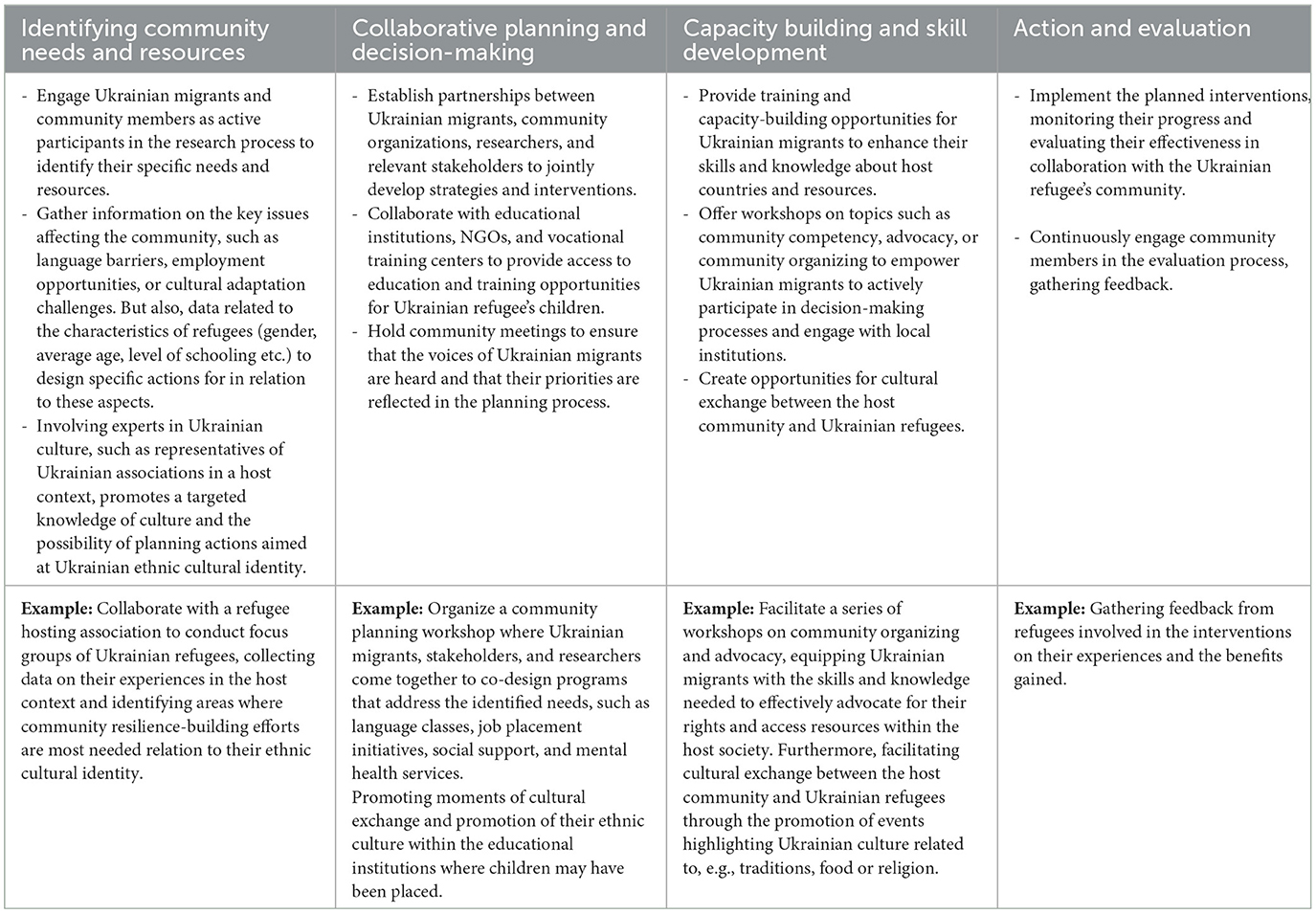
Table 1. Practical examples proposal of CBPR method's steps with the Ukrainian refugees.
Discussion
In this opinion article, we presented the community resilience approach to promoting refugees' integration and wellbeing and preventing the onset of psychiatric disorders, which could also be applied to Ukrainian migrants. In our opinion hosting refugees is a challenge also for the host community, which is called upon to deploy tangible and intangible resources that can promote community resilience and reduce risk factors for the development of mental health problems and psychiatric disorders among refugees, with a consequent reduction of health care costs. At the same time, a resilient refugee community can increase the resources of the host country. Indeed, in line with this framework, it can be argued that the design and implementation of community-centered interventions, with a focus on community resilience, are key aspects to protect the traumatic factors to which these people are exposed.
Given the difficult situation of Ukrainian immigrants, host countries might take steps to promote projects and actions that can foster the welfare of the individual at the community level, in addition to the individual. Such projects should strength the resilience of the refugee community who are facing the trauma of war and forced migration and who may later face a possible return to their country with its attendant difficulties. In order to do that, it is necessary to implement projects in which the community is involved, in which it's possible to promote agency and empowerment, and in which the different resilience factors of the community can be fostered, in a collaborative approach between political institutions and various community actors, e.g., through the CBPR methodology that involves community members in the whole process and promotes the implementation of actions related to the ethnic, cultural and sociodemographic specificity of Ukrainian refugees. Indeed, CBPR methodology can empowers Ukrainian migrant communities to actively participate in research and intervention processes, fostering community resilience. By leveraging their strengths and collaborating closely with community members, researchers can create impactful initiatives tailored to the specific needs of Ukrainian migrants.
In conclusion, further works are needed to clarify effective ways to implement projects by host countries to empower the community resilience of Ukrainian refugees.
Author contributions
LM and DP developed the idea presented. PC and MO developed the theory and drafted the manuscript. All authors critically reviewed the manuscript and gave their final approval.
Conflict of interest
The authors declare that the research was conducted in the absence of any commercial or financial relationships that could be construed as a potential conflict of interest.
Publisher's note
All claims expressed in this article are solely those of the authors and do not necessarily represent those of their affiliated organizations, or those of the publisher, the editors and the reviewers. Any product that may be evaluated in this article, or claim that may be made by its manufacturer, is not guaranteed or endorsed by the publisher.
References
1. United Nations High Commissioner for Refugees,. Operational Data Portal. (2023). Available online at: https://data.unhcr.org/en/situations/ukraine (accessed March 28, 2023).
2. Ukraine's Military Plans to Limit Free Movement to Make Conscription Easier. The Guardian. (2022). Available online at: https://www.theguardian.com/world/2022/jul/06/ukraines-military-plans-to-limit-free-movement-to-make-conscription-easier (accessed March 29, 2023).
3. Uphoff E, Robertson L, Cabieses B, Villalon FJ, Purgato M, Churchill R, et al. An overview of systematic reviews on mental health promotion, prevention, and treatment of common mental disorders for refugees, asylum seekers, and internally displaced persons. Cochrane Database Syst Rev. (2020) 9:9. doi: 10.1002/14651858.CD013458.pub2
4. Giacco D, Laxhman N, Priebe S. Prevalence of and risk factors for mental disorders in refugees. Semin Cell Develop Biol. (2018) 77:144–52. doi: 10.1016/j.semcdb.2017.11.030
5. Hodes M, Hussain N. The role of family functioning in refugee child and adult mental health. In:De Haene L, Rousseau C, , editor. Working with Refugee Families. Trauma Exile in Family Relation. Cambridge University Press (2020). p. 17–35.
6. Rosner R, Hagl M, Bücheler L, Comtesse H. Homesickness in asylum seekers: the role of mental health and migration-related factors. Front Psychiatry. (2022) 13:1034370. doi: 10.3389/fpsyt.2022.1034370
7. Smid GE. A framework of meaning attribution following loss. Eur J Psychotraumatol. (2020) 11:1776563. doi: 10.1080/20008198.2020.1776563
8. Charlson F, van Ommeren M, Flaxman A, Cornett J, Whiteford H, Saxena S. New WHO prevalence estimates of mental disorders in conflict settings: a systematic review and meta-analysis. Lancet. (2019) 394:240–8. doi: 10.1016/S0140-6736(19)30934-1
9. Javanbakht A. Addressing war trauma in Ukrainian refugees before it is too late. Europ J Psychotraumatol. (2022) 13:2104009. doi: 10.1080/20008066.2022.2104009
10. Elvevåg B, DeLisi LE. The mental health consequences on children of the war in Ukraine: a commentary. Psychiatry Rese. (2022) 317:114798. doi: 10.1016/j.psychres.2022.114798
11. Teshome AA, Abebe EC, Mengstie MA, Seid MA, Yitbarek GY, Molla YM et al. Post-traumatic stress disorder and associated factors among adult war survivors in Northwest Ethiopia: community-based, cross-sectional study. Front Psychiatry. (2023) 14:1083138. doi: 10.3389/fpsyt.2023.1083138
12. Vindevogel S, Verelst A. Supporting mental health in young refugees: a resilience perspective. In:Song S, Ventevogel P, , editor. Child, Adolesc Family Refugee Ment Health: A Global Perspec. Cham: Springer (2020). p. 53–65.
13. Höhne E, van der Meer AS, Kamp-Becker I, Christiansen H. A systematic review of risk and protective factors of mental health in unaccompanied minor refugees. Europ Child Adolesc Psychiatry. (2020) 1:15. doi: 10.1007/s00787-020-01678-2
14. Hassan G, Ventevogel P, Jefee-Bahloul H, Barkil-Oteo A, Kirmayer LJ. Mental health and psychosocial wellbeing of Syrians affected by armed conflict. Epidemiol Psychiatri Sci. (2016) 25:129–41. doi: 10.1017/S2045796016000044
15. Hodes M. Thinking about young refugees' mental health following the Russian invasion of Ukraine in 2022. Clin Child Psychol Psychiatry. (2023) 28:3–14. doi: 10.1177/13591045221125639
16. Siddiq H, Elhaija A, Wells K. An integrative review of community-based mental health interventions among resettled refugees from Muslim-majority countries. Community Ment Health J. (2023) 59:160–74. doi: 10.1007/s10597-022-00994-y
17. Mwanri L, Anderson L, Gatwiri K. Telling our stories: resilience during resettlement for African skilled migrants in Australia. Int J Environ Res Public Health. (2021) 18:3954. doi: 10.3390/ijerph18083954
18. Verbena S, Rochira A, Mannarini T. Community resilience and the acculturation expectations of the receiving community. J Community Psychol. (2021) 49:390–405. doi: 10.1002/jcop.22466
19. Wünsche M, Fischer S. Community resilience. networks for developing successful migration. In:Fingerle M, Wink R, , editor. Forced Migrat Resili: Conceptual Issues Empirical Results. Wiesbaden: Springer (2020). p. 45–69.
20. Koliou M, van de Lindt JW, McAllister TP, Ellingwood BR, Dillard M, Cutler H. State of the research in community resilience: progress and challenges. Sustain Resilient Infrastruct. (2020) 5:131–51. doi: 10.1080/23789689.2017.1418547
21. Tippens JA. Urban Congolese refugees' social capital and community resilience during a period of political violence in Kenya: a qualitative study. J Immigr Refugee Stud. (2020) 18:42–59. doi: 10.1080/15562948.2019.1569744
22. Norris FH, Stevens SP, Pfefferbaum B, Wyche KF, Pfefferbaum RL. Community resilience as a metaphor, theory, set of capacities, and strategy for disaster readiness. Am J Community Psychol. (2008) 41:127–50. doi: 10.1007/s10464-007-9156-6
23. Elshahat S, Moffat T. Mental health triggers and protective factors among Arabic-speaking immigrants and refugees in North America: a scoping review. J Immigr Minor Health. (2022) 24:489–505. doi: 10.1007/s10903-021-01215-6
24. Murphy A, Fuhr D, Roberts B, Jarvis CI, Tarasenko A, McKee M. The health needs of refugees from Ukraine. BMJ. (2022) 377:o864. doi: 10.1136/bmj.o864
25. Ciaramella M, Monacelli N, Cocimano LCE. Promotion of resilience in migrants: a systematic review of study and psychosocial intervention. J Immigr Minor Health. (2022) 24:1328–44. doi: 10.1007/s10903-021-01247-y
26. Kuttikat M, Vaillancourt A, Massey M. Battered but bold: Sri Lankan Tamil refugee war experiences, camp challenges and resilience. Int J Migr Health Soc Care. (2018) 14:245–59. doi: 10.1108/IJMHSC-04-2017-0013
27. Wachter K, Dalpe J, Bonz A, Drozdowski H, Hermer J. A scoping review of social support interventions with refugees in resettlement contexts: implications for practice and applied research. J Immigr Refugee Stud. (2021) 19:557–72. doi: 10.1080/15562948.2020.1854917
28. Logie CH, Lacombe-Duncan A, Lee-Foon N, Ryan S, Ramsay H. “It's for us–newcomers, LGBTQ persons, and HIV-positive persons. You feel free to be”: a qualitative study exploring social support group participation among African and Caribbean lesbian, gay, bisexual and transgender newcomers and refugees in Toronto, Canada. BMC Intl Health Hum Rights. (2016) 16:10. doi: 10.1186/s12914-016-0092-0
29. Rinker JA, Khadka N. Bhutanese refugees: on understanding the links between trauma, displacement, and community resilience. Global J Peace Res Praxis. (2018) 2:1.
30. Moore J. Postmigration living difficulties, help-seeking and community resilience in the initial stages of migration: coproducing community practice with recent Irish migrants to London. J Community Pract. (2018) 26:125–42. doi: 10.1080/10705422.2018.1450319
31. Roszik-Volovik X, Brandão AP, Kollárovics N, Farkas BF, Frank-Bozóki E, Horváth LO et al. Research group as helpers due to the war in Ukraine: focus group experiences of women researchers. Front Psychiatry. (2023) 14:1139252. doi: 10.3389/fpsyt.2023.1139252
32. Inter-Agency Standing Committee. IASC Guidelines on Mental Health and Psychosocial Support in Emergency Settings. Geneva: IASC 2006 (2006).
33. Bhugra D, Gupta S, Bhui K, Craig TOM, Dogra N, Ingleby JD, et al. WPA guidance on mental health and mental health care in migrants. World Psychiatry. (2011) 10:2–10. doi: 10.1002/j.2051-5545.2011.tb00002.x
34. Kaufman KR, Bhui K, Katona C. Mental health responses in countries hosting refugees from Ukraine. BJPsych Open. (2022) 8:87. doi: 10.1192/bjo.2022.55
35. Andrews J, Isański J, Nowak M, Sereda V, Vacroux A, Vakhitova H, et al. Feminized forced migration: Ukrainian war refugees. Womens Stud Int Forum. (2023) 99:102756. doi: 10.1016/j.wsif.2023.102756
36. Revens KE, Gutierrez D, Paul R, Reynolds AD, Price R, DeHaven MJ, et al. Social support and religiosity as contributing factors to resilience and mental wellbeing in Latino immigrants: a community-based participatory research study. J Immigr Minority Health. (2021) 23:904–16. doi: 10.1007/s10903-021-01179-7
37. Wallerstein NB, Duran B. Using community-based participatory research to address health disparities. Health Promot Pract. (2006) 7:312–23. doi: 10.1177/1524839906289376
38. Jones L, Wells K. Strategies for academic and clinician engagement in community-participatory partnered research. JAMA. (2007) 297:407–10. doi: 10.1001/jama.297.4.407
39. Greene MC, Jordans MJ, Kohrt BA, Ventevogel P, Kirmayer LJ, Hassan G, et al. Addressing culture and context in humanitarian response: preparing desk reviews to inform mental health and psychosocial support. Confl Health. (2017) 11:1–10. doi: 10.1186/s13031-017-0123-z
40. Walton DPT, Schwartz DPT, Ambia M, Ummul SJM, Zaaeed D, Schbley B, et al. Community based rehabilitation programs for resettled Muslim women refugees. J Health Ethics. (2022) 18:6. doi: 10.18785/jhe.1801.06
Keywords: community resilience, wellbeing, forced migration, Ukrainian refugees, trauma, stress disorders, protective factors
Citation: Migliorini L, Olcese M, Cardinali P and Prestia D (2023) Community resilience among Ukrainian refugees: what is the role of the host community in recovery from forced migration? Front. Psychiatry 14:1206304. doi: 10.3389/fpsyt.2023.1206304
Received: 15 April 2023; Accepted: 24 July 2023;
Published: 03 August 2023.
Edited by:
Rana Dajani, Hashemite University, JordanReviewed by:
Ram Sapkota, University of Regina, CanadaCopyright © 2023 Migliorini, Olcese, Cardinali and Prestia. This is an open-access article distributed under the terms of the Creative Commons Attribution License (CC BY). The use, distribution or reproduction in other forums is permitted, provided the original author(s) and the copyright owner(s) are credited and that the original publication in this journal is cited, in accordance with accepted academic practice. No use, distribution or reproduction is permitted which does not comply with these terms.
*Correspondence: Paola Cardinali, cGFvbGEuY2FyZGluYWxpQHVuaW1lcmNhdG9ydW0uaXQ=