 Elaine B. Clarke
 James B. McCauley2
 Stephen J. Sheinkopf
 Catherine Lord
- 1Department of Psychiatry and Biobehavioral Sciences, University of California, Los Angeles, Los Angeles, CA, United States
- 2Department of Psychology, St. Mary’s College of California, Moraga, CA, United States
- 3Department of History and Sociology of Science, University of Pennsylvania, Philadelphia, PA, United States
- 4Fundación Brincar por un Autismo Feliz, Buenos Aires, Argentina
- 5Consejo Nacional de Investigaciones Científicas Y Técnicas, Buenos Aires, Argentina
- 6Thompson Center for Autism and Neurodevelopment, University of Missouri, Columbia, MO, United States
A Corrigendum on
Understanding profound autism: implications for stigma and supports
by Clarke EB, McCauley JB, Lutz A, Gotelli M, Sheinkopf SJ and Lord C (2024). Front. Psychiatry. 15:1287096. doi: 10.3389/fpsyt.2024.1287096
In the published article, there was an error in Table 2, Profound Autism Prevalence Estimates by Sample, Gender, and Race, as published. We have identified several typographical errors in the original Lancet Commission, from which the statistics in Table 2 for the EDX sample were derived. The corrected Table 2, Profound Autism Prevalence Estimates by Sample, Gender, and Race and its caption, appear below.
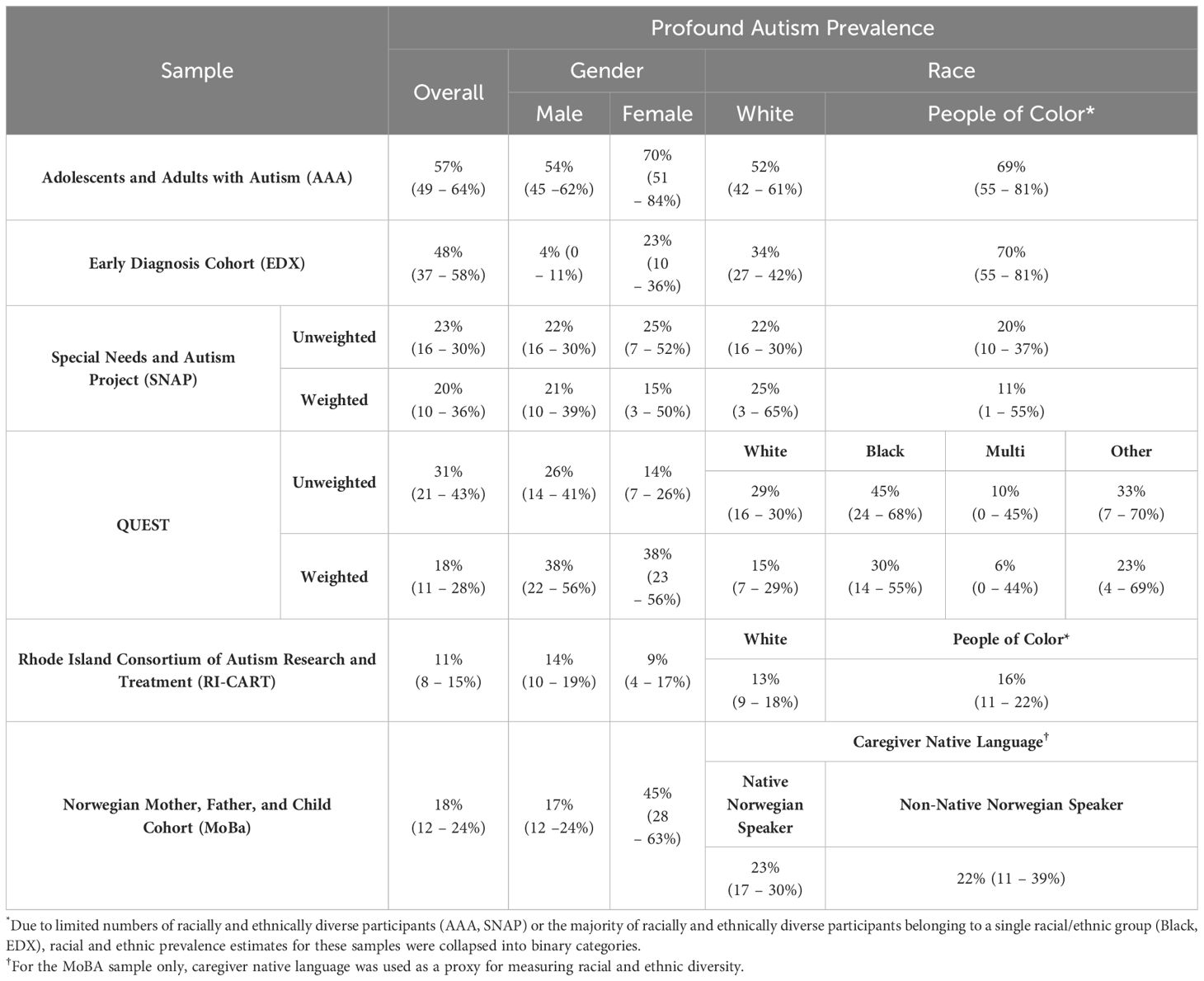
Table 2 Profound autism prevalence estimates by sample, gender, and race.
In the published article, there was an error the Results, United States Samples Prevalence Estimates, Paragraph 1. In the original Lancet paper, from which Table 2 and some of the Results section were derived, the proportions of individuals with profound autism in the EDX sample were incorrect. This sentence previously stated:
“The proportion of individuals meeting one or both criteria for profound autism criteria was 48% (95% CI 37–58%) in the EDX sample. A higher proportion of females in EDX met profound autism criteria than males, although confidence ranges overlapped (23% vs. 4%, see Table 2 for confidence intervals). Moreover, a higher proportion of participants of color met criteria for profound autism in the EDX sample compared to white participants (70% vs. 34%).”
The corrected sentence appears below:
“The proportion of individuals meeting one or both criteria for profound autism criteria was 57% (95% CI 49–64%) in the EDX sample. A higher proportion of females in EDX met profound autism criteria than males, although confidence ranges overlapped (70% vs. 54%, see Table 2 for confidence intervals). Moreover, a higher proportion of participants of color met criteria for profound autism in the EDX sample compared to white participants (69% vs. 52%).”
The authors apologize for these errors and state that this does not change the scientific conclusions of the article in any way. The original article has been updated.
Publisher’s note
All claims expressed in this article are solely those of the authors and do not necessarily represent those of their affiliated organizations, or those of the publisher, the editors and the reviewers. Any product that may be evaluated in this article, or claim that may be made by its manufacturer, is not guaranteed or endorsed by the publisher.
Keywords: autism spectrum disorder, profound autism, stigma and awareness, prevalence, mixed method, qualitative interview analysis, autistic adults
Citation: Clarke EB, McCauley JB, Lutz A, Gotelli M, Sheinkopf SJ and Lord C (2024) Corrigendum: Understanding profound autism: implications for stigma and supports. Front. Psychiatry 15:1396556. doi: 10.3389/fpsyt.2024.1396556
Received: 05 March 2024; Accepted: 24 May 2024;
Published: 13 June 2024.
Edited and Reviewed by:
Stefan Borgwardt, University of Lübeck, GermanyCopyright © 2024 Clarke, McCauley, Lutz, Gotelli, Sheinkopf and Lord. This is an open-access article distributed under the terms of the Creative Commons Attribution License (CC BY). The use, distribution or reproduction in other forums is permitted, provided the original author(s) and the copyright owner(s) are credited and that the original publication in this journal is cited, in accordance with accepted academic practice. No use, distribution or reproduction is permitted which does not comply with these terms.
*Correspondence: Elaine B. Clarke, ZWNsYXJrZUBtZWRuZXQudWNsYS5lZHU=