In the published article, there was an error in the Abstract, Results. This sentence previously stated:
“By contrast, the highest levels corresponded to Writing and Personal and Domestic Autonomy.”
The corrected sentence appears below:
“By contrast, the highest levels corresponded to Personal and Domestic Autonomy.”
In the published article, there was an error in Figure 2 as published. The mean value of Communication DAE was recalculated. The corrected Figure 2 and its caption appear below:
Figure 2
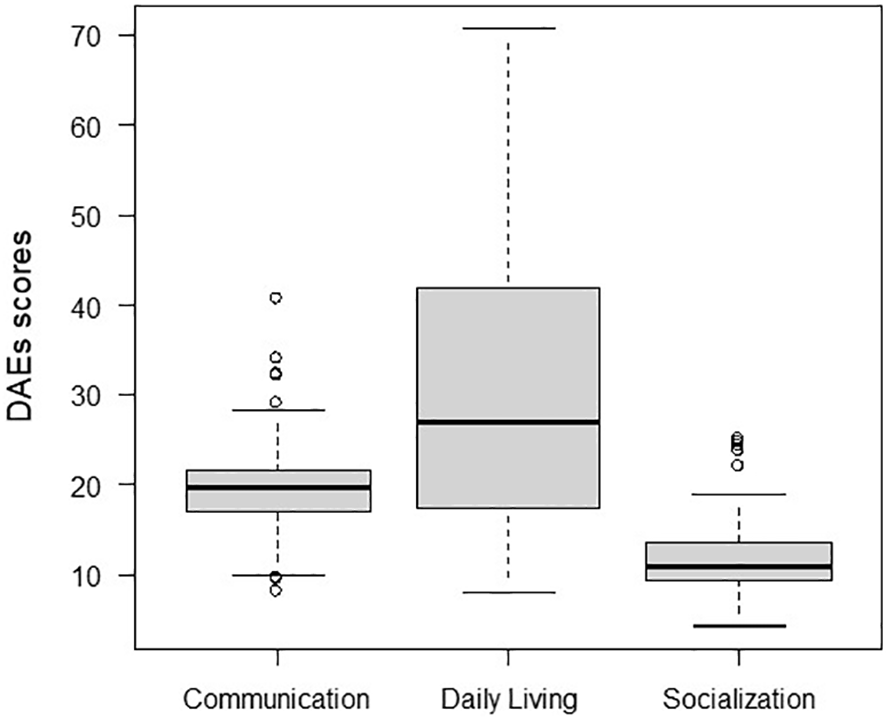
Profile of the median development ages equivalent (DAE) and interquartile range of the three domains of socio-adaptive development.
In the published article, there were errors in Table 2 as published. The values of 'VABS-II – Global DAE' and 'VABS-II - DAE Communication' were recalculated. 'VABS-II—Standard score Communication, Scale score Written' and 'VABS-II—DAE Communication, DAE Written' were removed. The caption previously stated:
Table 2
| M | Md | SD | IQR | Min | Max | |
|---|---|---|---|---|---|---|
| VABS-II – Standard score Communication | 20 | 20 | 0 | 0 | 20 | 20 |
| 1. Scale score Receptive | 1.1 | 1 | .6 | 0 | 1 | 6 |
| 2. Scale score Expressive | 1 | 1 | 0 | 0 | 1 | 1 |
| VABS-II - Standard score Daily Living | 20.2 | 20 | 1.3 | 0 | 20 | 29 |
| 1. Scale score Personal Autonomy | 1.04 | 1 | .27 | 0 | 1 | 3 |
| 2. Scale score Domestic Autonomy | 1.6 | 1 | 1.3 | 1 | 1 | 7 |
| 3. Scale score Community Autonomy | 1 | 1 | 0 | 0 | 1 | 1 |
| VABS-II - Standard score Socialization | 20 | 20 | 0 | 0 | 20 | 20 |
| 1. Scale score Interpersonal Relationships | 1 | 1 | 0 | 0 | 1 | 1 |
| 2. Scale score Play/Leisure | 1 | 1 | 0 | 0 | 1 | 1 |
| 3. Scale score Adaptation | 1 | 1 | 0 | 0 | 1 | 1 |
| VABS-II – Global DAE | 19.5 | 17.6 | 8.2 | 11,8 | 8.4 | 42.9 |
| VABS-II - DAE Communication | 14.4 | 12.5 | 6.9 | 5 | 8 | 50 |
| 1. DAE Receptive | 15.9 | 16.0 | 7.0 | 6.0 | 8.0 | 39 |
| 2. DAE Expressive | 12.9 | 10.0 | 8.7 | 6.0 | 7.0 | 61 |
| VABS-II - DAE Daily Living | 31.1 | 27.0 | 16.6 | 24.7 | 8.0 | 70.7 |
| 1. DAE Personal Autonomy | 33.3 | 31.0 | 17.1 | 21.0 | 8.0 | 107 |
| 2. DAE Domestic Autonomy | 40.9 | 27.0 | 32.4 | 50.0 | 5.9 | 127 |
| 3. DAE Community Autonomy | 19.2 | 12.0 | 12.6 | 21.0 | 8.0 | 57 |
| VABS-II - DAE Socialization | 12.3 | 11.0 | 4.9 | 4.3 | 4.3 | 25 |
| 1. DAE Interpersonal Relationships | 10.2 | 8.0 | 4.1 | 2.0 | 3.0 | 27 |
| 2. DAE Play/Leisure | 11.6 | 8.0 | 6.8 | 4.0 | 8.0 | 41 |
| 3. DAE Adaptation | 16.1 | 13.0 | 6.9 | 8.0 | 8.0 | 37 |
Values of mean (M), median (Md), Standard Deviation (SD), interquartile range (IQR), minimum and maximum of standard scores of the 3 domains and scale scores of the 8 subdomains of the 69 adults (VABS-II).
Values of the Development ages equivalent (DAE) of 3 domains of adaptive functioning and the 8 subdomains of the 69 adults (VABS-II). VABS, Vineland Adaptive Behavior Scale.
In gray: Standard and DAE scores of three domain.
“Values of mean (M), median (Md), Standard Deviation (SD), interquartile range (IQR), minimum and maximum of standard scores of the 3 domains and scale scores of the 9 subdomains of the 69 adults (VABS-II). Values of the Development ages equivalent (DAE) of 3 domains of adaptive functioning and the 9 subdomains of the 69 adults (VABS-II).”
The corrected Table 2 and its caption appear below:
In the published article, there was an error in Table 3 as published. The correlations between 'DAE Communication subdomains, Written DAE, Expressive DAE and Receptive DAE‘ were removed. The corrected Table 3 and its caption appear below:
Table 3
| Pairwise comparison | χ² (Durbin-Conover) | p | ||
|---|---|---|---|---|
| Three domains of adaptive functioning | ||||
| DAE Communication | – | DEA Daily Living | 15.3 | < .001 |
| DAE Communication | – | DEA Socialization | 2.58 | .011 |
| DAE Daily Living | – | DEA Socialization | 17.88 | < .001 |
| DAE Communication subdomains | ||||
| Receptive | – | Expressive | 4.8 | < .001 |
| DAE Daily Living subdomains | ||||
| Personal | – | Community | 8.06 | < .001 |
| Personal | – | Domestic | 0.22 | 0.824 |
| Community | – | Domestic | 8.28 | < .001 |
| DAE Socialization subdomains | ||||
| Interpersonal Relationships | – | Play/Leisure | 1.93 | 0.055 |
| Interpersonal Relationships | – | Adaptation | 11.16 | < .001 |
| Play/Leisure | – | Adaptation | 9.23 | < .001 |
Testing for pairwise differences in median development ages equivalent of domains and sub-domains scores Vineland-II of the 69 adults.
In the published article, there was an error in 3 Results, 3.2 Adaptive functioning developmental profile, Paragraph 1. The section previously stated:
“Therefore, because this work was concerned with adaptive development, only DAE values were considered for the statistical analysis. Moreover, as the VABS-II norms do not indicate DAEs for Communication, Daily Living, and Socialization domains, the DAEs calculated corresponded to the median and mean values of their three subdomains.
The corrected section appears below:
“Therefore, because this work was concerned with adaptive development, only DAE values were considered for the statistical analysis, excepted for Writing not interpretable in this study. Moreover, as the VABS-II norms do not indicate DAEs for Communication, Daily Living, and Socialization domains, the DAEs calculated corresponded to the median and mean values of their three subdomains (only two for Communication: Receptive and Expressive).”
In the published article, there was an error in 3 Results, 3.3 Adaptive functioning profile by domains and subdomains, Paragraph 1. This sentence previously stated:
“The values of DAE of three domains of adaptive functioning and the nine subdomains (VABS-II) of 69 adults are presented in Table 2 (data were missing for two participants).”
The corrected sentence appears below:
“The values of standard scores, scale scores and DAE of three domains of adaptive functioning and the eight subdomains of 69 adults are presented in Table 2 (data were missing for two participants).”
In the published article, there was an error in 3 Results, 3.3.1, The three adaptive functioning domains, Paragraph 4. This sentence previously stated:
“Comparisons of the DAEs for Communication, Daily Living, and Socialization were performed using nonparametric tests suitable for repeated measurements (χ² Friedman (2, N = 69) = 85.8, p <.001, w = 0.62). Multiple comparisons were followed by analytical comparisons [34] (Table 2).”
The corrected sentence appears below:
“Comparisons of the DAEs for Communication, Daily Living, and Socialization were performed using nonparametric tests suitable for repeated measurements (χ² Friedman (2, N = 69) = 101, p <.001, w = 0.73). Multiple comparisons were followed by analytical comparisons [34] (Table 3).”
In the published article, there were errors in 3 Results, 3 Adaptive functioning profile by domains and subdomains. The subheading 3.3.2 was incorrectly given as “3.3.2 The nine adaptive domains”. The correct subheading is “3.3.2 The eight adaptive domains”. There was also an error in Paragraph 2, which previously stated:
“For Communication (Multiple comparisons: χ² Friedman (2, N = 69) = 60.3, p <.001, w = 0.44) (Table 2), there were significant differences between the values of the Expressive, Receptive, and Written DAEs, with those of the Written subdomain (DAE = 37 months) being more developed than the two others.”
The corrected sentence appears below:
“For Communication (Multiple comparisons: χ² Friedman (2, N = 69) = 60.3, p <.001, w = 0.44) (Table 3), there were significant differences between the values of the Expressive and Receptive DAEs with those of receptive subdomain being more developed.”
In the published article, there was an error in 3 Results, 3.4 Relationships between socio-adaptive development and autistic symptomatology, Paragraph 2. This sentence previously stated:
“The severity of autistic symptomatology was significantly correlated with a low overall socio-adaptive level, a low level of autonomy in daily living (particularly the levels of development of domestic autonomy and autonomy in the community), and a low level of expressive communication”.
The corrected sentence appears below:
“The severity of autistic symptomatology was significantly correlated with a low overall socio-adaptive level, a low level of autonomy in daily living (particularly the levels of development of domestic autonomy and autonomy in the community), and a low level of expressive and receptive communication”.
In the published article, there was an error in 5 Discussion, Paragraph 4. This sentence previously stated:
“Results show evidence that the mean of the median DAE of socio-adaptive development (21.1 months) was slightly higher than that of cognitive and socio-emotional development (12 to 15 months), contrary to what was noted previously (17, 18).”
The corrected sentence appears below:
“Results show evidence the median of the global DAE of socio-adaptive development (17.6 months) was slightly higher than that of cognitive and socio-emotional development (12 to 15 months), contrary to what was noted previously (17, 18).”
In the published article, there was an error in 5 Discussion, Paragraph 5. This sentence previously stated:
“The median DAEs in the three domains of socio-adaptive development of these adults were as follows: the DAE of Communication was 19.7 months, the DAE of Daily Living was 27 months, and the DAE of Socialization was 11 months.”
The corrected sentence appears below:
“The median DAEs in the three domains of socio-adaptive development of these adults were as follows: the DAE of Communication was 12.5 months, the DAE of Daily Living was 27 months, and the DAE of Socialization was 11 months.”
The authors apologize for these errors and state that they do not change the scientific conclusions of the article in any way. The original article has been updated.
Statements
Publisher’s note
All claims expressed in this article are solely those of the authors and do not necessarily represent those of their affiliated organizations, or those of the publisher, the editors and the reviewers. Any product that may be evaluated in this article, or claim that may be made by its manufacturer, is not guaranteed or endorsed by the publisher.
Summary
Keywords
autism spectrum disorder, severe intellectual disability, Vineland-II, profiles of socio-adaptive development, heterogeneity, autonomy, Socio-Emotional and Cognitive Evaluation Battery-Adult - SCEB-A
Citation
Adrien J-L, Blanc R and Thiébaut E (2025) Corrigendum: Profile and development of adaptive behavior in adults with autism spectrum disorder and severe intellectual disability. Front. Psychiatry 16:1579158. doi: 10.3389/fpsyt.2025.1579158
Received
18 February 2025
Accepted
10 March 2025
Published
26 March 2025
Volume
16 - 2025
Edited and reviewed by
Tze Jui Goh, Institute of Mental Health, Singapore
Updates
Copyright
© 2025 Adrien, Blanc and Thiébaut.
This is an open-access article distributed under the terms of the Creative Commons Attribution License (CC BY). The use, distribution or reproduction in other forums is permitted, provided the original author(s) and the copyright owner(s) are credited and that the original publication in this journal is cited, in accordance with accepted academic practice. No use, distribution or reproduction is permitted which does not comply with these terms.
*Correspondence: Jean-Louis Adrien, jean-louis.adrien@parisdescartes.fr; jean-louis.adrien@u-paris.fr
Disclaimer
All claims expressed in this article are solely those of the authors and do not necessarily represent those of their affiliated organizations, or those of the publisher, the editors and the reviewers. Any product that may be evaluated in this article or claim that may be made by its manufacturer is not guaranteed or endorsed by the publisher.