Abstract
Forensic psychiatry aims to reduce criminogenic risks and enhance societal safety. While effective at a macro level, crime recidivism rates among forensic patients remain substantial. This underlines the need for innovation, with growing interest in the use of physiological biomarkers. To identify the extent (size), range, (variety), and nature (characteristics) of evidence on the use of physiological biomarkers in forensic psychiatry, a systematic scoping review was conducted following JBI methodology and PRISMA-ScR guidance. Data on study characteristics and results were extracted by two independent reviewers from 431 primary research studies published in scientific journals and dissertations. Most studies were conducted in North America (53.4%) and Europe (41.3%). The majority employed an observational design (95.6%) and were cross-sectional (87.7%). Studies predominantly focused on males (84.9%) and adults (85.9%). The most common diagnoses were psychopathy/antisocial personality disorder (51.7%) and sexual disorders (21.8%). Brain activity served as a biomarker outcome in 51.3% of studies, followed by peripheral sympathetic arousal (29.2%) and peripheral sexual arousal (13.8%). Biomarker assessment methods reflected these findings. Etiologic biomarker functions were most common (77.2%), followed by diagnostic functions (12.7%). Findings reveal several gaps in the existing scientific literature. Specifically, more experimental and longitudinal research is needed to integrate physiological biomarkers into e.g., interventions, effect monitoring, and (risk) assessment. Also, a greater focus on juveniles, patients with psychotic and substance use disorders, and the use of newer biomarker assessment methods measuring peripheral arousal is essential to advance the field.
Systematic review registration:
https://osf.io/, 10.17605/OSF.IO/46QBU.
1 Introduction
Certain types of psychopathology, such as schizophrenia, substance use disorder (SUD), and antisocial personality disorder, are significant risk factors for (recurrent) delinquent behavior (1–3). Forensic psychiatry aims to reduce criminogenic risks, thereby enhancing societal safety. Although this works at a macro level (4), the current selection of evidence-based interventions remains limited (5) and recidivism rates among forensic patients are still substantial. This underlines the need for innovation in developing new treatment (evaluation) tools, assessment strategies, and risk prediction methods. Much of this potential lies in biomedical science and technology. Over the past decades, advancements in these areas have significantly improved the understanding of disease mechanisms, treatment options, and outcomes in most medical disciplines. However, psychiatry, and particularly forensic psychiatry, has been slower to adopt these innovations. Traditionally, it has relied on subjective symptom presentations and interpretations of observed behavior for assessment, diagnosis, therapy, and prognostication (6). Forensic patients, however, are prone to socially desirable responses (7), raising concerns about the validity of current assessment and evaluation methods. Because of this, there is increasing attention to neurobiological factors associated with criminal behavior. The merged role of biomarkers in forensic psychiatry provides a more objective and potentially reliable assessment method (8, 9).
A biomarker is an indicator of normal or pathological biological processes or responses to exposure or (therapeutic) interventions (10). A common way to categorize biomarkers is by their clinical application (11, 12). The Biomarkers, EndpointS, and other Tools (BEST) glossary defines seven biomarker categories: susceptibility/risk, diagnostic, monitoring, prognostic, predictive, pharmacodynamic/response, and safety (10). Additionally, biomarkers can be classified based on their characteristics. For instance, the BEST glossary (10) and Califf (12) distinguish molecular, histologic, radiographic, and physiologic biomarkers, whereas Bodhagi et al. (11) propose a division into cellular, imaging, and molecular biomarkers, further subdividing the latter into genetic, protein, and chemical biomarkers.
To our knowledge, no scoping review has systematically examined the use of biomarkers in forensic psychiatry. The current evidence mapping regarding this subject remains very limited. While two narrative reviews exist regarding biomarkers for paedophilia and potential neurocognitive markers for recidivism prediction, these were not conducted systematically (8, 13). Additionally, other systematic reviews, such as those on objective predictors of outcome in forensic mental health services and on eye tracking and paedophilia, are outdated or overly narrow in scope (9, 14). Consequently, the available reviews are insufficient for understanding the role of biomarkers in forensic psychiatry.
This scoping review focused on physiological biomarkers (e.g., skin conductance, heart rate variability, and brain activity), as they are particularly relevant for clinical forensic practice. Unlike static biomarkers (e.g., genetic), physiological biomarkers are dynamic and changeable, offering actionable outcomes for prevention, assessment, and treatment. They are also non-invasive, easily measurable, and practical for ongoing assessment and intervention in forensic settings. Thus, this scoping review aimed to identify the extent (size), range (variety), and nature (characteristics) of evidence on the use of physiological biomarkers in forensic psychiatry. Sub-questions were: (1) How has research on physiological biomarkers in forensic psychiatry evolved over time?; (2) What clinical applications are addressed in this research?; (3) How are studies on physiological biomarkers distributed by offender type and diagnosis category? Due to the exploratory nature of the research, no a priori hypotheses were formulated.
2 Methods
2.1 Study descriptor
This study followed the JBI methodology for scoping reviews (15) and adhered to a protocol registered on the Open Science Framework (https://osf.io/46qbu/), with changes recorded in this paper. A descriptive approach is taken; no quality assessment of the included studies was conducted. The study is complied with following the Preferred Reporting Items for Systematic Reviews and Meta-Analyses extension for Scoping Reviews (PRISMA-ScR) checklist (16).
2.2 Participants
This scoping review included studies on forensic patients, defined as individuals diagnosed with a psychiatric disorder who were charged with or convicted of a criminal offense, without restrictions on gender, age, or ethnicity. Studies involving offenders with conditions like antisocial personality disorder, psychopathy, or paedophilic disorder were eligible. However, studies on individuals with transgressive behavior without a psychiatric disorder and/or ‘offender’ status were excluded. Research involving forensic psychiatry staff was also not considered.
2.2.1 Context
This review selected studies conducted in forensic psychiatry settings, including forensic in- and outpatient clinics, correctional facilities (including prisons, juvenile correctional facilities, and probation supervision), and other professional environments where forensic patients were reported.
2.2.2 Biomarkers
This review included studies reporting on the use of physiological biomarkers in forensic psychiatry, whether measured with imaging techniques or not. Anatomical/histological and molecular biomarkers (genetic, protein, chemical) were excluded unless studied in conjunction with physiological biomarkers. Physiological biomarkers were defined as measurable, dynamic indicators of the body’s physiological or pathological status. Examples included electrophysiological and hemodynamic brain activity assessed with EEG, MEG, fMRI, or SPECT, but not brain metabolism (which concerns biochemistry) measured with PET. Peripheral sympathetic arousal indicators, such as sexual arousal and eye movements, were also considered physiological biomarkers. For this review, the FDA and NIH (10) biomarker categories were adapted to suit the forensic psychiatric context, resulting in six functions and definitions: (1) etiologic: biomarker is an element in the explanatory model for the association between psychopathology and delinquent behavior; (2) diagnostic: biomarker is used to detect or confirm the presence of (a subtype of) psychopathology or condition status (e.g., arousal); (3) monitoring: biomarker is used to evaluate the course of patient functioning, including intervention effectiveness; (4) intervention: biomarker is part of an intervention (such as a training using biofeedback); (5) prognostic: biomarker is used to estimate the likelihood of crime recidivism; (6) predictive: biomarker is used to predict which patients benefit from certain interventions (responsiveness).
2.2.3 Studies
This scoping review included primary research (original studies) published in scientific journals and dissertations. Systematic reviews and meta-analyses were excluded but served as sources for identifying primary research (see below). Narrative reviews, conference papers, book chapters, and grey literature were excluded for feasibility because they were not deemed essential for the review’s purpose. Quantitative, qualitative, and mixed-method studies were considered, including observational (descriptive, exploratory, analytical designs), experimental (randomized controlled trials, non-randomized controlled trials, quasi-experimental studies), cross-sectional, and longitudinal studies. Searches covered all dates up to September 1, 2023, with no language restrictions. Any translation issues encountered were manageable.
2.2.4 Search strategy
The search strategy aimed to find published primary research studies using a three-step search strategy. First, a limited search of MEDLINE (PubMed) and PsycINFO was conducted to retrieve relevant publications. Titles, abstracts, and index terms from these articles were analyzed to develop (various iterations) a full search strategy for MEDLINE (see Supplementary Material Appendix A). Second, the final search strategy, using all identified keywords and index terms, was applied across all targeted databases (see below). For Google Scholar, a modified query with fewer characters and no truncation was used (see Supplementary Material Appendix B). Third, the reference lists of systematic reviews and meta-analyses, excluded during full-text screening, were searched for additional studies, deviating from the original protocol. However, the reference lists of included studies and excluded narrative reviews were not searched due to the substantial number of included studies and evidence saturation achieved after the initial steps.
2.2.5 Information sources
A comprehensive search was conducted through the following scientific databases: MEDLINE (PubMed), PsycINFO, Embase, Social Science Citation Index (Web of Science), Scopus (for citation tracking), Cochrane Library, and Google Scholar.
2.2.6 Study selection
All identified records (for Google Scholar the top 980) were uploaded and processed in EndNote 20 with duplicates removed. The records were then exported to the systematic review platform Rayyan (Qatar Computing Research Institute, Doha, Qatar). Titles and abstracts were screened by two reviewers (authors JM and EM) against the inclusion criteria. To optimize selection integrity, the first 50 publications were assessed jointly to establish consensus on interpreting and applying the inclusion criteria. Subsequently, 500 studies were screened on titles and abstracts independently by both reviewers and the ratings were compared. Strong inter-rater reliability was achieved (Cohen’s kappa = .94) (17), after which the remaining records were divided between the reviewers for independent assessment. Any uncertainties were resolved through cross-checks. The selection of the double-assessed publications was determined during biweekly consensus meetings. Next, both reviewers independently assessed the full text of the first 60 selected citations in detail against the inclusion criteria. Again, inter-rater reliability remained near perfect (Cohen’s kappa = .97) (17). The remaining publications were again divided and assessed by one of the two reviewers. Doubts or disagreements were resolved through cross-checks, followed by joint decision-making during consensus meetings.
2.2.7 Data extraction
Data from studies included in the scoping review were extracted by two independent reviewers (JM and EM) using a data extraction tool developed by the researchers to align with the review’s aim. This tool was designed based on the JBI instrument for extracting study details, characteristics, and results (15). JM and EM each created a draft, which was integrated into a single tool after a consensus discussion, with additional input and critical reflection from a third researcher (PH). The tool was piloted on five relevant papers retrieved during the first search step, leading to minor adjustments. Further refinements were made during the data extraction process following consensus consultations between JM and EM with PH’s input. In particular, several variables were reformulated or made more concrete. Furthermore, the variable ‘stimulus/task’ representing the provocation used during biomarker assessment, was added. The final version of the data extraction tool is available as Supplementary Material Appendix C. To ensure accuracy and minimize bias, data extraction was cross-checked by the reviewers in 10% of the studies. Inconclusive and unclear data were excluded from extraction.
3 Results
A total of 15,801 records were retrieved from the database searches. After removing duplicates, 9,686 records were screened on titles and abstracts. Subsequently, 1,070 publications were assessed for full-text eligibility. At the end of the selection process, 431 studies from 426 publications (some publications contained more than one qualifying study) were included in the scoping review. From these 431 studies, 85 were added via a structured reference list search of excluded systematic reviews and meta-analyses (Figure 1).
Figure 1

Study selection.
Supplemantay Table 1 shows the data extracted from all included studies, covering contextual, design, and substantive aspects, supplemented with brief summaries of study aims and conclusions (15, 16, 18–445). The latter is provided to clearly and concisely describe the content of the studies without adding any qualitative judgment.
The included studies were conducted between 1943 and September 1, 2023 (date the databases were searched). Until 2000, the number of studies was limited to 78 (18.1%). Thereafter, there was an exponential increase of 92 studies (21.3%) until 2010 and 261 studies (60.6%) until the mentioned search date (Figure 2).
Figure 2

Number of studies by year of publication.
Most studies were conducted in North America (53.4%) and Europe (41.3%). The top six countries (> 10 studies) were the United States, Canada, Germany, the Netherlands, the United Kingdom, and China, accounting for 83.3% of the studies (Figure 3).
Figure 3

Countries in which the included studies were conducted.
Table 1 presents the aggregated characteristics of the included studies, study populations, and control groups where applicable. The vast majority of studies had an observational design (95.6%), with case-control (62.6%) and cross-sectional (24.1%) studies being the most common. In contrast, (quasi) experimental research with physiological biomarkers in forensic psychiatry was scarce. In addition, most studies (87.7%) were not longitudinal. The included studies were mainly conducted in correctional facilities (45.6%) and inpatient clinics (34.2%), with fewer studies conducted in outpatient settings (16.2%). Most studies focused on men (84.9%), followed by both men and women (9.3%). The majority of study populations consisted of adults (85.9%), with 10.9% including both adults and youth, and only 3.0% specifically targeting juveniles. The offender types studied were mainly sex offenders (31.6%) or violent offenders (21.6%), though offender type was unspecified in over a third of the studies. Regarding diagnoses, more than half of the studies (51.7%) investigated individuals with (juvenile) psychopathy (or traits), antisocial personality disorder, conduct disorder, and/or disruptive behavior disorder. Additionally, 21.8% focused on sexual disorders (particularly paedophilia). Disorders such as substance use disorders (3.2%) and psychotic disorders, including schizophrenia (2.1%), were far less represented. In 75.9% of the studies, one or more control groups were included. Over half of these compared the study population to healthy controls or non-offenders, while a third used other offender types. In 14.4%, the control groups consisted of psychiatric patients.
Table 1
| Study type | 431 | 100% |
|---|---|---|
| Observational | 412 | 95.6% |
| Case-control | 270 | 62.6% |
| Cross-sectional | 104 | 24.1% |
| Cohort | 23 | 5.3% |
| Case-study, case-series | 14 | 3.2% |
| Cross-sectional + cohort | 1 | 0.2% |
| Experimental | 11 | 2.6% |
| Quasi-experimental | 8 | 1.9% |
| Follow-up duration | ||
| Not applicable | 378 | 87.7% |
| < 1 year (range 25 minutes - 1 year) | 35 | 8.1% |
| ≥ 1 year (range 1 year - 21 years) | 18 | 4.2% |
| Context in which the study was performed | 482 | 100% |
| Correctional facility | 220 | 45.6% |
| Inpatient clinic | 165 | 34.2% |
| Outpatient clinic | 78 | 16.2% |
| Other (e.g., community) | 6 | 1.2% |
| Not specified | 13 | 2.7% |
| Characteristics of study population | ||
| Gender | 431 | 100% |
| Male | 366 | 84.9% |
| Female | 14 | 3.2% |
| Male and female | 40 | 9.3% |
| Not specified | 11 | 2.6% |
| Age | 431 | 100% |
| Adult(s) | 370 | 85.8% |
| Juvenile(s)* | 13 | 3.0% |
| Adults and juveniles | 47 | 10.9% |
| Not specified | 1 | 0.2% |
| Offender type | 431 | 100% |
| Violent offender | 93 | 21.6% |
| Sex offender | 136 | 31.6% |
| Mixed offender group | 38 | 8.8% |
| Other | 5 | 1.2% |
| Not specified | 159 | 36.9% |
| Diagnosis | 431 | 100% |
| (Juvenile) psychopathy (traits), ASPD, CD, disruptive behavior disorder | 223 | 51.7% |
| Paraphilia, paedophilia, exhibitionism | 94 | 21.8% |
| Schizophrenia, psychotic disorder | 9 | 2.1% |
| Substance Use Disorder | 14 | 3.2% |
| Other (e.g., personality disorder, ADHD, …) | 24 | 5.6% |
| Mixed diagnoses | 40 | 9.3% |
| Not specified | 27 | 6.3% |
| Characteristics of control group(s)† | 327‡ | 100% |
| Healthy controls/non-offenders | 170 | 52.0% |
| Offenders | 109 | 33.3% |
| Psychiatric patients | 47 | 14.4% |
| Not specified | 1 | 0.3% |
Characteristics of study, study population, and (if applicable) control group(s).
*Study populations are classified as ‘juveniles’ if specifically stated in the study; upper age limits vary up to a maximum of 21 years depending on the country where the study was conducted; † in 139 of the 431 included studies there was no control group; ‡ in a number of studies there was more than one control group; these are only counted separately here if they differ in terms of characterization.
Table 2 provides an overview of cumulative data on biomarker outcome measures and functions extracted from the included studies. In just over half of the studies, brain activity (central nervous system) was examined as a biomarker outcome. Peripheral sympathetic arousal (e.g., skin conductance, heart rate variability) was assessed in 29,2% of the studies, and peripheral sexual arousal was studied in 13,8%. Relatively few studies examined eye movement, measured with eye trackers, or other biomarker outcomes. Regarding the functions of biomarkers, etiology (examining underlying substrates of forensic-relevant psychopathology and/or delinquent behavior) was clearly the main focus (77.2%). Biomarkers with diagnostic functions followed at an appropriate distance (12.7%), while other biomarker functions (monitoring, intervention, prognostic, and predictive biomarkers) were rarely investigated.
Table 2
| Biomarker outcome measure | 544* | 100% |
|---|---|---|
| Central nervous system: brain activity | 279 | 51.3% |
| Peripheral sympathetic arousal | 159 | 29.2% |
| Skin conductance/resistance (level) | 57 | 10.5% |
| Heart rate (variability) | 46 | 8.5% |
| Startle response | 19 | 3.5% |
| (Facial) electromyographic (muscle) activity | 17 | 3.1% |
| Respiration rate | 9 | 1.7% |
| Temperature | 5 | 0.9% |
| Blood pressure (diastolic and/or systolic) | 4 | 0.7% |
| Pupil dilatation | 2 | 0.4% |
| Peripheral sexual arousal† | 75 | 13.8% |
| Change in penis circumference | 74 | 13.6% |
| Vaginal blood volume, vaginal pulse rate and amplitude, response duration | 1 | 0.2% |
| Eye movement (eye tracker) | 13 | 2.4% |
| Other | 19 | 3.5% |
| Eye movement (EOG)‡ | 12 | 2.2% |
| Movement | 3 | 0.6% |
| Physiological indicators not specified§ | 3 | 0.6% |
| Speech reactions | 1 | 0.2% |
| Biomarker function¶ | 434 | 100% |
| Etiologic | 335 | 77.2% |
| Diagnostic | 55 | 12.7% |
| Monitoring | 19 | 4.4% |
| Intervention | 14 | 3.2% |
| Prognostic‖ | 8 | 1.8% |
| Predictive** | 3 | 0.7% |
Biomarker outcome measure and function.
*The total number of biomarker outcome measures exceeds the amount of studies (n = 431) because in several studies more than one biomarker outcome measure was used; † although ‘peripheral sexual arousal’ is also a sympathetic nervous system activity, this biomarker is categorized separately here because of its specific association with sex offenders; ‡ eye movement as measured with EOG, other than eye movement as measured with an eye tracker, is shown here in the ‘other’ category because it only serves the purpose of correcting for eyeblinks or detection of artifacts when interpreting an EEG; § the studies in question do not specify which physiological biomarkers, usually measured with a polygraph, were involved; ¶ the total number of biomarker functions exceeds the amount of studies because in three studies there were two biomarker functions; ‖ in this study, ‘prognostic’ function represents biomarkers that are used to estimate the likelihood of crime recidivism; ** the ‘predictive’ function here refers to biomarkers that are used to predict which patients benefit from certain interventions.
Table 3 lists the biomarker assessment methods used in the included studies. fMRI (31.3%) and EEG (25.5%) were the most common methods, both of which measure brain activity. PPG (penile plethysmography), used to measure peripheral sexual arousal, came in third place (15.6%). Not included in Table 3 but noteworthy is that of the 75 included studies using PPG as an assessment method, 45 (60%) were conducted in Canada, 23 (30.7%) in the US, three (4.0%) in Western Europe, three (4%) in Eastern Europe and one (1.3%) in New Zealand. For non-sexual peripheral sympathetic arousal, a variety of methods and devices were used, including polygraph, skin conductance devices, EMG, ECG, and others. The use of wearables was minimal (1.9%). Finally, eye trackers or active electrodes for measuring oculomotor responses were rarely used, consistent with earlier findings regarding biomarker outcomes. Table 3 also shows the stimuli or tasks used to elicit participant responses, applicable in 357 studies (82.8%). These stimuli and tasks were diverse (outlined in Supplementary Table 1) and Table 3 provides an outline classification for this purpose. Emotion tasks, sexual stimuli, and cognitive tasks were used approximately equally, together accounting for 79.8% of the total.
Table 3
| Biomarker assessment method | 482* | 100% |
|---|---|---|
| Central nervous system (brain) activity assessment | 279 | 57.9% |
| fMRI | 151 | 31.3% |
| EEG (including ERP, QEEG [quantitative EEG]) | 123 | 25.5% |
| SPECT | 4 | 0.8% |
| MEG (magnetoencephalography) | 1 | 0.2% |
| Peripheral sympathetic arousal assessment | 103 | 21.4% |
| Polygraph (divers types)† | 33 | 6.8% |
| SCD (skin conductance device) | 25 | 5.2% |
| EMG | 18 | 3.7% |
| ECG (EKG), photo-plethysmograph, photoelectric cell and tachometer, digital pulse oximeter (for heart rate) | 13 | 2.7% |
| Wearable: VU-AMS, Sense-IT, Empatica E4, Polar WearLink, Actigraph | 9 | 1.9% |
| Servo system (systolic blood pressure), Omron M5-I (systolic and diastolic blood pressure) | 2 | 0.4% |
| Thermometer (tympanic, digit) | 2 | 0.4% |
| Video-recording pupil dilatation | 1 | 0.2% |
| Peripheral sexual arousal assessment‡ | 75 | 15.6% |
| PPG (penis plethysmography) | 74 | 15.4% |
| Vaginal photoplethysmography | 1 | 0.2% |
| Oculo-motor reaction assessment: eye-tracker, active electrodes | 13 | 2.7% |
| Other | 12 | 2.5% |
| EOG§ | 12 | 2.5% |
| Stimulus¶ | 357‖ | 100% |
| Emotion task (e.g., emotion recognition, emotion processing, fear conditioning) | 99 | 27.7% |
| Sexual stimuli (audio and/or video, pictures) | 98 | 27.5% |
| Cognitive task (e.g., selective attention, response inhibition, cognitive flexibility) | 88 | 24.6% |
| Moral/empathy task | 19 | 5.3% |
| Perceptual-motor task (e.g., playing a video game) | 6 | 1.7% |
| Neurofeedback | 5 | 1.4% |
| Drug cue exposure task | 4 | 1.1% |
| Drug administered | 2 | 0.6% |
| Transcranial magnetic stimulation | 1 | 0.3% |
| Other | 33 | 9.2% |
Biomarker assessment method and stimulus.
*The total number of biomarker outcome assessment methods exceeds the amount of studies because in several studies more than one biomarker assessment method was used; † not restricted to ‘lie detection’; ‡ although ‘peripheral sexual arousal assessment’ is also a peripheral sympathetic arousal assessment, this assessment method is categorized separately here because of its specific association with sex offenders; § EOG is shown here in the ‘other’ category because it only serves the purpose of correcting for eyeblinks or detection of artifacts when interpreting an EEG; ¶ in 79 of the 431 included studies no stimulus was used (e.g., rest-state fMRI/EEG); ‖ in a number of studies more than one stimulus was used; these are only counted separately here if they differ in terms of characterization.
Finally, in the context of this scoping review, the association between some of the previously presented variables is visualized in Figures 4–6. Figure 4 shows the number of studies per year of publication, similar to Figure 2, but now differentiated by biomarker outcome. This again shows the predominance and increasing trend of research into brain activity and/or activation. However, it also indicates that PPG as an assessment method may be declining in recent years and that assessment methods for non-sexual peripheral arousal and oculomotor responses, albeit still limited, seem to be emerging.
Figure 4

Number of studies by year of publication, differentiated by biomarker outcome.
Figure 5
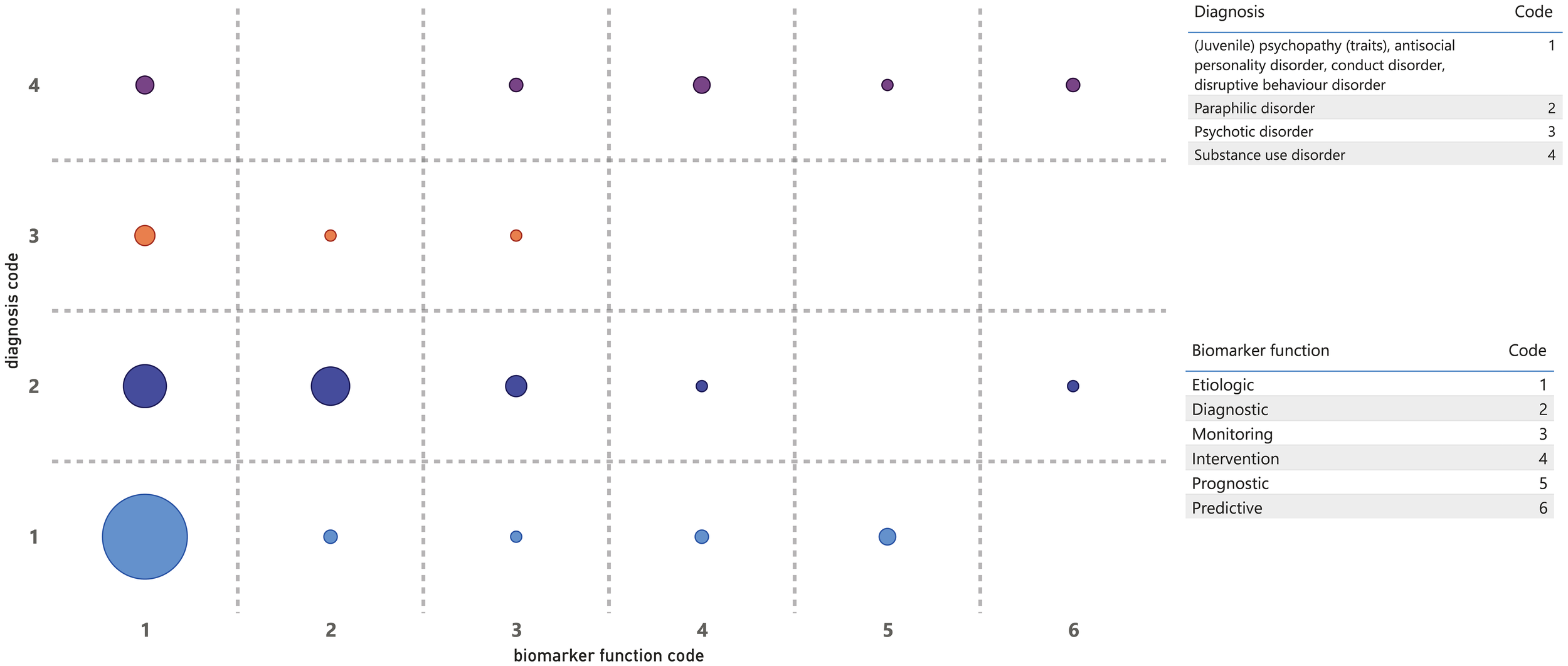
Diagnosis by biomarker function.
Figure 6

Diagnosis by biomarker outcome.
Figure 5 visualizes the diagnosis by biomarker function. This gap map shows that most etiological research with physiological biomarkers has been conducted in forensic patients with psychopathy, antisocial personality disorder, and paraphilias. For paraphilias, a reasonable portion of the research also addressed diagnostic biomarkers and, to a lesser extent, monitoring. The gaps, both partial and complete, were identified, particularly in patients with psychotic and substance use disorders. Additionally, significant gaps persist across all patient categories regarding biomarker functions monitoring, intervention, prognostic, and predictive purposes.
Last, Figure 6 visualizes diagnosis by biomarker outcome. This gap map shows that the scarce research in forensic patients with psychotic or substance use disorders primarily focused on the biomarker outcome of brain activity. Furthermore, it emerges that relatively little research is done in individuals with sexual disorders using biomarker outcomes that monitor non-sexual peripheral sympathetic activity, and that research with oculomotor outcomes is limited or absent across all diagnosis groups.
4 Discussion
The objective of this scoping review was to investigate the extent (size), range (variety), and nature (characteristics) of the evidence on the use of physiological biomarkers in forensic psychiatry. The review showed that the number of studies meeting the inclusion criteria has increased exponentially over recent decades, consistent with general trends in modern scientific research (446). However, a slight decline in the focus on physiological biomarkers in forensic psychiatry was observed in recent years (Figure 2). Whether this decline represents a sustained trend or merely a temporary post-COVID-19 publication dip remains to be seen. The majority of the 431 studies included were conducted in North America. This is not surprising as the US has long been a leading contributor to scientific output (447), including studies in psychiatry (439). Other countries in the top six, such as Canada, were also expected, given Canada’s, pioneering developments in forensic psychiatry, including the Risk-Need-Responsivity (RNR) model (448), the Psychopathy Checklist (449), and several risk assessment instruments (450).
A significant finding is that over 95% of the included studies had an observational design, highlighting a gap in research on the use of physiological biomarkers in forensic psychiatry. This becomes even more clearer when considering the variable ‘biomarker function’. Most research focused on the etiological function, examining underlying substrates of associations between psychopathology and delinquent behavior. Although this knowledge contributes to the scientific foundation, much of the research appears repetitive. Also, the clinical relevance of such studies is questionable. Forensic care primarily aims to prevent crime recidivism, which requires robust assessment tools, effective interventions, reliable response predictions, robust effect monitoring, and improved recidivism risk estimation. Thus, these findings indicate a big discrepancy between the current state of the literature and the practical needs of the clinical field. To meet these needs, more (experimental) intervention studies should be conducted, along with (observational) studies involving monitoring, predictive, and prognostic physiological biomarkers. These studies should preferably adopt longitudinal designs with multiple or continuous measurements. However, as shown in this scoping review, such studies are only marginally represented. The preference for observational, non-longitudinal designs likely stems from their fewer methodological and logistical challenges compared to longitudinal experimental research. Nonetheless, it is now clear that longitudinal and intervention-focused research requires far more attention moving forward.
Most included studies were conducted in correctional facilities, often in prison settings, or forensic inpatient clinics accounting for 79.8% of the total. This dominance may be related to the logistical and substantive advantages of these settings, such as the availability of participants, better control over external factors, and/or extrinsic motivators for participation. The dominance of inpatient studies also aligns with the RNR model, emphasizing efforts on forensic patients who commit serious crimes and who pose the highest security risk to society. These patients are often treated in inpatient settings (451).
Another notable gap arises when examining research populations. The sex ratio in the studies reflects the male-dominated forensic populations, with 82-95% males in European forensic settings (452) and similar figures for violence offenders globally (453). However, only a small number of studies include minors. Forensic child and adolescent psychiatry is a relatively young and niche field in most countries (454). Nevertheless, early interventions in juvenile delinquency are crucial, as such behavior often precedes adult criminal behavior (455). Thus, the lack of studies focusing on minors represents a significant gap that needs to be addressed. Next, there is limited research on certain psychiatric diagnoses among participants. Almost three-quarters of the studies focused on individuals with (juvenile) psychopathy, antisocial personality disorder, and paraphilias, while participants with psychotic or substance use disorders comprised only 5.3%. This is striking, given the overrepresentation of these disorders in forensic populations and their strong association with crime recidivism (456–458).
Regarding biomarker outcomes and assessment methods, brain activity and activation, along with their associated measurement tools, have dominated the field for years. Researchers often prioritize studying the brain, the ‘command center of body and mind’, to explain forensic abnormalities, despite the limitations and challenges of brain research in clinical practice. The focus may be linked to an overreliance on observational, mainly non-longitudinal research. Recently, the measurement of peripheral sympathetic arousal has gained traction due to its practicality, suitability for multiple or continuous measurements, and potential use in patient self-monitoring for impulse control. However, newer assessment methods, such as wearables, eye-tracking systems, and voice stress analysis tools, remain underutilized. Their cautious yet increasing adoption suggests a promising trend toward addressing this gap in forensic research. Finally, the near-exclusive use of PPG in North America, and its apparent decline, reflects ethical and legal obstacles, particularly regarding the sexual stimuli used. These constraints are notably stricter in Europe.
This scoping review has several strengths, including being the first of its kind and being conducted systematically using the JBI methodology for scoping reviews. Additionally, the research question and methodology were predefined in a protocol registered on the Open Science Framework (https://osf.io/46qbu/). Any changes to the original protocol are documented in this paper, which facilitates the critical appraisal of the methodology and helps in the identification of potential issues such as reporting bias (459). Furthermore, data extraction was conducted on 431 studies, highlighting another strength of this study: the substantial body of evidence on which the results are based. A possible limitation is the inclusion of only published studies reporting primary (original) research. Despite this, it is unlikely that a broader search would have led to different results due to saturation in the existing literature. Following the guidelines for scoping reviews (15), we aimed to provide a broad overview of the available literature and to identify possible gaps, rather than to conduct an in-depth evaluation, such as a quality assessment of the included studies and the risk of bias, as is typically done in systematic reviews. However, by limiting the scope to studies published in scientific journals and dissertations only, we can assume that these studies have already undergone a review process, which can be considered a certain guarantee of their quality.
In conclusion, this scoping review provides insight into the use of physiological biomarkers in forensic psychiatry and highlights several gaps in the scientific literature. In particular, there is a need for more longitudinal research to investigate the integration of physiological biomarkers into interventions, effect monitoring, crime risk prognostication, and prediction of patient responsiveness. Also, more attention is needed on juveniles, patients with psychotic and substance use disorders, and investigating new biomarker assessment methods, particularly those measuring peripheral arousal.
Statements
Data availability statement
The original contributions presented in the study are included in the article/Supplementary Material. Further inquiries can be directed to the corresponding author.
Author contributions
JM: Conceptualization, Data curation, Formal analysis, Investigation, Methodology, Resources, Software, Visualization, Writing – original draft, Writing – review & editing. EM: Conceptualization, Formal analysis, Investigation, Methodology, Project administration, Resources, Software, Supervision, Validation, Visualization, Writing – original draft, Writing – review & editing. SB: Conceptualization, Resources, Supervision, Validation, Writing – review & editing. PH: Conceptualization, Methodology, Resources, Supervision, Writing – review & editing.
Funding
The author(s) declare that no financial support was received for the research and/or publication of this article.
Acknowledgments
Figures were made by Bart-Jan ter Heegde (Data-analyst, Fivoor).
Conflict of interest
The authors declare that the research was conducted in the absence of any commercial or financial relationships that could be construed as a potential conflict of interest.
Generative AI statement
The author(s) declare that no Generative AI was used in the creation of this manuscript.
Publisher’s note
All claims expressed in this article are solely those of the authors and do not necessarily represent those of their affiliated organizations, or those of the publisher, the editors and the reviewers. Any product that may be evaluated in this article, or claim that may be made by its manufacturer, is not guaranteed or endorsed by the publisher.
Supplementary material
The Supplementary Material for this article can be found online at: https://www.frontiersin.org/articles/10.3389/fpsyt.2025.1580615/full#supplementary-material
Supplementary Table 1Study details and characteristics. NA, Not Applicable; NS, Not Specified; PPG, Penile plethysmography.
References
1
Al-Rousan T Rubenstein L Sieleni B Deol H Wallace RB . Inside the nation’s largest mental health institution: a prevalence study in a state prison system. BMC Public Health. (2017) 17:342. doi: 10.1186/s12889-017-4257-0
2
Fazel S Hayes AJ Bartellas K Clerici M Trestman R . Mental health of prisoners: prevalence, adverse outcomes, and interventions. Lancet Psychiatry. (2016) 3:871–81. doi: 10.1016/S2215-0366(16)30142-0
3
Morgan VA Morgan F Valuri G Ferrante A Castle D Jablensky A . A whole-of-population study of the prevalence and patterns of criminal offending in people with schizophrenia and other mental illness. Psychol Med. (2013) 43:1869–80. doi: 10.1017/S0033291712002887
4
Bengtson S Lund J Ibsen M Långström N . Long-term violent reoffending following forensic psychiatric treatment: comparing forensic psychiatric examinees and general offender controls. Front Psychiatry. (2019) 10:715. doi: 10.3389/fpsyt.2019.00715
5
Beaudry G Yu R Perry AE Fazel S . Effectiveness of psychological interventions in prison to reduce recidivism: a systematic review and meta-analysis of randomised controlled trials. Lancet Psychiatry. (2021) 8:759–73. doi: 10.1016/S2215-0366(21)00170-X
6
Ewen JB Potter WZ Sweeney JA . Biomarkers and neurobehavioral diagnosis. biomark Neuropsychiatry. (2021) 4:100029. doi: 10.1016/j.bionps.2020.100029
7
Tan L Grace RC . Social desirability and sexual offenders: a review. Sex Abuse. (2008) 20:61–87. doi: 10.1177/1079063208314820
8
Jordan K Wild TSN Fromberger P Müller I Müller JL . Are there any biomarkers for pedophilia and sexual child abuse? A review. Front Psychiatry. (2020) 10:940. doi: 10.3389/fpsyt.2019.00940
9
Sedgwick O Young S Das M Kumari V . Objective predictors of outcome in forensic mental health services-a systematic review. CNS Spectr. (2016) 21:430–44. doi: 10.1017/S1092852915000723
10
FDA-NIH Biomarker Working Group . BEST (Biomarkers, EndpointS, and other Tools) Resource. Silver Spring (MD: Food and Drug Administration (US (2016). Available at: https://www.ncbi.nlm.nih.gov/books/NBK326791/.
11
Bodaghi A Fattahi N Ramazani A . Biomarkers: Promising and valuable tools towards diagnosis, prognosis and treatment of Covid-19 and other diseases. Heliyon. (2023) 9:e13323. doi: 10.1016/j.heliyon.2023.e13323
12
Califf RM . Biomarker definitions and their applications. Exp Biol Med. (2018) 243:213–21. doi: 10.1177/1535370217750088
13
Tortora L Meynen G Bijlsma J Tronci E Ferracuti S . Neuroprediction and A.I. @ in forensic psychiatry and criminal justice: A neurolaw perspective. Front Psychol. (2020) 11:220. doi: 10.3389/fpsyg.2020.00220
14
Godet T Niveau G . Eye tracking and child sexual offenders: a systematic review. Forensic Sci Res. (2021) 6:133–40. doi: 10.1080/20961790.2021.1940737
15
Peters MDJ Godfrey C McInerney P Munn Z Tricco AC Khalil H . Scoping Reviews. In AromatarisELockwoodCPorrittKPillaBJordanZ editors. JBI Manual for Evidence Synthesis. JBI (2020). doi: 10.46658/JBIMES-24-09
16
Tricco AC Lillie E Zarin W O’Brien KK Colquhoun H Levac D et al . PRISMA extension for scoping reviews (PRISMA-scR): checklist and explanation. Ann Intern Med. (2018) 169:467–73. doi: 10.7326/M18-0850
17
McHugh ML . Interrater reliability: the kappa statistic. Biochem Med. (2012) 22:276–82. doi: 10.11613/issn.1846-7482
18
Abe N Greene JD Kiehl KA . Reduced engagement of the anterior cingulate cortex in the dishonest decision-making of incarcerated psychopaths. Soc Cognit Affect Neurosci. (2018) 13:797–807. doi: 10.1093/scan/nsy050
19
Abel GG Huffman J Warberg B Holl CL . Visual reaction time and plethysmography as measures of sexual interest in child molesters. Sex Abuse. (1998) 10:81–95. doi: 10.1177/107906329801000202
20
Aghajani M Colins OF Klapwijk ET Veer IM Andershed H Popma A et al . Dissociable relations between amygdala subregional networks and psychopathy trait dimensions in conduct-disordered juvenile offenders. Hum Brain Mapp. (2016) 37:4017–33. doi: 10.1002/hbm.23292
21
Aghajani M Klapwijk ET Andershed H Fanti KA van der Wee NJA Vermeiren RRJM et al . Neural processing of socioemotional content in conduct-disordered juvenile offenders with limited prosocial emotions. Prog Neuropsychopharmacol Biol Psychiatry. (2021) 105:110045. doi: 10.1016/j.pnpbp.2020.110045
22
Aghajani M Klapwijk ET van der Wee NJ Veer IM Rombouts SARB Boon AE et al . Disorganized amygdala networks in conduct-disordered juvenile offenders with callous-unemotional traits. Biol Psychiatry. (2017) 82:283–93. doi: 10.1016/j.biopsych.2016.05.017
23
Allen CH Aharoni E Gullapalli AR Edwards BG Harenski CL Harenski KA et al . Hemodynamic activity in the limbic system predicts reoffending in women. NeuroImage Clin. (2022) 36:103238. doi: 10.1016/j.nicl.2022.103238
24
Allen CH Maurer JM Edwards BG Gullapalli AR Harenski CL Harenski KA et al . Aberrant resting-state functional connectivity in incarcerated women with elevated psychopathic traits. Front Neuroimaging. (2022) 1:971201. doi: 10.3389/fnimg.2022.971201
25
Allen CH Maurer JM Gullapalli AR Edwards BG Aharoni E Harenski CL et al . Psychopathic traits and altered resting-state functional connectivity in incarcerated adolescent girls. Front Neuroimaging. (2023) 2:1216494. doi: 10.3389/fnimg.2023.1216494
26
Anderson NE Maurer JM Steele VR Kiehl KA . Psychopathic traits associated with abnormal hemodynamic activity in salience and default mode networks during auditory oddball task. Cognit Affect Behav Neurosci. (2018) 18:564–80. doi: 10.3758/s13415-018-0588-2
27
Anderson NE Steele VR Maurer JM Bernat EM Kiehl KA . Psychopathy, attention, and oddball target detection: New insights from PCL-R facet scores. Psychophysiology. (2015) 52:1194–204. doi: 10.1111/psyp.12441
28
Anderson NE Steele VR Maurer JM Rao V Koenigs MR Decety J et al . Differentiating emotional processing and attention in psychopathy with functional neuroimaging. Cognit Affect Behav Neurosci. (2017) 17:491–515. doi: 10.3758/s13415-016-0493-5
29
Anton ME Baskin-Sommers AR Vitale JE Curtin JJ Newman JP . Differential effects of psychopathy and antisocial personality disorder symptoms on cognitive and fear processing in female offenders. Cognit Affect Behav Neurosci. (2012) 12:761–76. doi: 10.3758/s13415-012-0114-x
30
Arnett PA Howland EW Smith SS Newman JP . Autonomic responsivity during passive avoidance in incarcerated psychopaths. Pers Individ Dif. (1993) 14:173–84. doi: 10.1016/0191-8869(93)90187-8
31
Baker LL . Neuropsychological and power spectral EEG characteristics of exhibitionists: a cerebral model of sexual deviation. Edmonton, Canada: University of Alberta (1985).
32
Barratt ES Stanford MS Kent TA Felthous A . Neuropsychological and cognitive psychophysiological substrates of impulsive aggression. Biol Psychiatry. (1997) 41:1045–61. doi: 10.1016/s0006-3223(96)00175-8
33
Baskin-Sommers A Curtin JJ Li W Newman JP . Psychopathy-related differences in selective attention are captured by an early event-related potential. Pers Disord. (2012) 3:370–8. doi: 10.1037/a0025593
34
Baskin-Sommers AR Curtin JJ Newman JP . Emotion-modulated startle in psychopathy: clarifying familiar effects. J Abnorm Psychol. (2013) 122:458–68. doi: 10.1037/a0030958
35
Baskin-Sommers AR Curtin JJ Newman JP . Specifying the attentional selection that moderates the fearlessness of psychopathic offenders. Psychol Sci. (2011) 22:226–34. doi: 10.1177/0956797610396227
36
Baskin-Sommers AR Newman JP Sathasivam N Curtin JJ . Evaluating the generalizability of a fear deficit in psychopathic African American offenders. J Abnorm Psychol. (2011) 120:71–8. doi: 10.1037/a0021225
37
Becker JV Hunter JA Goodwin D Kaplan MS Martinez D . Test-retest reliability of audio-taped phallometric stimuli with adolescent sexual offenders. Ann Sex Res. (1992) 5:45–51. doi: 10.1177/107906329200500103
38
Becker JV Kaplan MS Kavoussi R . Measuring the effectiveness of treatment for the aggressive adolescent sexual offender. Ann N Y Acad Sci. (1988) 528:215–22. doi: 10.1111/j.1749-6632.1988.tb50865.x
39
Becker JV Kaplan MS Tenke CE . The relationship of abuse history, denial and erectile response profiles of adolescent sexual perpetrators. Behav Ther. (1992) 23:87–97. doi: 10.1016/S0005-7894(05)80310-7
40
Becker JV Stein RM Kaplan MS Cunningham-Rathner J . Erection response characteristics of adolescent sex offenders. Ann Sex Res. (1992) 5:81–6. doi: 10.1007/BF00849733
41
Birbaumer N Veit R Lotze M Erb M Hermann C Grodd W et al . Deficient fear conditioning in psychopathy: a functional magnetic resonance imaging study. Arch Gen Psychiatry. (2005) 62:799–805. doi: 10.1001/archpsyc.62.7.799
42
Blackburn R . Aggression and the EEG: a quantitative analysis. J Abnorm Psychol. (1975) 84:358–65. doi: 10.1037//0021-843x.84.4.358
43
Blackburn R . Cortical and autonomic arousal in primary and secondary psychopaths. Psychophysiology. (1979) 16:143–50. doi: 10.1111/j.1469-8986.1979.tb01460.x
44
Blair RJ Jones L Clark F Smith M . The psychopathic individual: a lack of responsiveness to distress cues? Psychophysiology. (1997) 34:192–8. doi: 10.1111/j.1469-8986.1997.tb02131.x
45
Blanchard R Barbaree HE . The strength of sexual arousal as a function of the age of the sex offender: comparisons among pedophiles, hebephiles, and teleiophiles. Sex Abuse. (2005) 17:441–56. doi: 10.1177/107906320501700407
46
Blanchard R Christensen BK Strong SM Cantor JM Kuban ME Klassen P et al . Retrospective self-reports of childhood accidents causing unconsciousness in phallometrically diagnosed pedophiles. Arch Sex Beh. (2002) 31:511–26. doi: 10.1023/a:1020659331965
47
Blanchard R Klassen P Dickey R Kuban ME Blak T . Sensitivity and specificity of the phallometric test for pedophilia in nonadmitting sex offenders. Psychol Assess. (2001) 13:118–26. doi: 10.1037//1040-3590.13.1.118
48
Blanchard R Kolla NJ Cantor JM Klassen PE Dickey R Kuban ME et al . IQ, handedness, and pedophilia in adult male patients stratified by referral source. Sex Abuse. (2007) 19:285–309. doi: 10.1177/107906320701900307
49
Blanchard R Kuban ME Blak T Cantor JM Klassen P Dickey R . Phallometric comparison of pedophilic interest in nonadmitting sexual offenders against stepdaughters, biological daughters, other biologically related girls, and unrelated girls. Sex Abuse. (2006) 18:1–14. doi: 10.1177/107906320601800101
50
Blanchard R Kuban ME Blak T Cantor JM Klassen PE Dickey R . Absolute versus relative ascertainment of pedophilia in men. Sex Abuse. (2009) 21:431–41. doi: 10.1177/1079063209347906
51
Bochkarev VK Vasiliev NG Kirenskaya AV Tkachenko AA . Neirofiziologicheskie korrelyaty pedofilii: issledovanie vyzvannykh ritmov EEG [Neurophysiological correlates of pedophilia: a study of EEG evoked oscillations. Zh Nevrol Psikhiatr Im S S Korsakova. (2021) 121:52–8. doi: 10.17116/jnevro202112106152
52
Bontemps AP Batky BD Houser RA Salekin RT . Psychopathic traits, conduct problems, and the examination of self-referential processing using EEG in incarcerated adolescents. J Psychopathol Behav Assess. (2022) 44:81–97. doi: 10.1007/s10862-021-09945-5
53
Bosch R Chakhssi F Noordzij ML . Acceptance and potential clinical added value of biocueing in forensic psychiatric patients with autism spectrum disorder and/or intellectual disability. Psychiatry Res. (2022) 313:114645. doi: 10.1016/j.psychres.2022.114645
54
Brazil IA de Bruijn ER Bulten BH von Borries AK van Lankveld JJ Buitelaar JK et al . Early and late components of error monitoring in violent offenders with psychopathy. Biol Psychiatry. (2009) 65:137–43. doi: 10.1016/j.biopsych.2008.08.011
55
Brazil IA Mars RB Bulten BH Buitelaar JK Verkes RJ De Bruijn ER . A neurophysiological dissociation between monitoring one’s own and others’ actions in psychopathy. Biol Psychiatry. (2011) 69:693–9. doi: 10.1016/j.biopsych.2010.11.013
56
Brazil IA Verkes RJ Brouns BH Buitelaar JK Bulten BH de Bruijn ER . Differentiating psychopathy from general antisociality using the P3 as a psychophysiological correlate of attentional allocation. PloS One. (2012) 7:e50339. doi: 10.1371/journal.pone.0050339
57
Bresin K Finy MS Sprague J Verona E . Response monitoring and adjustment: differential relations with psychopathic traits. J Abnorm Psychol. (2014) 123:634–49. doi: 10.1037/a0037229
58
Broom I . The relationship between psychopathy and performance on a modified version of the Iowa Gambling Task in offender and undergraduate student samples. Ottawa, Ontario: Carleton University (2011).
59
Buschman J Bogaerts S Foulger S Wilcox D Sosnowski D Cushman B . Sexual history disclosure polygraph examinations with cybercrime offences: a first Dutch explorative study. Int J Offender Ther Comp Criminol. (2010) 54:395–411. doi: 10.1177/0306624X09334942
60
Caldwell BM Harenski CL Harenski KA Fede SJ Steele VR Koenigs MR et al . Abnormal frontostriatal activity in recently abstinent cocaine users during implicit moral processing. Front Hum Neurosci. (2015) 9:565. doi: 10.3389/fnhum.2015.00565
61
Calzada-Reyes A Alvarez-Amador A Galán-Garcia L Valdés-Sosa M . Electroencephalographic and morphometric abnormalities in psychopath offenders. Behav Sci Law. (2021) 39:597–610. doi: 10.1002/bsl.2548
62
Calzada-Reyes A Alvarez-Amador A Galán-García L Valdés-Sosa M . Electroencephalographic abnormalities in antisocial personality disorder. J Forensic Leg Med. (2012) 19:29–34. doi: 10.1016/j.jflm.2011.10.002
63
Calzada-Reyes A Alvarez-Amador A Galán-García L Valdés-Sosa M . EEG abnormalities in psychopath and non-psychopath violent offenders. J Forensic Leg Med. (2013) 20:19–26. doi: 10.1016/j.jflm.2012.04.027
64
Calzada-Reyes A Alvarez-Amador A Galán-García L Valdés-Sosa M . Sex differences in QEEG in psychopath offenders. Clin EEG Neurosci. (2020) 51:146–54. doi: 10.1177/1550059419872414
65
Cantor JM Blanchard R Christensen BK Dickey R Klassen PE Beckstead AL et al . Intelligence, memory, and handedness in pedophilia. Neuropsychology. (2004) 18:3–14. doi: 10.1037/0894-4105.18.1.3
66
Cantor JM Blanchard R . White matter volumes in pedophiles, hebephiles, and teleiophiles. Arch Sex Beh. (2012) 41:749–52. doi: 10.1007/s10508-012-9954-2
67
Cantor JM Kabani N Christensen BK Zipursky RB Barbaree HE Dickey R et al . Cerebral white matter deficiencies in pedophilic men. J Psychiatr R. (2008) 42:167–83. doi: 10.1016/j.jpsychires.2007.10.013
68
Cantor JM Lafaille S Soh DW Moayedi M Mikulis DJ Girard TA . Diffusion tensor imaging of pedophilia. Arch Sex Beh. (2015) 44:2161–72. doi: 10.1007/s10508-015-0629-7
69
Cantor JM Lafaille SJ Hannah J Kucyi A Soh DW Girard TA et al . Independent component analysis of resting-state functional magnetic resonance imaging in pedophiles. J Sex Med. (2016) 13:1546–54. doi: 10.1016/j.jsxm.2016.08.004
70
Cartocci G Boccia M Pompili PM Ferracuti S Frati P Fineschi V et al . Resting state functional magnetic resonance imaging study in mentally ill persons with diminished penal responsibility considered socially dangerous. Psychiaty Res Neuroimaging. (2021) 310:111259. doi: 10.1016/j.pscychresns.2021.111259
71
Casey H Rogers RD Burns T Yiend J . Emotion regulation in psychopathy. Biol Psychol. (2013) 92:541–8. doi: 10.1016/j.biopsycho.2012.06.011
72
Castonguay LG Proulx J Aubut J McKibben A Campbell M . Sexual preference assessment of sexual aggressors: predictors of penile response magnitude. Arch Sex Beh. (1993) 22:325–34. doi: 10.1007/BF01542121
73
Cazala F Fonteille V Moulier V Pélégrini-Issac M De Beaurepaire C Abondo M et al . Brain responses to pictures of children in men with pedophilic disorder: a functional magnetic resonance imaging study. Eur Arch Psychiatry Clin Neurosci. (2019) 269:713–29. doi: 10.1007/s00406-018-0933-z
74
Cazala F Harenski KA Thornton DM Kiehl KA Harenski CL . Neural correlates of moral judgment in criminal offenders with sadistic traits. Arch Sex Beh. (2021) 50:2163–71. doi: 10.1007/s10508-020-01818-4
75
Cheng Y Hung AY Decety J . Dissociation between affective sharing and emotion understanding in juvenile psychopaths. Dev Psychopathol. (2012) 24:623–36. doi: 10.1017/S095457941200020X
76
Clark AP Bontemps AP Houser RA Salekin RT . Psychopathy and resting state EEG theta/beta oscillations in adolescent offenders. J Psychopathol Behav Assess. (2022) 44:64–80. doi: 10.1007/s10862-021-09915-x
77
Cohen LJ Nikiforov K Gans S Poznansky O McGeoch P Weaver C et al . Heterosexual male perpetrators of childhood sexual abuse: a preliminary neuropsychiatric model. Psychiatr Q. (2002) 73:313–36. doi: 10.1023/a:1020416101092
78
Cohn MD Pape LE Schmaal L van den Brink W van Wingen G Vermeiren RR et al . Differential relations between juvenile psychopathic traits and resting state network connectivity. Hum Brain Mapp. (2015) 36:2396–405. doi: 10.1002/hbm.22779
79
Cohn MD Popma A van den Brink W Pape LE Kindt M van Domburgh L et al . Fear conditioning, persistence of disruptive behavior and psychopathic traits: an fMRI study. Transl Psychiatry. (2013) 3:e319. doi: 10.1038/tp.2013.89
80
Cohn MD van Lith K Kindt M Pape LE Doreleijers TA van den Brink W et al . Fear extinction, persistent disruptive behavior and psychopathic traits: fMRI in late adolescence. Soc Cognit Affect Neurosci. (2016) 11:1027–35. doi: 10.1093/scan/nsv067
81
Cohn MD Veltman DJ Pape LE van Lith K Vermeiren RR van den Brink W et al . Incentive processing in persistent disruptive behavior and psychopathic traits: a functional magnetic resonance imaging study in adolescents. Biol Psychiatry. (2015) 78:615–24. doi: 10.1016/j.biopsych.2014.08.017
82
Contreras-Rodríguez O Pujol J Batalla I Harrison BJ Bosque J Ibern-Regàs I et al . Disrupted neural processing of emotional faces in psychopathy. Soc Cognit Affect Neurosci. (2014) 9:505–12. doi: 10.1093/scan/nst014
83
Contreras-Rodríguez O Pujol J Batalla I Harrison BJ Soriano-Mas C Deus J et al . Functional connectivity bias in the prefrontal cortex of psychopaths. Biol Psychiatry. (2015) 78:647–55. doi: 10.1016/j.biopsych.2014.03.007
84
Cooper AJ Swaminath S Baxter D Poulin C . A female sex offender with multiple paraphilias: a psychologic, physiologic (laboratory sexual arousal) and endocrine case study. Can J Psychiatry. (1990) 35:334–7. doi: 10.1177/070674379003500411
85
Cope LM Vincent GM Jobelius JL Nyalakanti PK Calhoun VD Kiehl KA . Psychopathic traits modulate brain responses to drug cues in incarcerated offenders. Front Hum Neurosci. (2014) 8:87. doi: 10.3389/fnhum.2014.00087
86
Corley AR Corley MD Walker J Walker S . The possibility of organic left posterior hemisphere dysfunction as a contributing factor in sex-offending behavior. Sex Addict Compuls. (1994) 1:337–46. doi: 10.1080/10720169408400054
87
Corominas-Roso M Ibern I Capdevila M Ramon R Roncero C Ramos-Quiroga JA . Benefits of EEG-neurofeedback on the modulation of impulsivity in a sample of cocaine and heroin long-term abstinent inmates: a pilot study. Int J Offender Ther Comp Criminol. (2020) 64:1275–98. doi: 10.1177/0306624X20904704
88
Craft M Fabisch W Stephenson G Burnand G Kerridge D . 100 admissions to a psychopathic unit. J Ment Sci. (1962) 108:564–83. doi: 10.1192/bjp.108.456.564
89
Crowley TJ Dalwani MS Mikulich-Gilbertson SK Du YP Lejuez CW Raymond KM et al . Risky decisions and their consequences: neural processing by boys with Antisocial Substance Disorder. PloS One. (2010) 5:e12835. doi: 10.1371/journal.pone.0012835
90
da Cunha-Bang S Fisher PM Hjordt LV Perfalk E Persson Skibsted A Bock C et al . Violent offenders respond to provocations with high amygdala and striatal reactivity. Soc Cognit Affect Neurosci. (2017) 12:802–10. doi: 10.1093/scan/nsx006
91
da Cunha-Bang S Fisher PM Hjordt LV Holst K Knudsen GM . Amygdala reactivity to fearful faces correlates positively with impulsive aggression. Soc Neurosci. (2019) 14:162–72. doi: 10.1080/17470919.2017.1421262
92
Dargis M Wolf RC Koenigs M . Psychopathic traits are associated with reduced fixations to the eye region of fearful faces. J Abnorm Psychol. (2018) 127:43–50. doi: 10.1037/abn0000322
93
de Barros DM Dias AM Castellana GB Achá MF Busatto GF . Dimensional assessment of psychopathy and its relationship with physiological responses to empathic images in juvenile offenders. Front Psychiatry. (2013) 4:147. doi: 10.3389/fpsyt.2013.00147
94
de Looff P Noordzij ML Moerbeek M Nijman H Didden R Embregts P . Changes in heart rate and skin conductance in the 30 min preceding aggressive behavior. Psychophysiology. (2019) 56:e13420. doi: 10.1111/psyp.13420
95
de Vries-Bouw M Jansen L Vermeiren R Doreleijers T van de Ven P Popma A . Concurrent attenuated reactivity of alpha-amylase and cortisol is related to disruptive behavior in male adolescents. Horm Behav. (2012) 62:77–85. doi: 10.1016/j.yhbeh.2012.05.002
96
Decety J Chen C Harenski CL Kiehl KA . Socioemotional processing of morally-laden behavior and their consequences on others in forensic psychopaths. Hum Brain Mapp. (2015) 36:2015–26. doi: 10.1002/hbm.22752
97
Decety J Chen C Harenski C Kiehl KA . An fMRI study of affective perspective taking in individuals with psychopathy: imagining another in pain does not evoke empathy. Front Hum Neurosci. (2013) 7:489. doi: 10.3389/fnhum.2013.00489
98
Decety J Skelly L Yoder KJ Kiehl KA . Neural processing of dynamic emotional facial expressions in psychopaths. Soc Neurosci. (2014) 9:36–49. doi: 10.1080/17470919.2013.866905
99
Decety J Skelly LR Kiehl KA . Brain response to empathy-eliciting scenarios involving pain in incarcerated individuals with psychopathy. JAMA Psychiatry. (2013) 70:638–45. doi: 10.1001/jamapsychiatry.2013.27
100
Deeley Q Daly E Surguladze S Tunstall N Mezey G Beer D et al . Facial emotion processing in criminal psychopathy. Preliminary functional magnetic resonance imaging study. Br J Psychiatry. (2006) 189:533–9. doi: 10.1192/bjp.bp.106.021410
101
Delfin C Krona H Andiné P Ryding E Wallinius M Hofvander B . Prediction of recidivism in a long-term follow-up of forensic psychiatric patients: Incremental effects of neuroimaging data. PloS One. (2019) 14:e0217127. doi: 10.1371/journal.pone.0217127
102
Delfin C Ruzich E Wallinius M Björnsdotter M Andiné P . Trait disinhibition and NoGo event-related potentials in violent mentally disordered offenders and healthy controls. Front Psychiatry. (2020) 11:577491. doi: 10.3389/fpsyt.2020.577491
103
Delfin C Wallinius M Björnsdotter M Ruzich E Andiné P . Prolonged NoGo P3 latency as a possible neurobehavioral correlate of aggressive and antisocial behaviors: A Go/NoGo ERP study. Biol Psychol. (2022) 168:108245. doi: 10.1016/j.biopsycho.2021.108245
104
Deming P Cook CJ Meyerand ME Kiehl KA Kosson DS Koenigs M . Impaired salience network switching in psychopathy. Beh Brain Res. (2023) 452:114570. doi: 10.1016/j.bbr.2023.114570
105
Deming P Dargis M Haas BW Brook M Decety J Harenski C et al . Psychopathy is associated with fear-specific reductions in neural activity during affective perspective-taking. NeuroImage. (2020) 223:117342. doi: 10.1016/j.neuroimage.2020.117342
106
Deming P Eisenbarth H Rodrik O Weaver SS Kiehl KA Koenigs M . An examination of autonomic and facial responses to prototypical facial emotion expressions in psychopathy. PloS One. (2022) 17:e0270713. doi: 10.1371/journal.pone.0270713
107
Deming P Philippi CL Wolf RC Dargis M Kiehl KA Koenigs M . Psychopathic traits linked to alterations in neural activity during personality judgments of self and others. NeuroImage Clin. (2018) 18:575–81. doi: 10.1016/j.nicl.2018.02.029
108
Deming P . Large-scale brain networks in psychopathy (Dissertation). Madison, Wisconsin: University of Wisconsin-Madison (2021).
109
Dengerink HA Bertilson HS . Psychopathy and physiological arousal in an aggressive task. Psychophysiology. (1975) 12:682–4. doi: 10.1111/j.1469-8986.1975.tb00074.x
110
Denomme WJ Shane MS . History of withdrawal modulates drug- and food-cue reactivity in cocaine dependent participants. Drug Alcohol Depend. (2020) 208:107815. doi: 10.1016/j.drugalcdep.2019.107815
111
Denomme WJ Simard I Shane MS . Neuroimaging metrics of drug and food processing in cocaine-dependence, as a function of psychopathic traits and substance use severity. Front Hum Neurosci. (2018) 12:350. doi: 10.3389/fnhum.2018.00350
112
Dobbs DS Speck LB . Visual evoked response and frequency density spectra of prisoner-patients. Compr Psychiatry. (1968) 9:62–70. doi: 10.1016/s0010-440x(68)80029-x
113
Dolan MC Fullam RS . Psychopathy and functional magnetic resonance imaging blood oxygenation level-dependent responses to emotional faces in violent patients with schizophrenia. Biol Psychiatry. (2009) 66:570–7. doi: 10.1016/j.biopsych.2009.03.019
114
Dressing H Obergriesser T Tost H Kaumeier S Ruf M Braus DF . Homosexuelle Pädophilie und funktionelle Netzwerke - fMRI-Fallstudie. Fortschr Neurol Psychiatr. (2001) 69:539–44. doi: 10.1055/s-2001-18380
115
Drislane LE Vaidyanathan U Patrick CJ . Reduced cortical call to arms differentiates psychopathy from antisocial personality disorder. Psychol Med. (2013) 43:825–35. doi: 10.1017/S0033291712001547
116
Duindam HM Williams DP Asscher JJ Hoeve M Thayer JF Creemers HE . Heart-wired to be cold? Exploring cardiac markers of callous-unemotional traits in incarcerated offenders. Int J Psychophysiol. (2021) 170:168–77. doi: 10.1016/j.ijpsycho.2021.10.006
117
Eisenbarth H Angrilli A Calogero A Harper J Olson LA Bernat E . Reduced negative affect response in female psychopaths. Biol Psychol. (2013) 94:310–8. doi: 10.1016/j.biopsycho.2013.07.007
118
Espinoza FA Anderson NE Vergara VM Harenski CL Decety J Rachakonda S et al . Resting-state fMRI dynamic functional network connectivity and associations with psychopathy traits. NeuroImage Clin. (2019) 24:101970. doi: 10.1016/j.nicl.2019.101970
119
Espinoza FA Vergara VM Reyes D Anderson NE Harenski CL Decety J et al . Aberrant functional network connectivity in psychopathy from a large (N = 985) forensic sample. Hum Brain Mapp. (2018) 39:2624–34. doi: 10.1002/hbm.24028
120
Fanti KA Konikou K Cohn M Popma A Brazil IA . Amygdala functioning during threat acquisition and extinction differentiates antisocial subtypes. J Neuropsychol. (2020) 14:226–41. doi: 10.1111/jnp.12183
121
Fazio RL Dyshniku F Lykins AD Cantor JM . Leg length versus torso length in pedophilia: further evidence of atypical physical development early in life. Sex Abuse. (2017) 29:500–14. doi: 10.1177/1079063215609936
122
Fede SJ Borg JS Nyalakanti PK Harenski CL Cope LM Sinnott-Armstrong W et al . Distinct neuronal patterns of positive and negative moral processing in psychopathy. Cognit Affect Behav Neurosci. (2016) 16:1074–85. doi: 10.3758/s13415-016-0454-z
123
Fede SJ . Functional neural connectivity associated with moral processing in healthy and antisocial samples. Albuquerque, New Mexico: University of New Mexico (2017). Available at: https://digitalrepository.unm.edu/psy_etds/212 (Accessed October 9, 2023).
124
Fenton GW Tennent TG Fenwick PB Rattray N . The EEG in antisocial behaviour: a study of posterior temporal slow activity in special hospital patients. Psychol Med. (1974) 4:181–6. doi: 10.1017/s003329170004201x
125
Fielenbach S Donkers FC Spreen M Bogaerts S . Effects of a theta/sensorimotor rhythm neurofeedback training protocol on measures of impulsivity, drug craving, and substance abuse in forensic psychiatric patients with substance abuse: randomized controlled trial. JMIR Ment Health. (2018) 5:e10845. doi: 10.2196/10845
126
Fielenbach S Donkers FCL Spreen M Bogaerts S . The ability of forensic psychiatric patients with substance use disorder to learn neurofeedback. Int J Forensic Ment Health. (2019) 18:187–99. doi: 10.1080/14999013.2018.14851
127
Fielenbach S Donkers FCL Spreen M Smit A Bogaerts S . Theta/SMR neurofeedback training works well for some forensic psychiatric patients, but not for others: a sham-controlled clinical case series. Int J Offender Ther Comp Criminol. (2019) 63:2422–39. doi: 10.1177/0306624X19849562
128
Fink BC Steele VR Maurer MJ Fede SJ Calhoun VD Kiehl KA . Brain potentials predict substance abuse treatment completion in a prison sample. Brain Behav. (2016) 6:e00501. doi: 10.1002/brb3.501
129
Firestone P Bradford JM Greenberg DM Serran GA . The relationship of deviant sexual arousal and psychopathy in incest offenders, extrafamilial child molesters, and rapists. J Am Acad Psychiatry Law. (2000) 28:303–8.
130
Flórez G Vila XA Lado MJ Cuesta P Ferrer V García LS et al . Diagnosing psychopathy through emotional regulation tasks: heart rate variability versus implicit association test. Psychopathology. (2017) 50:334–41. doi: 10.1159/000479884
131
Flor-Henry P Lang RA Koles ZJ Frenzel RR . Quantitative EEG studies of pedophilia. Int J Psychophysiol. (1991) 10:253–8. doi: 10.1016/0167-8760(91)90036-w
132
Flor-Henry P Lang RA Koles ZJ Frenzel RR . Quantitative EEG investigations of genital exhibitionism. Ann Sex Res. (1988) 1:49–62. doi: 10.1007/BF00852882
133
Forth AE Hare RD . The contingent negative variation in psychopaths. Psychophysiology. (1989) 26:676–82. doi: 10.1111/j.1469-8986.1989.tb03171.x
134
Freeman SM Clewett DV Bennett CM Kiehl KA Gazzaniga MS Miller MB . The posteromedial region of the default mode network shows attenuated task-induced deactivation in psychopathic prisoners. Neuropsychology. (2015) 29:493–500. doi: 10.1037/neu0000118
135
Freund K Blanchard R . Phallometric diagnosis of pedophilia. J Consult Clin Psychol. (1989) 57:100–5. doi: 10.1037/0022-006X.57.1.100
136
Freund K Watson RJ . Assessment of the sensitivity and specificity of a phallometric test: An update of phallometric diagnosis of pedophilia. Psychol Assess. (1991) 3:254–60. doi: 10.1037/1040-3590.3.2.254
137
Freund K Watson RJ . The proportions of heterosexual and homosexual pedophiles among sex offenders against children: an exploratory study. J Sex Marital Ther. (1992) 18:34–43. doi: 10.1080/00926239208404356
138
Freund K Watson R Dickey R . Does sexual abuse in childhood cause pedophilia: an exploratory study. Arch Sex Beh. (1990) 19:557–68. doi: 10.1007/BF01542465
139
Fromberger P Jordan K Steinkrauss H von Herder J Witzel J Stolpmann G et al . Diagnostic accuracy of eye movements in assessing pedophilia. J Sex Med. (2012) 9:1868–82. doi: 10.1111/j.1743-6109.2012.02754.x
140
Fromberger P Jordan K Steinkrauss H von Herder J Stolpmann G Kröner-Herwig B et al . Eye movements in pedophiles: Automatic and controlled attentional processes while viewing prepubescent stimuli. J Abnorm Psychol. (2013) 122:587–99. doi: 10.1037/a0030659
141
Frommann N Stroth S Brinkmeyer J Wölwer W Luckhaus C . Facial affect recognition performance and event-related potentials in violent and non-violent schizophrenia patients. Neuropsychobiology. (2013) 68:139–45. doi: 10.1159/000353252
142
García-Gutiérrez MS Navarrete F Sala F Gasparyan A Austrich-Olivares A Manzanares J . Biomarkers in psychiatry: concept, definition, types and relevance to the clinical reality. Front Psychiatry. (2020) 11:432. doi: 10.3389/fpsyt.2020.00432
143
Gehrer NA Duchowski AT Jusyte A Schönenberg M . Eye contact during live social interaction in incarcerated psychopathic offenders. Pers Disord. (2020) 11:431–9. doi: 10.1037/per0000400
144
Gehrer NA Scheeff J Jusyte A Schönenberg M . Impaired attention toward the eyes in psychopathic offenders: Evidence from an eye tracking study. Behav Res Ther. (2019) 118:121–9. doi: 10.1016/j.brat.2019.04.009
145
Geurts DE von Borries K Volman I Bulten BH Cools R Verkes RJ . Neural connectivity during reward expectation dissociates psychopathic criminals from non-criminal individuals with high impulsive/antisocial psychopathic traits. Soc Cognit Affect Neurosci. (2016) 11:1326–34. doi: 10.1093/scan/nsw040
146
Gibbels C Sinke C Kneer J Amelung T Mohnke S Beier KM et al . Two sides of one coin: a comparison of clinical and neurobiological characteristics of convicted and non-convicted pedophilic child sexual offenders. J Clin Med. (2019) 8:947. doi: 10.3390/jcm8070947
147
Gibbens TC Pond DA Stafford-Clark D . A follow-up study of criminal psychopaths. J Ment Sci. (1959) 105:108–15. doi: 10.1192/bjp.105.438.108
148
Gillespie SM Rotshtein P Chapman H Brown E Beech AR Mitchell IJ . Pupil reactivity to emotional faces among convicted violent offenders: The role of psychopathic traits. J Abnorm Psychol. (2019) 128:622–32. doi: 10.1037/abn0000445
149
Gou N Xiang Y Zhou J Zhang S Zhong S Lu J et al . Identification of violent patients with schizophrenia using a hybrid machine learning approach at the individual level. Psychiatry Res. (2021) 306:114294. doi: 10.1016/j.psychres.2021.114294
150
Greenberg DM Bradford JM Curry S . Are pedophiles with aggressive tendencies more sexually violent? Bull Am Acad Psychiatry Law. (1996) 24:225–35.
151
Gregory S Blair RJ Ffytche D Simmons A Kumari V Hodgins S et al . Punishment and psychopathy: a case-control functional MRI investigation of reinforcement learning in violent antisocial personality disordered men. Lancet Psychiatry. (2015) 2:153–60. doi: 10.1016/S2215-0366(14)00071-6
152
Guan M Liao Y Ren H Wang X Yang Q Liu X et al . Impaired response inhibition in juvenile delinquents with antisocial personality characteristics: a preliminary ERP study in a Go/Nogo task. Neurosci Lett. (2015) 603:1–5. doi: 10.1016/j.neulet.2015.06.062
153
Habermeyer B Esposito F Händel N Lemoine P Klarhöfer M Mager R et al . Immediate processing of erotic stimuli in paedophilia and controls: a case control study. BMC Psychiatry. (2013) 13:88. doi: 10.1186/1471-244X-13-88
154
Habermeyer B Esposito F Händel N Lemoine P Kuhl HC Klarhöfer M et al . Response inhibition in pedophilia: an FMRI pilot study. Neuropsychobiology. (2013) 68:228–37. doi: 10.1159/000355295
155
Habermeyer B Händel N Lemoine P Klarhöfer M Seifritz E Dittmann V et al . LH-RH agonists modulate amygdala response to visual sexual stimulation: a single case fMRI study in pedophilia. Neurocase. (2012) 18:489–95. doi: 10.1080/13554794.2011.627346
156
Hamilton RK Baskin-Sommers AR Newman JP . Relation of frontal N100 to psychopathy-related differences in selective attention. Biol Psychol. (2014) 103:107–16. doi: 10.1016/j.biopsycho.2014.08.012
157
Hansen AL Johnsen BH Thornton D Waage L Thayer JF . Facets of psychopathy, heart rate variability and cognitive function. J Pers Disord. (2007) 21:568–82. doi: 10.1521/pedi.2007.21.5.568
158
Hare RD Craigen D . Psychopathy and physiological activity in a mixed-motive game situation. Psychophysiology. (1974) 11:197–206. doi: 10.1111/j.1469-8986.1974.tb00839.x
159
Hare RD . Psychopathy and electrodermal responses to nonsignal stimulation. Biol Psychol. (1978) 6:237–46. doi: 10.1016/0301-0511(78)90026-1
160
Hare RD . Psychopathy and physiological activity during anticipation of an adversive stimulus in a distraction paradigm. Psychophysiology. (1982) 19:266–71. doi: 10.1111/j.1469-8986.1982.tb02559.x
161
Hare RD . Psychopathy, autonomic functioning, and the orienting response. J Abnorm Psychol. (1968) 73:1–24. doi: 10.1037/h0025873
162
Hare RD . Temporal gradient of fear arousal in psychopaths. J Abnorm Psychol. (1965) 70:442–5. doi: 10.1037/h0022775
163
Harenski CL Calhoun VD Bustillo JR Haas BW Decety J Harenski KA et al . Functional connectivity during affective mentalizing in criminal offenders with psychotic disorders: associations with clinical symptoms. Psychiaty Res Neuroimaging. (2018) 271:91–9. doi: 10.1016/j.pscychresns.2017.11.003
164
Harenski CL Edwards BG Harenski KA Kiehl KA . Neural correlates of moral and non-moral emotion in female psychopathy. Front Hum Neurosci. (2014) 8:741. doi: 10.3389/fnhum.2014.00741
165
Harenski CL Harenski KA Kiehl KA . Neural processing of moral violations among incarcerated adolescents with psychopathic traits. Dev Cognit Neurosci. (2014) 10:181–9. doi: 10.1016/j.dcn.2014.09.002
166
Harenski CL Harenski KA Shane MS Kiehl KA . Aberrant neural processing of moral violations in criminal psychopaths. J Abnorm Psychol. (2010) 119:863–74. doi: 10.1037/a0020979
167
Harenski CL Thornton DM Harenski KA Decety J Kiehl KA . Increased frontotemporal activation during pain observation in sexual sadism: preliminary findings. Arch Gen Psychiatry. (2012) 69:283–92. doi: 10.1001/archgenpsychiatry.2011.1566
168
Harris GT Lalumière ML Seto MC Rice ME Chaplin TC . Explaining the erectile responses of rapists to rape stories: the contributions of sexual activity, non-consent, and violence with injury. Arch Sex Beh. (2012) 41:221–9. doi: 10.1007/s10508-012-9940-8
169
Herpertz SC Werth U Lucas G Qunaibi M Schuerkens A Kunert H-J et al . Emotion in criminal offenders with psychopathy and borderline personality disorders. Arch Gen Psychiatry. (2001) 58:737–45. doi: 10.1001/archpsyc.58.8.737
170
Hillbrand M Foster HG Hirt M . Alcohol abuse, violence, and neurological impairment: A forensic study. J Interpers Violence. (1991) 6:411–22. doi: 10.1177/088626091006004001
171
Hillbrand M Foster HG Hirt M . Variables associated with violence in a forensic population. J Interpers Violence. (1988) 3:371–80. doi: 10.1177/088626088003004002
172
Hinton JW O’Neill M Hamilton S Burke M . Psychophysiological differentiation between psychopathic and schizophrenic abnormal offenders. Br J Soc Clin Psychol. (1980) 19:257–69. doi: 10.1111/j.2044-8260.1980.tb00352.x
173
Hoff H Beneventi H Galta K Wik G . Evidence of deviant emotional processing in psychopathy: a FMRI case study. Int J Neurosci. (2009) 119:857–78. doi: 10.1080/00207450701590992
174
Hoppenbrouwers SS De Jesus DR Stirpe T Fitzgerald PB Voineskos AN Schutter DJ et al . Inhibitory deficits in the dorsolateral prefrontal cortex in psychopathic offenders. Cortex. (2013) 49:1377–85. doi: 10.1016/j.cortex.2012.06.003
175
Hoppenbrouwers SS De Jesus DR Sun Y Stirpe T Hofman D McMaster J et al . Abnormal interhemispheric connectivity in male psychopathic offenders. J Psychiatry Neurosci. (2014) 39:22–30. doi: 10.1503/jpn.120046
176
Hosking JG Kastman EK Dorfman HM Samanez-Larkin GR Baskin-Sommers A Kiehl KA et al . Disrupted prefrontal regulation of striatal subjective value signals in psychopathy. Neuron. (2017) 95:221–231.e4. doi: 10.1016/j.neuron.2017.06.030
177
Howard R Lumsden J . A neurophysiological predictor of reoffending in special hospital patients. Crim Behav Ment Health. (1996) 6:147–56. doi: 10.1002/cbm.82
178
Howard R McCullagh P . Neuroaffective processing in criminal psychopaths: brain event-related potentials reveal task-specific anomalies. J Pers Disord. (2007) 21:322–39. doi: 10.1521/pedi.2007.21.3.322
179
Howard RC Longmore FJ Mason PA Martin JL . Contingent negative variation (CNV) and erotic preference in self-declared homosexuals and in child sex offenders. Biol Psychol. (1994) 38:169–81. doi: 10.1016/0301-0511(94)90037-x
180
Howes RJ . Measurement of risk of sexual violence through phallometric testing. Leg Med. (2009) 11:S368–9. doi: 10.1016/j.legalmed.2009.02.073
181
Howes RJ . Plethysmographic assessment of incarcerated nonsexual offenders: a comparison with rapists. Sex Abuse. (1998) 10:183–94. doi: 10.1023/A:1021313820005
182
Howner K . Offenders with mental disorder: psychosocial and neurobiological aspects. Karolinska Institutet. Thesis (2010). Available at: https://hdl.handle.net/10616/40337 (Accessed October 9, 2023).
183
Ilyina VI Kamenskov M Dvoryanchikov NV . Methodological features of pedophilic disorder assessment using an eyetracker. Psychol Law. (2022) 12:180–96. doi: 10.17759/psylaw.2022120315
184
Iria C Barbosa F Paixão R . Identification of emotions in offenders with antisocial personality disorder (ASP): behavioral and autonomic responses depending on the reinforcement scheme. J Individ Differ. (2020) 41:8–16. doi: 10.1027/1614-0001/a000298
185
Jankovic M Bogaerts S Klein Tuente S Garofalo C Veling W van Boxtel G . The complex associations between early childhood adversity, heart rate variability, cluster B Personal Disord. and aggression. Int J Offender Ther Comp Criminol. (2021) 65:899–915. doi: 10.1177/0306624X20986537
186
Jiang W Liu H Liao J Ma X Rong P Tang Y et al . A functional MRI study of deception among offenders with antisocial personality disorders. Neuroscience. (2013) 244:90–8. doi: 10.1016/j.neuroscience.2013.03.055
187
Jiang W Shi F Liao J Liu H Wang T Shen C et al . Disrupted functional connectome in antisocial personality disorder. Brain Imaging Behav. (2017) 11:1071–84. doi: 10.1007/s11682-016-9572-z
188
Jones S Cisler J Morais H Bai S . Exploring neural correlates of empathy in juveniles who have sexually offended. Sex Abuse. (2018) 30:82–103. doi: 10.1177/1079063216630980
189
Jones S Joyal CC Cisler JM Bai S . Exploring emotion regulation in juveniles who have sexually offended: an fMRI study. J Child Sex Abuse. (2017) 26:40–57. doi: 10.1080/10538712.2016.1259280
190
Jordan K Fromberger P Laubinger H Dechent P Müller JL . Changed processing of visual sexual stimuli under GnRH-therapy–a single case study in pedophilia using eye tracking and fMRI. BMC Psychiatry. (2014) 14:142. doi: 10.1186/1471-244X-14-142
191
Jordan K Fromberger P Müller I Wernicke M Stolpmann G Müller JL . Sexual interest and sexual self-control in men with self-reported sexual interest in children - A first eye tracking study. J Psychiatr R. (2018) 96:138–44. doi: 10.1016/j.jpsychires.2017.10.004
192
Jordan K Fromberger P von Herder J Steinkrauss H Nemetschek R Witzel J et al . Impaired attentional control in pedophiles in a sexual distractor task. Front Psychiatry. (2016) 7:193. doi: 10.3389/fpsyt.2016.00193
193
Jordan K Fromberger P von Herder J Steinkrauss H . Can we measure sexual interest in pedophiles using a sexual distractor task? J Forensic Psychol. (2016) 1:1000109. doi: 10.4172/2475-319X.1000109
194
Joyal CC Putkonen A Mancini-Marïe A Hodgins S Kononen M Boulay L et al . Violent persons with schizophrenia and comorbid disorders: a functional magnetic resonance imaging study. Schizophr Res. (2007) 91:97–102. doi: 10.1016/j.schres.2006.12.014
195
Juárez M Kiehl KA Calhoun VD . Intrinsic limbic and paralimbic networks are associated with criminal psychopathy. Hum Brain Mapp. (2013) 34:1921–30. doi: 10.1002/hbm.22037
196
Jutai JW Hare RD Connolly JF . Psychopathy and event-related brain potentials (ERPs) associated with attention to speech stimuli. Pers Individ Dif. (1987) 8:175–84. doi: 10.1016/0191-8869(87)90172-3
197
Jutai JW Hare RD . Psychopathy and selective attention during performance of a complex perceptual-motor task. Psychophysiology. (1983) 20:146–51. doi: 10.1111/j.1469-8986.1983.tb03280.x
198
Kaine A Crim M Mersereau G . Faking sexual preference. Can J Psychiatry. (1988) 33:379–85. doi: 10.1177/070674378803300513
199
Kamenskov M . Validity of the Psychophysiological diagnosis of paraphylia. Zhurnal Nevrologii i Psihiatrii imeni S S Korsakova. (2013) 113:39–44.
200
Kärgel C Massau C Weiß S Walter M Borchardt V Krueger TH et al . Evidence for superior neurobiological and behavioral inhibitory control abilities in non-offending as compared to offending pedophiles. Hum Brain Mapp. (2017) 38:1092–104. doi: 10.1002/hbm.23443
201
Kärgel C Massau C Weiß S Walter M Kruger TH Schiffer B . Diminished functional connectivity on the road to child sexual abuse in pedophilia. J Sex Med. (2015) 12:783–95. doi: 10.1111/jsm.12819
202
Kennard MA Rabinovitch MS Fister WP . The use of frequency analysis in the interpretation of the EEGs of patients with psychological disorders. Electroencephalogr Clin Neurophysiol. (1955) 7:29–38. doi: 10.1016/0013-4694(55)90057-2
203
Kiehl KA Bates AT Laurens KR Hare RD Liddle PF . Brain potentials implicate temporal lobe abnormalities in criminal psychopaths. J Abnorm Psychol. (2006) 115:443–53. doi: 10.1037/0021-843X.115.3.443
204
Kiehl KA Hare RD Liddle PF McDonald JJ . Reduced P300 responses in criminal psychopaths during a visual oddball task. Biol Psychiatry. (1999) 45:1498–507. doi: 10.1016/s0006-3223(98)00193-0
205
Kiehl KA Hare RD McDonald JJ Brink J . Semantic and affective processing in psychopaths: an event-related potential (ERP) study. Psychophysiology. (1999) 36:765–74. doi: 10.1111/1469-8986.3660765
206
Kiehl KA Laurens KR Bates AT Liddle PF . Psychopathy and semantic processing: an examination of the N400. Pers Individ Dif. (2006) 40:293–304. doi: 10.1016/j.paid.2005.06.025
207
Kiehl KA Smith AM Hare RD Mendrek A Forster BB Brink J et al . Limbic abnormalities in affective processing by criminal psychopaths as revealed by functional magnetic resonance imaging. Biol Psychiatry. (2001) 50:677–84. doi: 10.1016/s0006-3223(01)01222-7
208
Kiehl KA Smith AM Hare RD Liddle PF . An event-related potential investigation of response inhibition in schizophrenia and psychopathy. Biol Psychiatry. (2000) 48:210–21. doi: 10.1016/s0006-3223(00)00834-9
209
Kiehl KA Smith AM Mendrek A Forster BB Hare RD Liddle PF . Temporal lobe abnormalities in semantic processing by criminal psychopaths as revealed by functional magnetic resonance imaging. Psychiatry Res. (2004) 130:297–312. doi: 10.1016/j.pscychresns.2004.02.002
210
Kiehl KA . A neuroimaging investigation of affective, cognitive, and language functions in psychopathy. Vancouver: University of British Columbia (2000).
211
Kimonis ER Fanti KA Goulter N Hall J . Affective startle potentiation differentiates primary and secondary variants of juvenile psychopathy. Dev Psychopathol. (2017) 29:1149–60. doi: 10.1017/S0954579416001206
212
Kingston DA Firestone P Moulden HM Bradford JM . The utility of the diagnosis of pedophilia: a comparison of various classification procedures. Arch Sex Beh. (2007) 36:423–36. doi: 10.1007/s10508-006-9091-x
213
Kirenskaya AV Kamenskov M . The association between slow cortical potentials preceding antisaccades and disturbances of consciousness in persons with paraphilic sexual behaviour. Int Rev Psychiatry. (2019) 31:149–58. doi: 10.1080/09540261.2018.1559136
214
Kirenskaya AV Kamenskov MY Myamlin VV Novototsky-Vlasov VY Tkachenko AA . The antisaccade task performance deficit and specific CNV abnormalities in patients with stereotyped paraphilia and schizophrenia. J Forensic Sci. (2013) 58:1219–26. doi: 10.1111/1556-4029.12241
215
Kirenskaya-Berus AV Tkachenko AA . Characteristic features of EEG spectral characteristics in persons with deviant sexual behavior. Hum Physiol. (2003) 29:278–87. doi: 10.1023/A:1023982119972
216
Klapwijk ET Aghajani M Colins OF Marijnissen GM Popma A van Lang ND et al . Different brain responses during empathy in autism spectrum disorders versus conduct disorder and callous-unemotional traits. J Child Psychol Psychiatry. (2016) 57:737–47. doi: 10.1111/jcpp.12498
217
Klapwijk ET Lelieveld GJ Aghajani M Boon AE van der Wee NJ Popma A et al . Fairness decisions in response to emotions: a functional MRI study among criminal justice-involved boys with conduct disorder. Soc Cognit Affect Neurosci. (2016) 11:674–82. doi: 10.1093/scan/nsv150
218
Klein TL . Differentiating between developmentally disabled child molesters and perpetrators of adult sexual molestation using penile plethysmography. Philadelphia: Drexel University (2005).
219
Knott V Impey D Fisher D Delpero E Fedoroff P . Pedophilic brain potential responses to adult erotic stimuli. Brain Res. (2016) 1632:127–40. doi: 10.1016/j.brainres.2015.12.004
220
Kolárský A Madlafousek J Novotná V . Stimuli eliciting sexual arousal in males who offend adult women: an experimental study. Arch Sex Beh. (1978) 7:79–87. doi: 10.1007/BF01542057
221
Kolárský A Madlafousek J . Female behavior and sexual arousal in heterosexual male deviant offenders. J Nerv Ment Dis. (1972) 155:110–8. doi: 10.1097/00005053-197208000-00005
222
Kolla NJ Dunlop K Downar J Links P Bagby RM Wilson AA et al . Association of ventral striatum monoamine oxidase-A binding and functional connectivity in antisocial personality disorder with high impulsivity: a positron emission tomography and functional magnetic resonance imaging study. Eur Neuropsychopharmacol. (2016) 26:777–86. doi: 10.1016/j.euroneuro.2015.12.030
223
Konicar L Radev S Silvoni S Bolinger E Veit R Strehl U et al . Balancing the brain of offenders with psychopathy? Resting state EEG and electrodermal activity after a pilot study of brain self-regulation training. PloS One. (2021) 16:e0242830. doi: 10.1371/journal.pone.0242830
224
Konopasek JE . Expeditious disclosure of sexual history via polygraph testing: Treatment outcome and sex offense recidivism. J Offender Rehabil. (2015) 54:194–211. doi: 10.1080/10509674.2015.1023481
225
Korponay C Pujara M Deming P Philippi C Decety J Kosson DS et al . Impulsive-antisocial dimension of psychopathy linked to enlargement and abnormal functional connectivity of the striatum. Biol Psychiatry Cognit Neurosci Neuroimaging. (2017) 2:149–57. doi: 10.1016/j.bpsc.2016.07.004
226
Krusemark EA Kiehl KA Newman JP . Endogenous attention modulates early selective attention in psychopathy: an ERP investigation. Cognit Affect Behav Neurosci. (2016) 16:779–88. doi: 10.3758/s13415-016-0430-7
227
Krylova M Ristow I Marr V Borchardt V Li M Witzel J et al . MEG reveals preference specific increases of sexual-image-evoked responses in paedophilic sexual offenders and healthy controls. World J Biol Psychiatry. (2021) 22:257–70. doi: 10.1080/15622975.2020.1789216
228
Kumari V Aasen I Taylor P Ffytche DH Das M Barkataki I et al . Neural dysfunction and violence in schizophrenia: an fMRI investigation. Schizophr Res. (2006) 84:144–64. doi: 10.1016/j.schres.2006.02.017
229
Kumari V Das M Hodgins S Zachariah E Barkataki I Howlett M et al . Association \ between violent behaviour and impaired prepulse inhibition of the startle response in antisocial personality disorder and schizophrenia. Beh Brain Res. (2005) 158:159–66. doi: 10.1016/j.bbr.2004.08.021
230
Kumari V Das M Taylor PJ Barkataki I Andrew C Sumich A et al . Neural and behavioural responses to threat in men with a history of serious violence and schizophrenia or antisocial personality disorder. Schizophr Res. (2009) 110:47–58. doi: 10.1016/j.schres.2009.01.009
231
Lake AJ Baskin-Sommers AR Li W Curtin. JJ Newman JP . Evidence for unique threat-processing mechanisms in psychopathic and anxious individuals. Cognit Affect Behav Neurosci. (2011) 11:451–62. doi: 10.3758/s13415-011-0041-2
232
Lalumière ML Harris GT Quinsey VL Rice ME . Sexual deviance and number of older brothers among sexual offenders. Sex Abuse. (1998) 10:5–15. doi: 10.1023/A:1022198329907
233
Lalumière ML Quinsey VL Harris GT Rice ME Trautrimas C . Are rapists differentially aroused by coercive sex in phallometric assessments? Ann N Y Acad Sci. (2003) 989:211–46. doi: 10.1111/j.1749-6632.2003.tb07307.x
234
Langevin R Ben-Aron M Wortzman G Dickey R Handy L . Brain damage, diagnosis, and substance abuse among violent offenders. Behav Sci Law. (1987) 5:77–94. doi: 10.1002/bsl.2370050108
235
Langevin R Curnoe S . A comparison of psychopathy, attention deficit hyperactivity disorder, and brain dysfunction among sex offenders. J Forensic Psychol Pract. (2010) 10:177–200. doi: 10.1080/15228930903550624
236
Langevin R Curnoe S . Psychopathy, ADHD, and brain dysfunction as predictors of lifetime recidivism among sex offenders. Int J Offender Ther Comp Criminol. (2011) 55:5–26. doi: 10.1177/0306624X09360968
237
Larson CL Baskin-Sommers AR Stout DM Balderston NL Curtin JJ Schultz DH et al . The interplay of attention and emotion: top-down attention modulates amygdala activation in psychopathy. Cognit Affect Behav Neurosci. (2013) 13:757–70. doi: 10.3758/s13415-013-0172-8
238
Laws DR Hanson RK Osborn CA Greenbaum PE . Classification of child molesters by plethysmographic assessment of sexual arousal and a self-report measure of sexual preference. J Interpers Violence. (2000) 15:1297–312. doi: 10.1177/088626000015012004
239
Levenston GK Patrick CJ Bradley MM Lang PJ . The psychopath as observer: Emotion and attention in picture processing. J Abnorm Psychol. (2000) 109:373–85. doi: 10.1037/0021-843X.109.3.373
240
Levy S Kennard M . A study of the electroencephalogram as related to personality structure in a group of inmates of a state penitentiary. Am J Psychiatry. (1953) 109:832–9. doi: 10.1176/ajp.109.11.832
241
Lievaart M van der Veen FM Huijding J Hovens JE Franken IHA . The relation between trait anger and impulse control in forensic psychiatric patients: an EEG study. Appl Psychophysiol Biofeedback. (2018) 43:131–42. doi: 10.1007/s10484-018-9393-5
242
Lijffijt M Cox B Acas MD Lane SD Moeller FG Swann AC . Differential relationships of impulsivity or antisocial symptoms on P50, N100, or P200 auditory sensory gating in controls and antisocial personality disorder. J Psychiatr R. (2012) 46:743–50. doi: 10.1016/j.jpsychires.2012.03.001
243
Lijffijt M Lane SD Mathew SJ Stanford MS Swann AC . Heightened early-attentional stimulus orienting and impulsive action in men with antisocial personality disorder. Eur Arch Psychiatry Clin Neurosci. (2017) 267:697–707. doi: 10.1007/s00406-016-0734-1
244
Lindberg N Tani P Appelberg B Stenberg D Naukkarinen H Rimón R et al . Sleep among habitually violent offenders with antisocial personality disorder. Neuropsychobiology. (2003) 47:198–205. doi: 10.1159/000071215
245
Lindberg N Tani P Porkka-Heiskanen T Appelberg B Rimón R Virkkunen M . ADHD and sleep in homicidal men with antisocial personality disorder. Neuropsychobiology. (2004) 50:41–7. doi: 10.1159/000077940
246
Lindberg N Tani P Sailas E Putkonen H Takala P Urrila AS et al . Sleep architecture in homicidal women with antisocial personality disorder–a preliminary study. Psychiatry Res. (2006) 145:67–73. doi: 10.1016/j.psychres.2005.10.014
247
Lindberg N Tani P Virkkunen M Porkka-Heiskanen T Appelberg B Naukkarinen H et al . Quantitative electroencephalographic measures in homicidal men with antisocial personality disorder. Psychiatry Res. (2005) 136:7–15. doi: 10.1016/j.psychres.2005.05.005
248
Liu H Liao J Jiang W Wang W . Changes in low-frequency fluctuations in patients with antisocial personality disorder revealed by resting-state functional MRI. PloS One. (2014) 9:e89790. doi: 10.1371/journal.pone.0089790
249
Lobbestael J Arntz A Cima M Chakhssi F . Effects of induced anger in patients with antisocial personality disorder. Psychol Med. (2009) 39:557–68. doi: 10.1017/S0033291708005102
250
Lobbestael J Arntz A . Emotional, cognitive and physiological correlates of abuse-related stress in borderline and antisocial personality disorder. Behav Res Ther. (2010) 48:116–24. doi: 10.1016/j.brat.2009.09.015
251
Loewinger-Cloyd L . Relationship between key variables in penile plethysmograph and viewing time measures of sexual arousal in sex offending adult males. Miami: University of Miami (2007).
252
Looman J . Sexual arousal in rapists as measured by two stimulus sets. Sex Abuse. (2000) 12:235–48. doi: 10.1177/107906320001200401
253
Loomans MM Tulen JH van Marle HJ . The startle paradigm in a forensic psychiatric setting: elucidating psychopathy. Crim Behav Ment Health. (2015) 25:42–53. doi: 10.1002/cbm.1906
254
Lu F Liu P Chen H Wang M Xu S Yuan Z et al . More than just statics: Abnormal dynamic amplitude of low-frequency fluctuation in adolescent patients with pure conduct disorder. J Psychiatr R. (2020) 131:60–8. doi: 10.1016/j.jpsychires.2020.08.027
255
Lu F Wang M Xu S Chen H Yuan Z Luo L et al . Decreased interhemispheric resting-state functional connectivity in male adolescents with conduct disorder. Brain Imaging Behav. (2021) 15:1201–10. doi: 10.1007/s11682-020-00320-8
256
Lu FM Zhou JS Zhang J Xiang YT Zhang J Liu Q et al . Functional connectivity estimated from resting-state fMRI reveals selective alterations in male adolescents with pure conduct disorder. PloS One. (2015) 10:e0145668. doi: 10.1371/journal.pone.0145668
257
Luckhaus C Frommann N Stroth S Brinkmeyer J Wölwer W . Training of affect recognition in schizophrenia patients with violent offences: behavioral treatment effects and electrophysiological correlates. Soc Neurosci. (2013) 8:505–14. doi: 10.1080/17470919.2013.820667
258
Lykins AD Cantor JM Kuban ME Blak T Dickey R Klassen PE et al . Sexual arousal to female children in gynephilic men. Sex Abuse. (2010) 22:279–89. doi: 10.1177/1079063210372141
259
Lykins AD Cantor JM Kuban ME Blak T Dickey R Klassen PE et al . The relation between peak response magnitudes and agreement in diagnoses obtained from two different phallometric tests for pedophilia. Sex Abuse. (2010) 22:42–57. doi: 10.1177/1079063209352094
260
MacDougall EAM . Psychopathy, heart rate, and skin conductance in adolescent offenders. Tuscaloosa, Alabama: University of Alabama (2016).
261
Mackaronis JE . Adolescent sexual offending: assessing sexual interest and exploring treatment trajectories and outcome. Salt Lake City, Utah: University of Utah (2014).
262
Madsen L Parsons S Grubin D . A preliminary study of the contribution of periodic polygraph testing to the treatment and supervision of sex offenders. J Forensic Psychi Ps. (2004) 15:682–95. doi: 10.1080/1478994042000270256
263
Maes M van West D De Vos N Westenberg H Van Hunsel F Hendriks D et al . Lower baseline plasma cortisol and prolactin together with increased body temperature and higher mCPP-induced cortisol responses in men with pedophilia. Neuropsychopharmacology. (2001) 24:37–46. doi: 10.1016/S0893-133X(00)00177-9
264
Maletzky BM . Factors associated with success and failure in the behavioral and cognitive treatment of sexual offenders. Ann Sex Res. (1993) 6:241–58. doi: 10.1007/BF00856862
265
Mannfolk C Liberg B Abé C Rahm C . Altered neural and behavioral response to sexually implicit stimuli during a pictorial-modified Stroop Task in pedophilic disorder. Biol Psychiatry Glob Open Sci. (2022) 3:292–300. doi: 10.1016/j.bpsgos.2022.02.004
266
Marschall-Lévesque S Rouleau JL Renaud P . Increasing valid profiles in phallometric assessment of sex offenders with child victims: combining the strengths of audio stimuli and synthetic characters. Arch Sex Beh. (2018) 47:417–28. doi: 10.1007/s10508-017-1053-y
267
Marsh A . When viewing empathy-eliciting scenarios, incarcerated men with high psychopathy display differences in brain activity compared with those with low psychopathy. Evid Based Ment Health. (2013) 16:96. doi: 10.1136/eb-2013-101487
268
Martin G Johnson CL . The boys totem town neurofeedback project: A pilot study of EEG biofeedback with incarcerated juvenile felons. J Neurother. (2005) 9:71–86. doi: 10.1300/J184v09n03_05
269
Massau C Kärgel C Weiß S Walter M Ponseti J Hc Krueger T et al . Neural correlates of moral judgment in pedophilia. Soc Cognit Affect Neurosci. (2017) 12:1490–9. doi: 10.1093/scan/nsx077
270
Maurer JM Steele VR Cope LM Vincent GM Stephen JM Calhoun VD et al . Dysfunctional error-related processing in incarcerated youth with elevated psychopathic traits. Dev Cognit Neurosci. (2016) 19:70–7. doi: 10.1016/j.dcn.2016.02.006
271
Maurer JM Steele VR Edwards BG Bernat EM Calhoun VD Kiehl KA . Dysfunctional error-related processing in female psychopathy. Soc Cognit Affect Neurosci. (2016) 11:1059–68. doi: 10.1093/scan/nsv070
272
Maurer JM Steele VR Fink BC Vincent GM Calhoun VD Kiehl KA . Investigating error-related processing in incarcerated adolescents with self-report psychopathy measures. Biol Psychol. (2018) 132:96–105. doi: 10.1016/j.biopsycho.2017.11.009
273
Maurer JM Steele VR Vincent GM Rao V Calhoun VD Kiehl KA . Adolescent psychopathic traits negatively relate to hemodynamic activity within the basal ganglia during error-related processing. J Abnorm Child Psychol. (2019) 47:1917–29. doi: 10.1007/s10802-019-00560-3
274
Mayer SV Rauss K Pourtois G Jusyte A Schönenberg M . Behavioral and electrophysiological responses to fairness norm violations in antisocial offenders. Eur Arch Psychiatry Clin Neurosci. (2019) 269:731–40. doi: 10.1007/s00406-018-0878-2
275
McDonald JB Bozzay ML Bresin K Verona E . Facets of externalizing psychopathology in relation to inhibitory control and error processing. Int J Psychophysiol. (2021) 163:79–91. doi: 10.1016/j.ijpsycho.2019.08.007
276
McGrath RJ Cumming GF Hoke SE Bonn-Miller MO . Outcomes in a community sex offender treatment program: A comparison between polygraphed and matched non-polygraphed offenders. Sex Abuse. (2007) 19:381–93. doi: 10.1177/107906320701900404
277
McKerracher DW Dacre AJ . A study of arsonists in a special security hospital. Br J Psychiatry. (1966) 112:1151–4. doi: 10.1192/bjp.112.492.1151
278
McPhail IV Olver ME Brouillette-Alarie S Looman J . Taxometric analysis of the latent structure of pedophilic interest. Arch Sex Beh. (2018) 47:2223–40. doi: 10.1007/s10508-018-1225-4
279
Meffert H Gazzola V den Boer JA Bartels AAJ Keysers C . Reduced spontaneous but relatively normal deliberate vicarious representations in psychopathy. Brain. (2013) 136:2550–62. doi: 10.1093/brain/awt190
280
Meier NM Perrig W Koenig T . Is excessive electroencephalography beta activity associated with delinquent behavior in men with attention-deficit hyperactivity disorder symptomatology? Neuropsychobiology. (2014) 70:210–9. doi: 10.1159/000366487
281
Meier NM Perrig W Koenig T . Neurophysiological correlates of delinquent behaviour in adult subjects with ADHD. Int J Psychophysiol. (2012) 84:1–16. doi: 10.1016/j.ijpsycho.2011.12.011
282
Mier D Haddad L Diers K Dressing H Meyer-Lindenberg A Kirsch P . Reduced embodied simulation in psychopathy. World J Biol Psychiatry. (2014) 15:479–87. doi: 10.3109/15622975.2014.902541
283
Miner MH West MA Day DM . Sexual preference for child and aggressive stimuli: Comparison of rapists and child molesters using auditory and visual stimuli. Behav Res Ther. (1995) 33:545–51. doi: 10.1016/0005-7967(94)00071-Q
284
Montry KM Simmonite M Steele VR Brook MA Kiehl KA Kosson DS . Phonological processing in psychopathic offenders. Int J Psychophysiol. (2021) 168:43–51. doi: 10.1016/j.ijpsycho.2021.07.627
285
Motzkin JC Newman JP Kiehl KA Koenigs M . Reduced prefrontal connectivity in psychopathy. J Neurosci. (2011) 31:17348–57. doi: 10.1523/JNEUROSCI.4215-11.2011
286
Moulden HM Firestone P Kingston D Bradford J . Recidivism in pedophiles: An investigation using different diagnostic methods. J Forensic Psychi Ps. (2009) 20:680–701. doi: 10.1080/14789940903174055
287
Moulier V Fonteille V Pélégrini-Issac M Cordier B Baron-Laforêt S Boriasse E et al . A pilot study of the effects of gonadotropin-releasing hormone agonist therapy on brain activation pattern in a man with pedophilia. Int J Offender Ther Comp Criminol. (2012) 56:50–60. doi: 10.1177/0306624X10392191
288
Müller JL Gänssbauer S Sommer M Döhnel K Weber T Schmidt-Wilcke T et al . Gray matter changes in right superior temporal gyrus in criminal psychopaths. Evidence from voxel-based morphometry. Psychiatry Res. (2008) 163:213–22. doi: 10.1016/j.pscychresns.2007.08.010
289
Müller JL Sommer M Döhnel K Weber T Schmidt-Wilcke T Hajak G . Disturbed prefrontal and temporal brain function during emotion and cognition interaction in criminal psychopathy. Behav Sci Law. (2008) 26:131–50. doi: 10.1002/bsl.796
290
Müller JL Sommer M Wagner V Lange K Taschler H Röder CH et al . Abnormalities in emotion processing within cortical and subcortical regions in criminal psychopaths: evidence from a functional magnetic resonance imaging study using pictures with emotional content. Biol Psychiatry. (2003) 54:152–62. doi: 10.1016/s0006-3223(02)01749-3
291
Müller K Curry S Ranger R Briken P Bradford J Fedoroff JP . Changes in sexual arousal as measured by penile plethysmography in men with pedophilic sexual interest. J Sex Med. (2014) 11:1221–9. doi: 10.1111/jsm.12488
292
Muñoz LC Frick PJ Kimonis ER Aucoin KJ . Types of aggression, responsiveness to provocation, and callous-unemotional traits in detained adolescents. J Abnorm Child Psychol. (2008) 36:15–28. doi: 10.1007/s10802-007-9137-0
293
Muñoz LC Frick PJ Kimonis ER Aucoin KJ . Verbal ability and delinquency: testing the moderating role of psychopathic traits. J Child Psychol Psychiatry. (2008) 49:414–21. doi: 10.1111/j.1469-7610.2007.01847.x
294
Munro GE Dywan J Harris GT McKee S Unsal A Segalowitz SJ . ERN varies with degree of psychopathy in an emotion discrimination task. Biol Psychol. (2007) 76:31–42. doi: 10.1016/j.biopsycho.2007.05.004
295
Munro GE Dywan J Harris GT McKee S Unsal A Segalowitz SJ . Response inhibition in psychopathy: the frontal N2 and P3. Neurosci Lett. (2007) 418:149–53. doi: 10.1016/j.neulet.2007.03.017
296
Newman JP Curtin JJ Bertsch JD Baskin-Sommers AR . Attention moderates the fearlessness of psychopathic offenders. Biol Psychiatry. (2010) 67:66–70. doi: 10.1016/j.biopsych.2009.07.035
297
Nijman H Jakobs A Waters M Osborne N Moerbeek M Herstel A et al . A randomized crossover study on the physiological arousal reducing effects of music in forensic psychiatry. Psychol Music. (2023) 51:764–81. doi: 10.1177/03057356221111823
298
Nummenmaa L Lukkarinen L Sun L Putkinen V Seppälä K Karjalainen T et al . Brain basis of psychopathy in criminal offenders and general population. Cereb Cortex. (2021) 31:4104–14. doi: 10.1093/cercor/bhab072
299
Ó Ciardha C . The use of implicit cognitive measures in the assessment of sexual offenders. Dublin: University of Dublin (2010).
300
Ogloff JR Wong S . Electrodermal and cardiovascular evidence of a coping response in psychopaths. Crim Justice Behav. (1990) 17:231–45. doi: 10.1177/0093854890017002006
301
Okasha A Sadek A Moneim SA . Psychosocial and electroencephalographic studies of Egyptian murderers. Br J Psychiatry. (1975) 126:34–40. doi: 10.1192/bjp.126.1.34
302
Ostrosky-Solís F Vélez-García A Santana-Vargas D Pérez M Ardila A . A middle-aged female serial killer. J Forensic Sci. (2008) 53:1223–30. doi: 10.1111/j.1556-4029.2008.00803.x
303
Pardini DA Phillips M . Neural responses to emotional and neutral facial expressions in chronically violent men. J Psychiatry Neurosci. (2010) 35:390–8. doi: 10.1503/jpn.100037
304
Pastor MC Moltó J Vila J Lang PJ . Startle reflex modulation, affective ratings and autonomic reactivity in incarcerated Spanish psychopaths. Psychophysiology. (2003) 40:934–8. doi: 10.1111/1469-8986.00111
305
Patrick CJ Bradley MM Lang PJ . Emotion in the criminal psychopath: Startle reflex modulation. J Abnorm Psychol. (1993) 102:82–92. doi: 10.1037/0021-843X.102.1.82
306
Patrick CJ Cuthbert BN Lang PJ . Emotion in the criminal psychopath: Fear image processing. J Abnorm Psychol. (1994) 103:523–34. doi: 10.1037/0021-843X.103.3.523
307
Pezzoli P Ziogas A Seto MC Jaworska N Mokros A Fedoroff P et al . The effects of acute transcranial direct current stimulation on attentional bias in pedophilic disorder: A preregistered pilot study. Neuromodulation. (2020) 24:879–89. doi: 10.1111/ner.13285
308
Pfabigan DM Seidel E Wucherer AM Keckeis K Derntl B Lamm C . Affective empathy differs in male violent offenders with high- and low-trait psychopathy. J Pers Disord. (2014) 29:42–61. doi: 10.1521/pedi_2014_28_145
309
Pham TH Philippot P Rime B . Subjective and autonomic responses to emotion induction in psychopaths. Encephale. (2000) 26:45–51.
310
Philippi CL Pujara MS Motzkin JC Newman J Kiehl KA Koenigs M . Altered resting-state functional connectivity in cortical networks in psychopathy. J Neurosci. (2015) 35:6068–78. doi: 10.1523/JNEUROSCI.5010-14.2015
311
Plaud JJ Gaither GA . A clinical investigation of the possible effects of long-term habituation of sexual arousal in assisted covert sensitization. Behav Ther Exp Psychiatry. (1997) 28:281–90. doi: 10.1016/s0005-7916(97)00026-8
312
Poeppl TB Nitschke J Dombert B Santtila P Greenlee MW Osterheider M et al . Functional cortical and subcortical abnormalities in pedophilia: a combined study using a choice reaction time task and fMRI. J Sex Med. (2011) 8:1660–74. doi: 10.1111/j.1743-6109.2011.02248.x
313
Ponseti J Bruhn D Nolting J Gerwinn H Pohl A Stirn A et al . Decoding pedophilia: increased anterior insula response to infant animal pictures. Front Hum Neurosci. (2018) 11:645. doi: 10.3389/fnhum.2017.00645
314
Ponseti J Granert O Jansen O Wolff S Beier K Neutze J et al . Assessment of pedophilia using hemodynamic brain response to sexual stimuli. Arch Gen Psychiatry. (2012) 69:187–94. doi: 10.1001/archgenpsychiatry.2011.130
315
Ponseti J Granert O Van Eimeren T Jansen O Wolff S Beier K et al . Assessing paedophilia based on the haemodynamic brain response to face images. World J Biol Psychiatry. (2016) 17:39–46. doi: 10.3109/15622975.2015.1083612
316
Pontius AA . Motiveless firesetting: implicating partial limbic seizure kindling by revived memories of fires in “Limbic Psychotic Trigger Reaction. Percept Mot Skills. (1999) 88:970–82. doi: 10.2466/pms.1999.88.3.970
317
Pontius AA . Two bankrobbers with “antisocial” and “schizoid/avoidant” Personal Disord. comorbid with partial seizures: temporal lobe epilepsy and limbic psychotic trigger reaction, respectively. J Dev Phys Disabil. (2001) 13:191–7. doi: 10.1023/A:1016617526205
318
Popma A Jansen LM Vermeiren R Steiner H Raine A Van Goozen SH et al . Hypothalamus pituitary adrenal axis and autonomic activity during stress in delinquent male adolescents and controls. Psychoneuroendocrinology. (2006) 31:948–57. doi: 10.1016/j.psyneuen.2006.05.005
319
Porter TM Feldman MD . A case of factitious pedophilia. J Forensic Sci. (2011) 56:1380–2. doi: 10.1111/j.1556-4029.2011.01804.x
320
Prado CSC Lopes PMG Moll J DeSalles A de Oliveira-Souza R . A case of developmental pedophilia unmasked by frontotemporal dementia. Neurocase. (2021) 27:129–37. doi: 10.1080/13554794.2021.1886310
321
Prehn K Schlagenhauf F Schulze L Berger C Vohs K Fleischer M et al . Neural correlates of risk taking in violent criminal offenders characterized by emotional hypo- and hyper-reactivity. Soc Neurosci. (2013) 8:136–47. doi: 10.1080/17470919.2012.686923
322
Prehn K Schulze L Rossmann S Berger C Vohs K Fleischer M et al . Effects of emotional stimuli on working memory processes in male criminal offenders with borderline and antisocial personality disorder. World J Biol Psychiatry. (2013) 14:71–8. doi: 10.3109/15622975.2011.584906
323
Proulx J Côté G Achille PA . Prevention of voluntary control of penile response in homosexual pedophiles during phallometric testing. J Sex Res. (1993) 30:140–7. doi: 10.1080/00224499309551694
324
Pujara M Motzkin JC Newman JP Kiehl KA Koenigs M . Neural correlates of reward and loss sensitivity in psychopathy. Soc Cognit Affect Neurosci. (2014) 9:794–801. doi: 10.1093/scan/nst054
325
Pujol J Batalla I Contreras-Rodríguez O Harrison BJ Pera V Hernández-Ribas R et al . Breakdown in the brain network subserving moral judgment in criminal psychopathy. Soc Cognit Affect Neurosci. (2012) 7:917–23. doi: 10.1093/scan/nsr075
326
Quinsey VL Bergersen SG Steinman CM . Changes in physiological and verbal responses of child molesters during aversion therapy. Can J Beh Sci. (1976) 8:202–12. doi: 10.1037/h0081948
327
Quinsey VL Steinman CM Bergersen SG Holmes TF . Penile circumference, skin conductance, and ranking responses of child molesters and “normals” to sexual and nonsexual visual stimuli. Beh Ther. (1975) 6:213–9. doi: 10.1016/S0005-7894(75)80143-2
328
Raine A Bihrle S Venables PH Mednick SA Pollock V . Skin-conductance orienting deficits and increased alcoholism in schizotypal criminals. J Abnorm Psychol. (1999) 108:299–306. doi: 10.1037/0021-843X.108.2.299
329
Raine A Lencz T Bihrle S LaCasse L Colletti P . Reduced prefrontal gray matter Vol. and reduced autonomic activity in antisocial personality disorder. Arch Gen Psychiatry. (2000) 57:119–27. doi: 10.1001/archpsyc.57.2.119
330
Raine A Venables PH . Enhanced P3 evoked potentials and longer P3 recovery times in psychopaths. Psychophysiology. (1988) 25:30–8. doi: 10.1111/j.1469-8986.1988.tb00954.x
331
Raine A . Effect of early environment on electrodermal and cognitive correlates of schizotypy and psychopathy in criminals. Int J Psychophysiol. (1987) 4:277–87. doi: 10.1016/0167-8760(87)90039-0
332
Raskin DC Hare RD . Psychopathy and detection of deception in a prison population. Psychophysiology. (1978) 15:126–36. doi: 10.1111/j.1469-8986.1978.tb01348.x
333
Renaud P Goyette M Chartier S Zhornitski S Trottier D Rouleau J-L et al . Sexual affordances, perceptual-motor invariance extraction and intentional nonlinear dynamics: Sexually deviant and non-deviant patterns in male subjects. Nonlin Dynam Psychol. (2010) 14:463–89.
334
Reyes AC Amador AA . Qualitative and quantitative EEG abnormalities in violent offenders with antisocial personality disorder. J Forensic Leg Med. (2009) 16:59–63. doi: 10.1016/j.jflm.2008.08.001
335
Reyes AC Gutiérrez Manso AT González MA . Evaluación objetiva del procesamiento de las emociones: estudio de un caso forense. Rev Colomb Psiquiatr. (2014) 43:47–51. doi: 10.1016/S0034-7450(14)70042-3
336
Reyes JR Vollmer TR Hall A . Comparison of arousal and preference assessment outcomes for sex offenders with intellectual disabilities. J Appl Behav Anal. (2017) 50:27–37. doi: 10.1002/jaba.364
337
Reyes JR Vollmer TR Hall A . Replications and extensions in arousal assessment for sex offenders with developmental disabilities. J Appl Behav Anal. (2011) 44:369–73. doi: 10.1901/jaba.2011.44-369
338
Reyes JR Vollmer TR Sloman KN Hall A Reed R Jansen G et al . Assessment of deviant arousal in adult male sex offenders with developmental disabilities. J Appl Behav Anal. (2006) 39:173–88. doi: 10.1901/jaba.2006.46-05
339
Rice ME Harris GT Lang C Chaplin TC . Adolescents who have sexually offended: is phallometry valid? Sex Abuse. (2012) 24:133–52. doi: 10.1177/1079063211404249
340
Rice ME Harris GT . Men who molest their sexually immature daughters: is a special explanation required? J Abnorm Psychol. (2002) 111:329–39. doi: 10.1037/0021-843X.111.2.329
341
Ristow I Foell J Kärgel C Borchardt V Li S Denzel D et al . Expectation of sexual images of adults and children elicits differential dorsal anterior cingulate cortex activation in pedophilic sexual offenders and healthy controls. NeuroImage Clin. (2019) 23:101863. doi: 10.1016/j.nicl.2019.101863
342
Rodman AM Kastman E Dorfman HM Baskin-Sommers A Kiehl KA Newman JP et al . Selective mapping of psychopathy and externalizing to dissociable circuits for inhibitory self-control. Clin Psychol Sci. (2016) 4:559–71. doi: 10.1177/2167702616631495
343
Rosburg T Deuring G Boillat C Lemoine P Falkenstein M Graf M et al . Inhibition and attentional control in pedophilic child sexual offenders - an event-related potential study. Clin Neurophysiol. (2018) 129:1990–8. doi: 10.1016/j.clinph.2018.06.029
344
Rosenberger LA Pfabigan DM Lehner B Keckeis K Seidel E Eisenegger C et al . Fairness norm violations in anti-social psychopathic offenders in a repeated trust game. Transl Psychiatry. (2019) 9. doi: 10.1038/s41398-019-0606-3
345
Rothemund Y Ziegler S Hermann C Gruesser SM Foell J Patrick CJ et al . Fear conditioning in psychopaths: event-related potentials and peripheral measures. Biol Psychol. (2012) 90:50–9. doi: 10.1016/j.biopsycho.2012.02.011
346
Sadeh N Verona E . Visual complexity attenuates emotional processing in psychopathy: Implications for fear-potentiated startle deficits. Cognit Affect Behav Neurosci. (2012) 12:346–60. doi: 10.3758/s13415-011-0079-1
347
Saleh F . A hypersexual paraphilic patient treated with leuprolide acetate: a single case report. J Sex Marital Ther. (2005) 31:433–44. doi: 10.1080/00926230591006782
348
Salley RD Khanna P Byrum W Hutt LD . REM sleep and EEG abnormalities in criminal psychopaths. Percept Mot Skills. (1980) 51:715–22. doi: 10.2466/pms.1980.51.3.715
349
Sartorius A Ruf M Kief C Demirakca T Bailer J Ende G et al . Abnormal amygdala activation profile in pedophilia. Eur Arch Psychiatry Clin Neurosci. (2008) 258:271–7. doi: 10.1007/s00406-008-0782-2
350
Sayed ZA Lewis SA Brittain RP . An electroencephalographic and psychiatric study of thirty-two insane murderers. Br J Psychiatry. (1969) 115:1115–24. doi: 10.1192/bjp.115.527.1115
351
Schalling D Lidberg L Levander SE Dahlin Y . Spontaneous autonomic activity as related to psychopathy. Biol Psychol. (1973) 1:83–97. doi: 10.1016/0301-0511(73)90001-x
352
Scheeff J Schneidt A Schönenberg M . Does attentional focus modulate affective information processing in male violent offenders with psychopathic traits? J Neurosci Res. (2021) 99:2763–73. doi: 10.1002/jnr.24941
353
Schenk AM Cooper-Lehki C Keelan CM Fremouw WJ . Underreporting of bestiality among juvenile sex offenders: polygraph versus self-report. J Forensic Sci. (2014) 59:540–2. doi: 10.1111/1556-4029.12332
354
Schienle A Wabnegger A Leitner M Leutgeb V . Neuronal correlates of personal space intrusion in violent offenders. Brain Imaging Behav. (2017) 11:454–60. doi: 10.1007/s11682-016-9526-5
355
Schiffer B Gizewski E Kruger T . Reduced neuronal responsiveness to visual sexual stimuli in a pedophile treated with a long-acting LH-RH agonist. J Sex Med. (2009) 6:892–4. doi: 10.1111/j.1743-6109.2008.01094.x
356
Schiffer B Krueger T Paul T de Greiff A Forsting M Leygraf N et al . Brain response to visual sexual stimuli in homosexual pedophiles. J Psychiatr Neurosci. (2008) 33:23–33.
357
Schiffer B Paul T Gizewski E Forsting M Leygraf N Schedlowski M et al . Functional brain correlates of heterosexual paedophilia. NeuroImage. (2008) 41:80–91. doi: 10.1016/j.neuroimage.2008.02.008
358
Schiffer B Pawliczek C Mu Ller B Forsting M Gizewski E Leygraf N et al . Neural mechanisms underlying cognitive control of men with lifelong antisocial behavior. Psychiatry Res. (2014) 222:43–51. doi: 10.1016/j.pscychresns.2014.01.008
359
Schiffer B Pawliczek C Müller BW Wiltfang J Brüne M Forsting M et al . Neural mechanisms underlying affective theory of mind in violent antisocial personality disorder and/or schizophrenia. Schizophr Bull. (2017) 43:1229–39. doi: 10.1093/schbul/sbx012
360
Schneider F Habel U Kessler C Posse S Grodd W Müller-Gärtner H-W . Functional imaging of conditioned aversive emotional responses in antisocial personality disorder. Neuropsychobiology. (2000) 42:192–201. doi: 10.1159/000026693
361
Schober JM Kuhn PJ Kovacs PG Earle JH Byrne PM Fries RA . Leuprolide acetate suppresses pedophilic urges and arousability. Arch Sex Beh. (2005) 34:691–705. doi: 10.1007/s10508-005-7929-2
362
Schug RA Yang Y Raine A Han C Liu J Li L . Resting EEG deficits in accused murderers with schizophrenia. Psychiatry Res. (2011) 194:85–94. doi: 10.1016/j.pscychresns.2010.12.017
363
Schuler M Mohnke S Amelung T Beier KM Walter M Ponseti J et al . Neural processing associated with cognitive empathy in pedophilia and child sexual offending. Soc Cognit Affect Neurosci. (2022) 17:712–22. doi: 10.1093/scan/nsab133
364
Schultz DH Balderston NL Baskin-Sommers AR Larson CL Helmstetter FJ . Psychopaths show enhanced amygdala activation during fear conditioning. Front Psychol. (2016) 7:348. doi: 10.3389/fpsyg.2016.00348
365
Seidel EM Pfabigan DM Keckeis K Wucherer AM Jahn T Lamm C et al . Empathic competencies in violent offenders. Psychiatry Res. (2013) 210:1168–75. doi: 10.1016/j.psychres.2013.08.027
366
Serafim A Barros DM Valim A Gorenstein C . Cardiac response and anxiety levels in psychopathic murderers. Braz J Psychiatry. (2009) 31:214–8. doi: 10.1590/s1516-44462009000300006
367
Sergiou CS Santarnecchi E Romanella SM Wieser MJ Franken IHA Rassin EGC et al . Transcranial direct current stimulation targeting the ventromedial prefrontal cortex reduces reactive aggression and modulates electrophysiological responses in a forensic population. Biol Psychiatry Cognit Neurosci Neuroimaging. (2022) 7:95–107. doi: 10.1016/j.bpsc.2021.05.007
368
Sergiou CS Tatti E Romanella SM Santarnecchi E Weidema AD Rassin EGC et al . The effect of HD-tDCS on brain oscillations and frontal synchronicity during resting-state EEG in violent offenders with a substance dependence. Int J Clin Health Psychol. (2023) 23:100374. doi: 10.1016/j.ijchp.2023.100374
369
Serin RC Mailloux DL Malcolm PB . Psychopathy, deviant sexual arousal and recidivism among sexual offenders: A psycho-culturally determined group defense. J Interpers Violence. (2001) 16:234–46. doi: 10.1177/088626001016003004
370
Serin RC Malcolm PB Khanna A Barbaree HE . Psychopathy and deviant sexual arousal in incarcerated sexual offenders. J Interpers Violence. (1994) 9:3–11. doi: 10.1177/088626094009001001
371
Seto MC Harris GT Rice ME Barbaree HE . The screening scale for pedophilic interests predicts recidivism among adult sex offenders with child victims. Arch Sex Beh. (2004) 33:455–66. doi: 10.1023/B:ASEB.0000037426.55935.9c
372
Seto MC Lalumière ML Blanchard R . The discriminative validity of a phallometric test for pedophilic interests among adolescent sex offenders against children. Psychol Assess. (2000) 12:319–27. doi: 10.1037/1040-3590.12.3.319
373
Shane MS Groat LL . Capacity for upregulation of emotional processing in psychopathy: all you have to do is ask. Soc Cognit Affect Neurosci. (2018) 13:1163–76. doi: 10.1093/scan/nsy088
374
Siep N Tonnaer F van de Ven V Arntz A Raine A Cima M . Anger provocation increases limbic and decreases medial prefrontal cortex connectivity with the left amygdala in reactive aggressive violent offenders. Brain Imaging Behav. (2019) 13:1311–23. doi: 10.1007/s11682-018-9945-6
375
Silverman D . Clinical and electroencephalographic studies on criminal psychopaths. Arch Neurol Psychiatry. (1943) 50:18–33. doi: 10.1001/archneurpsyc.1943.02290190028003
376
Simard I Denomme WJ Shane MS . Altered power spectra in antisocial males during rest as a function of cocaine dependence: a network analysis. Psychiatry Res Neuroimaging. (2021) 309:111235. doi: 10.1016/j.pscychresns.2020.111235
377
Sitaram R Caria A Veit R Gaber T Ruiz S Birbaumer N . Volitional control of the anterior insula in criminal psychopaths using real-time fMRI neurofeedback: a pilot study. Front Behav Neurosci. (2014) 8:344. doi: 10.3389/fnbeh.2014.00344
378
Small JG . The organic dimension of crime. Arch Gen Psychiatry. (1966) 15:82–9. doi: 10.1001/archpsyc.1966.01730130084013
379
Smith AM . An fMRI investigation of frontal lobe functioning in psychopathy and schizophrenia during a go/no go task. Vancouver: University of British Columbia (1999).
380
Smith PN Sams MW . Neurofeedback with juvenile offenders: A pilot study in the use of QEEG-based and analog-based remedial neurofeedback training. J Neurother. (2005) 9:87–99. doi: 10.1300/J184v09n03_06
381
Smith SM Honigsberger L Smith CA . E.E.G. and personality factors in baby batterers. Br Med J. (1973) 3:20–2. doi: 10.1136/bmj.3.5870.20
382
Soderstrom H Hultin L Tullberg M Wikkelso C Ekholm S Forsman A . Reduced frontotemporal perfusion in psychopathic personality. Psychiatry Res. (2002) 114:81–94. doi: 10.1016/s0925-4927(02)00006-9
383
Soderstrom H Tullberg M Wikkelsö C Ekholm S Forsman A . Reduced regional cerebral blood flow in non-psychotic violent offenders. Psychiatry Res. (2000) 98:29–41. doi: 10.1016/s0925-4927(99)00049-9
384
Sommer M Sodian B Döhnel K Schwerdtner J Meinhardt J Hajak G . In psychopathic patients emotion attribution modulates activity in outcome-related brain areas. Psychiatry Res. (2010) 182:88–95. doi: 10.1016/j.pscychresns.2010.01.007
385
Stafford-Clark D Taylor FH . Clinical and electro-encephalographic studies of prisoners charged with murder. J Neurol Neurosurg Psychiatry. (1949) 12:325–30. doi: 10.1136/jnnp.12.4.325
386
Stanford MS Conklin SM Helfritz LE Kockler TR . P3 amplitude reduction and executive function deficits in men convicted of spousal/partner abuse. Pers Individ Dif. (2007) 43:365–75. doi: 10.1016/j.paid.2006.12.011
387
Steele VR Claus ED Aharoni E Vincent GM Calhoun VD Kiehl KA . Multimodal imaging measures predict rearrest. Front Hum Neurosci. (2015) 9:425. doi: 10.3389/fnhum.2015.00425
388
Steele VR Maurer JM Arbabshirani MR Claus ED Fink BC Rao V et al . Machine learning of functional magnetic resonance imaging network connectivity predicts substance abuse treatment completion. Biol Psychiatry Cognit Neurosci Neuroimaging. (2018) 3:141–9. doi: 10.1016/j.bpsc.2017.07.003
389
Steele VR Maurer JM Bernat EM Calhoun VD Kiehl KA . Error-related processing in adult males with elevated psychopathic traits. Pers Disord. (2016) 7:80–90. doi: 10.1037/per0000143
390
Stinson JD Becker JV . Assessing sexual deviance: a comparison of physiological, historical, and self-report measures. J Psychiatr Pract. (2008) 14:379–88. doi: 10.1097/01.pra.0000341892.51124.85
391
Suchy Y Eastvold AD Strassberg DS Franchow EI . Understanding processing speed weaknesses among pedophilic child molesters: Response style vs. Neuropathology. J Abnorm Psychol. (2014) 123:273–85. doi: 10.1037/a0035812
392
Sun L Lukkarinen L Noppari T Nazari-Farsani S Putkinen V Seppälä K et al . Aberrant motor contagion of emotions in psychopathy and high-functioning autism. Cereb Cortex. (2022) 33:374–84. doi: 10.1093/cercor/bhac072
393
Sun Q Zhang Y Zhou J Wang X . Altered resting-state functional connectivity in the default mode network in male juvenile violent offenders. Brain Imaging Behav. (2022) 16:608–16. doi: 10.1007/s11682-021-00535-3
394
Sutton SK Vitale JE Newman JP . Emotion among women with psychopathy during picture perception. J Abnorm Psychol. (2002) 111:610–9. doi: 10.1037/0021-843X.111.4.610
395
Syngelaki EM Fairchild G Moore SC Savage JC van Goozen SH . Affective startle potentiation in juvenile offenders: the role of conduct problems and psychopathic traits. Soc Neurosci. (2013) 8:112–21. doi: 10.1080/17470919.2012.712549
396
Szczypiński J Wypych M Krasowska A Wiśniewski P Kopera M Suszek H et al . Abnormal behavioral and neural responses in the right dorsolateral prefrontal cortex during emotional interference for cognitive control in pedophilic sex offenders. J Psychiatr R. (2022) 151:131–5. doi: 10.1016/j.jpsychires.2022.04.012
397
Tang Y Jiang W Liao J Wang W Luo A . Identifying individuals with antisocial personality disorder using resting-state FMRI. PloS One. (2013) 8:e60652. doi: 10.1371/journal.pone.0060652
398
Tang Y Liu W Chen J Liao J Hu D Wang W . Altered spontaneous activity in antisocial personality disorder revealed by regional homogeneity. Neuroreport. (2013) 24:590–5. doi: 10.1097/WNR.0b013e3283627993
399
Tang Y Long J Wang W Liao J Xie H Zhao G et al . Aberrant functional brain connectome in people with antisocial personality disorder. Sci Rep. (2016) 6:26209. doi: 10.1038/srep26209
400
Ter Harmsel A van der Pol T Swinkels L Goudriaan AE Popma A Noordzij ML . Development of a wearable biocueing app (Sense-IT) among forensic psychiatric outpatients with aggressive behavior: design and evaluation study. JMIR Form Res. (2021) 5:e29267. doi: 10.2196/29267
401
Ter Harmsel JF Smulders LM Noordzij ML Swinkels LTA Goudriaan AE Popma A et al . Forensic psychiatric outpatients’ and therapists’ perspectives on a wearable biocueing app (Sense-IT) as an addition to aggression regulation therapy: qualitative focus group and interview study. JMIR For Res. (2022) 7:e40237. doi: 10.2196/40237
402
Thijssen S Kiehl KA . Functional connectivity in incarcerated male adolescents with psychopathic traits. Psychiatry Res Neuroimaging. (2017) 265:35–44. doi: 10.1016/j.pscychresns.2017.05.005
403
Thijssen S Rashid B Gopal S Nyalakanti P Calhoun VD Kiehl KA . Regular cannabis and alcohol use is associated with resting-state time course power spectra in incarcerated adolescents. Drug Alcohol Depend. (2017) 178:492–500. doi: 10.1016/j.drugalcdep.2017.05.045
404
Tikàsz A Potvin S Lungu O Joyal CC Hodgins S Mendrek A et al . Anterior cingulate hyperactivations during negative emotion processing among men with schizophrenia and a history of violent behavior. Neuropsychiatr Dis Treat. (2016) 12:1397–410. doi: 10.2147/NDT.S107545
405
Tillem S Harenski K Harenski C Decety J Kosson D Kiehl KA et al . Psychopathy is associated with shifts in the organization of neural networks in a large incarcerated male sample. NeuroImage Clin. (2019) 24:102083. doi: 10.1016/j.nicl.2019.102083
406
Tillem S Ryan J Wu J Crowley MJ Mayes LC Baskin-Sommers A . Theta phase coherence in affective picture processing reveals dysfunctional sensory integration in psychopathic offenders. Biol Psychol. (2016) 119:42–5. doi: 10.1016/j.biopsycho.2016.06.011
407
Tonnaer F Siep N van Zutphen L Arntz A Cima M . Anger provocation in violent offenders leads to emotion dysregulation. Sci Rep. (2017) 7:3583. doi: 10.1038/s41598-017-03870-y
408
Vaidyanathan U Hall JR Patrick CJ Bernat EM . Clarifying the role of defensive reactivity deficits in psychopathy and antisocial personality using startle reflex methodology. J Abnorm Psychol. (2011) 120:253–8. doi: 10.1037/a0021224
409
van den Bos W Vahl P Güroğlu B van Nunspeet F Colins O Markus M et al . Neural correlates of social decision-making in severely antisocial adolescents. Soc Cognit Affect Neurosci. (2014) 9:2059–66. doi: 10.1093/scan/nsu003
410
Veit R Flor H Erb M Hermann C Lotze M Grodd W et al . Brain circuits involved in emotional learning in antisocial behavior and social phobia in humans. Neurosci Lett. (2002) 328:233–6. doi: 10.1016/s0304-3940(02)00519-0
411
Veit R Konicar L Klinzing JG Barth B Yilmaz Ö Birbaumer N . Deficient fear conditioning in psychopathy as a function of interpersonal and affective disturbances. Front Hum Neurosci. (2013) 7:706. doi: 10.3389/fnhum.2013.00706
412
Veit R Lotze M Sewing S Missenhardt H Gaber T Birbaumer N . Aberrant social and cerebral responding in a competitive reaction time paradigm in criminal psychopaths. NeuroImage. (2010) 49:3365–72. doi: 10.1016/j.neuroimage.2009.11.040
413
Venables NC Hall JR Yancey JR Patrick CJ . Factors of psychopathy and electrocortical response to emotional pictures: Further evidence for a two-process theory. J Abnorm Psychol. (2015) 124:319–28. doi: 10.1037/abn0000032
414
Venables NC Patrick CJ . Reconciling discrepant findings for P3 brain response in criminal psychopathy through reference to the concept of externalizing proneness. Psychophysiology. (2014) 51:427–36. doi: 10.1111/psyp.12189
415
Verona E Bresin K Patrick CJ . Revisiting psychopathy in women: Cleckley/Hare conceptions and affective response. J Abnorm Psychol. (2013) 122:1088–93. doi: 10.1037/a0034062
416
Verona E Bresin K . Aggression proneness: Transdiagnostic processes involving negative valence and cognitive systems. Int J Psychophysiol. (2015) 98:321–9. doi: 10.1016/j.ijpsycho.2015.03.008
417
Verona E Patrick CJ Curtin JJ Bradley MM Lang PJ . Psychopathy and physiological response to emotionally evocative sounds. J Abnorm Psychol. (2004) 113:99–108. doi: 10.1037/0021-843X.113.1.99
418
Verona E Sprague J Sadeh N . Inhibitory control and negative emotional processing in psychopathy and antisocial personality disorder. J Abnorm Psychol. (2012) 121:498–510. doi: 10.1037/a0025308
419
Verschuere B Crombez G De Clercq A Koster EH . Psychopathic traits and autonomic responding to concealed information in a prison sample. Psychophysiology. (2005) 42:239–45. doi: 10.1111/j.1469-8986.2005.00279.x
420
Verschuere B Crombez G Koster EH De Clercq A . Antisociality, underarousal and the validity of the Concealed Information Polygraph Test. Biol Psychol. (2007) 74:309–18. doi: 10.1016/j.biopsycho.2006.08.002
421
Vilà-Balló A Hdez-Lafuente P Rostan C Cunillera T Rodriguez-Fornells A . Neurophysiological correlates of error monitoring and inhibitory processing in juvenile violent offenders. Biol Psychol. (2014) 102:141–52. doi: 10.1016/j.biopsycho.2014.07.021
422
Vincent GM Cope LM King J Nyalakanti P Kiehl KA . Callous-unemotional traits modulate brain drug craving response in high-risk young offenders. J Abnorm Child Psychol. (2018) 46:993–1009. doi: 10.1007/s10802-017-0364-8
423
Völlm B Richardson P McKie S Elliott R Dolan M Deakin B . Neuronal correlates of reward and loss in Cluster B personality disorders: a functional magnetic resonance imaging study. Psychiatry Res. (2007) 156:151–67. doi: 10.1016/j.pscychresns.2007.04.008
424
Völlm B Richardson P McKie S Reniers R Elliott R Anderson IM et al . Neuronal correlates and serotonergic modulation of behavioural inhibition and reward in healthy and antisocial individuals. J Psychiatr R. (2010) 44:123–31. doi: 10.1016/j.jpsychires.2009.07.005
425
Volman I von Borries AK Bulten BH Verkes RJ Toni I Roelofs K . Testosterone modulates altered prefrontal control of emotional actions in psychopathic offenders. eNeuro. (2016) 3:ENEURO.0107–15.2016. doi: 10.1523/ENEURO.0107-15.2016
426
von Borries AK Brazil IA Bulten BH Buitelaar JK Verkes RJ de Bruijn ER . Neural correlates of error-related learning deficits in individuals with psychopathy. Psychol Med. (2010) 40:1559–68. doi: 10.1017/S0033291709992017
427
Wahlund K Sorman K Gavazzeni J Fischer H Kristiansson M . Attenuated subjective ratings and skin conductance responses to neutral and negative pictures in non-psychopathic mentally disordered offenders with various diagnoses. Psychiatry Res. (2010) 180:30–4. doi: 10.1016/j.psychres.2009.09.009
428
Walter M Witzel J Wiebking C Gubka U Rotte M Schiltz K et al . Pedophilia is linked to reduced activation in hypothalamus and lateral prefrontal cortex during visual erotic stimulation. Biol Psychiatry. (2007) 62:698–701. doi: 10.1016/j.biopsych.2006.10.018
429
Weidacker K Kärgel C Massau C Krueger THC Walter M Ponseti J et al . Interference inhibition in offending and non-offending pedophiles: A preliminary event-related fMRI study. Neuropsychologia. (2022) 173:108301. doi: 10.1016/j.neuropsychologia.2022.108301
430
Wilson RJ Abracen J Looman J Picheca JE Ferguson M . Pedophilia: an evaluation of diagnostic and risk prediction methods. Sex Abuse. (2011) 23:260–74. doi: 10.1177/1079063210384277
431
Wong M Fenwick P Fenton G Lumsden J Maisey M Stevens J . Repetitive and non-repetitive violent offending behaviour in male patients in a maximum security mental hospital–clinical and neuroimaging findings. Med Sci Law. (1997) 37:150–60. doi: 10.1177/002580249703700211
432
Wong MT Lumsden J Fenton GW Fenwick PB . Electroencephalography, computed tomography and violence ratings of male patients in a maximum-security mental hospital. Acta Psychiatr Scand. (1994) 90:97–101. doi: 10.1111/j.1600-0447.1994.tb01562.x
433
Wong MTH Lumsden J Fenton GW Fenwick PBC . Epilepsy and violence in mentally abnormal offenders in a maximum security mental hospital. J Epilepsy. (1994) 7:253–8. doi: 10.1016/0896-6974(94)90052-3
434
Wormith JS Bradford JM Pawlak A Borzecki M Zohar A . The assessment of deviant sexual arousal as a function of intelligence, instructional set and alcohol ingestion. Can J Psychiatr. (1988) 33:800–8. doi: 10.1177/070674378803300904
435
Wormith JS . Assessing deviant sexual arousal: Physiological and cognitive aspects. Adv Behav Res Ther. (1986) 8:101–37. doi: 10.1016/0146-6402(86)90001-9
436
Yoder KJ Harenski C Kiehl KA Decety J . Neural networks underlying implicit and explicit moral evaluations in psychopathy. Transl Psychiatry. (2015) 5:e625. doi: 10.1038/tp.2015.117
437
Yoder KJ Harenski C Kiehl KA Decety J . Neural responses to morally laden interactions in female inmates with psychopathy. NeuroImage Clin. (2021) 30:102645. doi: 10.1016/j.nicl.2021.102645
438
Yoder KJ Harenski CL Kiehl KA Decety J . Psychopathic traits modulate functional connectivity during pain perception and perspective-taking in female inmates. NeuroImage Clin. (2022) 34:102984. doi: 10.1016/j.nicl.2022.102984
439
Zhang J Chen X Gao X Yang H Zhen Z Li Q et al . Worldwide research productivity in the field of psychiatry. Int Ment Health Syst. (2017) 11:20. doi: 10.1186/s13033-017-0127-5
440
Zhang J Zhou J Lu F Chen L Huang Y Chen H et al . Investigation of the changes in the power distribution in resting-state brain networks associated with pure conduct disorder. Sci Rep. (2017) 7:5528. doi: 10.1038/s41598-017-05863-3
441
Zhou J Yao N Fairchild G Cao X Zhang Y Xiang YT et al . Disrupted default mode network connectivity in male adolescents with conduct disorder. Brain Imaging Beh. (2016) 10:995–1003. doi: 10.1007/s11682-015-9465-6
442
Zhou J Yao N Fairchild G Zhang Y Wang X . Altered hemodynamic activity in conduct disorder: a resting-state FMRI investigation. PloS One. (2015) 10:e0122750. doi: 10.1371/journal.pone.0122750
443
Zijlmans J Bevaart F van Duin L Luijks MJA Popma A Marhe R . Error-related brain activity in relation to psychopathic traits in multi-problem young adults: An ERP study. Biol Psychol. (2019) 144:46–53. doi: 10.1016/j.biopsycho.2019.03.014
444
Zijlmans J Marhe R Bevaart F Luijks MA van Duin L Tiemeier H et al . Neural correlates of moral evaluation and psychopathic traits in male multi-problem young adults. Front Psychiatry. (2018) 9:248. doi: 10.3389/fpsyt.2018.00248
445
Zijlmans J Marhe R Bevaart F Van Duin L Luijks MA Franken I et al . The predictive value of neurobiological measures for recidivism in delinquent male young adults. J Psychiatr Neurosci. (2021) 46:E271–80. doi: 10.1503/jpn.200103
446
Bornmann L Haunschild R Mutz R . Growth rates of modern science: a latent piecewise growth curve approach to model publication numbers from established and new literature databases. Humanit Soc Sci Commun. (2021) 8:224. doi: 10.1057/s41599-021-00903-w
447
SCimago Lab . Scimago Journal & Country Rank (2024). Available online at: https://www.scimagojr.com/countryrank.php (Accessed June 26, 2024).
448
Andrews DA Bonta J Hoge RD . Classification for effective rehabilitation: rediscovering psychology. Crim Justice Behav. (1990) 17:19–52. doi: 10.1177/0093854890017001004
449
Hare RD . A research scale for the assessment of psychopathy in criminal populations. Pers Individ Dif. (1980) 1:111–9. doi: 10.1016/0191-8869(80)90028-8
450
Hanson RK Anderson D . Static-99R: An empirical-actuarial risk tool for adult males with a history of sexual offending. In: DouglasKSOttoRK, editors. Handbook of Violence Risk Assessment, 2nd ed. Oxford: Routledge/Taylor & Francis Group (2021). p. 106–30. doi: 10.4324/9781315518374-8
451
Eisenberg MJ van Horn JE Dekker JM Assink M van der Put CE Hendriks J et al . Static and dynamic predictors of general and violent criminal offense recidivism in the forensic outpatient population: A meta-analysis. Crim Justice Behav. (2019) 46:732–50. doi: 10.1177/0093854819826109
452
Tomlin J Lega I Braun P Kennedy HG Herrando VT Barroso R et al . Forensic mental health in Europe: some key figures. Soc Psychiatry Psychiatr Epidemiol. (2021) 56:109–17. doi: 10.1007/s00127-020-01909-6
453
Ali S Adshead G . Just like a woman: gender role stereotypes in forensic psychiatry. Front Psychiatry. (2022) 13:840837. doi: 10.3389/fpsyt.2022.840837
454
Boonmann C Schmeck K Witt A . Forensic child & adolescent psychiatry and psychology in Europe. Child Adolesc Psychiatry Ment Health. (2024) 18:70. doi: 10.1186/s13034-024-00756-6
455
Sharma R Malik P Dudi J Sharma M . Early childhood intervention for juvenile delinquency prevention: a review. In: SinghPSainiV, editors. Research trends in home science and extension. AkiNik Publications, New Delhi (2022). p. 51–68.
456
Fazel S Gulati G Linsell L Geddes JR Grann M . Schizophrenia and violence: systematic review and meta-analysis. PloS Med. (2009) 6:e1000120. doi: 10.1371/journal.pmed.1000120
457
Oberndorfer R Alexandrowicz RW Unger A Koch M Markiewicz I Gosek P et al . Needs of forensic psychiatric patients with schizophrenia in five European countries. Soc Psychiatry Psychiatr Epidemiol. (2023) 58:53–63. doi: 10.1007/s00127-022-02336-5
458
Palijan TZ Muzinić L Radeljak S . Psychiatric comorbidity in forensic psychiatry. Psychiatr Danub. (2009) 21:429–36.
459
Drucker AM Fleming P Chan AW . Research techniques made simple: Assessing risk of bias in systematic reviews. J Invest Dermatol. (2016) 136:e109–14. doi: 10.1016/j.jid.2016.08.021
Summary
Keywords
forensic psychiatry, physiological biomarkers, scoping review, biomarker function, psychopathology
Citation
Mens J, Masthoff E, Bogaerts S and Heus P (2025) Using physiological biomarkers in forensic psychiatry: a scoping review. Front. Psychiatry 16:1580615. doi: 10.3389/fpsyt.2025.1580615
Received
21 February 2025
Accepted
26 March 2025
Published
29 April 2025
Volume
16 - 2025
Edited by
Alexandre Martins Valença, Fluminense Federal University, Brazil
Reviewed by
Michal Privara, Charles University, Czechia
Anna Anselmo, Bonino Pulejo Neurology Center (IRCCS), Italy
Updates
Copyright
© 2025 Mens, Masthoff, Bogaerts and Heus.
This is an open-access article distributed under the terms of the Creative Commons Attribution License (CC BY). The use, distribution or reproduction in other forums is permitted, provided the original author(s) and the copyright owner(s) are credited and that the original publication in this journal is cited, in accordance with accepted academic practice. No use, distribution or reproduction is permitted which does not comply with these terms.
*Correspondence: Jenthe Mens, j.mens@tilburguniversity.edu
Disclaimer
All claims expressed in this article are solely those of the authors and do not necessarily represent those of their affiliated organizations, or those of the publisher, the editors and the reviewers. Any product that may be evaluated in this article or claim that may be made by its manufacturer is not guaranteed or endorsed by the publisher.