Abstract
Background:
Parental harsh parenting poses a significant risk for adolescent non−suicidal self-injury (NSSI). This longitudinal study investigated whether emotional uncontrollability, deviant peer affiliation, and school disengagement mediate the link between harsh parenting and adolescent NSSI, and whether these pathways are moderated by adolescents’ self-control.
Method:
A total of 513 Chinese adolescents (Mage = 10.32 years; SD = 0.96 years) were assessed at two time points six months apart.
Results:
T1 parental harsh parenting positively predicted T2 emotional uncontrollability, deviant peer affiliation, and school disengagement. T2 emotional uncontrollability and deviant peer affiliation, in turn, were associated with T2 NSSI. The mediating effect of T2 emotional uncontrollability on the relationship between T1 harsh parenting and T2 NSSI was significant. Moreover, this indirect link was significant for adolescents with low self-control, but not for those with high self-control.
Conclusion:
These findings highlighting the critical role of emotional uncontrollability as a mediator and, more importantly, self-control as a key moderator that buffers this risk pathway. These results suggest that interventions aimed at enhancing self-regulation and emotion-management skills may help mitigate the risk of NSSI among adolescents exposed to harsh parenting.
1 Introduction
Non-suicidal self-injury (NSSI) is defined as the behavior where individuals deliberately and repeatedly harm their own body tissues in ways not socially accepted, without having suicidal intent (1). NSSI is not only regarded as a strong predictor of suicidal behavior (2) but also has become a public health issue of global concern due to its continuously rising incidence rate (3). A recent systematic review on NSSI behaviors among the Chinese population found that the estimated lifetime prevalence of NSSI among adolescents is 24.7% (4). Given that NSSI may have long-term negative impacts on the psychological development of adolescent, in-depth exploration of the mechanism of adolescent NSSI urgently requires the attention of psychological workers and educators.
1.1 Parental harsh parenting and adolescent NSSI
The family level is the most significant ecological risk factor for adolescent NSSI (5). Parental acceptance-rejection theory (6) posits that compared to children raised with positive parenting styles, individuals who perceive themselves as rejected are more likely to experience mental health-related issues such as problem behaviors (7). Parental harsh parenting refers to harsh behaviors, attitudes, and emotions directed at children, with specific manifestations including physical aggression (e.g., slapping), verbal aggression (e.g., yelling), psychological aggression (e.g., neglect), and coercive/controlling behaviors (8). The hostility and neglect exhibited by parents during harsh parenting, combined with the influence of social learning, leave children unable to feel warmth and acceptance within the family, making them prone to a range of problem behaviors (9), including self-injury (10).
Compared to Western parents, Chinese parents tend to adopt an “authoritative parenting style” and express emotions more implicitly, which may constitute a unique family risk factor for NSSI among Chinese children (11). Liu et al. (12) conducted a two-year longitudinal survey of 373 junior high school students and found that harsh parental parenting styles were positively correlated with NSSI after 24 months. Results from a 15-year longitudinal survey of Canadian children and adolescents showed that experiencing parental harsh parenting in childhood leads to higher suicidal ideation during adolescence (13). More recently, longitudinal studies continue to underscore the long-term mental health risks associated with harsh parenting (10, 14).
According to the integrative model of self-injury, the family is a distal factor for NSSI. High-risk families (e.g., those involving traumatic experiences, childhood abuse) may cause individuals to develop internal or interpersonal vulnerabilities (such as poor emotion regulation), resulting in ineffective responses to life stressors and thus leading to NSSI tendencies or an increase in NSSI behaviors (15). This model has been widely recognized in self-injury-related research (16, 17). In summary, this study intends to explore the relationship between parental harsh parenting and NSSI, as well as the underlying mechanism.
1.2 The mediating role of emotional uncontrollability
Sense of uncontrollability is the individual’s negative subjective perception of their own control ability at the psychological level, including environmental uncontrollability, tool uncontrollability, and emotional uncontrollability (18). Emotional uncontrollability is a state in which an individual subjectively feels unable to moderate their emotional responses. This state may be caused by an overly intense emotional response, and it may further trigger a loss of control over behavior. According to Nock’s integrated theoretical model of NSSI (15, 19), harsh parenting (as a distal risk factor) is accompanied by the generation of negative emotions leading to emotional uncontrollability (proximal vulnerability) and individuals may regulate their emotional experiences through NSSI (functional behavior). Therefore, emotional uncontrollability may mediate the effect between harsh parenting and NSSI. Furthermore, according to emotional security theory (20), individuals assess their emotional security by perceiving parental interaction patterns and parenting behaviors within the family system. Under harsh parenting, individuals’ emotional stability and controllability are disrupted, leading to problem behaviors (21, 22). Harsh parenting affects emotional controllability both via the distal risk-proximal vulnerability pathway and by undermining family emotional security. And it exacerbates emotional dysregulation and ultimately increases the risk of NSSI. Parental conflict and harsh parenting often co-occur (23), and the research indicated that emotional uncontrollability mediates the relationship between parental conflict and NSSI (24). This study showed that exposure to parental conflict during childhood has a significant positive impact on NSSI in adolescent among some Chinese students. Existing literature has indirectly tested the mediating effect of emotional uncontrollability between harsh parenting and NSSI.
Authoritarian and harsh parenting styles are associated with adolescents’ emotional controllability (25). Because parents are the first teachers in the adolescent’ growth process. They influence children in all aspects of life, including values, emotions, and behaviors. To avoid punishment and under pressure, adolescents may develop emotional avoidance strategies such as “lying and evasion”, which may lead to emotional dysregulation. In contrast, children under gentle parenting tend to have better emotion regulation, and their physical and mental health as well as academic abilities develop more favorably. A study suggests that harsh parenting styles by fathers or mothers increase the likelihood of adolescents’ emotional uncontrollability (26).
Secondly, uncontrollable emotions may increase the risk of NSSI. Individuals with emotional dysregulation struggle to cope with negative emotions in a healthy way. They have low tolerance for negative emotions and are prone to immediate relief impulses due to emotional overload; they may use NSSI to achieve emotional relief and validation (27). Research shows that people with poor emotional controllability are more likely to engage in NSSI (28). Therefore, this study proposes Hypothesis 1: Emotional uncontrollability mediates the relationship between harsh parenting and NSSI.
1.3 The mediating role of deviant peer affiliation
During adolescence, peer relationships and social interactions play a pivotal role in development. Deviant peer affiliation refers to the extent to which individuals associate with peers who engage in maladaptive behaviors such as smoking, fighting, or alcohol use (29, 30). A substantial body of research has consistently demonstrated that deviant peer affiliation is significantly associated with a range of adverse outcomes in adolescence, including depression (31), Internet gaming disorder (32), and aggressive behavior (33). Collectively, these findings underscore the detrimental impact of deviant peer affiliations on adolescent psychosocial adjustment.
Within the family system, parenting styles are strongly associated with children’s psychological and physical development (34). Harsh parenting may deprive adolescents of adequate emotional support and behavioral reinforcement, fostering oppositional attitudes and significantly increasing their propensity to affiliate with deviant peers (35). From the perspective of social learning theory, when parents use harsh parenting, adolescents may internalize negative parent-adolescent interaction patterns and transfer these maladaptive behaviors to peer relationships (50). These dysfunctional interpersonal patterns can hinder the development of healthy peer connections, thereby heightening adolescents’ vulnerability to integration into deviant peer groups (36). Moreover, empirical research consistently demonstrates that adverse parent-adolescent interactions, such as parent-adolescent conflict, parental rejection, and childhood psychological maltreatment, are robustly linked to adolescents’ engagement in deviant peer affiliations (36–38).
According to deviance regulation theory, adolescents who affiliate with deviant peer groups are subject to group norms, which increases their tendency to conform their verbal and behavioral expressions to those of other group members (39). Moreover, self-injurious behaviors have been shown to exhibit peer contagion effects (40). Consequently, exposure to peers who engage in self-injury significantly elevates the risk that adolescents will engage in similar behaviors. On the other hand, deviant peer affiliation exposes adolescents to multiple stressors (41). When adolescents lack adequate psychological resources and effective coping strategies to regulate such stress, they may resort to maladaptive coping mechanisms, including NSSI (42). A growing body of empirical evidence supports this association, consistently identifying deviant peer affiliation as a significant risk factor for adolescent NSSI (43–45).
A growing body of research has examined NSSI through the integration of environmental and individual-level factors (46–48). However, less attention has been devoted to understanding NSSI within a multi-systemic ecological framework. The present study investigates adolescent NSSI by simultaneously considering family environmental influences and school-based peer dynamics, thereby contributing to a more comprehensive understanding of the developmental contexts underlying NSSI in adolescence. Based on the above theoretical and empirical foundations, we propose the following Hypothesis 2: Deviant peer affiliation mediates the association between harsh parenting and NSSI.
1.4 The mediating role of school disengagement
Schools represent a pivotal context in adolescent development and play a critical role in shaping youths’ psychological and behavioral adjustment (34). School disengagement refers to the erosion of an individual’s connection to the school system and encompasses both behavioral withdrawal (e.g., truancy, incomplete homework) and emotional detachment that arises from unmet needs within the school environment, such as inadequate academic support or conflictual teacher-student relationships (49). From the perspective of social learning theory, early parent-adolescent interaction patterns are internalized as internal working models (50), which subsequently influence behavioral and emotional regulation across multiple developmental contexts, including family and school settings. When adolescents are exposed to harsh parenting practices, they may internalize these maladaptive patterns and generalize them to peer interactions. Consequently, adolescents who display negative or aggressive behaviors toward peers are at heightened risk of peer rejection, which in turn may contribute to disengagement from school. Empirical research further demonstrates that distinct dimensions of parenting are differentially associated with adolescent school engagement (51). Notably, adverse parenting practices, such as insufficient parental monitoring and the use of corporal punishment, are consistently linked to lower levels of school involvement (52).
According to self-determination theory (53), external environmental factors that undermine the satisfaction of basic psychological needs within the self-system may lead individuals to experience persistent negative feedback, resulting in a deficit in adaptive coping strategies and increasing the propensity to engage in extreme regulatory behaviors. In the school context, adolescent disengagement is characterized by diminished feelings of belonging and a lack of perceived support, which may erode motivation to adhere to institutional expectations and heighten vulnerability to maladaptive behaviors, including aggression and rule violations (54). Consistent with this, empirical findings demonstrate that higher levels of school engagement are associated with reduced likelihood of aggressive conduct and problematic mobile phone use among adolescents (55, 56). Grounded in this theoretical and empirical framework, Hypothesis 3 is proposed: School disengagement mediates the association between harsh parenting and NSSI.
1.5 Self-control as a moderator
While the aforementioned multiple mediation model delineates potential pathways from harsh parenting to NSSI, individual differences in resilience are expected to significantly alter the strength of these associations. Among the most critical protective factors is self-control—conceptualized as an individual’s intrinsic ability to actively regulate behavioral responses, emotional states, and cognitive processes to achieve long-term goals (57). Contemporary extensions of the strength model of self-control (58) suggest that while harsh parenting depletes self-regulatory resources through chronic stress exposure, adolescents with high trait self-control demonstrate superior resource management and conservation strategies, thereby serving as a crucial buffer against familial adversity (14).
Empirical evidence increasingly supports self-control’s moderating function in developmental psychopathology. Self-control likely buffers the initial impact of harsh parenting on core mediators. Adolescents with heightened self-control possess enhanced capacity for cognitive reappraisal and impulse inhibition, preventing the escalation of transient distress into clinical-level emotion uncontrollability beliefs (59). Neurodevelopmental evidence suggests these adolescents exhibit strengthened prefrontal circuitry supporting emotion regulation (60), potentially weakening the harsh parenting-emotion uncontrollability beliefs link. Regarding deviant peer affiliation, adolescents with robust self-control demonstrate reduced impulsivity in social seeking behaviors, enabling more deliberate peer selection despite familial stress (61). Contemporary research indicates this protective mechanism remains significant even after accounting for peer network characteristics (62). Furthermore, self-control facilitates maintained school engagement amid adversity through sustained attention allocation and goal prioritization (63). A three-wave longitudinal study by Xiang et al. (64) specifically identified self-control as protecting academic engagement in Chinese adolescents experiencing family stress.
Self-control appears to buffer the progression from mediators to NSSI. Even when experiencing significant risk exposure, high self-control provides a crucial barrier against self-injurious acts through enhanced response inhibition and distress tolerance (65). Research examining the ideation-to-action framework for NSSI specifically identifies self-control deficits as critical in translating emotional pain into self-injurious behavior (66). In Chinese contexts, Jiang et al. (67) found self-control weakened the association between peer stress and NSSI frequency, highlighting its protective role at this advanced risk stage. Integrating the mediating and moderating mechanisms, the present study tests a comprehensive longitudinal moderated mediation model. We examine the mediating roles of emotional uncontrollability, deviant peer affiliation, and school disengagement, while positioning self-control as a critical moderator that is expected to buffer these indirect pathways. Accordingly, this study proposes the following hypotheses:
Hypothesis 4: Self-control moderates the indirect link between harsh parenting and NSSI through emotion uncontrollability beliefs.
Hypothesis 5: Self-control moderates the indirect link between harsh parenting and NSSI through deviant peer affiliation.
Hypothesis 6: Self-control moderates the indirect link between harsh parenting and NSSI through school disengagement.
2 Methods
2.1 Participants
In this study, a cluster random sampling method was used to select participants from four primary schools in Guangdong Province, all of whom were students from the fourth to sixth grades, and a two-wave longitudinal study was conducted. At Time 1 (T1), participants completed measurements including parental harsh parenting, NSSI, and demographic information (i.e., gender and age). At Time 2 (T2), participants completed measurements including NSSI, emotional dyscontrol, deviant peer affiliation, school engagement, self-control. The final dataset included 513 valid questionnaires, among which 275 were from males (53.6%), 238 from females (46.4%), with a mean age of 10.32 years (SD = 0.96 years; range from 9 to 13 years).
2.2 Measures
2.2.1 Parental harsh parenting
The Harsh Parenting Questionnaire, compiled by Wang (8), was used to measure the harsh behaviors, emotions, and attitudes perceived by adolescents from their parents. This scale consists of 8 items (e.g., “When I do something wrong, my father loses his temper with me and even shouts at me”), with a 5-point scoring system where 1 represents “never” and 5 represents “always”. The higher the score, the more severe harsh parenting experienced by the adolescent. In this study, the Cronbach’s alpha for this questionnaire was 0.84.
2.2.2 NSSI
This questionnaire was adapted by Yu et al. (68) based on the Deliberate Self-Harm Inventory compiled by Gratz (69), and 6 NSSI behaviors were selected for measurement. These six NSSI behaviors are the most common among Chinese adolescents, including cutting oneself, carving words or patterns on the skin with sharp objects until bleeding, severely scratching oneself until bleeding or scarring, pulling hair hard, biting oneself, and vigorously rubbing the skin until bleeding. Adolescents were asked to report the frequency of engaging in the above self-injury behaviors without suicidal intent in the past six months. The items used a 5-point rating scale, where 0 indicates “0 times” and 5 indicates “five times or more.” The higher the average score of the items, the more NSSI behaviors the individual had. NSSI was measured at both T1 and T2 in this study, with the Cronbach’s alpha for this questionnaire being 0.87 and 0.90, respectively.
2.2.3 Emotional dyscontrol
The Beliefs About Emotions Questionnaire compiled by Manser et al. (70) was used to measure emotional dyscontrol. This scale consists of 9 items (e.g., “When I am upset, that feeling completely takes over my mind”), with a 5-point scoring system where 1 represents “strongly disagree” and 5 represents “strongly agree”. The higher the score, the higher the level of emotional dyscontrol of the adolescent. In this study, the Cronbach’s alpha of this scale was 0.92.
2.2.4 Deviant Peer Affiliation
The Deviant Peer Affiliation Scale adapted by Yu et al. (71) was used to measure deviant peer affiliation. Participants were asked, “How many of your friends have engaged in deviant behaviors—such as fighting, smoking, and deliberately hurting themselves”. This scale consists of 8 items, with a 5-point scoring system ranging from 1 (none) to 5 (six or more). The higher the score, the more deviant peer affiliations the individual has. In this study, the Cronbach’s alpha of this scale was 0.69.
2.2.5 School disengagement
The School Engagement Scale compiled by Wang et al. (72) was used to measure school disengagement. The scale includes three dimensions: cognitive, emotional, and behavioral, with a total of 23 items (e.g., “Daydreaming in class, not paying attention and listening carefully.”). The items used a 5-point scoring system where 1 represents “always” and 5 represents “never”. The higher the score, the higher the degree of school disengagement. In this study, and the Cronbach’s alpha of this scale was 0.90.
2.2.6 Self-control
The Chinese version of the Self-Control Scale, compiled by Tangney et al. (73) and revised by Tan and Guo (74), was used to measure self-control. The scale includes 19 items (e.g., “I procrastinate things for so long that it affects my health or efficiency”). The items used a Likert 5-point rating scale, ranging from 1 (strongly disagree) to 5 (strongly agree). The higher the score, the higher the level of self-control. In this study, the Cronbach’s alpha of this scale was 0.73.
2.3 Procedure
This study has been approved by the Ethics Committee of Guangzhou University (GZHU202351), and informed consent has been obtained from the parents and students. Trained psychology research assistants assisted the participants in completing the self-report questionnaires, and the entire process lasted approximately 30 minutes. The anonymity of the participants was guaranteed, and they could withdraw from the study at any time without giving a reason. As a small token of gratitude, participants were given a commemorative pen after they finished filling out the questionnaires.
2.4 Statistical analysis
First, SPSS 27.0 was used for descriptive statistics and correlation analysis of the data. Second, Model 4 and Model 58 in the SPSS macro program PROCESS by Hayes (75) were used to test the mediating effect and moderating effect. The identified interaction effects were further examined using simple slope analysis. The significance of these effects was assessed via a bootstrapping procedure with bias correction, employing 5,000 bootstrap samples. A effect was considered significant if the 95% confidence interval (CI) excluded zero. Furthermore, the covariates of gender, age, and NSSI at T1 were included in all models.
3 Results
3.1 Descriptive analyses
Correlation coefficients and descriptive statistics of study variables are presented in Table 1. Specifically, T1 harsh parenting was positively associated with T2 emotion uncontrollability beliefs, T2 deviant peer affiliation, T2 school disengagement, and T2 NSSI. In addition, T2 NSSI was positively correlated with T2 emotion uncontrollability beliefs, T2 deviant peer affiliation, and T2 school disengagement. Finally, T2 self-control was negatively related to these five variables.
Table 1
| Variable | 1 | 2 | 3 | 4 | 5 | 6 | 7 | 8 | 9 |
|---|---|---|---|---|---|---|---|---|---|
| 1. Gender | 1.00 | ||||||||
| 2. Age | 0.04 | 1.00 | |||||||
| 3. T1 HP | 0.11* | −0.08 | 1.00 | ||||||
| 4. T1 NSSI | 0.02 | −0.03 | 0.20*** | 1.00 | |||||
| 5. T2 NSSI | 0.05 | −0.02 | 0.16*** | 0.45*** | 1.00 | ||||
| 6. T2 EUB | −0.05 | −0.01 | 0.20*** | 0.25*** | 0.38*** | 1.00 | |||
| 7. T2 DPA | 0.14** | 0.08 | 0.25*** | 0.20*** | 0.26*** | 0.23*** | 1.00 | ||
| 8. T2 SD | 0.16*** | −0.01 | 0.24*** | 0.18*** | 0.22*** | 0.34*** | 0.24*** | 1.00 | |
| 9. T2 SC | −0.10* | 0.06 | −0.23*** | −0.17*** | −0.23** | −0.41*** | −0.15*** | −0.52*** | 1.00 |
| M | − | 10.33 | 1.65 | 0.22 | 0.20 | 2.07 | 1.25 | 2.05 | 3.65 |
| SD | − | 0.96 | 0.66 | 0.61 | 0.64 | 0.97 | 0.37 | 0.60 | 0.77 |
Correlations and descriptive statistics of the variables.
HP, harsh parenting; NSSI, non-suicidal self-injury; EUB, emotion uncontrollability beliefs; DPA, deviant peer affiliation; SD, school disengagement; SC, self-control; T1, time 1; T2, time2. *p < 0.05, **p < 0.01, ***p < 0.001.
3.2 Testing for mediation effect
As Figure 1 shows, after controlling for the covariates, T1 harsh parenting significantly and positively predicted T2 emotion uncontrollability beliefs, T2 deviant peer affiliation, and T2 school disengagement. Moreover, T2 emotion uncontrollability beliefs and T2 deviant peer affiliation were positively association with T2 NSSI. However, T1 harsh parenting and T2 school disengagement were not significantly associated with T2 NSSI. Further bootstrapping analyses showed that the mediating effect of T2 emotion uncontrollability beliefs (Effect = 0.04, 95% CI [0.01, 0.09]) on the relationship between T1 harsh parenting and T2 NSSI were significant; however, the mediating effect of T2 deviant peer affiliation (Effect = 0.02, 95% CI [–0.00, 0.06]) and T2 school disengagement (Effect = 0.01, 95% CI [–0.01, 0.03]) was not significant.
Figure 1

Testing the mediation effect of T1 harsh parenting on T2 NSSI. HP, harsh parenting; NSSI, non-suicidal self-injury; EUB, emotion uncontrollability beliefs; DPA, deviant peer affiliation; SD, school disengagement; T1, time 1; T2, time2. **p < 0.01, ***p < 0.001.
3.3 Testing for moderated mediation
As shown in Figure 2, T2 self-control moderated the link between T1 harsh parenting and T2 emotion uncontrollability beliefs, as well as the link between T2 emotion uncontrollability beliefs and T2 NSSI. Simple-effects analysis suggested that the relationship between T1 harsh parenting and T2 emotion uncontrollability beliefs was significant among adolescents with low self-control (β = 0.17, p < 0.01; see Figure 3), but not among adolescents with high self-control (β = –0.02, p > 0.05). Furthermore, the relationship between T2 emotion uncontrollability beliefs and T2 NSSI was also significant among adolescents with low self-control (β = 0.35, p < 0.001; see Figure 4), but not among adolescents with high self-control (β = –0.01, p > 0.05).
Figure 2
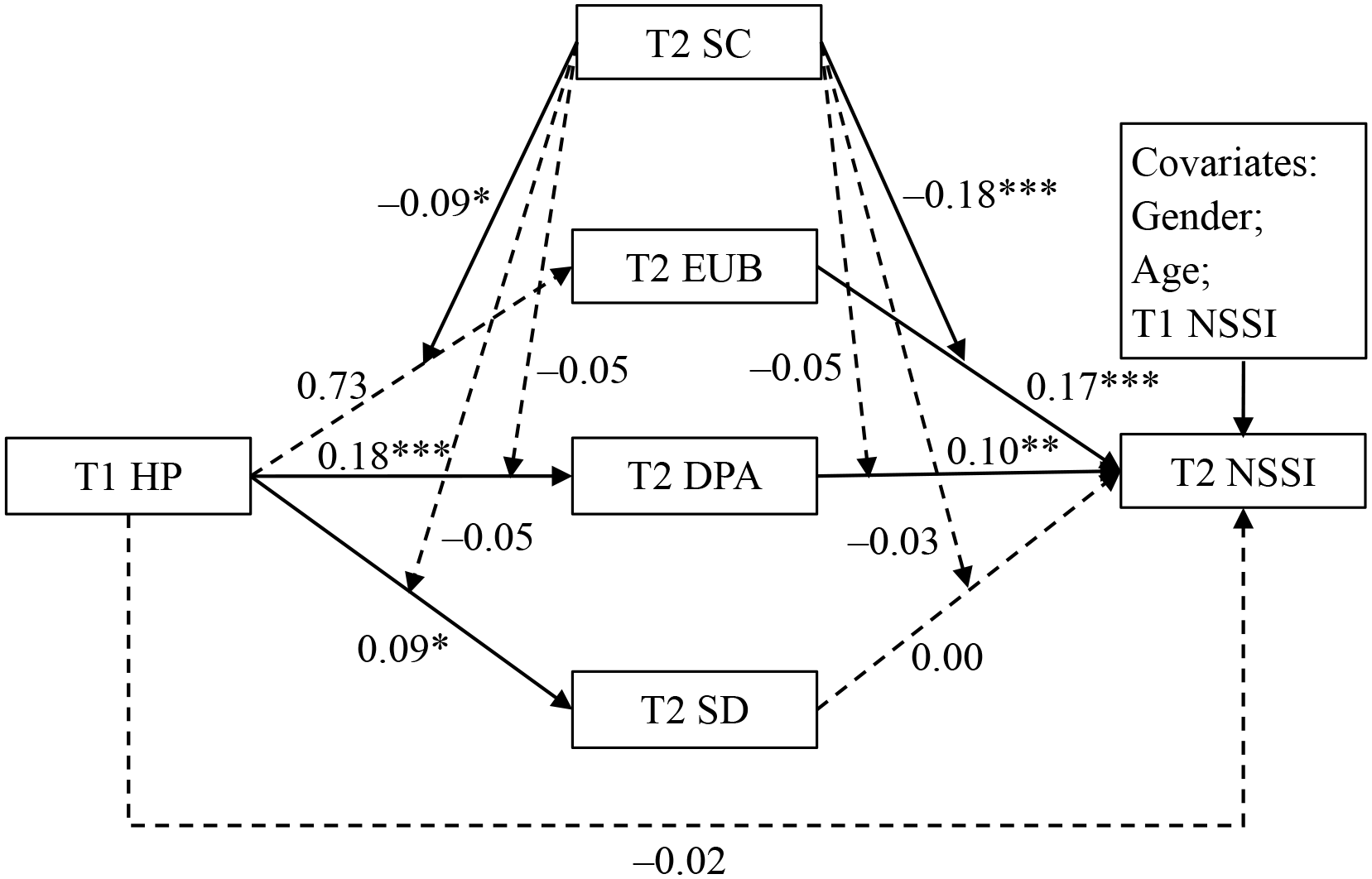
Testing the moderated mediation effect of T1 harsh parenting on T2 NSSI. HP, harsh parenting; NSSI, non-suicidal self-injury; EUB, emotion uncontrollability beliefs; DPA, deviant peer affiliation; SD, school disengagement; SC, self-control; T1, time 1; T2, time2. *p < 0.05, **p < 0.01, ***p < 0.001.
Figure 3

The moderating effect of T2 self-control on the relationship between T1 harsh parenting and T2 emotion uncontrollability beliefs.
Figure 4
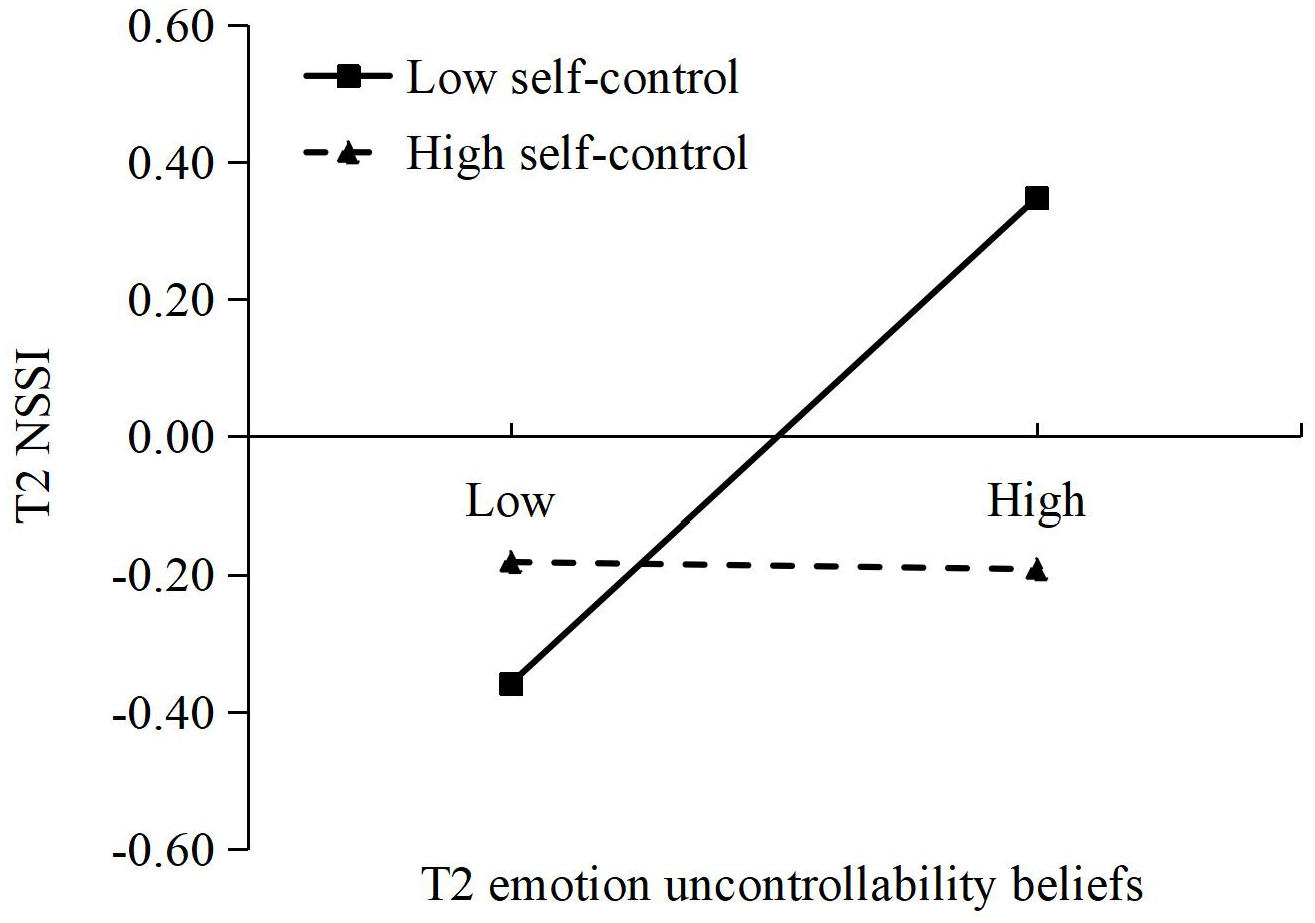
The moderating effect of T2 self-control on the relationship between T2 emotion uncontrollability beliefs and T2 NSSI.
Overall, the indirect effect of T1 harsh parenting on T2 NSSI via T2 emotion uncontrollability beliefs was moderated by T2 self-control. For adolescents low in self-control, T1 harsh parenting had significant effect on T2 NSSI through T2 emotion uncontrollability beliefs (Effect = 0.06, 95% CI [0.01, 0.13]). In contrast, the indirect effect was not significant for adolescents high in self-control (Effect = 0.00, 95% CI [–0.01, 0.01]). Moderated mediation effects of T2 self-control were not found in the links between T1 harsh parenting and T2 NSSI through T2 deviant peer affiliation or T2 school disengagement.
4 Discussion
4.1 The mediating role of emotional uncontrollability
The finding showed that adolescents who experience T1 harsh parenting from their parents are positively correlated with T2 emotional uncontrollability, which may also increase the risk of transitioning to T2 NSSI. This finding supported that T2 emotional uncontrollability is a mediating mechanism between T1 harsh parenting and T2 NSSI.
According to Nock’s theory (15), emotional uncontrollability is an internal stressor that may lead to NSSI as a way to cope with the long-term effects of harsh parenting. Recent study found that harsh parenting-induced parent alienation and unhealthy family functioning are closely tied to a history of NSSI, with depressive symptoms and self-criticism amplifying this risk (76). Similarly, this result also aligns with emotional security theory (20), where adolescents with insufficient emotional security are unable to cope with negative emotional events and use NSSI to transfer pain, forming a vicious cycle.
Moreover, T2 emotional uncontrollability is positively correlated with NSSI. This finding is consistent with existing research (77, 78). Liu et al. (78) found that childhood maltreatment (such as emotional neglect or physical abuse) indirectly triggers NSSI through exacerbating emotional dysregulation--traumatic experiences disrupt the development of early emotional regulation, making individuals more prone to emotional uncontrollability → NSSI in adulthood.
4.2 The mediating role of deviant peer affiliation
The results revealed a positive association between T1 harsh parenting and T2 deviant peer affiliation, as well as between T2 deviant peer affiliation and T2 NSSI. However, T2 deviant peer affiliation did not emerge as a significant mediator in the relationship between T1 harsh parenting and T2 NSSI, providing no support for the hypothesis 2.
Specifically, the results reveal a positive association between T1 harsh parenting and T2 deviant peer affiliation, a finding consistent with prior empirical evidence (37, 38). As a maladaptive parenting style, harsh parenting not only contributes to emotional dysregulation and internalizing difficulties in children and adolescents (36), but also disrupts the development of social and interpersonal competence. Repeated exposure to negative parent-adolescent interactions may lead adolescents to internalize these dysfunctional relational patterns and generalize them to peer contexts (50). This process compromises their capacity to develop and sustain healthy peer relationships, thereby heightening their risk of affiliating with deviant peers (36).
Furthermore, the present findings reveal a significant positive association between T2 deviant peer affiliation and T2 NSSI. This observation is consistent with existing empirical evidence, which indicates that adolescents with higher levels of involvement in deviant peer networks are more likely to engage in NSSI (43, 45). Moreover, this association is theoretically supported by both deviance regulation theory and general strain theory, which posit that exposure to deviant peers and exposure to stressful life events may increase the likelihood of NSSI as a maladaptive coping mechanism in response to negative emotional states (39, 41).
However, T2 deviant peer affiliation did not significantly mediate the overall pathway between T1 harsh parenting and T2 NSSI. According to Nock’ s (15) integrative model, distal factors such as parental rearing practices and childhood trauma typically influence NSSI indirectly by shaping proximal factors, including emotional coping and stressful life events (48, 79). In the present study, both harsh parenting and deviant peer affiliation represent distal risk factors that operate at the same level of the individual’ s microsystem. Consequently, although both factors jointly contribute to adolescents’ risk for NSSI, harsh parenting does not exert its effect on NSSI through influencing adolescents’ engagement in deviant peer affiliation.
4.3 The mediating role of school disengagement
The results of the present study indicate that T1 harsh parenting significantly predicted T2 school disengagement. However, T2 school disengagement did not significantly predict T2 NSSI, nor did it significantly mediate the relationship between T1 harsh parenting and T2 NSSI. Therefore, Hypothesis 3 was not supported.
The finding that T1 harsh parenting predicts T2 school disengagement is consistent with prior empirical evidence linking negative parenting practices to increased risk of adolescent disengagement from school (52). This result aligns with social learning theory (50), which posits that adolescents internalize interpersonal interaction patterns experienced within parent-adolescent relationships and subsequently generalize these behavioral and emotional schemas to other social contexts. Notably, similar to how deviant peer affiliation often requires internal psychological factors (e.g., depression) to influence NSSI rather than directly mediating family-related pathways (45), school disengagement may also lack a direct mediating effect without the synergy of individual vulnerability factors. When these internalized patterns are characterized by hostility, control, or emotional unresponsiveness, they may impair adolescents ‘ peer relationships, increase susceptibility to peer rejection, and ultimately undermine engagement with school settings.
Furthermore, the present study revealed that T2 school disengagement did not significantly predict T2 NSSI, a finding that contrasts with prior empirical evidence. Notably, research among Chinese adolescents has shown that higher levels of school engagement are prospectively associated with lower rates of NSSI (80). As a central ecological context in adolescent development, the school environment serves as a critical source of emotional support and belongingness, both of which are fundamental to psychological well-being (53). When adolescents become disengaged from school and are consequently deprived of these essential psychosocial resources, they may be at increased risk for maladaptive coping responses, including self-injurious behaviors. The absence of a significant association in the current study suggests that the pathway from school disengagement to NSSI may be conditional, potentially moderated by unmeasured individual or contextual factors. Therefore, future research should aim to enhance sample diversity and integrate additional moderating or mediating mechanisms to better understand the complex interplay offactors underlying adolescent NSSI.
4.4 The moderating role of self-control
The findings of this study reveal a nuanced moderating role of self-control in the developmental pathway from harsh parenting to NSSI. Specifically, self-control significantly moderated both the initial link between T1 harsh parenting and T2 emotion uncontrollability beliefs, and the subsequent association between T2 emotion uncontrollability beliefs and T2 NSSI. These results partially support our hypotheses, highlighting self-control’s function as a critical buffer at distinct stages of the risk pathway.
The significant moderating effect observed in the relationship between harsh parenting and emotion uncontrollability beliefs provides compelling evidence for the protective role of self-control in adolescent development. This finding aligns robustly with the strength model of self-control (58), which conceptualizes self-regulation as a limited resource that can be depleted by chronic stressors like harsh parenting. Adolescents with higher levels of self-control demonstrate enhanced capacity for cognitive reappraisal and impulse inhibition when confronted with parental hostility, thereby attenuating the development of emotion uncontrollability beliefs (14). Furthermore, the identified buffering effect at the crucial stage between emotion uncontrollability beliefs and NSSI underscores self-control’s vital role in preventing the behavioral enactment of self-injury. Even when experiencing intense emotional turmoil, adolescents with robust self-control can better inhibit the impulsive urge to engage in NSSI as a maladaptive coping strategy (65). The dual protective function of self-control—both in mitigating the initial emotional impact of harsh parenting and in preventing the behavioral expression of distress—highlights its multifaceted importance in adolescent mental health. This pattern aligns with emerging evidence that self-control training interventions can effectively reduce NSSI frequency among at-risk adolescents (81). This pattern aligns with emerging evidence that interventions enhancing self-control can reduce risky behaviors in adolescents (65).
However, contrary to our hypotheses, self-control did not demonstrate significant moderating effects on the pathways involving deviant peer affiliation or school disengagement. This pattern of findings suggests that the protective influence of self-control may be particularly salient in managing the direct emotional consequences of harsh parenting and in preventing the translation of emotional distress into behavioral manifestations of NSSI (66). The non-significant moderating effects on peer- and school-related pathways indicate that these associations may be more robust and less influenced by individual differences in self-control, or that other contextual factors may play more prominent roles in these specific pathways (61). These findings have important implications for intervention strategies, suggesting that programs aimed at enhancing self-control may be particularly effective in helping adolescents manage emotional responses to harsh parenting and in preventing the transition from emotional distress to self-injurious behaviors.
4.5 Limitations and implications
This study provides empirical support for a longitudinal moderated mediation model linking parental harsh parenting to adolescent NSSI via emotional uncontrollability, with self-control acting as a critical buffer. Scientifically, these findings extend theoretical models by delineating a specific protective pathway through which self-control mitigates familial risk—not only by reducing emotional dysregulation but also by weakening the link between dysregulation and self-injury. Practically, the results highlight the need for multi-level interventions: parent-oriented programs should aim to reduce harsh disciplinary practices, while school- and community-based initiatives should integrate emotion-regulation training and targeted self-control enhancement for adolescents, especially those exposed to adverse family environments.
This study has some limitations. Firstly, all variables relied on adolescents’ self-reported data, which may be subject to subjective bias. It is difficult to objectively capture the actual parenting behaviors through self-reporting, which may affect the accuracy of the measurements. Second, the research sample come from Chinese adolescents, so caution should be exercised when generalizing the results to samples from other cultures. For example, Chinese culture emphasizes the unique parenting concept of strict discipline, which fundamentally differed from the Western parenting norm of opposing corporal punishment. Third, this study used two waves of longitudinal data with a 6-month interval to examine the association mechanisms between variables. It cannot completely rule out short-term interference from third variables, such as sudden emotional uncontrollability or deviant peer affiliation. Future research can use multi-wave longitudinal tracking designs to enhance the stability of research findings.
5 Conclusions
This study examined the longitudinal association between parental harsh parenting and adolescent NSSI, with a focus on the mediating roles of emotional uncontrollability, deviant peer affiliation, and school disengagement, as well as the moderating role of self-control. Results indicated that T2 emotional uncontrollability significantly moderated the relationship between T1 parental harsh parenting and T2 NSSI. Furthermore, the indirect effect of T1 parental harsh parenting on T2 NSSI through T2 emotional uncontrollability was moderated by T2 self-control. These findings underscore the adverse impacts of parental harsh parenting and emotional uncontrollability on adolescent NSSI, as well as the protective role of self-control. To prevent adolescent NSSI, parents and school-based practitioners should attend to the roles of parenting practices, emotion regulation capacities, and self-control skills. Interventions ought to prioritize enhancing adolescents’ emotion regulation, and self-control to promote their overall psychological and physical well-being. It should be noted that the reliance on self-reported data may introduce common method bias. Future research would benefit from multi-wave longitudinal designs incorporating multiple informants to better capture dynamic processes and strengthen causal inference.
Statements
Data availability statement
The raw data supporting the conclusions of this article will be made available by the authors, without undue reservation.
Ethics statement
The studies involving humans were approved by The Ethics in Human Research Committee of the School of Education at Guangzhou University. The studies were conducted in accordance with the local legislation and institutional requirements. The participants provided their written informed consent to participate in this study. Written informed consent was obtained from the individual(s), and minor(s)’ legal guardian/next of kin, for the publication of any potentially identifiable images or data included in this article.
Author contributions
JL: Conceptualization, Data curation, Formal Analysis, Funding acquisition, Investigation, Methodology, Project administration, Resources, Software, Supervision, Validation, Visualization, Writing – original draft, Writing – review & editing. JW: Conceptualization, Data curation, Formal Analysis, Funding acquisition, Investigation, Methodology, Project administration, Resources, Software, Supervision, Validation, Visualization, Writing – original draft, Writing – review & editing. YT: Conceptualization, Data curation, Formal Analysis, Investigation, Methodology, Resources, Software, Validation, Visualization, Writing – review & editing. DC: Writing – original draft, Writing – review & editing. XX: Writing – original draft, Writing – review & editing. QZ: Writing – original draft, Writing – review & editing. XN: Conceptualization, Data curation, Formal Analysis, Funding acquisition, Investigation, Methodology, Project administration, Resources, Software, Supervision, Validation, Visualization, Writing – original draft, Writing – review & editing. CY: Conceptualization, Data curation, Formal Analysis, Funding acquisition, Investigation, Methodology, Project administration, Resources, Software, Supervision, Validation, Visualization, Writing – original draft, Writing – review & editing.
Funding
The author(s) declared that financial support was received for this work and/or its publication. This study was, supported by the National Education Science Planning of China (BBA230064) and by Guangdong Provincial Philosophy and Social Sciences Planning Project (GD25YXL02).
Conflict of interest
The author(s) declared that this work was conducted in the absence of any commercial or financial relationships that could be construed as a potential conflict of interest.
Generative AI statement
The author(s) declared that generative AI was not used in the creation of this manuscript.
Any alternative text (alt text) provided alongside figures in this article has been generated by Frontiers with the support of artificial intelligence and reasonable efforts have been made to ensure accuracy, including review by the authors wherever possible. If you identify any issues, please contact us.
Publisher’s note
All claims expressed in this article are solely those of the authors and do not necessarily represent those of their affiliated organizations, or those of the publisher, the editors and the reviewers. Any product that may be evaluated in this article, or claim that may be made by its manufacturer, is not guaranteed or endorsed by the publisher.
References
1
Nock MK . Why do people hurt themselves? New insights into the nature and functions of self-injury. Curr Dir. Psychol Sci. (2009) 18:78–83. doi: 10.1111/j.1467-8721.2009.01613.x
2
Franklin JC Ribeiro JD Fox KR Bentley KH Kleiman EM Huang X et al . Risk factors for suicidal thoughts and behaviors: a meta-analysis of 50 years of research. Psychol Bull. (2017) 143:187–232. doi: 10.1037/bul0000084
3
Buelens T Luyckx K Kiekens G Gandhi A Muehlenkamp JJ Claes L . Investigating the DSM-5 criteria for non-suicidal self-injury disorder in a community sample of adolescents. J Afect. Disord. (2020) 260:314–22. doi: 10.1016/j.jad.2019.09.009
4
Qu D Wen X Liu B Zhang X He Y Chen D et al . Non-suicidal self-injury in Chinese population: a scoping review of prevalence, method, risk factors and preventive interventions. Lancet Reg. Health West. Pac. (2023) 37:100794. doi: 10.1016/J.LANWPC.2023.100794
5
Yin F Jiang WL Zhou YQ Yang JW Yang N . Dominance analysis of influencing factors of adolescent non-suicidal self-injury from the perspective of ecosystem. Chi. J Health Educ. (2023) 39:517–22. doi: 10.16168/j.cnki.issn.1002-9982.2023.06.008
6
Rohner RP Khaleque A Cournoyer DE . Parental acceptance-rejection: theory, methods, cross-cultural evidence, and implications. Ethos. (2005) 33:299–334. doi: 10.1525/eth.2005.33.3.299
7
Anderson AS Siciliano RE Henry LM Watson KH Gruhn MA Kuhn TM et al . Adverse childhood experiences, parenting, and socioeconomic status: associations with internalizing and externalizing symptoms in adolescence. Child Abuse Negl. (2022) 125:105493. doi: 10.1016/j.chiabu.2022.105493
8
Wang M . Harsh parenting and peer acceptance in Chinese early adolescents: three child aggression subtypes as mediators and child gender as moderator. Child Abuse Negl. (2017) 63:30–40. doi: 10.1016/j.chiabu.2016.11.017
9
Black CFD . Partner emotional support and child problem behaviors: the indirect role of harsh parenting for young mothers and their children. Fam. Process. (2022) 61:376–91. doi: 10.1111/famp.12663
10
Gu H Chen W Cheng Y . Longitudinal relationship between harsh parenting and adolescent non-suicidal self-injury: the roles of basic psychological needs frustration and self-concept clarity. Child Abuse Negl. (2024) 149:106697. doi: 10.1016/J.CHIABU.2024.106697
11
Liu M Guo F . Parenting practices and their relevance to child behaviors in Canada and China. Scand J Psychol. (2010) 51:109–14. doi: 10.1111/j.1467-9450.2009.00795
12
Liu J Liu X Wang H Gao Y . Harsh parenting and non-suicidal self-injury in adolescence: the mediating effect of depressive symptoms and the moderating effect of the COMT Val158Met polymorphism. Child Adolesc. Psychiatry Ment Health. (2021) 15:70. doi: 10.1186/S13034-021-00423-0
13
Kingsbury M Sucha E Manion I Gilman SE Colman I . Adolescent mental health following exposure to positive and harsh parenting in childhood. Can J Psychiatry. (2020) 65:392–400. doi: 10.1177/0706743719889551
14
Li M Wang J Ma P Sun W Gong H Gao Y . The relationship between harsh parenting and adolescent depression. Sci Rep. (2023) 13:20647. doi: 10.1038/S41598-023-48138-W
15
Nock MK . Self-injury. Annu Rev Clin Psychol. (2010) 6:339–63. doi: 10.1146/annurev.clinpsy.121208.131258
16
Fu H Zhang M Yang S Kang C Liu L Zhao X . Decoding the adolescent non-suicidal self-injury: understanding with interpretable machine learning insights. BMC Public Health. (2025) 25:2994. doi: 10.1186/s12889-025-24354-z
17
Xue J Yan F Hu T He W . Family functioning and NSSI urges among Chinese adolescents: a three-wave chain multiple mediation model. J Youth Adolesc. (2025) 54:1128–39. doi: 10.1007/s10964-024-02119-y
18
Shear MK . The concept ofuncontrollability. Psychol Inq. (1991) 2:88–93. doi: 10.1207/s15327965pli020123
19
He N Xiang Y . Child maltreatment and nonsuicidal self-injury among Chinese adolescents: the mediating effect of psychological resilience and loneliness. Child. Youth Serv. Rev. (2022) 133:106335. doi: 10.1016/j.childyouth.2021.106335
20
Davies PT Cummings EM . Marital conflict and child adjustment: an emotional security hypothesis. Psychol Bull. (1994) 116:387–411. doi: 10.1037/0033-2909.116.3.387
21
Wang J Wang M Lei L . Longitudinal links among paternal and maternal harsh parenting, adolescent emotional dysregulation and short-form video addiction. Child Abuse Negl. (2023) 141:106236. doi: 10.1016/j.chiabu.2023.106236
22
Lunkenheimer E Ram N Skowron EA Yin P . Harsh parenting, child behavior problems, and the dynamic coupling of parents ‘ and children’s positive behaviors. J Fam. Psychol. (2017) 31:689–98. doi: 10.1037/fam0000310
23
Chen Q Lo CKM Chen M Chan KL Ip P . The occurrence and co-occurrence of harsh parenting and family conflict in Hong Kong. Int J Environ Res Public Health. (2022) 19:16199. doi: 10.3390/ijerph192316199
24
Cui K Long Y Xie H . How exposure to interparental conflict in childhood affects nonsuicidal self-injury in emerging adulthood: examining the moderated mediation effects of depression and emotion dysregulation. Deviant Behav. (2025), 1–15. doi: 10.1080/01639625.2025.2529440
25
Chang L Schwartz D Dodge KA McBride-Chang C . Harshparenting in relation to child emotion regulation and aggression. J Fam. Psychol. (2003) 17:598. doi: 10.1037/0893-3200.17.4.598
26
Wang M Wang J . Negative parental attribution and emotional dysregulation in Chinese early adolescents: harsh fathering and harsh mothering as potential mediators. Child Abuse Negl. (2018) 81:12–20. doi: 10.1016/j.chiabu.2018.04.008
27
Andersson H Aspeqvist E Dahlström Ö. Svedin CG Jonsson LS Landberg Å. et al . Emotional dysregulation and trauma symptoms mediate the relationship between childhood abuse and nonsuicidal self-Injury in adolescents. Front Psychiatry. (2022) 13:897081. doi: 10.3389/FPSYT.2022.897081
28
Glenn CR Blumenthal TD Klonsky ED Hajcak G . Emotional reactivity in nonsuicidal self-injury: divergence between self-report and startle measures. Int J Psychophysiol. (2011) 80:166–70. doi: 10.1016/j.ijpsycho.2011.02.016
29
Fergusson DM Horwood LJ . Prospective childhood predictors of deviant peer affiliations in adolescence. J Child Psychol Psychiatry. (1999) 40:581–92. doi: 10.1111/1469-7610.00475
30
Rudolph KD Lansford JE Agoston AM Sugimura N Schwartz D Dodge KA et al . Peer victimization and social alienation: predicting deviant peer affiliation in middle school. Child Dev. (2014) 85:124–39. doi: 10.1111/cdev.12112
31
Jiang J Zhou F . Influence of deviant peer affiliation on adolescent depression in China: roles of self-deviant behavior, academic performance, and academic stress. BMC Public Health. (2025) 25:2766. doi: 10.1186/S12889-025-23497-3
32
Yang RR Gan X Wang PY . The relationship between community violence exposure and traditional bullying among Chinese adolescents: the multiple mediating roles of deviant peer affiliation and internet game disorder. Curr Psychol. (2024) 43:27393–403. doi: 10.1007/s12144-024-06377-8
33
Tian Y Deng X Tong W He W . Relative deprivation and aggressive behavior: the serial mediation of school engagement and deviant peer affiliation. Child. Youth Serv. Rev. (2025) 168:108044. doi: 10.1016/J.CHILDYOUTH.2024.108044
34
Bronfenbrenner U . Ecological systems theory. In: KazdinAE, editor. Encyclopedia of Psychology, vol. 3 . Oxford University Press (2000). p. 129–33.
35
Kretschmer T Sentse M Meeus W Verhulst FC Veenstra R Oldehinkel AJ . Configurations of adolescents ‘ peer experiences: associations with parent-child relationship quality and parental problem behavior. J Res Adolesc. (2016) 26:474–91. doi: 10.1111/jora.12206
36
Zhang C Luo Y Zhang R . Parenting behaviors and deviant peer affiliation among Chinese adolescents: the mediating role of psychological reactance and the moderating role of gender. BMC Psychol. (2025) 13:379. doi: 10.1186/S40359-025-02703-2
37
Wang X Tian F Wang P . Childhood psychological maltreatment predicts adolescents ‘ bullying victimization: deviant peer affiliation and teacher-student relationships as moderators. Child. Youth Serv. Rev. (2024) 163:107814. doi: 10.1016/J.CHILDYOUTH.2024.107814
38
Chen Z Zou H Jiang L Chen Y Wu J Zhu W et al . Parent-child conflict and non-suicidal self-injury among Chinese adolescents: a double-path chain mediation model. Psychol Sch. (2025) 62:2755–65. doi: 10.1002/PITS.23497
39
Blanton H Christie C . Deviance regulation: a theory of action and identity. Rev Gen Psychol. (2003) 7:115–49. doi: 10.1037/1089-2680.7.2.115
40
Syed S Kingsbury M Bennett K Manion I Colman I . Adolescents ‘ knowledge of a peer ‘ s non-suicidal self-injury and own non-suicidal self-injury and suicidality. Acta Psychiatr Scand. (2020) 142:366–73. doi: 10.1111/acps.13229
41
Agnew R . Foundation for a general strain theory of crime and delinquency. Criminology. (1992) 30:47–87. doi: 10.1111/j.1745-9125.1992.tb01093.x
42
Hankin BL Abela JR . Nonsuicidal self-injury in adolescence: prospective rates and risk factors in a 2½ year longitudinal study. Psychiatry Res. (2011), 186:65–70.
43
Wei C Wang Y Ma T Zou Q Xu Q Lu H et al . Gratitude buffers the effects of stressful life events and deviant peer affiliation on adolescents’ non-suicidal self-injury. Front Psychol. (2022) 13:939974. doi: 10.3389/FPSYG.2022.939974
44
Zhang R Xie R Ding W Song S Yang Q Lin X . Longitudinal bidirectional relationships between deviant peer affiliation/core self-evaluation and non-suicidal self-injury among Chinese adolescents. Child. Youth Serv. Rev. (2024) 166:107984. doi: 10.1016/J.CHILDYOUTH.2024.107984
45
Li J Yu C . Deviant peer affiliation, depression, and adolescent non-suicidal self-injury: the moderating effect of the OXTR gene rs53576 polymorphism. Children. (2024) 11:1445. doi: 10.3390/CHILDREN11121445
46
Wen J Xu Q Zhang H Ding J Li M . School bullying and non-suicidal selfinjury amongruraladoles cents: the mediating role of alexithymia and the moderating role of friendship quality. Front Psychol. (2025) 16:1596166. doi: 10.3389/fpsyg.2025.1596166
47
Zhang J Wang E . Early life environmental unpredictability shapes non-suicidal self-injury: dual roles of experiential avoidance as mediator and moderator in Chinese college students. BMC Psychol. (2025) 13:670. doi: 10.1186/S40359-025-02986-5
48
Wang L Zha G Chen F Zhang J Li X Wang Z et al . The impact of childhood emotional abuse on non-suicidal self-injury in adolescents with mood disorders: a moderated mediation model. Front Psychiatry. (2025) 16:1553437. doi: 10.3389/fpsyt.2025.1553437
49
Henry KL Knight KE Thornberry TP . School disengagement as a predictor of dropout, delinquency, and problem substance use during adolescence and early adulthood. J Youth Adolesc. (2012) 41:156–66. doi: 10.1007/s10964-011-9665-3
50
Bandura A Ross D Ross SA . Transmission of aggression through imitation of aggressive models. J Abnorm. Soc Psychol. (1961) 63:575–82. doi: 10.1037/h0045925
51
Wang J Shi X Yang Y Zou H Zhang W Xu Q . The joint effect of paternal and maternal parenting behaviors on school engagement among Chinese adolescents: the mediating role of mastery goal. Front Psychol. (2019) 10:1587. doi: 10.3389/fpsyg.2019.01587
52
da Fonseca IB Santos G Santos MA . School engagement, school climate and youth externalizing behaviors: direct and indirect effects of parenting practices. Curr Psychol. (2024) 43:3029–46. doi: 10.1007/S12144-023-04567-4
53
Deci EL Ryan RM . Intrinsic motivation and self-determination in human behavior. Plenum Press (1985).
54
Hamza CA Heath NL . Nonsuicidal self-injury: what schools can do. In: Handbook of school-based mental health promotion: an evidence-informed framework for implementation. Springer International Publishing, Cham (2018). p. 237–60. doi: 10.1007/978-3-319-89842-114
55
Lin S Yu C Chen J Zhang W Cao L . Predicting adolescent aggressive behavior from community violence exposure, deviant peer affiliation and school engagement: a one-year longitudinal study. Child. Youth Serv. Rev. (2020) 111:104840. doi: 10.1016/j.childyouth.2020.104840
56
Chen Y Zhu J Ye Y Huang L Yang J Chen L et al . Parental rejection and adolescent problematic mobile phone use: mediating and moderating roles of school engagement and impulsivity. Curr.Psychol. (2021) 40:5166–74. doi: 10.1007/s12144-019-00458-9
57
Baumeister RF Bratslavsky E Muraven M Tice DM . Ego depletion: is the active self a limited resource? J Pers. Soc Psychol. (1998) 74:1252–65. doi: 10.1037/0022-3514.74.5.1252
58
Baumeister RF . Self-regulation, ego depletion, and inhibition. Neuropsychologia. (2014) 65:313–9. doi: 10.1016/j.neuropsychologia.2014.08.012
59
Compas BE Jaser SS Bettis AH Watson KH Gruhn MA Dunbar JP et al . Coping, emotion regulation, and psychopathology in childhood and adolescence: a meta-analysis and narrative review. Psychol Bull. (2017) 143:939–91. doi: 10.1037/bul0000110
60
Casey BJ . Beyond simple models of self-control to circuit-based accounts of adolescent behavior. Annu Rev Psychol. (2015) 66:295–319. doi: 10.1146/annurev-psych-010814-015156
61
Li J Chen Y Lu J Li W Yu C . Self-control, consideration of future consequences, and internet addiction among Chinese adolescents: the moderating effect of deviant peer affiliation. Int J Environ Res Public Health. (2021) 18:9026. doi: 10.3390/ijerph18179026
62
Vazsonyi AT Mikuška J Kelley EL . It’s time: a meta-analysis on the self-control–deviance link. J Crim. Just. (2017) 48:48–63. doi: 10.1016/j.jcrimjus.2016.10.001
63
Duckworth AL Taxer JL Eskreis-Winkler L Galla BM Gross JJ . Self-control and academic achievement. Annu Rev Psychol. (2019) 70:373–99. doi: 10.1146/annurev-psych-010418-103230
64
Xiang G-X Li H Gan X Qin K-N Jin X Wang P-Y . School resources, self-control and problem behaviors in Chinese adolescents: a longitudinal study in the post-pandemic era. Curr Psychol. (2022) 43:11–3. doi: 10.1007/s12144-022-04178-5
65
Martin A Oehlman M Hawgood J O’Gorman J . The role of impulsivity and self-control in suicidal ideation and suicide attempt. Int J Environ Res Public Health. (2023) 20:5012. doi: 10.3390/ijerph20065012
66
Riley EN Combs JL Jordan CE Smith GT . Negative urgency and lack of perseverance: identification of differential pathways of onset and maintenance risk in the longitudinal prediction of nonsuicidal self-injury. Behav Ther. (2015) 46:439–48. doi: 10.1016/j.beth.2014.12.002
67
Jiang Y You J Hou Y Du C Lin M-P Zheng X et al . Buffering the effects of peer victimization on adolescent non-suicidal self-injury: the role of self-compassion and family cohesion. J Adolesc. (2016) 53:107–15. doi: 10.1016/j.adolescence.2016.09.005
68
Yu CF Li MJ Zhang W . Childhood trauma, parent-child conflict, and adolescent non-suicidal self-injury: the moderating role of oxytocin receptor gene rs53576 polymorphism. China Youth Soc Sci. (2021) 40:97–108. doi: 10.16034/j.cnki.10-1318/c.2021.05.015
69
Gratz KL . Measurement of deliberate self-harm: preliminary data on the Deliberate Self-Harm Inventory. J Psychopathol. Behav Assess. (2001) 23:253–63. doi: 10.1023/A:1012779403943
70
Manser R Cooper M Trefusis J . Beliefs about emotions as a metacognitive construct: initial development of a self-report questionnaire measure and preliminary investigation in relation to emotion regulation. Clini. Psychol Psychother. (2012) 19:235–46. doi: 10.1002/cpp.745
71
Yu C Liao X Ni X Wang H . How and when deviant peer affiliation influence non-suicidal self-injury? Testing a longitudinal moderated serial mediation model among Chinese early adolescents. Child Psychiatry Hum Dev. (2025), 1–10. doi: 10.1007/S10578-025-01825-3
72
Wang M-T Willett JB Eccles JS . The assessment of school engagement: examining dimensionality and measurement invariance by gender and race/ethnicity. J Sch. Psychol. (2011) 49:465–80. doi: 10.1016/j.jsp.2011.04.001
73
Tangney JP Baumeister RF Boone AL . High self-control predicts good adjustment, less pathology, better grades, and interpersonal success. Pers. (2004) 72:271–324. doi: 10.1111/j.0022-3506.2004.00263.x
74
Tan SH Guo YY . Revision of the Self-Control Scale for college students. Chin J Clin Psychol. (2008), 468–70. doi: 10.16128/j.cnki.1005-3611
75
Hayes AF . Introduction to mediation, moderation, and conditionalprocess analysis: a regression-based approach. Guilford publications (2017).
76
Hoffman LM Carter SD Moore JA . Non-suicidal self-injury in a college sample: intrapersonal and family factors. J Adolesc Health. (2025) 77:412–9. Available online at: https://eric.ed.gov/?id=EJ1456904.
77
Franklin JC Aaron RV Arthur MS Shorkey SP Prinstein MJ . Nonsuicidal self-injury and diminished pain perception: the role of emotion dysregulation. Compr Psychiatry. (2012) 53:691–700. doi: 10.1016/j.comppsych.2011.11.008
78
Liu J Gao Y Liang C Liu X . The potential addictive mechanism involved in repetitive nonsuicidal self-injury: the roles of emotion dysregulation and impulsivity in adolescents. J @ Behav Addict. (2022) 11:953–62. doi: 10.1556/2006.2022.00077
79
Wan Z Fang S Zhao C . The effect of interparental conflict on non-suicidal self-injury in middle school students: a moderated mediation model of self-esteem and regulatory emotional self-efficacy. BMC Psychol. (2025) 13:384. doi: 10.1186/S40359-025-02681-5
80
Yu C Xie Q Lin S Liang Y Wang G Nie Y et al . Cyberbullying victimization and non-suicidal self-injurious behavior among Chinese adolescents: school engagement as a mediator and sensation seeking as a moderator. Front Psychol. (2020) 11:572521. doi: 10.3389/FPSYG.2020.572521
81
Mehlum L Tørmoen AJ Ramberg M Haga E Diep LM Laberg S et al . Dialectical behavior therapy for adolescents with repeated suicidal and self-harming behavior: a randomized trial. J Am Acad Child Adolesc. Psychiatry. (2014) 53:1082–91. doi: 10.1016/j.jaac.2014.07.003
Summary
Keywords
adolescent, deviant peer affiliation, emotional uncontrollability, non-suicidal self-injury (NSSI), parental harsh parenting, school disengagement, self-control
Citation
Li J, Wang J, Tian Y, Cui D, Xu X, Zhang Q, Ni X and Yu C (2026) Parental harsh parenting and non-suicidal self-injury among Chinese adolescents: the role of emotional uncontrollability, deviant peer affiliation, school disengagement, and self-control. Front. Psychiatry 16:1732342. doi: 10.3389/fpsyt.2025.1732342
Received
25 October 2025
Revised
16 December 2025
Accepted
22 December 2025
Published
20 January 2026
Volume
16 - 2025
Edited by
Zihao Zeng, Hunan Normal University, China
Reviewed by
Zhensong Lan, Guangxi Medical University, China
Dwi Indah Iswanti, Airlangga University, Indonesia
Updates
Copyright
© 2026 Li, Wang, Tian, Cui, Xu, Zhang, Ni and Yu.
This is an open-access article distributed under the terms of the Creative Commons Attribution License (CC BY). The use, distribution or reproduction in other forums is permitted, provided the original author(s) and the copyright owner(s) are credited and that the original publication in this journal is cited, in accordance with accepted academic practice. No use, distribution or reproduction is permitted which does not comply with these terms.
*Correspondence: Xingcan Ni, 2112308033@e.gzhu.edu.cn; Chengfu Yu, yuchengfu@gzhu.edu.cn
†These authors have contributed equally to this work
Disclaimer
All claims expressed in this article are solely those of the authors and do not necessarily represent those of their affiliated organizations, or those of the publisher, the editors and the reviewers. Any product that may be evaluated in this article or claim that may be made by its manufacturer is not guaranteed or endorsed by the publisher.