 Jia-Xin Li
 F. A. Cárdenas-López
 Xi Chen
- 1International Center of Quantum Artificial Intelligence for Science and Technology (QuArtist) and Physics Department, Shanghai University, Shanghai, China
- 2Forschungszentrum Jülich GmbH, Peter Grünberg Institute, Quantum Control (PGI-8), Jülich, Germany
- 3Department of Physical Chemistry, University of the Basque Country UPV/EHU, Bilbao, Spain
- 4EHU Quantum Center, University of the Basque Country UPV/EHU, Leioa, Spain
Based on renewed interest in the shortcut-to-adiabaticity techniques in quantum control, we propose a reverse-engineering approach to modulate the longitudinal coupling between a pair of two-level systems with a quantized single-mode resonator. This allows us to suppress the unwanted transitions in the time-evolution operator such that the system dynamics resemble a controlled-phase gate acting in the qubit subspace at the nanosecond scale. The reduced gating time mitigates the detrimental effect produced by the loss mechanisms in all aspects. Moreover, we present a possible experimental implementation based on superconducting quantum circuits. Our work further demonstrates the versatility of the reverse-engineering method to enhance quantum protocols based on circuit quantum electrodynamic architecture.
1 Introduction
Superconducting quantum circuits (SCs) and circuit quantum electrodynamics (cQED) (Blais et al., 2004; Chiorescu et al., 2004; Wallraff et al., 2004; Devoret and Martinis, 2005; Wendin and Shumeiko, 2005; You and Nori, 2006; Clarke and Wilhelm, 2008; Schoelkopf and Girvin, 2008; Devoret and Schoelkopf, 2013; Kockum and Nori, 2019; Krantz et al., 2019; Kjaergaard et al., 2020; Martinis et al., 2020; Blais et al., 2021) have become promising quantum platforms for quantum information processing (Blais et al., 2007; Blais et al., 2020) to implement quantum algorithms (Montanaro, 2016). This method has also been suitable for quantum simulation (Buluta and Nori, 2009; Houck et al., 2012; Georgescu et al., 2014) and, lately, strong evidence has been provided of computational advantages over its classical counterpart (Arute et al., 2019; Wu et al., 2021).
The tailor-made feature offered by the quantum platform permits us to engineer integrated electronic devices that mimic the fundamental elements of cavity QED. For example, artificial atoms correspond to Josephson junction-based circuits behaving as non-linear oscillators whose energy spectrum exhibits noticeable large anharmonicity (Bouchiat et al., 1998; Mooij et al., 1999; Nakamura et al., 1999; Orlando et al., 1999; Martinis et al., 2002; Koch et al., 2007; Schreier et al., 2008; Manucharyan et al., 2009; Barends et al., 2013; Nguyen et al., 2019; Yan et al., 2020). At the same time, LC circuits and transmission line resonators correspond to the quantized field mode (Itoh, 1974; Göppl et al., 2008). The coupling between these subsystems with additional circuit elements as the superconducting quantum interference device (SQUID) allows access to tunable transition energy and switchable coupling strength (Srinivasan et al., 2011). Furthermore, the increasing understanding of the fabrication techniques leads to engineered quantum systems with longer coherence times that protect them from the action of the environment (Wendin and Shumeiko, 2005).
With these elements, we aimed to design a set of logic operations between these artificial atoms that correspond to one- and two-qubit quantum gates, respectively. In circuit quantum electrodynamics, a plethora of two-qubit quantum gates has been proposed, which includes the iSWAP (Bialczak et al., 2010; Dewes et al., 2012; Li et al., 2020), the controlled-not (CNOT) (Paraoanu, 2006; Rigetti and Devoret, 2010; Chow et al., 2011), the controlled-phase (CP) (Strauch et al., 2003; Yang and Han, 2005; DiCarlo et al., 2009; Yamamoto et al., 2010; Xiong et al., 2022), the cross-resonance gate (CR) (Paraoanu, 2006; Rigetti and Devoret, 2010; Chow et al., 2011), and the resonator-induced CP gate (Chow et al., 2013; Paik et al., 2016), among others. The physics underlying these implementations relies upon the tunability of control parameters such that the dynamics on the two-qubit subspace at some sweet spot represent the desired gate (Li et al., 2020). Likewise, it is also possible to engineer quantum gates regarding fixed-frequency qubits that are driven by external microwave pulses (Paraoanu, 2006; Rigetti and Devoret, 2010; Chow et al., 2011; Chow et al., 2013; Paik et al., 2016). The most common situation is where the effective two-qubit interaction appears in a dispersive approximation between the qubits and the mediator (resonator or coupler) (Hua et al., 2014; Srinivasa et al., 2016), leading to a slow gating time that is a detriment to gate performance.
An alternative way to improve gate performance would be to achieve larger coupling strength values or drive the resonator with a high power signal that yields gating time at a sub-nanosecond time scale (García-Ripoll et al., 2003; Campbell et al., 2010; Chen, 2011; Romero et al., 2012). Nevertheless, these extreme considerations affecting the coupling and drive intensity may provoke leakage outside the computational basis and introduce unwanted transitions that will reduce gate performance even more. A way to circumvent this problem relies upon the use of quantum control techniques that accelerate the gating time while maintaining bounded coupling strength between the subsystem and the intensity drive. Within the broad family of quantum control techniques, we assess the shortcuts to adiabaticity (STA) (Chen et al., 2010; Guéry-Odelin et al., 2019), which provide optimal and robust solutions for accelerating slow adiabatic processes while overcoming systematic errors induced by fabrication errors or the unavoidable interaction with the environment (Guéry-Odelin et al., 2019,and references therein). In this regard, STA protocols have been generalized to open quantum system dynamics (Dann et al., 2019; Alipour et al., 2020), and the dissipative qubit readouts have been improved by adding counter-diabatic terms (Yin et al., 2022) or through inverse engineering of the longitudinal coupling (Cárdenas-López and Chen, 2022) in cQED.
Motivated by these advancements, we propose a method to engineer the longitudinal coupling between two transmon qubits coupled to an LC resonator to accelerate the performance of a controlled-phase gate. By using the reverse-engineering approach, we eliminated the unwanted terms appearing on the time-evolution operator governing the system dynamics such that, at a gating time of approximately 2 nanoseconds, the operator represents the required gate. Moreover, we analyzed the performance of the quantum gate under the typical noise source appearing in superconducting circuits and observed no detrimental effects on the final state within the short gating time. Herein, we discuss an experimental implementation with consistent state-of-the-art cQED architecture.
2 Model and Hamiltonian
Let us consider a quantized single field mode of frequency ωr coupled longitudinally to a pair of two-level systems where each of them has transition frequency ωq,ℓ, and we assume that they are coupled to the resonator through the time-dependent coupling strength λℓ(t). This situation is described by the following Hamiltonian (ℏ ≡ 1):
where
where, for simplicity, we renamed the variables as follows:
where
For time-independent coefficients λℓ, these equations reduced to
were fulfilled at the gating time tg. This gives the time-evolution operator as follows:
Coming back to the Schrödinger picture, we obtained
with ηℓ = ωq,ℓtg/2. Thus, for a specific gating time tg, and by engineering the coupling strength λℓ(t), it was possible to express the time evolution operator U (tg) as a controlled phase gate.
3 STA control: Reverse engineering
In this section, we aimed to design a modulation for the coupling strength λℓ(t) such that, at a desirable gating time tf, the time-evolution operator in Eq. 7 represents a controlled-phase gate acting on the qubit subspace. In other words, we intend that U (tg) ≡ CZ ⊕I. To do so, we had to find the unitary transformation
where ∂t refers to the time-derivative acting over operators. In general, it is possible to express
where gc,ℓ(t) is an auxiliary (classical) variable that eliminates the coupling strength in the Hamiltonian
that has the following Euler–Lagrange equation:
from which the control problem is reduced to solving a set of N differential equations (N is the number of qubits). The initial conditions for these equation sets require that, at t = 0 and t = tg, both adiabatic and lab frame must coincide (Chen et al., 2018; Guéry-Odelin et al., 2019; Cárdenas-López and Chen, 2022). Therefore, the initial conditions are given by
To assure smooth coupling strength modulation, we added the extra constraints
where M is the number coefficient required to fulfill all the initial conditions, and gc,ℓ(t) and its (k − 1)th derivatives vanish at t = 0 and t = tg for all values of n. Selecting k = 3 resulted in gc,ℓ(t),
The STA modulation satisfied construction of the conditions
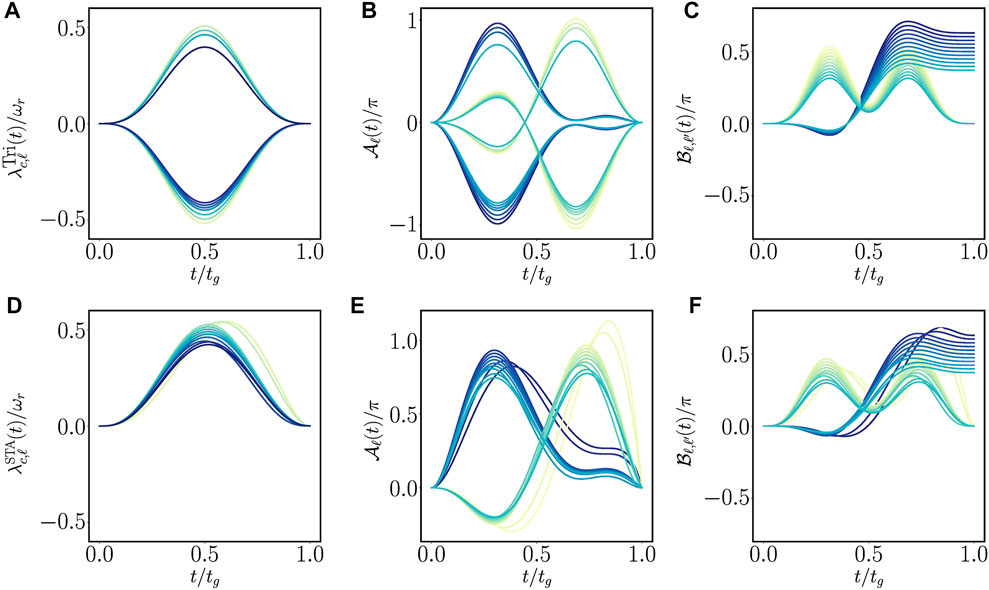
FIGURE 1. Modulation of coupling strength λℓ(t) as a function of the normalized time t/tg for different values of Θℓ,ℓ′ = (0, π/8) for (A) trigonometric and (D) STA modulation, and the parameter
4 Controlled-phase gate
As mentioned previously, generating fast and high-fidelity two-qubit quantum gates is at the heart of quantum computations and their applications in simulations and information processing, among other disciplines. In particular, the controlled-phase gate, i.e., CZ, changes the phase of the quantum state conditionally. In the basis {|gg⟩, |ge⟩, |eg⟩, |ee⟩}, it has the following form:
The CZ gate acts as an entangling gate when the initial quantum state is of the form |Ψ⟩ = (α|g⟩ + β|e⟩)(a|g⟩ + b|e⟩). The change phase on the state |ee⟩ does not permit writing the state as a tensor product. Conversely, the entanglement of formation (EoF) in the state is different from zero. For instance, for a quantum state with balanced amplitudes
More specifically, with our reverse-engineering protocol, the system dynamics reduced to the time-evolution operator depicted in Eq. 7. During the time evolution, the states {|gg⟩, |ge⟩, |eg⟩, |ee⟩} accumulated different phases given by
where the equal qubit frequency, i.e., ηℓ = η = ωqtg/2 was assumed. The first term on the time-evolution operator corresponds to the free terms of each qubit, whereas the second one is the effective ZZ interaction appearing due to factorization of the cavity degree of freedom. To obtain the typical controlled-phase gate CZ = diag [1, 1, 1–1], up to a global phase factor, we needed to solve
For the shorter generation time, we chose n = 0 and obtained Θℓ,ℓ′ = ±π/8, which resulted in U (tg) ≡ CZ = diag[1, 1, 1–1] up to a global time-dependent phase factor. Different values of Θℓ,ℓ′ will accumulate relative phases on the other state component, thereby degrading the performance of the quantum gate.
Figure 2 shows the system dynamics of the Hamiltonian in Eq. 1 for two different trigonometric and STA modulations. We calculated the population of the pair of two-level systems, the resonator and the EoF, of the two-qubit subspace for different angles Θℓ,ℓ′ when the system was initialized in the state |Ψ(0)⟩ = | + ⟩ ⊗| + ⟩ ⊗|0⟩, where
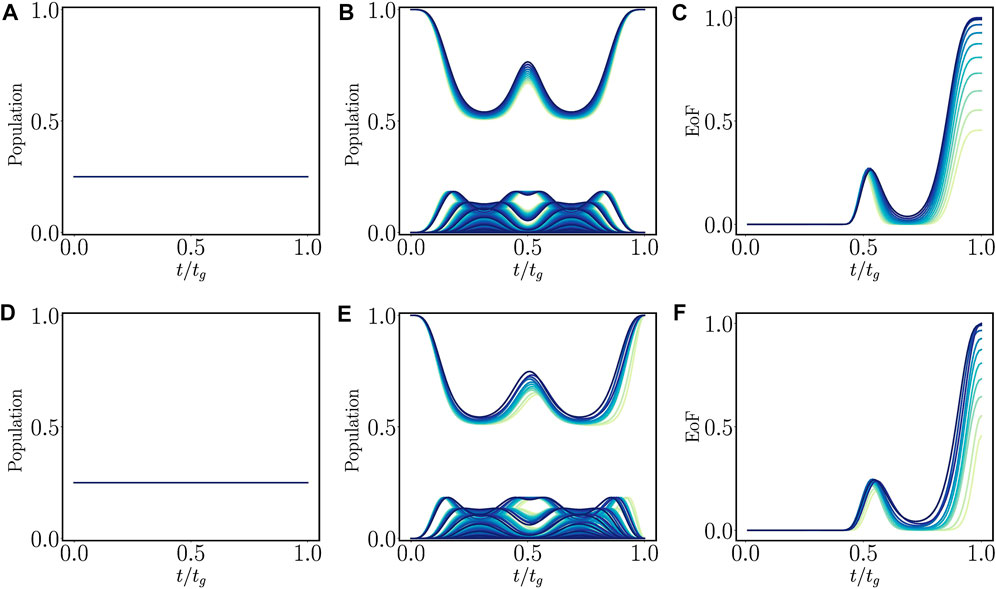
FIGURE 2. Population of the pair of two-level systems as a function of the normalized time t/tg for different values of Θℓ,ℓ′ = (0, π/8) for (A) trigonometric and (D) STA modulation. Population evolution of the resonator as a function of the normalized time t/tg for the (B) trigonometric and (E) STA modulation. Finally, EoF for the reduced density matrix consisting of the pair of two-level systems as a function of the normalized time t/tg for the (C) trigonometric and (F) STA modulation. The parameters are the same as those in Figure 1.
Next, we turned to the correlations embedded on the two-qubit subspace through the EoF, which, for this system, have an exact form given by
where the quantity C is termed concurrence defined as C = max(0, E4 − E3 − E2 − E1), where Ek are the eigenvalues (in increasing order) of the matrix
where ρ(t) is the density matrix describing the quantum state at time t and
Figure 3 shows the population of the two-qubit and resonator subspace, and the EoF as a function of the dimensionless gating time t/tg for the density matrix ρ(t) solution of the master equation in Eq. 19. There was no appreciable detrimental effect on the two-qubit subspace, and the population changed slightly and only at the end of the system dynamics without significantly affecting the performance of the protocol. For the resonator population, slight distortions of the population evolution were observed, which were produced mainly by the dissipation on the resonator, since its presence altered the displacement trajectory of the phase space. For the evolution of the EoF, we also observed that, for the optimal angle Θℓ,ℓ′ = π/8, there was no appreciable detrimental effect on the EoF at the end of the dynamics. However, for different angles, the generated correlation drastically decreased. In this situation, we concluded that the accumulated phase on each state component was affected by the depolarizing noise, since the relaxation losses did not abruptly change the population in the two-qubit state. In this sense, the controlled-phase gate was robust under relaxation noise, but fragile under depolarizing noise when the phase was not working at the optimal value Θℓ,ℓ′ = π/8.
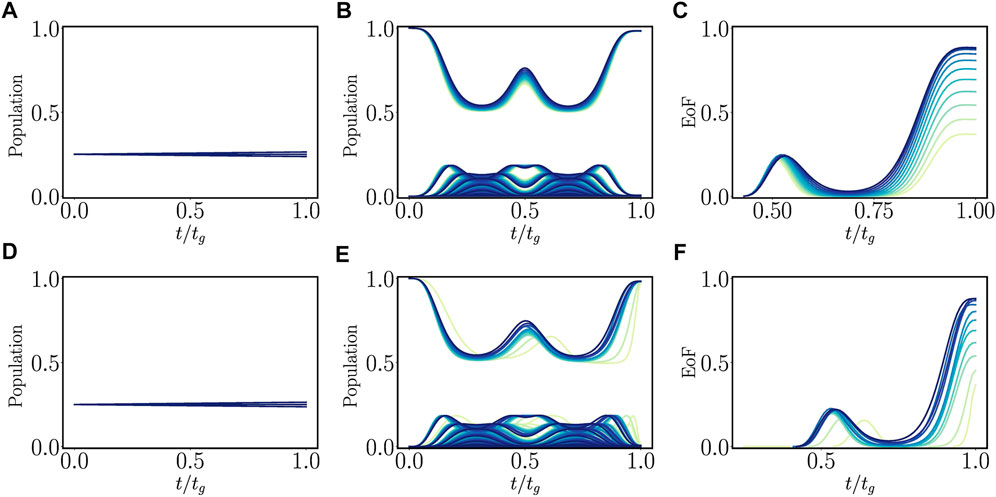
FIGURE 3. Population of the pair of two-level systems as a function of the normalized time t/tg for different values of Θℓ,ℓ′ = (0, π/8) for (A) trigonometric and (D) STA modulation. Population evolution of the resonator as a function of the normalized time t/tg for the (B) trigonometric and (E) STA modulation. Finally, EoF for the reduced density matrix consisting of the pair of two-level systems as a function of the normalized time t/tg for the (C) trigonometric and (F) STA modulation. The dynamics were calculated using the master equation in Eq. 19. The parameters are the same as those in Figure 1.
On the other hand, to demonstrate the robustness of the controlled-phase gate implementation over different initialization, we calculated the Schrödinger equation and the master equation [Eq. (19)] for the system prepared in the initial state |Ψ(0)⟩ = [cos(θ)|g⟩ + exp (iϕ) sin(θ)|e⟩] ⊗|e⟩ ⊗|0⟩ for different angles and phases in the range θ = (0, 2π) and ϕ = (0, 2π), and compared the result after applying the CZ gate. The comparison was carried out through the infidelity defined as
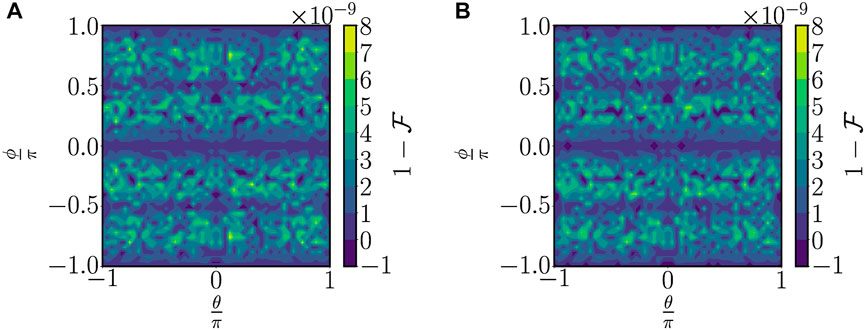
FIGURE 4. (A) Infidelity
5 Physical implementation
In this section, we discuss a possible experimental implementation for a single-mode resonator coupled to a pair of transmon circuits, as denoted in Figure 5. The single-mode resonator was an LC circuit with capacitance Cr and inductance Lr. Moreover, we modeled each transmon circuit (Koch et al., 2007) as a capacitor
where φ0 = ℏ/(2e) is the quantum magnetic flux and e is the electron charge. The canonical conjugate momenta are given by
We calculated the circuit Hamiltonian through the Legendre transformation
The quantization of each degree of freedom was achieved by promoting the momentum (node charge) and the flux functions to quantum operators satisfying canonical commutation relations. For the transmon qubit, the charge is proportional to the number of Cooper-pairs on the superconducting island, i.e.,
Here,
We expressed the oscillator in terms of the harmonic oscillator basis described by the operators
which lead to the following Hamiltonian:
where
corresponding to the transmon, resonator, and interaction terms.
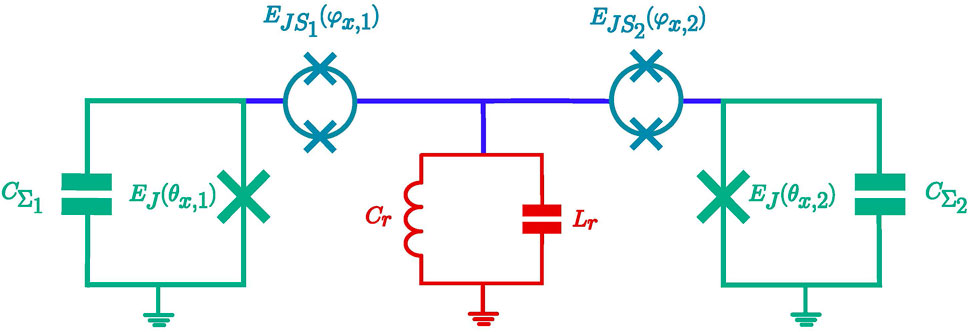
FIGURE 5. Schematic illustration of the experimental proposal: two transmon circuits formed by a capacitor
To illustrate this in the two-level approximation of the transmon circuit, the two-level approximation
where σx = |e⟩⟨g| + |g⟩⟨e| corresponds to the x-component Pauli matrix, and
where the qubit frequency is defined as
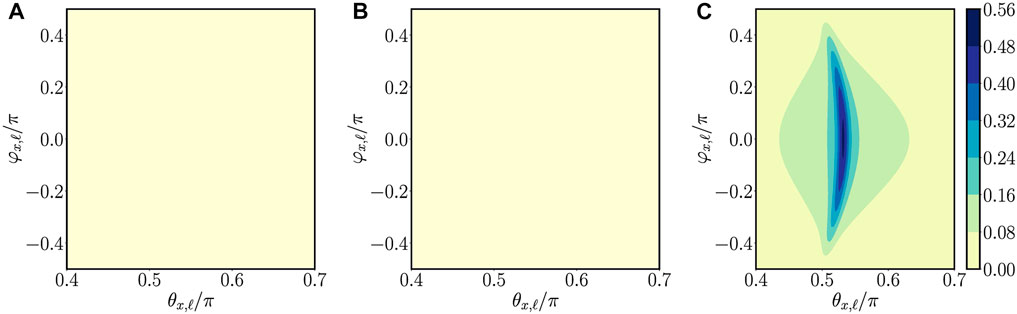
FIGURE 6. (A–C) Pauli matrix coefficient
It is worth mentioning that it is possible to perform single qubit gates on this architecture just by choosing a value of the external magnetic flux φx,ℓ such that we switch off the interaction term between the resonator and the transmon circuits. On the other hand, the anharmonicity of the transmon circuit is proportional to its charge energy EC = 238 MHz, which, for a typical transmon, could be small enough to consider the additional level. In our proposal, however, as the artificial atom is coupled longitudinally to the field mode, we may not expect either population leakage or transitions induced by them. We demonstrated calculation of the protocol to generate the CZ gate by including the third energy level, as depicted in Figure 7. As expected, we did not observe substantial modification to the system dynamics.
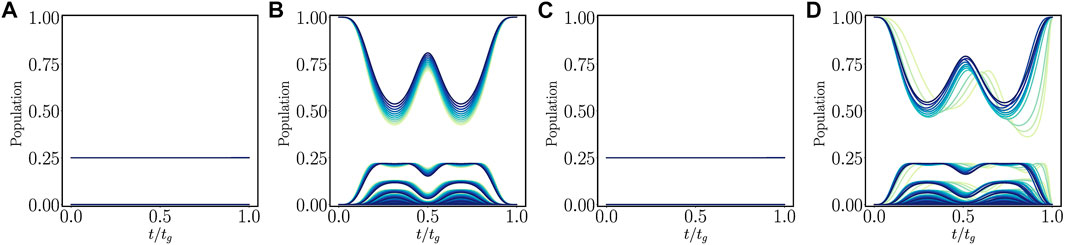
FIGURE 7. Population of the pair of three-level systems as a function of the normalized time t/tg for different values of Θℓ,ℓ′ = (0, π/8) for (A) trigonometric and (C) STA modulation. Population evolution of the resonator as a function of the normalized time t/tg for the (B) trigonometric and (D) STA modulation. The parameters are the same as those in Figure 1.
6 Conclusion
In summary, we have proposed a reverse-engineering method to modulate the longitudinal interaction between a pair of two-level systems with a cavity field to implement a controlled-phase gate using a pair of superconducting artificial atoms. We have constrained the modulation of the coupling strength to delete the unwanted terms appearing on the time-evolution operator, resulting in the two-qubit quantum gate that operates at 2 nanoseconds, which is within the current state-of-the-art in superconducting quantum circuits. The shorter generation time allows the gate to be insensitive to the unavoidable effects of the environment. The method can be extended to the fast control of multi-particle and other physical setups, such as trapped ions and quantum dots. The use of STA paves the way to implementation of faster and more resilient quantum gates by providing a key factor for quantum computation, quantum information processing, and quantum simulation.
Data availability statement
The raw data supporting the conclusion of this article will be made available by the authors, without undue reservation.
Author contributions
XC and FC-L developed the protocol; J-XL and FC-L performed the numerical simulations under supervision of XC. All authors wrote the manuscript.
Funding
This work was financially supported by NSFC (12075145), STCSM (Grant No. 2019SHZDZX01-ZX04), EU FET Open Grant EPIQUS (Grant No. 899368), the Basque Government through Grant No. IT1470-22, the project grant PID2021-126273NB-I00 funded by MCIN/AEI/10.13039/501100011033, “ERDF A way of making Europe” and “ERDF Invest in your Future,” and QUANTEK project (Grant No. KK-2021/00070).
Acknowledgments
FC-L thanks the German Ministry for Education and Research under QSolid, Grant No. 13N16149. XC thanks Ayudas para contratos Ramón y Cajal–2015–2020 (RYC-2017-22482).
Conflict of interest
The authors declare that the research was conducted in the absence of any commercial or financial relationships that could be construed as a potential conflict of interest.
Publisher’s note
All claims expressed in this article are solely those of the authors and do not necessarily represent those of their affiliated organizations, or those of the publisher, the editors, and the reviewers. Any product that may be evaluated in this article, or claim that may be made by its manufacturer, is not guaranteed or endorsed by the publisher.
Supplementary material
The Supplementary Material for this article can be found online at: https://www.frontiersin.org/articles/10.3389/frqst.2023.1135816/full#supplementary-material
References
Alipour, S., Chenu, A., Rezakhani, A. T., and del Campo, A. (2020). Shortcuts to adiabaticity in driven open quantum systems: Balanced gain and loss and non-markovian evolution. Quantum 4, 336. doi:10.22331/q-2020-09-28-336
Arute, F., Arya, K., Babbush, R., Bacon, D., Bardin, J. C., Barends, R., et al. (2019). Quantum supremacy using a programmable superconducting processor. Nature 574, 505–510. doi:10.1038/s41586-019-1666-5
Barends, R., Kelly, J., Megrant, A., Sank, D., Jeffrey, E., Chen, Y., et al. (2013). Coherent josephson qubit suitable for scalable quantum integrated circuits. Phys. Rev. Lett. 111, 080502. doi:10.1103/PhysRevLett.111.080502
Bialczak, R. C., Ansmann, M., Hofheinz, M., Lucero, E., Neeley, M., O’Connell, A. D., et al. (2010). Quantum process tomography of a universal entangling gate implemented with josephson phase qubits. Nat. Phys. 6, 409–413. doi:10.1038/nphys1639
Blais, A., Gambetta, J., Wallraff, A., Schuster, D. I., Girvin, S. M., Devoret, M. H., et al. (2007). Quantum-information processing with circuit quantum electrodynamics. Phys. Rev. A 75, 032329. doi:10.1103/PhysRevA.75.032329
Blais, A., Girvin, S. M., and Oliver, W. D. (2020). Quantum information processing and quantum optics with circuit quantum electrodynamics. Nat. Phys. 16, 247–256. doi:10.1038/s41567-020-0806-z
Blais, A., Grimsmo, A. L., Girvin, S. M., and Wallraff, A. (2021). Circuit quantum electrodynamics. Rev. Mod. Phys. 93, 025005. doi:10.1103/RevModPhys.93.025005
Blais, A., Huang, R. S., Wallraff, A., Girvin, S. M., and Schoelkopf, R. J. (2004). Cavity quantum electrodynamics for superconducting electrical circuits: An architecture for quantum computation. Phys. Rev. A 69, 062320. doi:10.1103/PhysRevA.69.062320
Bouchiat, V., Vion, D., Joyez, P., Esteve, D., and Devoret, M. (1998). Quantum coherence with a single cooper pair. Phys. Scr. T76, 165. doi:10.1238/physica.topical.076a00165
Buluta, I., and Nori, F. (2009). Quantum simulators. Science 326, 108–111. doi:10.1126/science.1177838
Čadež, T., Jefferson, J. H., and Ramšak, A. (2014). Exact nonadiabatic holonomic transformations of spin-orbit qubits. Phys. Rev. Lett. 112, 150402. doi:10.1103/PhysRevLett.112.150402
Campbell, W. C., Mizrahi, J., Quraishi, Q., Senko, C., Hayes, D., Hucul, D., et al. (2010). Ultrafast gates for single atomic qubits. Phys. Rev. Lett. 105, 090502. doi:10.1103/PhysRevLett.105.090502
Cárdenas-López, F., and Chen, X. (2022). Shortcuts to adiabaticity for fast qubit readout in circuit quantum electrodynamics. Phys. Rev. Appl. 18, 034010. doi:10.1103/PhysRevApplied.18.034010
Chen, C. Y. (2011). Geometric phase gate based on both displacement operator and squeezed operators with a superconducting circuit quantum electrodynamics. Commun. Theor. Phys. 56, 91–95. doi:10.1088/0253-6102/56/1/17
Chen, X., Jiang, R. L., Li, J., Ban, Y., and Sherman, E. Y. (2018). Inverse engineering for fast transport and spin control of spin-orbit-coupled bose-einstein condensates in moving harmonic traps. Phys. Rev. A 97, 013631. doi:10.1103/PhysRevA.97.013631
Chen, X., Ruschhaupt, A., Schmidt, S., del Campo, A., Guéry-Odelin, D., and Muga, J. G. (2010). Fast optimal frictionless atom cooling in harmonic traps: Shortcut to adiabaticity. Phys. Rev. Lett. 104, 063002. doi:10.1103/PhysRevLett.104.063002
Chiorescu, I., Bertet, P., Semba, K., Nakamura, Y., Harmans, C. J. P. M., and Mooij, J. E. (2004). Coherent dynamics of a flux qubit coupled to a harmonic oscillator. Nature 431, 159–162. doi:10.1038/nature02831
Chow, J. M., Córcoles, A. D., Gambetta, J. M., Rigetti, C., Johnson, B. R., Smolin, J. A., et al. (2011). Simple all-microwave entangling gate for fixed-frequency superconducting qubits. Phys. Rev. Lett. 107, 080502. doi:10.1103/PhysRevLett.107.080502
Chow, J. M., Gambetta, J. M., Cross, A. W., Merkel, S. T., Rigetti, C., and Steffen, M. (2013). Microwave-activated conditional-phase gate for superconducting qubits. New J. Phys. 15, 115012. doi:10.1088/1367-2630/15/11/115012
Clarke, J., and Wilhelm, F. K. (2008). Superconducting quantum bits. Nature 453, 1031–1042. doi:10.1038/nature07128
Dann, R., Tobalina, A., and Kosloff, R. (2019). Shortcut to equilibration of an open quantum system. Phys. Rev. Lett. 122, 250402. doi:10.1103/PhysRevLett.122.250402
Devoret, M. H., and Martinis, J. M. (2005). Implementing qubits with superconducting integrated circuits. Boston, MA: Springer US), 163–203. doi:10.1007/0-387-27732-3_12
Devoret, M. H., and Schoelkopf, R. J. (2013). Superconducting circuits for quantum information: An outlook. Science 339, 1169–1174. doi:10.1126/science.1231930
Dewes, A., Ong, F. R., Schmitt, V., Lauro, R., Boulant, N., Bertet, P., et al. (2012). Characterization of a two-transmon processor with individual single-shot qubit readout. Phys. Rev. Lett. 108, 057002. doi:10.1103/PhysRevLett.108.057002
DiCarlo, L., Chow, J. M., Gambetta, J. M., Bishop, L. S., Johnson, B. R., Schuster, D., et al. (2009). Demonstration of two-qubit algorithms with a superconducting quantum processor. Nature 460, 240–244. doi:10.1038/nature08121
Didier, N., Bourassa, J., and Blais, A. (2015). Fast quantum nondemolition readout by parametric modulation of longitudinal qubit-oscillator interaction. Phys. Rev. Lett. 115, 203601. doi:10.1103/PhysRevLett.115.203601
García-Ripoll, J. J., Zoller, P., and Cirac, J. I. (2003). Speed optimized two-qubit gates with laser coherent control techniques for ion trap quantum computing. Phys. Rev. Lett. 91, 157901. doi:10.1103/PhysRevLett.91.157901
Georgescu, I. M., Ashhab, S., and Nori, F. (2014). Quantum simulation. Rev. Mod. Phys. 86, 153–185. doi:10.1103/RevModPhys.86.153
Göppl, M., Fragner, A., Baur, M., Bianchetti, R., Filipp, S., Fink, J. M., et al. (2008). Coplanar waveguide resonators for circuit quantum electrodynamics. J. Appl. Phys. 104, 113904. doi:10.1063/1.3010859
Guéry-Odelin, D., Ruschhaupt, A., Kiely, A., Torrontegui, E., Martínez-Garaot, S., and Muga, J. G. (2019). Shortcuts to adiabaticity: Concepts, methods, and applications. Rev. Mod. Phys. 91, 045001. doi:10.1103/RevModPhys.91.045001
Houck, A. A., Türeci, H. E., and Koch, J. (2012). On-chip quantum simulation with superconducting circuits. Nat. Phys. 8, 292–299. doi:10.1038/nphys2251
Hua, M., Tao, M. J., and Deng, F. G. (2014). Universal quantum gates on microwave photons assisted by circuit quantum electrodynamics. Phys. Rev. A 90, 012328. doi:10.1103/PhysRevA.90.012328
Itoh, T. (1974). Analysis of microstrip resonators. IEEE Trans. Microw. Theory Tech. 22, 946–952. doi:10.1109/tmtt.1974.1128390
Kjaergaard, M., Schwartz, M. E., Braumüller, J., Krantz, P., Wang, J. I. J., Gustavsson, S., et al. (2020). Superconducting qubits: Current state of play. Annu. Rev. Condens. Matter Phys. 11, 369–395. doi:10.1146/annurev-conmatphys-031119-050605
Koch, J., Yu, T. M., Gambetta, J., Houck, A. A., Schuster, D. I., Majer, J., et al. (2007). Charge-insensitive qubit design derived from the cooper pair box. Phys. Rev. A 76, 042319. doi:10.1103/PhysRevA.76.042319
Kockum, A. F., and Nori, F. (2019). Quantum bits with Josephson junctions. Cham: Springer International Publishing, 703–741. doi:10.1007/978-3-030-20726-7_17
Krantz, P., Kjaergaard, M., Yan, F., Orlando, T. P., Gustavsson, S., and Oliver, W. D. (2019). A quantum engineer’s guide to superconducting qubits. Appl. Phys. Rev. 6, 021318. doi:10.1063/1.5089550
Leib, M., Deppe, F., Marx, A., Gross, R., and Hartmann, M. J. (2012). Networks of nonlinear superconducting transmission line resonators. New J. Phys. 14, 075024. doi:10.1088/1367-2630/14/7/075024
Leib, M., and Hartmann, M. J. (2014). Synchronized switching in a josephson junction crystal. Phys. Rev. Lett. 112, 223603. doi:10.1103/PhysRevLett.112.223603
Li, X., Cai, T., Yan, H., Wang, Z., Pan, X., Ma, Y., et al. (2020). Tunable coupler for realizing a controlled-phase gate with dynamically decoupled regime in a superconducting circuit. Phys. Rev. Appl. 14, 024070. doi:10.1103/PhysRevApplied.14.024070
Manucharyan, V. E., Koch, J., Glazman, L. I., and Devoret, M. H. (2009). Fluxonium: Single cooper-pair circuit free of charge offsets. Science 326, 113–116. doi:10.1126/science.1175552
Martinis, J. M., Devoret, M. H., and Clarke, J. (2020). Quantum josephson junction circuits and the dawn of artificial atoms. Nat. Phys. 16, 234–237. doi:10.1038/s41567-020-0829-5
Martinis, J. M., Nam, S., Aumentado, J., and Urbina, C. (2002). Rabi oscillations in a large josephson-junction qubit. Phys. Rev. Lett. 89, 117901. doi:10.1103/PhysRevLett.89.117901
Milburn, G., Schneider, S., and James, D. (2000). Ion trap quantum computing with warm ions. Fortschritte der Physik Prog. Phys. 48, 801–810. doi:10.1002/1521-3978(200009)48:9/11<801:aid-prop801>3.0.co;2-1
Montanaro, A. (2016). Quantum algorithms: An overview. npj Quantum Inf. 2, 15023–15028. doi:10.1038/npjqi.2015.23
Mooij, J. E., Orlando, T. P., Levitov, L., Tian, L., van der Wal, C. H., and Lloyd, S. (1999). Josephson persistent-current qubit. Science 285, 1036–1039. doi:10.1126/science.285.5430.1036
Nakamura, Y., Pashkin, Y. A., and Tsai, J. (1999). Coherent control of macroscopic quantum states in a single-cooper-pair box. nature 398, 786–788. doi:10.1038/19718
Nguyen, L. B., Lin, Y. H., Somoroff, A., Mencia, R., Grabon, N., and Manucharyan, V. E. (2019). High-coherence fluxonium qubit. Phys. Rev. X 9, 041041. doi:10.1103/PhysRevX.9.041041
Orlando, T. P., Mooij, J. E., Tian, L., van der Wal, C. H., Levitov, L. S., Lloyd, S., et al. (1999). Superconducting persistent-current qubit. Phys. Rev. B 60, 15398–15413. doi:10.1103/PhysRevB.60.15398
Paik, H., Mezzacapo, A., Sandberg, M., McClure, D. T., Abdo, B., Córcoles, A. D., et al. (2016). Experimental demonstration of a resonator-induced phase gate in a multiqubit circuit-qed system. Phys. Rev. Lett. 117, 250502. doi:10.1103/physrevlett.117.250502
Paraoanu, G. S. (2006). Microwave-induced coupling of superconducting qubits. Phys. Rev. B 74, 140504. doi:10.1103/PhysRevB.74.140504
Richer, S., and DiVincenzo, D. (2016). Circuit design implementing longitudinal coupling: A scalable scheme for superconducting qubits. Phys. Rev. B 93, 134501. doi:10.1103/PhysRevB.93.134501
Rigetti, C., and Devoret, M. (2010). Fully microwave-tunable universal gates in superconducting qubits with linear couplings and fixed transition frequencies. Phys. Rev. B 81, 134507. doi:10.1103/PhysRevB.81.134507
Romero, G., Ballester, D., Wang, Y. M., Scarani, V., and Solano, E. (2012). Ultrafast quantum gates in circuit qed. Phys. Rev. Lett. 108, 120501. doi:10.1103/PhysRevLett.108.120501
Saira, O. P., Groen, J. P., Cramer, J., Meretska, M., de Lange, G., and DiCarlo, L. (2014). Entanglement Genesis by ancilla-based parity measurement in 2d circuit qed. Phys. Rev. Lett. 112, 070502. doi:10.1103/PhysRevLett.112.070502
Schoelkopf, R. J., and Girvin, S. M. (2008). Wiring up quantum systems. Nature 451, 664–669. doi:10.1038/451664a
Schreier, J. A., Houck, A. A., Koch, J., Schuster, D. I., Johnson, B. R., Chow, J. M., et al. (2008). Suppressing charge noise decoherence in superconducting charge qubits. Phys. Rev. B 77, 180502. doi:10.1103/PhysRevB.77.180502
Schrieffer, J. R., and Wolff, P. A. (1966). Relation between the anderson and kondo Hamiltonians. Phys. Rev. 149, 491–492. doi:10.1103/PhysRev.149.491
Sørensen, A., and Mølmer, K. (2000). Entanglement and quantum computation with ions in thermal motion. Phys. Rev. A 62, 022311. doi:10.1103/PhysRevA.62.022311
Srinivasa, V., Taylor, J. M., and Tahan, C. (2016). Entangling distant resonant exchange qubits via circuit quantum electrodynamics. Phys. Rev. B 94, 205421. doi:10.1103/PhysRevB.94.205421
Srinivasan, S., Hoffman, A., Gambetta, J., and Houck, A. A. (2011). Tunable coupling in circuit quantum electrodynamics using a superconducting charge qubit with aV-shaped energy level diagram. Phys. Rev. Lett. 106, 083601. doi:10.1103/physrevlett.106.083601
Strauch, F. W., Johnson, P. R., Dragt, A. J., Lobb, C. J., Anderson, J. R., and Wellstood, F. C. (2003). Quantum logic gates for coupled superconducting phase qubits. Phys. Rev. Lett. 91, 167005. doi:10.1103/PhysRevLett.91.167005
Theis, L., Motzoi, F., Machnes, S., and Wilhelm, F. (2018). Counteracting systems of diabaticities using drag controls: The status after 10 years (a). EPL Europhys. Lett. 123, 60001. doi:10.1209/0295-5075/123/60001
Wallraff, A., Schuster, D. I., Blais, A., Frunzio, L., Huang, R. S., Majer, J., et al. (2004). Strong coupling of a single photon to a superconducting qubit using circuit quantum electrodynamics. Nature 431, 162–167. doi:10.1038/nature02851
Wendin, G., and Shumeiko, V. S. (2005). Superconducting quantum circuits, qubits and computing. doi:10.48550/ARXIV.COND-MAT/0508729
Wootters, W. K. (1998). Entanglement of formation of an arbitrary state of two qubits. Phys. Rev. Lett. 80, 2245–2248. doi:10.1103/PhysRevLett.80.2245
Wu, Y., Bao, W. S., Cao, S., Chen, F., Chen, M. C., Chen, X., et al. (2021). Strong quantum computational advantage using a superconducting quantum processor. Phys. Rev. Lett. 127, 180501. doi:10.1103/PhysRevLett.127.180501
Xiong, H., Ficheux, Q., Somoroff, A., Nguyen, L. B., Dogan, E., Rosenstock, D., et al. (2022). Arbitrary controlled-phase gate on fluxonium qubits using differential ac Stark shifts. Phys. Rev. Res. 4, 023040. doi:10.1103/PhysRevResearch.4.023040
Yamamoto, T., Neeley, M., Lucero, E., Bialczak, R. C., Kelly, J., Lenander, M., et al. (2010). Quantum process tomography of two-qubit controlled-z and controlled-not gates using superconducting phase qubits. Phys. Rev. B 82, 184515. doi:10.1103/PhysRevB.82.184515
Yan, F., Sung, Y., Krantz, P., Kamal, A., Kim, D. K., Yoder, J. L., et al. Engineering framework for optimizing superconducting qubit designs (2020). doi:10.48550/ARXIV.2006.04130
Yang, C. P., and Han, S. (2005). n-qubit-controlled phase gate with superconducting quantum-interference devices coupled to a resonator. Phys. Rev. A 72, 032311. doi:10.1103/PhysRevA.72.032311
Yin, Z., Li, C., Allcock, J., Zheng, Y., Gu, X., Dai, M., et al. (2022). Shortcuts to adiabaticity for open systems in circuit quantum electrodynamics. Nat. Commun. 13, 188–197. doi:10.1038/s41467-021-27900-6
Keywords: quantum control, shortcuts to adiabaticity, quantum gates, superconducting circuits, circuit quantum electrodynamics
Citation: Li J-X, Cárdenas-López FA and Chen X (2023) Shortcuts to adiabaticity in a fast controlled-phase gate in superconducting quantum circuits. Front. Quantum Sci. Technol. 2:1135816. doi: 10.3389/frqst.2023.1135816
Received: 01 January 2023; Accepted: 14 February 2023;
Published: 15 March 2023.
Edited by:
Erik Torrontegui, Universidad Carlos III de Madrid, SpainCopyright © 2023 Li, Cárdenas-López and Chen. This is an open-access article distributed under the terms of the Creative Commons Attribution License (CC BY). The use, distribution or reproduction in other forums is permitted, provided the original author(s) and the copyright owner(s) are credited and that the original publication in this journal is cited, in accordance with accepted academic practice. No use, distribution or reproduction is permitted which does not comply with these terms.
*Correspondence: Xi Chen, eGkuY2hlbkBlaHUuZXVz