 Franziska Greinert
 Rainer Müller1
 Simon Goorney
- 1Institut für Fachdidaktik der Naturwissenschaften, Technische Universität Braunschweig, Braunschweig, Germany
- 2Department of Management, Aarhus University, Aarhus, Denmark
- 3Niels Bohr Institute, Copenhagen University, Copenhagen, Denmark
The European Competence Framework for Quantum Technologies is rapidly evolving into the basic common language for educational efforts, comparison of training offerings, mapping of courses and development of educational modules. It has been compiled within the European Quantum Flagship coordination and support projects QTEdu and QUCATS. It is central, e.g., in the European Quantum Readiness Center and will be the starting point for a European certification scheme to standardise industry training. For version 2.0, released in April 2023, the framework has been updated and extended, e.g., with descriptions of the proficiency levels A1 to C2. The framework is structured into eight domains with 42 subdomains, each covering several topics and subtopics. This report briefly documents the update process and the role of the framework in quantum technology education.
1 Introduction
As quantum technologies (QTs) are beginning to supply numerous different industries a greater number of skilled professionals will be needed (McKinsey & Company, 2022). An increasing number of employees, especially from outside physics, will need to be able to work with QTs, or at least require a basic understanding of QTs to communicate with people working in the field. Different groups in Europe (Venegas-Gomez, 2020; Kaur and Venegas-Gomez, 2022; Greinert et al., 2023) and the United States (Fox et al., 2020; Aiello et al., 2021; Hasanovic et al., 2022; Hughes et al., 2022) have contributed to better understand the concrete requirements for the future quantum workforce. In Europe, the efforts to develop the quantum education ecosystem are driven by the Quantum Flagship (Quantum Flagship, 2023), the European Commission’s initiative to boost QTs in Europe. Education and training are part of the European projects on coordination and support action: QTEdu (Coordination and Support Action for Quantum Technology Education, 2019–2022) (QTEdu CSA, 2022; European Commission, 2023) and QUCATS (Coordination and Support Action of the Quantum Flagship, 2022–2025) (European Commission, 2022b). Both CSAs were set up by the European Commission to coordinate the projects within the Quantum Flagship.
In order for there to be a transparent, scalable, and comparable definition of any given job’s competences requirements, a certain degree of standardisation is necessary. The same is true for academic study programs or upskilling programs for industry workforce. Competence frameworks are used in several fields, such as digital skills (Vuorikari et al., 2022) or sustainability (Bianchi et al., 2022), to provide a common language for the competences in the field. They structure the field into different domains and provide descriptions and examples for different levels of proficiency. The overall structure can thus be seen as having two dimensions, with the domains as one dimension and the proficiency levels as the second dimension.
The European Competence Framework for Quantum Technologies has been developed in a bottom-up approach, collecting input and feedback from the QT community. A short overview of its evolution through a beta version to version 1.0 has been published by the European Commission in the Methodology and Version History (Greinert and Müller, 2021). Further details of the iterative study gathering input to the framework and predictions for the future quantum workforce, with a total of 188 responses, are published (Greinert et al., 2023). These efforts within the QTEdu project have resulted in a version 1.0 that was focussed on QT content.
Version 1.0 of the Competence Framework has been used for different purposes. Examples are the Qualification Profiles for Quantum Technologies (Greinert and Müller, 2022), exemplary competence profiles that could be achieved through targeted education programs, and the use in the QTEdu pilot projects (Faletic et al., 2023). It has also been a basis for the flagship education projects DigiQ and QTIndu funded within the Digital Europe program of the European Commission. DigiQ (Digitally Enhanced European Quantum Technology Master) aims to establish and expand a set of QT master programs throughout Europe with modularized and interconnected course offerings (Sherson and Goorney, 2023a). The QTIndu (Quantum Technologies Training for Industry) project aims to develop industry training courses, ranging from small brushup and introductory modules to full, in-depth courses, for upskilling in industry (Quantum Flagship, 2023). Throughout these endeavours the Competence Framework acts as a common language for standardisation and comparability. Beyond these initial spearheading projects, wider adoption of the Competence Framework in both educational institutions and for employee hiring and upskilling will be incentivized within the Accord-programme of the QUCATS virtual institution, the European Quantum Readiness Center EQRC (Sherson and Goorney, 2023b).
In the Framework version 1.0, the proficiency levels are characterised only by short descriptive designations for each of the six levels A1 to C2, adopted from language learning (Council of Europe, 2020). These designations range from A1—Awareness to C2—Innovation. They were adopted from the Digital Competence Framework for Educators (DigCompEdu) (Redecker and Punie, 2017). A major improvement in version 2.0 is the addition of concrete proficiency level descriptions with examples. This allows the Framework to be used as a specification of a selection of topics with associated proficiency levels. In this way, the Competence Framework can be used to compare different courses or qualifications. This will also be the starting point for the development of a European certification scheme to make certificates and training offers comparable.
Version 2.0 of the European Competence Framework for Quantum Technologies was released on World Quantum Day, 4/14, 2023 and is available via doi 10.5281/zenodo.7827254 (Greinert and Müller, 2023a).
2 Method: updating process
The revision of the framework focused on two aspects: updating the content based on additional community input, and adding detailed descriptions and examples of the proficiency levels. In addition, the overall structure was revised, adding descriptions and key skills for each of three blocks in order to emphasise ease of application.
2.1 Structural changes and updating of the content-focused dimension
The Competence Framework is intended to be an organically evolving document, updated regularly as the QT ecosystem and the understanding of the necessary workforce development needs deepen. Therefore, feedback was sought at several events and as the input was being processed, the Quantum Flagship and QTEdu community was invited to two online meetings to discuss proposed changes to the framework. In addition, several experts and interested community members were contacted to gather their feedback. Together with extensive QUCATS internal discussions and targeted consultations to incorporate feedback and experience from the past years, this resulted in the updated version of the content-focused dimension of the framework, i.e., the overview page and the detailed pages for each of the eight domains of the framework. The feedback collection and updating process to version 2.0 includes the following steps (Greinert and Müller, 2023b).
1. Collection of feedback on version 1.0 immediately after its release, a few individuals or groups made suggestions for additions and shifts of topics. They suggested, e.g., giving more visibility to classical computing and related topics, or adding a dedicated subdomain on the basics of quantum sensing.
2. Quick polls in QTEdu working group meetings in March 2022 for evaluation of impressions and collection of comments, e.g., on the use of the framework, documented for N = 59 responses in the document (European Commission, 2022a).
3. Discussion within the QUCATS team and consultation of some external experts with specific questions, involving about 20 people.
4. Feedback on final draft for version 2.0: Draft sent to selected contacts and members of the QTEdu community who had expressed an interest in contributing during the previous working group meetings; feedback requested from about 50 people, 5 responses received.
5. Two community input meetings in March 2023, invitations sent via the QTEdu and the Quantum Flagship newsletter to also engage experts outside the QT education community; 17 participants in total discussing the framework update.
Besides adding topics and changing wording, some structural changes have been made, the division into three main blocks has been updated, and descriptions of the three blocks have been added to clarify which competences are in which block. The overall narrative of the framework now is reconstructed to reflect the supply chain and technology stack for QT in order to best represent industry needs. This encompasses the component supplier, through e.g., system assembly and selection/consultancy, to the end-user. To make this even clearer and more useable, some key skills were added for each block. The structure of this page is shown in Figure 1, as well as a reduced version of the framework’s overview page showing the eight domains.
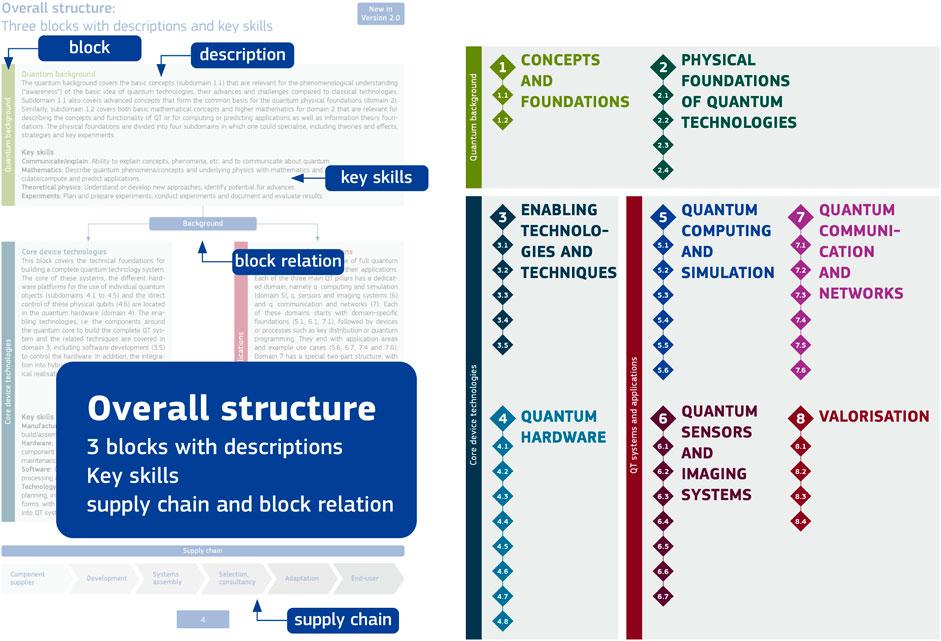
FIGURE 1. Overall structure of the framework: The new page in the framework version 2.0 (left) provides descriptions for the three blocks into which the framework domains are structured. In addition, key skills are provided. The supply chain at the bottom supports the block relation, from components in the left block to applications in the right block. The domains in this structure in version 2.0 (right) are visible in this reduced version of the overview page. While in the framework document also subdomains are listed, here only the anchor points of the subdomains are provided for an impression.
2.2 Descriptions for the proficiency levels
What is competence? What does it mean to be competent? Salman et al. (2020) provide a review about the concept of competence, describing competence with knowledge, skills, and self-actualization-related competence. Other models use knowledge, skills, and attitudes (KSA), as in the DigComp 2.2 framework (Vuorikari et al., 2022), or knowledge, skills, and responsibility and autonomy, as in the European Qualifications Framework (EQF) (European Commission, 2018), to only name a few.
Common in these systems is the appearance of knowledge and skills as two central components of competence. In addition, a third component appears that is less clearly defined and also less measurable. While knowledge and skills (the ability to do something) can be tested, attitudes or responsibilities cannot be tested easily, if at all. For the QT framework, this led to the decision to focus the proficiency level descriptions on knowledge and skills.
The starting point for formulating the six proficiency levels for QTs were the eight levels of the EQF. The EQF levels 5, 6, 7 and 8 are associated with the short, first, second and third cycles of the Qualifications Framework of the European Higher Education Area (European Commission, 2018, p. 16). These cycles are based on the European Credit Transfer and Accumulation System (ECTS), so they are linked to bachelor (first cycle, EQF level 6), master or doctoral programs. This is a common system that is easy to understand and to use in order to distinguish between different levels. Thus, we also provide a hint on how to reach each proficiency level, from a few hours to a long-term work experience in research and development such as a PhD project. By combining two of each of the first four EQF levels, the eight levels were reduced to six. For these, the EQF descriptions for knowledge and skills were adapted to QTs, leading to the proficiency level A1 to C2 descriptions. Figure 2 visualises this linking of the cycles/degrees with the EQF levels and of the EQF levels with the proficiency levels of the QT framework.
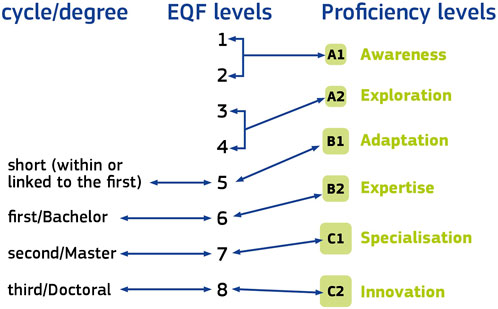
FIGURE 2. Linking of the proficiency levels to the EQF levels and the cycles/degrees.
To make the proficiency levels even more user-friendly, a short version of the description is provided in addition to the long format with the details on knowledge and skills. In addition, each proficiency level is illustrated with a concrete example of what the level means for a specific domain or subdomain.
3 Results: new version of the framework
3.1 Structural changes and updated content
The new version 2.0 is available since April 2023, see Greinert and Müller (2023a). A reduced version of the overview page with the eight domains in the three block structure of quantum background, core device technologies and QT systems and applications is shown in Figure 1.
In addition, the language of the framework has been clarified on the “How to use” page: The framework contains 8 domains (numbered 1, 2, … ) with 42 subdomains (numbered 1.1, 1.2, … ). For each subdomain, topics are provided, in some cases supplemented by subtopics. As in the old version, the overview page shows the main structure of the domains and subdomains, while the topics and subtopics are only visible on the detail pages, one for each domain. To help clarify these terms, Figure 3 provides an outline of the overview page and the “How to use” page. It shows what can be found where and what is meant by which term.
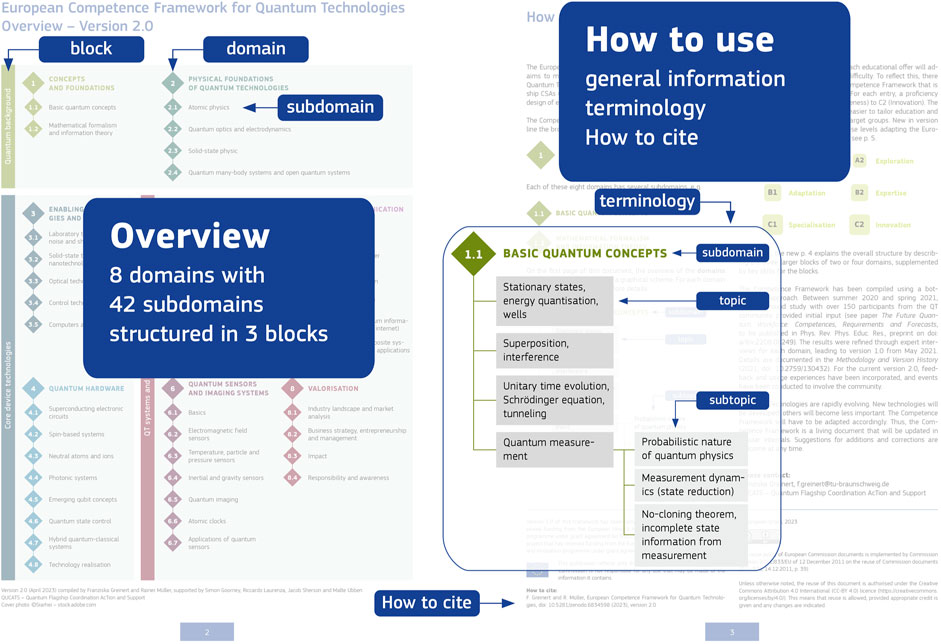
FIGURE 3. The overview page (left) provides an overview of the domains and subdomains, structured into three larger blocks. On the “How to use the Competence Framework” page (right), general information and a “how to cite” are provided, as well as a terminology explanation. This explanation also gives an idea of what the additional detail pages will look like. Each domain has a detail page that shows how the subdomains are extended by topics and subtopics.
The main changes in the update are:
• The former domain 8, “practical and soft skills,” is replaced by a new domain on valorisation, covering e.g., industry landscape, business and management, impact, responsibility and awareness raising. The former subdomains and topics that are no longer covered in domain 8 are either moved to other domains or dropped out because they represent too generic and not QT-specific concepts.
• The applications and use cases are included in the specific QT domains. The three QT domains have dedicated subdomains on the applications as well as a subdomain on the specific foundations each.
• Hardware covers all QTs in general, it is no longer just specific for quantum computers and sensors.
• The domain 2 “physical foundations” is expanded and some topics have been resorted, e.g., moved here from domain 1 (basic concepts) or moved to domain 3 (enabling technologies). In addition, the “practical/experimental skills” (old 8.1) are included in these (sub)domains, as is also visible in the key skills.
• There are no longer graphical links between the domains; connections/pathways through the framework become visible e.g., in the qualification profiles or in mappings of courses, where selections of the (sub)domains together with proficiency levels are provided.
In addition, the division into larger blocks is changed for domains 3 to 8. While in version 1.0 the “practical and soft skills” were separated from the QT domains, now the enabling technologies and techniques and the QT hardware are separated. Thus, the division is between the supplier part of the QT chain with components and the device core, and the three QT pillars. The QT pillars are complemented by the “valorisation,” which focuses on the complete devices and generating value from them, which is the end-user perspective.
As previously mentioned, a new page in version 2.0 complements the structure shown in the overview page by describing the three blocks quantum background, core device technologies, and QT systems and applications and providing key skills for each block, see Figure 1. The added key skills are intended to give a better sense of which skills are in which block, thus providing a skills-focused complement to the content-focused domains. These key skills are, for example, for the quantum background:
Communicate/explain: Ability to explain concepts, phenomena, etc., and to communicate about quantum.
Mathematics: Describe quantum phenomena/concepts and underlying physics with mathematics and use mathematics to calculate/compute and predict applications.
Theoretical physics: Understand or develop new approaches, identify potential for advances.
Experiments: Plan and prepare experiments, conduct experiments and document and evaluate results.
Full details can be found in the entire framework document (Greinert and Müller, 2023a).
3.2 Proficiency levels
The updated competence framework contains a new page dedicated on the proficiency levels. While it starts with the short version shown below, it also provides a long format of descriptions. In the long format, there is a separation between knowledge and skills for each level. In addition, an example is provided for each level for a selected framework domain or subdomain.
A1 Awareness (a few hours)Basic idea, overview of possibilities and limitations, reproduce solutions, operate a device or run an algorithm.
A2 Exploration (a few days)Knowledge of fundamentals or landscape of approaches describe functionalities, read and interpret an algorithm or a description.
B1 Adaptation (few weeks course)Specialised knowledge in a subdomain, awareness of its boundaries, explain complex functionalities, adapt approaches for concrete settings.
B2 Expertise (short research project)Advanced knowledge, critical perspectives, assessment of consequences, adapt or develop solutions for real-world use cases, identify possible use cases.
C1 Specialisation (longer research project)Highly specialised knowledge, critical awareness of interconnections, new solutions and methods, combine and integrate approaches.
C2 Innovation (long-year experience with R&D)Most advanced knowledge, interconnections, develop innovative solutions, evaluate and assess, extend and redefine professional practice.
These proficiency levels are thought to supplement the content-focussed (sub-)domains with their topics. Each subdomain, or even each topic, can be covered in a course or research work at a particular level. Thus, a person will be qualified in different (sub-) domains at different levels. The proficiency levels are therefore necessary for mapping and comparing courses, job offers or personal qualifications.
As already mentioned, the linking of the proficiency levels with the degrees Bachelor, Master or PhD, as defined by the European Qualification Framework, see Figure 2, and the corresponding descriptions in the framework provide an additional reference for the assessment of a level. In the long format of the level descriptions with the separation of knowledge and skills, these specifications explicitly name the degree. For example, for level B2 it says “e.g., through a short research project as for a bachelor thesis, internship with project.” In comparison, the short version above only refers to a “short research project.” However, the education provided in the degree is always provided as just one example means to reach the proficiency level. Other training programs or work and research projects can also lead to expertise and the attainment of higher proficiency levels.
An example of the use of the proficiency levels is provided with the qualification profiles (Greinert and Müller, 2022). The currently available beta version from January 2022 is based only on the descriptive designations of the levels from version 1.0. A major obstacle in compiling these sample profiles was that the people interviewed did not have a clear and common understanding of the levels. The added descriptions of the proficiency levels allow for easier application and clarify such ambiguities in communicating about the profession at different levels.
3.3 Overview of changes and impact
An overview of the changes made during the update of version 1.0 to version 2.0 together with the expected impact or improvement of the changes is provided in Table 1.
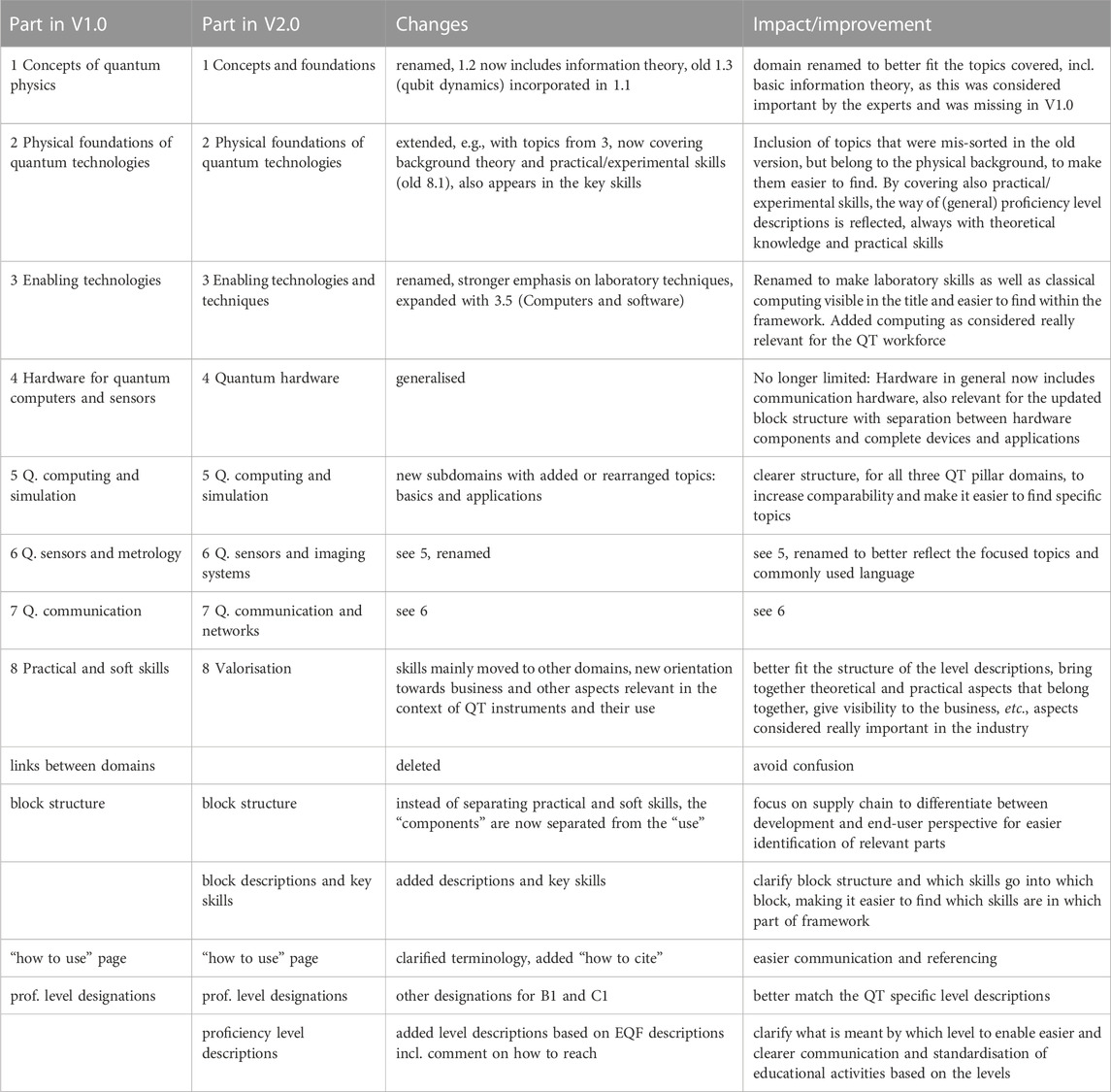
TABLE 1. Changes made between version 1.0 and version 2.0 and the corresponding impact or improvement.
4 Discussion: next steps and the role of responsibility
The updated version will be deployed within the European QT education community through application in the projects DigiQ and QTIndu. These are the flagship education programs in Europe, and will act as a fertile testing ground for application of the framework in Master programs and QT training courses designed from scratch. In addition, an industry needs analysis is conducted in mid 2023. Based on the experiences from the use of the framework and the results of the needs analysis, the framework will have to be updated. Especially the new key skills have to be reviewed to actually represent the key skills that are requested in these blocks. Similarly, the descriptions of the proficiency levels need to be reviewed: whether they are phrased in a useful way, or what changes need to be made to better meet the needs of the users.
For the proficiency levels, it has also to be figured out if the focus on knowledge and skills is appropriate—or if a third aspect is missing, and which one. In the EQF, this third component is called responsibility and autonomy: “In the context of the EQF, responsibility and autonomy is described as the ability of the learner to apply knowledge and skills autonomously and with responsibility.” (European Commission, 2018, p. 19) As discussed in the methods, we decided to focus only on the other two aspects of knowledge and skills in the proficiency level descriptions.
In the framework version 2.0, the aspect of responsibility is covered in subdomain 8.4 “responsibility and awareness”. Input from the community around this subdomain was gathered in prior interviews and the two rounds of QTEdu working group meetings with stakeholders from academia, industry, and education. It focused on the need for responsible awareness raising and public communication, particularly in the current age of hype and misinformation around other high-technology fields such as artificial intelligence (Nature Cell Biology Editorial, 2018). For this reason, the subdomain includes skills in outreach, public communication, education and training, as key areas in which stakeholders can make a concrete difference in quantum readiness for society (Goorney et al., 2022).
Other aspects of responsibility in QT include the ethical, legal, and governance. These topics are at the cutting edge of current research, as we are still uncovering issues around areas such as democratisation (Seskir et al., 2023) and patenting (Aboy et al., 2022). Thus, this sub-field may cover a range of possible approaches to responsibility in QT.
Feedback and experience from the use of the framework in other projects should also provide insights on how this is accepted from the users and what changes will be necessary in the next update.
Within the entire lifetime of the present Quantum Flagship coordination action (until 2025), the framework will be deployed and continually updated towards a fully operational certification scheme. This scheme aims to make training programs comparable through Europe and enable exchange and recognition between different institutions and nations. It will cover a selection of topics from the framework with associated proficiency levels, learning goals and sample examination tasks. In addition, best practices and course and material examples will be identified and communicated through the project.
Data availability statement
Publicly available datasets were analyzed in this study. This data can be found here: https://zenodo.org/record/7827254.
Author contributions
FG and RM compiled the Competence Framework. All authors contributed to the update of the framework, especially SG and JS for the new domain 8. FG organised the collection of feedback, compiled the framework document and wrote the first draft of the manuscript. SG wrote parts of the manuscript. All authors contributed to the article and approved the submitted version.
Funding
Version 1.0 of this framework has been compiled as part of a project that has received funding from the European Union’s Horizon 2020 research and innovation programme under grant agreement No. 951787. Its further development is part of a project that has received funding from the European Union’s Horizon Europe research and innovation programme under grant agreement No. 101070193. This publication reflects only the views of the authors, the European Commission is not responsible for any use that may be made of the information it contains.
Conflict of interest
The authors declare that the research was conducted in the absence of any commercial or financial relationships that could be construed as a potential conflict of interest.
Publisher’s note
All claims expressed in this article are solely those of the authors and do not necessarily represent those of their affiliated organizations, or those of the publisher, the editors and the reviewers. Any product that may be evaluated in this article, or claim that may be made by its manufacturer, is not guaranteed or endorsed by the publisher.
References
Aboy, M., Minssen, T., and Kop, M. (2022). Mapping the patent landscape of quantum technologies: Patenting trends, innovation and policy implications. IIC - Int. Rev. Intellect. Prop. Compet. Law 53, 853–882. doi:10.1007/s40319-022-01209-3
Aiello, C. D., Awschalom, D. D., Bernien, H., Brower, T., Brown, K. R., Brun, T. A., et al. (2021). Achieving a quantum smart workforce. Quantum Sci. Technol. 6, 030501. doi:10.1088/2058-9565/abfa64
Bianchi, G., Pisiotis, U., and Cabrera, M. (2022). GreenComp, the European sustainability competence framework. Luxembourg: LU: Publications Office of the European Union.
Council of Europe, (2020). Common European framework of reference for languages: Learning, teaching, assessment - companion volume. Strasbourg, France: Strasbourg: Council of Europe Publishing.
European Commission, (2022a). Coordination and support action for quantum technology education (QTEdu, Horizon 2020): Results: Report outlining community consensus on competence framework on quantum technology – lessons learned, recommendations for further research, and a roadmap for future development. https://cordis.europa.eu/project/id/951787/results.
European Commission, (2023). Coordination and support action for quantum technology education: QTEdu project. https://cordis.europa.eu/project/id/951787.
European Commission, (2022b). Quantum flagship coordination action and support: QUCATS project. https://cordis.europa.eu/project/id/101070193.
European Commission, (2018). The European qualifications framework: Supporting learning, work and cross-border mobility: 10th anniversary (Luxembourg: Luxembourg: Publications Office of the European Union).
Faletic, S., Bitzenbauer, P., Bondani, M., Chiofalo, M., Goorney, S., Krijtenburg-Lewerissa, K., et al. (2023). Contributions from pilot projects in quantum technology education as support action to quantum flagship. https://arxiv.org/abs/2303.07055.
Fox, M. F. J., Zwickl, B. M., and Lewandowski, H. J. (2020). Preparing for the quantum revolution: What is the role of higher education? Phys. Rev. Phys. Educ. Res. 16, 020131. doi:10.1103/PhysRevPhysEducRes.16.020131
Goorney, S., Foti, C., Santi, L., Sherson, J., Yago Malo, J., and Chiofalo, M. L. (2022). Culturo-scientific storytelling. Educ. Sci. 12, 474. doi:10.3390/educsci12070474
Greinert, F., Müller, R., Bitzenbauer, P., Ubben, M. S., and Weber, K.-A. (2023). Future quantum workforce: Competences, requirements, and forecasts. Phys. Rev. Phys. Educ. Res. 19, 010137. doi:10.1103/PhysRevPhysEducRes.19.010137
Greinert, F., and Müller, R. (2021). Competence framework for quantum technologies: Methodology and version history. Luxembourg: LU: Publications Office of the European Union. doi:10.2759/130432
Greinert, F., and Müller, R. (2023a). European competence framework for quantum technologies. Zenodo. doi:10.5281/zenodo.7827254
Greinert, F., and Müller, R. (2023b). “Kompetenzlevel für das European Competence Framework for Quantum Technologies,” in Proceedings for the DPG Spring Meeting 2023.
Greinert, F., and Müller, R. (2022). Qualification profiles for quantum technologies. Zenodo. doi:10.5281/zenodo.6834686
Hasanovic, M., Panayiotou, C. A., Silberman, D. M., Stimers, P., and Merzbacher, C. I. (2022). Quantum technician skills and competencies for the emerging Quantum 2.0 industry. Opt. Eng. 61, 081803. doi:10.1117/1.OE.61.8.081803
Hughes, C., Finke, D., German, D.-A., Merzbacher, C., Vora, P. M., and Lewandowski, H. J. (2022). Assessing the needs of the quantum industry. IEEE Trans. Educ. 65, 592–601. doi:10.1109/TE.2022.3153841
Kaur, M., and Venegas-Gomez, A. (2022). Defining the quantum workforce landscape: A review of global quantum education initiatives. Opt. Eng. 61, 081806. doi:10.1117/1.OE.61.8.081806
Nature Cell Biology Editorial, (2018). The challenge of the post-truth era. Nat. Cell Biol. 20, 1231. doi:10.1038/s41556-018-0231-z
QTEdu CSA (2022). Qtedu.eu. https://qtedu.eu/.
Quantum Flagship (2023). QTIndu: Making European industry quantum-ready. https://qt.eu/news/2023/2023-01-18_qtindu-making-european-industry-quantum- ready.
Quantum Flagship (2023). Quantum flagship: The future is quantum. https://qt.eu/.
Redecker, C., and Punie, Y. (2017). European framework for the digital competence of educators: DigCompEdu. Luxembourg: Publications Office of the EU.
Salman, M., Ganie, S. A., and Saleem, I. (2020). The concept of competence: A thematic review and discussion. Eur. J. Train. Dev. 44, 717–742. doi:10.1108/EJTD-10-2019-0171
Seskir, Z. C., Umbrello, S., Coenen, C., and Vermaas, P. E. (2023). Democratization of quantum technologies. Quantum Sci. Technol. 8, 024005. doi:10.1088/2058-9565/acb6ae
Sherson, J., and Goorney, S. (2023a). DigiQ. https://www.digiq.eu/.
Sherson, J., and Goorney, S. (2023b). European quantum readiness center. https://quantumready.eu/#/.
Venegas-Gomez, A. (2020). The quantum ecosystem and its future workforce: A journey through the funding, the hype, the opportunities, and the risks related to the emerging field of quantum technologies. PhotonicsViews 17, 34–38. doi:10.1002/phvs.202000044
Keywords: quantum technologies, competence framework, quantum workforce, quantum readiness, education, standardisation
Citation: Greinert F, Müller R, Goorney S, Sherson J and Ubben MS (2023) Towards a quantum ready workforce: the updated European Competence Framework for Quantum Technologies. Front. Quantum Sci. Technol. 2:1225733. doi: 10.3389/frqst.2023.1225733
Received: 19 May 2023; Accepted: 28 June 2023;
Published: 14 July 2023.
Edited by:
Marisa Michelini, University of Udine, ItalyReviewed by:
Leonid Krivitsky, Technology and Research (A∗STAR), SingaporeZixuan Hu, Purdue University, United States
Copyright © 2023 Greinert, Müller, Goorney, Sherson and Ubben. This is an open-access article distributed under the terms of the Creative Commons Attribution License (CC BY). The use, distribution or reproduction in other forums is permitted, provided the original author(s) and the copyright owner(s) are credited and that the original publication in this journal is cited, in accordance with accepted academic practice. No use, distribution or reproduction is permitted which does not comply with these terms.
*Correspondence: Franziska Greinert, Zi5ncmVpbmVydEB0dS1icmF1bnNjaHdlaWcuZGU=