 Ping Zhou
1 Background
Surface electromyography (EMG) is one of the most information-rich bioelectric signals with a wide range of applications, including in medical research, clinical diagnosis, rehabilitation, sports science, and ergonomics. There has been dramatic growth in surface EMG research over recent decades in China, due in part to continual economic development and investment in research. The rapid pace of surface EMG research is exemplified by the exponential increase in the number of publications over the past 40 years (Figure 1). The trend is also demonstrated by a considerable increase in the production of novel surface EMG equipment. Most notably, sales of high density surface EMG devices in China have increased almost 10-fold during the past 10 years (Guotao Li, personal communication, January 23, 2024; Xiaodong Liu, personal communication, January 24, 2024). As the growth of surface EMG-related research and applications in China accelerates, there is a need for more academic exchange, technical training, and knowledge dissemination.
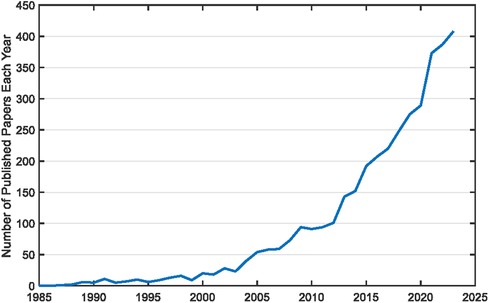
Figure 1. Rate of publications by authors with Chinese affiliations per year, based on a PubMed search using the following keywords contained in the title or abstract in the last 40 years: surface electromyography OR surface electromyogram OR surface EMG OR sEMG OR HDEMG OR HDsEMG.
2 Introduction of the symposium
This short communication introduces a recent symposium on surface EMG held in China. The symposium took place at the Hongdao International Convention and Exhibition Center in Qingdao city on November 24–25, 2023, and was chaired by the author of this communication. The theme of the symposium was “applications of surface EMG in clinical and rehabilitation practices”. More than 250 people from across academic, medical, and industrial sectors gathered together for in-depth discussions on the latest research, cutting-edge technologies, and novel applications of surface EMG. The symposium was hosted by the University of Health and Rehabilitation Sciences (Qingdao), and co-organized by the Shandong Provincial Biomedical Engineering Society and the Rehabilitation Engineering Branch of the Chinese Biomedical Engineering Society. The symposium was sponsored by Advictor Beijing Information Technology Co., Ltd. and the University of Health and Rehabilitation Sciences.
3 Summary of presentations
Twenty-six researchers presented research related to surface-EMG (Table 1). The talks touched on a number of applications, and reflects the current state of the art of surface EMG research in China. The majority (>70%) of presenters were university professors with a background in biomedical engineering. Three presentations were given by physician researchers. The presentations can be categorized into the following research areas.
• The first research area related to decoding of surface EMG and development of advanced myoelectric control for prostheses or rehabilitation robotics. These presentations highlighted the use of various approaches such as myoelectric pattern recognition, machine learning, deep learning, and surface EMG decomposition and projection. In particular, presented works focused on improving the reliability, adaptability, and usability of myoelectric control.
• The second research area related to innovation of surface EMG signal processing for extraction of meaningful physiological information. This included advances in high density surface EMG decomposition, motor unit number estimation, muscle innervation zone detection, muscle fiber conduction velocity estimation, and nonlinear dynamic analysis of surface EMG. In addition, presentations also expanded upon applications of these methods for examination of muscle performance, such as detection of muscle activity onset, prediction of muscle force, and assessment of muscle fatigue.
• The third research area related to neuromuscular assessment of neurological injuries or neuromuscular disorders using conventional, linear, or 2-dimensional high density surface EMG. High density surface EMG was a particular focus as it provides both temporal and spatial information of whole muscle and motor unit activity. The studied neuromuscular disorders included stroke, spinal cord injury, and cerebral palsy, etc. The presenters also discussed pathological mechanisms at the whole muscle or motor unit level that may contribute to disabilities.
• Three physician researchers discussed applications of surface EMG in their clinical practice. They presented case studies, demonstrating how surface EMG can provide important qualitative information to aid in diagnosis, prognosis, and evaluation of treatments in various neuromuscular disorders, such as radiculopathy, peripheral neuropathy, and degenerative osteoarthropathy.
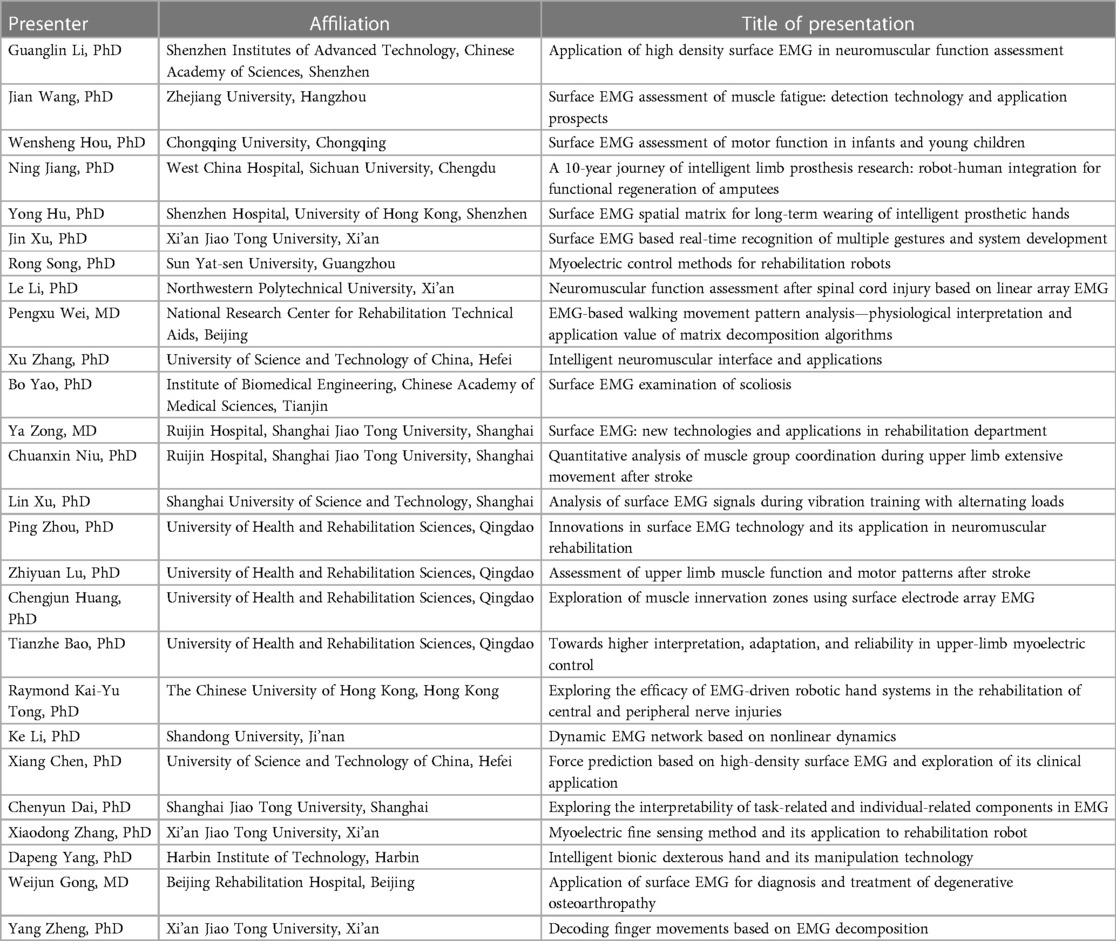
Table 1. A list of oral presentations (in chronological order) at the 2023 surface EMG symposium, Qingdao, China.
4 High density surface EMG decomposition workshop
In addition to scientific presentations, a workshop on high density surface EMG decomposition was held on the afternoon of November 25th. Dr. Maoqi Chen (the University of Health and Rehabilitation Sciences, Qingdao) delivered a training course on the progressive FastICA peel-off (PFP) method for high density surface EMG decomposition (1, 2). Dr. Chen shared an implementation program of the PFP algorithms (written in MATLAB) with all workshop participants. The training content included explanations of the rationale and principles of the PFP algorithms, instructions for using the PFP decomposition program, hands-on practice for decomposing high density surface EMG data, and a final period of Q&A and follow-up interactions. In particular, participants were trained on how to judge and accept reliable motor units, while avoiding spurious ones or other pitfalls (3). This is extremely important for practical applications, especially for novice or lay users. The workshop provided useful theoretical, technological, and software support for the participants interested in high density surface EMG research. A total of 128 trainees from different backgrounds (academic scientists, clinicians, engineers, graduate students, R&D staff) attended the workshop. It was emphasized that the PFP decomposition program delivered in the workshop should be used for research (non-commercial) purposes only.
5 Conclusion and future prospectives
The 2023 Surface EMG Symposium provided an interdisciplinary academic exchange platform for Chinese researchers in the field of surface EMG in academic, clinical, and rehabilitation practice. The symposium provided a forum for considerable discussion and sharing of ideas. The meeting generated much interest in developing new scientific collaborations among the participants. The symposium received more presentation requests than could be accommodated in a two day period, highlighting the strong interest in surface EMG in the research community. Given this strong interest, it is expected that similar symposium may occur regularly, perhaps every two years. Although this symposium covered a broad range of topics, there are other important topics or issues that were not addressed. These include recent advances in the manufacture of surface EMG electrodes and EMG data acquisition devices (4–6) and novel applications of surface EMG, including for pelvic floor examination and treatment (7). In addition, although surface EMG has achieved significant development in recent decades, barriers limiting widespread use in clinical and rehabilitation practice remain (8, 9). We hope these and other matters pertaining to surface EMG research can be addressed in future symposia.
Data availability statement
The original contributions presented in the study are included in the article/Supplementary Material, further inquiries can be directed to the corresponding author.
Author contributions
The author confirms being the sole contributor of this work and has approved it for publication.
Funding
The author declares financial support was received for the research, authorship, and/or publication of this article.
This work was supported by the Taishan Scholar Project of Shandong Province.
Conflict of interest
The author declares that the research was conducted in the absence of any commercial or financial relationships that could be construed as a potential conflict of interest.
The author declares that they were an editorial board member of Frontiers, at the time of submission. This had no impact on the peer review process and the final decision.
Publisher's note
All claims expressed in this article are solely those of the authors and do not necessarily represent those of their affiliated organizations, or those of the publisher, the editors and the reviewers. Any product that may be evaluated in this article, or claim that may be made by its manufacturer, is not guaranteed or endorsed by the publisher.
References
1. Chen M, Zhou P. A novel framework based on FastICA for high density surface EMG decomposition. IEEE Trans Neural Syst Rehabil Eng. (2016) 24:117–27. doi: 10.1109/TNSRE.2015.2412038
2. Chen M, Zhang X, Chen X, Zhou P. Automatic implementation of progressive FastICA peel-off for high density surface EMG decomposition. IEEE Trans Neural Syst Rehabil Eng. (2018) 26:144–52. doi: 10.1109/TNSRE.2017.2759664
3. Chen M, Zhou P. Caution is necessary for acceptance of motor units with intermediate matching in surface EMG decomposition. Front Neurosci. (2022) 16:876659. doi: 10.3389/fnins.2022.876659
4. Cheng L, Li J, Guo A, Zhang J. Recent advances in flexible noninvasive electrodes for surface electromyography acquisition. npj Flex Electron. (2023) 7:39. doi: 10.1038/s41528-023-00273-0
5. Zhang D, Chen Z, Xiao L, Zhu B, Wu R, Ou C, et al. Stretchable and durable HD-sEMG electrodes for accurate recognition of swallowing activities on complex epidermal surfaces. Microsyst Nanoeng. (2023) 9:115. doi: 10.1038/s41378-023-00591-3
6. Yang S, Cheng J, Shang J, Hang C, Qi J, Zhong L, et al. Stretchable surface electromyography electrode array patch for tendon location and muscle injury prevention. Nat Commun. (2023) 14(1):6494. doi: 10.1038/s41467-023-42149-x
7. Wu X, Zheng X, Yi X, Lai P, Lan Y. Electromyographic biofeedback for stress urinary incontinence or pelvic floor dysfunction in women: a systematic review and meta-analysis. Adv. Ther. (2021) 38(8):4163–77. doi: 10.1007/s12325-021-01831-6
8. Merletti R, Campanini I, Rymer WZ, Disselhorst-Klug C. Editorial: surface electromyography: barriers limiting widespread use of sEMG in clinical assessment and neurorehabilitation. Front. Neurol. (2021) 12:642257. doi: 10.3389/fneur.2021.642257
Keywords: surface EMG, symposium, workshop, rehabilitation, China
Citation: Zhou P (2024) Surface EMG in China: a report on the 2023 surface EMG symposium. Front. Rehabil. Sci. 5:1353564. doi: 10.3389/fresc.2024.1353564
Received: 10 December 2023; Accepted: 1 February 2024;
Published: 14 February 2024.
Edited by:
Anwar P. P. Abdul Majeed, Xi'an Jiaotong-Liverpool University, ChinaReviewed by:
Giacinto Luigi Cerone, Polytechnic University of Turin, Italy© 2024 Zhou. This is an open-access article distributed under the terms of the Creative Commons Attribution License (CC BY). The use, distribution or reproduction in other forums is permitted, provided the original author(s) and the copyright owner(s) are credited and that the original publication in this journal is cited, in accordance with accepted academic practice. No use, distribution or reproduction is permitted which does not comply with these terms.
*Correspondence: Ping Zhou ZHIucGluZy56aG91QG91dGxvb2suY29t