 Janet J. Rodríguez García
- 1Department of Public Health Sciences, Central University of Venezuela, Caracas, Venezuela
- 2Faculty of Medicine, School of Nutrition and Dietetics, Central University of Venezuela, Caracas, Venezuela
The 1948 Universal Declaration of Human Rights, approved by The General Assembly of the United Nations, recognized the right to food as a Basic Human Right. Consequently, at the national level, programs, norms, and laws were decreed to promote the population's health and nutrition. The 1999 Venezuelan Constitution explicitly included, for the first time, the term “Food Security” in Article 305. Subsequently, the government approved various laws and guidelines to regulate the right to food of the population. However, despite such laws, the well-being of the population has not improved. According to the 2020 State of Food Security and Nutrition in the World (2020), between 2017 and 2019, the undernourishment prevalence amounted to 31.4%. Also, reports from Caritas showed 14.4% of Global Acute Malnutrition in children under 5 years of age, and 20% of children were at risk of acute malnutrition for the period April–June 2020. Other factors have influenced the actual Venezuelan food insecurity condition. The current severe economic and social crisis has led to a Complex Humanitarian Emergency. This work aimed to consider if decreeing many laws related to food and nutrition is not enough to reduce this scourge, or if there is any guarantee that the Food and Nutrition Security (FNS) of the people would improve.
On December 10, 1948, 72 years ago, the right to food was recognized in the Universal Declaration of Human Rights by The General Assembly of the United Nations, Resolution 217 A (III).
Article 25 states: “Everyone has the right to an adequate standard of living that assures him, as well as his family, health and well-being, especially food…” (Naciones Unidas, 1948). Consequently at the national level, programs, norms, and laws were decreed to promote the population's health and nutrition. The 1999 Venezuelan Constitution, in its Article 305, explicitly included for the first time a Food Security statement, understood as the sufficient and stable availability of food at the national level, at all times, and its permanent access by the consuming public…” (República Bolivariana de Venezuela, 1999).
Subsequently, to favor the Right to Food of the Venezuelan people, various laws and regulations have been decreed. Table 1 describes the regulatory basis of food security in Venezuela. Despite these laws, and after the decree of the right to food in the Venezuelan Constitution, the country still has significant nutrition deficiencies. For instance, the State of Food Security and Nutrition in the World 2019 (FAO et al., 2019) reported that the prevalence of undernourishment increased by 21.2%, rising to 31% the following year (FAO et al., 2020). According to Caritas, the Global Acute Malnutrition in children under 5 years of age (GAM) was 14.4% in 2020 (Caritas de Venezuela, 2020). Moreover, the national report jointly issued, in December 2018, by the Bengoa Foundation, the Venezuelan Health Observatory, and the Agri-food Network of Venezuela, 33% of children under 2 years of age showed growth retardation when using the Size/Age indicator (Fundación Bengoa, 2018), that is, according to the data provided by these NGOs, that malnutrition is a foremost Public Health concern in Venezuela.
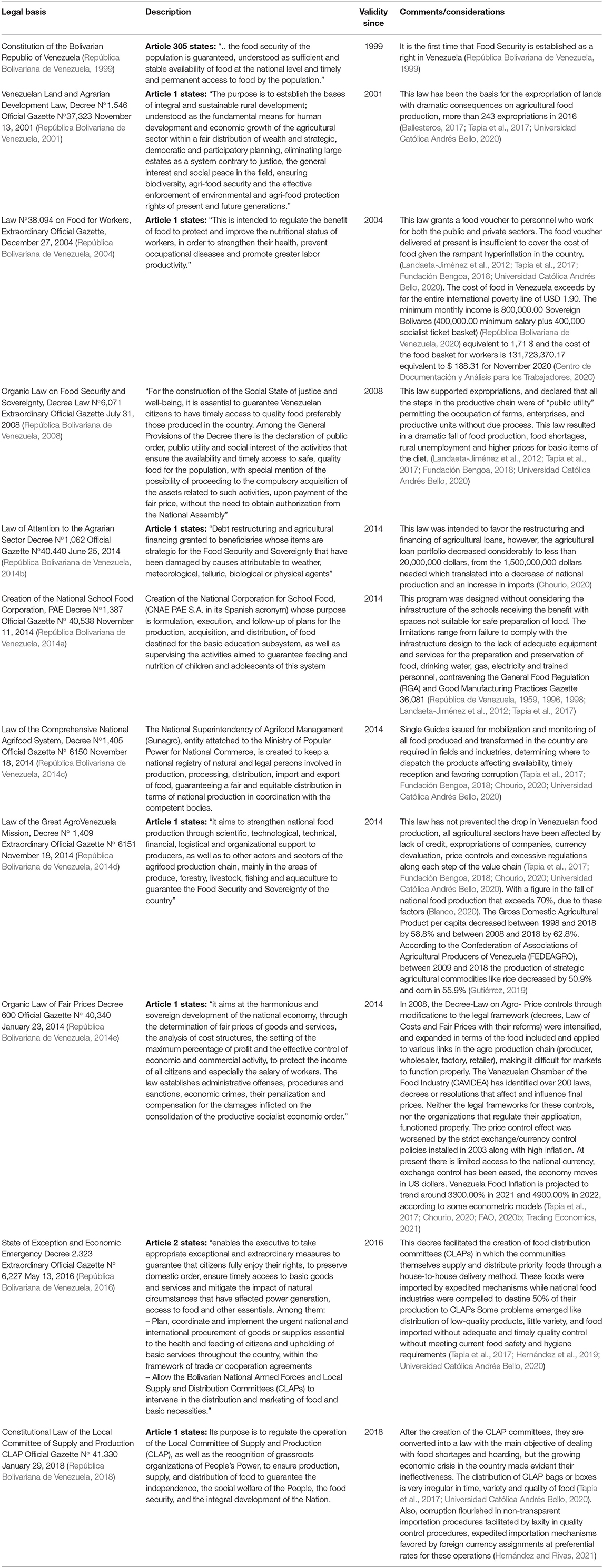
Table 1. Regulatory basis for food security in Venezuela.
Likewise, other aspects of Food Security have been affected, such as the availability and access to food (Fundación Bengoa, 2018; Universidad Católica Andrés Bello, 2020), the quality of the diet, the adequate consumption of proteins of high biological value (Caritas de Venezuela, 2020), mainly as a consequence of the economic and social crisis not recognized by the executive branch of the country. The Gross Domestic Product fell by 70% between 2013 and 2019, and 79.3% of Venezuelans have no sufficient income to cover the basic-food-basket (set of basic-foods necessary to ensure the nutrition of a family group of 5.2 members, consisting of eight subclasses of foods: meats and their preparations, fish and shellfish, cereals and their products, roots, and tubers, milk, cheese and eggs, fats and oils, fruits, and vegetables) (Landaeta-Jiménez et al., 2012; Tapia et al., 2017; Universidad Católica Andrés Bello, 2020).
Neither the food acquisition of Venezuelans, nor their nutritional-status, has improved even with the wide range of programs and laws enacted in the last 20 years. Recent statistics do not show any improvement in the malnutrition or undernourishment figures, much less in food-purchasing power since a 20-fold increase of the minimum salary is required to cover the food basket (Tapia et al., 2017). Figures reported by Caritas Venezuela indicate that 57% of households were food-deprived (Caritas de Venezuela, 2020). These indicators demonstrate the extent of Venezuela's Complex Humanitarian Emergency (Tapia et al., 2017; Universidad Católica Andrés Bello, 2020). It means that decreeing one or more laws related to food and nutrition is not enough to reduce this scourge.
Venezuela requires cohesive, integrated, continuous, and progressive state-policies and laws rather than government initiatives that change according to political interests. Experts, statespersons, and health professionals should design the food policies. To properly set objectives and goals, an accurate diagnosis is required. The particular needs of each age-and-vulnerable-group should receive special consideration.
To further develop these Food and Nutrition Security-policies, a few aspects should be considered (FAO, 2012a): ample availability, physical and economic access, sustainability, and stability of the agri-food system, nutritional and cultural adequacy, and other considerations to promote the biological utilization of consumed food. Moreover, several bioethical considerations apply: equity, distributive justice, and beneficence (Beauchamp and Childress, 1994; Giovane Mendieta-Izquierdo, 2020).
These moral values, as well as the principles of the FNS, must be an essential part of any program in Nutritional Public Health so that they can be continuous, assessable, measurable, and adaptable, that is to say, that all the programs that are developed can be monitored, adjusted, and controlled.
Bioethical principles aim to protect the human dignity of man. The association of these principles with food security improves the design of food policies. Initiatives developed using these approaches are real, fair, and well-balanced without disparagement or discrimination of any age group. Table 2 includes several recommendations for improvement of food security in Venezuela based on the principles of the food security and bioethics.
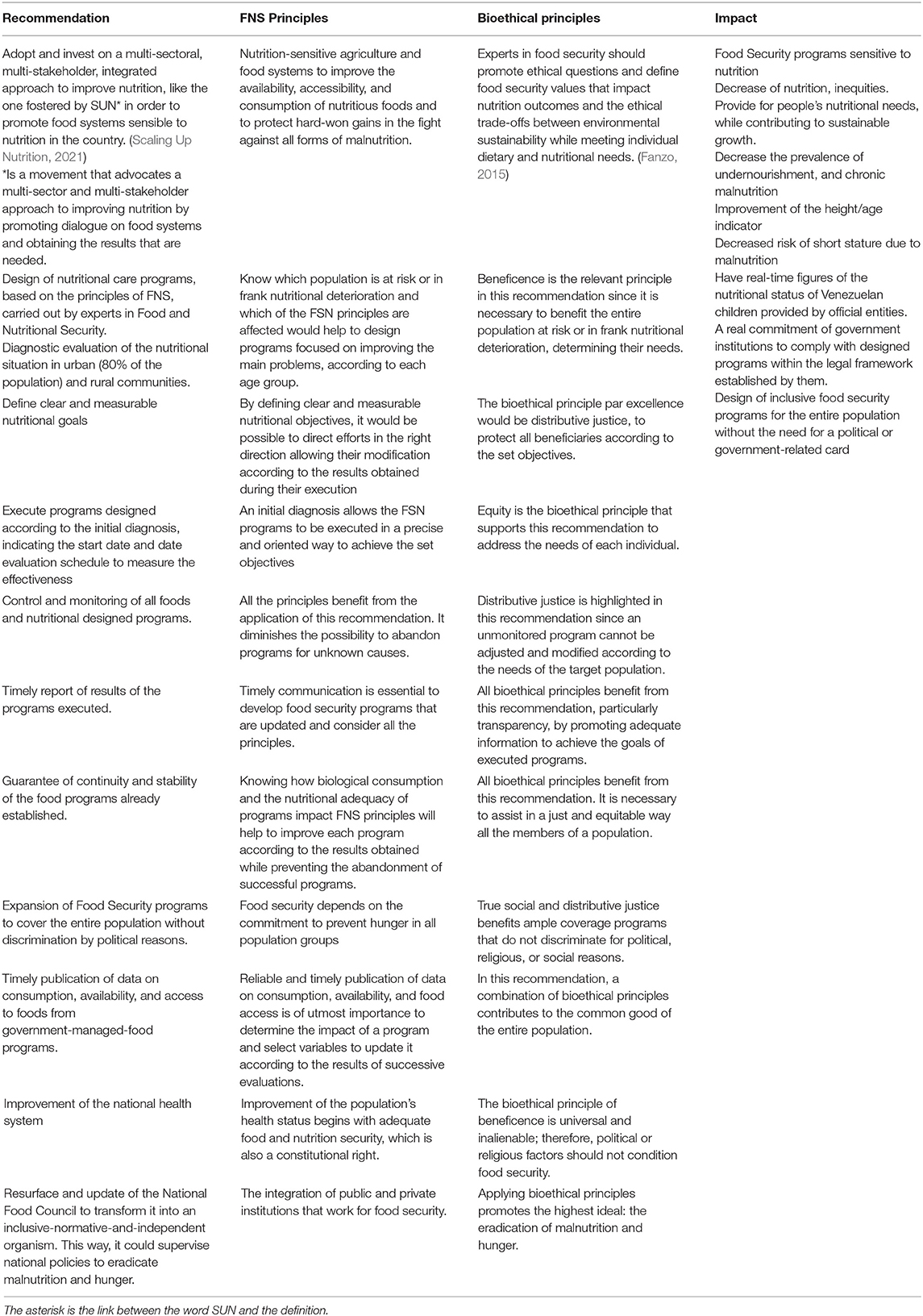
Table 2. Recommendations for improvement of food security in Venezuela based on the principles of the food security and bioethics.
In Venezuela, actual experience is to develop nutrition care programs that lack clear and precise objectives (Delgado and Herrera-Cuenca, 2019), with scope and goals that cannot be evaluated in a given period of time. They are usually developed as part of a policy plan, and subsequently forgotten or replaced by other faulty proposals following the same pattern.
Upon all these food insecurity problems, the country now faces the SARS-CoV-2, a highly aggressive Coronavirus that causes the Covid-19 pandemic, declared as such in March 2020. Limitations imposed because of Covid-19 further aggravate the delicate food situation in Venezuela.
The World Health Organization (WHO) has specified recommendations and guidelines to contain the virus spread. Among these are 14-day quarantine for suspected cases and isolation of cases confirmed; use of a face mask, hand-washing with soap and water, hand disinfection with alcoholic gels, thorough-domestic cleaning, and disinfection, as well as the maintenance of a 2 m physical-distancing.
Venezuela rapidly imposed these measures. Confinement of the country started on March 13, 2020, after the first cases were confirmed. Quarantine measures required many adjustments, particularly in food collection, storage, distribution, and delivery, both to the general and vulnerable population groups to avoid the surging of nutrition problems.
The pandemic has increased food insecurity and poverty, as many people have lost their jobs and or have insufficient income to cover the basic food basket. The National Survey of Living Conditions (ENCOVI) surveyed the impact of COVID-19 on employment and income. Figures show that 43% of the surveyed households report the inability to work or have lost income (Universidad Católica Andrés Bello, 2020).
According to the World Food Program July–September-2019 survey (World Food Program, 2019), 7.9% of the population (2.7 million) is in Severe Food Insecurity, and 24.4% (7 million) are in moderate Food Insecurity. These figures are previous to the onset of the pandemics. In addition, other factors contribute to aggravate the effects of confinement little availability of cash, shortage of gasoline, installation of police and military control posts and barricades and severely impact food security.
As shown by ENCOVI in its latest publication (March 2019–March 2020), rampant inflation exceeds 3,365% and 73.9% do not have enough income to cover the food basket in Venezuela. Rising unemployment figures in Venezuela are comparable to those of countries such as Nigeria, Chad, Congo, and Zimbabwe (Universidad Católica Andrés Bello, 2020).
Updated official figures on food availability, access, and consumption are not available. Therefore evaluation of pandemic-impact cannot be estimated. Different expert committees in Food and Nutritional Security (FNS) have declared that the Covid-19 pandemic will have severe repercussions on food security in the world (FAO, 2020b; FAO-CELAC, 2020; OXFAM, 2020), especially in countries that were already experiencing economic and social crises.
In Venezuela, multiple maladies (hyperinflation, unemployment, low wages, food and gasoline shortages, deficient public services) pave the current humanitarian crisis and forecast the nutrition and health problems assuredly prevalent shortly. Worrisome is the change in the eating pattern due to the intake of cheaper-starchy foods while sacrificing expensive high biological value proteins.
What has been missing is a strong political motivation to enforce the approved legislation. Unfortunately, government initiatives are short-sighted and aimed to strengthen the political grip on the population. For instance, Clap boxes reach their beneficiaries but do not satisfy their food and nutrition needs. The program to sell subsidized gasoline is very significant, but gas supply is scarce encouraging under-the-counter corrupt transactions (Abuelafia and Saboin, 2020). At present, there are at least 10 laws and programs which address food security issues. Nonetheless, acute malnutrition is rampant.
As sustained in this work, decreeing many laws related to food and nutrition is not enough to reduce hunger, malnutrition, inequity, etc. An attempt was made to demonstrate through the Venezuelan case, that States and the legal framework of a country are not always the guarantors the Food and Nutrition Security of the people, particularly if their design and enforcement disregards the advice of the health and nutrition experts.
Author Contributions
The author confirms being the sole contributor of this work and has approved it for publication.
Conflict of Interest
The author declares that the research was conducted in the absence of any commercial or financial relationships that could be construed as a potential conflict of interest.
The reviewer AC declared a shared affiliation, though no collaboration, with the author.
References
Abuelafia, E., and Saboin, J. L. (2020). A Look to the Future for Venezuela. Country Department Andean Group. Inter-American Development Bank. Discussion Paper No. IDB-DP-798. Publications IADB. Available online at: https://publications.iadb.org/publications/english/document/A-Look-to-the-Future-for-Venezuela.pdf (accessed February 12, 2021).
Ballesteros, A. (2017). “Cuántas expropiaciones se han ejecutado durante el gobierno de Maduro” El Estímulo, 22 de agosto 2017. Available online at: https://elestimulo.com/elinteres/cuantas-expropiaciones-se-han-ejecutado-durante-el-gobierno-de-maduro/ (accessed February 6, 2021).
Beauchamp, T. L., and Childress, J. F. (1994). Principles of Biomedical Ethics, 4th Edn. Oxford: Oxford University Press.
Blanco, D. (2020). “Caída de más de 70% de la producción nacional revela que la soberanía alimentaria quedó en el pasado” El Carabobeño, 26 de Noviembre 2020. Available online at: https://www.el-carabobeno.com/caida-de-la-produccion-nacional-soberania-alimentaria-quedo-en-el-pasado/ (accessed February 12, 2021).
Caritas de Venezuela (2020). Monitoreo Centinela de la Desnutrición Infantil y la Seguridad Alimentaria Familiar de los meses de Abril–Julio 2020. Available online at: http://caritasvenezuela.org/wp-content/uploads/2020/09/Boletin-SAMAN_Caritas-Venezuela_Abril-Julio2020-r1_compressed.pdf (accessed September 15, 2020).
Centro de Documentación y Análisis para los Trabajadores (CENDA) (2020). Canasta Alimentaria de los Trabajadores. Noviembre 2020. Available online at: http://cenda.org.ve/fotos_not/pdf/CENDA.%20RESUMEN%20EJECUTIVO.%20CAT%20NOVIEMBRE%202020WEB%20com.Pdf (accessed February 12, 2021).
Chourio, J. (2020). “2020 ha sido el año más catastrófico en producción agrícola en Venezuela.” El Diario, 22 de Octubre 2020. Available online at: https://eldiario.com/2020/10/22/produccion-agricola-2020-ano-mas-catastrofico/ (accessed January 24, 2021).
Delgado, A., and Herrera-Cuenca, M. (2019). El derecho a la alimentación en Venezuela bajo el enfoque de derechos. Cuadernos del Cendes, Año 36. N° 100 Tercera época Enero-April 2019, p. 57–80.
Fanzo, J. (2015). Ethical issues for human nutrition in the context of global food security and sustainable development. Glob. Food Secur. 7, 15–23. doi: 10.1016/j.gfs.2015.11.001
FAO (2012a). Ley Marco, Derecho a la Alimentación, Seguridad y Soberanía Alimentaria. XVIII Asamblea Ordinaria del Parlamento Latinoamericano, Panamá, 30 de Noviembre 2012.
FAO (2020b). Impacto del Covid 19 en la Seguridad Alimentaria y la Nutrición (SAN). Secretaría del GANESAN, Versión 1, 24 de marzo de 2020. Available online at: http://www.fao.org/fileadmin/templates/cfs/Docs1920/Chair/HLPE_Spanish.pdf (accessed July 31, 2020).
FAO, FIDA, OMS, PMA y UNICEF (2020). El estado de la seguridad alimentaria y la nutrición en el mundo 2020. Transformación de los sistemas alimentarios para que promuevan dietas asequibles y saludables. Roma: FAO.
FAO IFAD, UNICEF WFP and WHO (2019). The State of Food Security and Nutrition in the World 2019. Safeguarding Against Economic Slowdowns and Downturns. Rome: FAO.
FAO-CELAC (2020). Seguridad Alimentaria bajo la Pandemia de Covid-19. Informe preparado por FAO a solicitud de la Coordinación Nacional de la Presidencia Pro Témpore de México ante la CELAC, 2020. Available online at: http://www.fao.org/fileadmin/user_upload/rlc/docs/covid19/Boletin-FAO-CELAC.pdf (accessed August 1, 2020).
Fundación Bengoa (2018). Observatorio Venezolano de la Salud (OVS) y la Red Agroalimentaria de Venezuela. Emergencia Humanitaria Compleja en Venezuela, Derecho a la Alimentación, Reporte Nacional, Diciembre 2018. Available on line at: http://www.tsj.gob.ve/es/web/tsj/gaceta-oficial (accessed January 6, 2021).
Giovane Mendieta-Izquierdo (2020). Juan María Cuevas-Silva. Bioética en Salud Pública. Universidad Militar Nueva Granada. Available online at: http://www.scielo.org.co/pdf/rlb/v17n2/1657-4702-rlb-17-02-00001.pdf (accessed January 6, 2020).
Gutiérrez, A. (2019). La Situación Agroalimentaria en Venezuela. Hacia una Nueva Estrategia Revista Foro. 3, 31–52.
Hernández, C., and Rivas, T. (2021). Frontiers… Dismantling of Institutionalization and State Policies as Guarantors of Food Security in Venezuela. Food Safety Implications (in press). doi: 10.3389/fsufs.2021.623603
Hernández, P., Marcano, P., and Deniz, R., (2019). Evaluación del contenido nutricional de productos lácteos en programa de alimentación venezolano. Arch. Lat. Nutr. 69, 113–124.
Landaeta-Jiménez, M., Aliaga, C., Sifontes, Y., Herrera, M., Candela, Y., Delgado, A., et al. (2012). El Derecho a la Alimentación en Venezuela. Anales Venezolanos de Nutrición. 25, 73–84.
Naciones Unidas (1948). Carta internacional de los derechos humanos, 217 (III) Art 25, declaración universal de los derechos humanos 183 a, sesión plenaria, 10 de diciembre de.
OXFAM (2020). El virus del hambre: cómo el Coronavirus está agravando el hambre en un mundo hambriento. Nota informativa de OXFAM, 09 de julio 2020. Available online at: https://oxfamilibrary.openrepository.com/bitstream/handle/10546/621023/mb-the-hunger-virus-090720-es.pdf (accessed August 1, 2020).
República Bolivariana de Venezuela (1999). Constitución de la República Bolivariana de Venezuela, 305 1999. Gaceta Oficial No 5908. 19 de Febrero, 2009.
República Bolivariana de Venezuela (2001). Ley de Tierras y Desarrollo Agrario de Venezuela, Decreto 1.546, Gaceta Oficial No 37.323, 13 de Noviembre de 2.001. Available online at: http://www.tsj.gob.ve/es/web/tsj/gaceta-oficial (accessed January 22, 2021).
República Bolivariana de Venezuela (2004). Ley de Alimentación para los Trabajadores, Gaceta Oficial N° 38.094, 27 de diciembre de 2004.
República Bolivariana de Venezuela (2008). Ley Orgánica de Seguridad y Soberanía Agroalimentaria, Decreto N° 6.071, Gaceta Oficial Extraordinaria No 5889, 31 de Julio 2008.
República Bolivariana de Venezuela (2014a). Creación de la Corporación Nacional de Alimentación Escolar, PAE. Decreto N° 1.387, Gaceta Oficial N° 40.538, 11 de noviembre de 2014. Available online at: http://www.tsj.gob.ve/es/web/tsj/gaceta-oficial (accessed January 22, 2021).
República Bolivariana de Venezuela (2014b). Decreto con Rango, Valor y Fuerza de Ley de Atención al Sector Agrario, Decreto N° 1.062, Gaceta Oficial No 40.440, 25 de Junio de 2014. Available on line at: http://www.tsj.gob.ve/es/web/tsj/gaceta-oficial (accessed January 22, 2021).
República Bolivariana de Venezuela (2014c). Decreto con Rango, Valor y Fuerza de Ley del Sistema Nacional Integral Agroalimentario, Decreto N° 1.405, Gaceta Oficial No 6150, 18 de Noviembre de 2014. Available on line at: http://www.tsj.gob.ve/es/web/tsj/gaceta-oficial (accessed January 22, 2021).
República Bolivariana de Venezuela (2014d). Decreto con Rango, Valor y Fuerza de Ley de la Gran Misión AgroVenezuela, Decreto N° 1.409, Gaceta Oficial Extraordinaria No 6.151, 18 de Noviembre de 2014. Available online at: http://www.tsj.gob.ve/es/web/tsj/gaceta-oficial (accessed January 22, 2021).
República Bolivariana de Venezuela (2014e). Decreto con Rango, Valor y Fuerza de Ley Orgánica de Precios Justos, Decreto 600, Gaceta Oficial No 40.340 de fecha 23 de enero de 2014. Available online at: http://www.tsj.gob.ve/es/web/tsj/gaceta-oficial (accessed January 22, 2021).
República Bolivariana de Venezuela (2016). Estado de Excepción y Emergencia Económica. Decreto No 2.323, Gaceta Oficial Extraordinaria No 6.227 de fecha 13 de Mayo de 2016. Available online at: http://www.tsj.gob.ve/es/web/tsj/gaceta-oficial (accessed January 22, 2021).
República Bolivariana de Venezuela (2018). Ley Constitucional de los CLAP, sancionada por la Asamblea Nacional Constituyente. Gaceta Oficial No 41.330, 29 de Enero de 2018. Available online at: http://www.tsj.gob.ve/es/web/tsj/gaceta-oficial (accessed January 22, 2021).
República Bolivariana de Venezuela (2020). Presidencia de la República. Decreto N° 4.193, mediante el cual se incrementa el ingreso mínimo mensual y la protección social. Gaceta Oficial Extraordinaria N° 6.532 de fecha 27 de abril de 2020. Available online at: http://www.tsj.gob.ve/es/web/tsj/gaceta-oficial (accessed February 6, 2021).
República de Venezuela (1959). Reglamento General de Alimentos. Decreto No 525, Gaceta Oficial No 25.864, 16 de Enero 1959.
República de Venezuela (1996). Ministerio de Sanidad y Asistencia Social. Normas de Buenas Prácticas de Fabricación, Almacenamiento y Transporte de Alimentos para Consumo Humano. SG No 457-96, Gaceta Oficial No 36081. 07 de Noviembre 1996.
República de Venezuela (1998). Ministerio de Sanidad y Asistencia Social. Normas Sanitarias de Calidad del Agua Potable. SG No 018-98. Gaceta Oficial No 36.395. 13 de febrero 1998.
Scaling Up Nutrition (2021). Los Sistemas Alimentarios y la Nutrición. Available online at: https://scalingupnutrition.org/es/nutricion/los-sistemas-alimentarios-y-la-nutricion/ (accessed February 12, 2021).
Tapia, M. S., Puche, M., Pieters, A., Marrero, J. F., Clavijo, S., et al. (2017). “Food security and nutrition in Venezuela,” in Food and Nutrition Security in the Americas. Mexico: Ed. Interamerican Network of Academies of Sciences.
Trading Economics (2021). Venezuela Food Inflation. Available online at: https://tradingeconomics.com/venezuela/food-inflation#:~:text=Looking%20forward%2C%20we%20estimate%20Food,according%20to%20our%20econometric%20models (accessed February 5, 2021).
Universidad Católica Andrés Bello (UCAB) (2020). Encuesta Nacional de Condiciones de Vida (ENCOVI) 2019-2020. Available online at: https://www.proyectoencovi.com/informe-interactivo-2019 (accessed August 1, 2020).
World Food Program (WFP) (2019). Venezuela Food Security Assessment. Main Findings. Available on line at: https://reliefweb.int/report/venezuela-bolivarian-republic/wfp-venezuela-evaluaci-n-de-seguridad-alimentaria-principales (accessed February 24, 2020).
Keywords: food, nutrition, food security, food policies, malnutrition, children, Venezuela
Citation: Rodríguez García JJ (2021) Food Security in Venezuela: From Policies to Facts. Front. Sustain. Food Syst. 5:617907. doi: 10.3389/fsufs.2021.617907
Received: 15 October 2020; Accepted: 22 February 2021;
Published: 19 March 2021.
Edited by:
Maria S. Tapia, Academia de Ciencias Físicas, Matemáticas y Naturales de Venezuela, VenezuelaReviewed by:
Ben Davies Tall, United States Food and Drug Administration, United StatesJennifer Bernal, National University of Colombia, Colombia
Andrés Jose Carmona, Central University of Venezuela, Venezuela
Copyright © 2021 Rodríguez García. This is an open-access article distributed under the terms of the Creative Commons Attribution License (CC BY). The use, distribution or reproduction in other forums is permitted, provided the original author(s) and the copyright owner(s) are credited and that the original publication in this journal is cited, in accordance with accepted academic practice. No use, distribution or reproduction is permitted which does not comply with these terms.
*Correspondence: Janet J. Rodríguez García, amFyb2RzY2FAZ21haWwuY29t