AR
arun ramakrishnan
College of Nursing and Health Professions, Drexel University
Philadelphia, United States
6,331
Total downloads
30k
Total views and downloads
Recent advances in virtual reality (VR), augmented reality (AR), mixed reality (MR) and extended reality (XR) technologies have had significant impact in the fields of virtual reality therapy and immersive education. Although challenges exist in adoption of any new technology, several unique features like telepresence, enhanced immersion, engagement, biometric/motion-capture integration, gamification, and multiplayer capabilities, allow VR solutions to not only be complementary, but also pave the way for novel implementations that may not be possible with conventional methodologies. With increased adoption of these devices in both the research and consumer space, further accelerated by travel restrictions and other challenges posed by the 2019-20 pandemic, we have seen the rise of numerous innovative applications of VR to bridge the gaps in healthcare, academic education, and industrial training. When successfully applied, these technologies have the potential to transform healthcare and healthcare education.
The goal of this Research Topic is to bring together a multi-disciplinary collection of papers that have employed immersive technologies (like VR/AR/MR/XR) in a variety of applications. This collection will feature a multi-pronged approach aimed to showcase different aspects of development, use and evaluation of immersive technologies along with scoping reviews that summarize available research evidence. The aim of this Research Topic is to provide the reader with a rich set of evidence and experience from studies that have taken different approaches, thereby allowing cross-pollination of ideas, expanding the search space, and promoting further innovation and application of immersive technologies in healthcare therapies and education.
We welcome the submission of high-quality original research, meta-analysis and scoping reviews, including, but not limited to, the following topics:
- Use of immersive technology solutions to address psychological and psychophysiological factors like stress, emotion, or personality, e.g., Counseling, Cognitive behavior therapy, Exposure based therapies, Art therapies.
- Creation or adoption of immersive technology solutions to address neuromotor disorders e.g., Physical rehabilitation, Dance movement therapy, Immersive and Active video games.
- Use of Immersive technologies in older adults, addressing age-related cognitive impairments and promoting aging-in-place.
- Design and evaluation of immersive technology tools or applications for education and training (including remote learning) of healthcare providers (medical, nursing, clinical simulation, and biomedical engineering) and its contribution to the pedagogical process.
- Connected health, Tele-health, and In-home applications of immersive technologies.
- Dosage effects of VR Therapy and Immersive education.
- Challenges and risks in applying immersive technologies for healthcare and healthcare education.
- Addressing diversity, equity, inclusion, cultural, and ethical issues using immersive technologies.
- Integration of sensors, motion capture, haptics, robotics, and other technologies within VR therapy.
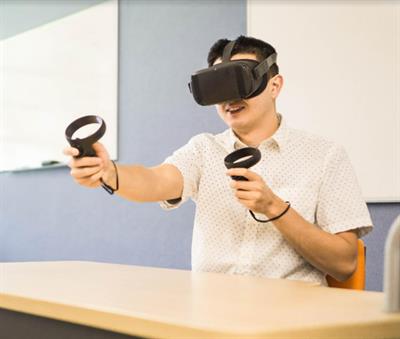
Keywords: Virtual reality, immersive education, augmented reality, mixed reality, technology, Extended reality
Important note: All contributions to this Research Topic must be within the scope of the section and journal to which they are submitted, as defined in their mission statements. Frontiers reserves the right to guide an out-of-scope manuscript to a more suitable section or journal at any stage of peer review.
