AV
apurva v oza
California Institute of Technology
Pasadena, United States
2,795
Total downloads
21k
Total views and downloads
Submit your idea
You will be redirected to our submission process.
Exomoons and exorings represent a relatively unexplored yet rapidly advancing frontier in exoplanetary science. The intricate structures of Saturn's expansive rings and the complex masses of Jupiter and Saturn's moons illustrate the meticulous balance these celestial bodies maintain, despite their comparatively minuscule mass relative to their host planets. Recent developments have advanced current astronomical technologies, necessitating innovative methodologies to confirm the existence of such phenomena. This has led to the announcement of several candidate exomoon and exoring systems by various teams employing diverse independent techniques, highlighting a vibrant epoch in celestial discovery that followed the precedent steps taken 55 years after humanity's lunar touchdown.
This Research Topic aims to explore the complexities of detecting and verifying exomoons and exorings within the context of exoplanetary systems. Specific objectives include validating current photometric and spectroscopic methods, integrating modeling approaches, and developing new experimental strategies to bolster our understanding and confirmation of these celestial bodies. This concerted effort intends to establish a robust framework for future explorations and broaden our understanding of these lesser-known cosmic components.
Additionally, contributions that draw parallels with solar system studies, employing analogs from our known celestial surroundings to support the search and evaluation of exomoon candidates, are crucial. Through these synergistic approaches, leveraging advanced spectroscopic and theoretic analytical tools, we will unlock further secrets of planetary science and enhance our detection capabilities in the realm of exomoons and exorings.
We will accept the following article types: Original Research, Review, Methods, and Perspective. To gather further insights in this burgeoning field, we welcome articles addressing, but not limited to, the following themes:
• Transit timing variations (TTV) for large exomoon discovery
• Photometric observations for identifying exorings and orphaned celestial bodies
• Electron Cyclotron Maser Instability (ECMI) analysis for studying magnetic interactions between exoplanets and exomoons
• Direct imaging techniques for capturing giant exomoons
• Investigating evaporative transmission spectra to explore small volcanic exomoons
• Studying stellar metallicity and its implications on exomoon history.
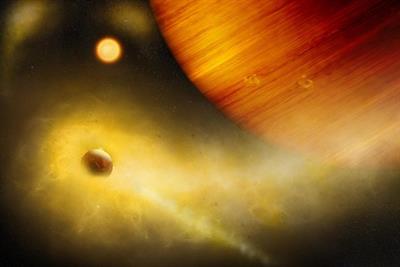
Image credit: Thibaut Roger, University of Bern
This Research Topic accepts the following article types, unless otherwise specified in the Research Topic description:
Articles that are accepted for publication by our external editors following rigorous peer review incur a publishing fee charged to Authors, institutions, or funders.
Keywords: Exomoons, Exorings
Important note: All contributions to this Research Topic must be within the scope of the section and journal to which they are submitted, as defined in their mission statements. Frontiers reserves the right to guide an out-of-scope manuscript to a more suitable section or journal at any stage of peer review.
California Institute of Technology
Pasadena, United States
Université de Paris
Paris, France
Ames Research Center, National Aeronautics and Space Administration
Moffet Field, United States
Konkoly Observatory (MTA)
Budapest, Hungary
Institute of Astronomy and Astrophysics, Academia Sinica
Taipei, Taiwan
Peking University
Beijing, China
Manuscripts can be submitted to this Research Topic via the main journal or any other participating journal.
Submit your idea
You will be redirected to our submission process.
