RP
ritesh patel
Southwest Research Institute Boulder
Boulder, United States
343
Total downloads
3,283
Total views and downloads
Submit your idea
You will be redirected to our submission process.
Manuscript Submission Deadline 31 December 2025
This Research Topic is currently accepting articles.
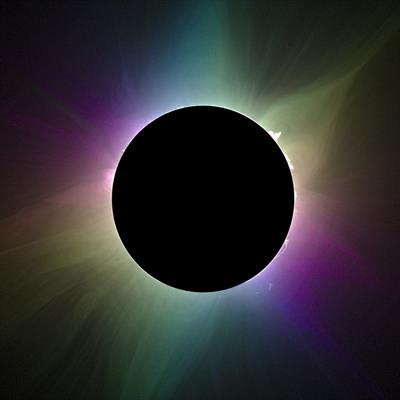
The white-light solar corona is composed of a relatively stable F-Corona and a polarized K-Corona. The polarization of the K corona, mainly observed through Thomson scattering, is perpendicular to the plane formed by the observer, the Sun, and the scattering point. Utilizing polarization measurements in the corona and heliosphere has proven valuable for estimating coronal electron density, conducting tomographic reconstructions of 3D electron density in the corona studying the 3D characteristics of coronal mass ejections (CMEs), and determining the chirality of CMEs. Recently, leveraging the analogy between polarization and colors, a vivid map of the solar corona representing polarization properties was presented, based on observations during the total solar eclipse in 2023.
Dedicated to the exploration of recent advancements in polarimetric investigations, this Research Topic focuses on emerging approaches and associated analyses, modeling, and technologies currently in development. This will help bring out new insights of the white-light solar corona and their dynamics in combination with multiwavelength and multivantage point observations. We extend an invitation to researchers to contribute Original Research and Review articles, covering a broad spectrum of key themes.
These themes encompass, but are not confined to:
1. Exploring transients in the solar corona, ranging from smaller to larger scales,
across varying distances from lower altitudes to more distant corona.
2. Polarimetric observational data analysis using existing white-light coronagraphs of LASCO, STEREO, and Solar Orbiter.
3. Advanced concepts and techniques for upcoming polarimeters including PUNCH, PROBA-3, CODEX.
4. Analysis of both historical and forthcoming total solar eclipse observations,
spanning past and future events.
5. Novel theoretical models and methodologies that can contribute to advancing the investigation of the solar corona and neighboring regions through white-light polarimetry.
6. Limitations of the existing techniques, tools and instruments and challenges to be addressed in the future.
Submissions are encouraged to explore one or more of the mentioned topics slated for coverage in this issue, without being restricted solely to those.
This Research Topic accepts the following article types, unless otherwise specified in the Research Topic description:
Articles that are accepted for publication by our external editors following rigorous peer review incur a publishing fee charged to Authors, institutions, or funders.
Keywords: Solar corona, polarimetry, solar eclipse, coronal mass ejection, instrumentation, image processing, numerical modelling
Important note: All contributions to this Research Topic must be within the scope of the section and journal to which they are submitted, as defined in their mission statements. Frontiers reserves the right to guide an out-of-scope manuscript to a more suitable section or journal at any stage of peer review.

Manuscripts can be submitted to this Research Topic via the main journal or any other participating journal.
Submit your idea
You will be redirected to our submission process.