SB
souradeep bhattacharya
Centre for Astrophysics Research, School of Physics Astronomy and Mathematics, University of Hertfordshire
Hatfield, United Kingdom
20
Total downloads
3,780
Total views and downloads
Submit your idea
Select the journal/section where you want your idea to be submitted:
Manuscript Submission Deadline 31 December 2025
This Research Topic is currently accepting articles.
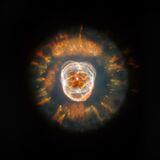
Planetary Nebulae (PNe) are emission-line nebulae in a short-lived late stage of stellar evolution for low- to intermediate-mass stars, including binaries. As such they are found in galaxies of all Hubble types, where they can act as discrete tracers of the light, kinematics and chemistry of their host-galaxy stellar populations. Moreover, PNe are the only emission-line interstellar medium (ISM) that exist in almost all structures of a galaxy, from the bulge to the disk and further to the outer halo, making them unique tracers of for the properties of their parent stellar populations across all kinds of galaxies. Deep PN Luminosity Functions act as reliable secondary distance indicators of galaxies out to ~40 Mpc, while also showing imprints of the age and metallicity distribution of their parent stellar populations. PNe have been widely used as kinematic tracers in galaxies, revealing in particular the complex dynamical properties of stellar halos. For nearby (out to ~3 Mpc) massive and Local Group galaxies, PNe have additionally shed light on the chemistry of the local ISM. PN population properties have also acted as constraints to understanding stellar evolution in galaxy environments beyond the Milky Way.
Galaxies are composed of stars and form the large-scale structure of the universe; stellar evolution drives the chemical evolution of the universe. PNe are descendants of low- and intermediate-mass stars that account for the absolute majority of stellar populations in the universe. Connecting PNe with their parent galaxy stellar populations offers a unique perspective into understanding the complex interplay of stellar evolution and extragalactic astrophysics. The goal of this research topic is to highlight the wide array of scientific progress that can be made by connecting the properties of PNe with those of their parent stellar populations. Through a combination of reviews and original research papers, we aim to have a set of papers that utilise observed and simulated PN population properties (photometric, kinematic and chemical) to provide insight on stellar evolution (from connecting with their progenitor population properties) as well as that of their parent galaxies (from galaxy-wide surveys).
The scope of the research topic extends to any study that utilises observed and simulated PN population properties, both within the Milky Way and those in other galaxies, that can be utilised to draw inferences on parent stellar population properties. As examples, these would include (but are not limited to) studies that connect PN populations to AGB and/or binary star properties of the Milky Way, radial metallicity gradients of galaxies derived from PNe, simulations aiming to predict PN population properties based on galaxy stellar population properties, utilising PNe as kinematic tracers to understand galaxy dynamics, utilising the PN luminosity function as a distance indicator, etc.
A non-exhaustive list of suggested topics for this collection includes:
• Alpha parameter and host stellar population properties (e.g. metallicity)
• Planetary nebula luminosity function (PNLF) shape and host stellar population properties
• PNLF cutoff and host stellar population properties
• PNe line profile and internal kinematics and host stellar population properties
• PNe line diagnostics and host stellar population properties
• PN population properties simulated from stellar population models
• Connecting PNe to predecessor AGB stellar population
• PNe as dynamical tracers of galaxies
• Stellar populations of PNe as derived through photoionization modelling based on the UV-optical spectroscopy of PNe
• Revealing the stellar population of the substructures in host galaxy using PNe as tracers (of chemistry and stellar population)
• The galaxy structure and chemical evolution traced by the population of PNe.
This Research Topic accepts the following article types, unless otherwise specified in the Research Topic description:
Articles that are accepted for publication by our external editors following rigorous peer review incur a publishing fee charged to Authors, institutions, or funders.
Keywords: Planetary Nebulae, interstellar medium, kinematics, chemical evolution, galaxies, stellar populations, binary stars, asymptotic giant branch stars
Important note: All contributions to this Research Topic must be within the scope of the section and journal to which they are submitted, as defined in their mission statements. Frontiers reserves the right to guide an out-of-scope manuscript to a more suitable section or journal at any stage of peer review.
Centre for Astrophysics Research, School of Physics Astronomy and Mathematics, University of Hertfordshire
Hatfield, United Kingdom
National Astronomical Observatories, Chinese Academy of Sciences (CAS)
Beijing, China
Armagh Observatory
Armagh, United Kingdom

Manuscripts can be submitted to this Research Topic via the main journal or any other participating journal.
Submit your idea
Select the journal/section where you want your idea to be submitted: