YZ
yaonan zhu
The University of Tokyo
Bunkyo, Japan
581
Total views and downloads
Submit your idea
Select the journal/section where you want your idea to be submitted:
Manuscript Summary Submission Deadline 30 January 2026 | Manuscript Submission Deadline 30 April 2026
This Research Topic is currently accepting articles.
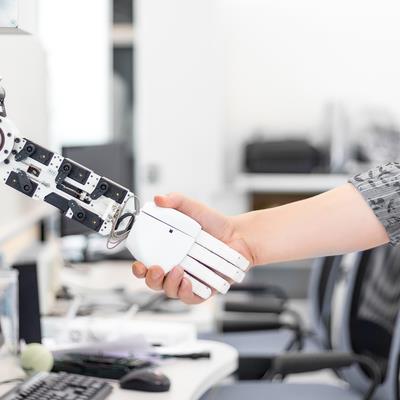
The emergence of foundation models has opened new frontiers in how robots perceive, act, and interact with the world. As these models are increasingly integrated into robotic systems, the long-envisioned goal of human-robot symbiosis, where humans and robots understand each other and collaborate in a mutually supportive and harmonious way, is now within reach.
This Research Topic invites research that explores how foundation models can advance collaborative, adaptive, and human-centered robotic systems by leveraging their strengths in language understanding, visual grounding, multimodal perception, and high-level reasoning. It focuses on contributions addressing human-robot collaboration in dynamic environments, language-guided multimodal interaction, and shared autonomy or teleoperation where robots learn from and support humans, ultimately enhancing robot perception, decision-making, and generalization, while fostering human-robot symbiosis within structured and interpretable system designs.
Achieving human-robot symbiosis has long been limited by robots' inability to perceive, reason, and interact with humans in natural and adaptive ways. The emergence of foundation models offers powerful capabilities in language, vision, and multimodal reasoning, opening new possibilities. When integrated into physical robotic systems, these models can help robots better understand human intentions and surrounding environments, reason jointly with humans to solve complex tasks, and even recognize their own limitations to request assistance.
This Research Topic aims to explore approaches that leverage foundation models or learning-based methods to achieve seamless, interpretable, and human-centered collaboration between humans and robots across perception, planning, communication, and decision-making. It particularly encourages work that advances human-robot collaboration in dynamic environments, language-guided multimodal interaction, and shared autonomy or teleoperation where robots learn from and support humans. Contributions may address theory, system integration, or applications that promote mutually beneficial human-robot symbiosis, in which humans and robots build shared understanding and utilize complementary capabilities. These efforts will also support the development of intelligent, generalizable, and context-aware robotic systems, enabling reliable and adaptable deployment in human-involved environments.
This Research Topic focuses on the integration of multimodal foundation models and learning-based approaches to advance human-centered robotics. While the vision encompasses a broad spectrum of human-robot symbiosis, this special issue emphasizes contributions that directly address:
- Interactive human-robot collaboration in dynamic and unstructured environments
- Language-guided and multimodal interaction that enhances mutual understanding between humans and robots
- Shared autonomy and teleoperation frameworks where robots learn from or support humans in complex tasks
We particularly welcome studies that combine perception, reasoning, and learning to improve robots’ capabilities in interpreting human intentions, adapting to context, and providing interpretable decision-making. Research on foundational technologies (for example, multimodal perception or skill learning) is also encouraged if it explicitly contributes to these interaction-focused goals.
Relevant research areas include, but are not limited to:
- Human-Robot Interaction
- Human-Robot Collaboration
- Human-Centered Robotics
- Multimodal Foundation Models in Robotics
- Language Guided Robotic Manipulation
- Teleoperation and Shared Autonomy
- Learning from Demonstration
- Mobile Manipulation
- Physical Human-Robot Interaction
- Interactive Laboratory Automation
- Interactive Task Planning and Decision Making
- Interactive Robot Learning and Skill Refinement
This Research Topic accepts the following article types, unless otherwise specified in the Research Topic description:
Articles that are accepted for publication by our external editors following rigorous peer review incur a publishing fee charged to Authors, institutions, or funders.
Keywords: Human-Robot Symbiosis, Multimodal Foundation Models in Robotics, LanguageGuided Robotics, Robotic Manipulation, Teleoperation, Human-Robot Collaboration
Important note: All contributions to this Research Topic must be within the scope of the section and journal to which they are submitted, as defined in their mission statements. Frontiers reserves the right to guide an out-of-scope manuscript to a more suitable section or journal at any stage of peer review.
The University of Tokyo
Bunkyo, Japan
Nagoya University
Nagoya, Japan
Ecole Centrale de Lyon
Écully, France
Huazhong University of Science and Technology
Wuhan, China
The University of Tokyo
Bunkyo, Japan
The University of Tokyo
Bunkyo, Japan
Manuscripts can be submitted to this Research Topic via the main journal or any other participating journal.
Submit your idea
Select the journal/section where you want your idea to be submitted: