Abstract
Researchers have recently turned their focus to a specific area: the links between altered states of consciousness and creativity. A spectrum of attentional states of consciousness exists, from hypnagogia and mind wandering to mindfulness and flow. These attentional states of consciousness are present during a variety of activities (e.g., sports, music, painting, writing, video games, theater, and meditation) as well as in situations characterized by boredom. They are also present in many professional fields and practices (e.g., education and teaching). Moreover, researchers and educators focus sometimes on only one state of consciousness (such as mind wandering) or only on attention, and do not question relationships with others (such as mindfulness or flow) or the links with intention, the different levels of consciousness involved and the changes in perception of time, self and space. Additionally, as we know that a state of consciousness rarely occurs alone or that it can have two forms (such as spontaneous and deliberate mind wandering), we propose a global approach allowing to grasp the stakes and perspectives of what we call attentional states of consciousness. Thus, to our knowledge, this is the first theoretical review highlighting the historical, empirical, theorical and conceptual relationships between creativity, attention, mind wandering, mindfulness and flow by offering concrete and empirical avenues and bases for reflection about educating for creativity and developing creative potential.
Introduction
The aim of this literature review is to offer new perspectives and insights on the connection between states of consciousness and creativity. States (sometimes also called “contents”) of consciousness are generally qualified as “altered” or “modified,” and these terms appear here in quotations, to retain the vocabulary used in research. We, however, prefer to use the term “attentional states of consciousness” (or the more neutral “states of consciousness”) as we feel this term best encapsulates the main states of consciousness studied in this article, all of which are closely linked to the concept of attention.
Thus, initially, the definition of terms seems important to us. Ludwig (1966, p. 225) defines altered states of consciousness as “a sufficient deviation in subjective experience or psychological functioning from certain general norms for that individual during alert, waking consciousness.” Lubart et al. (2015, p. 123) define creativity as “the ability to produce a production that is both new and adapted to the context in which it occurs.” One new perspective could then be to harness this connection in educational settings as a means of increasing pupils’ creative potential, a product of distinct and interdependent resources (namely, specific aspects of intelligence, motivation, knowledge, personality, cognitive styles of affect, and physical and socio-cultural environmental contexts). This creative potential can be expressed in a particular task or area and to varying degrees (Lubart et al., 2013; Barbot et al., 2015). The individual may or may not be aware of their potential, a latent state which can be considered a part of human capital as well as a resource for society (Lubart et al., 2013). Runco (2004) believes creativity is present in all children, not just the smartest, and that it is important to identify each child’s potential for developing it. The aim of this article is specifically to review mechanisms and educational practices including mind wandering, mindfulness, flow, and creativity. We will begin by retracing the conceptual history of states of consciousness, then turn our focus to the theoretical and empirical relationships between states of consciousness and creativity, and will conclude by proposing educational avenues.
Attentional States of Consciousness and Creativity
A Historical, Empirical, Theoretical and Conceptual Perspective of States of Consciousness
Early Studies and Characterizations
One of the earliest appearances of the concept of altered states of consciousness as it is understood today dates back to the 1940s, when, in an article on amnesia, Paterson (1943) wondered about “the characteristics of fully conscious behavior” (p. 33) and discussed a “state of restricted consciousness” (p. 34). However, it wasn’t until the late 1950s and 1960s that the topic started eliciting broader interest among researchers. In 1959, Tauber and Green (1959) studied the altered states of consciousness induced by brain damage and sensory input deprivation, while Gill and Brenman (1959) studied the state of hypnosis as an altered state of consciousness. Dickes (1965) also studied the hypnoid state. Finally, while Paul (1966) studied the influence of hallucinogenic mushrooms and telepathy on patients suffering from altered states of consciousness with amnesia, Ludwig (1966) observed that the nature and function of altered states of consciousness “have been neither systematically explored nor adequately conceptualized” (p. 225). His article discusses the way in which altered states of consciousness are induced and explores their characteristics and functions. He notes a great diversity in the states of consciousness and the various ways they are induced, yet also acknowledges some common characteristics (Ludwig, 1966): modifications of thought (in the processes of concentration, attention, memory and judgment), a modification in perception of time and chronology, loss of control, change in emotional expression, change in body image, perceptual distortions (such as hallucinations, increased mental imagery, and hyperacuity), a change in the understanding or meaning of things, the emergence of a sense of ineffability (characterized by an inability to communicate the nature or essence of an experience), feelings of rejuvenation, and a hyper-suggestibility.
Finally, Ludwig (1966) divides these altered states of consciousness into two main types: (1) inappropriate expressions (linked to attempts to resolve emotional conflicts, to defense mechanisms in response to threatening situations, to a desire to escape responsibilities and internal tensions, to the manifestation of self-destructive tendencies, to the manifestation of organic lesions or neurophysiological disorders, or to an involuntary and potentially dangerous response to certain stimuli, such as drowsiness at the wheel); and (2) adaptive expressions (aimed at healing, acquiring new knowledge or experience, or simply socializing).
Toward a Science of Altered States of Consciousness
Building on Ludwig’s work, Silverman and Köhler (1968) suggested a new paradigm for the study of these states of consciousness, which emphasizes the characteristics of attentional response by differentiating between ordinary waking states and modified states of consciousness “in terms of patterns of physiological, sensory and perceptual responses” (p. 1214–1215). Conferences and conventions on the topic of states of consciousness also started to emerge around this time, including those organized by the American Association for Humanistic Psychology in 1969 and 1970 concerning the similarities and differences between altered states of consciousness reached via different methods (drugs, meditation, yoga, physical isolation, autogenic training, hypnotism, and feedback training) and the implications of altered states of consciousness for creativity and education (Fadiman, 1969).
The need to provide a concrete and solid scientific basis for the study of states of consciousness was also expressed by Tart (1972) who defined states of altered consciousness as “qualitative alteration in the overall pattern of mental functioning, such that the experiencer feels his consciousness is radically different from the ‘normal’ way it functions” (p. 94). Crombach (1974) proposed that altered states of consciousness should not be regarded as mental dysfunctions, while Silverman (1975–1976) emphasized that altered states of consciousness—including those studied in psychopathology—can have positive impacts on the people who experience them, such as people with schizophrenia, notably by bringing about a positive reorganization of the personality. This observation led Havens (1975), among others, to argue that the denomination “altered states of consciousness” is detrimental, inadequate, and should be replaced by a more appropriate term.
Moreover, Tart (1976) indicated that the terms “states of consciousness” and “altered states of consciousness” were “now generally used in such an ambiguous way as to be almost meaningless” (p. 51), with people using the first term “simply to mean what’s on their mind at any moment” (p. 51). He therefore considered it important to study the individual and their psychic patterns as well as their culture in order to be able to tap and develop “latent human potentials in altered states” (p. 63). Tart’s reasoning seemed to highlight the need for a differential science of altered states of consciousness that would study at once inter-individual, intra-individual and inter-group variations. In the 1960s, 70s and 80s, several intercultural and international projects were conducted on altered states of consciousness, in particular by Bourguignon (1965, 1966, 1973), Dittrich et al. (1985), Ward (1989), and Locke and Kelly (1985) who proposed a preliminary model for intercultural studies of states of consciousness (1985).
New Conceptualizations, New Measures
In the late twentieth century, researchers continued to develop new methods for the analysis of these states of consciousness (Van Quekelberghe et al., 1991; Frolov, 1994; Dittrich, 1998; Majerus et al., 2000; Moreira-Almeida and Lotufo-Neto, 2017). Dittrich et al. (1985) set up scales to measure altered states of consciousness, primarily focusing on three states of consciousness called “Oceanic Boundlessness, Dread of Ego-Dissolution, and Visionary Restructuralization” which were generally associated with the use of drugs such as marijuana and LSD. Dittrich (1998), followed by Studerus et al. (2010), also pointed out that altered states of consciousness represent an unusual and subjective experience that can be self-induced but can also spontaneously occur in daily life—even though they are seen by Western culture as abnormal and pathological. Tabatabaeian and Jennings (2018) further indicated that these states can be either natural or induced “by methods as varied as sensory deprivation, shamanic drumming, trance, meditation, endurance running, hallucinogen consumption, and even epileptic seizures” and “produce shared cognitive and behavioral effects, including hallucinations, out-of-body experiences, ego dissolution, enhanced imagery, and a distorted sense of time” (p. 1).
In addition, neurological studies on altered states of consciousness have pointed to the existence of a “default brain connectivity shaping brain areas [.] in a way that transcends levels of consciousness” (Boly et al., 2008, p. 119). Researchers reached this conclusion after examining “the spontaneous activity of the brain when it is devoid of attention-demanding tasks” (Guldenmund et al., 2012, p. 107) in situations such as coma or sleep. However, in an effort to better classify and understand states of consciousness and their origins, researchers have set out to develop more complete and complex taxonomies. Vaitl et al. (2005) published a review of the literature on the psychobiology of altered states of consciousness. They proposed a system of classification according to the origin of the alteration: spontaneously occurring (states of drowsiness, reverie, hypnagogic states, sleep and dream, and near-death experiences); physically and physiologically induced (extreme environmental conditions, starvation and diet, sexual activity and orgasm, respiratory maneuvers); psychologically induced (sensory deprivation, homogenization and overload, trance-induced by the rhythm by drums or dancing, relaxation, meditation, hypnosis, and biofeedback); disease-induced (psychotic disorders, coma and vegetative state, and epilepsy) and pharmacologically induced. The authors observed that spontaneously occurring alterations cause changes in cortical levels and “are transient in nature and immediately vanish when the central arousal system returns to normal levels either by voluntary control, biological rhythms (sleep-wake cycles), or resuscitation” (Vaitl et al., 2005, p. 102). The researchers went on to point out that physically and physiologically induced alterations exert “a strong influence on brain functions” and that, in such cases, “subjective experiences may differ considerably according to the deficits or surpluses in energy supply to the brain” (ibid., p. 105). Furthermore, they noted that altered states of consciousness are “obviously related to alterations of those brain systems responsible for the regulation of consciousness, arousal, and selective attention” (2005, p. 115), specifically the prefrontal, orbitofrontal, anterior cingulate and parietal cortices, as well as the cerebellum, the striatum and the thalamus.
Finally, Dumas et al. (2017) proposed four dimensions of alteration of consciousness: content, quality, mode and level. They define content as “what the experience represents” and specify that may be inaccurate or impossible. Quality refers to the perception of things, for example, “people suffering from derealization or depression perceive the content of the world exactly like healthy people, but the quality of the world—its affective and cognitive content—is transformed.” Mode corresponds to “the way in which the subject relates to their content of consciousness” (p. 4), for example, when an individual judges what they perceive as real or unreal. Usually it is the last dimension, the level of consciousness that is brought to light in the realm of creativity. However, it should be stressed that people who experience delusions (doubts about perceptions and reality) show elevated levels of creativity (Fink et al., 2014). That is why the links between creativity and psychopathology merit consideration.
Contents of Consciousness, Neurotransmitters, Psychopathology and Creativity
According to Carson (2011, p. 144), connections between psychopathology and highly creative individuals can be attributed to genetic factors influencing dopamine (a neurotransmitter which plays a role in particular in attitudes of seeking pleasure and curiosity) and serotonin (a neurotransmitter which plays a role in inhibition, mood regulation and aggressiveness, and which regulates the effects of dopamine) in “the prefrontal and subcortical brain” which “may predispose certain people to experience altered mental states that provide access to—and interest in—associational material typically filtered out of conscious awareness during normal waking states. “Khalil et al. (2019) point to substantial and growing evidence of a close link between the development of creativity and a number of brain diseases.
However, Abraham (2018) indicates that people don’t always recognize themselves as creative, and this is especially true of children and people with psychiatric disorders. Thus, certain people under certain conditions may be unable to communicate the product of their creation orally or to explain the exact flow of their thoughts. This is notably one of the debates surrounding creative process research. Wallas (1926) saw the creative process as consisting of four stages: “preparation” which entails a search for information; “incubation,” wherein the person does not “consciously think about the problem”; “illumination,” wherein the individual makes the connection between ideas; and finally, “verification” (p. 52). However, this model is controversial: no specific evidence supports the strict division into four stages (Lubart, 2001) and many questions remain, such as “the level of conscious and unconscious processing at all stages” when “most aspects of information processing are unconscious […] at all stages of the creative process” (Abraham, 2018, p. 63).
It is also worth noting that drug use can cause inhibition deficits which prevent individuals from filtering out irrelevant information. These deficits are naturally found in the brain function of people with psychopathological disorders and altered states of consciousness. This is in line with the conclusions of Carson (2011) who theorized a shared vulnerability model of psychopathology and creativity which is particularly relevant as pertains to altered states of consciousness. Moreover, it is interesting to note the evolution in Carson’s (2011) terminology relating to states of consciousness. She initially uses the expression “altered states of consciousness,” which she subsequently replaces by “disinhibited states of consciousness” before ultimately abandoning both expressions to speak today of “contents of consciousness.” Moreover, Aru et al. (2019) offered to pair states and contents of consciousness. The connotation of the terms has thus been changed by removing the negatively connotated term “altered.” Usually, these states of consciousness are qualified as “modified” and often refer to a loss of “the notion of self, space and time” associated with emotional shocks or taking drugs and the induction of “trance or meditation [or an] ecstatic state” (Sender, 2018). These modified states of consciousness, which exert an influence in particular on the appearance or disappearance of beta, theta and delta brain waves, are sometimes used for therapeutic purposes (Mishara and Schwartz, 2011; Srinivasan, 2015) and have concrete links with the creative process.
Relations Between States of Consciousness and Creativity
History and General Overview
Alongside studies on states of consciousness and creativity, researchers have begun to focus specifically on the links between altered states of consciousness and creativity. As with initial research on creativity, this offshoot developed out of scientific interest in the phenomenon of geniuses. In his book on human faculties, Galton (1883) defines the ideation process of geniuses as occurring in an “antechamber of consciousness” (p. 203). Poincaré (1908) also acknowledges this intervention of unconscious processes in invention and creation: “the role of this unconscious work in mathematical invention seems to me indisputable” (p. 11, personal translation). Researchers would further investigate these topics in the following decades. Brain (1948) writes that “the most remarkable feature of the creations of genius is the extent to which they arise independently of the conscious mind” (p. 14). Two decades later, Krippner (1965) would specifically formulate the idea that “altered states of consciousness may prove effective in fostering the creative act because creativity is basically preverbal and unconscious in origin” (p. 149) and that “other forms of altered consciousness are worthy of serious study if the act of human creation is to be better understood” (Krippner, 1968, p. 65).
Krippner et al. (1972) have contended that “the creative person’s originality derives, in part, from his ability to perceive the world differently than do other persons” and that creative people “also have confidence in the validity of their perceptions” (p. 203). They also argue that “many creative persons enter and emerge from various non-ordinary realities with very little effort” (p. 204), that “most creative persons accomplish a larger amount of work than others during the same amount of time” and that this is probably due to a distortion in the perception of time (p. 208). They stress that “as the gifted person attempts to experience non-ordinary reality for creative purposes, he may be tempted to utilize short-cuts for attaining temporary insights” such as the use of psychedelic drugs (p. 226). Tasman (1976) has discussed the relationships between creativity, creative process, cognitive styles and altered states of consciousness. Martindale (1977) has in turn explored the differences between individuals in the creative process by studying electroencephalographies (EEG) of creative and non-creative people. He notes in particular that “uncreative people tend to show alpha blocking on all types of cognitive tasks, while creative people tend to be differentially reactive” (p. 69). In addition, Gordon and Poze (1981) have noted that people create particular environments to bring out creativity (p. 2) and that it would be interesting to deepen analyses on “the physiological effect of moving from conscious to subconscious and back in the course of creating an imaginative analogy” (p. 9) in order to better understand the creative process in the brain. Indeed, the 1980s marked the beginning of larger-scale physiological studies using EEG. Thus, new hypotheses began to emerge, from the possibility of endorphin (a neuropeptide) involvement in altered states of consciousness (Henry, 1982) to the use of hypnosis to enhance creativity (Raikov, 1983). Shaw and Conway (1990) studied unconscious processes and the perception of tacit information by creative individuals and found that more creative people use “more non-conscious clues and non-consciously primed solutions” and that these tacit information perception processes were also found in gifted people with attention deficit hyperactivity disorder (Shaw, 1992). Finally, researchers have proposed a quantum physics model involving the notions of creativity and conscious and non-conscious perception (McCarthy, 1993). Whence the importance—indeed the necessity—of studying links between, on the one hand, attention and memory (both of which often function unusually in modified states of consciousness) and, on the other, creativity and modified states of consciousness.
Attention, Memory and Creativity
Attention
Attention can be defined as “the set of mechanisms that allow us to select information and its processing steps” (Dehaene, 2014, personal translation). Several types of attention have been identified (Tremolada et al., 2019): focused attention, or the ability “to focus actively on one thing without being distracted by other stimuli” (p. 2); sustained attention, or the ability to “maintain concentrated attention over prolonged periods of time” (p. 2); divided or shared attention, the ability to “[pay] attention to a number of things or events at once” (p. 8); selective attention, which entails “not only the ability to direct attention toward single events and stimuli, but also to redirect attentional focus according to current demands of a situation” (p. 9); open monitoring attention, or “non-reactively monitoring the content of experience from moment to moment,” whether emotions, thoughts or perceptions (Lutz et al., 2008, p. 163); and finally, alternating attention (or attention switching), the ability to “[shift] back and forth between multiple tasks, operations, or mental sets” (Miyake et al., 2000, p. 55).
Later, Vartanian (2019) has shed light on the relationships between creativity, defocused attention, flexible cognitive control, and flexible variation of the focus of attention in relation to task demands. He points out that elusive attention, which “allows irrelevant information to enter consciousness,” is associated with better scores in tests of “real-world creativity” (2019, p. 161) and that flexible attention is associated with better divergent thinking scores. He therefore concludes that “different types of creativity can be associated with different types of attention” (2019, p. 161). Lin et al. (2013) also conclude that two forms of creativity (divergent thinking and insightful problem solving) “relate differently to two modes of attention” (p. 96). This might explain why various states of consciousness that seem to be in opposition—such as mindfulness, flow, and mind wandering—are linked to creativity, as they refer to different levels of consciousness and different types of attention based on different situations and contexts. Thus, one might say that: mindfulness is mainly based on a sustained open monitoring attention; flow on a sustained focused attention; and mind wandering on an absence of attention to the environment, an inability to maintain attention on the current activity, inattention, or even a defocused mode of attention “allowing irrelevant information to be noticed and processed” (von Hecker and Meiser, 2005, p. 456) and “in which attentional resources during encoding are more evenly distributed across all aspects of a stimulus” (von Hecker and Meiser, 2005, p. 457). Whereas both mindfulness and flow usually result from endogenous attention—i.e., the person initially intentionally directs their attention to their phenomenological experience or to a specific task (Hagège, 2019)—mind wandering fundamentally consists in an exogenous attention, meaning the subject does not choose what their attention is going to fall on. Moreover, albeit numerous specific techniques of meditation for developing mindfulness exist (Hagège, 2019); flow and mind wandering are more ordinary and easily reached states of consciousness. Mindfulness has been considered as a control mechanism whereas flow is uncontrolled and involves automatic processing of outside information (Resodys, 2010). The two cannot be experienced simultaneously (Sheldon et al., 2015) and may have antagonistic health outcomes (Hagège, 2019).
Carruthers’ literature review (2016) on creativity and attention highlights the body of research linking these two notions and specifically notes that creative individuals have “defocused attention that enables their ability to produce original responses” (p. 74) but that they also use this diffuse attention for the “successful production of creative ideas and solutions” (p. 79). This can also be confirmed during the creative process when, during “the generative stage of problem solving, the creative individual uses defocused, broad attention to search for clues, but when the solution begins to become clear, narrow attention is used to define and organize the idea” (p. 79). This idea is also taken up by White and Shah (2006) who explain that creative production is related to “both the ability to diffuse attention and generate ideas, and the ability to focus attention and work within certain constraints” (p. 1128). Zabelina (2018) argues in the same vein that “leaky attention may help individuals to take into consideration nominally irrelevant information, and integrate it with relevant information to create new ideas” (p. 174). She also states that “divergent thinking is linked with flexible attention, potentially driven by the ability to focus, inhibit, and switch attention, while creative achievement is linked with leaky attention” and that “creativity as measured by surveying people’s real-life creative accomplishments, on the other hand, is linked with leaky attention” (2018, p. 174). This could explain why people with attention deficit hyperactivity disorder (ADHD) score better on divergent thinking and daily living tests (Carruthers, 2016, p. 80–81; White and Shah, 2006, p. 1128). ADHD is notably “associated with a wandering pattern of the mind” at the cognitive level (Carson, 2019, p. 304). Thus, “defocused processing of non-task-related information during creative tasks can activate unusual associations, resulting in original combinations of information” (Boot et al., 2017). This has led some researchers to speak of a “creative advantage” in people with ADHD (Beaven, 2012, p. 3).
In addition, Carruthers et al. (2018) carried out a study of one hundred adults in which they found no consistent relationship between creativity and attention apart from that between self-reported concentration and divergent thinking. This notion of concentration associated with creativity may explain the results observed in creativity tests on people with autism, who demonstrate an ability to reach the state of flow regularly in the pursuit of a specific interest (Milton, 2017). Narzisi and Muccio (2021, p. 1), also noticed that autistic people may be predisposed to a state of “consciousness that consists of being aware of and attentive to what is occurring in the present moment.” This could be attributed to an “extremely narrow focus of attention” (Lyons and Fitzgeral, 2013, p. 773) as well as a “reduced self-awareness” associated with a “right hemisphere dysfunction” which “might be advantageous in the development of special talents” (Lyons and Fitzgeral, 2013, p. 777) but also in the development of divergent thinking (Takeuchi et al., 2014; Best et al., 2015) due to a capacity for systemization (the ability to analyze the variables of a system, deduce the underlying rules and build systems) (Baron-Cohen, 2002). The results from a Swedish population studied over a forty-year period showed that “individuals with bipolar disorder and healthy siblings of people with schizophrenia or bipolar disorder were overrepresented in creative professions” (Kyaga et al., 2011). The study led researchers to establish an “association between creative professions and first-degree relatives of patients with schizophrenia, bipolar disorder, anorexia nervosa, and for siblings of patients with autism” (Kyaga et al., 2013, p. 83).
However, recent studies regarding mind wandering and the spectrum of schizophrenia seem contradictory (Shin et al., 2015; Chen et al., 2019). Indeed, divergent thinking deficits (Nemoto et al., 2005; Rodrigue and Perkins, 2012) could be explained by the fact that “the manner in which cognitive subprocesses interact during authentic creative production” (Boldt, 2019, p. 2) is not taken into account in creativity tests. This may be because “an individual [can] sequence the subprocesses for creativity in several different ways” (Lubart, 2001, p. 304), making them difficult to assess. Similarly, some results from people with bipolar disorder do not show better creativity, but rather more homogeneous levels of creativity (Johnson et al., 2015), though in certain samples of the population—especially among eminently creative personalities—“bipolar disorder is clearly over-represented” (Johnson et al., 2012, p. 4). These findings could also be explained by the fact that the standardized tests were designed for people without psychopathological disorders who may have different cognitive bases and functioning.
Memory
Although “creativity and memory are typically considered opposite processes in psychology and contemporary culture” (Glăveanu and Wagoner, 2015, p. 67), memory, like attention, is linked to learning and creativity (Lussier et al., 2018). Stein, 1989 has underlined the positive and negative effects of memory on creativity while questioning the way in which individuals transfer their old knowledge to new problems. He notes that “people may enhance the creative transfer of knowledge during learning by imagining appropriate applications of the information that is being studied” (1989, p. 175). These observations were confirmed more recently by an MRI study (Beaty et al., 2018) which highlighted the involvement of core network regions (especially hippocampus) in “episodic retrieval, future simulation, and divergent thinking.” In a systematic review, Remoli and Santos (2017) conclude that the relationships between memory and creativity are modified according to the tasks studied and that the degree of use of working memory can either improve or, on the contrary, hinder creativity. The influence of working memory has notably been studied by Furley and Memmert (2015) in the context of sports. Finally, a recent Swiss study found that the type of education provided (Montessori and traditional in this case) has a definite effect on semantic memory—“knowledge of objects, facts, and concepts, as well as words and their meaning,” (Garrard et al., 1997)—and on higher cognitive functions such as creative thinking (Denervaud et al., 2021), hence the importance of organizing new teaching practices and questioning the relationships between states of consciousness and memory. As early as 2010, the positive effects of mindfulness meditation on working memory were initially highlighted (Zeidan et al., 2010) and then subsequently confirmed (Mrazek et al., 2013; Håkansson et al., 2017; Basso et al., 2019; Jha et al., 2019). Given that mindfulness meditation decreases stress, which has a negative impact on memory, the regular practice of mindfulness meditation can improve memory (Ngô, 2013; Botha et al., 2015; Bulzacka et al., 2018; Russell-Williams et al., 2018). Indeed, it may also improve visual (Youngs et al., 2021) and verbal memory (Lueke and Lueke, 2019).
In addition, although mind wandering can usually be associated with negative consequences in the minds of the general public, some researchers have contestes this assumption, particularly concerning working memory as a function of attentional situations or stress (Levinson et al., 2012; McVay et al., 2013; Mooneyham and Schooler, 2013; Rummel and Boywitt, 2014; Zavagnin et al., 2014; Banks and Boals, 2017; Robison and Unsworth, 2017; Varao-Sousa et al., 2018; Voss et al., 2018; Meier, 2019; Frick et al., 2020; Goller et al., 2020; Iglesias-Parro et al., 2020; Peterson and Wissman, 2020; Soemer and Schiefele, 2020; Blondé et al., 2022). Finally, although there have been very few studies on flow and memory (Hancock, 2015; Katahira et al., 2018), Mihaly Csikszentmihalyi specifies that “all forms of mental flow depend on memory, either directly or indirectly” (1990, p. 121).”
Attentional States of Consciousness and Creativity
Concepts and Definitions
The scientific literature describes several states of consciousness as “modified” or “altered,” whether by activities or substances, or as a result of brain characteristics: hypnagogia, mind wandering, dreaming, psychosis, mindfulness, flow, hypnosis, coma, sleepwalking, anesthesia, and sleep. Each of these entails an influence on the perception of time, space and self (the ego). Psychedelic states resulting from drug use as well as innate or induced hallucinatory states will not be discussed here. Hypnagogia is a “state of consciousness between wakefulness and sleep” which “provides a palette where conscious awareness intertwines with dream images” and is therefore conducive to artistic creation (Linton, 2015, p. 98). Linton (2015) explains using this state for his production work and notes that this state “entails a loss of ego, transformation of perception, and alterations to time and space that feel like entering into a stream of sensations being perceived at once” (2015, p. 98).
About modes of creativity, Dietrich (2015) has posited three: “deliberate” mode, “spontaneous” mode and “flow” (2015, p. 10–11) and that “we can now attempt to explain the boosting of some kinds of creative thoughts in certain kinds of states of consciousness (note the italics), most notably mind wandering, dreaming, meditation, flow, and LSD (long slow distance) running” (2015, p. 150). The “spontaneous mode” could refer to mind wandering and the “deliberate” mode to mindfulness; flow, however, can be considered a specific state of consciousness.
First, Mihály Csíkszentmihályi refers to flow as “the state in which people are so involved in an activity that nothing else seems to matter; the experience itself is so enjoyable that people will do it even at great cost, for the sheer sake of doing it” (1990, p. 4). He (Csíkszentmihályi, 1990) describes four dimensions of flow: cognitive absorption, altered perception of time, lack of self-concern, and well-being. The concept of cognitive absorption (Agarwal and Karahanna, 2000) is defined as “a state of deep involvement” composed of five dimensions: “temporal dissociation,” “targeted immersion” in the task, “increased pleasure,” and feelings of “control” and “curiosity.” It has been studied particularly in the context of serious games and digital tools, as well as in music and sports (Aherne et al., 2011). Csíkszentmihályi (2006) also explains that flow is an integral part of creativity and that it causes a state of consciousness where “consciousness and action are intimately mixed” (p. 111), where “the image of the self has less importance” and where “the notion of time changes” (p. 112). States of consciousness experienced in the acting professions (comedy, theater, dramatic arts, etc.) can also be considered altered states of consciousness (Scheiffele, 2001) as can psychodramas; indeed, these states of consciousness “echo a large part of what Mihály Csíkszentmihályi described as flow” (Scheiffele, 2013, p. 20).
Secondly, mind wandering can also be considered a state of consciousness. It is defined as “a common everyday experience in which attention becomes disengaged from the immediate external environment and focused on internal trains of thought” (Schooler et al., p.1). Mind wandering can thus cause mental time travel (Ye et al., 2014) and can be spontaneous or deliberate (Seli et al., 2015; Vannucci and Chiorri, 2018).
Finally, Shapiro (1983) asserts that meditation can be considered “as an altered state of consciousness” (p. 76). She states that individuals have reported “vivid visual experiences, feelings of paranoia, feelings of being ‘turned on,’ dreamlike experiences, temporary loss of orientation in time, or space, primary-process perceptual distortions” (1983, p. 69–70) during meditation experiences, and that the “intensification and change of consciousness” were among the factors replicated in some experiments (1983, p. 71). These changes in consciousness could indicate a state of mindfulness and are consistent with Sedlmeier’s (2018) statements on Western mindfulness meditation and the profound changes in the state of consciousness induced by meditation. Jon Kabat-Zinn (2003) defines mindfulness as “the awareness that emerges through paying attention on purpose, in the present moment, and non-judgmentally to the unfolding of experience moment by moment” (2003, p. 145). Mindfulness is generally defined as a trait, an outcome to be expected, a process or a mode of consciousness that can be achieved through meditation. On the other hand, we can define meditation “as a form of training of the mind which allows in particular to develop attention and vigilance, but also qualities such as calm, compassion, benevolence and discernment” (Nedelcu and Grégoire, 2016, p. 46).
Empirical Relationships Between Flow, Mindfulness, Mind Wandering and Creativity
Recently, researchers have started to investigate the links between creativity and attentional states of consciousness—i.e., mindfulness, flow and mind wandering.
Mindfulness
With reference to mindfulness, we now know that different kinds of meditation have different effects on creativity. Colzato et al. (2012) have found that open monitoring meditation improves divergent thinking and that focused-attention meditation improves convergent thinking. Moreover, prior meditation experience has been shown to modulate both performance and strategy, especially in regard to open monitoring meditation and the insight strategy used by people with meditation experience (Colzato et al., 2014). This suggests that the type of meditation practiced is significant, as two different types can have opposite effects, and that the effects of meditation on creativity vary depending on program length (Capurso et al., 2014; Lippelt et al., 2014). These results are consistent with those obtained by Berkovich-Ohana et al. (2017) who found that people who had practiced more than 1000 h of meditation scored better on divergent thinking tests (flexibility and fluency). In contrast, Ding et al. (2014) found that short-term integrative body-mind training (30 min per day for 7 days) improved divergent thinking scores and that a short-term (5-h) meditation program was more effective than relaxation in activating the eureka effect (understanding something suddenly that was previously incomprehensible) (Ding et al., 2015a). Ding et al. (2015b) also concluded that personality and mood predict individual variation in the effects of meditation on creativity. It is also worth noting that listening to pre-recorded open monitoring meditation can improve divergent thinking, even though such meditations are not led by a live instructor (Poure, 2016). Drawing on the five facets of mindfulness developed by Baer et al. (2006)—describing, acting with awareness, non-judging of inner experience, non-reactivity to inner experience and observing—Baas et al. (2014) state that only the ability to observe and attend to various stimuli can improve creativity without other skills, i.e., acting with awareness and acceptance without judgment. Horan (2009) postulates that meditation improves creative incubation and illumination via transcendence and integration.
More recently, Lebuda et al. (2016) conducted a meta-analysis of the mindfulness–creativity empirically fed link, indicating that the link between creativity and mindfulness is at the little-c creativity level (“creativity of daily life,” see Kaufman and Beghetto, 2009) with a small-to-medium effect size (Figure 1). They noticed that the main link between creativity and mindfulness is about open monitoring meditation and divergent thinking by enhancing working memory, originality, cognitive flexibility and the ability to switch perspective, and by reducing fear of judgment and responding in a non-habitual fashion. These strong links led Henriksen et al. (2020) to explore the implications for teaching and learning settings and to call for further study, given the lack of educational literature on the subject. It is also worth noting that some teachers have started incorporating mindfulness skills into new educational digital programs even though they don’t always assess them (Butler et al., 2016). Finally, Prochazkova and Hommel (2020) made a review about meditation-induced altered states of consciousness and creativity in which they studied behavioral and neural evidences.
FIGURE 1
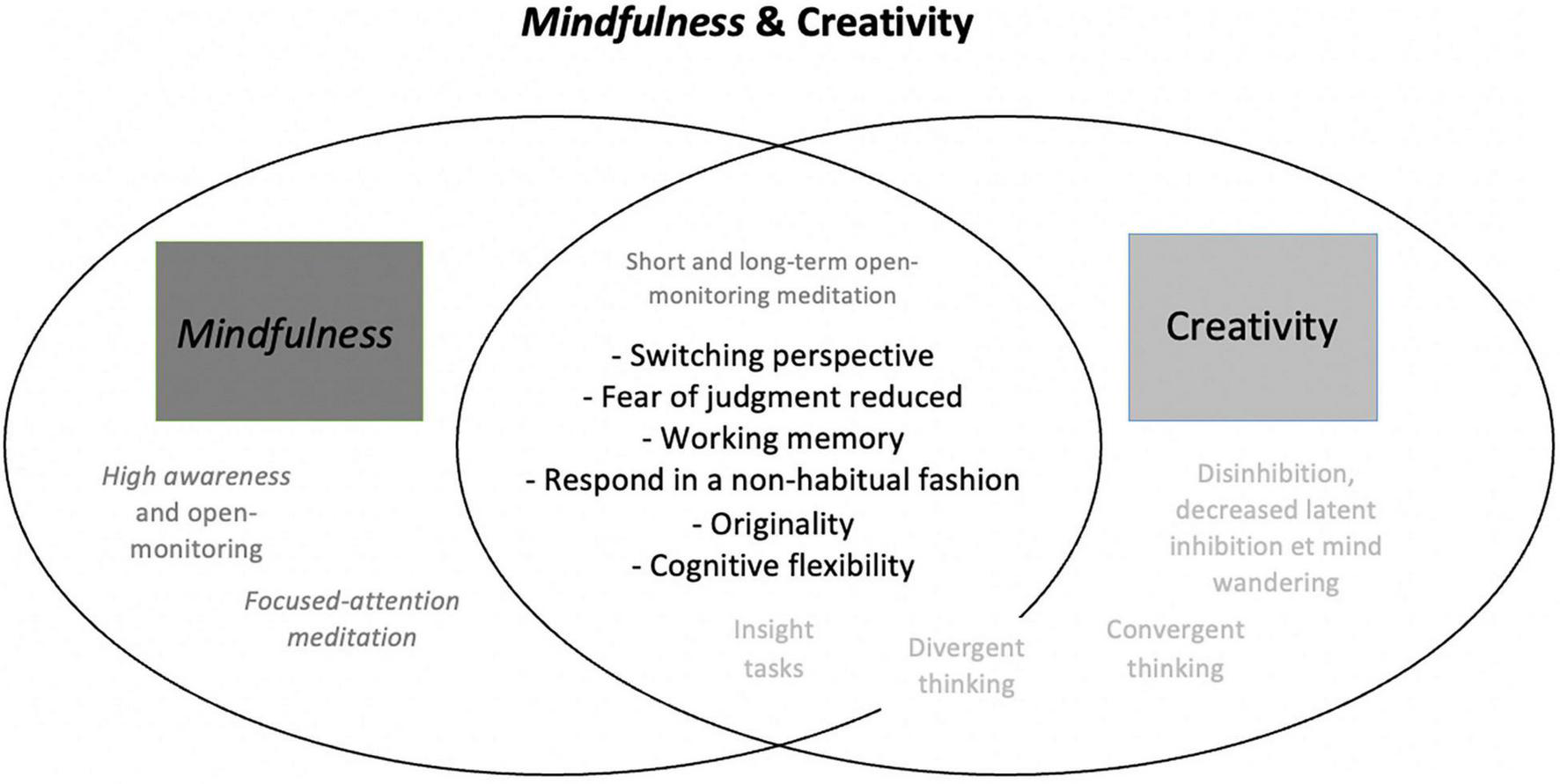
Model of the link between mindfulness and creativity. Schematization from Lebuda et al. (2016).
Flow
In contrast to the paucity of literature on mindfulness and creativity, a substantial amount of literature exists on the connections between flow and creativity in educational settings. Hsiao et al. (2014) have studied how traditional instruction and instruction using digital games can increase creativity, manual skills and the appearance of flow experiences compared to traditional instruction, as students in the digital environment are actively involved in acquiring knowledge and resolving tasks. These results are consistent with Dawoud et al. (2015) who observed that flow mediates the relationship between the interactivity of computer-aided design and creative behavior in architecture design students. Yeh and Lin (2018) have also studied the influence of digital games on creativity among secondary school pupils. In particular, they note that implementing achievement goals during digital creativity game-playing enhances the level of mastery experience through the attainment of flow which enhances self-efficacy and self-determination. Yeh et al. (2019) confirmed these results in another game-based learning experience which was found to enhance mindful learning experience, flow experience, self-efficacy, and mastery experience during creativity. All these results on digital tools and environment are consistent with Yang et al. (2018) who found that people in an immersive virtual reality environment achieve higher-quality creative products than people in a traditional digital-free environment. Yang et al. (2019) confirmed these findings, also noting that virtual reality environments gave rise to a significant correlation between (1) the individual creativity level and the state of flow, and (2) the state of flow and the quality of the creative product. Flow-creativity has also been studied in artistic fields. MacDonald et al. (2016) have studied group flow, creativity and music among university students and found that when flow levels increased, creativity levels increased as well. Landau and Limb (2017) have described the correlations between flow, musical improvisation and musical creativity and call for musical improvisation in the classroom as a means of fostering students’ creativity.
Thus, flow and creativity can be studied both in individuals and in groups. Sawyer (2015) has established conditions for group flow: group goals, close listening, complete concentration, being in control, blending egos, equal participation, knowing team mates, good communication, and being progress-oriented. Duncan and West (2018) have also studied group flow and called for more studies in higher education and business settings. Primus and Sonnenburg (2018) studied group and individual flow experiences in design thinking fields using Lego Serious Play and found that in co-creative settings, group flow experience and individual flow experience are strongly associated. Chilton (2013) worked in art therapy classrooms and noticed that art therapy is a whole brain activity which activate flow state and how it would be important to encourage research in this creative art experience. Gardiner (2017) has also studied educational settings and links between playwriting pedagogy, creativity and flow. He notes the importance of enhancing levels of engagement in the classroom by encouraging flow experiences, and also calls for a paradigm shift for teachers who may feel inadequate and dissatisfaction at the end of the creative activity and kill students’ motivation. Mihelič and Aleksič (2017) studied graduate students and found that satisfaction with work-life balance increases flow experience which in turn fosters individual creativity. This means that employers seeking to increase employees’ creativity should take care to offer them a healthy working environment.
Mind Wandering
Mind wandering is characterized by an attentional disengagement from one’s environment (Danckert, 2018) and is fostered by boredom. Research about mind wandering-creativity links goes back several decades. Schubert (1977, 1978) reflected on different aspects of boredom and creativity for psychiatry patients. College students studied by Harris (2000) reported opportunities for thought (44 out of 131), relaxation (29 out of 131) and increasing levels of creativity (7 out of 131) during mind wandering. Harris observed that boredom proneness was positively correlated with mood monitoring, which is itself correlated with neuroticism, which is in turn correlated with creativity (Perkins et al., 2015). This seems to be consistent with Gasper and Middlewood (2014) who note that those students who experienced elation and boredom engaged in more associative thought than those who experienced distress and relaxation. Bench and Lench (2013) posit boredom as a discrete functional emotion and a valuable adaptive function, driving people to seek out new goals and experiences; they also call for further experimental boredom research. Moreover, Mann and Cadman (2014) tried to dissociate the effects of mind wandering on creativity during a given activity. They found that boring reading and writing tasks increased both the number of creative answers and the level of creativity in terms of usefulness compared to a control group. Thus, they concluded that boredom can be a strength and should be encouraged in education, work and leisure settings. Finally, Pachai et al. (2016) reviewed all experimental studies of mind wandering in education and proposed methods to alleviate mind wandering in the classroom, despite its positive influence on creativity.
These links between creativity and mind wandering can be explained by the fact that mind wandering facilitates creative incubation, which is consistent with Baird et al. (2012) and Tan et al. (2015) who studied the phenomenon in college students. Dijksterhuis and Meurs (2006) had already sought to highlight the relationship between creativity, incubation and the unconscious mind, and found that, in a creative task, conscious thoughts lead to more convergent answers whereas unconscious thoughts lead to more divergent answers. This is consistent with Preiss and Cosmelli (2017) who interviewed four Chilean poets and called them “mindful mind wanderers.” They noted that the poets went through four steps during their creative process, including the development of trust during the incubation phase. This mindful mind wandering may be understood as task-related mind wandering and may be considered a cognition resource. This idea may temper the results from Randall et al. (2014) who found that an increase in mind wandering was generally associated with decreases in task performance, whereas an increase in task-related thoughts was associated with increased performance. Christoff et al. (2016) consider mind wandering to be part of the spontaneous-thought processes, alongside dreaming and creative thinking, and suggest that it can be spontaneous, automatically constrained or deliberately constrained. Fox and Beaty (2019) explain that “conceptualizations of creative thinking can be applied with only minor modifications to mind wandering” (p. 128) and that anyone can be creative. They argue that mind wandering, like creative thinking, requires a generative phase of thoughts and an evaluative phase. The first phase makes “the production of novel ideas” easier and the second phase enables “the assessment of their usefulness” (Ellamil et al., 2012, p. 17783). While the first phase is associated with medial temporal lobe regions, the second is associated with insular, rostrolateral, temporopolar cortex and default and executive network areas (Ellamil et al., 2012). These processes have been studied, for example, in performance artists (Thomson and Jaque, 2017) within the framework of consciousness (Ahn and van Swol, 2021).
However, Preiss et al. (2019) have tempered these assertions about mind wandering and creative thinking with their observation that mind wandering can have a positive effect on creativity only in people with high attention spans and high metacognition. Wu and Hao (2020) have also stressed that creative ideation requires attention and that it is essential to inhibit interference of old ideas and external stimuli. Moreover, Yamaoka and Yukawa (2020) have shown that more extensive mind wandering correlates to greater divergent thinking but poorer mental health. Furthermore, since mind wandering can foster creativity but hinder productivity (Brishtel et al., 2020), educators may want to create new tools or teaching methods to reduce it (Szpunar et al., 2013) or redirect it (Szpunar, 2017). Beghetto and Schuh (2020) offer suggestions to allow teachers to appeal to imaginative mind wandering for creative learning outcomes (2020, p. 264). We thus see the value in working both on students’ attentional and metacognitive skills but also on their mental health with other tools such as meditation, in order to foster different states of consciousness (like mindfulness).
Reconciling Mindfulness, Flow and Mind Wandering
Thus, some scientific literature already exists on the individual links between these attentional states of consciousness and creativity, but also on the complementarities and oppositions between attentional states. While they can all be considered beneficial states of consciousness and are associated with positive elements in the scientific literature (i.e., creativity, cognitive flexibility, problem solving), obvious differences emerge and suggest that these states might be incompatible with one another. This has led researchers to study the contradictions, similarities and interactions between the different states. Dust (2015) points out that although “people engage in mind wandering [.] for the majority of their day” and while it generally allows for the association and emergence of ideas, mindfulness and flow are particularly valuable in the workplace in that mindfulness facilitates “higher performance by being aware of external stimuli” and flow by “blocking out external stimuli” (p. 610). Moreover, the default mode network, defined as a “network of interacting brain regions that is active when a person is not focused on the outside world” (Voelcker-Rehage et al., 2016, p. 63), such as during mind wandering, is reduced during meditation (Garrison et al., 2015; Voelcker-Rehage et al., 2016; Ramírez-Barrantes et al., 2019; Feruglio et al., 2021). The default mode network is involved in internal mentation, understood as “the introspective and adaptive mental activities in which humans spontaneously and deliberately engage in everyday” (Andrews-Hanna, 2012, p. 251).
Other studies have shown that mindfulness practices can enhance the state of flow in sports (Kaufman et al., 2009; Aherne et al., 2011; Thienot et al., 2014; Junot and Paquet, 2016). Yet contrasting research (Sheldon et al., 2015) has shown that “boosting a person’s ability to remain mindful during an activity might actually undermine their ability to get absorbed in that activity” (2015, p. 281), while also emphasizing that mindfulness and flow can “come and go in potentially rapid succession” and “take place quite often within a particular period of time” (2015, p. 281). This observation is aligned with the conclusions of other researchers (Vago and Zeidan, 2016) who explain that mindfulness and mind wandering may arise according to the “specified demands of the situation” (2016, p. 96).
Thus, these three different states of consciousness can be complementary, antagonistic and/or successive in various activities. Mrazek et al. (2012) have carried out several studies on mind wandering and mindfulness to “clarify the opposition between the constructs of mindfulness and mind wandering” and the results confirm their “opposing relationship.” In addition, studies have highlighted the concrete opposition between mind wandering and mindfulness by demonstrating the effectiveness of mindfulness training in reducing mind wandering (Mrazek et al., 2013, 2014; Rahl et al., 2017). Schooler and his team tried to strike a balance between mind wandering and mindfulness. They ultimately concluded that mind wandering shouldn’t be devalued because it can “offer some unique benefits” (Schooler et al., 2014, p. 2). In addition, Agnoli et al. (2018, p. 41) have highlighted the fact that “mind wandering and mindfulness dimensions predicted creative behavior both alone and in combination, suggesting a complex interdependence between these two mental states within the creative thinking process.” Baird et al. (2012) state that “engaging in simple external tasks that allow the mind to wander may facilitate creative problem solving” and thus facilitate the creative incubation stage (p. 1117). Moreover, Henriksen et al. (2020) underline that mindfulness and mind wandering can enhance each other toward creativity. This article underlines that even if the literature on mindfulness and mind wandering generally places the two states in opposition—each characterized by different neural correlates—this extensive reflection on the relationships between these states of consciousness and their links to creativity has moved the lines and led us to reconsider these oppositional states as existing in complementarity and sometimes simultaneity, as in the case of mindful mind wandering (Preiss and Cosmelli, 2017).
Taken together, this data shows that various attentional states (or contents) of consciousness can be thought of as normal states of consciousness, and that they are strongly tied to creativity. More empirical studies are needed to get a better picture of the link between attentional states of consciousness and creativity, especially in educational settings. Regardless, we can conclude from our analysis that the debate should not be about supporting certain states of consciousness and hindering others, but rather about how we arrange, support, prompt and use all of them in educational settings.
Toward a New Era of Creativity Education Based on the Attentional States of Consciousness?
How Education for Creativity Has Evolved Over the Last Several Decades
As early as the 1950s and 1960s, researchers began to explore the issue of education for creativity in schools (especially among gifted children). Although initially creativity was studied almost exclusively in the field of psychology, its pertinence to pedagogical sciences was quickly established. As early as 1962, Torrance (1962) questioned traditional education by making adjustments to the roles of teachers and school directors, such as the establishment of new training programs, the modification of school curriculum and its objectives, the use of new materials and methods, the implementation of new assessments and a modification of teacher-student relations. Torrance (1959) also highlighted the blockages which he felt prevented creativity from developing, namely: “premature attempts to eliminate or reduce children’s imagination,” “restrictions on curiosity,” an “overemphasis on sex roles” (p. 313), an overemphasis on winning rather than facing setbacks or frustrations, induction of fear and shyness in children by test administrators, and an emphasis on verbal skills instead of problem solving. There are dozens of different programs aimed at encouraging creativity in school, each one focused on specific skills: problem solving, imagination, decision making, cognitive flexibility, emotional control, metacognition, and so on. By the same token, there are a multitude of ways to discourage creativity in education, such as “perpetuating the idea that there is only one correct way to accomplish a task and that there is one and only one correct answer to each question,” “cultivating unconditional submission to, and preferably fear of authority,” “insisting on sticking to the lesson plan at all costs,” “promoting belief in the compartmentalization of knowledge,” “discouraging curiosity” or “promoting beliefs that are antithetical to the development of creative thinking” (Nickerson, 2010, p. 1–3).
Some programs are techniques to be applied whereas others are essentially teaching resources (Cropley, 2003, p. 142–143). However, for Cropley, holistic approaches are an essential part of in education for creativity and these approaches must take into account all aspects of the individual: the person’s creative potential, their psychological characteristics and their environment (2003, p. 144–145). He therefore proposes changes to the educational environment and classroom practices that target students’ cognitive, personality and motivational aspects by setting up an active pedagogy and by offering, among other things, varied educational material, pleasant and non-stress-inducing activities, increased student autonomy and a serene working atmosphere (2003, p. 150). Cropley (2003) also stresses the importance of encouraging creativity (and therefore innovation) in higher education due to economic globalization and global economic competition. He proposes changing eligibility criteria, modifying teaching methods, reducing excessive specialization of students, redefining the teacher’s role, modifying assessments, allowing students to be more independent in learning, developing problem-based learning and encouraging distance learning (2003, p. 165–173). One challenge facing educators today is teaching creativity in “an era of content and accountability standards” (Baer and Garrett, 2010, p. 6). Kaufman and Beghetto (2010) list some twenty ideas they consider essential for making school and creativity compatible. These include: using technology, knowing the myths and misconceptions of creativity, encouraging intrinsic motivation, recognizing the importance of daily creativity, creating a caring environment, integrating creativity into all school subjects, and providing better training for teachers.
Why a State of Consciousness-Based Creative Education Should Be Considered a Serious Option: Pedagogical and Neuroscientific Insights
All these pedagogical considerations are based on neuroscientific data which shows the value of this new educational path. First, Piirto (2010) focuses on attitudes and processes, and recommends, for example, encouraging risk-taking, self-discipline, group trust, ambiguity tolerance, and fostering student ingenuity through certain types of exercises (e.g., meditation, drawing, and attentive listening) that facilitate the stages of the creative process: inspiration, ideation, incubation, imagination, visualization, intuition, improvisations. These pedagogical activities give individuals the opportunity to develop their talents and thus their creative potential through the implementation of creative rituals, meditation (mindfulness and flow), reading intellectual studies on certain subjects or even physical exercises to allow creative thoughts to emerge (Piirto, 2016, p. 135). Daydream- and mind wandering-facilitating learning and creativity in the classroom have also been encouraged by Gotlieb et al. (2016).
Moreover, Flaherty (2005) proposes a “three-factor anatomical model of human idea generation and creative drive, focusing on interactions between the temporal lobes, frontal lobes, and limbic system” (2005, p. 147). Changes in the temporal lobe (atrophy or enlargement) can trigger or inhibit creative drive (2005, p. 3) and alterations in the dopaminergic system are associated with creative thinking (2005, p. 4). Neurotransmitters including dopamine, serotonin, norepinephrine and endorphins thus have a clear impact on motivational factors (Flaherty, 2018, p. 25). The goal should then be to restore homeostasis, i.e., the balance between overly low motivation and high motivation (Flaherty, 2018, p. 41). This balance of neurotransmitters can be restored by medication, sleep and exercise, psychotherapy, electrical brain stimulation techniques, or by cognitive training and education (such as the use of meditation in the classroom).
Furthermore, according to Corballis (2018), “brain imaging now suggests that creativity depends on widespread circuits of the brain, including the default-mode network” (p. 54). He also notes that “there are likely to be differential, though graded, contributions from each hemisphere, simply because there are functional differences between them, but these appear not to constitute the simple polarity so widely assumed” (p. 54). He goes on to argue that the brain “has a natural source of random variation” and that creative ideas can emerge from dreams and daydreams, the imagination or even mind wandering, which occupies more than half of the brain’s time during waking periods (p. 55). Thus, we can easily understand why and how attentional states of consciousness may be beneficial for creativity and for acquiring a wide range of academic skills and knowledge.
Education, Attentional States of Consciousness, Creativity, Responsibility, Well-Being and Psychosocial Skills
At this point, another aspect of creativity merits discussion. Creativity is never neutral and may be malevolent (McLaren, 1993): indeed, creativity and problem solving should entail consideration of the consequences of one’s actions and acceptance of responsibility for the results achieved (OECD, 2018, p. 7). Indeed, creativity can be either beneficial or harmful for the economy as for individual and group well-being: education for creativity must thus be tailored to the culture in which it is administered in order to overcome educational challenges arising from the continuous innovation and education necessary for sustainable development in a world of waste and consumerism (Craft, 2005). For instance, Hindle et al. (2015) highlight the importance of taking cultural aspects into account during creativity assessments. They cite the example of indigenous creativity in Māori arts education, underlining how hard it is to assess intangible elements such as the Māori concept of being or even flow in this framework. Creativity education therefore calls for going beyond conventional constraints of education for creativity for creativity while also taking into account ethics, environmental protection and pupils’ socio-emotional and psychosocial skills development. These skills now appear to be key drivers of economic development, social justice and the feeling of belonging to one or more communities (Craft, 2005, p. 160). In 1993, the World Health Organization (WHO) defined life skills as “the abilities for adaptive and positive behavior that enable individuals to deal effectively with the demands and challenges of everyday life” (World Health Organization, 1994, p. 1). These life skills are also called “psychosocial skills” (World Health Organization, 1994, p.1) and have an “important role to play […] in terms of physical, mental and social well-being” (World Health Organization, 1994, p. 1). Accordingly, the WHO has urged educators to incorporate the following ten skills into school curricula: decision-making, problem-solving, creative thinking, critical thinking, effective communication, interpersonal relationship skills, self-awareness, empathy, and the ability to cope with stress and emotions (World Health Organization, 1994, p. 1). More recently, the United Nations General Assembly (2015) proposed broader ethical goals for education as part of the 17 Sustainable Development Goals to be achieved by 2030 which include, among others: universal access to a quality education that endows all individuals with the knowledge, skills and values necessary for them to live with dignity, to build a life and to contribute to their society; gender equality; reduced inequalities; health and well-being; and the fight against climate change.
It is therefore essential that students be provided with formal and informal learning opportunities for developing their creative potential, though it may be necessary to highlight certain safeguards to ensure a given education has the intended effect. Since creativity is not the only benefit to using states of consciousness in the classroom, we will now turn to a consideration of the effects of mindfulness meditation, from its general benefits for pupils to its ability to promote ethics and responsibility (Hagège, 2019). Mindfulness meditation programs in schools are increasingly common, though vary in the duration, frequency and type of meditation (Grégoire et al., 2016). Some of these programs have already shown effectiveness in children in terms of: decreasing suicidal ideation (Britton et al., 2014), reducing blood pressure and heart rate (Barnes et al., 2004) and reducing stress for pupils and teachers (Bostic et al., 2015; Spijkerman et al., 2016; Dunning et al., 2019), which in turn leads to enhanced prosociality (Kreplin et al., 2018; Taylor et al., 2020), self-reflection (Yun et al., 2020), cognitive functions like working memory (Whitfield et al., 2021) and attention (Yun et al., 2020). Meta-analyses point to a general enhancement of well-being (Waters et al., 2015; Zoogman et al., 2015; Klingbeil et al., 2017; Theurel et al., 2018; Wilson et al., 2021). It should also be noted that mindfulness is an inclusive practice shown to improve psycho-emotional well-being, behaviors and executive functions of children with attention deficit hyperactivity disorder (Black et al., 2009; Bigelow et al., 2021; Oliva et al., 2021), as children with ADHD may experience excessive spontaneous mind wandering (Bozhilova et al., 2018) but also hyperfocus (which can be understood as flow) at school, during screen time and during hobbies (Hupfeld et al., 2019). Given the capacity of attentional states of consciousness to develop nearly all psychosocial skills and increase all kinds of scholastic knowledge, this new educational path must be seriously considered.
Discussion
The Foundations for Developing Creative Potential Through Attentional States of Consciousness
Empirical literature usually considers the impact of one specific state of consciousness on students’ creativity. Yet we have shown that flow, mindfulness and mind wandering each have different effects—a finding which points to the utility of educational interventions fostering all three states of consciousness. As flow and mind wandering are more easily reached, and more frequent and spontaneous than mindfulness (which requires consistent training), mindfulness should be a cornerstone of this new multifaceted pro-creativity pedagogical approach that should be adequately supplemented with knowledge content and technical skills acquisition. Our findings show no experiment of this nature. As we have indicated above, even if these three states of consciousness are simultaneously exclusive, they appear to be rather complementary when occurring successively over time. Indeed, despite having divergent characteristics in terms of intention, consciousness and attention, all attentional states of consciousness entail changes in perception of time, self and space. Considered together, they could provide a better understanding of the links between creativity and the complementarity among attentional states of consciousness. We thus hope these observations will encourage researchers to organize experimental studies that foster and assess combinations of these attentional states of consciousness to get better results on imagination and education for a responsible creativity among children and college students. So, taking this data into account, it would seem that the creative act can occur across the spectrum of consciousness, attention and intention, and that creativity is neither exclusively correlated with absence or total consciousness, attention and intention. The table below outlines this process (Table 1):
- •
The table (Table 1) dissociates consciousness from attention and intention because the three do not function similarly. Altered states of consciousness can be spontaneous or can be physically, pharmacologically, psychologically or pathologically induced (Vaitl et al., 2005, p. 100). We have included other states of consciousness, such as hypnagogia and dreaming, to better illustrate our idea. The table should be read as follows:
⋅ The state of mindfulness involves deep consciousness (++) and is caused voluntarily (++) by focusing one’s attention on something internal or on one’s environment.
⋅ The state of flow involves heightened awareness (+) and is caused intentionally (+) through an activity such as sports, music, video games, etc. by focusing one’s attention in a sustained manner on something external.
⋅ The state of mind wandering involves either an awareness (+) or an absence of awareness (−), is caused intentionally (+) or unintentionally (−) and entails defocused attention or inattention.
TABLE 1
| Type | Intention | Consciousness | Attention | Changes in perception of time, self and space |
| Mindfulness (at initial training thus not stabilized) | + + | +: (self and the environment) | Endogenous mainly Focused Attention | + |
| Mindfulness (mainly spontaneous because sufficiently trained and stabilized) | - + | + +: (self and the environment) | Exogenous mainly Open Monitoring Attention | + + |
| Flow | + - | +: (environmental task) -: (self) | Maybe Endogenous at the beginning then Focused and Sustained Exogenous Attention | + |
| Mind wandering | - + | -: (environment, emotions, bodily sensations) + -: (thoughts: usually - but + if mindful) | Defocused Attention and Inattention | - + |
| Hypnagogia | - + | - + | Selective Endogenous and Exogenous Attention | + + |
| Dreaming | – | - (+ : during lucid dreaming) | Sustained and Shared Exogenous Attention | + + |
Typology of attentional states of consciousness.
Different levels of consciousness and intention, and different kinds of attention may generate different kinds of creativity, though this would require more specific studies. Yet, resorting to an educational program incorporating flow, mindfulness and mind wandering would either involve three different activities (e.g., meditation, sports and a boring or relaxing activity) or a single activity capable of inducing any one of these three states at a given time, including different levels of intention, attention and consciousness. It is worth noting that mind wandering occurs spontaneously during mindfulness training, and can thus become progressively more conscious (refer to our earlier discussion of “mindful mind wandering”). With this in mind, we will also investigate the following question: Does the effect of mind wandering (alone or in combination with flow and mindfulness) on creativity depend on the level of consciousness involved? Regardless, any attempt to oversee experimentation in children and/or college students with attention, consciousness and intention would require a new educational program that fosters different states of consciousness, such as the Mindfulness-Based Ethics of Responsibility (MBER) program (Hagège, in press).
Avenues for This New Educational Path
More recent educational interventions have, as a result, focused on children’s executive functions and on certain states of consciousness characterized by changes in cognitive processes including attention and concentration. Researchers and educators must follow this lead by promoting the techniques and methods of education for creativity and taking an interest in this emerging paradigm: creativity education through alternative attentional states (or contents) of consciousness. Doing so will yield more data, affording researchers a better understanding of its impacts and mechanisms.
Supporting Individual and Group Digital Learning
In 2014, the Qatar Foundation hosted the World Innovation Summit for Education and conducted a “School in 2030” survey, querying experts and professionals (teachers, associations, public institutions and companies) from all over the world (Europe, Middle East, Asia, Oceania, Africa, North America, Latin America and the Caribbean). Among other findings, the results highlighted that online learning may become the norm and that, in the future, psychosocial and practical skills will be more important than technical skills. Survey respondents overwhelmingly agreed on one point: 93% reported a preference for schools that implement innovative methods based on new pedagogical approaches and creative processes, but complained that the rigidity of the system remains a major obstacle to these methods’ implementation.
In light of the substantial corpus of literature cited in this article, the abovementioned forecasts for the future of education, and the current pandemic, it seems only logical that we should seek to develop new digital educational programs—from podcasts and virtual reality to video games and applications—capable of fostering flow, mind wandering and mindfulness. Some tools already exist: virtual reality meditation applications (Guided Meditation and Relax Vr; computer and video games Journey, flOw and Flower); and a number of podcasts, applications and recordings made by professional meditators. Unfortunately, these tools are not always tailored to educational settings and as it stands there is a serious dearth of state of consciousness educational tools—whence the vital necessity to create new ones for educational purposes, designed to foster all attentional states of consciousness and responsible creativity. However, such a curricula switch could also be affected by rethinking teacher training.
Redesigning Teacher Training and Classroom Environments
One key objective should be to implement inclusive and personalized educational approaches that help learners believe in their creative potential, identify their creative abilities and then develop this creativity via formal and informal (preferably ethics-centered) learning opportunities (Craft, 2005). Despite the plethora of advice that can be given to teachers, there remain constant gaps between theory and practice: personalized teaching allows each individual to develop their potential, but how does one implement such an approach at a student-teacher ratio of 30-to-1? One solution might be to modify the form and content of the program, but this may be difficult given constraints surrounding school curricular content and scheduling.
The French research field of “les éducations à” la créativité, la santé, l’environnement, la responsabilité, etc. (which can be translated as “educating for” creativity, health, environment, responsibility, etc.) entails a set of practices challenging traditional education. Barthes et al. (2017) explain that in this approach to teaching, academic knowledge is marginal and is tied into societal issues, with the aim of changing behaviors, values and practices, getting students involved, and questioning usual school operations.
Thus, promoting education for responsible creativity means first and foremost training teachers in mindfulness, flow, mind wandering and ethics embodiment (Hagège, 2019) and focusing on new kinds of learning skills, such as psychosocial skills (e.g., creative thinking, regulation of emotions, regulation of stress, decision making, values ranking). Moreover, we know that school, family and classroom environments can influence children’s academic performance, well-being, attention and social behavior (Day et al., 2015; Berman et al., 2018; Massonnié et al., 2019; Tapia-Fonllem et al., 2020; Molina Roldán et al., 2021).
Limitations and Conclusion
It seems important to acknowledge the limitations of this review. First, although it includes a substantial number of (mostly English-language) references from PsycNet, Google Scholar, Frontiers and Science Direct, it should by no means be considered exhaustive. Second, it presents historical perspectives on the states of consciousness chronologically, whereas the history of science is more complex and non-linear. Finally, personal biases stemming from our different working fields, interests and professional statuses have influenced the writing of this review.
To conclude, this review nevertheless suggests numerous innovative perspectives for empirical research and education on the topic of using attentional states of consciousness to foster creativity. Attentional states of consciousness could be used to harness all creative resources (Sternberg and Lubart, 1991) at all levels (Beghetto and Kaufman, 2007), in all fields (Kaufman and Baer, 2004), while taking into account cultural variations (Lubart et al., 2019) and using inclusive practices to adapt to people, their processes and their environment (Rhodes, 1961). The value of harnessing attentional states of consciousness for educational purposes lies in their utility as cognitive tools and phenomenological activities. Indeed, working with the different attentional states of consciousness (especially flow, mindfulness and mind wandering) can be an asset in schools. Firstly, because it may favor the development of the psychosocial skills necessary to navigate the challenges of the twenty-first century; secondly because it is a non-academic way of developing these skills that may increase students’ level of engagement, and thereby enhance learning and foster creativity.
Publisher’s Note
All claims expressed in this article are solely those of the authors and do not necessarily represent those of their affiliated organizations, or those of the publisher, the editors and the reviewers. Any product that may be evaluated in this article, or claim that may be made by its manufacturer, is not guaranteed or endorsed by the publisher.
Statements
Author contributions
KR wrote the article. HH co-supervised him for his Ph.D. guided the bibliographic research and helped structure and formulate the article. Both authors contributed to the article and approved the submitted version.
Funding
This project was supported by an educational research grant awarded by the European Regional Development Fund allocated by the European Union.
Conflict of interest
The authors declare that the research was conducted in the absence of any commercial or financial relationships that could be construed as a potential conflict of interest.
References
1
AbrahamA. (2018). The Neuroscience of Creativity.Cambridge: University Press.
2
AgarwalR.KarahannaE. (2000). Time Flies When You’re Having Fun: Cognitive Absorption and Beliefs about Information Technology Usage.MIS Q.24665–694. 10.2307/3250951
3
AgnoliS.VanucciM.PelagattiC.CorazzaG. E. (2018). Exploring the link between mind wandering, mindfulness, and creativity: A multidimensional approach.Creat. Res. J.3041–53. 10.1080/10400419.2018.1411423
4
AherneC.MoranA. P.LonsdaleC. (2011). The effect of mindfulness training on athletes’ flow: An initial investigation.Sport Psychol.25177–189. 10.1123/tsp.25.2.177
5
AhnP. H.van SwolL. M. (2021). “Personality metatraits, neurocognitive networks, and reasoning norms for creative decision-making,” in Consumer Happiness: Multiple Perspectives, edsDuttaT.MandalM. K. (Netherland: Springer), 179–201.
6
Andrews-HannaJ. R. (2012). The brain’s default network and its adaptive role in internal mentation.Neuroscientist18251–270. 10.1177/1073858411403316
7
AruJ.SuzukiM.RutikuR.LarkumM. E.BachmannT. (2019). Coupling the State and Contents of Consciousness.Front. Syst. Neurosci.13:43. 10.3389/fnsys.2019.00043
8
BaasM.NevickaB.Ten VeldenF. S. (2014). Specific Mindfulness Skills Differentially Predict Creative Performance.Personal. Soc. Psychol. Bull.401092–1106. 10.1177/0146167214535813
9
BaerJ.GarrettT. (2010). “Teaching for Creativity in an Era of Content Standards and Accountability,” in Nurturing Creativity in the Classroom, edsBeghettoR.KaufmanJ. (Cambridge: Cambridge University Press), 6–23. 10.1017/CBO9780511781629.003
10
BaerR. A.SmithG. T.HopkinsJ.KrietemeyerJ.ToneyL. (2006). Using self-report assessment methods to explore facets of mindfulness.Assessment1327–45. 10.1177/1073191105283504
11
BairdB.SmallwoodJ.MrazekM. D.KamJ. W.FranklinM. S.SchoolerJ. W. (2012). Inspired by distraction: mind wandering facilitates creative incubation.Psychol. Sci.231117–1122. 10.1177/0956797612446024
12
BanksJ. B.BoalsA. (2017). Understanding the role of mind wandering in stress-related working memory impairments.Cogn. Emot.311023–1030. 10.1080/02699931.2016.1179174
13
BarbotB.BesançonM.LubartT. (2015). Creative potential in educational settings: Its nature, measure, and nurture.Education43371–381. 10.1080/03004279.2015.1020643
14
BarnesV. A.DavisH. C.MurzynowskiJ. B.TreiberF. A. (2004). Impact of meditation on resting and ambulatory blood pressure and heart rate in youth.Psychos. Med.66909–914. 10.1097/01.psy.0000145902.91749.35
15
Baron-CohenS. (2002). The extreme male brain theory of autism.Trends Cogn. Sci.6248–254. 10.1016/s1364-6613(02)01904-6
16
BarthesA.LangeJ.-M.Tutiaux-GuillonN. (2017). Dictionnaire critique des enjeux et concepts des “éducations à”.Paris: L’Harmattan.
17
BassoJ. C.McHaleA.EndeV.OberlinD. J.SuzukiW. A. (2019). Brief, daily meditation enhances attention, memory, mood, and emotional regulation in non-experienced meditators.Behav. Brain Res.356208–220. 10.1016/j.bbr.2018.08.023
18
BeatyR. E.ThakralP. P.MadoreK. P.BenedekM.SchacterD. L. (2018). Core Network Contributions to Remembering the Past, Imagining the Future, and Thinking Creatively.J. Cogn. Neurosci.301939–1951. 10.1162/jocn_a_01327
19
BeavenA. (2012). Attention Deficit Hyperactivity Disorder: Reframing “deficit” as Creative Strength.Ph.D. thesis.Southampton: University of Southampton. Available online at: https://eprints.soton.ac.uk/347117/(accessed March 4, 2022).
20
BeghettoR. A.KaufmanJ. C. (2007). Toward a broader conception of creativity: A case for “mini-c” creativity.Psychol. Aesth.173–79. 10.1037/1931-3896.1.2.73
21
BeghettoR. A.SchuhK. L. (2020). “Exploring the connection between imagination and creativity in academic learning. Creativity and the Wandering Mind,” in Creativity and the Wandering Mind, Spontaneous and Controlled Cognition, edsPreissD. D.CosmelliD.KaufmanJ. C. (New York, NY: Elsevier), 249–267. 10.1016/b978-0-12-816400-6.00011-0
22
BenchS. W.LenchH. C. (2013). On the function of boredom.Behav. Sci.3459–472. 10.3390/bs3030459
23
Berkovich-OhanaA.GlicksohnJ.Ben-SoussanT. D.GoldsteinA. (2017). Creativity is enhanced by long-term mindfulness training and is negatively correlated with trait default-mode-related low-gamma inter-hemispheric connectivity.Mindfulness8717–727. 10.1007/s12671-016-0649-y
24
BermanJ. D.McCormackM. C.KoehlerK. A.ConnollyF.Clemons-ErbyD.DavisM. F.et al (2018). School environmental conditions and links to academic performance and absenteeism in urban, mid-Atlantic public schools.Int. J. Hyg. Environ. Health221800–808. 10.1016/j.ijheh.2018.04.015
25
BestC.AroraS.PorterF.DohertyM. (2015). The relationship between subthreshold autistic traits, ambiguous figure perception and divergent thinking. J. Autism Dev. Disord.45, 4064–4073. 10.1007/s10803-015-2518-2
26
BigelowH.GottliebM. D.OgrodnikM.GrahamJ. D.FenesiB. (2021). The Differential Impact of Acute Exercise and Mindfulness Meditation on Executive Functioning and Psycho-Emotional Well-Being in Children and Youth With ADHD.Front. Psychol.12:660845. 10.3389/fpsyg.2021.660845
27
BlackD. S.MilamJ.SussmanS. (2009). Sitting-meditation interventions among youth: a review of treatment efficacy.Pediatrics124e532–e541. 10.1542/peds.2008-3434
28
BlondéP.SperdutiM.MakowskiD.PiolinoP. (2022). Bored, distracted, and forgetful: The impact of mind wandering and boredom on memory encoding.Q. J. Exp. Psychol.7553–69. 10.1177/17470218211026301
29
BoldtG. (2019). Artistic creativity beyond divergent thinking: Analysing sequences in creative subprocesses.Think. Skills Creat.34:100606. 10.1016/j.tsc.2019.100606
30
BolyM.PhillipsC.TshibandaL.VanhaudenhuyseA.SchabusM.Dang-VuT. T.et al (2008). Intrinsic brain activity in altered states of consciousness: how conscious is the default mode of brain function?Anna. N. Y. Acad. Sci.1129119–129. 10.1196/annals.1417.015
31
BootN.NevickaB.BaasM. (2017). Creativity in ADHD: Goal-Directed Motivation and Domain Specificity.J. Attent. Disor.241857–1866. 10.1177/1087054717727352
32
BosticJ. Q.NevarezM. D.PotterM. P.PrinceJ. B.BenningfieldM. M.AguirreB. A. (2015). Being present at school: implementing mindfulness in schools.Child Adolesc. Psych. Clin. North Am.24245–259. 10.1016/j.chc.2014.11.010
33
BothaE.GwinT.PurporaC. (2015). The effectiveness of mindfulness-based programs in reducing stress experienced by nurses in adult hospital settings: a systematic review of quantitative evidence protocol.JBI Datab. System. Rev. Implement. Rep.1321–29. 10.11124/jbisrir-2015-2380
34
BourguignonE. (1965). “The self, the behavioral environment, and the theory of spirit possession,” in Context and Meaning in Cultural Anthropology, edsSpiroM. E.HallowellA. I. (Mumbai: Free Press), 39–60.
35
BourguignonE. (1966). “World distribution and patterns of possession states,” in Trance and possession states, ed.PrinceR. (Mumbai: Free Press), 3–34.
36
BourguignonE. (1973). Religion, Altered States of Consciousness and Social Change.Columbus: Ohio State University Press.
37
BozhilovaN. S.MicheliniG.KuntsiJ.AshersonP. (2018). Mind wandering perspective on attention-deficit/hyperactivity disorder.Neurosci. Biobehav. Rev.92464–476. 10.1016/j.neubiorev.2018.07.010
38
BrainW. R. (1948). Some reflections on genius.Eugen. Rev.4012–20.
39
BrishtelI.KhanA. A.SchmidtT.DinglerT.IshimaruS.DengelA. (2020). Mind Wandering in a Multimodal Reading Setting: Behavior Analysis and Automatic Detection Using Eye-Tracking and an EDA Sensor.Sensors20:2546. 10.3390/s20092546
40
BrittonW. B.LeppN. E.NilesH. F.RochaT.FisherN. E.GoldJ. S. (2014). A randomized controlled pilot trial of classroom-based mindfulness meditation compared to an active control condition in sixth-grade children.J. School Psychol.52263–278. 10.1016/j.jsp.2014.03.002
41
BulzackaE.LavaultS.PelissoloA.Bagnis IsnardC. (2018). Mindful neuropsychology : repenser la réhabilitation neuropsychologique à travers la pleine conscience [Mindful neuropsychology: Mindfulness-based cognitive remediation].L’Encéphale4475–82. 10.1016/j.encep.2017.03.006
42
ButlerD.BrownM.Mac CríostaG. (2016). “Telling the story of MindRising: Minecraft, mindfulness and meaningful learning,” in ICEdTech16, International Conference on Educational Technologies Melbourne, (Cambridge: Cambridge University Press).
43
CapursoV.FabbroF.CrescentiniC. (2014). Mindful creativity: The influence of mindfulness meditation on creative thinking.Front. Psychol.4:1020. 10.3389/fpsyg.2013.01020
44
CarruthersL. (2016). Creativity and Attention: A Multi-Method Investigation, Ph.D thesis, Edinburgh, UK: Edinburgh Napier University. 10.13140/RG.2.2.13664.89603
45
CarruthersL.MacLeanR.WillisA. (2018). The Relationship Between Creativity and Attention in Adults.Creat. Res. J.30370–379. 10.1080/10400419.2018.1530910
46
CarsonS. H. (2011). Creativity and Psychopathology: A Shared Vulnerability Model.Can. J. f Psych.56144–153. 10.1177/070674371105600304
47
CarsonS. H. (2019). “Creativity and Mental Illness,” in The Cambridge Handbook of Creativity, Second Edition, edsKaufmanJ. C.SternbergR. J. (Cambridge: Cambridge University Press), 296–318.
48
ChenT.QinX.-J.CuiJ.-F.LiY.LiuL.-L.WangP.et al (2019). Mind wandering in schizophrenia: A thought-sampling study.Conscious. Cognit.74:102774. 10.1016/j.concog.2019.102774
49
ChiltonG. (2013). Art therapy and flow: A review of the literature and applications.Art Therapy3064–70. 10.1080/07421656.2013.787211
50
ChristoffK.IrvingZ. C.FoxK. C.SprengR. N.Andrews-HannaJ. R. (2016). Mind-wandering as spontaneous thought: a dynamic framework.Nat. Rev. Neurosci.17718–731. 10.1038/nrn.2016.113
51
ColzatoL. S.OzturkA.HommelB. (2012). Meditate to create: the impact of focused-attention and open-monitoring training on convergent and divergent thinking.Front. Psychol.3:116. 10.3389/fpsyg.2012.00116
52
ColzatoL. S.SzaporaA.LippeltD.HommelB. (2014). Prior meditation practice modulates performance and strategy use in convergent- and divergent-thinking problems.Mindfulness810–16. 10.1007/s12671-014-0352-9
53
CorballisM. (2018). “Laterality and Creativity: A False Trail?,” in The Cambridge Handbook of the Neuroscience of Creativity, edsJungR.VartanianO. (Cambridge: Cambridge University Press), 10.1017/9781316556238.004
54
CraftA. (2005). Creativity in Schools: Tensions and Dilemmas.New York, NY: Routledge.
55
CrombachG. (1974). Psychopathology from the point of view of altered states of consciousness.Conf. Psych.17184–191.
56
CropleyA. J. (2003). Creativity in Education and Learning: A Guide for Teachers and Educators.London, UK: Kogan Page.
57
CsíkszentmihályiM. (1990). Flow: The Psychology of Optimal Experience.Manhattan, NY: Harper and Row.
58
CsíkszentmihályiM. (2006). La créativité - Psychologie de la découverte et de l’invention.Paris: Éditions Robert Laffont.
59
DanckertJ. (2018). Special topic introduction: Understanding engagement: mind-wandering, boredom and attention.Exp. Brain Res.2362447–2449. 10.1007/s00221-017-4914-7
60
DawoudH. M.Al-SamarraieH.ZaqoutF. (2015). The role of flow experience and CAD tools in facilitating creative behaviours for architecture design students.Int. J. Technol. Des. Educ.25541–561. 10.1007/s10798-014-9294-8
61
DayS. L.ConnorC. M.McClellandM. M. (2015). Children’s behavioral regulation and literacy: The impact of the first-grade classroom environment.J. School Psychol.53409–428. 10.1016/j.jsp.2015.07.004
62
DehaeneS. (2014). Collége de France – Fondements Cognitifs des Apprentissages 1640 Scolaires. Available online at: https://www.college-de-france.fr/media/stanislas-dehaene/UPL2812985053430393578_Cours_2_Fondements_cognitifs_des_apprentissages_scolaires_v6.pdf(accessed March 4, 2022).
63
DenervaudS.ChristensenA. P.KenettY. N.BeatyR. E. (2021). Education shapes the structure of semantic memory and impacts creative thinking. npj Sci.Learn6:35. 10.1038/s41539-021-00113-8
64
DickesR. (1965). The Defensive Function of an Altered State of Consciousness: A Hypnoid State.J. Am. Psych. Assoc.13356–403. 10.1177/000306516501300206
65
DietrichA. (2015). How Creativity Happens in the Brain.London, UK: Palgrave Macmillan.
66
DijksterhuisA.MeursT. (2006). Where creativity resides: the generative power of unconscious thought.Consci. Cogn.15135–146. 10.1016/j.concog.2005.04.007
67
DingX.TangY. Y.CaoC.DengY.WangY.XinX.et al (2015a). Short-term meditation modulates brain activity of insight evoked with solution cue.Soc. Cogn. Affect. Neurosci.1043–49. 10.1093/scan/nsu032
68
DingX.TangY. Y.TangR.PosnerM. I. (2014). Improving creativity performance by short-term meditation.BBF10:9. 10.1186/1744-9081-10-9
69
DingX.TangY.-Y.DengY.TangR.PosnerM. I. (2015b). Mood and personality predict improvement in creativity due to meditation training.Learn. Indiv. Diff.37217–221. 10.1016/j.lindif.2014.11.019
70
DittrichA. (1998). The standardized psychometric assessment of altered states of consciousness (ASCs) in humans.Pharmacopsychiatry3180–84. 10.1055/s-2007-979351
71
DittrichA.von ArxS.StaubS. (1985). International study on altered states of consciousness (ISASC): Summary of results.German J. Psychol.9319–339.
72
DumasG.FortierM.GonzálezJ. (2017). Les enjeux des états modifiés de la conscience et de la cognition : Limites passées et émergence de nouveaux paradigmes [Revisiting Altered States of Consciousness and cognition: Pitfalls of past research and rising new paradigms].Intellectica677–24.
73
DuncanJ.WestR. E. (2018). Conceptualizing Group Flow: A Framework.Educat. Res. Rev.131–11.
74
DunningD. L.GriffithsK.KuykenW.CraneC.FoulkesL.ParkerJ.et al (2019). Research Review: The effects of mindfulness-based interventions on cognition and mental health in children and adolescents - a meta-analysis of randomized controlled trials.J. Child Psychol. Psych.60244–258. 10.1111/jcpp.12980
75
DustS. B. (2015). Mindfulness, flow, and mind wandering: The role of trait-based mindfulness in state-task alignment.Industr. Organiz. Psychol.8609–614. 10.1017/iop.2015.87
76
EllamilM.DobsonC.BeemanM.ChristoffK. (2012). Evaluative and generative modes of thought during the creative process.NeuroImage591783–1794. 10.1016/j.neuroimage.2011.08.008
77
FadimanJ. (1969). The Council Grove Conference On Altered States of Consciousness.J. Hum. Psychol.9135–137. 10.1177/002216786900900203
78
FeruglioS.MatizA.PagnoniG.FabbroF.CrescentiniC. (2021). The Impact of Mindfulness Meditation on the Wandering Mind: a Systematic Review.Neurosci. Biobehav. Rev.131313–330. 10.1016/j.neubiorev.2021.09.032
79
FinkA.BenedekM.UnterrainerH. F.PapousekI.WeissE. M. (2014). Creativity and psychopathology: are there similar mental processes involved in creativity and in psychosis-proneness?Front Psychol.5:1211. 10.3389/fpsyg.2014.01211
80
FlahertyA. W. (2005). Frontotemporal and dopaminergic control of idea generation and creative drive.J. Comp. Neurol.493147–153. 10.1002/cne.20768
81
FlahertyA. W. (2018). “Homeostasis and the Control of Creative Drive,” in The Cambridge Handbook of the Neuroscience of Creativity, edsJungR.VartanianO. (Cambridge: Cambridge University Press), 10.1017/9781316556238.003
82
FoxK. C.BeatyR. E. (2019). Mind-wandering as creative thinking: neural, psychological, and theoretical considerations.Curr. Opin. Behav. Sci.27123–130. 10.1016/j.cobeha.2018.10.009
83
FrickM. A.AshersonP.BrockiK. C. (2020). Mind-wandering in children with and without ADHD.Br. J. Clin. Psychol.59208–223. 10.1111/bjc.12241
84
FrolovM. V. (1994). Problems of the analysis of altered states of consciousness.Neurosci. Behav. Physiol.24248–253. 10.1007/BF02362030
85
FurleyP.MemmertD. (2015). Creativity and working memory capacity in sports: working memory capacity is not a limiting factor in creative decision making amongst skilled performers.Front. Psychol.6:115. 10.3389/fpsyg.2015.00115
86
GaltonF. (1883). Inquiries into Human Faculty and its Development.New York, NY: MacMillan and Co.
87
GardinerP. (2017). Playwriting and Flow: The Interconnection Between Creativity, Engagement and Skill Development.Int. J. Educat.18:6.
88
GarrardP.PerryR.HodgesJ. R. (1997). Disorders of semantic memory.J. Neurol.62431–435. 10.1136/jnnp.62.5.431
89
GarrisonK. A.ZeffiroT. A.ScheinostD.ConstableR. T.BrewerJ. A. (2015). Meditation leads to reduced default mode network activity beyond an active task.Cogn. Affect. Behav. Neurosci.15712–720. 10.3758/s13415-015-0358-3
90
GasperK.MiddlewoodB. L. (2014). Approaching novel thoughts: Understanding why elation and boredom promote associative thought more than distress and relaxation.J. Exp. Soc. Psychol.5250–57. 10.1016/j.jesp.2013.12.007
91
GillM. M.BrenmanM. (1959). Hypnosis and Related States: Psychoanalytic Studies in Regression.New York, NY: International Universities Press.
92
GlăveanuV. P.WagonerB. (2015). Memory and Creativity- Historical and Conceptual Intersections.Psychol. Sci. Hum. Being567–83. 10.1007/978-3-319-21094-0-5
93
GollerH.BanksJ. B.MeierM. E. (2020). An individual differences investigation of the relations among life event stress, working memory capacity, and mind wandering: A preregistered replication-extension study.Memory Cogn.48759–771. 10.3758/s13421-020-01014-8
94
GordonW. J. J.PozeT. (1981). Conscious/Subconscious Interaction in a Creative Act.J. Creat. Behav.151–10. 10.1002/j.2162-6057.1981.tb00269.x
95
GotliebR.JahnerE.Immordino-YangM.KaufmanS. (2016). “How Social-Emotional Imagination Facilitates Deep Learning and Creativity in the Classroom,” in Nurturing Creativity in the Classroom (Current Perspectives in Social and Behavioral Sciences, edsBeghettoR.KaufmanJ. (Cambridge, UK: Cambridge University Press), 308–336. 10.1017/9781316212899.018
96
GrégoireS.LachanceL.RicherL. (2016). La présence attentive (mindfulness): État des connaissances théoriques, empiriques et pratiques.France: Presses Universitaires.
97
GuldenmundP.VanhaudenhuyseA.BolyM.LaureysS.SodduA. (2012). A default mode of brain function in altered states of consciousness.Archiv. Ital. Biol.150107–121. 10.4449/aib.v150i2.1373
98
HagègeH. (0000). Educational Mindfulness-Based Ethics of Responsibility (MBER) Program.New York, NY: Springer.
99
HagègeH. (2019). Education for Responsibility.New York, NY: Springer.
100
HåkanssonK.LedreuxA.DaffnerK.TerjestamY.BergmanP.CarlssonR.et al (2017). BDNF Responses in Healthy Older Persons to 35 Minutes of Physical Exercise, Cognitive Training, and Mindfulness: Associations with Working Memory Function.JAD55645–657. 10.3233/JAD-160593
101
HancockP. A. (2015). The Royal Road to Time: How Understanding of the Evolution of Time in the Brain Addresses Memory, Dreaming, Flow, and Other Psychological Phenomena.Am. J. Psychol.1281–14. 10.5406/amerjpsyc.128.1.0001
102
HarrisM. B. (2000). Correlates and characteristics of boredom proneness and boredom.J. Appl. Soc. Psychol.30576–598. 10.1111/j.1559-1816.2000.tb02497.x
103
HavensR. (1975). On the alteration of altered states of consciousness.J. Hum. Behav.1249–52.
104
HenriksenD.RichardsonC.ShackK. (2020). Mindfulness and creativity: Implications for thinking and learning.Think. Skills Creat.37:100689. 10.1016/j.tsc.2020.100689
105
HenryJ. (1982). Possible Involvement of Endorphins in Altered States of Consciousness.Ethos10394–408.
106
HindleR.HyndsA. S.PhillipsH.RamekaL. (2015). Being, Flow and Knowledge in Māori Arts Education: Assessing Indigenous Creativity.Austral. J. Indig. Educat.4485–93. 10.1017/jie.2015.7
107
HoranR. (2009). The Neuropsychological Connection Between Creativity and Meditation.Creat. Res. J.21199–222. 10.1080/10400410902858691
108
HsiaoH.-S.ChangC.-S.LinC.-Y.HuP.-M. (2014). Development of children’s creativity and manual skills within digital game–based learning environment.J. Comput. Assis. Learn.30377–395. 10.1111/jcal.12057
109
HupfeldK. E.AbagisT. R.ShahP. (2019). Living “in the zone”: hyperfocus in adult ADHD.Attent. Deficit Hyperact. Disord.11191–208. 10.1007/s12402-018-0272-y
110
Iglesias-ParroS.SorianoM. F.PrietoM.RodríguezI.AznarteJ. I.Ibáñez-MolinaA. J. (2020). Introspective and Neurophysiological Measures of Mind Wandering in Schizophrenia.Scient Rep.10:4833. 10.1038/s41598-020-61843-0
111
JhaA. P.DenkovaE.ZanescoA. P.WitkinJ. E.RooksJ.RogersS. L. (2019). Does mindfulness training help working memory ‘work’ better?Curr. Opin. Psychol.28273–278. 10.1016/j.copsyc.2019.02.012
112
JohnsonS. L.MurrayG.FredricksonB.YoungstromE. A.HinshawS.BassJ. M.et al (2012). Creativity and bipolar disorder: Touched by fire or burning with questions?Clin. Psychol. Rev.321–12. 10.1016/j.cpr.2011.10.001
113
JohnsonS. L.TharpJ. A.HolmesM. K. (2015). Understanding creativity in bipolar I disorder.Psychol. Aesthe. Creat. Arts9319–327. 10.1037/a0038852
114
JunotA.PaquetY. (2016). The Role of Passion on Environmental Behaviors.Reìunion: Universiteì de la.
115
Kabat-ZinnJ. (2003). Mindfulness-based interventions in context: Past, present, and future.Clin. Psychol.10144–156. 10.1093/clipsy.bpg016
116
KatahiraK.YamazakiY.YamaokaC.OzakiH.NakagawaS.NagataN. (2018). EEG Correlates of the Flow State: A Combination of Increased Frontal Theta and Moderate Frontocentral Alpha Rhythm in the Mental Arithmetic Task.Front. Psychol.9:300. 10.3389/fpsyg.2018.00300
117
KaufmanJ. C.BaerJ. (2004). The Amusement Park Theoretical (APT) Model of Creativity.Korean J. Think. Probl. Solv.1415–25.
118
KaufmanJ. C.BeghettoR. A. (2009). Beyond Big and Little: The Four C Model of Creativity.Rev. General Psychol.131–12. 10.1037/a0013688
119
KaufmanJ.BeghettoR. (2010). “Creativity in the Classroom Coda: Twenty Key Points and Other Insights,” in Nurturing Creativity in the Classroom, edsBeghettoR.KaufmanJ. (Cambridge, UK: Cambridge University Press), 10.1017/CBO9780511781629.021
120
KaufmanK. A.GlassC. R.ArnkoffD. B. (2009). Evaluation of Mindful Sport Performance Enhancement (MSPE): A new approach to promote flow in athletes.J. Clin. Sport Psychol.3334–356. 10.1123/jcsp.3.4.334
121
KhalilR.GoddeB.KarimA. A. (2019). The Link Between Creativity, Cognition, and Creative Drives and Underlying Neural Mechanisms.Front. Neural Circuits13:18. 10.3389/fncir.2019.00018
122
KlingbeilD. A.RenshawT. L.WillenbrinkJ. B.CopekR. A.ChanK. T.HaddockA.et al (2017). Mindfulness-based interventions with youth: A comprehensive meta-analysis of group-design studies.J. School Psychol.6377–103. 10.1016/j.jsp.2017.03.006
123
KreplinU.FariasM.BrazilI. A. (2018). The limited prosocial effects of meditation: A systematic review and meta-analysis.Sci. Rep.8:2403. 10.1038/s41598-018-20299-z
124
KrippnerS. (1965). Hypnosis and Creativity.Gifted Child Q.9149–155. 10.1177/001698626500900313
125
KrippnerS. (1968). The psychedelic state, the hypnotic trance and the creative act.J. Hum. Psychol.849–67. 10.1177/002216786800800105
126
KrippnerS.DreistadtR.HubbardC. C. (1972). The Creative Person and Non-Ordinary Reality.Gifted Child Q.16203–228. 10.1177/001698627201600304
127
KyagaS.LandénM.BomanM.HultmanC. M.LångströmN.LichtensteinP. (2013). Mental illness, suicide and creativity: 40-year prospective total population study.J. Psychiatr. Res.4783–90. 10.1016/j.jpsychires.2012.09.010
128
KyagaS.LichtensteinP.BomanM.HultmanC.LångströmN.LandénM. (2011). Creativity and mental disorder: Family study of 300 000 people with severe mental disorder.Br. J. Psych.199373–379. 10.1192/bjp.bp.110.085316
129
LandauA. T.LimbC. J. (2017). The Neuroscience of Improvisation.Music Educat. J.10327–33. 10.1177/0027432116687373
130
LebudaI.ZabelinaD.KarwowskiM. (2016). Mind Full of Ideas: A Meta-Analysis of the Mindfulness–Creativity Link.Personal. Indiv. Diff.9322–26. 10.1016/j.paid.2015.09.040
131
LevinsonD. B.SmallwoodJ.DavidsonR. J. (2012). The persistence of thought: evidence for a role of working memory in the maintenance of task-unrelated thinking.Psychol. Sci.23375–380. 10.1177/0956797611431465
132
LinW.-L.HsuK.-Y.ChenH.-C.ChangW. (2013). Different attentional traits, different creativities.Think. Skills Creat.996–106. 10.1016/j.tsc.2012.10.002
133
LintonM. (2015). Altered states of consciousness and creative expression.Int. J. Transpers. Stud.3498–102. 10.24972/ijts.2015.34.1-2.98
134
LippeltD. P.HommelB.ColzatoL. S. (2014). Focused attention, open monitoring and loving kindness meditation: effects on attention, conflict monitoring, and creativity - A review.Front. Psychol.5:1083. 10.3389/fpsyg.2014.01083
135
LockeR.KellyE. (1985). A Preliminary Model for the Cross-Cultural Analysis of Altered States of Consciousness.Ethos133–55.
136
LubartT. I. (2001). Models of the Creative Process: Past, Present and Future.Creat. Res. J.13295–308. 10.1207/S15326934CRJ1334_07
137
LubartT. I.MouchiroudC.TordjmanS.ZenasniF. (2015). Psychologie de la créativité.Paris: Armand Colin.
138
LubartT.GlăveanuV.De VriesH.CamargoA.StormeM. (2019). “Cultural Perspectives on Creativity,” in The Cambridge Handbook of Creativity, edsKaufmanJ.SternbergR. (Cambridge: Cambridge University Press), 421–447. 10.1017/9781316979839.022
139
LubartT. I.ZenasniF.BarbotB. (2013). Creative potential and its’ measurement. Int. J. Talent Dev. Creat.1, 41–51.
140
LudwigA. M. (1966). Altered states of consciousness.Archiv. General Psych.15225–234. 10.1001/archpsyc.1966.01730150001001
141
LuekeA.LuekeN. (2019). Mindfulness improves verbal learning and memory through enhanced encoding.Memory Cogn.471531–1545. 10.3758/s13421-019-00947-z
142
LussierF.ChevrierE.GasconL. (2018). “Chapitre 4. Attention et mémoire, deux autres voies d’accès à l’apprentissage,” in Neuropsychologie de l’enfant et de l’adolescent : Troubles développementaux et de l’apprentissage, edLussierF. (Britain: Dunod). 10.3917/dunod.lussi.2018.01.0209
143
LutzA.SlagterH. A.DunneJ. D.DavidsonR. J. (2008). Attention regulation and monitoring in meditation.Trends Cogn. Sci.12163–169. 10.1016/j.tics.2008.01.005
144
LyonsV.FitzgeralM. (2013). “Critical Evaluation of the Concept of Autistic Creativity,” in Recent Advances in Autism Spectrum Disorders-Volume I, ed.FitzgeraldM. (Britain: Dunod), 10.5772/54465
145
MacDonaldR.ByrneC.CarltonL. (2016). Creativity and flow in musical composition: An empirical investigation.Psychol. Music34292–306. 10.1177/0305735606064838
146
MajerusS.Van der LindenM.DamasF. (2000). Les états de conscience altérée : Comment les définir et comment les évaluer ?Rev. Neuropsychol.10219–254.
147
MannS.CadmanR. (2014). Does Being Bored Make Us More Creative?Creat. Res. J.26165–173. 10.1080/10400419.2014.901073
148
MartindaleC. (1977). Creativity, consciousness, and cortical arousal.J. Altered States Conscious.369–87.
149
MassonniéJ.RogersC. J.MareschalD.KirkhamN. Z. (2019). Is Classroom Noise Always Bad for Children? The Contribution of Age and Selective Attention to Creative Performance in Noise.Front. Psychol.10:381. 10.3389/fpsyg.2019.00381
150
McCarthyK. A. (1993). Indeterminacy and consciousness in the creative process: What quantum physics has to offer.Creat. Res. J.6201–219. 10.1080/10400419309534479
151
McLarenR. B. (1993). The dark side of creativity.Creat. Res. J.6137–144. 10.1080/10400419309534472
152
McVayJ. C.UnsworthN.McMillanB. D.KaneM. J. (2013). Working memory capacity does not always support future-oriented mind-wandering.Can. J. Exp. Psychol.6741–50. 10.1037/a0031252
153
MeierM. E. (2019). Is There a Positive Association Between Working Memory Capacity and Mind Wandering in a Low-Demand Breathing Task? A Preregistered Replication of a Study by Levinson, Smallwood, and Davidson (2012).Psychol. Sci.30789–797. 10.1177/0956797619837942
154
MiheličK. K.AleksičD. (2017). Dear Employer, Let Me Introduce Myself” – Flow, Satisfaction with Work–Life Balance and Millennials Creativity.Creat. Res. J.29397–408. 10.1080/10400419.2017.1376503
155
MiltonD. (2017). Going With the Flow: Reconsidering ‘Repetitive Behaviour’ Through the Concept of ‘Flow States’.Basingstoke, UK: BILD.
156
MisharaA. L.SchwartzM. A. (2011). “Altered states of consciousness as paradoxically healing: An embodied social neuroscience perspective,” in Altering consciousness: Multidisciplinary perspectives: History, culture, and the humanities; Biological and psychological perspectives, edsCardeñaE.WinkelmanM. (Basingstoke, UK: BILD), 327–353.
157
MiyakeA.FriedmanN. P.EmersonM. J.WitzkiA. H.HowerterA.WagerT. D. (2000). The unity and diversity of executive functions and their contributions to complex “Frontal Lobe” tasks: a latent variable analysis.Cogn. Psychol.4149–100. 10.1006/cogp.1999.0734
158
Molina RoldánS.MarauriJ.AubertA.FlechaR. (2021). How Inclusive Interactive Learning Environments Benefit Students Without Special Needs.Front. Psychol.12:661427. 10.3389/fpsyg.2021.661427
159
MooneyhamB. W.SchoolerJ. W. (2013). The costs and benefits of mind-wandering: a review.Can. J. Exp. Psychol.6711–18. 10.1037/a0031569
160
Moreira-AlmeidaA.Lotufo-NetoF. (2017). Methodological guidelines to investigate altered states of consciousness and anomalous experiences.Int. Rev. Psych.29283–292. 10.1080/09540261.2017.1285555
161
MrazekM. D.BroadwayJ. M.PhillipsD. T.FranklinM. S.MooneyhamB. W.SchoolerJ. W. (2014). “Mindfulness: An antidote for wandering minds,” in The Wiley Blackwell handbook of mindfulness, edsNgnoumenC. T.LangerE. J. (New Jersey, NJ: Wiley Blackwell), 153–167. 10.1002/9781118294895.ch8
162
MrazekM. D.FranklinM. S.PhillipsD. T.BairdB.SchoolerJ. W. (2013). Mindfulness training improves working memory capacity and GRE performance while reducing mind wandering.Psychol. Sci.24776–781. 10.1177/0956797612459659
163
MrazekM. D.SmallwoodJ.SchoolerJ. W. (2012). Mindfulness and mind-wandering: finding convergence through opposing constructs.Emotion12442–448. 10.1037/a0026678
164
NarzisiA.MuccioR. (2021). A Neuro-Phenomenological Perspective on the Autism Phenotype.Brain Sci.11:914. 10.3390/brainsci11070914
165
NedelcuA.GrégoireS. (2016). “Meditation and attentive presence,” in La présence attentive (mindfulness): État des connaissances théoriques, empiriques et pratiques, edsGrégoireS.LachanceL.RicherL. (Cambridge: Presses Universitaires du Québec).
166
NemotoT.MizunoM.KashimaH. (2005). Qualitative Evaluation of Divergent Thinking in Patients with Schizophrenia.Behav. Neurol.16217–224. 10.1155/2005/386932
167
NgôT. L. (2013). Revue des effets de la méditation de pleine conscience sur la santé mentale et physique et sur ses mécanismes d’action [Review of the effects of mindfulness meditation on mental and physical health and its mechanisms of action].Santé Mentale Québec3819–34. 10.7202/1023988ar
168
NickersonR. (2010). “How to Discourage Creative Thinking in the Classroom,” in Nurturing Creativity in the Classroom, edsBeghettoR.KaufmanJ. (Cambridge, UK: Cambridge University Press), 1–5. 10.1017/CBO9780511781629.002
169
OECD (2018). The future of education and skills, Education 2030.Paris: OECD.
170
OlivaF.MalandroneF.di GirolamoG.MirabellaS.ColombiN.CarlettoS.et al (2021). The efficacy of mindfulness-based interventions in attention-deficit/hyperactivity disorder beyond core symptoms: A systematic review, meta-analysis, and meta-regression.J. Affect. Disor.292475–486. 10.1016/j.jad.2021.05.068
171
PachaiA. A.AcaiA.LoGiudiceA. B.KimJ. A. (2016). The mind that wanders: Challenges and potential benefits of mind wandering in education.Scholar. Teach. Learn. Psychol.2134–146. 10.1037/stl0000060
172
PatersonA. (1943). Amnesia in Altered States of Consciousness.Proc. Roy. Soc. Med.36573–576.
173
PaulM. A. (1966). Two cases of alerted consciousness with amnesia apparently telepathically induced.Psych. Rev.84–8.
174
PerkinsA. M.ArnoneD.SmallwoodJ.MobbsD. (2015). Thinking too much: self-generated thought as the engine of neuroticism.Trends Cogn. Sci.19492–498. 10.1016/j.tics.2015.07.003
175
PetersonD. J.WissmanK. (2020). Using tests to reduce mind-wandering during learning review.Memory28582–587. 10.1080/09658211.2020.1748657
176
PiirtoJ. (2010). “The Five Core Attitudes, Seven I’s, and General Concepts of the Creative Process,” in Nurturing Creativity in the Classroom, edsBeghettoR.KaufmanJ. (Cambridge: Cambridge University Press), 142–171. 10.1017/CBO9780511781629.008
177
PiirtoJ. (2016). “The Five Core Attitudes and Seven I’s of the Creative Process,” in Nurturing Creativity in the Classroom, edsBeghettoR.KaufmanJ. (Cambridge: Cambridge University Press), 131–161. 10.1017/9781316212899.011
178
PoincaréH. (1908). L’invention mathématiques. [Paper presentation].Paris: Institut Général Psychologique.
179
PoureP. (2016). The impact of mindfulness meditation on students’ creativity.Ph.D thesisIndianapolis: Butler University.
180
PreissD. D.CosmelliD. (2017). “Mind wandering, creative writing, and the self,” in The creative self: Effect of beliefs, self-efficacy, mindset, and identity, edsKarwowskiM.KaufmanJ. C.. (Netherland: Elsevier Academic Press), 10.1016/B978-0-12-809790-8.00017-0
181
PreissD. D.IbacetaM.OrtizD.CarvachoH.GrauV. (2019). An Exploratory Study on Mind Wandering, Metacognition, and Verbal Creativity in Chilean High School Students.Front. Psychol.10:1118. 10.3389/fpsyg.2019.01118
182
PrimusD. J.SonnenburgS. (2018). Flow Experience in Design Thinking and Practical Synergies with Lego Serious Play.Creat. Res. J.30104–112. 10.1080/10400419.2018.1411574
183
ProchazkovaL.HommelB. (2020). Altered states of consciousness and creativity.Creat. Wand. Mind34121–158. 10.1016/b978-0-12-816400-6.00006-7
184
RahlH. A.LindsayE. K.PacilioL. E.BrownK. W.CreswellJ. D. (2017). Brief mindfulness meditation training reduces mind wandering: The critical role of acceptance.Emotion17224–230. 10.1037/emo0000250
185
RaikovV. L. (1983). Créativité et hypnose [Creativity and hypnosis].Perspect. Psych.21111–118.
186
Ramírez-BarrantesR.ArancibiaM.StojanovaJ.Aspé-SánchezM.CórdovaC.Henríquez-ChR. A. (2019). Default Mode Network, Meditation, and Age-Associated Brain Changes: What Can We Learn from the Impact of Mental Training on Well-Being as a Psychotherapeutic Approach?Neural Plast.2019:7067592. 10.1155/2019/7067592
187
RandallJ. G.OswaldF. L.BeierM. E. (2014). Mind-wandering, cognition, and performance: a theory-driven meta-analysis of attention regulation.Psychol. Bull.1401411–1431. 10.1037/a0037428
188
RemoliT. C.SantosF. H. (2017). Interactions between working memory and creativity: A systematic review.Psicol. Estudo2253–65. 10.4025/psicolestud.v22i1.32518
189
Resodys (2010). Barbara Joly-Pottuz – Neuropsychologie de L’attention. Available online at: http://www.resodys.org/IMG/pdf/_HabibBJP_22_1_10.pdf(accessed March 4, 2022).
190
RhodesM. (1961). An Analysis of Creativity.Phi Delta Kappan42305–310.
191
RobisonM. K.UnsworthN. (2017). Working memory capacity and mind-wandering during low-demand cognitive tasks.Conscious. Cogn.5247–54. 10.1016/j.concog.2017.04.012
192
RodrigueA. L.PerkinsD. R. (2012). Divergent Thinking Abilities across the Schizophrenic Spectrum and Other Psychological Correlates.Creat. Res. J.24163–168. 10.1080/10400419.2012.677315
193
RummelJ.BoywittC. D. (2014). Controlling the stream of thought: working memory capacity predicts adjustment of mind-wandering to situational demands.Psychon. Bull. Rev.211309–1315. 10.3758/s13423-013-0580-3
194
RuncoM. A. (2004). “Everyone has creative potential,” in Creativity: From potential to realization, edsSternbergR. J.GrigorenkoE. L.SingerJ. L. (Washington, DC: American Psychological Association), 21–30. 10.1037/10692-002
195
Russell-WilliamsJ.JaroudiW.PerichT.HoscheidtS.El HajM.MoustafaA. A. (2018). Mindfulness and meditation: treating cognitive impairment and reducing stress in dementia.Rev. Neurosci.29791–804. 10.1515/revneuro-2017-0066
196
SawyerK. (2015). Group Flow and Group Genius.NAMTA J.4029–52.
197
ScheiffeleE. (2001). Acting: An altered state of consciousness, Research in Drama Education.J. Appl. Theat. Perform.6179–191. 10.1080/13569780120070722
198
ScheiffeleE. (2013). Alterations of Consciousness during Psychodrama and Sociodrama.Br. J. Psychodr. Sociodr.183–20.
199
SchoolerJ. W.MrazekM. D.FranklinM. S.BairdB.MooneyhamB. W.ZedeliusC.et al (2014). “The Middle Way: Finding the Balance between Mindfulness and Mind-Wandering,” in Psychology of Learning and Motivation, ed.RossB. H. (Cambridge: Academic Press), 1–33. 10.1016/B978-0-12-800090-8.00001-9
200
SchubertD. S. (1977). Boredome as an Antagonist of Creativity.J. Creat. Behav.11233–240. 10.1002/j.2162-6057.1977.tb00631.x
201
SchubertD. S. (1978). Creativity and coping with boredom.Psych. Anna.846–54.
202
SedlmeierP. (2018). Meditation and altered states of consciousness.J. Conscious. Stud.2573–101.
203
SeliP.CarriereJ. S. A.SmilekD. (2015). Not all mind wandering is created equal: Dissociating deliberate from spontaneous mind wandering.Psychol. Res.79750–758. 10.1007/s00426-014-0617-x
204
SenderE. (2018). La Conscience dans Tous ses États. Sciences et Avenir. Available online at: https://www.sciencesetavenir.fr/sante/cerveau-et-psy/la-conscience-dans-tous-ses-etats_130247(accessed March 4, 2022).
205
ShapiroD. H. (1983). Meditation as an altered state of consciousness: Contributions of Western behavioral science.J. Transpers. Psychol.1561–81.
206
ShawG. A. (1992). Hyperactivity and creativity: The tacit dimension.Bull. Psychon. Soc.30157–160. 10.3758/BF03330426
207
ShawG. A.ConwayM. (1990). Individual differences in nonconscious processing- The role of creativity.Personal. Indiv. Diff.11407–418. 10.1016/0191-8869(90)90224-F
208
SheldonK. M.PrenticeM.HalusicM. (2015). The Experiential Incompatibility of Mindfulness and Flow Absorption.Soc. Psychol. Personal. Sci.6276–283. 10.1177/1948550614555028
209
ShinD.-J.LeeT. Y.JungW. H.KimS. N.JangJ. H.KwonJ. S. (2015). Away from home: The brain of the wandering mind as a model for schizophrenia.Schizophr. Res.16583–89. 10.1016/j.schres.2015.03.021
210
SilvermanJ. (1975–1976). Altered states of consciousness: positive and negative outcomes.J. Alter. States Conscious.2, 295–317.
211
SilvermanJ.KöhlerW. (1968). A Paradigm for the Study of Altered States of Consciousness.Br. J. Psych.1141201–1218. 10.1192/bjp.114.515.1201
212
SoemerA.SchiefeleU. (2020). Working memory capacity and (in)voluntary mind wandering.Psychon. Bull. Rev.27758–767. 10.3758/s13423-020-01737-4
213
SpijkermanM. P.PotsW. T.BohlmeijerE. T. (2016). Effectiveness of online mindfulness-based interventions in improving mental health: A review and meta-analysis of randomised controlled trials.Clin. Psychol. Rev.45102–114. 10.1016/j.cpr.2016.03.009
214
SrinivasanT. M. (2015). Healing altered states of consciousness.Int. J. Yoga887–88. 10.4103/0973-6131.158468
215
SteinB. S. (1989). “Memory and Creativity,” in Handbook of Creativity. Perspectives on Individual Differences, edsGloverJ. A.RonningR. R.ReynoldsC. R. (Netherland: Springer), 10.1007/978-1-4757-5356-1_9
216
SternbergR. J.LubartT. I. (1991). An investment theory of creativity and its development.Hum. Devel.341–31. 10.1159/000277029
217
StuderusE.GammaA.VollenweiderF. X. (2010). Psychometric evaluation of the altered states of consciousness rating scale (OAV). PLoS One5:e12412. 10.1371/journal.pone.0012412
218
SzpunarK. K. (2017). Directing the Wandering Mind.Curr. Direct. Psychol. Sci.2640–44. 10.1177/0963721416670320
219
SzpunarK. K.MoultonS. T.SchacterD. L. (2013). Mind wandering and education: from the classroom to online learning.Front. Psychol.4:495. 10.3389/fpsyg.2013.00495
220
TabatabaeianS.JenningsC. (2018). Toward a neurophysiological foundation for altered states of consciousness.Behav. Brain Sci.41:E87. 10.1017/S0140525X17002187
221
TakeuchiH.TakiY.SekiguchiA.NouchiR.KotozakiY.NakagawaS.et al (2014). Creativity measured by divergent thinking is associated with two axes of autistic characteristics. Front. Psychol.5:921. 10.3389/fpsyg.2014.00921
222
TartC. T. (1976). The basic nature of altered states of consciousness: a systems approach. J. Transpers. Psychol.8, 45–64.
223
TanT.ZouH.ChenC.LuoJ. (2015). Mind Wandering and the Incubation Effect in Insight Problem Solving.Creat. Res. J.27375–382. 10.1080/10400419.2015.1088290
224
Tapia-FonllemC.Fraijo-SingB.Corral-VerdugoV.Garza-TeránG.Moreno-BarahonaM. (2020). School Environments and Elementary School Children’s Well-Being in Northwestern Mexico.Front. Psychol.11:510. 10.3389/fpsyg.2020.00510
225
TartC. T. (1972). States of Consciousness and State-Specific Sciences.Science1761203–1210. 10.1126/science.176.4040.1203
226
TasmanA. (1976). Creativity, the creative process, and cognitive style and state.Comprehens. Psych.17259–269. 10.1016/0010-440X(76)90077-8
227
TauberE. S.GreenM. R. (1959). Prelogical experience: an inquiry into dreams and other creative processes.Netherland: Elsevier.
228
TaylorS. B.KennedyL. A.LeeC. E.WallerE. K. (2020). Common humanity in the classroom: Increasing self-compassion and coping self-efficacy through a mindfulness-based intervention.J. Am. College Health70142–149. 10.1080/07448481.2020.1728278
229
TheurelA.GimbertF.GentazE. (2018). Quels sont les bénéfices académiques, cognitifs, socio-émotionnels et psychologiques des interventions basées sur la pleine conscience en milieu scolaire ? Une synthése des 39 études quantitatives publiées entre 2005 et 2017.ANAE154337–352.
230
ThienotE.JacksonB.DimmockJ.GroveJ. R.BernierM.FournierJ. F. (2014). Development and preliminary validation of the mindfulness inventory for sport.Psychol. Sport Exerc.1572–80. 10.1016/j.psychsport.2013.10.003
231
ThomsonP.JaqueS. V. (2017). Creativity and the Performing Artist.New York, NY: Academic Press.
232
TorranceE. P. (1959). Current research on the nature of creative talent.J. Counsel. Psychol.6309–316. 10.1037/h0042285
233
TorranceE. P. (1962). Guiding creative talent.Hoboken, NJ: Prentice-Hall Inc.
234
TremoladaM.TavernaL.BonichiniS. (2019). Which Factors Influence Attentional Functions? Attention Assessed by KiTAP in 105 6-to-10-Year-Old Children.Behav. Sci.9:7. 10.3390/bs9010007
235
United Nations General Assemblyr (2015). Resolution adopted by the General Assembly on 25 September 2015, Transforming our world: the 2030 Agenda for Sustainable Development.New York, NY: United Nations.
236
VagoD. R.ZeidanF. (2016). The brain on silent: mind wandering, mindful awareness, and states of mental tranquility.Anna. N. Y. Acad. Sci.137396–113. 10.1111/nyas.13171
237
VaitlD.BirbaumerN.GruzelierJ.JamiesonG. A.KotchoubeyB.KüblerA. (2005). Psychobiology of altered states of consciousness.Psychol. Bull.13198–127. 10.1037/0033-2909.131.1.98
238
Van QuekelbergheR.Altstötter-GleichC.HertweckE. (1991). Assessment schedule for altered states of consciousness: A brief report.J. Parapsychol.55377–390.
239
VannucciM.ChiorriC. (2018). Individual differences in self-consciousness and mind wandering: Further evidence for a dissociation between spontaneous and deliberate mind wandering.Personal. Indiv. Diff.12157–61. 10.1016/j.paid.2017.09.022
240
Varao-SousaT. L.SmilekD.KingstoneA. (2018). In the lab and in the wild: How distraction and mind wandering affect attention and memory.Cogn. Res.3:42. 10.1186/s41235-018-0137-0
241
VartanianO. (2019). “Neuroscience of Creativity,” in The Cambridge Handbook of Creativity, edsKaufmanJ. C.SternbergR. J. (Cambridge: Cambridge University Press), 148–172.
242
Voelcker-RehageC.NiemannC.HübnerL.GoddeB.WinnekeA. H. (2016). “Benefits of physical activity and fitness for lifelong cognitive and motor development—Brain and behaviour,” in Sport and exercise psychology research: From theory to practice, edsRaabM.WyllemanP.SeilerR.ElbeA. M.HatzigeorgiadisA. (New Jersey, NJ: Elsevier Academic Press). 43–73. 10.1016/B978-0-12-803634-1.00003-0
243
von HeckerU.MeiserT. (2005). Defocused attention in depressed mood: Evidence from source monitoring.Emotion5456–463. 10.1037/1528-3542.5.4.456
244
VossM. J.ZukoskyM.WangR. F. (2018). A new approach to differentiate states of mind wandering: Effects of working memory capacity.Cognition179202–212. 10.1016/j.cognition.2018.05.013
245
WallasG. (1926). The Art of Thought.Holland: Harcourt.
246
WardC. A. (1989). Altered States of Consciousness and Mental Health: A Cross-Cultural Perspective.Thousand Oaks, US: Sage Publications Inc.
247
WatersL.BarskyA.RiddA.AllenK. (2015). Contemplative education: A systematic, evidence-based review of the effect of meditation interventions in schools.Educat. Psychol. Rev.27103–134. 10.1007/s10648-014-9258-2
248
WhiteH. A.ShahP. (2006). Uninhibited imaginations: Creativity in adults with Attention-Deficit/Hyperactivity Disorder.Personal. Indiv. Diff.401121–1131. 10.1016/j.paid.2005.11.007
249
WhitfieldT.BarnhoferT.AcabchukR. (2021). The Effect of Mindfulness-based Programs on Cognitive Function in Adults: A Systematic Review and Meta-analysis.Neuropsychol. Rev.10.1007/s11065-021-09519-y [Epub online ahead of print].
250
WilsonN. A.KennyM. A.PeñaA. S. (2021). Role of meditation to improve children’s health: Time to look at other strategies.J. Paediatr. Child Health57178–181. 10.1111/jpc.15275
251
World Health Organization (1994). Life Skills Education for Children and Adolescents in Schools. 2nd rev.Geneva: World Health Organization.
252
WuM.HaoN. (2020). “Mind Wandering,” in Encyclopedia of Creativity (Third Edition), edsPritzkerS.RuncoM. (New York, NY: Academic Press), 10.1016/B978-0-12-809324-5.23841-8
253
YamaokaA.YukawaS. (2020). Mind wandering in creative problem-solving: Relationships with divergent thinking and mental health.PLoS One15:e0231946. 10.1371/journal.pone.0231946
254
YangX.ChengP.-Y.LinL.HuangY. M.RenY. (2019). Can an Integrated System of Electroencephalography and Virtual Reality Further the Understanding of Relationships Between Attention, Meditation, Flow State, and Creativity?J. Educat. Comput. Res.57846–876. 10.1177/0735633118770800
255
YangX.LinL.ChengP.-Y.YangX.RenY.HuangY.-M. (2018). Examining creativity through a virtual reality support system.Educat. Technol. Res. Devel.661231–1254. 10.1007/s11423-018-9604-z
256
YeQ.SongX.ZhangY.WangQ. (2014). Children’s mental time travel during mind wandering.Front. Psychol.5:927. 10.3389/fpsyg.2014.00927
257
YehY.LinC. S. (2018). Achievement goals influence mastery experience via two paths in digital creativity games among elementary school students.J. Comput. Assist. Learn.34223–232. 10.1111/jcal.12234
258
Yeh, Yu-chu, ChenS.-Y.RegaE. M.LinC.-S. (2019). Mindful Learning Experience Facilitates Mastery Experience Through Heightened Flow and Self-Efficacy in Game-Based Creativity Learning.Front. Psychol.10:1593. 10.3389/fpsyg.2019.01593
259
YoungsM. A.LeeS. E.MirekuM. O.SharmaD.KramerR. (2021). Mindfulness Meditation Improves Visual Short-Term Memory.Psychol. Rep.1241673–1686. 10.1177/0033294120926670
260
YunM. R.ShinN.KimH.JangI. S.HaM. J.YuB. (2020). Effects of School-Based Meditation Courses on Self-Reflection, Academic Attention, and Subjective Well-Being in South Korean Middle School Students.J. Pediatr. Nurs.54e61–e68. 10.1016/j.pedn.2020.05.002
261
ZabelinaD. L. (2018). “Attention and Creativity,” in The Cambridge Handbook of the Neuroscience of Creativity, edsJungR. E.VartanianO. (Cambridge: Cambridge University Press).
262
ZavagninM.BorellaE.De BeniR. (2014). When the mind wanders: age-related differences between young and older adults.Acta Psychol.14554–64. 10.1016/j.actpsy.2013.10.016
263
ZeidanF.JohnsonS. K.DiamondB. J.DavidZ.GoolkasianP. (2010). Mindfulness meditation improves cognition: evidence of brief mental training.Conscious. Cogn.19597–605. 10.1016/j.concog.2010.03.014
264
ZoogmanS.GoldbergS. B.HoytW. T.MillerL. (2015). Mindfulness interventions with youth: A meta-analysis.Mindfulness6290–302. 10.1007/s12671-013-0260-4
Summary
Keywords
states of consciousness, mindfulness, mind wandering, flow, creativity, education, attention
Citation
Rebecchi K and Hagège H (2022) Educating Through Attentional States of Consciousness, an Effective Way to Develop Creative Potential?. Front. Educ. 7:774685. doi: 10.3389/feduc.2022.774685
Received
12 September 2021
Accepted
23 February 2022
Published
17 March 2022
Volume
7 - 2022
Edited by
Helané Wahbeh, Institute of Noetic Sciences, United States
Reviewed by
Ansar Abbas, Airlangga University, Indonesia; Kalina Christoff, University of British Columbia, Canada; Arnaud Delorme, UMR 5549 Centre de Recherche Cerveau et Cognition (CerCo), France
Updates
Copyright
© 2022 Rebecchi and Hagège.
This is an open-access article distributed under the terms of the Creative Commons Attribution License (CC BY). The use, distribution or reproduction in other forums is permitted, provided the original author(s) and the copyright owner(s) are credited and that the original publication in this journal is cited, in accordance with accepted academic practice. No use, distribution or reproduction is permitted which does not comply with these terms.
*Correspondence: Kevin Rebecchi, rebecchikevin@yahoo.fr
This article was submitted to Educational Psychology, a section of the journal Frontiers in Education
Disclaimer
All claims expressed in this article are solely those of the authors and do not necessarily represent those of their affiliated organizations, or those of the publisher, the editors and the reviewers. Any product that may be evaluated in this article or claim that may be made by its manufacturer is not guaranteed or endorsed by the publisher.