Introduction
To ensure global sustainability, the next generation must care about environmental systems, assess environmental problems, and make informed decisions (Monroe and Krasny, 2016; Fang, 2020). Unfortunately, the level of environmental literacy in the United States is still surprisingly low (McBeth and Volk, 2009; Plutzer et al., 2016). Without higher environmental literacy, pressing sustainability challenges (e.g., climate change, pollution, and inequitable distribution of resources) will continue (Kinslow et al., 2019). American teachers are expected to meet national and regional academic standards, many of which include socio-environmental objectives (Hufnagel et al., 2018). Place-based education (PBE), which uses the local context to teach about social ecological systems, is one way to meet these goals (Woodhouse and Knapp, 2000). Some PBE scholars focus on biophysical places (e.g., Smith, 2002), while others also consider socio-cultural attributes (e.g., Bowers, 2008). Regardless of scope, PBE can be designed to encourage civic engagement (Gruenewald, 2003). Our integrated perspective defines PBE lessons as: (1) being grounded in local biophysical and/or socio-cultural context; (2) fostering partnerships between schools and community members; (3) exploring content in interdisciplinary ways; (4) employing experiential pedagogies; and (5) promoting civic engagement (Wright et al., 2021).
Because promoting civic engagement may feel aspirational for some teachers, fostering place attachment may be an important first step (Semken and Freeman, 2008; Kudryavtsev et al., 2012). When people feel connected to their environment, they feel protective of that space (Gruenewald and Smith, 2014), call it home (Altman and Low, 1992), and develop a positive emotional connection to it that helps shape their identities (Hay, 1998; Morgan, 2010). In fact, the theory of place identity emerged from research on place attachment and explains that people's perceptions of who they are can be shaped by their childhood memories of their social and physical place (Proshansky et al., 1983). Place identity develops as children spend more time outdoors, accumulate experiences, connect positive emotions with places, and develop their sense of belonging in social ecological systems (Chawla, 1992; Dallago et al., 2009). Then, as place identity strengthens, people are more likely to advocate for and protect that place (Dresner et al., 2015), or express intentions of doing so (Buta et al., 2014; Stefaniak et al., 2017), or being civically engaged (Anton and Lawrence, 2014). Considering that place attachment develops in early adolescence, (Sobel, 1990), it makes sense to support middle school teachers in curriculum development efforts. Here, we advocate for lessons that center on visual evidence of the local environment to prompt students' place attachment.
Visual Imagery in Place-Based Education
Analyzing images of local environmental disturbances motivates people to be change agents (Sheppard, 2005). Photographic analysis research shows that identity, belonging, and place-attachment are tightly connected constructs (Freeman et al., 2022) and that using photographs to initiate discussions with community members, especially children, is particularly effective (Cappello, 2005; Peroff et al., 2020). Visual images convey multiple concepts at once, evoke emotive responses, and are memorable (Rodriguez and Dimitrova, 2011; Brantner et al., 2013). Furthermore, when students collect visual images, they gain ownership of the data and use them to communicate with others (Rodriguez and Dimitrova, 2011; Altinay, 2017).
Beginning in Fall 2017, we established a formal two-year partnership with middle school science teachers, university researchers, and a non-profit organization focused on wildlife conservation in the mountain west U.S. (Wright et al., 2021). Teachers explained their various goals: to integrate technology, focus on real-world examples, and allow students to analyze authentic data. We introduced them to camera traps to meet all three goals. Camera traps use infrared sensors to capture images of moving objects, including wildlife and people, and are an effective and widely used approach to non-invasively monitor and research wildlife activity and abundance (O'Connell et al., 2011). Indeed, digital technologies, like camera traps, are becoming increasingly important in real-world, data-driven conservation efforts globally (Buxton et al., 2018). During curriculum development workshops, we collectively brainstormed with teachers the types of questions biologists ask about local human-wildlife interactions and then developed lessons on limiting resources, trophic interactions, and shared natural spaces.
Teachers were excited to use wildlife camera trap images from on or near their school grounds to help their students learn about local wildlife (Wright et al., 2021). Permission was granted by the school district and city to place camera traps in natural areas on or near schools to record urban wildlife. Teachers and students periodically checked the cameras' SD cards and uploaded photographs to a shared computer drive. Professional development workshops provided teachers the time to (1) exchange and review curriculum, (2) decide how they wanted to use the photographic data, and (3) share how they were currently using these images in their lessons.
Teachers discovered that students cared deeply about issues in their own backyards and were excited to analyze photographic data, without disturbing natural areas, to determine what species were present and when they were active (Figure 1). Although teachers were not at first familiar with how to use camera traps and to identify photographed animals, we argue that it is well worth the effort because it allows students the chance to analyze visual images near their school grounds, uncovering a hidden world of faunal diversity that students often only learn about in textbooks. Discovering that nocturnal animals (e.g., coyotes, foxes, skunks) walked on the same paths that people used during the day elicited great enthusiasm among the students (Lin Hunter and Wright, 2019). Teachers perceived that their students were more excited and informed about their local ecological systems after analyzing camera trap images, encouraging a connection to their community and discussions about conservation (Wright et al., 2021).
Figure 1
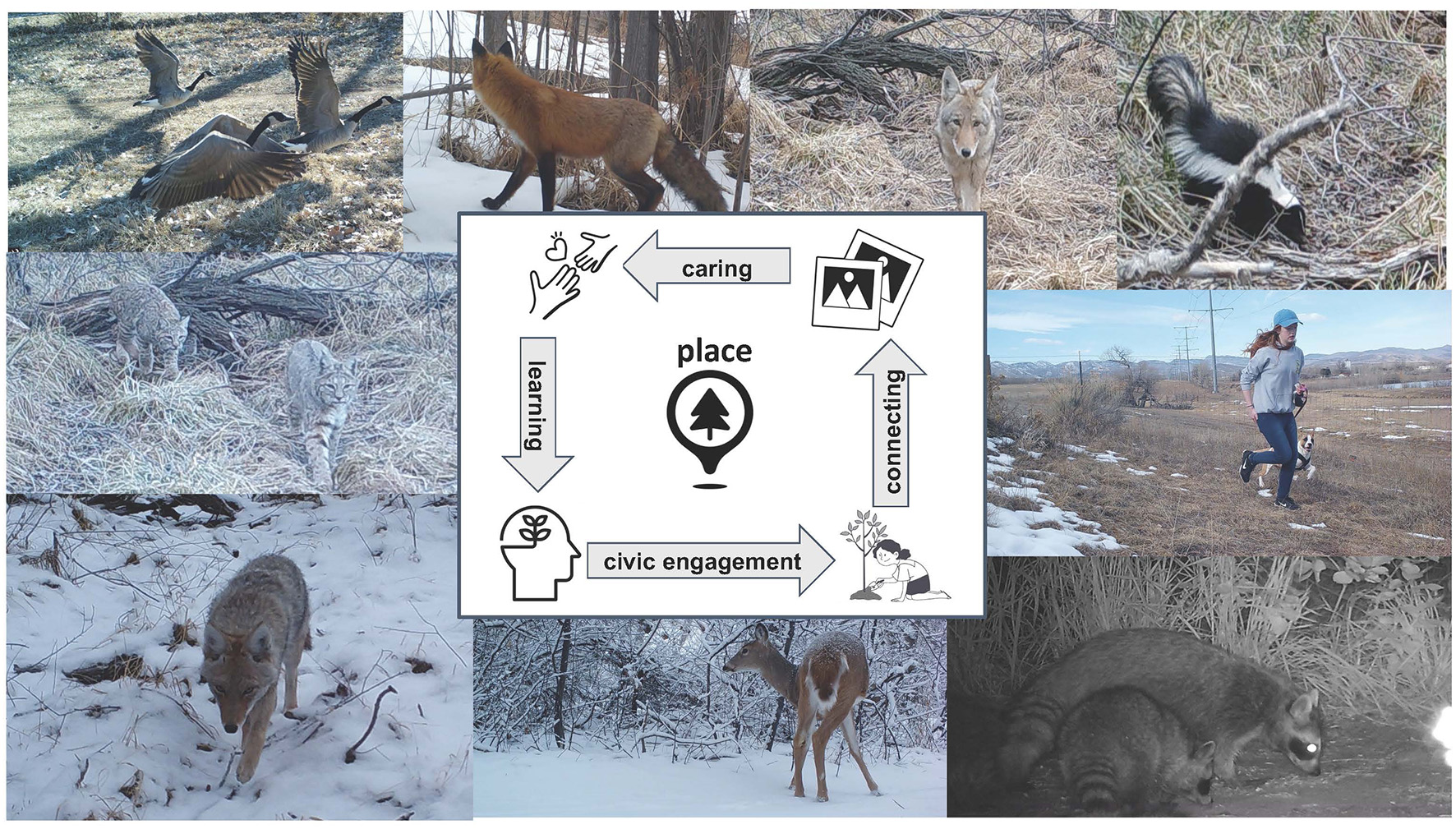
Camera trap photographs allow students to discover “hidden” wildlife, potentially prompting them to connect to, care for, and learn about their local place, often precursors for civic engagement. Images from camera traps were collected by middle school teachers and students in Poudre School District with support from Kevin Crooks.
Discussion
Visual imagery in PBE may be an impactful precursor of developing environmental literacy. Photographs provide details that may be missed in verbal or textual descriptions of natural systems, while eliciting emotions about a place (Rodriguez and Dimitrova, 2011; Brantner et al., 2013). Young (2021) argued that when people take or capture photographs, they become “visual citizens,” and when they share these images with their communities, they can promote collective action to conserve their environment. This is consistent with the goals of PBE: to increase students' understanding of the environment while encouraging them to act within their community (Figure 1).
Although we argue that camera trap photographs can help students discover the “hidden” biodiversity of their environment, we can only surmise that this discovery then prompts them to care about their socio-ecological world and feel motivated to learn more about species diversity and abundance, as well as trophic interactions. However, the relationship between connecting, caring, learning, and acting is well-known in environmental education (Ardoin et al., 2020). Therefore, we posit that these attributes can be fostered when individuals take time to see and understand their environments through photographs. Simply supplying teachers with cameras may not be enough. Teachers need support in learning how to set up the cameras, download the images from the memory cards, and sort through them to create a meaningful dataset for lessons. In our experience, teachers appreciated help from university wildlife biology students, scientists, and community conservation organizations (Wright et al., 2021). We found that teachers who demonstrated curricular agency and received initial support were more likely to teach using the wildlife photographs. The development of visual literacy may be a powerful component of developing environmental literacy that should be further examined if educators want to better equip global citizens to manage current and future environmental problems.
Funding
This paper was supported with funding from the Environmental Protection Agency Environmental Education Grant #NE-96882001-0 and the National Science Foundation Grants #1540794 and 1413925.
Publisher's Note
All claims expressed in this article are solely those of the authors and do not necessarily represent those of their affiliated organizations, or those of the publisher, the editors and the reviewers. Any product that may be evaluated in this article, or claim that may be made by its manufacturer, is not guaranteed or endorsed by the publisher.
Statements
Author contributions
All authors listed have made a substantial, direct, and intellectual contribution to the work and approved it for publication.
Acknowledgments
We are grateful to the educators who have used camera traps as part of our curriculum collaboration with them, allowing us to develop our ideas expressed in this essay.
Conflict of interest
The authors declare that the research was conducted in the absence of any commercial or financial relationships that could be construed as a potential conflict of interest.
References
1
AltinayZ. (2017). Visual communication of climate change: Local framing and place attachment. Coast. Manag.45, 293–309. 10.1080/08920753.2017.1327344
2
AltmanI.LowS. M. (1992). Place Attachment. New York: Plenum Press. 10.1007/978-1-4684-8753-4
3
AntonC. E.LawrenceC. (2014). Home is where the heart is: the effect of place of residence on place attachment and community participation. J. Environ. Psychol.40, 451–461. 10.1016/j.jenvp.2014.10.007
4
ArdoinN. M.BowersA. W.GaillardE. (2020). Environmental education outcomes for conservation: a systematic review. Biol. Conservat.241, 108224. 10.1016/j.biocon.2019.108224
5
BowersC. A. (2008). Why a critical pedagogy of place is an oxymoron. Environ. Educ. Res.14, 325–335. 10.1080/13504620802156470
6
BrantnerC.GeiseS.LobingerK. (2013). Fractured paradigm? Theories, concepts and methodology of visual framing research: A systematic review, in Paper Presented at the Annual Meeting of the International Communication Association (London: ICA).
7
ButaN.HollandS. M.KaplanidouK. (2014). Local communities and protected areas: the mediating role of place attachment for pro-environmental civic engagement. J. Outdoor Recreat. Tour.5, 1–10. 10.1016/j.jort.2014.01.001
8
BuxtonR. T.LendrumP. E.CrooksK. R.WittemyerG. (2018). Pairing camera traps and acoustic recorders to monitor the ecological impact of human disturbance. Global Ecol. Conservat.16, e00493. 10.1016/j.gecco.2018.e00493
9
CappelloM. (2005). Photo interviews: eliciting data through conversations with children. Field Methods17, 170–182. 10.1177/1525822X05274553
10
ChawlaL. (1992). Childhood place attachments, in Place Attachment. Boston, MA: Springer. p. 63–86. 10.1007/978-1-4684-8753-4_4
11
DallagoL.PerkinsD. D.SantinelloM.BoyceW.MolchoM.MorganA. (2009). Adolescent place attachment, social capital, and perceived safety: a comparison of 13 countries. Am. J. Community Psychol. 44, 148–160. 10.1007/s10464-009-9250-z
12
DresnerM.HandelmanC.BraunS.Rollwagen-BollensG. (2015). Environmental identity, pro-environmental behaviors, and civic engagement of volunteer stewards in portland area parks. Environ. Educ. Res.21, 991–1010. 10.1080/13504622.2014.964188
13
FangW. T. (2020). Envisioning Environmental Literacy. Singapore: Springer. 10.1007/978-981-15-7006-3
14
FreemanC.Latai NiusuluA.SchaafM.Taua'aT. S.TanieluH.ErglerC.et al. (2022). Identity, belonging and place attachment amongst pacific island children: a photographic analysis. Children's Geograph.1–16. 10.1080/14733285.2022.2039900
15
GruenewaldD. A. (2003). Foundations of place: a multidisciplinary framework for place-conscious education. Am. Educ. Res. J.40, 619–654. 10.3102/00028312040003619
16
GruenewaldD. A.SmithG. A. (2014). Place-Based Education in the Global Age: Local Diversity. New York, NY: Routledge.
17
HayR. (1998). Sense of place in a developmental context. J. Environ. Psychol. 18, 5–29. 10.1006/jevp.1997.0060
18
HufnagelE.KellyG. J.HendersonJ. A. (2018). How the environment is positioned in the next generation science standards: a critical discourse analysis. Environ. Educ. Res.24, 731–753. 10.1080/13504622.2017.1334876
19
KinslowA. T.SadlerT. D.NguyenH. T. (2019). Socio-scientific reasoning and environmental literacy in a field-based ecology class. Environ. Educ. Res.25, 388–410. 10.1080/13504622.2018.1442418
20
KudryavtsevA.KrasnyM. E.StedmanR. C. (2012). The impact of environmental education on sense of place among urban youth. Ecosphere.3, art29–15. 10.1890/ES11-00318.1
21
Lin HunterD. E.WrightD. S. (2019). Adventures along Colorado's front range with wildlife pics: increasing scientific literacy for diverse students. Rural Connections.139, 21–24.
22
McBethW.VolkT. L. (2009). The national environmental literacy project: a baseline study of niddle grade students in the United States. J. Environ. Educ.41, 55–67. 10.1080/00958960903210031
23
MonroeM. C.KrasnyM. E. (2016). Across the Spectrum: Resources for Environmental Education, 3rd Edn.Washington, DC: North American Association for Environmental Education.
24
MorganP. (2010). Towards a developmental theory of place attachment. J. Environ. Psychol.30, 11–22. 10.1016/j.jenvp.2009.07.001
25
O'ConnellA. F.NicholsJ. D.KaranthK. U. (2011). Camera Traps in Animal Ecology: Methods and Analyses. New York: Springer. 10.1007/978-4-431-99495-4
26
PeroffD. M.MoraisD. B.SeekampE.SillsE.WallaceT. (2020). Assessing residents' place attachment to the Guatemalan Maya landscape through mixed methods photo elicitation. J. Mixed Method. Res.14, 379–402. 10.1177/1558689819845800
27
PlutzerE.McCaffreyM.HannahA. L.RosenauJ.BerbecoM.ReidA. H. (2016). Climate Confusion among US Teachers. Science.351, 664–665. 10.1126/science.aab3907
28
ProshanskyH. M.FabianA. K.KaminoffR. (1983). Place identity: physical world socialisation of the self. J. Environ. Psychol.3, 57–83. 10.1016/S0272-4944(83)80021-8
29
RodriguezL.DimitrovaD. V. (2011). The levels of visual framing. J. Vis. Lit. 30, 48–65. 10.1080/23796529.2011.11674684
30
SemkenS.FreemanC. B. (2008). Sense of place in the practice and assessment of place-based science teaching. Sci. Educ.92, 1042–1057. 10.1002/sce.20279
31
SheppardS. R. (2005). Landscape visualisation and climate change: The potential for influencing perceptions and behaviour. Environ. Sci. Policy.8, 637–654. 10.1016/j.envsci.2005.08.002
32
SmithG. A. (2002). Place-based education: learning to be where we are. Phi Delta Kappan.83 (8): 584–594. 10.1177/003172170208300806
33
SobelD. (1990). A place in the world: adults' memories of childhood's special places. Child Environm. Q.6, 25–31.
34
StefaniakA.BilewiczM.LewickaM. (2017). The Merits of Teaching Local History: Increased Place Attachment Enhances Civic Engagement and Social Trust. J. Environ. Psychol.51, 217–225. 10.1016/j.jenvp.2017.03.014
35
WoodhouseJ. L.KnappC. E. (2000). Place-Based Curriculum and Instruction: Outdoor and Environmental Education Approaches. Charleston, WV: ERIC Digest.
36
WrightD. S.CrooksK. R.HunterD. O.KrummC. E.BalgopalM. M. (2021). Middle school science teachers' agency to implement place-based education curricula about local wildlife. Environ. Educ. Res.27, 1519–1537. 10.1080/13504622.2021.1960955
37
YoungS. (2021). Citizens of photography: visual activism, social media and rhetoric of collective action in Cambodia. South East Asia Res.29, 53–71. 10.1080/0967828X.2021.1885305
Summary
Keywords
photographs, place-based education, wildlife, environment, environmental literacy
Citation
Wright DS, Crooks KR and Balgopal MM (2022) Wildlife Photographs: Seeing, Caring, and Learning Through Place-Based Education. Front. Educ. 7:910324. doi: 10.3389/feduc.2022.910324
Received
01 April 2022
Accepted
17 June 2022
Published
13 July 2022
Volume
7 - 2022
Edited by
Vasilia Christidou, Aristotle University of Thessaloniki, Greece
Reviewed by
Irida Tsevreni, University of Thessaly, Greece; Pinelopi Papadopoulou, University of Western Macedonia, Greece
Updates
Copyright
© 2022 Wright, Crooks and Balgopal.
This is an open-access article distributed under the terms of the Creative Commons Attribution License (CC BY). The use, distribution or reproduction in other forums is permitted, provided the original author(s) and the copyright owner(s) are credited and that the original publication in this journal is cited, in accordance with accepted academic practice. No use, distribution or reproduction is permitted which does not comply with these terms.
*Correspondence: Meena M. Balgopal Meena.Balgopal@colostate.edu; orcid.org/0000-0002-3846-9256
This article was submitted to STEM Education, a section of the journal Frontiers in Education
Disclaimer
All claims expressed in this article are solely those of the authors and do not necessarily represent those of their affiliated organizations, or those of the publisher, the editors and the reviewers. Any product that may be evaluated in this article or claim that may be made by its manufacturer is not guaranteed or endorsed by the publisher.