Abstract
Entrepreneurship serves as a pivotal force for innovation and sustainable development. Today, its influence on wealth generation, job creation, and national economic growth is indisputable. Understanding the entrepreneurial profiles and capacities of future professionals has become a priority within both academic and business realms. While there is substantial research evidence highlighting the impact of entrepreneurship on the business sector, studies specifically examining university contexts worldwide are limited, particularly in developing nations. This study aimed to characterize the entrepreneurial capacity profile of university students in Ecuador, a developing country in South America. Drawing from a literature review, we developed an instrument adapted from the theory of planned behavior (TPB), incorporating personal attitude, subjective norms, and perceived behavioral control as determinants of entrepreneurial intention. This framework measures entrepreneurial capacity, integrating prominent entrepreneurial competencies identified in the literature as part of personal factors: problem-solving, creativity, financial management, leadership, negotiation, decision-making, self-confidence, and resilience. The instrument was administered to a sample of university students in Ecuador. Using statistical methods, we analyzed the relationships between demographics (age and gender), educational background (parents' education and occupation), the entrepreneurial ecosystem, and TPB factors-including personal attitude, subjective norms, and perceived behavioral control-on entrepreneurial intention. Key findings reveal that age, gender, parents' educational background, occupation, and the entrepreneurial ecosystem significantly influence the entrepreneurial intentions of university students. Within their entrepreneurial profiles, self-confidence, creativity, and decision-making skills emerged prominently, while financial management, negotiation, and problem-solving showed potential areas for development. These results offer valuable insights for updating academic programs to foster entrepreneurial intention in Ecuador and other developing countries. Theoretically, this study reinforces TPB as a foundational framework in entrepreneurship research, particularly underscoring the moderating role of sociodemographic variables such as age, gender, and educational level. Practically, it provides a quantitative measurement tool and a control variable for future studies aiming to identify entrepreneurial skills within regional contexts.
1 Introduction
Entrepreneurship has become a key driver for the economic development of nations (Crudu, 2019; Poveda et al., 2020; Paz Marcano et al., 2020; Saoula et al., 2023; Zamora Mayorga, 2021). Through this, companies are created, generating income and wealth (Zamora Mayorga, 2021), being crucial to job creation, associated with the ability to develop new products or services and to innovate (Crudu, 2019). In short, it is a crucial paradigm for improving the economic wellbeing of nations (Saoula et al., 2023). On the other hand, previous research has indicated that specific psychological characteristics motivate people to become entrepreneurs (Rosado-Cubero et al., 2022). As López-Núñez et al. (2021) describe, some researchers have studied the skills, attitudes, and traits that influence entrepreneurial initiative, standing out studies about entrepreneurial personality. In contrast, Boubker et al. (2021) confirm the presence of factors influencing the degree of entrepreneurial intention; only the modes of influence vary from one study to another. The theory of planned behavior (TPB) represents a relevant approach whose development has been significant in entrepreneurship literature to understand and explain that phenomenon (Sarmiento-Suárez et al., 2022; Ajzen, 2020; Bosnjak et al., 2020).
Higher education institutions (HEIs), as social transformers, must provide a favorable environment for their students to get involved in creating new companies (Olo et al., 2021; Lis, 2021). In this sense, studies on entrepreneurship and education have attempted to evaluate the impact of entrepreneurship on entrepreneurial intention as an essential outcome, especially among students (Aboobaker, 2020). As Tomy and Pardede (2020) remark, knowing students' entrepreneurial intentions is relevant to understanding how to foster entrepreneurship in universities.
In recent years, along with studying the entrepreneurial intention of different groups and collectives, entrepreneurship research also incorporates a gender perspective (Sánchez-Torné et al., 2021). As the study by Bullough et al. (2022) remarks, women play an important role in entrepreneurship worldwide. A better understanding of the interaction between gender, entrepreneurial self-efficacy, and entrepreneurial intention is key to improving the participation rate of women in entrepreneurial activities (Wilson et al., 2007).
Although entrepreneurship has received attention from academics and researchers, and there has been interest in its study and the factors that generate it, it has been little investigated and appreciated in the university context and with a quantitative approach. This research aims to characterize the profile of the entrepreneurship capacity of students from UNEMI (“UNiversidad Estatal de MIlagro”), a university in Ecuador, an in-developing country, considering notable aspects from the literature. Our study can be a starting point for Ecuador and other similar in-developing countries to eventually update their university education profile to effectively develop entrepreneurship capacity in their students in the current globally competitive world.
This article is structured as follows: after this introduction, Section 2 addresses the theoretical background of the theory of planned behavior, entrepreneurial self-efficacy, entrepreneurial intention, entrepreneurial capacity, and entrepreneurial profile. Then, Section 3 presents the methodology. Then, Section 4 describes the main results and their analysis. Hence, Section 5 ends with the conclusions and references.
2 Background
2.1 Theory of planned behavior
Research on entrepreneurial intention has attracted attention and interest from entrepreneurship. In that context, the theory of planned behavior (TPB) has been very popular (Tornikoski and Maalaoui, 2019). TBP is highly applied in the social and behavioral field (Ajzen, 2020) and has received extensive attention in health sciences, environmental sciences, business and management, and educational research (Bosnjak et al., 2020). As Poveda et al. (2020) highlight, PBT constitutes a model of great relevance within the literature on subjects' behavior.
PBT postulates that behavioral intentions immediately determine behaviors and, in certain circumstances, perceived behavioral control (Kan and Fabrigar, 2017). As the study by Taing and Chang (2021) explains, PBT provides a conceptual framework for addressing the complexities of human social behavior. It incorporates and redefines central concepts from the social and behavioral sciences, allowing the prediction and understanding of particular behaviors in specific contexts (Ajzen, 1991). According to this theory, human behavior is guided by three types of considerations: behavioral (beliefs about the probable consequences of behavior), normative (beliefs about the normative expectations of others), and control (beliefs about the presence of factors that can facilitate or impede the performance of the behavior) (Bosnjak et al., 2020). Figure 1 presents the model of the theory of planned behavior proposed by Ajzen (1991).
Figure 1
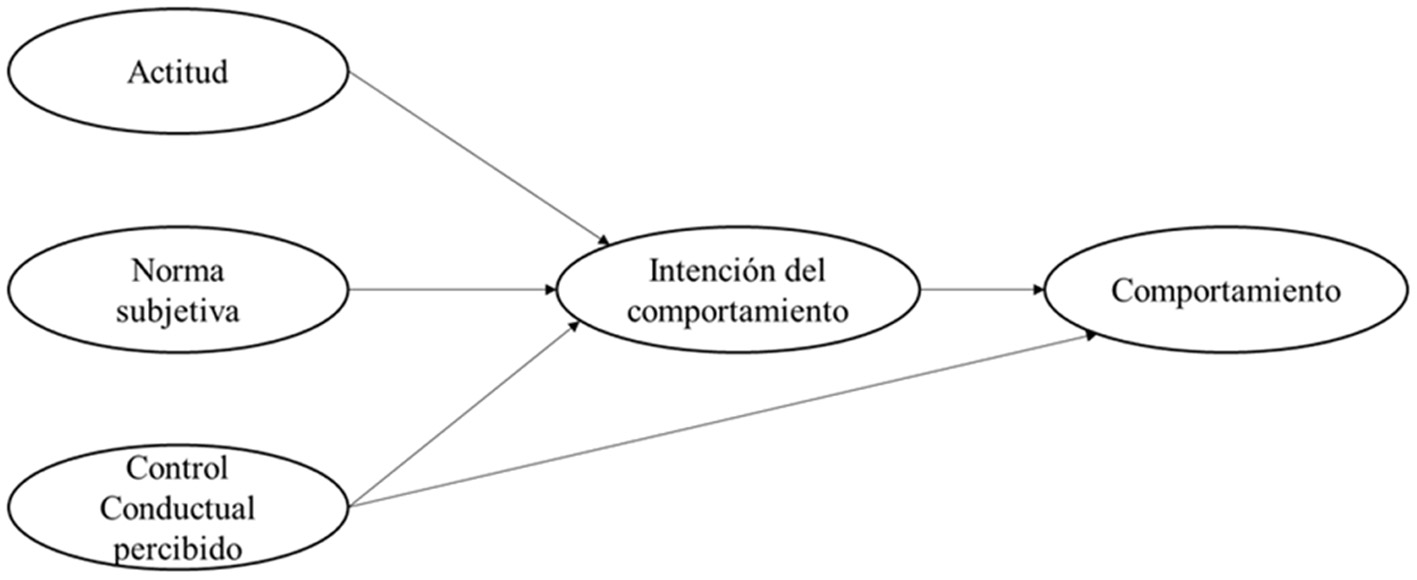
Model of the theory of planned behavior.
PBT offers a valuable framework for research in the social and behavioral sciences (Djafarova and Foots, 2022). As Hagger et al. (2022) remark, PBT has been applied extensively to predict, explain, and modify health behavior, and a current work in progress (Bosnjak et al., 2020). The current TPB formulation and existing results motivate us to engage in university students' behavior. However, the main motivation is to look for a strong control perception over the behavior (Ajzen, 2020). The TPB proposed by Ajzen (1991) is widely considered one of the most useful models to explain students' entrepreneurial intentions (Bularafa, 2022).
2.2 Entrepreneurial self-efficacy
Self-efficacy specifies individuals' beliefs about their abilities to execute planned behavior (Bandura et al., 1999). Self-efficacy is linked to a person's psychological development and skills to achieve goals or objectives (Farhat, 2020). As Maitlo et al. (2020) explain, self-efficacy is an essential attribute that entrepreneurs possess because it helps them translate uncertain business environments into opportunities.
Entrepreneurial self-efficacy (ESE) arises from the broader concept of self-efficacy rooted in social cognitive theory, which highlights the role of social context, observation, and reproduction of behavior in social learning for developing self-efficacy beliefs (Newman et al., 2019). ESE has been considered vital to entrepreneurship and related to entrepreneurial intention, gender, and entrepreneurship education (Valencia-Arias and Marulanda-Valencia, 2019). ESE has been considered an antecedent of the intention to create a new company (Bacq and Alt, 2018) and a direct impact on the entrepreneurial intention (Elnadi and Gheith, 2021).
As Boyd and Vozikis (1994) emphasize, ESE refers to the strength of an individual's belief and ability to perform the role related to entrepreneurial success. The study by Chen et al. (1998) gives confidence in the abilities of ESE to perform the tasks and roles of an entrepreneur successfully. Similarly Wang and Huang (2019), regarding ESE and attended people, mention confidence in their abilities playing a determining role in shaping entrepreneurial intentions.
2.3 Entrepreneurial intention
Entrepreneurial intention is a mental state in which people favor creating a new company or creating value within existing organizations (Garćıa-Uceda and Aśın, 2022). As Newman et al. (2019) accentuate, entrepreneurial intention is the most widely studied outcome of entrepreneurial self-efficacy. Hence, entrepreneurial intention constitutes an important topic in the theory of entrepreneurship, which has been widely researched (Phuong et al., 2020).
Entrepreneurial intention is the conscious state of mind that precedes action and directs attention toward entrepreneurial behaviors, such as starting a new business and becoming an entrepreneur (Moriano et al., 2012). Entrepreneurial intention is the will to start an entrepreneurial activity (Nguyen, 2017) and reflects a state of mind that people prefer self-employment instead of being employees (Phuong et al., 2020). Entrepreneurial intention is the state of mind that directs and guides the entrepreneur's actions toward the development and implementation of the business concept (Boyd and Vozikis, 1994); a personal decision formed by individuals after considering the perceived desirability and perceived feasibility of a particular business opportunity (Douglas, 2020). In summary, entrepreneurial intention is an important factor in encouraging entrepreneurial behavior (Mustofa and Setiawan, 2022).
2.4 Entrepreneurial capacity & profile
Entrepreneurial capacity is the ability to start and operate a successful business expressed in terms of entrepreneurial intention and entrepreneurial self-efficacy (Oyeku et al., 2014). Entrepreneurial capacity is the experience of transforming scientific knowledge into a commercial product or service to be sold in the market (Afzal et al., 2018). Considering its main components, entrepreneurial capacity includes organizational, strategic, innovation, and learning skills (Salamzadeh et al., 2023).
According to Hindle (2007), entrepreneurial capacity constitutes the ability to evaluate the economic potential latent in a selected element of new knowledge and to design ways to transform that potential into realizable economic value for intended stakeholders. It is the skill that helps seize opportunities, allows leading a team, and permits creating value to achieve business objectives successfully (Hu et al., 2022).
The profile of an entrepreneur refers to the characteristics, traits, qualities, and attributes of an entrepreneur (Shuaibu et al., 2021). These entrepreneurial skills can be classified as soft skills due to their intrinsic and intangible nature (Lozano et al., 2023). Individual capabilities are considered in terms of knowledge, experiences, skills, tools, attitudes, and values aimed at achieving professional development and entrepreneurial goals (Mart́ınez-Mart́ınez and Ventura, 2020). They are typically perceived as traits, not capabilities, that can be learned (Garćıa-Uceda and Aśın, 2022).
Rodriguez Lopez and Borges Gomez (2018) present six traits that define the entrepreneur's profile: originality; proactivity and assumption of risks, resilience; time and energy management; freedom of action; and image creation. Similarly, Saavedra et al. (2021) present achievement motivation, autonomy, innovation, internal locus of control, self-efficacy, optimism, and stress tolerance as relevant concepts for entrepreneurial capacity development in Peruvian students. For Quispe Fernandez et al. (2022), the entrepreneurial skills that students must develop are motivation, creativity, leadership, decision-making, and critical thinking. Chávez Moreno (2020) consider leadership, creativity, teamwork, and communication as relevant skills for developing entrepreneurial capacity. Table 1 summarizes these competencies with their definition and authors who apply them in their research.
Table 1
| Competence | Definition | Source |
|---|---|---|
| Problem resolution | Ability to analyze problems, generate, and select alternatives to maximize benefit | Andrade-Adaime et al., 2022 |
| Creativity | Ability to generate novel and useful ideas and solutions | Quispe Fernandez et al., 2022; Chávez Moreno, 2020; Il Sung Park and Duarte Masi, 2015; Paz Marcano et al., 2020; Andrade-Adaime et al., 2022; Gómez Miranda, 2023 |
| Financial administration | Ability to analyze, organize, and present financial data | |
| Leadership | Ability to guide the team on a specific path, inspiring values and anticipating scenarios | Quispe Fernandez et al., 2022; Chávez Moreno, 2020; Paz Marcano et al., 2020; Shuaibu et al., 2021 |
| Bargaining power | Ability to create collaborative environments and achieve commitments | Gómez Miranda, 2023 |
| Decision-making | Ability to choose a course of action among alternatives based on knowledge of the organizational context | Quispe Fernandez et al., 2022; Andrade-Adaime et al., 2022 |
| Self-confidence | The belief that you are capable of completing a task or choosing the right approach to solving a problem | Lozano et al., 2023; Paz Marcano et al., 2020; Shuaibu et al., 2021 |
| Resilience | Ability to recover from adversity and learn from it | Rodriguez Lopez and Borges Gomez, 2018 |
Attitudinal entrepreneurial skills.
Based on the reviewed literature in the current study, key factors are analyzed to characterize the entrepreneurial profile of university students at an Ecuadorian University. This leads to the formulation of the following research hypotheses.
H1: There is a relationship between demographic characteristics and students' entrepreneurial intention.
H2: There is a relationship between educational factors and students' entrepreneurial intention.
H3: There is a relationship between the entrepreneurial ecosystem and students' entrepreneurial intention.
3 Methods
This research aimed to characterize the entrepreneurial profile of students at a public university in Ecuador. This would update courses and classes to facilitate decision-making in curricular and teaching-learning strategies and, therefore, global university management. This study could also be applied to other universities in countries like Ecuador to characterize university students' current entrepreneurial capacity.
The research approach is quantitative based on data obtained through a questionnaire. The methodological design is non-experimental as it does not intentionally manipulate the variables. The study design is cross-sectional and correlational. A questionnaire was designed and applied to university students to collect data through the online modality.
3.1 Instrument design
The instrument used to collect the information, the “Entrepreneurial Profile of the University Student” questionnaire, consists of four parts: (1) Demographic characteristics, (2) Entrepreneurship scale, (3) variables for validation, and (4) Entrepreneurial competencies. The first part includes variables such as age, gender, major, venture experience (if you have had a venture), closeness with an entrepreneur (if you know an entrepreneur), and if you currently work or have worked before. These variables would help identify patterns in the behavior of students concerning entrepreneurship. The second part is the entrepreneurship scale, which consists of 20 variables derived from the four dimensions: personal attitude, subjective norm, perceived behavioral control, and entrepreneurial intention. In the third part of the questionnaire, two questions were included: one about self-perception as a future entrepreneur and another about preparation within the university in this role. Both questions would be used for statistical hypothesis testing and measuring the scale used. In the fourth part, the most prominent entrepreneurial competencies in the literature are considered members of personal factors: problem-solving, creativity, financial management, leadership, negotiation skills, decision-making, self-confidence, and resilience for evaluation by each student surveyed.
3.1.1 Demographic characteristics
Garćıa-Uceda and Aśın (2022), based on the approach of Herman and Stefanescu (2017), distinguish within the determinants of entrepreneurial intention, the personal factors that include demographic characteristics, such as age and gender that part 1 of the instrument include, and the personality traits included in part 4 as entrepreneurial competencies. As Arias Vargas et al. (2021) distinguish, sociodemographic factors such as gender, age, education, family environment, role models, and interaction with successful people mainly favor the entrepreneurial activity of young people.
Sociodemographic characteristics statistically affect the probability of creating a new venture (León Mendoza, 2017). A frequently analyzed factor is the level of education of the entrepreneurs (Contreras-Barraza et al., 2021). According to (Saucedo Estrada, 2018), the educational level is one of the variables that influence the intention to start a business; that is, the higher the educational level is, the higher the rate of entrepreneurial activity.
Based on the proposals of different authors, our questionnaire considers the following variables: gender (Arias Vargas et al., 2021; León Mendoza, 2017; Sánchez-Torné et al., 2021; Sarmiento-Suárez et al., 2022; Saucedo Estrada, 2018; Valencia-Arias and Marulanda-Valencia, 2019; Vamvaka et al., 2020), age (Arias Vargas et al., 2021; León Mendoza, 2017; Saavedra et al., 2021; Sarmiento-Suárez et al., 2022), educational level (Arias Vargas et al., 2021; Saucedo Estrada, 2018), level of education of the parents (Saavedra et al., 2021), occupation of the parents (Saavedra et al., 2021; Sarmiento-Suárez et al., 2022), employment status (León Mendoza, 2017), previous entrepreneurial experience, and entrepreneurial environment (Saavedra et al., 2021; Sarmiento-Suárez et al., 2022; Saucedo Estrada, 2018).
The entrepreneurship scale, in part 2, is based on the proposals of Liñán and Chen (2009) and Kolvereid (1996), which, in turn, is based on the theory of planned behavior (Ajzen, 1985, 1991, 2011, 2020), scientifically proven and starting point for the development of entrepreneurship studies worldwide (Abad-Segura and González-Zamar, 2019). TPB represents a referential framework to understand entrepreneurial intention (Sarmiento-Suárez et al., 2022), and it has been widely used in the study of entrepreneurial intention in students (Valenzuela-Keller et al., 2021).
According to the results of the systematic literature review carried out by Regnault et al. (2022), most of the measurement instruments used in the reported research are based on the Entrepreneurial Intention Questionnaire (EIQ) by Liñán and Chen (2009) and on the “Attitude and Self-Employment scale Intentions” by Kolvereid (1996). Table 2 presents the four dimensions that characterize the entrepreneurship profile: (1) personal attitude, the degree to which the individual has a positive or negative personal assessment about being an entrepreneur, with five variables; (2) subjective norm, the perception that the individual has that his “reference people” would approve or not his decision to undertake, with three variables; (3) perceived behavioral control, an individual's perception of the ease or difficulty of becoming an entrepreneur, with six variables; and (4) entrepreneurial intention, the effort that an individual would make to carry out that entrepreneurial behavior, with six variables.
Table 2
| Dimension | Variables |
|---|---|
| Personal attitude | Being an entrepreneur would imply more advantages than disadvantages. A professional major as an entrepreneur is attractive to me. If I had the opportunity and resources, I would like to start my own business. Being an entrepreneur would give me great satisfaction. Among several options, I prefer to be an entrepreneur. |
| Subjective norm | My family would approve of my decision to start a business. My friends think I should become an entrepreneur. People whose opinion I value would approve of my decision to start a business. |
| Perceived behavioral control | Starting a company and keeping it running would be easy for me. I am ready to start a new business. I feel able to control the process of creating a new business. I know the nuts and bolts of starting a business. It would be very easy for me to develop an entrepreneurial project. If you tried to start a business, you would have a very good chance of success. |
| Entrepreneurial Intention | I am willing to do anything to be an entrepreneur. My professional goal is to become an entrepreneur. I will do my best to start and run my own company. I am determined to create a company in the future. I have thought very seriously about starting a company. I have the firm intention of starting a company one day. |
Dimensions of entrepreneurship.
3.1.2 Analysis of data
The data analysis used appropriate statistical tests according to the proposed hypothesis. In addition to the tools for descriptive analysis, this study used means comparison tests, t-tests, and variance analysis, among other inferential analysis methods. For each test, preliminary analyses were conducted to verify assumptions, including independence (runs test), normality (Kolmogorov–Smirnov test), and homogeneity of variance (Levene's test), as applicable.
This research aimed to characterize the entrepreneurial profile of students at a public university in Ecuador. This would facilitate decision-making in the design of curricular and teaching-learning strategies and, therefore, university management on a global scale. The research approach is quantitative, based on data obtained through a questionnaire. The methodological design is non-experimental, as it does not intentionally manipulate the variables. The study design is cross-sectional and correlational.
The target population of the study was students from the State University of Milagro (UNEMI), encompassing all 24 provinces of Ecuador. These students were enrolled in undergraduate programs during the May–September 2022 academic period, totaling 39,524, as reported in the Institutional Management Report 2022 by the Universidad Estatal de Milagro, Ecuador (Universidad Estatal de Milagro, Ecuador, 2023). For data collection, a questionnaire was developed and distributed to university students via an online platform integrated into the institution's academic management system, resulting in 2,640 valid responses. This sample included students from all faculties, programs, and academic levels, capturing the demographic and academic diversity of the student population and ensuring balanced representation across various segments.
With 2,640 responses, the sampling error rate was calculated at 1.84% for a 95% confidence level, assuming p = q = 0.5, which is sufficiently low for statistical analysis. Table 3 presents the study's technical details, including the universe or population, geographic and temporal scope, sampling unit, sample size, sampling error, and confidence level.
Table 3
| Characteristics | Survey |
|---|---|
| Target universe or population | Students of the State University of Milagro |
| Sampling units | Students |
| Sample size | 2,640 |
| Sampling error/confidence level | 1.84% / 95% |
| Surveyed | Undergraduate |
Technical data of the study.
3.2 Content validity and reliability of the scale
Validity represents the extent to which a research effort accurately measures its designated factors (Adeyemi, 2024). Content validity, as one form of validity, reflects the degree to which each item on a scale measures the phenomenon of interest and its dimension within the proposed investigation (Matos et al., 2020). It is often considered a rational judgment rather than a numerical evaluation (Ozsahin et al., 2022). For content validity, as outlined by Zhang et al. (2008), a comprehensive literature review is essential to understand the definitions of the constructs of interest and to ensure a complete list of components is identified by established guidelines.
The scale used to measure Entrepreneurial Intention is adapted from the frameworks proposed by Liñán and Chen (2009) and Kolvereid (1996), based on the theory of planned behavior, ensuring its theoretical foundation and alignment of each item with the relevant theories. Furthermore, different researchers have widely utilized the scale, providing evidence of its content validity.
Reliability refers to the degree to which an instrument yields consistent and coherent results (Hernández-Sampieri et al., 2014), and one method of evaluating reliability is through internal consistency analysis. Cronbach's alpha is among the most commonly used statistics to assess the reliability of scales in educational science research (Ozsahin et al., 2022; Taber, 2018).
The Cronbach's alpha for the scale yielded a value of α = 0.942. This value is considered excellent (Adeyemi, 2024), affirming that the scale is reliable for measuring entrepreneurial intention.
4 Results
4.1 Descriptive analysis
According to the characteristics of the university students, four age groups were classified: those under 20, those from 20 to 25, those from 25 to 30, and those over 30 years old, respectively. From the 2,640 students surveyed, approximately 17% are under 20 years old, 32% are between 20 and 25 years old, 19% are between 25 and 30 years old, and 32% are over 30 years old. Regarding gender, two options were taken into account: feminine and masculine. More than 70% of the respondents are women, which shows their predominance in the group of respondents.
Regarding the parents' educational level, only 13% of the fathers and 14% of the mothers are professionals. 11% of the fathers and 10% of the mothers of the students surveyed are self-employed or business owners. Remarkably, a high percentage, 40% of mothers and 20% of fathers are unemployed.
Approximately 44% of the students who participated in the study have had a business; the majority, 82%, personally know an entrepreneur; and more than 75%, three out of every four students, have worked or are working. Table 4 summarizes the classification of the students surveyed by their demographic characteristics, educational factors, and entrepreneurship background.
Table 4
| Description | Frequency | Percentage |
|---|---|---|
| Gender | ||
| Women | 1912 | 72.4 |
| Men | 728 | 27.6 |
| Age (years) | ||
| 20 years | 446 | 16.9 |
| From 20 to 25 years | 844 | 32.0 |
| From 25 to 30 years | 507 | 19.2 |
| 30 years | 843 | 31.9 |
| Semester | ||
| 1 | 40 | 1.52 |
| 2 | 422 | 15.98 |
| 3 | 569 | 21.55 |
| 4 | 479 | 18.14 |
| 5 | 506 | 19.17 |
| 6 | 245 | 9.28 |
| 7 | 273 | 10.34 |
| 8 | 102 | 3.86 |
| 9 | 3 | 0.11 |
| 10 | 1 | 0.04 |
| Father's educational level | ||
| Primary | 1,116 | 42.3 |
| Secondary | 1,048 | 39.7 |
| Professional | 3.4. 5 | 13.0 |
| Others | 131 | 5.0 |
| Mother's educational level | ||
| Primary | 1,034 | 39.1 |
| Secondary | 1,137 | 42.3 |
| Professional | 369 | 14.0 |
| Others | 120 | 4.6 |
| Father's occupation | ||
| Public sector | 311 | 11.8 |
| Private sector | 338 | 12.8 |
| Self-employed employee or businessman | 294 | 11.1 |
| Retired | 288 | 10.9 |
| Unemployed | 533 | 20.2 |
| Others | 876 | 33.2 |
| Mother's occupation | ||
| Public sector | 202 | 7.7 |
| Private sector | 192 | 7.3 |
| Self-employed employee or businessman | 270 | 10.2 |
| Retired | 88 | 3.3 |
| Unemployed | 1,059 | 40.1 |
| Others | 829 | 31.4 |
| Has had a business | ||
| Yeah | 1,168 | 44.2 |
| No | 1,472 | 55.8 |
| Meet an entrepreneur | ||
| Yeah | 2,165 | 82.0 |
| No | 475 | 18.0 |
| Work or have worked | ||
| Yeah | 2,020 | 76.5 |
| No | 620 | 23.5 |
Demographic characteristics of the sample.
The study used a Likert scale to measure the entrepreneurship profile of the university students studied, ranging from 1 to 5, where 1 represents a state of complete disagreement and 5 completely agree. Table 5 presents the criteria and results for the location of the global profile.
Table 5
| 1 | 2 | 3 | 4 | 5 |
|---|---|---|---|---|
| 0%–12.5% | 12.5%–37.5% | 37.5%–62.5% | 62.5%–87.5% | 87.5%–100% |
| Very low | Low | Acceptable | Good | Very good |
Criteria for defining the global entrepreneurship profile.
From the data of the 2,640 respondents, an average value of 3.82 was obtained, representing 70.6%, which, according to the criteria in Table 6, is a “GOOD” Entrepreneurship Level. Among the best-valued variables are, “If I had the opportunity and resources, I would like to start my own business” with the highest of 4.48, which represents 87% of the scale, without reaching “VERY GOOD;” “My family would approve of my decision to start a business” with 4.33; and “Being an entrepreneur would give me great satisfaction” with 4.27. The intrinsic factors of motivation, which have to do with the entrepreneurial attitude of the university student, are highlighted.
Table 6
| Problem resolution | Financial administration | Bargaining power | Self-confidence | Creativity | Leadership | Decision making | Resilience | |
|---|---|---|---|---|---|---|---|---|
| Half | 3.83 | 3.54 | 3.70 | 4,166 | 4,162 | 4,154 | 4,158 | 4,019 |
| Std. dev | 1.05 | 1.12 | 1.11 | 1.06 | 1.00 | 1.03 | 1.00 | 1.04 |
Entrepreneurial skills of the UNEMI student.
The worst-valued variables on the scale are, “I know the practical details necessary to start a company” with 3.27, which represents 57%; “It would be very easy for me to develop an entrepreneurial project” with 3.28; and, “Starting a business and keeping it running would be easy for me” with 3.43. In this group of the worst-rated variables, their extrinsic nature stands out as they depend on the student's environment, not their attitude.
Similarly, the results of the assessment of entrepreneurial skills presented in Table 6 show that the UNEMI student perceives himself as having self-confidence, creativity, and decision-making skills. On the other hand, it has a low rating in financial skills, negotiation skills, and problem-solving.
4.2 Inferential analysis
This section evaluates the previously stated hypotheses using the appropriate statistical tests.
H1: When comparing the means of each age group–under 20, 20 to 25, 25 to 30, and over 30–significant differences are observed among them, as shown by the Analysis of Variance (ANOVA) results in Table 7. Prior assessments of the assumptions confirmed independence (runs test, p < 0.009), normality (Kolmogorov–Smirnov test, KS = 0.140, p < 0.010), and homogeneity of variances (Levene's test, W = 6.302, p < 0.001), all significant at the 5% level. Therefore, it is evident that the age group to which the student belongs influences their entrepreneurial intention. Therefore, it is evident that the age group to which the student belongs determines their entrepreneurial intention. Significant differences are evident regarding gender, as shown in Table 8.
Wilson et al. (2007) found strong gender effects on entrepreneurial self-efficacy and intentions, supporting previous research on self-efficacy differences in those career areas that appear to reflect gender-based role expectations.
H2: Regarding the educational factors, the results of Table 9 show that there is no significant difference between the semesters that the students take, which contrasts with Laguia et al. (2017) point out that the educational level is one of the variables that influence the intention to undertake, in such a way that the higher the academic level, the higher the rate of entrepreneurial activity. Concerning the training of the parents, Table 10 highlights that the father's occupation does not significantly impact the student's entrepreneurial intention at 5%. If a 1% significance level was considered, only the mother's education would determine entrepreneurial intention. All assumptions of tests of independence, normality, and homogeneity of variances were verified in advance, with results significant at the 5% level.
H3: Most authors point out that an environment for entrepreneurship for the individual determines entrepreneurial intention. In the case of UNEMI students, the statistical tests, (Table 11) support this theory, finding significant differences between those who have had a business or not, know an entrepreneur or not, and whether they work.
Table 7
| Source of variation | Sum of squares | Degrees of freedom | Mean square | F | p-value |
|---|---|---|---|---|---|
| Age group | 92.46 | 3 | 30.82 | 28.31 | 0.0001 |
| Mistake | 2,970.16 | 2,636 | 1.09 | ||
| Total | 2,015.002 | 2,639 |
Variance analysis of entrepreneurial intention according to age.
Table 8
| Entrepreneurial Intention (average) | N | t | Next. | ||
|---|---|---|---|---|---|
| Gender | Women | 3.80 | 1912 | 4.76 | 0.01 |
| Men | 4.02 | 728 |
Statistical tests between entrepreneurial intention according to gender.
Table 9
| Source of variation | Sum of squares | Degrees of freedom | Mean square | F | p-value |
|---|---|---|---|---|---|
| Semester | 6.84 | 8 | 8.55 | 7.61 | 0.613 |
| Mistake | 2,952.92 | 2,630 | 1.12 | ||
| Total | 2,959.76 | 2,638 |
Variance analysis.
Entrepreneurial Intention according to the semester being studied.
Table 10
| Source of variation | Sum of squares | Degrees of freedom | Mean square | F | p-value |
|---|---|---|---|---|---|
| Father Training | 11.34 | 3 | 3.78 | 3.38 | 0.018 |
| Mistake | 2,951.28 | 2,636 | 1.12 | ||
| Total | 2,962.62 | 2,639 | |||
| Mother Training | 21.59 | 3 | 7.20 | 6.45 | 0.001 |
| Mistake | 2,941.03 | 2,636 | 1.12 | ||
| Total | 2,962.62 | 2,639 | |||
| Father's Occupation | 3.05 | 5 | 0.61 | 0.54 | 0.744 |
| Mistake | 2,959.57 | 2,634 | 1.12 | ||
| Total | 2,962.62 | 2,639 | |||
| Mistake | 2,949.32 | 2,634 | |||
| Total | 2,962.62 | 2,639 |
Variance analysis.
Entrepreneurial Intention according to parental training or occupation.
Table 11
| Entrepreneurial Intention (average) | N | t | Next. | ||
|---|---|---|---|---|---|
| Has had a business | Yeah | 4.04 | 1,168 | 8.18 | 0.01 |
| No | 3.71 | 1,472 | |||
| Meet an entrepreneur | Yeah | 3.92 | 2,165 | 5.9 | 0.01 |
| No | 3.60 | 475 | |||
| Work or have worked | Yeah | 3.95 | 2020 | 8.16 | 0.01 |
| No | 3.56 | 620 |
Statistical tests between entrepreneurial intention vs entrepreneurial environment.
For all tests carried out, equality of variances has been assumed, based on the respective Levene equality of variances tests, all significant at 5%.
5 Conclusion
Entrepreneurship influences the development of nations, so support for education in this field represents a strategy that should be part of university policies. This study characterized the profile of the UNEMI student, which can be used to design effective policies and action plans.
The UNEMI student is at a good level to start entrepreneurial activities. The results support the impact of age and gender, parental training and occupation, and the existence of an entrepreneurial ecosystem on students' entrepreneurial intentions. However, the semester the student is in, and his or her father's occupation does not have a significant impact.
The scale to measure the entrepreneurship profile, which includes personal attitude, subjective norms, and perceived behavioral control, determines the entrepreneurial intention of the UNEMI student. The entrepreneurial skills that are most valued among UNEMI students are self-confidence, creativity, and decision-making, and those that are least valued are financial skills, negotiation skills, and problem-solving. The latter represents an opportunity to prioritize entrepreneurship training initiatives.
This research is a pioneer in Ecuador and Latin America. The reported experiment and results from UNEMI, a current 100% online university in Ecuador, are perfectly replicable in other universities in Ecuador and other developing countries to measure the entrepreneurship profile of their students and update their study programs if necessary.
Statements
Data availability statement
The datasets presented in this study can be found in online repositories. The names of the repository/repositories and accession number(s) can be found in the article/supplementary material.
Ethics statement
Approval was obtained from the Universidad Estatal de Milagro. The procedures used in this study adhere to the tenets of the Declaration of Helsinki.
Author contributions
MD: Writing – original draft, Writing – review & editing. AM: Conceptualization, Data curation, Formal analysis, Funding acquisition, Investigation, Methodology, Project administration, Resources, Software, Supervision, Validation, Visualization, Writing – original draft, Writing – review & editing. PN: Conceptualization, Data curation, Formal analysis, Funding acquisition, Investigation, Methodology, Project administration, Resources, Software, Supervision, Validation, Visualization, Writing – original draft, Writing – review & editing. LF: Conceptualization, Data curation, Formal analysis, Funding acquisition, Investigation, Methodology, Project administration, Resources, Software, Supervision, Validation, Visualization, Writing – original draft, Writing – review & editing. WÁ: Conceptualization, Data curation, Formal analysis, Funding acquisition, Investigation, Methodology, Project administration, Resources, Software, Supervision, Validation, Visualization, Writing – original draft, Writing – review & editing. CV-S: Writing – original draft, Writing – review & editing.
Funding
The author(s) declare financial support was received for the research, authorship, and/or publication of this article. The authors declare that financial support was received from the Office of Research and Graduate Studies at Universidad Estatal de Milagro for the publication of this article.
Acknowledgments
To the State University of Milagro, UNEMI, Ecuador, for funding the research project “Characterization of the profile of the entrepreneurship capacity of students at the State University of Milagro, UNEMI, Ecuador.”
Conflict of interest
The authors declare that the research was conducted in the absence of any commercial or financial relationships that could be construed as a potential conflict of interest.
Publisher’s note
All claims expressed in this article are solely those of the authors and do not necessarily represent those of their affiliated organizations, or those of the publisher, the editors and the reviewers. Any product that may be evaluated in this article, or claim that may be made by its manufacturer, is not guaranteed or endorsed by the publisher.
References
1
Abad-SeguraE.González-ZamarM.-D. (2019). Effects of financial education and financial literacy on creative entrepreneurship: a worldwide research. Educ. Sci. 9:238. 10.3390/educsci9030238
2
AboobakerN. (2020). Human capital and entrepreneurial intentions: do entrepreneurship education and training provided by universities add value?Horizon28, 73–83. 10.1108/OTH-11-2019-0077
3
AdeyemiB. (2024). “Reliability and validity in quantitative research,” in Applied Linguistics and Language Education Research Methods: Fundamentals and Innovations, ed. H. P. Bui (IGI Global), 86–102. 10.4018/979-8-3693-2603-9.ch007
4
AfzalM. N. I.MansurK.ManniU. H. (2018). Entrepreneurial capability (ec) environment in asean-05 emerging economies: an empirical approach. Asia Pacific J. Innov. Entrepr. 12, 206–221. 10.1108/APJIE-01-2018-0002
5
AjzenI. (1985). “From intentions to actions: a theory of planned behavior,” in Action Control: From Cognition to Behavior (Springer), 11–39. 10.1007/978-3-642-69746-3_2
6
AjzenI. (1991). The theory of planned behavior. Organ. Behav. Hum. Dec. Proc. 50, 179–211. 10.1016/0749-5978(91)90020-T
7
AjzenI. (2011). The theory of planned behaviour: Reactions and reflections. Psychol. Health26, 1113–1127. 10.1080/08870446.2011.613995
8
AjzenI. (2020). The theory of planned behavior: Frequently asked questions. Hum. Behav. Emer. Technol. 2, 314–324. 10.1002/hbe2.195
9
Andrade-AdaimeM. C.Pardo-RozoY. Y.Marlés-BetancourtC. (2022). Desarrollo de competencias en emprendimiento en estudiantes de la universidad de la amazonia (2019–2020). I+ D Rev. Invest. 17, 131–140. 10.33304/revinv.v17n2-2022009
10
Arias VargasF.Ribes-GinerG.Garces GiraldoL.BoteroD. (2021). Factores sociodemográficos que inciden en el emprendimiento rural de jóvenes en antioquia. Rev. Venez. Geren. 26, 1218–1240. 10.52080/rvgluz.26.96.14
11
BacqS.AltE. (2018). Feeling capable and valued: a prosocial perspective on the link between empathy and social entrepreneurial intentions. J. Bus. Ventur. 33, 333–350. 10.1016/j.jbusvent.2018.01.004
12
BanduraA.FreemanW. H.LightseyR. (1999). Self-efficacy: the exercise of control. J. Cogn. Psychother. 13, 158–166. 10.1891/0889-8391.13.2.158
13
BosnjakM.AjzenI.SchmidtP. (2020). The theory of planned behavior: selected recent advances and applications. Europe's J. Psychol. 16:352. 10.5964/ejop.v16i3.3107
14
BoubkerO.DouayriK.AatarA.RharzouzJ. (2021). Determinantes de la intención emprendedora de las mujeres marroquíes. Rev. Venez. Geren. 26, 520–538. 10.52080/rvgluz.26.e6.32
15
BoydN. G.VozikisG. S. (1994). The influence of self-efficacy on the development of entrepreneurial intentions and actions. Entrepr. Theory Pract. 18, 63–77. 10.1177/104225879401800404
16
BularafaB. A. (2022). Moderating role of entrepreneurship education on personality traits and entrepreneurial intention of undergraduate students. Int. J. Intell. Disc. 5, 35–50.
17
BulloughA.GuelichU.ManolovaT. S.SchjoedtL. (2022). Women's entrepreneurship and culture: gender role expectations and identities, societal culture, and the entrepreneurial environment. Small Bus. Econ. 58, 985–996. 10.1007/s11187-020-00429-6
18
Chávez MorenoE. A. (2020). Comparative analysis among uabc students of entrepreneurial skills. RIDE10:e031. 10.23913/ride.v10i20.646
19
ChenC. C.GreeneP. G.CrickA. (1998). Does entrepreneurial self-efficacy distinguish entrepreneurs from managers?J. Bus. Ventur. 13, 295–316. 10.1016/S0883-9026(97)00029-3
20
Contreras-BarrazaN.Espinosa-CristiaJ. F.Salazar-SepulvedaG.Vega-MuñozA. (2021). Entrepreneurial intention: a gender study in business and economics students from Chile. Sustainability13:4693. 10.3390/su13094693
21
CruduR. (2019). The role of innovative entrepreneurship in the economic development of EU member countries. J. Entrepr. Manag. Innov. 15, 35–60. 10.7341/20191512
22
DjafarovaE.FootsS. (2022). Exploring ethical consumption of generation z: theory of planned behaviour. Young Consum. 23, 413–431. 10.1108/YC-10-2021-1405
23
DouglasE. (2020). Entrepreneurial Intention: Past, Present, and Future Research. Cheltenham: Edward Elgar Publishing. 10.4337/9781788975230
24
ElnadiM.GheithM. H. (2021). Entrepreneurial ecosystem, entrepreneurial self-efficacy, and entrepreneurial intention in higher education: evidence from Saudi Arabia. Int. J. Manag. Educ. 19:100458. 10.1016/j.ijme.2021.100458
25
FarhatS. D. (2020). Factores clave para el desarrollo emprendedor de estudiantes universitarios. Rev. Venez. Geren. 25, 145–158. 10.37960/revista.v25i89.31386
26
García-UcedaE.AsínJ. (2022). Estudio sobre la intención emprendedora en estudiantes del grado en trabajo social: Intención emprendedora en estudiantes de trabajo social. Int. Technol. Sci. Soc. Rev. 12, 1–11. 10.37467/revtechno.v11.4475
27
Gómez MirandaO. M. (2023). Actitudes emprendedoras de estudiantes universitarios: caso de una institución de educación superior en colombia. Tendencias24, 174–197. 10.22267/rtend.222302.220
28
HaggerM. S.CheungM. W.-L.AjzenI.HamiltonK. (2022). Perceived behavioral control moderating effects in the theory of planned behavior: a meta-analysis. Health Psychol. 41:155. 10.1037/hea0001153
29
HermanE.StefanescuD. (2017). Can higher education stimulate entrepreneurial intentions among engineering and business students?Educ. Stud. 43, 312–327. 10.1080/03055698.2016.1277134
30
Hernández-SampieriR.FernándezC.BaptistaP. (2014). Metodología de la Investigación. New York: McGraw-Hill, 6a edition.
31
HindleK. (2007). Teaching entrepreneurship at university: from the wrong building to the right philosophy. Handb. Res. Entrepr. Educ. 1, 104–126. 10.4337/9781847205377.00013
32
HuW.LiuH.TianY.ZhangX.MaoY. (2022). Entrepreneurial capability, career development, and entrepreneurial intention: evidence from China's HR survey data. Front. Psychol. 13:870706. 10.3389/fpsyg.2022.870706
33
Il Sung ParkS.Duarte MasiS. (2015). El perfil del emprendedor y los estudios relacionados a los emprendedores iberoamericanos. Rev. Int. Invest. Ciencias Soc. 11, 291–314. 10.18004/riics.2015.diciembre.291-314
34
KanM. P. H.FabrigarL. R. (2017). Theory of Planned Behavior. Cham: Springer International Publishing. 10.1007/978-3-319-28099-8_1191-1
35
KolvereidL. (1996). Prediction of employment status choice intentions. Entrepr. Theory Pract. 21, 47–58. 10.1177/104225879602100104
36
LaguiaA.MorianoJ.Gamez-GutiérrezJ.MoleroF. (2017). Validación del cuestionario de intención emprendedora en una muestra de estudiantes universitarios de colombia. Univ. Psychol16, 60–73. 10.11144/Javeriana.upsy16-1.vcie
37
León MendozaJ. C. (2017). Influencia de las características sociodemográficas individuales en la creación de negocios en el perú. Semestre Econ. 20, 37–59. 10.22395/seec.v20n43a2
38
LiñánF.ChenY.-W. (2009). Development and cross-cultural application of a specific instrument to measure entrepreneurial intentions. Entrepr. Theory Pract. 33, 593–617. 10.1111/j.1540-6520.2009.00318.x
39
LisM. (2021). Higher education institutions as partners in growing innovation of local economy. Soc. Sci. 10:316. 10.3390/socsci10080316
40
López-NúñezM. I.Rubio-ValdehitaS.Díaz-RamiroE.Martín-SeoaneG. (2021). Perfil emprendedor de estudiantes universitarios: un modelo predictivo. Rev. Educ. 392, 11–33. 10.4438/1988-592X-RE-2021-392-477
41
LozanoC.GutiérrezL.RuizC. (2023). La metodología del enfoque en elser: competencias emprendedoras en los participantes del creactivate 4.0. Estud. Gest. 13, 9–33. 10.32719/25506641.2023.13.11
42
MaitloQ.PachoF. T.LiuJ.BhuttoT. A.XuhuiW. (2020). The role of entrepreneurial self-efficacy in resources acquisition in a new venture: the mediating role of effectuation. SAGE Open10:2158244020963571. 10.1177/2158244020963571
43
Martínez-MartínezS. L.VenturaR. (2020). Entrepreneurial profiles at the university: a competence approach. Front. Psychol. 11:612796. 10.3389/fpsyg.2020.612796
44
MatosF. R.RossiniJ.LopesR. F. F.AmaralJ. D. H. (2020). Translation, adaptation, and evidence of content validity of the schema mode inventory. Psicologia22, 39–59. 10.5935/1980-6906/psicologia.v22n2p39-59
45
MorianoJ. A.GorgievskiM.LagunaM.StephanU.ZarafshaniK. (2012). A cross-cultural approach to understanding entrepreneurial intention. J. Career Dev. 39, 162–185. 10.1177/0894845310384481
46
MustofaA.SetiawanA. (2022). Perceived behavioral control builds students' entrepreneurial intentions. AL-ISHLAH14, 3241–3248. 10.35445/alishlah.v14i3.1511
47
NewmanA.ObschonkaM.SchwarzS.CohenM.NielsenI. (2019). Entrepreneurial self-efficacy: a systematic review of the literature on its theoretical foundations, measurement, antecedents, and outcomes, and an agenda for future research. J. Vocat. Behav. 110, 403–419. 10.1016/j.jvb.2018.05.012
48
NguyenC. (2017). Entrepreneurial intention of international business students in viet nam: a survey of the country joining the trans-pacific partnership. J. Innov. Entr. 6:7. 10.1186/s13731-017-0066-z
49
OloD.CorreiaL.RegoC. (2021). Higher education institutions and development: missions, models, and challenges. J. Soc. Stud. Educ. Res. 12, 1–25. 10.4018/978-1-7998-0174-0.ch001
50
OyekuO.OduyoyeO.ElemoG.AkindojuA.KarimuF. (2014). Entrepreneurial capability and entrepreneurial success of small and medium enterprises: a review of conceptual and theoretical framework. Res. Human. Soc. Sci. 4, 136–143.
51
OzsahinD. U.MustaphaM. T.UzunB. (2022). Theoretical Aspect of Decision Analysis. Cham: Springer International Publishing. 10.1007/978-3-030-96682-9_2
52
Paz MarcanoA. I.Salóm CrespoJ. A.García GuilianyJ.Suarez BarrosH. B. (2020). Perfil emprendedor en la formación universitaria venezolana. Rev. Cienc. Soc. 26, 161–174. 10.31876/rcs.v26i1.31317
53
PhuongN. N. D.VanQ. N. T.DungN. D. (2020). The effect of perceived educational support, self-efficacy and planned behavior predictors on entrepreneurial intention of ho chi minh city university students. Ho Chi Minh City Open Univ. J. Sci. Econ. Bus. Admin. 10, 133–147. 10.46223/HCMCOUJS.econ.en.10.1.226.2020
54
PovedaF. K. I.VelásteguiO. S. V.NuñezE. R. V.CórdovaV. H. (2020). Modelo de ecuaciones estructurales para determinar la intención de emprendimiento de estudiantes de posgrado. Rev. Métodos Cuant. Para Econ. Empr. 30, 346–357. 10.46661/revmetodoscuanteconempresa.3715
55
Quispe FernandezG. M.Delgado AyaviriR.Ayaviri NinaD.Maldonado NúñezA. I. (2022). Competencias emprendedoras para generar una cultura de emprendimiento en la educación superior. Rev. Cienc. Soc. 28, 297–313. 10.31876/rcs.v28i.38847
56
RegnaultM. D.MejíasA. A.VacaL. F.RegnaultH. D.BaqueW. A.RomeroP. N. (2022). “Self-efficacy and entrepreneurial intention in university students: a systematic literature review,”? in 20th LACCEI International Multi-Conference for Engineering, Education, and Technology.
57
Rodriguez LopezR.Borges GomezE. (2018). The profile of the entrepreneur. Cultural construction of post-fordist labor subjectivity. Cuader. Relac. Labor. 36, 265–284. 10.5209/CRLA.60697
58
Rosado-CuberoA.Freire-RubioT.HernándezA. (2022). Entrepreneurship: what matters most. J. Bus. Res. 144, 250–263. 10.1016/j.jbusres.2022.01.087
59
SaavedraE. F. C.AlfaroC. E. R.JaraC. I. A.RosalesE. M. A. (2021). Escala de perfil emprendedor en estudiantes universitarios peruanos. Rev. Venez. Gerencia26, 840–858. 10.52080/rvgluzv26n94.21
60
SalamzadehA.MortazaviS.HadizadehM.BragaV. (2023). Examining the effect of business model innovation on crisis management: the mediating role of entrepreneurial capability, resilience and business performance. Innov. Manag. Rev. 20, 132–146. 10.1108/INMR-11-2021-0213
61
Sánchez-TornéI.Pérez-SuárezM.García-RíoE.Baena-LunaP. (2021). Cómo influye el género en la intención emprendedora? Un análisis del estudiantado universitario. Rev. Invest. Educ. 39, 427–444. 10.6018/rie.428451
62
SaoulaO.ShamimA.AhmadM. J.AbidM. F. (2023). Do entrepreneurial self-efficacy, entrepreneurial motivation, and family support enhance entrepreneurial intention? The mediating role of entrepreneurial education. Asia Pacific J. Innov. Entrepr. 17, 20–45. 10.1108/APJIE-06-2022-0055
63
Sarmiento-SuárezJ. E.Reyes-RodríguezJ. F.Ramírez-MontañezJ. C. (2022). Intención emprendedora en estudiantes de la universidad pontificia bolivariana: exploración de un modelo basado en la teoría del comportamiento planeado. Rev. CEA8:e2018. 10.22430/24223182.2018
64
Saucedo EstradaH. K. (2018). Measurement of the intention of entrepreneurs universities using structural equations. Rev. Invest. Negocios11, 52–63.
65
ShuaibuH.KaminY. B.IsaU. M.CledumasA. M. (2021). “The concept of entrepreneurship,”? in Education at the Intersection of Globalization and Technology. 10.5772/intechopen.94857
66
TaberK. (2018). The use of cronbach's alpha when developing and reporting research instruments in science education. Res. Sci. Educ. 48, 1273–1296. 10.1007/s11165-016-9602-2
67
TaingH. B.ChangY. (2021). Determinants of tax compliance intention: focus on the theory of planned behavior. Int. J. Public Admin. 44, 62–73. 10.1080/01900692.2020.1728313
68
TomyS.PardedeE. (2020). An entrepreneurial intention model focussing on higher education. Int. J. Entrepr. Behav. Res. 26, 1423–1447. 10.1108/IJEBR-06-2019-0370
69
TornikoskiE.MaalaouiA. (2019). Critical reflections-the theory of planned behaviour: an interview with ICEK AJZEN with implications for entrepreneurship research. Int. Small Bus. J. 37, 536–550. 10.1177/0266242619829681
70
Universidad Estatal de Milagro Ecuador (2023). Informe de Gestión Institucional 2022. Available at: https://www.unemi.edu.ec/wp-content/uploads/2023/06/Informe-de-Gestion-Institucional-UNEMI-2022.pdf (accessed March 17, 2024).
71
Valencia-AriasJ. A.Marulanda-ValenciaF. Á. (2019). Evolution and research trends in entrepreneurial self-efficacy: a bibliometric análisis. Estudios Gerenc. 35, 219–232.
72
Valenzuela-KellerA. A.Gálvez-GamboaF. A.Silva-AravenaE.Moreno-VillagraM. (2021). Actitudes emprendedoras de estudiantes universitarios de primer año en chile. Formación Univer. 14, 103–112. 10.4067/S0718-50062021000400103
73
VamvakaV.StoforosC.PalaskasT.BotsarisC. (2020). Attitude toward entrepreneurship, perceived behavioral control, and entrepreneurial intention: dimensionality, structural relationships, and gender differences. J. Innov. Entrepr. 9, 1–26. 10.1186/s13731-020-0112-0
74
WangL.-Y.HuangJ.-H. (2019). Effect of entrepreneurial self-efficacy on the entrepreneurial intentions of students at a university in Hainan Province in China: taking social support as a moderator. Int. J. Lear. Teach. Educ. Res. 18, 183–200. 10.26803/ijlter.18.9.10
75
WilsonF.KickulJ.MarlinoD. (2007). Gender, entrepreneurial self-efficacy, and entrepreneurial career intentions: implications for entrepreneurship education. Entrepr. Theory Pract. 31, 387–406. 10.1111/j.1540-6520.2007.00179.x
76
Zamora MayorgaD. J. (2021). Potencial emprendedor de los estudiantes de la universidad técnica estatal de quevedo. Conrado17, 260–265.
77
ZhangM.SarkerS.McCulloughJ. (2008). Measuring information technology capability of export-focused small or medium sized enterprises in China: scale development and validation. J. Global Inf. Manag. 16, 31–25. 10.4018/jgim.2008070101
Summary
Keywords
entrepreneurship, entrepreneurial profile, higher education, theory of planned behavior, entrepreneurial intention
Citation
D'Armas Regnault M, Mejías Acosta A, Noboa Romero P, Fajardo Vaca L, Álvarez Baque W and Vidal-Silva C (2024) Characterizing the entrepreneurial profile of university students from a developing country. Front. Educ. 9:1443476. doi: 10.3389/feduc.2024.1443476
Received
12 June 2024
Accepted
18 November 2024
Published
27 December 2024
Volume
9 - 2024
Edited by
Mohammad Shamsuddoha, Western Illinois University, United States
Reviewed by
Milka Escalera Chávez, Autonomous University of San Luis Potosi, Mexico
Maura Pilotti, Prince Mohammad bin Fahd University, Saudi Arabia
Updates
Copyright
© 2024 D'Armas Regnault, Mejías Acosta, Noboa Romero, Fajardo Vaca, Álvarez Baque and Vidal-Silva.
This is an open-access article distributed under the terms of the Creative Commons Attribution License (CC BY). The use, distribution or reproduction in other forums is permitted, provided the original author(s) and the copyright owner(s) are credited and that the original publication in this journal is cited, in accordance with accepted academic practice. No use, distribution or reproduction is permitted which does not comply with these terms.
*Correspondence: Cristian Vidal-Silva cristian.vidal.silva@edu.udla.cl
†These authors have contributed equally to this work
Disclaimer
All claims expressed in this article are solely those of the authors and do not necessarily represent those of their affiliated organizations, or those of the publisher, the editors and the reviewers. Any product that may be evaluated in this article or claim that may be made by its manufacturer is not guaranteed or endorsed by the publisher.