Abstract
This study examines the relational dynamics of knowledge brokerage among educational leaders in implementing multi-tiered systems of support (MTSS) for mental health promotion in schools. Recognizing the critical link between student mental health and academic achievement, schools are increasingly expected to provide comprehensive mental health supports. Utilizing social network analysis (SNA), this research explores the information-seeking behaviors of educational leaders within a public school system in British Columbia, Canada. By mapping the relational connections among school and district leaders, the study identifies how these leaders, as knowledge brokers, navigate and influence educational policies and practices related to MTSS. The findings reveal latent interaction patterns that can either facilitate or impede the flow of essential information, highlighting potential areas for strategic intervention. The analysis demonstrates the importance of leadership in fostering collaboration and ensuring the effective integration of mental health initiatives into school communities. Additionally, the study underscores the complex interactions through which knowledge is exchanged and mobilized, emphasizing the need for systems to enhance relational ties and promote collaborative leadership. This research contributes to the scholarship and practice of educational leadership by advancing the understanding of how social networks and knowledge brokerage can support the successful implementation of MTSS.
Introduction
Academic achievement cannot be divorced from student mental health. Educational researchers, practitioners, and policymakers increasingly support this statement as an axiom of effective education systems, where schools serve as primary settings for delivering mental health supports and services to young people (Bücker et al., 2018; Organization for Economic Cooperation and Development, 2017; Georgiades et al., 2019; Kutcher and Wei, 2020). In multiple Canadian provinces, for example, schools are expected to offer interdisciplinary wraparound services, providing a structured environment where mental health supports benefit all students, from those with diagnosable conditions to those facing everyday emotional challenges (e.g., Government of Alberta, 2017; Government of British Columbia, 2022a).
Despite the recognized need for mental health supports in schools, significant barriers to their effective delivery persist, stemming from underutilized implementation drivers related to staff competencies, organizational and system structures, and leadership (MacGregor et al., 2024; Shelemy et al., 2019; Sims and Melcher, 2017). Knowledge brokerage plays an important role in this context, as mental health supports and services often rely on the relational dynamics between educational leaders, staff, students, and community partners. Knowledge brokerage refers to “a dynamic and complex set of actors, activities, [and] motivations within which research is exchanged, transformed, and otherwise communicated” (Farley-Ripple and Tise, 2017, p. 13). However, the role(s) of leadership in school-based mental health supports is an area in special need of more study, as it has received very limited research attention among the various implementation drivers. As noted by Author (2024), “to omit the critical role of leadership … is to seemingly accept the increased likelihood of negative side effects [of mental health supports], such as those related to strain of resource and time pressures” (p. 19).
The urgency of addressing mental health in educational settings is underscored by the fact that nearly one in four young people between the ages of 9 and 12 experience issues related to poor mental health, which can precipitate lifelong challenges if not addressed early (Fusar-Poli et al., 2020; Mental Health Commission of Canada, 2013; Hjorth et al., 2016; Lawrence et al., 2019; Smith et al., 2019). The adverse outcomes for students with unaddressed mental health challenges can include lower academic achievement, higher school attrition rates, and heightened risks of unemployment and substance abuse (Doran and Kinchin, 2019; Larson et al., 2017). This reality is exacerbated by ongoing stressors affecting students globally, such as the downstream consequences of the COVID-19 pandemic (Vaillancourt et al., 2021).
Against this backdrop, there is a need to rethink how evidence about mental health supports in schools is mobilized to effect change (Clarke et al., 2021; Linden et al., 2022). This study aims to inform the implementation of multi-tiered systems of support (MTSS) for mental health promotion and early intervention in schools by examining the relational dynamics of knowledge brokerage among educational leaders. Utilizing social network analysis (SNA), we explore the information-seeking behaviours of educational leaders within a public school system in British Columbia, Canada. By mapping the relational connections among school and district leaders, our findings reveal how these leaders, as knowledge brokers, navigate and influence educational policies and practices related to MTSS. This exploration identifies latent interaction patterns that can facilitate or impede the flow of essential information and highlights potential areas for strategic intervention. Our analysis was guided by the research question: “How do school and district leaders broker information related to MTSS within educational leadership networks?”
Literature review
School-based mental health
As a starting point, we draw from the World Health Organization’s (2022) definition of mental health, which defines it as “a state of well-being in which the individual realizes his or her own abilities, can cope with the normal stresses of life, can work productively and fruitfully, and is able to make a contribution to his or her community” (para. 1). This definition underscores the positive dimensions of mental health, emphasizing the capacity for effective interaction and contribution. Despite heightened awareness and attention in recent years, mental health challenges remain widespread, with mental illnesses representing a rapidly growing category of global health issues and affecting a significant proportion of the population across various life stages (Organization for Economic Cooperation and Development, 2019). The COVID-19 pandemic exacerbated these challenges, particularly among children and youth, leading to increased anxiety, depression, and substance abuse rates, especially among those with neurodiversities or chronic conditions (American Psychological Association, 2023; Samji et al., 2021). The alarming prevalence of suicide as the second leading cause of death among 15–29-year-olds globally (World Health Organization, 2021) highlights the critical need for accessible, effective mental health supports.
Education systems can play a foundational role in supporting child and youth mental health through MTSS (Turner, 2022; August et al., 2018; Fabiano and Evans, 2019), which include tiers of increasing support intensity and complexity, offered to children as needed (Table 1). However, the implementation of MTSS is fraught with challenges, such as resource allocation, stigma, and systemic barriers, limiting effectiveness and reach (Procter et al., 2021; Punukollu et al., 2020; Bulanda et al., 2014; Morrison and Peterson, 2016). Recognizing and addressing these challenges is central to enhancing the outcomes of mental health supports, ensuring they meet the diverse needs of student populations.
Table 1
| Tier | Summary |
|---|---|
| Universal |
|
| Targeted |
|
| Individualized |
|
Multi-tiered systems of support.
Adapted from Alberta Education (2023).
The context for MTSS in British Columbia, Canada
The mandate of public education in British Columbia is “to develop their individual potential and to acquire the knowledge, skills and abilities needed to contribute to a healthy society and a prosperous and sustainable economy” (Government of British Columbia, 2024, para. 1). Within this mandate, student achievement and mental health are measured using various indicators, such as grade-to-grade transition rates and examination results. These indicators also include student completion rates and self-reported feelings of belonging in schools. For example, the percentage of students who feel welcome in their school, as reported in the Student Satisfaction Survey, serves as a key measure of mental health (Government of British Columbia, 2022b).
During the 2019/2020 school year, the Ministry of Education’s Learning Division launched a three-year grant program aimed at enhancing mental health across all 60 public school districts. This initiative was driven by a mandate letter requiring each district to integrate mental health programming as a system-level goal. The selection of participating districts was based on community size and a set of performance measures, which were publicly detailed in the Framework for Enhancing Student Learning (Government of British Columbia, 2019). This strategic approach was intended to foster a more cohesive and inclusive educational environment.
The Ministry of Education closely monitors graduation and school completion rates as indicators of both academic success and student mental health. For the 2018–2019 school year, for instance, the provincial graduation rate was 89%, higher than the OECD average of 80%. However, students with identified special needs, including those requiring behavior support or diagnosed with mental health conditions, had a lower completion rate, averaging between 65 and 72%, with nearly 30% of these students not completing school at the same rate as their peers.
Educational leaders in the province take up various roles related to MTSS. By navigating the complex interactions within their networks, they influence both policy and practice. Effective leadership is essential for fostering collaboration and ensuring that mental health initiatives are embedded in school communities. These leaders, through their strategic positioning and relational networks, are central to the successful implementation of MTSS across the province.
Conceptual framework
Knowledge brokerage occurs through social relations. While previous research into the social infrastructure that enables knowledge brokerage has produced valuable insights, there is a need to combine foundational concepts to better understand how knowledge flows among the leaders of education systems. To that end, we draw upon Rodway et al.’s (2021) framework (Figure 1) of network activity and network utility.
Figure 1
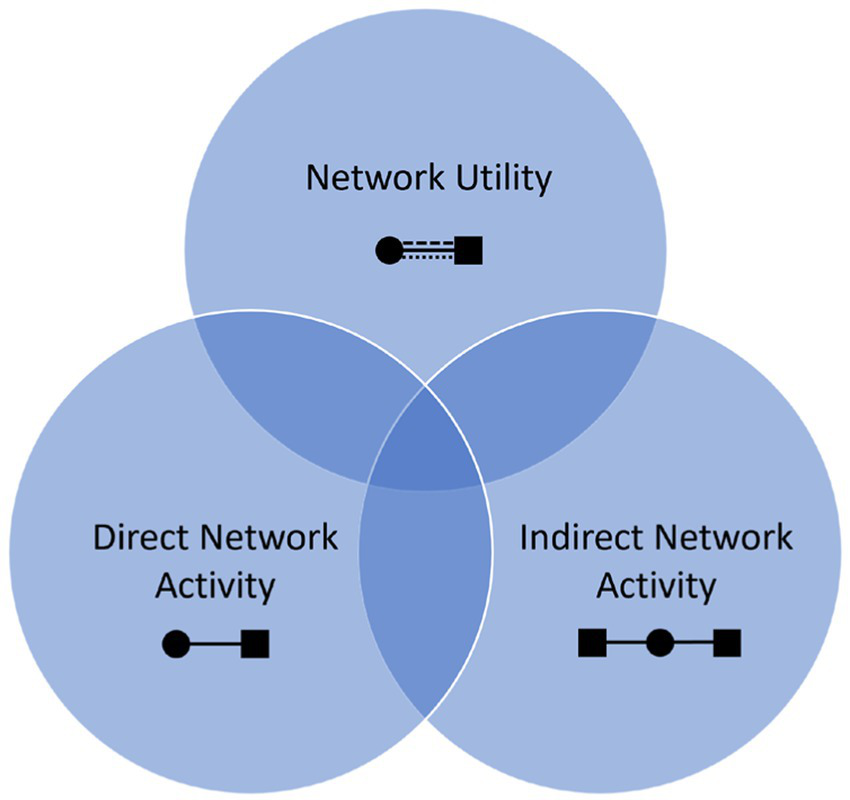
A network theory of knowledge brokerage.
Network activity addresses the direct and indirect social connections that mobilize knowledge, which can be examined through measures of centrality. Direct network activity can be conceived of in three ways: (1) a general relationship exists (degree centrality); (2) resources are sought through relationships (outdegree centrality), and (3) resources are provided through relationships (indegree centrality). In each case, the degree centrality measure tells us about the number of direct connections an individual possesses within a defined social network, serving as an indicator of involvement or activity (Borgatti et al., 2018). But knowledge does not only flow through direct relationships.
Indirect network activity encourages us to consider the relational patterns throughout whole networks, which can be measured using betweenness centrality. Specifically, this dimension captures the indirect knowledge brokering activity in a network, providing a sense of who is facilitating multiple pathways for resource flows within a network by mediating connections between otherwise disconnected individuals or groups. We and Rodway et al. (2021) are not the only researchers studying knowledge brokerage who have thought to bring these concepts together. Hopkins et al. (2018), for example, used betweenness centrality to identify knowledge brokers in science education policy implementation, which then informed their analysis of brokerage chains. Van den Boom-Muilenburg et al. (2022), like us, incorporated both degree centrality and betweenness centrality into their study of knowledge brokerage to study sustainable school improvement through professional learning communities. However, we are among the first, to our knowledge, to integrate with these measures of centrality the concept of multiplexity.
A multiplex tie is a connection between people or other social network actors comprising multiple types of relations (e.g., advice and materials exchange; Carolan, 2014). Multiplexity is thus an indicator of tie quality in that the more relational dimensions that comprise a relationship, the stronger the connection between those actors is likely to be (Granovetter, 1973). We use multiplexity as a measure of network utility, which tells us about how knowledge brokerage is channelled through multiple relations. In line with our focus on information-seeking behaviours and what this meant for knowledge brokerage, we considered a spectrum of relations ranging from those that mobilized instrumental information about MTSS (i.e., for specific and direct action) to conceptual information (i.e., for general understanding; Lavis et al., 2003).
Methods
Research design
This study aimed to generate an in-depth analysis of how education leaders broker information related to MTSS within an educational leadership network, focusing on one school district in British Columbia. Considerations included the connections between provincial and district-level policy and governance, educational leadership practices across the district and school levels, and the engagement of school-based leadership with their communities in implementing mental health promotion and tiered interventions in public education settings.
To address the research problem, a case study design was adopted to provide an in-depth description and analysis of the bounded system described below (Bloomberg and Volpe, 2016; Merriam, 1998; Merriam and Tisdell, 2016; Yazan, 2015). This design allowed for in-depth data collection from multiple sources, enabling a detailed examination of the complex relationships and connections within the school system. Furthermore, the case study’s foundation in a social constructivist approach aligns with Merriam’s (1998) orientation, which emphasizes interaction with participants to capture the nuanced dynamics within the system (Yazan, 2015).
Site and participants
For this case study, a purposeful sampling technique was employed to select both the research site and participants. The site selection criteria required school districts to be in an average-sized urban community of approximately 80,000–120,000 residents, with publicly accessible data on mental health and achievement measures as outlined by the Framework for Enhancing Student Learning (Government of British Columbia, 2019). These measures included student achievement, rates of school completion, self-reported school climate measures, and a comparison to the provincial average results for British Columbia school districts. Ten districts initially met the community size criterion.
Subsequently, these districts were evaluated against the selection criteria and categorized by their performance relative to the provincial average. The top five districts, determined by the greatest number of categories where they exceeded the provincial average, were selected as potential sites. The Virtus Public School District (pseudonym), having responded first to the participation invitation, was chosen for this study. This district includes 20 elementary schools, five middle schools, and five secondary schools, located in both mid-sized urban and smaller rural communities.
Participants were selected based on their roles in district and school leadership, involvement in mental health programming, and at least 1 year of experience in the school system. Thirty-seven individuals met these criteria, with 31 participating in the initial survey phase of data collection. For the subsequent interview phase, five individuals were purposefully chosen based on their central, peripheral, or bridging positions within the network, identified through the initial SNA findings. These individuals were selected to represent varied roles and connections across the network, providing insight into how different positions influence information flow and support the implementation of mental health initiatives.
Data collection
Data collection involved two phases, beginning with a social network survey designed to elucidate the informal relationships underpinning the information-seeking behaviours of educational leaders. This approach recognizes that “informal relationships among employees often reflect organizational workings more accurately than formal structures do” (Cross et al., 2002, p. 26). The survey was completed by 31 of the 37 leadership team members (84%) and encompassed three sections: demographic information, information-seeking behaviours, and open-ended questions.
In the information-seeking behaviours section, participants were prompted to identify individuals from whom they had sought advice over the past year regarding mental health promotion and multi-tiered systems of support. The survey facilitated the identification of both conceptual and instrumental types of information-seeking, aligning with the study’s conceptual framework (see Table 2). Participants identified their social connections using a provided roster that included all leadership team members and four school-level roles—school counsellor, mental health teacher lead, child and youth worker, and community partner. Only individuals who provided consent were included in the roster. Additionally, two policy documents—the Provincial Mandate Letter to school districts and the district’s corresponding plan—were included as potential information sources. These policy documents were included based on the understanding that documents can provide a means for comprehending the role of codified thought and action in the “development of complex and enduring social arrangements” (Miller and Alvarado, 2005, p. 349). In other words, like human actors, documents can facilitate or constrain the potential for information-sharing (Carolan, 2014).
Table 2
| Label | Description |
|---|---|
| Generic | Sharing general information about MTSS not captured by the other relations. |
| Knowledge | Deepening knowledge of mental health and MTSS. |
| Opinion | Seeking opinions regarding the implementation of new initiatives or programs. |
| Support | Seeking support for a change in practice. |
| Co-plan | Co-planning or co-selecting resources or materials for practice. |
Information-seeking relations examined.
The second phase involved interviews to gain a deeper understanding of the network attributes and leadership practices influencing mental health promotion and MTSS within the district. Recognizing the limitations of SNA in capturing individual influences and subjective interpretations within networks (Crossley, 2010; Ahrens, 2018), qualitative network analysis was employed. This approach focuses on the micro-perspective of individual actors within the network. Five individuals, identified as central, peripheral, or bridging actors in the network, participated in Zoom interviews that lasted 1 h and followed a semi-structured format. Interview questions included inquiries about participants’ backgrounds with mental health promotion, formal training, and resources accessed to support MTSS, as well as their interpretations of the network analysis maps. For example, participants were asked, “What formal training, professional development, or in-services have you been provided within your current role to support mental health promotion and multi-tiered systems of support?” and “Can you identify any additional roles, individuals, community organizations, policies, or practices that have contributed positively to mental health promotion or multi-tiered systems of support in your district?” This format allowed participants to discuss their interpretations of network relationships and how these relationships influence leadership and engagement strategies for mental health promotion.
Data analysis
Data analysis first involved SNA to examine the relational data, using the UCINET 6 software (Borgatti et al., 2002). The initial step included inspecting participant demographics and calculating whole-network statistics such as network density and fragmentation, complemented by visualizations of individual relations. This provided a foundational understanding of the district leadership network’s characteristics. From there, a dichotomization process was used to convert the valued relational data (i.e., how often each respondent interacted with their identified colleagues) into binary format. Interactions occurring “once in the past month” or more frequently were considered substantive and coded as “1,” while less frequent interactions were coded as “0.” The cutoff point was selected to best preserve the pattern of relationships found in the original data, as evidenced by a Pearson correlation coefficient of 0.91 between the original and dichotomized matrices.
Subsequently, the network measures specified in the conceptual framework for each relation were calculated (Table 3). For the calculation of network activity, emphasis was placed on in-degree centrality, which allowed the analysis to capture the flow of information toward key leaders, revealing how they were positioned as sources of expertise and support. This approach aligns with the study’s aim to understand how leaders’ influence is enacted through their accessibility and their role as information resources within the district’s network. A multiplex matrix was then constructed by summing the binary matrices corresponding to the individual social relations, providing a composite view of network interactions. Given the dependent nature of network data, inferential statistics were calculated using the permutation-based versions of common statistical tests (i.e., ANOVAs), utilizing 20,000 permutations to ensure reliable statistical inferences.
Table 3
| Level of Analysis | Description |
|---|---|
| Whole Network | Density: the proportion of actual ties to possible ties in the network, reflecting the extent to which a network is closely knit. Centralization: the degree to which connections in the network are centered around one or a few nodes, indicating potential points of control or influence. Fragmentation: the extent to which a network is divided into separate components. Transitivity: the degree to which nodes in a network tend to cluster together, forming subgroups. Average distance: how far apart nodes are, on average, which can affect information flow and diffusion processes in the network. Arc reciprocity: the proportion of arcs (directed edges) that are reciprocated within a network. |
| Individual Actors | In-degree centrality: the number of incoming connections a node has in a directed network, indicating its popularity or significance as a receiver of connections. Betweenness centrality: the extent to which a node appears on the shortest paths between other nodes, highlighting its role as an intermediary or bridge within the network. |
Social network measures.
See Borgatti et al. (2018) and Carolan (2014) for more detail about each measure.
In conjunction with SNA, qualitative data from the interviews and open-ended survey questions, and various documents were analyzed to explore how leaders perceive and act within their networks regarding mental health initiatives. The lead author conducted this analysis, with interpretations discussed and refined in consultation with the other authors to ensure alignment with the aims of this work.
The qualitative analysis was designed to extend and contextualize the SNA findings, offering deeper insight into the relational patterns observed and situating the network analysis within the broader themes of network utility and activity (Ahrens, 2018). The coding process followed Creswell and Poth’s (2018) five stages, involving (1) an initial read-through of text data, (2) division of text into segments of information, (3) assignment of codes to these segments, (4) reduction of overlap and redundancy among codes, and (5) organization of the remaining codes into categories of consolidated meaning. The coding process was iterative and cyclical, allowing reflection both during and after data collection as a heuristic method (Saldaña, 2016). The analysis occurred in two stages: first cycle and second cycle coding. The first cycle employed elemental and affective coding, categorizing information as either descriptive or emotional. After this initial round, the data were reviewed again, allowing for refinement and consolidation of codes. In the second cycle, we examined smaller segments for shared characteristics, grouping analogous codes into larger thematic segments. These larger segments were then connected to build coherence and develop meaningful interpretations (Saldaña, 2016), allowing us to explain how leaders’ understanding of network attributes influenced their perceptions and actions in mental health promotion and MTSS implementation.
Policy documents were analyzed separately using content analysis (Ahrens, 2018; Merriam and Tisdell, 2016) to identify content related to mental health and leadership practices. The findings from this content analysis were then integrated with the findings from the interview and survey data, providing an integrated perspective on how knowledge-sharing practices within the network influenced the development and implementation of the district’s mental health strategies.
Findings
We structure this section by beginning with the quantitative network analysis, presenting whole-network descriptive statistics as well as a knowledge brokerage analysis informed by our conceptual framework. We then present how these quantitative results can be further understood through the qualitative thematic analysis.
Network analysis
Whole-network descriptive statistics
The analysis of individual relations revealed nuanced patterns of interaction (Table 4). Co-planning, characterized by its low density and high fragmentation, indicated sparse and isolated information-seeking behaviours concerning planning or resource selection for instruction, with interactions largely unidirectional and with limited reciprocity. In contrast, the support relation, despite its lower density, displayed a higher level of transitivity and some reciprocity, suggesting that while information-seeking to support changing practices was infrequent, it tended to occur within more interconnected subgroups, with a slight tendency towards mutual exchange.
Table 4
| Relation Measure |
Co-plan | Support | Opinion | Knowledge | Generic | Multiplex |
|---|---|---|---|---|---|---|
| Density | 0.021 | 0.015 | 0.025 | 0.022 | 0.016 | 0.099 |
| In-degree centralization | 0.130 | 0.106 | 0.186 | 0.189 | 0.105 | 0.413 |
| Fragmentation | 0.968 | 0.976 | 0.965 | 0.972 | 0.981 | 0.782 |
| Transitivity | 0.100 | 0.231 | 0.100 | 0.200 | 0.286 | 0.367 |
| Average distance | 1.474 | 1.357 | 1.381 | 1.212 | 1.174 | 1.668 |
| Arc reciprocity | 0 | 0.111 | 0 | 0 | 0.105 | 0.102 |
Whole-Network Measures for the Individual and Multiplex Relations.
Relational dimensions were not statistically significantly correlated with one another.
Opinion-seeking interactions were noted for their higher density and in-degree centralization, pointing to a more frequent engagement among certain individuals for advice on new initiatives. However, similar to co-planning, these interactions were predominantly one-way and occurred without forming cohesive subgroups, as indicated by the low transitivity. Knowledge-seeking about mental health, while showing moderate density, exhibited the highest fragmentation among the relations and a relatively higher transitivity, suggesting some level of group cohesion in information-seeking yet with a unidirectional flow of interactions. Generic information-seeking showed patterns of high fragmentation and the highest transitivity, indicating that while interactions were infrequent and fragmented when they occurred, they were more likely to be within cohesive subgroups, with a notable level of reciprocity in exchanges.
The aggregated view provided by the multiplex relation revealed a more interconnected network (Figure 2), marked by a higher density and in-degree centralization. This suggested a network where certain leaders stood out as central figures. Despite the lower fragmentation compared to individual relations, the network exhibited some signs of division, albeit less so than in individual relations. Notably, the highest transitivity observed in the multiplex relation underscored a strong tendency towards forming cohesive subgroups of information sharing, with a moderate level of mutual interactions as indicated by reciprocity.
Figure 2
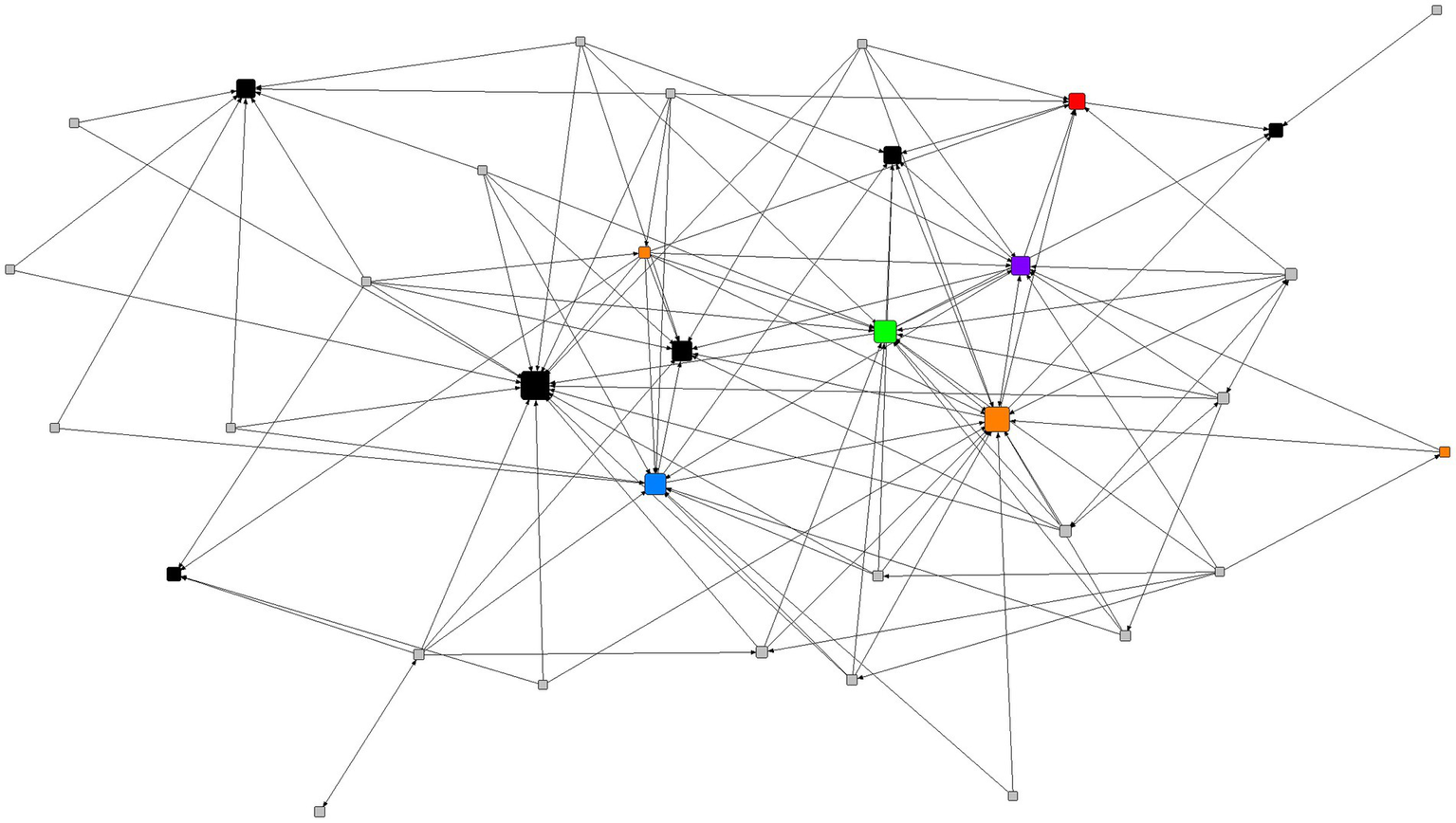
Sociogram of the multiplex relation. The role of each node is noted using colour. Purple, director of instruction; Grey, principal; Orange, district principal; Blue, coordinator; Green, assistant superintendent; Red, Superintendent, Black, other actors (policy documents and specialized roles).
Knowledge brokerage statistics
We now turn to knowledge brokerage statistics aligned with our conceptual framework, noting that network utility is considered alongside each network activity dimension. Beginning with the direct network activity, the in-degree centrality of participants reveals distinct patterns in the roles various school and system leaders play in sharing their expertise and guidance (Table 5). The Coordinator stood out in the co-planning and knowledge relations, illustrating their importance to instructional planning and mental health expertise. Their influence was also evident in the multiplex relation, in which they were the district’s third-most sought-out individual across all relations. The Director of Instruction was primarily influential in the opinion and generic relations, suggesting they may have played a role in shaping the district’s general perceptions of mental health programming. Principals exhibited the lowest centrality across individual relations, indicating they did not have a prominent role in the direct mobilization of information throughout the district. In contrast, the District Principal was marginally active in each relation, contributing to a noteworthy level of activity in the multiplex relation. The Assistant Superintendent was the most influential leader in the district for direct information sharing about mental health. The differences among these leadership roles were confirmed to be statistically significant as measured by a permutation-based ANOVA, F(6, 28) = 10.012, p < 0.001, η2 = 0.682.
Table 5
| Relation Role |
Co-plan | Support | Opinion | Knowledge | Generic | Multiplex |
|---|---|---|---|---|---|---|
| Coordinator* | 4 | 1 | 2 | 4 | 0 | 11 |
| Director of instruction* | 1 | 0 | 4 | 1 | 3 | 9 |
| Principal | 0 (0) | 0.27 (0.53) | 0.09 (0.29) | 0 (0) | 0.23 (0.42) | 0.59 (0.78) |
| District principal | 1 (0.82) | 0.67 (0.94) | 1 (0.82) | 2.33 (3.30) | 0.67 (0.47) | 5.67 (5.91) |
| Assistant Superintendent* | 0 | 4 | 3 | 1 | 4 | 12 |
| Superintendent* | 1 | 1 | 3 | 0 | 1 | 6 |
| SBC* | 5 | 0 | 7 | 5 | 0 | 17 |
| SBCYCW* | 3 | 0 | 3 | 0 | 2 | 8 |
| SBMHTL* | 1 | 0 | 1 | 1 | 1 | 4 |
| CBMHP* | 2 | 1 | 1 | 5 | 1 | 10 |
In-degree centrality across different leadership roles.
SBC, School-based Counsellor; SBCYCW, School-based Child and Youth Care Worker; SBMHTL, School-based Mental Health Teacher Lead; CBMHP, Community Based Mental Health Partner. An asterisk indicates roles for which there was either a single participant or multiple individuals grouped into a single node.
The specialized roles of SBC, SBCYCW, and CBMHP emerged as central nodes within the network, particularly in the opinion relation and the overarching multiplex relation. Their high in-degree centrality appeared to underscore the perceived value of these individuals’ specialized knowledge and experience. Notably, however, the SBMHTL role displayed the second-lowest in-degree centrality for the multiplex relation, meaning few people sought out this individual despite their role as a close-to-practice leader in mental health programming.
Shifting to indirect network activity, the Coordinator and Assistant Superintendent stood out for their high betweenness centrality, which was particularly evident for the multiplex relation (Table 6). This suggests these leaders held an essential role in mediating information sharing among others in the district. The Director of Instruction and the District Principal were also actively involved in mobilizing knowledge among otherwise disconnected district leaders. In contrast, the principals were minimally involved as intermediaries. The Superintendent also showed limited engagement with brokering information throughout the network. However, the permutation-based ANOVA did not show a statistically significant variation in betweenness centrality among the leadership roles, F(6, 28) = 5.26, p = 0.12, η2 = 0.530.
Table 6
| Relation Role |
Co-plan | Support | Opinion | Knowledge | Generic | Multiplex |
|---|---|---|---|---|---|---|
| Coordinator* | 4 | 0 | 2 | 2 | 0 | 26.03 |
| Director of instruction* | 5 | 0 | 0 | 3.5 | 0 | 19.28 |
| Principal | 0 (0) | 0.18 (0.49) | 0.14 (0.62) | 0 (0) | 0.14 (0.43) | 1.22 (2.65) |
| District principal | 2 (2.83) | 2 (2.83) | 2 (2.16) | 0 (0) | 0.33 (0.47) | 22.02 (27.11) |
| Assistant Superintendent* | 0 | 0 | 5 | 1.5 | 0 | 31.02 |
| Superintendent* | 3 | 0 | 0 | 0 | 0 | 3.78 |
Betweenness centrality across different leadership roles.
SBC, School-based Counsellor; SBCYCW, School-based Child and Youth Care Worker; SBMHTL, School-based Mental Health Teacher Lead; CBMHP, Community Based Mental Health Partner. An asterisk indicates roles for which there was a single participant.
Qualitative findings: unidirectional currents of leadership
The qualitative findings from the interviews with district and school-level leaders complement the patterns observed in the network analysis. A central focus emerged around the essential but varied role of leadership in the implementation of MTSS and the generally unidirectional nature of information-seeking concerning mental health. In contrast to what was observed in the network analysis, the role of the superintendent was lauded during the qualitative interviews, with other district leaders seeing this individual as a driver of mental health promotion and MTSS within the district. In other words, although not highly central in terms of betweenness centrality, the superintendent played a significant role in shaping the district’s strategic focus. For instance, one district leader highlighted a critical moment when the superintendent prioritized mental health:
I think the leadership came when we had our superintendent say, ‘Yes, this is important enough that in the summer, I’m going to take four days out of my busy life and go with school-based leaders [to a training opportunity focused on mental health literacy].’ … After that, everyone committed to coming together and going to that training during the summer. I think that was probably a decisive leadership moment.
Evidently, the event was thought to elevate the district’s MTSS initiatives, and the superintendent’s attendance was believed to be an indication of its credibility. As a principal noted, the tone set by senior administration galvanized other school leaders around the deep integration of mental health priorities into school culture:
It’s part of who we are now. It’s something that’s just embedded into our school culture. And it’s, it's not something that’s just a one-off. That’s, you know, we talked about mental health last year, so we’re going to move on to social-emotional development next year, or you know, self-regulation or, you know, some of these buzz words that come and go. But mental health literacy, mental health promotion, mental health aspects, and wellness are here to stay.
This perspective reflected the higher levels of engagement and centralization observed in the multiplex network, where, despite the apparent disparities in engagement levels across different roles, a unified commitment to mental health prevailed across the district.
Additionally, the interviews pointed out the necessity for enhanced engagement and support for site-based principals, emphasizing the need for tailored professional development and coaching to build capacity and foster reciprocal relationships. It was suggested that more targeted conversations are required to identify and address their specific needs, in doing so, nurturing a more collaborative and supportive network environment. As one district leader commented when asked about the district’s social relations in support of student mental health, “the connections look very much one-way …. As a system, we rely heavily on district services and our counsellors.” This way of seeing the district network was echoed by other participants, who noted that school-level leaders often do not reach out to each other but rather to district services for support and information, indicating a gap in peer-to-peer communication. This behaviour suggested a largely unidirectional flow of information within the network and highlighted the potential for greater connectivity and resource sharing among peers.
Finally, community partnerships were recognized as a vital component of the network’s support structure for mental health initiatives. One leader emphasized the integration of these partnerships within the school environment, noting, “our community partnerships are really strong. And some of our schools have lots of community partnerships built right within the school environment …. They’re not separate from the schools; they are part of them.” This integration helped to create a cohesive support system that leaders viewed as a fundamental aspect of the schools’ operational framework, enhancing the effectiveness of mental health initiatives.
Discussion
In this article, we explored the relational networks of educational leaders within a single school district in British Columbia, Canada, focusing on how their social connections could facilitate or impede knowledge flows related to MTSS. By drawing together our SNA and interview findings, we now present three contributions of this research to advance scholarship and practice of educational leadership and knowledge brokerage: (1) MTSS is a multiplex phenomenon actioned through leadership networks; (2) there is no one way to engage in knowledge brokerage, and (3) mixed methods offer a productive approach for capturing the complexities of knowledge brokerage.
MTSS and educational leadership
We begin by returning to the centrality of different district leadership roles across the studied relations. Leaders’ connections shaped the pathways through which information about MTSS flowed throughout the district. Their influence was variably cast depending on whether the information was more conceptual (e.g., deepening knowledge of mental health and MTSS) or more instrumental (e.g., co-planning the use of specific materials). In other words, like earlier research (e.g., Rodway et al., 2021; Sinnema et al., 2020), our findings reveal that school and district leaders are variably positioned across their multiple social relations. This insight is important insofar that “school leaders (e.g., administrators, specialists, and teacher leaders) play important roles in shaping teachers’ opportunities to develop ties and, by extension, potentially social capital” (Spillane and Shirrell, 2017, p. 639). Understanding how leaders can cultivate wider social networks in education systems to support MTSS thus requires giving attention to how those leaders are positioned across multiple social relations.
In this study, for instance, consider the roles of Coordinator and Assistant Superintendent. Had we focused exclusively on how knowledge was brokered throughout the participating district, the Coordinator would have appeared central while the Assistant Superintendent only marginally so. This story would be reversed had we exclusively focused on interactions related to whom leaders sought out regarding support for changes to existing practices. To go further, we see that the Director of Instruction was nearly as central to information brokering as these two individuals within the multiplex network, but this individual’s prominence would be overlooked if only the knowledge or support relations were considered. The strategic positioning of school and district leaders cannot be understood solely through narrow representations, such as traditional organizational charts, of their system’s social networks. A multiplex view reveals how different leadership roles contribute to MTSS by engaging in distinct relational functions, such as exchanging knowledge and providing support for change, which collectively enhance the system’s capacity to implement such initiatives. Simply put, MTSS is a multiplex phenomenon.
Knowledge brokerage
Our study’s insights into knowledge brokerage emphasize the complex interactions through which knowledge is exchanged, transformed, and communicated. Similar to our comments above, the relational connections among school and district leaders highlight patterns of knowledge brokerage that can both facilitate and impede efforts to promote mental health in schools. However, rather than place the burden for change on individual actors, it is our position that current structures within education systems may not adequately support building connections and shared vision among leaders. Variations in centrality and interaction nature suggest that while some leaders are well-integrated, others remain peripheral, inhibiting their contribution to district-wide goals. This raises questions about the degree to which education systems are organized to foster collaboration or perpetuate silos, despite the preponderance of research-and practice-based evidence that urges for more distributive approaches to change (e.g., Brown et al., 2024; Organization for Economic Cooperation and Development, 2023). To create change through knowledge brokerage, it will require systems to enhance relational ties and promote collaborative leadership. Formal mechanisms like professional learning networks and informal strategies such as cross-role mentoring can amplify leaders’ capacity to engage in effective knowledge brokerage, enhancing MTSS implementation (e.g., Procter et al., 2021; Rodway et al., 2021).
Moreover, SNA revealed significant insights into the communication patterns among educational leaders in the participating district. For example, opinion-seeking interactions had higher density and centralization, indicating certain leaders were frequently sought for new initiatives. In contrast, co-planning activities were less frequent and more fragmented, potentially limiting planning and implementation of district-wide initiatives. Qualitative insights regarding the superintendent’s role aligned with these findings. Although not centrally positioned in direct network measures, the superintendent was perceived as a significant driver of mental health initiatives, demonstrating the impact of indirect influence on strategic priorities. This highlights the value of multiple and mixed methods, which can allow for a richer, multidimensional view of knowledge brokerage within school systems by combining quantitative data to capture broad patterns with qualitative insights that reveal deeper contextual nuances (also see Spillane et al., 2017; Van den Boom-Muilenburg et al., 2022).
While this study is observational in nature, its findings have implications for the design of future interventions aimed at enhancing knowledge brokerage within educational leadership networks. Although we did not test the impact of specific interventions, the analysis of existing social networks among school and district leaders provided insights into the relational dynamics that can support or hinder the implementation of MTSS. Observing these patterns allows for the identification of strategic points where knowledge brokerage could be strengthened through targeted interventions, such as fostering more reciprocal peer-to-peer interactions among school-based leaders or building capacity through professional development initiatives.
Network activity and network utility
Finally, we found that the network activity-network utility framework provided an informative model for how different leadership roles navigated the brokerage of educational policies and practices within the context of mental health and MTSS. Similar to Rodway et al. (2021), our analysis underscores that no single dimension of knowledge brokerage can fully encapsulate the complexity of information sharing. Direct network activity, highlighted through in-degree centrality, revealed key individuals in the dissemination of expertise and guidance. Indirect network activity, captured via betweenness centrality, shed light on those leaders who played crucial intermediary roles, facilitating connections and the flow of information between otherwise disconnected leaders. Network utility, as measured by multiplexity, provided insights into the quality and strength of these ties, revealing the layered patterning of interactions that sustained information sharing within the district.
Notwithstanding the insights this framework enabled, we see opportunities to advance how it might be applied and what could be learned from similar studies. First, although we employed centrality measures such as in-degree and betweenness to elucidate the roles and influence of district leaders within the network, exploring additional measures could yield insights not possible [with these measures]. For instance, Glegg et al. (2019) suggest that metrics such as closeness centrality and eigenvector centrality might offer deeper understandings of influence and connectivity within networks. These alternatives could potentially uncover subtler dynamics in how knowledge is brokered and utilized across educational systems. Furthermore, our findings suggest that traditional methods for measuring tie strength—such as frequency of interaction or duration of contact—while informative, only partially narrate the relational dynamics critical in educational settings (Granovetter, 1973; Carolan, 2014). Future research would benefit from delving deeper into the network utility dimension, as it offers a lens through which to view the multi-faceted nature of professional relationships and their impact on the systemic implementation of educational innovations.
Statements
Data availability statement
The datasets presented in this article are not readily available because to protect participant identity, limited data is available. Requests to access the datasets should be directed to jenniferturner0@gmail.com.
Ethics statement
The studies involving humans were approved by Conjoint Faculties Research Ethics Board, University of Calgary. The studies were conducted in accordance with the local legislation and institutional requirements. The participants provided their written informed consent to participate in this study. Written informed consent was obtained from the individual(s) for the publication of any potentially identifiable images or data included in this article.
Author contributions
JT: Writing – original draft, Writing – review & editing. SM: Writing – original draft, Writing – review & editing. SF: Writing – original draft, Writing – review & editing.
Funding
The author(s) declare that financial support was received for the research, authorship, and/or publication of this article. This article draws on research supported by the Social Sciences and Humanities Research Council (Grant number: 430-2023-00590).
Conflict of interest
The authors declare that the research was conducted in the absence of any commercial or financial relationships that could be construed as a potential conflict of interest.
Publisher’s note
All claims expressed in this article are solely those of the authors and do not necessarily represent those of their affiliated organizations, or those of the publisher, the editors and the reviewers. Any product that may be evaluated in this article, or claim that may be made by its manufacturer, is not guaranteed or endorsed by the publisher.
References
1
Ahrens P. (2018). Qualitative network analysis: a useful tool for investigating policy networks in transnational settings?Methodol. Innov.11:9816. doi: 10.1177/2059799118769816
2
Alberta Education . (2023). Mental health in schools. Available at: https://www.alberta.ca/mental-health-in-schools.aspx
3
American Psychological Association (2023). Worsening mental health crisis pressure psychologist workforce: 2021 COVID-19 practitioner survey. Available at: https://www.apa.org/pubs/reports/practitioner/covid-19-2021 (Accessed May 01, 2024).
4
August G. Piehler T. Miller F. (2018). Getting “SMART” about implementing multi-tiered systems of support to promote school mental health. J. Sch. Psychol.66, 85–96. doi: 10.1016/j.jsp.2017.10.001
5
Bloomberg L. Volpe M. (2016). Completing your qualitative dissertation: A roadmap from beginning to end. 3rd Edn. Los Angeles, CA: SAGE Publications.
6
Borgatti S. P. Everett M. G. Freeman L. C. (2002). Ucinet 6 for windows: Software for social network analysis. Analytic Technologies.
7
Borgatti S. P. Everett M. G. Johnson J. C. (2018). Analyzing social networks. Los Angeles, CA: Sage.
8
Brown C. Luzmore R. O’Donovan R. Ji G. Patnaik S. (2024). How educational leaders can maximise the social capital benefits of inter-school networks: findings from a systematic review. Int. J. Educ. Manag.38, 213–264. doi: 10.1108/IJEM-09-2023-0447
9
Bücker S. Nuraydin S. Simonsmeier B. A. Schneider M. Luhmann M. (2018). Subjective well-being and academic achievement: a meta-analysis. J. Res. Pers.74, 83–94. doi: 10.1016/j.jrp.2018.02.007
10
Bulanda J. J. Bruhn C. Byro-Johnson T. Zentmyer M. (2014). Addressing mental health stigma among young adolescents: evaluation of a youth-led approach. Health Soc. Work39, 73–80. doi: 10.1093/hsw/hlu008
11
Carolan B. (2014). Social network analysis and education. Thousand Oaks, CA: Sage.
12
Clarke A. Sorgenfrei M. Mulcahy J. Davie P. Friedrich C. McBride T. (2021). Adolescent mental health: a systematic review on the effectiveness of school-based interventions. Early Intervention Foundation. Available at: https://www.eif.org.uk/report/adolescent-mental-health-a-systematic-review-on-the-effectiveness-of-school-based-interventions (Accessed May 01, 2024).
13
Creswell J. W. Poth C. N. (2018). Qualitative inquiry and research design choosing among five approaches. 4th Edn. Los Angeles, CA: SAGE Publications.
14
Cross R. Borgatti S. P. Parker A. (2002). Making invisible work visible: using social network analysis to support strategic collaboration. Calif. Manag. Rev.44, 25–46. doi: 10.2307/41166121
15
Crossley N. (2010). The social world of the network. Combining qualitative and quantitative elements in social network analysis. Sociologica, 1–33. doi: 10.2383/32049
16
Doran C. M. Kinchin I. (2019). A review of the economic impact of mental illness. Aust. Health Rev.43, 43–48. doi: 10.1071/AH16115
17
Fabiano G. Evans S. W. (2019). Introduction to the special issue of school mental health on best practices in effective multi-tiered intervention frameworks. Sch. Ment. Heal.11, 1–3. doi: 10.1007/s12310-018-9283-2
18
Farley-Ripple E. Tise J. (2017). “Brokerage and the research-practice gap: A theoretical and empirical examination.” in Paper presented at the 2017 annual meeting of the American Educational Research Association.
19
Fusar-Poli P. Salazar de Pablo G. De Micheli A. Nieman D. H. Correll C. U. Kessing L. V. et al . (2020). What is good mental health? A scoping review. Eur. Neuropsychopharmacol.31, 33–46. doi: 10.1016/j.euroneuro.2019.12.105
20
Georgiades K. Duncan L. Wang L. Comeau J. Boyle M. H. Afifi T. O. et al . (2019). Six-month prevalence of mental disorders and service contacts among children and youth in Ontario: evidence from the 2014 Ontario child health study. Can. J. Psychiatr.64, 246–255. doi: 10.1177/0706743719830024
21
Glegg S. M. N. Jenkins E. Kothari A. (2019). How the study of networks informs knowl- edge translation and implementation: A scoping review. Implement. Sci.14, 1–27. doi: 10.1186/s13012-019-0879-1
22
Government of Alberta (2017). Mental health in schools. Available at: https://open.alberta.ca/dataset/9781460132999 (Accessed May 01, 2024).
23
Government of British Columbia (2019). Framework for enhancing student learning. Available at: https://www2.gov.bc.ca/gov/content/education-training/k-12/administration/program-management/enhancing-student-learning (Accessed May 01, 2024).
24
Government of British Columbia (2022a). Mental health in schools strategy. Available at: https://www2.gov.bc.ca/gov/content/erase/mental-health (Accessed May 01, 2024).
25
Government of British Columbia (2022b). Information to support student learning. Available at: https://studentsuccess.gov.bc.ca/)
26
Government of British Columbia (2024). Ministry of Education and child care. Available at: https://www2.gov.bc.ca/gov/content/governments/organizational-structure/ministries-organizations/ministries/education (Accessed May 01, 2024).
27
Granovetter M. S. (1973). The strength of weak ties. Am. J. Sociol.78, 1360–1380. doi: 10.1086/225469
28
Hjorth C. F. Bilgrav L. Frandsen L. Sjørslev O. Torp-Pedersen C. Nielsen B. et al . (2016). Mental health and school dropout across educational levels and genders: 4-year follow-up study. BMC Public Health16, 976–912. doi: 10.1186/s12889-016-3622-8
29
Hopkins M. Wiley K. E. Penuel W. R. Farrell C. C. (2018). Brokering research in science education policy implementation: the case of a professional association. Evid. Policy14, 459–476. doi: 10.1332/174426418X15299595170910
30
Kutcher S. Wei Y. (2020). School mental health: a necessary component of youth mental health policy and plans. World Psychiatry19, 174–175. doi: 10.1002/wps.20732
31
Larson S. Chapman S. Spetz J. Brindis C. D. (2017). Chronic childhood trauma, mental health, academic achievement, and school-based health center mental health services. J. Sch. Health87, 675–686. doi: 10.1111/josh.12541
32
Lavis J. N. Ross S. McLeod C. Gildiner A. (2003). Measuring the impact of health research. J. Health Serv. Res. Policy8, 165–170. doi: 10.1258/135581903322029520
33
Lawrence D. Dawson V. Houghton S. Goodsell B. Sawyer M. G. (2019). Impact of mental disorders on attendance at school. Aust. J. Educ.63, 5–21. doi: 10.1177/0004944118823576
34
Linden B. Stuart H. Fortier A. (2022). Evaluation of “Bell Let’s talk in the classroom”: a guide for improving teachers’ confidence in providing mental health education. Can. J. Commun. Ment. Health41, 1–27. doi: 10.7870/cjcmh-2022-024
35
MacGregor S. Friesen S. Turner J. Domene J. F. McMorris C. Allan S. et al . (2024). The side effects of universal school-based mental health supports: An integrative review. Rev. Res. Educ. doi: 10.3102/0091732X241256628
36
Mental Health Commission of Canada (2013). Making the case for investing in mental health in Canada. Available at: https://mentalhealthcommission.ca/resource/making-the-case-for-investing-in-mental-health-in-canada/ (Accessed May 01, 2024).
37
Merriam S. B. (1998). Qualitative research and case study applications in education. San Francisco, CA: Jossey-Bass.
38
Merriam S. B. Tisdell E. J. (2016). Qualitative research: A guide to design and implementation. 4th Edn. San Francisco, CA: Jossey-Bass.
39
Miller F. A. Alvarado K. (2005). Incorporating documents into qualitative nursing research. J. Nurs. Scholarsh.37, 348–353. doi: 10.1111/j.1547-5069.2005.00060.x
40
Morrison W. Peterson P. (2016). Pan-Canadian joint consortium for school health: positive mental health toolkit. Pan-Canadian Joint Consortium for School Health. Available at: https://wmaproducts.com/JCSH/ (Accessed May 01, 2024).
41
Organization for Economic Cooperation and Development (2017). PISA 2015 Results (Volume III): Students' Well-Being. Paris, France: OECD Publishing.
42
Organization for Economic Cooperation and Development (2019). Health at a glance 2019: OECD indicators. Paris, France: OECD Publishing.
43
Organization for Economic Cooperation and Development (2023). Who really cares about using education research in policy and practice? Developing a culture of research engagement, educational research and innovation. Paris, France: OECD Publishing.
44
Procter T. Roberts L. Macdonald I. Morgan-Clare A. Randell B. Banerjee R. (2021). Best practice review of whole school approach (WSA) within MHSTs in the south-east and east of England: evaluation report. National Institute for Health and Care Research. Available at: https://arc-kss.nihr.ac.uk/document-download/158-best-practice-review-of-whole-school-approach-wsa-within-mhsts-in-the-south-east-and-east-of-england-evaluation-report/file (Accessed May 01, 2024).
45
Punukollu M. Burns C. Marques M. (2020). Effectiveness of a pilot school-based intervention on improving scottish students’ mental health: a mixed methods evaluation. Int. J. Adolesc. Youth25, 505–518. doi: 10.1080/02673843.2019.1674167
46
Rodway J. MacGregor S. Daly A. Liou Y.-H. Yonezawa S. Pollock M. (2021). A network case knowledge brokering. J. Prof. Cap. Commun.6, 148–163. doi: 10.1108/JPCC-11-2020-0089
47
Saldaña J. (2016). The coding manual for qualitative researchers. 3rd Edn. London, United Kingdom: SAGE Publications.
48
Samji H. Wu J. Ladak A. Vossen C. Stewart E. Dove N. et al . (2021). Review: mental health impacts of the COVID-19 pandemic on children and youth—a systematic review. Child Adolesc. Mental Health27, 173–189. doi: 10.1111/camh.12501
49
Shelemy L. Harvey K. Waite P. (2019). Supporting students’ mental health in schools: what do teachers want and need?Emot. Behav. Diffic.24, 100–116. doi: 10.1080/13632752.2019.1582742
50
Sims B. Melcher B. (2017). Active implementation frameworks: Their importance to implementing and sustaining effective mental health programs in rural schools. In: Handbook of rural school mental health. Eds. MichaelK. D.JamesonJ. P., (Springer International). pp. 339–361.
51
Sinnema C. Daly A. J. Liou Y. H. Rodway J. (2020). Exploring the communities of learning policy in New Zealand using social network analysis: a case study of leadership, expertise, and networks. Int. J. Educ. Res.99:101492. doi: 10.1016/j.ijer.2019.10.002
52
Smith A. Forsyth K. Poon C. Peled M. Saewyc E. McCreary Centre Society (2019). Balance and connection in BC: The health and well-being of our youth. British Columbia, Canada: McCreary Centre Society.
53
Spillane J. P. Shirrell M. (2017). Breaking up Isn’t hard to do: exploring the dissolution of teachers’ and school leaders’ work-related ties. Educ. Adm. Q.53, 616–648. doi: 10.1177/0013161X17696557
54
Spillane J. P. Shirrell M. Sweet T. M. (2017). The elephant in the schoolhouse: the role of propinquity in school staff interactions about teaching. Sociol. Educ.90, 149–171. doi: 10.1177/0038040717696151
55
Turner J. (2022). Finding the strength: a case study of school district leadership of mental health promotion in one district in British Columbia [doctoral dissertation, University of Calgary]. PRISM Institutional Repository. Available at: http://hdl.handle.net/1880/115125 (Accessed May 01, 2024).
56
Vaillancourt T. Szatmari P. Georgiades K. Krygsman A. (2021). The impact of COVID-19 on the mental health of Canadian children and youth. Facets6, 1628–1648. doi: 10.1139/facets-2021-0078
57
Van den Boom-Muilenburg S. N. Poortman C. L. Daly A. J. Schildkamp K. (2022). Key actors leading knowledge brokerage for sustainable school improvement with PLCs: who brokers what?Teach. Teach. Educ.110:103577. doi: 10.1016/j.tate.2021.103577
58
World Health Organization . (2021). Suicide. Available at: https://www.who.int/news-room/fact-sheets/detail/suicide
59
World Health Organization (2022). Mental health. Available at: https://www.who.int/news-room/fact-sheets/detail/mental-health-strengthening-our-response
60
Yazan B. (2015). Three approaches to case study methods in education: yin, merriam, and stake. Qual. Rep.20, 134–152. doi: 10.46743/2160-3715/2015.2102
Summary
Keywords
educational leadership, mental health, multi-tiered systems of support, knowledge brokerage, social network analysis
Citation
Turner J, MacGregor S and Friesen S (2024) Educational leaders and school-based mental health: a social network analysis of knowledge brokerage. Front. Educ. 9:1457546. doi: 10.3389/feduc.2024.1457546
Received
30 June 2024
Accepted
20 November 2024
Published
09 December 2024
Volume
9 - 2024
Edited by
Joshua A. Jackman, Sungkyunkwan University, Republic of Korea
Reviewed by
Sara Hoy, Swedish School of Sport and Health Sciences, Sweden
M-H Catherine Toh, James Cook University Singapore, Singapore
Updates
Copyright
© 2024 Turner, MacGregor and Friesen.
This is an open-access article distributed under the terms of the Creative Commons Attribution License (CC BY). The use, distribution or reproduction in other forums is permitted, provided the original author(s) and the copyright owner(s) are credited and that the original publication in this journal is cited, in accordance with accepted academic practice. No use, distribution or reproduction is permitted which does not comply with these terms.
*Correspondence: Stephen MacGregor, stephen.macgregor@ucalgary.ca
Disclaimer
All claims expressed in this article are solely those of the authors and do not necessarily represent those of their affiliated organizations, or those of the publisher, the editors and the reviewers. Any product that may be evaluated in this article or claim that may be made by its manufacturer is not guaranteed or endorsed by the publisher.