Abstract
With the advancement of globalization, English as a key resource for knowledge, business, and culture has become increasingly important in higher education. This study aims to explore the challenges of English education in the process of internationalization of higher education in Asia, especially in China. This study systematically reviews relevant literature associated with Asian countries, focusing on the impact of English-medium instruction (EMI) courses on student performance in China, Japan, and Central Asia. The findings indicate that while English education provides students with broader international communication opportunities, it also poses challenges in terms of cultural identity and academic performance. Furthermore, changes in policies and practices have had a profound impact on the experiences of teachers and students, especially in the context of international schools and education centers.
1 Introduction
English education plays an important role in internationalizing higher education in Asia. Under globalization, policies, and practices of internationalization in higher education generally recognize the significance of English in generating, circulating, and disseminating knowledge (Dimmock and Walker, 2005). At the same time, internationalization in higher education has prompted the growth of English-taught courses and partnerships with overseas universities in most Asian countries. As Asian higher education places increasing emphasis on English, the language is being leveraged more by Asian countries and institutions as a resource for commerce, politics, knowledge, and culture.
However, rapid socioeconomic changes have posed major challenges for 21st century higher education (Shin and Harman, 2009). Issues in Asia-Pacific and globally have drawn research attention (Le Ha, 2013). Previous studies have explored different interpretations and rationales for the role of English in higher education internationalization across Asia. For example, Shimmi and Yonezawa (2015) examined how cultural identity formation and risks have materialized under internationalization policies and practices in Japan. They also highlighted the challenges faced by top Japanese research universities in retaining global status. Experimental English-medium instruction was found to have initial negative impacts on student outcomes in Central Asian universities. A study by Nurshatayeva and Page (2020) reported lower GPAs, reduced graduation probabilities and more course failures. Factors influencing international students’ cultural adaptation were examined in the context of Malaysia by Shafaei et al. (2016). Based on Berry’s cultural adaptation framework, they studied the effects of individual characteristics like gender, region of origin, marital status, education level as well as predictors such as English proficiency, media use and post-graduation plans. Scholarship availability, reputation and geographical/cultural proximity emerged as key attractors for Thailand’s growing higher education enrollment, according to Snodin (2019). However, the literature tends to privilege native English-speaking country experiences over those from developing countries. Insights can also be drawn from studies in South Korea and Japan (Park et al., 2022; Itoi and Mizukura, 2024). However, existing literature lacks integration across Asian countries and overlooks contributions from China. The current study aims to address this gap by analyzing policies and practices across multiple Asian countries (e.g., China, Japan, South Korea) to understand the role of English in higher education internationalization.
Through reform and opening-up over 40 years, China has achieved outstanding successes in higher education internationalization including strengthened educational cooperation, emerging models like Confucius Institutes and dual degree programs, regional mechanisms, and evolved policies supporting inbound student mobility (Lien and Miao, 2023). China’s experience thus provides valuable insights into facilitating Asian higher education internationalization. While studies on foreign language education in Chinese higher education provide insights into challenges facing internationalization in China, literature on the subject lacks systematic reviews. Therefore, this study systematically reviews the development of educational internationalization in China and other Asian countries, and challenges in foreign language education, through a systematic review. With the accelerating process of economic globalization, the tide of higher education internationalization cannot be ignored. Internationalization presents both opportunities and challenges for the development of Chinese higher education. This study aims to explore challenges facing higher education. It further seeks to refine research on challenges in Asian higher education, particularly foreign language teaching. A systematic search of relevant databases was conducted based on predetermined criteria. Studies published in English that evaluated challenges and practices regarding internationalization across Asia, with a focus on China, were included.
The review synthesized findings from 13 empirical studies. Key themes that emerged included insufficient English language proficiency hindering intercultural exchanges, limited experience abroad for students and faculty, lack of targeted programs and policies supporting internationalization, imbalanced inbound-outbound student mobility, insufficient institutional support systems, and perceived cultural risks like loss of identity under expanding English-medium instruction.
Recommendations proposed enhancing English education, diversifying international partnerships, expanding exchange programs, scholarship incentives, cultural training, capacity building for international offices and bilingual instructional resources. Limitations and directions for future research were also discussed. This systematic review offers a consolidated perspective on achievements, persisting issues, and strategies relevant to Asian nations seeking to navigate opportunities and overcome challenges in internationalizing higher education.
2 Internationalization of higher education in Asia
2.1 The global expansion of higher education
The global expansion of higher education has been marked by a substantial increase in access and enrollment rates worldwide. Some of the previous studies attribute this growth to factors such as rising middle-class populations, government initiatives, and the growing recognition of education’s importance in the knowledge economy (Alexander, 2020; Chakraborty, 2021; Cantwell et al., 2023). Internationalization has been a key driver of higher education expansion. However, some argues that despite overall growth, inequalities persist in access to higher education, particularly in low-income countries and among marginalized populations (Reinders et al., 2021; Mello, 2022). Geibel (2020) highlight the increasing mobility of students, faculty, and programs across borders. While traditional destination countries like the United States and United Kingdom remain popular, new regional hubs are emerging, particularly in Asia and the Middle East. Mello et al. (2023) explore the impact of the COVID-19 pandemic on internationalization, noting that while physical mobility was temporarily disrupted, it accelerated the adoption of virtual exchange programs and online international collaborations. The rapid advancement of technology has played a crucial role in the global expansion of higher education. The global expansion of higher education has been facilitated by the proliferation of technologies that have increased access beyond traditional campus boundaries. Yu et al. (2024) examined how Massive Open Online Courses (MOOCs) and other forms of online learning have significantly expanded educational access. However, some studies caution against an over reliance on technology alone. Quaicoe and Pata (2020), Aydin (2021), Afzal et al. (2023), and He et al. (2024) highlighted issues such as the digital divide and need for quality assurance and digital literacy training for both students and faculty in online education models.
As higher education expands globally, ensuring quality standards has become increasingly important. Carvalho et al. (2023) discussed the challenges of quality assurance in cross-border education and the need for international accreditation frameworks. Other studies have focused on issues of sustainability in the context of expansion. Wang et al. (2024), for example, analyzed English teachers’ motivation in Macau’s higher education post-pandemic while Xu and Sukjairungwattana (2022) examined questions of funding sustainability. Varghese and Panigrahi (2023) reviewed various models of financing including public funding, private investment and cost-sharing, emphasizing the need for student support initiatives to promote equity and social justice.
The globalization of economies and societies has enabled the global integration of higher education systems. Ng (2012) noted how marketization and internationalization policies have supported the expansion of higher education in emerging Asian giants like India, China, Indonesia and Malaysia. Ardakani et al. (2011) highlighted how international academic networks, conferences, student/faculty exchanges can enhance global visibility and reputations of institutions, attracting more resources and opportunities. Thi Thu Le et al. (2024) discussed the important role of internationalization in promoting cultural understanding, education quality, workforce skills and research in the current Asian context. According to Ng (2012), implementing internationalization is crucial for universities, students and development across Asia.
2.2 Impact of foreign language education on internationalization
Dlaska (2012) lays the groundwork for understanding the development of modern foreign language curricula in higher education and their role in supporting internationalization agendas. This provides important context for how language education policies have evolved. Rose and McKinley (2018) analyze Japan’s Top Global University Project, which indicates a shift toward more flexible and unique forms of English language education in Japanese universities compared to past approaches. Their results demonstrate how language policies are changing at the national level in response to internationalization. Building on this, Hellmich (2018) emphasizes the importance of foreign language education for developing deeper cultural understanding between countries. This links language learning to broader internationalization outcomes around cultural exchange and competence. Meanwhile, Dang et al.’s (2013) study examines the use of English as a medium of instruction in Vietnamese higher education as a response to internationalization and pressures to boost English proficiency. Their analysis of an EFL teacher training program illustrates how global influences can shape language teaching practices through various factors.
2.3 The internationalization of foreign language education in China
Due to its size and connectivity to other economies, China’s internationalization efforts have significant implications both domestically and globally. Consequently, China has been selected as a focus country, as it has prioritized expanding its presence and influence in international education in recent decades.
Research on foreign language education in China has examined a variety of areas relevant to internationalization. Studies have focused on language policy, cultural identity, and socioeconomic impacts within the nation’s diverse ethnic and regional contexts. Language is closely tied to expressions of cultural identity. Liu (2023) discusses how language acts as an important constituent in constructing ethnic identity. Foreign language policies in particular have been used to shape understandings of ethnicity under different historical and geopolitical circumstances. Liu’s research illustrates how more open language policies may contribute to national prosperity.
Exploring such linkages between language education and cultural dimensions provides insights into internationalization within China. Foreign languages impact socio-cultural understandings as well as economic mobility. Foreign language education in China has not undergone systematic planning but has developed in adapting to constantly changing socio-political circumstances, meaning it is largely determined by political, economic, and educational motivations (Li, 2007). Currently, major defects in English learning in China lie in English teaching curricula, autonomous learning, and the education system. For Chinese foreign language learners, autonomous learning skills and self-regulation are crucially important for effectively applying language in real contexts (Huang X. et al., 2024). Hu et al. (2024) examined the evolving challenges of English education policy. They found that the focus has shifted from developing students’ basic and practical skills to now emphasizing deeper research abilities and solving real-world problems through education. The researchers provided policymakers with a more robust and thorough understanding of English education policy issues. This greater insight allows decision-makers to better accommodate educational needs and face challenges in the current globalized context.
3 Methods
This systematic review was conducted on the basis of the framework of the Preferred Reporting Items for Systematic Reviews and Meta Analyses (PRISMA) (Haddaway et al., 2022). By taking advantage of PRISMA flowchart, this systematic review outlined the selection process of literature for inclusion and exclusion. Through selection, high quality articles can provide comprehensive insights into Asia education internalization.
Based on the literature review, the present study addresses the following research questions:
What are the challenges faced different Asian countries, and how can they seek a balance between maintaining local cultural identity and implementing English-medium instruction models, especially in managing the policy, implementation and capacity building challenges of internationalizing higher education?
To gather and analyze all eligible literature, during June 2024 to July 2024, a list of keywords like “Chinese education internalization” or “English education” “higher education internationalization in Asia” were employed to search for related literature.
The inclusion and exclusion criteria used are as follows:
Inclusion Criteria: (1) Studies employ rigorous, well-structured research designs and are written in academic English. (2) Studies provide sufficient information needed to conduct a systematic review, such as details on methods, participants, measures, results, etc.
Exclusion Criteria: (1) Studies not written in English. (2) Studies that fail to provide adequate information to be included in a systematic review. (3) Studies that cannot be accessed or retrieved in full text.
Any studies meeting the above inclusion criteria and not excluded based on the exclusion criteria will be considered eligible for inclusion in the systematic review. This establishment of clear inclusion/exclusion standards aims to ensure only relevant, high-quality sources are analyzed (Yu et al., 2024). The flowchart (Figure 1) shows the research method employed for article selection.
FIGURE 1
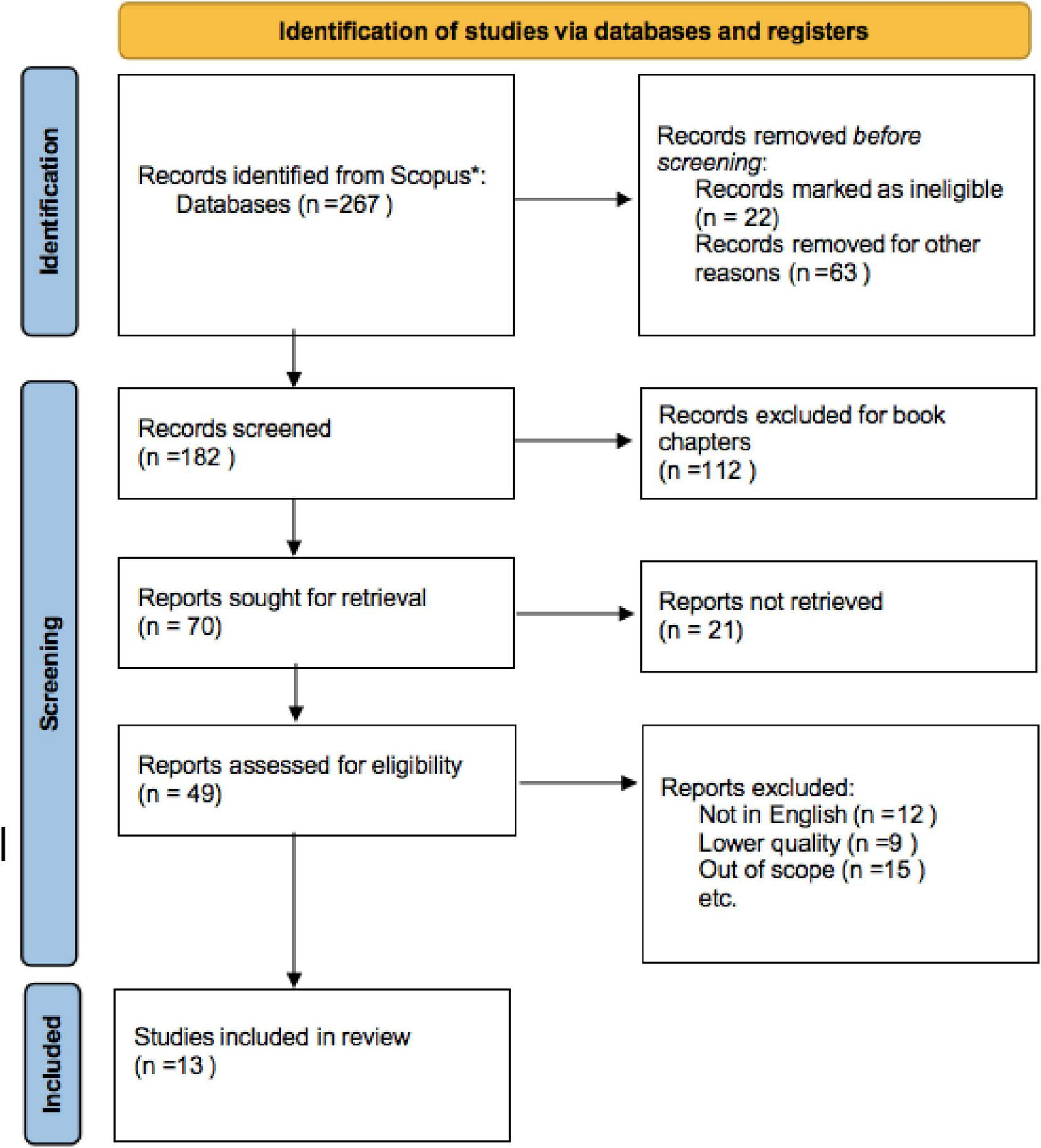
Flowchart of the literature filtering process.
Based on the exclusion criteria mentioned in the flowchart, a total of 13 relevant studies were selected from the initial pool of 267 articles identified from Scopus. The 13 studies were analyzed in detail to find about the types of language interaction and impacts. By establishing a rigorous methodology, systematic reviews minimize bias in the selection of studies and facilitate rigorous data synthesis and analysis across multiple qualitative and quantitative investigations. This analytical approach allows researchers to uncover patterns and trends within and across studies on a topic. Additionally, systematic reviews play an important role by identifying gaps in the existing research literature, thus guiding opportunities for future study. Given their comprehensive and unbiased analysis of all available high-quality evidence, systematic reviews provide valuable insight for both researchers looking to advance scientific understanding as well as practitioners and policymakers seeking reliable evidence to inform decisions. Their structured methodology yields robust conclusions regarding a research question or issue. For these reasons, systematic reviews have become influential in fields from education to healthcare to public policy (Liu and Xu, 2024).
4 Results and discussion
This section presents an analysis of the findings from selected studies on the challenges and opportunities related to higher education internationalization in China and Asia (Table 1). The issues identified across the studies in the first subsection are categorized into policy, implementation, capacity building, sociocultural, and research and assessment challenges. The second subsection offers insights and recommendations for addressing these challenges, focusing on strategies to enhance the effectiveness of internationalization efforts, including balancing global engagement with local needs, enhancing English as a Medium of Instruction (EMI) programs, and cultivating regional cooperation.
TABLE 1
| No. | Title | Authors | Objectives | Methods | Key points | Conclusions |
| 1 | Nationalizing the international in China: A phenomenological study on the purpose of international schooling in an era of regulation. | Poole and Qin (2024). | Addresses the gap in understanding how recent regulation has impacted actors at the phenomenological level beyond just institutional impacts. Gains insights into the impact of regulation on lived experiences by analyzing teachers’ understanding of international schooling. | Uses survey and in-depth interview data with teachers from an international school in China that explored their understandings of international schooling. | Explores how recent policy changes in China affect teachers’ experiences in international schools, using cosmopolitan nationalism to examine the local-global dynamic. Qualitative data was gathered to understand teachers’ views. | Regulation had little impact on teachers’ beliefs, possibly due to normalization or delayed internalization. Teachers held two views: 1) international schools as diverse alternatives, and 2) nationalism with peripheral cosmopolitanism. |
| 2 | Education hubs in a globalized world: The emergence of China. | Qu and Dai (2024). | Explores the development of education hubs in China and their role in promoting regional development. Addresses gaps in literature on education hubs in China through comparative case studies. | conduct case studies of three education hubs in China: (i) the International Collaborative Education Exemplary Zone; (ii) the International Higher Education Demonstration Zone; and (iii) the International Education Innovation Pilot Zone. | Discusses education hubs as the third generation of cross-border education initiatives enabled by internationalization. Focuses on gaps in literature on education hubs in China compared to Southeast Asia and Middle East. Conducts case studies of 3 education hubs in China: iZJU, GBA, Hainan FTP to understand their emergence and impact. | Education hubs face challenges to develop ecosystems for attracting education providers and global talent mobility. Opportunities include responding to demand for transnational education and innovation through university-industry-government partnerships. |
| 3 | Global Ambitions: Internationalization and China’s Rise as Knowledge Hub | Henry Osokpo et al. (2021) | Analyzes China’s higher education reforms and opening up from an international perspective. Places recent reforms in the context of China’s longer history of cultural exchange with other regions. | Uses historical and literature review methodologies to analyze the evolution of China’s higher education system and its internationalization. It also incorporates document analysis of policies and official reports to support its arguments. | Discusses changes in China’s higher education system over the past 4 decades since reform and opening up. Focuses on international dimensions and how this period opened Chinese’s mind to the outside world after the Cultural Revolution. Notes China’s longer history of relations with outside world through spread of Confucianism and Buddhism in earlier eras. | Reform and opening up represented not just economic/political changes but an opening of Chinese’s mind. Ongoing debates within China around incorporating outside ideas while retaining Chinese essence. China has risen as a knowledge and education hub, attracting many international students. |
| 4 | India an emerging higher education hub for South Asian countries: Globalization and internationalization essential keys for growth of South Asia | Bakhru (2019) | Examines current state of higher education in South Asia, particularly India. Discusses trends, internationalization efforts and future possibilities. Explores potential for India to emerge as an educational hub for South Asia. | Synthesizes existing data and reports to examine the current state of higher education in South Asia, with a particular focus on India. | Shows that (1) higher education is key to addressing changes from internationalization in South Asia regarding growth, poverty, competitiveness, jobs; (2) South Asia is growing exponentially but faces challenges of employability and education quality; (3) India, as the largest economy in South Asia, should take a lead role in higher education; (4) India is preferred destination for South Asian students, presenting opportunity to establish educational hub. | India is well positioned due regional demand and policies supporting internationalization. Developing world-class institutions and programs can attract more regional students. Stronger regional cooperation frameworks could facilitate India becoming education hub. |
| 5 | Internationalization and English as a Medium of Instruction in Mongolian Higher Education: A New Concept. | Gundsambuu (2019) | Examines internationalization efforts at Mongolian universities. Explores faculty views on rationales for introducing EMI. | Uses a mixed-methods approach, combining qualitative document analysis of policy documents, university reports, and conducts an online survey with faculty members. | Finds out that (1) Internationalization is forcing universities to internationalize to survive growing competition; (2) Mongolian universities plan to offer more English courses/programs to boost competitiveness, visibility in Asia; (3) Mongolia’s internationalization process and faculty perceptions of English medium instruction (EMI). | Government plays a key role in internationalization through policies and initiatives. Faculty see EMI aims to improve graduates’ English skills for global careers and boost university profile. |
| 6 | Challenges of the Japanese higher education Amidst population decline and internationalization | Yonezawa (2020) | Examines challenges of Japan’s higher education transformation amid demographic/economic changes. Analyzes government reforms and policies to promote internationalization. | Reviews historical trends and analyzing publicly available demographic and educational data to examine the impact of population decline on Japan’s higher education system. | Discovers that Japan faces demographic decline and pressure to internationalize universities due to internationalization; Points out that Government initiatives to attract international students and send domestic students abroad. Concerns about Japanese youth being inward-looking and less globally competitive. | Brain drain risks lack discussion; country appeals may decline due to aging society issues. Regional collaboration could boost attractiveness but consensus is lacking. |
| 7 | The “internationalization,” or “Englishisation,” of higher education in East Asia | Galloway et al. (2020) | Provides insights into how EMI policy is operationalized and conceptualized by stakeholders. Highlights constraints to policy implementation. | Combines questionnaires, interviews, and focus groups with students and staff at Chinese and Japanese universities to examine how EMI policy is implemented and conceptualized at institutional and classroom levels. | Examines implementation and conceptualization of English Medium Instruction (EMI) policy in Chinese and Japanese universities. | Identified environmental constraints and need for context-sensitive implementation approaches. Calls for more research on EMI trends, curriculum evaluation, and quality assurance. |
| 8 | Master’s Education in Massified, Internationalized, and Marketized East Asian Higher Education Systems. | Jung (2020). | Addresses major issues in current master’s education through country-specific case studies. Deepens understanding of master’s education trends and challenges in different contexts. | Involve shistorical and empirical approaches to examine the development and current challenges of master’s education in East Asia, focusing on issues like employability, massification, internationalization, and marketization. | Focuses on expanding master’s education and current challenges in East Asia (China, Hong Kong, Japan, South Korea, Taiwan). Describes historical backgrounds and characteristics of master’s education in these systems. Identifies new demands for master’s education in terms of employability and labor market outcomes. | Master’s education is expanding rapidly but faces issues related to massification, internationalization, and marketization. |
| 9 | Measuring what matters? mapping higher education internationalization in the Asia–Pacific | Williams and Bentley (2021) | Analyzes available internationalization indicators and data in the region. Identifies gaps and limitations in existing indicators. | Uses a structured search and review of academic and agency literatures to identify and classify publicly available indicators of internationalization in higher education across the Asia–Pacific region. | Provides snapshot of internationalization indicators in Asia-Pacific higher education. Notes focus on student mobility vs. other functions and lack of outcomes data. Discusses potential reasons for narrow measurement focus. | Current indicators provide an incomplete picture of internationalization. Broader range of indicators needed to capture diverse functions and outcomes. |
| 10 | Internationalization of higher education in Korea: policy trends toward the pursuit of the SDGs | Jon and Yoo (2021) | Analyzes trends in South Korea’s policies for internationalization of higher education. Suggests future directions toward stronger pursuit and practice of SDGs. | Uses a case study approach to analysis of relevant literature and policy documents, examines government policy trends and institutional strategies for the internationalization of higher education in Korea. | Discusses internationalization of higher education in South Korea and its relation to Sustainable Development Goals (SDGs). Notes past focus on mobility and need for more systematic/comprehensive involvement in SDGs. Presents case study analyzing government policies and institutional strategies. | Past policies focused on controlling outbound then promoting inbound mobility. Current efforts to link internationalization and SDGs need expanding and systematizing. |
| 11 | Monitoring implementation of the Tokyo Convention on recognition: a multi-stakeholder approach to the internationalization of higher education in the Asia-Pacific | Teter and Wang (2021) | Assesses implementation of the Tokyo Convention throughout Asia-Pacific. Explores approaches for monitoring the convention over time. | Involves a standardized survey sent to recognition authorities in 46 Asia-Pacific countries, with qualitative data from 27 countries analyzed to assess the implementation of the Tokyo Convention and its impact on higher education governance. | Examines the role of the Tokyo Convention for facilitating regional collaboration on international higher education in Asia-Pacific. Analyzes data from a survey of recognition authorities in the region regarding convention implementation. | A multi-stakeholder collaborative governance approach is needed for effective monitoring. Establishment of a baseline with a proposal to extend this to the Global Convention. |
| 12 | Internationalization of higher education in Vietnam: current situations, policies, and challenges | Ryu and Nguyen (2021) | Understands internationalization of higher education in Vietnam. Categorizes internationalization activities using Knight’s framework. | Involves a case study approach using detailed analysis of Vietnam’s higher education reforms, policy frameworks, and internationalization activities, supported by empirical data collected over time. | Examines internationalization of higher education in Vietnam through a case study. Analyzes reforms, policies, and internationalization activities at national and institutional levels. | Vietnam is promoting internationalization to integrate globally and support development. Challenges remain around cooperation, talent retention, and finances. |
| 13 | Internationalization and the ASEM Education Process: The Malaysian higher education experience | Munusamy and Hashim (2021) | Evaluates relationship between Malaysia’s internationalization and participation in AEP. | Uses a Likert-style questionnaire administered to 170 respondents selected through total population sampling to evaluate the relationship between Malaysia’s higher education internationalization efforts. | Examines Malaysia’s internationalization of higher education and relationship with ASEM Education Process (AEP). | Findings indicate AEP has positively supported and significantly impacted Malaysia’s internationalization. Participation in AEP should be encouraged and policies updated. |
The details of included studies.
4.1 Challenges in China and Asia
All the selected studies have discussed the challenges in China and Asia. These challenges are classified into the following categories:
Policy challenges: Managing external influences while maintaining national identity (Henry Osokpo et al., 2021).
Operationalizing SDG connections and global frameworks in national contexts (Jon and Yoo, 2021; Teter and Wang, 2021). Developing coordinated strategies and partnerships (Ryu and Nguyen, 2021).
Implementation challenges: Developing strong talent mobility ecosystems while managing brain drain/gain (Qu and Dai, 2024). Ensuring quality over quantity in EMI programs and content learning (Galloway et al., 2020). Coordinating expansion while ensuring program quality amid massification (Jung, 2020).
Capacity building challenges: Developing globally competitive English language programs and faculty proficiency (Gundsambuu, 2019). Addressing quality, access and institutional capacity issues across diverse systems (Bakhru, 2019). Sustaining participation in regional initiatives and optimizing benefits (Munusamy and Hashim, 2021).
Sociocultural challenges: Overcoming inward-looking tendencies of youth (Yonezawa, 2020). Standardizing qualifications while reducing cross-border mobility barriers (Bakhru, 2019).
Research and assessment challenges:
Understanding phenomenological impacts of policy changes (Poole and Qin, 2024). Measuring diverse functions and developing meaningful outcome indicators (Williams and Bentley, 2021). Establishing effective monitoring mechanisms (Teter and Wang, 2021).
4.2 Suggestions for handling the challenges of internationalizing higher education
The review revealed several key challenges to higher education internationalization in Asia, especially in China, particularly related to EMI implementation, balancing global and local needs, and coordination across diverse systems. Based on these findings, several suggestions emerge for addressing the challenges. For example, we can conduct further qualitative research that engages with multiple stakeholders could help develop a richer understanding of the phenomenological impacts of policies on the ground (Poole and Qin, 2024). Strategic frameworks that sensitively integrate local needs and traditions with priorities for global engagement may help balance external influences with national identity (Henry Osokpo et al., 2021). By leveraging university-industry-government partnerships through incentive programs could help strengthen ecosystems conducive to talent mobility while mitigating issues like brain drain across dynamic conditions (Qu and Dai, 2024; Gundsambuu, 2019). Moreover, Qu and Dai (2024) consider adaptation of transnational education models leveraging digital technologies and blended learning may facilitate continued engagement amid changes to the global environment. Implementing coordinated quality assurance frameworks including systematic accreditation and qualifications recognition mechanisms could help surmount barriers to regional student and faculty mobility while enabling comparability (Bakhru, 2019). Flagship programs delivered in English with appropriate linguistic support infrastructures may attract strategic international enrollment and collaboration (Gundsambuu, 2019; Yonezawa, 2020). Forging cooperative regional agreements around key issues such as recognition of qualifications, mobility schemes, and harmonization of cross-border data standards could help address coordination challenges resulting from systemic diversity (Bakhru, 2019; Williams and Bentley, 2021). Capacity building networks and targeted knowledge exchange initiatives may also help mitigate variability in institutional quality (Bakhru, 2019; Jon and Yoo, 2021). Coordination of indicator development through multilateral platforms could support more holistic monitoring of internationalization progress overtime (Williams and Bentley, 2021). Sustained financial support paired with evaluation may aid implementation of comprehensive strategies optimized to diverse national and institutional contexts (Munusamy and Hashim, 2021; Jung, 2020). Regional consortia may increase Asia’s competitive position through collective strengths (Teter and Wang, 2021).
In addition to the challenges identified, the review reveals a notable trend toward the adoption of English as a Medium of Instruction (EMI) across various Asian countries. EMI programs have been implemented with mixed results due to the desire to enhance global competitiveness and attract international students and faculty. Institutions have increased their international visibility and collaboration opportunities, but they have also faced significant challenges for both students and faculty. Due to insufficient English proficiency, many students have difficulty comprehending and participating in EMI courses (Huang Y. et al., 2024; Yang et al., 2024), potentially negatively impacting their academic performance and overall learning experience. The quality of education is also compromised when faculty members are unable to deliver content in English effectively. As a result of these findings, it is evident that comprehensive language support systems and professional development programs are essential to the success of EMI programs.
Also, the review indicates that internationalization efforts are closely intertwined with the preservation of cultural identity in a complex manner. There is an increasing concern among Asian higher education institutions about the erosion of local languages, cultural values, and traditional knowledge systems as they strive to internationalize. China and Japan, which have strong cultural traditions, are particularly aware of this tension. According to the findings of this study, successful internationalization strategies require striking a delicate balance between global engagement and local relevance. For example, developing curricula incorporating international perspectives while preserving local cultural elements, implementing bilingual education models, and developing intercultural competencies among faculty and students could be part of this process. Further, the review stresses the need for contextualizing internationalization initiatives according to the unique needs and characteristics of each country or institution, rather than using a one-size-fits-all approach to internationalization. As policymakers and institutional leaders navigate the complex landscape of higher education internationalization in Asia, this nuanced understanding of internationalization challenges and strategies offers valuable insights.
5 Conclusion
The current research emphasizes the dual role of English education in the context of the internationalization of higher education in Asia. While English-medium instruction (EMI) courses provide students with a global perspective and competitive advantage, promoting international exchange and cooperation, they also raise concerns about cultural identity and academic quality. Particularly in some countries, students may face challenges such as insufficient language proficiency and difficulties in cultural adaptation when adjusting to the EMI environment, which can lead to a decline in academic performance and graduation rates.
The discussion section of the research indicates that the current English education policies and practices in many Asian countries still have shortcomings. For example, the professional development and training of teachers often fail to keep up with the pace of internationalization, resulting in uneven teaching quality. Furthermore, many higher education institutions lack effective support systems to provide students with the necessary language and cultural adaptation support. These issues not only affect the learning experiences of students but also have a negative impact on the international reputation of the institutions.
To effectively address these challenges, policymakers and higher education institutions need to focus on the protection and development of local cultures while promoting internationalization. Specifically, it is recommended to take the following measures: First, enhance the quality of English education by providing more language support and cultural training to help students adapt better to the EMI environment; Second, encourage diversified international collaboration and establish a more balanced student mobility mechanism to ensure a reasonable ratio of incoming and outgoing students; Finally, emphasize the maintenance of cultural identity by incorporating local culture into the curriculum and campus activities to promote student understanding and appreciation.
Furthermore, the research also highlights the importance of transnational educational cooperation, especially in the establishment of education centers and international schools. Through these platforms, students can not only access high-quality educational resources but also develop their adaptability and cross-cultural communication skills in a multicultural environment.
Future research should further explore how to strike a balance between internationalization and local culture to promote more inclusive and sustainable educational development. Additionally, the research should focus on the unique challenges and opportunities faced by different countries and regions in the internationalization process, in order to provide more targeted recommendations and solutions for policymakers and educators. Such efforts could significantly enhance the internationalization of higher education in Asia and promote the comprehensive development of students and the sustainable growth of society. True internationalization requires a deep respect for cultural diversity, integrating varied cultural perspectives to cultivate talent equipped for success in a globalized world.
Statements
Data availability statement
The original contributions presented in this study are included in this article/supplementary material, further inquiries can be directed to the corresponding author.
Author contributions
PS: Conceptualization, Funding acquisition, Methodology, Project administration, Writing – review and editing. HH: Conceptualization, Formal analysis, Methodology, Software, Writing – original draft, Writing – review and editing. RL: Conceptualization, Methodology, Writing – original draft. JH: Writing – review and editing, Validation, Investigation.
Funding
The author(s) declare that financial support was received for the research, authorship, and/or publication of this article. This research project is supported by the Faculty of Liberal Arts, Mahidol University, of the fiscal year 2024.
Conflict of interest
The authors declare that the research was conducted in the absence of any commercial or financial relationships that could be construed as a potential conflict of interest.
Publisher’s note
All claims expressed in this article are solely those of the authors and do not necessarily represent those of their affiliated organizations, or those of the publisher, the editors and the reviewers. Any product that may be evaluated in this article, or claim that may be made by its manufacturer, is not guaranteed or endorsed by the publisher.
References
1
Afzal A. Khan S. Daud S. Ahmad Z. Butt A. (2023). Addressing the digital divide: Access and use of technology in education.J. Soc. Sci. Rev.3883–895. 10.54183/jssr.v3i2.326
2
Alexander B. (2020). Academia Next: The Futures of Higher Education.Baltimore, MD: Johns Hopkins University Press.
3
Ardakani F. B. Yarmohammadian M. H. Abari A. A. F. Fathi K. (2011). Internationalization of higher education systems.Procedia Soc. Behav. Sci.151690–1695. 10.1016/j.sbspro.2011.03.353
4
Aydin M. (2021). Does the digital divide matter? Factors and conditions that promote ICT literacy.Telemat. Inform.58:101536. 10.1016/j.tele.2020.101536
5
Bakhru K. M. (2019). India an emerging higher education hub for South Asian countries: Globalisation and internationalisation essential keys for growth of South Asia.Int. J. Bus. Global.23:497. 10.1504/IJBG.2019.104831
6
Cantwell B. Platonova D. Froumin I. (2023). “Understanding the contributions of higher education through the politics of reform,” in Assessing the Contributions of Higher Education, (Cheltenham: Edward Elgar Publishing), 218–242. 10.4337/9781035307173.00021
7
Carvalho N. Rosa M. J. Amaral A. (2023). Cross-border higher education and quality assurance. Results from a systematic literature review.J. Stud. Int. Educ.27695–718. 10.1177/10283153221076900
8
Chakraborty A. (2021). Foreign partnership in Indian higher education: Significance, challenges and concerns.Global. Soc. Educ.19579–592. 10.1080/14767724.2020.1861439
9
Dang T. K. A. Nguyen H. T. M. Le T. T. T. (2013). The impacts of globalisation on EFL teacher education through English as a medium of instruction: An example from Vietnam.Curr. Issues Lang. Plan.1452–72. 10.1080/14664208.2013.780321
10
Dimmock C. Walker A. (2005). Educational leadership in a globalising world: New intellectual challenges.Int. J. Educ. Manag.19532–539.
11
Dlaska A. (2012). From politics to policy: Rethinking the relationship between language centres and Modern Foreign Language departments.Lang. Learn. High. Educ.1287–299. 10.1515/cercles-2011-0022
12
Galloway N. Numajiri T. Rees N. (2020). The ‘internationalisation’, or ‘Englishisation’, of higher education in East Asia.High. Educ.80395–414. 10.1007/s10734-019-00486-1
13
Geibel W. R. (2020). A pedagogy of student mobility: Facilitating humanistic outcomes in internationalization and student mobility.J. Comp. Int. High. Educ.1267–77. 10.32674/jcihe.v12iSpring.1271
14
Gundsambuu S. (2019). Internationalization and English as a medium of instruction in Mongolian higher education: A new concept.J. Lang. Educ.548–66. 10.17323/jle.2019.8481
15
Haddaway N. R. Page M. J. Pritchard C. C. McGuinness L. A. (2022). PRISMA2020: An R package and Shiny app for producing PRISMA 2020-compliant flow diagrams, with interactivity for optimised digital transparency and Open Synthesis. Campbell Syst. Rev. 18:e1230. 10.1002/cl2.1230
16
He R. Xu W. Dong D. Yu Z. (2024). A Meta-analysis of the Effect of interactive technologies on language education.Int. J. Adult Educ. Technol.151–28. 10.4018/IJAET.340933
17
Hellmich E. A. (2018). Language in a global world: A case study of foreign languages in U.S. K–8 education.Foreign Lang. Annals51313–330. 10.1111/flan.12333
18
Henry Osokpo O. James R. Riegel B. (2021). Maintaining cultural identity: A systematic mixed studies review of cultural influences on the self-care of African immigrants living with non-communicable disease. J. Adv. Nurs. 77, 3600–3617. 10.1111/jan.14804
19
Hu H. Li F. Luo Z. (2024). The evolution of China’s English education policy and challenges in higher education: Analysis based on LDA and Word2Vec.Front. Educ.9:1385602. 10.3389/feduc.2024.1385602
20
Huang X. Xu W. Li F. Yu Z. (2024). A meta-analysis of effects of automated writing evaluation on anxiety, motivation, and second language writing skills. The Asia-Pacific Education Researcher. 10.1007/s40299-024-00865-y
21
Huang Y. Xu W. Sukjairungwattana P. Yu Z. (2024). Learners’ continuance intention in multimodal language learning education: An innovative multiple linear regression model.Heliyon10:e28104. 10.1016/j.heliyon.2024.e28104
22
Itoi K. Mizukura R. (2024). Experience of Japanese exchange students in EMI programmes: Benefits and issues of translanguaging.Int. J. Multiling.211434–1453. 10.1080/14790718.2023.2177652
23
Jon J. E. Yoo S. S. (2021). Internationalization of higher education in Korea: Policy trends toward the pursuit of the SDGs.Int. J. Comp. Educ. Dev.23120–135. 10.1108/IJCED-10-2020-0073
24
Jung J. (2020). Master’s education in massified, internationalized, and marketized East Asian higher education systems.High. Educ. Policy33613–618. 10.1057/s41307-020-00215-9
25
Le Ha P. (2013). Issues surrounding English, the internationalisation of higher education and national cultural identity in Asia: A focus on Japan.Crit. Stud. Educ.54160–175. 10.1080/17508487.2013.781047
26
Li M. (2007). Foreign language education in primary schools in the People’s Republic of China.Curr. Issues Lang. Plan.8148–160. 10.2167/cilp113.0
27
Lien D. Miao L. (2023). International student mobility to China: The effects of government scholarship and Confucius Institute. Int. J. Chinese Educ. 12:2212585X231213787. 10.1177/2212585X2312137
28
Liu W. (2023). The role of English education in China’s shifting national identity.Asian Englishes25421–434. 10.1080/13488678.2022.2033906
29
Liu Z. Xu W. (2024). Unveiling the power of social interactions: A systematic review of student experiences in informal learning space.Environ. Soc. Psychol.91–10. 10.54517/esp.v9i1.1867
30
Mello R. Erro-Garcés A. Dickmann M. Brewster C. (2023). A potential paradigm shift in global mobility? The impact of the COVID-19 pandemic.Int. Bus. Rev.34:102245. 10.1016/j.ibusrev.2023.102245
31
Mello U. (2022). Centralized admissions, affirmative action, and access of low-income students to higher education.Am. Econ. J. Econ. Policy14166–197. 10.1257/pol.20190639
32
Munusamy M. M. Hashim A. (2021). Internationalisation and the ASEM Education Process: The Malaysian higher education experience.High. Educ. Q.75500–516. 10.1111/hequ.12282
33
Ng S. W. (2012). Rethinking the mission of internationalization of higher education in the Asia-Pacific region.Compare J. Comp. Int. Educ.42439–459. 10.1080/03057925.2011.652815
34
Nurshatayeva A. Page L. C. (2020). Effects of the shift to english-only instruction on college outcomes: Evidence from Central Asia.J. Res. Educ. Effect.1392–120. 10.1080/19345747.2019.1652711
35
Park S. Kim S.-Y. Lee H. Kim E. G. (2022). Professional development for English-medium instruction professors at Korean universities.System109:102862. 10.1016/j.system.2022.102862
36
Poole A. Qin Y. (2024). Nationalising the international in China: A phenomenological study on the purpose of international schooling in an era of regulation.Br. Educ. Res. J.50367–384. 10.1002/berj.3932
37
Qu L. Dai Y. (2024). Education hubs in a globalized world: The emergence of China.Int. J. Educ. Dev.104:102959. 10.1016/j.ijedudev.2023.102959
38
Quaicoe J. S. Pata K. (2020). Teachers’ digital literacy and digital activity as digital divide components among basic schools in Ghana.Educ. Inform. Technol.254077–4095. 10.1007/s10639-020-10158-8
39
Reinders S. Dekker M. Falisse J. B. (2021). Inequalities in higher education in low-and middle-income countries: A scoping review of the literature.Dev. Policy Rev.39865–889. 10.1111/dpr.12535
40
Rose H. McKinley J. (2018). Japan’s English-medium instruction initiatives and the globalization of higher education.High. Educ.75111–129. 10.1007/s10734-017-0125-1
41
Ryu J. H. Nguyen A. T. (2021). Internationalization of higher education in Vietnam: Current situations, policies, and challenges.Int. J. Comp. Educ. Dev.23227–241. 10.1108/IJCED-10-2020-0074
42
Shafaei A. Abd Razak N. Nejati M. (2016). Integrating two cultures successfully: Factors influencing acculturation attitude of international postgraduate students in Malaysia.J. Res. Int. Educ.15137–154. 10.1177/1475240916653566
43
Shimmi Y. Yonezawa A. (2015). Japan’s “top global university” project. Int. Higher Educ. 27–28. 10.6017/ihe.2015.81.8742
44
Shin J. C. Harman G. (2009). New challenges for higher education: Global and Asia-Pacific perspectives.Asia Pacific Educ. Rev.101–13. 10.1007/s12564-009-9011-6
45
Snodin N. (2019). Mobility experiences of international students in Thai higher education.Int. J. Educ. Manag.331653–1669. 10.1108/IJEM-07-2018-0206
46
Teter W. R. Wang L. (2021). Monitoring implementation of the Tokyo Convention on recognition: A multi-stakeholder approach to the internationalization of higher education in the Asia-Pacific.Int. J. Comp. Educ. Dev.23157–174. 10.1108/IJCED-10-2020-0075
47
Thi Thu Le H. Le Minh C. Tran T. Thi Nghiem T. Thanh Nguyen H. Duc La M. et al (2024). Internationalization of higher education in Asia: A bibliometric analysis based on Scopus database from 2003 to 2022.Cogent Educ.111–14. 10.1080/2331186X.2024.2322892
48
Varghese N. V. Panigrahi J. (2023). “Innovations in financing of higher education: An overview,” in Financing of Higher Education: Traditional Approaches and Innovative Strategies, edsVargheseN.PanigrahiJ. (Singapore: Springer), 1–13. 10.1007/978-981-19-7391-8_1
49
Xu W. Sukjairungwattana P. (2022). The study of Macau’s higher education 1999-2019.Front. Educ.7:898238. 10.3389/feduc.2022.898238
50
Yang S. Xu W. Liu R. Yu Z. (2024). Influencing and moderating variables in informal digital learning of English through a structural equation model.Comput. Assist. Lang. Learn.1–36. 10.1080/09588221.2023.2280645
51
Yonezawa A. (2020). Challenges of the Japanese higher education amidst population decline and globalization. Glob. Soc. Educ. 18, 43–52. 10.1080/14767724.2019.1690085
52
Yu Z. Xu W. Sukjairungwattana P. (2024). A meta-analysis of eight factors influencing MOOC-based learning outcomes across the world.Interact. Learn. Environ.32707–726. 10.1080/10494820.2022.2096641
53
Wang Y. Xu W. Guan K. Zhao J. Wu P. (2024). English teachers’ post-pandemic motivation in Macau’s higher education system. Theory Pract. Lang. Stud. 14, 1990–2001. 10.17507/tpls.1407.05
54
Williams K. E. Bentley L. A. (2021). Latent profiles of teacher-reported self-regulation and assessed executive function in low-income community preschools: Relations with motor, social, and school readiness outcomes. Front. Psychol.12:708514. 10.3389/fpsyg.2021.708514
Summary
Keywords
internationalization, higher education, English education, cultural identity, globalization
Citation
Sukjairungwattana P, Hu H, Liu R and Huang J (2025) From local to global: systematically reviewing higher education internationalization in Asia. Front. Educ. 9:1473820. doi: 10.3389/feduc.2024.1473820
Received
31 July 2024
Accepted
18 November 2024
Published
10 January 2025
Volume
9 - 2024
Edited by
Priscilla Roberts, University of Saint Joseph, Macao, SAR, China
Reviewed by
Wahyu Widada, University of Bengkulu, Indonesia
Yamina El Kirat El Allame, Mohammed V University in Rabat, Morocco
Yi Yan, China University of Petroleum, China
Carola Herrera, University of Antofagasta, Chile
Updates
Copyright
© 2025 Sukjairungwattana, Hu, Liu and Huang.
This is an open-access article distributed under the terms of the Creative Commons Attribution License (CC BY). The use, distribution or reproduction in other forums is permitted, provided the original author(s) and the copyright owner(s) are credited and that the original publication in this journal is cited, in accordance with accepted academic practice. No use, distribution or reproduction is permitted which does not comply with these terms.
*Correspondence: Haiyang Hu, 429359152sea@gmail.com
Disclaimer
All claims expressed in this article are solely those of the authors and do not necessarily represent those of their affiliated organizations, or those of the publisher, the editors and the reviewers. Any product that may be evaluated in this article or claim that may be made by its manufacturer is not guaranteed or endorsed by the publisher.