Abstract
Introduction:
The outbreak of COVID-19 introduced unprecedented uncertainty worldwide, with South Africa being no exception. There is a paucity of information on the impacts of academic adjustment and fear of COVID-19 among undergraduate students in a new university environment. This study aimed to examine the relationship between academic adjustment and fear of COVID-19 among undergraduate students enrolled at a South African University.
Methods:
A cross-sectional correlational research design was employed, utilizing web-based questionnaires that combined the Academic Adjustment Scale and the Fear of COVID-19 Scale. The theoretical framework used was the self-transcendence theory, supported by theoretical perspectives on adjustment and differential susceptibility theories. A total of 501 participants were selected through simple random sampling. Data were analyzed using descriptive and inferential statistics, including simple linear regression correlation analysis and multivariate analysis of variance.
Results:
Fear of COVID-19 showed a significant positive correlation with academic adjustment (r = 0.17, p < 0.001). Additionally, fear of COVID-19 was positively correlated with dimensions of academic adjustments, specifically academic achievement (r = 0.19, p < 0.001) and academic motivation (r = 0.20, p < 0.001).
Discussion:
The study concluded that there was a significant positive correlation between fear of COVID-19 and academic adjustment. Therefore, it is crucial to implement interventions aimed at continuously enhancing students' academic adjustment as a seamless process.
1 Introduction
Globally, outbreaks of infectious diseases can lead to a rise in mental health difficulties among the people affected and the sub-groups of the population that are at an elevated risk of mental health problems. Students, among other subgroups, were also affected academically during the coronavirus disease (COVID-19) pandemic (Gittings et al., 2021). On 30 January 2020, the World Health Organization (WHO) declared a public health emergency of international concern regarding the outbreak of severe acute respiratory syndrome coronavirus 2 (SARS-CoV-2), which causes the disease known as COVID-19. Shortly after the declaration by the WHO, thousands of cases were reported in different countries (Solomou and Constantinidou, 2020). Due to the rapidly pervasive nature of the virus, the WHO declared COVID-19 a pandemic on 11 March 2020. The outbreak of COVID-19 resulted in immediate uncertainty among the developed and developing countries, given the daily statistical reports.
Africa's vulnerability to pandemics has been proven (Adagbada et al., 2012; Dzinamarira et al., 2020). The COVID-19 pandemic served as an alert for developing countries with the existing poor healthcare systems struggling to handle high infectious diseases (Lone and Ahmad, 2020). Additionally, Southern Africa's winter “flu” season makes the continent more vulnerable during this current pandemic (COVID-19). The infectious Disease Vulnerability Index (IDVI) showed that among the 25 countries which are the most vulnerable to infectious diseases, 22 are African countries (Lone and Ahmad, 2020). South Africa is no exception to the above-mentioned African countries. Therefore, it is reasonably fair to hypothesize that the majority of the African population will be at high risk of COVID-19 due to their vulnerability to infectious diseases.
The first case of COVID-19 was confirmed on 5 March 2020 in South Africa; 18 days later, 402 cases were identified (Mushayabasa et al., 2020). The South African government then implemented a total shutdown (Abdool-Karim, 2020). This adversely impacted the country's health system, economic system, educational system, food security and many other sectors (Bakalis et al., 2020; Ozili, 2020; Akseer et al., 2020). Students were also affected because of unplanned closures of higher education institutions. In addition, at the undergraduate and postgraduate levels, several higher education institutions had to scramble to place study materials online for students to adjust academically (Kuhfeld et al., 2020). As required, contact universities had to develop innovative and flexible ways to offer theory and practical components to students, and find alternative forms of formative (and most likely summative) assessment (Hedding et al., 2020). This implied that there had to be academic adjustment for the students, and a new method of teaching and learning was introduced. However, academic staff at contact universities, such as the North-West University (NWU), typically have little, if any, experience or training in the pedagogy or delivery of online learning, since they are used to contact teaching and learning methods (Lapitan et al., 2021). Thus, academics with teaching responsibilities had to upskill and familiarize themselves quickly with online learning platforms and all that it entailed, including increased curricular administration (Hedding et al., 2020).
Instant and drastic changes to the educational system came with the demand of adjustment to the new learning methods adopted by universities. The impact of the new normal on students' academic adjustment has been, and continues to be, a concern. Many students were not accustomed to online learning (Dianito et al., 2021). Moreover, the lack of academic resources (such as the access to library, internet and computers) impacted students adversely. Insufficient social support as a result of students' locations when total shutdown was announced added to the lockdown implications on student adjustment processes (Singh et al., 2020).
Adjustment is known as the process of acclimatizing or becoming used to a new situation (Cambridge Advanced Learner's Dictionary, 2008), while academic adjustment is the ability to adjust to university life, including the teaching and learning methods of that university (Ratelle et al., 2017). Furthermore, academic adjustment is a continuous development of learning and coping strategies aimed at achieving academic success. In the current study, academic adjustment was referred to as the capability of full-time students to adjust to remote learning in their homes or residences during the COVID-19 pandemic. With regard to academic adjustment, research suggested that there are adjustment issues as a result of the transition from high school to university (Alfawaz et al., 2021). Amidst the already documented challenges posed by the said transition, the question to ask is how many more challenges will students face as a result of the new norms of teaching? Hence, this study aimed to investigate the academic adjustment of students during the COVID-19 pandemic. Specifically, this study sought to answer the following research question: How did the COVID-19 pandemic impact the academic adjustment of undergraduate university students in South Africa?
The remainder of this paper is structured as follows: First, a comprehensive literature review examines existing research on academic adjustment, and the impact of COVID-19 on university students. Next, the materials and methods section detail the research design, participants, measures, and data analysis procedures employed in this study. The results section presents the findings of the statistical analyses. Finally, the discussion interprets these results in light of previous research and theory, followed by a conclusion summarizing the key findings, implications and recommendations of the study.
2 Literature review
Adjustment is thought to occur continuously in response to internal pressures and environmental demands, but special problems arise when these demands become excessive—when an individual is exposed to stressful conditions. Furthermore, it highlights that an individual must be able to adjust to changes in their physical, social and professional environments (MacArthur et al., 2015; Lazarus, 1961). Adjustment is, in other words, the behavioral process of reconciling contradictory expectations or needs that are inhibited by environmental difficulties (Campbell, 2006). On a daily basis, people and animals adjust to their surroundings. However, adjustment may differ from person to person and animal to animal in terms of duration; the longer it takes for adjustment to occur can be indicative of maladjustment. For students, that would be academic maladjustment such as the inability to attend online classes and failure to submit online assessments during COVID-19.
The current study used self-transcendence theory to understand students' academic adjustment and psychological wellbeing (PWB) during the COVID-19 pandemic. The self-transcendence theory provided a human capacity to expand the personal boundaries of the participants in many ways; for instance, participants' intrapersonal and interpersonal skills to connect with the study and nature with a purpose beyond self. This theory facilitates understanding of how wellbeing mediates between relationships and experiences. This theory provided a lifespan developmental perspective of undergraduate students, as well as environmental process of health and wellbeing (Reed, 2008, 2010; Reed and Haugan, 2021; Abreu et al., 2023). Supported by theoretical perspectives on adjustment and differential susceptibility theories, adjustment theory is evaluated using two processes, namely adjustment as an achievement and adjustment as a process. Adjustment as an achievement focuses on adjustment at a particular point in time, considering a person's adjustment to a single difficulty rather than all the obstacles they have encountered (Campbell, 2006). In this case, adjustment as an achievement refers to the academic adjustment of students during the pandemic lockdown and not all the other adjustments they had to make in their lives for adaptive functioning. It is possible to successfully adapt to one environment while yet finding it difficult to adapt to a different, unrelated scenario (Campbell, 2006). For example, students may have found it easy to adapt to the university life without any difficulty but had problems adapting to the pandemic lockdown and accepting the pandemic as their new reality, hence developing a fear of COVID-19. During the pandemic, students may have found it hard to study at home due to balancing their schoolwork and house chores; as a result, they had to find another place or time to study, which may have been difficult.
According to the adjustment theory, having a good adjustment is necessary for maintaining one's mental health. According to Gibbons et al. (2019), an individual who is well-adjusted has sound judgment, is reasonable and does not exhibit unusual or challenging behavior. Adjustment is a continuum rather than a clear dichotomy (Gibbons et al., 2019). People can change and become competent at adapting in various situations. Although previous studies revealed that adjusting to the pandemic was challenging, the undergraduate students gave it their all and completed their academic year to advance to the next academic level (Besser et al., 2022; Alea et al., 2020).
Sub-Saharan Africa experienced endless challenges academically during the lockdown era. For example, Oyediran et al. (2020) reported that the shutdown of learning institutions affected around 46 million Nigerian pupils. As a result of the COVID-19 epidemic, all schools from primary to higher level of education were closed, leaving pupils stranded at home (Owusu-Fordjour et al., 2020). Similar observations were recorded in South Africa, where approximately 12 million children were in grades 1–12 (Amin and Mahabeer, 2021), and South African universities and institutes of higher learning experienced an unprecedented shift to online learning and rotational learning in 2020 with limited access to campus. There was a struggle to get the academic network (staff and students) to embrace this transition in the absence of a formal online curriculum (Govender et al., 2021; Sahu, 2020). In South Africa, students are challenged by technical operational obstacles such as poor connectivity and data limitations and/or accompanied by issues related to poor housing conditions (Dube, 2020). Personal issues such as unplanned pregnancy, substance use, depression and other mental health problems also posed challenges (Van der Walt et al., 2020).
3 Materials and methods
3.1 Study approach
A quantitative study approach was used to investigate academic adjustment during the COVID-19 pandemic among undergraduate university students in the 2020 academic year. Saunders et al. (2009) reported that quantitative methods emphasize objective measurement and statistical, mathematical or numerical analysis by influencing pre-existing statistical data using computational techniques. A cross-sectional research design was adopted to examine the association between academic adjustment and fear of COVID-19 of students during the COVID-19 pandemic. A cross-sectional research design was used in the study because the participant's exposure was measured at one point in time. It measures two or more factors to determine or estimate the extent to which the values for the factors (sociodemographic) are related or change in an identifiable pattern (Flesch, 2015). Moreover, the study examined the relationship among two variables (academic adjustment and fear of the COVID-19 pandemic).
3.2 Study area
This study was conducted at the NWU, South Africa. NWU is one of the higher learning institutions in South Africa with a high enrolment rate; in 2018, the NWU was the second-largest university in South Africa, based on the total headcount of the 61,212 students enrolled in 2018; a total of 17,794 were distance students. Furthermore, this institution is located within two provinces, namely North West and Gauteng provinces. Students formed part of vulnerable groups that were affected by COVID-19. Findings on studies suggested that factors such as online learning and adjustment to online learning increased students' stress during COVID-19 (Cena et al., 2023; Marler et al., 2021). Similarly, students worldwide were affected by the transition to online learning, of which South African students are no exception (Van Niekerk and Van Gent, 2021).
3.3 Target population
According to Goddard and Melville (2004), the population is the total set or group or people to whom the findings of the survey are to be generalized. The current study targeted undergraduate students from all three NWU campuses (Potchefstroom, Mahikeng, and Vanderbijlpark) who were registered for full-time courses in 2020. The sample included second- to fourth-year students.
3.4 Sampling method
Simple random sampling was adopted in the current study (Taherdoost, 2016; Marczyk et al., 2005). Simple random sampling was an advantageous technique because of its capacity to generate knowledge in the field of interest from more knowledgeable others (Creswell and Creswell, 2017). Undergraduate students were sampled through a random process so that each person remaining in the population had the same probability of being selected for the sample. There was an advertisement period to recruit prospective participants for a month prior to collecting data. The permission to post the questionnaire link (https://forms.gle/ZARKf5Drxc4CKBRN8) on eFundi (NWU online learning platform/course management system) was gained from the Research Data Gatekeeper Committee (RDGC) because permission to access the students would have already been granted. The questionnaires were converted into web-based Google Forms questionnaire (https://forms.gle/ZARKf5Drxc4CKBRN8). The study was conducted online, allowing participants to engage from the comfort of their homes, university residence rooms or off-campus accommodations. Participants were informed of the voluntary nature of participation, and willing participants provided consent while confidentiality was maintained.
3.4.1 Sample inclusion criteria
Inclusion criteria is a composition of the study which identifies the study population in a consistent, reliable and objective way (Saunders et al., 2009; Garg, 2016). NWU undergraduate students who were, at that time, registered for full-time courses in 2020 were selected; all undergraduate students were included in the study because the COVID-19 pandemic was still ongoing and thus affected second- to fourth-year students. The study solely concentrates on the undergraduate students and their academic adjustment during the COVID-19 pandemic. The academic adjustment, and fear of COVID-19 of the undergraduate students during the COVID-19 pandemic was assessed. Students participating in this study were efficient in reading and understanding English, as the informed consent form and online questionnaires were written in English. English is one of the mediums of communication and instruction across the three NWU campuses (Potchefstroom, Mahikeng and Vanderbijlpark).
3.4.2 Sample exclusion criteria
According to Creswell and Creswell (2017), exclusion criteria include the characteristics of the population which are ineligible for the study. The exclusion also refers to the participants who will not be included in the study or withdraw after being included (Garg, 2016). In this study, postgraduate students (from honors to doctoral levels) were excluded as they are typically more adjusted to university life and better equipped to manage their academics despite changes in teaching methods.
3.5 Sample size
Yamane's sample size formula was adopted to draw a sample from the study population (Ikehi et al., 2019; Yamane, 1967). The total number of undergraduate students at NWU was 46,716, distributed across Mahikeng campus (13,291), Potchefstroom campus (26,479), and Vanderbijlpark campus (6,946). Calculated according to campuses we sampled Mahikeng campus had 114, Potchefstroom campus was 277 and Vanderbijlpark campus were 59 students. Therefore, from the 46,716 registered NWU undergraduate students, 400 participants were selected. This sampling technique was time-cautious and financially effective compared to a census study whereby every member of a population is included (Kothari, 2004). In addition, the study increased the sample size to 450 participants to have a feasible and standard sample in case some participants were not cooperative in the study. However, the study garnered more interest from students than initially anticipated. The sample size was 501 participants, both males and females, and included students from all three campuses (Mahikeng, Potchefstroom and Vanderbijlpark).
3.6 Ethical procedure
Prior to presenting the study, the researcher and the supervisory team participated in ethics training (TRREE) and obtained the certificates of completion. The study was presented to the NWU Psychology Department (Mahikeng Campus). Upon approval, it was submitted to the Community Psychosocial Research (COMPRES) scientific committee. Permission to enter the student community was then requested from the Research Data Gatekeeper Committee (RDGC) of the NWU after preliminary approval had been obtained from the Health Research Ethics Committee (HREC). Once the RDGC had granted the study permission, the letter of permission from the RDGC was sent to HREC for final ethics approval.
The study made use of an online questionnaire with two sections. Section one consisted of questions that sought to obtain the participants' demographic information. Section two was based on the Academic Adjustment Scale (AAS) and used to measure the academic adjustment of students who were enrolled at NWU for the first time in 2020 (Anderson et al., 2016). This section also included measures to assess the fear of COVID-19 and its relationship to academic adjustment. The impact of COVID-19 on students' academic adjustment was measured by testing how COVID-19 and the associated fear affected the students' academic adjustment as they were transitioning to an institute of higher learning during the pandemic.
3.7 Data collection
The data were collected among 501 undergraduate students using an online platform. The validated scales were also converted into an online web-based tool using Google Forms. The participants were allowed to use their own smart cell phones, laptops or desktop computers that were connected to the internet to complete the questionnaires. The data were analyzed using the Statistical Package for the Social Sciences (SPSS version 28) on a computer in a private room at the researcher's home and at the university library (Postgraduate Research Common Room) at the NWU Mahikeng Campus. The following is a description of the scales that were converted into the aforementioned web-based questionnaire for data collection.
3.7.1 Academic adjustment scale
This measure is a nine-item scale, comprising three sub-scales. The order of the 43 items was standardized to eliminate order-effects (Anderson et al., 2016). The participants were required to indicate the level at which each question applied to them, namely: 1-Rarely applies to me, 2-Occasionally applies to me, 3-Neither does nor does not apply to me, 4-Sometimes applies to me, or 5-always applies to me.
3.7.2 Fear of Coronavirus-19 scale
In this measure, participants specified their level of agreement with the seven statements using a five-item Likert-type scale (Ahorsu et al., 2022), from 1—strongly disagree, 2—disagree, 3—neither agree nor disagree, 4—agree, and 5—strongly agree. The minimum score possible for each question is 1 and the maximum is 5. The total score adds up to an item score (ranging from 7 to 35). The higher the score, the greater the fear of COVID-19.
3.8 Data analysis
Descriptive statistics, simple linear regression correlation analysis, multivariate analysis of variance (MANOVA), and inferential statistical techniques (Fisher and Marshall, 2009; Swanepoel et al., 2018; Trafimow and MacDonald, 2017) were used to determine the relationship between variables (academic adjustment and fear of the COVID-19 pandemic). Descriptive statistics such as frequency, mean, percentage and standard deviation were computed. Additionally, inferences were made using correlations to determine the type of relationships existing among academic adjustment, and COVID-19. Both the descriptive and inferential statistical analysis techniques were employed in the current study to analyse the data, using SPSS version 28. The study utilized Pearson's correlational analysis to examine the relationship between academic adjustment and the COVID-19 pandemic. Kumar (2011) stated that the correlation research design is used to establish or determine the existence of relationship interdependence among two or more aspects of a situation.
3.9 Validity and reliability
3.9.1 Academic adjustment scale (AAS)
The reliability is very high for the entire AAS scale (Anderson et al., 2016) (0.864), which satisfies the minimum requirement of Cronbach Alpha Coefficient of 0.70, indicating satisfactory internal consistency (Anderson et al., 2016; Cronbach, 1949). According to Anderson et al. (2016), the face validity of AAS with value of p = 0.49 shows significance and is therefore valid to measure academic adjustment. Therefore, across three studies conducted by Anderson et al. (2016), it was confirmed that the factor structure supported validity and reliability hypotheses, which confirmed the AAS as the measure which is psychometrically stable. The scale has sub-scales, namely academic lifestyle, academic achievement and academic motivation. The scale, which has been validated and demonstrated an internal consistency of 0.79 in a South African context, is particularly suitable for use in this setting (Akanni and Oduaran, 2018). The scale was obtained from the internet and is freely available for use. The current study reported Cronbach alpha coefficients of 0.70, this shows that the scale is reliable and valid in a South African context.
3.9.2 Fear of Coronavirus-19 scale
In this measure, participants specified their level of agreement with the seven statements using a five-item Likert-type scale [45], from 1—strongly disagree, 2—disagree, 3—neither agree nor disagree, 4—agree, and 5—strongly agree (Ahorsu et al., 2022). The minimum score possible for each question is 1 and the maximum is 5. The total score adds up to an item score (ranging from 7 to 35). The higher the score, the greater the fear of COVID-19. All reliability coefficients had positive correlations and the Amharic (language) version of the scale had satisfactory psychometric properties. The current study reported Cronbach alpha coefficients of 0.80, this shows that the scale is reliable and valid in a South African context.
4 Results
4.1 Socio-economic characteristics of the participants
In the study, the socio-economic characteristics that were considered included age, home language, current level of study, faculty and campus location. As indicated in Table 1, the participants were grouped into four age groups, with the majority (52.5%) of the participants aged between 18 and 21 years. Approximately 33.73% of the participants were third-year students. About 20.76% of the participants were majoring in the Faculty of Education, and about 38.4% of the participants were from the Potchefstroom campus, which is the largest campus in the university population.
Table 1
| Parameter | Frequency | Percentage (%) |
|---|---|---|
| Age (years) | ||
| 18–21 | 263 | 52.6 |
| 22–25 | 187 | 37.4 |
| >25 | 50 | 10 |
| Current level of study | ||
| First year | 137 | 27.15 |
| Second year | 118 | 23.55 |
| Third year | 167 | 32.73 |
| Fourth year | 83 | 16.57 |
| Faculty | ||
| Economic and management sciences | 119 | 23.75 |
| Education | 104 | 20.76 |
| Humanities | 93 | 18.57 |
| Natural Sciences | 81 | 16.17 |
| Health Sciences | 49 | 9.78 |
| Law | 45 | 8.98 |
| Engineering | 6 | 1.20 |
| Theology | 4 | 0.80 |
| Campus location | ||
| Potchefstroom | 192 | 38.4 |
| Mahikeng | 171 | 34.2 |
| Vanderbijlpark | 137 | 27.4 |
Demographics of the participants.
4.2 Descriptive statistics and correlations
4.2.1 Zero-order correlations among study variables
The results of Pearson's correlations are displayed in Table 2. Fear of COVID-19 was positively correlated with PWB (r = 0.22, p < 0.001) and academic adjustment (r = 0.17, p < 0.001). In addition, the fear of COVID-19 was positively correlated with dimensions of academic adjustments, which include academic achievement (r =0.19, p < 0.001) and academic motivation (r = 0.20, p < 0.001). However, there was no significant relationship between fear of COVID-19 and academic lifestyle (r = 0.00, p = 0.99).
Table 2
| N = 501 | 1 | 2 | 3 | 4 | 5 | 6 | 7 | 8 |
|---|---|---|---|---|---|---|---|---|
| Mean | - | - | 18.36 | 45.68 | 35.81 | 10.68 | 11.70 | 13.43 |
| SD | - | - | 7.98 | 7.77 | 5.36 | 2.53 | 2.71 | 1.94 |
| α | - | - | 0.91 | 0.86 | 0.68 | 0.39 | 0.78 | 0.30 |
| Sex (1) | - | - | ||||||
| Age (2) | −0.17** | - | ||||||
| Fear of COVID-19 (3) | 0.07 | 0.05 | - | |||||
| Academic adjustment (5) | −0.003 | 0.07 | 0.17** | 0.52** | - | |||
| Academic lifestyle (6) | −0.05 | 0.08 | 0.00 | 0.32** | 0.75** | |||
| Academic achievement (7) | −0.03 | 0.05 | 0.19** | 0.51** | 0.84** | 0.45** | - | |
| Academic motivation (8) | 0.10* | 0.02 | 0.20** | 0.32** | 0.61** | 0.15** | 0.34** | - |
Summary of correlations and descriptive statistics among focal variables.
**p < 0.001; *p < 0.01: Gender (0 = male, 1 = female).
Fear of COVID-19 is significantly associated with the dimensions of academic adjustments of undergraduate NWU students. Simple linear regression analysis was used to test this hypothesis. The dimensions of academic adjustment, which include academic lifestyle, academic achievement and academic motivation, were regressed onto fear of COVID-19. The standardized estimates are presented in the model shown in Table 3.
Table 3
| High % | Low % | |
|---|---|---|
| Academic lifestyle | 54.7 | 45.3 |
| Academic achievement | 60.1 | 39.9 |
| Academic motivation | 61.5 | 38.5 |
| Academic adjustment | 56.9 | 43.1 |
| Fear of COVID-19 | 52.8 | 47.7 |
The percentage of high and low scores on study variables.
Results showed that fear of COVID-19 was significantly associated with academic achievement (β = 0.19, p < 0.001) and academic motivation (β = 0.19, p < 0.001) but not academic lifestyle (β = 0.00, p = 0.99). Specifically, high fear of COVID-19 was associated with high levels of academic achievement and academic motivation. Fear of COVID-19 accounted for 3% and 4% variance in academic achievement and academic motivation respectively (Figure 1).
Figure 1
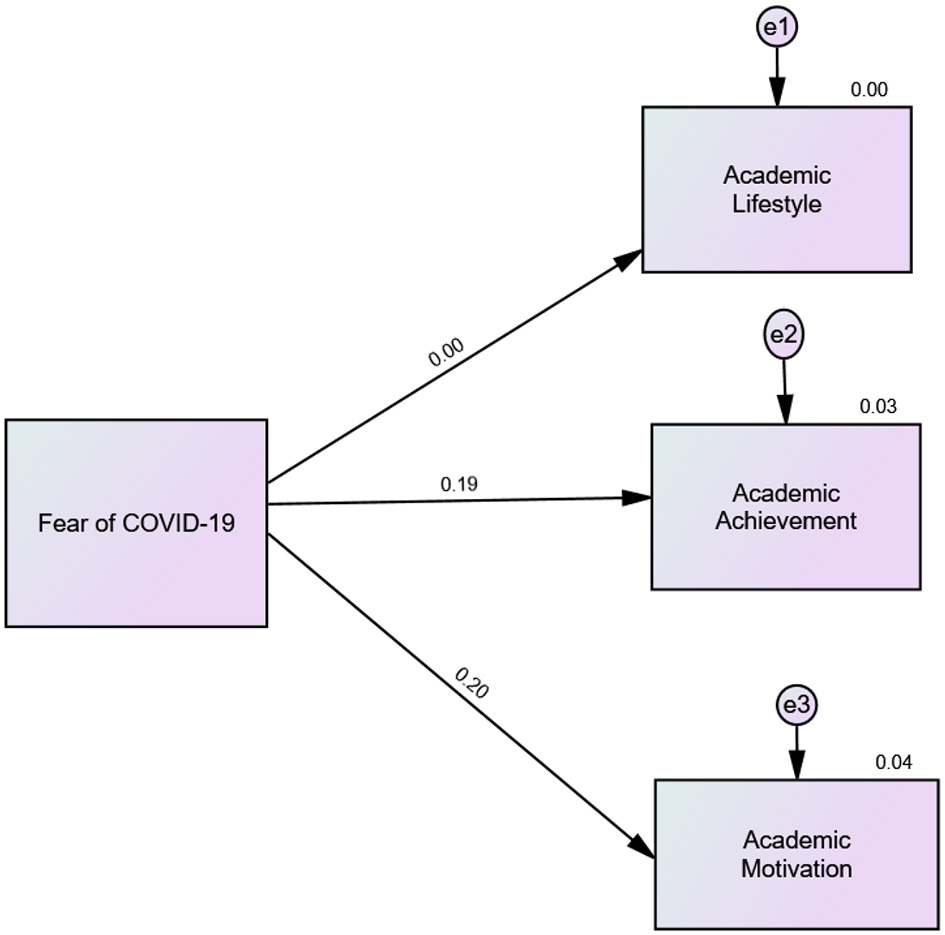
Association of fear of COVID-19 with the dimensions of academic adjustment.
Table 4 shows a three-way MANOVA testing the influence of sex, level of study and campus location on dimensions of academic adjustments. Results showed that gender [Wilks' ∧ = 0.98, F(3,492) = 2.60, p = 0.05 multivariate η2 = 0.016] and level of study [Wilks' ∧ = 0.96, F(9,1198) = 2.46, p = 0.009, multivariate η2 = 0.015] were significant on the combined dimensions of academic adjustment while campus location [Wilks' ∧ = 0.99, F(6,984) = 1.05, p = 0.39, multivariate η2 = 0.011] was not.
Table 4
| Academic lifestyle | Academic achievement | Academic motivation | ||||
|---|---|---|---|---|---|---|
| M | 95% CI | M | 95% CI | M | 95% CI | |
| Sex | ||||||
| Male | 10.90 | [10.54, 11.26] | 11.87 | [11.49, 12.26] | 13.22 | [12.94, 13.49] |
| Female | 10.65 | [10.36, 10.95] | 11.72 | [11.41, 12.04] | 13.61 | [13.39, 13.83] |
| Level of study | ||||||
| First year | 10.68 | [10.24, 11.12] | 11.64 | [11.17, 12.11] | 13.77 | [13.43, 14.10] |
| Second year | 11.01 | [10.55, 11.47] | 11.89 | [11.40, 12.38] | 13.46 | [13.11, 13.81] |
| Third year | 10.30 | [9.90, 10.69] | 11.41 | [10.98, 11.83] | 12.98 | [12.68, 13.28] |
| Fourth year | 11.11 | [10.56, 11.65] | 12.26 | [11.67, 12.84] | 13.45 | [13.02, 13.86] |
| Campus location | ||||||
| Potchefstroom | 10.88 | [10.54, 11.25] | 11.84 | [11.44, 12.24] | 13.27 | [12.99, 13.56] |
| Mahikeng | 10.68 | [10.30, 11.07] | 11.62 | [11.21, 12.03] | 13.61 | [13.32, 13.91] |
| Vanderbijlpark | 10.76 | [10.34, 11.19] | 11.94 | [11.48, 12.40] | 13.35 | [13.03, 13.68] |
Adjusted mean scores for academic lifestyle, academic achievement and academic motivation by sex, level of study and campus location.
A follow-up univariate ANOVA in Table 5 indicated that sex significantly influenced academic motivation [F(1,494) = 4.97, p = 0.026, partial η2 = 0.01] but not academic lifestyle [F [1,494] = 1.08, p = 0.30, partial η2 = 0.002] and academic achievement [F(1,494) = 0.35, p =0.56, partial η2 = 0.001]. Also, level of study was significant on academic motivation [F(3,494) = 4.22, p = 0.006, partial η2 = 0.025] and academic lifestyle [F(3,494) = 2.65, p = 0.048, partial η2 = 0.016] but not academic achievement [F(3,494) = 1.99, p = 0.11, partial η2 = 0.01].
Table 5
| Variables | Wilks' Lambda | F | df | Error df | p | η2 |
|---|---|---|---|---|---|---|
| Intercept | 0.018 | 8,910.72 | 3 | 492 | 0.00 | 0.98 |
| Sex | 0.984 | 2.60 | 3 | 492 | 0.05 | 0.016 |
| Campus location | 0.987 | 1.05 | 6 | 984 | 0.39 | 0.006 |
| Level of study | 0.956 | 2.46 | 9 | 1,198 | 0.009 | 0.015 |
Multivariate tests—gender, level of study and campus location on academic lifestyle, academic achievement and academic motivation.
Comparison of adjusted means showed that female students (M = 13.61) had higher scores on academic motivation than male students (M = 13.22). Further, a post hoc analysis using Bonferroni corrections showed that first-year students (M = 13.77) had higher academic motivation than third-year students (M = 13.98). In addition, a post hoc analysis using the Least Significant Difference (LSD) test showed that third-year students (M = 10.30) had low scores on academic lifestyle in comparison with second (M = 11.01) and fourth-year students (M = 11.11).
5 Discussion
Academic adjustments include academic lifestyle, academic achievement and academic motivation. The results revealed that the fear of COVID-19 was significantly associated with academic achievement and academic motivation, but not academic lifestyle. These results are similar to the previous studies that were conducted during the era of the pandemic and have revealed that COVID-19 fear had an impact on the students' academic motivation (Pasion et al., 2020). Furthermore, the analysis in the current study yielded that the fear of COVID-19 positively affected academic lifestyle, as opposed to what was hypothesized in this study. This shows that university students in the present study had a higher level of academic motivation and academic achievement in the period of COVID-19, which could be explained by the participants' resilience, constructive coping, positive problem orientation and rational problem-solving. The study by Zhang et al. (2020) contrasts with the current results, as it found that academic lifestyle was significantly related to fear of COVID-19, whereas our study found no significant relationship. The outbreak of the novel coronavirus has affected university students across all levels of study. The implication of the above-mentioned is that COVID-19 has negatively impacted the academic performance of students, which was significant to the academic lifestyle of students. Adjustment theory stipulates that adjustment can occur as either an achievement or a process (Campbell, 2006). The concept of adjustment as a process explains why academic lifestyle in the current study was not significantly related to fear of COVID-19, as it is possible to successfully adapt to one environment while finding it difficult to adapt to a different, unrelated situation. Based on the above results, the researchers accept the hypothesis, as two dimensions (academic achievement, academic motivation) were significantly associated with fear of COVID-19.
Using three-way MANOVA, the results showed that gender and level of study had significant effects on the combined dimensions of academic adjustment, while campus location did not. Gender differences do not affect university students' ability to succeed, but studies have produced mixed results (Amin et al., 2018; Michels and Schulze, 2021). Yau and Cheng (2012), found that females outperform their male counterparts in higher education. Furthermore, with the advent of the internet and social media, much information was disseminated and consumed through online means, whether it be through online lectures, blogs, social media or different interactive dashboards located on campus. This does not pose a significant threat to academic adjustment. This may be attributed to the fact that self-directed learning is not associated with a campus location but with the desire to learn and the desire to develop oneself as an independent person.
A follow-up univariate ANOVA (Table 6) indicated that gender significantly influenced academic motivation but not academic lifestyle and academic achievement. Also, level of study was significant on academic motivation and academic lifestyle but not academic achievement. Historically, academic achievement has been associated with men (Greer, 2008). However, in this study, the comparison of adjusted means revealed that female students scored higher on academic motivation than male students. This signifies that female students use coping strategies amid changing their emotional response to stressful situations. Furthermore, a post hoc analysis using Bonferroni corrections showed that first-year students had higher academic motivation than third-year students. In addition, a post hoc analysis using the LSD test showed that third-year students had low scores on academic lifestyle in comparison with second- and fourth-year students. Moreover, the study rejects the hypothesis, given that gender differences do not affect university students' ability to succeed, and a follow-up ANOVA indicated that gender significantly influenced academic motivation but not academic lifestyle and academic achievement.
Table 6
| Source | Dependent variable | SS | df | MS | F | Sig. | η2 |
|---|---|---|---|---|---|---|---|
| Intercept | Academic lifestyle | 51,673.23 | 1 | 51,673.23 | 8,123.88 | 0.00 | 0.943 |
| Academic achievement | 61,959.38 | 1 | 61,959.38 | 8,487.65 | 0.00 | 0.945 | |
| Academic motivation | 80,089.17 | 1 | 80,089.17 | 21,826.53 | 0.00 | 0.978 | |
| Gender | Academic lifestyle | 6.88 | 1 | 6.88 | 1.08 | 0.30 | 0.002 |
| Academic achievement | 2.53 | 1 | 2.53 | 0.35 | 0.56 | 0.001 | |
| Academic motivation | 18.25 | 1 | 18.25 | 4.97 | 0.026 | 0.010 | |
| Campus | Academic lifestyle | 3.44 | 2 | 1.72 | 0.27 | 0.76 | 0.001 |
| Academic achievement | 8.30 | 2 | 4.15 | 0.57 | 0.57 | 0.002 | |
| Academic motivation | 10.94 | 2 | 5.47 | 1.49 | 0.23 | 0.006 | |
| Level of study | Academic lifestyle | 50.57 | 3 | 16.86 | 2.65 | 0.048 | 0.016 |
| Academic achievement | 43.67 | 3 | 14.56 | 1.99 | 0.11 | 0.012 | |
| Academic motivation | 46.44 | 3 | 15.48 | 4.22 | 0.006 | 0.025 | |
| Error | Academic lifestyle | 3,142.17 | 494 | 6.36 | |||
| Academic achievement | 3,606.17 | 494 | 7.30 | ||||
| Academic motivation | 1,812.66 | 494 | 3.67 |
Univariate tests-sex, level of study and campus location on academic lifestyle, academic achievement and academic motivation.
6 Conclusions
COVID-19 has significantly impacted the global education sector, leading to the closure of universities and the shift to remote learning. This study found a positive correlation between academic adjustment and fear of COVID-19, with fear positively affecting academic achievement and motivation. Specifically, fear of COVID-19 was moderately correlated with academic adjustment (r = 0.17), accounting for 6% and 3% of the variance respectively. To protect students from the virus and mitigate its harmful effects, policymakers should focus on mental health and wellbeing during lockdowns. Universities should raise awareness about psychological wellness services and collaborate with the Departments of Health and Higher Education to support psychosocial and wellbeing initiatives. Media companies may contribute by creating free content and advertisements that promote wellbeing, and universities may regularly raise awareness campaigns about psychological wellness services for students in need. This will help foster institutions of higher learning to prioritize academic adjustment of students. While this study provides valuable insights, limitations such as its cross-sectional nature highlight the need for longitudinal research to examine long-term impacts. We acknowledge that the study had constraints regarding sample size and methodology, which influenced the interpretation and generalisability of the results. Therefore, future studies should explore additional mediating factors between fear, adjustment and wellbeing. The findings suggest interventions to enhance student resilience and coping skills could be particularly beneficial as the higher education sector continues to evolve post-pandemic. In the South African context specifically, efforts to address technological and resource inequities will be crucial to support equitable academic adjustment and wellbeing for all students.
Statements
Data availability statement
Datasets are available on request: The raw data supporting the conclusions of this article will be made available by the authors, without undue reservation.
Ethics statement
The studies involving humans were approved by the North-West University-Health Sciences Research Ethics Committee (HREC). The studies were conducted in accordance with the local legislation and institutional requirements. The participants provided their written informed consent to participate in this study.
Author contributions
MT: Conceptualization, Data curation, Formal analysis, Funding acquisition, Investigation, Methodology, Project administration, Resources, Software, Supervision, Validation, Visualization, Writing – original draft, Writing – review & editing. CM: Conceptualization, Methodology, Supervision, Validation, Visualization, Writing – original draft, Writing – review & editing. WT: Conceptualization, Methodology, Supervision, Validation, Visualization, Writing – original draft, Writing – review & editing.
Funding
The author(s) declare financial support was received for the research, authorship, and/or publication of this article. This research was funded by the National Research Foundation (NRF), grant number UID 150197 as well as the North-West Department of Health. The funders had no role in the design of the study; in the collection, analyses or interpretation of data; in the writing of the manuscript; or in the decision to publish the results.
Acknowledgments
We are grateful to our participants for their willingness to be a part of this study. We further extend our sincere gratitude to the Research Data Gatekeeper Committee (RDGC) for granting us permission to conduct this study with students.
Conflict of interest
The authors declare that the research was conducted in the absence of any commercial or financial relationships that could be construed as a potential conflict of interest.
Publisher’s note
All claims expressed in this article are solely those of the authors and do not necessarily represent those of their affiliated organizations, or those of the publisher, the editors and the reviewers. Any product that may be evaluated in this article, or claim that may be made by its manufacturer, is not guaranteed or endorsed by the publisher.
References
1
Abdool-KarimS. S. (2020). The South African response to the pandemic. N. Engl. J. Med. 382, 95–97. 10.1056/NEJMc2014960
2
AbreuT.AraújoL.RibeiroO. A. (2023). conceptual analysis of theories on transcendence in later life. Educ. Gerontol. 49, 419–435. 10.1080/03601277.2022.2135223
3
AdagbadaA. O.AdesidaS. A.NwaokorieF. O.NiemoghaM.-T.CokerA. O. (2012). Cholera epidemiology in Nigeria: an overview. Pan African Med. J. 12:59.
4
AhorsuD. K.LinC. Y.ImaniV.SaffariM.GriffithsM. D.PakpourA. H.et al. (2022). The fear of COVID-19 scale: development and initial validation. Int. J. Ment. Health Addict. 20, 1537–1545. 10.1007/s11469-020-00270-8
5
AkanniA. A.OduaranC. A. (2018). Perceived social support and life satisfaction among freshmen: Mediating roles of academic self-efficacy and academic adjustment. J. Psychol. Africa28, 89–93. 10.1080/14330237.2018.1454582
6
AkseerN.KandruG.KeatsE. C.BhuttaZ. A. (2020). COVID-19 pandemic and mitigation strategies: implications for maternal and child health and nutrition. Am. J. Clin. Nutr. 112, 251–256. 10.1093/ajcn/nqaa171
7
AleaL. A.FabreaM. F.RoldanR. D. A.FarooqiA. Z. (2020). Teachers' Covid-19 awareness, distance learning education experiences and perceptions towards institutional readiness and challenges. Int. J. Learn. Teach. Educ. Res. 19, 127–144. 10.26803/ijlter.19.6.8
8
AlfawazH. A.WaniK.AljumahA. A.AldisiD.AnsariM. G.YakoutS. M.et al. (2021). Psychological well-being during COVID-19 lockdown: Insights from a Saudi State University's Academic Community. J. King Saud Univer-Sci. 33, 1–7. 10.1016/j.jksus.2020.101262
9
AminM.TatlahI. A.AfghaniA. (2018). Problems of females' progression in higher education: perceptions of female university students. Pak. J. Gender Stud. 16, 71–88. 10.46568/pjgs.v16i1.116
10
AminN.MahabeerP. (2021). Curriculum tinkering in situations of crises and inequalities: The case of South Africa. Prospects51, 489–501. 10.1007/s11125-021-09564-8
11
AndersonJ. R.GuanY.KocY. (2016). The academic adjustment scale: measuring the adjustment of permanent resident or sojourner students. Int. J. Intercultu. Relat. 54, 68–76. 10.1016/j.ijintrel.2016.07.006
12
BakalisS.ValdramidisV.ArgyropoulosD.AhrneL.ChenJ.CullenP.et al. (2020). How COVID-19 changed our food systems and food security paradigms. Curr. Res. Food Sci. 3, 166–172. 10.1016/j.crfs.2020.05.003
13
BesserA.FlettG. L.Zeigler-HillV. (2022). Adaptability to a sudden transition to online learning during the COVID-19 pandemic: understanding the challenges for students. Scholar. Teach. Learn. Psychol. 8:85. 10.1037/stl0000198
14
Cambridge Advanced Learner's Dictionary (2008). Cambridge Advanced Learner's Dictionary. 3rd ed. Cambridge: Cambridge University.
15
CampbellS. B. (2006). Behavior Problems in Preschool Children: Clinical and Developmental Issues. New York, NY: Guilford Press.
16
CenaE.TonerP.McParlandA.BurnsS.DudgeonK. (2023). Studying and learning psychology during the COVID-19 pandemic: a mixed-methods approach on students' perspectives of psychological well-being and adjustment to studying online. Psychol. Learn. Teach. 22, 137–158. 10.1177/14757257231169938
17
CreswellJ. W.CreswellJ. D. (2017). Research Design: Qualitative, Quantitative, and Mixed Methods Approaches. London: Sage Publications.
18
CronbachL. J. (1949). Essentials of Psychological Testing. Washington, DC: Harper.
19
DianitoA. J.EspinosaJ.DuranJ.TusJ. A. (2021). glimpse into the lived experiences and challenges faced of PWD students towards online learning in the Philippines amidst COVID-19 pandemic. Int. J. Adv. Res. Innovat. Ideas Educ. 7, 1206–1230.
20
DubeB. (2020). Rural online learning in the context of COVID 19 in South Africa: evoking an inclusive education approach. Multidiscip. J. Educ. Research10, 135–157. 10.17583/remie.2020.5607
21
DzinamariraT.DzoboM.ChitungoI. (2020). COVID-19: A perspective on Africa's capacity and response. J. Med. Virol. 92, 2465–2472. 10.1002/jmv.26159
22
FisherM. J.MarshallA. P. (2009). Understanding descriptive statistics. Aust. Crit. Care22, 93–97. 10.1016/j.aucc.2008.11.003
23
FleschJ. M. (2015). School Bullying Intervention Programs and the Eight Positive Youth Development Indicators of High-Quality Youth Programs: A Systematic Review and AnalysisCorvallis: Oregon State University.
24
GargR. (2016). Methodology for research. Indian J. Anaesth. 6, 640–645. 10.4103/0019-5049.190619
25
GibbonsM. M.RhinehartA.HardinE. (2019). How first-generation college students adjust to college. J. College Stud. Retent.: Res. Theory Pract. 20, 488–510. 10.1177/1521025116682035
26
GittingsL.ToskaE.MedleyS.CluverL.LogieC. H.RalayoN.et al. (2021). ‘Now my life is stuck!': experiences of adolescents and young people during COVID-19 lockdown in South Africa. Glob. Public Health16, 947.963. 10.1080/17441692.2021.1899262
27
GoddardW.MelvilleS. (2004). Research Methodology: An Introduction. Juta and Company Ltd.
28
GovenderN.ReddyP.BhagwanR. (2021). Academic and psychosocial challenges of health sciences students during the COVID-19 pandemic: a university of technology perspective. Persp. Educ. 39, 44–61. 10.18820/2519593X/pie.v39.i3.5
29
GreerT. M. (2008). Racial and ethnic-related stressors as predictors of perceived stress and academic performance for African American students at a historically Black college and university. J. Negro Educ. 77, 60–71.
30
HeddingD. W.GreveM.BreetzkeG. D.NelW.Van VuurenB. J. (2020). COVID-19 and the academe in South Africa: not business as usual. S. Afr. J. Sci. 116, 1–3. 10.17159/sajs.2020/8298
31
IkehiM. E.OnuF. M.IfeanyiezeF. O.ParadangP. S.NwakpadoluM. G.EkentaL. U.et al. (2019). Survey on sample sizes of postgraduate theses in agricultural education and extension in universities of Nigeria. J. Extens. Educ. 31, 6200–6208. 10.26725/JEE.2019.1.31.6200-6208
32
KothariC. R. (2004). Research methodology: Methods and Techniques. 2nd Revised ed. New Delhi: New Age International Publishers (P) Ltd.
33
KuhfeldM.SolandJ.TarasawaB.JohnsonA.RuzekE.LiuJ.et al. (2020). Projecting the potential impact of COVID-19 school closures on academic achievement. Educ. Research. 49, 549–565. 10.3102/0013189X20965918
34
KumarR. (2011). Research Methodology: A Step-by-Step Guide for Beginners. 3rd ed. New Delhi: Sage Publications India (P) Ltd.
35
LapitanL. D. S.TiangcoC. E.SumalinogD. A. G.SabarilloN. S.DiazJ. M. (2021). An effective blended online teaching and learning strategy during the COVID-19 pandemic. Educ. Chem. Eng.35, 116–31. 10.1016/j.ece.2021.01.012
36
LazarusR. S. (1961), Adjustment and Stress. R S Lazarus Adjustment and Personality. New York: McGraw-Hill Book Company, 303–29. 10.1037/11301-011.
37
LoneS. A.AhmadA. (2020). COVID-19 pandemic an African perspective. Emerging Microbes and Infections. 9, 1300–1308. 10.1080/22221751.2020.1775132
38
MacArthurJ.BrownM.McKechanieA.MackS.HayesM.FletcherJ.et al. (2015). Making reasonable and achievable adjustments: the contributions of learning disability liaison nurses in ‘getting it right'for people with learning disabilities receiving general hospitals care. J. Adv. Nurs. 71, 1552–1563. 10.1111/jan.12629
39
MarczykG.DeMatteoD.FestingerD. (2005). Essentials of Research Design and Methodology. New Jersey: John Wiley and Sons, Inc.
40
MarlerE. K.BruceM. J.AbaoudA.HenrichsenC.SuksatanW.HomvisetvongsaS.et al. (2021). The impact of COVID-19 on university students' academic motivation, social connection, and psychological well-being. Scholars. Teach. Learn. Psychol. 10, 320–330. 10.1037/stl0000294
41
MichelsM.SchulzeR. (2021). Emotional intelligence and the dark triad: a meta-analysis. Pers. Individ. Dif. 180:110961. 10.1016/j.paid.2021.110961
42
MushayabasaS.Ngarakana-GwasiraE. T.MushanyuJ. (2020). On the role of governmental action and individual reaction on COVID-19 dynamics in South Africa: a mathematical modelling study. Inform. Med. Unlocked. 20:100387. 10.1016/j.imu.2020.100387
43
Owusu-FordjourC.KoomsonC.HansonD. (2020). The impact of Covid-19 on learning-the perspective of the Ghanaian student. Eur. J. Educ. Stud. 7, 88–101.
44
OyediranW. O.OmoareA. M.OwoyemiM. A.AdejobiA. O.FasasiR. B. (2020). Prospects and limitations of e-learning application in private tertiary institutions amidst COVID-19 lockdown in Nigeria. Heliyon. 6:e05457. 10.1016/j.heliyon.2020.e05457
45
OziliP. (2020). COVID-19 in Africa: socio-economic impact, policy response and opportunities. Int. J. Sociol. Soc. Policy. 12, 177–200. 10.1108/IJSSP-05-2020-0171
46
PasionR.Dias-OliveiraE.CamachoA.MoraisC.FrancoR. C. (2020). Impact of COVID-19 on undergraduate business students: a longitudinal study on academic motivation, engagement and attachment to university. Account. Res. J.34, 246–257. 10.1108/ARJ-09-2020-0286
47
RatelleC. F.DuchesneS.GuayF. (2017). Predicting school adjustment from multiple perspectives on parental behaviors. J. Adolesc. 54, 60–72. 10.1016/j.adolescence.2016.11.008
48
ReedP. G. (2008). Theory of self-transcendence. Middle Range Theory Nurs. 3, 105–129.
49
ReedP. G. (2010). Pamela Reed's theory of self-transcendence. Nurs. Theor. Nurs. Pract. 4, 417–427.
50
ReedP. G.HauganG. (2021). “Self-transcendence: a salutogenic process for well-being,” in Health Promotion in Health Care-Vital Theories and Research, eds. G. Haugan, E. Eriksson E (Cham: Springer), 103–15.
51
SahuP. (2020). Closure of Universities Due to Coronavirus Disease 2019 (COVID-19): Impact on education and mental health of students and academic staff. Cureus12, 2–6. 10.7759/cureus.7541
52
SaundersM.LewisP.ThornhillA. (2009). Research Methods for Business Students. 5th ed. London: Pearson Education limited.
53
SinghS.RoyD.SinhaK.ParveenS.SharmaG.JoshiG.et al. (2020). Impact of COVID-19 and lockdown on mental health of children and adolescents: a narrative review with recommendations. Psychiatry Res. 293:113429. 10.1016/j.psychres.2020.113429
54
SolomouI.ConstantinidouF. (2020). Prevalence and predictors of anxiety and depression symptoms during the COVID-19 pandemic and compliance with precautionary measures: age and sex matter. Int. J. Environ. Res. Public Health17, 4924–4942. 10.3390/ijerph17144924
55
SwanepoelJ. W. H.SwanepoelC. J.Van GraanF.AllisonJ. S.SantanaL. (2018). Elementry Statistical Methods 6th ed. Potchefestrom: Ivyline Academic Publishers.
56
TaherdoostH. (2016). Sampling methods in research methodology; how to choose a sampling technique for research. Int. J. Acad. Res. Managem. 5, 18–27. 10.2139/ssrn.3205035
57
TrafimowD.MacDonaldJ. A. (2017). Performing inferential statistics prior to data collection. Educ. Psychol. Meas. 77, 204–219. 10.1177/0013164416659745
58
Van der WaltS.MabasoW.DavidsE. L.VriesD. (2020). P. The burden of depression and anxiety among medical students in South Africa: a cross-sectional survey at the University of Cape Town. South Afric. Med. J. 110, 69–79. 10.7196/SAMJ.2019.v110i1.14151
59
Van NiekerkR. L.Van GentM. M. (2021). Mental health and well-being of university staff during the coronavirus disease 2019 levels 4 and 5 lockdown in an Eastern Cape university, South Africa. South Afric. J. Psychiat. 27:1589. 10.4102/sajpsychiatry.v27i0.1589
60
YamaneT. (1967). Statistics, An Introductory Analysis. 2nd ed. New York: Harper and Row.
61
YauH. K.ChengA. L. F. (2012). Are there any gender differences in the perception of university support during the transition period to higher education?Tertiary Educ. Managem. 18, 309–320. 10.1080/13583883.2012.697914
62
ZhangN.HuW.WangK. (2020). “Research on the coping methods of college students to 2019-nCov,” in 4th International Conference on Culture, Education and Economic Development of Modern Society; University of Electronic Science and Technology of China Chengdu, China. Amsterdam: Atlantis Press.
Summary
Keywords
academic adjustment, fear of COVID-19, South Africa, undergraduate students, college students
Citation
Tau MM, Mapaling C and Tsabedze WF (2024) From fear to fortitude: academic adjustment during COVID-19 among South African undergraduates. Front. Educ. 9:1490291. doi: 10.3389/feduc.2024.1490291
Received
02 September 2024
Accepted
05 November 2024
Published
13 December 2024
Volume
9 - 2024
Edited by
Amjad Islam Amjad, School Education Department, Pakistan
Reviewed by
Ravi Kant, Central University of South Bihar, India
Elizabeth Ifeoma Anierobi, Nnamdi Azikiwe University, Nigeria
Updates
Copyright
© 2024 Tau, Mapaling and Tsabedze.
This is an open-access article distributed under the terms of the Creative Commons Attribution License (CC BY). The use, distribution or reproduction in other forums is permitted, provided the original author(s) and the copyright owner(s) are credited and that the original publication in this journal is cited, in accordance with accepted academic practice. No use, distribution or reproduction is permitted which does not comply with these terms.
*Correspondence: Wandile Fundo Tsabedze wandile.tsabedze@gmail.com
Disclaimer
All claims expressed in this article are solely those of the authors and do not necessarily represent those of their affiliated organizations, or those of the publisher, the editors and the reviewers. Any product that may be evaluated in this article or claim that may be made by its manufacturer is not guaranteed or endorsed by the publisher.