Abstract
The socio-ecological impacts of climate change, biodiversity loss, and globalisation are becoming increasingly evident locally and globally. While efforts are being made to sensitise citizens through environmental and ecological education, the impetus for their active participation in addressing growing socio-ecological problems is still lagging behind. In this context, this study presents the design and testing process of a citizen science workshop based on the HUMETAV model, as applied in the Museum of Environmental Sciences of the University of Guadalajara. This is an initiative driven by Transition Design to raise awareness among youth about the socio-ecological importance of connecting nature and the city through techno-creative empowerment. We begin by presenting the visual representation of the HUMETAV model, which is crucial to understanding the scope of this development. This paper has followed the Design Process and Design Practice design methodology to define the HUMETAV–Citizen Science workshop to test the HUMETAV model. The findings of this study are that (a) the HUMETAV model can be applied to citizen science as a pedagogical tool; (b) the Design Process and Practice methodology is suitable for the development of educational training activities; (c) the Transition Design and Threshold for Citizen Science Projects framework effectively guides the design of citizen science proposals; (d) feedback engagement transforms participants into vital co-creators, mirroring citizen science practices; and (e) a student-teacher-mentor inter-group structure is a catalyst for long-term online workshop success by emphasising the importance of collaboration. The implications of this study for educational communities lie in the benefits of applying a model that empowers youth through a co-designed, interdisciplinary approach in real-world environments to improve socio-ecological conditions. Future research can build on these findings to explore the applicability of the HUMETAV model across diverse educational settings.
1 Introduction
Raising public awareness of socio-ecological issues is gradually producing positive results (Rousseau and Deschacht, 2020). The mass media have repeatedly warned of the snowball effect of a lack of environmental literacy, emphasising the need for pedagogical approaches that engage students with real-world ecological issues that are relevant to them (Thevenin, 2022). Moving from awareness to action means overcoming several hurdles beyond traditional one-way communication. This includes the use of pedagogical strategies to find motivational triggers (Lotfian et al., 2020) and guide learners towards progressive engagement and appropriation within a given experience. However, until the renaissance of citizen science, largely due to technological advances and the momentum of the open science movement, research has had a limited reach, often limited in scope, frequently constrained by targeted funding that supports only a few initiatives (Lukyanenko et al., 2020). We propose an open pedagogical model, the HUMETAV model, to promote the civic engagement of young people in socio-ecological issues that affect local communities. HUMETAV (Hub Urbano como Modelo de Emprendimiento Tecnocreativo sobre el Avance y lo Vivo) is the Spanish acronym for Urban Hub Model of Technocreative Entrepreneurship for Life and Advancement (Sanabria-Zepeda and Santana Castellon, 2022).
The HUMETAV model is a technocreative approach that aims to empower young people, especially higher education students, to raise awareness and promote the integration of nature into urban environments through applied research with a social focus. In contrast to top-down approaches to environmental education that passively transfer knowledge, the HUMETAV model seeks to actively empower participants to become co-creators and problem-solvers from a bottom-up perspective (Heimlich and Ardoin, 2008; Wals and Kieft, 2010). From this standpoint, HUMETAV is first and foremost a transformative pedagogical strategy that transcends conventional information dissemination to achieve meaningful engagement (Stern et al., 2013). This model has its conceptual origins in the Industrial Design programme of the Tecnologico de Monterrey, in collaboration with the Museum of Environmental Sciences (MCA) of the University of Guadalajara. The Museum’s mission is to “understand the city and inspire the conservation of nature that sustains it” and its purpose is to “catalyse social and ecological processes for the benefit of its community” (Santana Castellón, 2022; Del Castillo, 2023; MCA website: https://museodecienciasambientales.org.mx/en). With its novel mission and purpose statements, the MCA has filled a new niche on the role of museums in promoting UN-HABITAT’s New Urban Agenda [UdeG (Universidad de Guadalajara), 2022]. The HUMETAV model and the MCA coincide in their efforts to engage young people in understanding and acting on socio-ecological issues.
The conceptualisation of the model emerged during the design and delivery of an online workshop that followed a technocreative process underpinned by Transition Design (TD), an approach to addressing ‘wicked’ problems (Kossoff and Irwin, 2021). TD is defined as an emerging approach that aims to address complex problems and catalyse societal transitions towards a more sustainable future. It emphasises cross-sectoral collaboration, advocates multi-scale solutions (region, city, neighbourhood, household) and focuses on creating lifestyle-based visions of the future (Kossoff and Irwin, 2021). TD is based on a deep and long-term vision and the design of solutions that involve community participation and co-creation, adapting to both local and global needs. In addition, TD encourages prototyping and experimentation, fostering new narratives and more just and regenerative ways of living (Irwin, 2015). Figure 1 is a visual representation of the HUMETAV model and its components.
Figure 1
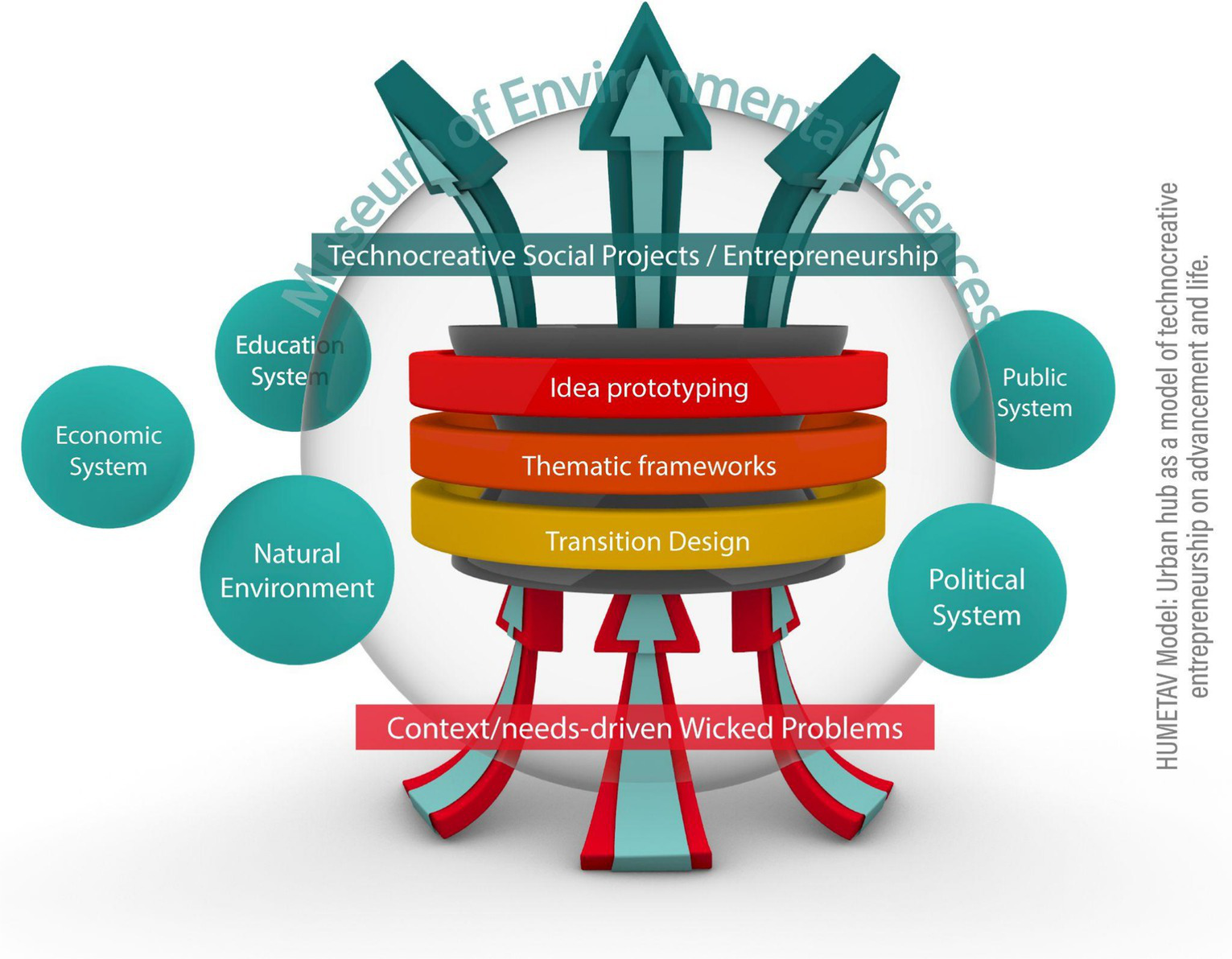
Visual representation of the HUMETAV model and its components that define long-term sustainability (ecological, economic, social, political and cultural).
Figure 1 shows the interacting elements of the HUMETAV model. The overall view of the model is inspired by the corona effect of a drop of water, indicating the bottom-up flow from the problem to the solution. At its centre, the biosphere represents the Museum of Environmental Sciences, which provides the thematic and physical context around which wicked problems are studied. Five spheres float around the museum, implicitly symbolising the pillars of sustainability (Purvis et al., 2018) and representing the five helixes of innovation (Carayannis et al., 2012). The flow of the model is bottom-up, starting with the context and/or needs associated with the wicked problems to be targeted, represented by the red arrows. Wicked problems are addressed through three stages, represented by succesive rings. The first represents TD, which ranges from mapping the problems and their stakeholders to designing the future and systemic interventions. This process leads to the ideation of potential projects of social benefit that partially address the needs identified in the wicked problems related to the mission and purpose of the Museum of Environmental Sciences. The second represents the thematic frameworks, which correspond to the focus of each workshop and allow for the adaptation and support of the content to be developed by the participants. The third ring, the prototyping of ideas, centres on the creative process and its translation into workshop outcomes. Moving through the rings involves close interaction with the spheres of innovation and sustainability. The final process of the model that consolidates the social projects is shown by the arrows at the top. This is where results become visible through technocreative approaches, leading to entrepreneurial initiatives that empower citizens.
Through workshops and collaborative processes, the HUMETAV model seeks to generate practical solutions to complex problems related to sustainability and community wellbeing in urban environments developed in Mexico, specifically in the immediate vicinity of the museum, but which could be extrapolated to other contexts (Sanabria-Zepeda and Santana Castellon, 2022). Some of the problems identified on the basis of the analysis carried out with the HUMETAV model turn out to be complex problems that require a systemic vision, such as solid waste management, air quality in the area, transport and public mobility problems, among others.
The consortium has recently applied the HUMETAV model in the production of the HUMETAV — Citizen Science (CS) workshop, piloted in partnership with the European Citizen Science Academy. This experience is a source of refinement of the model’s characteristics for future replication. The HUMETAV model has been configured to incorporate citizen science as a tool in educational practice, to motivate students and teachers to participate in the identification of socio-ecological problems relevant to them in their immediate environment, and to motivate action based on the design of citizen science project proposals through the HUMETAV–CS educational workshop.
The momentum of citizen science has democratised the ideal of turning ordinary people into amateur scientists through voluntary, open projects. Unlike traditional research, it allows participants to progressively engage in researcher-style activities, from data collection to interpretation, problem diagnosis (Urválková and Janoušková, 2019), analysis, and finally collaborative publication of results (Turnhout and Ganzevoort, 2023). Thanks to the widespread availability of technology, citizen science can now achieve tremendous reach in participant recruitment and generation of multi-regional databases (Brenton et al., 2018). Furthermore, the boom in the education sector using citizen science in curricular activities has proven to be an effective mechanism for student engagement and co-creation of knowledge, leading to increased dissemination of scientific research (Pizzolato and Tsuji, 2022). Participation in citizen science can be categorised using the conceptual framework of “levels” or “ladders” of participation, with the highest degree being when citizens control all stages of the scientific process, known as ‘participant-led research’ (Haklay, 2018; Vayena and Tasioulas, 2015; Vayena et al., 2015; Sanabria-Z et al., 2022). In some cases, the level and duration of participants’ involvement in citizen science projects is rather superficial and may not assess their competence development (Land-Zandstra et al., 2021). Taking these issues into account, the present study sought to engage participants, namely researchers, teachers and students, in co-creative collaboration at different stages of the HUMETAV model design and its local implementation, with the aim of promoting socio-ecological awareness among young people.
With a focus on collaborative workshop production, the HUMETAV model aims to generate practical solutions to complex problems of sustainability and community well-being in urban environments. Compared to urban sustainability approaches that rely on expert-driven planning, the HUMETAV model embeds a multi-helix innovation framework that directly engages educational institutions and local communities in the collaborative development of context-specific solutions (United Nations Human Settlements Programme, 2017; Friedmann, 2010). In this way, the approach transforms urban problem-solving from a prescriptive process to a dynamic and participatory innovation ecosystem (Carayannis et al., 2012; Trencher et al., 2014).
This study addresses this issue by designing and testing a citizen science education workshop based on the HUMETAV model, and reporting on its design and evaluation process. The design methodology for building the workshop followed the five stages of Buchanan’s Design Process and Practice (Dubberly, 2004), leading from the conceptual model to the development and testing of the HUMETAV model. The discussion section of this paper presents the findings in line with the literature and the conclusion addresses implications, limitations and future studies. Designing citizen science projects that focus on developing participants’ thinking involves more than just considering the expected level of participation from the outset, i.e., approaching projects from a participant design perspective. The research question is: How does the HUMETAV model provide an effective framework for developing an educational strategy that promotes the holistic development of socio-ecological citizen science projects, ensuring both the integral development of participants and the consideration of their context?
2 Theoretical framework
2.1 Green literacy landscape
Green literacy, or the understanding of ecological and environmental concepts, in addition to fostering a deeper understanding of the links between political/economic systems and environmental sustainability, is crucial in addressing socio-ecological issues to empower individuals and communities to make informed decisions that promote sustainability. The socio-ecological approach to environmental education emphasises the integration of ecological knowledge with political knowledge of local social dynamics to enable students and teachers to effectively address environmental challenges (Kyburz-Graber et al., 2006). A central socio-ecological issue of our time is the widespread disconnection between human communities and natural systems (Aldeia and Alvés, 2019; Fallan, 2019; Giengera et al., 2024), as well as the disconnection between ecological knowledge and political knowledge (Beery et al., 2023). Simplistic environmental analyses deliberately or naively misrepresent the subjects of development and ignore the socio-political divergences of interests and perspectives that produce environmental degradation. Interdisciplinary political ecology approaches recognise socio-ecological conflicts that are contextualised in power dynamics, social inequalities, cultural differences, and labour and knowledge production processes (Martinez-Alier et al., 2014; Le Billon, 2015). All are important elements in the construction of environmental education and awareness (Yadav et al., 2022; Melnyk and Podorozhnyi, 2023). These knowledge and perspective gaps contribute to the unrecognised impacts of human decisions and activities that lead to environmental and ecosystem degradation, resulting in biodiversity loss and climate change (Adla et al., 2022).
The growing urgency of socio-ecological problems calls for a reassessment of how societies understand and value the environment and the political control processes associated with resource use and appropriation, both of which are crucial to moving towards more sustainable practices. International policies in recent years have placed strategic actions to address climate change, inequalities, power dynamics, social problems, and the digital divide at the centre of their missions to achieve a green, equitable, and just transition (Succini and Ciravegna, 2022). An example of this is the European Green Deal initiatives, which stimulate projects to promote learning about environmental sustainability (Bianchi et al., 2022). This underlines the fundamental importance of education as a field that plays a role in fostering environmental citizenship, as demonstrated by the Sustainability Awareness Questionnaire, which measures the impact of educational interventions on sustainability knowledge, attitudes and behaviours (Alsaati et al., 2020). Such interventions can significantly improve sustainability behaviours, which are crucial for addressing socio-ecological problems (Ariza et al., 2021).
Educational practices empower students to adopt pro-environmental habits and understand the impact of their consumption on climate change (Velasco-Martínez et al., 2020). Alternatives and possible solutions have emerged through the integration of green literacy into school curricula (Ito and Igano, 2020; Merritt et al., 2022; Liu et al., 2023). Several initiatives have strengthened the impact of green literacy, for example, ecological literacy (Nadiroh et al., 2021; Koyama and Watanabe, 2023) has been essential in deepening the care, protection, and resilience of communities. The introduction of education policies for sustainable development, permaculture education (Cassel and Cousineau, 2018; Friedman and Katz, 2021; Suh, 2023), regenerative strategies (Wahl, 2016; Gibbons, 2020; Jackson, 2021; McIntyre-Mills and Corcoran-Nantes, 2022), and systems thinking in education and science (Sevaldson and Jones, 2019; Esteves, 2020) has sparkled global and local action. These efforts require user-centred design approaches that allow for the adaptation of educational initiatives to the actual context of students, teachers and institutions, equipping them with the knowledge and skills needed to make responsible environmental choices (Fleacă et al., 2023). From this perspective, design could incorporate elements that promote learning and skill development, such as information provision, training and feedback, which have been shown to significantly improve the knowledge and skills of participants in biodiversity projects (Peter et al., 2021).
Thus, contextual design increasingly has the potential to facilitate and connect knowledge and actors (Vasquez et al., 2019), supporting the construction of critical ecological and responsible thinking both theoretically and within complex applications (Rittel and Webber, 1973; Sweeting, 2018). This leads to reasoning about the social and environmental impacts of decision-making and design processes. Furthermore, design education expands the boundaries of design disciplines and educational models based on the concepts of sustainability, ecology, and social-environmental responsibility (Boehnert et al., 2022; Salamanca and Briggs, 2021; Succini et al., 2021).
Globally, the implementation of green literacy programmes is uneven. Many communities still lack access to quality environmental and socio-ecological education due to a variety of factors including economic, social, and environmental inequalities (Griswold et al., 2022), which overburden marginalised communities and make it difficult for them to effectively address environmental issues (Nesmith et al., 2020; Masten et al., 2021). In the education sector, rapidly evolving socio-ecological issues often outpace existing curricula, highlighting the need for more dynamic, interdisciplinary and adaptive educational approaches that keep pace with change (Fettes and Blenkinsop, 2023; Ramachandran et al., 2024). An interdisciplinary approach is essential for addressing sustainability challenges, as it allows students to apply knowledge across multiple disciplines, taking into account the different stakeholders and elements involved in socio-ecological issues (Anyolo et al., 2024). Engaging students with societal challenges and ecological perspectives can enhance learning across disciplines (Markauskaite et al., 2024). In light of the above, education acts as a catalyst for change, empowering individuals and communities to make informed, effective and responsible decisions.
The HUMETAV model has considered the theoretical principles provided by green literacy, which identify the educational principles necessary to critically and actively address current socio-ecological challenges. It is recognised that environmental literacy not only promotes scientific and technical understanding of issues related to the environmental crisis but also seeks to develop critical and ethical skills that foster transformative action. The HUMETAV model has sought to integrate interdisciplinary approaches from the humanities, education and technology, designing pedagogical strategies based on citizen science, with the intention that both students and the community develop green literacy skills through practical and collaborative experiences, contributing to their empowerment as agents of change.
2.2 The promise of citizen science in socio-ecological awareness
The concept of Citizen Science (CS) or ‘participatory science’ involving non-scientists in scientific research, has emerged as a transformative approach to promoting scientific literacy and responsibility, empowering ordinary citizens by engaging them in real-world scientific research. CS allows participants, some of whom aspire to become amateur scientists, to voluntarily and progressively engage in researcher-style activities, from data collection to interpretation, problem diagnosis (Urválková and Janoušková, 2019), analysis, and finally collaborative publication of results (Turnhout and Ganzevoort, 2023). Some of the contributions of CS, in contrast to traditional science, are that it: promotes the democratisation of science; creates new opportunities for non-formal civic education and scientific literacy; enables the acquisition of information not accessible through traditional methods; helps to empower civil sectors; and facilitates the modification or generation of public policy (Schade et al., 2021). CS falls within the concept of open science proposed by UNESCO (UNESCO Recommendation on Open Science, 2021).
There are some relevant antecedents to the work presented in this study, leading to the stance and vision co-created in a participatory approach. Tweddle et al. (2012) in their ‘Guide to citizen science’, state that the term refers only to studies of biodiversity and the environment. They define CS citizen action to voluntarily collect information and samples of biodiversity and the environment to contribute to collective knowledge and to monitor and/or interpret observations. Others, such as Ballard and Harris (2019), note that CS helps to bridge the gap between funding and sometimes interest for fieldwork and what is needed to develop studies in the field of ecology. In this regard, Lorke et al. (2019), stated that training and guidelines should be facilitated for volunteers for CS initiatives to achieve their scientific goals of data collection and analysis, regardless of whether the goals are formal and informal, educational, for public engagement, or for the preservation of the environment and conservation rights. With this in mind, it is noteworthy that authors sucha as Roche et al. (2020) note that digital platforms have a strong influence on the future integration of citizen science in the context of education and learning in a global perspective.
Active citizen participation in projects that address socio-ecological issues can significantly increase awareness and understanding. Through direct involvement, participants can see first-hand the effects of phenomena related to issues such as climate change, biodiversity loss, and pollution. This can transform abstract perceptions into concrete and personal understanding. For example, projects such as eBird or iNaturalist are well known for enabling users to record species observations, contributing to global databases that track changes in biodiversity and species distributions due to socio-ecological change. Similarly, Pocock et al. (2023) discuss how participation in citizen science projects has a significant positive impact on conservation behaviour by fostering an individual’s relationship with the natural world, and outline the role of experiential learning in strengthening the link between environmental awareness and action. By empowering individuals to act at multiple scales, from local to global, citizen science fosters deep civic engagement and commitment to solving current and future social-ecological problems (Adamou et al., 2021). Similarly, citizen participation has had implications beyond the generation of scientific knowledge, as exemplified by participation in autonomous citizen search collectives for missing relatives in Mexico, which represents a different type of citizen science, whose motivational engine was emotional pain (Santana-Castellón et al., 2024).
By recognising the role of citizen science in socio-ecological issues, a foundation of empowerment and engagement is identified, laying the groundwork for the integration of citizen science into education systems, which promises to revolutionise the way students engage with environmental issues. Integrating citizen science into education can enhance students’ understanding of socio-ecological issues by providing experiential learning that complements traditional teaching. This approach has been shown to improve students’ scientific literacy and attitudes towards science and technology (Queiruga-Dios et al., 2020). Citizen science projects in schools can significantly improve students’ scientific literacy and attitudes towards science and technology, while also enhancing the educational benefits of participating in scientific research by increasing motivation, interest, knowledge, and scientific and communication skills (Lüsse et al., 2022; Atias et al., 2023). This approach enriches students’ learning experiences and fosters a sense of responsibility and connection to the environment, preparing them to address global challenges with informed and innovative solutions. The broader implications of integrating citizen science into educational frameworks promise to cultivate a generation of informed and engaged citizens capable of addressing complex socio-ecological challenges (Sá et al., 2022). According to Queiruga-Dios et al. (2020), curricular integration of citizen science projects could increase student engagement with the UN Sustainable Development Goals (SDGs), demonstrating the fundamental role of education in achieving global sustainability. A shift towards an education system that values and uses citizen science would prepare students for future challenges and support a more environmentally aware and scientifically literate society. However, the main challenges in implementing these initiatives are the motivation, leadership and collaboration of volunteers. In this context, the HUMETAV model is a case in point, demonstrating how citizen science can be strategically aligned with the Sustainable Development Goals, in particular SDG 4 and SDG 13. The HUMETAV model integrates participatory science into educational settings, thereby promoting inclusive, equitable and quality education (SDG 4) and fostering lifelong learning opportunities through experiential and problem-based pedagogies. The project’s methodology facilitates a collaborative creation of knowledge, thereby enhancing critical thinking, environmental awareness and collaborative innovation among students and educators. Furthermore, the project makes a direct contribution to SDG 13 by empowering young people to take concrete action on identified socio-ecological issues.
2.3 Developing thinking skills through participation in citizen science
Engaging students in citizen science projects contributes to complex thinking and problem-solving skills. These projects provide a platform for students to participate in authentic scientific research, which enhances their scientific literacy and engagement, and prepares them to become informed civic participants in modern society (Zhang et al., 2023). Participation in citizen science initiatives fosters the development of complex thinking skills, which are critical for addressing contemporary global challenges. This is particularly evident in higher education, where citizen science projects have been shown to enrich the learning experience by aligning with the development of complex thinking skills (Alfaro-Ponce et al., 2024). Furthermore, when individuals are confronted with authentic problems, their curiosity and creative abilities predominate (Simanjuntak et al., 2021), especially when these problems are part of their daily reality. The ability to collect and collaboratively analyse data from the environment through citizen science projects brings opportunities to apply local and individual knowledge, skills, and talents from different disciplines and perspectives (Luna-Nemecio et al., 2020). All these conditions create engaging and stimulating scenarios for students to develop their complex thinking, as it is possible for them to establish a fundamental dimension of their role as change agents in their immediate context.
Systems thinking and interdisciplinary learning among students enables them to understand the interconnectedness of socio-ecological systems and the complex nature of environmental challenges. The effect of external forces on a system is determined by its internal structure; therefore, understanding the structure of the system facilitates the anticipation of system behaviour (Wei et al., 2020), and this knowledge can be applied to real-world scenarios to develop problem-solving skills. Systems thinking in experiential learning means cognitively grasping processes to understand information (Pennington et al., 2021) and perceiving the interconnectedness of the elements that make up environmental, social, political, and cultural reality. These skills help students to meet the challenges of ecological emergencies or to seek social justice in stressed communities.
Similarly, participation in citizen science projects offers a unique and practical way to develop students’ ethical reasoning and sense of civic responsibility in the face of socio-ecological problems, especially if their design includes an appropriate formulation of ethical considerations, and these are translated into straightforward criteria for informed consent, environmental impact, cultural impact, technology use, and dissemination of the results (Pennington et al., 2021). The interdisciplinary nature of many citizen science projects, incorporating social sciences and humanities, further enriches students’ understanding of the socio-cultural dimensions of environmental issues (Turrini et al., 2018; Tauginienė et al., 2020). As suggested by D’Souza and Fernandes (2021), an interdisciplinary approach to education can enhance students’ ethical reasoning skills and civic responsibility by promoting creativity, critical thinking, and deep learning. It encourages students to consider different perspectives and the wider social context, thereby enhancing their ethical reasoning skills and civic responsibility (Dawson and Robinson, 2021). It also provides a methodological framework that can be applied across disciplines, fostering a more integrated understanding of challenges at the interface of science, society, and the environment.
In addition to recognising the contributions of citizen science to scientific advancement and education, it is imperative to address the criticisms associated with it and explore ways to improve it. Citizen science engages the public in research and socio-ecological issues, but has been subject to criticism in a number of areas, including ethical, methodological, and pragmatic concerns (Collins et al., 2022; Cooper et al., 2021; Lowry and Stepenuck, 2021; Shirk et al., 2012; Strasser et al., 2018). A major criticism is the limited integration of citizen-generated data into formal policy frameworks. This is exemplified by air quality monitoring projects in Germany and Niger, where data remains underutilised due to weak policy linkages (Lepenies and Zakari, 2021). Whilst this constitutes a compelling critique, observations have been made of instances which demonstrate policy-influencing linkages that foster collaboration between citizens, scientists and policymakers. For instance, initiatives centred on invasive alien species in Europe have demonstrated that citizen engagement enhances scientific awareness and literacy, which is imperative for managing biodiversity loss and informing policy frameworks, such as the EU IAS Regulation (Price-Jones et al., 2022). Furthermore, the integration of citizen science into Urban Living Labs has demonstrated potential for the development of participatory mechanisms for urban governance, particularly in addressing issues such as urban flooding (Veeckman and Temmerman, 2021). The success of these projects is attributed to the implementation of effective participatory strategies, the validation of data, and the establishment of feedback loops between stakeholders.
From an ethical perspective, citizen voices are often marginalised in the context of scientific governance, despite the existence of participatory paradigms that encourage dialogue and engagement (Phillips et al., 2012). In addition, top-down, scientist-led projects may not be aligned with community research objectives, limiting the potential for participatory democracy (Mueller and Tippins, 2012). Furthermore, the politicisation of epistemology in citizen science raises questions about the legitimacy of lay contributions to scientific knowledge, challenging traditional paradigms (Ghinea, 2019). Some scholars (Ellwood et al., 2023; Benyei et al., 2021) have questioned whether citizen science is inherently democratic and empowering. The power differentials in citizen science that arise from contexts of gender, age, social class, and educational level relationships, affect levels of participation in different projects (Rautio et al., 2022; Jönsson et al., 2023), and the unpaid work of volunteers could constitute labour exploitation with an extractivist logic that reinforces existing power structures. However, if volunteers are involved in problem selection and research planning, or if the project is an educational and training experience, then it contributes positively to capacity building. These critiques highlight the need for strategic integration with policy, ethical considerations, and inclusive participation to enhance the transformative potential of citizen science. It is important to note that effective linkage with formal policy frameworks can be achieved through a number of strategies. One such strategy involves the involvement of decision-makers (municipalities, environmental agencies, etc.) in the design of the project and in the definition of the citizen research questions from the outset. This approach aims to enhance the relevance and legitimacy of the data to political actors. Furthermore, the communication of results, the development of executive reports, policy briefs or visualisations that interpret the data from an accessible and action-oriented language should be considered. Such an approach would also facilitate the integration of participatory and transformative education, equipping students with the skills to address socio-environmental challenges in a democratic manner.
The HUMETAV model recognises how citizen science acts as a transformative educational strategy that develops critical and reflective skills in participants. Through their active participation, students and communities can develop cognitive skills such as data analysis, problem-solving, systems thinking and informed decision-making. This approach is consistent with the aims of the model by integrating experiential learning and collaborative work in real-life socio-ecological problem contexts. The direct interaction with environmental issues and the collaborative construction of knowledge allows participants to reflect on the complexity of these challenges and to propose ethical and sustainable solutions, thereby strengthening both their scientific understanding and their critical and creative skills.
3 Methodology
Design thinking methodologies have proven to be valuable in a number of fields of study. It is a paradigm that allows complex problems to be tackled by combining theories and models from different disciplines, and is applicable in many fields, including educational research (Heiner et al., 2023; Díaz-Lauzurica and Moreno-Salinas, 2023). Their emphasis on empathy and iterative prototyping has been instrumental in product development and user experience design. Similarly, their divergent and convergent processes have successfully guided service design and strategic innovation projects. These methodologies can help conceptualise, develop and test an educational workshop to address socio-environmental challenges through the design of citizen science projects, harnessing the power of design principles to connect theoretical knowledge with practical solutions that have a meaningful impact (Irwin, 2015). Therefore, we aimed to address the following research streams around the HUMETAV concept: retrospectively analyse the process and outcomes of the HUMETAV—Transition Design (TD) workshop in 2020 and from the lessons learned, conceptualise the HUMETAV. In this study, its visual representation is presented and thus applied in the design and testing of the HUMETAV-CS workshop. Figure 2 shows in concrete terms the stages followed in the development of this proposal.
Figure 2

Sequence for HUMETAV model developing and testing (source: own representation).
For the purposes of this study, Buchanan’s Design Process and Practice (Dubberly, 2004) was chosen as the guiding methodology because it provides a structured approach that can be instrumental in the design, development and testing of an educational workshop course for the development of citizen science proposals. The foundation stage sets out the vision and moves on to four stages of analysis and design proposal: brief, conception, realisation, and delivery. The approach combines strategic planning with practical development, with an emphasis on iterative prototyping and testing to refine potential solutions. This ensures the creation of viable products, based on research and user feedback, resulting in a documented and tested prototype. Definitions of each stage are given below.
The foundation stage, Vision and Strategy, aims to discover the driving forces and background of the problem to be solved. The aim is to identify the role of the organisations involved in the project and to propose a central challenge in the form of a brief to lay the foundations for the application of the HUMETAV model to the construction of the HUMETAV–CS workshop.
Four stages will drive the creative process:
Stage 1, Brief, aims to identify and select the problems, functions, and features to be addressed by the project.
Stage 2, Conception, focuses on the possible project concepts and the evaluation of their feasibility.
Stage 3, Realisation, focuses on the planning and development of the prototype project. It continues with an evaluation of the project by its target users.
Stage 4, Delivery, consists of the presentation of the final prototype project. It includes the specifications according to the model and the objectives.
The results of the process of applying the HUMETAV model to the design and delivery of the HUMETAV-CS workshop are described following Buchanan’s methodology. Five tables summarising the results are presented below. An extended version of the tables can be accessed via this link to an open platform: https://doi.org/10.5281/zenodo.13896230.
Figure 3 shows the approach to developing the HUMETAV–CS workshop based on the HUMETAV model through the stages of Buchanan’s Design Process and Practice methodology (Dubberly, 2004). The elements that were set as milestones to be developed throughout the design process and ultimately reported as outcomes.
Figure 3
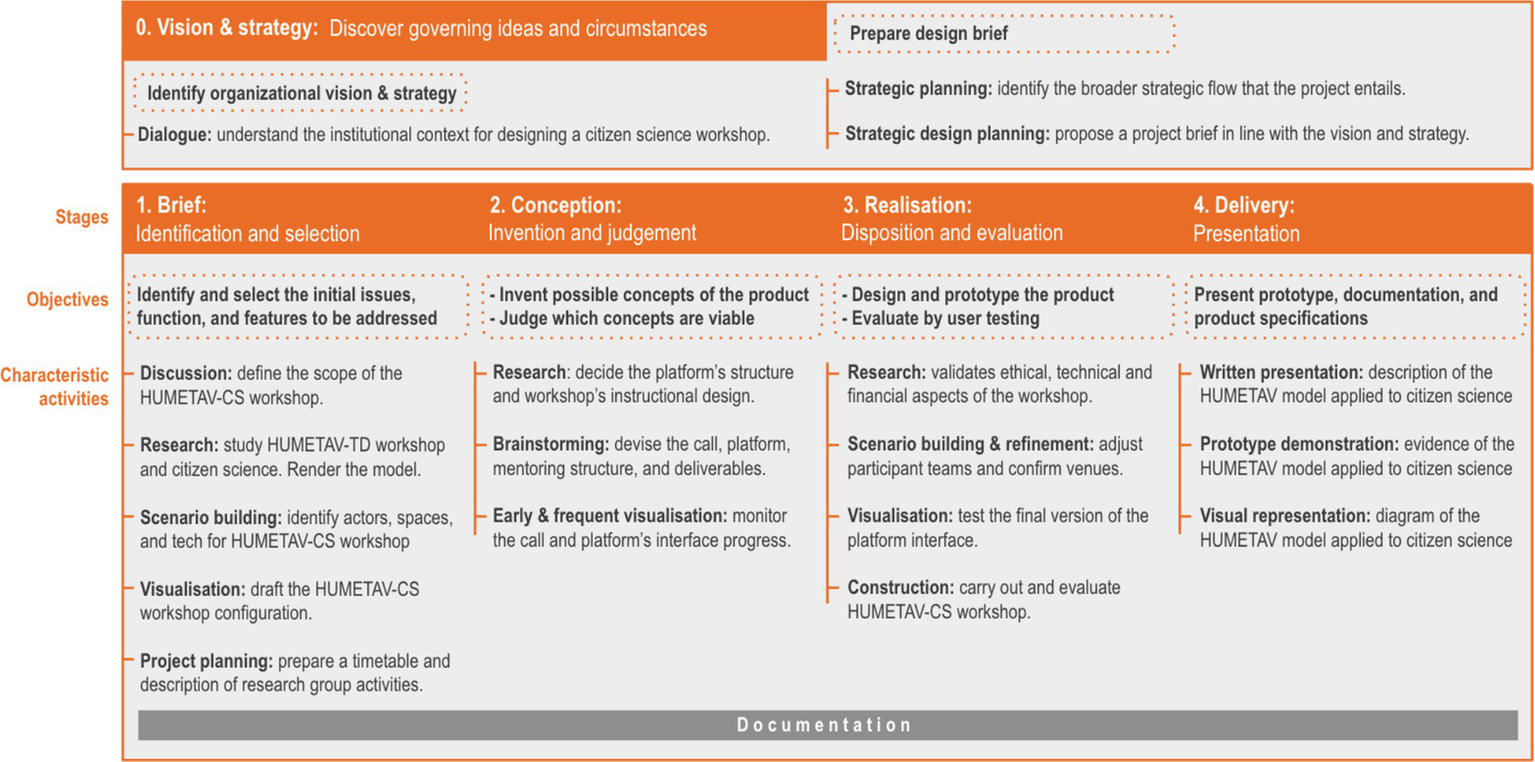
Stages of the Buchanan Design and Practice Process methodology for the application of the HUMETAV model in the creation of the HUMETAV-CS workshop.
Looking at Figure 3, at the top is Stage 0, Vision and Strategy, which refers to the previous tasks carried out before starting Stages 1 to 4 as defined in Buchanan’s Design Process and Practice methodology.
Looking at the stages derived from Buchanan’s Design and Practice Process methodology, which guided the application of the HUMETAV model in the creation of the HUMETAV-CS workshop, similarities with project management methodologies can be seen. Buchanan (1992) argues that design is a process of ‘placements’ involving recursive refinement of understanding and solutions, which has significant parallels with modern iterative approaches to project management. Project management methodologies and Buchanan’s methodology of process and design practice share significant similarities, particularly in their emphasis on structured processes, stakeholder involvement and adaptability to complex environments. Both approaches recognise the importance of a phased implementation strategy, as seen in Harvard’s project management theory, which uses the phases of planning, development, execution and closure to optimise project outcomes (Ebm et al., 2024). Similarly, Buchanan’s methodology is likely to include iterative phases that allow for continuous refinement and adaptation, similar to the concepts of intervention design concepts used in collaborative adaptive management, which emphasise the need for practical interventions tailored to specific socio-political contexts (Beratan, 2020). Both methodologies also emphasise the importance of stakeholder engagement and institutional policy alignment, which are critical to achieving sustainable success in complex projects (Ebm et al., 2024). However, it is important to recognise the nuances that differentiate these methodologies. While Buchanan’s methodology remains more grounded in design thinking, the project management methodologies maintain a more pragmatic focus on deliverable outcomes. This subtle distinction does not diminish their similarities, but rather highlights the richness of their complementary approaches to tackling complex problems Figure 4.
Figure 4
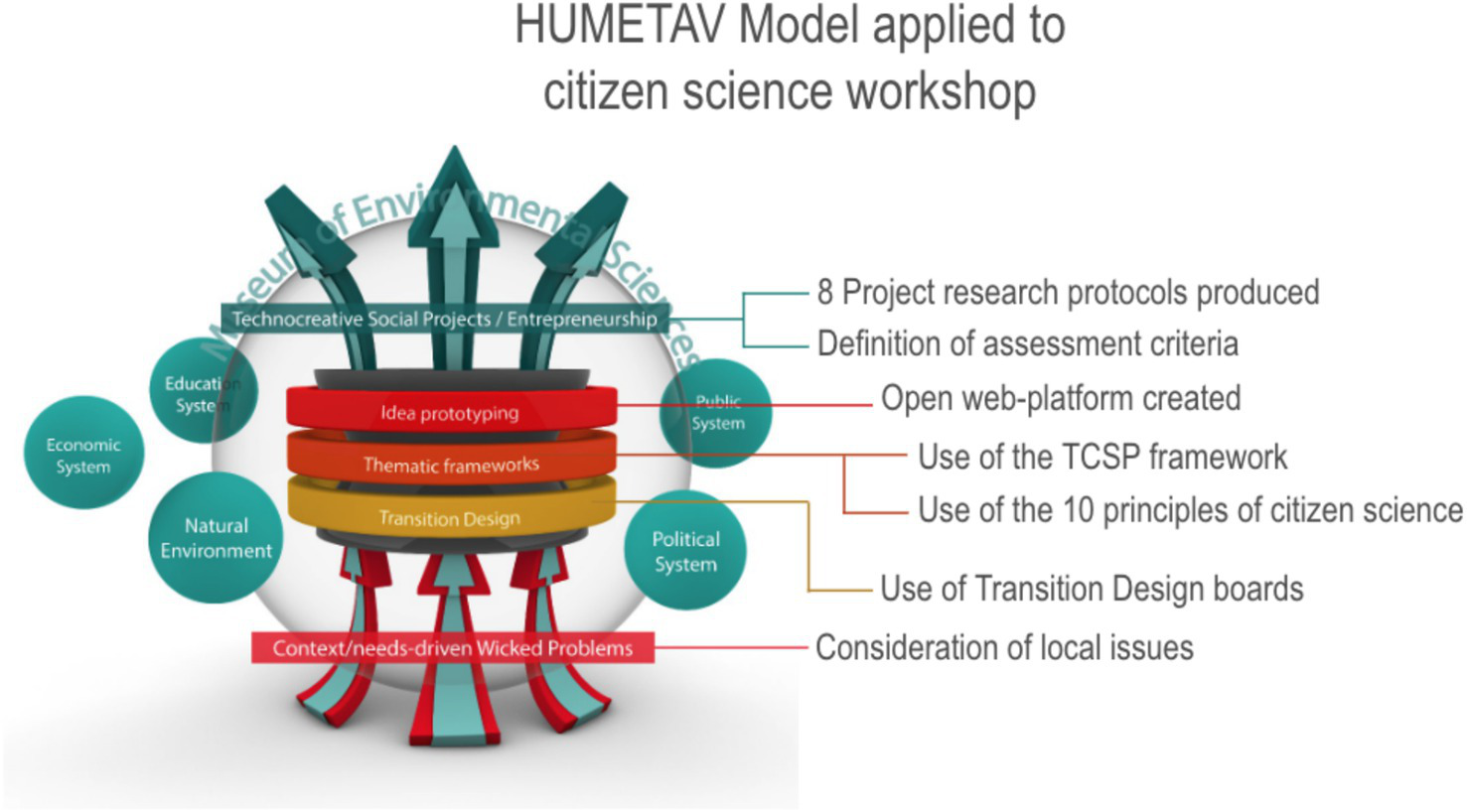
Results of the application of the HUMETAV model to the creation of the HUMETAV-CS workshop.
Table 1 below describes each of the activities and objectives carried out in the initial stage (Stage 0—Vision and Strategy) for the design of the workshop based on the HUMETAV model.
Table 1
| Activities and objectives | Stage 0—vision and strategy: description of the information gathered |
|---|---|
| Dialogue: To understand the institutional context for designing and piloting a citizen science workshop | Researchers from both universities and the Museum of Environmental Sciences met to identify the guiding ideas and circumstances for the HUMETAV-CS workshop. They recognised that since both institutions serve university students from the metropolitan area of Guadalajara, Mexico, and in accordance with the Fund’s guidelines, these would be their target participants. They also decided to invite professors, regardless of the level at which they teach. |
| Strategic Planning: To identify the broader strategic flow that the project involves | Given that the HUMETAV model was designed in the context of the Museum of Environmental Sciences’ mission and consolidated through the HUMETAV-TD workshop, held in 2020, we proceeded to study the details and scope of this experience in the museum’s current context. |
| Strategic design planning: To propose a project brief in line with the vision and strategy | We produced a project summary to guide the design of the workshop ‘HUMETAV—Citizen Science, Training Young Scientists through the Design of Citizen Science Projects’. The aim was to encourage participants to design citizen science projects with a socio-ecological impact, where they observe and document facts and phenomena of the natural and social environment, while developing complex thinking. |
Description of characteristic activities of Stage 0 (strategy and vision) of Buchanan’s design process and practice methodology in relation to the HUMETAV–CS workshop.
4 Brief (Stage 1)
In this stage, we identified and selected the initial problems, functions, and characteristics of the HUMETAV–CS workshop. Further research was undertaken to develop the call brief, including a review of the highlights of the previous HUMETAV—TD workshop. Table 2 presents the key findings from this stage, describing the characteristic activities of discussion, scenario building, visualisation, and project planning.
Table 2
| Activities and objectives | Stage 1—brief: description of the information gathered |
|---|---|
| Discussion: To define the scope of the HUMETAV–CS workshop | The search for consensus among researchers to decide on the scope of the HUMETAV–CS workshop call for participation continued during this stage. Once the call template had been decided, the content of the project was discussed, for which it was essential to understand the origins and concepts of the HUMETAV model and the cornerstones of citizen science. |
| Research: To study the HUMETAV—TD workshop and citizen science. and render the HUMETAV model | We studied the materials of HUMETAV-TD: Analysis of Wicked Problems for the Museum of Environmental Sciences, based on Design for Transition’ (Sanabria-Zepeda and Santana-Castellon, 2022) and the available HUMETAV-TD technical report (Sanabria-Z et al., 2021). Objectives, processes, content, logistics, challenges and learning were identified. The European Citizen Science Association (ECSA) website was a main source of information and collaboration with the European Citizen Science Academy was suggested. To guide the project, the TD stages for addressing wicked problems, the Threshold for Citizen Science Projects (TCSP) framework (Sanabria-Z et al., 2022) for project design and impact assessment, and the 10 Principles of Citizen Science (Robinson et al., 2018) were adopted as general guidelines. The instructional design of the HUMETAV-TD was found to be appropriate for the objectives, with workshop leaders presenting and recording the weekly sessions, sharing digital resources by topic, and providing feedback on team boards during the week with the support of mentors. |
| Scenario building: To identify actors, spaces, technologies, and interactions for the HUMETAV-CS workshop | We decided to run the HUMETAV-CS workshop online, with only two face-to-face sessions for the opening and closing. We also decided to create a web platform for the project homepage and for carrying out the activities with the participants. |
| Visualisation: To draft the configuration of the HUMETAV-CS workshop | To make the project brief tangible, the organisers developed a project timetable and an outline of the call for participation. In addition, the use of the eight components of the TCSP framework was linked to both the development of the content modules for participants and the selection criteria for the best final projects. Furthermore, the role of the web platform was identified as a cross-cutting priority for the success of the project, as it would be the main interaction of the participants with the learning materials and the delivery of the tasks. |
| Project planning: To prepare a timetable and description of activities | We set up a timetable in line with the deadlines and budget set by the fund. We created tasks on research products and call and workshop logistics; data collection tools and ethical requirements; citizen science content, mentoring and web platform requirements. |
Description of characteristic activities of Stage 1 (Brief) of Buchanan’s design process and practice methodology in relation to the HUMETAV–CS workshop.
5 Conception (Stage 2)
In this second stage of the methodology, aimed at invention and judgement, we produced the first proposal of the HUMETAV model applied to the HUMETAV—Citizen Science workshop. The project researchers co-created its structure incrementally and iteratively, through a development based on the design process approach and complementary methodologies. Its feasibility was assessed at each iteration. The formulation of the workshop, which ultimately served to test the model, required proposing the type of technological platform to be developed, the methodologies to be integrated, and the instructional design to guide the participants to achieve the expected outcomes of the workshop. Planning the configuration of the experience for the participants integrated the call for participation, the didactic sequence, the mentoring role, the presentation of the results, and the evaluation process. Table 3 describes the research, brainstorming, and early and frequent visualisation activities according to their objectives.
Table 3
| Activities and objectives | Stage 2—conception: description of the information gathered |
|---|---|
| Research: To decide the structure of the platform and the instructional design of the workshop | It was envisaged that the HUMETAV-CS workshop platform would present the objective of the project, the competences to be developed and the profile of the research members. It was also envisaged that it would host the input and output questionnaires on the participants’ perception of complex thinking and their perception of civic participation. Finally, it would allow the registration of participants and access to a set of 14 didactic modules that would guide the work of the HUMETAV-CS workshop. |
| Brainstorming: To ideate the call launch process, platform interface, and participant deliverables. | It was envisaged that the Call for Participation would be distributed via institutional media and social networks as an online PDF document. The workshop learning modules would combine TD with the eight components of the TCSP framework. Mentoring activities would be integrated based on the experience of the HUMETAV-TD workshop. In addition, the evaluation process of the participating teams would include elements of feedback and final evaluation. The deliverables would be: (1) a poster for the conference; (2) an oral presentation; and (3) a research protocol. |
| Early and frequent visualisation: To monitor the progress of the call and the platform | We oversaw the development of the final details of the call through iterative meetings with the project’s research team. We also began working with the software development company to design the modules of the HUMETAV-CS workshop platform, which would be developed incrementally over the course of the workshop. |
Description of the characteristic activities of stage 2 (Conception) of Buchanan’s design process and practice methodology in relation to the co-creation of the HUMETAV–CS workshop.
6 Realisation (Stage 3)
This stage focused on the piloting of the HUMETAV–CS workshop. Here we explain how the HUMETAV model was applied and tested in the design of the citizen science workshop, based on the 3 months of experience with participants recruited through the call. Topics covered include the launch of the call, the opening the event, the HUMETAV-CS workshop platform, teamwork, outcomes, evaluation and the closing of the event. Table 4 describes characteristic activities, including research, scenario building and refinement, visualisation, and construction.
Table 4
| Activities and objectives | Stage 3—realisation: description of the information gathered |
|---|---|
| Research: To validate the ethical, technical, and financial aspects of the HUMETAV–CS workshop | We submitted an institutional application for exemption to the ethics committee with a research protocol that focused on secure data management and informed consent of participants. We also initiated the process of a research collaboration agreement between the two organising institutions. Pending ethics committee approval, we proceeded with the Call for Participants, outlining the requirements, guidelines and evaluation criteria. The technical requirements included that the evaluation of the projects would respond to rubrics that were aligned with criteria created from the TCSP framework and the 10 principles of citizen science. On the other hand, it was ensured that access to the HUMETAV-CS workshop platform and activities was provided and that there was an opportunity for continuous feedback from users. The project managers, supported by specialists from the institution, oversaw the management of the fund, including the development of the HUMETAV-CS workshop platform, promotional materials and cafeteria services during the opening and closing events. |
| Scenario building and refinement: To adjust team configuration and confirm venues | We distributed the HUMETAV-CS workshop tasks among the researchers, who would oversee the development of the workshop during the 3 months. The tasks included creating research tools, overseeing the development of the HUMETAV-CS workshop platform, creating content for the modules, communicating with the teams, and reviewing progress on the fulfilment of institutional aspects of the project. We booked an auditorium next to the Museum of Environmental Sciences for the kick-off, which included registration, a welcome kit and a guided tour of the museum. For the closing ceremony, we reserved a hall for final presentations at the Congress Centre of the Tecnologico de Monterrey and invited two speakers in the field of citizen science. |
| Visualisation: To test the final version of the platform interface | We validated the functioning of the administrative functions of the HUMETAV-CS workshop platform, as well as the format of the modules through which the participants would navigate through and the resulting data analysis section. We tested the first modules with content, monitoring both functionality and instructional design. The activities related to the TCSP framework were carried out on the platform, while the activities related to TD were carried out on the Miro collaborative platform. |
| Construction: To carry out and evaluate the HUMETAV–CS workshop | We completed the recruitment of the participating teams and organised the assignment of a mentor to each team. Of the 11 teams that responded to the call, eight completed the workshop. A total of 69 final participants registered, 39 from the participating public institution and 30 from the private institution. Of the total number of participants 39 were students and the rest, 30 were tutors and professors who accompanied the teams, that is, 56.52% of the participants were students. Regarding participation by gender, it was identified that there were twice as many women as men, with a ratio of 2:1. The mentors maintained close contact with their assigned teams. However, the impact of their role could not be observed due to changes in the configuration of the team members, which were made along the way. The didactic sequence was effectively assimilated into the HUMETAV-CS workshop platform and helped the teams to complete the project proposals on time. The effective development of the proposals integrated the conceptual frameworks defined to define the citizen science projects. The teams received feedback from the European Citizen Science Academy before the final presentations and also had the opportunity to hear from two citizen science experts who spoke at the closing event, a professor on behalf of Tecnologico de Monterrey and online from the leader of the European Citizen Science Academy. We judged the entries against the criteria we had set out and awarded the top three prizes and five commendations to the participating teams. During the course of the workshop, we obtained the exemption letter from the Ethics Committee and finalised the signing of the Inter-institutional Agreement, both of which took longer than expected. Commitments relating to expenditure supported by the Fund were met and declared on time. |
Description of characteristic activities of Stage 3 (Realisation) of the Buchanan Design Process and Practice methodology related to the testing and evaluation of the HUMETAV model through the piloting of the HUMETAV–CS workshop.
In summary, the didactic sequence of the implementation of the HUMETAV-CS workshop included several phases. In the first phase, following the open call to invite those interested in participating (students and teachers from the participating institutions), we held a first introductory session to the HUMETAV-CS workshop, in which the objectives and process were explained, as well as the 10 principles of citizen science. Then, in a second phase, we held weekly videoconferences to exchange information on the activities that would enable them to identify and detect socio-environmental problems. For the process of identifying and defining the problems, we used the TD approach. After defining the problems, during the weekly meetings we presented the eight components of the TCSP framework. Each component was accompanied by short activities to outline the project prototypes. The teams then built the prototypes, which were finally presented in a face-to-face format at a final event. Both the content and the didactic activities were displayed on the HUMETAV-CS workshop platform.
7 Delivery (Stage 4)
In this last stage, the methodology led to the overall presentation, including the prototype of the final product, documentation, and specifications. It was assimilated as a result of the application of the HUMETAV model in the design and experience of the HUMETAV–CS workshop. Table 5 shows the characteristic elements of the model applied to the workshop (a written presentation), the evidence of the model applied (demonstration of the prototype), and the diagram of the model applied to citizen science (visual representation).
Table 5
| Activities and objectives | Stage 4—delivery description of the extracted information |
|---|---|
| Written presentation: To describe the HUMETAV model as applied in the HUMETAV-CS workshop. | The HUMETAV model is framed within a five-helix innovation environment and five sustainability components, focusing on the theme and context of the institutional mission and purpose of the Museum of Environmental Sciences. The model addresses wicked problems using the TD approach and contextualises the solution ideation process with thematic frameworks, leading to the development of techno-creative and social entrepreneurship projects that respond to the particular context and needs. Its application in the design and piloting of the workshop involved adding existing citizen science principles to define the scope, as well as the TCSP framework as a prerequisite for addressing the problem. That is, participants were presented with the 10 principles of citizen science as a set of guidelines that a citizen science project should consider in order to promote citizen involvement in the identified problem and, ultimately, the democratisation of science. The eight components that make up the TCSP framework were adopted by the workshop participants as guiding criteria for proposing and designing of citizen science projects. Each of the components was presented through a didactic sequence that included a module for each component. These presented what each component consists of and what its scope and implications might be. The HUMETAV-CS workshop platform dedicated to the project acted as a catalyst and fundamental space for the personalisation of content and learning. The process of creating a supportive platform also enabled the involvement of researchers and allowed participants to link their contribution to an ongoing research project. |
| Prototype demonstration To evidence the application of the HUMETAV model to the HUMETAV-CS workshop | Overall, we managed to reflect the structural learning from the HUMETAV-TD workshop in the design and implementation of the HUMETAV-CS workshop. In particular, we noticed a smooth connection and assimilation between the TD approach and the TCSP framework during the practical part of the workshop. We observed that the teams’achievements showed that the modelled pathway had a greater scope of specificity of deliverables compared to the previous workshop. Similar to HUMETAV-TD, the inter-university integration was a positive factor that made the joint organisation of the event natural. The implementation of the original HUMETAV-CS workshop platform was a strong point for the pedagogical involvement of teams and researchers. |
| Visual representation: To diagram the HUMETAV model as applied to the HUMETAV–CS workshop | In reviewing the application of the HUMETAV model in the experience of the HUMETAV-CS workshop, we were able to establish that the key points that were introduced corresponded satisfactorily to the flow promoted by the model (see Figure 4). Following the bottom-up flow of the model, it can be seen that the aspect of identifying wicked problems in relation to context and needs was successful in helping to identify the pressing issues in the participants’ locations. The entry into the Transition Design approach processes had the expected effect of delimiting the problems and their stakeholders, imagining the ideal future and proposing how to move towards it, taking into account the fivefold innovation helix. The thematic framing with the TCSP framework and the 10 Principles of Citizen Science was crucial to guide the proposals in the expected direction of the workshop. This was supported by the dedicated web platform created for the workshop, where they were able to prototype their proposed solutions. In the final stage, the creation of evaluation criteria derived from the thematic frameworks allowed for comprehensive results in the technocreative research protocols that could be turned into ventures. All this was framed and accompanied by the vision of the two institutions involved and in the spirit of the mission of the Museum of Environmental Sciences. |
Description of the characteristic activities of Stage 4 (Delivery) of Buchanan’s design process and practice methodology in relation to the results of the HUMETAV–CS workshop and the visualisation of the applied HUMETAV model.
Below is a visual representation of the HUMETAV model and its components as described in Table 5 is shown. Each element of the model has been linked to the basic criteria for the design and construction of the HUMETAV-CS workshop.
Each of the levels in the figure (looking at it from bottom to top) represents a key step or approach that guides the construction of the workshop:
Context/needs-driven Wicked Problems: Fundamental part of the model, emphasising the importance of identifying and addressing local problems from a multidimensional perspective.
Transition Design: Incorporated as a key tool to facilitate the transition to sustainable solutions, using specific dashboards to guide the process.
Thematic Frameworks: Provide a conceptual structure for addressing issues in the socio-environmental context. The TCSP framework and the 10 Principles of Citizen Science were considered.
Idea prototyping: This step is intended to foster creativity in a controlled environment, which was made possible with the development of the workshop platform.
Technocreative Social Projects/Entrepreneurship: The model culminates in the generation of initiatives that integrate technological innovation, creativity and social impact. At this stage, 8 research protocols have been submitted and evaluation criteria have been established based on the criteria used in the Thematic Frameworks stage.
The external elements (economic, educational, political, public and natural systems) represent the systemic frameworks that influence and are considered at each stage of the model. This visual representation is intended to highlight the interrelationship between theory and practice in the workshop design.
As part of the Delivery stage, one can also consider the process that allowed the evaluation of the model, which focused on the evaluation of the objectives set with the model. The evaluation criteria to be considered were the following: (1) Evaluate the effectiveness of the HUMETAV model in enhancing participants’ understanding of citizen science. The scope of this criterion was achieved when the participants completed the design of their own citizen science project based on the problems identified and the particular interests of the participants. Criterion (2) Evaluate the impact of the workshop on participants’ ability to design and implement citizen science projects. This was achieved when the researchers reviewed, analysed and evaluated the designed projects based on a rubric aligned with criteria created from the TCSP framework and the 10 principles of citizen science. Finally, condition (3) Gathering feedback on the workshop structure, content, and delivery methods, was evidenced by the feedback sessions held with each of the teams, in addition to the brief interviews conducted with some of the participants at the end of the project to get their point of view.
To ensure transparency and consistency in the final evaluation, all participating teams submitted two documents summarising their projects to a shared digital folder using structured templates: (1) Appendix 1—Threshold for Citizen Science Projects and (2) Appendix 2—10 Principles of Citizen Science. These templates required teams to explicitly describe how their proposals addressed the eight components of the TCSP framework and the 10 principles of the European Citizen Science Association –ECSA, (2023), including references to the corresponding sections of their research protocol documents.
Each project was subsequently evaluated by the research team using a rubric that assessed two key dimensions: (a) the extent to which each of the eight TCSP components was addressed (rated on a scale from 1 [low] to 10 [high]); and (b) the clarity with which each component was articulated (also rated from 1 to 10). Where appropriate, evaluators included brief written justifications to support their ratings. This dual-criteria approach enabled a structured yet nuanced evaluation of both the depth of ideas and the clarity of expression in each project.
To ensure consistency in the evaluation process, each researcher was assigned responsibility for assessing one of the eight TCSP components across all participating teams. The materials used to inform the evaluations included: the team’s full project proposal, their submitted poster, the two corresponding synthesis appendices, the preliminary review provided by the European Citizen Science Academy, and the final project presentation delivered during the closing event.
8 Discussion
Based on the process of developing the HUMETAV–CS workshop, which ultimately tested the HUMETAV model, we discuss the findings of the whole trajectory.
The HUMETAV model can be successfully applied to citizen science education initiatives. All the components of the HUMETAV model were instrumental in the design and piloting of the HUMETAV–CS workshop (see Table 4 and Figure 1). The transversal elements and characteristics of the model allow it to be implemented in different courses; even the platform allows for a high degree of self-management of the activities. However, it is important to recognise that it is the networking and dialogue of the participants during the implementation that gives the model its robustness.
The Design Process and Practice methodology is suitable for educational training activities. The five stages of Buchanan’s methodology (Dubberly, 2004) were an instructive guide for formulating, testing, and documenting the results of the design of a citizen science workshop to validate the HUMETAV model (see Figure 2). This approach highlights the importance of iterative testing in refining educational tools (Heiner et al., 2023; Díaz-Lauzurica and Moreno-Salinas, 2023) for citizen science as a curricular activity (Pizzolato and Tsuji, 2022; Peltoniemi et al., 2023) to ensure that they are effective and engaging.
The combination of TD and the TCSP framework effectively guides the design of strategies for the implementation of the HUMETAV-CS workshop. This framework was also adopted for the illustration of the model. Tables 3 and 4 show how the combination and piloting of the two approaches, Design and CS, resulted in a functional implementation of the HUMETAV–CS workshop. TD (Kossoff and Irwin, 2021) is a thread woven into the design of the proposed model and reflected in the practical activities, allowing participants to identify and analyse in depth the socio-environmental problems they face and propose a solution from a citizen science research perspective.
Feedback turns participants into key co-creators, reflecting citizen science practices, as Pizzolato and Tsuji (2022) point out. The activity deliverables defined by the HUMETAV–CS research and design team (see Table 3) promoted co-creative work among the participating teams throughout the process, facilitating feedback among all stakeholders. This included feedback from the research group to the teams, internally among the team members themselves, and from the participating institutions on the teams’ deliverables (see Table 4), the research protocol, and the conference poster, which were the primary evidence of the teams’ substantive work. This multi-level feedback process is consistent with other citizen science studies that emphasise co-creation and iterative guidance as key factors in learner engagement and project ownership (Pizzolato and Tsuji, 2022). On the other hand, the participants themselves, as team members, were also co-creators, sharing comments and observations on the platform processes. As most of the deliverables were documented in the platform in their initial version, the participants, as users, were able to identify aspects for improvement, which were continuously communicated to the management and design team.
The student-teacher-mentor intergroup structure can act as a catalyst in the long-term performance of online workshops. The innovative structural pillars specified for the HUMETAV–CS workshop included the integrated roles of mentor-teacher-students in the composition of the work teams. This was determined by the previous experience of HUMETAV–TD (see Tables 2 and 3), where the mentor figure was perceived by the participating students and teachers as a guide to achieve the set goals and promote the interactions necessary to sustain collaborative work, adapting to the meaning proposed by Perminova et al. (2023). In HUMETAV–TD, the mentor-teacher-student relationship contributed to a distributed leadership, balanced among the team members according to the activities. However, this structure was different in HUMETAV–CS because the mentor figure was intermittent in the teams; however, the mentor-teacher-student proposal has promising advantages for collaborative and co-creative work that need to be explored and defined in future implementations.
While the HUMETAV model was specifically developed for the socio-ecological focus of this workshop, its structure shares some characteristics with other pedagogical approaches. For example, project-based learning (PBL) also emphasizes interdisciplinary collaboration and real-world problem-solving. However, HUMETAV distinguishes itself by embedding these principles within a territorial and socio-ecological framework, guided by Transition Design and the Threshold for Citizen Science Projects (TCSP). Similarly, although inquiry-based learning (IBL) encourages student-led investigation, HUMETAV offers a more scaffolded process that integrates civic engagement and community-oriented outcomes. These comparisons highlight the distinctive strengths of the HUMETAV model in educational contexts that prioritise complex thinking, ecological awareness, and systemic change.
In HUMETAV-CS workshop, where participants from a variety of institutional and social contexts come together, it is vital to acknowledge and manage potential biases arising from academic backgrounds, hierarchical roles, and unspoken influences from mentors and teachers. To this end, it is recommended that, in future implementations, spaces for collective reflection on the positions of each member be integrated from the beginning. This would encourage a dialogic facilitation that promotes horizontality in decision-making, and the process should be documented through collaborative logs. Likewise, training in diverse epistemologies and the triangulation of perspectives during the analysis would enrich the knowledge produced and make the team’s internal negotiation processes more transparent. This pair of strategy outlines would not only seek to mitigate biases, but also to strengthen the ethical, formative and democratic dimension of the project, consistent with the principles of critical citizen science.
9 Conclusion
This study aimed to evaluate the HUMETAV model through its application in the design of a citizen science workshop aimed at co-creating project proposals by participants and improving young people’s engagement in addressing socio-ecological challenges. This finding echoes prior research indicating that citizen science initiatives can significantly boost scientific literacy, motivation, and a sense of civic responsibility among learners (Lüsse et al., 2022). Through the methodological process adopted, the following findings were obtained: (a) the HUMETAV model can be applied to educational activities for citizen science training; (b) the Design and Practice process methodology is suitable for developing educational training activities; (c) TD and the TCSP framework effectively guide the design of citizen science proposals; (d) feedback engagement transforms participants into key co-creation agents, reflecting citizen science practices; and (e) a student-teacher-mentor inter-group structure can act as a catalyst in the performance of long-term online workshops. These findings highlight the socio-environmental and educational potential of the HUMETAV model, particularly in engaging young people in real-world, multidisciplinary projects. Implications extend to educational programmes that can benefit from prioritising collaborative approaches to problem-solving and empowerment through technocreative practices.
On a practical level, the implications of our proposal suggest that educational programmes should emphasise collaborative projects beyond the traditional classroom. Whilst other educational models that incorporate citizen science—such as project-based learning (PBL)—similarly emphasise student agency, interdisciplinary enquiry and real-world problem-solving, the HUMETAV model offers a distinctive contribution by integrating these elements into a structured socio-ecological and territorial framework. In contrast to the broad thematic focus of general PBL approaches, which frequently remain within the confines of the school, the HUMETAV model explicitly situates learning within the urban territory, fostering place-based engagement and dialogue among stakeholders. This anchoring in a specific territorial context serves to enhance the relevance and impact of learning, by establishing a nexus between students’ scientific inquiry, civic engagement, and environmental justice. Furthermore, HUMETAV integrates digital tools and platforms that facilitate collaborative sense-making. While sharing foundational elements with other models, HUMETAV advances the pedagogical potential of citizen science by deeply integrating ethical reflection, territorial identity and civic innovation, thus cultivating learners who are not only informed and critical of the environment they are living in, but also engaged and socially responsible.
Furthermore, for the research community, our work demonstrates the importance of developing and testing frameworks that facilitate inter-institutional collaboration in participatory approaches such as citizen science. In addition, the introduction of the HUMETAV model, which has been shown to be a promising approach to engaging students in meaningful socio-ecological projects that foster a deep connection with the community and improve their problem-solving skills, has had a significant impact on research. The learning patterns observed in this workshop align with Peltoniemi et al. (2023), who highlight that citizen science contexts offer meaningful and lasting learning opportunities when participants are actively involved in all stages of the process.
Nevertheless, the study has limitations, such as the extent of collaboration and the variability of student involvement. That is to say, during the project implementation of HUMETAV, the level of engagement of the participating students was not continuous, but the defined outcomes were achieved. It is acknowledged that engagement is a pivotal factor in citizen science and experiential learning projects; consequently, new pedagogical and methodological strategies could be developed to sustain and strengthen student engagement throughout the process. One potential strategy is the introduction of dynamic and rotating roles (e.g., coordinator, rapporteur, community liaison, data analyst) that encourage collective responsibility and distribute the workload more equitably. Furthermore, the engagement with relevant actors (e.g., organisations, communities, collectives) related to the issue at an early stage is recommended, with the objective of fostering increased commitment, as these individuals perceive their contributions as having a tangible impact. They highlight the need to explore strategies to increase student participation and engagement. Another limitation of this study is the absence of quantitative data to measure the effectiveness of the HUMETAV model in terms of participant learning outcomes. This limitation affects the objectivity with which the workshop’s pedagogical impact can be measured. Moreover, the long-term impact of these projects on students’ understanding of socio-ecological issues and their development as citizen scientists could be explored. To address this methodological gap, it is recommended to implement a longitudinal monitoring approach that combines extended studies (3–5 years), mixed research methods and the development of specific knowledge transfer indicators. The creation of a digital platform as a virtual monitoring community would provide a dual benefit: On the one hand, it would facilitate the systematic collection of qualitative data over time. On the other hand, it would foster a support network among participants that enhances the multiplier effect of their learning. In this space, a system of evaluation of evolving competencies applied at strategic intervals (post-workshop, 6 months, annual and biennial) would facilitate the documentation of not only the persistence of interest in socioecological issues, but also the more subtle personal and social transformations, such as the application of knowledge in academic and everyday contexts, continued participation in community initiatives, and academic and professional choices linked to sustainability. These strategies would not only assess the long-term effectiveness of the model on student learning, civic engagement, and socio-ecological awareness, but also identify which elements generate more drastic impacts on the environment. Based on this study, future research can improve the effectiveness of citizen science projects developed under the HUMETAV model to address complex socio-ecological problems.
Statements
Data availability statement
The datasets presented in this article are not readily available because they contain identifiable information and consent was not obtained for open sharing. Requests to access the datasets should be directed to the corresponding author.
Author contributions
JS-Z: Conceptualization, Data curation, Formal analysis, Funding acquisition, Investigation, Methodology, Project administration, Resources, Software, Supervision, Validation, Visualization, Writing – original draft, Writing – review & editing. ES-C: Writing – review & editing. PO: Writing – review & editing, Conceptualization, Data curation, Formal analysis, Funding acquisition, Investigation, Methodology, Project administration, Resources, Software, Supervision, Validation, Visualization. JM-E: Writing – review & editing. IA: Writing – review & editing. TI: Writing – review & editing. GK: Writing – review & editing. DS-R: Writing – review & editing. LS: Writing – review & editing. DV-C: Writing – review & editing. NP-F: Writing – review & editing. LQ: Writing – review & editing. IA-I: Writing – review & editing. CM: Writing – review & editing. LV: Writing – review & editing. LS-S: Writing – review & editing.
Funding
The author(s) declare that financial support was received for the research and/or publication of this article. The authors would like to acknowledge the financial support of Novus (Grant number: ID N22-291), Institute for the Future of Education, Tecnologico de Monterrey, Mexico, and the Universidad de Guadalajara in the production of this work.
Acknowledgments
We acknowledge the technical support of Writing Lab, Institute for the Future of Education, Tecnologico de Monterrey, Mexico, in the production of this work. We acknowledge with appreciation the participation and collaboration of Gabriela Vaca-Medina, Socorro Vargas-Jaramillo, Claudia Marina Vicario-Solorzano, Fernando Calonge-Reillo, Muki Haklay and Margherita Ascari, whose involvement was instrumental to the success of this project.
Conflict of interest
The authors declare that the research was conducted without any commercial or financial relationships that could potentially create a conflict of interest.
Generative AI statement
The author(s) declare that Generative AI was used in the creation of this manuscript. During the preparation of this article, the authors used OpenAI’s ChatGPT (version GPT-4, accessed via https://chat.openai.com) to assist with language refinement, editing, and enhancing academic writing clarity. The tool was employed under the direct supervision of the authors. All conceptual development, analysis, interpretations, and scholarly contributions were independently produced and verified by the authors. No content was generated by the tool without author review and approval.
Publisher’s note
All claims expressed in this article are solely those of the authors and do not necessarily represent those of their affiliated organizations, or those of the publisher, the editors and the reviewers. Any product that may be evaluated in this article, or claim that may be made by its manufacturer, is not guaranteed or endorsed by the publisher.
References
1
AdamouA.GeorgiouY.Paraskeva-HadjichambiD.HadjichambisA. C. (2021). Environmental citizen science initiatives as a springboard towards the education for environmental citizenship: a systematic literature review of empirical research. Sustain. For.13:13692. doi: 10.3390/su132413692
2
AdlaK.KulijerD.DedićN.ŠnjegotaD. (2022). “Degradation of ecosystems and loss of ecosystem services” in One health. eds. PrataJ. C.RibeiroA. I.Rocha-SantosT. (Portugal: Elsevier eBooks), 281–327.
3
AldeiaJ.AlvésF. (2019). Against the environment. Problems in society/nature relations. Front. Sociol.4:29. doi: 10.3389/fsoc.2019.00029
4
Alfaro-PonceB.Durán-GonzálezR.Morales-MaureL.Sanabria-ZJ. (2024). Citizen science as a relevant approach to the challenges of complex thinking development in higher education: mapping and bibliometric analysis. Human. Soc. Sci. Commun.11, 1–13. doi: 10.1057/s41599-024-02853-5
5
AlsaatiT.El-NaklaS.El-NaklaD. (2020). Level of sustainability awareness among university students in the Eastern Province of Saudi Arabia. Sustain. For.12:3159. doi: 10.3390/su12083159
6
AnyoloE.IipingeS.HakoA. (2024). Achieving Sustainability Through Interdisciplinary Approach: An Analysis of Teacher Education Transformed Curriculum. In The 10th Asian Conference on Education & International Development (ACEID2024) Conference Proceedings. (Japan: The International Academic Forum)411–420. doi: 10.22492/issn.2189-101X.2024.33
7
ArizaM. R.Boeve-de PauwJ.OlssonD.Van PetegemP.ParraG.GerickeN. (2021). Promoting environmental citizenship in education: the potential of the sustainability consciousness questionnaire to measure impact of interventions. Sustain. For.13:11420. doi: 10.3390/su132011420
8
AtiasO.KaliY.ShavitA.Baram-TsabariA. (2023). Meaningful participation of schools in scientific research through contributory citizen science projects. Sci. Educ.107, 1163–1192. doi: 10.1002/sce.21800
9
BallardH. L.HarrisE. M. (2019). Training. Handbook of citizen science in ecology and conservation. Berkeley: University of California Press.
10
BeeryT.OlafssonA. S.GentinS.MaurerM.StålhammarS.AlbertC.et al. (2023). Disconnection from nature: expanding our understanding of human–nature relations. People Nat.5, 470–488. doi: 10.1002/pan3.10451
11
BenyeiP.Pardo-de-SantayanaM.Aceituno-MataL.Calvet-MirL.Carrascosa-GarcíaM.Rivera-FerreM.et al. (2021). Participation in citizen science: insights from the CONECT-e case study. Sci. Technol. Hum. Values46, 755–788. doi: 10.1177/0162243920948110
12
BeratanK. K. (2020). Application of intervention design concepts to project planning for collaborative adaptive management of natural resources. Ecol. Soc.25:250111. doi: 10.5751/es-11324-250111
13
BianchiG.PisiotisU.Cabrera GiraldezM. (2022). “GreenComp – The European sustainability competence framework,” in European Commission, Joint Research Centre, eds. BacigalupoM.PunieY. (Luxembourg: Publications Office of the European Union) doi: 10.2760/13286
14
BoehnertJ.SinclairM.DewberryE. (2022). Sustainable and responsible design education: tensions in transitions. Sustain. For.14:6397. doi: 10.3390/su14116397
15
BrentonP.von GavelS.VogelE.LecoqM. E. (2018). “Technology infrastructure for citizen science” in Citizen science: Innovation in Open Science, society and policy. eds. HeckerS.HaklayM.BowserA.MakuchZ.VogelJ.BonnA. (London: UCL Press eBooks), 63–80.
16
BuchananR. (1992). Wicked problems in design thinking. Des. Issues8, 5–21. doi: 10.2307/1511637
17
CarayannisE. G.BarthT. D.CampbellD. F. (2012). The quintuple Helix innovation model: global warming as a challenge and driver for innovation. J. Innov. Entrep.1:2. doi: 10.1186/2192-5372-1-2
18
CasselJ. B.CousineauS. V. (2018). “Permaculture as a systemic design practice” in Systemic design: Theory, methods, and practice. eds. JonesP.KijimaK. (Tokyo: Springer Japan), 293–318.
19
CollinsS. A.SullivanM.BrayH. J. (2022). Exploring scientists’ perceptions of citizen science for public engagement with science. JCOM21:A01. doi: 10.22323/2.21070201
20
CooperC. B.HawnC. L.LarsonL. R.ParrishJ. K.BowserG.CavalierD.et al. (2021). Inclusion in citizen science: the conundrum of rebranding. Science372, 1386–1388. doi: 10.1126/science.abi6487
21
D’SouzaR.FernandesN. V. (2021). “A perspective on an interdisciplinary approach to education” in Modern perspectives in language, literature, and education (India: Book Publisher International), 105–113.
22
DawsonL. M.RobinsonJ. (2021). Constructing ethical learning spaces through interdisciplinary dialogue. J. Intercult. Stud.42, 300–316. doi: 10.1080/07256868.2021.1930725
23
Del CastilloA. (2023). Mexico builds the largest environmental sciences museum in Latin America. El Pais. International. (Jalisco - SEP 17, 2023–07:03 CST). Available online at: https://english.elpais.com/international/2023-09-17/mexico-builds-largest-environmental-sciences-museum-in-latin-america.html#:~:text=Mexico%20builds%20largest%20environmental%20sciences%20museum%20in%20Latin%20America,-The%20Museum%20of (Accessed December 12, 2023).
24
Díaz-LauzuricaB.Moreno-SalinasD. (2023). Applying design thinking to enhance programming education in vocational and compulsory secondary schools. Appl. Sci.13:12792. doi: 10.3390/app132312792
25
DubberlyH. (2004). How do you design?Dubberly Design Office: A compendium of Models.
26
EbmC.Del PozoC.BarbarelloA.PoliG.BrusaS. (2024). Unleashing excellence: using a project management approach to effectively implement a simulation curriculum to improve residents’ preparedness. BMC Med. Educ.24:234. doi: 10.1186/s12909-024-05166-y
27
EllwoodE. R.PaulyG. B.AhnJ.GolembiewskiK.HigginsL. M.OrdeñanaM. A.et al. (2023). Citizen science needs a name change. Trends Ecol. Evol.38, 485–489. doi: 10.1016/j.tree.2023.03.003
28
EstevesA. M. (2020). “Systemic thinking,” “regenerative culture,” and new forms of prefigurative politics: challenges for the global left. Globalizations17, 232–236. doi: 10.1080/14747731.2019.1670954
29
European Citizen Science Association –ECSA. (2023). Available online at: https://www.ecsa.ngo/ [Accessed February 20, 2024]
30
FallanK. (2019). The culture of nature in the history of design. Oxfordshire, UK: Routledge Taylor & Francis Group.
31
FettesM.BlenkinsopS. (2023). “Designing education for eco-social-cultural change” in Education as the practice of eco-social-cultural change. Switzerland: Palgrave Macmillan Cham. 21–56. doi: 10.1007/978-3-031-45834-7
32
FleacăB.FleacăE.MaiducS. (2023). Fostering skills for sustainability – lessons learnt from curriculum design and learning outcomes. Europ. J. Sustain. Dev.12:69. doi: 10.14207/ejsd.2023.v12n1p69
33
FriedmanZ.KatzP. (2021). “Permaculture in action: urban farming as continual science learning,” in Teaching and learning in urban agricultural community contexts, eds. DeCoitoI. et al. (Canada: Springer International Publishing), 97–119.
34
FriedmannJ. (2010). Place and place-making in cities: a global perspective. Plan. Theory Pract.11, 149–165. doi: 10.1080/14649351003759573
35
GhineaN. (2019). Citizen science and the politicization of epistemology. Am. J. Bioeth.19, 58–60. doi: 10.1080/15265161.2019.1619860
36
GibbonsL. V. (2020). Regenerative -the new sustainable?Sustain. For.12:5483. doi: 10.3390/su12135483
37
GiengeraA.Nursey-BrayaM.RodgeraD.SzorenyiaA.WeinsteinbP.Hanson-EaseybS.et al. (2024). Responsible environmental education in the Anthropocene: understanding and responding to young people’s experiences of nature disconnection, eco-anxiety and ontological insecurity. Environ. Educ. Res.30, 1619–1649. doi: 10.1080/13504622.2024.2367022
38
GriswoldW.PatelM.GnanadassE. (2022). One person cannot change it; It’s going to take a community: addressing inequity through community environmental education. Adult Learn.35, 23–33. doi: 10.1177/10451595221145206
39
HaklayM. (2018). “Participatory citizen science” in Citizen science: Innovation in Open Science, society and policy. eds. HaklayM.HeckerS.BowserA.MakuchZ.VogelJ.BonnA. (London, UK: UCL Press), 52–62.
40
HeimlichJ. E.ArdoinN. M. (2008). Understanding behavior to understand behavior change: a literature review. Environ. Educ. Res.14, 215–237. doi: 10.1080/13504620802148881
41
HeinerC.SchnaithmannC.KaiserN.HagenR. (2023). Fostering student-centered learning with design thinking in higher education. Int. J. Manag. Appl. Res.10, 177–190. doi: 10.18646/2056.102.23-014
42
HUMETAV-CC (2023). Available online at: https://www.humetav-cc.net/en [Accessed February 20, 2024]
43
IrwinT. (2015). Transition design: a proposal for a new area of design practice, study, and research. Des. Cult.7, 229–246. doi: 10.1080/17547075.2015.1051829
44
ItoH.IganoC. (2020). Place-based environmental education to promote eco-initiatives: the case of Yokohama, Japan. Reg. Stud. Reg. Sci.7, 292–308. doi: 10.1080/21681376.2020.1794950
45
JacksonN. J. (2021). “Steps to an ecology of lifelong-Lifewide learning for sustainable, regenerative futures” in Third international handbook of lifelong learning. eds. EvansK.LeeW. O.MarkowitschJ.ZukasM. (Switzerland: Springer International Handbooks of Education), 1–24.
46
JönssonM.KasperowskiD.CoulsonS. J.NilssonJ.BínaP.KullenbergC.et al. (2023). Inequality persists in a large citizen science programme despite increased participation through ICT innovations. Ambio53, 126–137. doi: 10.1007/s13280-023-01917-1
47
KossoffG.IrwinT. (2021). “Transition design as a strategy for addressing urban wicked problems” in Cities without capitalism. eds. SadriH.ZeybekogluS. (New York: Taylor & Francis Group), 90–120.
48
KoyamaD.WatanabeT. (2023). Why a dispositional view of ecological literacy is needed. Teach. High. Educ.28, 1108–1117. doi: 10.1080/13562517.2023.2198637
49
Kyburz-GraberR.HoferK.WolfensbergerB. (2006). Studies on a socio-ecological approach to environmental education: a contribution to a critical position in the education for sustainable development discourse. Environ. Educ. Res.12, 101–114. doi: 10.1080/13504620500527840
50
Land-ZandstraA. M.AgnelloG.GültekinY. S. (2021). “Participants in citizen science” in The science of citizen science. eds. VohlandK.et al. (Cham: Springer), 243–259.
51
Le BillonP. (2015). “Environmental conflict” in The Routledge handbook of political ecology. eds. PerreaultT.BridgeG.McCarthJ. (Oxon: Routledge), 598–608.
52
LepeniesR.ZakariI. S. (2021). Citizen science for transformative air quality policy in Germany and Niger. Sustain. For.13:3973. doi: 10.3390/su13073973
53
LiuJ.HuZ.DuF.TangW.ZhengS.LuS.et al. (2023). Environment education: a first step in solving plastic pollution. Front. Environ. Sci.11, –1130463. doi: 10.3389/fenvs.2023.1130463
54
LorkeJ.GolumbicY.N.RamjanC.AtiasO., (2019): Training needs and recommendations for citizen science participants, facilitators and designers. COST action 15212 report. Available online at: http://hdl.handle.net/10141/622589
55
LotfianM.IngensandJ.BrovelliM. A. (2020). A framework for classifying participant motivation that considers the typology of citizen science projects. ISPRS Int. J. Geo Inf.9:704. doi: 10.3390/ijgi9120704
56
LowryC. S.StepenuckK. F. (2021). Is citizen science dead?Environ. Sci. Technol.55, 4194–4196. doi: 10.1021/acs.est.0c07873
57
LukyanenkoR.WigginsA.RosserH. K. (2020). Citizen science: an information quality research frontier. Inf. Syst. Front.22, 961–983. doi: 10.1007/s10796-019-09915-z
58
Luna-NemecioJ.TobónS.Juárez-HernándezL. G. (2020). Sustainability-based on socioformation and complex thought or sustainable social development. Resour. Environ. Sustain.2:100007. doi: 10.1016/j.resenv.2020.100007
59
LüsseM.BrockhageF.BeekenM.PietznerV. (2022). Citizen science and its potential for science education. Int. J. Sci. Educ.44, 1120–1142. doi: 10.1080/09500693.2022.2067365
60
MarkauskaiteL.SchwarzB.DamşaC.MuukkonenH. (2024). Beyond disciplinary engagement: researching the ecologies of interdisciplinary learning. J. Learn. Sci.33, 213–241. doi: 10.1080/10508406.2024.2354151
61
Martinez-AlierJ.AnguelovskiI.BondP.Del BeneD.DemariaF.GerberJ.-F.et al. (2014). Between activism and science: grassroots concepts for sustainability coined by environmental justice organizations. J. Polit. Ecol.21, 19–60. doi: 10.2458/v21i1.21124
62
MastenS. J.et al. (2021). Global environmental engineering for and with historically marginalized communities. Environ. Eng. Sci.38, 285–287. doi: 10.1089/ees.2021.0103
63
McIntyre-MillsJ. J.Corcoran-NantesY. (2022). Transformative education for regeneration and wellbeing: A critical systemic approach to support multispecies relationships and pathways to sustainable environments. Singapore: Springer Nature.
64
MelnykI.PodorozhnyiV. (2023). Factors of environmental awareness formation in students. Pers. Environ. Issues3, 5–9. doi: 10.31652/2786-6033-2023-1(3)-5-9
65
MerrittE. G.SternM. J.PowellR. B.Troy FrensleyB. (2022). A systematic literature review to identify evidence-based principles to improve online environmental education. Environ. Educ. Res.28, 674–694. doi: 10.1080/13504622.2022.2032610
66
MuellerM. P.TippinsD. J. (2012). Citizen science, ecojustice, and science education: Rethinking an education from nowhere,” in Second International Handbook of Science Education, eds. B. Fraser, K. Tobin, C. McRobbie. Vol 24. Dordrecht: Springer. doi: 10.1007/978-1-4020-9041-7_58
67
NadirohN.ZulfaV.YulianiS. (2021). Learning transformation of the 21st-century curriculum for prospective teachers in terms of eco-literacy. IOP Conf. Ser. Earth Environ. Sci.802:012009. doi: 10.1088/1755-1315/802/1/012009
68
NesmithA.SchmitzC. L.Machado-Escudero-YBilliotS.ForbesR. A.PowersM. C. F.et al. (2020). “Environmental injustice: transformative change toward justice” in The intersection of environmental justice, climate change, community, and the ecology of life.(Switzerland: Springer Cham), 39–56.
69
PeltoniemiA. J.KauppinenH.LampiE.LämsäJ.SabelO.HämäläinenR. (2023). How citizen scientists learn: exploring learning perceptions through an international survey. Citizen Sci.8:18. doi: 10.5334/cstp.485
70
PenningtonD.VincentS.GosselinD.ThompsonK. (2021). Learning across disciplines in socio-environmental problem framing. Socio-environ. Syst. Model.3:17895. doi: 10.18174/sesmo.2021a17895
71
PerminovaO.UstinovaN.TrefilovaE. (2023). Mentoring system in an educational institution of higher education. Vestnik of Samara University. Hist. Pedagog. Philol.29, 84–90. doi: 10.18287/2542-0445-2023-29-3-84-90
72
PeterM.DiekötterT.KremerK.HöfflerT. (2021). Citizen science project characteristics: connection to participants’ gains in knowledge and skills. PLoS One16:e0253692. doi: 10.1371/journal.pone.0253692
73
PhillipsL. J.CarvalhoA.DoyleJ. (2012). Citizen voices: Performing public participation in science and environment communication. Bristol, UK: Intellect Ltd.
74
PizzolatoL.TsujiL. J. S. (2022). Citizen science in K–12 school-based learning settings. Sch. Sci. Math.122, 222–231. doi: 10.1111/ssm.12528
75
PocockM.HamlinI.ChristelowJ.PassmoreH.-A.RichardsonM. (2023). The benefits of citizen science and nature-noticing activities for well-being, nature connectedness, and pro-nature conservation behaviors. People Nat.5, 591–606. doi: 10.1002/pan3.10432
76
Price-JonesV.BrownP. M. J.AdriaensT.TricaricoE.FarrowR. A.CardosoA. C.et al. (2022). Eyes on the aliens: citizen science contributes to research, policy and management of biological invasions in Europe. NeoBiota78, 1–24. doi: 10.3897/neobiota.78.81476
77
PurvisB.MaoY.RobinsonD. (2018). Three pillars of sustainability: in search of conceptual origins. Sustain. Sci.14, 681–695. doi: 10.1007/s11625-018-0627-5
78
Queiruga-DiosM.López-IñestaE.Diez-OjedaM.Sáiz-ManzanaresM.Vázquez DorríoJ. (2020). Citizen science for scientific literacy and the attainment of sustainable development goals in formal education. Sustain. For.12:4283. doi: 10.3390/su12104283
79
RamachandranA.SchwellnusM.GladwinD.Derby-TalbotR.EllisN. (2024). Cultivating educational adaptability through collaborative transdisciplinary learning spaces. Discov. Educ.3, 1–13. doi: 10.1007/s44217-023-00084-5
80
RautioP.TammiT.AiveloT.HohtiR.KervinenA.SaariM. (2022). “For whom? By whom?”: critical perspectives of participation in ecological citizen science. Cult. Stud. Sci. Educ.17, 765–793. doi: 10.1007/s11422-021-10099-9
81
RittelH.WebberM. (1973). Dilemmas in a general theory of planning. Policy. Sci.4, 155–169. doi: 10.1007/BF01405730
82
RobinsonL.D.CawthrayJ.L.WestS.E.BonnA.AnsineJ. (2018). “Ten principles of citizen science," in Citizen science: Innovation in Open Science, society and policy, eds. HeckerS. et al. (London, UK: UCL Press eBooks), 27–40.
83
RocheJ.BellL.GalvãoC.GolumbicY. N.KloetzerL.KnobenN.et al. (2020). Citizen science, education, and learning: challenges and opportunities. Front. Sociol.5:613814. doi: 10.3389/fsoc.2020.613814
84
RousseauS.DeschachtN. (2020). Public awareness of nature and the environment during the COVID-19 crisis. Environ. Resour. Econ.76, 1149–1159. doi: 10.1007/s10640-020-00445-w
85
SáM.SerpaS.FerreiraC. M. (2022). Citizen science in the promotion of sustainability: the importance of smart education for smart societies. Sustain. For.14:9356. doi: 10.3390/su14159356
86
SalamancaJ.BriggsM. (2021). Rationalizing inquiry paths for responsible Design in the Context of a global pandemic. Strat. Design Res. J.14, 50–65. doi: 10.4013/sdrj.2021.141.05
87
Sanabria-ZJ.Molina-EspinosaJ.-M.Alfaro-PonceB.Vycudilíková-OutláM. (2022). A threshold for citizen science projects: complex thinking as a driver of holistic development. RIED25, 113–131. doi: 10.5944/ried.25.2.33052
88
Sanabria-ZJ.Santana CastellónE.García GonzálezA.Velarde CamaquiD.Salas GuadianaE.Castillo MartínezI.et al. (2021). Data from: Informe Técnico TD-HUMETAV. Zenodo2021:4581. doi: 10.5281/zenodo.5634581
89
Sanabria-ZepedaJ.Santana-CastellonE. (2022). TD-HUMETAV: Análisis de problemas perversos para el Museo de Ciencias Ambientales, con base en el Diseño para la Transición. Cuadernos del Centro de Estudios en Diseño y Comunicación157:6851. doi: 10.18682/cdc.vi157.6851
90
Santana CastellónE. (2022). Un museo de Historia Natural nacido desde la ciudad. Decisio 57 (May-August):65–72. Available online at: https://www.researchgate.net/publication/375718076_Un_museo_de_Historia_Natural_nacido_desde_la_ciudad_DECISIO_2022
91
Santana-CastellónE.Chávez-GonzálezT. R.Linton-PadillaL. A.González-RuizA. (2024). “Las madres buscadoras hacen ciencia ciudadana”. In: Ávila BarrientosV. H.GonzálezT. R. ChávezCárdenasJ. L. Silván (Coord.) Interpretar la naturaleza para encontrar a quienes nos faltan: ciencias biológicas, físicas y de la tierra aplicadas a la detección de inhumaciones clandestinas. Jalisco: Gobierno de Jalisco y CentroGe CONAHCYT P. 133–167.
92
SchadeS.PelachoM.Van NoordwijkT.VohlandK.HeckerS.ManzoniM. (2021). Citizen science and policy, in The Science of Citizen Science, eds. K. Vohlandetal et al. (Switzerland: The Springer), 351–371. doi: 10.1007/978-3-030-58278-4_18
93
SevaldsonB.JonesP. (2019). An Interdiscipline emerges: pathways to systemic design. She Ji J. Design Econ. Innov.5, 75–84. doi: 10.1016/j.sheji.2019.05.002
94
ShirkJ. L.BallardH. L.WildermanC. C.PhillipsT.WigginsA.JordanR.et al. (2012). Public participation in scientific research: a framework for deliberate design. Ecol. Soc.17:229. doi: 10.5751/es-04705-170229
95
SimanjuntakM.HutahaeanJ.MarpaungN.RamadhaniD. (2021). Effectiveness of problem-based learning combined with computer simulation on Students' problem-solving and creative thinking skills. Int. J. Instr.14, 519–534. doi: 10.29333/iji.2021.14330a
96
SternM. J.PowellR. B.HillD. (2013). Environmental education program evaluation in the new millennium: what do we measure and what have we learned?Environ. Educ. Res.20, 581–611. doi: 10.1080/13504622.2013.838749
97
StrasserB. J.BaudryJ.MahrD.SanchezG.TancoigneE. (2018). “Citizen science”? Rethinking science and public participation. Sci. Technol. Stud.2018, 52–76. doi: 10.23987/sts.60425
98
SucciniL.AscariM.FormiaE. M.GianfrateV.ZannoniM. (2021). Design for Responsible Innovation. Social impacts of products and services. Padusa21, 235–255.
99
SucciniL.CiravegnaE. (2022). Design and responsible innovation. Ethics and caring as keys to addressing contemporary crises. Diid1, 24–36. doi: 10.30682/diid7722b
100
SuhJ. (2023). “Permaculture principles, practices, and environmentalism” in Sustainable agriculture reviews 58: Phosphorus use efficiency for sustainable agriculture. eds. IqbalA.et al. (Cham: Springer International Publishing), 1–23.
101
SweetingB. (2018). “Wicked problems in design and ethics” in Systemic design: Theory, methods, and practice. eds. JonesP.et al. (Tokio: Springer), 119–143.
102
TauginienėL.ButkevičienėE.VohlandK.HeinischB.DaskoliaM.SuškevičsM.et al. (2020). Citizen science in the social sciences and humanities: the power of interdisciplinarity. Palgrave. Communications6:89. doi: 10.1057/s41599-020-0471-y
103
TheveninB. (2022). Media literacy goes outside. New York: Routledge eBooks, 123–129.
104
TrencherG.YarimeM.McCormickK. B.DollC. N.KrainesS. H. (2014). Beyond the third mission: exploring the emerging university function of co-creation for sustainability. Sci. Public Policy41, 151–179. doi: 10.1093/scipol/sct044
105
TurnhoutS.GanzevoortW. (2023). Citizen science and biodiversity. Oxford Research Encyclopedia of Environmental Science [Preprint]. doi: 10.1093/acrefore/9780199389414.013.846 (Accessed February 10, 2024).
106
TurriniT.DörlerD.RichterA.HeiglF.BonnA. (2018). The threefold potential of environmental citizen science - generating knowledge, creating learning opportunities and enabling civic participation. Biol. Conserv.225, 176–186. doi: 10.1016/j.biocon.2018.03.024
107
TweddleJ.C.RobinsonL.D.PocockM.J.O.RoyH.E (2012). Guide to citizen science: Developing, implementing and evaluating citizen science to study biodiversity and the environment in the UK. Natural History Museum and NERC Centre for Ecology & Hydrology for UK-EOF. Available online at: www.ukeof.org.uk
108
UdeG (Universidad de Guadalajara). (2022). Museo de Ciencias Ambientales se internacionaliza. Available online at: https://udg.mx/es/noticia/museo-de-ciencias-ambientales-de-la-udeg-se-internacionaliza
109
UNESCO Recommendation on Open Science. (2021). Available at: 10.54677/mnmh8546
110
United Nations Human Settlements Programme. (2017). New Urban Agenda. United Nations.
111
UrválkováE.JanouškováS. (2019). Citizen science – bridging the gap between scientists and amateurs. Chem. Teach. Int.1:32. doi: 10.1515/cti-2018-0032
112
VasquezJ. J. C.CelaschiF.FormiaE.Iñiguez FloresR.MoránR. M. L.TrianaN. Y. R. (2019). Design & Territories: emergencies and conflicts at the time of the Anthropocene. Strat. Design Res. J.12, 138–154. doi: 10.4013/sdrj.2019.122.02
113
VayenaE.BrownswordR.EdwardsS. J.GreshakeB.KahnJ. P.LadherN.et al. (2015). Research led by participants: a new social contract for a new kind of research. J. Med. Ethics42, 2hu8nij €16–219. doi: 10.1136/medethics-2015-102663
114
VayenaE.TasioulasJ. (2015). “We the scientists”: a human right to citizen science. Philos. Technol.28, 479–485. doi: 10.1007/s13347-015-0204-0
115
VeeckmanC.TemmermanL. (2021). Urban living labs and citizen science: from innovation and science towards policy impacts. Sustain. For.13:526. doi: 10.3390/su13020526
116
Velasco-MartínezL. C.Martín-JaimeJ. J.Estrada-VidalL. I.Tójar-HurtadoJ. C. (2020). Environmental education to change the consumption model and curb climate change. Sustain. For.12:7475. doi: 10.3390/su12187475
117
WahlD. C. (2016). Designing Regenerative Cultures. Axminster, England: Triarchy Press Ltd.
118
WalsA. E. J.KieftG. (2010). Education for sustainable development: research overview. (Sida review/Swedisch international development Cooperatioen agency; no. 2010:13). Sida. Available online at: https://edepot.wur.nl/161396
119
WeiC.DeatonM.ShumeT.BerardoR.BurnsideW. (2020). A framework for teaching socio-environmental problem-solving. J. Environ. Stud. Sci.10, 467–477. doi: 10.1007/s13412-020-00603-y
120
YadavS. K.BanerjeeA.JhariyaM. K.MeenaR. S.RajA.KhanN.et al. (2022). “Environmental education for sustainable development,” in Natural Resources Conservation and Advances for Sustainability, eds. KumarM.BanerjeeA.MeenaR. S.MeenaS. N.. (Netherlands: Elsevier eBooks) 415–431. doi: 10.1016/b978-0-12-822976-7.00010-7
121
ZhangE. Y.HundleyC.WatsonZ. L.FarahF.BunnellS. L., KristensenT.et al. (2023). Learning by doing: A multi‐level analysis of the impact of citizen science education. J. Sci. Educ, 107, 1324–1351. doi: 10.1002/sce.21810
Summary
Keywords
citizen science, educational innovation, higher education, complex thinking, educational model, design process, transition design, socio-ecological education
Citation
Sanabria-Z J, Santana-Castellón E, Olivo P, Molina-Espinosa JM, Artemova I, Irwin T, Kossoff G, Sánchez-Ruano D, Succini L, Velarde-Camaqui D, Platero-Fernández NG, Quintero L, Alvarez-Icaza Longoria I, Montanari C, Valle L and Sánchez-Salgado LA (2025) HUMETAV model for citizen science initiatives: designing socio-ecological projects to foster awareness. Front. Educ. 10:1392118. doi: 10.3389/feduc.2025.1392118
Received
27 February 2024
Accepted
29 April 2025
Published
27 May 2025
Volume
10 - 2025
Edited by
R. Ahmad Zaky El Islami, Universitas Sultan Ageng Tirtayasa, Indonesia
Reviewed by
Cecep Darmawan, Indonesia University of Education, Indonesia
Chrisa Tsinaraki, Technical University of Crete, Greece
Sugeng Setyadi, Sultan Ageng Tirtayasa University, Indonesia
Muhamad Arif, Syarif Hidayatullah State Islamic University Jakarta, Indonesia
Updates
Copyright
© 2025 Sanabria-Z, Santana-Castellón, Olivo, Molina-Espinosa, Artemova, Irwin, Kossoff, Sánchez-Ruano, Succini, Velarde-Camaqui, Platero-Fernández, Quintero, Alvarez-Icaza Longoria, Montanari, Valle and Sánchez-Salgado.
This is an open-access article distributed under the terms of the Creative Commons Attribution License (CC BY). The use, distribution or reproduction in other forums is permitted, provided the original author(s) and the copyright owner(s) are credited and that the original publication in this journal is cited, in accordance with accepted academic practice. No use, distribution or reproduction is permitted which does not comply with these terms.
*Correspondence: Pamela Olivo, pamela.olivo@tec.mx
Disclaimer
All claims expressed in this article are solely those of the authors and do not necessarily represent those of their affiliated organizations, or those of the publisher, the editors and the reviewers. Any product that may be evaluated in this article or claim that may be made by its manufacturer is not guaranteed or endorsed by the publisher.