Abstract
This study conducts a bibliometric analysis to explore the dynamics of educational management during the transfer of schools to Provincial Administrative Organizations (PAOs) as part of Thailand’s decentralization efforts. The primary aim is to identify key themes, trends, and influential works that shape the discourse surrounding this policy shift. Using a dataset of 190 publications and authors’ keyword co-occurrence data, the study examines trends, patterns, and knowledge gaps from 2018 to 2024. By applying bibliometric techniques, including citation and co-citation analysis, the research maps the intellectual landscape of educational management within the context of decentralization. Despite a downward trend in the volume of publications, these methods remain essential for handling quantitative research data and understanding the citation patterns within the field. The findings reveal a concentrated focus on administrative challenges, stakeholder engagement, and the impact on educational outcomes. However, there is a notable lack of research addressing the long-term effects and sustainability of the management structures that have been transferred to PAOs. Additionally, the study highlights key authors, institutions, and journals that have significantly contributed to the field, showcasing an academic network of collaboration and knowledge production. This bibliometric overview provides policymakers, educators, and researchers with a consolidated view of the lessons learned during this transition. It underscores the need for continued investigation into best practices and innovative approaches to educational management in decentralized systems. Future research directions are proposed to address the identified gaps and further explore the evolving landscape of educational governance in Thailand. Ultimately, this study contributes to the broader discourse on decentralization and its implications for educational administration, offering valuable insights to inform policy and practice in similar contexts globally.
1 Introduction
Decentralization of educational management involves transferring authority and responsibility from central to local governments, aiming to improve educational outcomes by tailoring decision-making to local needs (Bjork, 2004). Local governments play a crucial role in this process, overseeing budget allocation, curriculum development, and school administration (Cheema and Rondinelli, 2007). This empowerment allows them to address specific educational needs, enhance community participation, and improve accountability (Cheema and Rondinelli, 2007). Additionally, local governments can tailor educational policies to reflect local contexts, thereby enhancing education’s relevance and effectiveness (Grauwe, 2005). However, successful decentralization hinges on local governments’ capacity to manage their new responsibilities effectively (Bray, 2003).
Many countries around the world have embraced the decentralization of educational management, empowering local governments to play a significant role in shaping educational policies and practices. For instance, in the United States, local school boards are responsible for decision-making regarding curriculum, budget allocation, and personnel management (Wirt and Kirst, 1997). Similarly, in Brazil, municipal governments have considerable autonomy in managing education, including the establishment and operation of schools, curriculum development, and teacher hiring. In South Africa, the post-apartheid era witnessed a shift toward decentralized education governance, with provincial departments of education assuming greater responsibility for resource allocation and policy implementation (Naidoo, 2004). These examples illustrate how decentralization empowers local governments to address local educational needs and foster community engagement in shaping educational outcomes.
In Thailand, this decentralization policy is enshrined in key laws such as the Constitution of the Kingdom of Thailand BE 2540 and the National Education Act of 1999. These laws grant local governments the authority to organize and provide education, aligning with principles of decentralization (Constitution of the Kingdom of Thailand BE 2540, 2024; National Education Act of 1999, 2024). Assessing readiness involves evaluating local governments’ ability to coordinate education according to established policies and standards, supported by Local Government Act 2000 (2024).
Including a global comparison in the study of Thailand’s decentralization efforts provides several benefits, particularly in terms of strengthening policy implications. By comparing Thailand’s experience with decentralization to other countries that have implemented similar reforms, policymakers can gain valuable insights into what has worked well and what challenges have emerged elsewhere (Japan International Cooperation Agency, 2008; Organisation for Economic Co-operation and Development, 2017). This broader international perspective can help identify best practices and avoid pitfalls, leading to more informed, evidence-based decisions for improving educational management in Thailand (Asian Development Bank, 2014). For instance, comparing Thailand’s decentralization efforts to those in Latin America or Southeast Asia, where local governments have been granted increased responsibility for education, could reveal useful lessons on the scalability and sustainability of such reforms (Warr, 2014). Moreover, global comparisons can highlight the impact of cultural, economic, and political contexts on the effectiveness of decentralization policies, offering a more nuanced understanding of how local factors influence policy outcomes (Institute of Developing Economies, JETRO, 2018). This comparative approach enriches the discussion of decentralization by situating Thailand’s efforts within a broader international framework, thereby enhancing the relevance and applicability of the findings.
Thailand boasts 7,855 local government organizations, with various administrative bodies assuming roles in education management. Before 2,542 B.E., certain local governments had the authority to administer education, focusing on promoting education rather than direct management. Nonetheless, they played significant roles in overseeing non-formal and informal education initiatives (National Education Commission, 1997). To address administrative challenges, Ministerial Regulations were introduced in 2547 B.E., establishing rules for assessing organizational readiness for basic education management. These regulations aim to evaluate readiness in scenarios such as establishing new educational arrangements or accepting education management responsibilities from the Ministry of Education.
Our research aims to analyze literature on education management during decentralization from 2018 to 2024. By employing bibliometric methodologies, we intend to trace publication trends, identify key themes and topics, elucidate collaboration patterns, and decode keyword evolution. This study seeks to answer questions about publication trends, highly cited documents, and emerging themes and topics in the decentralization educational management field, contributing to our understanding of this critical area of research.
2 Literature review
2.1 Evolution and impacts of lesson learned from decentralization in transferring school to provincial administrative organizations
The decentralization of educational governance, particularly in the transfer of schools to Provincial Administrative Organizations (PAOs), has evolved significantly over time, offering valuable insights into its impact on educational management. Initially, challenges such as administrative inefficiencies and disparities in resource allocation were prevalent (Azfar et al., 2018). However, these early obstacles provided important lessons that have informed subsequent policy adjustments. Research indicates that decentralization fosters greater local accountability and responsiveness to community needs (Bjork et al., 2013), while also promoting innovation in educational practices, allowing schools to tailor their curricula and teaching methods to local contexts. Despite these benefits, decentralization also brings challenges, including ensuring equitable access to resources and maintaining consistent accountability standards (Naidoo, 2004). Nevertheless, the evolution of decentralization in Thailand underscores its potential to enhance educational management and improve student outcomes.
Key lessons from the decentralization process reveal the importance of a comprehensive policy framework that ensures educational quality and equity. Without clear guidelines, decentralization can lead to inconsistencies in the delivery of education (Cummings and Bain, 2018). School-based management (SBM) approaches, which involve local stakeholders such as parents and teachers, have proven effective in fostering a sense of ownership and accountability (Bray, 2003). Additionally, human resource management has emerged as a critical area, with a focus on continuous professional development and strategic personnel allocation. Effective decentralization requires local administrative bodies to be staffed with skilled personnel capable of navigating the complexities of educational management (Winkler and Yeo, 2007). Budgetary considerations also play a pivotal role; without adequate funding, decentralization efforts may fail to address the diverse needs of local schools, potentially resulting in disparities in educational quality (Prawda, 1993). Furthermore, the development of robust information systems is essential for monitoring progress, ensuring transparency, and fostering continuous improvement through the sharing of best practices (Barrera-Osorio et al., 2009). Leadership is another critical factor in decentralization’s success, as strong and confident leadership is needed to build trust among stakeholders and guide the implementation of decentralized policies (Leithwood and Jantzi, 2006).
To gain a deeper understanding of how decentralization is experienced on the ground in Thailand, it is crucial to incorporate case studies, interviews, and qualitative reviews (Fry, 1983; Nagai and Kagoya, 2014). Case studies from regions like Chiang Mai, where decentralization has been more extensively implemented, can provide valuable insights into how local governance structures have adapted to the transfer of schools, including managing resources, recruiting teachers, and developing curricula (Fry, 1983). Interviews with local education officers, school principals, teachers, and community members can provide firsthand perspectives on how decentralization has affected their roles and daily operations (Nagai and Kagoya, 2014). These qualitative accounts help to highlight the practical implications of decentralization, uncovering personal experiences and challenges faced by stakeholders. Additionally, qualitative reviews of policy documents, government reports, and educational audits can help identify gaps in policy implementation and examine the evolving impacts of decentralization on educational management, student outcomes, and community engagement (Fry, 1983; Raza et al., 2020). Further comparisons with other countries that have implemented similar decentralization reforms—such as Indonesia or Mexico—could offer valuable lessons on successful strategies and potential challenges (Nagai and Kagoya, 2014). By integrating these diverse sources, the study of Thailand’s decentralization efforts can provide a more comprehensive understanding of the challenges and opportunities involved in transferring schools to PAOs.
The decentralization of educational governance through the transfer of schools to PAOs has revealed key factors essential for success, including strategic policy frameworks, effective human resource management, adequate budgeting, robust information systems, and strong leadership. While these elements show promise in improving educational outcomes and tailoring them to local needs, the practical integration of these factors remains underexplored. This study addresses these gaps by investigating the interplay of these elements within decentralized education systems, offering insights to inform policy and practice.
2.2 Previous studies on bibliometric analysis of lesson learned from decentralization lesson learned from decentralization in transferring school to provincial administrative organizations
Bibliometric analysis has become a valuable tool for examining the lessons learned from decentralization, particularly in the context of transferring schools to provincial administrative organizations (PAOs). Previous studies utilizing bibliometric methods have provided critical insights into how decentralization processes impact educational systems and governance. For instance, a bibliometric study by Fumasoli and Stensaker (2013) highlighted the increasing academic interest in educational decentralization, tracing the evolution of research trends and identifying key thematic areas. This study revealed that decentralization efforts are frequently associated with themes such as governance, accountability, and educational outcomes, reflecting the broad implications of transferring educational responsibilities to local entities.
Another significant bibliometric analysis by Woszczynski and Whitman (2016) explored the organizational aspects of decentralization, focusing on how systemic relations management is addressed in the academic literature. This study found that effective management of relationships among various stakeholders—such as local authorities, school administrators, teachers, and the community—is crucial for the success of decentralization initiatives. It emphasized the need for robust communication channels and collaborative frameworks to ensure seamless transitions and sustained educational quality.
Furthermore, research by Tran et al. (2018) utilized bibliometric techniques to assess the impacts of decentralization on educational leadership. Their analysis indicated that strong leadership is consistently highlighted as a determinant of successful decentralization, underscoring the role of school leaders in navigating the complexities of transferring administrative responsibilities. This study also identified a growing body of literature focusing on the professional development of educational leaders to equip them with the skills necessary for managing decentralized systems effectively.
The reviewed bibliometric studies illuminate the complexity of decentralization, emphasizing the pivotal role of governance structures, stakeholder collaboration, and leadership in ensuring effective transitions, such as the transfer of schools to PAOs. However, significant gaps remain in understanding the practical strategies for managing these transitions within varying local contexts. This study seeks to address these gaps by exploring the nuanced dynamics of decentralization processes, offering insights to strengthen policy frameworks and implementation practices. The next section outlines the research methods employed to investigate these issues systematically and rigorously.
3 Research method
3.1 Research design
Bibliometric analysis has become an increasingly prominent method in education research, providing valuable insights into publication trends, knowledge dissemination, and scholarly impact (Donthu et al., 2021). Its growing popularity is due to several factors. Firstly, significant progress has been made in the development, availability, and accessibility of bibliometric software tools, such as the Publish or Perish application and VOSviewer, along with the widespread use of scientific databases like Google Scholar. Secondly, there has been a notable exchange of bibliometric methodology across different disciplines, including the integration of these approaches into educational research (Zupic and Čater, 2015; Ahmi, 2022).
Scholars have utilized bibliometric techniques to examine various aspects of education, including curriculum development, pedagogical practices, educational technology, and policy implementation. For instance, Cobo et al. (2011) explored educational data mining, demonstrating the growing influence of data-driven approaches in education. Similarly, Mongeon and Paul-Hus (2016) analyzed the role of open access in shaping research dissemination trends, illustrating bibliometric analysis’ ability to uncover pivotal patterns in education literature.
Further, comparative bibliometric studies provide valuable insights into methodological approaches and outcomes. For example, Falagas et al. (2008) investigated trends in medical education research, emphasizing the value of co-citation analysis for identifying highly referenced works, a strategy that aligns closely with the goals of the current study. Meanwhile, Martínez-López et al. (2020) conducted a bibliometric review of e-learning research, utilizing VOSviewer to highlight evolving research themes and knowledge clusters. These studies demonstrate the versatility of bibliometric methods in analyzing diverse educational topics.
Additionally, Ahmi and Mohamad (2019) emphasized how visualization techniques, such as overlay and density maps, can elucidate thematic evolution, while Van Eck and Waltman (2010) underscored the potential of co-authorship networks for identifying influential collaborations. By leveraging these advanced bibliometric techniques, this study aims to provide a comprehensive understanding of the dynamics involved in educational management during the transfer of schools to provincial administrative organizations, contributing valuable lessons from decentralization efforts.
3.2 Data sources
This study employed bibliometric analysis, which involves the statistical examination of published research articles, focusing on the complex quantitative analysis of citations and citation counts. Bibliometric data is crucial for identifying research trends and understanding the relationships between different clusters and items. The process involves several levels of analysis, beginning with the collection of article data. Initially, this entails gathering published research articles related to the topic “Education management in transferring schools to provincial administrative organizations: Lessons learned from decentralization.”
For this study, data was obtained from the Google Scholar database on May 29, 2024. Google Scholar was selected due to its extensive and credible coverage of peer-reviewed academic material across key disciplines such as science, medicine, and social sciences, all pertinent to our investigation into the decentralization of education management (Harzing and Alakangas, 2016). Known for its rigorous quality control and wide geographic scope, Google Scholar was the optimal choice for our bibliometric analysis (Falagas et al., 2008). It provides essential metadata attributes, including citations and author affiliations, which are critical for this type of analysis (Martín-Martín et al., 2018).
The data collected included various metrics such as source types, document types, subject fields, language distribution, publication patterns, authorship, institutional contributions, global publication distribution, and dominant author keywords. The search strategy focused on identifying documents relevant to the decentralization of education management by using a set of keywords including “decentralization,” “education management,” “lesson learned,” and “local government” (Zupic and Čater, 2015). By restricting the search to article titles, we ensured the results were specifically related to our topic, thereby improving the relevance and accuracy of our findings (Mongeon and Paul-Hus, 2016). The search query was structured as follows: TITLE (“decentralization” OR “education management” OR “lesson learned” OR “local government” OR “school”) AND PUBYEAR >2018 AND PUBYEAR <2024 AND (LIMIT-TO (DOC-TYPE, “ar”)) AND (LIMIT-TO (PUBSTAGE, “final”)).
Google Scholar was used to source bibliometric data on lessons learned from decentralization in education management, covering publications from 2018 to 2024. The five-year period provides a sufficient timeframe to analyze the current trends and challenges of decentralization in Thailand. The decentralization of education in Thailand officially began in 1999 following the approval of the Education Act. This process can be divided into four key phases: (1) Early Implementation (1999–2006), (2) Challenges and Resistance (2001–2010), (3) Political Instability and Its Impact (2010–2016), and (4) Recent Developments and Ongoing Issues (2016–Present). Articles from 2018 to 2024 were selected to focus on understanding the most recent challenges and ongoing issues in decentralization, with the aim of identifying potential solutions to move the process forward effectively. Article data was collected using the Publish or Perish application, resulting in 190 articles for analysis. The collected data was stored in CSV format for examination using Microsoft Excel and in RIS format for further study and visualization using the VOSviewer program. After data collection, the article data was filtered to ensure the completeness of components, such as the publication year. Subsequently, the data was analyzed using Microsoft Excel and visualized using VOSviewer.
3.3 Data analysis
Bibliometric analysis using VOSviewer provides a comprehensive way to visualize and interpret the relationships and trends in academic research. In this study, VOSviewer was employed to analyze 190 articles related to decentralization in education management, sourced from the Google Scholar database. Google Scholar is more comprehensive, as it includes a wider range of sources, including articles from Scopus and WoS, open access, and grey literature. VOSviewer, known for its capability to create maps based on network data, helps in identifying key themes, authors, and institutions within the dataset (van Eck and Waltman, 2010). This tool facilitated the clustering of related research topics and the visualization of co-citation networks, offering insights into the structure and dynamics of the research field. By mapping the co-occurrence of keywords and the co-authorship networks, the analysis revealed prominent research areas and influential researchers in the domain of decentralization in education management. Such visualizations are crucial for understanding how different research themes are interconnected and for identifying gaps in the literature. The use of bibliometric analysis in this context not only highlights the development and current trends in decentralization but also informs future research directions by pinpointing underexplored areas (Cobo et al., 2011; Zupic and Čater, 2015).
Bibliometric analysis using VOSviewer involves several systematic steps to ensure comprehensive and insightful results. According to Al Husaeni et al. (2022), the process begins with data collection from relevant databases, such as Google Scholar, using specific keywords to capture the scope of the research field accurately. The next step is data preprocessing, where the collected data is cleaned and prepared for analysis, ensuring that all entries are complete and correctly formatted. Following this, the data is imported into VOSviewer, a powerful tool for constructing and visualizing bibliometric networks (van Eck and Waltman, 2010). In VOSviewer, researchers can create various types of maps, such as co-authorship, co-citation, and keyword co-occurrence maps, which help in identifying relationships and clusters within the data. The final step involves interpreting these maps to draw meaningful conclusions about research trends, influential authors, and emerging topics within the field. This systematic approach not only enhances the reliability of the analysis but also provides a clear visual representation of the academic landscape, guiding future research directions effectively (Al Husaeni et al., 2022).
4 Results and discussion
4.1 Development of lesson learned from decentralization in education management publications 2019–2024
An analysis of research documents published each year reveals a decline in studies on “Lesson learned from decentralization in education management” from 2018 to 2024. As shown in Figure 1, the number of publications on “Education management in transferring schools to provincial administrative organizations: Lesson learned from decentralization” has steadily decreased over this period. The highest number of studies were published in 2018 and 2023, with 35 and 38 documents respectively, while the lowest number was recorded in 2024 with just 10 documents. Although there was a consistent yearly decline, a notable increase occurred from 2022 to 2023, with approximately 15 additional documents. However, in 2024, the number of publications on this topic dropped sharply by about 28 documents compared to the previous year.
Figure 1
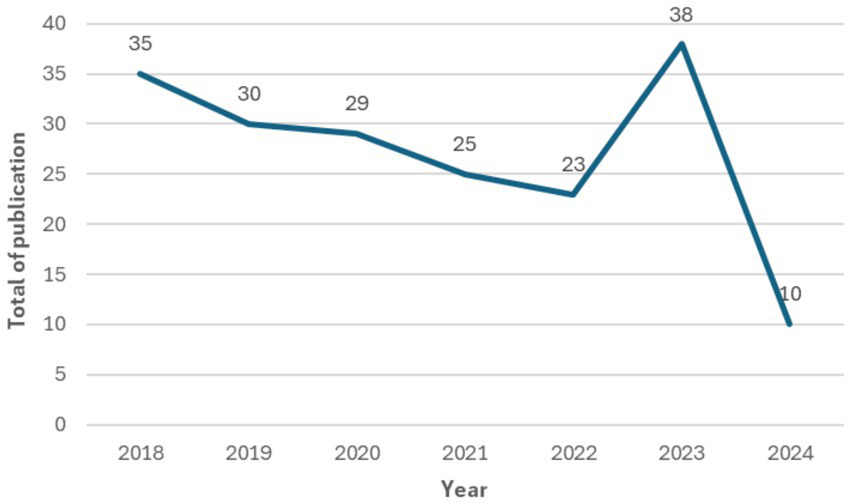
Annual report of publications on “Lesson learned from decentralization education management.”
4.2 Trend of lesson learned from decentralization in education management citations, 2018–2024
In this research, we present an analysis of 20 articles focusing on various lessons learned from decentralization in education management, specifically those with the highest number of citations. Table 1 displays metadata from articles with the highest citation counts. According to Table 1, it is evident that many articles, such as “Charting Chicago School Reform: Democratic Localism as a Lever for Change” by Bryk (2018), discuss different lessons learned from the decentralization of education management and are frequently cited, totaling 747 citations. Another notable article is the research conducted by Cheng (2022), which has been cited 722 times since its publication, averaging 361 citations per year. Based on the data provided in Table 1, these articles stand out for their significant impact and contribution to the discourse on decentralization in education management.
Table 1
| No | Cites | Title | Year | CitesPer year | CitesPer author | References |
|---|---|---|---|---|---|---|
| 1 | 747 | Charting Chicago school reform: Democratic localism as a lever for change | 2018 | 124.5 | 747 | Bryk (2018) |
| 2 | 722 | School effectiveness and school-based management: A mechanism for development | 2022 | 361 | 722 | Cheng (2022) |
| 3 | 97 | Linking school-based management and school effectiveness: The influence of self-based management, motivation and effectiveness in the Arab education system in … | 2020 | 24.25 | 49 | Arar and Nasra (2020) |
| 4 | 73 | Shifting the perspective on community-based management of education: From systems theory to social capital and community empowerment | 2019 | 14.6 | 73 | Edwards (2019) |
| 5 | 67 | Adolescent girls’ nutrition and prevention of anaemia: a school based multisectoral collaboration in Indonesia | 2018 | 11.17 | 13 | Roche et al. (2018) |
| 6 | 56 | Place-based governance and leadership in decentralised school systems: Evidence from England | 2022 | 28 | 56 | Greany (2022) |
| 7 | 53 | A school-based fusion of East and West: A case study of modern curriculum innovations in a Chinese kindergarten | 2018 | 8.83 | 27 | Yang and Li (2018) |
| 8 | 49 | Implementation of School-Based Management in Curriculum and Learning Processes: a Literature Review | 2021 | 16.33 | 25 | Amon and Bustami (2021) |
| 9 | 46 | Responsibility, authority, and accountability in school-based and non-school-based management: Principals’ coping strategies | 2018 | 7.67 | 23 | Grinshtain and Gibton (2018) |
| 10 | 43 | 21st Century experiences in the development of school-based management policy and practices in Indonesia | 2022 | 21.5 | 14 | Bandur et al. (2022) |
| 11 | 41 | Stakeholders’ responses to school-based management in Indonesia | 2018 | 6.83 | 41 | Bandur (2018) |
| 12 | 39 | Curriculum reform with a school-based approach: intellectual, structural and cultural challenges | 2018 | 6.5 | 13 | Lee et al. (2018) |
| 13 | 37 | Policy implementation within the frame of school-based curriculum: a comparison of public school and Islamic private school teachers in East Java, Indonesia | 2018 | 6.17 | 37 | Qoyyimah (2018) |
| 14 | 33 | The effectiveness of school-based decision making in improving educational outcomes: A systematic review | 2018 | 5.5 | 8 | Carr-Hill et al. (2018) |
| 15 | 32 | Financial Decentralization in Malaysian Schools: Strategies for Effective Implementation | 2018 | 5.33 | 8 | Radzi et al. (2018) |
| 16 | 32 | Educational assistance and education quality in Indonesia: the role of decentralization | 2019 | 6.4 | 32 | Sari (2019) |
| 17 | 31 | The implementation of school-based management in public elementary schools | 2019 | 6.2 | 31 | Martin (2019) |
| 18 | 31 | Application of Madrasah Based Management in Improving the Quality of Aliyah Madrasah Education | 2019 | 6.2 | 10 | Anwar et al. (2019) |
| 19 | 30 | School-based management in marginal areas: Satisfying the political context and student needs | 2022 | 15 | 10 | Ulfatin et al. (2022) |
| 20 | 30 | School-based curriculum development in Singapore: a case study of a primary school | 2018 | 5 | 10 | Hairon et al. (2018) |
Different lessons learned from decentralization in education management articles with the most citations.
4.3 Visualization of research data mapping
Data mapped using VOSviewer produces 3 forms of visualization, namely network visualization (Figure 2), overlay visualization (Figure 3), and density visualization (Figure 4).
Figure 2
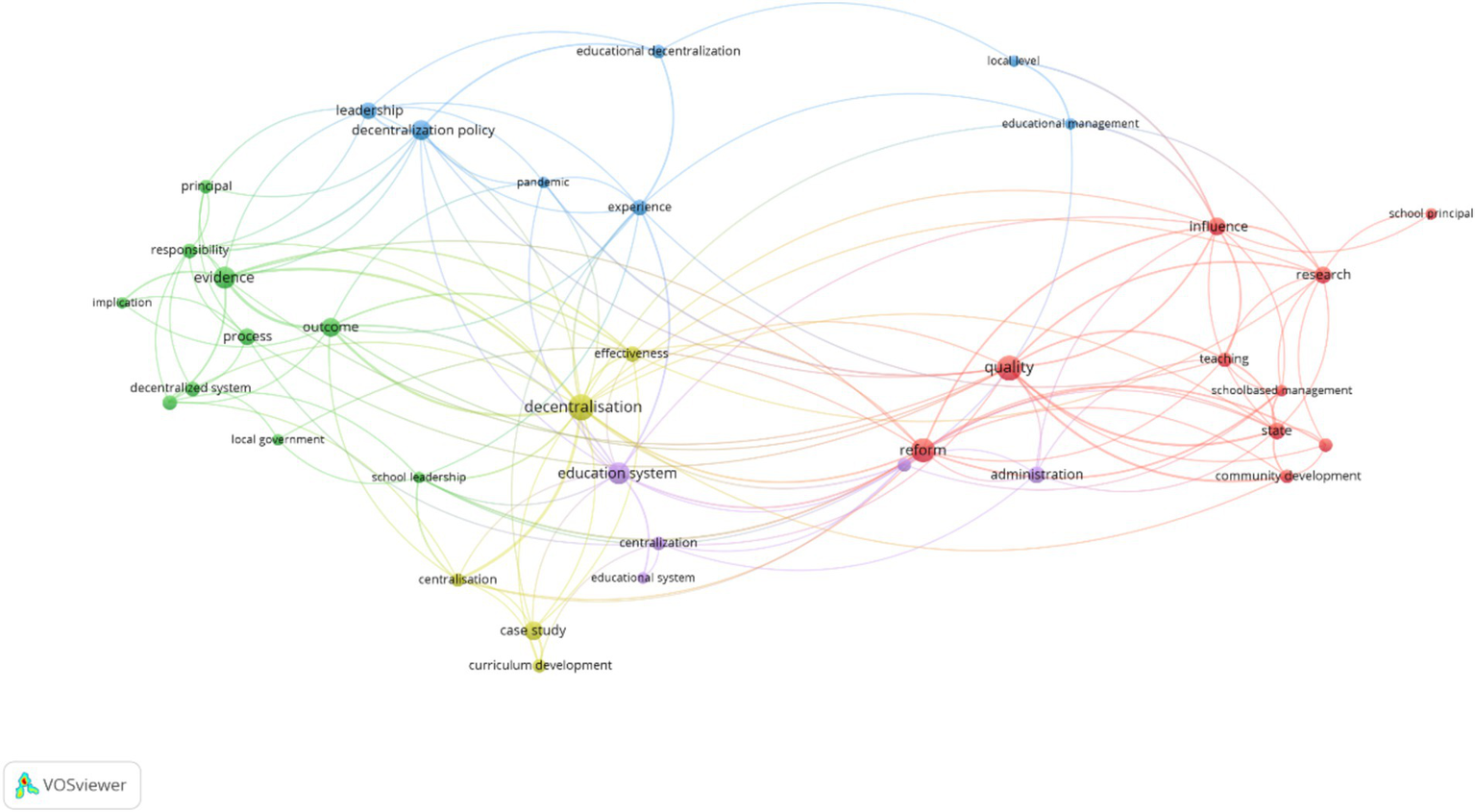
Network visualization based on Lesson learned from decentralization in education management.
Figure 3
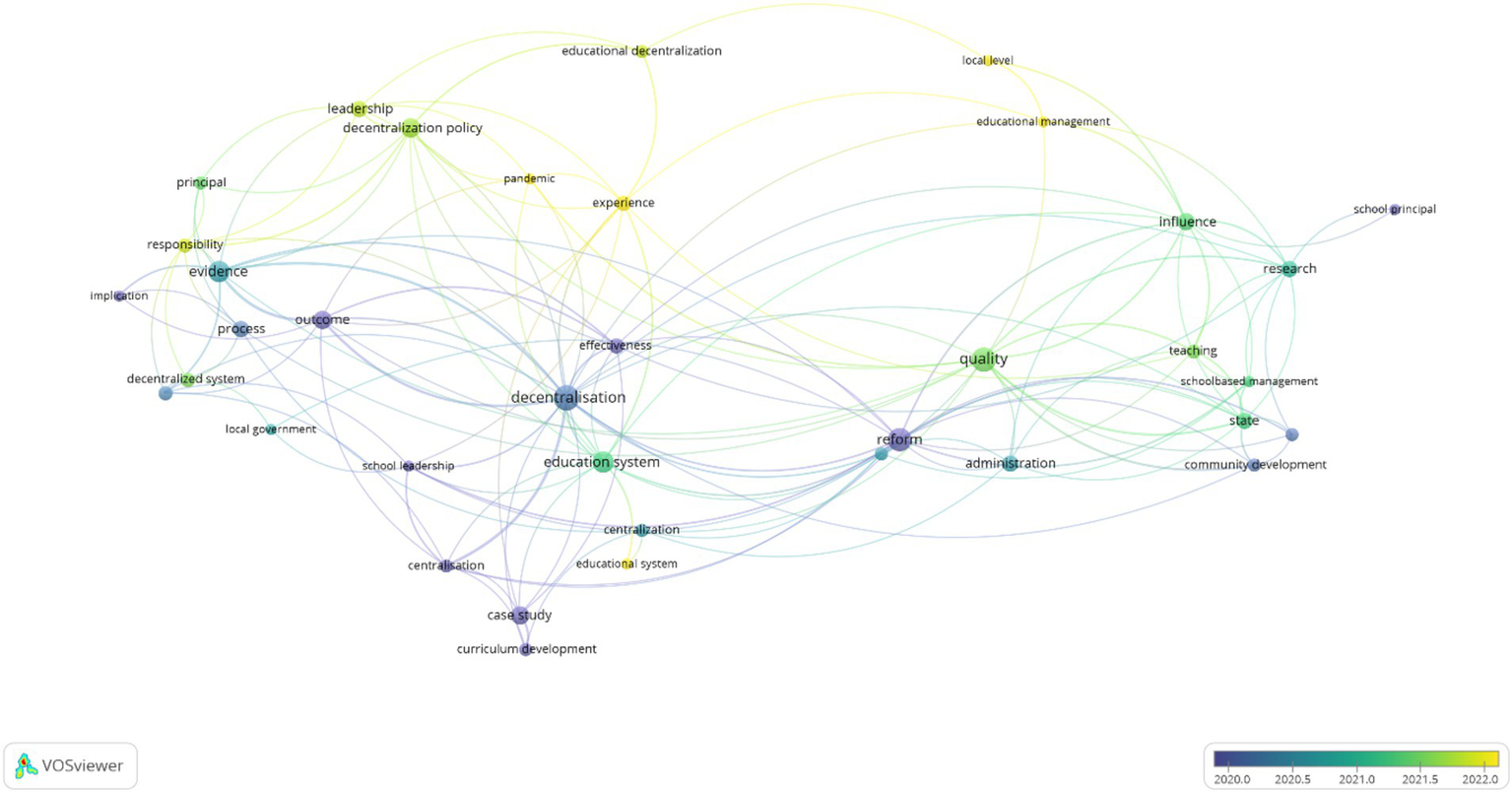
Overlay visualization based on Lesson learned from decentralization.
Figure 4

Density visualization based on Lesson learned from decentralization.
The network visualization reveals that terms derived from abstracts and keywords, corresponding to those used during data collection, are categorized into five clusters, totaling 37 items. Each item within these clusters exhibits distinct linkages, total link strength, and occurrences. In addition, the network visualization demonstrates a total link strength of 200 and 144 links. Below is a detailed breakdown of each cluster:
Cluster 1, marked in red, encompasses 10 items: community development, decentralized education, influence, quality, reform, research, school principal, school-based management, state, and teaching.
Cluster 2, highlighted in green, includes 10 items: decentralized system, evidence, implication, local government, outcome, principal, process, responsibility, school leadership, and school level.
Cluster 3, depicted in blue, comprises 7 items: decentralization policy, educational decentralization, educational management, experience, leadership, local level, and pandemic.
Cluster 4, distinguished in yellow, incorporates 5 items: case study, centralization (practice), curriculum development, decentralization, and effectiveness.
Cluster 5, shaded in purple, encompasses 5 items: administration, centralization (system), education system, educational system, and effect.
The overlay visualization reveals that terms extracted from abstracts and keywords, corresponding to those used during data collection, are categorized into 5 clusters, totaling 37 items. Each item within these clusters exhibits distinct linkages, total link strength, and occurrences. Overall, the network visualization demonstrates a total link strength of 200 and 144 links. Below is a detailed breakdown of each cluster:
Cluster 1, highlighted in purple and green, encompasses 10 items: community development, decentralized education, influence, quality, reform, research, school principal, school-based management, state, and teaching.
Cluster 2, marked in green, includes 10 items: decentralized system, evidence, implication, local government, outcome, principal, process, responsibility, school leadership, and school level.
Cluster 3, distinguished in yellow, comprises 7 items: decentralization policy, educational decentralization, educational management, experience, leadership, local level, and pandemic.
Cluster 4, depicted in green and yellow, incorporates 5 items: case study, centralization (practice), curriculum development, decentralization, and effectiveness.
Cluster 5, shaded in blue, encompasses 5 items: administration, centralization (system), education system, educational system, and effect.
The density visualization highlights the organization of terms from abstracts and keywords, consistent with those used during data collection, into five distinct clusters with a total of 37 items. These items are distinguished by their individual connections, cumulative link strength, and occurrence rates. Density visualization provides insights into the prominence and thematic concentration of research topics by employing gradient color intensities to represent item significance (van Eck and Waltman, 2010). This technique allows for the identification of dominant themes and peripheral topics within a research domain. The total link strength, amounting to 200, and the 144 recorded links reveal a dense network of interconnections, highlighting the interplay between key themes and their relative importance. Previous studies have emphasized that such visualizations are instrumental in detecting influential topics and emerging research areas (Cobo et al., 2011; Perianes-Rodriguez et al., 2016). Moreover, the identification of clusters enables researchers to map the intellectual structure and thematic evolution of the field, thereby providing a comprehensive view of knowledge development (Donthu et al., 2021). By utilizing these visualizations, this study demonstrates how bibliometric tools can facilitate a deeper understanding of the dynamics within educational management research.
4.4 Discussion
The current study aimed to explore the experiences of educational personnel under the management of provincial administration organizations. Lessons learned from decentralization were facilitated through mapping analysis. The results reveal a steady decrease in the number of published studies on Educational Management in School Transfer to Provincial Administrative Organizations during Decentralization over time, dropping from 30 papers in 2018 to 10 in 2024. Utilizing a bibliometric analysis approach, the experiences of educational personnel under provincial administration management were examined. This study employed both cartographic and bibliometric analysis techniques, including VOSviewer cartographic analysis. Despite this downward trend, these methods remain crucial for handling quantitative research data and understanding referenced information within the research.
The findings reveal that the clusters identified in the study’s overlay visualization represent distinct thematic areas within the broader context of educational decentralization. These clusters can be labeled or renamed to better encapsulate the decentralization issues in Thailand.
Cluster 1, labeled “Operational Dynamics in Decentralized Education,” focuses on the practical aspects and outcomes of decentralization. It examines key themes such as community development, school-based management, teaching quality, and the roles of school principals. This cluster highlights the intersection of research, reform, and influence in shaping decentralized education systems.
Cluster 2, labeled “Governance and Leadership in Decentralization,” emphasizes governance structures and leadership roles at various levels. It explores the responsibilities of local governments and school-level leadership, as well as their implications for outcomes and processes within decentralized systems.
Cluster 3, renamed “Policy and Adaptation in Educational Decentralization,” addresses the development and adaptation of policies, particularly in response to challenges like pandemics. It also investigates educational management and leadership dynamics at the local level, underscoring the need for flexible policy frameworks.
Cluster 4, referred to as “Balancing Centralization and Decentralization in Curriculum and Practices,” examines the interplay between centralized and decentralized approaches. It focuses on case studies, curriculum development, and their effectiveness in achieving decentralization goals.
Cluster 5, called “Structural Dynamics of Education Systems,” delves into the structural aspects of centralization and decentralization, with particular attention to administrative systems, the broader educational framework, and their impact on educational outcomes.
Together, these clusters provide a comprehensive perspective on the complex and multifaceted nature of educational decentralization, offering valuable insights into its operational, governance, policy, curricular, and structural dimensions.
One key implication of using bibliometric techniques is the lack of reliable and comprehensive data repositories for analysis, especially from developing countries that may not have advanced web-based databases. This limitation hinders thorough and accurate data collection. However, the internet’s capabilities hold the promise of gradually improving and expanding data sources. The current study presents significant implications across multiple dimensions, including theoretical, methodological, practical, and societal. These insights provide valuable understanding of the comprehensive impact of bibliometric analysis on decentralization in education management research.
4.4.1 Theoretical implications
The study contributes to the theory of decentralization by providing empirical evidence on how decentralization policies impact educational administration at the local level. Decentralization theory posits that shifting governance from central to local authorities can enhance efficiency, accountability, and responsiveness to local needs (Bray, 1996; Faguet, 2014). This study supports this theory by highlighting the roles and challenges faced by Provincial Administrative Organizations (PAOs) in managing schools, thus providing a nuanced understanding of how decentralization unfolds in practice.
Moreover, the research addresses gaps in existing literature regarding the long-term sustainability and effectiveness of decentralized educational management structures. By identifying the paucity of research on the long-term effects of school transfers to PAOs, this study underscores the need for more longitudinal studies to assess the sustainability of decentralized governance models (Faguet, 2014). Additionally, the focus on administrative challenges and stakeholder engagement aligns with organizational theory, which emphasizes the importance of efficient management practices and stakeholder involvement for successful organizational performance (Donaldson, 2001).
The study also contributes to the literature on educational outcomes by examining how decentralization affects student performance and school quality. This is in line with theories suggesting that local governance can tailor educational strategies to better meet the needs of their communities, potentially leading to improved outcomes (Davies, 2008). The bibliometric approach employed in this research further enhances theoretical understanding by mapping the intellectual landscape and identifying key trends and influential works, thus guiding future research directions in the field.
4.4.2 Methodological implications
The study offers several methodological implications by employing bibliometric analysis. The study demonstrates the utility of this method in systematically mapping and analyzing the intellectual structure of a research field (Aria and Cuccurullo, 2017). Bibliometric techniques, including citation and co-citation analysis, allow researchers to identify key themes, influential works, and research trends, providing a comprehensive overview of the scholarly landscape. This methodological approach can be particularly valuable in fields with extensive and diverse literature, such as educational management and decentralization, as it helps to synthesize large volumes of information and uncover hidden patterns (Zupic and Čater, 2015).
Additionally, the study’s use of co-occurrence data from author keywords highlights the effectiveness of this technique in identifying emerging topics and gaps in the literature. By analyzing keyword trends, researchers can pinpoint areas that require further investigation, thereby guiding future research efforts (He, 1999). The study’s focus on a specific timeframe (2018–2024) also underscores the importance of temporal analysis in bibliometric research, which can reveal how scholarly interest and research priorities evolve over time (Boyack and Klavans, 2010).
Moreover, the methodological rigor demonstrated in this study, through the careful selection and analysis of a comprehensive dataset, sets a standard for future bibliometric studies in educational research. It emphasizes the need for meticulous data collection and analysis procedures to ensure the reliability and validity of bibliometric findings (Moed, 2006). Thus, this study exemplifies how bibliometric analysis can be a powerful tool in educational research, offering detailed insights and advancing theoretical and practical knowledge in the field.
4.4.3 Practical implications
The study’s findings highlight the administrative challenges and stakeholder engagement issues that arise during the transfer of school management to local authorities. This insight is crucial for policymakers as it underscores the need for robust training programs and support systems for local administrators to ensure a smooth transition and effective management (Wallner, 2018; Bakar et al., 2016). For example, to equip local administrators with skills for effective school management post-decentralization, offering mentorship, peer support, and ongoing professional development to ensure quality education and policy adherence. Additionally, understanding these challenges allows for the development of targeted interventions to mitigate potential disruptions in educational services (Caldwell, 2008).
The identification of a concentrated focus on administrative and educational outcomes also suggests areas where local authorities can improve their practices. By emphasizing the importance of stakeholder engagement, the study highlights the need for inclusive decision-making processes that involve teachers, parents, and community members, which can enhance the legitimacy and responsiveness of educational policies (Bray, 2003). Practical steps could include establishing regular communication channels and feedback mechanisms to ensure that all voices are heard and considered in the management of schools. This can be achieved by implementing feedback mechanisms, such as surveys or public forums, that allow parents, teachers, and students to share their concerns and suggestions on school management. For example, provincial education offices (PAOs) could organize quarterly community consultations to gather input on school performance and the effectiveness of policies.
Moreover, the research points to a significant gap in the study of long-term effects and sustainability of decentralized educational management structures. This finding indicates that ongoing monitoring and evaluation are essential for assessing the effectiveness of decentralization policies over time. Policymakers should invest in longitudinal studies and continuous data collection to track progress and make informed adjustments to policies and practices (Faguet, 2014). For instance, the Thai government could invest in longitudinal studies that track the performance of schools and educational outcomes across different provinces, comparing areas with varying levels of decentralization. By collecting continuous data on key indicators such as student performance, teacher quality, and resource allocation, policymakers can better understand how decentralization impacts education in the long term. These practical measures, informed by the study’s insights, can contribute to more effective and sustainable educational management within decentralized frameworks.
4.4.4 Societal implications
The study emphasizes how decentralization holds the potential to democratize education governance, facilitating greater community involvement and accountability (Bray, 2003). This shift can empower local communities, granting them a voice in educational decision-making and nurturing a sense of ownership and responsibility toward local schools. Such community engagement is essential for creating educational environments that are responsive to the diverse needs and cultural contexts of local populations (Caldwell, 2008; Bakar et al., 2007). Additionally, decentralization has the potential to address educational inequities by enabling local authorities to allocate resources more effectively and tailor educational policies to meet specific local needs (Faguet, 2014). This localized approach can contribute to reducing disparities in educational access and quality, fostering more equitable outcomes across different regions.
Furthermore, by identifying challenges and gaps in current decentralized management structures, the study advocates for continuous support and capacity-building for local administrators, ensuring that decentralization benefits all segments of society, particularly marginalized and underserved communities (Wong et al., 2018). Moreover, the focus on stakeholder engagement underscores the importance of inclusive practices in education management. Ensuring active involvement of stakeholders such as students, parents, teachers, and community members in the governance process can lead to the development of more effective and sustainable educational policies (Bray, 2003). This inclusive approach not only enhances educational outcomes but also fosters social cohesion and trust within communities, nurturing a more collaborative and supportive societal framework.
4.5 Limitations and future directions
The primary limitation of this study is its restricted timeframe, which focuses on the most recent 5 years (2018–2024) of issues related to the decentralization of education in Thailand. While this timeframe aligns with the study’s objective of understanding current challenges, it may overlook earlier foundational works and long-term trends. Including these could offer a more comprehensive perspective on the decentralization process (Zupic and Čater, 2015), tracing developments from the initial implementation of the decentralization policy in 1999. Additionally, the reliance on bibliometric techniques, while powerful, inherently focuses on quantifiable data and may miss nuanced qualitative insights into the lived experiences and contextual specifics of the school transfer process (Moed, 2006).
A limitation of this study is its lack of focus on regional differences in the implementation of decentralization across Thailand, particularly between rural and urban areas. The study does not fully address how varying local contexts, resources, and challenges might influence the effectiveness of decentralization in different regions (Faguet, 2014). As a result, the findings may not fully capture the complexities and disparities in the management and outcomes of decentralized educational systems in diverse geographical settings (Bray, 2003). Further research could explore these regional variations to provide a more comprehensive understanding of decentralization’s impact across the country.
The dataset’s reliance on specific academic databases presents a potential bias, as it may exclude valuable publications from regional journals or grey literature that offer critical local perspectives and practical insights (Aria and Cuccurullo, 2017). Additionally, the study is limited by its use of data gathered exclusively through keywords related to evaluation and education policy, restricting the scope of the search to these terms within Google Scholar. Furthermore, the focus on citation and co-citation analysis may lead to an overemphasis on highly cited works, potentially overlooking important but less-cited research (Boyack and Klavans, 2010).
Future research should consider expanding the temporal and database scope to capture a broader range of literature and historical context. Integrating qualitative methodologies, such as case studies or interviews, could complement the bibliometric approach by providing deeper insights into the practical and human aspects of decentralization (He, 1999). Additionally, exploring the long-term impacts and sustainability of the school transfer process through longitudinal studies would provide valuable information on the effectiveness and durability of decentralized management structures (Faguet, 2014). These enhancements can lead to a more holistic understanding of educational decentralization in Thailand and beyond.
5 Conclusion
The research provides critical insights into the complex process of educational decentralization. Through a comprehensive bibliometric analysis, the study identifies key themes, trends, and influential works that have shaped the discourse on educational management within decentralized frameworks. The findings highlight significant administrative challenges and the necessity for effective stakeholder engagement, emphasizing the need for robust support systems for local authorities (Bray, 2003; Wong et al., 2018). Additionally, the study reveals a notable gap in research on the long-term effects and sustainability of decentralized management structures, calling for further longitudinal studies to assess the durability and effectiveness of these governance models (Faguet, 2014). The practical implications underscore the importance of tailored interventions and inclusive decision-making processes that enhance educational outcomes and foster community involvement (Caldwell, 2008). By mapping the intellectual landscape, the study not only consolidates existing knowledge but also identifies future research directions to address current gaps and challenges. This research contributes significantly to the broader discourse on decentralization, offering valuable insights that can inform policy and practice in similar educational contexts globally. Consequently, the study underscores the complexity and potential of decentralization in educational management, advocating for continued exploration and refinement of strategies to optimize educational governance (Aria and Cuccurullo, 2017; Zupic and Čater, 2015).
Statements
Author contributions
JC: Writing – original draft, Writing – review & editing. DP: Conceptualization, Writing – review & editing. RS: Validation, Writing – review & editing. MT: Visualization, Writing – review & editing. BM: Validation, Writing – review & editing.
Funding
The author(s) declare that financial support was received for the research, authorship, and/or publication of this article. This research project was financially supported by the Faculty of Education Mahasarakham University.
Conflict of interest
The authors declare that the research was conducted in the absence of any commercial or financial relationships that could be construed as a potential conflict of interest.
The author(s) declared that they were an editorial board member of Frontiers, at the time of submission. This had no impact on the peer review process and the final decision.
Publisher’s note
All claims expressed in this article are solely those of the authors and do not necessarily represent those of their affiliated organizations, or those of the publisher, the editors and the reviewers. Any product that may be evaluated in this article, or claim that may be made by its manufacturer, is not guaranteed or endorsed by the publisher.
References
1
Ahmi A. (2022). Bibliometric analysis for beginners: a practical guide with examples using VOSviewer. Sintok: Universiti Utara Malaysia Press.
2
Ahmi A. Mohamad R. (2019). Bibliometric analysis of global scientific literature on web accessibility. Int. J. Recent Technol. Eng.7, 250–258. doi: 10.35940/ijrte.C1171.098319
3
Al Husaeni D. N. Al Husaeni D. F. Nandiyanto A. B. D. Al-Obaidi A. S. M. (2022). Introducing ASEAN Journal of Science and Engineering Education: A bibliometric analysis study for understanding internationalization. Data and Metadata, 1:43.
4
Amon L. Bustami M. R. (2021). Implementation of school-based management in curriculum and learning processes: a literature review. J. Pendidikan Dasar dan Menengah1, 1–11.
5
Anwar L. M. Jufri A. W. Muhaimi L. (2019). Application of madrasah-based management in improving the quality of Aliyah madrasah education. Int. J. Multicult. Multirelig. Understand.6, 257–269. doi: 10.18415/ijmmu.v6i5.1086
6
Arar K. Nasra M. A. (2020). Linking school-based management and school effectiveness: the influence of self-based management, motivation, and effectiveness in the Arab education system in Israel. Educ. Manag. Admin. Lead.48, 186–204. doi: 10.1177/1741143218775428
7
Aria M. Cuccurullo C. (2017). Bibliometrix: an R-tool for comprehensive science mapping analysis. J. Informet.11, 959–975. doi: 10.1016/j.joi.2017.08.007
8
Asian Development Bank . (2014). Effect of decentralization strategy on macroeconomic stability in Thailand. Available at:https://www.adb.org/publications/effect-decentralization-strategy-macroeconomic-stability-thailand (Accessed February 22, 2024)
9
Azfar O. Kahkonen S. Lanyi A. Meagher P. Rutherford D. (2018). “Decentralization, governance, and public services: the impact of institutional arrangements” in Devolution and development (Maryland, USA: Routledge), 45–88.
10
Bakar H. A. Halim H. Mustaffa C. S. Mohamad B. (2016). Relationships differentiation: Cross-ethnic comparisons in the Malaysian workplace. J. Intercult. Commun. Res.45, 71–90. doi: 10.1080/17475759.2016.1140672
11
Bakar H. A. Mohamad B. Mustafa C. S. (2007). Superior–subordinate communication dimensions and working relationship: Gender preferences in a Malaysian organization. J. Intercult. Commun. Res.36, 51–69. doi: 10.1080/17475750701265281
12
Bandur A. (2018). Stakeholders’ responses to school-based management in Indonesia. Int. J. Educ. Manag.32, 1082–1098. doi: 10.1108/IJEM-11-2017-0346
13
Bandur A. Hamsal M. Furinto A. (2022). 21st-century experiences in the development of school-based management policy and practices in Indonesia. Educ. Res. Policy Prac.21, 85–107. doi: 10.1007/s10671-021-09293-x
14
Barrera-Osorio F. Fasih T. Patrinos H. A. Santibáñez L. (2009). Decentralized decision-making in schools: the theory and evidence on school-based management. Washington D.C.: World Bank Publications.
15
Bjork C. (2004). Decentralisation in education, institutional culture, and teacher autonomy in Indonesia. Int. Rev. Educ.50, 245–263. doi: 10.1007/s11159-004-2622-6
16
Bjork R. A. Dunlosky J. Kornell N. (2013). Self-regulated learning: Beliefs, techniques, and illusions. Annu. Rev. Psychol.64, 417–444.
17
Boyack K. W. Klavans R. (2010). Co-citation analysis, bibliographic coupling, and direct citation: which citation approach represents the research front most accurately?J. Am. Soc. Inf. Sci. Technol.61, 2389–2404. doi: 10.1002/asi.21419
18
Bray M. (2003). Community initiatives in education: goals, dimensions, and linkages with governments. Compare33, 31–45. doi: 10.1080/03057920302598
19
Bray M. (1996). Decentralization of education: Community financing (Vol. 36). New York: World Bank Publications.
20
Bryk A. (2018). Charting Chicago school reform: democratic localism as a lever for change. New York, NY: Routledge.
21
Caldwell B. J. (2008). Raising the stakes: From improvement to transformation in the reform of schools. New York, NY: Routledge.
22
Carr-Hill R. Rolleston C. Schendel R. Waddington H. (2018). The effectiveness of school-based decision making in improving educational outcomes: a systematic review. J. Dev. Eff.10, 61–94. doi: 10.1080/19439342.2018.1440250
23
Cheema G. S. Rondinelli D. A. (2007). Decentralizing governance: Emerging concepts and practices. Washington, D.C.: Brookings Institution Press.
24
Cheng Y. C. (2022). School effectiveness and school-based management: a mechanism for development: Routledge.
25
Cobo M. J. López-Herrera A. G. Herrera-Viedma E. Herrera F. (2011). An approach for detecting, quantifying, and visualizing the evolution of a research field: a practical application to the fuzzy sets theory field. J. Informet.5, 146–166. doi: 10.1016/j.joi.2010.10.002
26
Constitution of the Kingdom of Thailand BE 2540 . (2024). Royal Thai Government.
27
Cummings W. K. Bain O. (2018). “U.S. doctoral study to early career” in Doctoral education for the knowledge society: convergence or divergence in national approaches?New York, NY: Springer, 91–103.
28
Davies B. (2008). Raising the stakes: from improvement to transformation in the reform of schools. Int. J. Educ. Manag.22:456. doi: 10.1108/09513540810895460
29
Donaldson L. (2001). The contingency theory of organizations: Sage Publications.
30
Donthu N. Kumar S. Mukherjee D. Pandey N. Lim W. M. (2021). How to conduct a bibliometric analysis: an overview and guidelines?J. Bus. Res.133, 285–296. doi: 10.1016/j.jbusres.2021.04.070
31
Edwards D. B. (2019). Shifting the perspective on community-based management of education: from systems theory to social capital and community empowerment. Int. J. Educ. Dev.64, 17–26. doi: 10.1016/j.ijedudev.2018.11.004
32
Faguet J. P. (2014). Decentralization and governance. World Dev.53, 2–13. doi: 10.1016/j.worlddev.2013.01.002
33
Falagas M. E. Pitsouni E. I. Malietzis G. A. Pappas G. (2008). Comparison of PubMed, Scopus, web of science, and Google scholar: strengths and weaknesses. FASEB J.22, 338–342. doi: 10.1096/fj.07-9492LSF
34
Fry G. W. (1983). Decentralization and development strategy: a Thai case study. Available at:https://es.ircwash.org/sites/default/files/Fry-1983-Decentralization.pdf (Accessed February 25, 2024).
35
Fumasoli T. Stensaker B. (2013). Organizational studies in higher education: a reflection on historical themes and prospective trends. High Educ. Pol.26, 479–496. doi: 10.1057/hep.2013.25
36
Grauwe A. D. (2005). Improving the quality of education through school-based management: learning from international experiences. Int. Rev. Educ.51, 269–287. doi: 10.1007/s11159-005-7733-1
37
Greany T. (2022). Place-based governance and leadership in decentralised school systems: evidence from England. J. Educ. Policy37, 247–268. doi: 10.1080/02680939.2020.1792554
38
Grinshtain Y. Gibton D. (2018). Responsibility, authority, and accountability in school-based and non-school-based management: principals’ coping strategies. J. Educ. Adm.56, 2–17. doi: 10.1108/JEA-01-2017-0005
39
Hairon S. Chua C. S. K. Neo W. L. (2018). School-based curriculum development in Singapore: a case study of a primary school. Asia Pacific J. Educ.38, 518–532. doi: 10.1080/02188791.2018.1530192
40
Harzing A. W. Alakangas S. (2016). Google scholar, Scopus, and the web of science: a longitudinal and cross-disciplinary comparison. Scientometrics106, 787–804. doi: 10.1007/s11192-015-1798-9
41
He Q. (1999). Knowledge discovery through co-word analysis. Libr. Trends48, 133–159.
42
Institute of Developing Economies, JETRO . (2018). IDE-JETRO annual report 2018. Institute of Developing Economies, JETRO. Available at:http://www.ide.go.jp/ (Accessed February 25, 2024).
43
Japan International Cooperation Agency . (2008). Trends and developments in decentralization in Thailand. Available at:https://www.jica.go.jp/Resource/jica-ri/IFIC_and_JBICI-Studies/english/publications/reports/study/capacity/200807/pdf/002.pdf (Accessed February 25, 2024).
44
Lee T. Cheng Y. C. Ko J. (2018). Curriculum reform with a school-based approach: intellectual, structural, and cultural challenges. Sch. Leaders. Manag.38, 278–301. doi: 10.1080/13632434.2017.1386647
45
Leithwood K. Jantzi D. (2006). Transformational school leadership for large-scale reform: effects on students, teachers, and their classroom practices. Sch. Eff. Sch. Improv.17, 201–227. doi: 10.1080/09243450600565829
46
Local Government Act 2000 (2024). Government of Thailand.
47
Martin M. (2019). The implementation of school-based management in public elementary schools. Asian J. Assess. Teach. Learn.9, 44–56. doi: 10.37134/ajatel.vol9.no1.5.2019
48
Martínez-López F. J. Merigó J. M. Valenzuela-Fernández L. Nicolás C. (2020). Fifty years of the European journal of marketing: a bibliometric analysis. Eur. J. Mark.54, 13–42. doi: 10.1108/EJM-11-2018-0823
49
Martín-Martín A. Orduna-Malea E. Thelwall M. Delgado López-Cózar E. (2018). Google scholar, web of science, and Scopus: a systematic comparison of citations in 252 subject categories. J. Informet.12, 1160–1177. doi: 10.1016/j.joi.2018.09.002
50
Moed H. F. (2006). Citation analysis in research evaluation: Springer.
51
Mongeon P. Paul-Hus A. (2016). The journal coverage of web of science and Scopus: a comparative analysis. Scientometrics106, 213–228. doi: 10.1007/s11192-015-1765-5
52
Nagai F. Kagoya K. (2014). Local capability and decentralization in Thailand. Available at:https://www.ide.go.jp/library/English/Publish/Reports/Jrp/pdf/147_4.pdf
53
Naidoo J. P. (2004). Educational decentralization and school governance in South Africa: from policy to practice: Harvard University.
54
National Education Act of 1999 . (2024). Government of Thailand.
55
National Education Commission . (1997). National policy on education 1997. National Education Commission.https://nec.gov.lk/wp-content/uploads/2014/04/National_Policy_1997-I.pdf
56
Organisation for Economic Co-operation and Development . (2017). Fiscal decentralisation and inclusive growth in Asia. Available at:https://www.oecd-ilibrary.org/governance/fiscal-decentralisation-and-inclusive-growth-in-asia_c32c291b-en
57
Perianes-Rodriguez A. Waltman L. Van Eck N. J. (2016). Constructing bibliometric networks: a comparison between full and fractional counting. J. Informet.10, 1178–1195. doi: 10.1016/j.joi.2016.10.006
58
Prawda J. (1993). Educational decentralization in Latin America: lessons learned. Int. J. Educ. Dev.13, 253–264. doi: 10.1016/0738-0593(93)90033-V
59
Qoyyimah U. (2018). Policy implementation within the frame of school-based curriculum: a comparison of public school and Islamic private school teachers in East Java, Indonesia. Compare48, 571–589. doi: 10.1080/03057925.2017.1334536
60
Radzi N. M. Ghani M. F. A. Siraj S. Afshari M. (2018). Financial decentralization in Malaysian schools: strategies for effective implementation. MOJES1, 20–32.
61
Raza S. H. Iftikhar M. Mohamad B. Pembecioğlu N. Altaf M. (2020). Precautionary behavior toward dengue virus through public service advertisement: mediation of the individual’s attention, information surveillance, and elaboration. Sage Open, 10:2158244020929301. doi: 10.1177/2158244020929301
62
Roche M. L. Bury L. Yusadiredja I. N. Asri E. K. Purwanti T. S. Kusyuniati S. et al . (2018). Adolescent girls’ nutrition and prevention of anaemia: a school-based multisectoral collaboration in Indonesia. BMJ363:k4822. doi: 10.1136/bmj.k4822
63
Sari V. A. (2019). Educational assistance and education quality in Indonesia: the role of decentralization. Popul. Dev. Rev.45, 123–154. doi: 10.1111/padr.12272
64
Tran N. D. Hallinger P. Truong T. (2018). The heart of school improvement: a multi-site case study of leadership for teacher learning in Vietnam. Sch. Leaders. Manag.38, 259–283. doi: 10.1080/13632434.2017.1411905
65
Ulfatin N. Mustiningsih Sumarsono R. B. Yunus J. N. (2022). School-based management in marginal areas: satisfying the political context and student needs. Manag. Educ.36, 124–134. doi: 10.1177/0892020620959739
66
van Eck N. J. Waltman L. (2010). Software survey: VOSviewer, a computer program for bibliometric mapping. Scientometrics84, 523–538. doi: 10.1007/s11192-009-0146-3
67
Wallner J. (2018). “Federalism and education: the Canadian case” in Federalism and education: ongoing challenges and policy in ten countries. eds. WongK. K.KnuplingF.KollingM.ChebenovaD. (Charlotte, NC: Information Age Publishing), 107–126.
68
Warr P. (2014). Why Thailand must decentralise. East Asia ForumAvailable at:https://eastasiaforum.org/2014/09/22/why-thailand-must-decentralise/ (Accessed February 25, 2024).
69
Winkler D. R. Yeo B. (2007). “Identifying the impact of education decentralization on the quality of education” in AED: education quality improvement program 2 (EQUIP 2) Working Paper. Washington DC: American Institutes for Research.
70
Wirt F. M. Kirst M. W. (1997). The political dynamics of American education. Berkeley, CA: McCutchan Publishing Corporation.
71
Wong K. K. Knupling F. Kolling M. Chebenova D. (Eds.) (2018). Federalism and education: Ongoing challenges and policy in ten countries. Charlotte, NC: Information Age Publishing.
72
Woszczynski A. B. Whitman M. E. (2016). Perspectives on open access opportunities for IS research publication: potential benefits for researchers, educators, and students. J. Inf. Syst. Educ.27, 259–276.
73
Yang W. Li H. (2018). A school-based fusion of east and west: a case study of modern curriculum innovations in a Chinese kindergarten. J. Curric. Stud.50, 17–37. doi: 10.1080/00220272.2017.1294710
74
Zupic I. Čater T. (2015). Bibliometric methods in management and organization. Organ. Res. Methods18, 429–472. doi: 10.1177/1094428114562629
Summary
Keywords
decentralization, lesson learned, education management, local government, school
Citation
Chano J, Mohamad B, Prabjandee D, Singporn R and Tuaypar M (2025) Lessons learned in transition: a bibliometric analysis of educational management in school transfer to provincial administrative organizations during decentralization. Front. Educ. 10:1435928. doi: 10.3389/feduc.2025.1435928
Received
21 May 2024
Accepted
13 January 2025
Published
28 January 2025
Volume
10 - 2025
Edited by
Sydney D. Richardson, North Carolina Agricultural and Technical State University, United States
Reviewed by
Hamdan Said, University of Technology Malaysia, Malaysia
Yusriadi Yusriadi, Universitas Cahaya Prima, Indonesia
Edi Supriyadi, Universitas Teknologi Bandung, Indonesia
Updates
Copyright
© 2025 Chano, Mohamad, Prabjandee, Singporn and Tuaypar.
This is an open-access article distributed under the terms of the Creative Commons Attribution License (CC BY). The use, distribution or reproduction in other forums is permitted, provided the original author(s) and the copyright owner(s) are credited and that the original publication in this journal is cited, in accordance with accepted academic practice. No use, distribution or reproduction is permitted which does not comply with these terms.
*Correspondence: Jiraporn Chano, jiraporn.j@msu.ac.th
Disclaimer
All claims expressed in this article are solely those of the authors and do not necessarily represent those of their affiliated organizations, or those of the publisher, the editors and the reviewers. Any product that may be evaluated in this article or claim that may be made by its manufacturer is not guaranteed or endorsed by the publisher.