Abstract
Background:
The disposition to critical thinking equips students with the capacity for objective analysis, informed decision-making, and problem-solving. Furthermore, it enhances intellectual autonomy and adaptability within academic contexts.
Objectives:
To assess the psychometric properties of the Critical Thinking Disposition Scale in Peruvian adolescents.
Methodology:
The psychometric adaptation process was implemented to evaluate the relevance, clarity, and comprehension of the items through expert judgment and pilot testing. Utilizing a sample of 499 students aged 10–17 years (M = 15.8, SD = 1.30), a confirmatory factor analysis (CFA) was conducted.
Results:
The scale demonstrated validity and reliability, yielding optimal fit and reliability indices that support its unidimensional structure.
Conclusion:
The validation of the Critical Thinking Disposition Scale in the Peruvian context provides a valuable instrument for assessing and fostering the propensity of Peruvian students to employ critical thinking skills, with implications for professional practice and educational policy. Furthermore, the study is significant because it shows that all factor values were greater than 0.40, which represents that the items contribute significantly to the evaluation of adolescents’ disposition to critical thinking.
1 Introduction
Critical thinking touches on a crucial topic in education since it is an essential indicator of quality in the teaching-learning process (Alsaleh, 2020), and its development is a priority in contemporary education (Aderoncele-Acosta et al., 2020).
Various investigations have demonstrated the effectiveness of critical thinking in academic activities. For example, Almulla and Al-Rahmi (2023) found that students who develop critical thinking have better learning capacity, and their self-efficacy increases (Namaziandost et al., 2023), increasing their performance (Martín-Raugh et al., 2023). Critical thinking promotes intellectual autonomy, independence (Fu et al., 2023), self-regulation, and self-assessment (Bernal et al., 2020). In this way, students can make informed decisions and develop their self-organization skills favorably, becoming a key factor in dealing with adverse situations (Van Tonder et al., 2022).
Critical thinking also becomes relevant in the digital age (Leuwol et al., 2023; Sel, 2022) and its development is of significant interest within the field of education in general (Nunnally and Bernstein, 1995; Campo et al., 2023). It allows adolescents to evaluate and discern the information disseminated by digital media and the use they make of it, which constitutes a safeguard for their physical, mental, and social integrity, given the amount of false information that exists and can be harmful to them (Gouseti et al., 2024).
Recent reports highlight the looming danger of the digital age for teenagers (Rauscher and Badenhorst, 2021). For example, the Global Standards of Digital Inteligence Institute (2023) pointed out, after a study in 30 countries worldwide, the following risks for children and adolescents in the digital age. Of the participants, 45% face cyberbullying, 29% consume violent and sexual content, and 28% receive online threats. Likewise, the United Nations International Children’s Emergency Fund (United Nations International Children’s Emergency Fund, 2024) expresses great concern about these and other dangers that the digital age brings for adolescents.
Given this problem, timely intervention by national and international educational authorities is necessary to implement appropriate policies for children, adolescents, and young people (Miller, 2023). In this sense, promoting the development of critical thinkers can be a possible and effective alternative solution (Aguilera and Pandya, 2021).
Critical thinking also benefits students on a personal level. It allows them to consolidate their identity by creating a space for reflection on their experiences, beliefs, and values through self-knowledge and critical reflection. This knowledge is used for decision-making and developing the ability to resolve conflicts and maintain interpersonal relationships (Nunnally and Bernstein, 1995; Branje et al., 2021). Furthermore, Haag et al. (2022) assert that the development of critical thinking skills is a priority in the twenty-first century and enables students to construct their identity through active participation and reflective practice.
Critical thinking is also relevant for the development of a sense of social responsibility and civic spirit in adolescents by encouraging analysis, interpretation, and dialogue, allowing them to assume an active role in democratic, civic, and social participation for a committed participation in their environment (Fuentes-Moreno et al., 2020), helping to improve their self-esteem.
In the context described above, critical thinking constitutes an important skill for adolescents on a personal, academic, and socio-emotional level, contributing to their optimal development and preparing them for their transition to youth and adulthood (Bernal et al., 2020). In this way, characteristics of personality, such as honesty, empathy and solidarity, have been shown to be related to critical thinking and that, when combined, enhance the ability to make correct decisions in adolescents (Merma-Molina et al., 2022). However, when talking about critical thinking, it is necessary to mention that this does not only consist of the cognitive part Guerci de Siufi (2008), which has to do with the skills of searching for information, analysis, interpretation, and evaluation for decision-making (Richards et al., 2020); but it also includes a dispositional aspect, little addressed in research (Fandiño Parra et al., 2021), especially in the adolescent population. This disposition is the tendency, inclination, attitude, and mental habits that a person has to think critically and reflectively. That is the openness to listening to different perspectives or points of view for analysis based on reason and a solid argument (Ennis, 1996). Facione et al. (1995) assert that the development of critical thinking skills is essential for sound decision-making and effective problem-solving. Halpern (1998) posits that this constitutes a learning experience that would enable the adolescent to navigate new contexts, with enhanced prospects of attaining academic success. However, the development and application of these skills in various contexts would not be possible, but thanks to motivation and dispositional adaptability (Perkins et al., 1993).
This attitudinal aspect is fundamental for developing critical thinking skills (Lun et al., 2023). It is directly related to reflective learning and predicts the ability to make decisions after reflecting, analyzing, and verifying information (Karahan et al., 2023) and influences their learning abilities (Daradoumis and Arguedas, 2020).
Previous studies highlight the importance of a disposition toward critical thinking (Aysu, 2023) points out that the inclination to explore new ideas, reflective questioning, and proactive learning allow the development of the skills of this type of thinking (Rauscher and Badenhorst, 2021).
There are some scales to measure critical thinking skills (such as the California Critical Thinking Skills Test [CCTST, (Facione and Facione, 1994)] and The Watson–Glaser Critical Thinking Appraisal [WGCTA, (Watson, 1980)] used in various investigations around the world. Cui et al. (2021) mention that although there are various tools to measure critical thinking skills, a better understanding is required regarding the inclination to use these skills in everyday life, that is, the disposition.
In this sense, some known scale to measure the disposition to critical thinking are the California Critical Thinking Disposition Inventory (CCTDI), which combines critical thinking skills and dispositions into 75 items grouped into seven factors: inquisitiveness, open-mindedness, systematicity, analyticity, truth-seeking, critical thinking self-confidence; maturity (Facione and Facione, 1992; Orhan, 2022), the Critical Thinking Disposition Assessment (CTDA), which measures the disposition to critical thinking through 19 items grouped into three factors: systematicity and analyticity, inquisitiveness and conversance, and maturity and skepticism (Yuan et al., 2014), the Watson-Glaser Critical Thinking Appraisal (WGCTA), which, although primarily focuses on critical thinking skills, can be used to quantify the predisposition to apply these skills in various contexts (El Hassan and Madhum, 2007) through 80 items grouped into five factors: interpretation, analysis, evaluation, inference, and explanation (Arslan and Demirtas, 2016; Kemper et al., 2019).
On the other hand, Quinn et al. (2020) point out a notable need for more consensus on measuring the dispositional dimension of critical thinking. Thus, the need for a valid and reliable instrument to adequately measure this construct is evident (Butler, 2024).
Faced with this need, after a thorough theoretical review, Sosu (2013) developed the Critical Thinking Disposition Scale (CTDS). This scale is the most relevant and appropriate for measuring the disposition to critical thinking since, unlike the previous ones, it focuses exclusively on a person’s attitude to using critical thinking skills (Bakhtiari-Dovvombaygi et al., 2024). This relevance and conceptual specificity are fundamental from a psychometric point of view, as pointed out by Kline (2015). Furthermore, the CTDS is the closest to the educational context, as it addresses the issue of commitment to critical thinking, highlighting the importance of maintaining the motivation to think critically, a constancy that is part of the educational task (Álvarez-Huerta et al., 2023). The CTDS has also demonstrated efficacy in administration due to its brevity compared to other scales, ensuring enhanced efficiency in data collection and mitigation of respondent fatigue (Arslan and Demirtas, 2016; Kemper et al., 2019). This makes it more appropriate for other extensive scales, as indicated by psychometric theory (Nunnally and Bernstein, 1994). Although it has received criticism for its brevity and simplicity, its use in recently published studies supports its reliability (Abanto-Ramírez et al., 2024; Karakus̨, 2024; Li et al., 2024).
The CTDS has been validated and adapted to various contexts. In Türkiye, Akin et al. (2015) verified the bifactor structure of the CTDS with good fit indices (x2 = 53.24, df = 40, RMSEA = 0.040, NFI = 0.90, NNFI = 0.96, GFI = 0.96, AGFI = 0.93, CFI = 0.97, IFI = 0.97 and SRMR = 0.046) and reliability (α = 0.78).
Likewise, Gerdts-Andresen et al. (2022) evaluated the psychometric properties of CTDS in Norwegian university students by testing the two factors proposed by Sosu (2013) with good fit indices in the analysis performed (GFI = 0.95, TLF = 0.94, CFI = 0.96, RMSEA = 0.040, SRMR = 0.053) and an α = 0.76. Likewise, Orhan (2023) supports the two-factor structure. For its part, Yockey (2016) and Bravo et al. (2020) support the unifactorial structure of the scale by reporting that they present better parsimony and fit indices [CFI = 0.976; RMSEA = 0.089 (0.081,0.097); SRMR = 0.031; ECV = 0.889]. These discrepancies in the factor structure may be due to cultural and specific reasons of the various study populations, which makes it necessary to analyze the psychometric properties of this scale, as suggested by Anastasi and Urbina (1997).
Evaluating the critical thinking disposition scale is essential to understand Peruvian students’ critical thinking disposition better. Therefore, verifying whether a scale is appropriate and relevant for Peruvian students is crucial. Few studies demonstrate the psychometric properties of this scale in the adolescent population. Most have only focused on university students, and there is one in the Peruvian context. This situation makes it difficult to measure this construct reliably and accurately, giving rise to possible inaccuracies and biases in the results obtained (American Educational Research Association, 2014). Therefore, this research aims to evaluate the psychometric properties of the Critical Thinking Disposition scale in Peruvian adolescents. This will allow educational actors, managers, and teachers to diagnose their students’ willingness to think critically and design effective interventions to develop these skills.
2 Materials and methods
2.1 Design and participants
This study is of an instrumental type (Ato et al., 2013), using a convenience sampling method. The sample was selected using the electronic calculator Soper (2024), which considered several factors: the number of observed and latent variables in the model, the expected effect size (λ = 0.10), the desired statistical significance (α = 0.05), and the level of statistical power (1–β = 0.80). According to these parameters, the minimum sample required for the study was 87 participants. However, 499 students were recruited, with a majority proportion of men (53.3%) aged between 12 and 17 years (M = 15.8, SD = 1.30). Most students were in their third year of secondary school, representing 42.7% of the sample (Table 1).
TABLE 1
| Characteristics | N | % | |
| N = 499 | |||
| Sex | Male | 266 | 53.3 |
| Female | 233 | 46.7 | |
| Year of study | First | 205 | 41.1% |
| Second | 27 | 5.4% | |
| Third | 213 | 42.7% | |
| Forth | 22 | 4.4% | |
| Fifth | 32 | 6.4% | |
| Age | 12 | 27 | 5.4% |
| 13 | 21 | 4.2% | |
| 14 | 17 | 3.4% | |
| 15 | 35 | 7.0% | |
| 16 | 261 | 52.3% | |
| 17 | 138 | 27.7% | |
Detailed description of the study sample.
2.2 Instruments
The Critical Thinking Readiness Scale was developed by Sosu (2013) based on the theoretical proposals of the APA Delphi Report (Facione, 1990), Californian critical thinking inventory (Facione and Facione, 1992; Perkins et al., 1993; Halonen, 1995; Ennis, 1996; Halpern, 1998). Its objective is to measure two dispositional domains of critical thinking: Critical Openness (the willingness to receive new ideas and critically evaluate them) and Reflective Skepticism (the tendency to reflect on past experiences and question current evidence). The Spanish version of this scale, validated in young university students, was used for this study (Bravo et al., 2020) because it is more suitable for the target population due to its cultural and linguistic adaptation compared to the original version in English, as well as the demonstration of validity and reliability (Muñiz et al., 2013). Its structure is unifactorial and consists of 11 items that can be directly quantified on a Likert scale from 1 to 5 (1 = Strongly disagree, 2 = Disagree, 3 = Undecided, 4 = Agree and 5 = Strongly agree). It has proven reliable (α = 0.777) and has adequate psychometric properties (CFI = 0.976; RMSEA = 0.089; SRMR = 0.031). The version of the instrument used retains all the items of Sosu’s initial proposal, for example “I usually try to think about the bigger picture during a discussion.”
2.3 Procedure
The Peruvian Union University Ethics Committee approved the research protocol, with reference number 2023-CE-EPG-00110. Permission was requested from the management of the educational institutions to which the survey was applied. Permission was obtained from the parents and/or guardians of the students who participated in the study, considering they are minors. In addition, each student gave their consent to participate. Free and voluntary participation was taken into account, as well as the confidentiality and anonymity of the data collected, following the principles of the Declaration of Helsinki (Puri et al., 2009).
2.4 Analysis
To evaluate the content validity of the CTDS, five teachers with experience in teaching and research in the educational and psychometric field participated, who rated the relevance of the items and provided suggestions for improvement (Suárez-Alvarez et al., 2018). Responses were analyzed using Aiken’s V coefficient (V = 1, p = 0.031; Aiken, 1985; Penfield and Giacobbi, 2004). A pilot test was carried out with 30 high school students through group discussion to verify the items’ comprehensibility and detect possible semantic errors and inconsistencies (Muñiz and Fonseca-Pedrero, 2019).
Then, construct validity was determined. First, the descriptive statistics of the Critical Thinking Disposition Scale items (mean, standard deviation, asymmetry, and kurtosis) were analyzed using the FACTOR Analysis program version 10.1. In the second stage, the validity evidence based on the internal structure was analyzed through a Confirmatory Factor Analysis (CFA) utilizing the freely available R software within its RStudio interface, using the Lavaan package (Rosseel, 2012). The estimation method was Robust Weighted Least Squares (WLSMV), and structural equation modeling (SEM) was considered, in order to establish the existence of relationships between latent variables and observed variables, thereby enabling the verification of a proposed structural model (Brown, 2015; Kline, 2016), It is beneficial to examine the factor structure of a scale and its psychometric properties (Byrne, 2010). The comparative fit index (CFI), adjusted goodness of fit index (AGFI), and Tucker-Lewis Index (TLI) were estimated. Also, the parameters for the root mean square error of approximation (RMSEA) and the root mean square error rate (SRMR) were taken into account, following the criteria proposed by Hu and Bentler (1999), who point out that the CFI and TLI should be greater than 0.9 and the RMSEA less than 0.08. Finally, the JAMOVI statistical software was used to evaluate reliability through Cronbach’s alpha and Omega coefficients.
3 Results
3.1 Content validity
The content validation criterion was obtained from the evaluation of five specialists in the educational area, who rated the items based on the criteria of clarity, congruence, context, and belonging to the domain of the construct on a scale of 0 = “The validation criterion is not met” to 6 = “The validation criterion is met.” As a result, the minimum value of V = 0.96 (CI 95% = 0.80; 0.99) for item 1, V = 0.93 (CI 95% = 0.79; 0.98), and values equal to greater than V = 0.97 for the rest of the items (CI 95% = 0.83; 0.99) for the rest of the items, considering them suitable for subsequent statistical analysis. These findings indicate that the item wording demonstrates clarity and unambiguity, uniformly measures the construct without contradictions, and aligns with the theoretical framework supporting the construct they aim to assess. No items were eliminated, as illustrated in Table 2.
TABLE 2
| Items | Aiken’s V | CI 95% | |
| Low | Up | ||
| DPC1 | 0.93 | 0.79 | 0.98 |
| DPC2 | 0.99 | 0.87 | 1.00 |
| DPC3 | 0.97 | 0.83 | 0.99 |
| DPC4 | 1.00 | 0.89 | 1.00 |
| DPC5 | 0.98 | 0.85 | 1.00 |
| DPC6 | 1.00 | 0.89 | 1.00 |
| DPC7 | 1.00 | 0.89 | 1.00 |
| DPC8 | 1.00 | 0.89 | 1.00 |
| DPC9 | 1.00 | 0.89 | 1.00 |
| DPC10 | 1.00 | 0.89 | 1.00 |
| DPC11 | 1.00 | 0.89 | 1.00 |
| F1 | 0.99 | 0.87 | 1.00 |
Content validity from Aiken’s V.
3.2 Pilot test
Following recommendation of Wilson (2005), a qualitative pilot test was carried out using a discussion group made up of 30 adolescents with characteristics similar to the population under study. Each one evaluated the comprehensibility of the items and possible writing errors. The members of the pilot group easily understood all the items. This suggests that, upon administration of the scale to the participants, the items were readily comprehensible and did not elicit confusion or ambiguities. No difficulties were reported in interpreting the meaning of each item, and the language employed was appropriate for the sample’s characteristics in terms of age, cultural context, and educational level.
3.3 Preliminary analysis of items and reliability
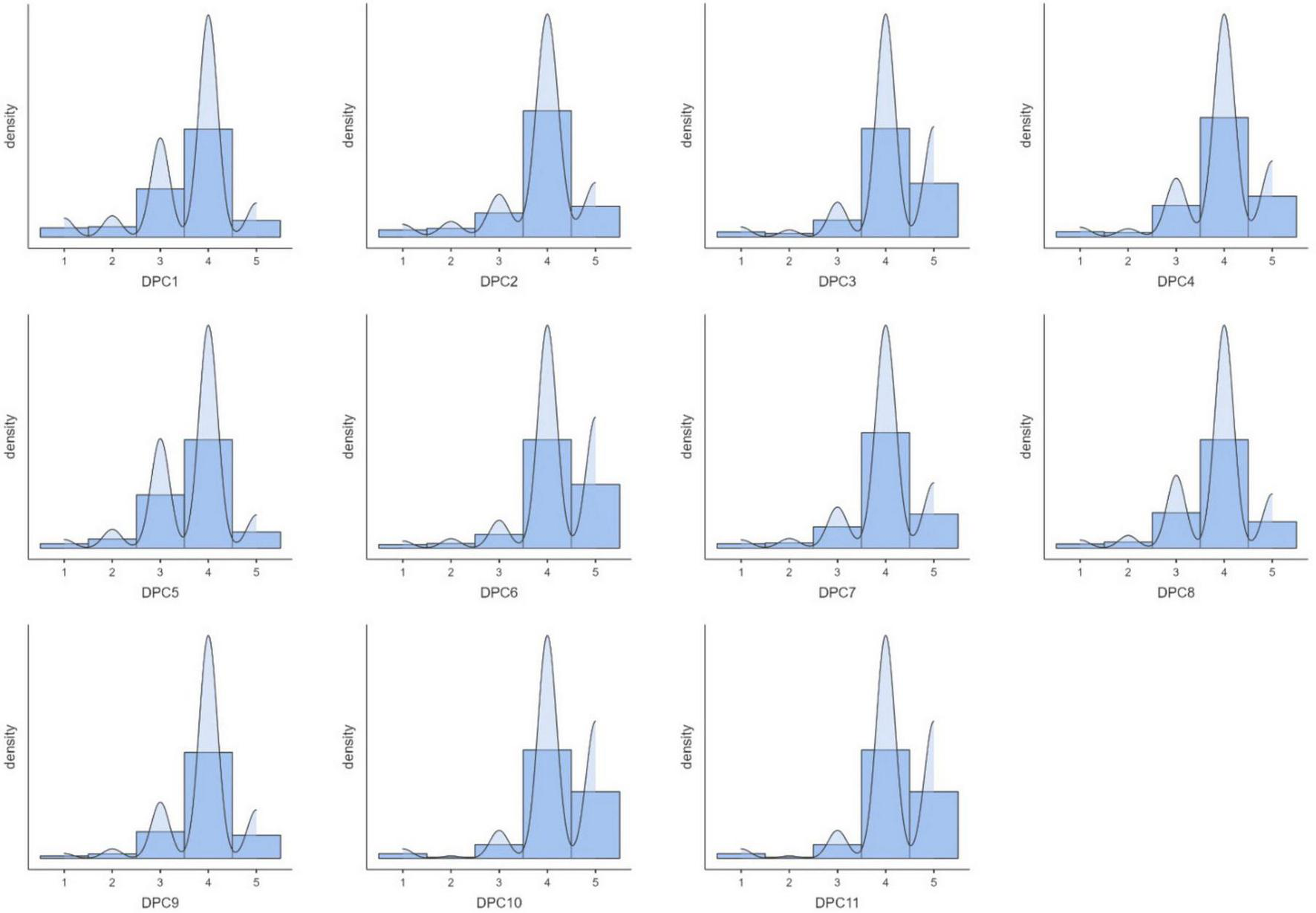
Table 3 shows the mean, standard deviation, asymmetry, and kurtosis of the eleven Critical Thinking Disposition Scale items. The mean of the items ranges from 3.58 to 4.19, and its standard deviation exceeds 0.70 in all cases. The asymmetry indices (g1) of all items were within the range ± 2, indicating a symmetrical data distribution (Finney and DiStefano, 2006). On the other hand, the kurtosis indices (g2) are less than three in most items, indicating a relatively normal distribution (de Winter et al., 2016; DeCarlo, 1997). Several items exhibit a kurtosis slightly exceeding three (3,6,7), indicating heavier tails and greater concentration in the mean values, as well as a more elongated tail (leptokurtic, in the case of item 11); this observation is common, in practice, within the social sciences (Cain et al., 2017). See Figure 1 and Table 3. In addition, it presents the reliability indices by internal consistency using Cronbach’s alpha, ordinal alpha, and McDonald’s Omega methods.
TABLE 3
| M | SD | g1 | g2 | |
| n = 399 | ||||
| Item 1 | 3.58 | 0.90 | -1.11 | 1.38 |
| Item 2 | 3.84 | 0.87 | -1.41 | 2.66 |
| Item 3 | 4.08 | 0.82 | -1.48 | 3.64 |
| Item 4 | 3.92 | 0.82 | -1.23 | 2.72 |
| Item 5 | 3.64 | 0.79 | -0.93 | 1.54 |
| Item 6 | 4.16 | 0.80 | -1.44 | 3.54 |
| Item 7 | 3.94 | 0.80 | -1.38 | 3.38 |
| Item 8 | 3.89 | 0.83 | -1.1 | 2.48 |
| Item 9 | 3.82 | 0.80 | -1.08 | 2.18 |
| Item 10 | 3.88 | 0.73 | -1.12 | 2.86 |
| Item 11 | 4.19 | 0.79 | -1.61 | 4.69 |
Preliminary analysis of the items of the Critical Thinking Disposition Scale.
TABLE 4
| Coefficient α | Coefficient ω | |
| Item 1 | 0.853 | 0.856 |
| Item 2 | 0.845 | 0.849 |
| Item 3 | 0.845 | 0.849 |
| Item 4 | 0.843 | 0.847 |
| Item 5 | 0.852 | 0.856 |
| Item 6 | 0.846 | 0.851 |
| Item 7 | 0.847 | 0.852 |
| Item 8 | 0.846 | 0.85 |
| Item 9 | 0.85 | 0.854 |
| Item 10 | 0.834 | 0.836 |
| Item 11 | 0.834 | 0.836 |
DPC reliability analysis.
FIGURE 1
Histogram of the items in the Critical Thinking Disposition Scale.
The findings have shown that the scale generally presents an expected internal consistency of Cronbach α = 0.857, ordinal α = 0.870, and McDonald’s ω = 0.860.
3.4 Confirmatory factor analysis
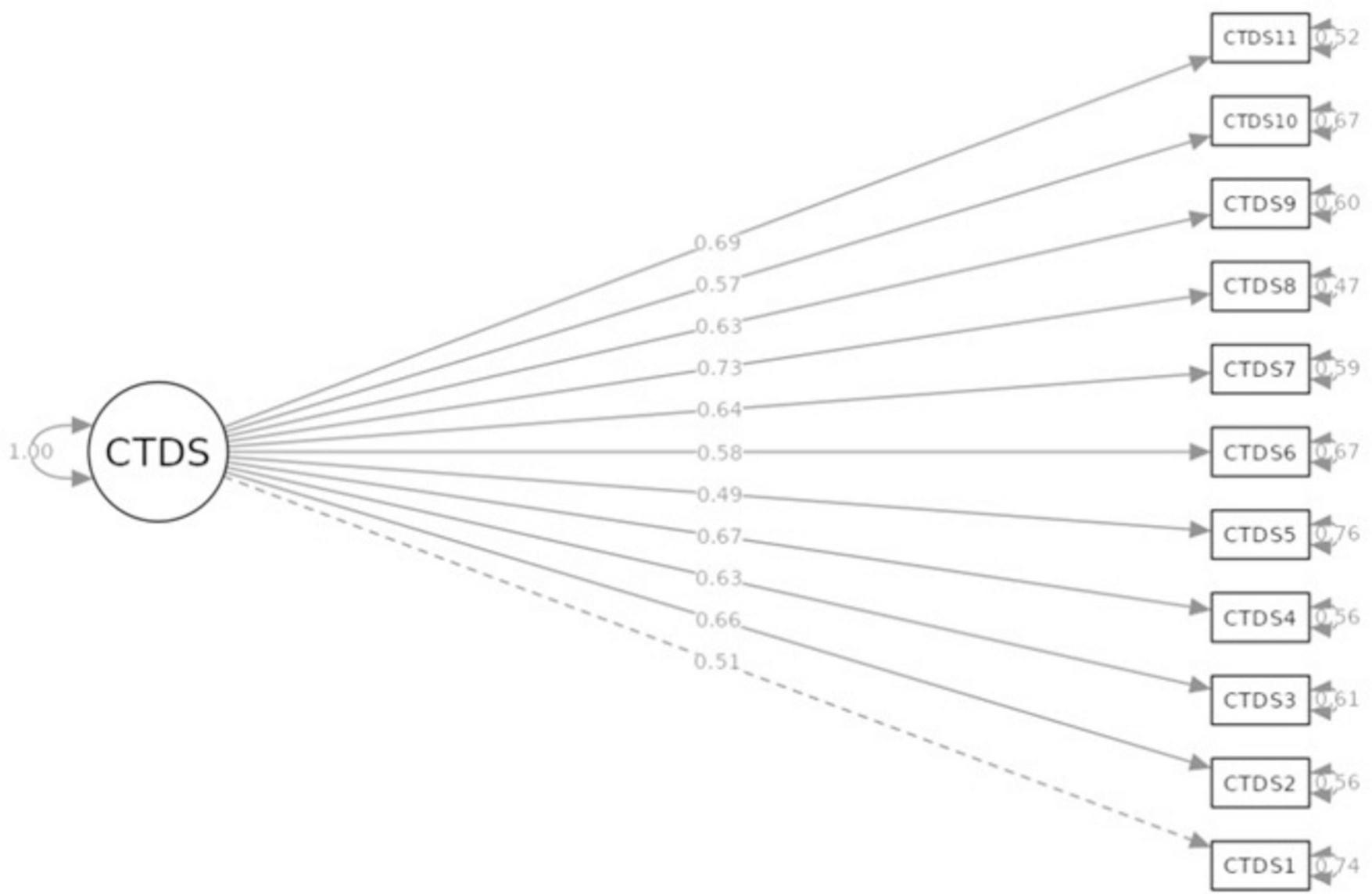
Validity evidence based on internal structure was analyzed through a CFA. The goodness-of-fit indices of the original model showed a good fit (χ2 = 112.42, df = 190, p = 0.000; CFI = 0.949; TLI = 0.937; RMSEA = 0.056 and SRMR < 0.036). As shown in Figure 2 and Table 5. This result represents an appropriate fit for the single-factor model of CTDS since it has a TLI and CFI greater than 0.90 and an RMSEA and SRMR less than 0.08, which indicates a good fit (Bentler, 1990; Hu and Bentler, 1999). Furthermore, the moderate to high correlations (0.22–1.00) presented in Table 6 indicate that the items share variance, which substantiates the univariate structure of CTDS (Nunnally and Bernstein, 1994).
FIGURE 2
Unifactor structure of the critical thinking disposition scale.
TABLE 5
| Model | χ 2 | df | CFI | TLI | RMSEA | SRMR | |
| – | – | – | – | Value | (90%) CI | – | |
| 11 items | 112.42 | 35 | 0.963 | 0.952 | 0.067 | (0.061,0.081) | 0.042 |
Fit indices of the models evaluated by confirmatory factor analysis (CFA) of the study instrument.
df, degree of freedom; CFI, comparative fit index; TLI, Tucker-Lewis’s index; RMSEA, root mean square error of approximation; CI, confidence interval.
TABLE 6
| DPC1 | DPC2 | DPC3 | DPC4 | DPC5 | DPC6 | DPC7 | DPC8 | DPC9 | DPC10 | DPC11 | |
| DPC1 | – | – | – | – | – | – | – | – | – | – | – |
| DPC2 | 0.344*** | – | – | – | – | – | – | – | – | – | – |
| DPC3 | 0.257*** | 0.448*** | – | – | – | – | – | – | – | – | – |
| DPC4 | 0.228*** | 0.435*** | 0.418*** | – | – | – | – | – | – | – | – |
| DPC5 | 0.264*** | 0.336*** | 0.297*** | 0.322*** | – | – | – | – | – | – | – |
| DPC6 | 0.365*** | 0.318*** | 0.372*** | 0.331*** | 0.257*** | – | – | – | – | – | – |
| DPC7 | 0.305*** | 0.286*** | 0.292*** | 0.358*** | 0.298*** | 0.414*** | – | – | – | – | – |
| DPC8 | 0.310*** | 0.340*** | 0.400*** | 0.395*** | 0.285*** | 0.278*** | 0.373*** | – | – | – | – |
| DPC9 | 0.247*** | 0.277*** | 0.297*** | 0.299*** | 0.259*** | 0.254*** | 0.369*** | 0.415*** | – | – | – |
| DPC10 | 0.329*** | 0.391*** | 0.388*** | 0.478*** | 0.311*** | 0.421*** | 0.345*** | 0.351*** | 0.379*** | – | – |
| DPC11 | 0.329*** | 0.391*** | 0.388*** | 0.478*** | 0.311*** | 0.421*** | 0.345*** | 0.351*** | 0.379*** | 1.000*** | – |
Matrix of correlations of Critical Thinking Disposition Scale (CTDS) items.
***The correlation is significant at the 0.01 level.
4 Discussion and conclusion
The disposition to critical thinking is essential for education because it allows adaptation to personal, social, and professional demands Tiruneh et al. (2014). A decent education is characterized by the number of opportunities for thinking and practice given to students (Freire, 2021). Despite the importance of critical thinking in the school population, the literature does not provide evidence for the causes or results for populations under 18 (Çelik İskifoğlu et al., 2022). In this sense, the research objective was to validate the Critical Thinking Disposition scale in Peruvian adolescents.
The Critical Thinking Disposition Scale validation analyses in Peruvian adolescents were developed using a psychometric methodology (Ato et al., 2013). The Peruvian version of the Critical Thinking Disposition Scale showed good clarity considering a population of adolescents between 12 and 17 years old with direct approval of the 11 items and instructions. Likewise, the AFC findings confirm the unidimensional structure of the instrument in Spanish, with items that present factor loadings following what is recommended (Dominguez-Lara and Fernández-Arata, 2019). These results are similar to those reported by Bravo et al. (2020), where the single-factor structure was the most consistent considering the construct of disposition to critical thinking. This one-factor model is further based on recent theoretical evidence (Yockey, 2016), which can explain most of the variance of each item on the scale. This result differs from the original model (Sosu, 2013), which maintains two main dimensions.
These findings suggest both theoretical and practical implications. The results of this study confirm the application of the theory on dispositions to critical thinking, which identifies a set of attitudes that define the personal attitude and disposition to value and use critical thinking in personal, professional, and civic matters (Facione et al., 2021). In this sense, a unidimensional scale can assess the disposition to critical thinking (Bravo et al., 2020). Highlight that this scale has 11 items that ensure speed and practicality in its application, ultimately promoting research into this construct. This scale also aims to motivate Peruvian adolescent students to develop critical thinking skills and attitudes. As a result, it is expected that students will become more involved in academic activities, developing strategies that improve their learning capacity and decision-making attitudes, which will translate into greater academic success (Büyüközkan et al., 2020; Rivas et al., 2023). Furthermore, this scale is a solid tool that allows universities to find students with a greater disposition to critical thinking and, in turn, implement strategies that improve students’ critical thinking skills. For this reason, this scale constitutes a fundamental axis in university evaluations that seeks to understand the disposition of adolescent students toward critical thinking. Finally, this study can help teachers find the determinants of dispositional critical thinking and improve their levels.
In relation to educational policy and based on the University Law (Ministerio de Educacion, 2014), the legislation establishes the training of professionals with high professional quality and a full sense of social responsibility, therefore, it is important to promote critical thinking skills, necessary in the analysis, evaluation and solution of society’s problems. Therefore, relevant evaluation through reliable instruments such as the critical thinking disposition scale will help in achieving this objective.
In this sense, the main contribution of the present study is to provide a tool that can help researchers study and evaluate the disposition to critical thinking in adolescent students in a Peruvian context, which is a current need (Pérez-Morán et al., 2021). Therefore, this critical thinking readiness scale can help develop public policies that address students’ critical thinking attitudes and abilities. In this sense, this questionnaire allows for collecting information that supports actions to improve students’ critical thinking skills during their adolescent years and guiding improvement actions in this field.
This research presents limitations: First, the students were selected conveniently, so probability samples must be developed to avoid representation bias. Although the sampling method has some advantages since in many cases random sampling is not feasible or practical due to the high cost and time to be developed (Etikan, 2016). Therefore, it is generalizable only to the surveyed population (Andrade, 2021). Furthermore, empirical research on the proposed instrument is limited to adolescent students only; additional studies could expand this scope to measure beyond institutional, educational intervention, understanding that a high percentage of students study outside the educational system. Finally, considering the sample’s gender, 53.3% of the participants were women, so it is advisable to repeat the study with a more balanced gender distribution. Developing similar research by adding interviews and focus groups is also important.
In conclusion, the results showed that the Critical Thinking Disposition Scale in Peruvian adolescents shows adequate internal validity, based on content analysis and confirmatory factor analysis, and adequate reliability, evaluating the internal consistency of CTDS and whether the items are coherent with each other and reflect the same underlying construct. It is concluded that the Critical Thinking Readiness Scale in Peruvian adolescent students presents adequate psychometric properties and allows a significant evaluation of the student’s willingness to develop critical thinking skills and attitudes.
Statements
Data availability statement
The raw data supporting the conclusions of this article will be made available by the authors, without undue reservation.
Ethics statement
The studies involving humans were approved by Comité de ética de la Escuela de Posgrado de la Universidad Peruana Unión. The studies were conducted in accordance with the local legislation and institutional requirements. Written informed consent for participation in this study was provided by the participants’ legal guardians/next of kin.
Author contributions
HM-H: Conceptualization, Investigation, Writing – original draft. JT-C: Investigation, Methodology, Writing – review and editing. CA-R: Project administration, Supervision, Validation, Writing – review and editing.
Funding
The author(s) declare that no financial support was received for the research, authorship, and/or publication of this article.
Conflict of interest
The authors declare that the research was conducted in the absence of any commercial or financial relationships that could be construed as a potential conflict of interest.
Generative AI statement
The authors declare that no Generative AI was used in the creation of this manuscript.
Publisher’s note
All claims expressed in this article are solely those of the authors and do not necessarily represent those of their affiliated organizations, or those of the publisher, the editors and the reviewers. Any product that may be evaluated in this article, or claim that may be made by its manufacturer, is not guaranteed or endorsed by the publisher.
References
1
Abanto-RamírezC. D.Turpo-ChaparroJ. E.ApazaA.López-GonzalesJ. L. (2024). Disposition to critical thinking, anxiety due to COVID-19 and academic self-efficacy in university students.Front. Educ.9:1125889. 10.3389/feduc.2024.1125889
2
Aderoncele-AcostaÁNagamine MiyashiroM.Medina CoronadoD. (2020). Development of critical thinking.Teach. Soc.17532–546.
3
AguileraE.PandyaJ. Z. (2021). Critical literacies in a digital age: Current and future issues.Pedagogies Int. J.16103–110. 10.1080/1554480X.2021.1914059
4
AikenL. R. (1985). Three coefficients for analyzing the reliability and validity of ratings.Educ. Psychol. Meas.45131–142. 10.1177/0013164485451012
5
AkinA.HamedogluM. A.ArslanS.AkinÜÇelikE.KayaÇet al (2015). The adaptation and validation of the turkish version of the critical thinking disposition scale (CTDS).Int. J. Educ. Res.1631–35.
6
AlmullaM. A.Al-RahmiW. M. (2023). Integrated social cognitive theory with learning input factors: The effects of problem-solving skills and critical thinking skills on learning performance sustainability.Sustainability15:3978. 10.3390/su15053978
7
AlsalehN. J. (2020). Teaching critical thinking skills: Literature review.Turk. Online J. Educ. Technol.1921–39.
8
Álvarez-HuertaP.MuelaA.LarreaI. (2023). Disposition towards critical thinking and student engagement in higher education.Innov. High. Educ.48239–256. 10.1007/s10755-022-09614-9
9
American Educational Research Association (2014). Standards for Educational and Psychological Testing.Washington, DC: American Educational Research Association.
10
AnastasiA.UrbinaS. (1997). Psychological Testing, 7th Edn. London: Pearson.
11
AndradeC. (2021). The inconvenient truth about convenience and purposive samples.Indian J. Psychol. Med.4386–88. 10.1177/0253717620977000
12
ArslanS.DemirtasZ. (2016). Social emotional learning and critical thinking disposition.Stud. Psychol.58276–285. 10.21909/sp.2016.04.723
13
AtoM.López GarcíaJ. J.BenaventeA. (2013). A classification system for research designs in psychology.Ann. Psychol.29:178511. 10.6018/analesps.29.3.178511
14
AysuS. (2023). “Today’s two important skills: Digital literacy and critical thinking,” in Undividing Digital Divide, edsKöksalD.UlumG.GençG. (Berlin: Springer), 37–48. 10.1542/peds.2020-1681
15
Bakhtiari-DovvombaygiH.PourhasanK.RahmatyZ.Zare-KasebA.AbbaszadehA.RashtbarzadehA.et al (2024). Evaluation of cross-cultural adaptation and validation of the Persian version of the critical thinking disposition scale: Methodological study.BMC Nurs.23:463. 10.1186/s12912-024-02129-y
16
BentlerP. M. (1990). Comparative fit indexes in structural models.Psychol. Bull.107238–246. 10.1037/0033-2909.107.2.238
17
BernalR. T.MelendroM.CharryC. (2020). Transition to adulthood autonomy scale for young people: Design and validation.Front. Psychol.11:457. 10.3389/fpsyg.2020.00457
18
BranjeS.de MoorE. L.SpitzerJ.BechtA. I. (2021). Dynamics of identity development in adolescence: A decade in review.J. Res. Adolesc.31908–927. 10.1111/jora.12678
19
BravoM. J.GalianaL.RodrigoM. F.Navarro-PérezJ. J.OliverA. (2020). An adaptation of the critical thinking disposition scale in spanish youth.Think. Skills Creativity38:100748. 10.1016/j.tsc.2020.100748
20
BrownT. A. (2015). Confirmatory factor analysis for applied research, 2nd Edn.New York, NY: Guilford Press.
21
ButlerH. A. (2024). Predicting everyday critical thinking: A review of critical thinking assessments.J. Intell.12:16. 10.3390/jintelligence12020016
22
BüyüközkanG.FeyzioğluO.HavleC. A. (2020). “Analysis of success factors in aviation 4.0 using integrated intuitionistic fuzzy MCDM methods,” in Intelligent and Fuzzy Techniques in Big Data Analytics and Decision Making. INFUS, 2019. Advances in Intelligent Systems and Computing, 1029, edsKahramanC.CebiS.Cevik OnarS.OztaysiB.TolgaA.SariI. (Cham: Springer), 598–606.
23
ByrneB. M. (2010). Structural Equation Modeling With AMOS: Basic Concepts, Applications, and Programming, 2nd Edn. Milton Park: Routledge.
24
CainM. K.ZhangZ.YuanK.-H. (2017). Univariate and multivariate skewness and kurtosis for measuring nonnormality: Prevalence, influence and estimation.Behav. Res. Methods491716–1735. 10.3758/s13428-016-0814-1
25
CampoL.Galindo-DomínguezH.BezanillaM.-J.Fernández-NogueiraD.PobleteM. (2023). Methodologies for fostering critical thinking skills from university students’ points of view.Educ. Sci.13:132. 10.3390/educsci13020132
26
Çelik İskifoğluT.ÇerkezY.İskifoğluG. (2022). Thinking culture and critical thinking dispositions of high school students in Turkish Republic of Northern Cyprus.Front. Psychol.13:1017747. 10.3389/fpsyg.2022.1017747
27
CuiL.ZhuY.QuJ.TieL.WangZ.QuB. (2021). Psychometric properties of the critical thinking disposition assessment test amongst medical students in China: A cross-sectional study.BMC Med. Edu.21:10. 10.1186/s12909-020-02437-2
28
DaradoumisT.ArguedasM. (2020). Cultivating students’ reflective learning in metacognitive activities through an affective pedagogical agent.J. Educ. Technol. Soc.2319–31.
29
de WinterJ. C. F.GoslingS. D.PotterJ. (2016). Comparing the Pearson and Spearman correlation coefficients across distributions and sample sizes: A tutorial using simulations and empirical data.Psychol. Methods21273–290. 10.1037/met0000079
30
DeCarloL. T. (1997). On the meaning and use of kurtosis.Psychol. Methods2292–307. 10.1037/1082-989X.2.3.292
31
Digital Inteligence Institute (2023). Nearly Two-Thirds of Children Surveyed Around the World are Exposed to Cyber Risks, First-Ever Global Child Online Safety Index reveals.Dublin: Digital Inteligence Institute
32
Dominguez-LaraS.Fernández-ArataM. (2019). Autoeficacia académica en estudiantes de Psicología de una universidad de Lima.Rev. Electrónica Invest. Educ.21:1. 10.24320/redie.2019.21.e32.2014
33
El HassanK.MadhumG. (2007). Validating the watson glaser critical thinking appraisal.High. Educ.54361–383. 10.1007/s10734-006-9002-z
34
EnnisR. H. (1996). Critical thinking dispositions: Their nature and assessability.Informal Logic.18165–182. 10.22329/il.v18i2.2378
35
EtikanI. (2016). Comparison of convenience sampling and purposive sampling.Am. J. Theoretical Appl. Stat.5:1. 10.11648/j.ajtas.20160501.11
36
FacioneP. A. (1990). Critical Thinking: A Statement of Expert Consensus for Purposes of Educational Assessment and Instruction (“The Delphi Report”).Oakland, CA: California Academic Press.
37
FacioneP. A.FacioneN. C. (1992). California Critical Thinking Disposition Inventory.Oakland, CA: California Academic Press.
38
FacioneP. A.FacioneN. C. (1994). The California Critical Thinking Skills Test: CCTST: Test Manual.Oakland, CA: California Academic Press.
39
FacioneP. A.FacioneN. C.RiegelF.MartiniJ. G.CrossettiM. (2021). Holistic critical thinking in times of covid-19 pandemic: Unveiling fundamental skills to clinical nursing practice.Rev. Gaúcha Enfermagem42:e20210235. 10.1590/1983-1447.2021.20210235
40
FacioneP. A.SánchezC. A.FacioneN. C.GainenJ. (1995). The disposition toward to critical thinking.J. General Educ.441–25.
41
Fandiño ParraY. J.Muñoz BarrigaA.López DíazR. A.Galindo CuestaJ. A. (2021). Teacher education and critical thinking: Systematizing theoretical perspectives and formative experiences in Latin America.Rev. Invest. Educ.39149–167. 10.6018/rie.416271
42
FinneyS. J.DiStefanoC. (2006). “Nonnormal and categorical data in structural equation models,” in A Second Course in Structural Equation Modeling, edsHancockG. R.MuellerR. O. (Charlotte: IAP), 269–314.
43
FreireP. (2021). Education for Critical Consciousness, 1st Edn. London: Bloomsbury Publishing.
44
FuJ.DingY.NieK.ZaighamG. H. K. (2023). How does self-efficacy, learner personality, and learner anxiety affect critical thinking of students.Front. Psychol.14:1289594. 10.3389/fpsyg.2023.1289594
45
Fuentes-MorenoC.Sabariego-PuigM.Ambros-PallarésA. (2020). Developing social and civic competence in secondary education through the implementation and evaluation of teaching units and educational environments.Hum. Soc. Sci. Commun.7:39. 10.1057/s41599-020-0530-4
46
Gerdts-AndresenT.Tindvik HansenM.GrøndahlV. A. (2022). Educational effectiveness: Validation of an instrument to measure students’ critical thinking and disposition.Int. J. Instruct.15685–700.
47
GousetiA.IlomäkiL.LakkalaM. (2024). “Re-thinking critical digital literacies in the context of compulsory education,” in The Palgrave handbook of everyday digital life.Palgrave Macmilan, 261–281. 10.1007/978-3-031-30438-5_15
48
Guerci de SiufiB. (2008). La pregunta como soporte de un pensamiento crítico localizado.Cuadernos Facul. Hum. Ciencias Soc.3523–37.
49
HaagP.FantoniT.DubalS. (2022). Fostering engagement, reflexivity, and 21st-century skills in middle school: A pilot collaborative action research on identity formation with adolescent co-researchers.J. Intell.10:64. 10.3390/jintelligence10030064
50
HalonenJ. S. (1995). Demystifying critical thinking.Teach. Psychol.2275–81. 10.1207/s15328023top2201_23
51
HalpernD. F. (1998). Teaching critical thinking for transfer across domains: Disposition, skills, structure training, and metacognitive monitoring.Am. Psychol.53449–455. 10.1037/0003-066X.53.4.449
52
HuL.BentlerP. M. (1999). Cutoff criteria for fit indexes in covariance structure analysis: Conventional criteria versus new alternatives.Struct. Equ. Model. Multidisciplinary J.61–55. 10.1080/10705519909540118
53
KarahanE.BozanM. A.AkçayA. O.AkçayİM. (2023). An investigation of primary school students’ critical thinking dispositions and decision-making skills.Int. J. Educ. Res. Rev.8137–150. 10.24331/ijere.1205285
54
Karakus̨İ (2024). University students’ cognitive flexibility and critical thinking dispositions.Front. Psychol.15:1420272. 10.3389/fpsyg.2024.1420272
55
KemperC. J.TrappS.KathmannN.SamuelD. B.ZieglerM. (2019). Short versus long scales in clinical assessment: Exploring the trade-off between resources saved and psychometric quality lost using two measures of obsessive–compulsive symptoms.Assessment26767–782. 10.1177/1073191118810057
56
KlineP. (2015). A Handbook of Test Construction (Psychology Revivals).Milton Park: Routledge. 10.4324/9781315695990
57
KlineR. B. (2016). “Principles and practice of structural equation modeling,” in Principles and practice of structural equation modeling, 4th Edn. New York, NY: Guilford Press.
58
LeuwolF. S.DeswalantriD.LumingkewasC. S.PattiasinaP. J.MardikawatiB. (2023). Role of digital literacy and self efficacy in enhancing students’ critical thinking in learning in the digital era.Edumaspul J. Pendidikan72678–2685.
59
LiS.WangZ.SunY. (2024). Relationship between thinking dispositions, working memory, and critical thinking ability in adolescents: A longitudinal cross-lagged analysis.J. Intell.12:52. 10.3390/jintelligence12060052
60
LunV. M.-C.YeungJ. C.KuK. Y. L. (2023). Effects of mood on critical thinking.Think. Skills Creativity47:101247. 10.1016/j.tsc.2023.101247
61
Martín-RaughM.KellH.LingG.FishteinD.YangZ. (2023). Noncognitive skills and critical thinking predict undergraduate academic performance.Assess. Eval. High. Educ.48350–361. 10.1080/02602938.2022.2073964
62
Merma-MolinaG.Gavilán-MartínD.Urrea-SolanoM. (2022). Actively open-minded thinking, personality and critical thinking in spanish adolescents: A correlational and predictive study.Int. J. Instruct.15579–600.
63
MillerS. (2023). Child Protection in the Digital World: Why is it needed?. Available online at: https://www.savethechildren.net/blog/child-protection-digital-world-why-it-needed
64
Ministerio de Educacion (2014). Ley Universitaria: Ley N° 30220.El Peruano: Ministerio de Educacion.
65
MuñizJ.Fonseca-PedreroE. (2019). Ten steps for test development.Psicothema317–16. 10.7334/psicothema2018.291
66
MuñizJ.ElosuaP.HambletonR. K. (2013). Directrices para la traducción y adaptación de los tests: Segunda edición.Psicothema25151–157. 10.7334/psicothema2013.24
67
NamaziandostE.RezaiA.HeydarnejadT.KrukM. (2023). Emotion and cognition are two wings of the same bird: Insights into academic emotion regulation, critical thinking, self-efficacy beliefs, academic resilience, and academic engagement in Iranian EFL context.Think. Skills Creativity50:101409. 10.1016/j.tsc.2023.101409
68
NunnallyJ.BernsteinI. (1994). Psychometric Theory, 3rd Edn. New York, NY: Mc Graw Hill.
69
NunnallyJ.BernsteinI. (1995). “Psychometric theory,” in Applied psychological measurement, 3rd Edn, Vol. 19. Sage Publishing. 10.1177/014662169501900308
70
OrhanA. (2022). California critical thinking disposition inventory: Reliability generalization meta-analysis.J. Psychoeduc. Assess.40202–220. 10.1177/07342829211048962
71
OrhanA. (2023). Investigating psychometric properties of the turkish version of sosu critical thinking disposition scale: Evidence from two independent samples.Int. J. Psychol. Educ. Stud.10348–359. 10.52380/ijpes.2023.10.2.1017
72
PenfieldR. D.GiacobbiP. R. (2004). Applying a score confidence interval to aiken’s item content-relevance index.Meas. Phys. Educ. Exerc. Sci.8213–225. 10.1207/s15327841mpee0804_3
73
Pérez-MoránG.Bazalar-PalaciosJ.Arhuis-IncaW. (2021). Diagnóstico del pensamiento crítico de estudiantes de educación primaria de Chimbote.Perú. Rev. Electrón. Educ.251–11. 10.15359/ree.25-1.15
74
PerkinsD. N.JayE.TishmanS. (1993). Beyond abilities: A dispositional theory of thinking.Merrill-Palmer Q. 391–21.
75
PuriK.SureshK.GogtayN.ThatteU. (2009). Declaration of Helsinki, 2008.J. Postgraduate Med.55131–134. 10.4103/0022-3859.52846
76
QuinnS.HoganM.DwyerC.FinnP.FogartyE. (2020). Development and validation of the student-educator negotiated critical thinking dispositions scale (SENCTDS).Think. Skills Creativity38:100710. 10.1016/j.tsc.2020.100710
77
RauscherW.BadenhorstH. (2021). Thinking critically about critical thinking dispositions in technology education.Int. J. Technol. Design Educ.31465–488. 10.1007/s10798-020-09564-3
78
RichardsJ. B.HayesM. M.SchwartzsteinR. M. (2020). Teaching clinical reasoning and critical thinking: From cognitive theory to practical application.Chest1581617–1628. 10.1016/j.chest.2020.05.525
79
RivasS. F.SaizC.AlmeidaL. S. (2023). The role of critical thinking in predicting and improving academic performance.Sustainability15:1527. 10.3390/su15021527
80
RosseelY. (2012). Lavaan: An R package for structural equation modeling.J. Stat. Softw.481–36.
81
SelB. (2022). Social media use of prospective teachers in the post-truth era: Confirmation, trust, critical thinking tendency.Particip. Educ. Res.9463–480. 10.17275/per.22.49.9.2
82
SoperD. S. (2024). Calculadora de tamaño de Muestra a Priori Para Modelos de Ecuaciones Estructurales [software]. Available online at: https://www.danielsoper.com/statcalc/references.aspx?id=89
83
SosuE. M. (2013). The development and psychometric validation of a critical thinking disposition scale.Think. Skills Creativity910.1016/j.tsc.2012.09.002
84
Suárez-AlvarezJ.PedrosaI.LozanoL. M.García-CuetoE.CuestaM.MuñizJ. (2018). Using reversed items in likert scales: A questionable practice.Psicothema30149–158. 10.7334/psicothema2018.33
85
TirunehD. T.VerburghA.ElenJ. (2014). Effectiveness of critical thinking instruction in higher education: A systematic review of intervention studies.High. Educ. Stud.4. 10.5539/hes.v4n1p1
86
United Nations International Children’s Emergency Fund (2024). Protecting Children Online.New York, NY: United Nations International Children’s Emergency Fund.
87
Van TonderG. P.KloppersM. M.GrosserM. M. (2022). Enabling self-directed academic and personal wellbeing through cognitive education.Front. Psychol.12:789194. 10.3389/fpsyg.2021.789194
88
WatsonG. (1980). Watson-Glaser Critical Thinking Appraisal.London: Psychological Corporation.
89
WilsonM. (2005). “Constructing measures: An item response modeling approach,” in Constructing measures: An item response modeling approach.Milton Park: Routledge.
90
YockeyR. D. (2016). Validation study of the critical thinking dispositions scale: A brief report.North Am. J. Psychol.18101–106.
91
YuanS.-P.LiaoH.-C.WangY.ChouM.-J. (2014). Development of a scale to measure the critical thinking disposition of medical care professionals.Soc. Behav. Pers. Int. J.42303–311. 10.2224/sbp.2014.42.2.303
Summary
Keywords
disposition to critical thinking, psychometric properties, adolescents, reliability, validity
Citation
Martínez-Huamán H, Turpo-Chaparro JE and Abanto-Ramírez CD (2025) Psychometric properties of the critical thinking disposition scale in Peruvian adolescents. Front. Educ. 10:1537797. doi: 10.3389/feduc.2025.1537797
Received
01 December 2024
Accepted
27 February 2025
Published
11 March 2025
Volume
10 - 2025
Edited by
Musa Adekunle Ayanwale, University of Johannesburg, South Africa
Reviewed by
Zuzana Haláková, Comenius University, Slovakia
Victor Eyo Essien, University of Maryland, College Park, United States
Daniel Oyeniran, The University of Alabama, United States
Updates
Copyright
© 2025 Martínez-Huamán, Turpo-Chaparro and Abanto-Ramírez.
This is an open-access article distributed under the terms of the Creative Commons Attribution License (CC BY). The use, distribution or reproduction in other forums is permitted, provided the original author(s) and the copyright owner(s) are credited and that the original publication in this journal is cited, in accordance with accepted academic practice. No use, distribution or reproduction is permitted which does not comply with these terms.
*Correspondence: Carlos D. Abanto-Ramírez, carlosabanto@upeu.edu.pe
Disclaimer
All claims expressed in this article are solely those of the authors and do not necessarily represent those of their affiliated organizations, or those of the publisher, the editors and the reviewers. Any product that may be evaluated in this article or claim that may be made by its manufacturer is not guaranteed or endorsed by the publisher.