Abstract
Introduction:
Educational organizations are increasingly concerned with students’ well-being and happiness in order to improve the quality of learning and promote the sustainability of teaching. Literature has shown that teacher happiness is related to students’ happiness and contributes to better academic performance, greater motivation and psychological well-being. In an increasingly uncertain, unpredictable and competitive school organizational reality, it is important that top and middle leaders recognize the significant power they have to influence the members of their organization, whether positively or negatively. The practice of successful leadership in a school context is essential to promote positive environments and inspire confidence in teachers, technicians, educational assistants and students.
Objectives:
Map the existing literature to understand the role of leadership in promoting student and teacher happiness in school environments.
Methodology:
A Scoping Review was carried out, following the guidelines proposed by PRISMA-ScR (Preferred Reporting Items for Systematic reviews and Meta-Analyses extension for Scoping Reviews), to ensure methodological validity and reliability. The research was carried out in five scientific databases, considering the defined eligibility criteria.
Results and discussion:
A total of 17 articles were analyzed, as they met the established inclusion criteria. It was found that school happiness is promoted by factors such as a sense of belonging, interpersonal relationships, academic self-efficacy and teachers’ personal and pedagogical skills. Regarding the analysis of the role of leadership, it was possible to perceive that there are several styles that are related to happiness in the school environment.
Conclusion:
This review showed that the combination of leadership styles is fundamental, since there is no single leadership style that is considered effective for all contexts and situations, and it may vary depending on the school environment and circumstances.
1 Introduction
Educational organizations are increasingly concerned with students’ well-being and happiness, in order to improve the quality of learning and promote the sustainability of teaching (UNESCO, 2016).
In terms of defining happiness, the scientific community has had some difficulty in clearly and objectively defining this construct, since it is ambiguous and complex. It has been essentially characterized through two aspects: hedonic and eudaimonic (Delle Fave et al., 2011). In the hedonic aspect, happiness focuses on subjective well-being (Diener and Ryan, 2009; Lyubomirsky et al., 2005), positive emotions and life satisfaction (Diener and Ryan, 2009). From a eudaimonic perspective, happiness is related to psychological well-being (Ryff and Keyes, 1995; Ryff and Singer, 2008), purpose of life (Keyes et al., 2002; Ryff and Keyes, 1995), self-realization and personal growth (Ryan and Deci, 2001; Ryff and Keyes, 1995).
Happiness in the school context has been associated with different factors that contribute to student success (Lyubomirsky et al., 2005; Tanhaye Reshvanloo and Hejazi, 2014). Among these factors, greater motivation (Antaramian, 2017; Isen and Reeve, 2005), commitment (Heffner and Antaramian, 2016; King et al., 2015; Lewis et al., 2011), confidence (Cheng and Furnham, 2002) and self-efficacy (Antaramian, 2017; Cheng and Furnham, 2002) stand out, which play a fundamental role in promoting learning and improving academic performance and achievement (Bakker et al., 2005; Heffner and Antaramian, 2016; Nickerson et al., 2011; Oishi et al., 2007; Talebzadeh and Samkan, 2011). Complementarily, Okun et al. (2009) investigated the relationship between students’ grades and happiness, suggesting that students with lower grades had lower levels of happiness and tolerated a greater degree of stress.
It is also relevant to mention that happiness in the school environment can be influenced by other factors, such as teacher happiness (Bakker et al., 2005), life satisfaction (Proctor et al., 2010), and satisfaction with the school environment (Gómez-Baya et al., 2021).
In a school organizational context characterized by uncertainty, unpredictability and competition, it is essential that top and middle leaders understand the importance of their role and how they impact the different elements of the school community, in promoting positive, healthy and happy school climates. Gurr (2015) found that successful school leaders do not follow a single leadership style, but exhibit consistent behaviours, guided by transparency in their beliefs, values and actions, as well as by fairness. In addition, leaders include others in decision-making processes and inspire trust.
With this research, we aim to contribute to improving learning and, more broadly, to a healthy and successful educational system. In terms of general objective, this review aims to understand the influence of leadership practices in promoting school happiness. More specifically, it aims to answer the following research questions:
-
What are the dimensions that contribute to teachers and students’ happiness?
-
What are the leadership practices that relate to happiness in schools?
2 Methodology
As the role of leadership in promoting organizational happiness still lacks sustained research, we opted for the Scoping Review methodology to map and synthesize the main evidence that has emerged in research literature on the subject over the last 5 years, as well as to identify possible knowledge gaps. In addition, the selection of publications between 2019 and 2024 made it possible to incorporate more recent findings, reflecting contemporary trends and challenges that influence organizational happiness.
To support the review process, the guidelines proposed by PRISMA-ScR (Preferred Reporting Items for Systematic reviews and Meta-Analyses extension for Scoping Reviews) were followed to ensure methodological quality. The review protocol consists of 27 verification items, divided into 7 sections: Title, Abstract, Introduction, Method, Results, Discussion, and Funding, which allows improving the quality of the report and the methodological quality (Page et al., 2021).
2.1 Eligibility criteria
Criteria for inclusion and exclusion of studies were defined in order to answer the previously defined review questions (Table 1).
Table 1
| Inclusion criteria | Exclusion criteria |
|---|---|
| Publication date: studies published between 2019 and 2024 | Studies published in periods not defined in the inclusion criteria |
| Type of study: qualitative, exploratory, quantitative, full text available | Type of study: review and critical analysis of literature |
| Title and abstract of interest for the review: articles that show the association between leadership and happiness in school organizations | Title and abstract that are not relevant to the review and that address the topic of COVID-19 |
| Language: English and Portuguese | Studies in languages not defined in the inclusion criteria |
| Document type: articles published in scientific journals | Document type: articles published in Conferences, Systematic Reviews, Meta-analyses, Dissertations |
| Sample: headteacher, teachers and students | The sample type does not fit within the scope of the review |
| Access: open/free | restricted/paid | Access: ----- |
Inclusion and exclusion criteria.
2.2 Sources of information
A bibliographic and cross-sectional research was carried out through the consultation of scientific articles obtained from five databases: Web of Science, Scopus, B-On, Education Source, and ERIC. Additional articles were included to understand the construct of leadership in promoting happiness in school organizations.
2.3 Research strategy
The search strategy was based on a set of keywords to identify titles and abstracts of articles that relate to the review questions. For this purpose, the following combinations of keywords will be used, as shown in Table 2.
Table 2
| AND | AND | |
|---|---|---|
| Leadership | Happiness | School OR Education OR Teachers OR Students |
| Happy | ||
| Happy school | Students OR Teachers |
|
Keyword combinations for searching articles in databases.
The selection of relevant articles was carried out from December 2023 to July 2024 and focused mainly on the review questions mentioned above.
After the research was carried out, duplicates were removed. At this stage, a reference management program—Mendeley—was used to facilitate the analysis of the articles to be included in the literature review, according to the pre-defined eligibility criteria. In this way, the titles and abstracts of the articles were evaluated, selecting only those that were related to the topic under study and, taking into account the previously defined eligibility criteria. The full articles were then analyzed. After this stage, the snowballing technique was used, without limiting the search in terms of date, to search for other studies/articles, based on those that were included in the first stage of the research. Using this technique, it was possible to identify 5 relevant articles to be considered in this review. A total of 17 articles were considered eligible, as they met the established inclusion criteria.
The process of researching and selecting articles is summarized in the flowchart (Figure 1) for PRISMA-ScR scoping reviews (Page et al., 2021).
Figure 1
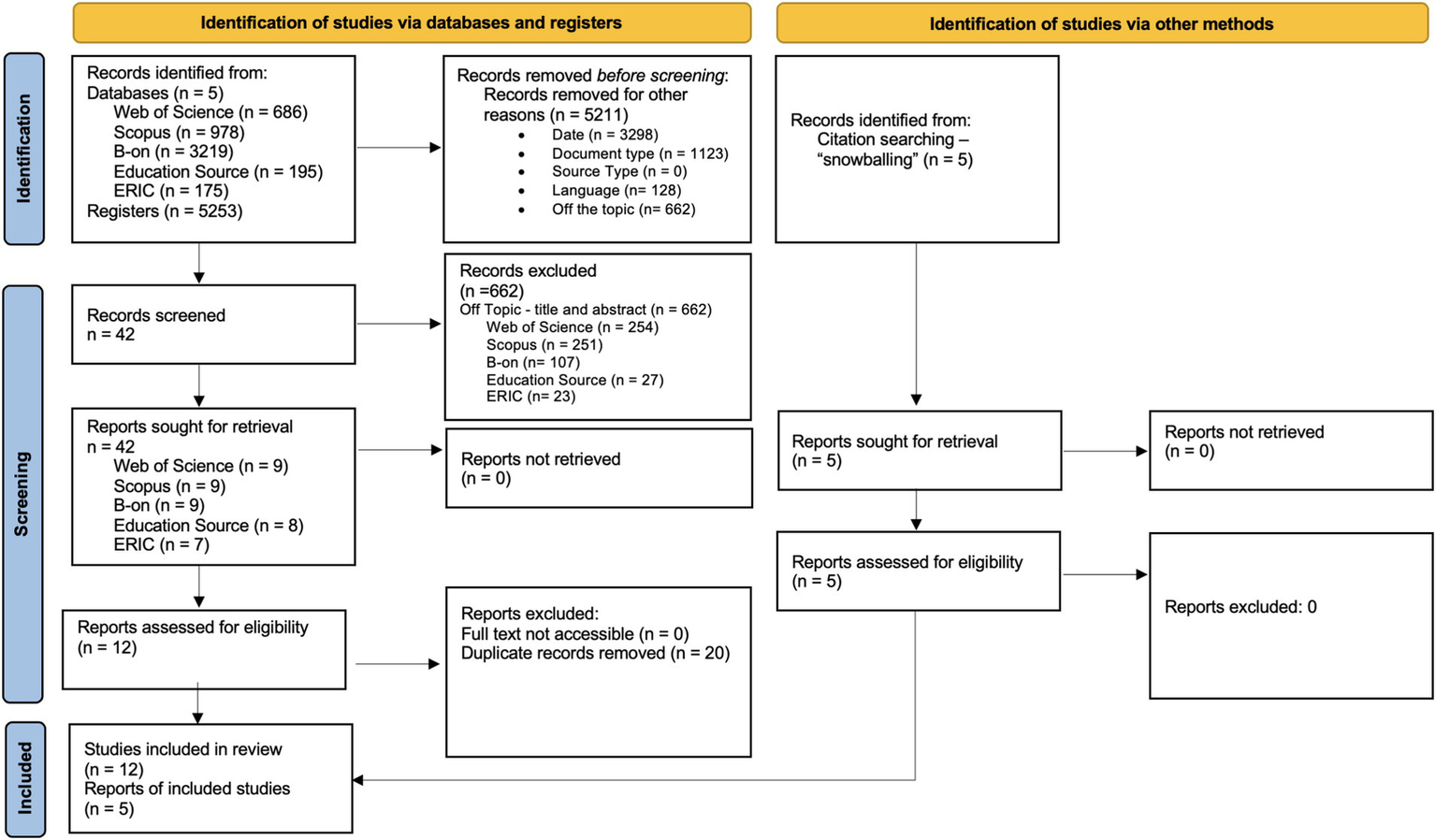
Flowchart showing the different phases of the process of selecting and including articles for scoping review—PRISMA-ScR flowchart diagram (Page et al., 2021).
2.4 Data collection and analysis process
Regarding the articles that were included in the preparation of this review, an Excel table was created, which allowed the organization of the data, according to the following topics: Author, Year, Country, Objectives | Hypotheses, Type of Study, Sample/Population and Main Results.
3 Results
The descriptive characteristics of the included studies are organized in table form, which encompasses all relevant data related to the questions previously defined for this review, as illustrated in Table 3.
Table 3
| Authors | Year | Country | Questions | Objectives | Hypotheses | Study type | Methodology | Instruments | Sample | Population | Main results obtained |
|---|---|---|---|---|
| Q1: What dimensions contribute to happiness in school organizations? | ||||
| O’Rourke and Cooper | 2010 | Australia | To better assess the happiness levels of 4th and 6th grade students and determine the correlations between student happiness and associated factors identified in the literature. | Quantitative methodology Piers-Harris 2 Children’s Self-Concept (Piers and Hertzberg, 2002), the Faces Scale, the Children’s Questionnaire, and the Subjective Happiness Scale (Lyubomirsky, 2007) |
N = 871 students Gender: 56.6% girls and 43.4% boys Age: 4th year (M = 9.58 SD = 0.413 and the 6th year was M = 11.15 SD = 0.4) Education: 4th and 6th years, of public and private education systems |
Feelings of friendship, belonging and optimism are strong indicators of children’s happiness. |
| López-Pérez and Zufanò | 2020| United Kingdom | To examine how the type of family, friend and school relationships, as well as the environment, are related to children’s subjective well-being (SWB). | Mixed methodology Questionnaire evaluates students’ psychological needs satisfaction at school - SPBNS (Tian et al. 2014) Participants were asked to answer the following question: “Please define in your own words what it means to you to be happy in the school” |
N = 744 children and pre-adolescents from eight public schools Age: 9–11 years old 12–14 years old |
Preadolescents specifically reported the categories “positive feelings,” “getting good grades,” “competence,” “harmony,” and “positive relationships with teachers.” |
| Calp | 2020 | Türkiye | To explore and describe the concept of a peaceful and happy school environment from the perspective of primary school teachers and students. | Qualitative methodology: case study Semi-structured interview: were designed to capture the perspectives and suggestions of the participants regarding the characteristics of a peaceful and happy school environment. |
N = 126 participants | 103 primary school students and 23 primary school teachers from public schools in Türkiye. Age: 9 years (students) 39 years (teachers), both genders |
The study highlights the importance of creating a positive and supportive school environment that fosters respect, trust and a sense of belonging for both students and teachers. Clear rules and the need for effective and trusting relationships between students, teachers and parents are also essential. |
| Leung, Leung, Kwok, Hui ALo; Tam and Lai | 2021 | Australia | The aim of the present study was to examine the mediating role of academic performance academic between positive relationships (parent–child relationship, peer relationship, teacher-student relationship) and happiness in a group of primary school students (Marsh et al. 1983). | Longitudinal study Parent–child relationship (PCR), Peer relationship (PER), Teacher-student relationship (TSR), Academic achievement (ACH), Happiness (HAP), Parent-child relationship (PCR) (Marsh et al. 1983) Peer relationship (PER) (Marsh et al. 1983) Teacher-student relationship (TSR) and Academic achievement (ACH) – based on the Achievement Scale of the Quality of School Life Scale (Ainley et al. 1990; Pang, 1999) Happiness (HAP) - Subjective Happiness Scale (Lyubomirsky and Lepper 1999) |
N = 980 primary school students 4 to 6 (girls = 441, 45.0%; boys = 539, 55.0%) who participated in the Time 1 assessment. N = 786 (girls = 358, 45.5%; boys = 428, 54.5%) completed the Time 2 assessment. Age: 9.88 (SD = 0.92) years (range: 8 to 13 years) |
The results show that positive relationships with parents and peers benefit students’ academic performance. Academic success mediates the relationship between parent–child relationships, peer relationships, and happiness. To help students reach their potential and improve their psychological well-being, strategies should be adopted in the community and schools to improve parent–child relationships, peer relationships, and a harmonious classroom. |
| Döş | 2023 | Türkiye | The aim of this research is to reveal the relationships between secondary school students’ perception of a happy school and general self-efficacy, life satisfaction and academic self-efficacy. | Quantitative Study: correlational study in which the relationship between the variables school happiness, general self-efficacy, academic self-efficacy and life satisfaction was analyzed. Happy School Scale; General Self-Efficacy Scale; Academic Self-Efficacy Scale; Life Satisfaction Scale. |
N = 315 students Gender: female (151) and male (164) Education: 9th grade (44); 10th grade (76); 11th grade (102) and 12th grade (93) |
General self-efficacy, academic self-efficacy and life satisfaction were found to be significant predictors of happy school. |
| Gramaxo, Flores, Dutschke and Seabra | 2023 | Portugal | 1. What is the level of happiness at school reported by students? 2. Are there differences depending on age and gender? 3. What makes Portuguese students happy at school? 4. What makes Portuguese students unhappy at school? 5. What are the characteristics of a happy school from the perspective of Portuguese students? |
Exploratory descriptive and correlational study, given the lack of previous studies on happy schools in Portugal | 2,708 students Gender: female (1,460) and male (1,248) Age: 6–20 years old |
The results show that friendships and relationships within the school community are the most fundamental reason why students feel happy at school. A happy school is one where students have friends and fun and engaging activities, opportunities for learning, success and good performance, largely due to the characteristics, attitudes, skills and abilities of teachers. |
| Gramaxo, Seabra, Abelha, and Dutschke| 2023 | Portugal | 1. What are parents and guardians’ perceptions of their children’s level of happiness at school? 2. How do children’s age and gender influence parents’ perceptions? 3. What are the most relevant dimensions of the happy experiences of parents and their children? And of parents and children at the children’s school? 4. What are the most relevant dimensions of the unhappy experiences of parents and children together at their children’s school? 5. From the parents’ perspective, what are the characteristics of a happy school? |
Mixed methodology - descriptive and correlational exploratory study, given the lack of previous studies on happy schools in Portugal. | Age: 5–20 years (x = 11.86, SD = 3.25), from preschool to secondary school | The results show that parents value the relationships their children establish at school, the personal and professional skills of teachers, learning strategies and the fact that students can be creative while learning valuable content. |
| Göktas and Akyürek | 2023 | Türkiye | 1. What is the level of school happiness according to students’ perceptions? 2. What is the level of student leadership according to student perceptions? 3. What is the relationship between school happiness and student leadership, according to student perceptions? 4. Does school happiness predict student leadership to a significant degree, according to student perceptions? |
Quantitative methodology: descriptive relational survey School happiness scale, Student Leadership Scale (Roets, 1992); Özdemir et al, (2021) |
N = 470 students from public or private schools | School happiness is a process that directly affects the happiness of teachers, students and other stakeholders and can be considered a success factor. Since school happiness is a process that directly affects teachers, students, and other stakeholders, it can be thought that school principals can increase students’ school happiness by improving instructional leadership behaviours and, therefore, positively affecting their level of leadership. |
| Pivarč | 2023 | Czech Republic | To determine what children aged 10–15 associate with happiness/satisfaction, as well as to analyse factors related to their feelings of happiness and their assessment of life satisfaction. | Quantitative methodology: survey Subjective Happiness Scale and Students’ Life Satisfaction Scale. |
N = 954 children Age: 10 to 15 years (M = 13.26, SD = 1.49) Gender: 573 females and 381 males |
The results indicate that children considered themselves relatively happy and satisfied, and understood happiness/satisfaction in terms of the concept of eudaimonia (personal growth, achievement of school goals, etc.). |
| Kumar and Sahoo | 2024 | India | 1. To study the level of happiness of secondary school students. 2. To study the level of happiness of secondary school students, in relation to their gender, location and type of schools. 3. Study the difference between the happiness of secondary school students, depending on gender, location and type of school. 4. To study the relationship between happiness and the academic performance of secondary school students. |
Quantitative methodology: survey Happiness Scale (Bhardwaj and Das, 2017) |
N = 157 students, from public and private schools Education: 11th grade Gender: 78 male and 79 female students |
The level of happiness of high school students is positively correlated with their academic performance, but there is no significant correlation between the two. |
| Q2: What are the leadership practices that relate to promoting happiness in schools? | ||||
| Algan and Ummanel | 2019 | Türkiye | (1) Do distributed leadership characteristics of school headteachers predict organizational happiness and quality of working life for teachers? (2) Is there a mediating effect of teachers’ organizational happiness on the relationship between distributed leadership characteristics of school headteachers and the quality of professional life of teachers? |
Quantitative methodology The Distributed Leadership Scale; Quality of Work Life Scale; Organizational Happiness Scale |
N = 208 teachers Gender: female (76.4%) and male (23.6%) Age: 21–30 (28.4%) 31–40 years (38.9%) 41–50 (24.0%) |
The results indicated that distributed leadership, significantly and directly, positively affects teachers’ quality of professional life and organizational happiness. |
| Algan and Ummanel | 2020 | Türkiye | This study investigates distributed leadership, organizational happiness and quality of working life in preschools. | Mixed Methodology Interviews with the school administrators. Administrators’ thoughts on the effects of their behaviours on organizational happiness and quality of work life of teachers were examined. The Distributed Leadership Scale; Quality of Work Life Scale and Organizational Happiness Scale |
N = 208 teachers Age: 21–30 (28.4%) 31–40 years (38.9%) 41–50 (24.0%) Gender: female (76.4%) male (23.6%) Education: Bachelor’s degree (81.3%) Doctorate (1.9%) |
The results indicated that distributed leadership, significantly and directly, positively affects teachers’ quality of working life and organizational happiness. |
| Corrigan and Merry | 2022 | Australia | This study examined the role of the school headteacher and identified the attributes that teachers and students recognise as being desirable in a school headteacher. | Qualitative methodology Survey to seek the opinions of leaders, teachers, and students as to the desirable attributes of a school principal. |
N = 405 teachers and students from nine schools | Teachers and students preferred the integrated leadership style, which combines instructional and transformational leadership, and agreed on the importance of the headteacher as a role model for students and colleagues. This key element of the headteacher’s role was associated with two other attributes, namely that a principal should (a) promote a shared vision in the school, and (b) have a vision for the school that they help develop with colleagues. |
| Wang and Hackett|2022| Canada | H: Leader self-assessed virtue-centered moral identity (VCMI) mediates the positive relationship between subordinate-rated virtuous leadership and leader self-assessed happiness. H: Follower VCMI mediates the relationship between virtuous leadership and follower happiness. |
Observational, non-experimental and cross-sectional quantitative methodology Virtuous leadership (Wang and Hackett, 2022), virtues-centered moral identity (VCMI) scale (Aquino and Reed, 2002), Ethical Leadership Scale (ELS; Brown et al., 2005), Singer’s scale (Singer, 2000) and Lynch’s scale (Lynch et al., 1999) |
131 leader-follower dyads Leaders: 39% male, 61% female | Most are 31 or older and half have more than 5 years of leadership experience Leaders: 47% male and 53% female | Most are 31 years old or older |
Moral identity centered on virtues (virtuous leadership) contributes to the happiness of both leaders and subordinates. Virtuous leadership involves six cardinal virtues (courage, temperance, justice, prudence, humanity, and truthfulness) and emphasizes the contributions of the virtue ethics school of moral philosophy. Thus, fostering a moral identity centered on virtues plays a central role, as leaders and followers are likely to behave virtuously. |
| Kılıç, Karabay and Kocabaş | 2023 | Türkiye |
|
Mixed methodology (qualitative and quantitative) Semi-structured interview to explain the quantitative data School Principals Leadership Style Scale (Akan et al., 2014); the Teacher Organizational Happiness Scale (Korkut, 2019) and the Organizational Happiness Scale |
N = 323 participants Gender: female (5) and male (3) Average age: 38 years |
There is a significant relationship between the level of organizational happiness and leadership styles. Teachers report that they are happier when they work with transformational leaders rather than “laissez faire” and transactional leaders in their schools. |
| Tore and Duman-Saka | 2023 | Türkiye | To analyse the relationship between teacher leadership and organizational happiness of secondary school teachers. | Quantitative Methodology Teacher Leadership Scale, and the Organizational Happiness Scale |
N = 358 teachers Gender: female (65%) and male (35%) Education: Bachelor’s degree (78%) |
Encouraging professional development and cultivating teachers’ strengths can create an environment that fosters collaboration, mutual support, and shared decision-making. This positive atmosphere leads to greater job satisfaction and, subsequently, higher levels of organizational happiness among teachers. |
| Çevik and Çelik|2023 | Türkiye | This study aims to determine the variables that predict teachers’ organizational happiness levels. | Predictive correlational quantitative methodology Organizational Happiness Index (OHI), the Empowering Leadership Questionnaire (ELQ), and the Well-Being at Work Scale (WBWS) |
N = 605 participants, from preschool to higher education Gender: female (476–78.7%) and male (129–21.3%) |
Empowering leadership behaviours of school headteachers were identified as a significant predictor of teachers’ organizational happiness levels, with a greater likelihood of high organizational happiness associated with empowering leadership. |
Characterization of articles included in the scoping review.
The review allowed us to synthesise the results of studies that address the dimensions of school happiness, as well as leadership practices associated with happiness in the school environment, as shown in Figures 2, 3.
Figure 2
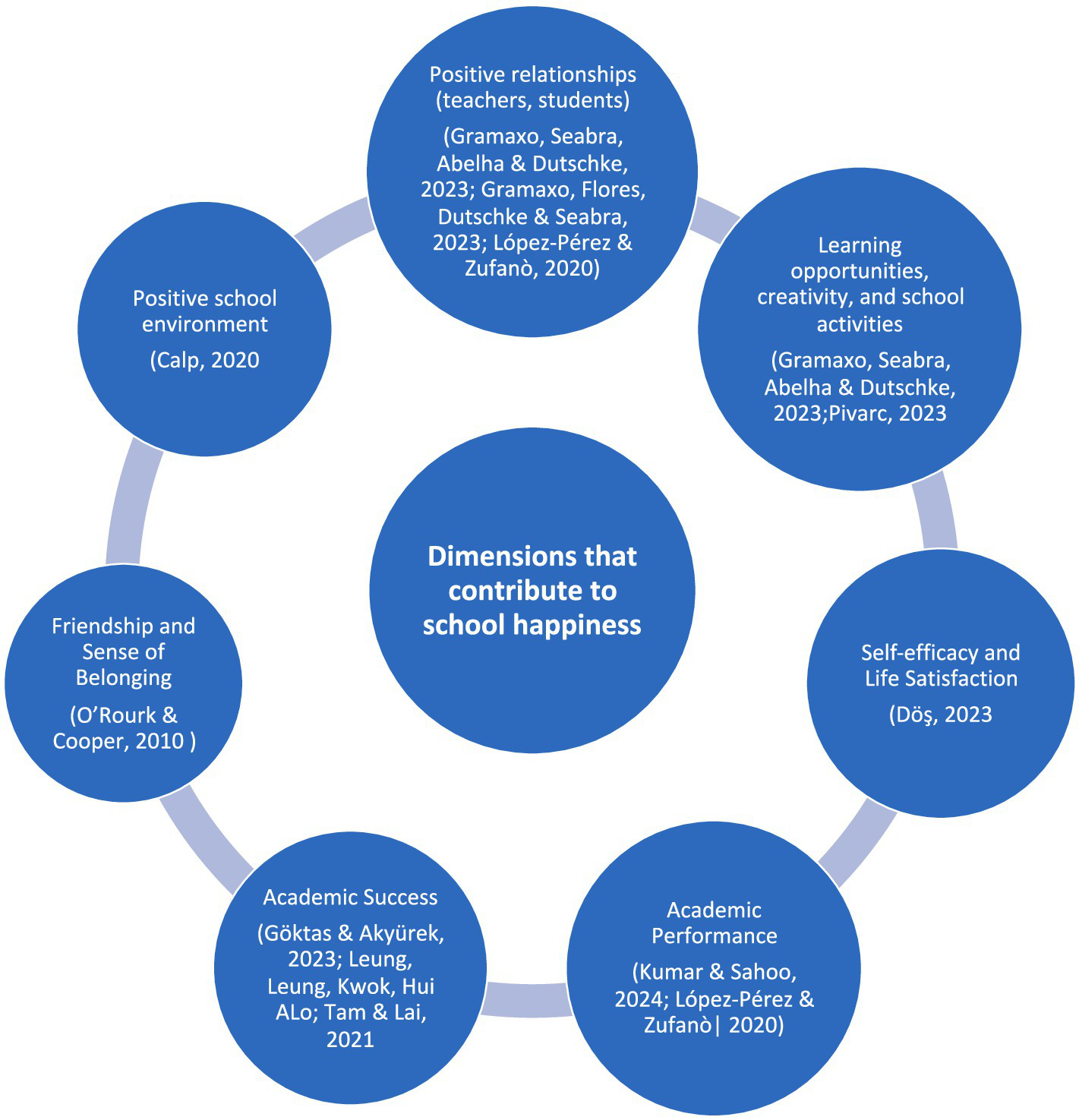
Map of the results analysed in the scoping review on the dimensions of happiness.
Figure 3
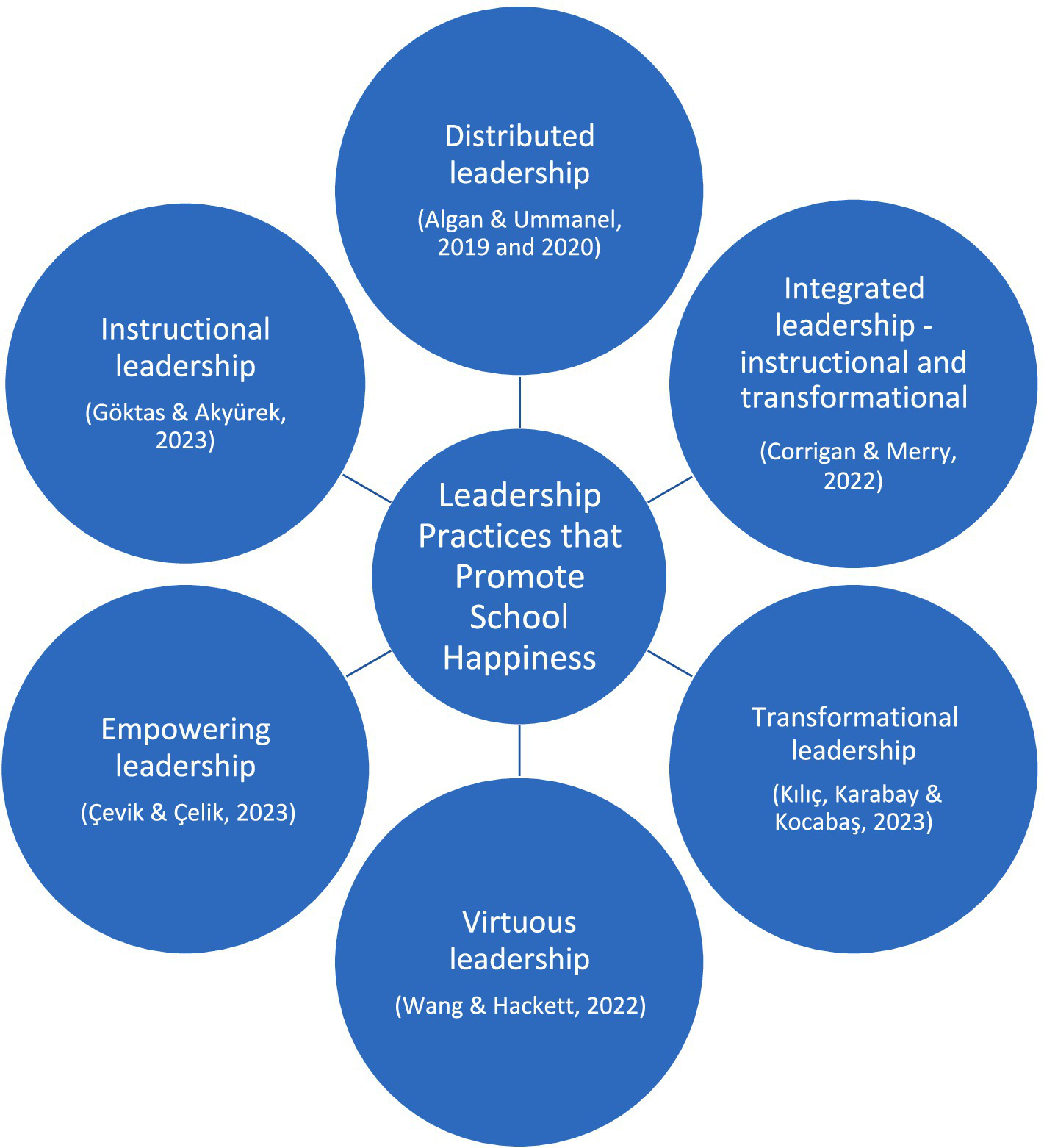
Map of the results analysed in the scoping review on leadership practices that promote school happiness.
3.1 Discussion of results
The main results extracted from the 17 articles included in this review are summarised below, seeking to understand the factors that may contribute to school happiness and understand leadership practices in promoting these positive environments.
Regarding the first review question (Table 2), the various studies analysed allowed us to elucidate the factors that promote happiness in school organizations. Specifically, the importance of the sense of belonging (Calp, 2020), relationships with friends (O'Rourke and Cooper, 2010; Gramaxo et al., 2023a,b) and with teachers (López-Pérez and Zuffianò, 2020), academic self-efficacy (Döş, 2023; Pivarč, 2023) and teachers’ personal and pedagogical skills (Gramaxo et al., 2023a,b) stand out. The data obtained are consistent with the literature, since motivation, commitment and interpersonal relationships have been considered fundamental in the academic success and well-being of students (Lyubomirsky et al., 2005; Tanhaye Reshvanloo and Hejazi, 2014).
Regarding the second review question, we found that a single leadership style is insufficient to adequately promote school happiness. Among the leadership studies analysed, the following are the ones that appear most associated with the promotion of school happiness: distributed leadership (Algan and Ummanel, 2019, 2020), transformational leadership (Kılıç et al., 2023), virtuous leadership (Wang and Hackett, 2022), integrated leadership (Corrigan and Merry, 2022) and empowering leadership (Çevik and Çeli̇k, 2023). The analysis of the different studies shows the importance of a multifaceted approach in leadership practices to promote happiness in the school environment. Thus, the integration of the different leadership styles proves to be fundamental to the creation of happy school environments. In this line of thought, leaders should demonstrate a moral identity centered on virtues (Wang and Hackett, 2022), promote a shared vision of the school (Corrigan and Merry, 2022), in a collaborative environment, in which all opinions are valued in decision-making (Tore and Duman-Saka, 2023), thus, contributing to professional development and growth (Tore and Duman-Saka, 2023).
It should be noted that these results are in line with what has been studied by Gurr (2015), insofar as successful leaders do not follow just one leadership style, since it is the situations and needs that require the adaptation of the most appropriate practices to the educational environment.
3.2 Study limitations
Despite the limitations listed below, this review contributed to a better understanding of the role of leadership in promoting happiness in school environments, thus opening new avenues for further research. Although the scarcity of studies related to leadership and school happiness represents a limitation, it also constitutes an opportunity for the development of new studies and research.
We also point out as limitations the fact that only articles published in Portuguese and English, in scientific journals that were available in full text, were included, which may have excluded other studies with possible important results for the topic.
Finally, although the analysed articles correspond to different cultural contexts, more research will be needed on the relationship between the role of leadership and happiness before any cross-cultural generalizations can be made.
4 Conclusion
4.1 Final considerations and relevance of the study/implications
This research has provided a deeper understanding by examining the relationship between leadership practices and styles in promoting school happiness, in order to contribute to improving learning and, more broadly, to a healthy and successful education system. We found that a combination of different leadership styles is necessary in promoting happy and healthy school environments, as there is no single leadership style that is considered to be effective, and it can vary depending on the school environment and circumstances.
With this research, we intend to encourage other studies to analyse this relationship, in order to promote greater awareness of the importance of leadership in promoting school happiness, ensuring the quality and sustainability of education.
4.2 Prospects for future research
The data obtained through this review indicate paths for the advancement of new scientific studies on the role of leadership and happiness in school organizations. We suggest that future research understand in a deeper way the characteristics of leaders who can contribute to school happiness.
In order to better understand the practical implications of this research in the future, we consider it pertinent that future studies study the triad Headteachers-Teachers-Students, since it has been observed that the literature focuses essentially on the Headteacher-Teacher and/or Teacher-Student dyads. It is also essential to analyze which characteristics of leaders are most related to happiness in the school environment, in order to guarantee the quality of learning.
Finally, it will be important to identify the factors that contribute to effective leadership, to analyse what may be hindering its effective and safe implementation within the educational context, contributing to the quality and sustainability of teaching.
Statements
Data availability statement
The raw data supporting the conclusions of this article will be made available by the authors, without undue reservation.
Author contributions
AV: Investigation, Writing – original draft, Writing – review & editing. LR: Writing – original draft, Writing – review & editing, Investigation. JA: Writing – original draft, Writing – review & editing, Investigation.
Funding
The author(s) declare that financial support was received for the research, authorship, and/or publication of this article. The authors are grateful to the Fundação para a Ciência e Tecnologia (FCT) for the support to CEDH – Research Centre for Human Development (Ref. UIDB/04872/2020) and to Faculty of Education and Psychology da Universidade Católica Portuguesa and also the Ribadouro Schools Group for providing the necessary conditions for the study to be conducted.
Conflict of interest
The authors declare that the research was conducted in the absence of any commercial or financial relationships that could be construed as a potential conflict of interest.
Generative AI statement
The authors declare that no Gen AI was used in the creation of this manuscript.
Publisher’s note
All claims expressed in this article are solely those of the authors and do not necessarily represent those of their affiliated organizations, or those of the publisher, the editors and the reviewers. Any product that may be evaluated in this article, or claim that may be made by its manufacturer, is not guaranteed or endorsed by the publisher.
References
1
Ainley J. Goldman J. Reed R . (1990). Primary schooling in Victoria: A study of students’ attitude and achievements in years 5 and 6 of government primary schools. ACER monograph no. 37. Hawthorn: Australian Council for Education Research.
2
Akan D. Yıldırım İ. Yalçın S. (2014). Developing the school principals leadership styles scale. Electronic Journal of Social Sciences, 13, 392–415. doi: 10.17755/esosder.28743
3
Algan E. K. Ummanel A. (2019). Toward sustainable schools: a mixed methods approach to investigating distributed leadership, organizational happiness, and quality of work life in preschools. Sustainability11:5489. Available at:https://search.ebscohost.com/login.aspx?direct=true&AuthType=ip,shib&db=edb&AN=139080520&lang=pt-pt&site=eds-live&scope=site
4
Algan E. K. Ummanel A. (2020). Erratum: Algan, EK; Ummanel, A. Toward sustainable schools: a mixed methods approach to investigating distributed leadership, organizational happiness, and quality of work life in preschools. Sustainability 2019, 11, 5489. Sustainability12:519. Available at:https://search.ebscohost.com/login.aspx?direct=true&AuthType=ip,shib&db=edb&AN=141759472&lang=pt-pt&site=eds-live&scope=site
5
Antaramian S. (2017). The importance of very high life satisfaction for students' academic success. Cogent Educ.4:1307622. doi: 10.1080/2331186X.2017.1307622
6
Aquino K. Reed A. (2002). “The self-importance of moral identity,” Journal of Personality and Social Psychology, 83, 1423–1440.
7
Bakker A. B. Demerouti E. Euwema M. C. (2005). Job resources buffer the impact of job demands on burnout. J. Occup. Health Psychol.10, 170–180. doi: 10.1037/1076-8998.10.2.170
8
Bhardwaj R. L. Das P. R. (2017). Manual for happiness scale. Agra: National Psychological Corporation.
9
Brown M. E. Trevino L. K. Harrison D. A. (2005). “Ethical leadership: a social learning perspective for construct development and testing,” Organizational Behavior and Human Decision Processes, 97, 117–134.
10
Calp Ş. (2020). Peaceful and happy schools: how to build positive learning environments. Int. Electron. J. Element. Educ.12, 311–320. doi: 10.26822/iejee.2020459460
11
Çevik M. S. Çeli̇k M. (2023). Study of variables predicting Teachers' organizational happiness levels with ordinal logistical regression analysis. Int. J. Progress. Educ.19, 59–80. doi: 10.29329/ijpe.2023.603.5
12
Cheng H. Furnham A. (2002). Personality, peer relations, and self-confidence as predictors of happiness and loneliness. J. Adolesc.25, 327–339. doi: 10.1006/jado.2002.0475
13
Corrigan J. Merry M. (2022). Principal leadership in a time of change. Front. Educ.7:897620. doi: 10.3389/feduc.2022.897620
14
Delle Fave A. Brdar I. Freire T. Vella-Brodrick D. Wissing M. P. (2011). The Eudaimonic and hedonic components of happiness: qualitative and quantitative findings. Soc. Indic. Res.100, 185–207. doi: 10.1007/s11205-010-9632-5
15
Diener E. Ryan K. (2009). Subjective well-being: a general overview. S. Afr. J. Psychol.39, 391–406. doi: 10.1177/008124630903900402
16
Döş İ. (2023). Relationship between happy school, general self-efficacy, academic self-efficacy and life satisfaction. Eur. J. Educ. Manage.6, 31–44. doi: 10.12973/eujem.6.1.31
17
Gómez-Baya D. García-Moro F. J. Muñoz-Silva A. Martín-Romero N. (2021). School satisfaction and happiness in 10-year-old children from seven European countries. Children8:370. doi: 10.3390/children8050370
18
Gramaxo P. Flores I. Dutschke G. Seabra F. (2023a). What makes a school a happy school? Portuguese students' perspectives. Front. Educ.8:1267308. doi: 10.3389/feduc.2023.1267308
19
Gramaxo P. Seabra F. Abelha M. Dutschke G. (2023b). What makes a school a happy school? Parents' perspectives. Educ. Sci.13:1267308. doi: 10.3390/educasci13040375
20
Gurr D. (2015). A model of successful school leadership from the international successful school principalship project. Societies5, 136–150. doi: 10.3390/soc5010136
21
Heffner A. L. Antaramian S. P. (2016). The role of life satisfaction in predicting student engagement and achievement. J. Happiness Stud.17, 1681–1701. doi: 10.1007/s10902-015-9665-1
22
Isen A. M. Reeve J. (2005). The influence of positive affect on intrinsic and extrinsic motivation: facilitating enjoyment of play responsible work behavior, and self-control. Motiv. Emot.29, 295–323. doi: 10.1007/s11031-006-9019-8
23
Keyes C. L. M. Shmotkin D. Ryff C. D. (2002). Optimizing well-being: the empirical encounter of two traditions. J. Pers. Soc. Psychol.82, 1007–1022. doi: 10.1037/0022-3514.82.6.1007
24
Kılıç G. N. Karabay A. Kocabaş İ. (2023). Examining the relationship between school Administrators' leadership styles and Teachers' organizational happiness. Int. J. Organ. Leadersh.12, 91–112. doi: 10.33844/ijol.2023.60352
25
King R. B. McInerney D. M. Ganotice F. A. Jr. Villarosa J. B. (2015). Positive affect catalyzes academic engagement: cross-sectional, longitudinal, and experimental evidence. Learn. Individ. Differ.39, 64–72. doi: 10.1016/j.lindif.2015.03.005
26
Korkut A . (2019). Analysis of teachers’ perceptions of organizational happiness, organizational cynicism and organizational justice[Unpublished doctoral dissertation, Inonu University, Institute of Education Sciences].
27
Lewis A. D. Huebner E. S. Malone P. S. Valois R. F. (2011). Life satisfaction and student engagement in adolescents. J. Youth Adolesc.40, 249–262. doi: 10.1007/s10964-010-9517-6
28
López-Pérez B. Zuffianò A. (2020). Children's and Adolescents' happiness conceptualizations at school and their link with autonomy, competence, and relatedness. J. Happiness Stud.22, 1141–1163. doi: 10.1007/s10902-020-00267-z
29
Lynch P. Eisenberger R. Armeli S. (1999). “Perceived organizational support: inferior versus superior performance by wary employees,” J. Appl. Psychol.84, 467–483.
30
Lyubomirsky S. (2007). The how of happiness: A scientific approach to getting the life you want. New York: Penguin Press.
31
Lyubomirsky S. Lepper H. S. (1999). A measure of subjective happiness: Preliminary reliability and construct validation. Soc. Indic. Res., 46, 137–115.
32
Lyubomirsky S. King L. Diener E. (2005). The benefits of frequent positive affect: does happiness lead to success?Psychol. Bull.131, 803–855. doi: 10.1037/0033-2909.131.6.803
33
Marsh H. W. Smith I. D. Barnes J. (1983). Multitrait-multimethod analysis of the self-description questionnaire: Student-teacher agreement on multidimensional ratings of student self-concept. Am. Educ. Res. J., 20, 333–357.
34
Nickerson C. Diener E. D. Schwarz N. (2011). Positive affect and college success. J. Happiness Stud.12, 717–746. doi: 10.1007/s10902-010-9224-8
35
Özdemir Y. Yılmaz Hiğde A. Sağkal A. S. (2021). Developing the school happiness scale for primary school children (SHSPSC): Validity and reliability study. Millî Eğitim Dergisi, 50, 111–127.
36
Oishi S. Diener E. Lucas R. E. (2007). The optimum level of well-being: can people be too happy?Perspect. Psychol. Sci.2, 346–360. doi: 10.1111/j.1745-6916.2007.00048.x
37
Okun M. A. Levy R. Karoly P. Ruehlman L. (2009). Dispositional happiness and college student GPA: unpacking a null relation. J. Res. Pers.43, 711–715. doi: 10.1016/j.jrp.2009.03.010
38
O'Rourke J. Cooper M. (2010). Lucky to be happy: a study of happiness in Australian primary students. Aust. J. Educ. Dev. Psychol.10, 94–107. doi: 10.4135/9789353287795.n5
39
Page M. J. McKenzie J. E. Bossuyt P. M. Boutron I. Hoffmann T. C. Mulrow C. D. et al (2021). The PRISMA 2020 statement: an updated guideline for reporting systematic reviews. bmj, 372.
40
Pang N. S. K. (1999). Students’ perceptions of quality of school life in Hong Kong primary schools. Educ. Res. J., 14, 49–71.
41
Piers E. V. Herzberg D. S. (2002). Manual for the Piers-Harris Children’s Self-Concept Scale (2nd Edition), Los Angeles: Western Psychological Services.
42
Pivarč J. (2023). Preconceptions of happiness and satisfaction: the perspective of children from Czech primary schools. J. Effic. Responsib. Educ. Sci.16, 128–139. doi: 10.7160/eriesj.2023.160204
43
Proctor C. Linley P. A. Maltby J. (2010). Very happy youths: benefits of very high life satisfaction among adolescents. Soc. Indic. Res.98, 519–532. doi: 10.1007/s11205-009-9562-2
44
Roets L. F. (1992). Leadership: A skills training program. Des Moines, IA: Leadership Publishers Inc.
45
Ryan R. M. Deci E. L. (2001). On happiness and human potentials: A review of research on hedonic and eudaimonic well-being. Annual review of psychology, 52, 141–166.
46
Ryff C. D. Keyes C. L. M. (1995). The structure of psychological well-being revisited. J. Pers. Soc. Psychol.69, 719–727. doi: 10.1037/0022-3514.69.4.719
47
Ryff C. D. Singer B. H. (2008). Know thyself and become what you are: a eudaimonic approach to psychological well-being. J. Happiness Stud.9, 13–39. doi: 10.1007/s10902-006-9019-0
48
Singer M. (2000). “Ethical and fair work behavior: a normative-empirical dialogue concerning ethics and justice,” J. Bus. Ethics.28, 187–209.
49
Talebzadeh F. Samkan M. (2011). Happiness for our children in schools: a conceptual model. Procedia Soc. Behav. Sci.29, 1462–1471. doi: 10.1016/j.sbspro.2011.11.386
50
Tanhaye Reshvanloo F. Hejazi E. (2014). Perceived parenting styles, academic achievement and academic motivation: a causal model. Int. J. Educ. Appl. Sci.1, 94–100. doi: 10.22034/injoeas.2021.161062
51
Tian L. Han M. Huebner E. S. (2014). Preliminary development of the adolescent students’ basic psychological needs at school scale. J. Adolesc., 37, 257–267. doi: 10.1016/j.adolescence.2014.01.005
52
Tore E. Duman-Saka B. (2023). The relationship between teacher leadership and organizational happiness of secondary school teachers. Eur. J. Educ. Manage.6, 247–259. doi: 10.12973/eujem.6.4.247
53
UNESCO (2016). Happy schools! A framework for learner well-being in the Asia-pacific. Paris: UNESCO.
54
Wang G. Hackett R. D. (2022). Virtuous leadership, moral behavior, happiness and organizational citizenship: the mediating effect of virtues-centered moral identity. Leadersh. Organ. Dev. J.43, 1047–1062. doi: 10.1108/LODJ-11-2021-0499
Summary
Keywords
school, happiness, leadership, students, teachers
Citation
Vale A, Ribeiro LM and Alves JM (2025) Happiness in school organizations: the role of leadership (a scoping review). Front. Educ. 10:1541533. doi: 10.3389/feduc.2025.1541533
Received
08 December 2024
Accepted
07 February 2025
Published
19 February 2025
Volume
10 - 2025
Edited by
Claudia Fahrenwald, University of Education Upper Austria, Austria
Reviewed by
Ana Paula Monteiro, University of Trás-os-Montes and Alto Douro, Portugal
Gül Kadan, Cankiri Karatekin University, Türkiye
Updates
Copyright
© 2025 Vale, Ribeiro and Alves.
This is an open-access article distributed under the terms of the Creative Commons Attribution License (CC BY). The use, distribution or reproduction in other forums is permitted, provided the original author(s) and the copyright owner(s) are credited and that the original publication in this journal is cited, in accordance with accepted academic practice. No use, distribution or reproduction is permitted which does not comply with these terms.
*Correspondence: Andreia Vale, s-aplvale@ucp.pt
Disclaimer
All claims expressed in this article are solely those of the authors and do not necessarily represent those of their affiliated organizations, or those of the publisher, the editors and the reviewers. Any product that may be evaluated in this article or claim that may be made by its manufacturer is not guaranteed or endorsed by the publisher.