Abstract
The National Science Foundation (NSF) Louis Stokes Alliance for Minority Participation (LSAMP) has a > 30-year history of providing high impact educational experiences to undergraduates and graduate students of color in science, technology, engineering, and mathematics (STEM). In 2020, LSAMP program leadership published biographical information from 1,137 alumni across 36 alliances. In this article, data were extracted from that publication and analyzed by major discipline, listed degrees earned, and alliance affiliation. Doctoral recipient data were compared to the National Center for Science and Engineering Statistics Survey of Earned Doctorates data between 1992 and 2022. Key findings were that the LSAMP program has supported at least 6% of doctorates earned by people of color (POC) in STEM fields since its inception. When disaggregated by discipline, 12 and 10% respectively, of doctorates earned by POC in mathematics and computer science and physical and earth sciences were LSAMP alumni. We identify factors contributing to variation between alliances in discipline and Trailblazer representation. We conclude that the LSAMP program has made a demonstrable impact on graduate degree earnings by POC since its start and suggest strategic recruitment and retention efforts based on specific alliance strengths. Continued congressional financial support of this program is pivotal to continue broadening participation in the STEM workforce.
Introduction
There is a long-standing need for diverse graduates in STEM (science, technology, engineering and mathematics) to address national and global challenges (The National Academies of Sciences, 2011; Betz et al., 2021). The U.S is at a critical nexus to develop essential skills for workforce development in current and emerging STEM industries and technologies of the future (National Science Foundation, 2024). In addition, students who went into the COVID-19 pandemic with the greatest educational needs and fewest opportunities were from historically marginalized and underserved groups. The pandemic widened educational disparities for people of color, demonstrating the value and importance of continued efforts to provide support for people of color in pursuit of higher education (United States Department of Education Office for Civil Rights, 2021).
Underrepresentation in STEM
The National Science Foundation (NSF) defines underrepresented minority (URM) as Black or African Americans; Hispanic or Latinos; American Indians or Alaska Natives; and Native Hawaiians or Other Pacific Islanders (National Science Foundation, 2024b). This paper will preferably use people/students of color (POC) instead of URM to describe the NSF-defined population. The term and acronym URM have been criticized as harmful language (Williams, 2020). This criticism stems from the term “underrepresented” referring to “below” or “not enough,” thereby perpetuating microaggressive implications that people of color are not worthy of inclusion. In 2021, POC represented 33.9% of college students and 14% of the college-educated science and engineering workforce (DePass and Chubin, 2008; National Center for Science and Engineering Statistics, 2023; United States Census Bureau, 2024). According to National Center for Science and Engineering Statistics, (NCSES), less than 13% of all doctoral degrees and 11% of STEM doctorates were earned by POC in 2022 (National Center for Science and Engineering Statistics, 2023). In contrast, POC compose nearly 35% of the U. S. population according to the 2024 estimated Census data which demonstrates incongruent representation between the general populus and STEM workforce (United States Census Bureau, 2024). Innovation, talent, and wealth gaps have been attributed to this systemic incongruency (Cook et al., 2022; Hsieh et al., 2019).
Underrepresentation in STEM coursework and major choice has been documented throughout higher education systems. For example, undergraduate students in STEM courses or majors have variable successes in their likelihood of obtaining a STEM degree depending on their intersecting identities (Hatfield et al., 2022). Specifically, one drop/fail/withdraw (DFW) (e.g., from a “weed-out class” or other experienced challenge) for POC students (male or female) and White female students is most similar to two DFW’s for White males or Asian students (male or female) in predicting whether the student will obtain a STEM degree. This discrepancy demonstrates a structural problem in higher education for students who want to pursue STEM but face significant obstacles. Adequate support systems are needed to allow students to navigate higher education and persist through graduation to reduce wealth, innovation, and talent gaps in the STEM workforce.
History of the LSAMP program
In 1991, the National Science Foundation invested in the development of the ‘Alliances for Minority Participation’ (AMP) to support STEM matriculation, retention, and graduate education of POC (Gates et al., 2022). In 1999, the program was named after the late congressman and civil rights advocate, Louis Stokes in honor of his advocacy and support of education and the advancement of underrepresented groups in the sciences.
LSAMP was created during a time of great need to prepare college students for the U.S. workforce and mentor persons of color in STEM careers. Higher education enrollment had seen exponential growth between 1960 and 1990 and nearly 30 years had passed since the Johnson administration called for affirmative action in the workplace (National Center for Education Statistics, 1993; Office of Civil Rights, 1972). Affirmative action refers to procedures designed to address historical and systemic discrimination particularly in education and employment and has since been federally banned along with diversity, equity, and inclusion (DEI) initiatives (The White House, 2025; Cornell Law School Legal Information Institute, 2022). Affirmative action and DEI initiatives in STEM education have been crucial for addressing historical inequities, increasing innovations, ensuring equal opportunity, providing role models, and driving economic and societal benefits (Maxwell and Garcia, 2019).
The NSF LSAMP program has had a notable impact across STEM communities in the United States. For example, the University of California system LSAMP program was developed just before the regents voted to end race-conscious admissions in 1995. After the regents’ vote, more than 20 LSAMP institutions were in jeopardy of losing funding. The regents’ vote began a cascade of institutional policies banning race-conscious admissions; yet the LSAMP program remained as a congressionally mandated funding initiative. Even in 2025, as funding is being eliminated for DEI initiatives nationally, LSAMP remains a steadfast reminder of strength and resilience and is still in limited operation at the time of writing (June 16, 2025).
The LSAMP program has effectively supported a collaborative educational infrastructure, community of mentors, and STEM networks through joint recruitment strategies, college retention pathways, and graduation planning (Hamilton and Parker, 2011). A formal evaluation of the Illinois LSAMP program showed that LSAMP provided academic support and promoted identity development (Burt et al., 2023). Baber and Jackson (2018) identified LSAMP as a model for leadership, recruitment, faculty engagement, student bridges to advanced education, continuous evaluation, financial assistance, and evidence-based implementation (Burt et al., 2023). The described multi-faceted STEM education experiences illustrate the individual and community level interactions created for LSAMP students to thrive socially, professionally, and academically.
Hamilton and Parker (2011) evaluated the impacts (including persistence and retention) of students enrolled in the University of Maryland’s NSF-LSAMP program. Attesting to how the University of Maryland’s alliance achieved consistently high retention and graduation rates. Hamilton and Parker (2011) describe that since the inception of the program in 1994, the first semester GPA (grade point average) of students enrolled in the bridge program had almost doubled, and the retention rate from first to second year remained above 90% (Hamilton and Parker, 2011). Student organizations, bridge programs, undergraduate research experiences, and study groups are critically important opportunities for students in LSAMP communities (Hamilton and Parker, 2011). As the program has grown, new tracks to support students have emerged creating an “open to all” strategy involving community colleges and four-year institutions with undergraduate and graduate student funding opportunities for research (Baber and Jackson, 2018).
Since its inception, the LSAMP program has supported over 650,000 students (National Science Foundation, 2018); yet there is little published on the broad impact LSAMP has had on racial/ethnic representation in STEM graduate degree earnings as a nationwide, federal program. Most publications focus on alliance-level programmatic elements and the impact of those strategies (Gates et al., 2022). The present article demonstrates the nation-level impact of LSAMP on students of color earning post-graduate degrees.
Purpose/research questions
This paper aims to provide evidence for the accomplishments of LSAMP alumni across the U. S. and explore the graduation successes of LSAMP alumni. Outcomes are then compared to data curated by the National Center for Science and Engineering Statistics to quantify how LSAMP has directly impacted POC and their earned doctorates. As graduates of the LSAMP program themselves, the authors leverage their collective culturally relevant experiences and programmatic knowledge to answer the following research questions:
What are the documented STEM disciplinary spaces of NSF LSAMP Trailblazers and alliance correlations?
How does the Trailblazer dataset compare to National Center for Science and Engineering Statistics Survey of Earned Doctorates data for people of color between 1992 and 2022?
LSAMP trailblazers in STEM magazine
In 2020, a request was made to LSAMP program administrators to collect data on the academic and career successes of alumni from their alliances. The goal was to publish a magazine about LSAMP alumni successes in either/both academic or professional careers. The LSAMP program celebrated its thirtieth year by publishing the biographies of 1,137 alumni across 36 alliances in what was called the “LSAMP Magazine: Special 2020 Innovators and Trailblazers Edition” (2020). The present article provides a descriptive quantitative analysis of the individuals featured in the Trailblazers document and provides evidence for the importance of the LSAMP program in supporting doctoral degree earnings by POC.
Positionality statement
“Lived experience refers to representation and understanding of an individual’s human experiences, choices, and options and how those factors influence one’s perception of knowledge based on one’s own life” (U.S. Office of the Assistant Secretary for Planning and Evaluation, 2021; Office of the Assistant Secretary for Planning and Evaluation (ASPE), 2021). The authors of this paper share lived experience as LSAMP alumni (two of which were highlighted in the Trailblazers magazine). The authors met through the National Alliance Leading the Acceleration of STEM or NALA (STEM) which was created to provide community and professional development for LSAMP alumni.
Dominique Smart, M.Ed. earned a Bachelor’s of Arts in Biology and a Masters in Educational Psychology from Rutgers University. She was a participant in the New Jersey Garden State-LSAMP program and upon graduation had the honor to serve as the GS-LSAMP program coordinator for 5 years. She currently serves on the Executive Board for NALA (STEM) and is an Administrative Research Associate at the Rutgers Cancer Institute. Dominique uses culturally relevant research and evaluation techniques to study the outcomes of underrepresentation in STEM disciplines, mentor-mentee dynamics, and long-term successes of college students of color across the nation.
Meli’sa S. Crawford, Ph.D. earned her Bachelor of Science in Psychology with a minor in Molecular and Cellular Biology from the University of Arizona. There she completed research through the Undergraduate Research Opportunities Consortium program sponsored by the Western Alliance to Expand Student Opportunities (WAESO) LSAMP. As a Bridge to the Doctorate scholar, Dr. Crawford received her Ph.D. in Biology with a focus in Physiology from Arizona State University. In 2020, she began her postdoctoral research at the University of California, Riverside in the Division of Biomedical Sciences and in 2023 was awarded the University of California President’s Postdoctoral Fellowship. Her current research focuses on elucidating the communication between the lungs and the gut by understanding how exposure to environmental pollutants induce chronic airway inflammation and alter intestinal barrier function. Dr. Crawford is a proud member of Alpha Kappa Alpha Sorority, Inc. and is committed to mentorship and increasing participation and access to opportunities for underrepresented minorities in STEM.
Ana Chicas-Mosier, Ph.D. earned Bachelor of Science degrees in both biology and psychology and a Ph.D. in Zoology from Oklahoma State University. During that time, she was a participant in the Oklahoma LSAMP alliance and a Bridge to the Doctorate scholar. She currently serves as vice-president for NALA (STEM), is the Director of Education, Outreach, and Diversity Programs for the Center for Environmentally Beneficial Catalysis at the University of Kansas. She served as co-PI for the Aligning STEM Trainees for Enterprising Research LSAMP prior to its May 2025 termination. As co-PI for the Aligning STEM Trainees for Enterprising Research LSAMP. Her research background includes equity in STEM disciplines, novel techniques for education research and learning environments, pollinator health, and integrated pest management. Her background, identities, research experience, and strong positive connection with LSAMP influence her perspective around inclusion in higher education. Dr. Chicas-Mosier personally advocates for the continuation and expansion of LSAMP programs.
Methods
Participants
In January 2020, former NSF LSAMP program director, Dr. Arthur Hicks, sent out a request for participation to LSAMP Principal Investigators. LSAMP Principal Investigators and leadership staff then requested information from their alumni at their own discretion. For this reason, the type of information received varied between alliances and only 36 of 44 alliances participated in the data collection. Alumni volunteered their biographies to be included in the publicly available Trailblazers magazine (Louis Stokes Alliance for Minority Participation Magazine, 2020). Most of the graduates included in the Trailblazers had earned terminal degrees (e.g., Ph.D., M.D.) prior to its publication (n = 1,100). Program leaders in each alliance ultimately determined which scholars would be included and the information that would be highlighted. The work was then compiled by Louis Dale and Carolyn Braswell at the University of Alabama- Birmingham. The variables in our analysis were selected because they were consistently available across the entire dataset. All participants were alumni of the LSAMP program so are assumed to be people of color.
The Trailblazers document does not reflect every LSAMP scholar, or every terminal degree earned by LSAMP alumni. The results of the present analysis are conservative estimates of the total impact of the LSAMP program since its inception.
NCSES survey of earned doctorates
The NCSES Survey of Earned Doctorates is an “annual census conducted since academic year 1958 of all individuals receiving a research doctorate from an accredited U. S. institution in a given academic year” (National Center for Science and Engineering Statistics, 2024). The publicly available dataset categorizes STEM disciplines into four categories: (1) life sciences, (2) physical and earth science, (3) mathematics and computer sciences, and (4) engineering. To simultaneously investigate both race/ethnicity data and STEM discipline the data are only publicly available at a 5-year frequency, so comparisons were made using data between 1992 and 2022. This resulted in an overestimation of the cumulative number of earned doctorates earned by POC in the United States as compared to Trailblazers data (1993–2020). An overestimation of the cumulative number of earned doctorates was selected over an underestimation (i.e., 1992–2017) to maintain a conservative and rigorous comparison of LSAMP’s impact.
Data analysis
A quantitative document analysis was used to demonstrate the accomplishments (terminal degree and STEM majors) of LSAMP graduates. The quantitative measures described in this paper include comparisons to NCSES Survey of Earned Doctorates between 1992–2022 and analysis of 1,136 Trailblazers coded by discipline, degree (s) earned, and alliance.
Degrees earned data were aggregated by degree type (e.g., Ph.D. or M.D.) and discipline (e.g., life science or engineering) to determine the types of degrees earned by Trailblazers and if there were alliance or disciplinary trends. Alliance data was collected from the NSF Award Search database to determine longevity of the program and whether a Bridge to the Doctorate (graduate education fellowship) was available to scholars.
Survey of Earned Doctorates data were disaggregated by race/ethnicity and grouped by similar disciplines. Race/ethnicity disaggregation allowed the research team to include only LSAMP race/ethnicity types from the comparative dataset to more closely mirror the Trailblazer data. Grouped disciplines (as described in NCSES Survey of Earned Doctorates) and 5-year frequency of survey data limited the level of granularity that was available for comparison to LSAMP scholar data. For this reason, LSAMP disciplines are grouped into the four described NCSES categories when compared to NCSES data. Disciplines were disaggregated into biology, chemistry, computer science, earth science, education, engineering, mathematics, physics, and psychology when not comparing to NCSES data.
The Trailblazers data were run through regression analysis (Trailblazers x Alliance; Alliance x Year Established, and Trailblazers x Discipline) to identify significant factors describing the trends. None of the results were significant so the authors will only include descriptive analysis for the remainder of the manuscript.
Results
Degrees earned
Of the 1,136 participants in the Trailblazers document, 78% earned a Ph.D. (Figure 1). Of those who earned any type of doctoral degree1 (n = 1,100), 24 (~2%) also earned a secondary doctoral degree (e.g., M.D./Ph.D). The “Other” category (Figure 1) represents additional degree types that were listed by Trailblazers but were earned by fewer than 10 individuals. Figure 1 demonstrates the breadth of degree types earned by LSAMP Trailblazers (n = 22).
Figure 1

Trailblazers disaggregated by their first-listed doctoral degree. The “Other” category represents ≤10 individuals (<1%) per degree type.
The highest percentage of Trailblazers (41%), regardless of their alliance affiliation, earned their undergraduate degree in a life science field (Figure 2). This was followed by 23% in engineering and 18% in chemistry. Computer science, earth science, mathematics, and physics each represented between 2 and 6% of undergraduate degrees. Mississippi LSAMP had the highest number of computer science graduates (n = 9), New Mexico for earth sciences (n = 5), WAESO and Greater Alabama Black Belt Region for mathematics (n = 9 each), and Louisiana for physics (n = 7).
Figure 2
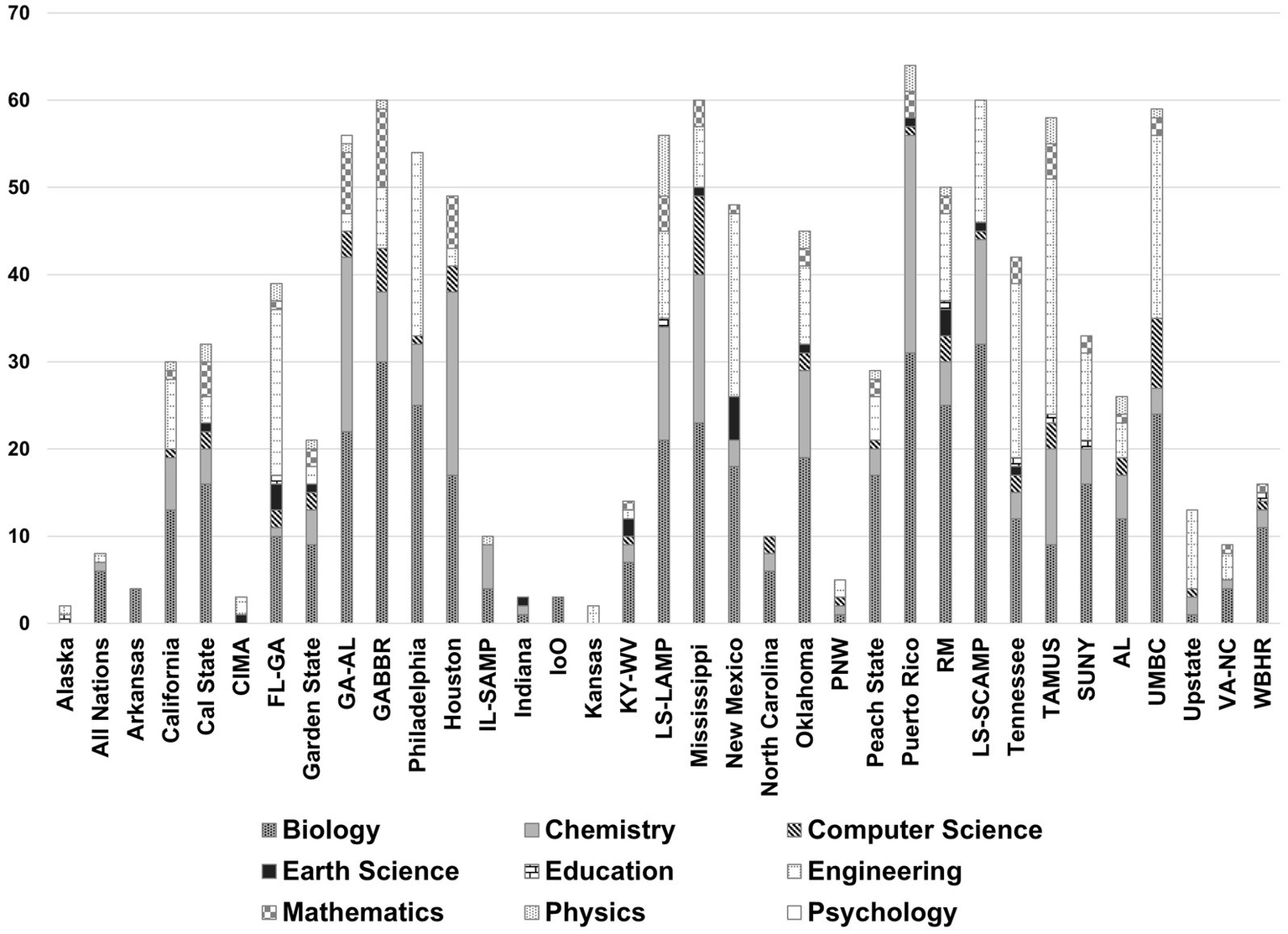
Number of trailblazers separated by alliance and discipline. Acronyms for abbreviated alliances can be found in Table 2.
Comparison of trailblazers to NCSES data
Comparisons to NCSES data between 1992 and 2022 disaggregated by race and STEM discipline shows a clear impact of the LSAMP program on earned doctorates by POC (Table 1). Depending on the discipline, LSAMP Trailblazers represent between 4 and 12% of research doctorates earned by POC in our study period. This is especially important for mathematics and computer science and physical and earth science where approximately one in every ten doctorates earned by people of color in our study period were included in the Trailblazers dataset.
Table 1
| NCSES STEM disciplines | LSAMP Trailblazers | NCSES since 1992 | Percent of graduates |
|---|---|---|---|
| Life Sciences | 301 | 7,089 | 4% |
| Physical and Earth Science | 226 | 2,277 | 10% |
| Engineering | 230 | 2,906 | 8% |
| Mathematics and Computer Science | 127 | 1,039 | 12% |
| Cumulative | 884 | 13,311 | 6.6% |
Comparison of Trailblazers to NCSES Survey of Earned Doctorates between 1992 and 2022.
Included NCSES race/ethnicity categories were Hispanic/Latino, American Indian or Alaska Native, Asiana, Black or African American, more than One Race, and Other Race or Races. Trailblazers with Ph.D. or Ed.D. degrees were included in the below dataset.
The greatest number of Trailblazers (60+) were from GABBR, South Carolina, Mississippi, and Puerto Rico. Other than GABBR, these alliances were established during the first three cohorts of the LSAMP program (1991 & 1992, Table 2). The fewest Trailblazers (≤10) were from Alaska (2001), All Nations (1994), Arkansas (2008), CIMA (2013), Houston (2014), Illinois (1993), Indiana (2016), Kansas (2013), North Carolina (1997), PNW (2009), and VA-NC (1990). There was no significant correlation between LSAMP alliance longevity and representation in the Trailblazers magazine.
Table 2
| LSAMP alliance | State(s) | Acronym* | Year Est. | Bridge to the doctorate awarded | No. Trail-blazers |
|---|---|---|---|---|---|
| Alaska | AK | 2001 | No | 2 | |
| Kansas | KS | 2013 | No | 2 | |
| Ciencia, Ingeniería, y Matemáticas Aliados (CIMA) | TX | CIMA | 2013 | No | 3 |
| Indiana | IN | 2016 | No | 3 | |
| Islands of Opportunity | HI | IoO | 2006 | No | 3 |
| Arkansas | AR | 2008 | No | 4 | |
| Pacific Northwest | ID, OR, WA | PNW | 2009 | No | 5 |
| All Nations | WA, ID, MT, WY, ND, SD, MN, WI, MI, NE, KS, OK, NM, AZ | 1994 | No | 9 | |
| Virginia- North Carolina | VA, NC | VA-NC | 1990 | Yes | 9 |
| Illinois | IL | ILSAMP | 1993 | Yes | 10 |
| North Carolina | NC | 1997 | Yes | 10 | |
| Upstate | NY | 2007 | No | 13 | |
| Kentucky- West Virginia | KY, WV | KY-WV | 2006 | Yes | 14 |
| Washington Baltimore Hampton Roads | D.C., MA | WBHR | 1990 | Yes | 16 |
| Garden State | NJ | 2009 | Yes | 21 | |
| University of Alabama | AL | AL | 1992 | No | 26 |
| Peach State | GA | 1997 | Yes | 29 | |
| California | CA | 1994 | No | 30 | |
| California State | CA | Cal State | 1994 | No | 32 |
| The State University of New York | NY | SUNY | 1996 | Yes | 33 |
| Florida-Georgia | FL, GA | FL-GA | 1992 | Yes | 39 |
| Tennessee | TN | 1995 | Yes | 42 | |
| Oklahoma | OK | 1990 | Yes | 45 | |
| New Mexico | NM | 1993 | No | 48 | |
| Houston | TX | 2014 | No | 49 | |
| Rocky Mountain | CO, WY | RM | 1996 | Yes | 50 |
| Greater Philadelphia Region | PA, DE, NJ | Philadelphia | 1994 | Yes | 54 |
| Georgia-Alabama | GA, AL | GA-AL | 1997 | No | 56 |
| Louisiana | LS | LS-LAMP | 2000 | Yes | 56 |
| Texas A&M University System | TX | TAMUS | 1991 | Yes | 58 |
| University of Maryland Baltimore County | MA | UMBC | 1995 | Yes | 59 |
| Greater Alabama Black Belt Region | AL | GABBR | 2017 | No | 60 |
| South Carolina | SC | LS-SCAMP | 1992 | Yes | 60 |
| Mississippi | MS | 1991 | Yes | 60 | |
| Western Alliance to Expand Student Opportunities | AZ, CO, UT | WAESO | 1996 | Yes | 60 |
| Puerto Rico | PR | 1991 | Yes | 64 |
Trailblazer alliances ordered by the first year of NSF funding.
*Acronyms are listed only if they are different from the standard U.S. State acronym. The All Nations alliance does not use an acronym.
Discussion
This is the first published analysis on LSAMP alumni data at the national level. Previous work has reviewed alliance-level datasets, typically estimating the impact of a particular programmatic elements such as international travel (Benjamin et al., 2021) or educational interventions (Sansing-Helton et al., 2021). The geographic breadth of the current dataset allows us to make inferences about the historical impact of the LSAMP program on POC earning graduate STEM degrees.
A key finding was the proportion of doctorates received by LSAMP alumni compared to the nationwide data from NCSES. The Trailblazers dataset does not represent every alliance or graduate degree earned by LSAMP scholars between 1992 and 2022. The comparative analysis between Trailblazers and NCSES (Table 1) clearly demonstrates that the LSAMP program has had an important impact on the number of POC earning doctoral degrees; with some disciplines seeing one in ten earned doctorates by POC were also LSAMP alumni. There is significant evidence that undergraduate research experiences and other high impact educational practices promote grade point average, graduate program enrollment, STEM career interest, and other skills (Russell et al., 2007; Carter et al., 2009; Eagan et al., 2013; Sell et al., 2018). The Trailblazers database demonstrates that LSAMP has successfully supported academic success for POC and should remain a congressionally mandated equity program to promote retention and graduate degree attainment.
There is noticeable variability between the number of alumni represented across the aggregated STEM disciplines (Figure 2). Math, computer science, and physical sciences represented the smallest proportion of LSAMP alumni relative to the total Trailblazers dataset, but the greatest overlap with NCSES earned doctorates. There is a relatively small number of earned doctorates by POC in these fields but 10 + % of those degrees are represented in the LSAMP Trailblazers dataset. The programs with the highest proportions of these degrees may emphasize those respective disciplines more than other alliances. Mississippi alliance’s key program is a high school bridge program to higher education (Louis Stokes Mississippi Alliance for Minority Participation, 2018), New Mexico’s alliance formally shifted their research focus to climate resilience and sustainability in Spring 2025 (New Mexico Alliance for Minority Participation, 2024), GABBR’s PI is also mathematics faculty (Auburn University, 2025), and Louisiana emphasizes advanced programming skills in addition to research, mentorship, and professional development (Bagayoko, 2010). This may demonstrate that alliance structural factors and curriculum emphasis directly impact the disciplinary selection of students who participate in the program. Knowledge of how alliance structure impacts student disciplinary selection is valuable for existing LSAMP programs as they can shift their design and curricula to better support students in disciplines with exceedingly low inclusion of POC.
Nine alliances included fewer than ten alumni in the Trailblazers dataset (Figure 2). Except for All Nations (1994), each of these alliances was established between 2001 and 2016 and represent 7 of the 13 alliances created after 2000. In contrast Garden State, Houston, and GABBR were also created since 2001 and included >20 Trailblazers (Table 2). While it does seem that alliance age may be a factor in the number of Trailblazers, likely a combination of factors such as type of alliance (2- or 4-year institutions), number of respondents, and/or alliance structure are better indicators of Trailblazer inclusion. Additional research into factors that may predict Bachelor of Science degree completion may provide insight into future focus areas for expanding the impact of LSAMP.
The authors recommend multi-organizational efforts or the formation of a ‘bridge’ between LSAMP alliances, and students entering the STEM workforce. This type of trans-institutional collaboration may offer innovative mechanisms to monitor the success of LSAMP alumni post-graduation and illuminate individual stories from the LSAMP community to support the program as a model for STEM student success.
The authors have used the Trailblazers document to approximate the impact of the LSAMP program in supporting STEM scholars of color earning graduate degrees. Though this dataset underestimates the total number of degrees earned by LSAMP scholars, it demonstrates that the program is meeting its primary aims (National Science Foundation, 2024b). Graduate school recruiters could strategize their recruitment efforts for LSAMP scholars to increase graduate enrollment in STEM fields. Figure 2 is a valuable resource to identify which LSAMP alliances have the strongest disciplinary emphasis for graduate student recruitment.
Study limitations
The Trailblazers document is considered a conservative estimate of the impact of LSAMP on earned doctorates by POC. However, the authors recognize that the sampling methodology is subject to bias by individual alliance leadership and participant self-selection. This may limit the generalizability of the study as those with Ph.D.s may have been more likely to be selected by program leadership and/or respond.
A deeper understanding of LSAMP alumni college experience would require the release of the ‘WebAMP’ dataset from the National Science Foundation. Until 2024, this platform collected data from each alliance annually including demographics, disciplines, research experiences, and other items. There may be efforts to synthesize and provide public access to ‘WebAMP’ but these data were not yet available at the time of writing.
Conclusion
The LSAMP program has played a pivotal role in addressing the national charge to improve representation of minorities in STEM majors and career sectors through a multi-phased and collaborative approach. By providing individualized support services, research opportunities, and professional development, LSAMP has significantly contributed to the academic and professional success of over 650,000 U.S. minority students in STEM (National Science Foundation, 2018). LSAMP has directly supported at least 6.6% of earned Ph.D. and Ed.D. degrees by POC since 1992. The LSAMP program is pivotal to supporting POC toward earning doctoral degrees and therefore requires federal, state, and institutional support to continue its impact.
Statements
Data availability statement
Publicly available datasets were analyzed in this study. This data can be found here: https://drive.google.com/file/d/1gW8ev4vkd-cXeAZVjMzgsCjFu6jxgvnO/view?usp=sharing.
Ethics statement
Ethical approval was not required for the study involving humans in accordance with the local legislation and institutional requirements. Written informed consent to participate in this study was not required from the participants or the participants’ legal guardians/next of kin in accordance with the national legislation and the institutional requirements.
Author contributions
DS: Conceptualization, Data curation, Writing – original draft, Writing – review & editing. MC: Formal analysis, Visualization, Writing – review & editing. AC-M: Conceptualization, Data curation, Writing – original draft, Writing – review & editing.
Funding
The author(s) declare that no financial support was received for the research and/or publication of this article.
Acknowledgments
We thank the National Science Foundation for spearheading the creation of the “LSAMP Trailblazers Magazine 2020” supported by NSF award# 1747988: Achieving Internal and External Dissemination with Effective Publications. We would also like to thank the members of the NALA (STEM)2 executive board, especially Paul Faronbi, E-Lexus Thornton, Nicholas Means, Nia Gilliam, and Myra James, for their contributions during the data collection and analysis phase of this paper.
Conflict of interest
The authors declare that the research was conducted in the absence of any commercial or financial relationships that could be construed as a potential conflict of interest.
Generative AI statement
The authors declare that no Gen AI was used in the creation of this manuscript.
Publisher’s note
All claims expressed in this article are solely those of the authors and do not necessarily represent those of their affiliated organizations, or those of the publisher, the editors and the reviewers. Any product that may be evaluated in this article, or claim that may be made by its manufacturer, is not guaranteed or endorsed by the publisher.
Footnotes
1.^Doctoral degree in this instance is inclusive of the following degrees: Ph.D., M.D., Pharm.D., D.O., J.D., D.D.S., Ed.D., O.D., D.M.D., D.V.M., D.P.M., D.N.P, D.P.T., D.Ph., D.C., or D.M.P.
2.^NALA(STEM) is a 501(c)3 non-profit organization designed to unite, support, and build community among all historically excluded peoples in STEM through career development and transition of undergraduate, graduate students, postdocs, and professionals through conferences, workshops, and mentorship.
References
1
Auburn University. (2025). Greater Alabama Black Belt Region staff directory. Available online at: https://cws.auburn.edu/apspi/pm/staff (Accessed March 25, 2025).
2
BaberL.D.JacksonJ.. (2018). From the edge of success to the center: development of LSAMP alliances, 1987–2017. Available online at: https://www.iinspirelsamp.org/wp-content/uploads/2016/11/Quantitative-Research-Brief_2018.pdf (Accessed July 22, 2024).
3
BagayokoD.. (2010). The ten-strand systemic mentoring model. Available online at: https://www.subr.edu/assets/subr/LSLAMP/TEN-StrandSYSTEMICMENTORINGModel05.pdf (Accessed April 1, 2025).
4
BenjaminM. E.YatesD.DupiusS. (2021). LSAMP-NICE: expanding international STEM research for underrepresented minorities. Front. Educ.6:668232. doi: 10.3389/feduc.2021.668232
5
BetzA. R.KingB.GrauerB.MonteloneB.WileyZ.ThurstonL. (2021). Improving academic self-concept and STEM identity through a research immersion: pathways to STEM summer program. Front. Educ.6:674817. doi: 10.3389/feduc.2021.674817
6
BurtB. A.StoneB. D.MotshubiR.BaberL. D. (2023). Stem validation among underrepresented students: leveraging insights from a STEM diversity program to broaden participation. J. Divers. High. Educ.1, 53–65. doi: 10.1037/dhe0000300
7
CarterF. D.MandellM.MatonK. I. (2009). The influence of on-campus, academic year undergraduate research on STEM Ph. d. Outcomes: evidence from the Meyerhoff scholarship program. Educ. Eval. Policy Anal.31, 441–462. doi: 10.3102/0162373709348584
8
CookL. D.GersonJ.KuanJ. (2022). Closing the gap in black and pink. Entrep. Innov. Policy Econ.1, 43–66. doi: 10.1086/719250
9
Cornell Law School Legal Information Institute. (2022). Affirmative action. Available online at: https://www.law.cornell.edu/wex/affirmative_action#:~:text=Affirmative%20action%20is%20defined%20as,such%20discrimination%20in%20the%20future (Accessed April 1, 2025).
10
DePassA.L.ChubinD.E.. (2008). Understanding interventions that encourage minorities to pursue research careers: building a community of research and practice. Available online at: www.cossa.org/diversity/reports/08Understanding_Interventions.pdf (Accessed January, 2025).
11
EaganK. M.HurtadoS.ChangM. J.GarciaG. A.HerreraF. A.GaribayJ. C. (2013). Making a difference in science education: the impact of undergraduate research programs. Am. Educ. Res. J.50. doi: 10.3102/0002831213482038
12
GatesA. E.GilbertJ.BotangaC.LondonB.NguyenK. (2022). Editorial: new developments in pathways toward diversity and inclusion in STEM: a United States perspective. Front. Educ.7:983922. doi: 10.3389/feduc.2022.983922
13
HamiltonT.ParkerR.. (2011). UMCP LSAMP: 15 years of successful retention and graduation of underrepresented minority students. Women in Engineering ProActive Network. Available online at: https://journals.psu.edu/wepan/article/view/58560
14
HatfieldN.BrownN.TopazC. M. (2022). Do introductory courses disproportionately drive minoritized students out of STEM pathways?PNAS Nexus1:pgac167. doi: 10.1093/pnasnexus/pgac167
15
HsiehC. T.HurstE.JonesC. I.KlenowP. J. (2019). The allocation of talent and U.S. economic growth. Econometrica87, 1439–1474. doi: 10.3982/ECTA11427
16
Louis Stokes Alliance for Minority Participation Magazine. (2020). Special edition 2020 innovators and trailblazers. Available online at: https://lsmrce.org/documents/community/LSAMP-Trailblazers-Magazine-2020.pdf (Accessed July 23, 2024).
17
Louis Stokes Mississippi Alliance for Minority Participation. (2018). LSMAMP Bridge STEM Program. Available online at: https://lsmamp.blog.olemiss.edu/bridge-stem/ (Accessed March 25, 2025).
18
MaxwellC.GarciaS. (2019). 5 reasons to support affirmative action in college admissions. Available online at: https://www.americanprogress.org/article/5-reasons-support-affirmative-action-college-admissions/ (Accessed March 28, 2025).
19
National Center for Education Statistics (1993). 120 years of American education: a statistical portrait. Eds: SnyderT.D. Available online at: https://nces.ed.gov/pubs93/93442.pdf (Accessed April 1, 2025).
20
National Center for Science and Engineering Statistics (2024). Available online at: https://ncses.nsf.gov/surveys/earned-doctorates/2023 (Accessed March 25, 2025).
21
National Science Foundation. (2018). Fact sheet: NSF by the numbers. Available online at: https://nsf.gov/news/factsheets/Factsheet_By_the_Numbers_v7_D.pdf (Accessed July 22, 2024).
22
National Center for Science and Engineering Statistics (2023). Doctorate Recipients from U.S. Universities: 2022. Available online at: https://ncses.nsf.gov/pubs/nsf24300/data-tables (Accessed June 16, 2025).
23
National Science Foundation. (2024). The state of US science and engineering 2024. Available online at: https://ncses.nsf.gov/pubs/nsb20243/talent-u-s-and-global-stem-education-and-labor-force (Accessed March 26, 2025).
24
National Science Foundation. (2024b). Louis Stokes Alliance for Minority Participation. Available online at: https://new.nsf.gov/funding/opportunities/louis-stokes-alliances-minority-participation (Accessed March 27, 2025).
25
New Mexico Alliance for Minority Participation. (2024). NM AMP. Available online at:https://nmamp.nmsu.edu/ (Accessed March 25, 2025).
26
Office of Civil Rights. (1972). Higher education guidelines for executive order 11246. Available online at: https://files.eric.ed.gov/fulltext/ED074893.pdf (Accessed April 1, 2025).
27
Office of the Assistant Secretary for Planning and Evaluation (ASPE). Engaging people with lived experience to improve federal research, policy, and practice. (2021). Available online at: https://aspe.hhs.gov/lived-experience (Accessed April 1, 2025).
28
RussellS. H.HancockM. P.McCulloughJ. (2007). Benefits of undergraduate research experiences. Science316, 548–549. doi: 10.1126/science.1140384
29
Sansing-HeltonB.CooverG.BentonC. E. (2021). Increasing STEM transfer readiness among underrepresented minoritized two-year college students: examining course-taking patterns, experiences, and interventions. Front. Educ.6:667091. doi: 10.3389/feduc.2021.667091
30
SellA. J.NagineyA.AlexanderC. (2018). The impact of undergraduate research on academic success. SPUR1, 19–29. doi: 10.18833/spur/1/3/8
31
The National Academies of Sciences (2011). Expanding minority participation: America’s science and technology talent at the crossroads. Washington, DC: National Academy Press.
32
The White House. (2025). Fact Sheet: President Donald J. Trump Protects Civil Rights and Merit-Based Opportunity by Ending Illegal DEI. Available online at: https://www.whitehouse.gov/fact-sheets/2025/01/fact-sheet-president-donald-j-trump-protects-civil-rights-and-merit-based-opportunity-by-ending-illegal-dei/ (Accessed March 30, 2025).
33
U.S. Office of the Assistant Secretary for Planning and Evaluation. (2021). Methods and emerging strategies to engage people with live experience, improving federal research, policy, and practice. Available online at: https://aspe.hhs.gov/sites/default/files/documents/62e7a64c60e10c47484b763aa9868f99/lived-experience-brief.pdf (Accessed March 28, 2025).
34
United States Census Bureau. (2024). Quickfacts. Available online at: https://www.census.gov/quickfacts/ (Accessed March 26, 2025).
35
United States Department of Education Office for Civil Rights. (2021). Education in a pandemic: The disparate impacts of COVID-19 on America’s students. Available online at: https://www2.ed.gov/about/offices/list/ocr/docs/20210608-impacts-of-covid19.pdf (Accessed April 1, 2025).
36
WilliamsT.L.. (2020). ‘Underrepresented minority’ considered harmful, racist language. Available online at: https://cacm.acm.org/blogcacm/underrepresented-minority-considered-harmful-racist-language/ (Accessed March 27, 2025).
Summary
Keywords
higher education, Louis Stokes Alliance for Minority Participation, STEM graduates, National Center for Science and Engineering Statistics Survey of Earned Doctorates, National Science Foundation (NSF)
Citation
Smart Graham D, Crawford MS and Chicas-Mosier AM (2025) Trailblazers in STEM: a document analysis of the accomplishments of Louis Stokes Alliances for Minority Participation alumni. Front. Educ. 10:1542978. doi: 10.3389/feduc.2025.1542978
Received
10 December 2024
Accepted
09 June 2025
Published
04 July 2025
Volume
10 - 2025
Edited by
Zahid Pranjol, University of Sussex, United Kingdom
Reviewed by
Chia Pin Kao, Southern Taiwan University of Science and Technology, Taiwan
Daniel Olivares Zambrano, University of Southern California, United States
Updates
Copyright
© 2025 Smart Graham, Crawford and Chicas-Mosier.
This is an open-access article distributed under the terms of the Creative Commons Attribution License (CC BY). The use, distribution or reproduction in other forums is permitted, provided the original author(s) and the copyright owner(s) are credited and that the original publication in this journal is cited, in accordance with accepted academic practice. No use, distribution or reproduction is permitted which does not comply with these terms.
*Correspondence: Ana M. Chicas-Mosier, ana.chicasmosier@gmail.com
Disclaimer
All claims expressed in this article are solely those of the authors and do not necessarily represent those of their affiliated organizations, or those of the publisher, the editors and the reviewers. Any product that may be evaluated in this article or claim that may be made by its manufacturer is not guaranteed or endorsed by the publisher.