Abstract
The purpose of this study is to identify the most influential variables in suicide among students, based on studies conducted from 2019 to 2024. Given the increase in suicide rates within this demographic group, 26 variables were identified, analyzed, and modeled in a social network. Indices of density, centrality, and closeness were used to assess the influence of each variable within the network. The results showed that the use of technologies, isolation, depression, and repeated exposure to traumatic experiences increase suicidal ideation and, therefore, the risk of suicide. These findings emphasize the need to develop multifaceted prevention programs tailored to student populations for more effective outcomes.
1 Introduction
Suicide represents a major public health problem, causing nearly 800,000 deaths per year (Mamdani et al., 2022). It is among the top ten causes of death in the United States for individual aged ten to sixty-four years (Ehlman et al., 2022). It has a severe socioeconomic impact and significant public health challenge and burden (Deng et al., 2024), contributing to over-demand of health services for survivors, loss of work days and reduced productivity (Wang et al., 2024), medical expenses, legal fees, funeral expenses (Sui and Zhang, 2025). Young people have the highest rates of suicidal ideation and suicide attempts, with a prevalence of 10% to 12% for suicidal ideation and 4% to 7% for suicide attempts (Commisso et al., 2023; Altavini et al., 2023).
In the case of Mexico, in 2015, a suicide rate of 5.2 per 100,000 inhabitants was recorded, with a rate of 8.2 per 100,000 among young people aged 19 to 25 years, representing 41.3% of mortality in this age group (Granados-Cosme et al., 2020). In 2020, 7,826 suicides were reported in Mexico. Consistent with previous years, 81.7% of the total suicides in 2020 occurred among males, and 73.8% affected individuals younger than 45 years (Borges et al., 2022).
Despite advances in medical and psychological research in recent years regarding risk factors and prevention, suicidality remains one of the most prevalent, devastating, and potentially preventable public health problems worldwide. It is therefore considered imperative to further explore the most recent contributions in the literature regarding factors associated with the progression from suicidal desire to suicide attempt (Sims et al., 2023). What has been widely reported in the literature is that suicidal ideation is one of the main predictors of suicide attempts and suicidal actions (Atreya et al., 2022).
From the perspective of social and personality psychology, suicide involves both cognitive and motivational components. In this view, it can be seen as a means of escaping the self -an act that may be interpreted as altruistic self-sacrifice, a ritual, or a gesture of honor intended to end deeply distressing thoughts and emotions (Baumeister, 1990). Postulates that suicide arises from the desire to escape from a painful conscience (Liu et al., 2024) or overwhelming emotional distress (Zhu et al., 2024), with overwhelming negative emotions that cannot be effectively regulated (Kobrinsky and Siedlecki, 2024). When the individual has lost hope of escaping suffering, suicide may be the only salvation (Yöyen and Keleş, 2024). In this sense, suicide is seen as a solution to pain at extremely severe levels where it is not known what the source is and how it can be helped (Pompili, 2024). The recovery process is long and even painful, it requires physical activation and coping activities, a radical change of attitude toward life, and above all, that the enthusiasm and this new vision be long-lasting.
Consequently, it is imperative to improve suicide risk assessment to identify and intervene in a timely manner among young people who are experiencing suicidal ideation, developing suicide plans, or making preparations to carry out a suicide attempt (Koh et al., 2023). Therefore, it is a priority to continue studies aimed at identifying modifiable risk factors in the development and persistence of suicidal thoughts and behaviors (Russell et al., 2019).
This section is divided into two parts. The first part describes some variables that, according to the current frontier of knowledge, influence suicidal ideation and behavior to some degree. These include (a) risk factors, (b) media and sensationalist news, and (c) depression. The second part briefly describes social network analysis, a tool used to characterize the relationships between the identified variables.
1.1 Risk factors for suicide
The reasons why people commit suicide are complex and multidimensional in etiology, making it impossible to rely on a single explanation that can be generalized (Casant and Helbich, 2022; Arowosegbe and Oyelade, 2023). Suicide risk involves a complex interaction of individual and contextual risk factors. However, as Weissinger et al. (2023) emphasize, none of these factors should be understood as a direct cause of suicide attempts or death by suicide. Given the emotional and economic burden associated with suicidal behaviors, further research into relevant risk and protective factors remains crucial (Rogers et al., 2021). Such research would enable decision-makers to implement evidence-based national strategies and educational programs to reduce risk. Although studies have made significant progress in identifying risk factors for suicide, suicidal ideation, and suicide attempts, the results remain disappointing (Martin et al., 2023), and many individuals continue to suffer from suicidal ideation or die by suicide.
Most studies have analyzed factors strongly implicated in the emergence of suicidal ideation in the university population, including anxiety, hopelessness, depression, stress (Martin et al., 2023; Xuan et al., 2023), low social support, affective dysregulation, alcohol use disorder, and depressive cognitive style (Han et al., 2022). However, these factors may stem from more severe underlying issues related to the life histories of young people, which place them in situations of extreme vulnerability. For example, having experienced physical or sexual abuse (Han et al., 2022), substance abuse, or parental abandonment during developmental stages can trigger difficulties in adapting to life, establishing healthy relationships, resolving interpersonal conflicts, or finding a way out (Davenport and Crepeau-Hobson, 2021).
From this perspective, it can be argued that sexual violence has been identified as a significant factor associated with suicidal ideation and suicide attempts among students (Baiden et al., 2024). Sexual abuse can lead to many of the risk factors that may subsequently result in a suicide attempt. For instance, an association has been reported between suicide and aggressive behavior (Xuan et al., 2023); however, the latter may have been triggered by a history of family violence or sexual abuse. The same applies to the potential association between demoralization and c The key is to analyze what in the young person’s history has triggered demoralization and to intervene at the root of the problem, rather than merely addressing its consequences.
1.2 Media and sensational news about suicide
Several studies have shown that media reports of suicide are associated with an increase in suicide cases, this phenomenon has been defined as the Werther effect (Sinyor et al., 2025). It has been demonstrated that the media can have both a protective influence on suicide risk in the population (Niederkrotenthaler et al., 2010) and a negative influence, potentially encouraging and contributing to an increase in suicides (Lueck et al., 2024). However, recent studies have provided evidence that some stories spread in the media seem to reduce suicidal ideation. Specifically, when stories represent constructive coping with suicidal ideation, a Papageno effect is produced (Niederkrotenthaler and Till, 2020). This phenomenon has stimulated a new line of novel research based on the premise that media stories of hope and recovery may help reduce suicide attempts and increase the intention to seek help (Arendt et al., 2025).
A meta-analysis examined the impact of hope narratives on suicidal ideation and their effects on help-seeking intention. Although the effects can be considered small, the authors conclude that the massive dissemination of such messages could yield significant positive effect (Niederkrotenthaler et al., 2022). Although there has been significant evidence regarding the outcomes associated with both the Werther and Papageno effects, more evidence remains important in highly vulnerable populations. However, it has been limited by the potential ethical implications (Niederkrotenthaler and Till, 2019).
Sensational reports of suicide, particularly those involving celebrity suicides, are associated with a rise in suicide cases, a phenomenon known as the “Werther effect” (Till et al., 2023). Numerous studies have clearly shown that extensive media coverage of suicide is associated with a significant increase in suicide rates (Gould, 2001). To date, controversy remains regarding the relationship between suicide and the media. For example, suicide imitation through the media has been studied using before-after comparisons or time series designs, testing whether news stories were associated with subsequent changes in suicide rates (Niederkrotenthaler et al., 2020).
Public awareness of the problem of suicide has sparked a debate about its strengths and limitations. Messages can be transmitted through the media, but they can also be used to communicate important information to the public.
2 Materials and methods
A search was conducted in Google Scholar, which is specialized search engine that allowed us to locate articles from important databases in the literature such as PubMed, Taylor & Francis, ScienceDirect, Springer, APA PsycNet, Wiley, and Elsevier were identified. Articles published between 2019 and 2024—the last five years—were included. The search terms used were suicide, suicide risk, suicide risk factors, and suicide students. Theoretical and empirical articles, literature reviews, and meta-analyses that established relationships between risk factors related to suicide were considered. In order to avoid duplication, we prioritized primary studies. Meta-analyses and Systematic reviews were included to obtain a broader theoretical discussion.
The search using the keywords suicide risk factors yielded approximately 27,900 results. The inclusion criteria were as follows: the studies had meet methodological quality, to be indexed to the databases mentioned above, the title had to indicate a relationship between specific variables and suicide, the article had to be written in English. The articles were then filtered based on the alignment between the title and the research focus. Eighty articles were identified and systematically analyzed to identify the main variables associated with suicide.
Among the exclusion criteria, articles that did not address risk factors directly related to suicidal ideation or that lacked methodological rigor were eliminated from the review.
The identified variables were then integrated into a network to characterize the interactions between them and to identify the most prevalent variables surrounding the phenomenon of suicide. The relationships between the variables were weighted according to the results of each study, using a scale from 0 to 5. A weight of 5 was assigned if the variable significantly influenced or contributed to the induction of suicide, while a weight of 0 indicated no influence, with intermediate values assigned accordingly. These data were used to construct an adjacency matrix, which served as input for building the network in the UCINET 6 software (Borgatti, 2002).
2.1 Statistical analysis
The approach of this study is exploratory and systemic, since the focus consists of the integration of variables of diverse nature that the literature has considered relevant in the studies of the suicide phenomenon and have been associated through their interactions.
Given that the risk factors for suicide are within a complex system that without a deep analysis would be difficult to understand due to its varied interconnections and structure. The use of network analysis allows for a visual representation to identify key patterns and relationships to understand the dynamics of this system of risk factors (Rogers et al., 2019).
3 Results and discussion
The network in Figure 1 was developed using the UCINET 6 software (Borgatti, 2002). It is a Mode 1 network, consisting of 26 variables identified in Table 1, with their corresponding nomenclature displayed in the network.
FIGURE 1
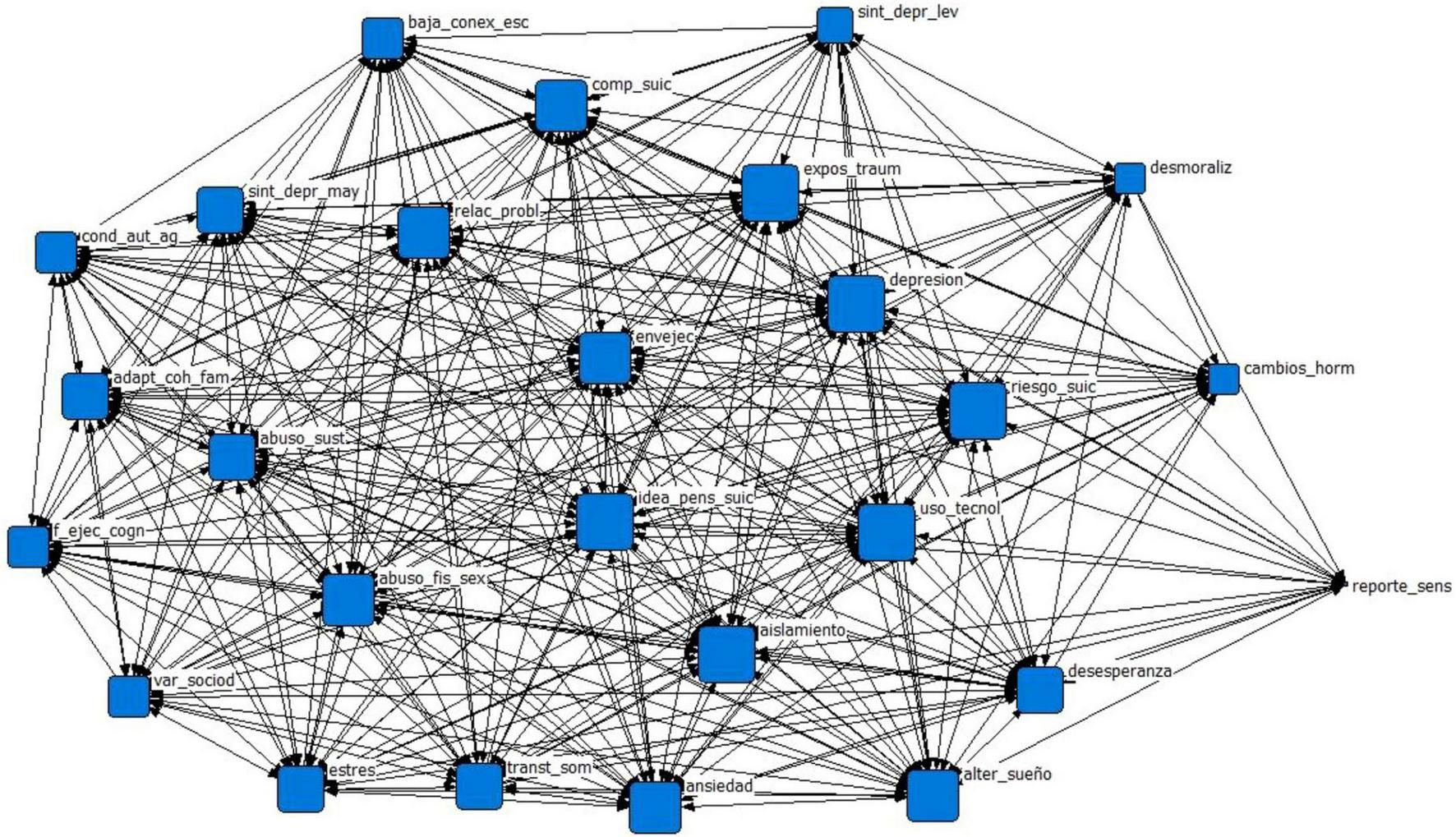
Network of variables related to suicide. Source: Created by the authors using UCINET 6 software (Borgatti, 2002).
TABLE 1
| No. | Variable name | Networklabel |
| 1 | Hopelessness | Desesperanza |
| 2 | Suicide risk | riesgo_suicidio |
| 3 | Demoralization | demoralize |
| 4 | Aging | envejec |
| 5 | Suicidal behaviors | comp_suic |
| 6 | Substance abuse | abuso_sust |
| 7 | Cognitive executive functioning | f_ejec_cogn |
| 8 | Self-harm and aggressive behavior | cond_aut_ag |
| 9 | Mild depressive symptoms | sint_depr_lev |
| 10 | Major depressive symptoms | sint_depr_may |
| 11 | Suicidal ideation and thoughts | idea_pens_suic |
| 12 | Sleep disturbances | alter_sueno |
| 13 | Hormonal changes | cambios_horm |
| 14 | Depression | depression |
| 15 | Social isolation | aislamiento |
| 16 | Technology use | uso_tecnol |
| 17 | Low school connectedness | baja_conex_esc |
| 18 | Low family adaptability and cohesion | adapt_coh_fam |
| 19 | Sociodemographic variables | var_sociod |
| 20 | Physical and sexual abuse | abuso_fis_sex |
| 21 | Dysfunctional relationships | relac_probl |
| 22 | Repeated exposure to traumatic experiences | expos_traum |
| 23 | Sensationalist reporting | reporte_sens |
| 24 | Anxiety | ansiedad |
| 25 | Stress | estres |
| 26 | Somatic symptom disorders | transt_som |
Nomenclature of variables according to the network in Figure 1.
Source: Created by the authors.
3.1 Network density
Equation 1 shows the calculation of the network density (∂) based on its variables vijvij, where rprp represents the total number of possible relationships and rere represents the existing relationships. In the network shown in Figure 1, 26 actors were identified, with a total of 504 existing relationships out of 650 possible relationships. The network has a density of 77%, indicating that it is highly connected. This means that all variables are connected to at least one other variable, although not necessarily with the same weight.
(a) Centrality Equation 2 shows the calculation of the centrality level for each actor in the network, where,
d(ni) refers to the degree of node ii, and this is calculated for each actor ii up to jj. In the case of the graph or network in Figure 1, the degree is 25 units, which is the highest magnitude compared to the rest of the nodes in the network. This corresponds to the following variables: (1) repeated exposure to traumatic experiences, (2) suicide risk, (3) technology use, (4) isolation, (5) depression, and (6) suicidal ideation and thoughts.
(b) Intermediation
Equation 3 shows the calculation of betweenness for each node, expressed as the sum of probabilities estimated over all pairs of actors, excluding actor ii, where ii is distinct from jj and kk.
In this sense, the nodes with the highest betweenness index are those that connect pairs of nodes, thereby facilitating communication between them. These nodes are precisely the ones with the highest centrality identified in the previous calculation, but in this case, they have a magnitude of 1.552.
(c) Closeness
The degree of closeness refers to a node’s capacity to reach all other actors in the network. In this case, it is calculated using Equation 4, where d(ni,nj)d(ni, nj) refers to the elements of a g × gg × g distance matrix, and g−1g−1 represents the minimum possible total distance.
The actors or nodes with the smallest magnitude, 25 units of geodesic distance in this case, would be the closest to the centralizing nodes and therefore coincide with those calculated in the previous sections.
The parameters calculated above are verified in the software results in Figures 2, 3.
FIGURE 2
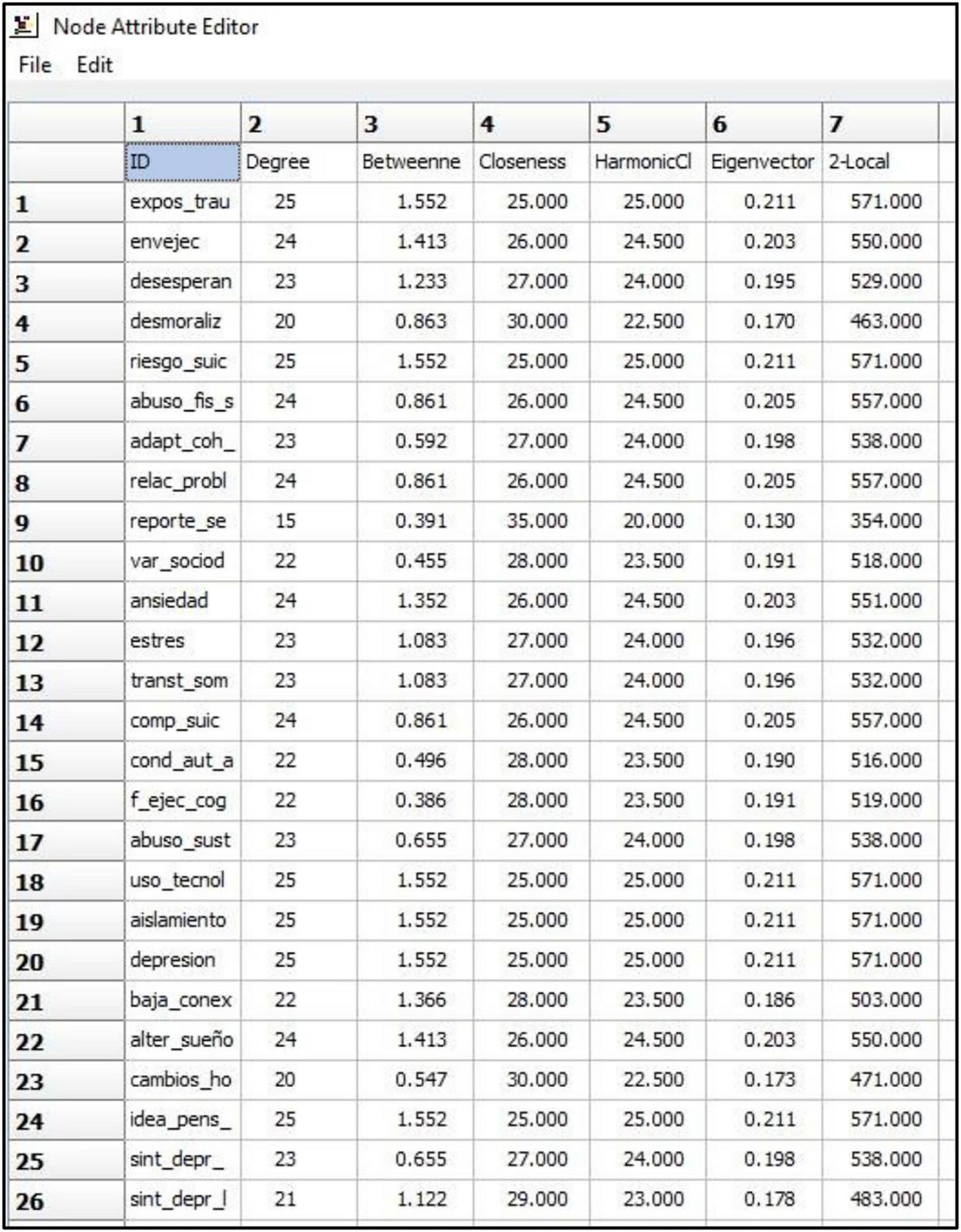
Network variable indicators. Source: Information extracted from the UCINET tool (Borgatti et al., 2014).
FIGURE 3
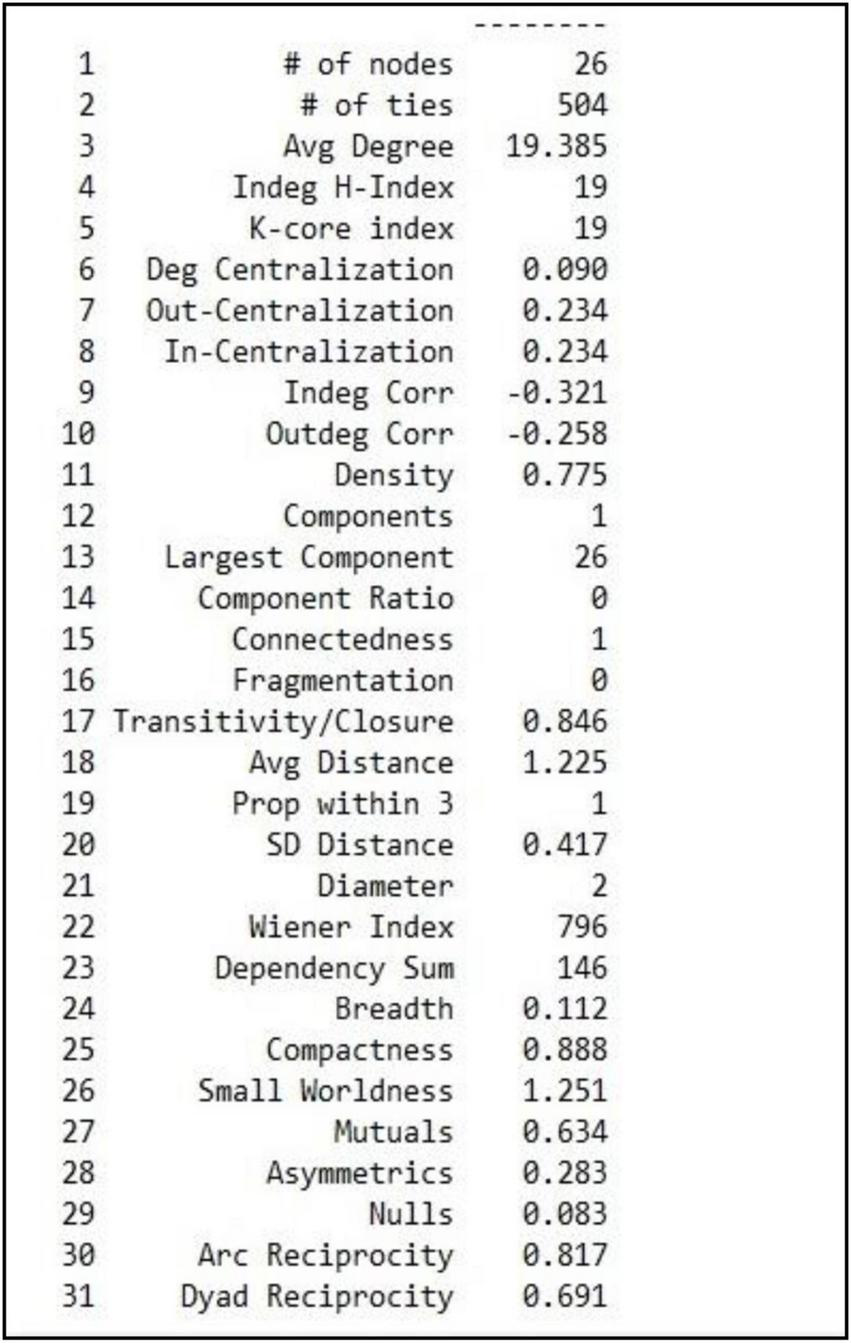
Global network indicators. Source: Information extracted from the UCINET tool (Borgatti et al., 2014).
According to the network topology in Figure 1, which resembles a partial mesh, since not all nodes are connected to each other, it can be observed that the most relevant variables are relatively close and centered on the right side of the network. This reflects that the nodes that are less relevant, but that are directly related to the most important ones (with a degree of centrality of 24) are anxiety, sleep disorders, suicidal behavior, physical and sexual abuse, and aging. On the other hand, the most distant nodes, with less impact on the central ones, are hormonal changes and sensationalist reports, with a degree of centrality of 20.
According to the network topology in Figure 1, which resembles a partial mesh (since not all nodes are connected to each other), it can be observed that the most relevant variables are relatively close and centered on the right side of the network. This reflects that the less relevant nodes, which are directly connected to the most important ones (with a centrality degree of 24), include anxiety, sleep disorders, suicidal behavior, physical and sexual abuse, and aging. On the other hand, the most distant nodes, which have less impact on the central ones, are hormonal changes and sensationalist reports, with a centrality degree of 20.
It is noteworthy that the relationship between drug use and suicide, has been extensively documented and studied (Borges and Loera, 2010; Brockie et al., 2015; Gibbons et al., 2009; Ohberg et al., 1996; Yerevanian and Choi, 2013), however, this relationship did not demonstrate relevance in our study. Within network theory framework, connections represent relationships of dependency or influence, where higher the degree of connection between nodes, the greater mutual influence (Newman, 2018; Wasserman and Faust, 1994). In this context, the nodes or variables that showed the greatest association with suicide did not include substance abuse as a predominant node. Notably, substance use and abuse have a weight of 23 (only two points less than the most relevant variables). Conversely, the variables with the greatest influence on the network (degree indicator of 25) are excessive use of technology, isolation, depression, and repeated exposure to traumatic experiences. Gien their topologically proximity (lower closeness indicator across the entire network with a value of 25) centered on the right in the network, one can think of a highly cohesive cluster. These results coincide with studies from recent years, which have identified novel findings due to changes in lifestyles influenced by technology and which now provide empirical evidence of its effects on human behavior. For example, Keles et al. (2020) found that excessive use of social media and digital technologies is related to high levels of anxiety and suicidal thoughts in young people, due in part to exposure to negative content and cyberbullying.
Excessive technology use promotes social isolation, which exacerbates depression and increases the suicide risk among youth (Twenge et al., 2018). This isolation, leads to depression and suicidal behavior in young people (McCoy et al., 2024; Orben and Przybylski, 2019; Santos et al., 2023). Even the excessive use of technologies is comparable to prolonged exposure to traumatic events of abuse and violence (Holman et al., 2020; Richards et al., 2017).
The findings are consistent with those of Shiratori et al. (2014), who conducted a network analysis to examine the reasons for suicide across populations of all ages. They found that depression and physical ailments are factors related to suicide but play distinct roles. These authors suggest that not all suicide attempts occur during depressive episodes. Factors such as traumatic events and hopelessness should also be taken into account. Meanwhile, Giabbanelli et al. (2022) analyzed suicide risk factors related to Adverse Childhood Experiences. In this study, the authors found that parents’ financial difficulties may influence the likelihood of children being exposed to such experiences, which, in turn, increases the risk of suicidal ideation.
These findings open a new line of research to analyze the relationship between technological trends and suicide. Although there are already studies on this topic (Dunlop et al., 2011; Ruder et al., 2011; Sedgwick et al., 2019), it would be interesting to examine the micro-factors that build this relationship in future research. On the other hand, it is worth mentioning that the use of computational tools based on graph theory, in this case, has allowed for the modeling of a qualitative phenomenon to describe the relationships between variables. This adds value and contributes to the frontier of behavioral science literature, as there is currently not a wide body of work on its application.
This study has several implications, highlighting the need to implement multifaceted interventions. The authors recommend focusing attention on students who, due to excessive use of technology, may be experiencing isolation, desolation, or depression. It is important to regulate the content of mobile applications, specifically short videos that have no viewing limits. Digital platforms should identify accounts that spend excessive time watching short videos and develop algorithms to present them with productive, motivational content that encourages positive imagination and supports the learning of new skills. Schools should promote more healthy, creative and fun content for young audiences.
Adolescents who suffer from social isolation and depression need care, support groups, feeling integrated. This could be achieved if educational institutions promoted the creation of digital projects through multimedia workshops that foster integration, social interaction, and initiatives that transform digital engagement into purposeful social connections, enriched with creativity and cognitive stimulation.
Statements
Data availability statement
The original contributions presented in this study are included in this article/supplementary material, further inquiries can be directed to the corresponding author.
Author contributions
BG-J: Writing – review and editing, Software, Writing – original draft, Formal Analysis, Methodology. MA-F: Writing – review and editing, Methodology, Investigation, Software, Validation, Formal Analysis. MS-M: Writing – review and editing, Investigation, Methodology. IG-M: Formal Analysis, Methodology, Supervision, Writing – original draft, Investigation. EL-R: Methodology, Supervision, Conceptualization, Writing – original draft, Investigation, Writing – review and editing, Formal Analysis.
Funding
The authors declare that no financial support was received for the research and/or publication of this article.
Acknowledgments
This is a short text to acknowledge the contributions of specific colleagues, institutions, or agencies that aided the efforts of the authors.
Conflict of interest
The authors declare that the research was conducted in the absence of any commercial or financial relationships that could be construed as a potential conflict of interest.
Generative AI statement
The authors declare that no Generative AI was used in the creation of this manuscript.
Publisher’s note
All claims expressed in this article are solely those of the authors and do not necessarily represent those of their affiliated organizations, or those of the publisher, the editors and the reviewers. Any product that may be evaluated in this article, or claim that may be made by its manufacturer, is not guaranteed or endorsed by the publisher.
References
1
Altavini C. S. Asciutti A. P. R. Santana G. L. Solis A. C. O. Andrade L. H. Oliveira L. G. et al (2023). Suicide ideation among Brazilian college students: Relationship with academic factors, mental health, and sexual abuse.J. Affect. Disord.329324–334. 10.1016/j.jad.2023.02.112
2
Arendt F. Till B. Gutsch A. Niederkrotenthaler T. (2025). Social media influencers and the papageno effect: Experimental evidence for the suicide-preventive impact of social media posts on hope, healing, and recovery.Soc. Sci. Med.370:117852. 10.1016/j.socscimed.2025.117852
3
Arowosegbe A. Oyelade T. (2023). Application of natural language processing (NLP) in detecting and preventing suicide ideation: A systematic review.Int. J. Environ. Res. Public Health20:1514. 10.3390/ijerph20021514
4
Atreya A. Nepal S. Menezes R. G. Marhatta A. Ghimire S. Shah P. (2022). Suicidal ideation among medical and nursing students.J. Nepal Health Res. Counc.20852–858. 10.33314/jnhrc.v20i4.4147
5
Baiden P. LaBrenz C. A. Harrell D. R. Wood B. M. Gobodzo E. C. Baiden J. F. et al (2024). Exposure to neighborhood violence and suicidal thoughts and behaviors among adolescents in the USA: Findings from a population-based study.Sch. Ment. Health561–16. 10.1007/s12310-023-09627-5
6
Baumeister R. F. (1990). Suicide as escape from self.Psychol. Rev.9790–113. 10.1037/0033-295X.97.1.90
7
Borgatti S. (2002). Ucinet for windows: Software for social network analysis.Harvard, MA: Analytic Technologies.
8
Borgatti S. P. Everett M. G. Johnson J. C. (2014). Analyzing social networks. Thousand Oaks, CA: SAGE Publications.
9
Borges G. Loera C. R. (2010). Alcohol and drug use in suicidal behaviour.Curr. Opin. Psychiatry23195–204. 10.1097/YCO.0b013e3283386322
10
Borges G. Garcia J. A. Pirkis J. Spittal M. J. Gunnell D. Sinyor M. et al (2022). A state level analyses of suicide and the COVID-19 pandemic in Mexico.BMC Psychiatry22:460. 10.1186/s12888-022-04095-8
11
Brockie T. N. Dana-Sacco G. Wallen G. R. Wilcox H. C. Campbell J. C. (2015). The relationship of adverse childhood experiences to PTSD, depression, poly-drug use and suicide attempt in reservation-based native American adolescents and young adults.Am. J. Commun. Psychol.55411–421. 10.1007/s10464-015-9721-3
12
Casant J. Helbich M. (2022). Inequalities of suicide mortality across urban and rural areas: A literature review.Int. J. Environ. Res. Public Health191–15. 10.3390/ijerph19052669
13
Commisso M. Temcheff C. Orri M. Poirier M. Lau M. Côté S. et al (2023). Childhood externalizing, internalizing and comorbid problems: Distinguishing young adults who think about suicide from those who attempt suicide.Psychol. Med.531030–1037. 10.1017/S0033291721002464
14
Davenport J. R. Crepeau-Hobson M. F. (2021). School-based suicide risk assessment: Standardization, comprehensiveness, and follow-up procedures in colorado.Contemp. Sch. Psychol.27262–274. 10.1007/s40688-021-00383-4
15
Deng B. McLeod G. F. Boden J. Sabel C. E. Campbell M. Eggleton P. et al (2024). The impact of area-level socioeconomic status in childhood on mental health in adolescence and adulthood: A prospective birth cohort study in Aotearoa New Zealand.Health Place88:103246. 10.1016/j.healthplace.2024.103246
16
Dunlop S. M. More E. Romer D. (2011). Where do youth learn about suicides on the internet, and what influence does this have on suicidal ideation?J. Child Psychol. Psychiatry521073–1080. 10.1111/j.1469-7610.2011.02416.x
17
Ehlman D. C. Yard E. Stone D. M. Jones C. M. Mack K. A. (2022). Changes in suicide rates –United States, 2019 and 2020.MMWR Morb. Mortal. Wkly. Rep.71306–312. 10.15585/mmwr.mm7108a5
18
Giabbanelli P. J. Rice K. L. Galgoczy M. C. Nataraj N. Brown M. M. Harper C. R. et al (2022). Pathways to suicide or collections of vicious cycles? Understanding the complexity of suicide through causal mapping.Soc. Netw. Anal. Min.12:60. 10.1007/s13278-022-00886-9
19
Gibbons R. D. Hur K. Brown C. H. Mann J. J. (2009). Relationship between antiepileptic drugs and suicide attempts in patients with bipolar disorder.Arch. Gen. Psychiatry661354–1360. 10.1001/archgenpsychiatry.2009.159
20
Gould M. S. (2001). Suicide and the media.Ann. N. Y. Acad. Sci.932200–224. 10.1111/j.1749-6632.2001.tb05807.x
21
Granados-Cosme J. A. Gómez Landeros O. Islas Ramírez M. I. Maldonado Pérez G. Martínez Mendoza H. F. Pineda Torres A. M. (2020). Depresión, ansiedad y conducta suicida en la formación médica en una universidad en México.Invest. Educ. Méd.965–74. 10.22201/facmed.20075057e.2020.35.20224
22
Han K. Ji L. Chen C. Hou B. Ren D. Yuan F. et al (2022). College students’ screening early warning factors in identification of suicide risk.Front. Genet.13:977007. 10.3389/fgene.2022.977007
23
Holman E. A. Garfin D. R. Lubens P. Silver R. C. (2020). Media exposure to collective trauma, mental health, and functioning: Does it matter what you see?Clin. Psychol. Sci.8111–124. 10.1177/2167702619858300
24
Keles B. McCrae N. Grealish A. (2020). A systematic review: The influence of social media on depression, anxiety and psychological distress in adolescents.Int. J. Adolesc. Youth2579–93. 10.1080/02673843.2019.1590851
25
Kobrinsky V. Siedlecki K. L. (2024). Specific emotion regulation difficulties mediating the associations between post-traumatic stress disorder symptoms and suicidal behaviors.Curr. Psychol.4335833–35844. 10.1007/s12144-024-07051-9
26
Koh Y. S. Shahwan S. Jeyagurunathan A. Abdin E. Vaingankar J. A. Chow W. L. et al (2023). Prevalence and correlates of suicide planning and attempt among individuals with suicidal ideation: Results from a nationwide cross-sectional survey.J. Affect. Disord.32887–94. 10.1016/j.jad.2023.02.033
27
Liu L. Wang W. Lian Y. Wu X. Li C. Qiao Z. (2024). Longitudinal impact of perfectionism on suicidal ideation among Chinese college students with perceived academic failure: The roles of rumination and depression.Arch. Suicide Res.28830–843. 10.1080/13811118.2023.2237088
28
Lueck J. A. Callaghan T. Scherr S. (2024). Suicidal ideation during the COVID-19 pandemic: Investigating mental health, COVID-19 health beliefs, and news media consumption in the United States population in the year 2020.OMEGA J. Death Dying881168–1180. 10.1177/00302228211062361
29
Mamdani F. Weber M. D. Bunney B. Burke K. Cartagena P. Walsh D. et al (2022). Identification of potential blood biomarkers associated with suicide in major depressive disorder.Transl. Psychiatry12:159. 10.1038/s41398-022-01918-w
30
Martin A. Oehlman M. Hawgood J. O’Gorman J. (2023). The role of impulsivity and self-control in suicidal ideation and suicide attempt.Int. J. Environ. Res. Public Health20:5012. 10.3390/ijerph20065012
31
McCoy T. Sochan A. J. Spaeth A. M. (2024). The relationship between sleep and physical activity by age, race, and gender.Rev. Cardiovasc. Med.25:378. 10.31083/j.rcm2510378
32
Newman M. (2018). Networks, 2nd Edn. Oxford: Oxford University Press.
33
Niederkrotenthaler T. Till B. (2019). Suicide and the media: From Werther to Papageno effects–A selective literature review.Suicidologi248–11. 10.5617/suicidologi.7398
34
Niederkrotenthaler T. Till B. (2020). Effects of suicide awareness materials on individuals with recent suicidal ideation or attempt: Online randomised controlled trial.Br. J. Psychiatry217693–700. 10.1192/bjp.2019.259
35
Niederkrotenthaler T. Braun M. Pirkis J. Till B. Stack S. Sinyor M. et al (2020). Association between suicide reporting in the media and suicide: Systematic review and meta-analysis.BMJ368:m575. 10.1136/bmj.m575
36
Niederkrotenthaler T. Till B. Kirchner S. Sinyor M. Braun M. Pirkis J. et al (2022). Effects of media stories of hope and recovery on suicidal ideation and help-seeking attitudes and intentions: Systematic review and meta-analysis.Lancet Public Health7e156–e168. 10.1016/S2468-2667(21)00274-7
37
Niederkrotenthaler T. Voracek M. Herberth A. Till B. Strauss M. Etzersdorfer E. et al (2010). Role of media reports in completed and prevented suicide: Werther v. Papageno effects.Br. J. Psychiatry197234–243. 10.1192/bjp.bp.109.074633
38
Ohberg A. Vuori E. Ojanperä I. Lonnqvist J. (1996). Alcohol and drugs in suicides.Br. J. Psychiatry16975–80. 10.1192/bjp.169.1.75
39
Orben A. Przybylski A. K. (2019). The association between adolescent well-being and digital technology use.Nat. Hum. Behav.3173–182. 10.1038/s41562-018-0506-1
40
Pompili M. (2024). On mental pain and suicide risk in modern psychiatry.Ann. Gen. Psychiatry23:6. 10.1186/s12991-024-00490-5
41
Richards T. N. Tillyer M. S. Wright E. M. (2017). Intimate partner violence and the overlap of perpetration and victimization: Considering the influence of physical, sexual, and emotional abuse in childhood.Child Abuse Neglect67240–248. 10.1016/j.chiabu.2017.02.037
42
Rogers M. L. Gorday J. Y. Joiner T. E. (2021). Examination of characteristics of ruminative thinking as unique predictors of suicide-related outcomes.J. Psychiatr. Res.1391–7. 10.1016/j.jpsychires.2021.05.001
43
Rogers M. L. Hom M. A. Joiner T. E. (2019). Differentiating acute suicidal affective disturbance (ASAD) from anxiety and depression symptoms: A network analysis.J. Affect. Disord.250333–340. 10.1016/j.jad.2019.03.005
44
Ruder T. D. Hatch G. M. Ampanozi G. Thali M. J. Fischer N. (2011). Suicide announcement on Facebook.Crisis32280–282. 10.1027/0227-5910/a000086
45
Russell K. Allan S. Beattie L. Bohan J. MacMahon K. Rasmussen S. (2019). Sleep problem, suicide and self-harm in university students: A systematic review.Sleep Med. Rev.4458–69. 10.1016/j.smrv.2018.12.008
46
Santos R. M. S. Mendes C. G. Sen Bressani G. Y. de Alcantara Ventura S. de Almeida Nogueira Y. J. de Miranda D. M. et al (2023). The associations between screen time and mental health in adolescents: A systematic review.BMC Psychol.11:1–21. 10.1186/s40359-023-01166-7
47
Sedgwick R. Epstein S. Dutta R. Ougrin D. (2019). Social media, internet use and suicide attempts in adolescents.Curr. Opin. Psychiatry32534–541. 10.1186/s13034-023-00597-9
48
Shiratori Y. Tachikawa H. Nemoto K. Endo G. Aiba M. Matsui Y. et al (2014). Network analysis for motives in suicide cases: A cross-sectional study.Psychiatry Clin. Neurosci.68299–307. 10.1111/pcn.12132
49
Sims M. A. Menzies R. E. Menzies R. G. (2023). A systematic review of the relationship between death anxiety, capability for suicide, and suicidality.Death Stud.4816–26. 10.1080/07481187.2023.2179686
50
Sinyor M. Shin S. Lee J. Stack S. Men V. Y. Niederkrotenthaler T. (2025). Suicide rates in South Korea and internationally following release of the Netflix series ‘Squid Game’.Soc. Sci. Med.371:117934. 10.1016/j.socscimed.2025.117934
51
Sui X. Zhang J. (2025). Income disparity and suicide rates: Evidence from countries.Sociol. Spectr.581–20. 10.1080/02732173.2025.2493101
52
Till B. Arendt F. Rothauer P. Niederkrotenthaler T. (2023). The role of the narrative in educative suicide awareness materials: A randomized controlled trial.Health Commun.19:e13579. 10.1080/10410236.2023.2167580
53
Twenge J. M. Joiner T. E. Rogers M. L. Martin G. N. (2018). Increases in depressive symptoms, suicide-related outcomes, and suicide rates among US adolescents after 2010 and links to increased new media screen time.Clin. Psychol. Sci.63–17. 10.1177/2167702617723376
54
Wang S. S. Eapen V. Lin P. I. (2024). The relationship between mental health reforms and general population suicide rates in Australia over the past three and a half decades: 1987–2021.Psychiatry Res.335:115884. 10.1016/j.psychres.2024.115884
55
Wasserman S. Faust K. (1994). Social network analysis: Methods and applications.Cambridge: Cambridge University.
56
Weissinger G. Rivers A. S. Atte T. Diamond G. (2023). Suicide risk screening in the school environment: Family factors and profiles.Child. Youth Serv. Rev.145:106766. 10.1016/j.childyouth.2022.106766
57
Xuan L. Hua S. Lin L. Jianli Y. (2023). Gender differences in the predictive effect of depression and aggression on suicide risk among first-year college students.J. Affect. Disord.3271–6. 10.1016/j.jad.2023.01.123
58
Yerevanian B. I. Choi Y. M. (2013). Impact of psychotropic drugs on suicide and suicidal behaviors.Bipolar Disord.15594–621. 10.1111/bdi.12098
59
Yöyen E. Keleş M. (2024). First-and second-generation psychological theories of suicidal behaviour.Behav. Sci.14:710. 10.3390/bs14080710
60
Zhu J. Xie P. Zhang X. (2024). Social exclusion and suicide intention in Chinese college students: A moderated mediation model.Front. Psychol.15:1354820. 10.3389/fpsyg.2024.1354820
Summary
Keywords
suicide, risk factors, mental health, depression, anxiety
Citation
García-Jarquín B, Aguilar-Fernández M, Sanchez-Medina MA, García-Montalvo IA and López-Ramírez E (2025) Technology, isolation, and drug use: a social network analysis of suicide risk. Front. Educ. 10:1600134. doi: 10.3389/feduc.2025.1600134
Received
25 March 2025
Accepted
26 May 2025
Published
23 June 2025
Volume
10 - 2025
Edited by
Eduardo Fernández-Jiménez, European University of Madrid, Spain
Reviewed by
Nishit Sinha, Indian Institute of Management Indore, India
Cristiana Tapoi, Prof. Dr. Alexandru Obregia Psychiatry Hospital, Romania
Updates
Copyright
© 2025 García-Jarquín, Aguilar-Fernández M, Sanchez-Medina, García-Montalvo and López-Ramírez.
This is an open-access article distributed under the terms of the Creative Commons Attribution License (CC BY). The use, distribution or reproduction in other forums is permitted, provided the original author(s) and the copyright owner(s) are credited and that the original publication in this journal is cited, in accordance with accepted academic practice. No use, distribution or reproduction is permitted which does not comply with these terms.
*Correspondence: Enrique López-Ramírez, enrique.lr@itoaxaca.edu.mx
Disclaimer
All claims expressed in this article are solely those of the authors and do not necessarily represent those of their affiliated organizations, or those of the publisher, the editors and the reviewers. Any product that may be evaluated in this article or claim that may be made by its manufacturer is not guaranteed or endorsed by the publisher.