Climate change research aims to understand global environmental change and how it will impact nature and society. The broad scope of climate change impacts means that successful adaptation and mitigation efforts will require an unprecedented collaboration effort that unites diverse disciplines and is able to rapidly respond to evolving climate issues (IPCC, 2014). However, to achieve this aim, climate change research practices need updating: key research findings remain behind journal paywalls, and scientific progress can be impeded by low levels of reproducibility and transparency (Ellison, 2010; Morueta-Holme et al., 2018), individual data ownership (Hampton et al., 2015), and inefficient research workflows (Lowndes et al., 2017). Furthermore, the level of public interest and policy engagement on climate change issues relies on fast communication of academic research to public institutions, with the result that the societal impact of climate change studies will differ according to their public availability and exposure. Here, we argue that by adopting open science (OS) principles, scientists can advance climate change research and accelerate efforts to mitigate impacts; especially for highly vulnerable developing regions of the world where research capacity is limited. We underscore the specific benefits of OS in raising the academic and societal impact of climate change research using citation and media metrics.
OS facilitates collaboration and triage
The pace of climate change combined with a need to address societal and ecological impacts with limited resources mean that climate change research is fast-moving and interdisciplinary. Some fields, such as biological conservation, can be considered triage disciplines that require efficient and rapid decision making (Bottrill et al., 2008). To this end, OS principles can help to minimize scientific uncertainty while increasing collaboration potential. For example, OS encourages data and code sharing (Ram, 2013), assists the peer-review process with fully-reproducible manuscripts (Lowndes et al., 2017), and reduces time to publication with preprints and open access (OA) journals (Vale, 2015). Most scientists agree that publicly-funded research should be freely available (Dallmeier-Tiessen et al., 2011) and several institutions have successfully implemented OS practices to share data and research in open-access archives. For instance, research on climate-driven thermal bleaching events in coral reef ecosystems has benefited hugely from open access to NOAA's large-scale monitoring data (e.g., NOAA CoralWatch; Harris et al., 2017). Although comprehensive open data policies have been implemented by some governments (e.g., USA; Obama, 2013) and journal groups (e.g., Nature editors, 2018), journal policies on data sharing are typically insufficient for adequate reproducibility (Stodden et al., 2018). Nonetheless, these examples demonstrate importance of adopting open data principles; comprehensive uptake of these practices will substantially enhance the application of academic research to climate change issues.
Academic and non-academic communication of climate change may be especially important for developing nations. Most climate change research is published through institutes within the developed world (McSweeney, 2015), yet the greatest impacts will be observed in some of the least developed and most vulnerable regions of the world (IPCC, 2014; Blasiak et al., 2017). Inability to access subscription-only publications may inhibit science-based policy in developing countries. For example, inaccessibility of primary research has contributed to low citation rates in policy plans for tropical marine protected areas, implying that environmental management may fall behind current scientific knowledge (Cvitanovic et al., 2014). With the rise in usage of publication repositories such as Sci-Hub (https://en.wikipedia.org/wiki/Sci-Hub), which enable users to download PDF versions of paywalled articles, there is clearly a widespread demand for OA research (Bohannon, 2016; Himmelstein et al., 2018).
OA benefits to research communication: citations and altmetric data
Open science practices can result in greater public engagement (Wang et al., 2015) and, through OA publications, increase citation rates (“the OA citation advantage”) (Lawrence, 2001; Eysenbach, 2006). Using Scopus citation data, we show that the proportion of OA studies increased substantially over time in publications containing “climat* change” in their title, abstract, or keywords between 2007 and 2016 (Scopus; www.scopus.com), accounting for only 4% in 2007 and increasing to 25% in 2016 (Figure 1). However, this varied by journal rank (JR). We categorized journals into four groups, using JRs that are 3-year weighted citation rates obtained from SCImago Journal Rankings (see Figure 1 caption for category breakdown; SCImago1). For the low JR category, OA publications in 2016 accounted for < 20%, while the medium category had the largest OA proportion at 30%. High and very high categories had 23% and 26% OA, respectively. Popular OA journals such as PLoS ONE and Scientific Reports comprised 71 and 24% of OA publications within their JR groups (medium- and high-ranked, respectively), and 15 and 3% of all publications within their groups, respectively. Across all journal ranks, OA climate change studies were cited more than closed studies (Figure 2A), indicating that adopting OA could lead to earlier and increased citations of climate change research, and thus accelerate scientific progression by building upon existing science at a faster rate (Eysenbach, 2006; Lowndes et al., 2017). Though we used SCImago Journal Rankings to keep consistency with the Scopus citation database, such citation-based metrics are coarse measures of journal research quality, and do not represent research impact for individual papers (Lariviere et al., 2016) or non-academic audiences.
Figure 1
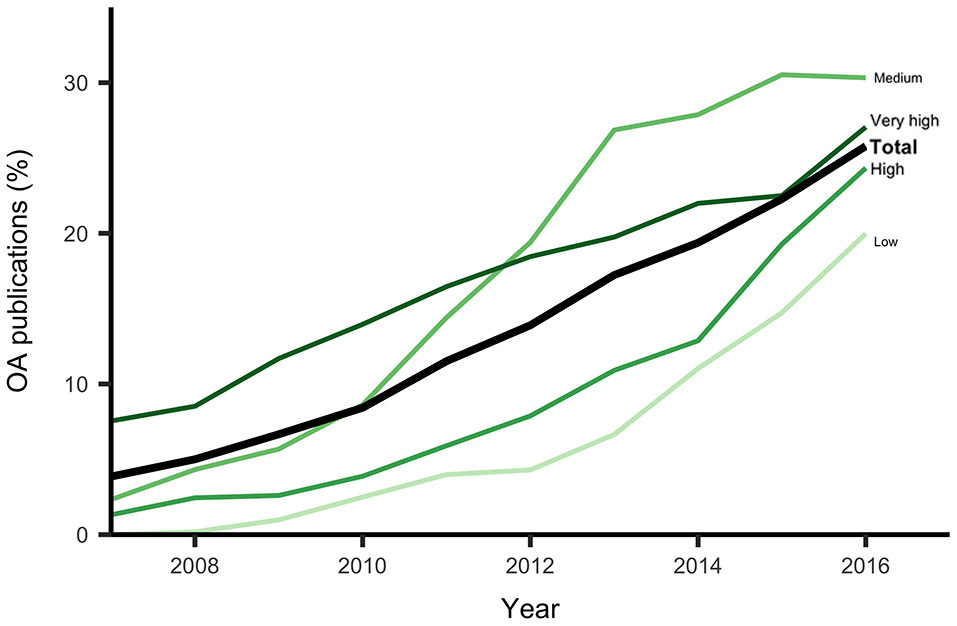
Increasing prevalence of open access (OA) climate studies published between 2007 and 2016. Proportional increase in OA climate change publications (black line) and across four journal ranking categories (colored lines; low = 0.14–0.93, medium = 0.93–1.5, high = 1.5–2.2, very high = 2.2–18.1). Publications were extracted from Scopus (www.scopus.com) for articles and reviews published between 2007 and 2016 containing the term “climat* change” in title, abstract, or keywords. We further restricted publications to those journals with >100 total citation records (i.e., journals which regularly published climate change research, n = 225). Journal rankings are 3-year weighted citation rates (SCImago Journal Rankings; www.scimagojr.com), ranging from 0.14 to 18.13. Bins are the 25th, 50th, and 75th quantiles of the journal rank distribution.
Figure 2
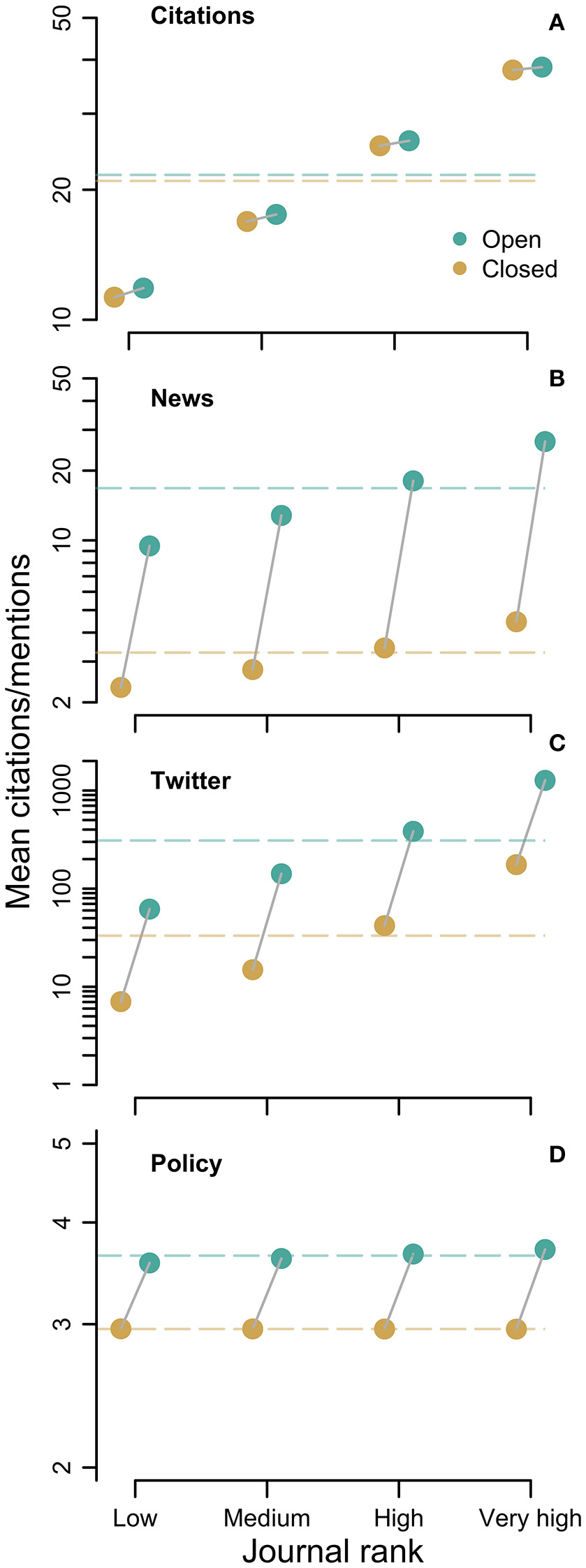
Citations, communication, and media influence of closed and open access climate change studies published between 2007 and 2016. Points are predicted mean number of citations (A), news mentions (B), twitter mentions (C), and policy mentions (D) in four journal ranking categories, controlling for effects of publication year and journal on citations/mentions. Dashed lines are mean citations/mentions controlling for journal rank, publication year and journal name. Citations were extracted from Scopus for the same studies in Figure 1. News, twitter and policy mentions were extracted from Altmetric (www.altmetric.com) for study DOIs in Figure 1. Citations and mentions were averaged for each journal in each year, and fitted to linear mixed effects models with journal ranking bin (4 bins represented by the 25th, 50th, and 75th quantiles) and access (open/closed) as fixed effects and year and journal as random intercepts. Citations and mentions were log10 transformed for normality and presented on a log10 scale. All analyses were conducted in R 3.4.4 (R Core Team, 2018).
Beyond academic citation advantages, OA climate change research can have a greater societal impact when studies are communicated to non-academic audiences by mainstream news and social media, as well as used by policymakers (Wang et al., 2015; Bornmann et al., 2016). In “mentions” of climate change studies in online news sources, Twitter feeds, and policy documents (www.altmetric.com), we show that OA studies were communicated more frequently (Figures 2B–D), likely due to those studies being more accessible to non-academic audiences. Despite the positive OA effect, the most widely-communicated papers were high impact and closed access papers (e.g., 88% of studies with >100 news mentions were closed access). High-ranking journals such as Nature and Science are often promoted with academic press releases, highlighting how paywalls can limit public understanding and engagement of academic knowledge (Parker, 2013). Nonetheless, higher news and Twitter activity for OA studies—irrespective of journal rank—supports a longstanding perception that open research is more widely disseminated and discussed online (Wang et al., 2015; Côté and Darling, 2018).
Policy documents cited open studies more often than closed, and this difference was consistent across JRs (Figure 2D). Thus, when policymakers lack institutional access to paywalled journals, the OA effect may result in greater uptake of primary research into policy. However, because Altmetric tracks major policy groups in North America and Europe (Bornmann et al., 2016), we note that these policy trends may be biased toward academic authors working for international organizations (e.g., Food and Agriculture Organization of the United Nations, World Bank, Intergovernmental Panel on Climate Change). While our results show a positive trend toward OA (Figure 1) and higher OA mentions in policy documents (Figure 2D), important research still remains behind paywalls and there is evidence that subscription-only publishing models can limit the uptake of current scientific knowledge by policymakers (e.g., Cvitanovic et al., 2014; Fuller et al., 2014; Rafidimanantsoa et al., 2018). For example, OA may be especially important for small-scale, low-impact studies which are relevant for local policy but do not receive much media attention.
Transitioning to open climate change research
Core OS principles are simply the open sharing of data, code, and papers throughout the research process (Hampton et al., 2015; McKiernan et al., 2016). Such practices have reformed entire disciplines (e.g., preprints in mathematics, open genome data in genetics; Nielsen, 2011), but the transition to OS for climate change research is incomplete. For climate change scientists, who must respond to evolving environmental changes with research that has considerable societal impact, the open sharing of data, code, and research outputs could be transformative (e.g., Lowndes et al., 2017). Because of the success of OS in other fields, tools for OS are already freely available (Table 1). For example, several preprint and data repositories target climate change fields (e.g., MarXiv for marine science), while existing version control and coding tools have been adapted for an OS workflow in environmental research (e.g., RStudio and Github, Lowndes et al., 2017).
Table 1
| Open science practice | Benefits | Application to climate change research |
|---|---|---|
| Publish open access | Increase uptake of primary research by public institutions (government and policy) | Limited uptake of scientific knowledge by policymakers (Cvitanovic et al., 2014) may be addressed with open access (Figure 2D) |
| Improve access to science by developing countries, thus enhancing climate change adaptation and mitigation efforts | Developing countries, which are most at risk to climate change impacts (IPCC, 2014), can access up-to-date climate research | |
| Improve public communication of scientific evidence, thus raising public understanding of science | Prior knowledge of climate change causes are correlated to heightened concern (Shi et al., 2016) | |
| Adopt reproducible and transparent research workflows | Increase efficiency of research and robustness of findings | Progression of open science data tools and practices for increased transparency (Lowndes et al., 2017) |
| Archive data, code, and preprints | Greater sharing of data, code, and ideas will stimulate more collaborative and interdisciplinary research | Journals publishing climate change research should adopt transparency policies (Nosek et al., 2015) Standardized metadata reporting will facilitate literature comparisons and meta-analyses (Morueta-Holme et al., 2018) Openly-available environmental monitoring datasets have been critical sources of information (e.g., NOAA's SST product; Reynolds et al., 2002) Open science workflows facilitate large collaborations (e.g., GitHub, Open Science Framework; Ram, 2013; Wilson et al., 2014) |
| Data availability will advance practices of “climate change triage” | Climate change triage that supports long-term values of multiple stakeholders (e.g., scientists, Indigenous communities, government, industry; Wheeler et al., 2016) will require integration of diverse datasets from multiple disciplines Access to open datasets at global and local scales facilitates conservation triage of coral reefs (Harris et al., 2017) | |
| Fast release of ideas and improved research before peer-review | Archiving pre- and post-prints on open access repositories such as arXiv, biorXiv, MarXiv, and EarthArXiv |
Recommendations to advance climate change research with open science tools.
Despite the clear benefits of OS in enhancing research output and communication to stakeholders, considerable barriers to OS uptake persist, including closed publishing, fear of being “scooped,” and clarity of data ownership (Nosek et al., 2015). Research outputs—usually publications—are already required by most granting agencies, where OA publishing costs are typically covered by grants and institutions (Dallmeier-Tiessen et al., 2011). Furthermore, most climate change research is funded by developed countries yet may focus on climate issues in developing countries that often lack the institutional capacity for journal subscriptions and OA fees (van Helden, 2012; McSweeney, 2015). Thus, to incentivize OS climate change research, we propose funding bodies should require grant holders to openly publish datasets, papers and code, and mandate active dissemination of climate change findings to stakeholders rather than passive dissemination by publication.
Scientists across disciplines have argued, convincingly, for improving research practices by adopting OS principles (Hampton et al., 2015; Nosek et al., 2015; McKiernan et al., 2016). We extend these arguments to show that adoption of OS practices, such as OA publications, OS workflows, and sharing data, is particularly needed to improve the academic and societal impact of climate change research. Given that global efforts to combat climate change impacts will require both rapid collaborative research and communication among academics, policymakers and the public, climate change research is in urgent need of strong OS stewardship.
Statements
Data availability statement
Journal citations and mentions were extracted from Scopus (www.scopus.com) and Altmetric (www.altmetric.com). We provide our queried search terms and R coding scripts at github.com/travistai2/open-science-cc.
Author contributions
TT conceived the idea. TT and JR contributed equally to data analysis and writing.
Acknowledgments
We thank Jonathan Adams for discussions about altmetrics, and William Cheung, Andres Cisneros, Cameron Freshwater, Nick Graham, Laura Kehoe, Sally Keith and Rashid Sumaila for useful comments on the manuscript.
Conflict of interest
The authors declare that the research was conducted in the absence of any commercial or financial relationships that could be construed as a potential conflict of interest.
Footnotes
1.^SCImago (n.d.). SJR — SCImago Journal & Country Rank [Portal]. Available online at: http://www.scimagojr.com (Accessed May 02, 2018).
References
1
BlasiakR.SpijkersJ.TokunagaK.PittmanJ.YagiN.ÖsterblomH. (2017). Climate change and marine fisheries: least developed countries top global index of vulnerability. PLoS ONE12:e0179632. 10.1371/journal.pone.0179632
2
BohannonJ. (2016). Who's downloading pirated papers? everyone. Science352, 508–512. 10.1126/science.352.6285.508
3
BornmannL.HaunschildR.MarxW. (2016). Policy documents as sources for measuring societal impact: how often is climate change research mentioned in policy-related documents?Scientometrics109, 1477–1495. 10.1007/s11192-016-2115-y
4
BottrillM. C.JosephL. N.CarwardineJ.BodeM.CookC.GameE. T.et al. (2008). Is conservation triage just smart decision making?Trends Ecol. Evol.23, 649–654. 10.1016/j.tree.2008.07.007
5
CôtéI. M.DarlingE. S. (2018). Scientists on twitter: preaching to the choir or singing from the rooftops?FACETS3, 682–694. 10.1139/facets-2018-0002
6
CvitanovicC.FultonC. J.WilsonS. K.van KerkhoffL.CrippsI. L.MuthigaN. (2014). Utility of primary scientific literature to environmental managers: an international case study on coral-dominated marine protected areas. Ocean Coast. Manage.102, 72–78. 10.1016/j.ocecoaman.2014.09.003
7
Dallmeier-TiessenS.DarbyR.GoernerB.HyppoelaeJ.Igo-KemenesP.KahnD.et al. (2011). Highlights from the SOAP project survey. What scientists think about open access publishing. arXiv:1101.5260.
8
EllisonA. M. (2010). Repeatability and transparency in ecological research. Ecology91, 2536–2539. 10.1890/09-0032.1
9
EysenbachG. (2006). Citation advantage of open access articles. PLoS Biol.4:e157. 10.1371/journal.pbio.0040157
10
FullerR. A.LeeJ. R.WatsonJ. E. (2014). Achieving open access to conservation science. Conserv. Biol.28, 1550–1557. 10.1111/cobi.12346
11
HamptonS. E.AndersonS. S.BagbyS. C.GriesC.HanX.HartE. M.et al. (2015). The tao of open science for ecology. Ecosphere6, 1–13. 10.1890/ES14-00402.1
12
HarrisJ. L.EstradivariE.FoxH. E.McCarthyO. S.AhmadiaG. N. (2017). Planning for the future: incorporating global and local data to prioritize coral reef conservation. Aquat. Conserv. Mar. Freshw. Ecosyst.27, 65–77. 10.1002/aqc.2810
13
HimmelsteinD. S.RomeroA. R.LevernierJ. G.MunroT. A.MclaughlinS. R.Greshake TzovarasB.et al. (2018). Sci-Hub provides access to nearly all scholarly literature. Elife7:e32822. 10.7554/eLife.32822
14
IPCC (2014) Climate change 2014: impacts, adaptation, and vulnerability, in Part A: Global and Sectoral Aspects. Contribution of Working Group II to the Fifth Assessment Report of the Intergovernmental Panel on Climate Change, eds FieldC. B.BarrosV. R.DokkenD. J.Mach,K. J.MastrandreaM. D.BilirT. E.ChatterjeeM.EbiK. L.EstradaY. O.GenovaR. C.GirmaB.KisselE. S.LevyA. N.MacCrackenS.MastrandreaP. R.WhiteL. L. (Cambridge; New York, NY: Cambridge University Press).
15
LariviereV.KiermerV.MacCallumC. J.McNuttM.PattersonM.PulvererB.et al. (2016). A simple proposal for the publication of journal citation distributions. bioRxiv [preprint]. 062109. 10.1101/062109
16
LawrenceS. (2001). Free online availability substantially increases a paper's impact. Nature411:521. 10.1038/35079151
17
LowndesJ. S. S.BestB. D.ScarboroughC.AfflerbachJ. C.FrazierM. R.O'HaraC. C.et al. (2017). Our path to better science in less time using open data science tools. Nat. Ecol. Evol.1:160. 10.1038/s41559-017-0160
18
McKiernanE. C.BourneP. E.BrownC. T.BuckS.KenallA.LinJ.et al. (2016). How open science helps researchers succeed. Elife5:e16800. 10.7554/eLife.16800
19
McSweeneyR. (2015). Analysis: The Most “Cited” Climate Change Papers. Carbon Brief. Available online at: https://www.carbonbrief.org/analysis-the-most-cited-climate-change-papers (Accessed May 02, 2018).
20
Morueta-HolmeN.OldfatherM. F.Olliff-YangR. L.WeitzA. P.LevineC. R.KlingM. M.et al. (2018). Best practices for reporting climate data in ecology. Nat. Climate Change8, 92–94. 10.1038/s41558-017-0060-2
21
Nature editors (2018). Two documents for greater transparency. Nature555:6. 10.1038/d41586-018-02563-4
22
NielsenM. (2011). Reinventing Discovery: The New Era of Networked Science. Princeton, NJ: Princeton University Press.
23
NosekB. A.AlterG.BanksG. C.BorsboomD.BowmanS. D.BrecklerS. J.et al. (2015). Promoting an open research culture. Science348, 1422–1425. 10.1126/science.aab2374
24
ObamaB. (2013). Executive Order—Making Open and Machine Readable The New Default for Government Information. Available online at: https://obamawhitehouse.archives.gov/the-press-office/2013/05/09/executive-order-making-open-and-machine-readable-new-default-government- (Accessed May 02, 2018).
25
ParkerM. (2013). The ethics of open access publishing. BMC Med. Ethics14:16. 10.1186/1472-6939-14-16
26
R Core Team (2018). R: A Language and Environment for Statistical Computing (Vienna).
27
RafidimanantsoaH. P.PoudyalM.RamamonjisoaB. S.JonesJ. P. G. (2018). Mind the gap: the use of research in protected area management in Madagascar. Madagascar Conserv. Dev.13. 10.4314/mcd.v13i1.3
28
RamK. (2013). Git can facilitate greater reproducibility and increased transparency in science. Source Code Biol. Med.8:7. 10.1186/1751-0473-8-7
29
ReynoldsR. W.RaynerN. A.SmithT. M.StokesD. C.WangW. (2002). An improved in situ and satellite SST analysis for climate. J. Clim.15, 1609–1625. 10.1175/1520-0442(2002)01<1609:AIISAS>2.0.CO;2
30
ShiJ.VisschersV. H. M.SiegristM.ArvaiJ. (2016). Knowledge as a driver of public perceptions about climate change reassessed. Nat. Clim. Change6, 759–762. 10.1038/nclimate2997
31
StoddenV.SeilerJ.MaZ. (2018). An empirical analysis of journal policy effectiveness for computational reproducibility. Proc. Natl. Acad. Sci. U.S.A.115, 2584–2589. 10.1073/pnas.1708290115
32
ValeR. D. (2015). Accelerating scientific publication in biology. Proc. Natl. Acad. Sci. U.S.A.112, 13439–13446. 10.1073/pnas.1511912112
33
van HeldenP. (2012). The cost of research in developing countries. EMBO Rep.13:395. 10.1038/embor.2012.43
34
WangX.LiuC.MaoW.FangZ. (2015). The open access advantage considering citation, article usage and social media attention. Scientometrics103, 555–564. 10.1007/s11192-015-1589-3
35
WheelerH. C.BerteauxD.FurgalC.ParleeB.YoccozN. G.GrémilletD. (2016). Stakeholder perspectives on triage in wildlife monitoring in a rapidly changing arctic. Front. Ecol. Evol.4:128. 10.3389/fevo.2016.00128
36
WilsonG.AruliahD. A.BrownC. T.Chue HongN. P.DavisM.GuyR. T.et al. (2014). Best practices for scientific computing. PLoS Biol.12:e1001745. 10.1371/journal.pbio.1001745
Summary
Keywords
interdisciplinary, science communication, open access, reproducibility, citation metrics, altmetrics
Citation
Tai TC and Robinson JPW (2018) Enhancing Climate Change Research With Open Science. Front. Environ. Sci. 6:115. doi: 10.3389/fenvs.2018.00115
Received
03 June 2018
Accepted
20 September 2018
Published
11 October 2018
Volume
6 - 2018
Edited by
Rob Swart, Wageningen Environmental Research, Netherlands
Reviewed by
Sebastian Helgenberger, Institute for Advanced Sustainability Studies, Germany; Robert Gieseke, Potsdam-Institut für Klimafolgenforschung (PIK), Germany
Updates
Copyright
© 2018 Tai and Robinson.
This is an open-access article distributed under the terms of the Creative Commons Attribution License (CC BY). The use, distribution or reproduction in other forums is permitted, provided the original author(s) and the copyright owner(s) are credited and that the original publication in this journal is cited, in accordance with accepted academic practice. No use, distribution or reproduction is permitted which does not comply with these terms.
*Correspondence: Travis C. Tai t.tai@oceans.ubc.ca
This article was submitted to Interdisciplinary Climate Studies, a section of the journal Frontiers in Environmental Science
Disclaimer
All claims expressed in this article are solely those of the authors and do not necessarily represent those of their affiliated organizations, or those of the publisher, the editors and the reviewers. Any product that may be evaluated in this article or claim that may be made by its manufacturer is not guaranteed or endorsed by the publisher.