Abstract
Introduction:
Green restaurants minimize negative impacts on the environment through the implementation of green practices. Analyzing how urban and rural customers differ in their green consumption behaviors is necessary to get the whole society to support green eateries. This paper uses the theory of planned behavior with two extended predictors green innovation and anticipated regret, to explore whether there are differences in the factors that influence urban and rural residents' intention to patronize green restaurants.
Methods:
A questionnaire survey was conducted with 301 urban and 320 rural residents. The analysis was conducted using partial least squares structural equation modeling (PLS-SEM) with SmartPLS 3.0 and multigroup analysis is employed.
Results:
The findings reveal signi?cant differences between the impacts of green innovation on the attitudes, the impacts of green innovation on behavioral intention, the impacts of subjective norms on behavioral intention, and the indirect effects of green innovation on the behavioral intention via attitudes for rural and urban residents. However, the results do not support any differences between the impacts of the attitudes, perceived behavioral control, anticipated regret on the behavioral intention for rural and urban residents.
Discussion:
This study has enriched the relevant literature on green restaurant patronage from the perspective of comparing rural and urban residents, and can be used as a reference for the managers in implementing targeted strategies tailored to different residents for promoting green restaurant.
1 Introduction
Many traditional restaurants, use large quantities of disposable tableware, plastic packaging, and energy-intensive equipment, consumed almost five times as much energy per square foot as any other type of commercial building (Guinot et al., 2022). It is estimated that restaurants in the US alone discard 390,000 tons of edible food annually, which is far from being positive to the environment (Arun et al., 2021). Green restaurants emerge as environmentally sustainable restaurants that take action to minimize negative impacts on the environment through the implementation of green practices, such as recycling, use of renewable energy, responsible waste disposal, reduction of food waste, and provision of organic foods (Kwok et al., 2016). In 2021, the national standards of “Green restaurants Operation and Management,” considering the development direction of Chinese catering market in the “14th Five-Year Plan,” identify four dimensions of green restaurants, i.e., conservation, environmental protection, safety and health, and put forward detailed requirements for catering enterprises and communities. However, as indicated by Chinese Hotel Association (CHA), it is extremely challenging to carry out the promotion and implementation of the standards so as to put green catering operations into practice and foster a positive culture of “green living and green development”—containing three main aspects of environmental-friendly, resources-conserving, and economic development, in the whole society, including both cities and countryside (Feng et al., 2017).
Researches about the green restaurant have been primarily explored in the western countries (e.g., Nimri et al., 2021; Zhang and Jeong, 2023; Pierro et al., 2023; Nimri et al., 2024). Norm activation model (NAM) and value-belief-norm (VBN) were all important frameworks in explaining the environmentally friendly usage, purchase, and post-use behaviors of consumers (Majeed et al., 2023; Jhawar et al., 2023; Hong et al., 2024). These studies highlight the importance of moral norm, beliefs, awareness of responsibility to green consumption, however, largely lack considering the influence of social norms, and the individual's sense of control over behavior and attitude toward it (Xu et al., 2024). Theory of planned behavior (TPB), proposed by Ajzen (1991), provides an important logical framework for predicting human behavior and suggests that human behavioral intentions are influenced by attitudes, subjective norms, and perceived behavioral control (Harland et al., 1999; Han et al., 2010; Han and Kim, 2010). Among these, some researchers have used the extended TPB to examine consumers' green restaurants patronage intention (Kim et al., 2013; Chung, 2016; Tommasetti et al., 2018; Lee and Huang, 2024). However, as a rational-choice model, TPB has been criticized for neglecting emotional and moral dimensions (Lou et al., 2020), and the correlation between antecedent environmental concern and green restaurant patronage. Besides, few equivalent studies have been conducted in the context of China, especially the differences between rural and urban residents, which is important for the strategy makers to promote green restaurants in the whole country wide. Thus, the present study has endeavored to investigate the determinants to predict customers' desirable post-dining behavioral intentions toward the green restaurants situated in China.
The current study extends previous research in three ways: (1) to examine the effects of the consumers perception toward green restaurants patronage by relying on an extension of the TPB with two additional predictors, including anticipated regret and green innovation; (2) to compare the effects between urban and rural residents on their support for and participation in green restaurants patronage in the rural Hengpi Town and urban Nanping Town in China; (3) to identify the appropriate strategies to promote green restaurants in both urban and rural areas.
2 Literature review and hypotheses development
2.1 Green restaurants
The term “green” refers to “environmentally-friendly,” “ecofriendly,” “environmentally-responsible,” or “sustainable,” and these terms are frequently used interchangeably. A “green” restaurant denotes any restaurant that actively engages in “green” practices (Schubert et al., 2010; Kwok et al., 2016). The scope of green restaurant practices has not been clearly defined. In the United States, the Green Restaurant Association (GRA), a non-profit organization that provides certification for green restaurants, has proposed eight environmental guidelines for green restaurants [GRA (The Green Restaurant Association), 2020]. They are: (1) water efficiency, (2) waste reduction and recycling, (3) sustainable food, (4) energy saving, (5) reusable and environmentally friendly disposables, (6) chemical and pollution reduction, (7) sustainable durable goods and building materials, and (8) transparency and education. This paper refers to the GRA guideline and Chaturvedi et al. (2024) who summarized the practices of green restaurants as shown in Table 1, which will be provided to the respondents in the questionnaire of this study, to give them the definition of a green restaurant.
Table 1
| Recycling glass, paper, cardboard, plastic, aluminum, cooking oil |
|---|
| Using biodegradable, recyclable utensils, cups, and packaging |
| Composting food and garden waste |
| Reusing leftover soaps/toiletries for staff use or use in public washrooms |
| Using natural cleaning alternatives (e.g., lemon juice, vinegar, salt) |
| Using cage-free eggs |
| Use local and regional farms for produce, cheese, wines |
| Use organic items in catering and concessions operations |
| Fitting energy-saving devices (e.g., dimmer/time switches, energy-efficient light bulbs) |
| Monitoring consumption |
| Improving insulation |
Eco-friendly restaurant practices.
2.2 Theory of planned behavior
TPB, proposed by Ajzen (1991), provides an important logical framework for predicting human behavior and suggests that human behavioral intentions are influenced by attitudes, subjective norms, and perceived behavioral control (Harland et al., 1999; Han et al., 2010; Han and Kim, 2010). Among these, attitudes are feelings about a behavior, an emotional disposition; subjective norms are prostrated as the pressure perceived to perform or not perform a behavior; and perceived behavioral control is expressed as the perceived ease of conducting a behavior.
Some researchers have used the TPB as a theoretical framework to examine the consumers' green restaurants patronage intention (Kim et al., 2013; Chung, 2016; Tommasetti et al., 2018). Three key determinants of the TPB (i.e., attitude, subjective norms, and perceived behavioral control) exerted a significant impact on consumers' propensity to patronize green restaurants (Chung, 2016). Several studies added new constructs to TPB to enhance the model's explanatory capacity for green restaurant patronage (e.g., Kim et al., 2013; Tommasetti et al., 2018). For example, Jang et al. (2015) add the constructs of collectivism, perceived consumer effectiveness and environmental concerns to extend TPB model, and show that all underlying dimensions significantly influence the customers' intention to patronize the green restaurants. Moon (2021) confirms the significant influence of normative, behavioral, and control beliefs on consumers' green restaurants patronage and the moderating effects of age and gender. Nimri et al. (2024) reveal that integrating TPB, new beliefs and altruism are significant driving factors of green restaurant patronage.
These studies applying the TPB model to the green restaurant context have been considerably effective in explaining and predicting consumer intention to green restaurants patronage. However, TPB, as a rational-choice model, has been criticized for neglecting emotional and moral consideration (Lou et al., 2020), and the correlation between antecedent environmental concern of TPB model and intention in green restaurant consumption has been questioned (Jang et al., 2015). Additionally, none of the green restaurant studies are conducted in the context of China and has compared the differences between rural and urban residents, while urban and rural consumers' consumption exhibits significant disparities (Hori et al., 2013; Marzouk, 2019). To address this gap, the present study extended the TPB model with two environmentally related constructs: anticipated regret and green innovation, and also conducts a comparison between the residents of urban and rural areas toward green restaurant.
2.2.1 Anticipated regret
Godin and Kok (1996) indicate that TPB model is not quite effective in predicting behaviors with strong emotions. Kals et al. (1999) also point out that ecological behavior cannot be viewed as a result of rational choices alone, but the emotional factors, such as guilt, anger at inadequate protection of nature, and interest in nature. In order to predict and explain social decisions and behaviors more accurately, it is necessary to discuss the influence of irrational emotions on behavior (Breckler and Wiggins, 1989; Richard et al., 1996).
Anticipated regret is a counterfactual emotion experienced when imagining future outcomes in the current situation (Zellenberg, 1999). Several empirical findings have supported the importance of emotions in consumers' ecological behavior (Carrus et al., 2008; Rivis et al., 2009). Richard et al. (1996) find that within the TPB framework of Ajzen's (1991), emotions are expected to be independent of attitudes toward predicting behavioral intentions. In addition, Rivis et al. (2009) show that specific emotions, i.e., anticipated regret, are more strongly correlated with behavioral intentions than general anticipatory emotions, in which regret is not a human trait but an experiential state. Kim et al. (2013) extend the TPB model and verify that the incorporation of anticipatory emotions into the model can be more effective in predicting behavioral intentions. In addition, Wang et al. (2019) has proved the significant and positive effects of negative expectancies on individuals' behavioral intentions in urban areas. Maduku (2024) investigates how consumers' environmental concerns explain their anticipated positive emotions and negative emotions, and how consumers' environmental concerns serve as a driving force behind their anticipated positive and negative emotions, elucidating the interaction between these factors and cumulative impact on their intentions toward sustainable consumption. None of the previous green restaurant studies applying the TPB have investigated the effects of consumers' anticipated emotions regarding green restaurants.
2.2.2 Green innovation
Green innovation has gained more extensive attention as the high current environmental issues (Chang, 2011). Different scholars have given the definitions about green innovation. Among them, Aguilera-Caracuel and Ortiz-de-Mandojana (2013) consider green innovation as the process of developing green products, services and processes with some degree of novelty. Chen et al. (2012) and Borsatto and Bazani (2021) regard green innovation as the integration of eco-design and eco-production. Wang G. et al. (2021) define green innovation as innovation that focuses on sustainable development and conservation of natural resources through the development of greener products and services. Therefore, green innovation is the innovation contributed to environmental sustainability throughout the entire business cycle, i.e., product design, production, supply, and end-use (Fei et al., 2016; Takalo and Tooranloo, 2021).
Amin et al. (2017) concludes that the role of consumers' attitudes is crucial between green purchase intention and green innovation. Chaudhary and Bisai (2018) propose that consumer planning behaviors often change as green innovation and green consumption intentions. Moslehpour et al. (2023) further indicate that eco-innovation is a strong predictor of green purchase intention and examine the mediating role of consumer attitudes between eco-innovation and green purchase intention. Although it is believed that green innovation can predict green consumption intention, few study has focused on eco-friendly restaurants or made comparisons between rural and urban residents. Moreover, according to Weinhold and Nair-Reichert (2009) and Napolitano et al. (2022), it can be concluded that middle-class consumers are more driven to innovate than low-income individuals. However, the impacts of innovation on behavior intention are not considered from green restaurant perspective.
2.3 Urban and rural green consumption intention
Previous literature have agreed that there are differences toward green consumption behavior between urban and rural consumers. For example, Hori et al. (2013) indicate that urban and rural consumer lifestyles differ greatly from one another. While traditional lifestyles are more likely to persist in rural areas, urban areas experience periods of rapid population concentration. Nair (2015) observe that compared to rural populations, urban consumers show a greater concern over the environment, while Khare (2015) confirm that rural residents are less likely to make green purchasing than urban residents. Marzouk (2019) examines the differences in sustainable energy and water consumption behavior between urban and rural residents. In addition, Sun (2018) has found that income influences tourism consumption of urban and rural residents differently. Vokoun and Jílková (2020) contends that green innovation in rural and urban areas should be different because of the greater transaction costs associated with acquiring information in rural areas. In China, the urban-rural dual structure has a more positive effect on economic development of the cities. Additionally, the general atmosphere of environmental protection associated with economic development will undoubtedly influence the behavior of consumers to some degree (Nie, 2014). With the agreement of previous literature on the different consumption behaviors of rural and urban residents, there must be some differences in green restaurants patronage under the variations in urban and rural situations. However, an extensive comparison analysis between urban and rural residents is required, as the specific mechanisms and paths are still needed to explore. Therefore, the following hypotheses are proposed.
H1: There is a significant difference between the effects of green innovation on residents' altitudes toward green restaurants in urban and rural areas.
H2: There is a significant difference between the effects of residents' altitudes on their green restaurants patronage intention in urban and rural areas.
H3: There is a significant difference between the effects of green innovation on residents' green restaurants patronage intention in urban and rural areas.
H4: There is a significant difference between the effects of residents' subjective norms on their green restaurants patronage intention in urban and rural areas.
H5: There is a significant difference between the effects of residents' perceived behavioral control on their green restaurants patronage intention in urban and rural areas.
H6: There is a significant difference between the effects of residents' anticipated regret on their green restaurants patronage intention in urban and rural areas.
H7: There is a significant difference between the indirect effects of green innovation on residents' green restaurants patronage intention via attitudes in urban and rural areas.
3 Method
3.1 Study area
According to “Urban Planning Law” of China, a rural area is referred to the place that has specific natural landscape and socio-economic conditions, with market towns and villages and is dominated by the agricultural industry including various kinds of farms, forests, horticulture, and vegetable production, etc. An urban area refers to municipalities, cities and towns established according to the administrative structure, generally including residential, industrial and commercial regions that serve administrative purposes.
Hengpi Town, located in the center of Wuhua County, a large agricultural county in Meizhou City, Guangdong Province. Wuhua County is the main production area of national agricultural products. Hengpi Town is also one of the rural demonstration villages in Meizhou City. Nanping Town is located in the southwestern part of Xiangzhou District, Zhuhai City, Guangdong Province. Xiangzhou District, bordering Macao to the south, is the political, economic and financial center of Zhuhai City. In 2019, Xiangzhou District was listed in the “Top 100 Districts of National Comprehensive Strength” and “Top 100 Districts of National Quality of New Urbanization.” In the same year, it was recognized as one of the top 100 regions for green development. Nanping Town, relatively densely populated, has most mature industrial park in Zhuhai. Questionnaires were distributed in urban and rural areas, respectively. Nanping Town, Xiangzhou District, Zhuhai City, Guangdong Province, was chosen as the urban area, and Hengpi Town, Wuhua County, Meizhou City, Guangdong Province, was chosen as the rural area.
3.2 Data collection procedure
This quantitative study employed a questionnaire, which includes the items used to measure green innovation (4 items; Wang et al., 2019; Asadi et al., 2020), anticipated regret (3 items; Richard et al., 1998), attitudes (4 items), subjective norms (3 items), perceived behavioral control (4 items) and intention (3 items) adapted from previous studies (Han et al., 2010; Kim and Han, 2010). Questions were answered on a 5-point Likert scale, with 1 referring to strongly disagree and 5 referring to strongly agree.
The study collected data through a combination of community WeChat groups and offline distribution of questionnaires in urban and rural areas, respectively. A random sampling method was used. According to Nunnally (1975), the sample size should be more than 10 times the number of questions in the questionnaire. A total of 621 questionnaires were collected from January 2023 to March 2023 (301 questionnaires from Nanping Township, Xiangzhou District, Zhuhai City, Guangdong Province; 320 questionnaires from Hengpi Township, Wuhua County, Meizhou City, Guangdong Province). Two hundred and seventy-six valid questionnaires were collected from the urban group and 276 valid questionnaires were collected from the rural group after screening those who answered the questionnaires in a complete and truthful manner. The valid recovery rates in the urban and rural groups were 91.7% and 86.25%, respectively.
4 Analysis and findings
4.1 Descriptive analysis
Table 2 summarizes the profile of respondents in the two groups: rural Hengpi Town and urban Nanping Town. Among the valid questionnaires in the rural group, there were 114 females (41.30%) and 162 males (58.70%). The majority of them were between the age of 36–45. Regarding the monthly income, the RMB 3,000 to RMB 8,000 bracket showed the largest group respondents (57.25%). Most of the respondents in this group received a high school education (57.25%). Among the urban group, there were 102 females (47.10%) and 146 males (52.90%). The majority of them were between the age of 26–35 (33.33%). The largest proportion of the group had a monthly income of RMB 3,000–8,000 (36.96%). Most of the respondents in this group had a Bachelor's Degree (57.25%).
Table 2
| Demographics | Rural ( N = 276) | Urban ( N = 276) | |||
|---|---|---|---|---|---|
| Frequency | Percentage (%) | Frequency | Percentage (%) | ||
| Gender | Male | 162 | 58.70 | 146 | 52.90 |
| Female | 114 | 41.30 | 130 | 47.10 | |
| Age (years) | 15–25 | 23 | 8.33 | 56 | 20.99 |
| 26–35 | 97 | 35.14 | 92 | 33.33 | |
| 36–45 | 124 | 44.93 | 81 | 29.35 | |
| 46–55 | 25 | 9.06 | 39 | 14.13 | |
| 56 and above | 7 | 2.54 | 8 | 2.90 | |
| Level of education | No formal education | 9 | 3.26 | 1 | 0.36 |
| Primary school | 7 | 2.54 | 6 | 2.17 | |
| Secondary school | 43 | 15.58 | 13 | 4.71 | |
| High school | 158 | 57.25 | 67 | 24.28 | |
| Bachelor's degree | 56 | 20.29 | 158 | 57.25 | |
| Income | Postgraduate and above | 3 | 1.09 | 31 | 11.23 |
| No more than RMB 3,000 | 26 | 9.42 | 24 | 8.70 | |
| RMB 3,001–8,000 | 158 | 57.25 | 102 | 36.96 | |
| RMB 8,001–12,000 | 63 | 22.83 | 94 | 34.06 | |
| More than RMB 12,000 | 29 | 10.51 | 56 | 20.29 | |
The profiles of the respondents.
4.2 Assessment of measurement model
Composite reliability (CR) is used for assessing construct reliability and should be higher than 0.7 to establish the consistency of the scale items (Hair et al., 2018). For each group of data, as Table 3, Cronbach's α values for each scale were higher than 0.7, indicating that the measurement model possessed acceptable reliability (Hair et al., 2011). To establish convergent validity, the average variance extracted (AVE) values were between 0.533 and 0.799, above the 0.5 threshold (Table 3). The factor loadings of all the other items were higher than 0.7.
Table 3
| Measurable item | Factor loading | Cronbach's alpha | CR | AVE | ||||
|---|---|---|---|---|---|---|---|---|
| Rural | Urban | Rural | Urban | Rural | Urban | Rural | Urban | |
| Green innovation (GI) | 0.900 | 0.843 | 0.930 | 0.895 | 0.767 | 0.680 | ||
| The green restaurant uses less or non-polluting/toxic materials | 0.877 | 0.864 | ||||||
| The green restaurant improves environmentally friendly packaging for existing and new products | 0.850 | 0.778 | ||||||
| The green restaurant recovers of restaurant's end-of-life products and recycling | 0.890 | 0.811 | ||||||
| The green restaurant uses eco-labeling | 0.886 | 0.843 | ||||||
| Subjective norms (SN) | 0.874 | 0.818 | 0.923 | 0.892 | 0.799 | 0.733 | ||
| Most people who are important to me think I should select a green restaurant for a meal | 0.904 | 0.8 | ||||||
| Most people who are important to me would want me to select a green restaurant for a meal | 0.894 | 0.838 | ||||||
| People whose opinions I value would prefer that I select a green restaurant for a meal | 0.884 | 0.892 | ||||||
| Perceived behavioral control (PBC) | 0.797 | 0.708 | 0.868 | 0.820 | 0.621 | 0.533 | ||
| Selecting a green restaurant for a meal, compared to a non-green restaurant, is completely up to me | 0.782 | 0.745 | ||||||
| I am confident that if I want, I can select a green restaurant for a meal, compared to a non-green restaurant | 0.776 | 0.7 | ||||||
| I have enough money to select a green restaurant for a meal | 0.828 | 0.706 | ||||||
| I have enough time to select a green restaurant for a meal | 0.766 | 0.754 | ||||||
| Anticipated regret (AR) | 0.837 | 0.767 | 0.902 | 0.865 | 0.754 | 0.682 | ||
| Worried/not worried | 0.877 | 0.799 | ||||||
| Regret/not regret | 0.867 | 0.81 | ||||||
| Tense/relax | 0.861 | 0.863 | ||||||
| Attitude toward the behavior (ATT) | 0.830 | 0.803 | 0.887 | 0.871 | 0.663 | 0.629 | ||
| Undesirable/desirable | 0.854 | 0.755 | ||||||
| Unpleasant/pleasant | 0.721 | 0.7 | ||||||
| Unfavorable/favorable | 0.835 | 0.863 | ||||||
| Unenjoyable/enjoyable | 0.840 | 0.836 | ||||||
| Intention (BI) | 0.834 | 0.841 | 0.902 | 0.904 | 0.754 | 0.759 | ||
| I will select a green restaurant for a meal | 0.859 | 0.869 | ||||||
| I will make an effort to select a green restaurant for a meal | 0.864 | 0.86 | ||||||
| I am willing to select a green restaurant for a meal | 0.877 | 0.876 | ||||||
Assessment results of the measurement model.
Discriminant validity is the extent to which each variable is distinct from other constructs in the model, which can be assessed by comparing the square root of the AVEs for each construct with correlation between that construct and any other construct (Fornell and Larcker, 1981; Hair et al., 2018). From Table 4, it can be seen that all correlations are lower than the square root of each AVE, which suggested discriminant validity of the measurement model (Fornell and Larcker, 1981).
Table 4
| Constructs | Rural | Urban | ||||||||||
|---|---|---|---|---|---|---|---|---|---|---|---|---|
| SN | ATT | PBC | GI | BI | AR | SN | ATT | PBC | GI | BI | AR | |
| SN | 0.894 | 0.856 | ||||||||||
| ATT | 0.692 | 0.814 | 0.65 | 0.793 | ||||||||
| PBC | 0.623 | 0.675 | 0.788 | 0.503 | 0.614 | 0.73 | ||||||
| GI | 0.351 | 0.352 | 0.45 | 0.876 | 0.625 | 0.701 | 0.587 | 0.825 | ||||
| BI | 0.756 | 0.695 | 0.659 | 0.362 | 0.867 | 0.677 | 0.745 | 0.579 | 0.725 | 0.871 | ||
| AR | 0.6 | 0.698 | 0.73 | 0.378 | 0.658 | 0.868 | 0.591 | 0.71 | 0.557 | 0.721 | 0.695 | 0.826 |
Discriminant validity test of all constructs.
SN, Subjective norms; ATT, Attitude toward the behavior; PBC, Perceived behavioral control; GI, Green Innovation; BI, Intention; AR, Anticipated regret.
There is an alternative approach—Heterotrait-Monotrait Ratio of Correlations (HTMT), to assess the discriminant validity, which has recently been regarded as a criterion superior to traditional assessment methods such as the Fornell-Larcker criterion (Henseler et al., 2015; Voorhees et al., 2016). As Table 5, the HTMT values were less than the cutoff value of 0.90, indicating satisfactory discriminant validity among the variables (Henseler et al., 2015).
Table 5
| Constructs | Rural | Urban | ||||||||||
|---|---|---|---|---|---|---|---|---|---|---|---|---|
| SN | ATT | PBC | GI | BI | AR | SN | ATT | PBC | GI | BI | AR | |
| SN | – | – | ||||||||||
| ATT | 0.807 | – | 0.784 | – | ||||||||
| PBC | 0.744 | 0.825 | – | 0.654 | 0.803 | – | ||||||
| GI | 0.389 | 0.393 | 0.525 | – | 0.748 | 0.838 | 0.753 | – | ||||
| BI | 0.884 | 0.825 | 0.804 | 0.404 | – | 0.811 | 0.892 | 0.744 | 0.858 | – | ||
| AR | 0.700 | 0.831 | 0.894 | 0.425 | 0.787 | – | 0.742 | 0.898 | 0.752 | 0.892 | 0.863 | - |
Discriminant validity of HTMT.
SN, Subjective norms; ATT, Attitude toward the behavior; PBC, Perceived behavioral control; GI, Green Innovation; BI, Intention; AR, Anticipated regret.
4.3 Model assessment
The structural model was tested in partial least squares structural equation modeling (PLS-SEM) with SmartPLS 3.0. Bootstrapping is a non-parametric resampling method for checking the statistical significance of various PLS-SEM results, such as the coefficient of determination R2, predictive relevance Q2, and path coefficients β. Multiple covariance can also be detected for the structural model by variance inflation factor (VIF).
As Table 6, the R2 values of the endogenous variables of attitudes and behavioral intention in the rural group indicate that the proportions of exogenous variables explaining the variances of changes in endogenous variables were 12.4% and 66.2%, respectively, while R2 values of the endogenous variables of attitudes and behavioral intention in the urban group mean that the proportions of exogenous variables explaining the variance of changes in endogenous variables was 49.2% and 67.9%, respectively. Thus, the overall explanatory power of the research model is satisfactory for the two groups (Osman and Sentosa, 2013).
Table 6
| Constructs | Rural | Urban | ||
|---|---|---|---|---|
| R 2 | Adjusted R 2 | R 2 | Adjusted R 2 | |
| ATT | 0.124 | 0.12 | 0.492 | 0.49 |
| BI | 0.662 | 0.655 | 0.679 | 0.673 |
Coefficient of determination (R2).
SN, Subjective norms; ATT, Attitude toward the behavior; PBC, Perceived behavioral control; GI, Green Innovation; BI, Intention; AR, Anticipated regret.
The Q2 value tells how fit the observations produced by the model and the parameter estimates (Hair et al., 2014). Q2 > 0 means that the model has predictive relevance and if Q2 <0, it shows that the model has predictive relevance deficiency (Osman and Sentosa, 2013). The Q2 values for the structural model (Table 7) indicate that the predictive relevance of the model is acceptable.
Table 7
| Constructs | Rural | Urban | ||||
|---|---|---|---|---|---|---|
| SSO | SSE | Q 2 (=1-SSE/SSO) | SSO | SSE | Q 2 (=1-SSE/SSO) | |
| SN | 828 | 828 | 828 | 828 | ||
| ATT | 1,104 | 1,016.436 | 0.079 | 1,104 | 769.889 | 0.303 |
| PCB | 1,104 | 1,104 | 1,104 | 1,104 | ||
| GI | 1,104 | 1,104 | 1,104 | 1,104 | ||
| BI | 828 | 425.306 | 0.486 | 828 | 411.292 | 0.503 |
| AR | 828 | 828 | 828 | 828 | ||
Q-square values (Q2).
SN, Subjective norms; ATT, Attitude toward the behavior; PBC, Perceived behavioral control; GI, Green Innovation; BI, Intention; AR, Anticipated regret.
As in the Table A1, all the external and internal VIF are lower than 3.3, indicating that multicollinearity is not a serious concern, so the model is considered to be free of common method bias (Kock, 2015).
To demonstrate the effectiveness of the extended variables—green innovation and anticipated regret, the TPB model and the extended TPB model are examined and compared for model fitness. The standardized root mean square residual (SRMR) is the square root of the mean of squared residual correlation with a range between 0.0 and 1.0. SRMR <0.1 indicates an acceptable fit, while a more stringent criterion is SRMR <0.08 (Hu and Bentler, 1998). Normed Fit Index (NFI) measures the increase in fit when specifying the model under consideration relative to the fit of a certain baseline model (Bentler and Bonett, 1980). It takes a value between 0 and 1 values, and the closer to 1, the better the model fits. As Table 8, both the original model and the extended model meet the criteria of the model fitness index. After adding the extended variables, SRMR changed from 0.061 to 0.052, Chi-Square changed from 575.358 to 979.664, and R2 changed from 0.613 to 0.634, which proves the improvement of the extended TPB model.
Table 8
| Items | Criterion | TPB model | Extended TPB model |
|---|---|---|---|
| SRMR | <0.08 | 0.061 | 0.052 |
| NFI | >0.80 | 0.857 | 0.858 |
| Chi-square | 575.358 | 979.664 | |
| R 2 | 0.613 | 0.634 |
Structural model fit.
4.4 Invariance measurement across two groups
The acceptability of the measurement models and measurement invariance should be established, before multigroup analysis (MGA) to compare the path coefficients between different groups (Schubert et al., 2010; Henseler et al., 2015; Hair et al., 2018). Henseler et al. (2015) proposed a three-step measurement invariance of composites (MICOM) method for PLS-SEM, including (1) the assessment of configural invariance (2) compositional invariance assessment and (3) equal means and variances assessment. If configural invariance and compositional invariance are verified, partial measurement invariance is established. Then MGA can be performed to compare the path coefficients (Henseler et al., 2015). Followed the MICOM method, the current study establishes partial measurement invariance of the two groups as Table 9, which is necessary for studying the MGA's group-specific differences of PLS-SEM results between rural and urban contexts.
Table 9
| Constructs | Configural invariance | Compositional invariance (correlation = 1) | Partial measurement invariance established | Equal mean assessment | Equal variance assessment | Full measurement invariance | |||
|---|---|---|---|---|---|---|---|---|---|
| C = 1 | Confidence internal (CIs) | Differences | Confidence internal (CIs) | Differences | Confidence internal (CIs) | ||||
| SN | Yes | 1.000 | [0.999, 1.000] | Yes | 0.15 | [−0.144, 0.141] | 0.173 | [−0.217, 0.217] | No |
| ATT | Yes | 1.000 | [0.999, 1.000] | Yes | 0.262 | [−0.138, 0.139] | 0.159 | [−0.210, 0.214] | No |
| PBC | Yes | 0.999 | [0.997, 1.000] | Yes | 0.746 | [−0.141, 0.138] | 0.424 | [−0.203, 0.197] | No |
| GI | Yes | 1.000 | [1.000, 1.000] | Yes | 0.583 | [−0.141, 0.135] | 0.022 | [−0.211, 0.206] | No |
| BI | Yes | 1.000 | [0.999, 1.000] | Yes | −0.026 | [−0.142, 0.136] | 0.039 | [−0.186, 0.187] | Yes |
| AR | Yes | 0.999 | [0.999, 1.000] | Yes | 0.347 | [−0.141, 0.140] | 0.154 | [−0.190, 0.190] | No |
Results of invariance measurement testing using permutation.
SN, Subjective norms; ATT, Attitude toward the behavior; PBC, Perceived behavioral control; GI, Green Innovation; BI, Intention; AR, Anticipated regret.
4.5 Assessment of the structural model and multi group analysis
To conduct MGA, PLS-SEM provides two most conservative techniques to assess the differences between the path coefficients of two groups, i.e., Henseler's bootstrap-based MGA (Henseler et al., 2009) and the permutation test (Chin and Dibbern, 2009). Henseler's MGA compares group-specific bootstrap estimates from each bootstrap sample directly. According to Henseler et al. (2009), a p-value lower than 0.05 or higher than 0.95 indicates at the 5% level significant differences between specific path coefficients across two groups. The p-values of permutation test are only at the 5% level (Chin and Dibbern, 2009).
A bootstrapping estimation with 5,000 samples was used to derive the path coefficient and significance level of the model. Table 10 shows the results of the structural model assessment. In the rural group, the effect of green innovation on attitudes and the effect of attitudes on behavioral intention are significant and positive (path coefficient β = 0.352/0.176, p-value < 0.001), while green innovation does not have a significant effect on behavioral intention (β = 0.022). Subjective norms and anticipated regret positively affect behavioral intention (β = 0.445/0.160, p-value < 0.001/0.05), but perceived behavioral control has no significant impact on behavioral intention. The indirect effect of green innovation on behavioral intention via attitudes is significant and positive (β = 0.062, p-value < 0.01). In the urban group, the effect of green innovation on attitudes is significant and positive (β = 0.701, p-value < 0.001), and the effect of attitudes on behavioral intention is significant and positive (β = 0.285, p-value < 0.001). The effect of green innovation on behavioral intention is significant and positive (β = 0.236, p-value < 0.001), and the effect of subjective norms is significant and positive on behavioral intention (β = 0.217, p-value < 0.001), while perceived behavioral control has no significant effect on behavioral intention. Anticipated regret has a significant and positive effect on behavioral intention (β = 0.156, p-value < 0.05), and the indirect effect of green innovations through attitudes is significant and positive (β = 0.156, p-value < 0.05). In terms of the effect of green innovation on attitudes for the urban group is significantly higher than that for the rural group. Regarding the effect of attitudes on behavioral intentions, the urban group is slightly higher than the rural group. In terms of the indirect effect of green innovation on behavioral intentions through attitudes, the urban group is slightly higher than the rural group. Differently, the rural group is higher than the urban group in the effect of subjective norms on behavioral intention and the effect of perceived behavioral control on behavioral intention; and the rural group is slightly higher than the urban group in the effect of anticipated regret on behavioral intentions.
Table 10
| Hypothesis | Relationships | Path coefficient | Path coefficient differences | 95% CIs | p -value | Supported or not | |||
|---|---|---|---|---|---|---|---|---|---|
| Rural | Urban | Rural | Urban | PLS-MGA | Permutation test | ||||
| H1 | GI → ATT | 0.352*** | 0.701*** | −0.350 | [0.250, 0.439] | [0.638, 0.751] | 0.000*** | 0.000*** | Yes/Yes |
| H2 | ATT → BI | 0.176** | 0.285*** | −0.110 | [0.071, 0.270] | [0.178, 0.385] | 0.105 | 0.119 | No/No |
| H3 | GI → BI | 0.022 | 0.236*** | −0.214 | [−0.042, 0.085] | [−0.027, 0.163] | 0.002*** | 0.001*** | Yes/Yes |
| H4 | SN → BI | 0.445*** | 0.217*** | 0.229 | [0.339, 0.550] | [0.127, 0.305] | 0.006** | 0.007*** | Yes/Yes |
| H5 | PBC → BI | 0.136 | 0.069 | 0.067 | [0.020, 0.252] | [−0.012, 0.142] | 0.216 | 0.204 | No/No |
| H6 | AR → BI | 0.160* | 0.156* | 0.004 | [0.047, 0.280] | [0.046, 0.249] | 0.482 | 0.471 | No/No |
| H7 | GI → ATT → BI | 0.062** | 0.200*** | −0.138 | [0.026, 0.099] | [0.130, 0.275] | 0.004*** | 0.004*** | Yes/Yes |
Multi group analysis and results of hypothesis testing.
SN, Subjective norms; ATT, Attitude toward the behavior; PBC, Perceived behavioral control; GI, Green Innovation; BI, Intention; AR, Anticipated regret.
*p < 0.05, **p < 0.01, ***p < 0.001.
The results of MGA analysis show that the difference between rural and urban groups on the path from green innovation to attitudes is −0.350 with a significant p-value, which indicates that the effect of green innovation on attitudes of the urban group is significantly higher than that of the rural group, and thus hypothesis H1 is supported. The difference between rural and urban groups in the path of green innovation on behavioral intention is −0.214 and the p-value is significant, which means that the effect of green innovation on behavioral intentions of the urban group is significantly higher than that of the rural group, and hypothesis H3 is supported. The difference between rural and urban groups in the path of subjective norms on the behavioral intentions is 0.229 and the p-value is significant, which means that regarding the effect of green innovation on behavioral intentions, the rural group is significantly higher than the urban group, and hypothesis H4 is thus supported. Meanwhile, there is a significant difference in the indirect impact of green innovation on behavioral intentions via attitudes for rural and urban residents, and hypothesis H7 is supported (path coefficient difference βd = −0.138, p-value < 0.05). Figure 1 shows the results of the assessment of the model in both rural Hengpi and urban Nanping Towns.
Figure 1
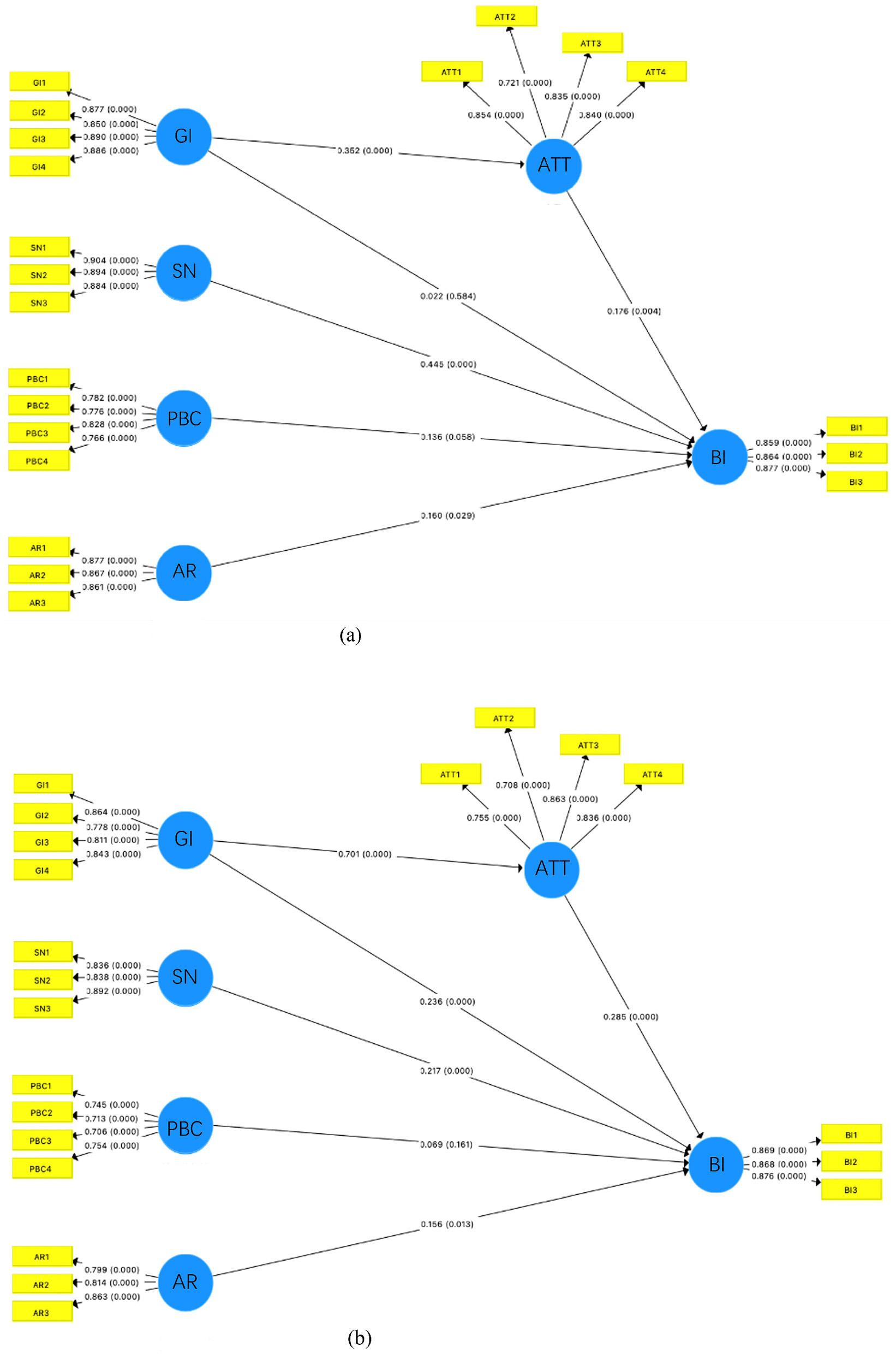
Results of assessment of model in (a) rural Hengpi and (b) urban Nanping Towns. SN, Subjective norms; ATT, Attitude toward the behavior; PBC, Perceived behavioral control; GI, Green Innovation; BI, Intention; AR, Anticipated regret.
5 Discussion
The rapid expansion of restaurants and the widespread eating-out habits in China have a substantial aggravation on the environment. There is thus a high need for both academic researchers and marketers who wish to see extensive patronage of green restaurants in both rural and urban areas may be gleaned from the results presented here.
The results of MGA reveal significant differences between the effects of green innovation on attitude for rural and urban residents (H1). Previous studies have demonstrated the positive and significant effect of green innovation on attitude (Sharma et al., 2022; Moslehpour et al., 2023), thus indicating that the result of the present study is consistent with those of previous studies. Napolitano et al. (2022), however, compare these effects in different contexts and conclude that green innovation is mainly concentrated in countries with low inequality. The current study further finds the effect size of green innovation on urban residents to be much higher than that on rural ones. Therefore, with restaurants' green innovation, residents in Nanping Town hold more positive attitude toward green restaurants than residents in rural Hengpi. The possible explanation may be that residents in urban Nanping Town are significantly more involved in eco-city building and are subsequently more aware of the impact that green innovation has on their community. Additionally, the overall educational level of urban residents is usually higher, and their openness to technology and innovation is notably heightened. They exhibit a greater propensity to explore and experiment with emerging technologies, particularly those that yield environmental and social advantages, leading those with positive perceptions to be more supportive of green restaurant development.
Table 10 shows the non-significant differences between the effects of attitude on behavioral intentions in rural and urban areas, so H2 is not supported. The effect is significant for either rural or urban group, which is consistent with the findings of Kim et al. (2013). However, there is no significant difference in the effect of attitude on behavioral intention between rural and urban groups. Lou et al. (2020) believes that the influence of urban residents' attitudes on behavioral intention to choose green restaurants is mainly affected by the collective social benefits, while the rural residents are mainly affected by the level of income. We can speculate that the reasons for the lack of difference in the influence of urban and rural residents' attitudes on behavioral intention are the popularization of environmental protection education, the trend of rural urbanization and the pace of the China's comprehensive poverty alleviation into a well-off society building that all affect the awareness and attitudes of rural and urban residents toward green restaurants.
The results show that there is a significant difference between the effects of green innovation on the behavioral intention of rural and urban residents. Correspondingly, there is also a significant difference in the indirect effects of green innovation on the behavioral intention through their attitudes of rural and urban residents, so H3 and H7 of this study are supported. In addition, green innovation has an impact on the behavioral intention through attitudes, regardless of rural or urban group. This is in line with the conclusion drawn by Chaudhary and Bisai (2018). In the urban group, green innovation has direct and significant impacts on the behavioral intention to choose green restaurants and thus, green innovation is a strong predictor for consumer purchase intention, which is consistent with the findings of Moslehpour et al. (2023). However, this is not applicable to rural residents, since green innovation does not have a direct effect on their behavioral intention to choose green restaurants.
There is a significant difference in the effects of subjective norms on the behavioral intention to choose green restaurants between the rural group and the urban group, so H4 is supported. The effect of subjective norms on the behavioral intention to choose green restaurants is significant for both rural and urban groups. However, this effect in rural group is significantly larger than urban group. These two groups are affected by subjective norms in different ways, which is in line with Lou et al. (2020). Rural residents live more in a family style, with closer interpersonal relationships, while urban residents usually live alone or in small-unit families. Also, residents in urban destinations have a more independent mindset with less interpersonal connection than those in rural areas (Moan et al., 2005). Thus, subjective norms can be a strong predictor to behavior intention when social pressure from others is high. From the perspective of economics of information processing, inexperienced consumers may not access to adequate and complete information about green restaurants, therefore they could keep an open mind to possible guidance and advice from their friends and relatives (Hansen et al., 2004).
In addition, the results show the non-significant differences between the effects of perceived behavioral control on the behavioral intention of rural and urban groups, so H5 is not supported. Moreover, the effect of perceived behavioral control on behavioral intentions to choose green restaurants is not significant for either rural or urban residents. This finding is inconsistent with previous research on consumers in green hotel environments (Ajzen, 1991; Han et al., 2010; Kim and Han, 2010), which argues that the effects of perceived behavioral control in predicting consumers' behavioral intentions may vary in behavior and context. Different from green hotels, although green restaurants have been heavily promoted and are the future mainstream trend in China's food and beverage industry, they are currently at an early stage of development. It can be observed that supportive policies, like subsidies, tax reduction, etc., regarding green restaurants are not yet extensive, while individual food and beverage operators are constrained by costs, and thus have limited accessibility to consumers. Consumers may be not familiar with green restaurants. Another reason may be that in urban areas, where time is an important influence on perceived behavioral control. Consumers may need to choose a restaurant within a short period of time for the fast-paced urban lifestyles, which prevents them from taking the time to search for a green restaurant. Construct of perceived behavioral control refers to an individual's judgment of their ability to perform a specific behavior (Ajzen, 1991). A person holds the conviction that an action is familiar and effortlessly manageable; consequently, he can perceive a high level of behavioral control (Notani, 1998). In addition, another explanation may be related to the feasibility of TPB to predict pro-environmental behavior requires further examination (Lou et al., 2020). Behavioral, normative, and control beliefs, often referred to as indirect predictors, have an impact on the TPB's completeness and effectiveness in predicting pro-environmental behavior in addition to direct predictors, such as perceived behavioral control (Yuriev et al., 2020). Accordingly, it is difficult for an individual to predict his or her eco-behavioral intentions or future behavior from the perceived behavioral control (Notani, 1998; Lou et al., 2020).
The study shows that there is no significant difference in the effect of anticipated regret on the behavioral intention of rural and urban residents, so H6 is not supported, which is inconsistent with Landmann et al. (2021) that investigated the impacts of negative anticipated emotions on smartphone usage intention for smallholder farmers in the context of a developing country. We can speculate that since the effects of anticipatory regret on behavioral intentions in previous research are not ecological focus, the role of anticipated regret on ecological behavioral intentions does not vary as regions. As China has placed a growing emphasis on reducing low-carbon emissions and the enhancement of overall ecological and environmental awareness, the effect of anticipated regret on the behavioral intention of choosing a green restaurant is significant for both rural and urban residents. This result also suggests that anticipated regret increases the willingness to choose a green restaurant, which is consistent with the findings of Kim et al. (2013).
This study will assist scholars and companies in better understanding the choices for green restaurants of both rural and urban residents. Except for perceived behavioral control, green innovation, attitude, subjective norms and anticipated regret all have significant impacts on green restaurants patronage intention. However, compared with rural residents, the impacts of green innovation on attitudes/behavioral intention are significantly higher, but the effect of subjective norms on behavioral intention is significantly smaller among the urban residents. Besides, the impact of green innovation on behavior intention is fully mediated by attitudes for rural group, which is different from the direct impact for urban one. Therefore, different strategies can be adopted to promote eco-friendly restaurants according to differences in rural and urban areas, thus achieving a better environmental conservation.
6 Implications
6.1 Theoretical implications
This paper has made several contributions to the current literature. Firstly, previous research on the impact of green innovations on behavioral intentions have focused on the beauty sector (Moslehpour et al., 2023), green hotels (Cheng et al., 2022; Kamboj et al., 2022), and green consumption (Paparoidamis et al., 2019; Yang et al., 2022; Viale et al., 2022). This work fills in the gaps by extending the TPB model with the variables of green innovation and anticipated regret to study their impacts on consumers' intention to choose green restaurants.
Limited research has explored the association between green innovation and consumers' green consumption behavior. Zameer and Yasmeen (2022) show that green innovation does not have any direct impact on green purchase intention, while green product knowledge accumulated through green innovation plays a full mediating role to reinforce this intention. In this study, the linkage between green innovation and green restaurant patronage intention exhibits two distinct trends. For rural group, green innovation cannot affect behavior intention directly; instead, attitudes fully mediate the relationship for rural group, while for urban one, the influence is direct. This is intriguing since for urban residents, green innovation seems to have a more substantial impact on green restaurant patronage intention.
In environmental management literature, the comparisons between rural and urban areas are mainly focused on energy or fuel consumption (Zhao et al., 2012; He et al., 2021; Wang S. et al., 2021). The issues of energy consumption in rural and the resulting environmental problems are addressed in these studies. This paper contributes to the field by comparing the two groups in green restaurant patronage intention by an extended TPB model. Tang et al. (2023) confirm the significant differences in the effects of tourists' perceived ease of use on green consumption attitude and subjective norms on green consumption intention in urban and rural tourism destinations. The results of this study not only indicate the significant and positive influence of green innovation, anticipated regret, attitude, and subjective norms on green restaurants patronage, but identify the different impact strengths of green innovation, subjective norms between rural and urban areas.
6.2 Managerial implication
Since urban and rural residents are affected by attitudes, subjective norms, and green innovations in the different ways, it is possible for policymakers and restaurant operators to tailor the strategies to residents of the two regions.
Firstly, considering the different influence of subjective norms, in urban area, the government can publicize green restaurants in schools, enterprises or communities, thus amplifying public understanding of environmental conservation and the benefits of green restaurants, so as to create a virtuous cycle at the social level. In the rural areas, the local government can invest in relevant supporting projects for green restaurants in villages, use environmental education and subsidies, and promote and propagate the value of environmental conservation, to create a domino effect and mutual infection throughout the rural communities. This will increase the willingness of rural residents to choose green restaurants. Additionally, in rural areas, local businesses can leverage unique regional advantages to help promote green restaurants by introducing fine locally-sourced ingredients in a variety of cuisines, enhancing local residents' awareness of the value of natural and safe ingredients. Moreover, by seamlessly integrating the “green concept” into the fabric of everyday life, these businesses contribute substantially to fostering a sustainable and environmentally-conscious community.
Secondly, the government and businesses should not ignore the role of green innovation in the marketing and promotion of green restaurants. The results of the study pointed out that the impacts of green innovation on behavioral intention are different for urban and rural residents. It is worth to mention that green innovation does not directly affect the behavioral intention of rural residents to visit green restaurants, but through the influence on attitudes of rural residents. Therefore, in order to enhance the rural residents' willingness to choose green restaurant, the government and green restaurant managers can focus more on the ways to improve the attitudes of rural residents toward green restaurant by green innovation.
To be more specific, in order to encourage rural residents to choose green restaurants, the government can place science videos about how these establishments with green innovations to achieve environmental protection goals in rural areas. In urban areas, the government can recognize the green innovations adopted by green restaurants that have played a particular role in environmental protection and can also set environmental and health standards and a regulatory framework for the restaurants to follow, thus increasing consumers' confidence and acceptance of green restaurants. For example, restaurants that employ solar panels and wind turbines to achieve zero emissions in urban areas, might concentrate on promoting the green innovated facilities used in the restaurant and how they significantly preserve the environment. If the restaurant is located in a rural area, marketers can focus on highlighting how the restaurant's green innovations protect the environment in more details to foster a welcoming atmosphere, and enable consumers to experience the changes and benefits brought by green innovations to a greater extent.
Finally, the impacts of perceived behavioral control are not significant for either rural or urban residents' behavioral intention, which indicates that the accessibility of green restaurants is quite limited. The government has two options to improve. First, the government can increase the visibility and recognition of green restaurants through advertising and promotional initiatives, or even conducting essential educational campaigns, etc. Thus, the public will become more familiar with green restaurants options, thereby facilitating easier access and encouraging broader participation in these restaurants. Second, through subsidies, tax incentives, or supervision from government, green restaurants can offer more affordable rates and higher-quality services. This can also support and encourage the conversion of other restaurants to green ones, thereby offering consumers a broader array of sustainable dining options.
7 Conclusions
This study looked at TPB model with the extension of the two variables of green innovation and anticipated regrets as it applies to green restaurants patronage intention under the rural and urban contexts in China. The results confirm the effectiveness of the extended TPB model, as well as the significant and positive influence of green innovation, anticipated regret, attitude, and subjective norms on green restaurants patronage intention. Besides, through the comparisons between rural and urban residents, it is found the significant differences between the impacts of green innovation on the attitudes, the impacts of green innovation on behavioral intention, the impacts of subjective norms on green restaurants patronage intention, and the indirect effects of green innovation on the behavioral intention via attitudes for rural and urban residents. The findings of this study will help the marketers of eco-friendly restaurants think beyond the box.
However, there are still some limitations and deficiencies. Firstly, the rural-urban comparisons in this study are only focused on one urban area and one rural area, which have representativeness to some extent, but the universality of the research findings needs to be further confirmed. Additional empirical studies to multiple case sites are necessary to ascertain whether the theoretical findings can be applied to a wider range of regions. Secondly, only anticipated regret and green innovation are added to TPB model to investigate the residents' behavioral intentions for green restaurants. To examine whether more extension factors are required to boost the model's efficacy, more empirical research can be conducted.
Statements
Data availability statement
The original contributions presented in the study are included in the article/supplementary material, further inquiries can be directed to the corresponding author.
Author contributions
YH: Supervision, Writing – review & editing, Conceptualization, Methodology, Writing – original draft. JW: Methodology, Writing – original draft, Data curation. KW: Funding acquisition, Supervision, Writing – review & editing. QH: Validation, Writing – review & editing.
Funding
The author(s) declare that financial support was received for the research and/or publication of this article. This research was supported by Major Program of National Social Science Foundation of China “Research on Urban Resilience Governance System in the Context of Major Public Health Emergencies” (No. 22&ZD142).
Conflict of interest
The authors declare that the research was conducted in the absence of any commercial or financial relationships that could be construed as a potential conflict of interest.
Generative AI statement
The author(s) declare that no Gen AI was used in the creation of this manuscript.
Publisher’s note
All claims expressed in this article are solely those of the authors and do not necessarily represent those of their affiliated organizations, or those of the publisher, the editors and the reviewers. Any product that may be evaluated in this article, or claim that may be made by its manufacturer, is not guaranteed or endorsed by the publisher.
References
1
Aguilera-Caracuel J. Ortiz-de-Mandojana N. (2013). Green innovation and financial performance: an institutional approach. Organ. Environ.26, 365–385. 10.1177/1086026613507931
2
Ajzen I. (1991). The theory of planned behavior. Organ. Behav. Hum. Decis. Process.50, 179–211. 10.1016/0749-5978(91)90020-T
3
Amin H. Abdul Rahman A. R. Abdul Razak D. Rizal H. (2017). Consumer attitude and preference in the Islamic mortgage sector: a study of Malaysian consumers. Manage. Res. Rev.40, 95–115. 10.1108/MRR-07-2015-0159
4
Arun T. M. Kaur P. Ferraris A. Dhir A. (2021). What motivates the adoption of green restaurant products and services? A systematic review and future research agenda. Business Strategy Environ.30, 2224–2240. 10.1002/bse.2755
5
Asadi S. Pourhashemi S. O. Nilashi M. Abdullah R. Samad S. Yadegaridehkordi E. et al . (2020). Investigating influence of green innovation on sustainability performance: a case on Malaysian hotel industry. J. Clean. Prod.258:120860. 10.1016/j.jclepro.2020.120860
6
Bentler P. M. Bonett D. G. (1980). Significance tests and goodness of fit in the analysis of covariance structures. Psychol. Bull. 88:588.
7
Borsatto J. M. L. S. Bazani C. L. (2021). Green innovation and environmental regulations: a systematic review of international academic works. Environ. Sci. Pollut. Res.28, 63751–63768. 10.1007/s11356-020-11379-7
8
Breckler S. J. Wiggins E. C. (1989). Affect versus evaluation in the structure of attitudes. J. Exp. Soc. Psychol.25, 253–271. 10.1016/0022-1031(89)90022-X
9
Carrus G. Passafaro P. Bonnes M. (2008). Emotions, habits and rational choices in ecological behaviours: the case of recycling and use of public transportation. J. Environ. Psychol.28, 51–62. 10.1016/j.jenvp.2007.09.003
10
Chang C. H. (2011). The influence of corporate environmental ethics on competitive advantage: the mediation role of green innovation. J. Business Ethics104, 361–370. 10.1007/s10551-011-0914-x
11
Chaturvedi P. Kulshreshtha K. Tripathi V. Agnihotri D. (2024). Investigating the impact of restaurants' sustainable practices on consumers' satisfaction and revisit intentions: a study on leading green restaurants. Asia-Pacific J. Business Adminis.16, 41–62. 10.1108/APJBA-09-2021-0456
12
Chaudhary R. Bisai S. (2018). Factors influencing green purchase behavior of millennials in India. Manage. Environm. Qual.29, 798–812. 10.1108/MEQ-02-2018-0023
13
Chen Y. S. Chang C. H. Wu F. S. (2012). Origins of green innovations: the differences between proactive and reactive green innovations. Manage. Decis.50, 368–398. 10.1108/00251741211216197
14
Cheng Y. H. Chang K. C. Cheng Y. S. Hsiao C. J. (2022). How green marketing influences customers' green behavioral intentions in the context of hot-spring hotels. J. Tourism Serv.24, 190–208. 10.29036/jots.v13i24.352
15
Chin W. W. Dibbern J. (2009). “An introduction to a permutation based procedure for multi-group PLS analysis: results of tests of differences on simulated data and a cross cultural analysis of the sourcing of information system services between Germany and the USA,” in Handbook of Partial Least Squares: Concepts, Methods and Applications (Berlin, Heidelberg: Springer Berlin Heidelberg), 171–193. 10.1007/978-3-540-32827-8_8
16
Chung K. C. (2016). Exploring customers' post-ding behavioral intentions toward green restaurants: an application of theory of planned behavior. Int. J. Org. Innov. 9, 119−134.
17
Fei J. Wang Y. Yang Y. Chen S. Zhi Q. (2016). Towards eco-city: the role of green innovation. Energy Procedia104, 165–170. 10.1016/j.egypro.2016.12.029
18
Feng C. Wang M. Liu G. C. Huang J. B. (2017). Green development performance and its influencing factors: a global perspective. J. Clean. Prod.144, 323–333. 10.1016/j.jclepro.2017.01.005
19
Fornell C. Larcker D. F. (1981). Evaluating structural equation models with unobservable variables and measurement error. J. Market. Res.18, 39–50. 10.1177/002224378101800104
20
Godin G. Kok G. (1996). The theory of planned behavior: a review of its applications to health-related behaviors. Am. J. Health Promot.11, 87–98. 10.4278/0890-1171-11.2.87
21
GRA (The Green Restaurant Association) . (2020). Green Restaurant Certification Standards. Available online at: https://www.dinegreen.com/certification-standards (accessed August 08, 2020).
22
Guinot J. Barghouti Z. Chiva R. (2022). Understanding green innovation: a conceptual framework. Sustainability14:5787. 10.3390/su14105787
23
Hair J. F. Hult G. T. M. Ringle C. M. Sarstedt M. (2014). A Primer on Partial Least Squares Structural Equation Modeling. Thousand Oaks, CA: Sage.
24
Hair J. F. Ringle C. M. Sarstedt M. (2011). PLSSEM: indeed a silver bullet. J. Market. Theory Prac.19, 139–152. 10.2753/MTP1069-6679190202
25
Hair J. F. Sarstedt M. Ringle C. M. Gudergan S. P. (2018). Advanced issues in Partial Least Squares Structural Equation Modeling (PLS-SEM). Thousand Oaks, CA: Sage. 10.3926/oss.37
26
Han H. Hsu L. T. J. Sheu C. (2010). Application of the theory of planned behavior to green hotel choice: testing the effect of environmental friendly activities. Tourism Management31, 325–334. 10.1016/j.tourman.2009.03.013
27
Han H. Kim Y. (2010). An investigation of green hotel customers' decision formation: developing an extended model of the theory of planned behavior. Int. J. Hospital. Manage.29, 659–668. 10.1016/j.ijhm.2010.01.001
28
Hansen T. Jensen J. M. Solgaard H. S. (2004). Predicting online grocery buying intention: a comparison of the theory of reasoned action and the theory of planned behavior. Int. J. Inf. Manage.24, 539–550. 10.1016/j.ijinfomgt.2004.08.004
29
Harland P. Staats H. Wilke H. A. (1999). Explaining proenvironmental intention and behavior by personal norms and the theory of planned behavior. J. Appl. Soc. Psychol.29, 2505–2528. 10.1111/j.1559-1816.1999.tb00123.x
30
He G. Geng C. Zhai J. Zhao Y. Wang Q. Jiang S. et al . (2021). Impact of food consumption patterns change on agricultural water requirements: an urban-rural comparison in China. Agric. Water Manage.243:106504. 10.1016/j.agwat.2020.106504
31
Henseler J. Ringle C. M. Sarstedt M. (2015). A new criterion for assessing discriminant validity in variance-based structural equation modeling. J. Acad. Market. Sci.43, 115–135. 10.1007/s11747-014-0403-8
32
Henseler J. Ringle C. M. Sinkovics R. R. (2009). “The use of partial least squares path modeling in international marketing,” in New Challenges to International Marketing (Advances in International Marketing, Vol. 20), eds. R. R. Sinkovics and P. N. Ghauri (Leeds: Emerald Group Publishing Limited), 277–319. 10.1108/S1474-7979(2009)0000020014
33
Hong Y. Al Mamun A. Masukujjaman M. Yang Q. (2024). Significance of the environmental value-belief-norm model and its relationship to green consumption among Chinese youth. Asia Pacific Manage. Rev.29, 127–140. 10.1016/j.apmrv.2023.10.002
34
Hori S. Kondo K. Nogata D. Ben H. (2013). The determinants of household energy-saving behavior: survey and comparison in five major Asian cities. Energy Policy52, 354–362. 10.1016/j.enpol.2012.09.043
35
Hu L. T. Bentler P. M. (1998). Fit indices in covariance structure modeling: sensitivity to underparameterized model misspecification. Psychol. Methods3:424.
36
Jang S. Y. Chung J. Y. Kim Y. G. (2015). Effects of environmentally friendly perceptions on customers' intentions to visit environmentally friendly restaurants: an extended theory of planned behavior. Asia Pacific J. Tourism Res.20, 599–618. 10.1080/10941665.2014.923923
37
Jhawar A. Kumar P. Israel D. (2023). Impact of materialism on tourists' green purchase behavior: extended norm activation model perspective. J. Vacation Market.30, 841–855. 10.1177/13567667231178328
38
Kals E. Schumacher D. Montada L. (1999). Emotional affinity toward nature as a motivational basis to protect nature. Environ. Behav.31, 178–202. 10.1177/00139169921972056
39
Kamboj S. Matharu M. Lim W. M. Ali F. Kumar S. (2022). Consumer adoption of green hotels: understanding the role of value, innovation, and involvement. J. Hospital. Market. Manage.31, 819–849. 10.1080/19368623.2022.2071370
40
Khare A. (2015). Antecedents to green buying behaviour: a study on consumers in an emerging economy. Market. Intell. Plann.33, 309–329. 10.1108/MIP-05-2014-0083
41
Kim Y. Han H. (2010). Intention to pay conventional-hotel prices at a green hotel–a modification of the theory of planned behavior. J. Sustain. Tourism18, 997–1014. 10.1080/09669582.2010.490300
42
Kim Y. J. Njite D. Hancer M. (2013). Anticipated emotion in consumers' intentions to select eco-friendly restaurants: augmenting the theory of planned behavior. Int. J. Hospital. Manage.34, 255–262. 10.1016/j.ijhm.2013.04.004
43
Kock N. (2015). Common method bias in PLS-SEM: a full collinearity assessment approach. Int. J. e-Collaborat.11, 1–10. 10.4018/ijec.2015100101
44
Kwok L. Huang Y. K. Hu L. (2016). Green attributes of restaurants: what really matters to consumers?Int. J. Hospital. Manage.55, 107–117. 10.1016/j.ijhm.2016.03.002
45
Landmann D. Lagerkvist C. J. Otter V. (2021). Determinants of small-scale farmers' intention to use smartphones for generating agricultural knowledge in developing countries: evidence from rural India. Euro. J. Dev. Res.33, 1435–1454. 10.1057/s41287-020-00284-x
46
Lee H. H. Huang P. Y. (2024). Exploring the attitudes, perceived value, and repurchase intention of the elderly towards green restaurants. Techn. Soc. Sci. J.53:365. 10.47577/tssj.v53i1.10324
47
Lou T. Wang D. Chen H. Niu D. (2020). Different perceptions of belief: predicting household solid waste separation behavior of urban and rural residents in China. Sustainability12:7778. 10.3390/su12187778
48
Lou T. Wang D. Chen H. Niu D. (2020). Different perceptions of belief: predicting household solid waste separation behavior of urban and rural residents in China. Sustainability12:7778. 10.3390/su12187778
49
Maduku D. K. (2024). How environmental concerns influence consumers' anticipated emotions towards sustainable consumption: the moderating role of regulatory focus. J. Retail. Consumer Serv.76:103593. 10.1016/j.jretconser.2023.103593
50
Majeed S. Kim W. G. Kim T. (2023). Perceived green psychological benefits and customer pro-environment behavior in the value-belief-norm theory: the moderating role of perceived green CSR. Int. J. Hospital. Manage.113:103502. 10.1016/j.ijhm.2023.103502
51
Marzouk O. A. (2019). A qualitative examination of urban vs rural sustainable consumption behaviours of energy and water consumers in the emerging Egyptian market. J. Human. Appl. Soc. Sci.1, 98–114. 10.1108/JHASS-07-2019-0016
52
Moan I. S. Rise J. Andersen M. (2005). Predicting parents' intentions not to smoke indoors in the presence of their children using an extended version of the theory of planned behaviour. Psychol. Health20, 353–371. 10.1080/08870440512331317706
53
Moon S. J. (2021). Investigating beliefs, attitudes, and intentions regarding green restaurant patronage: an application of the extended theory of planned behavior with moderating effects of gender and age. Int. J. Hospital. Manage.92:102727. 10.1016/j.ijhm.2020.102727
54
Moslehpour M. Chau K. Y. Du L. Qiu R. Lin C. Y. Batbayar B. (2023). Predictors of green purchase intention toward eco-innovation and green products: evidence from Taiwan. Econ. Res.36:2121934. 10.1080/1331677X.2022.2121934
55
Nair P. B. (2015). Profiling green consumer characteristics: an eternal quandary. J. Adv. Manage. Sci.3, 174–178. 10.12720/joams.3.2.174-178
56
Napolitano L. Sbardella A. Consoli D. Barbieri N. Perruchas F. (2022). Green innovation and income inequality: a complex system analysis. Struct. Change Econ. Dyn.63, 224–240. 10.1016/j.strueco.2022.09.007
57
Nie W. (2014). Differences and decomposition of public environmental concern between urban and rural areas. J. China Univ. Geosci.14, 62–65.
58
Nimri R. Dharmesti M. Arcodia C. Mahshi R. (2021). UK consumers' ethical beliefs towards dining at green restaurants: a qualitative evaluation. J. Hospital. Tourism Manage.48, 572–581. 10.1016/j.jhtm.2021.08.017
59
Nimri R. Kralj A. Shishan F. Suheimat N. (2024). To ‘green dine' or not to ‘green dine'? Assessing the impact of beliefs and altruism. J. Retail. Consumer Serv.77:103680. 10.1016/j.jretconser.2023.103680
60
Notani A. S. (1998). Moderators of perceived behavioral control's predictiveness in the theory of planned behavior: a meta-analysis. J. Consumer Psychol.7, 247–271. 10.1207/s15327663jcp0703_02
61
Nunnally J. C. (1975). Psychometric theory–25 years ago and now. Educ. Res.4, 7–21. 10.3102/0013189X004010007
62
Osman Z. Sentosa I. (2013). Mediating effect of customer satisfaction on service quality and customer loyalty relationship in malaysian rural tourism. Int. J. Econ. Business Manage. Stud.2, 25–37.
63
Paparoidamis N. G. Tran T. T. H. Leonidou L. C. Zeriti A. (2019). Being innovative while being green: an experimental inquiry into how consumers respond to eco-innovative product designs. J. Product Innov. Manage.36, 824–847. 10.1111/jpim.12509
64
Pierro R. D. Frasnetti E. Bianchi L. Bisagni M. Capri E. Lamastra L. (2023). Setting the sustainable development targets for restaurants and Italian HoReCa sector. Sci. Total Environ.855:158908. 10.1016/j.scitotenv.2022.158908
65
Richard R. de Vries N. K. van der Pligt J. (1998). Anticipated regret and precautionary sexual behavior. J. Appl. Soc. Psychol.28, 1411–1428. 10.1111/j.1559-1816.1998.tb01684.x
66
Richard R. Van Der Pligt J. De Vries N. (1996). Anticipated affect and behavioral choice. Basic Appl. Soc. Psych.18, 111–129. 10.1207/s15324834basp1802_1
67
Rivis A. Sheeran P. Armitage C. J. (2009). Expanding the affective and normative components of the theory of planned behavior: a meta-analysis of anticipated affect and moral norms. J. Appl. Soc. Psychol.39, 2985–3019. 10.1111/j.1559-1816.2009.00558.x
68
Schubert F. Kandampully J. Solnet D. Kralj A. (2010). Exploring consumer perceptions of green restaurants in the US. Tourism Hospital. Res.10, 286–300. 10.1057/thr.2010.17
69
Sharma N. Paço A. Kautish P. (2022). The impact of eco-innovation on green buying behaviour: the moderating effect of emotional loyalty and generation. Manage. Environ. Qual.34, 1026–104510.1108/MEQ-11-2021-0267
70
Sun Y. (2018). Urban and rural differences in the influences of income on tourism consumption based on the PDL model. J. Luoyang Normal Univ.37, 25–29.
71
Takalo S. K. Tooranloo H. S. (2021). Green innovation: a systematic literature review. J. Clean. Prod.279:122474. 10.1016/j.jclepro.2020.122474
72
Tang C. Han Y. Ng P. (2023). Green consumption intention and behavior of tourists in urban and rural destinations. J. Environ. Plann. Manage.66, 2126–2150. 10.1080/09640568.2022.2061927
73
Tommasetti A. Singer P. Troisi O. Maione G. (2018). Extended theory of planned behavior (ETPB): investigating customers' perception of restaurants' sustainability by testing a structural equation model. Sustainability10:2580. 10.3390/su.10072580
74
Viale L. Vacher S. Bessouat J. (2022). Eco-innovation in the upstream supply chain: re-thinking the involvement of purchasing managers. Supply Chain Manage.27, 250–264. 10.1108/SCM-11-2020-0591
75
Vokoun M. Jílková J. (2020). Eco-innovation activities in the Czech economy 2008?2014: impact of the eco-innovative approach to the profit stream and differences in urban and rural enterprises. Economies8:3. 10.3390/economies8010003
76
Voorhees C. M. Brady M. K. Calantone R. Ramirez E. (2016). Discriminant validity testing in marketing: an analysis, causes for concern, and proposed remedies. J. Acad. Market. Sci.44, 119–134. 10.1007/s11747-015-0455-4
77
Wang G. Li Y. Zuo J. Hu W. Nie Q. Lei H. (2021). Who drives green innovations? Characteristics and policy implications for green building collaborative innovation networks in China. Renew. Sustain. Energy Rev.143:110875. 10.1016/j.rser.2021.110875
78
Wang S. Sun S. Zhao E. Wang S. (2021). Urban and rural differences with regional assessment of household energy consumption in China. Energy.232:121091. 10.1016/j.energy.2021.121091
79
Wang S. Wang J. Ru X. Li J. Zhao D. (2019). Understanding employee's electricity conservation behavior in workplace: do normative, emotional and habitual factors matter?J. Clean. Prod.215, 1070–1077. 10.1016/j.jclepro.2019.01.173
80
Weinhold D. Nair-Reichert U. (2009). Innovation, inequality and intellectual property rights. World Dev.37, 889–901. 10.1016/j.worlddev.2008.09.013
81
Xu Z. Meng W. Li S. Chen J. Wang C. (2024). Driving factors of farmers' green agricultural production behaviors in the multi-ethnic region in China based on NAM-TPB models. Glob. Ecol. Conserv.50:e0281210.1016/j.gecco.2024.e02812
82
Yang S. Wang W. Feng D. Lu J. (2022). Impact of pilot environmental policy on urban eco-innovation. J. Clean. Prod.341:130858. 10.1016/j.jclepro.2022.130858
83
Yuriev A. Dahmen M. Paillé P. Boiral O. Guillaumie L. (2020). Pro-environmental behaviors through the lens of the theory of planned behavior: a scoping review. Resour. Conserv. Recycl.155:104660. 10.1016/j.resconrec.2019.104660
84
Zameer H. Yasmeen H. (2022). Green innovation and environmental awareness driven green purchase intentions. Market. Intelli. Plann.40, 624–638. 10.1108/MIP-12-2021-0457
85
Zellenberg M. (1999). Anticipated regret, expected feedback and behavioral decision making. J. Behav. Decis. Making, 12, 93–106. 10.1002/(SICI)1099-0771(199906)12:2<93::AID-BDM311>3.0.CO;2-S
86
Zhang X. Jeong E. H. (2023). Are co-created green initiatives more appealing than firm-created green initiatives? Investigating the effects of co-created green appeals on restaurant promotion. Int. J. Hospital. Manage.108:103361. 10.1016/j.ijhm.2022.103361
87
Zhao C. S. Niu S. W. Zhang X. (2012). Effects of household energy consumption on environment and its influence factors in rural and urban areas. Energy Procedia14, 805–811. 10.1016/j.egypro.2011.12.1015
Appendix
Table A1
| (a) External VIF | ||
|---|---|---|
| Items | Rural | Urban |
| AR1 | 2.079 | 1.474 |
| AR2 | 1.933 | 1.576 |
| AR3 | 1.888 | 1.694 |
| ATT1 | 2.066 | 1.491 |
| ATT2 | 1.512 | 1.455 |
| ATT3 | 1.936 | 2.052 |
| ATT4 | 1.869 | 1.812 |
| BI1 | 1.893 | 2.009 |
| BI2 | 1.883 | 1.894 |
| BI3 | 2.052 | 2.091 |
| GI1 | 2.222 | 1.607 |
| GI2 | 2.342 | 1.851 |
| GI3 | 3.067 | 2.02 |
| GI4 | 1.514 | 1.335 |
| PBC1 | 1.602 | 1.373 |
| PBC2 | 1.776 | 1.309 |
| PBC3 | 1.56 | 1.395 |
| PBC4 | 2.504 | 1.708 |
| SN1 | 2.402 | 1.807 |
| SN2 | 2.203 | 2.051 |
| SN3 | 2.813 | 2.125 |
| (b) Internal VIF | ||
| Paths | Rural | Urban |
| GI → ATT | 1 | 1 |
| ATT → BI | 2.645 | 2.806 |
| GI → BI | 1.271 | 2.684 |
| SN → BI | 2.129 | 1.961 |
| PBC → BI | 2.675 | 1.773 |
| AR → BI | 2.599 | 2.576 |
| GI → ATT → BI | – | – |
VIF.
Summary
Keywords
green restaurants, green innovations, theory of planned behavior, urban, rural
Citation
Huang Y, Wei J, Wang K and Hou Q (2025) The role of green innovation on green restaurant patronage intention: urban vs. rural residents. Front. Sustain. Food Syst. 9:1506984. doi: 10.3389/fsufs.2025.1506984
Received
22 October 2024
Accepted
25 April 2025
Published
21 May 2025
Volume
9 - 2025
Edited by
Decong Tang, Fujian Agriculture and Forestry University, China
Reviewed by
Rawan Nimri, Griffith University, Australia
Ivana Blesic, University of Novi Sad, Serbia
Updates
Copyright
© 2025 Huang, Wei, Wang and Hou.
This is an open-access article distributed under the terms of the Creative Commons Attribution License (CC BY). The use, distribution or reproduction in other forums is permitted, provided the original author(s) and the copyright owner(s) are credited and that the original publication in this journal is cited, in accordance with accepted academic practice. No use, distribution or reproduction is permitted which does not comply with these terms.
*Correspondence: Kai Wang kai.wang@whu.edu.cn
Disclaimer
All claims expressed in this article are solely those of the authors and do not necessarily represent those of their affiliated organizations, or those of the publisher, the editors and the reviewers. Any product that may be evaluated in this article or claim that may be made by its manufacturer is not guaranteed or endorsed by the publisher.