Abstract
Introduction:
With the booming development of the digital economy, the integrated development of digital technology and agriculture continues to expand and deepen. Clarifying the impact and mechanisms of digital economy on agricultural development resilience is of great significance for sustainable agricultural development.
Methods:
Based on the provincial panel data of 13 major grain-producing regions in China from 2010 to 2020, the evaluation system of digital economy and agricultural development resilience were constructed, and the entropy-TOPSIS method was used to measure them. Using the panel Tobit model, the mediation effect model and the threshold regression model, the impact effects and the mechanism of digital economy on agricultural development resilience were explored.
Results:
The results show that digital economy has a positive effect on agricultural development resilience, and this conclusion remains valid after a series of robustness tests. Mechanism analysis reveals that mitigating the misallocation of agricultural resources is a crucial pathway through which the digital economy enhances agricultural development resilience. Furthermore, the threshold effect analysis suggests that the digital economy’s role in promoting agricultural development resilience exhibits a non-linear characteristic, with increasing marginal effects. Additionally, the heterogeneity analysis indicates that the impact of the digital economy on agricultural development resilience varies regionally, with a notably stronger positive effect on the eastern region compared to the central and northern regions.
Discussion:
This study provides empirical evidence that the digital economy enhances the resilience of agricultural development and provides relevant policy recommendations for the government, which is important for promoting sustainable agricultural development.
1 Introduction
Agriculture is the foundation of all industries. In recent years, China’s total grain production has continuously remained at a high level of over 1.3 trillion catties, thus completely bidding farewell to the era of “quantity shortage.” However, agriculture is vulnerable due to long production cycles and dependence on natural conditions (Yang et al., 2024). Social factors such as market shocks, epidemics and war industry also weaken the resilience of the agricultural sector (Wan et al., 2024). The agricultural system still faces the challenge of insufficient risk-resistance, and its ability to withstand risks, adapt to adjustments, and innovate and transform urgently needs to be improved. In response, China has proposed to “build an agricultural powerhouse with strong industrial resilience.”
The digital economy refers to economic activities that revolve around digital information as the core production factor, propelled by digital technology to boost productivity and optimize the economic structure (Cao and Han, 2022). It relies on the “Internet of Everything” to exert spillover effects and multiplier effects (Wen and Chen, 2020), gradually infiltrating into the national economy and numerous aspects of production activities, serving as a driving force for technological innovation and economic growth. According to “the China Digital Economy Development Report” released by the China Academy of Information and Communications Technology, the scale of China’s digital economy has been expanding steadily, reaching a total of $53.9 trillion in 2023, with a nominal year-on-year growth rate of 7.39%; the growth contribution of the digital economy to GDP is up to 66.45%, effectively supporting stable economic growth. Concurrently, the integration and development of digital economy and agriculture continue to broaden and deepen, with the digital economy penetration rate in the primary industry reaching 10.78%, an increase of 0.32% from the previous year. So, what impact does the digital economy have on the resilience of agricultural development? Is it “digital dividends” or a “digital divide”? What is the degree of this impact? What are the mechanisms of action? Does the impact effect exhibit regional heterogeneity? Exploring these issues helps to clarify the impact and mechanism of the digital economy on agricultural development resilience, enabling active responses to the agricultural risks resulting from various uncertain and unstable factors, which is of vital practical significance for accelerating the construction of a strong agricultural country with robust resilience.
Extensive research has been conducted on the relationship between the digital economy and agricultural systems. However, there remain areas for enhancement. First, the existing literature is predominantly qualitative research, with a lack of empirical studies (Jiang, 2022a; Zhang and Luan, 2022). Second, the existing studies typically focus on agricultural human capital, regional industrial structure advancement, and urban–rural income gap as mechanism variables for the digital economy to enhance agricultural development resilience, lacking empirical analysis of agricultural resource misallocation as a mechanism variable from a resource allocation perspective (Song and Liu, 2023; Yu et al., 2023; Zhao and Xu, 2023). In view of this, this study constructs an evaluation system for agricultural development resilience based on the PSR model, and deeply explores the mechanism of the role of the digital economy, agricultural resource misallocation, and agricultural development resilience through panel Tobit models and mediation effect models; further, it establishes a nonlinear regression model and conducts regional heterogeneity tests to explore the marginal effect characteristics and regional differences in the impact of the digital economy on agricultural development resilience, thus policy recommendations are proposed to empower the agricultural development resilience and promote the construction of a strong agricultural country through the digital economy.
2 Theoretical analysis and research hypothesis
The concept of resilience was first proposed by Holling (1973), and introduced into the field of systems ecology. Due to the complexity and variability of human society and events such as international financial crises and global public health emergencies continually challenge the process of social development. The concept of resilience has gradually expanded from the natural sciences to the humanities and social sciences fields such as economics. However, within the scope of economic research, resilience theory was first applied to urban economic resilience and industrial chain resilience. Drawing on existing research (Cellini and Torrisi, 2014; Folke, 2006; Yu and Zhang, 2019), this paper defines the resilience of agricultural development as the comprehensive ability of the agricultural system to resist external shocks and challenges, adjust the development structure, transform production patterns, and realize transformation and innovation through its own development when encountering shocks and challenges. Agricultural development resilience can convert risks into driving force for transformational innovation, thereby ensuring the fundamental stability and security of food supply.
2.1 Theoretical analysis of digital economy’s empowerment of agricultural development resilience
The digital economy fully leverages its economies of scale, scope, and long tail effects to optimize the economic development environment, primarily enhancing agricultural development resilience through the following three aspects. First, the digital economy relies on digital platforms and information resources to enhance the agricultural system’s ability to resist risks. By utilizing the “Internet+” and big data platforms, it strengthens the mechanism of information sharing, achieves the co-construction and sharing of information resources among market entities, reducing the risks of information asymmetry for agricultural entities, improving the transaction efficiency in the agricultural system, and lowering the transaction costs in the agricultural market (Hao and Tan, 2022). Moreover, the digital economy injects new vitality into traditional extensive agriculture that is characterized by “high pollution and low output,” enhancing the ecological service benefits of agriculture, integrating the joint efforts of multiple parties, and promoting the standardization and greening of the agricultural production process (Yang and Lin, 2022). Second, the digital economy improves the adaptability and regulatory capacity of agriculture through digital inclusive finance and digital product services. Digital inclusive finance leverages the advantage of “vitality of finance” to empower agricultural development, providing affordable, secure, and convenient financial services to vulnerable groups, supporting the stable production for agricultural entities, bridging the “last mile” of financial services, and establishing a new model of financial services that is compatible with the production of agriculture, rural areas, and farmers (Deng and Wang, 2022). Third, the digital economy enhances the transformation and innovation capabilities of agriculture through digital infrastructure and technological innovation spillover. In the context of the rapid development of the digital economy, various departments of the agricultural system utilize the spillover effects of digital technology to transform them into agricultural productivity. By employing artificial intelligence, it continuously develops intelligent agricultural equipment manufacturing, intelligent production monitoring instruments, and other facilities, achieving comprehensive control over the production, transportation, and sales of agricultural products, and continuously innovating the total factor productivity of agriculture. The agricultural system gradually generates new types of operators, using digital technology to drive technological innovation in agricultural production, developing a new model of multi-dimensional and all-round smart agriculture based on big data and cloud computing, promoting the specialization, technologization, and organization of agricultural production, enhancing the transformation and innovation capabilities of the agricultural system, and maintaining the coordination of agricultural innovation. Based on this, the following hypothesis is proposed:
Hypothesis 1: The digital economy has a positive promoting effect on the agricultural development resilience.
2.2 The mechanism of digital economy promoting agricultural development resilience
The key to enhancing agricultural development resilience through the digital economy lies in the deep application of digital technology in the agricultural field. Digital facilities not only improve the production efficiency of agricultural producers but also significantly enhance the efficiency of agricultural resource allocation (Li, 2023). The digital economy can expand the utilization space of agricultural production factors, drive the transformation of traditional agriculture toward intelligence and greenness, change traditional production models, and break the way of traditional agricultural resource allocation through technological innovation and model innovation. For example, the digital economy promotes the organic integration of the production and consumption, achieving effective connection between supply and demand, reducing the inefficiency of agricultural supply, and improving the agricultural resources misallocation (Wang et al., 2022). At the same time, the digital economy, supported by digital products and services, helps to enhance farmers’ knowledge and cultural levels and expands the cultural and radiation functions of agriculture, providing a variety of educational courses such as knowledge lectures and production skill training for agricultural producers. This enhances farmers’ ability to apply digital technology and scientific management levels, enabling them to carry out agricultural production scientifically and rationally. Consequently, it promotes the scientific allocation of agricultural resources, reduces the degree of distortion in factor markets, improves the efficiency of agricultural resource allocation, and strengthens the stability of the agricultural system. Based on this, the following hypothesis is proposed:
Hypothesis 2: The digital economy increases the agricultural development resilience by improving the agricultural resources misallocation.
2.3 Analysis of the threshold effect of digital economy on agricultural development resilience
According to the previous theoretical analysis, the digital economy has a positive promotional effect on agricultural development resilience. However, due to the differences in resource endowments and digital infrastructure among the 13 major grain-producing regions, when the level of digital economic development is low, the digital infrastructure and information platforms are not perfect, severely limiting the breadth and depth of digital economy applications. This results in the underutilization of the spillover and multiplier effects of the digital economy, with a relatively limited impact on enhancing agricultural development resilience. Conversely, as the level of digital economic development increases, the digital infrastructure and information networking platforms gradually improve, the agricultural system begins to enjoy the digital dividend. The construction of digital villages continues to advance, the threshold of digital technology is reduced, and the positive effects of the digital economy are fully demonstrated, significantly enhancing the agricultural system’s ability to withstand risks, recover and regulate, and transform and innovate. Therefore, the promotional effect of the digital economy on agricultural development resilience in grain-producing regions is not a simple linear relationship but may exhibit a threshold effect, that is, the impact of the digital economy on agricultural development resilience shows a non-linear characteristic of increasing marginal effects. Based on this, the following hypothesis is proposed:
Hypothesis 3: There is a threshold effect in the impact of the digital economy on agricultural development resilience.
Based on the above theoretical analysis, the impact mechanism of how digital economy affects agricultural development resilience is summarized as shown in Figure 1.
Figure 1
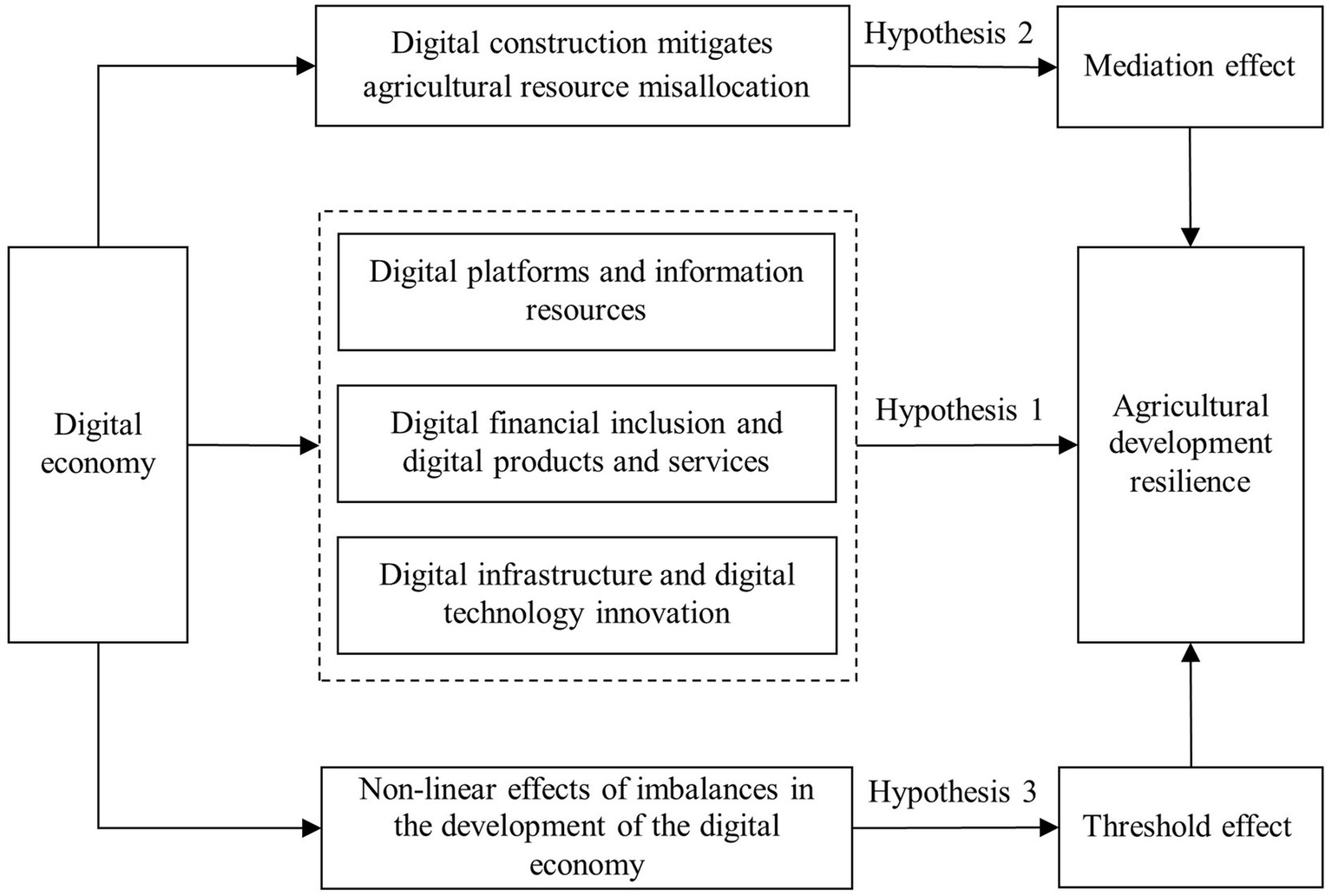
Impact mechanism diagram.
3 Materials and methods
3.1 Model construction
3.1.1 Panel tobit model
Since the resilience index of agricultural development calculated using the entropy-TOPSIS method has a value range of (0–1) and there is a left truncation issue, ordinary OLS regression may lead to inconsistent estimates. Therefore, this study employs the panel Tobit model to explore the impact of the digital economy on agricultural development resilience in China’s grain-producing regions. Taking the agricultural development resilience of the 13 major grain-producing regions as the explained variable, the following Tobit baseline regression model is constructed:
Where Arit represents the agricultural development resilience index; Digeit represents the level of digital economic development; i represents the province; t represents the year; Zit represents a series of control variables; α0 represents the intercept term; α1 and βk represent the parameters to be estimated; εit represents the random disturbance term.
Since the agricultural development resilience is influenced not only by the level of digital economic development but also by other factors such as the density of rural roads, regional industrial structure, the level of new agricultural formats, agricultural water consumption, agricultural human capital, and the level of agricultural economy. Therefore, Equation 1 can be improved as follows:
In Equation 2, Rifit represents the density of rural roads, Risit represents the regional industrial structure, Nfait represents the level of new agricultural formats, lnAwit represents agricultural water consumption, lnRzit represents agricultural human capital, and Eait represents the level of agricultural economy. β1-β6 are the coefficients of the influence of the series of control variables on agricultural development resilience.
3.1.2 Mediation effect model
To explore whether there is a significant mediation effect of agricultural resource misallocation in the process of the digital economy influencing agricultural development resilience, referring to the existing research method (Wen et al., 2004), the mediation effect model is constructed, specifically as shown in Equations 3–5:
Where Misit is the mediation variable of agricultural resource misallocation index; α0, β0, γ0 is the constant term; α1 is the total effect of the digital economy on agricultural development resilience; γ1 is the direct effect of the digital economy on agricultural development resilience; β1, γ2 is the mediation effect of the digital economy on agricultural development resilience.
3.1.3 Panel threshold model
The above analyses indicate that the digital economy has a significant positive effect on agricultural development resilience. Previous studies have shown that the digital economy has strong externalities, suggesting that its impact on agricultural development resilience is not a simple linear promotional relationship, but may exist a threshold effect. This study adopts the research method of Wang (2015) to set up the panel threshold model as follows:
In Equation 6, γ represents the threshold value; I(•) is the threshold indicator function, which is equal to 1 if the condition within the parentheses is met, otherwise 0; C represents the control variables; εit represents the random disturbance term.
3.2 Variable selection
3.2.1 Explained variable
The explained variable is agricultural development resilience. Based on the definition of agricultural development resilience provided in the previous section, and referring to the PSR model (Pressure-State-Response), this study constructs an indicator system for agricultural development resilience (Table 1), which includes three dimensions: the capacity for agricultural systems to resist risks, the capacity for adaptation and regulation, and the ability for transformation and innovation. Among them, the capacity for agricultural systems to resist risks reflects the ability of agricultural systems in major grain-producing areas to absorb and process external shocks while maintaining a stable and healthy development trend, and it is mainly measured from four dimensions: economic, production, ecological, and social. The capacity for adaptation and regulation reflects the ability of agricultural systems to adjust their development structures and recover their development trends when suffering external shocks, and is mainly measured from the perspectives of recovery and regulation. The agricultural transformation and innovation capacity demonstrates the ability of agriculture to convert external shocks into development opportunities, innovate agricultural development mechanisms, and drive the transformation and upgrading of agricultural production patterns, which is measured through agricultural innovation resilience.
Table 1
| Primary indicators | Secondary indicators | Tertiary indicators | Interpretation of indicators | Indicator attributes |
|---|---|---|---|---|
| Risk resistance ability (P) | Agricultural economic resilience | First industry development capability | Gross output value of primary industry/GDP | + |
| Level of food production | Total food production | + | ||
| Engel’s coefficient of rural households | Rural household food consumption/total expenditure of rural household consumption | _ | ||
| Urban–rural consumption gap | Rural consumer goods retail sales/total social consumer goods retail sales | + | ||
| Total agricultural output value per unit sown area | Agricultural total output/area of crops planted | + | ||
| Agricultural production resilience | Effective irrigation rate | Effective irrigated area/crop sown area | + | |
| Level of agricultural mechanization | Total power of agricultural machinery per unit sown area | + | ||
| Capability of agricultural disaster resistance | 1-Disaster affected area/affected area | + | ||
| Level of production materials price | Price index of agricultural production materials | _ | ||
| Multiple cropping index | Total annual crop sown area/total cultivated land area | + | ||
| Agricultural ecological resilience | Agricultural carbon emission intensity | Agricultural carbon emissions per unit sown area | _ | |
| Agricultural non-point source pollution intensity | Comprehensive index of agricultural non-point source pollution | _ | ||
| Level of agricultural carbon sequestration | Agricultural carbon sequestration | + | ||
| Level of agricultural ecological service | Value of agricultural ecosystem services | + | ||
| Level of environmental governance | Area Treated for Soil and Water Erosion Control | + | ||
| Agricultural social resilience | Convenience of rural water usage | Penetration rate of rural tap water | + | |
| Potential of rural population | Number of rural population aged 15-64/total rural permanent population | + | ||
| Level of rural healthcare | Average number of rural doctors per thousand agricultural population | + | ||
| Level of rural education | Average years of education per rural resident | + | ||
| Adaptation and adjustment ability (S) | Agricultural recovery resilience | Level of rural electrification | Per capita electricity consumption in rural areas | + |
| Level of rural residents’ consumption | Consumption expenditure of rural residents | + | ||
| Growth rate of agricultural output value | Growth rate of gross agricultural product | + | ||
| Potential of rural consumption | Per capita disposable income of rural residents | + | ||
| Agricultural adjustment resilience | Intensity of financial support for agriculture | Balance of agricultural-related loans of financial institutions | + | |
| Depth of agricultural insurance | Agricultural insurance revenue of insurance institutions/total output value of agriculture, forestry, animal husbandry and fishery | + | ||
| Transformation and innovation capability (R) | Agricultural innovation resilience | Potential for science and technology R&D | Number of R&D personnel | + |
| Strength of fiscal support for agriculture | Financial expenditure on agriculture, forestry and water affairs/general public budget expenditure | + | ||
| Level of agricultural investment | Investment of rural households’ fixed assets in agriculture, forestry, animal husbandry and fishery | + | ||
| Agricultural R&D human capital | Agricultural technicians in public economic enterprises and institutions | + | ||
| Level of agricultural R&D expenditure | Index of expenditure on agricultural scientific research | + |
Evaluation indicators system for agricultural development resilience.
In the comprehensive measurement of agricultural development resilience, the entropy value method is first used to standardize the original data, objectively determining the weights of each indicator, followed by the use of the TOPSIS model to calculate the comprehensive level of agricultural development resilience (Tian et al., 2022).
3.2.2 Core explanatory variable
The core explanatory variable in this study is the digital economy. An evaluation indicator system for the development of the digital economy is constructed (Table 2), and it is based on four aspects: digital economy infrastructure, application level, development potential, and development environment (Cui and Feng, 2020). The entropy-TOPSIS method is then used for the measurement.
Table 2
| Primary indicators | Secondary indicators | Interpretation of indicators | Indicator attributes |
|---|---|---|---|
| Digital economy infrastructure | Internet penetration rate | Number of Internet user/total population | + |
| Mobile phone base station density | Total number of mobile phone base stations/administrative area | + | |
| Long-distance optical cable construction density | Total length of long-distance optical cable construction/administrative area | + | |
| Digital economy application level | Total amount of digital product manufacturing | Total sales of communication and computer electronics products | + |
| Development level of telecommunication services | Total telecommunication business revenue for the year/regional GDP for the year | + | |
| Development level of software business | Total software service revenue for the year/ regional GDP for the year | + | |
| Digital economy development potential | Proportion of fiscal investment in science and technology | Proportion of science and technology fiscal expenditure to general public budget fiscal expenditure | + |
| Intensity of investment in digital construction | Fixed asset investment in information transmission, software, and information technology services | + | |
| Number of scientists and researchers | Full-time equivalent of R&D personnel | + | |
| Digital economy development environment | Digital development environment | Number of employees in communication and computer industries | + |
| Digital technology market environment | Total turnover of technology market | + | |
| Digital financial environment | Digital inclusive finance index | + |
Evaluation indicators system for digital economy.
3.2.3 Mediating variable
The mediating variable is agricultural resources misallocation. Firstly, the misallocation indices of the three resource elements of capital, labor and land required for agricultural production are calculated separately (Lei et al., 2022). Then, the three are summed up to obtain the agricultural resource misallocation index for each major grain production area. Among them, capital is measured by the amount of agricultural capital stock, labor by the number of employees in the primary industry, and land by the total sown area of crops.
3.2.4 Control variables
To avoid the endogeneity problem caused by omitted variables, this paper selects other factors that may affect agricultural development resilience, and includes them as control variables in the baseline regression model (Li et al., 2022; Jiang, 2022a, 2022b). Specifically, including the following: the rural roads density, measured by the ratio of the total length of rural roads to the administrative area outside the built-up area; the regional industrial structure, measured as the ratio of the total output value of the secondary and tertiary industries to the regional gross domestic product (GDP); the level of new agricultural business forms, measured as the ratio of the area of facility agriculture to the total sown area of crops; agricultural water consumption, measured by the water consumption during agricultural production; agricultural human capital, measured by the number of laborers engaged in agricultural production; agricultural economy level, measured as the ratio of the total output value of agriculture to the rural permanent population in the that year.
The descriptions and descriptive statistics of the variables are shown in Table 3.
Table 3
| Variable type | Variable name | Variable definition | Mean | SD | Min | Max |
|---|---|---|---|---|---|---|
| Explained variable | Agricultural development resilience | Level of agricultural development resilience | 0.238 | 0.074 | 0.131 | 0.517 |
| Explanatory variable | Digital economy | Level of digital economy | 0.183 | 0.171 | 0.016 | 0.953 |
| Mediating variable | Agricultural resource misallocation | Sum of absolute values of capital, labor, and land misallocation indices | 3.706 | 2.088 | 0.287 | 10.84 |
| Control variables | Rural road density | Total mileage of rural roads/administrative area outside built-up area | 0.922 | 0.433 | 0.119 | 1.657 |
| Regional industrial structure | Total output value of the secondary and tertiary industries/Gross Regional Product | 0.893 | 0.032 | 0.749 | 0.957 | |
| Level of new agricultural business formats | Area of facility agriculture/total sown area of crops | 0.017 | 0.021 | 0.001 | 0.09 | |
| Agricultural water consumption | Logarithm of total agricultural water consumption | 5.012 | 0.362 | 4.301 | 5.757 | |
| Agricultural human capital | Logarithm of the number of laborers in agricultural production | 6.984 | 0.502 | 6.093 | 7.905 | |
| Agricultural economy level | Total agricultural output value/total rural permanent population | 2.439 | 1.108 | 0.902 | 7.517 |
Description and descriptive statistics of variables.
3.3 Data sources
Considering the rationality, scientific nature, and availability of the data, the sample data for this study consist of panel data from 13 major grain-producing regions in China from 2010 to 2020. The original data are sourced from the China Statistical Yearbook, China Rural Statistical Yearbook, China Industrial Statistical Yearbook, China Financial Statistical Yearbook, China Science and Technology Statistical Yearbook, the Peking University Digital Inclusive Finance Index, as well as the statistical yearbooks and the national economic and social development statistical bulletins of each province. For some missing values, linear interpolation and linear prediction methods were adopted to ensure the integrity of the data.
4 Empirical results and analysis
4.1 Panel tobit regression results
The previous text employed the entropy-TOPSIS method to measure the agricultural development resilience index, which falls within the interval [0, 1] and is considered merged data. The model that uses the subsumed data as the explained variable is a restricted model, directly using the OLS regression model would lead to estimation errors. Therefore, this study selected the panel Tobit model for empirical testing.
Following the panel Tobit regression of the explained and explanatory variables, the Wald test rejected the null hypothesis of no individual effects, and the LR test result also rejected the null hypothesis, indicating that individual effects exist in the panel data. In light of this, the study used a random effects panel Tobit model for the empirical analysis. Additionally, during the baseline regression, control variables were introduced sequentially to preliminarily test the robustness of the model. The results of the panel Tobit regression model are shown in Table 4.
Table 4
| Variable | Tobit | ||||||
|---|---|---|---|---|---|---|---|
| (1) | (2) | (3) | (4) | (5) | (6) | (7) | |
| Dige | 0.231*** | 0.256*** | 0.275*** | 0.249*** | 0.250*** | 0.282*** | 0.202*** |
| (9.65) | (9.41) | (9.26) | (8.19) | (8.48) | (7.05) | (3.48) | |
| Rif | 0.037** | 0.031* | 0.028 | 0.026 | 0.038* | 0.047*** | |
| (2.25) | (1.75) | (1.42) | (1.52) | (1.94) | (2.69) | ||
| Ris | −0.224** | −0.231 | −0.185 | −0.181** | −0.133* | ||
| (−2.12) | (0.102) | (−1.32) | (−2.30) | (−1.85) | |||
| Nfa | 0.590*** | 0.608*** | 0.569*** | 0.549** | |||
| (2.74) | (2.83) | (2.63) | (2.55) | ||||
| lnAw | 0.055*** | 0.054** | 0.049** | ||||
| (2.75) | (2.51) | (2.51) | |||||
| lnRz | 0.018** | 0.042** | |||||
| (2.02) | (2.16) | ||||||
| Ea | 0.013** | ||||||
| (1.98) | |||||||
| _cons | 0.195*** | 0.225*** | 0.416*** | 0.415*** | 0.094 | −0.004 | −0.459* |
| (15.64) | (10.46) | (3.33) | (3.4) | (0.55) | (0.63) | (−1.78) | |
| rho | 0.723 | 0.738 | 0.733 | 0.707 | 0.676 | 0.659 | 0.622 |
| Wald test | 93.07 | 98.11 | 101.36 | 114.25 | 136.7 | 143.97 | 149.57 |
| Log Likelihood | 299.351 | 300.929 | 302.124 | 305.806 | 308.766 | 309.448 | 311.174 |
| P-value | 0.000 | 0.000 | 0.000 | 0.000 | 0.000 | 0.000 | 0.000 |
| N | 143 | 143 | 143 | 143 | 143 | 143 | 143 |
Results of the panel Tobit regression model.
***, **, and * indicate significant at the 1, 5, and 10% levels, respectively, and t-statistics for regression coefficients are in parentheses.
In Table 4 model (1) includes only the digital economy as the core explanatory variable and no control variables. The regression results show that the digital economy in major grain-producing areas has a significant positive impact on agricultural development resilience, with a regression coefficient of 0.231 and passing the 1% significance test. This means that a 1% increase in the level of digital economic development will increase agricultural development resilience by 0.231%. Models (2) to (7) demonstrate that with the addition of control variables, the coefficients of the impact of the digital economy on agricultural development resilience are all positive and pass the 1% significance test, indicating that the positive impact of the digital economy on agricultural development resilience is robust. The reason is: the improvement of digital platforms that can reduce the transaction costs of agricultural products in the market, drive the transformation of traditional agricultural development models, enhance the innovative and creative capabilities of the agricultural system, and increase the services value and efficiency of agricultural ecosystem, thereby improving the capacity of agriculture to withstand risks. In summary, the digital economy has a significant promoting effect on the agricultural development resilience, which verifies hypothesis 1.
According to model (7), the density of rural roads has a significant positive impact on agricultural development resilience, which is consistent with the research conclusion of Li et al. (2022). The possible reason may be that the continuous improvement of rural infrastructure can effectively enhance agricultural productivity, improve the production environment for agriculture, and reduce the production costs for agricultural entities, thereby enhancing the ability of agriculture to withstand external shocks and risks. The coefficient of influence of the regional industrial structure on agricultural development resilience is negative, which is consistent with the research conclusion of Hao and Tan (2022). The possible reason may be that the upgrading of regional industrial structure may lead to a “suction effect,” concentrating production factors into the secondary and tertiary industries, thereby impacting the production conditions and environment for agriculture, and posing challenges to its sustainable development. The level of agricultural new business forms has a positive impact on agricultural development resilience, which may be because the development of new business forms in agriculture can improve agricultural production conditions and promote the transformation and upgrading of traditional agriculture. Both agricultural water use and agricultural human capital have a positive effect on agricultural development resilience. Agriculture is “weak,” and agricultural production is closely related to water resources. The stable supply of water resources is an important guarantee for agriculture to withstand risks. Abundant agricultural human capital provides labor force assurance for agricultural production, enhancing the flexibility of the agricultural system in responding to risks. The level of agricultural economic development has a significant positive impact on agricultural development resilience, which may be because with the improvement of the level of agricultural economic development, the agricultural system gradually expands, and the foundation of fixed asset investment for the agricultural system is strengthened, thereby enhancing the resilience of agricultural development.
4.2 Robustness test
To verify the robustness of the impact of the digital economy on agricultural development resilience, the article employed three testing methods: applying a 1% trimming to the variables, substituting the core explanatory variable with the digital financial inclusion index, and converting the econometric model from a panel Tobit model to a fixed effects model. Columns (1) to (3) of Table 5 present the results of the robustness tests. Observing Table 5, it is found that the digital economy has a significant positive impact on agricultural development resilience, although there is some variation in the regression coefficients, their signs and significance levels are essentially consistent with the regression results in Table 4. This indicates that the construction of an indicator system can accurately evaluate the agricultural development resilience and the development level of digital economy in various grain-producing areas, and the econometric results show robustness.
Table 5
| Variable | Variable shrinkage | Replace explanatory variable | Fixed effect model | Explanatory variable lagged | 2SLS instrumental variable |
|---|---|---|---|---|---|
| (1) | (2) | (3) | (4) | (5) | |
| Dige | 0.209*** | 0.126** | 0.067*** | 0.349*** | 0.415*** |
| (3.40) | (2.35) | (3.31) | (4.63) | (3.15) | |
| Rif | 0.049** | 0.977*** | 0.084*** | 0.051*** | 0.022* |
| (2.43) | (5.35) | (2.86) | (2.61) | (1.69) | |
| Ris | −0.127*** | −0.023* | −0.057*** | −0.098** | −0.091** |
| (−2.99) | (−1.67) | (−3.27) | (−1.62) | (−2.12) | |
| Nfa | 0.511*** | 0.705*** | 0.472 | 0.496** | 0.377*** |
| (3.16) | (3.53) | (1.19) | (2.17) | (4.22) | |
| lnAw | 0.046* | 0.023*** | 0.003 | 0.046** | 0.121 |
| (1.84) | (6.36) | (1.01) | (2.06) | (1.02) | |
| lnRz | 0.040** | 0.032*** | 0.024*** | 0.028 | 0.028** |
| (2.06) | (4.67) | (3.51) | (1.21) | (2.42) | |
| Ea | 0.016* | 0.038*** | 0.017*** | 0.019* | 0.004 |
| (1.76) | (6.7) | (3.05) | (1.79) | (0.55) | |
| _cons | −0.442 | −0.836*** | −0.082 | 0.005 | 0.398 |
| (−0.60) | (−4.93) | (−0.38) | (1.33) | (1.07) | |
| Wald test | 144.43 | 247.94 | 111.23 | ||
| Log Likelihood | 311.34 | 308.831 | 287.201 | ||
| P-value | 0.000 | 0.004 | 0.000 | 0.000 | 0.000 |
| R 2 | 0.664 | 0.875 | |||
| N | 143 | 143 | 143 | 130 | 130 |
Robustness and endogeneity test results.
***, **, and * indicate significant at the 1, 5, and 10% levels, respectively, and t-statistics for regression coefficients are in parentheses.
4.3 Endogeneity test
Firstly, to mitigate the interference from endogeneity issues in the model specification, the digital economy and all control variables were re-estimated with a lag of one period, and the results are presented in column (4) of Table 5. Secondly, the lagged value of the digital economy was used as an instrumental variable, and the two-stage least squares (2SLS) model was employed for re-estimation, with the specific results shown in column (5) of Table 5. The results of the endogeneity test indicate that the coefficient of the digital economy on agricultural development resilience is consistently and significantly positive, suggesting that the development of the digital economy significantly promotes the enhancement of agricultural development resilience. Moreover, the coefficients, significance levels, and the direction of impact of the control variables are largely consistent with those from the previous regression results.
4.4 Mechanism test
To explore the mediating role of agricultural resources misallocation in the process of the interaction between the digital economy and agricultural development resilience, this study employs the “three-step regression method” for empirical analysis. The mechanism test results on how the development of the digital economy promotes the improvement of agricultural development resilience by alleviating the of agricultural resources misallocation are shown in Table 6.
Table 6
| Variable | Ar | Mis | Ar |
|---|---|---|---|
| (1) | (2) | (3) | |
| Dige | 0.202*** | −0.368** | 0.193*** |
| (3.48) | (−2.55) | (2.72) | |
| Mis | −0.412** | ||
| (−2.23) | |||
| Rif | 0.047*** | −0.466 | 0.040** |
| (2.69) | (−0.57) | (2.41) | |
| Ris | −0.133* | −0.192** | −0.098* |
| (−1.85) | (−2.56) | (−1.39) | |
| Nfa | 0.549** | 0.073 | 0.701*** |
| (2.55) | (1.13) | (3.54) | |
| lnAw | 0.049** | 3.091*** | 0.025 |
| (2.51) | (3.43) | (1.33) | |
| lnRz | 0.042** | −0.448 | 0.043*** |
| (2.16) | (−1.21) | (3.46) | |
| Ea | 0.013** | −0.051 | 0.013* |
| (1.98) | (−1.29) | (1.77) | |
| Constant | −0.459* | −1.420* | −0.462*** |
| (−1.78) | (−1.73) | (−3.15) | |
| Time fixed effect | Yes | Yes | Yes |
| Province fixed effects | Yes | Yes | Yes |
| Bootstrap test | 0.012** | ||
| (2.39) | |||
| N | 143 | 143 | 143 |
| R 2 | 0.947 | 0.975 | 0.947 |
The mechanism test results.
***, **, and * indicate significant at the 1, 5, and 10% levels, respectively, and t-statistics for regression coefficients are in parentheses.
The model (1) shows that the regression coefficient of the digital economy on agricultural development resilience is 0.202, and it passes the 1% significance test; in model (2), the regression coefficient of the digital economy on agricultural resources misallocation is −0.368, and it passes the 5% significance test, indicating that the development of the digital economy can effectively alleviate the misallocation of resources in the agricultural sector; in model (3), when the index of agricultural resources misallocation is added, the regression coefficient of the digital economy on agricultural development resilience decreases from 0.202 to 0.193, and it still passes the 1% significance test, which suggests that the influence path of the digital economy on the significant improvement of agricultural development resilience by improving the misallocation of agricultural resources exists. Further Bootstrap tests were conducted to enhance the reliability of the conclusion, and this study conducted 800 samples for the test, with the results confirming the significant mediating effect of agricultural resources misallocation. Therefore, the path “digital economy → mitigating agricultural resource misallocation → Enhancing agricultural development resilience” has been verified, and hypothesis 2 has been supported. That means that the digital economy effectively improves the mismatch of agricultural resources by enhancing resource allocation efficiency, promoting industrial structure upgrading, applying digital technology, fostering high-quality agricultural development, and optimizing the allocation of production factors in agriculture; the efficiency and effectiveness of agricultural resource allocation directly affect the stability and adaptability of the agricultural system, thereby influencing the level of agricultural development resilience. Therefore, improving the mismatch of agricultural resources is an important path for the digital economy to promote the enhancement of agricultural development resilience.
4.5 Threshold effect analysis
The preceding analysis indicates that the digital economy has a significant promoting effect on the agricultural development resilience. As a comprehensive concept, the digital economy possesses strong externality, which suggests that its promoting effect on agricultural development resilience is not a simple linear one, and there may exist a threshold effect. Therefore, this article adopts the research method of Hansen (1999) to test for the existence of a threshold effect, with the results presented in Table 7. The test results for the level of digital economic development as the threshold variable show that only the single threshold passes the significance test, while the p-values corresponding to the double and triple thresholds do not pass the significance test. This indicates that the impact of digital economy on agricultural development resilience has a single threshold characteristic, and the threshold value is 0.540. Thus, this study employs a single threshold model to conduct a threshold effect test.
Table 7
| Threshold variable | Threshold nature | Threshold value | F-statistic | p-value | BS times | Crit1 | Crit5 | Crit10 |
|---|---|---|---|---|---|---|---|---|
| Dige | Single threshold | 0.540 | 26.29 | 0.000 | 300 | 20.0829 | 12.4472 | 9.6957 |
| Double threshold | 6.62 | 0.2136 | 300 | 30.0813 | 14.6239 | 8.3812 | ||
| Triple threshold | 3.73 | 0.61 | 300 | 39.3888 | 24.3686 | 18.4219 |
Threshold characteristics diagnostic test results.
The threshold effect regression results are shown in Table 8. When the level of digital economy is below this threshold value, the regression coefficient of its impact is 0.184, which passes the 1% significance test; while above the threshold value, the regression coefficient increases to 0.238, also passing the 1% significance test. This indicates that as the level of digital economic development increases, its promoting effect on agricultural development resilience also strengthens, demonstrating a non-linear characteristic of increasing marginal effects. The possible reasons include: at the early stage of digital economic development, due to insufficient support from financial “alive water” to agriculture, and the imperfect digital infrastructure and digital platforms, there are obstacles in the agricultural system’s use of digital information platforms, and the spillover effects of the digital economy are limited. When the digital economy reaches a higher stage of development, the spillover effects and economies of scale are enhanced, driving the transformation of traditional agriculture to data-driven precision agriculture, significantly improving the efficiency of agricultural resource allocation and total factor productivity, thus significantly enhancing its promoting effect on agricultural development resilience. Therefore, hypothesis 3 is validated.
Table 8
| Threshold variable | Agricultural development resilience |
|---|---|
| Dige*I (Dige ≤ 0.540) | 0.184*** |
| (6.54) | |
| Dige*I (Dige > 0.540) | 0.238*** |
| (9.20) | |
| _cons | 0.201*** |
| (38.97) | |
| rho | 0.741 |
| N | 143 |
Threshold effect regression results.
***Indicate significant at the 10% level, respectively, and t-statistics for regression coefficients are in parentheses.
4.6 Heterogeneity analysis
To comprehensively analyze the differential effect of the digital economy on the agricultural development resilience across China’s 13 major grain-producing regions, this study references the research method of Luo et al. (2022). The 13 major grain-producing regions were divided into three zones: northern, central, and eastern, with the north including Inner Mongolia, Liaoning, Heilongjiang, and Jilin; the center including Hubei, Sichuan, Anhui, Jiangxi, Henan, and Hunan; and the east including Shandong, Hebei, and Jiangsu. A panel Tobit regression model was used to separately examine the effect of the digital economy on the agricultural development resilience in these three zones, with the heterogeneity test results shown in Table 9.
Table 9
| Variable | Northern region | Northern region | Eastern region |
|---|---|---|---|
| (1) | (2) | (3) | |
| Dige | 0.102* | 0.150*** | 0.591** |
| (1.72) | (3.02) | (2.35) | |
| Rif | 0.168** | −0.001 | 0.053* |
| (2.35) | (−0.47) | (1.89) | |
| Ris | −0.504 | −0.508* | −0.778 |
| (−1.12) | (−1.85) | (1.25) | |
| Nfa | 0.416* | 1.114* | 0.296** |
| (1.77) | (1.67) | (2.12) | |
| lnAw | 0.014 | −0.018 | 0.122*** |
| (1.02) | (−0.69) | (4.26) | |
| lnRz | 0.094** | 0.040** | 0.095** |
| (2.09) | (2.24) | (2.24) | |
| Ea | 0.001* | 0.016* | 0.045** |
| (1.79) | (1.89) | (2.25) | |
| _cons | 0.003** | −0.475* | −1.80** |
| (2.08) | (−1.82) | (−2.47) | |
| N | 44 | 66 | 33 |
Results of heterogeneity test.
***, **, and * indicate significant at the 1, 5, and 10% levels, respectively, and t-statistics for regression coefficients are in parentheses.
The results show that the regression coefficient for the impact of digital economy on agricultural development resilience is eastern (0.591) > central (0.150) > northern (0.102), indicating that the digital economy in the eastern region has a greater impact on agricultural development resilience. Specifically, a 1% increase in the level of digital economy is associated with a 0.591% increase in agricultural development resilience. While in the central and northern regions, although the digital economy has a positive effect on the agricultural development resilience, the impact coefficient is smaller. This suggests that there is a regional heterogeneity in the impact of digital economy on agricultural development resilience in grain-producing regions. The underlying economic logic is as follows: the eastern region, as the “vanguard” of economic development among the 13 major grain-producing regions, enjoys favorable conditions in terms of resource endowment and infrastructure. It has a relatively high level of digital economic development and a sufficient supply of professional and technical talents, particularly in Jiangsu and Shandong, where there are a number of scientific research institutions and information technology enterprises. These entities can leverage the advantages of industrial agglomeration to fully utilize the spillover effects of the digital economy, thereby making the positive promoting effect of the digital economy on agricultural development resilience in the eastern region stronger.
5 Discussion
Regarding the direction and regional differences of the impact of the digital economy on agricultural development resilience, the findings of this study are consistent with those of Zhao and Xu (2023) and Lin and Wang (2024). However, this study extends the construction of a comprehensive evaluation index system and measurement method for the agricultural development resilience. It draws on the PSR model to select 30 evaluation indicators from three dimensions of the agricultural system: its risk resistance capacity, adaptive regulation capacity, and transformative innovation capacity. The measurement is conducted using the entropy-TOPSIS method. In terms of the impact pathway of the digital economy on agricultural development resilience, previous studies have pointed out that industrial structure optimization (Zhao and Xu, 2023), rural human capital (Song and Liu, 2023), the vibrancy of innovation and entrepreneurship (Lin and Wang, 2024), and the integrated development of rural industries (Li et al., 2024) are the transmission mechanisms through which the digital economy affects the agricultural development resilience. While this study, from the perspective of resource allocation, has found that improving the misallocation of agricultural resources is also a key pathway for digital economy to enhance agricultural development resilience. Notably, existing research generally holds that the digital economy exhibits a nonlinear dynamic characteristic with increasing marginal effects (Zhao et al., 2020) and the threshold effect test results of the digital economy on agricultural development resilience in this study provide support for this conclusion.
Furthermore, this study is not without limitations. Although provincial-level data were employed, it is important to note the considerable variation among different county-level regions within each province, particularly in terms of resource distribution and the extent of digital economic development. Future research may benefit from acquiring more detailed and trustworthy county-level data through fieldwork, including surveys and interviews, to improve the accuracy and depth of understanding the influence and underlying mechanisms of the digital economy on agricultural development resilience.
6 Conclusions and policy recommendations
6.1 Conclusion
Based on the panel data from China’s 13 major grain production areas between 2010 and 2020, this study begins with the digital economy as the focal point. It constructs a comprehensive indicator system for agricultural development resilience using the PSR model, and measures it through the entropy-TOPSIS method. The study employs panel Tobit, mediation effect, and threshold effect models to empirically analyze the mechanism through which the digital economy influences on agricultural development resilience. The findings are as follows: First, the digital economy can significantly enhance agricultural development resilience. Second, addressing the misallocation of agricultural resources is crucial for the digital economy to foster agricultural development resilience. Third, the impact of the digital economy on agricultural development resilience exhibits a “marginal effect increasing” nonlinear characteristic. Finally, the positive effects of the digital economy on agricultural resilience show regional heterogeneity, with a stronger promotional effect in the eastern regions compared to the central and northern regions.
6.2 Policy recommendations
To effectively strengthen agricultural development resilience and expedite the construction of a robust agricultural nation, the following policy recommendations are proposed.
Firstly, enhance investment in the construction of digital infrastructure and digital platforms, and promote the deep integration of the digital economy with the agricultural system. During the development of the digital economy, the government should strengthen investment in infrastructure, introduce social idle capital through a diversified attraction model, build digital information platforms, leverage the role of digital resources in promoting the agricultural system, establish a mechanism for co-construction and sharing of the digital economy, create a favorable market environment, eliminate information asymmetry issues, strengthen the full flow of production factors in agriculture with the external environment, and improve the level of sustainable development in agriculture.
Secondly, improve the misallocation of agricultural resources and effectively harness their intermediary effect. On the one hand, the government should actively expand the utilization space of resources for agricultural production factors, drive traditional agriculture toward intelligent and green development, transform traditional production models, use technological innovation and digital means to break away from the traditional agricultural resource allocation methods. This will enhance the quality of agricultural resource allocation, alleviate the resource misallocation issues, stabilize the internal structure of the agricultural system, and empower agriculture to withstand external shocks and challenges. On the other hand, the government should strengthen the construction of a “digital + agriculture” talent team, use multiple channels to promote the gradual improvement of digital skills and literacy among farmers, continuously encourage the transformation of agricultural producers from “those who know how to farm” to “those who can farm wisely,” promote the full penetration of digital technology into the agricultural field, and enhance the innovative vitality of the agricultural system.
Thirdly, considering the regional heterogeneity and threshold effect of the impact from the digital economy on agricultural development resilience, each major grain-producing region should combine their own resource endowments to develop the digital economy. The eastern regions should give full play to their digital advantages, deeply explore the integration paths of digital technology with agricultural production, accelerate the transformation and application of digital achievements, and serve as a model for the central and northern regions; the central regions should rely on their traditional agricultural strengths, focus on the research and development of practical digital technologies, and improve the application level of digital and intelligent equipment; the northern regions should strengthen digital infrastructure construction to ensure the hardware support for the digital transformation of agriculture. The three regions should jointly establish and improve the collaborative mechanism for the development of the digital economy, promote the joint construction and sharing of digital infrastructure, fully utilize the digital dividend, gradually narrow the “digital divide,” and jointly promote the enhancement of agricultural development resilience and advance the construction of a strong agricultural country.
Statements
Data availability statement
The original contributions presented in the study are included in the article/supplementary material, further inquiries can be directed to the corresponding author.
Author contributions
XX: Conceptualization, Funding acquisition, Methodology, Project administration, Supervision, Writing – review & editing. JG: Formal analysis, Methodology, Resources, Software, Validation, Writing – review & editing. SX: Data curation, Formal analysis, Investigation, Methodology, Software, Writing – original draft.
Funding
The author(s) declare that financial support was received for the research and/or publication of this article. This study was funded by the National Social Science Foundation of China (18BGL165).
Conflict of interest
The authors declare that the research was conducted in the absence of any commercial or financial relationships that could be construed as a potential conflict of interest.
Generative AI statement
The authors declare that no Gen AI was used in the creation of this manuscript.
Publisher’s note
All claims expressed in this article are solely those of the authors and do not necessarily represent those of their affiliated organizations, or those of the publisher, the editors and the reviewers. Any product that may be evaluated in this article, or claim that may be made by its manufacturer, is not guaranteed or endorsed by the publisher.
References
1
Cao J. Han Y. (2022). An empirical test on the impact of the digital economy on the high-quality development of urban economy. Stat. Decis.38, 82–86. doi: 10.13546/j.cnki.tjyjc.2022.16.016
2
Cellini R. Torrisi G. (2014). Regional resilience in Italy: a very long-run analysis. Reg. Stud.48, 1779–1796. doi: 10.1080/00343404.2013.861058
3
Cui K. Feng X. (2020). Research on the design of rural digital economy indicator system from the perspective of digital rural construction. Res. Agric. Mod.41, 899–909. doi: 10.13872/j.1000-0275.2020.0079
4
Deng C. Wang F. (2022). Path selection of digital inclusive finance in promoting high-quality agricultural development-based on the case analysis of agricultural digital inclusive finance in Heilongjiang Province. J. Audit Econ.37, 117–126. doi: 10.3969/j.issn.1004-4833.2022.06.012
5
Folke C. (2006). Resilience: the emergence of a perspective for social-ecological systems analyses. Glob. Environ. Chang.16, 253–267. doi: 10.1016/j.gloenvcha.2006.04.002
6
Hansen B. E. (1999). Threshold effects in non-dynamic panels: estimation, testing, and inference. J. Econom.93, 345–368. doi: 10.1016/S0304-4076(99)00025-1
7
Hao A. Tan J. (2022). The impact of digital rural construction on the resilience of China’s food system. J. South China Agric. Univ. Soc. Sci. Ed.21, 10–24. doi: 10.7671/j.issn.1672-0202.2022.03.002
8
Holling C. S. (1973). Resilience and stability of ecological systems. Annu. Rev. Ecol. Syst.4, 1–23. doi: 10.1146/annurev.es.04.110173.000245
9
Jiang C. (2022a). Developing the digital economy to lead and drive agricultural transformation and rural industrial integration. Econ. Rev. J.8, 41–49. doi: 10.16528/j.cnki.22-1054/f.202208041
10
Jiang H. (2022b). Analysis of spatial network effects on China’s agricultural economy resilience. Guizhou Soc. Sci.8, 151–159. doi: 10.13713/j.cnki.cssci.2022.08.020
11
Lei S. Qin J. Wang C. (2022). Measurement, spatial and temporal evolution characteristics and influencing factors analysis of agricultural resource misallocation in China. Chin. J. Agric. Resour. Reg. Plan.43, 83–94. doi: 10.7621/cjarrp.1005-9121.20220809
12
Li X. (2023). Digital rural construction, resource factors misallocation and high-quality agricultural development. J. Tech. Econ. Manag.7, 91–96. doi: 10.3969/j.issn.1004-292X.2023.07.017
13
Li P. He R. Liu C. (2024). The influence mechanism and effects of digital rural construction on agricultural economic resilience. Stat. Decis.40, 11–17. doi: 10.13546/j.cnki.tjyjc.2024.02.002
14
Li J. Teng L. Ma H. Wang Y. (2022). Spatial heterogeneity and influencing factors of agricultural economic resilience in Anhui Province. East China Econ. Manag.36, 75–84. doi: 10.19629/j.cnki.34-1014/f.220409001
15
Lin D. Wang J. (2024). Digital rural construction, innovation and entrepreneurship activity, and agricultural economic resilience. J. Tech. Econ. Manag.5, 123–128. doi: 10.3969/j.issn.1004-292X.2024.05.019
16
Luo H. Li Z. Wang J. (2022). Evaluation of agro-ecological security and diagnosis of its obstacle factors in China’s main grain producing areas based on PSR model. J. Stat. Inf.37, 22–33. doi: 10.3969/j.issn.1007-3116.2022.01.003
17
Song M. Liu X. (2023). Research on the mechanism of digital economy empowering agricultural resilience-based on the mediating effect analysis of human capital. Jiangsu Soc. Sci.1, 103–112. doi: 10.13858/j.cnki.cn32-1312/c.20230207.008
18
Tian S. Tong M. Li X. (2022). Fiscal expenditure, government competition and health care service levels-an empirical analysis based on the provincial panel entropy Tobit model. J. Yunnan Univ. Fin. Econ.38, 19–36. doi: 10.16537/j.cnki.jynufe.000807
19
Wan Q. Chao R. R. Li J. S. Khan N. (2024). Toward a sustainable agricultural system in China: exploring the nexus between agricultural science and technology innovation, agricultural resilience and fiscal policies supporting agriculture. Front. Sustain. Food Syst.8:1390014. doi: 10.3389/fsufs.2024.1390014
20
Wang Q. (2015). Fixed-effect panel threshold model using Stata. Stata J.15, 121–134. doi: 10.1177/1536867X1501500108
21
Wang J. Zhang Y. Ma X. (2022). Digital economy, resource misallocation and total factor productivity. Financ. Trade Res.33, 10–26. doi: 10.19337/j.cnki.34-1093/f.2022.11.002
22
Wen T. Chen Y. (2020). Integration and development of digital economy and agricultural rural economy: practical models, realistic obstacles, and breakthrough paths. Agric. Econ. Issues.7, 118–129. doi: 10.13246/j.cnki.iae.2020.07.011
23
Wen Z. Zhang L. Hou J. Liu H. (2004). Mediation effects testing procedures and its applications. Acta Psychol. Sin.5, 614–620. Available at: https://kns.cnki.net/kcms2/article/abstract?v=ywQ10qv17SGYasV-tmUDNy3oG-Bi0GKC531EfpoHb9uuqlh29SIxkDcJrtP-VKAL5lkHcSDyyUvvaC1kDPmpMwg1_fSijnzvc3dLzd6jCppH44TaoBDzQ2cJoG_5ptFCBoR4WOjzj-KFyQ9mMOYK1WVvbyeuDQB5xsDGVWuJjOcSE-4vSKvMbg==&uniplatform=NZKPT&language=CHS
24
Yang W. Lin Q. (2022). Digital practice, real challenges, and promotion strategies in eco-agriculture. Fujian Trib.9, 76–85. Available at: https://www.ncpssd.cn/Literature/articleinfo?id=FJLTRWSHKXB2022009007&synUpdateType=&type=journalArticle&typename=
25
Yang C. Liu W. Zhou J. (2024). The role of digital finance in shaping agricultural economic resilience: evidence from machine learning. Agriculture14:1834. doi: 10.3390/agriculture14101834
26
Yu L. Shi C. Yang X. Mu Y. (2023). The impact mechanism of rural digitalization on the resilience of Chinese agriculture-an empirical study based on the coupling coordination degree and mediation effect model. J. China Agric. Univ.28, 308–320. doi: 10.11841/j.issn.1007-4333.2023.07.26
27
Yu W. Zhang P. (2019). Research on the spatial and temporal differentiation characteristics and influencing factors of Chinese agricultural development resilience. Geogr. Geo-Inf. Sci.35, 102–108. doi: 10.3969/j.issn.1672-0504.2019.01.016
28
Zhang Y. Luan J. (2022). Digital economy empowers rural revitalization: theoretical mechanisms, constraints, and promotion paths. Reformation5, 79–89. Available at: https://www.ncpssd.cn/Literature/articleinfo?id=GG2022005006&synUpdateType=&type=journalArticle&typename=
29
Zhao W. Xu X. (2023). The effects and mechanism of digital economy on agricultural economy resilience. J. South China Agric. Univ. Soc. Sci. Ed.22, 87–96. doi: 10.7671/j.issn.1672-0202.2023.02.008
30
Zhao T. Zhang Z. Liang S. (2020). Digital economy, entrepreneurial activity, and high-quality development—empirical evidence from Chinese cities. Manag. World.36, 65–76. doi: 10.19744/j.cnki.11-1235/f.2020.0154
Summary
Keywords
digital economy, agricultural development resilience, agricultural resource misallocation, impact effects, mechanism analysis
Citation
Xue X, Gao J and Xu S (2025) The impact and mechanism of digital economy on agricultural development resilience: evidence from China. Front. Sustain. Food Syst. 9:1574461. doi: 10.3389/fsufs.2025.1574461
Received
10 February 2025
Accepted
30 May 2025
Published
18 June 2025
Volume
9 - 2025
Edited by
Siphe Zantsi, Agricultural Research Council of South Africa (ARC-SA), South Africa
Reviewed by
Walter Shiba, Agricultural Research Council of South Africa (ARC-SA), South Africa
Thembalethu Macdonald Seti, Cape Peninsula University of Technology, South Africa
Updates
Copyright
© 2025 Xue, Gao and Xu.
This is an open-access article distributed under the terms of the Creative Commons Attribution License (CC BY). The use, distribution or reproduction in other forums is permitted, provided the original author(s) and the copyright owner(s) are credited and that the original publication in this journal is cited, in accordance with accepted academic practice. No use, distribution or reproduction is permitted which does not comply with these terms.
*Correspondence: Xuandeng Xue, xue69519@163.com
Disclaimer
All claims expressed in this article are solely those of the authors and do not necessarily represent those of their affiliated organizations, or those of the publisher, the editors and the reviewers. Any product that may be evaluated in this article or claim that may be made by its manufacturer is not guaranteed or endorsed by the publisher.