Abstract
Purpose:
This study aimed to use a mixed-method approach to develop a comprehensive tool to measure the perceived benefits of consuming insect-based food.
Design/methodology/approach:
In the first step, the construct and item generation was developed by literature review and in-depth interviews, and 67 initial items were generated. In the second step, 41 items were evaluated and refined through expert reviews. The third step involved a pretest with 45 locals, followed by an exploratory factor analysis to validate the scale. In the fourth step, a pilot test was conducted with 200 residents to refine the scale items. Finally, data were collected from 1,089 Chinese consumers to further validate the reliability and validity of the scale.
Findings:
The results showed that insect-based food consumption benefits consisted of six dimensions (health, nutritional, taste and flavor, cultural, financial, and environmental value benefits). The overall structure demonstrated satisfactory reliability and validity. The perceived benefits of insect-based food influence customers' attitudes, consumption values, and consumption intentions differently based on gender, age, and education level.
Research implications:
By exploring the benefits of consuming insect-based food, this study provides a specific measurement tool to help promote insect-based food consumption, enriching the existing literature in the food fields.
Originality:
To the best of the authors' knowledge, this is the first study to develop a measurement tool to measure the benefits of eating insect-based foods from a consumer perspective.
1 Introduction
Edible insects have been a traditional food source in many cultures, contributing significantly to food security and nutritional needs, particularly in developing countries (Aigbedion-Atalor et al., 2024; Lee et al., 2024). Insect-based foods are recognized as a sustainable alternative to conventional protein sources, offering a wide array of essential nutrients such as proteins, healthy fats, and micronutrients (Van Huis, 2015; Jankowski et al., 2025). The positive role of insect-based foods in promoting healthier diets and food security has been well-documented, particularly in areas facing challenges related to food scarcity and malnutrition (Pechal et al., 2019). Recently, there has been a growing interest in insect-based food in Western countries, with innovations like mealworm burgers, cricket milkshakes, and various insect-based snacks gaining popularity in the United States (Collins et al., 2019). This trend has also been mirrored in countries like South Korea, where chefs are exploring new culinary possibilities using edible insects (Hwang and Choe, 2020). The food industry has increasingly recognized the potential of insect-based foods as an innovative, sustainable, and alternative source of nutrition, contributing to both consumer demand and market growth (Ali and Ali, 2022; Clarkson et al., 2018).
Insect-eating are trending globally (Han et al., 2017). Consumers can enjoy a variety of foods made from edible insect (Ramos-Elorduy, 2009; Nervo et al., 2024), which have become one of the dining options sought after by diners looking for fresh, exciting, and innovative experiences (Youssef and Spence, 2021). The prevalence of insect food consumption demonstrates the importance of developing measures to assess the benefits of consuming insect food because customers' food choices are driven by the benefits they seek from food consumption (Badu-Baiden et al., 2024; Choe and Kim, 2024).
To increase customers' acceptance of edible insect-based food, previous studies have explored insect-based food consumption benefits from a nutritional perspective, suggesting that their rich proteins, healthy fats, and micronutrients would positively influence consumer choice (Legendre and Baker, 2021; Ranga et al., 2025; Tuccillo et al., 2020). These studies on the benefits of insect-based food consumption have mainly focused on conducting health value-oriented empirical investigations, aiming to measure the impact level of the health benefits provided by edible insects on diners' willingness to consume (Liu and Kim, 2024b; Tuccillo et al., 2020). Studies have also confirmed from an environmental sustainability perspective that insect-based foods can mitigate the adverse effects of global climate change and resource scarcity, with expectations that this will be a key driver of consumer attitude change (Maciejewska et al., 2025; Menozzi et al., 2017; Michel and Begho, 2023; Schiemer et al., 2018). While previous studies have explored the health benefits and the potential for mitigating global climate change and resource scarcity, there is still a gap in research that encompasses the full spectrum of benefits that consumers experience when consuming insect-based foods.
Although existing studies have contributed to increasing customers' awareness and acceptance of insect-based food, few studies have constructed and validated multiple dimensions of the benefits of insect-based food consumption. This limitation has affected food industry operators' comprehensive understanding of the value of insect-based food and what benefits customers seek from tasting insect-based food. Thus, this study attempted to measure insect-based food consumption benefits by following rigorous and systematic procedures. Specifically, the aim of this study was to develop a measurement instrument for insect-based food consumption benefits and to evaluate the benefits experienced by diners eating insect-based food in China. Chinese diners were chosen as the sample because of the successful commercial promotion of insect-based foods in many regions of the country and the lack of significant aversion or resistance of Chinese customers to insect-based food (Castro Delgado, 2019; Liu and Kim, 2024b).
The findings of this study will contribute valuable insights for food industry professionals, helping them evaluate the perceptions of consumers toward insect-based foods. By developing and validating a comprehensive measurement tool, this research aims to enhance the understanding of consumer behavior, providing a foundation for more effective marketing strategies, product development, and consumer education initiatives. This study also expands the literature by offering a multidimensional perspective on the perceived benefits of insect-based foods, moving beyond the traditional focus on health and environmental sustainability. Finally, this research has the potential to accelerate the adoption of insect-based foods, making them an integral part of future sustainable food systems.
2 Literature review
2.1 Insect food consumption
Insect-based foods are becoming popular globally. It is estimated that there are around 2,100 edible insect species, and these have been a part of the traditional diets of over 300 different ethnic groups (Jongema, 2017). Common types of edible insects include Lepidoptera (e.g., bamboo borer Chilo fuscidentalis and silkworm Bombyx mori), Orthoptera (e.g., locusts and crickets), and Hymenoptera (e.g., bees, ants, and wasps) (Chen et al., 2009). These insects and their eggs can be prepared into various types of food through methods such as frying, roasting, boiling, baking, and stewing (Figure 1). The versatility of insect-based foods has led to their gradual incorporation into restaurant menus, with the rise of insect-themed restaurants being observed across different regions globally (Van Huis et al., 2013).
Figure 1

Photos of insect-based foods.
As a nation with a long history of entomophagy, the attention and acceptance of insect food in the market are high in China (Su et al., 2023), which has driven the rise of insect restaurants across China, with insect dishes being commonly found in both urban and rural eateries (Feng et al., 2018). Popular insect-based dishes in Chinese cuisine include cicada nymphs, crickets, and grasshoppers (Chen et al., 2009), with local culinary traditions incorporating insects in unique ways. For example, some southern regions of China feature tea brewed with insect feces as a specialty beverage, while fried silkworm pupae are widely enjoyed as a street snack (Xu et al., 2013). China's high acceptance of insect-based foods is rooted in an entomophagical culture dating back at least 3,000 years (Feng et al., 2020). Silkworms and cicada pupae have been the most popular edible insects in China since ancient times (Luo, 2005). Ancient Chinese texts, such as the “Rites of Zhou,” even highlight the consumption of ant eggs as a luxury food enjoyed by the imperial court during the Zhou Dynasty (Luo, 1997). This ancient tradition of entomophagy makes the Chinese perspective important for exploring the promotion of insect-based food consumption.
Previous research has suggested that customers' willingness to try insect-based foods is influenced by their perception of the benefits associated with these foods (Liu and Kim, 2024b). The nutritional profile of edible insects, particularly their high protein content, serves as a significant driver of consumption (Ordoñez-Araque and Egas-Montenegro, 2021). Enhancing the crispy texture is another effective approach (Mishyna et al., 2020). By transforming these originally unappealing and feared ingredients into exquisite dishes through careful cooking, restaurants are reshaping customers' attitudes toward insect consumption (Hwang and Choe, 2020). Despite this, some customers still refuse to eat insect-based food because high nutrition and good taste are not sufficient to drive their willingness to try such foods. Therefore, understanding customers' perceptions of the benefits of consuming insects is crucial for effectively stimulating their consumption behavior. However, few studies have explored and measured insect-based food consumption benefits as a comprehensive structure.
2.2 Food consumption benefits
Benefits refer to the features that fulfill customers' desires or address their problems (Botschen et al., 1999). Recognizing the attributes of benefits is essential because they shape customers' attitudes (Aaker, 2014). As Hooley and Saunders (1993) suggested, customers are more interested in the benefits they obtain from purchasing and consuming a product than in the technical characteristics of the product or service itself. The food consumption benefits warrant further attention as they would better meet customers' needs and greatly promote food consumption (Choi et al., 2021; Finch, 2006; Kim and Choe, 2019). For example, Choe and Kim (2018) demonstrated that perceived food consumption benefits significantly influenced tourists' behavioral intentions regarding the consumption of local cuisine. Since perceived food consumption benefits are the most critical factor influencing consumer choice, food businesses should consider the benefits customers receive from consuming food (Vu et al., 2019).
Previous studies in the consumer behavior literature have explored benefits from various perspectives, including functional, social, affective, cognitive, aesthetic, hedonic, situational, and holistic aspects (Lai, 1995; Sweeney and Soutar, 2001). Research in food fields indicates that health, taste, and sensory benefits are key factors in food choice (Onwezen et al., 2012; Suzuki and Park, 2018). Furthermore, emotional and curiosity-related benefits of consuming exotic or novel food are also considered important (Kim and Choe, 2019; Menozzi et al., 2017). Some researchers have suggested that food consumption benefits also include psychological satisfaction, cultural significance, and social enjoyment derived from eating (Aertsens et al., 2009; Chinnici et al., 2002; Saba and Messina, 2003). While researchers support the idea of multiple benefits from consuming food, creating a unified and comprehensive concept of these benefits remains challenging. In particular, it should be noted that edible insects are an unusual food. Thus, the dimensions of benefits derived from insect-based food and their respective degrees of importance could differ from those of generic food consumption benefits. For instance, for customers in communities with traditions of entomophagy, dimensions that sustain unique ways of life and cultural values may be more critical since edible insects are not just food but also cultural symbols (Ghosh et al., 2018; Ramos-Elorduy, 2009; Yen, 2009). Additionally, environmentally conscious customers place an importance on the sustainability benefits of insect-based foods rather than other benefit dimensions.
Based on previous research on insect-based foods, this study defined the benefits of insect-based foods as positive outcomes customers gain from consuming them. Even though prior studies have suggested potential dimensions such as health (Nowakowski et al., 2022), nutrition (Hazarika and Kalita, 2023), taste (Mishyna et al., 2020), and environmental value (Lange and Nakamura, 2021), the dimensions of insect-based food consumption benefits have not been fully validated.
3 Method
To measure insect-based food consumption benefits, this study adopted serial procedures for scale development proposed or adopted in previous studies (Badu-Baiden et al., 2024; Choe and Kim, 2019; Churchill, 1979; DeVellis and Thorpe, 2021; Otoo et al., 2021). The development of the measurement tool for insect-based food consumption benefits involved five studies, as illustrated in Table 1. In Stage 1, a literature review was conducted, and initial items were identified through in-depth interviews. In Stage 2, the initial items were refined via expert reviews. In Stages 3 and 4, pre-tests and pilot tests were conducted to further refine the items, while Stages 5 and 6 involved two samplings, examining the dimensional nature of measurement items for insect-based food consumption benefits, and predicting other attitudinal and willingness variables.
Table 1
| Stage | Methods | |
|---|---|---|
| Stage 1: domain identification and item generation | Extensive literature review and focus group | Content analysis |
| Stage 2: domain identification, item generation, and purification of items | In-depth interview with nine experienced consumers | Analysis of the recorded scripts |
| Stage 3: domain identification, item generation, and purification of items | Pre-test with 45 diners | Frequency test, identification of new items, and/or modification of wording |
| Stage 4: assessing reliability and validity | Pilot test with 200 diners | EFA, validity check |
| Stage 5: data collection (one) and measure purification | Online panel survey with 557 diners | EFA, checking the factor dimensionality and reliability coefficients |
| Stage 6: data collection (two) and validation | Online panel survey with 532 customers | CFA, validity check (convergent, nomological, construct and predictive validity), reliability check |
Procedures for measuring and assessing insect-based food consumption benefits.
EFA, Exploratory Factor Analysis; CFA, Confirmatory Factor Analysis.
4 Results
4.1 Domain identification and item generation
The initial stage of the measurement of insect-based food consumption benefits involved specifying and defining the construct domains (Churchill, 1979). Given that customers decide to consume insect-based food due to various benefits, previous literature on the benefits of consuming edible insects and on food consumption benefits more generally was utilized for content analysis. Two external reviewers were invited to validate the results of the content analysis in order to secure external validity and confirm the domains of construction. These procedures led to the generation of seven a priori domains of insect-based food consumption benefits, including energy-giving benefits, nutritional benefits, health benefits, taste and flavor benefits, cultural benefits, financial benefits, and environmental value benefits.
More specifically, energy-giving benefits involved the energy obtained from consuming insect-based food, along with reduced hunger and increased satiety (Onwezen et al., 2012); nutritional benefits involved the nutritional value provided by insect-based food, such as protein, vitamins, or minerals (Mogendi et al., 2016); health benefits involved the health advantages and disease prevention associated with consuming insect-based food, with an emphasis on consumers' preferences for natural products (Onwezen et al., 2012); taste and flavor benefits involved the sensory pleasure derived from consuming insect-based food, including taste, aroma, and visual appeal (Spence et al., 2022); cultural benefits involved the reinforcement and perpetuation of unique beliefs and identities of consumers within specific communities (Liu and Kim, 2024a); financial benefits involved the financial advantages perceived by consumers when consuming insect-based food (Choe and Kim, 2019); and environmental value benefits involved the environmental awareness and knowledge generated by consuming insect-based food (Minton and Rose, 1997).
The second step was to identify items within a specific domain (Churchill, 1979). Items pertaining to insect-based food consumption benefits were adopted from several past studies (Badu-Baiden et al., 2024; Chen et al., 2009; Choe and Kim, 2018; Clarkson et al., 2018; Hartmann et al., 2015; Jauniskis and Michopoulou, 2021). To ensure that the items in the question bank are suitable for evaluating insect-based food consumption benefits, we invited an expert panel formed by four food scholars and six restaurant industry supervisors to assess the applicability of the indicators. Based on an extensive literature review and the results of focus group discussions, we identified a total of 67 indicators assessing the benefits of tasting insect-based foods from 25 studies. These indicators were in the energy-giving (6 items), nutritional (10 items), taste and flavor (13 items), health (15 items), cultural (11 items), financial (5 items) and environmental value (7 items) domains. Therefore, insect-based food consumption benefits were assumed to be multidimensional.
4.2 In-depth interviews
We conducted in-depth interviews with experienced consumers of insect-based food to identify items across various domains measuring insect-based food consumption benefits and developed new items overlooked in the previous step. Utilizing non-probability sampling, nine insect-based food lovers were selected (see Table 2). Each was familiar with and had consumed over five types of insect-based foods.
Table 2
| No. | Age | Gender | Occupation | Most recent experience of eating insect-based food | Recently eaten insect species | Interview length (minutes) |
|---|---|---|---|---|---|---|
| 1 | 32 | Male | University lecturer | 1 week | Caelifera (adult) | 40 |
| 2 | 34 | Female | University lecturer | 3 months | Omphisa fuscidentalis (larvae) | 71 |
| 3 | 36 | Female | Restaurant chain consultant | 5 months | Bombyx mori (pupae) | 50 |
| 4 | 46 | Female | Civil servant | 1 week | Cicadidae (pupae), Caelifera (adult) | 43 |
| 5 | 38 | Male | Food manufacturing company accountant | 2 weeks | Apis mellifera (pupae) | 50 |
| 6 | 26 | Male | Civil servant | 1 month | Omphisa fuscidentalis (larvae) | 60 |
| 7 | 34 | Male | Architect | 4 months | Caelifera (adult) | 60 |
| 8 | 35 | Female | Food blogger | 5 months | Coleoptera (adult), Anoplophora chinensis (larvae) | 70 |
| 9 | 58 | Male | Civil servant, | 4 months | Cicadidae (pupae) | 60 |
Profile of the in-depth interview respondents.
The interviews commenced with open-ended questions, prompting participants to recall their experiences of consuming insect-based food, overall impressions of the insect-based food, and reasons for consuming such food. Subsequently, participants were presented with an initial list of items to further assess the items' clarity in explaining insect-based food consumption benefits. Items which were described as redundant or unclear by over half of the participants were to be deleted or modified. Finally, participants were asked to recall again their experiences of consuming insect-based food and to explain the benefits of consuming such food. At this stage, some items not addressed in the previous phase were added. As a result, 36 out of 67 initial items were retained, and five new items were added. After multiple revisions of wording and sentence structure, 41 items remained.
4.3 Pre-test and pilot test
To further test the reliability and validity of the generated items, 45 residents of Yunnan province, China, were invited to conduct a pre-test. The measurement items were translated into Chinese in advance to ensure participants' understanding of each item's meaning. Each item was measured using a 7-point Likert scale to gauge respondents' level of agreement with the representation of the corresponding dimension. Additionally, a separate section was provided for respondents to provide feedback. All selected participants had consumed approximately five to ten types of insect-based foods and had extensive experience in consuming such foods. The applicability of each item was measured, and items scoring below 3 were removed. Also, adjustments were made to the wording of some items. Five out of the 41 items were deleted, while two new items were added. Eventually, the measurement of insect-based food consumption benefits was composed of 38 items.
Before the main survey was conducted, a pilot test was conducted to ensure the validity of the measurement and to identify possible challenges. The pilot survey adopted a purposive sampling method and was administered among 200 diners from Yunnan Province. The largest number of participants (21.3%) came from Kunming, the capital city of Yunnan Province. The sample had an equal proportion of males and females and was dominated by participants aged between 30 and 39 years (37.8%). Most of the participants had received higher education, with 113 (60.1%) having received a college/university degree. Their favorite insect-based foods included bee pupae (19.7%), and most of the participants had last eaten insect-based food in the previous 30 days (39.9%).
To reduce overlapping or irrelevant dimensions, exploratory factor analysis (EFA) was used to identify the measurement structure of each domain (Hair et al., 2009). Dimensions with communalities and factor loadings below 0.45 were removed following suggestions from previous research (Choi and Hyun, 2022; Hair et al., 2009). As a result, the 38 items were reduced to 35, and the seven main dimensions were formed, which altogether explained 69.92% of the total variance. The reliability ranged from 0.85 to 0.92. The mean score for each domain ranged from 5.39 to 6.23. Hence, 35 items were used in the main survey stage.
4.4 First data collection and measure purification
4.4.1 First data collection
The initial 35 items were rated using a 7-point Likert scale, ranging from 1 (strongly disagree) to 7 (strongly agree). To ensure the validity of the scale, two questionnaire surveys were conducted among customers who had consumed insect-based foods. The first online survey selected diners from Yunnan Province, China as the sample. Yunnan Province was chosen due to its diverse ethnic culture and longstanding entomophagy tradition (Yi et al., 2010). Thus, all participants had experience tasting insect-based food.
Researchers distributed questionnaires via the data collection platform Credamo to ensure anonymity and confidentiality of the data. 643 completed questionnaires were collected, resulting in a response rate of 86.6%. After eliminating missing values, identical responses, and randomly filled questionnaires, totaling 557 responses. Most participants were from Kunming (22.1%), the capital city of Yunnan Province, followed by Qujing (10.4%). Regarding age, those 30–39 years old accounted for 40.4%, 26–29-year-old accounted for 29.3%. In terms of education level, respondents with college/university accounted for 58.5%, those with master's degree or above education accounted for 11.8%. Regarding favorite insect-based food, 23.9% of respondents favored eating bee pupae. Frequency analysis results showed that 42.4% of participants had consumed insect-based food in the past 30 days, and 27.3% had consumed insect-based food in the past 1–2 months.
4.4.2 Exploratory factor analysis
To reduce the number of items and enhance the conciseness, the data collected in the initial sampling were subjected to exploratory factor analysis. SPSS 22.0 was used to analyze the results of normality tests. Principal axis factoring with Promax rotation was conducted on the dataset. Based on criteria of eigenvalues ≥1, communalities < 0.4, and factor loadings < 0.4, eight items were removed. Therefore, five were removed from 35 measurement items. Loadings of 30 measurement items clearly loaded onto six factors, explaining 70.48% of the variance. Reliability alpha for the five domains, from 0.84 to 0.92, showing the internal consistency of the items within each domain (see Table 3). However, the domain of energy provision and health was loaded onto a single factor, which contrasts with the results of the literature review and pilot testing. Given that three items in the energy provision benefits scale simultaneously reflected health benefits, this domain was renamed as the health benefit domain.
Table 3
| Dimensions and items | Communality | Factor loading | Mean | |
|---|---|---|---|---|
| Dimension 1: Health benefit (eigenvalue: 8.61, variance explained: 28.68%, Cronbach's α = 0.92, grand mean: 5.80) | ||||
| Hea_7 | Insect-based food makes me less hungry. | 0.81 | 0.88 | 5.86 |
| Hea_3 | Insect-based food makes me healthier. | 0.67 | 0.80 | 5.74 |
| Hea_8 | Insect-based food keeps me vigorous. | 0.72 | 0.80 | 5.70 |
| Hea_5 | Insect-based food improves my energy level. | 0.66 | 0.77 | 5.86 |
| Hea_2 | Insect-based food protects me from certain diseases. | 0.63 | 0.77 | 5.80 |
| Hea_6 | Insect-based food is a good tonic to strengthen my body. | 0.63 | 0.75 | 5.78 |
| Hea_1 | Insect-based food makes my diet more diverse. | 0.61 | 0.73 | 5.84 |
| Dimension 2: Cultural - maintaining benefit (eigenvalue: 3.18, variance explained: 10.58%, Cronbach's α = 0.92, grand mean: 6.00) | ||||
| Cul_2 | Insect-based food allows me to better understand the local food culture/history. | 0.81 | 0.88 | 5.99 |
| Cul_4 | Insect-based food strengthens my sense of identity with the local food culture. | 0.75 | 0.83 | 6.03 |
| Cul_1 | Insect-based food is acceptable in our local food culture. | 0.70 | 0.82 | 6.01 |
| Cul_7 | Insect-based food shows the diversity of our local food culture. | 0.71 | 0.81 | 5.99 |
| Cul_5 | Insect-based food is a traditional local food that my family and friends have eaten. | 0.68 | 0.80 | 6.01 |
| Cul_3 | Insect-based food allows me to contribute to inheriting the local unique food culture. | 0.63 | 0.75 | 5.96 |
| Dimension 3: Taste and flavor benefit (eigenvalue: 2.74, variance explained: 9.12%, Cronbach's α = 0.90, grand mean: 5.96) | ||||
| Tas_5 | Insect-based food tastes tender. | 0.78 | 0.85 | 5.96 |
| Tas_4 | Insect-based food tastes delicious. | 0.74 | 0.84 | 5.96 |
| Tas_1 | Insect-based food provides new flavors and relieved dietary monotony. | 0.69 | 0.80 | 5.95 |
| Tas_2 | Insect-based food tastes crunchy. | 0.67 | 0.79 | 5.99 |
| Tas_6 | Insect-based food tastes new. | 0.68 | 0.77 | 5.93 |
| Dimension 4: Nutritional benefit (eigenvalue: 2.56, variance explained: 8.55%, Cronbach's α = 0.88, grand mean: 6.25) | ||||
| Fin_2 | Insect-based food gives me other nutrients, such as vitamins and essential minerals etc. | 0.77 | 0.84 | 6.24 |
| Fin_3 | Insect-based food gives me high protein. | 0.75 | 0.82 | 6.32 |
| Fin_1 | Insect-based food gives me diverse and comprehensive nutrition. | 0.72 | 0.82 | 6.22 |
| Fin_4 | Insect-based food supplements my nutrition. | 0.71 | 0.80 | 6.22 |
| Dimension 5: Financial benefit (eigenvalue:2.16, variance explained: 7.19%, Cronbach's α = 0.87, grand mean: 5.79) | ||||
| Nut_4 | Insect-based food is readily available at the local restaurants. | 0.77 | 0.86 | 5.78 |
| Nut_2 | Insect-based food's price is acceptable. | 0.75 | 0.84 | 5.78 |
| Nut_3 | Insect-based food gives me value for money. | 0.69 | 0.80 | 5.81 |
| Nut_1 | Insect-based food is an ordinary food at the local restaurants. | 0.69 | 0.77 | 5.78 |
| Dimension 6: Environmental value benefit (eigenvalue: 1.90, variance explained: 6.35%, Cronbach's α = 0.84, grand mean: 5.68) | ||||
| Env_1 | Insect-based food is environmentally friendly. | 0.78 | 0.85 | 5.70 |
| Env_4 | Insect-based food is a renewable food resource. | 0.67 | 0.81 | 5.68 |
| Env_2 | Insect-based food helps to improve my environmental awareness. | 0.67 | 0.79 | 5.71 |
| Env_3 | Insect-based food is a sustainable food alternative. | 0.63 | 0.76 | 5.64 |
The results of EFA (N = 557).
4.5 Second data collection and sampling
Following Churchill's (1979) recommendation, we tested the reliability of the scale using different sample groups. Similar to the process of the first round of survey, customers who have eaten insect-based food were the subjects of the study. Data was collected through the Credamo platform. A total of 589 questionnaires were collected (Sample 2), and after excluding 57 incomplete or logically erroneous responses, 532 questionnaires were retained (90.32%). Approximately half of the respondents are female (52.1%). In terms of age, those in their thirties comprise 38.9% of the sample, followed by those in their twenties (31.8%). Over half of the respondents hold a university degree (61.8%). Regarding their favorite insect-based food, bee pupae account for 22.95%, followed by bamboo worms at 13.9%. The majority of respondents are from Yunnan Province, China (30.9%), followed by Guizhou Province, China (12.8%) and Shandong Province, China (10.4%). About 41% of respondents consumed insect-based foods in the last 30 days, followed by 1–2 months (28.6%) and 2–3 months (25.6%).
4.6 Confirmatory factor analysis (CFA)
Reliability and validity tests were performed. Reliability analysis on the six domains and their corresponding items was first conducted using item-total correlations, coefficient alpha, and coefficient alpha after item deletion. As shown in Table 4, the reliability values for the six domains ranged from 0.87 to 0.93, with the Cronbach's α of the scale being 0.93. This implies that each item effectively measures the factor it represents. Second, the AVE values range from 0.63 to 0.69, all exceeding 0.5, meeting the convergence validity criterion. Calculated CR values all exceed 0.87, surpassing the threshold of 0.70, thereby confirming the effectiveness of convergence (Ali et al., 2018). Furthermore, discriminant validity is assured as each construct's AVE value is greater than the square of the correlations between respective constructs (Fornell and Larcker, 1981). The standardized factor loadings for each item ranged from 0.72 to 0.89, all values exceeding the standard of 0.50. In conclusion, the scale constructed from the EFA results demonstrates good reliability and construct validity.
Table 4
| Insect-based food consumption benefits | CR | AVE | Cronbach's α |
|---|---|---|---|
| Health benefit | 0.94 | 0.65 | 0.93 |
| Nutritional benefit | 0.89 | 0.66 | 0.89 |
| Taste and flavor benefit | 0.91 | 0.66 | 0.91 |
| Cultural benefit | 0.92 | 0.67 | 0.92 |
| Financial benefit | 0.87 | 0.63 | 0.87 |
| Environmental benefit | 0.86 | 0.60 | 0.85 |
CR, AVE, and Cronbach's α of each dimension (N = 532).
4.7 Nomological validity
The degree of nomological validity can be determined by the level of correlation between theoretically defined constructs (Hair et al., 2013). Therefore, this study further examined the level of correlation between the six domains of insect-based food consumption benefits. Table 5 indicates significant (at the 0.001) and positive correlations among domains, including health benefits, nutritional benefits, taste and flavor benefits, cultural benefits, financial benefits, environmental value benefits, confirming nomological validity. Therefore, nomological validity was confirmed.
Table 5
| Insect-based food consumption benefits | HB | NB | TFB | CB | FB | EB |
|---|---|---|---|---|---|---|
| Health benefit | 1.00 | |||||
| Nutritional benefit | 0.41* | 1.00 | ||||
| Taste and flavor benefit | 0.36* | 0.32* | 1.00 | |||
| Culture- maintaining benefit | 0.37* | 0.36* | 0.36* | 1.00 | ||
| Financial benefit | 0.34* | 0.25* | 0.23* | 0.26* | 1.00 | |
| Environmental benefit | 0.33* | 0.27* | 0.26* | 0.26* | 0.37* | 1.00 |
| Mean | 5.77 | 6.21 | 5.94 | 6.00 | 5.80 | 5.68 |
| Std Dev | 0.82 | 0.64 | 0.63 | 0.64 | 0.73 | 0.64 |
Nomological validity of the measurement of insect-based food consumption benefits (N = 532).
* Indicates statistical significance at the level of P < 0.001.
4.8 Construct validity test
The inspection and comparison of four alternative models were conducted to determine which one was best suited for measuring insect-based food consumption benefits. As depicted in Figures 2–5, Model 1 (Figure 2) was a first-order model comprising 30 items, while Model 2 (Figure 3) was also a first-order model containing six factors. Model 3 (Figure 4) was a second-order model with five factors, whereas Model 4 (Figure 5) was a third-order model. Table 6 presents the goodness-of-fit indices for the alternative models.
Figure 2
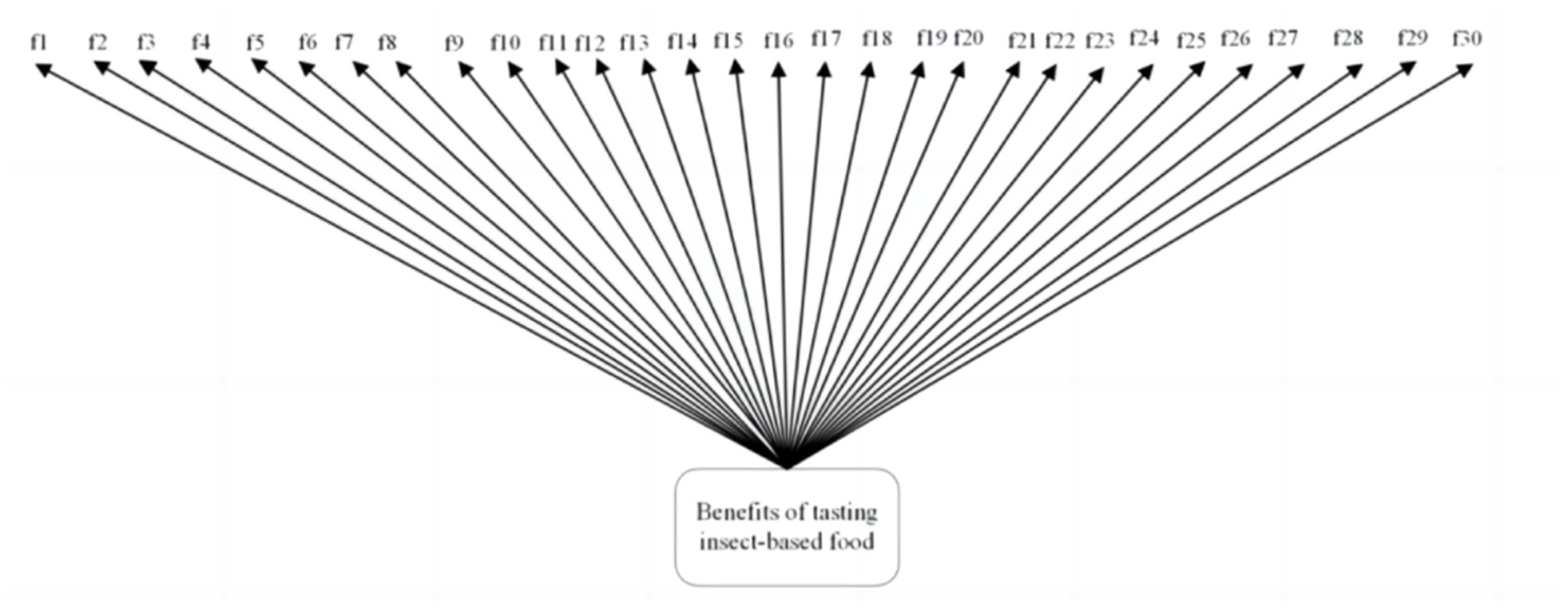
Model 1: First-order model with one factor.
Figure 3
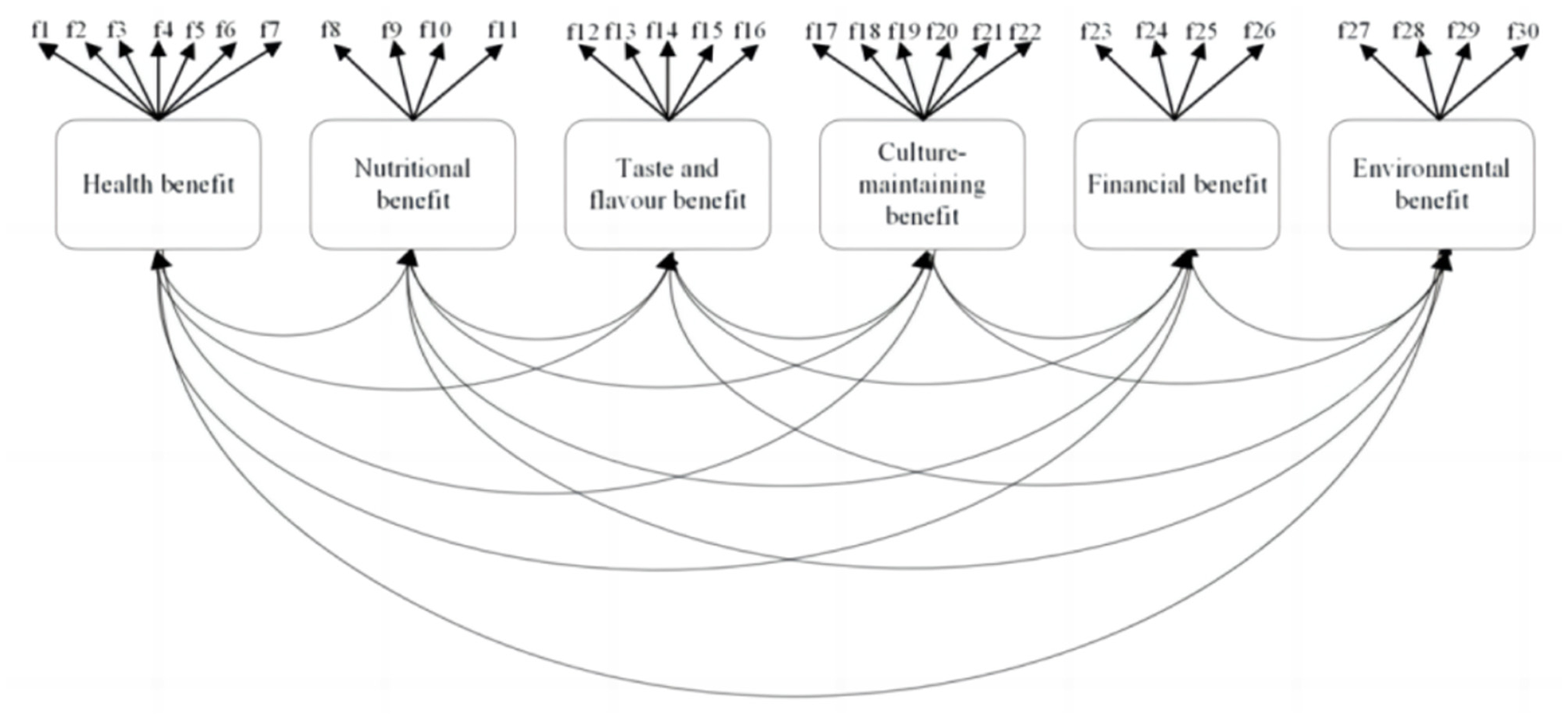
Model 2: First-order model with six factors.
Figure 4
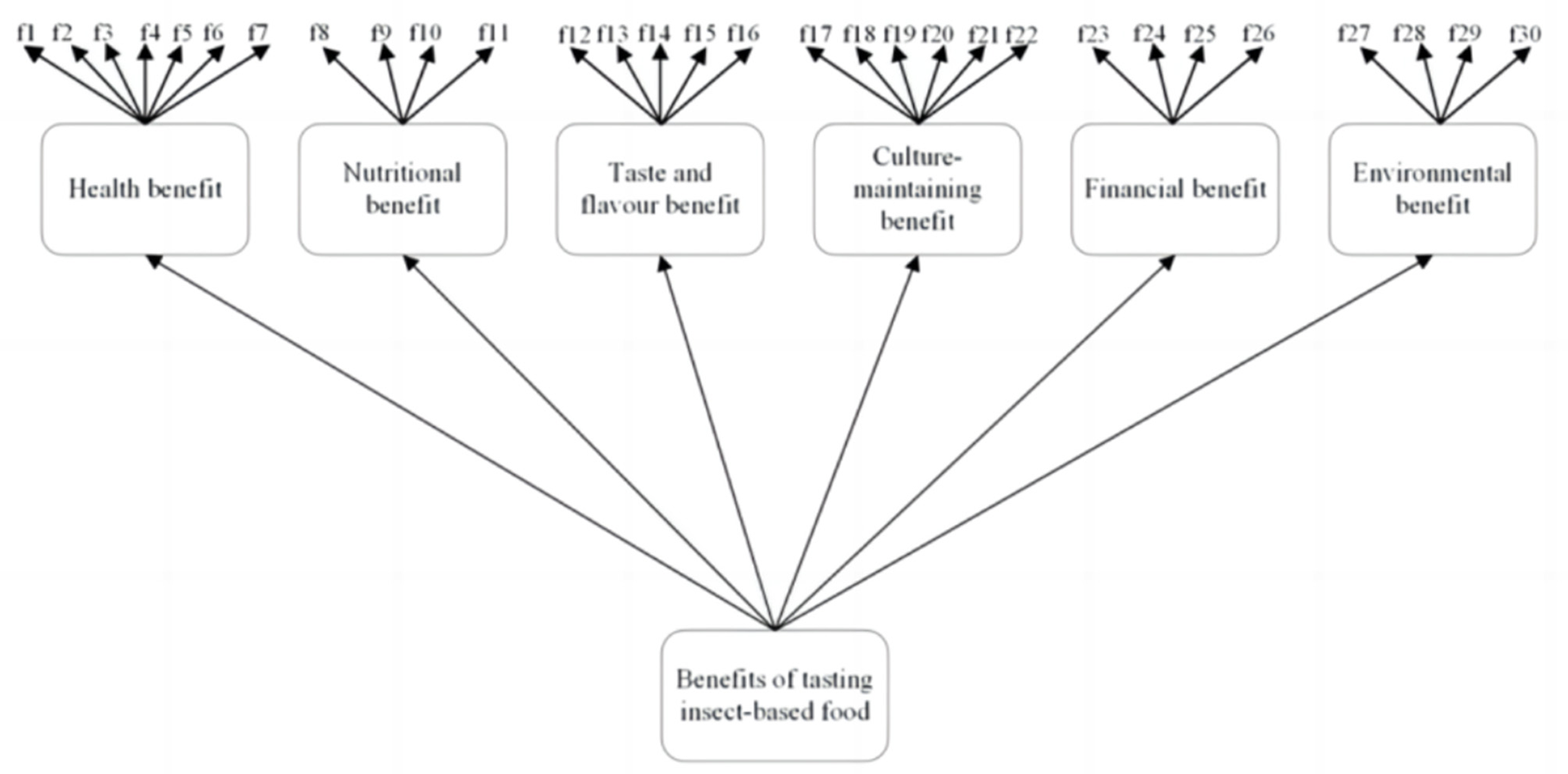
Model 3: Second-order model with five factors.
Figure 5
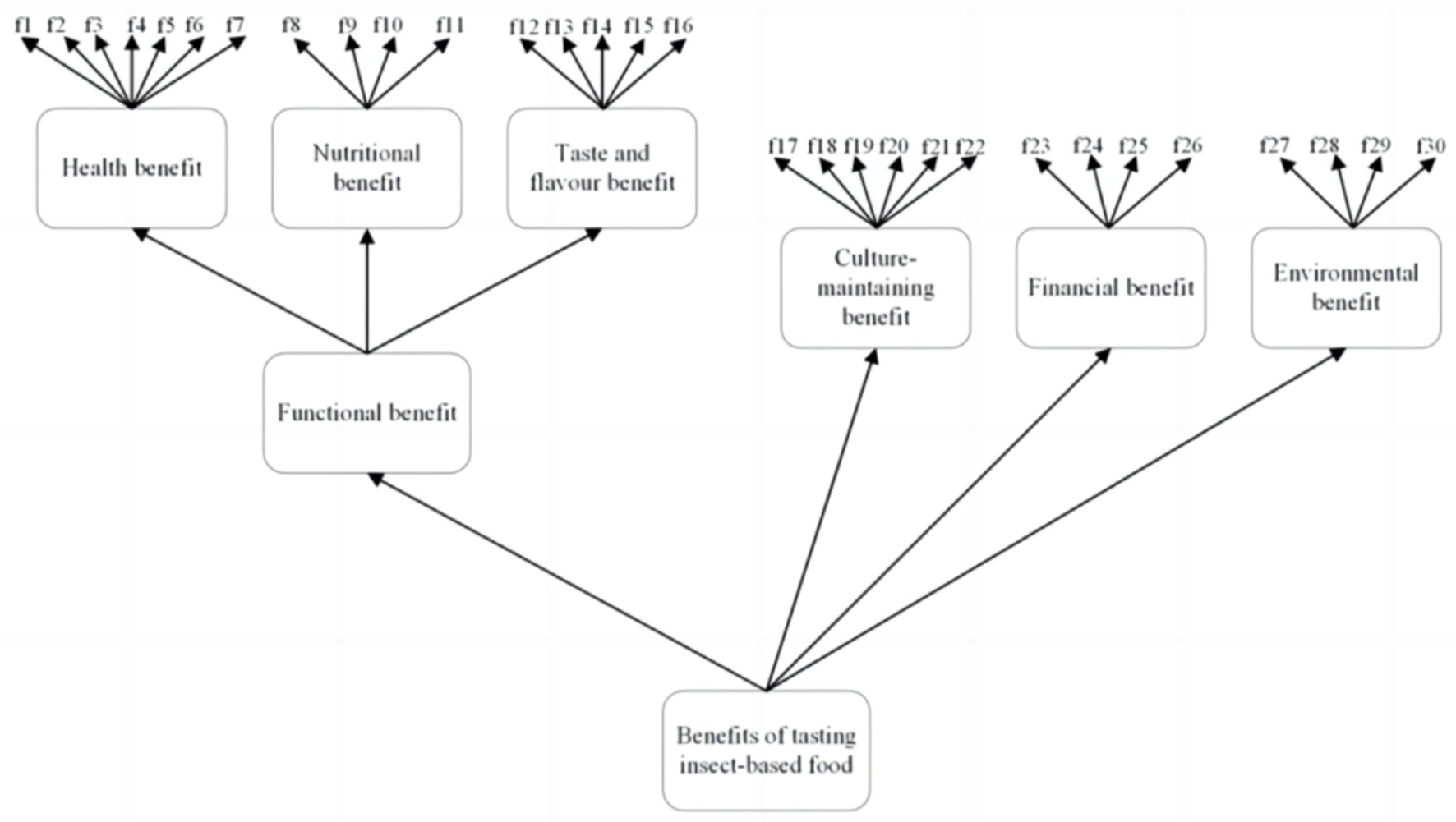
Model 4: Third-order model.
Table 6
| Goodness-of-fit indices | Measurement model | |||
|---|---|---|---|---|
| Model 1: First-order model with one factor | Model 2: First-order model with six factors | Model 3: Second-order model with six factors | Model 4: Third-order model | |
| RMSEA | 0.168 | 0.051 | 0.051 | 0.051 |
| GFI | 0.446 | 0.915 | 0.913 | 0.913 |
| CFI | 0.421 | 0.948 | 0.946 | 0.946 |
| NNFI | 0.378 | 0.942 | 0.942 | 0.942 |
| χ2 | 12,772.705 | 1,495.979 | 1,542.421 | 1,540.499 |
| df | 405 | 390 | 399 | 398 |
| χ2/df | 31.538 | 3.836 | 3.866 | 3.871 |
Model comparison for dimensionality (N = 532).
The results indicated that Model 1 exhibited the poorest fit indices in conceptualizing insect-based food consumption benefits. Models 3 and 4 demonstrated acceptable model fits across multiple model fit indices. However, Model 2 was validated as the optimal model for measuring insect-based food consumption benefits. Consequently, this study adopted the first-order model with six factors.
4.9 Measurement invariance test
To increase the robustness of the effectiveness of the measurement items, two invariance tests were conducted. First, the total sample from the data collection one and two was divided based on the last time insect-based food was consumed to account for potential differences across time. Second, the total sample was again randomly split into two groups. Table 7 displays the differences in chi-square and degrees of freedom used to assess model invariance. The results confirmed the invariance of the measurement model between the two different time datasets (Δχ2 = 28.104, p = 0.256) and between the two randomly split samples (Δχ2 = 22.217, p = 0.566), suggesting that the measurement model was acceptable in terms of structural reliability and convergent validity.
Table 7
| Fit indices | Time (Dataset 1. N = 442. Those who last consumed insect-based food in the previous 30 days; Dataset 2. N = 325. Those who last consumed insect-based food in the previous 1–2 months) | Randomly split groups ( N = 545 in first dataset;N = 544 in second dataset) | ||
|---|---|---|---|---|
| Unconstrained | Full metric invariance | Unconstrained | Full metric invariance | |
| χ2 | 1,642.979 | 1,671.083 | 1,736.841 | 1,759.058 |
| χ2/df | 2.106 | 2.078 | 2.227 | 2.188 |
| df | 780 | 804 | 780 | 804 |
| GFI | 0.874 | 0.872 | 0.903 | 0.856 |
| RMSEA | 0.038 | 0.038 | 0.034 | 0.037 |
| TLI | 0.935 | 0.937 | 0.950 | 0.943 |
| CFI | 0.942 | 0.941 | 0.955 | 0.947 |
| IFI | 0.942 | 0.942 | 0.955 | 0.947 |
| NFI | 0.895 | 0.893 | 0.921 | 0.883 |
| Δχ2 = 28.104 (p = 0.256) | Δχ2 = 22.217 (p = 0.566) | |||
Model comparison for measurement invariance test (N = 1,089).
4.10 Predictive validity
It was essential to check the predictive validity of the measurement of insect-based food consumption benefits. Thus, data collected from 1,089 customers who have eaten insect-based foods (Sample 1& 2) were used for empirical analysis. Given that existing literature supports the positive impact of food benefits on attitudes (Choi et al., 2013), food consumption (Kim and Choe, 2019), and intention behavior (Badu-Baiden et al., 2024), we conducted multiple regression analyses of insect-based food benefits on these three variables to confirm the predictive validity of the scale. Measurement items of attitudes toward tasting insect-based food were adopted from Choe and Kim's (2018) study. Items measuring the consumption value of insect-based food were derived from multiple previous studies (Chen et al., 2009; Feng et al., 2020; Hartmann et al., 2015; Kim and Choe, 2019; Looy et al., 2014; Tuccillo et al., 2020). Items specifying willingness to consume insect-based food in the future were adapted from two prior studies (Jauniskis and Michopoulou, 2021; Ruby and Rozin, 2019).
The results indicated that the VIF (variance inflation factor) was below 1.63, suggesting that there were no significant multicollinearity issues (Dattalo, 2013). As shown in Table 8, domains of insect-based food consumption benefits could effectively explain the three dependent variables according to gender, age, and education levels. R2 values ranging from 0.23 to 0.45 indicated moderately good predictivity of insect-based food consumption benefits because the domains of the insect-based food consumption benefits explained 23% to 45% of the variance of these dependent variables. Three domains, namely health, nutritional, taste and flavor, and cultural benefits, very significantly explained the three dependent variables, in line with previous studies which explored consumption benefits sought from consuming local food (Badu-Baiden et al., 2024; Choi et al., 2013; Kim and Choe, 2019; Ruby and Rozin, 2019). Interestingly, financial and environmental benefits showed no or only minor contributions to predicting some dependent variables such as attitude toward tasting insect-based food and consumption value of insect-based food, indicating new implications in the insect-based food context.
Table 8
| Independent variables | All ( N = 1,089) | Male ( N = 528) | Female ( N = 561) | Age 18-39 ( N = 81) | Age 40 above ( N = 276) | Below bachelor's degree ( N = 370) | Bachelor's degree or above ( N = 719) | |||||||
|---|---|---|---|---|---|---|---|---|---|---|---|---|---|---|
| β | t -value | β | t -value | β | t -value | β | t -value | β | t -value | β | t -value | β | t -value | |
| Dependent variable: Attitude toward tasting insect-based food | ||||||||||||||
| Health | 0.21 | 7.47*** | 0.22 | 5.72*** | 0.19 | 4.70*** | 0.22 | 6.76*** | 0.17 | 2.90** | 0.31 | 6.49*** | 0.16 | 4.67*** |
| Nutritional | 0.09 | 3.49*** | 0.08 | 2.22* | 0.12 | 2.99** | 0.08 | 2.76** | 0.14 | 2.40* | 0.15 | 3.18** | 0.06 | 1.95 |
| Taste and flavor | 0.08 | 3.07** | 0.12 | 3.35*** | 0.05 | 1.17 | 0.10 | 3.20** | 0.03 | 0.48 | 0.00 | 0.05 | 0.12 | 3.60*** |
| Cultural | 0.42 | 15.58*** | 0.46 | 12.65*** | 0.37 | 9.40*** | 0.41 | 13.31*** | 0.47 | 8.16*** | 0.34 | 7.34*** | 0.45 | 13.71*** |
| Financial | 0.02 | 0.91 | 0.01 | 0.20 | 0.04 | 1.18 | 0.05 | 1.75 | −0.07 | −1.40 | −0.05 | −1.12 | 0.06 | 1.89 |
| Environmental | 0.03 | 1.28 | −0.02 | −0.52 | 0.09 | 2.47** | 0.03 | 0.90 | 0.06 | 1.04 | 0.05 | 1.11 | 0.03 | 0.90 |
| F = 126.35 (p < 0.001) R2 = 0.41 | F = 71.89 (p < 0.001) R2 = 0.45 | F = 58.17 (p < 0.001) R2 = 0.38 | F = 90.33 (p < 0.001) R2 = 0.40 | F = 37.43 (p < 0.001) R2 = 0.44 | F = 33.12 (p < 0.001) R2 = 0.34 | F = 98.58 (p < 0.001) R2 = 0.45 | ||||||||
| Dependent variable: Consumption value of insect-based food | ||||||||||||||
| Health | 0.23 | 8.06*** | 0.22 | 5.42*** | 0.24 | 5.88*** | 0.23 | 6.87*** | 0.25 | 4.26*** | 0.27 | 5.42*** | 0.21 | 6.03*** |
| Nutritional | 0.16 | 5.65*** | 0.13 | 3.36*** | 0.18 | 4.65*** | 0.15 | 4.79*** | 0.17 | 2.98** | 0.16 | 3.37*** | 0.15 | 4.48*** |
| Taste and flavor | 0.12 | 4.26*** | 0.12 | 3.20** | 0.11 | 2.84** | 0.14 | 4.60*** | 0.00 | 0.08 | 0.10 | 2.14* | 0.11 | 3.36*** |
| Cultural | 0.25 | 9.22*** | 0.30 | 7.59*** | 0.21 | 5.41*** | 0.24 | 7.76*** | 0.33 | 5.47*** | 0.15 | 3.05** | 0.31 | 9.05*** |
| Financial | 0.09 | 3.31*** | 0.08 | 2.12* | 0.10 | 2.59* | 0.13 | 4.01*** | −0.02 | −0.47 | 0.10 | 2.00* | 0.08 | 2.49* |
| Environmental | 0.04 | 1.46 | 0.03 | 0.90 | 0.05 | 1.26 | 0.03 | 1.00 | 0.07 | 1.29 | 0.01 | 0.23 | 0.05 | 1.42 |
| F = 109.28 (p < 0.001) R2 = 0.38 | F = 52.43 (p < 0.001) R2 = 0.37 | F = 57.00 (p < 0.001) R2 = 0.38 | F = 79.83 (p < 0.001) R2 = 0.37 | F = 32.41 (p < 0.001) R2 = 0.41 | F = 22.69 (p < 0.001) R2 = 0.26 | F = 88.35 (p < 0.001) R2 = 0.42 | ||||||||
| Dependent variable: Willingness to consume insect-based food in the future | ||||||||||||||
| Health | 0.20 | 6.65*** | 0.18 | 4.18*** | 0.21 | 5.12*** | 0.23 | 6.86*** | 0.08 | 1.21 | 0.19 | 3.64*** | 0.21 | 5.57*** |
| Nutritional | 0.10 | 3.46*** | 0.09 | 2.16* | 0.11 | 2.87** | 0.09 | 2.91** | 0.11 | 1.82 | 0.12 | 2.45* | 0.09 | 2.45* |
| Taste and flavor | 0.15 | 5.18*** | 0.19 | 4.64*** | 0.10 | 2.61** | 0.17 | 5.25*** | 0.09 | 1.37 | 0.14 | 2.87** | 0.15 | 4.19*** |
| Cultural | 0.22 | 7.59*** | 0.22 | 5.26*** | 0.22 | 5.53*** | 0.21 | 6.53*** | 0.26 | 4.03*** | 0.17 | 3.48*** | 0.24 | 6.85*** |
| Financial | 0.11 | 3.85*** | 0.07 | 1.62 | 0.15 | 3.90*** | 0.10 | 3.16** | 0.12 | 2.05* | 0.14 | 2.81** | 0.09 | 2.65** |
| Environmental | 0.07 | 2.59* | 0.08 | 2.06* | 0.06 | 1.63 | 0.06 | 2.01* | 0.12 | 2.01* | 0.05 | 0.94 | 0.08 | 2.38* |
| F = 86.99 (p < 0.001) R2 = 0.32 | F = 37.92 (p < 0.001) R2 = 0.30 | F = 50.65 (p < 0.001) R2 = 0.35 | F = 66.82 (p < 0.001) R2 = 0.33 | F = 21.28 (p < 0.001) R2 = 0.31 | F = 19.73 (p < 0.001) R2 = 0.23 | F = 68.12 (p < 0.001) R2 = 0.36 | ||||||||
Effects of insect-based food consumption benefits on attitude, food consumption value, and willingness to consume (N = 1,089).
***p < 0.001, **p < 0.01, *p < 0.05.
5 Conclusion and discussion
This study attempted to develop a measurement tool for insect-based food consumption benefits and assess insect-based food diners' benefits. Through the meticulous literature review and focus group interviews, the following seven dimensions of insect-based food consumption benefits were systematically generated: energy-giving benefits, nutritional benefits, taste and flavor benefits, health benefits, cultural benefits, financial benefits, and environmental value benefits. After in-depth interviews and pre-test, 35 items according to the seven dimensions were preliminarily identified. Subsequently, a sample of Chinese customers who have eaten insect-based food was surveyed, and the measurement tool's structure was further explored through two rounds of questionnaires. The results determined that insect-based food consumption benefits consisted of six dimensions and 30 items. Since the reliability coefficients of the factors ranged from 0.87 to 0.92, the internal consistency of items in each domain was high. CFA also confirmed the measurement tool's reliability and validity. The development process of the measurement tool of insect-based food consumption benefits was scientifically rigorous and the measurement tool was based on a first-order model with six factors. Therefore, the findings of this study blazed a trail for future research on insect-based food benefits as perceived by patrons of insect-based restaurants.
Furthermore, we also elucidated how the six dimensions of insect-based food consumption benefits contribute to enhancing potential outcomes regarding attitude toward insect-based food, consumption value of insect-based food, and willingness to consume insect-based food in the future. The results indicated that the health benefits, nutritional value, taste and flavor benefits, and cultural benefits significantly enhanced customers' attitudes toward insect-based food. This implies that food business operators need to emphasize the functionality and quality of insect-based food elements, for example by showing how their sensory appeal and taste quality can elevate consumers' experiences of such cuisine (Churchward-Venne et al., 2017; Feng et al., 2020; Gravel and Doyen, 2020; Hwang and Choe, 2020). In particular, health benefits need to be promoted to diners because insect-based food contains necessary nutrients such as protein, vitamins, and minerals (Gravel and Doyen, 2020; Lee et al., 2024; Pechal et al., 2019). On the other hand, restaurant managers need to inform prospective diners that the price of insect-based food is reasonable because diners are sensitive to financial benefits (Han et al., 2017; Michel and Begho, 2023).
However, the results indicated that environmental benefit did not contribute to a positive attitude toward insect-based food or a positive perceived consumption value. This finding may be attributed to geographic and cultural differences leading to different perceptions of sustainability or pro-environmentalism (Davari et al., 2024; Nosrati et al., 2023; Williams et al., 2016). Therefore, it can be assumed that customers from different regions and cultural backgrounds perceive the environmental benefits of consuming insect-based food differently. Additionally, all six dimensions were significantly related to the willingness to consume such food, suggesting that a comprehensive understanding of the dimensions of insect-based food consumption benefits is crucial for attracting customers.
6 Implications and limitations
6.1 Theoretical implications
The results of this study contribute to the literature on promoting customer consumption in insect-based foods. Extensive research has been conducted to understand the feasibility of insect-based foods as future food sources. However, most studies (Belluco et al., 2013; Kourimská and Adámková, 2016; Rumpold and Schlüter, 2013) related to food science focus on discussing such food's nutritional value, neglecting other benefits consumers can receive from consuming such products. Also, most existing studies in the hospitality and catering industry have confirmed the potential of incorporating insect-based foods into menus (Baker et al., 2019; Jauniskis and Michopoulou, 2021). The current literature lacks clear concepts and appropriate measurements for evaluating insect-based food consumption benefits in food consumption settings. This study consolidated multiple perspectives, such as food science, consumer behavior, restaurant, and sustainability, to develop the assessment instrument of insect-based food consumption benefits. This provides a conceptual understanding of customers' perceived benefits of consuming insect-based food.
Second, due to the repulsiveness of insect-based food, previous studies in the nutrition literature have focused on identifying the impact of its health and nutritional benefits on enhancing diners' willingness to consume such food (Churchward-Venne et al., 2017; Kourimská and Adámková, 2016; Nowakowski et al., 2022; Rumpold and Schlüter, 2013). Therefore, there is a need to investigate diner's perceptions of dining places from consumer perspectives, such as cultural benefits like locality maintenance and interactions with local people via entomophagy. Our study is the first to identify that local diners' better understanding of their local food history and maintenance of their cultural identity are important consumption benefits of insect-based food. Future research should explore the potential cultural benefits of insect consumption for non-local tourists as well.
Third, diners' attitudes and behaviors such as willingness to purchase, recommendation to others, and acceptance of price are determined by food consumption benefits (Choe and Kim, 2018; Finch, 2006; Kivela and Crotts, 2006; Rousta and Jamshidi, 2020; Tsai and Wang, 2017). The results of this insect-based food study corroborate those of previous studies because the regression model explained 23% to 45% of the variance of the six domains of insect-based food consumption benefits. Possible future research topics therefore include the pricing of luxury insect-based food, the persuasive efficacy of messages emphasizing nutrition, sustainability, novelty-seeking, and cultural identity.
Fourth, the study's findings on the environmental benefits of insect-based foods offer valuable theoretical insights into consumers' perceptions of sustainability. The high mean values (5.67 to 5.73) reported by diners in relation to the environmental benefits of consuming insect-based food suggest a strong recognition of the potential contribution of insect foods to sustainability (Lange and Nakamura, 2021; Looy et al., 2014; Michel and Begho, 2023; Ordoñez-Araque and Egas-Montenegro, 2021). This finding is particularly noteworthy as it highlights consumers' growing awareness of the environmental advantages of insect consumption, which is often considered an alternative to traditional livestock farming with a lower ecological footprint. However, it is intriguing to note that environmental benefits did not significantly influence diners' attitudes toward consuming insect-based foods, their perceived value of these foods, or their willingness to consume them in the future. This discrepancy calls for further theoretical exploration to understand why environmental benefits, despite being highly valued, do not strongly correlate with key consumer outcomes. Future research should investigate potential psychological, cultural, or contextual factors that may explain the lack of a significant relationship between perceived environmental benefits and actual consumption behavior. Additionally, examining how different communication strategies about environmental sustainability might influence consumer willingness to adopt insect-based foods is an important avenue for future work.
6.2 Practical implications
One of the main challenges faced by edible insect is the lack of customer acceptance of insect-based foods. This largely stems from the unappealing appearance of edible insects and customers' concerns about consuming them (Baker et al., 2016). An effective solution is to improve customers' perceptions by promoting the benefits of insect-based foods. The measurement developed in this study can serve as a tool to assess customers' perceptions of the benefits of insect-based foods. Marketing managers in particular can use this measurement instrument to survey customers and understand their views on tasting edible insect foods. Also, by using this measurement instrument, food businesses can further enhance the appeal of insect-based foods by highlighting six key aspects: health value, nutritional content, unique taste, cultural connection, financial benefits, and environmental value. Considering the differences in regional and cultural backgrounds, marketing managers can explore specific dimensions suitable for their operations and adjust the weight of these six dimensions accordingly for optimal application.
In terms of the health benefits most valued by customers, food development practitioners need to emphasize the health and energy-giving benefits of insect-based food to shift consumer attitudes. Promotion of health benefits needs to include highlighting how insect-based food contributes to a balanced and diverse diet and offers medicinal properties, such as those recognized in traditional Chinese medicine. Second, sales can explain detailed nutritional information to customers when they purchase, and labels can display the nutritional content of each food to guide informed choices and encourage positive feedback.
Third, developing diverse cooking methods to offer different tastes and flavors is crucial. While innovative cooking techniques should be explored, popular methods like frying and roasting should be maintained. Since insect-based food is still unfamiliar to many consumers, rather than keeping the insect shape in the cooking, food practitioners can consider adding the powder form of edible insects to familiar cuisines, improving the flavor and texture. Local governments should facilitate cooperation among stakeholders to develop more appealing flavors. This can be achieved through chefs' innovative culinary techniques, culinary experts' guidelines, and food bloggers' communication strategies to promote delicious insect-based foods.
Fourth, local food distributors can educate customers about insect-based food's role in traditional ethnic cuisine, enhancing their dining experience. Insect-based food practitioners and food marketing departments can conduct creative and educational activities. For example, they can cooperate to hold culinary/research seminars to emphasize the conservation and improvement of traditional practices of insect consumption, which is important for cultural heritage. Promoting the uniqueness of local ethnic food culture or producing video clips on the history and culinary styles of insect-based food will also be effective. These efforts can improve consumers' understanding of different food preferences and cultures in various societies.
Fifth, ensuring the affordability of insect-based food is important. While some edible insects are high-value traditional Chinese medicinal materials, their prices should be managed to maintain consumer loyalty. Emphasizing the “value for money” aspect can improve attitudes, but local food distributors should also avoid overhyping the value of insect-based food to support stable consumption growth. Offering a variety of serving styles and good value meals, including cooking services for raw materials purchased at local markets, can cater to different budgets.
Sixth, the environmental benefits of insect-based food should be highlighted to attract environmentally conscious consumers. The current study shows that consumers tend to think of insect-based food as a sustainable food source for the future but do not necessarily link environmental value benefit with current attitude and consumption value of insect-based food. Therefore, it is important to emphasize to customers that consuming insect-based food can reduce poverty, promote economic development, and contribute to creating a sustainable food system now (Jackson-Davis et al., 2023). Local food distributors can emphasize sustainability when interacting with guests. Public organizations should use advertising and promotional materials to highlight how insect-based food consumption supports ecological conservation and sustainability, thus attracting and retaining eco-minded customers.
6.3 Limitations and suggestion for future research
This study has several limitations, which lead to the potential for further research. First, the development and testing of the measurement instrument were conducted in China, which means we obtained a reflection of diners' responses from only one country. However, the importance of cultural benefits can vary with the level of acceptance of entomophagy (Hartmann et al., 2015; Ramos-Elorduy, 2009; Tuccillo et al., 2020; Yen, 2009; Youssef and Spence, 2021). Therefore, future studies need to apply this instrument to diverse international diners to confirm the instrument's dimensional nature and the ability of the six domains to explain insect-based food patrons' attitudes and future consumption willingness. Second, the benefits sought from consuming local food can differ according to socio-demographic characteristics, past experiences, and psychological traits (e.g., food neophobia or food neophilia) (Badu-Baiden et al., 2024; Choe and Kim, 2024). Therefore, future research needs to adopt segmentation analysis to detect such differences. Third, there is a need to consider data collection from other regional, cultural, and religious consumer groups to confirm the generalizability and transferability of the results of this study.
Statements
Data availability statement
The raw data supporting the conclusions of this article will be made available by the authors, without undue reservation.
Author contributions
YL: Formal analysis, Methodology, Writing – original draft, Writing – review & editing. SK: Conceptualization, Investigation, Supervision, Writing – review & editing. JC: Investigation, Validation, Writing – review & editing. SW: Funding acquisition, Project administration, Resources, Writing – review & editing.
Funding
The author(s) declare that financial support was received for the research and/or publication of this article. This research was provided by the Sichuan Cuisine Development Research Institute (Project no. CC25W01), Chengdu Cultural Economy Research Center of the Chengdu Philosophy and Social Sciences Research Center (Project no. CE202409), 2024 University-Level Research Project of Sichuan Tourism University (Project no. 2024SCTUZZ10), Research Center for Technological Innovation and New Economy in the Chengdu-Chongqing Economic Circle under the project titled “Research on the Synergistic Mechanism and Measurement System of Cultural and Tourism Integration in Chengdu-Chongqing Economic Zone” (Grant Number: CYCX2025ZC47), and Research on the Synergistic Mechanism and Measurement System of Cultural and Tourism Integration in Chengdu-Chongqing Economic Zone (Grant no. CYCX2025ZC47).
Conflict of interest
The authors declare that the research was conducted in the absence of any commercial or financial relationships that could be construed as a potential conflict of interest.
Generative AI statement
The author(s) declare that no Gen AI was used in the creation of this manuscript.
Publisher’s note
All claims expressed in this article are solely those of the authors and do not necessarily represent those of their affiliated organizations, or those of the publisher, the editors and the reviewers. Any product that may be evaluated in this article, or claim that may be made by its manufacturer, is not guaranteed or endorsed by the publisher.
References
1
Aaker D. (2014). Strategic Market Management (10th ed.). Hoboken, NJ: Wiley.
2
Aertsens J. Verbeke W. Mondelaers K. Van Huylenbroeck G. (2009). Personal determinants of organic food consumption: a review. Br. Food J.111, 1140–1167. 10.1108/00070700910992961
3
Aigbedion-Atalor P. O. Fening K. O. Adeyemi A. O. Idemudia I. Ojukwu K. C. Nwobodo M. A. et al . (2024). Regenerative edible insects for food, feed, and sustainable livelihoods in Nigeria: consumption, potential and prospects. Future Foods9:100309. 10.1016/j.fufo.2024.100309
4
Ali F. Rasoolimanesh S. M. Sarstedt M. Ringle C. M. Ryu K. (2018). An assessment of the use of partial least squares structural equation modeling (PLS-SEM) in hospitality research. Int. J. Contemp. Hospit. Managem.30, 514–538. 10.1108/IJCHM-10-2016-0568
5
Ali L. Ali F. (2022). Perceived risks related to unconventional restaurants: A perspective from edible insects and live seafood restaurants. Food Control131:108471. 10.1016/j.foodcont.2021.108471
6
Badu-Baiden F. Kim S. Ahn S. W. Wong A. K. F. Agrusa J. (2024). Analysis of vegan restaurant diners' hierarchical experience structure by examining a vegan food attribute–benefit–value–intention linkage. Int. J. Hospit. Tour. Administ.25, 505–532. 10.1080/15256480.2022.2129544
7
Baker M. A. Legendre T. S. Kim Y. W. (2019). “Edible insect gastronomy,” in The Routledge Handbook of Gastronomic Tourism (London: Routledge), 412–419.
8
Baker M. A. Shin J. T. Kim Y. W. (2016). An exploration and investigation of edible insect consumption: the impacts of image and description on risk perceptions and purchase intent. Psychol. Market.33, 94–112. 10.1002/mar.20847
9
Belluco S. Losasso C. Maggioletti M. Alonzi C. C. Paoletti M. G. Ricci A. (2013). Edible insects in a food safety and nutritional perspective: a critical review. Compreh. Rev. Food Sci. Food Safety12, 296–313. 10.1111/1541-4337.12014
10
Botschen G. Thelen E. M. Pieters R. (1999). Using means-end structures for benefit segmentation: an application to services. Eur. J. Market. 33, 38–58. 10.1108/EUM0000000004491
11
Castro Delgado M. (2019). A Global Perspective on Insect-Based Foods: Willingness to Eat, Brand Equity Impact, Reasons for Not Eating and Consumer Acceptability of an Insect-Based Product.Manhattan: Kansas State University.
12
Chen X. Feng Y. Chen Z. (2009). Common edible insects and their utilization in China. Entomol. Res.39, 299–303. 10.1111/j.1748-5967.2009.00237.x
13
Chinnici G. D'Amico M. Pecorino B. (2002). A multivariate statistical analysis on the consumers of organic products. Br. Food J.104, 187–199. 10.1108/00070700210425651
14
Choe J. Y. Kim S. S. (2024). Who are food-neophobic tourists? The influence of food neophobia on tourists' local food responses. J. Foodserv. Busin. Res.2024, 1–29. 10.1080/15378020.2024.2303537
15
Choe J. Y. J. Kim S. S. (2018). Effects of tourists' local food consumption value on attitude, food destination image, and behavioral intention. Int. J. Hospital. Managem.71, 1–10. 10.1016/j.ijhm.2017.11.007
16
Choe J. Y. J. Kim S. S. (2019). Development and validation of a multidimensional tourist's local food consumption value (TLFCV) scale. Int. J. Hospital. Managem.77, 245–259. 10.1016/j.ijhm.2018.07.004
17
Choi J. Lee A. Ok C. (2013). The effects of consumers' perceived risk and benefit on attitude and behavioral intention: a study of street food. J. Travel & Tour. Market.30, 222–237. 10.1080/10548408.2013.774916
18
Choi J. Park J. Jeon H. Asperin A. E. (2021). Exploring local food consumption in restaurants through the lens of locavorism. J. Hosp. Tour. Manag.30, 982–1004. 10.1080/19368623.2021.1923608
19
Choi J. O. Hyun S. S. (2022). Development of employee silence scale in travel agencies. J. Hosp. Tour. Manag.52, 208–218. 10.1016/j.jhtm.2022.06.016
20
Churchill G. A. (1979). A paradigm for developing better measures of marketing constructs. J. Market. Res.16, 64–73. 10.1177/002224377901600110
21
Churchward-Venne T. A. Pinckaers P. J. van Loon J. J. van Loon L. J. (2017). Consideration of insects as a source of dietary protein for human consumption. Nutr. Rev.75, 1035–1045. 10.1093/nutrit/nux057
22
Clarkson C. Mirosa M. Birch J. (2018). Consumer acceptance of insects and ideal product attributes. Br. Food J.120, 2898–2911. 10.1108/BFJ-11-2017-0645
23
Collins C. M. Vaskou P. Kountouris Y. (2019). Insect food products in the western world: assessing the potential of a new ‘green'market. Ann. Entomol. Soc. Am.112, 518–528. 10.1093/aesa/saz015
24
Dattalo P. (2013). Analysis of Multiple Dependent Variables. Oxford: Oxford University Press.
25
Davari D. Nosrati S. Kim S. (2024). Do cultural and individual values influence sustainable tourism and pro-environmental behavior? Focusing on Chinese millennials. J. Travel Tour. Market.41, 559–577. 10.1080/10548408.2024.2309180
26
DeVellis R. F. Thorpe C. T. (2021). Scale Development: Theory and Applications. Thousand Oaks, CA: SAGE Publications.
27
Feng Y. Chen X. M. Zhao M. He Z. Sun L. Wang C. Y. et al . (2018). Edible insects in China: Utilization and prospects. Insect Sci.25, 184–198. 10.1111/1744-7917.12449
28
Feng Y. Zhao M. Ding W. F. Chen X. M. (2020). Overview of edible insect resources and common species utilisation in China. J. Insects Food Feed6, 13–25. 10.3920/JIFF2019.0022
29
Finch J. E. (2006). The impact of personal consumption values and beliefs on organic food purchase behavior. J. Food Prod. Market.11, 63–76. 10.1300/J038v11n04_05
30
Fornell C. Larcker D. F. (1981). Evaluating structural equation models with unobservable variables and measurement error. J. Market. Res.18, 39–50. 10.1177/002224378101800104
31
Ghosh S. Jung C. Meyer-Rochow V. B. (2018). What governs selection and acceptance of edible insect species?Edible Insects Sustain. Food Syst.2018, 331–351. 10.1007/978-3-319-74011-9_20
32
Gravel A. Doyen A. (2020). The use of edible insect proteins in food: challenges and issues related to their functional properties. Innovat. Food Sci. Emerg. Technol.59:102272. 10.1016/j.ifset.2019.102272
33
Hair J. F. Ringle C. M. Sarstedt M. (2013). Partial least squares structural equation modeling: rigorous applications, better results and higher acceptance. Long Range Plann.46, 1–12. 10.1016/j.lrp.2013.01.001
34
Hair J. F. Jr. Black W. C. Babin B. J. Anderson R. E. (2009). Multivariate Data Analysis (7th ed.). Upper Saddle River, NJ: Pearson Prentice Hall.
35
Han R. Shin J. T. Kim J. Choi Y. S. Kim Y. W. (2017). An overview of the South Korean edible insect food industry: challenges and future pricing/promotion strategies. Entomol. Res.47, 141–151. 10.1111/1748-5967.12230
36
Hartmann C. Shi J. Giusto A. Siegrist M. (2015). The psychology of eating insects: a cross-cultural comparison between Germany and China. Food Qual. Prefer.44, 148–156. 10.1016/j.foodqual.2015.04.013
37
Hazarika A. K. Kalita U. (2023). Human consumption of insects. Science379, 140–141. 10.1126/science.abp8819
38
Hooley G. J. Saunders J. A. (1993). Competitive Positioning: The Key to Marketing Strategy. New York: Prentice Hall.
39
Hwang J. Choe J. Y. (2020). How to enhance the image of edible insect restaurants: Focusing on perceived risk theory. Int. J. Hospital. Managem.87:102464. 10.1016/j.ijhm.2020.102464
40
Jackson-Davis A. White S. Kassama L. S. Coleman S. Shaw A. Mendonca A. et al . (2023). A review of regulatory standards and advances in essential oils as antimicrobials in foods. J. Food Prot.86:100025. 10.1016/j.jfp.2022.100025
41
Jankowski W. M. Przychodniak D. Gromek W. Majsiak E. Kurowski M. (2025). Edible insects as an alternative source of nutrients: benefits, risks, and the future of entomophagy in Europe—a narrative review. Foods14:270. 10.3390/foods14020270
42
Jauniskis P. Michopoulou E. (2021). Edible insects and their acceptance in Western Societies. J. Gastron. Tour.5, 51–63. 10.3727/216929720X15968961037917
43
Jongema Y. (2017). Worldwide List of Edible Insects. Wageningen: Wageningen University & Research. Available online at: https://www.wur.nl/en/research-results/chair-groups/plant-sciences/laboratory-of-entomology/edible-insects/worldwide-species-list.htm
44
Kim S. Choe J. Y. (2019). Testing an attribute-benefit-value-intention (ABVI) model of local food consumption as perceived by foreign tourists. Int. J. Contemp. Hospital. Managem.31, 123–140. 10.1108/IJCHM-10-2017-0661
45
Kivela J. Crotts J. C. (2006). Tourism and gastronomy: gastronomy's influence on how tourists experience a destination. J. Hospital. Tour. Res.30, 354–377. 10.1177/1096348006286797
46
Kourimská L. Adámková A. (2016). Nutritional and sensory quality of edible insects. NFS J.4, 22–26. 10.1016/j.nfs.2016.07.001
47
Lai A. (1995). Consumer values, product benefits and customer value: a consumption behavior approach. Adv. Consum. Res.22:381.
48
Lange K. W. Nakamura Y. (2021). Edible insects as future food: chances and challenges. J. Future Foods1, 38–46. 10.1016/j.jfutfo.2021.10.001
49
Lee Y. J. Kweon H. Jo Y. Y. Kim S. G. (2024). Insect-originated functional food: Nutritional benefits and applications. Int. J. Indust. Entomol. Biomater.48, 99–106. 10.7852/ijie.2024.48.3.99
50
Legendre T. S. Baker M. A. (2021). The gateway bug to edible insect consumption: interactions between message framing, celebrity endorsement and online social support. Int. J. Contemp. Hospital. Managem.33, 1810–1829. 10.1108/IJCHM-08-2020-0855
51
Liu Y. Kim S. (2024a). Exploring insect-based food consumption experiences and their consequences in a mature entomophagous community. Bri. Food J.126, 2686–2713. 10.1108/BFJ-09-2023-0800
52
Liu Y. J. Kim S. S. (2024b). Investigating the moderating role of utilitarian function and environmental identity in consuming insect-based food in restaurants. Int. J. Hospital. Managem.119, 103738. 10.1016/j.ijhm.2024.103738
53
Looy H. Dunkel F. V. Wood J. R. (2014). How then shall we eat? Insect-eating attitudes and sustainable foodways. Agric. Human Values31, 131–141. 10.1007/s10460-013-9450-x
54
Luo Z. (2005). “Insects as traditional food in China,” in Ecological Implications of Minilivestock: Potential of Insects, Rodents, Frogs and Snails (Boca Raton, FL: Science Publishers, Inc.), 475–480.
55
Luo Z. Y. (1997). Insects as food in China. Ecol. Food Nutr.36, 201–207. 10.1080/03670244.1997.9991515
56
Maciejewska M. Dabrowska A. Cano-Lamadrid M. (2025). Sustainable protein sources: functional analysis of tenebrio molitor hydrolysates and attitudes of consumers in Poland and Spain toward insect-based foods. Foods14:333. 10.3390/foods14020333
57
Menozzi D. Sogari G. Veneziani M. Simoni E. Mora C. (2017). Eating novel foods: an application of the Theory of Planned Behaviour to predict the consumption of an insect-based product. Food Qual. Prefer.59, 27–34. 10.1016/j.foodqual.2017.02.001
58
Michel P. Begho T. (2023). Paying for sustainable food choices: the role of environmental considerations in consumer valuation of insect-based foods. Food Qual. Prefer.106:104816. 10.1016/j.foodqual.2023.104816
59
Minton A. P. Rose R. L. (1997). The effects of environmental concern on environmentally friendly consumer behavior: an exploratory study. J. Bus. Res.40, 37–48. 10.1016/S0148-2963(96)00209-3
60
Mishyna M. Chen J. Benjamin O. (2020). Sensory attributes of edible insects and insect-based foods–Future outlooks for enhancing consumer appeal. Trends in Food Sci. Technol.95, 141–148. 10.1016/j.tifs.2019.11.016
61
Mogendi J. B. De Steur H. Gellynck X. Makokha A. (2016). Consumer evaluation of food with nutritional benefits: a systematic review and narrative synthesis. Int. J. Food Sci. Nutr.67, 355–371. 10.3109/09637486.2016.1170768
62
Nervo C. Ricci M. Torri L. (2024). Understanding consumers attitude towards insects as food: Influence of insect species on liking, emotions, sensory perception and food pairing. Food Res. Int.182:114174. 10.1016/j.foodres.2024.114174
63
Nosrati S. Kim S. S. Leung J. (2023). Moderating effects of cultural values on the relationship between individual values and pro-environmental behavior. J. Hosp. Tour. Manag.57, 158–169. 10.1016/j.jhtm.2023.10.002
64
Nowakowski A. C. Miller A. C. Miller M. E. Xiao H. Wu X. (2022). Potential health benefits of edible insects. Crit. Rev. Food Sci. Nutr.62, 3499–3508. 10.1080/10408398.2020.1867053
65
Onwezen M. C. Reinders M. J. van der Lans I. A. Sijtsema S. J. Jasiulewicz A. Guardia M. D. et al . (2012). A cross-national consumer segmentation based on food benefits: The link with consumption situations and food perceptions. Food Qual. Prefer.24, 276–286. 10.1016/j.foodqual.2011.11.002
66
Ordoñez-Araque R. Egas-Montenegro E. (2021). Edible insects: a food alternative for the sustainable development of the planet. Int. J. Gastron. Food Sci.23:100304. 10.1016/j.ijgfs.2021.100304
67
Otoo F. E. Kim S. Choi Y. (2021). Developing a multidimensional measurement scale for diaspora tourists' motivation. J. Travel Res.60, 417–433. 10.1177/0047287519899990
68
Pechal J. L. Benbow M. E. Kamng'ona A. W. Safalaoh A. Masamba K. Kang'ombe J. (2019). The need for alternative insect protein in Africa. Ann. Entomol. Soc. Am.112, 566–575. 10.1093/aesa/saz046
69
Ramos-Elorduy J. (2009). Anthropo-entomophagy: cultures, evolution and sustainability. Entomol. Res.39, 271–288. 10.1111/j.1748-5967.2009.00238.x
70
Ranga L. Panagiotou M. Noci F. Charalampidou M. Gkatzionis K. Dermiki M. (2025). Cross-cultural perspectives on insect-based foods: insights from consumers in Greece and Ireland. Foods14:490. 10.3390/foods14030490
71
Rousta A. Jamshidi D. (2020). Food tourism value: investigating the factors that influence tourists to revisit. J. Vacat. Market.26, 73–95. 10.1177/1356766719858649
72
Ruby M. B. Rozin P. (2019). Disgust, sushi consumption, and other predictors of acceptance of insects as food by Americans and Indians. Food Qual. Prefer. 74, 155–162. 10.1016/j.foodqual.2019.01.013
73
Rumpold B. A. Schlüter O. K. (2013). Nutritional composition and safety aspects of edible insects. Mol. Nutr. Food Res.57, 802–823. 10.1002/mnfr.201200735
74
Saba A. Messina F. (2003). Attitudes towards organic foods and risk/benefit perception associated with pesticides. Food Qual. Prefer.14, 637–645. 10.1016/S0950-3293(02)00188-X
75
Schiemer C. Halloran A. Jespersen K. Kaukua P. (2018). Marketing insects: superfood or solution-food?Edible Insects Sustain. Food Syst.2018, 213–236. 10.1007/978-3-319-74011-9_14
76
Spence C. Motoki K. Petit O. (2022). Factors influencing the visual deliciousness/eye-appeal of food. Food Qual. Prefer.102:104672. 10.1016/j.foodqual.2022.104672
77
Su Y. Chen J. L. Zhao M. Liao H. J. Zhao M. Du Y. Z. et al . (2023). Insects are a delicacy: exploring consumer acceptance and market demand for edible insects in China. J. Insects Food Feed9, 389–398. 10.3920/JIFF2022.0059
78
Suzuki S. Park J. (2018). Consumer evaluation of healthy, unpleasant-tasting food and the post-taste effect of positive information. Food Qual. Prefer.66, 107–110. 10.1016/j.foodqual.2018.01.006
79
Sweeney J. C. Soutar G. N. (2001). Consumer perceived value: the development of a multiple item scale. J. Retailing77, 203–220. 10.1016/S0022-4359(01)00041-0
80
Tsai C. T. S. Wang Y. C. (2017). Experiential value in branding food tourism. J. Destinat. Market. Managem.6, 56–65. 10.1016/j.jdmm.2016.02.003
81
Tuccillo F. Marino M. G. Torri L. (2020). Italian consumers' attitudes towards entomophagy: influence of human factors and properties of insects and insect-based food. Food Res. Int.137:109619. 10.1016/j.foodres.2020.109619
82
Van Huis A. (2015). Edible insects contributing to food security?Agricult. Food Secur.4, 1–9. 10.1186/s40066-015-0041-5
83
Van Huis A. Van Itterbeeck J. Klunder H. Mertens E. Halloran A. Muir G. et al . (2013). Edible Insects: Future Prospects for Food and Feed Security (No. 171).Rome: Food and agriculture organization of the United Nations.
84
Vu H. Q. Li G. Law R. Zhang Y. (2019). Exploring tourist dining preferences based on restaurant reviews. J. Travel Res.58, 149–167. 10.1177/0047287517744672
85
Williams J. P. Williams J. R. Kirabo A. Chester D. Peterson M. (2016). “Nutrient content and health benefits of insects,” in Insects as Sustainable Food Ingredients (Cambridge, MA: Academic Press), 61–84.
86
Xu L. Pan H. Lei Q. Xiao W. Peng Y. Xiao P. (2013). Insect tea, a wonderful work in the Chinese tea culture. Food Res. Int.53, 629–635. 10.1016/j.foodres.2013.01.005
87
Yen A. L. (2009). Entomophagy and insect conservation: some thoughts for digestion. J. Insect Conserv.13, 667–670. 10.1007/s10841-008-9208-8
88
Yi C. He Q. Wang L. Kuang R. (2010). The utilization of insect-resources in Chinese rural area. J. Agricult. Sci.2:146. 10.5539/jas.v2n3p146
89
Youssef J. Spence C. (2021). Introducing diners to the range of experiences in creative Mexican cuisine, including the consumption of insects. Int. J. Gastron. Food Sci.25:100371. 10.1016/j.ijgfs.2021.100371
Summary
Keywords
insect-based food, food systems, benefit, appetite, sustainability
Citation
Liu Y, Kim S, Choe JJY and Wang S (2025) Measuring the benefits of insect-based food among Chinese consumers: a mixed-method approach. Front. Sustain. Food Syst. 9:1577140. doi: 10.3389/fsufs.2025.1577140
Received
15 February 2025
Accepted
02 June 2025
Published
27 June 2025
Volume
9 - 2025
Edited by
Sebastian Elgueta, San Sebastián University, Chile
Reviewed by
Lenka Kourimska, Czech University of Life Sciences Prague, Czechia
Rocsana Bucea-Manea-Tonis, National University of Physical Education and Sport, Romania
Updates
Copyright
© 2025 Liu, Kim, Choe and Wang.
This is an open-access article distributed under the terms of the Creative Commons Attribution License (CC BY). The use, distribution or reproduction in other forums is permitted, provided the original author(s) and the copyright owner(s) are credited and that the original publication in this journal is cited, in accordance with accepted academic practice. No use, distribution or reproduction is permitted which does not comply with these terms.
*Correspondence: Yunyao Liu liuyunyao88@163.comShengpeng Wang 18321569369@163.c
Disclaimer
All claims expressed in this article are solely those of the authors and do not necessarily represent those of their affiliated organizations, or those of the publisher, the editors and the reviewers. Any product that may be evaluated in this article or claim that may be made by its manufacturer is not guaranteed or endorsed by the publisher.